




Abstract
This paper addresses despotic leadership and ideological manipulation in the workplace, and explores their detrimental consequences for employees and other stakeholders. The notion of ‘hegemonic totalism’ is advanced to account for how employees are often subordinated to the will of powerful elites. Our argument is illustrated through a case study of Theranos, a high prolife Silicon Valley biotech company that promised a revolution in healthcare diagnostics but which was declared bankrupt in 2018. Its once much-feted founding CEO, Elizabeth Holmes, has been sentenced to eleven years in prison for fraud. Analysis of empirical material on the company illustrates how business leaders may engage in despotic practices, while simultaneously invoking apparently positive ideals to enforce the performance of consent by employees. Following an exploration of the paradoxes and pathologies of hegemonic totalism, our study identifies three primary countervailing forces that act to limit its effects.
Introduction
Our paper explores how despotic leadership and ideological manipulation is combined in business organizations to achieve a heightened state of control that we characterize as ‘hegemonic totalism’. This phenomenon is situated in the context of contemporary capitalist work organizations, where organizing labour power to create a product or deliver a service involves not only ‘technique[s] of production’ but also ‘technique[s] of domination’ (Laclau & Mouffe, 1985/2001, p. 79). That is because neoliberal capitalism requires the systematic and normalized organization of labour creativity while seeking to avoid democratic determination and accountability. We argue that this is enabled inter alia by hegemonic totalism.
As we show by reference to Theranos, a biotech company that was based in Silicon Valley, numerous techniques were deployed to achieve (the performance of) compliance with the despotic demands of its two senior executives. These included the subjugation of its employees to putatively noble belief systems that, we contend, masked ignoble ends. While our focus is upon an extreme case, we suggest that elements of hegemonic totalism are present in many work organizations. ‘Hegemonic’ forms of control do not rely primarily upon naked coercion, although, ultimately, their application is underpinned by coercive means (e.g. threats of dismissal and other exercises of the ‘managerial prerogative’). Totalism points to the despotic imposition of a single, often grandiose, ideal that seeks to command employee support by attributing to the organization a sense of purpose that is benign, ennobling and/or functionally necessary (Schwartz, 1990). The nobility attributed to the corporate ends-in-view is then invoked to justify whatever despotic means – including intimidation, deception and secrecy – that are deemed necessary to accomplish performative consent. Such control is intended to be as ‘totalizing’ – pervasive and unrestricted – as that manifest in ‘total institutions’ (Goffman, 1961/1991). Architects and perpetrators of ‘hegemonic totalism’ expect it to secure their privileged positions – as consultants, employers or executives – by harnessing the agency of employees so that their productive capacities systematically create and enrich powerful elites.
We offer a case study of Theranos as a particularly compelling illustration of the dynamics of hegemonic totalism. We conjecture that, in a lesser and localized form, these are ubiquitous in contemporary work organizations. The undemocratic seeds of hegemonic totalism are increasingly immanent in the formation and reproduction of capitalist work organizations, since the neoliberal context in which they now operate seeks to suppress, disarm or discredit all countervailing forces. Accordingly, we begin by reviewing literatures relevant to hegemonic totalism, including those concerned with authoritarianism, despotism, ideology, hegemony and resistance. We then situate our theorizing in relation to Burawoy’s (1983, 1985) discussion of the historical shifts in capitalist workplaces from ‘despotic’, to ‘hegemonic’, to ‘despotic hegemonic’ regimes. Consistent with Burawoy’s analysis, our framing of the construct of hegemonic totalism is guided by a tradition of enquiry oriented primarily to enabling emancipatory change (Cornelissen, Höllerer, & Seidl, 2021; Willmott, 1997). Emancipation is conceived here as ‘the telos of resistance practices’ provoked by ‘organizational contexts of power and domination’ (Mumby, Thomas, Martí, & Seidl, 2017, p. 1161). Some salient details of Theranos’ fifteen-year history are provided before we explicate the sources of our empirical materials and our mode of their analysis. Next, we identify key elements of hegemonic totalism that we illustrate by reference to their operation at Theranos. We also explore countervailing forces that prevent the full realization of corporate despotism. In a discussion section and conclusion, we consider the implications of our analysis for future research, and for practice.
Framing Hegemonic Totalism: Authoritarianism, despotism, ideology, hegemony and resistance
Authoritarianism, which we associate with hierarchy and the opportunity it affords for despotism (e.g. ‘little Hitlerism’), strives to establish a state of widespread certainty about issues that are often uncertain. In the context of capitalist work organizations, and elsewhere, the quest for certainty and closure is in part an unintended consequence of the functional imperative to delegate. This is because, paradoxically, in the pursuit of competitive advantage, the delegation of responsibility may result in employees pursuing interests and taking actions that are counter to what senior managers deem to be the interests of the organization (Clegg, 1994). Forms of normative control (e.g. ‘paternalism’ and ‘responsible autonomy’) have been devised to mitigate this effect.
Historically, during the era of ‘market despotism’ (Burawoy, 1983), worker recalcitrance was disciplined primarily by ‘the whip of the market’. To counteract this control, labour organized, secured the right to vote and established political parties to gain some measure of protection from the naked coercion of market forces. During this ‘hegemonic’ era, the despotic inclinations of employers were mitigated by their need to coordinate the respective priorities of labour and capital through such mechanisms as collective bargaining. Management ideologues, notably Elton Mayo, facilitated this shift by commending ‘normative’ means of engineering an ethos of collaboration and/or recognition as a ‘progressive’ and ‘enlightened’ alternative to naked coercion and the inevitable resistance to which it gave rise (McCabe, Ciuk, & Gilbert, 2020; Mumby et al., 2017).
Burawoy (1983, p. 602) terms the most recent phase of capitalist development ‘hegemonic despotism’, in which capital, embodied in the fallible agency of corporate executives, has engaged in ‘push back’ against the restrictions placed upon its ‘autonomous’ exercise of managerial prerogatives and removed restrictions on its mobility and reach. In the era of ‘hegemonic despotism’, labour rather than capital is obliged to make ‘concessions’ (Burawoy, 1983, pp. 602–603). The focus is less the ‘whipping’ of the individual worker by the market, although that remains (e.g. with zero-hours contracts), than the eroding of the rights and power of ‘the collective labourer’ (Burawoy, 1983, p. 603, italics omitted). Many work organizations develop an increasingly ‘despotic face’ so that employees ‘feel their collective impotence’ but may also, according to Burawoy (1983), perceive ‘the irreconcilability of their interests with the development of capitalism’ (p. 603). However, Burawoy’s conjecture presumes that interests (or priorities) are materially self-evident, rather than socially identified. It therefore risks underplaying the capacity of sophisticated normative means of control to shape processes of ‘interest’ or ‘priority’ identification and associated means of conflict resolution.
Normative means of control are made possible by the exceptional ‘world-openness’ (Berger & Luckmann, 1967) of human nature. As well as being a condition of creativity, this openness is a source of ontological insecurity that renders human beings amenable to ‘construction’ and ‘possession’ by others, notably elites who promote and reward notions of ‘appropriateness’ (e.g. through branding and training) that they deem to be congruent with their priorities (Alvesson & Willmott, 2002). In corporate contexts, the prospect of security may be offered to employees through an invitation to subscribe to, or at least comply with, a favoured ideal (Schwartz, 1990). This kind of normative control is facilitated by employees’ willing or grudging ‘participat[ion] in their own subordination through socially constructing their identities, knowledge and institutions’ (Putnam & Boys, 2006, p. 557, emphasis added; see also Gramsci, 1971; Mumby, 1997). Employees then strive to perform and reproduce those ‘identities, etc.’, and so contribute to perpetuating established structures of advantage. Yet, at the same time, the multiple realities engendered by ‘world openness’ (Berger & Luckmann, 1967) foster expressions of difference and associated acts of resistance (Collinson, 1994; Gagnon & Collinson, 2017), such as the withdrawal of labour and engagement in whistleblowing (Ezzamel, Willmott, & Worthington, 2001; Kenny, 2019; Kenny & Fotaki, 2023).
In the contemporary era, the iron fist of authoritarianism is masked, imperfectly, by the velvet glove of ideology. Ideology is often viewed as ‘the underlying cognitive assumptions of belief, or the total structure of the mind including the conceptual apparatus’ (Hamilton, 1987, p. 20). Popular management writers, ever alert to the appeal of normative controls, have long recognized its appeal in the form of corporate ‘populism’. For example, Collins and Porras (1996, p. 66) claim that a ‘core ideology’ provides ‘the glue that holds an organization together as it grows, decentralises, diversifies’. Elites may thus favour establishing a ‘core ideology’ that expresses some higher moral purpose, and requires employees to express devotion, or at least enact a sufficiently compliant performance of devotion, to the vaunted ideal. Here our focus is upon how ideals encoded in ‘core ideology’ may readily justify insidiously oppressive management practices by institutionalizing a single, uniform definition of reality that seeks to regulate employee behaviour, feelings and attitudes.
However, capitalist work organizations are rarely, if ever, ‘total institutions’ (Goffman, 1961/1991; see also Shankar, 1996). Except in closed worlds where a single ideology can be all-encompassing, ‘core ideology’ is vulnerable to challenge and resistance (Willmott, 1993, 2013). Since ‘consent’ is seldom unconditional or universal in workplaces, ideals meet with resistance when they encounter employees’ alternative conceptions of what may be deemed ‘the appropriate individual’ (Alvesson & Willmott, 2002). Even though control of employees can be pervasive, and extend beyond ‘official’ working hours, organizational ideals typically compete with multiple other sources of influence and associated ideals with which employees identify. Employees are not necessarily willing to abandon these extra-corporate ideals when at work. However, their capacity to resist forms of domination will depend, as Laclau and Mouffe (1985/2001, p. 85) note, upon ‘the position they occupy within the ensemble of social relations, and not only in those of production’. One possible expression of employees’ multiple, often intersectional, ‘positionings’ within this ‘ensemble’ is counter-hegemonic behaviour, including overt resistance (e.g. sabotage, collective work-to-rule, whistleblowing, etc.).
Ideologies: encompassing and segmented
Theorizing the issue of normative control, we distinguish segmented ideologies associated with multiple positionings from encompassing ideologies which strive to colonize and dissolve this multiplicity. Encompassing ideology is characterized by its intent to replace and/or infuse the ideologies of all other institutions (e.g. family, civil society, etc.). To this end, it ‘call[s] to mind things that are not in normal evidence, not directly viewable by the senses, not in the circumference of the immediate – they make reference to things not “at hand”’ (Gouldner, 1976, p. 24). For example, when considering the era of ‘post-totalitarianism’ in his native Czechoslovakia, Havel (1978/2015, p. 25) comments on the ‘hypnotic charm’ of encompassing ideology as follows: ‘All one has to do is accept it, and suddenly everything becomes clear. . . all mysteries, unanswered questions, anxiety, and loneliness vanish.’ In workplaces, ‘things not “at hand”’ (Gouldner, 1976, p. 24) include ostensibly sublime or ennobling ideals that gain consent, or permit willful blindness, to what otherwise might to called out as problematical – such as the experience of bullying and intrusive surveillance. Investment in an encompassing ideology provides an antidote to the ontological insecurity arising from ‘world openness’.
Communism or Stalinism, for example, offered an encompassing ‘scientific’ view of the world that claimed to be applicable to all forms of human activity across time and space (Kolakowski, 2005). As a form of intellectual imperialism, and in common with the contemporary pervasiveness of market-centric neo-liberalism, 1 its seeming omniscience and intended omnipresence had irresistible appeal among true believers in its ostensibly lofty, crusading mission (Arendt, 1978). It enabled what Gramsci (1971), writing about consciousness under capitalism, called ‘hegemony’, in which we have ‘a system of dominant ideas that receive consent from the relatively powerless or subaltern groups’ (Haugaard, 2010, p. 239). Insofar as conviction fosters an inner tranquillity associated with certitude, it may also generate an inordinate level of zeal and protectiveness (see Koestler, 1949, for a particularly compelling account). The ultimate price paid for subordination to such ideology, Havel (1978/2015, p. 25) conjectures, is ‘abdication of one’s own reason, conscience, and responsibility’.
Segmented ideologies, in contrast, are associated with the time-space limitations of particular institutions, and so both accommodate and compete with other, comparably embedded ideologies. Unlike the imperialistic ambitions of encompassing ideology, segmented ideologies are rooted in diverse and specific institutions, including the family, civil society, religion, education and work organizations. They are a source of the ‘cracks that permeate corporate rationality, which managerialism cannot eliminate’ (McCabe et al., 2020, p. 955; see also Ybema & Horvers, 2017). Values drawn from other spheres (e.g. family, religions) may place in question the legitimacy of corporate ideals that demand, justify, mask and/or normalize oppressive work practices. Those practices include work intensification, discrimination, tight and extensive surveillance, excessive secrecy, minimal accountability, deferential or unethical behaviour, and much more (Caprar, Walker, & Ashforth, 2022). Employees may then experience, and endeavour to resolve, their experience of ‘cognitive dissonance’ (Festinger, 1957) – between, for example, the sublime vision projected by elites and the indignities associated with their pressured working lives – by giving voice to their grievances (e.g. by withdrawing their labour or by whistleblowing) (Parker, 2014).
Even when executives regard themselves as benevolent actors who need not fear employee disaffection, they may still strive to establish an encompassing corporate ideology capable of releasing ‘communal fantasies of purpose, growth and belonging’ (Resch, Hoyer, & Steyaert, 2021, p. 1; see also Kets de Vries, 2006). Attempts by powerful elites to impose ideals on others are examples of ‘symbolic violence’ (Bourdieu & Passeron, 1990). When this violence meets with resistance from employees who identify more strongly with other ideals, the response may be to double down by amplifying the corporate ideals and ensuring adherence to them, a response that is rationalized by reference to those very ideals (Arendt, 1978). 2
Hegemonic totalism is a response to the recalcitrance associated with segmented ideology. Typically, it relies upon what, seemingly, are unassailable totems – such as a ‘cult of personality’ revolving around an ostensibly exceptional CEO; the extraordinary talents attributed to a venerated inner circle; and/or the ‘magic’ ascribed to a brand. When successfully enacted, the certainty offered by hegemonic totalism is complementary to the ‘game playing’ that, Burawoy (2012, p. 193) contends, ‘counters ennui and arduousness’ (Burawoy, 2012, p. 193). Both stratagems seek to subordinate the interests of labour to those of capital. But whereas employee game-playing is an expression of creative, if self-defeating, adjustment to deadening and degrading working conditions, hegemonic totalism is primarily an expression of elite manipulation. Nevertheless, many ‘loyal’ employees passively accommodate themselves to its operation, while many others become actively complicit. Each stratagem maintains the status quo of exploitation by normalizing the relations of domination through which the power of elites is enacted. The effectiveness of these approaches is, however, placed in jeopardy by the everyday enactment of segmented ideologies that such stratagems are intended to disarm.
Informed by our consideration of the connections between authoritarianism, despotism, ideology and hegemony, we seek to shed light on two key research questions: How does the exercise of normative control complement and contradict coercion? (e.g. within Theranos); and, more specifically, What are the elements, dynamics and wider implications of hegemonic totalism in capitalist work organizations? Addressing these questions requires a close consideration of the agency of Elizabeth Holmes (CEO) and Sunny Balwani (President and COO), the two most senior executives at Theranos. A focus on leaders risks attributing hegemonic despotism to their personalities. This risk is mitigated by taking account of the conditions of possibility of establishing Theranos as well as its survival for over a decade.
Our analysis offers a corrective to the vast literature on what has been termed ‘the romance of leadership’, building on the foundational work of Meindl, Ehrlich and Dukerich (1985). This challenges the tendency to over-attribute responsibility for organizational success or failure to the agency of individual leaders. While broadly sympathetic to this work, we nevertheless underscore the importance of taking full account of the conditions of possibility of leader behaviour while seeking not to understate leader agency, particularly when it is geared to the entrenchment of autocratic power. In addition to examining how it was possible for autocratic agency to be exercised at Theranos for an extended period, we take account of how countervailing forces emerged to discredit the claims made by its most senior executives, and so brought about its collapse. Overall, the intended contribution of our study is to identify the operating features of hegemonic totalism in contemporary workplaces in a manner that may be of value to practitioners, as well as researchers, for analysing its dynamics and facilitating their removal.
Methods and Context
Our case ‘investigates a contemporary phenomenon in depth and within its real-life context’ (Yin, 2009, p. 18). A wealth of publicly available data is examined to theorize the key elements and dynamics of hegemonic totalism, as exemplified by how Theranos was established, organized and collapsed. We readily acknowledge Theranos to be an extreme case (Eisenhardt, 1989; Flyvbjerg, 2006) that enables us to render despotic leadership and ideological manipulation more intelligible, and thereby contribute to a body of knowledge that is intended to ‘unveil the black box of how organizations concentrate and wield power’ (Chen, 2016, p. 35).
Situating Theranos
Theranos was a US-based, privately held, health technology company that employed over 800 people at its peak. The company was founded in 2003 by the then 19-year-old Elizabeth Holmes, its first and only CEO, who had dropped out of her studies of chemical engineering at Stanford University to realize her vision of developing a revolutionary health product. 3 The ‘Edison’ device, later renamed ‘miniLab’, was intended to administer and analyse hundreds of tests on very small blood samples obtained by a thumb pinprick.
Holmes was ignorant of the biochemical challenges posed in engineering such a device. Nonetheless, her plans to create the revolutionary product and bring it to market were uncritically amplified by the media and accepted by investors (Parloff, 2014, 2015). Her family contacts enabled her to recruit a board of directors populated by many well-known names, including William Perry (former Secretary of Defense), Henry Kissinger (former Secretary of State), Sam Nunn (former US Senator), and former Secretary of State, George Shultz. Their presence helped Holmes to raise more than US$700 million from a number of venture capitalists as well as private investors such as Oracle’s Larry Ellison and Rupert Murdoch, the media mogul, who personally invested $125 million. At its height, the company had a valuation of $10 billion.
The demise of Theranos in 2018 followed an investigation by the Wall Street Journal (coincidentally owned by Murdoch) in 2015. The WSJ revealed that no peer-reviewed work had ever been published that validated the claims made about the company’s revolutionary technology, many of which were questioned by expert commentators (Cristea, Cahan, & Ioannidis, 2019; Diamandis, 2015). The initial WSJ report published in October 2015 contained reference to compromising revelations from Theranos employees. 4 These claimed that the blood tests Theranos ran were in fact mostly carried out using technology bought from other companies (Bilton, 2016, 2019). Following the publication of the WSJ article, the company then came under sustained scrutiny from various quarters – medical authorities, investors, the Securities and Exchange Commission (SEC), former business partners as well as patients, and an increasingly sceptical media. In 2016, the Journal of Clinical Investigation published the only independent study of Theranos tests which revealed that they were outside the normal range almost two times more frequently than standard tests, and so could be harmful to patients (Kidd et al., 2016). The company lingered on in an increasingly sickly state until it was formally wound up in 2018. 5 In January 2022, Holmes was convicted on four charges of fraud, and was eventually sentenced to eleven years in prison. Her most senior executive, Sunny Balwani, was convicted on similar charges in July 2022, and sentenced to thirteen years in prison. A central intrigue, or mystery (Alvesson & Kärreman, 2007), of the Theranos case is this: what practices – of leading, managing and organizing – made possible the very establishment, operation and growth of Theranos from 2003 to 2015, when it never had a product that worked?
Procedures and data analysis
Data collected for case study research varies enormously and may include archival research, interviews, document analysis, and so on (Buchanan, 2012). Our sources are listed in Appendix 1. We also draw upon a notable insider account from Tyler Shultz (2020) who released a 3.5-hour podcast detailing his experiences as an employee of Theranos, as well as a joint interview/presentation by Shultz and another ex-employee and fellow whistle-blower, Erika Cheung, given at Stanford Business School on 14 January 2019 (Spilling the Blood, 2019).
Our selection of Theranos as a case study was guided by what Alvesson and Sandberg (2022) refer to as ‘pre-understandings’ coupled with a long-established curiosity about the ‘phenomena of interest’ – e.g. ‘despotic leadership’ and ‘corporate culturalism’ – that we attribute to the operation of the company. Interrogating the phenomena involved ‘a dialogical conversation with data and theory, in which they [data and theory] provoke each other in ways that “open up” and bring the phenomenon at issue into view’ (Alvesson & Sandberg, 2022, p. 401). All data sources are of course partial by virtue of the contingency of their processes of construction as well as their selection and interpretation. But what is remarkable about the available accounts of Theranos is their consistency. Nonetheless, the act of bringing ‘the phenomenon at issue into view’ is not a matter of faithfully representing the Theranos phenomenon. Instead, it has required our best efforts to makes sense of what we term ‘hegemonic totalism’ based upon our critical scrutiny, as well as our mobilization, of pre-understandings and theoretical proclivities.
Accordingly, our ‘dialogical conversation’ was conducted through thematic analysis that involves ‘identifying, analyzing, and reporting patterns (themes) within data’ (Braun & Clarke, 2006, p. 6), again on the basis of our restrictive but also enabling orientation to the data. The ‘conversation’ involved what Lee (1999, p. 49) describes as ‘selective coding’ – that is, we began with, and added, categories that reflected both our pre-understandings (e.g. of despotism), and those relevant to the research questions that guided our study. These categories initially included: surveillance; resistance (or its absence); management practices consistent with hubris; the compliance or otherwise of the board. We then interrogated our empirical material in a back-and-forth analysis between our starting assumptions and our sources. Fresh categories were generated during this process, such as the presence of conformist rituals and attempts to craft a corporate ideology. Their comprehension involved the repeated and reflexive reconstruction of our initial understandings (see Hibbert, 2021; Mees-Buss, Welch, & Piekkari, 2022). When (re)interrogating the data sources, we paid particular attention to stories, events and incidents that dealt with how Theranos was organized, the leadership of its two most senior executives, and episodes in which management practices were employed to establish and maintain control. Many of these episodes could be described as ‘critical incidents’ (Bott & Tourish, 2016), that is, they apparently had a particular salience for the actors involved.
As we repeatedly interrogated the empirical materials, we sought to abstract and assemble them as integral parts of the whole. The main elements and dynamics that, we conjecture, comprise the phenomenon of hegemonic totalism are identified and connected in Figure 1.
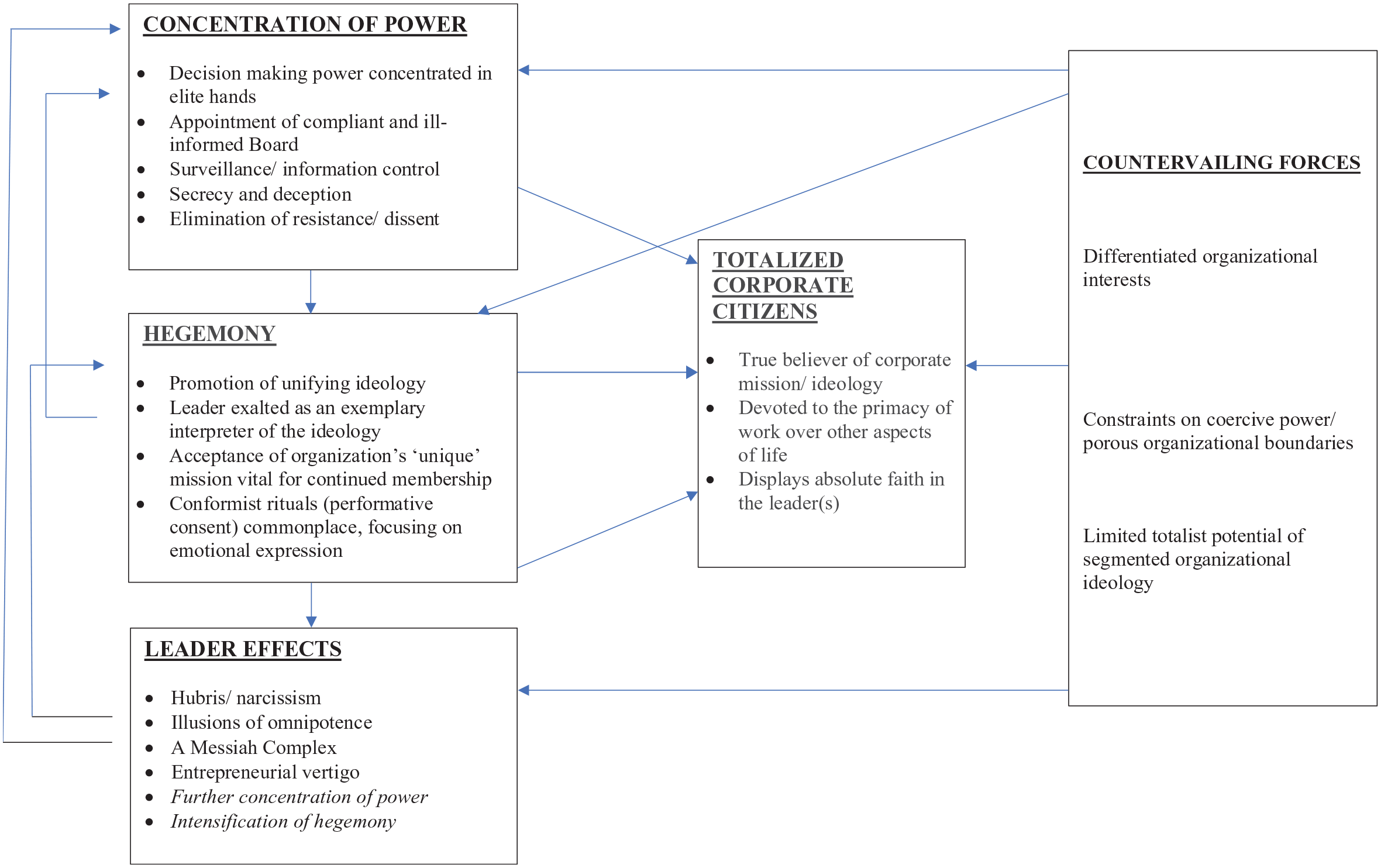
A theory of hegemonic totalism.
Hegemonic Totalism within Theranos
As shown in Figure 1, a concentration of power is combined with a project of building hegemony based on the promotion of a unifying ideology that demands willing compliance. Set against this, we identify pervasive countervailing forces that, in a corporate context, blunt the realization of a totalizing agenda. Unless otherwise specified, incidents and management practices detailed are derived from Carreyrou (2018), twice a Pulitzer Prize winner, and who was the investigative journalist at the Wall Street Journal who first broke the Theranos story.
Totalized corporate citizens
At the centre of Figure 1, we place the ‘ideal’ figure of the ‘totalized corporate citizen’. That is because the primary condition of possibility of hegemonic totalism is actors who, unconditionally or calculatingly, subscribe to the corporate mission. In their ‘ideal’ form, they are ‘true believers’. This dedication involves more than a coercive exercise of ‘the whip of the market’ or the application of ‘the arbitrary tyranny of the overseer’ (Burawoy, 1985, p. 150; Ashworth, 1994). It reflects a cult-like ambition on the part of powerful elites to ‘totalize’ the emotions, behaviours and beliefs of employees, and so transform them into pliable corporate citizens (Lifton, 1961). In this process, tentative conjectures about the world are translated into sacred convictions that depend on the word of hallowed authorities for their validation. In principle, the potency of such convictions discredits counter-hegemonic claims that convey ‘inconvenient truths’. 6 Life becomes subsumed to the dedicated realization of the organizational ideal, as employees are transformed into little more than a means of production (Hanlon, 2017). In practice, however, countervailing forces animated by employees’ investment in segmented ideologies may emerge that question the value of ideals and the veracity of claims promoted by elites. Despite the presence of such constraints, our analysis identifies a number of processes whereby Holmes and Balwani sought to create totalized corporate citizens. At their core, these relate to how they exercised power, while seeking to reduce any constraints on their authority. We illustrate these practices in the analysis that follows.
The concentration of power
A compliant, ill-informed board
Corporate boards are supposed to offer appropriate expertise, oversight and feedback on key proposals and decisions sufficient to challenge the actions and proposals of executives (Petra, 2005). However, as we have noted, most board members lacked any expertise in biotech or start-ups (Ritholtz, 2018). This, combined with Holmes’ ownership of 99.7% of the company’s voting shares made her position unassailable. By forcing out anyone who still asked critical questions, Holmes (and Balwani) exercised extensive control over the company’s operations with minimal accountability.
Holmes also cultivated a persona modelled on Steve Jobs that may have impressed and disarmed (elderly male) board members. The Jobs image (see Sharma & Grant, 2011) reinforced the promise of Theranos as emblematic of Silicon Valley. There was a conviction that great wealth, as well as kudos, were within the grasp of a few exceptional people, including prescient or at least well-connected investors, who were capable of recognizing Holmes’ exceptional talent, and so believed that her device would revolutionize healthcare. As one of the faithful described his reasoning: ‘It was the opportunity to join the rocket ship’ (The Dropout, Part 2, 2019). Impressed by such prospects, employees as well as board members and other investors, regulators and media commentators were averse to detecting a vital difference: Apple’s products worked while Theranos’ did not.
Surveillance and information control
When employees conceive of themselves as agents of human capital accumulation, they ‘become complicit in dissolve[ing] the boundaries between work and non-work’ (Fleming, 2014, p. 99). Such devotional subordination typically requires the propagation of noble goals by elites who are the primary beneficiaries of this deception. A culture of righteous self-sacrifice then takes root, involving corporeal self-neglect that is fuelled by ‘cycles of extreme commitment where the sense of urgency dictates everyday life’ (Rahmouni Elidrissi & Courpasson, 2021, p. 44).
At Theranos, ‘extreme commitment’ was enforced through intense surveillance. Balwani undertook a daily inspection of the security logs to determine when employees had checked in and out. Security cameras were omnipresent, and the dark colours on their surface ensured that no one knew whether they were pointing in their direction or not. An alarm sounded if more than one person tried to enter lab rooms at the same time. Multiple security guards were posted at Theranos’ entrance and inside the building. Employees had to sign nondisclosure agreements even before they were interviewed for employment (Spilling the Blood, 2019).
Such surveillance promotes Benthamite ‘self-monitoring, resulting in the gaze of the supervisor being enacted by the employees themselves’ (Fleming & Spicer, 2014, p. 245; see also Iedema & Rhodes, 2010). Stress was endemic, with the company’s senior scientist, Ian Gibbons, committing suicide in 2013, on the eve of testifying in a patent dispute involving Theranos (HBO Documentary, 2019). It is perhaps tempting to exaggerate the totalizing influence of such self-censoring dynamics, and to minimize the space remaining for resistance (Sanson & Courpasson, 2022; Sewell & Barker, 2006). Yet, there was an ideal of ever greater self-control, deemed necessary to minimize deviation from realizing the corporate ideal (Auletta, 2014). This control produced a simulacrum of agreement with a mission and agenda ordained from the top. For many Theranos employees, their coerced complicity was experienced as unforced consent. As Erika Cheun, the whistleblower, recalled, she, along with other Theranos employees ‘fell in love with the vision of Theranos. I was super sold on the vision, totally drank the Kool-Aid’ (Spilling the Blood, 2019). 7
However, the use of surveillance to limit dissent suggests that the full internalization of the corporate ideology was not obtained. Had everyone been as fully committed to the corporate vision as they were compelled to claim they were, such controls would have been unnecessary. Of course, it is not possible to determine how many of Theranos’ employees were true, aspiring or fake believers. But it is evident that those who worked on building the miniLab were more directly exposed to mundane indicators relevant to appraising claims about its advanced development, or even its feasibility. Tyler Shultz refers to ‘two entirely different worlds’: ‘in the carpeted world Elizabeth [Holmes] was a goddess’. But, in the tiled world where he was based, ‘nothing works. We’re on a sinking ship. Everything is a lie’ (HBO Documentary, 2019). Such insider knowledge and, more specifically, a capacity to recognize rather than reinterpret such indicators of deception was a significant countervailing force, among others, that we elaborate upon below.
Secrecy and deception
Secretiveness as well as deception were normalized within Theranos. In a presentation for two potential investors, data were shown which appeared to demonstrate that results delivered by Theranos’ revolutionary product had the same level of accuracy as those obtained from conventional machines. In reality, Theranos had purchased commercial blood analysers to obtain the results concerned, and pretended that these were generated by the miniLab. Investors were also shown financial projections ten times greater than Theranos’ own internal forecasts (Cold Fusion, 2019). Holmes and Balwani were adept at producing ‘alternative facts’ before Kellyanne Conway, senior counselor to President Trump, voiced the meme.
Elimination of resistance/dissent
Despotic leadership is characterized by attempts to quash any flow of information upwards that is critical in nature (Stein, 2008). Consistent with this, hegemonic totalism at Theranos was perhaps most evident in the speed at which people suspected of ‘thought crimes’ (Orwell, 1949) were fired. Querying the efficacy of its technology was the ultimate thought crime. In the gallows humour of employees, staff sacked for failing to demonstrate unwavering loyalty to Holmes or Balwani were ‘the disappeared’. It was terminology which, as Carreyrou (2018, p. 77) notes, conjured ‘up images of a Mafia hit in 1970s Brooklyn’. The threatening presence of high-powered lawyers hired by Theranos further dissuaded doubters from becoming active dissenters. If suspected of whistleblowing, former employees were ordered to desist, with the threat that ‘Theranos will consider all appropriate remedies, including filing suit against you’. 8 In line with research into whistleblowing (Kenny & Fotaki, 2023), the intention was to make it clear to all would-be dissidents that they would be faced with incalculable losses and pain if they revealed their concerns publicly. However, while the suppression of dissent by physical surveillance and intimidation was regarded as a necessity, it was evidently not regarded as sufficient. Holmes and Balwani became increasingly set upon establishing a fully hegemonic internal regime.
Hegemony
The pursuit of hegemony offers a seemingly civilized and benign means of reconciling the often divergent priorities of capital and labour (Laine & Vaara, 2007). Accordingly, Theranos’ ‘hegemonic regime’ with a ‘despotic face’ (Burawoy, 1983, p. 603) was masked by frequent assertions of a noble corporate purpose that sought to acquire the standing of an encompassing ideology.
Promotion of unifying ideology
Popular management writers have often made grandiose claims for the power of corporate ideologies. For example, Collins and Porras (1996, p. 66) characterized them as ‘analogous to the principles of Judaism that held the Jewish people together for centuries without a homeland, even as they spread throughout the Diaspora’. In reality, it is difficult to imagine how any corporate ideology could have equivalent breadth and depth to those of a major world religion. Instead, a rhetoric of higher aims – conveyed by such organizational ideals as changing the world, eradicating poverty, achieving peace, or (in the case of Theranos) transforming the health of the world’s population – may do little more than mystify and mask venal and/or self-aggrandizing ends such as the promotion of shareholder value.
Such obfuscation aligns with the increasingly popular view that businesses must be organized around a core sense of purpose in order to promote ‘not only better social outcomes but also enhanced functioning of firms and markets’ (Mayer, 2021, p. 1). Invoking the fantasy of an underlying unitarism, this proposition ‘consent-washes’ the endemic conflicts associated with the systemic exploitation and domination of labour (see Degiuli & Kollmeyer, 2007) Such gambits tacitly endorse shareholder value maximization while simultaneously harbouring the fantasy that they do not (Davis, 2021). How did these dynamics manifest themselves at Theranos?
Following a number of resignations, voluntary as well as forced, Holmes convened a staff meeting in 2014 at which she announced ‘that she was building a religion. If there were any among them who didn’t believe, they should leave’ (Carreyrou, 2018, p. 173). This messianic message was reinforced by Balwani who declared that Theranos’ blood testing technology would have the same impact on public health as antibiotics, and emphasized how the company was working ‘to build something that we think is magical’ (The Dropout, Part 4, 2019). A year later, Holmes was identified by the New York Times as one of its ‘five visionary tech entrepreneurs who are changing the world’. 9 Being part of the ‘magic’ of Theranos was presented as a unique opportunity for its staff to renew their commitment and redouble their efforts as participants in the establishment of a world-changing venture that, of course, was also destined to enhance their vitae and future careers.
Holmes and Balwani were attempting to create a belief system that would have a totalizing influence despite, or because of, the absence of the material artifact – the miniLab – upon which the system of belief ultimately depended. Of course, for employees and others who invested in Holmes’ vision, acknowledgement of the ‘yawning abyss’ (Hallonsten, 2022) between the official ideology promoted by elites and the reality of life within organizations was avoided, at least until their faith was once again put to the test. Thus, it is important to appreciate how faith and disbelief may alternate with each other in rapid succession, or even coexist at any given moment – a phenomenon that Orwell (1949) terms doublethink. We conjecture that many Theranos employees did not necessarily fully believe or disbelieve in the ‘religion’ confected by Holmes and Balwani, and that, relatedly, its technology was the most important development in human history. We surmise that they could believe both, or repeatedly switch between beliefs, perhaps with minimal awareness that they were doing so. Such doublethink renders subjects complicit in the inhibition and suppression of dissent.
Leader exalted as an exemplary interpreter of the ideology
In a Fortune (2014) magazine broadcast interview, Holmes spoke, as she often did, of a beloved uncle who had died when an earlier diagnosis of his illness could have saved his life, prompting the large audience to burst into spontaneous applause. This emotive origin story was subsequently shown to be far-fetched. But it is an example of ‘a tool for achieving hegemony, used to establish a “regime of truth” that favours one story at the expense of others’ (Näslund & Pemer, 2012, p. 90). Crucially, once the meanings contained within a narrative becomes privileged, they can ‘exercise a profound hegemonic influence, shaping the stories told by others about these and similar types of events’ (Brown, 2005, p. 1582) and, significantly, contribute to crowding out less flattering narratives.
The emotion-laden accounts of Holmes’ motivation amounted to a form of ‘rhetorical persuasion’ (Fernando & Prasad, 2018, p. 1570) that sought to mitigate any doubts by Theranos employees and other stakeholders that they were among a select few ‘insiders’ savvy and fortunate enough to share a special identity and mission, and who were blessed to have much more than just a job or package of stocks. They were invited to imagine themselves as members of a ‘revolutionary’ movement dedicated to making the world a better place. To illustrate, board member General James Mattis described Holmes as ‘a revolutionary in the truest sense’ (HBO Documentary, 2019). The Fortune interview quoted above underscored this ‘truth’ by being captioned ‘Elizabeth Holmes Mission’. To the extent that the mission captivated employees, it served to tighten the operation of hegemonic control and galvanize extra, unpaid effort. It also legitimized a despotic approach to management that denounced any manifestation of dissent as subversive of the organization’s morally unassailable core purpose.
Conformist rituals
In line with the suppression of dissent, staff meetings resembled gatherings where a revivalist leader rallies the faithful, and often ended with corporate chants. Bilton (2019) reports that ‘Some (chants) were positive, and some were more famously negative, such as when employees in lab coats chanted “fuck you” to denounce a competitor or journalist.’ These episodes are reminiscent of the ‘two-minute hate’ in Orwell’s (1949) Nineteen Eighty-Four, in which people assembled to vent their hatred against enemies of ‘the Party’. Needless to say, such gatherings at Theranos were not occasions when employees might raise challenging questions about Holmes’ claims without fear of joining the ranks of ‘the disappeared’.
Such rituals point to another key aspect of hegemonic totalism. Chiang, Chen, Liu, Akutsu and Wang’s (2020) study of authoritarian leadership suggests that it suppresses both positive and negative emotions. But they conceive positive emotions rather narrowly, in terms of activities that, for example, celebrate employee birthdays, and are not directly geared to a more complete identification with corporate goals. In contrast, orchestrated rituals at Theranos were intended to foster pride in belonging to such an exalted enterprise, and thus promote an emotional over-identification with the organization’s vision, goals and leaders. Accordingly, we identify emotional expression rather than emotional suppression as a key means of extending control into ever more aspects of employees’ lives. In such an environment, merely doing a job for a salary can be depicted by management as showing insufficient moral commitment to ‘making the world a better place’.
Leader effects
CEOs, in particular, are widely depicted in the media, in management textbooks and journal articles as wealth creators and entrepreneurial spirits (Bromley & Meyer, 2021; Collinson, Smolović Jones, & Grint, 2018). As shown by our analysis of Theranos, such valorization can facilitate the entrenchment of leader dominance, a phenomenon characterized variously as destructive leadership (Einarsen, Aasland, & Skogstad, 2007; Padilla, Hogan, & Kaiser, 2007; Tourish, 2013), exploitative leadership (Schmid, Verdorfer, & Peus, 2019), ‘bad’ leadership (Kellerman, 2004), autocratic leadership (Harms, Wood, Landay, Lester, & Lester, 2018) and toxic leadership (Lipman-Blumen, 2005). At the same time, our analysis has resisted a tendency to over-correct for ‘the romance of leadership’ fallacy by under-estimating the role of leader agency within emergent autocratic systems. We have shown how, at Theranos, the extreme valorization and concentration of power in elite hands gave free rein to narcissistic (Sadler-Smith, 2019) and ‘self-interested’ (Giurge, van Dijke, Zheng, & De Cremer, 2021, p. 1) leader behaviour.
Fawning media coverage of CEO Holmes, the latest and female Silicon Valley sensation, ensured that she became a business celebrity. Lovelace, Bundy, Hambrick and Pollock (2018) draw attention to the problems that can arise when CEOs achieve such status, and so risk becoming devoted dupes of their own propaganda. Among the most potent of celebrity archetypes is the ‘creator’ – the visionary who is revered for establishing a business from nothing. Celebrity of this kind can boost the leader’s self-belief to absurd levels, and so encourage hubristic behaviours (Sadler-Smith, 2019). Illusions of omnipotence may flourish, and even develop into a full-blown Messiah complex that facilitates the concentration of ever greater power in the leader.
We conjecture that this is what happened to Holmes, although an alternative interpretation is that she was a genuine, if misguided and increasingly deranged ‘interloper’, or a ‘femme fatale’, whose ‘fallibility’ has been ‘presented as especially heinous because [she] not only wield[ed] power over men but also wield[ed] the power of men’ (Dundes, Buitelaar, & Streiff, 2019, p. 176). Notably, when Theranos moved to a new headquarters building, Holmes modelled her office on the White House’s oval office, complete with bulletproof windows (Carreyrou, 2018). Her persona merged with the organization ideal of Theranos as the next Apple, and even raised the prospect of Holmes as a future US president.
Awkward questions associated with the organizational ideal inevitably arise and can become increasingly difficult to rationalize or wish away. As Weber (1948, p. 249) observed when considering the fate of would-be charismatic leaders, their mission ‘must “prove” itself in that those who faithfully surrender to him must fare well. If they do not fare well, [the leader] is obviously not the master sent by the gods.’ Identification of a gap between grandiose claims and their fulfilment can produce what we term ‘entrepreneurial vertigo’ for the leader and increased cognitive dissonance for employees and other stakeholders as they become painfully aware of how far there is to fall if the deception and cover-ups are exposed.
Countervailing forces
Ultimately, Theranos failed when faith in its promises could no longer be sustained. Drawing on work within the critical tradition of management studies that challenges managerialist views of organization(s), and highlights how antagonistic interests inevitably lead to conflict and resistance (e.g. Gagnon & Collinson, 2017; Harding, Ford, & Lee, 2017), we identify three key elements, signalled throughout our analysis, that contributed to the demise of Theranos. These elements, we surmise, are present in other organizational contexts where they limit the emergence and reach of hegemonic totalism:
Evidence of differentiated organizational ‘interests’. Had all employees genuinely shared a hegemonic sense of a common interest, the extensive systems of surveillance and control deployed by Holmes and Balwani would have been needless. Thus, despite attempts to suppress them, differences with the corporate ideal did arise. These were most dramatically manifest as whistleblowing and, more tragically, in a suicide. There was also evidence of persistent resistance, even in the face of the most intense pressures (Collinson, 1994). Notably, board member Avie Tevanian, a friend of Steve Jobs, repeatedly raised specific concerns about the materiality of Holmes’ deals with pharmaceutical companies. When his concerns were ignored by devotees of the Theranos ideal, Tevanian resigned, protesting at the lack of information available to him and the rest of the board.
Limits to, and constraints upon, the exercise of coercive power. Like all business organizations, Theranos had porous organizational boundaries: many of those who were targets of efforts to turn them into ‘totalised corporate citizens’ simply left the company. Suspected ‘dissidents’ were fired. But despite imposing a non-disclosure agreement on the leavers, Holmes and Balwani could not make them literally disappear. Investigative journalism by the WSJ picked up and pursued academic misgivings about the company’s claims as well as testimony from whistle-blowers. Various federal agencies, including the Securities and Exchange Commission and the House of Representatives Committee on Energy and Commerce, took an increasing interest in Theranos. They resisted legal threats and eventually rejected assurances that all was well (Bilton, 2019). In short, the exercise of despotic power was counteracted, and eventually disabled, by investigative journalism, government institutions and whistle-blowers.
Limited totalizing potential of the segmented organizational ideology fashioned and enforced by Holmes and Balwani. Unlike the world religion that they invoked as its exemplar, their attempts to fashion an ideology could not provide an all-encompassing moral and intellectual framework that would dominate every aspect of people’s lives, including their ethical sensibility. Corporate ideologies are inescapably segmented. They are incapable of offering a normative framework capable of guiding every aspect of their employees’ lives. Exit then becomes an alternative to ‘loyalty’ (Palpacuer & Seignour, 2019; Shorten, 2012). Such, we argue, was the case within Theranos. It provides a strong constraint on the totalistic potential of such organizations. Attempts to establish and maintain ideological control thus results in ongoing, dynamic, contested and fluid battles where antagonism can never be completely eliminated from social relations (Contu, Palpacuer, & Balas, 2013). Much as Holmes and Balwani longed to manufacture totalized corporate citizens, they were unable to force fit an entire workforce into their identikit mould.
Discussion
We now revisit our core conception of hegemonic totalism and consider its significance beyond the Theranos case study. In doing so, we discuss the fragility of ‘the world of appearances’ created by the contradictions between supposedly noble ideologies and the realities of intense surveillance, secrecy, intimidation and deception. Our discussion considers the implications of hegemonic totalism for both further research and practice, while our conclusion reflects on the problems that powerful elites may encounter when engaging in the ideological manipulation of employees.
Precarious world of appearances
A parallel was drawn earlier between Havel’s (1978/2015) characterization of ‘post-totalitarian’ Czechoslovakia and features of contemporary organizational life. In the era of neoliberalism (see note 1), corporate employees exist, like the citizens described by Havel, ‘in a world of appearances, a mere ritual, a formalized language deprived of semantic contact with reality’ (Hallonsten, 2022, p. 5). Those appearances are widely maintained by the promotion of an ideal of the appropriate employee, and its accompanying (intimidating) means of enforcement, that seek to suppress overt expressions of dissent. At Theranos, the mission to create a world-changing product served to justify bullying and harassment. These were (re)framed as a necessary means of securing loyalty and testing commitment to the corporate vision that preserved the fiction of a noble end and progress towards its realization.
There is no reason to believe that the dynamics of hegemonic totalism are unique to Theranos. Rather, we posit that there is often a ‘yawning abyss’ (Hallonsten, 2022, p. 5) between the ideals constructed by managerial elites and employees’ everyday experience of work (McCabe et al., 2020). When priority is given to corporate ‘conformity, uniformity, and discipline’ (Havel, 1978/2015, p. 29) in the service of the organization ideal, features of organizing such as ‘diversity, independent self-constitution, and self-organization’ (Havel, 1978/2015, p. 29) are stifled by elements of hegemonic totalism. The process is illustrated by Havel (1978/2015) in the allegorical tale of a Prague shopkeeper who compliantly puts up a sign bearing the slogan ‘Workers of the world, unite!’ but without necessarily believing in the message. The shopkeeper, Havel continues, does not think much about the sign as it was not something that he had made or purposefully acquired. Likewise, Theranos employees publicly subscribed to the organization ideal for fear of attracting the aggressive attentions of Balwani and ultimately being fired. In each case, and in response to internalized intimidation, their actions communicate the message: ‘I can be depended upon and am beyond reproach.’ Moreover, in corporations, compliant action by an employee, board director or shareholder tacitly invites fellow workers and stakeholders to unite behind a totemic ideal, such as the belief that the miniLab would make a revolutionary difference to health care. Since managing an appearance of commitment to an ideal is often critical to building a career, such pretence is endemic to corporate life (e.g. Kunda, 1992/2006; Whyte, 1956).
Beyond the shopkeeper’s gesture of loyalty to the cause, there is, Havel suggests, something more subtle about displaying the sign (or subscribing to the organization ideal). It allows the shopkeeper (organizational member) to comfort him/herself with the thought that the slogan which he endorses is high minded – solidarity is a noble ideal, as is the ambition to revolutionize health care, and so there is no shame in displaying the sign or performing the organizational ideal. Even if the shopkeeper/employee is unpersuaded by the regime’s propaganda, and is privately critical of its despotic intent, compliance can be rationalized as subscribing to a ‘noble’ cause, thereby enabling a blind eye to be turned to their complicity in mendacious activities. In line with this, hegemonic totalism at Theranos was perpetuated by accommodating much of what was done in its name – including the bullying, the close surveillance, the secrecy and the deception.
The significance of hegemonic totalism and further research
Our conjecture, which invites further research, is that elements of hegemonic totalism are widespread. To take one instance, surveillance technologies are becoming more deeply embedded in work organizations, and have the potential to extend digital monitoring beyond what was imaginable only a few years ago (Delanti, 2021; Zorina, Bélanger, Kumar, & Clegg, 2021). Theranos illustrates how intense surveillance can entrench the position of senior executives by protecting their claims from scrutiny.
We have suggested that mystification underpinned by coercion (e.g. the threat of being ‘disappeared’) is at the core of hegemonic totalism. It is exemplified by organizational ideals which employees may not believe. But they are obliged to act as if they are believers, in order to avoid accusations of disloyalty and associated punishments. And yet, just as Havel’s greengrocer may ‘snap’ and ‘stop putting up the slogans to ingratiate himself’ (Havel, 1978/2015, p. 39), employees exposed to segmented ideology may privilege and enact values that are manifest as disaffection with the organizational ideal (Harding et al., 2017).
The decision of one greengrocer or employee not to be compliant is, of course, inconsequential in terms of its immediate impact. S/he can readily be replaced. Its significance resides, rather, in exhibiting a preparedness to refuse participation in ‘the world of appearances the fundamental pillar of the system’ (Havel, 1978/2015, p. 40). It shows that it is possible for an ordinary person to resist. We acknowledge that resistance also presents guardians of ‘the system’ with an opportunity to demonstrate their capacity to sanction resistance to the favoured ideal. To take a recent corporate example, Elon Musk threatened employees at Tesla with the loss of stock options if they unionized. However, his tweet was eventually judged by the National Labor Relations Board to be ‘an unlawful attempt to coerce employees by threatening their compensation’. 10 By then, however, it had probably achieved what many believed to be its desired effect of ensuring that Tesla employees avoided all association with unions. Such a compliant response could also convey to Tesla shareholders and other stakeholders that employees consented to whatever steps management deemed necessary to ensure support for fulfilling the revolutionary corporate ideal of ‘bringing compelling mass-market electric cars to market as soon as possible’. 11 Nonetheless, Havel contends, in the longer term people’s refusal to maintain the world of appearances provide ‘the primary breeding ground for what might, in the widest possible sense of the word, be understood as an opposition [to “the system”]’. The moment of ‘snapping’ (Havel, 1978/2015, p. 39), he suggests, is the equivalent of a ‘bacteriological weapon’ deployed by ‘a single civilian to disarm an entire division’ (Havel, 1978/2015, p. 42).
At Theranos, the whistle-blowers, Tyler Shultz and Erika Cheung, ‘upset the power structure’ by challenging ‘the world of appearances’. Of course, they did not tear ‘the system’ apart. That is not least because ‘the power structure’, in the form of media coverage, framed what we have characterized as hegemonic totalism at Theranos as exceptional, and not as an extreme case of what is increasingly commonplace in corporations. Challenging this conservative discourse of exceptionalism (that defends the rule) requires a further step – equivalent to the greengrocer doing ‘something that goes beyond an immediately personal self-defensive reaction’ (Havel, 1978/2015, p. 64). Havel suggests that this step could, for example, take the form of spreading passive non-participation by actively organizing his fellow greengrocers, or copying and lending ‘unofficial’, subversive literature to his associates. Havel’s broader point is that effective opposition requires a measure of ‘inner emancipation’ (Havel, 1978/2015, p. 65) from organizational ideals if it is not to be replaced by identification with some other, comparably mystifying, ideal. Mounting any challenge to ‘the power structure’ is likely to incur costs – emotional as well as financial. 12 The experience of Tyler Shultz who racked up $400,000 in legal bills in order to be vindicated 13 underscores the relevance of ‘networked parrhesia’ as a means of protecting and empowering ‘those in weaker positions within institutions to release information about institutional corruption and the abuse of power’ (Munro, 2017, p. 536).
Implications for research and practice
We propose some new directions for further research, especially in organizational contexts where, for the moment, manifestations of hegemonic totalism are less developed and pervasive, and countervailing forces are comparatively weak. A deeper understanding is needed into organizations that resemble total institutions in a number of important ways (Clegg, 2006). In particular, we commend research that directly examines sources of resistance to elements of hegemonic totalism, and considers how these may be strengthened through ‘inner emancipation’ as well as legally and organizationally. Relatedly, connections between (the responsibilities of) ownership and (the means of) governance merit more extensive investigation. Finally, we call for closer consideration of the phenomena that we have characterized as ‘leader effects’.
In addition, we see multiple implications for practice, including the radical reform of corporate governance. The board of Theranos was, as Clearfield and Tilcsik (2018, p. 191) note, ‘remarkable for its lack of diversity’ (ten board members where white men with an average age, at the end, of 76). Members also lacked the detailed knowledge required to pose penetrating questions and thereby stimulate discussion. 14 In contrast, heterogeneous boards facilitate productive conflict, reduce the prospect of groupthink and help to limit the risk of over-confidence (Almandoz & Tilcsik, 2016). 15 A diverse mix of expert voices is vital, both to prevent outrageous deceit, and an overly empowered CEO from imposing autocratic models of management on organizations. But beyond issues of board composition there is an issue of ownership and control. Holmes held 99.7% of the company’s voting shares, making her position in the boardroom unassailable. Whatever challenges might be made by members of a more diverse, better-informed board, could be disregarded, as Avie Tevanian discovered, by the owner of the voting shares. Vigorous regulation and enforcement measures are required to limit the concentration and abuses of power.
Conclusion
The concept of hegemonic totalism has relevance for potentially changing a world fashioned by neoliberalism, and where despotic management practices are becoming more pervasive and, to a degree, naturalized. This development is facilitated by corporate propaganda about employee well-being, alluring statements of corporate purpose, exaggerated or bogus claims of social responsibility and subscription to the deceptive credo of shared value (Crane, Palazzo, Spence, & Matten, 2014). Reduced accountability provides protective secrecy that presents endless opportunities for further abuse, obfuscation and litigation. If these defensive stratagems offer insufficient protection for powerful elites, then forms of intimidation are applied. These may meet with limited challenge when countervailing forces – notably, organized labour and leftist political parties – have been weakened and marginalized by the advent of neoliberalism.
We have framed hegemonic totalism, illustrated by the case of Theranos, in relation to the neoliberal weakening of countervailing checks and balances on capitalist expansionism. Senior Theranos executives promoted the corporate ideal of the ‘totalized corporate citizen’ that required employees, whether genuinely or instrumentally, to perform the compliant, overtly consensual persona that affirmed the ideal. However, we have also shown how, in a context where employees and others are invested in diverse normative orders and their associated values, institutionalizing an encompassing ideology is problematical. It is vulnerable to challenges from those (e.g. whistleblowers, investigative journalists) whose sense of identity and moral compass is derived from a segmented ideology.
Despite high profile and salutary cases such as Theranos, elites continue to engage in ideological manipulation by presenting themselves as benevolent moral authorities in an effort to mask relations of domination and exploitation. Fuller examination of the elements and dynamics of hegemonic totalism can better equip employees, and members of society more widely, to transform institutions that currently accommodate it. An alternative framing of corporate governance, while rebuilding elements of civil society that have been undermined by neoliberalism, can promote greater democratic accountability and offer the most hopeful means of counteracting hegemonic totalism.
Footnotes
Appendix 1: Data Sources
Funding
The author(s) received no financial support for the research, authorship, and/or publication of this article.
