




Abstract
Gender shapes collective narratives of entrepreneurial ascent and failure in multiple and often contradictory ways, but how this happens remains under-researched. We argue that catharsis – a concept rarely used in organization studies – helps shed light on how female startup founders can be targeted and responsibilized in the post-failure descent, even after being glorified as exceptional and lucrative investment objects during the ascent of their venture. We illustrate our claims via a highly mediatized case: Elizabeth Holmes at Theranos. While extreme, the significant public attention this case attracted renders it an exemplar for interrogating gender dynamics in entrepreneurial ascent and downfall narratives. We analyse the case via a poststructuralist feminist narrative lens focusing on shifts in Holmes’ mediatized subject positions from 2013 to 2023. Narrative ‘arcs’ of ascent and failure can, we argue, involve a cathartic re-gendering that shapes the female entrepreneur’s fall from grace while restoring a financialized social order in which they remain ‘othered’. Related to this, we demonstrate how investor interests are a driving force in shaping the scene of entrepreneurial failure as cathartic re-gendering, and we show how the promise of postfeminist entrepreneurship fails to materialize in such cases.
Keywords
Introduction
A few months before Elizabeth Holmes, the founder of health technology startup Theranos, was due to start an 11-year prison sentence for investor fraud, one of her jurors allegedly admitted that it was tough to convict somebody ‘so likable, with such a positive dream’ (Wall Street Journal, 10 January 2022). By contrast, some magazines drew attention to how Holmes had been ‘out for blood’ to ‘fool the world’s wealthiest men’ (Telegraph, 18 November 2022). For some, gender played a key role in her rapid ascent and downfall. For others, it was her social position amid people of power, influence and wealth that had enabled her to uphold an entrepreneurial fantasy that turned out dangerous to patients and investors. Yet others predicted Theranos and Holmes to be the first of many examples of the exploitation of healthcare principles in a neoliberal market where profit trumps care concerns (Tourish & Willmott, 2023). Meanwhile, a few kept believing in the dream of a future without disease that Holmes had sold (Lerman, 2021).
How does gender and its multiple normative reproductions play out across the arc of an entrepreneurial journey from glorified ascent to mediatized descent? Entrepreneurs play a key role in developing future visions of societies, newness and change (Beckert, 2016). They present a brighter future to investors and customers, one in which hopes of overcoming current pain are front and centre (Garud, Schildt, & Lant, 2014). Attention to the gendered dynamics underlying entrepreneurial glorification and failure is critical particularly in the context of the rise of new industries in which care and competition are brought together for the purpose of financial enrichment (Geiger, 2020). We seek to understand the dynamics at play when the figure of female entrepreneur is elevated in these contexts, and we examine the purposes served by their downfall. We see circulating media narratives as revelatory for how female entrepreneurial subject positions are constructed and negotiated (Ahl, 2007; Steyaert, 2007). Using a poststructuralist feminist narrative lens, we analyse the gendered tropes and subject positions attached to the entrepreneurial story arc, as circulated through mainstream and business media and in entrepreneurs’ self-presentations. 1 We study this in the context of the narrative production and circulation of the figure of Elizabeth Holmes across tweets, talks and interviews from around 2013, when Holmes became a highly mediatized figure, to her last media appearance before starting her prison sentence in May 2023. Our analysis reveals a kaleidoscopic patchwork of gendered positions during Holmes’ ascent and descent, which in both phases sutured over evident contradictions in her self-presentation, and we ask whose interests this suturing may serve. We deploy the metaphor of catharsis, which we understand as the storied purification of elements that can threaten extant social order, power structures and dominant discourses including, in our case, the purported expertise of investors to discern value in innovative technologies.
Our study sheds light on three critical dynamics: first, catharsis via collective purification, which accompanies downfall and reinstates important aspects of the social order – here, a re-gendering of the successful tech entrepreneur and recalibration of investor expertise; second, investor interests as a driving force in shaping narratives of entrepreneurial glorification and failure; and third, the precariousness of the postfeminist stance, whose ambiguous subject positions help make the entrepreneur an attractive investment object in the ascent but also precipitate her downfall and vilification after failure.
Conceptual Background
The ascent of the glorified entrepreneur
Research on entrepreneurial ascent and failure has placed substantial focus on the subject position of the entrepreneur – how they are depicted and how they present themselves. Yet, research on gender dynamics in the circulation of public narratives about entrepreneurs, for instance in popular business magazines, tends to overlook the interests and purposes to which specific gender representations are produced (Power, Rak, & Kim, 2019).
Entrepreneurs in the ascent are often positioned as visionary heroes driving innovation, economic growth and societal progress (Audretsch & Thurik, 2001). Silicon Valley, the location of our article, is well-known for such entrepreneurial glorification, frequently elevating individuals to the status of ‘celebrity entrepreneur’ (Baker & Welter, 2024; Little & Winch, 2021). The media is central in shaping and disseminating these glorified images. TV, film and novels tend to portray entrepreneurs as exceptionally visionary, risk-taking individuals who achieve success through hard work, ingenuity and passion (Cardon, Wincent, Singh, & Drnovsek, 2009; Nicholson & Anderson, 2005). High-profile entrepreneurs such as Steve Jobs, Elon Musk and Jeff Bezos are often portrayed as modern-day icons, reinforcing the idea that entrepreneurial success is predestined for those equipped with personal brilliance, charisma, courageous risk-taking and perseverance (Gerpott & Kieser, 2020; Little & Winch, 2021). For Rindova, Barry, and Ketchen (2009), such representations of entrepreneurial figures – particularly within technology entrepreneurship – are cliched, simplifying and idealizing the entrepreneurial journey. Meanwhile, critical scholars argue that it is structural and systemic factors – rather than natural predispositions and inherent qualities – that influence entrepreneurial outcomes (Kenny & Scriver, 2012; Ogbor, 2000). As Ogbor (2000) notes, the mythicizing of the entrepreneur serves ideological purposes by promoting individualism and market-oriented values while obscuring the inequalities and power dynamics that can accompany entrepreneurial activities.
Gendering the ascent of the entrepreneur
Gender plays a role in this mythicizing of the ascending entrepreneur: common narratives both draw on, and exacerbate, gender and racial biases (Lewis, 2014). Media and social media representations depict successful entrepreneurs as predominantly male and white, reinforcing stereotypes and marginalizing the experiences of women and minority entrepreneurs (Byrne, Fattoum, & Diaz Garcia, 2019). Examining how such gendered narratives influence the experiences of female entrepreneurs, Marlow and McAdam (2012) study support programmes for high-tech ventures, where women are often framed through a ‘deficit lens’. This gendering reflects and reinforces biases within technology entrepreneurship, an area in which ‘presumptions of masculinity seamlessly inform entrepreneurial characterization’ (Marlow & McAdam, 2012, p. 669). Media portrayals of Silicon Valley-based technology entrepreneurship have further cemented ‘the casual acceptance that men are naturally at the head of most successful firms’ (Baker & Welter, 2024, p. 3).
The common depiction of the successful (tech) entrepreneur as a masculine subject has material implications. In a terrain where only around 14% of senior venture capitalists are women, startup funding is disproportionately allocated to male-led endeavours: female-only founded ventures receive a mere 2% of startup funding (Allraise, 2024; Pitchbook, 2024). Similarly, Eddleston, Ladge, Mitteness, and Balachandra (2016) found that female entrepreneurs are held to different standards by banks assessing their suitability for investment. Research shows even well-resourced female entrepreneurs feeling compelled to overlook such biases (Meliou & Ozbilgin, 2024, p. 1536): an ‘illusio’ of gender equality allows them to ‘continue to play the game’, ignoring structural inequalities.
Entrepreneurial failure and descent
The tendency to glorify the rising entrepreneur has implications for how failing entrepreneurs are experienced (Kibler, Mandl, Farny, & Salmivaara, 2021). Because the dominant tropes tend to equate entrepreneurial success with personal virtue and capability, failure is traditionally seen as personal inadequacy, causing stigma and emotional distress (Cardon, Stevens, & Potter, 2011; Shepherd, 2003). This is particularly the case in contexts in which entrepreneurship is glorified such as in Silicon Valley (Eberhart, Eesley, & Eisenhardt, 2017) – a location that is, according to one saying, ‘defined by its winners, not its losers’ (McCluskey, 2021, n.p.). Given such stigma, entrepreneurs strive to explain what went wrong and why in order to repair their reputation (Mantere, Aula, Schildt, & Vaara, 2013). How such failure justifications are received depends both on the attributes of the entrepreneur and those of the observer, with those seen as the ‘other’ often judged more harshly (Shepherd & Patzelt, 2015).
At the same time, failure itself has been glorified in entrepreneurial narratives, with events such as ‘f**up nights’ (Ingardi, Meyer, & Verdin, 2021) and a host of popular management books and podcasts celebrating entrepreneurial failure as a vital part of the entrepreneurial journey. Indeed, the trope of ‘fail often, fail better’ to rationalize and occasionally celebrate entrepreneurial failure has its origins in the tech entrepreneurship culture and is prevalent in Silicon Valley today (Shepherd, Williams, Wolfe, & Patzelt, 2016).
Gendering entrepreneurial failure
Despite the recent celebration of entrepreneurial failure, female entrepreneurs appear to have a harder time shedding the shadows of past failures. Analysing post-failure venture capital funding decisions, Pistilli, Paccagnini, Breschi, and Malerba (2023) found a distinct gender bias: female founders were more frequently penalized than their male counterparts, who were more likely perceived to have learned from their misadventures. Examining media narratives, Titus Jr., O’Brien, Parker, and Aumueller (2025, p. 126) found this female failure penalty to be alleviated only if failing women were perceived as ‘warm and accommodating’, in congruence with public role perceptions. Accordingly, Simmons, Wiklund, Levie, Bradley, and Sanwar (2019) warn that fear of failure and public stigma continue to act as deterrents for female entrepreneurs.
In sum, public narratives of entrepreneurship can be distinctly gendered, in relation to both entrepreneurial ascent and descent. In recent years, female entrepreneurs have turned toward a postfeminist stance to counter this gendering (Byrne et al., 2019; Nadin, Smith, & Jones, 2020). Postfeminism, as it emerges within certain areas of female entrepreneurship practice and its media portrayals, sees gender-based exclusion as a relic of the past. Women achieve empowerment through fluid movement between diverse kinds of gender positioning: they are no longer tied to fixed positions attracting debilitating stereotypes (Rottenberg, 2014, 2017). The underlying logic of postfeminism is that of individual success, hence working collectively to change the status quo is no longer a concern (Baker & Kelan, 2019; Byrne et al., 2019). The emphasis is on control for competitive success and embracing ‘masculine’ traits including prioritizing work and an appetite for risk (Nadin et al., 2020). Media- and self-portrayals of high-profile women demonstrate this, including for example the ‘lean in’ feminism popularized by technology executive Sheryl Sandberg – the hope conveyed is that postfeminist entrepreneurs can access the glorification previously reserved for their male counterparts. However, such portrayals are mostly silent about the fact that postfeminist success in most contexts requires at least middle-class levels of privilege, with attendant resources and social networks (Grybos, 2024; Lewis, 2014). Public narratives of postfeminist role models frequently conform to a very narrow range of plots, which typically occlude the social and individual costs of such performances (Marks, 2021). Even so, postfeminist entrepreneurship is a phenomenon on the rise, particularly in tech industry contexts such as the one studied here (Petrucci, 2020).
Returning to our core issue, we know that gender marks entrepreneurial ascent, but in complex and nuanced ways underlain with other sources of advantage and disadvantage. We know that in contexts that tend to glorify entrepreneurship, female entrepreneurial failure is still often stigmatized. Yet, there is scant understanding of how gender plays out across the entire path of a glorified entrepreneurial journey, from ascent to descent, and in whose interests different gendered tropes may circulate. It is to these issues that we address our study.
Explaining rise-and-fall arcs through narrative inquiry
We turn to narrative inquiry, which has a strong tradition in entrepreneurship research (Gartner, 2007; Larty & Hamilton, 2011; Lo Verso, 2025; Marks, 2021; O’Connor, 2002; Shepherd et al., 2016; Smith & Anderson, 2004; Steyaert, 2007). Narrative inquiry ‘focuses on the study of stories as deliberately and purposefully told, constituted of past experiences, and simultaneously connected to the flow of power in the wider world’ (Pitre, Kushner, Raine, & Hegadoren, 2013, p. 8). As a specific form of discursive analysis, narrative inquiry often concerns itself with individual stories from specific actors to explain how people make sense of certain situations by drawing on socially circulating narratives (Cunliffe & Coupland, 2012). Narrative inquiry postulates that individual entrepreneurial stories are embedded within historical and ideological contexts, including gender discourses and power structures, to analyse ‘how in storytelling a variety of cultural and master-narratives are drawn upon, interwoven, appropriated, resisted and potentially altered’ (Steyaert, 2007, p. 734). On a narrative inquiry view, entrepreneurs are emplotted, both by themselves and by onlookers (Marks, 2021; O’Connor, 2002), with the notion of ‘plot’ conveying a connection or causality that turns a chain of events into a story (Czarniawska, 2004). Byrne and Shepherd (2015) for instance studied the emotional content of entrepreneurial failure stories to illuminate how sense is made of such events.
Beyond providing societal frames for individual storytelling, narrative also operates at the collective level. Research demonstrates how collectively constructed narratives not only shape shared meaning but also have a disciplining effect by establishing ‘what is regarded as normal, truthful or, indeed, “rational”’ (Gabriel, 2015, p. 280). Media can be a central source for constructing and perpetuating entrepreneurial narratives that undergird social and power relations, including gendered ones (Byrne & Giuliani, 2025; Byrne et al., 2019).
In order to excavate such collective narratives around the entrepreneurial figure of Elizabeth Holmes, we adopt Ahl’s (2007) poststructuralist feminist perspective on the narrative method. 2 A poststructuralist feminist lens helps shed light on the complexities of gender in organizational and entrepreneurial settings and the operation of power therein (Ford, Harding, Gilmore & Richardson, 2017; Lewis, 2014). Combined with narrative inquiry, a poststructuralist feminist lens allows examining how the performance and reproduction of masculinity and femininity occurs through narrative articulations of often taken-for-granted gendered social arrangements (Ahl, 2007). Entrepreneurial subject positions, in this perspective, emerge as shaped by dominant discourses and contextualized through the production and reception of circulating narratives (Nadin et al., 2020).
The operation of tropes and subject positions across texts is a key focus, particularly those that anchor the ways in which gendered phenomena are discussed. In the context of narrative analysis, tropes are recurring motifs that lean on broader cultural conventions or socially shared figures of thought, while subject positions are discursive constructions of social positions from which characters encounter the world and that audiences can readily identify – and identify with (Anton & Peterson, 2003; Holstein & Gubrium, 2012; Törrönen, 2001). While analysing tropes and subject positions helps reveal narrators’ choices around what to narrate, how narratives develop follows culturally recognizable scripts too. Booker (2004) argues that all narratives follow one of several basic narrative arcs, with a ‘meta-plot’ that leads a hero from the anticipation stage, in which they are called to duty or adventure, to a dream stage, in which first successes toward a narrative goal are reached, through complications and frustrations, to a final resolution. In her analysis of entrepreneurship storybook tales, Smith (2005) found the anticipation stage often portrays the hero predestined for the adventure. Action, adventure and crisis followed, and story endings were either ‘happy ever afters’ or ‘imbued with the tragic pathos of the hubristic payback’ (p. 9), particularly if the heroic entrepreneur was found to overreach. Analysing entrepreneurial narratives as moral tales, Smith and Anderson (2004, p. 137) too highlight the potential of hubris and a fall from grace, particularly if moral codes are ignored: ‘The entrepreneur – who dares to be Godlike and fails, has only one way to fall – downwards.’
Smith’s notion of ‘hubristic payback’ recalls a much older principle of narrative emplotment, namely the Aristotelian metaphor of catharsis, or the storied purification of negative or contradictory emotions from a social body (Meisiek, 2004; Scheff, 2007). In Greek tragedy, catharsis was believed to be particularly effective if a fall from grace occurred to a high-born member of society. Indeed, the steeper and higher the fall, the greater the resulting catharsis – the German philosopher Alfred Schopenhauer (2009/1819) utilized the notion of Fallhöhe (height of fall) for this important dramatic principle. A steep fall indicates to the observer that even those previously venerated are not immune to misfortune and mistake. Hubris and catharsis are often closely related: where the fall is steeper because the failing character has believed themselves to be invincible or untouchable, or because the failing character is perceived to have traits unsuitable for leaders, this can be particularly amenable to emotional purification on the part of the witnessing audience, including in organizational life (Nixon, 2016).
The metaphor of catharsis, we believe, holds interesting potential for the understanding of gendered entrepreneurial rise-and-fall arcs, particularly if these are highly mediatized. Catharsis is rarely deployed in organization studies – exceptions include Westwood (2004), who investigated the role of catharsis as a relief valve in organizational life, and Mantere et al. (2013), who explored how failed entrepreneurs narratively ‘cleanse’ themselves from their failure. Yet Aristotelian tragedy theory is clear that the main metaphorical function of catharsis is for the observer rather than the protagonist. Through cathartic cleansing, observers make sense of what happened and justify the fall of a powerful figure – now perceived as flawed and unworthy – thereby recalibrating social order (Scheff, 2007). ‘Temporal restructuring’ (Rosenthal, 2022) may be used to reframe the past, where ‘telltale’ signs and hindsight are used to reconstruct social meanings. A downfall involving the revelation that the observer has been misled to believe a once-revered figure represents a crucial analytic moment (Vogel, Moats, Woolgar, & Helgesson, 2022). Researcher attentiveness to moments of downfall and catharsis may illuminate a multitude of assumptions normally lying under the surface, unleashed in the rapid sensemaking such moments provoke (Vogel et al., 2022). As we later show, catharsis emerged in our analysis as a helpful metaphor to explain the gendered dynamics and the recalibration of social order.
In what follows, we examine the role of gender in rise-and-fall entrepreneurial arcs, utilizing narrative inquiry and a poststructuralist feminist lens, with a focus on how female entrepreneurs’ roles are understood, negotiated and presented within mediatized public arenas. An in-depth, high-profile case is ideal for this purpose.
Case and Method
Industry background
Our case, Elizabeth Holmes at Theranos, is exemplary for a number of reasons: Holmes is arguably the most prominent female entrepreneur-failure of the past decade. Her emergence and downfall took place in Silicon Valley, a location noted for entrepreneurial glorification, but also one with an ambiguous attitude to gender. It has been confronted with accusations of widespread misogyny, anchored in a ‘brotopian’ culture (Chang, 2018) and ‘toxic geek masculinity’ (Banet-Weiser, 2018, p. 131). Revelations of systemic gender discrimination such as those made by Ellen Pao, a former venture capitalist and tech executive, continue to be met with violent backlashes (Pao, 2017). Notwithstanding this cultural bias against any positionality that is not ‘young, white, male, and geek’ (Twine, 2023), Silicon Valley has occupied a prominent place globally both in the entrepreneurial imagination and in funders’ financial capital allocation (Baker & Welter, 2024).
Beyond its significance in the context of Silicon Valley’s ‘geek masculinity’, Elizabeth Holmes’ case is situated at a societally critical conjuncture: the marketization of healthcare (Geiger, 2021). The healthcare industry tends to be culturally conservative and evidence-driven, yet its interface with digital technology has become a hotbed of entrepreneurship (Cozzolino & Geiger, 2024; Geiger & Kjellberg, 2021). The rapid rise of digital health is driven by a breed of digital companies that import into healthcare their concepts and ideologies, including a widespread acceptance of a ‘fake it till you make it’ attitude (Geiger, 2020). Similar to a previous investment wave into biotechnology ventures, health tech startups have tended to be funded by venture capital (Kampmann, 2024; Lazonick & Tulum, 2011). Venture capitalists typically receive equity stakes and directorships in the privately held firms and tend to have short, three-to-five-year investment horizons (Birch, 2023). In short, we see a landscape in which entrepreneurial ventures focused on radically altering what they portray as a ‘sick care’ system (Topol, 2015) rise with significant media attention, backed by risk-friendly but typically impatient venture investment capital.
Theranos and Elizabeth Holmes
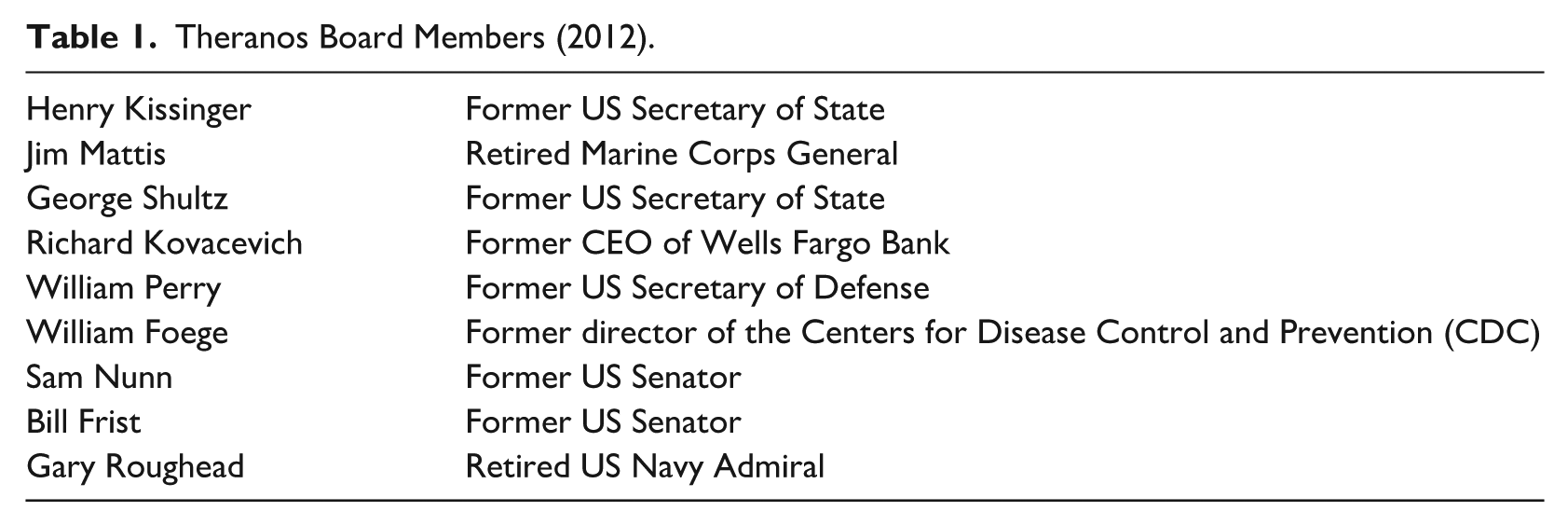
It is perhaps because her firm was situated at this particular conjuncture that the case of Theranos and the figure of Elizabeth Holmes received exceptional levels of media attention. For some, this was also because the protagonist was ‘young, blond, and blue-eyed’, as a Forbes cover article from summer 2014 stated. Other commentators noted that media attention was roused by an entrepreneurial arc that, from the outset, seemed ‘storied’ (New York Times, January 2019): Elizabeth Holmes founded her company Theranos in 2004 after dropping out of a biochemical degree at Stanford University. The 19-year-old Holmes set out to upend the oligopolistic US blood testing industry by offering over-the-counter blood tests, which would be administered through a simple finger prick in a pharmacy booth or in a consumer’s home. Over a ten-year period, operating in ‘stealth mode’ in Silicon Valley parlance, Holmes managed to assemble an all-male board of advisors that included several household names in US politics and military, though few if any board members had a medical background (Table 1).
Theranos Board Members (2012).
In a radical change of relationship with the media, in 2013, the company and its founder were suddenly in the spotlight, with several magazine cover stories, TV and newspaper interviews, a TED talk, and a strong social media presence materializing in quick succession. This timing was not accidental: Theranos’ early investors were reported to be waiting for the company’s market launch to reap returns on their investment, and Theranos had started to court several large potential clients, particularly the large pharmacy chains Walgreens and CVS (Weisul, 2015). High-visibility publicity was instrumental, and having strong supporters and investors such as media mogul Rupert Murdoch and other highly networked individuals was undoubtedly helpful in this regard. A Forbes magazine cover story in June 2014 entitled ‘This CEO is out for blood’, which crowned Holmes as ‘the youngest woman to become a self-made billionaire’, epitomizes the media coverage at the time.
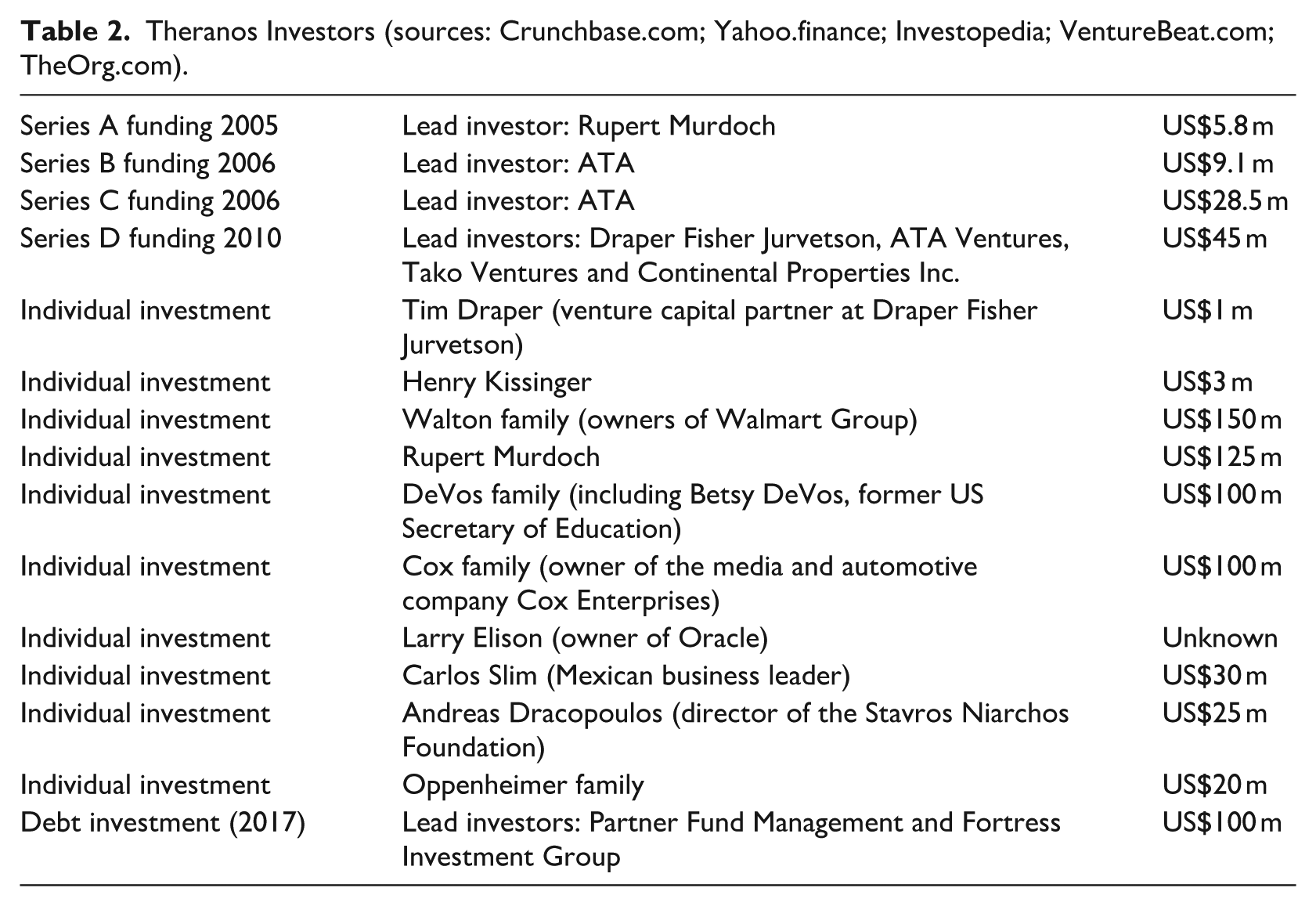
With a strong presence across all types of media, Holmes quickly gained spots on lists including the ’30 under 30’ and ‘Five Visionary Tech Entrepreneurs Who Are Changing the World’, while Theranos was listed among the ‘Top 10 medical innovations 2015’ by the Cleveland Clinic. 3 Despite having no formal training in medicine, Holmes was appointed to the Harvard Medical School board in 2014 and named as one of the Times’ 100 most influential people in the world that same year. The sustained media campaign showed material effects: according to court documents, Theranos went from running out of money in late 2012 to raising more than US$700 million by late 2014 (Times, January 2022; see Table 2). Valued at US$9 billion by mid-2015, the company was expected to become the first health tech ‘decacorn’, that is, a startup worth over US$10 billion – with Holmes as the youngest ever female billionaire at the helm. 4
Theranos Investors (sources: Crunchbase.com; Yahoo.finance; Investopedia; VentureBeat.com; TheOrg.com).
Yet, this female entrepreneurship fairytale soon turned dark. Scientists started to note that the firm’s secrecy around its finger-prick blood testing technology meant that no peer review results had been published and the technology remained entirely unproven by external experts (Diamandis, 2015). Basing his insights on the disclosures of several whistleblowers, in late 2015, investigative journalist John Carreyrou published a series of critical revelations about Theranos in the Wall Street Journal. Shortly afterward, the US Food and Drug Administration (FDA) announced that Theranos’ blood testing kit had been wrongly classified as a low-risk medical device (FDA, 2015). In early 2016, the US Center for Medicare and Medical Services found serious deficiencies with Theranos tests that posed ‘immediate jeopardy’ to patients (CMS, 2016). In 2018, a federal criminal investigation was launched, with the company facing fraud allegations by the US Securities and Exchange Commission (SEC), a class action suit by investors, and a breach of contract lawsuit by its lead customer Walgreens (SEC, 2018).
When Theranos shut down in September 2018, it owed its debtors over US$1 billion (Chang, 2018). Both Elizabeth Holmes and her former business and life partner Sunny Balwani were charged with several counts of massive fraud and harming patients. In January 2022, a federal court found Holmes guilty on three counts of financial fraud and one count of conspiracy to commit fraud. She was found not guilty on four other counts, while the jury failed to reach a unanimous verdict on three counts pertaining to patient harm. Holmes received an 11-year prison sentence, which she commenced in May 2023. Balwani was convicted of twelve counts of fraud, receiving a 13-year prison sentence, starting in April 2023. In the meantime, the story of Elizabeth Holmes and Theranos has been the topic of several TV series, books and podcasts, including Carreyrou’s (2018) book and podcast Bad Blood, The Dropout podcast by Rebecca Jarvis, and a Disney/Hulu Limited series.
Data collection
The figure of Holmes has multiple authors and audiences: the former include Holmes and her public relations team, but also business journalists, investors, event organizers and others; the latter include potential customers, investors, regulators and the general public. Our specific interest is in the tropes on which these authors converged to present and circulate subject positions pertaining to Holmes, how these subject positions worked together or contradicted each other, and how they shifted over the course of Holmes’ entrepreneurial ascent and downfall.
Our data stem from different sources. One of us (SG) was conducting ethnographic research in Silicon Valley when news of Theranos’ fraud broke in late 2015 and was able to observe the reactions of the local tech and venture capital community first-hand – though given the subject matter, conversations were typically flagged as being ‘off the record’. We then followed the constructions of Holmes’ narrative journey and the associated tropes and subject positions in the general and business news media, seeing media as spaces where power is fought over and upheld (Castells, 2007), including gendered power. When we began to systematically search the Factiva and Nexus databases for “Elizabeth Holmes AND Theranos” in all English-speaking news, we received over 7,800 hits, distributed over time as shown in Figure 1. After discarding duplicate materials, brief mentions and entertainment items, our full body of news data, which we imported into NVivo, consisted of 984 English-speaking press and magazine articles published between 2013 and 2023 – from the moment when Holmes began to actively seek out the public limelight to her final interview before starting her prison sentence.
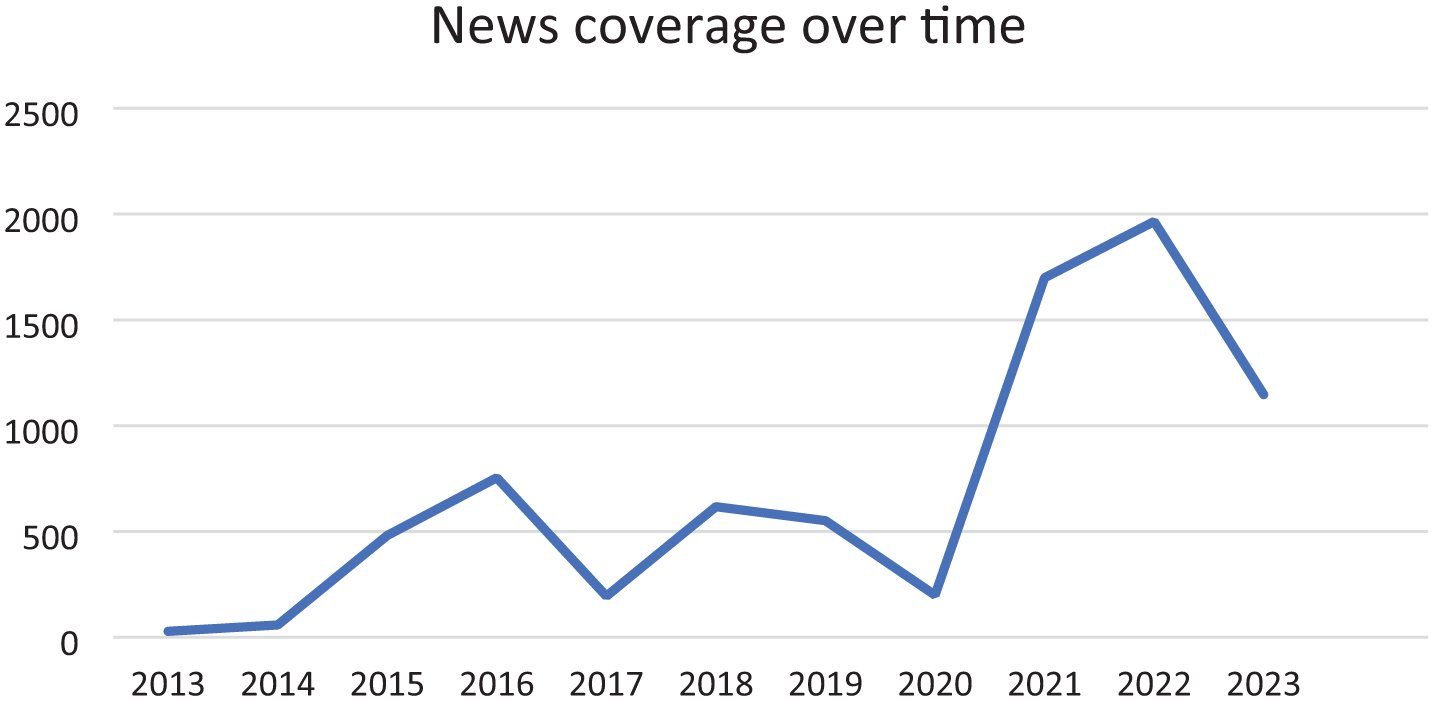
Distribution of articles on Elizabeth Holmes in English-speaking newspapers and magazines 2013–2023.
We were also interested in Holmes’ ‘self’-presentation’, aware that this constructed self is highly mediatized and shaped by others. We studied five video clips with Holmes on TED talks and Youtube (between five and 17 minutes each), 12 print interviews, her twitter feed (@EHolmes2003) of 364 tweets and retweets, and her reported court depositions. We read any associated social media comments.
Analytical approach
We engaged in a thematic analysis of our media sources to discern the subject positions ascribed across the narrative arc, how these reproduce articulations of gendered entrepreneurship norms, and how they are variously received, circulated and shaped. Our data analysis proceeded through several interlinked steps, in line with canonical work in narrative analysis (Czarniawska, 2004; Mishler, 1995) and previous narrative studies in entrepreneurship and organizational research (Boje, Rosile, Durant, & Luhman, 2004; Heizmann & Liu, 2022; Lo Verso, 2025; Nadin et al., 2020; Steyaert, 2007). Distilling best practice from this preceding research, our first analytic step involved engaging with our database of 984 media articles and Holmes’ self-presentations through close readings, paying attention to sensitizing concepts gleaned from our literature review including entrepreneurial origin, glorification, ascent, hubris, failure, descent and sensemaking, and the tropes most closely associated with our central figure. For the purpose of this study, tropes represent the constitutive elements of the constructed subject position under discussion (adopted or attributed by others). In line with our poststructuralist approach, we sought to examine the work of gendered power and discursive gendered norms in relation to each trope (see Appendix Table 4 column 1, ‘Trope’ in the online supplementary material).
We then noted how tropes worked together to shape emergent subject positions. For instance, the subject position of ‘female Steve’ assembled tropes about Holmes’ origin story as a college dropout, appearance (her black turtleneck), direct comparisons with other tech ‘geniuses’ and their business practices, particularly Steve Jobs, and ways in which these tropes were gendered. We proceeded similarly for the other subject positions presented below. Table 4 in the online appendix illustrates how tropes worked together to yield subject positions and provides representative or ‘proof quotes’ for each (Pratt, 2008). We took note of the contexts of production, for instance in reflecting on the ownership and audiences of different news outlets (including the fact that the Wall Street Journal, which first reported on Theranos’ wrongdoings, is owned by Rupert Murdoch, an early investor and mentor of Holmes). 5
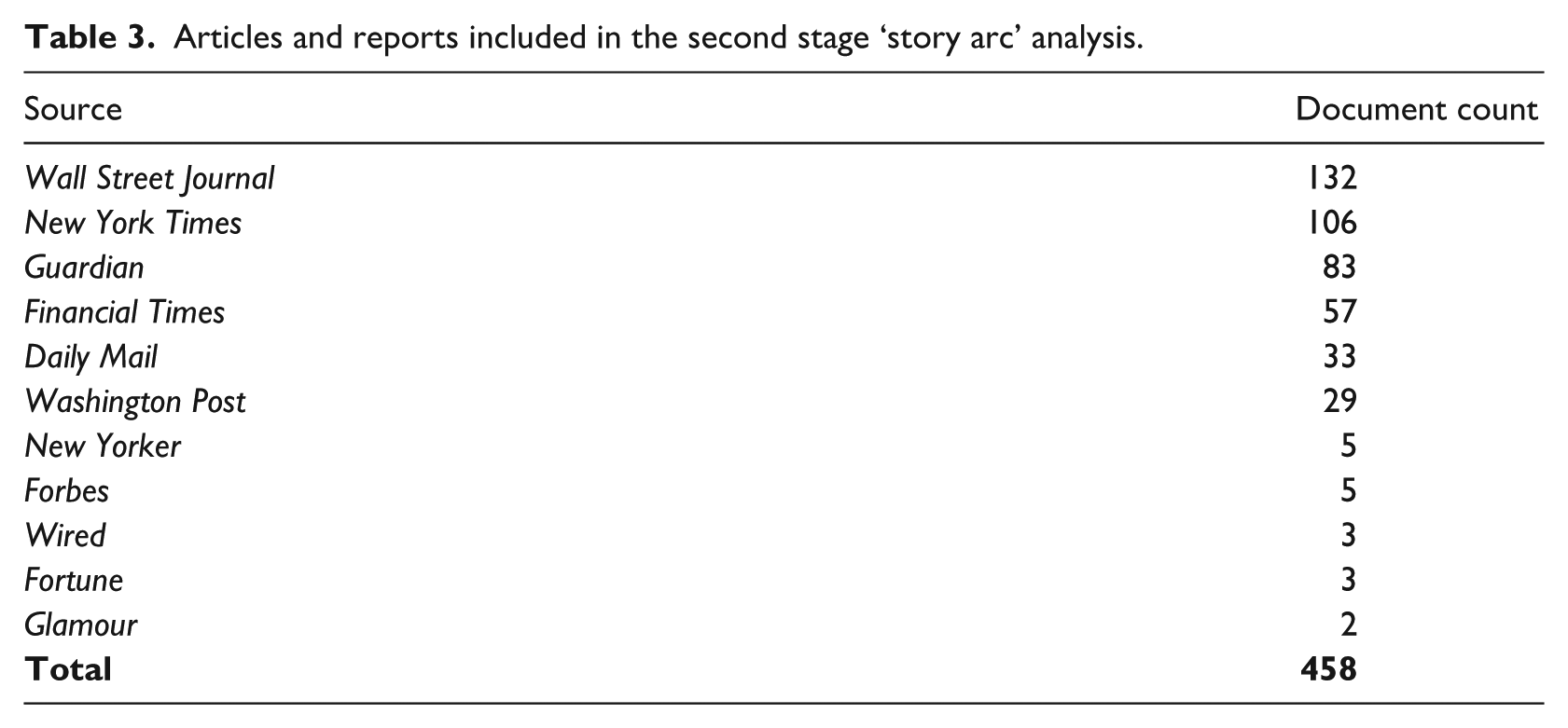
Our second-stage analysis closely examined the ‘story arc’ along which these tropes and subject positions took shape: how they emerged and circulated across different sources, how positions shifted over time, and whether any dissenting narratives were visible. Across these analytical dimensions, we observed how subject positions reinforced or challenged gendered discourses of entrepreneurship and gendered ‘canonical narratives’ (Larty & Hamilton, 2011, p. 231). We focused this second-stage analysis on a more concentrated dataset of 458 articles, detailed in Table 3. We narrowed our full corpus down as follows. We examined those large-circulation news sources (‘nationals’) that had the most in-depth, continuous and original coverage of Elizabeth Holmes, because the majority of material in other newspapers was syndicated. We also sought diversity of sources between those known as more liberal and those regarded as more conservative, and from within and outside the US in case Holmes’ subject positions were reflected differently in different cultural contexts. Based on this rationale, we focused our second-stage analysis on reporting in the US based Wall Street Journal, Financial Times, New York Times and Washington Post, and the UK-based Daily Mail and The Guardian. We further included specific pieces from other newspapers or magazines that were heavily referenced in our overall media corpus, including the 2014 Holmes cover stories and follow-on reporting in The New Yorker, Glamour, Wired and Forbes.
Articles and reports included in the second stage ‘story arc’ analysis.
At this point, our interrogation focused specifically on how these subject positions are put to work in terms of the rise-and-fall arc of this entrepreneurial figure (see online appendix Table 4 Column 4 ‘Narrative plot point’). We observed ‘temporal restructuring’ in relation to the post-hoc sensemaking around Holmes’ ascent and descent, and within the latter, the concept of catharsis proved instructive.
The emergent narrative pertaining to Holmes’ journey was not straightforward. Some ascribed subject positions directly contradict the dominant narrative (e.g. celebrations of Holmes as ‘Girlboss’ during her descent); these are depicted in Table 4 (online supplementary material) and noted in our findings. We reflected on how the narrations of subject positions were anchored in space and time (De Fina, 2021), for instance with cathartic gendered constructions significantly intensifying during Homes’ court case. When the Hulu miniseries on Holmes appeared, we also found intensified reflections in the media on whether ‘female fraudsters’ had, as they put it, ‘a moment’. Additionally, we found that particularly in US media, Holmes’ downfall was often situated in broader reflections around the virtues and structural flaws of Silicon Valley’s tech entrepreneurship and venture capital practices, which often were also constructed as gendered.
Overall, our analysis shows how specific gendered subject positions are employed to emplot Holmes’ entrepreneurial arc – with some tensions and contradictions emerging – but with distinct gendered elements of various kinds working across the narrative arc. In our findings section, we present these subject positions alongside the tropes that comprise them. We present periods demarcating Holmes’ ‘ascent’ and ‘descent’ – the former lasting from 2013 until late 2015, the latter from 2016 to 2023 – which allows closer analysis of the dynamics underscoring each phase. We illustrate each subject position with a subset of our data, with more extensive empirical data provided in Table 4, and we weave analysis and conceptual development through the presentation of this case, drawing out key points for discussion.
Findings
The ascent
Rising entrepreneurs are often admired and idealized as visionary heroes. For Elizabeth Holmes, her gender fed into this glorification, albeit through a complex assemblage of positions. Being a very young female founder was a double-edged sword at a time when gender bias and sexual harassment in the tech industry started to be discussed in earnest for the first time (Chang, 2018; Crandall, Brown, & McMahon, 2021). Our data presented in this section and in Table 4 indicate that Holmes and her backers handled the ‘female entrepreneur’ tag judiciously and strategically, with news media reflecting and amplifying the kaleidoscopic mix of (post)feminisms that Holmes appeared to embody.
The female Steve
Holmes’ public persona was strongly modelled on her male tech counterparts, evoking their particular and often glorified ‘nerd masculinity’ cultural framing (Crandall et al., 2021), but with a gendered twist. Her origin story neatly fit Silicon Valley stereotypes: particularly in early reporting she was consistently portrayed as a Mandarin-speaking ‘wunderkind’ who knew she would become a billionaire and change the world at an early age (Glamour, October 2015). More importantly, her first-year-Stanford-college-dropout-to-tech-founder CV was almost identical to those of glorified tech entrepreneurs such as Mark Zuckerberg or Steve Jobs. Her appearance tapped into an easily recognizable sartorial code: black turtleneck jumpers reminiscent of Steve Jobs (New Yorker, December 2014). Holmes herself frequently expressed her admiration for this archetypal tech founder, for instance in a 2015 tweet stating ‘Details matter, it’s worth waiting to get it right. #oneofakind #RememberingSteve.’ She was also reported to keep a framed photo of Steve Jobs in her office (Daily Mail, Sept. 2021). Media comparisons with other glorified Silicon Valley male ‘phenoms’ – the tech vernacular for a person with extraordinary promise – were common: She may be the female Mark Zuckerberg that Silicon Valley has been waiting for. . .She started when she was young, defied the odds and built a great technology. . . (Stanford entrepreneurship professor Vivek Wadhwa quoted in Silicon Valley Magazine, July 2014)
This heavily circulating subject position of a ‘female Steve Jobs’ or a ‘female Bill Gates’ (Fortune, June 2014) was a powerful mechanism to place Holmes into a lineage of tech trailblazers, fostering familiarity and recognition: Holmes became ‘the girl wonder mixing it up with the bad boys of Silicon Valley’ (Washington Post, December 2021). We recall that this was a time when Silicon Valley started facing a wave of public accusations of misogyny; hence a female tech founder who was both similar to and different (qua her gender) from her famous male predecessors was a highly attractive proposition to media commentators.
The caring visionary
‘Changing the world’ for good (CNBC, April 2015) was a central aspect in which Holmes’ subject position differed from those bad boys of Silicon Valley, who, as the popular saying went, were known to be moving fast and breaking things. By contrast, Elizabeth Holmes’ gender supported a particular deployment of care, which in popular media reporting amplified the gendered exceptionality trope. In her public appearances, tweets and media interviews, Holmes herself continuously emphasized how she had dedicated her life to making the world a better place. Holmes often anchored this personal quest in her childhood as a little girl who was afraid of needles and who decided to care for those sharing this fear, ‘the stuff of childhood nightmares’ (Open Magazine, December 2018). She also often recounted the story of her uncle Ron who had died of skin cancer because he was allegedly diagnosed too late for the cancer to be treatable. This story became a highly productive springboard for Holmes’ caring trope: The reality within our health-care system today is that when someone you care about gets really sick, by the time you find that out it’s most often too late to do anything about it. It’s heartbreaking. Because in those moments, there’s nothing you wouldn’t do to change it, and too often you’re helpless. (Holmes, TED talk 2014)
The story’s climax – that, through Theranos’ innovations, ‘no one will have to say goodbye too soon to a loved one’ (New Yorker, December 2014) – became a refrain in media amplifications of Holmes. This emotive refrain proved extremely effective in soliciting audiences’ emotions; as one commentator confessed: ‘You find yourself nodding with her’ (New Scientist, October 2019).
We note that those with vested interests in Holmes’ success frequently magnified this portrayal of a more ‘caring’ female tech leader. For instance, former Defense Secretary William J. Perry, an early Theranos board member and vocal supporter of Holmes, was reported as saying ‘She has a social consciousness Steve [Jobs] never had. . .He was a genius; she’s one with a big heart’ (New Yorker, December 2014). This quote encapsulates Holmes’ positioning not only as a feminized but also an enhanced version of Silicon Valley’s male tech visionary – a catalyst for a more caring Silicon Valley femtopia perhaps, alongside its existing ‘brotopia’ (Chang, 2018).
The Iron Sister
Holmes selectively embraced a more outright feminist stance, placing herself in a lineage of female trailblazers. This was most visibly deployed on her Twitter feed, which drew on images and quotes from historic and contemporary female leaders in science, sports and politics: Congrats to the amazing @serenawilliams on SI Sportsperson of the Year. Keep shattering glass ceilings #ironsisters http://on.si.com/Serena (@eholmes2003, 15 December 2015) So wonderful to see @melindagates recognized for her incredible work. When women help women, change happens @forbes http://onforb.es/1QEhE8s (@EHolmes2003, November 2015)
With these tweets, Holmes placed herself in a tradition of women shattering ‘glass ceilings’, a history ranging, in her Twitter feed, from Nobel-prize winning scientist Marie Sklodowska Curie to contemporary personalities such as Serena Williams and Melinda Gates. Corporate messaging reiterated how Holmes stepped into this lineage of extraordinary women as a role model who raised others up with her. A Theranos promotional video from 2015 entitled ‘Breaking the glass ceiling’
6
featured female Theranos employees praising their boss: To see a woman leading such a strong company and leading with such strong ideas and doing so in a very technical manner and how much that does inspire other women to pursue these not only technical dreams but also dream really big.
7
Holmes herself is shown at the end of the video, asserting: ‘Some people talk about glass ceilings. I always say that next to every glass ceiling there is an iron lady.’ Shortly after this video was released, Holmes joined Huffington Post in launching an ‘Iron Sister’ campaign to empower women in science and technology. In a much-quoted article for the outlet from October 2015, she writes: ‘Madeleine Albright once said that “there’s a special place in hell reserved for women who don’t support other women” I believe that there’s a special place in history for women who do, and that is what the Iron Sisters campaign is all about.’ In these mediatized self-presentations, equality with men is the ultimate goal and women must fight for this collectively, just as they once fought for their right to vote.
The lean-in feminist
While the ‘iron lady’ statements above are perhaps the most forthright deployment of feminist rhetoric, in many other public appearances, Holmes expressed a more ambiguous stance toward gender issues: As for her gender, Holmes, who wears all black suits and heels and speaks in a deep, soft voice, has never allowed herself to think of it as an issue, she says. But she knows people are paying attention. ‘If I can show that in this country, a 19-year-old girl can drop out of school and build something like this,’ she said, ‘then other women should be doing it.; (Contra Costa Times California, July 2014)
This quote evidences the neoliberal subject position of the self-made female entrepreneur for whom gender is a ‘non-issue’ (Gill, 2017), a trope that heavily circulated at the time of this interview in 2014. This was a time when the publication of Sandberg’s ‘lean-in’ philosophy popularized the belief that ‘women are hindered by barriers that exist within ourselves’ (Sandberg, 2013).
In keeping with this neoliberal, self-made persona, Holmes was presented in many media portrayals as a ‘nun-like’ and ‘ethereal’ workaholic (ABC documentary The Dropout), showing other women what they could do if they just applied themselves enough. She was portrayed as a person who was always perfectly turned out, lived off a much-photographed ‘pulverized concoction of cucumber, parsley, kale, spinach, romaine lettuce, and celery’ (New Yorker, December 2014) and never seemed to rest (Inc., October 2015). Aligned with ‘lean in’ feminism, she therefore appeared as the near-perfect embodiment of the neoliberal trope of a market-ready society that ‘empowers’ women to be well and productive (Rottenberg, 2014, 2017).
Investors and the ascent
While media reports may not fully capture the vested interests supporting circulating subject positions, investment data may help understand the purposes for which Holmes’ kaleidoscopic portrayals were put to use. Holding ownership of over 50% of her company and 99% of the voting rights, Holmes herself clearly had most to gain from her own glorification, but as Table 2 illustrates, other people too had considerable financial interest in the ascent of Holmes and Theranos. Accordingly, investors seized many opportunities to amplify the subject positions illustrated above; these included individuals such as Rupert Murdoch with direct links to media businesses as well as board members and investors who spoke to the media frequently about Holmes and Theranos – Kissinger, Perry, Shultz, Kovacevich and Robertson, among others (see Table 4 in the online appendix for quotes). Endorsement and support from such respected senior male figures were likely aimed to increase believability in the narrative of a caring, exceptional female version of the more familiar figure of tech bro (Titus Jr. et al., 2025).
Heavy media circulation in a very short space of time further helped glorify this ‘one woman’s quest to liberate healthcare’ (New Yorker, December 2014). In her rapid ascent, investor interests were forwarded in tandem with media attention to this potent mix of postfeminism and care. As one journalist summarized: In an industry obsessed with conquering the impossible – and, of course, making the world a better place – she was regarded as a modern-day heroine. (Vanity Fair, October 2016)
For investors who invested early and cashed out at the apex of Holmes’ ascent, it is largely irrelevant whether the belief in Holmes as a more caring, feminized version of the archetypical Silicon Valley tech founder was grounded in reality (Birch, 2023; McCluskey, 2021). This mentality is in keeping with the Silicon Valley dictum to ‘fake it till you make it’, a dictum that explicitly condones deceit, at least up to the point where financial gains have been realized.
Holmes’ ascent to heroine was harnessed even beyond investor circles. In 2015, US President Barack Obama nominated Holmes as one of his Presidential Ambassadors for Global Entrepreneurship 8 – only to quietly withdraw this nomination once the FDA investigations into Theranos begun. Other politicians also leveraged Holmes’ glorified female tech persona. Senators McCain and Biden both grasped photo opportunities with Holmes in the Theranos labs, while Bill Clinton showcased Holmes at his 2015 Clinton Global Initiative meeting. 9 In short, Holmes was not only an investor subject, holding on to a significant part of her company, she also became an investment object, of central material interest to a range of powerful male figures.
The descent
Holmes’ highly publicized ascent was short and steep: as soon as fraud investigations began in late 2015, her flawless image of the visionary yet caring founder heroine began to tarnish. Mirroring the multiplicity of gendered positions characterizing her ascent, during the decline gendered portrayals played out in a similarly kaleidoscopic manner. Holmes was depicted as first, a traitor to women, second, a villainous seductress of men, third, a manipulator instrumentalizing a care ethics for profit, fourth, a reformed traditional female, and fifth, a girlboss icon.
Traitor to women
As revelations of misconduct emerged, media reporting started to depict Holmes’ fraud not just as a corporate misdemeanour but as a treason of other female entrepreneurs. Her former Stanford professor Phyllis Gardner was repeatedly cited as saying how other would-be female founders will struggle even more as a result of Holmes’ actions (Sunday Times, March 2019). Several comments on Youtube under the ‘glass ceiling’ video now read as follows: Elizabeth disappointed so many women. If she would have actually worked on something that she KNEW worked imagine where so many women would be now? I hope she never forgets the immense damage and extra roadblock she put for so many incredible, intelligent, and talented women there are. Thanks a lot, Elizabeth. (public comment on Youtube, 2022; original emphasis)
This trope, of how Holmes had damaged female entrepreneurship for decades to come, circulated across a range of media. A New York Times article published in August 2021, in the middle of the court case, is headlined ‘They Still Live in the Shadow of Theranos’s Elizabeth Holmes’. It reports on female tech founders fielding constant comparisons with Holmes, to a point where one of the female founders reportedly was advised to ‘dye her hair so that the connections [to Holmes] would stop’. An opinion piece in the Guardian reiterates this trope: When prominent male entrepreneurs are caught lying to investors or acting unethically it’s often shrugged off or even excused; it certainly doesn’t affect other men’s careers. When a prominent woman is disgraced, however, all women are implicated. The bar has always been higher for women; Holmes’s downfall may have raised it higher still. (Guardian, September 2021)
Following this reporting, one gains the distinct impression that in her fall, Holmes was taking the reputation of all female entrepreneurs down with her.
Villainous seductress
While these reported repercussions are themselves telling of an environment that continues to be hostile to female founders, media portrayals of Holmes’ downfall from 2018 onward also evoked a distinctly misogynist tone. Dozens of media articles across all outlets now utilized recognizably gendered language, portraying Holmes as a young seductress who had ‘lured’ seasoned male investors into her fraudulent scheme (Rolling Stone, November 2022) and ‘charmed’ and ‘wooed’ other men into her organization (Evening Standard, November 2022). Media commentators now wondered ‘how tycoons, politicians and even Henry Kissinger were duped by the fraudster’ (Telegraph, November 2022). This trope turned the many men who had endorsed Holmes during her ascent into innocent victims of Holmes’ deceit – particularly the investors and members of what was once portrayed as the ‘single most accomplished board in U.S. history’ (Fortune, July 2014). References to ‘her disturbing ability to coolly deceive some of America’s wealthiest and most intelligent people’ (Daily Mail, June 2019) were deployed liberally to exonerate the part investors played in this entrepreneurial fraud. In more sensationalist reporting, direct reference was made to investors thinking with their ‘groin’ or ‘pants’ (Daily Mail, September 2021); in other outlets, they were painted as guileless victims with ‘old, dumb money’ (New York Times, April 2022). By contrast, Stanford’s Phyllis Gardner was now portrayed as the ‘fearless female professor who helped bring down Elizabeth Holmes’ (Stylist, November 2018) and, as the only senior woman in this story, the one who had seen through Holmes from the start. Media reporting now also circled around the ‘delusion’ and ‘hubris’ (Wall Street Journal, January 2022) of Holmes’ apparent desire to be like Steve Jobs which, with hindsight, was something she could never accomplish. Journalists were generally quieter about their own contribution to Holmes’ ascent, with Fortune’s Roger Parloff the only one to write a ‘mea culpa’ (Fortune, December 2015).
Feminist commentators have likened the male attributions to Holmes to those of Disney villaine Maleficent and have drawn parallels between the (male) celebration of both figures’ downfall after reaching for power beyond their purported female station (Dundes, Buitelaar, & Streiff, 2019). The near-complete exoneration of powerful males in this case, particularly in conservative media outlets, is particularly striking given that Holmes’ court case found that the due diligence and corporate oversight of board members and funders were greatly lacking (Feldman & Solum, 2021).
Fake carer
Lack of care was an important additional feature in the presentation of a ‘cold’ and ‘villainous’ Holmes during the downfall. A CEO who had outwardly embraced an ethos of care while simultaneously ‘inflicting their lies on real medical patients, . . . that was part of the outrage’ (Atlantic, April 2022). The distinctly care-less ways in Theranos behaved – to customers, patients and investors – were now held up in stark contrast to earlier rhetoric. Holmes’ heavy reliance on the deployment of personal care relations to sell her firm and herself drew particular ire: ‘Holmes promised “a world in which no one ever has to say goodbye too soon” – and that was perhaps her biggest crime of all’ (Refinery.com, March 2019). We note that when fraud revelations first started to emerge, Holmes reiterated her care ethos, for instance in a high-profile interview on the Mad Money show. Casting herself as the lone heroine facing adversity, Holmes argued that ‘First they think you’re crazy, then they fight you, and all of a sudden you change the world.’ 10 In this rendering, the blockages between now and a more caring future are to be blasted away by those tragic heroic figures who dare confront the status quo. This defence, however, did not hold up for long.
Carelessness became an even more central part of Holmes’ public downfall once revelations emerged about how she ‘cared’ for her own workers within Theranos. Holmes’ ‘nun-like’ public persona was now revealed to stand in stark contrast with the reality of a ‘toxic’ work culture built on secrecy, intimidation and lies (Tourish & Willmott, 2023). During the court case, workers gave details about what life was like under Holmes’ leadership. One ex-employee testified that ‘there was a sinister environment filled by weird corporate spies who would report back anything they didn't like to Holmes’. He also said that staff knew Theranos technology was not reliable but staff were too afraid to speak up because they feared Holmes so much. (Daily Mail, September 2021)
The overall impression emanating of Holmes as a distinctly care-less leader stood in stark contrast to Holmes’ subject position as a caring boss prior to the downfall.
Traditional femininity
Holmes and her team did not simply accept this reversal of her public image from Silicon Valley wunderkind to cold-blooded seductress. Holmes herself adopted a new gendered positioning during her court case, embracing what may be considered more traditional female subjectivity, as a ‘devoted mother’ (Daily Mail, November 2022). She was pregnant with her first child at the beginning of her court case and with her second as sentencing approached. While this timing may of course be coincidental, some commentators detected in it a cynical deployment of motherhood and traditional family imagery, aimed at garnering jurors’ sympathies (New York Post, November 2022). Multiple newspapers published photographs of Holmes holding hands with her mother while entering the courtroom, typically accompanied by commentary judging this to be a highly unusual behaviour for an almost forty-year-old married woman (Washington Post, December 2021).
Evoking her own metamorphosis, Holmes addressed the public at the end of her court case in keeping with this softer, more feminized mother and daughter subject position: There are so many things I would do differently if I had the chance. I tried to realize my dream too quickly. Yesterday I tried to change the world. Today, I’m wise, and want to change myself. (Holmes, court closing statement)
The deployment of a genderized ethos of care thus remained part of Holmes’ self-presentation to the end: her inherent compulsion to care and to make things better is her life’s work, even if it ended in failure on this attempt.
This more traditionally feminine trope was supported by some media narratives, most notably in a 5,000-word New York Times article entitled ‘Liz Holmes wants you to forget about Elizabeth’ (New York Times, May 2023). The article appeared shortly before the start of her prison sentence and broke seven years of media silence by Holmes herself. In this piece, ‘Liz’ is portrayed as an ordinary, homely mum who takes her kids to the zoo and has started to volunteer for the Rape Crisis Center. 11 This persona evokes catharsis where those who emerge from entrepreneurial failure do so as a much improved and purified self – in our case, a seemingly reformed, softened and chastened ‘model of docility and domesticity’ (Guardian, May 2023). 12
#GirlBoss
We note a final twist to Holmes’ multifaceted gendered subject positions: as a ‘girlboss’ icon. The girlboss trope exemplifies the presence of one of several contradictory subject positions throughout this narrativization of entrepreneurial success and failure, depicted in Table 4. Emerging around 2014 as a millennial take on Sandberg’s ‘lean-in’ feminism, the girlboss trope grew popular among young, college-educated women, depicting a female persona who is brazen and unafraid of rubbing up against male norms and power structures (Byrne & Giuliani, 2025; Marks, 2021). By 2020, the #GirlBoss Instagram account boasted 1.6 million followers and the term had been tagged more than 20.2 million times (Business Insider, 2020). In Holmes’ case, it was the sheer audacity of her pursuit of a piece of male power that made her a girlboss icon during her descent, as this Tweet from August 2021 expresses: ‘say what u will about elizabeth holmes but she scammed henry kissinger and rupert murdoch. a #girlboss move’ [sic]. A popular Etsy shop sprang up, which sold T-shirts and other items with prints of Holmes’ face and the caption #girlboss, alongside multiple other online shops that sell Theranos and Elizabeth Holmes memorabilia. Several Elizabeth Holmes fan clubs emerged, and reportedly, during her trial, ‘spectators waited in pre-dawn lines for a chance to sit in on the proceedings. This included self-described “fans”, blonde women who came dressed like Holmes in dark suits’ (Rolling Stone, November 2022). On social media, fans posted: ‘wearing a black turtleneck in solidarity with my girl elizabeth holmes [sic] whose only crime was caring too much and defrauding investors’ (Twitter, November 2022).
While Holmes’ elevation to #girlboss status could be read as a collective challenge to a male-dominated environment, critical commentators have highlighted the ambiguity of the girlboss identity as ‘something that white wealthy women could exploit. Additionally, they could tell themselves that what they were doing was furthering modern feminism’ (Atlantic, April 2022). Holmes’ downfall was celebrated by an audience for whom the privileges she had exploited and the dangers she had caused to patients did not matter as much as the fact that she ostensibly stood up to a male-dominant environment. This version of female entrepreneurship was that of a somewhat cynical challenge to power, but for its own sake rather than any wider purpose (Beck, 2021).
Investors and the downfall
Analysing the multiple facets that led to Holmes’ downfall, we note two points. First, it was the US SEC’s complaint against the firm for ‘massive investor fraud’ and not the CDC’s medical fraud investigations that shut down Theranos. Upon settlement, an SEC spokesperson stated: ‘Innovators who seek to revolutionize and disrupt an industry must tell investors the truth about what their technology can do today, not just what they hope it might do someday’ (Forbes, March 2018). This statement obfuscates the fact that investors specifically seek out early-stage, risky ventures to maximize financial returns, even if technologies are unproven (Kampmann, 2024). In fact, this skilled ‘investor gaze’ lies at the core of venture capitalist’s competitive advantage and claims of expertise (Muniesa, 2017): the capacity to discern what may be valuable in the future. Venture capitalist’s public standing and the confidence of those entrusting them with their funds hinges on this presumed savvy, which urgently needed to be restored after the spectacular revelation of Theranos’ fraud. The venture capital community was compelled to make convincing sense of the failure and to exonerate their profession. Financial reporting now circled around a sense of hindsight where the technology was evidently ‘never going to work’, as it was ‘fantastical’ to begin with (Verge, December 2021). Spokespeople emphasized how Theranos’ investment emanated mainly from private family investors and a handful of ‘tourist’ venture capitalists who had no specific healthcare expertise (McCluskey, 2021). Thus, those who had naively bought into the persona of the female tech entrepreneur were relegated to a second tier of investors who had been justly punished for their credulity. One commentator even claimed that Theranos proved ‘just how well Silicon Valley does its homework’ (Stross, 2016, n. p.).
Second, the final court decision judged the patient harm brought by Theranos and its CEO as inconclusive compared to the harm caused to investors. Despite Carreyrou’s initial reporting, and subsequent commentary emphasizing the real tragedies potentially caused to the patients, patients appeared to have been rendered irrelevant in this judgement. In the end, it seems that the most impactful dimension of Holmes’ downfall was not her reckless endangerment of people’s lives, but that her descent failed those who had staked money on the seemingly highly lucrative female tech heroine that Holmes had promised to be, and that powerful media interests had cheered along.
Gendered entrepreneurship and the downfall
When handing down an 11-year sentence for investor fraud, the judge recalled the huge early promises invested in her and described her fall from grace as a ‘tragedy’: The tragedy of this case is that Ms. Holmes is brilliant. She had creative ideas. She is a big thinker. She was a woman moving into an industry that was dominated by, and let’s face it, male ego. That young women entrepreneurs are regrettably denied access to, but she made that. She made that. She got into that world. (US District Judge Edward Davila, Closing Statement, 22 November 2022)
Judge Davila’s depiction of Holmes’ ascent and descent as a gendered tragedy evokes the sense that – as with the Greek tragedies – this story was always going to end up a certain way. With the benefit of hindsight, many media reports too noted an air of inevitability to what happened to this female tech entrepreneur – whether her earlier success was ‘an elaborate scheme to defraud investors’ or ‘a sign of the impossible gymnastics that female founders must perform to be taken seriously’ (New York Times, May 2023). Commentators also noted the mythical quality of this story, with Holmes ‘at the centre of one of the world’s oldest and best-known tales: genesis, hubris, crisis, nemesis’ (Financial Times, March 2018). Yet, as much as journalists and investors ‘wanted to believe’ this story while it resembled a fairytale with a shining heroine (Guardian, January 2022), the vociferous, extensive and often highly gendered commentary Holmes’ trial attracted requires closer examination. This is something we explore through the metaphor of catharsis.
Discussion
We analysed the gendered dynamics underlying entrepreneurial glorification and failure via an examination of the storied arc of Theranos’ Elizabeth Holmes. When she was asked about the TV series in the New York Times piece published before her imprisonment, Holmes reportedly answered: ‘They’re not playing me. They’re playing a character I created.’ Bringing a poststructuralist feminist lens to bear allows us to dig deeper into the mix of subject positions that emerged through Holmes’ own and others’ depictions and to ask who may benefit from such rise-and-fall arcs. Our analytic framing has been developed as the findings proceeded, and here we distil three key points of discussion and contribution.
Catharsis as an act of restoring gendered social order
Holmes’ descent involved, as literature would suggest, a stigmatization of the entrepreneur at the heart of the failing venture (Cardon et al., 2011; Shepherd, 2003). Holmes found herself the focal point for blame, scrutinized and isolated. This stands in stark contrast to the mediatized reporting around Theranos’ chief operations officer Sunny Balwani, who had been all but invisible in the business news until his own court case, where media interest in the main revolved around Holmes’ and Balwani’s intimate relationship. Depictions of Holmes’ failure were also notable for the viscerally gendered meaning-making on the part of commentators, in a manner uncommon to other failures. Many commentators endeavoured to account for the significance of this downfall that was now styled as specifically female – to figure out what it ‘meant’ for other women in tech. Others used it as a way to recalibrate the ‘bro’ masculinity prevailing in Silicon Valley or to reinstate the investment community’s self-belief. Holmes herself, and presumably her PR advisors, thought it best to mobilize a traditional female framing for Holmes’ public redemption – a tactic that in turn was critically read as ‘weaponizing white womanhood’ (Guardian, May 2023). Drawing together these different processes, a catharsis metaphor is particularly helpful.
Catharsis depicts how revelations of deception or failure create moments of immediate disruption because they pose particular ‘appearance/reality puzzles’, a cleavage of social meanings and observed facts (Vogel et al., 2022, p. 8). Resolving this puzzle can be painful, and observers tend to seek to quickly restore social order, deploying explanations to protect themselves (Vogel et al., 2022). In our case, the puzzle appeared to be the question of how a female entrepreneur was allowed to ascend to such mediatized heights and garner such a degree of support despite the ‘reality’ of the problems underlying her mission.
The urgent, collective re-organization of meaning to which revelations of the fraud committed by this exceptional female ‘unicorn’ gave rise sheds light on the social dynamics underlying catharsis, specifically in relation to the position of gender within the status quo: misogynistic tendencies emerged as part of the cathartic outpouring of explanations attending the downfall of Holmes. Temporal restructuring (Rosenthal, 2022) was heavily deployed by the investment community, and revised tropes emerged in which media commentators rushed to the figure of the ‘wise’ female professor who had seen through the young seductress all along.
Critical to all these renderings was the equating of aspects of Holmes’ gender with the reasons for failure. As Rosenthal (2022) notes, through cleansing, social order is more or less restored, with the drama of the expelled imposter pointing to specific aspects of its topography – in Holmes’ case a prison sentence and her conviction as a villaine in the court of public opinion, perhaps only redeemable by adopting more traditional female roles (see Titus Jr. et al., 2025). A revised meaning of female entrepreneurship emerged as a result, in which it was inevitable that this tragedy – to quote Judge Davila – would end up as tragedies do. Females remain on the outside of entrepreneurial funding – other to the norm. Narratives of entrepreneurship failure are critical to examine (Shepherd et al., 2016), while the emotions they elicit shed light on how collective sense is made of failure events (Byrne & Shepherd, 2015). To such debates, we contribute the concept of catharsis to help understand how audiences deploy frequently gendered explanations for entrepreneurial failure.
This raises the question of who else may be affected by cathartic re-gendering, beyond this case. Comparing our case with existing research suggests that in other male-dominant settings a woman perceived as overly ambitious or more senior than the positions normally ascribed to women may also encounter stakeholders who collectively construct a downfall narrative that restores the social order. To be clear, we do not believe there is agentic intent at play – an orchestrated decapitation – but rather that the emergent dominant narrative may work to achieve the results we have seen in our case. Fotaki and Harding (2018) showed that senior women academics can find themselves suddenly and momentarily ‘re-gendered’ as diminished figures by discursive emergences of patriarchal speech and text. Kenny and Fanchini (2024) demonstrate the same dynamic at play in senior women finance professionals who, despite their formal authority, find their valid whistleblowing disclosures are met with demeaning and misogynist comments, with a silencing effect. Through its focus on how power is embedded in the texts, speech and media depictions that circulate in these contexts, narrative inquiry combined with the concept of catharsis offers a valuable opening to investigate the subtle mechanisms of such collective gendered disciplining.
Postfeminist entrepreneurs as investment objects
Catharsis, we argue, also helps explain how Holmes’ glorification and downfall was amplified through the trajectory of the ‘investment gaze’ (Muniesa, 2017) that those with a vested interest cast on Holmes – first as a promising investment object, then as an aberration of their expertise that needed to be purged. During the ascent, the cheers of supportive investors who reaped returns as Theranos’ valuation increased were a critical contextual factor, and the melange of gendered positions ensured that Theranos was underwritten without the normal scrutiny applied to businesses in this area. For investors, the question of whether an enterprise’s innovative promises will ever materialize is less important than the question of whether the make-believe can be upheld long enough for their equity shares to be cashed out (Geiger, 2020). This makes early-stage investors singularly reliant on the stories told about the ventures and particularly about the entrepreneurs they are investing in (Garud et al., 2014).
In a neoliberal market context, financial investors are the arbiters of value; acting on behalf of society at large, they must be perceived as capable of discerning a good from a bad investment and make financial decisions accordingly (Muniesa, 2017). During the downfall, this ability needed to be reclaimed at all costs, be it through cathartic tropes of male investor victims or through temporal restructuring, with Silicon Valley venture capitalists now reiterating how they had seen through the narrative impossibility all along. While not every female entrepreneurial story arc will be as spectacular as Holmes’, in many small ways some of the ‘impossible gymnastics’ that characterized her kaleidoscopic role mix may be present in many female founders’ attempts to comply with a predominantly male investor gaze. For debates on gender and entrepreneurship, we argue that financial vested interests are critical in how genderized entrepreneurial subject positions are created, sustained and abandoned; the backdrop of serious money being invested in glorified entrepreneurs cannot be ignored.
Postfeminist fluidity and entrepreneurial downfall
These insights give rise to our third contribution, to debates on gender and organization studies: noting the fragility of postfeminism as a defence against gendered bias. Scholars have described the widespread hope that postfeminism might enable female entrepreneurial heroines to engage masculine traits at will and be thereby protected from gender-based stigma (Nadin et al., 2020). Holmes’ ascent was marked by postfeminist ‘fluidity’: she moved effortlessly between traditionally masculine, feminist and traditionally -female caring tropes circulating across different types of media, depending on the situation and the audience. On closer examination, contradictions abounded: for example, the necessity of a mutually supportive sisterhood seemed to matter little to competitive ‘lean-in’ Elizabeth, while her underlying privilege and middle-class background were not allowed to disturb the ‘drop-out’ persona. Yet as with other postfeminist entrepreneurs, these ambivalences received little scrutiny (Lewis, 2014; Nadin et al., 2020); rather, the often-contradictory blend of caring yet neoliberal postfeminist positions represented fuel for the investment object’s ascent. Ironically, the gender lenses applied to Holmes’ downfall were as multi-faceted and ambiguous as those postfeminist melanges fuelling the ascent; she was now both witch and healer, traditional female and seductress. Allowing attacks from a variety of gendered perspectives, we see how the efficacy of the very ambiguity that had precipitated the ascent also hastened the downfall.
The narrative arc of Elizabeth Holmes highlights the various deployments of subject positions that female – even postfeminist – entrepreneurs are, in the end, ‘allowed’ to hold. If indeed a generalized misogyny has shaped this situation, perhaps the evident Schadenfreude to which this catharsis gave rise recalibrates the sense of disturbance of the social order that the fraud revelations have caused and adds a distinctly patriarchal flavour to the catharsis we have witnessed. Catharsis reveals the impossibility of postfeminism as a vehicle for meaningful change when it comes to gender and entrepreneurship. Postfeminism offers a mere suture to deep-seated inequalities, a temporary advantage for the subject to enhance their individual success project (McRobbie, 2009). That said, we note that there may be potential for collective resistance in the #girlboss celebration by other women: in its ‘failure: so what?’ attitude, this position offers a potential challenge to postfeminist entrepreneurship and its self-serving alliances with dominant masculinity (Byrne & Giuliani, 2025).
Conclusions
Through the case of Elizabeth Holmes at Theranos, we describe how the ‘gendered arc’ of the glorified postfeminist entrepreneur involves: first, a contradictory mix of positions fuelling the ascent; second, a cathartic re-gendering that shapes her fall from grace and signals a return to a social order in which the female entrepreneur remain ‘othered’; and third, the driving force of investor interests providing essential fuel to the scene, in both directions. We have examined such catharsis in the context of tech entrepreneurship and in a case with a distinctly US-centric flavour, in its setting within a highly privatized healthcare system and a high-risk investment culture. We urgently invite future research to compare our case’s dynamics with those that occur following failure revelations in more distal settings. Similarly, while we focused our attention on the role of investors in driving this gendered arc, further research is needed to explore how other vested interests, including those of tech journalists and other media powers, influence entrepreneurial story arcs. Future research may also beneficially compare media reporting of Holmes’ journey from heroine to failure with that of her male counterparts; recent cases of notoriety include Wirecard’s Jan Marsalek or Billy McFarland of Fyre Festival fame.
We acknowledge our own potential biases and investments in Holmes’ story as depicted here; while we can only ever produce yet another narrative that adds to those already circulating (Ahl, 2007), we can attempt to examine the ‘otherness in ourselves’ (Fotaki & Harding, 2018, p. 25). As so many others, we have followed Holmes’ case over the years with our own feelings and projections, including a sense of wonder whether a man would have been treated the same way in the same situation. This question is, of course, never answerable, but it reflects the multi-coloured prism through which the Holmes story has been and will continue to be read by academics, media commentators and the broader public.
Supplemental Material
sj-docx-1-oss-10.1177_01708406251362918 – Supplemental material for Downfall, Catharsis and Re-gendering: Entrepreneurial glorification and the case of Theranos’ Elizabeth Holmes
Supplemental material, sj-docx-1-oss-10.1177_01708406251362918 for Downfall, Catharsis and Re-gendering: Entrepreneurial glorification and the case of Theranos’ Elizabeth Holmes by Susi Geiger and Kate Kenny in Organization Studies
Footnotes
Acknowledgements
We would like to sincerely thank our senior editor, Professor Nancy Harding, and our three expert reviewers for their highly supportive and constructive engagement with our manuscript and their interactions with us throughout the review process. A special thank you to Professor Patricia Lewis, the participants at the 2023 Organization Studies workshop, the Organizations, Work, Identity and Careers (OWIC) research group at Grenoble Ecole De Management, and the participants at a Weizenbaum Institute research seminar for their excellent comments and suggestions on earlier versions of this paper.
Funding
The author(s) received no financial support for the research, authorship, and/or publication of this article.

Supplemental material
Supplemental material for this article is available online.
Notes
Author biographies
References
Supplementary Material
Please find the following supplemental material available below.
For Open Access articles published under a Creative Commons License, all supplemental material carries the same license as the article it is associated with.
For non-Open Access articles published, all supplemental material carries a non-exclusive license, and permission requests for re-use of supplemental material or any part of supplemental material shall be sent directly to the copyright owner as specified in the copyright notice associated with the article.
