



Abstract
Organization change failure has typically been viewed as occurring when expected outcomes of change have not been met. This view downplays key, but frequently hidden organizational dimensions such as deep structures and temporality. In this article, drawing inspiration from the story of Alice in Wonderland, we distinguish between surface-level intervention approaches to change, deeper process approaches and, deeper yet, structuration approaches, and suggest the different ways they approach change failure as well as the implications of these. On the basis of our exploration we propose a three-fold way forward: adopting a process-based, empirically grounded and reflective approach to understanding change and its often-failed outcomes; adopting methodologies that can capture deep structures and temporal dimensions; and incorporating expanded conceptions of time as a multi-level, nested construct. We illustrate our ideas of deep structures and temporality by drawing from a particularly important illustration of long-term successful change that includes multiple short-term failures, that of the National Aeronautics and Space Administration in the United States (NASA).
Keywords
Introduction
In this article we show how understandings and meanings of organizational change failure require exploration not only of surface events and processes that take place in change, but also of underlying events and processes that are rarely explored or articulated as playing central roles in change failure. Thus, we discuss change and change failure on multiple levels, both seen and unseen.
To do so we draw inspiration from Alice in Wonderland, a novel written by Lewis Carroll (2011) in 1865 about a young girl named Alice who falls down a rabbit hole into a fantasy world full of illogical events. Alice has been one of the best-known books in the English-speaking world for well over a century. It “exemplifies the profound questioning of reality which characterizes the mainstream of nineteenth-century English literature” (Rackin, 1966: 313). Thus, it prompts us to consider dimensions that are central to change failure even if they are unrecognized. Further, it does this in a way that is likely to be particularly memorable. Boris (2017) and Polkinghorne (1988), among others, make evident that stories are much more memorable and evoke much stronger human responses than do statements of fact or theoretical arguments. The story of Alice illustrates and stimulates important meanings and emotions that are integral parts of the theoretical constructs we discuss.
Organizational scholars and practitioners writing about organizational change often use metaphors from Alice in Wonderland. For example, Ainsworth (2010), De Rooy (2018), Gibbons (2015), Holman (2013), Lund Dean and Forray (2017) and Somekh (2005), among others, have discussed aspects of change initiatives in terms of going into or down the rabbit hole. Kanter (1989: 19) described how the environmental context for many current companies is the croquet game in Wonderland “because everything is alive and changing around the player—an all-too-real condition for many managers.” McCabe (2016: 946) talked about how, in contrast to most metaphors of organizations, Alice in Wonderland draws “attention to that which is ridiculous, irrational, disordered, unpredictable, uncertain, unexpected, stupid, inane, nonsensical, contradictory or just plain silly.” In other words, the story of Alice going down the rabbit hole into Wonderland has been wonderfully evocative for those engaged in understanding organizations and organizational change and especially their “underground,” apparently nonsensical dimensions.
While Alice in Wonderland has inspired a good deal of writing about organizations and change in them, the story has not been used as a metaphor and lens for making sense of change failure. Yet there is considerable recognition that failure is a very frequent component of organizational change, and that it frequently doesn’t seem to make sense.
Thus, stimulated by the experiences of Alice in Wonderland, the purpose of this article is to explore the underground dimensions of organization change failure in comparison to its more surface manifestation. More specifically, we will explore the deep structures and complex temporal dimensions associated with organizational change failure that are hidden from view. As Kelly (2011: 21) notes, “Alice is ‘our’ representative” for this task.
Much like Alice going down the rabbit hole into Wonderland, the more we explore, the more there is to find. While the meaning of “change failure” appears clear on the surface, upon investigation we discover that different views of change failure imply different perspectives on what failure actually involves and what its causes might be. Like Wonderland itself, such a state of affairs mirrors and engages with the complexity of the organizational change field much better than the way the field often speaks of itself.
This article includes several parts. First, we address how scholars and practitioners frequently address organizational change failure on the surface (what we are labelling change as intervention), including an illustrative vignette from the history of the Xerox Corporation that shows why surface understandings are inadequate for understanding change failure. Second, we begin to go “down the rabbit hole” to explore more in-depth dimensions of change (which we are labelling change as process). Deeper still, we encounter deep structures and temporal dimensions (which we are labelling change as structuration). Here we also include illustrative vignettes from NASA. We conclude by suggesting implications for organizational change research and practice.
We introduce each section with brief notes or quotations from Alice. These stimulate the imagination and set the tone for the sections.
Surface failure: Change as intervention
The White Rabbit put on his spectacles. “Where shall I begin, please your Majesty?” he asked. “Begin at the beginning,” the King said, very gravely, “and go on till you come to the end: then stop.” (Carroll, 2011: 175)
The ubiquity of change failure
The concept of change failure itself is most frequently treated in an orderly way as unproblematic, prominently defined as occurring when a change program does not meet its stated goals, as noted for example by Beer (2000); Hammer and Champy (1993); Hughes (2011); Jorgensen et al. (2009); Kotter (1996, 2008); Michael and Mirvis (1977); Thomas et al. (2016) and others. As an illustration of this perspective, Nutt (1992: 320) argued that: “Failures occur during planned change when plans are not implemented or when they are withdrawn because performance fails to meet expectations.”
On the surface, change failure apparently occurs quite frequently. Multiple authors argue that 60–70% of changes fail (e.g., Jorgensen et al., 2009, 2014; Maurer, 2010; Thomas et al., 2016). Yet, this agreement is often without evidence, a point that Hughes (2011) makes abundantly clear.
When considered on the surface, the causes of change failure appear to be somewhat straightforward. An IBM report (Jorgensen et al., 2014) suggests that these include a lack of clarity about change management benefits and activities, lack of clarity about the role of a change professional, lack of change management resources and, relatedly, change management being too expensive. Other sources of failure that have been commonly discussed include, among others, lack of planning, insufficient leadership, inadequate communication, or actions inconsistent with change model employed (e.g., Anderson, 2018; Raelin and Cataldo, 2011). A frequently discussed cause is resistance to change from employees (e.g., Battilana and Casciaro, 2013; Vales, 2007).
But despite the agreed-upon claim of a high failure rate, and despite all the factors that cause failure, organizations keep changing. Why would this occur when there is such (unsubstantiated) agreement that the success of change is so unlikely? One likely answer is that the picture is more complex than assumed. It depends on the perspective of change employed; which itself implies different causes or attributions of failure.
Avoiding change failure on a surface level
Given this view of failure and its comparatively straightforward causes, a voluminous literature offers clear, step-by-step prescriptions for how to accomplish planned change successfully (e.g., Basford and Schaninger, 2016; Beer and Nohria, 2000; Kanter, 1999; Kotter, 1996; Schantz, 2017). As Schantz (2017) noted, these often include instructions such as follow a process, start with the executives, pay attention to the individual change process, focus on managers, and so forth. For example, lack of resource planning is an issue because change “generally is a longer and costlier endeavor than most change leaders realize. If you don’t plan and resource the latter phases of change, you’ll not realize the full benefits you set out to achieve” (Anderson, 2018). This all assumes linear causality.
Perhaps the cornerstone model that inspired this literature is Lewin’s (1947: 35) pronouncement that “a successful change includes therefore three aspects: unfreezing (if necessary) the present level L1, moving to the new level L2, and freezing new life on the new level.” The organization change field has made much more of this side-comment than Lewin (1947) intended, elevating it to a field-shaping paradigm (Bartunek and Woodman, 2015; Cummings et al., 2016).
Prescriptive approaches to organization change typically present models that treat change as a series of episodes or stages that occur within a setting that would otherwise be considered fairly stable and in which the nature of causality is clear; and so is what should be done (e.g., Bennis, 1965; Kotter, 1996; Levy, 1986). As Michael and Mirvis (1977: 312) put it, “Central (to these models) is the belief that reality is comprised of discrete objects and events, interacting in sequences that can be understood as chains of causes and effects.” Addressed to management and change leaders, and based on these beliefs, these models are commonly composed of multiple steps, with the assumption that if these are properly followed, they lead to successful change outcomes. Change episodes thus have a beginning, intervening actions and, following how the field interpreted Lewin (1947), a definite and presumably successful end (e.g., Stouten et al., 2018; Werkman, 2009).
However, accomplishing surface-level change successfully is more complex than the literature typically suggests. Consider the following example.
Vignette: Xerox and its apparent change successes
In the 1980s, Xerox undertook several reorganizations to respond to Japanese competition in the copier market. Paul Allaire, Xerox’s CEO between 1990 and 1999, noted in an interview that “in the 1980s we went through a number of reorganizations. But none of them got at the fundamental question of how we run the company” (Allaire, 1992: 107). During Allaire’s tenure, Xerox set out to transform not only the structures, processes and human resource aspects of the company, but also the underlying value system, what Allaire referred to as the “informal culture” (what we refer to later as the “legitimation” dimension of deep structures). Xerox aimed to change from a functional corporate design to a matrix one, ultimately aiming to create large numbers of self-organizing teams that draw from shared corporate services. While Xerox was partially successful in gaining back lost market share in the copier market from the Japanese, it persistently failed to recognize the immense commercial potential of the game-changing technologies that its Palo Alto Research Center (PARC) had created (Smith and Alexander, 1988). Instead, these technologies were either copied by other companies or commercialized by Xerox scientists who left the company to do so (Chesbrough, 2002).
Xerox’s dominant logic of what the company was about (what we refer to later as the “signification” dimension of seep structures) was focused on the copier market. The company was caught in a competency trap with intertwined cognitive, behavioral and organizational dimensions that hindered the executives from recognizing and capitalizing on the ground-breaking technologies that PARC had invented (Heracleous et al., 2017). Because those executives controlled what Giddens (1984) called allocative (material) and authoritative (hierarchical) resources (what we refer to later as the “domination” dimension of deep structures), Xerox was caught in a perfect storm of its deep structures hindering any meaningful organization change towards commercializing the new technologies that would enable the company to expand from the copier market to potentially lead the broader information technology industry. This process took place beneath the surface of several apparently successful change interventions that had met their stated goals.
In other words, Xerox’s reorganizations in the 1980s, even though deemed successful in terms of restructuring the company, failed to change the company’s deep structures. Further, the company’s transformation change efforts in the 1990s, even though successful in creating a more adaptive, customer-focused organization, failed to change or extend the dominant logic of the company (i.e., change the “signification” dimension of its deep structures) from copiers to the broader information technology domain.
Xerox’s story illustrates apparently successful change at the surface level, as well as change failure at the deep levels. While Xerox’s change interventions were a success in terms of meeting their goals, they were a failure in terms of change in the deep structures of the organization. This disjuncture ultimately led to Xerox missing its chance to commercialize several of its ground-breaking technologies and become a much more influential industry actor than it is today.
When we view change as involving longer-term trajectories of organizations where change is ongoing, not necessarily under the banner of any particular surface organizational intervention, the causes of failure come to be recognized as complex and multi-dimensional. They often involve deeper structural and temporal dimensions (e.g., Dooley, 1997; Pettigrew et al., 2001). Thus, we must begin to look beneath the surface of change to understand failure or potential success more adequately.
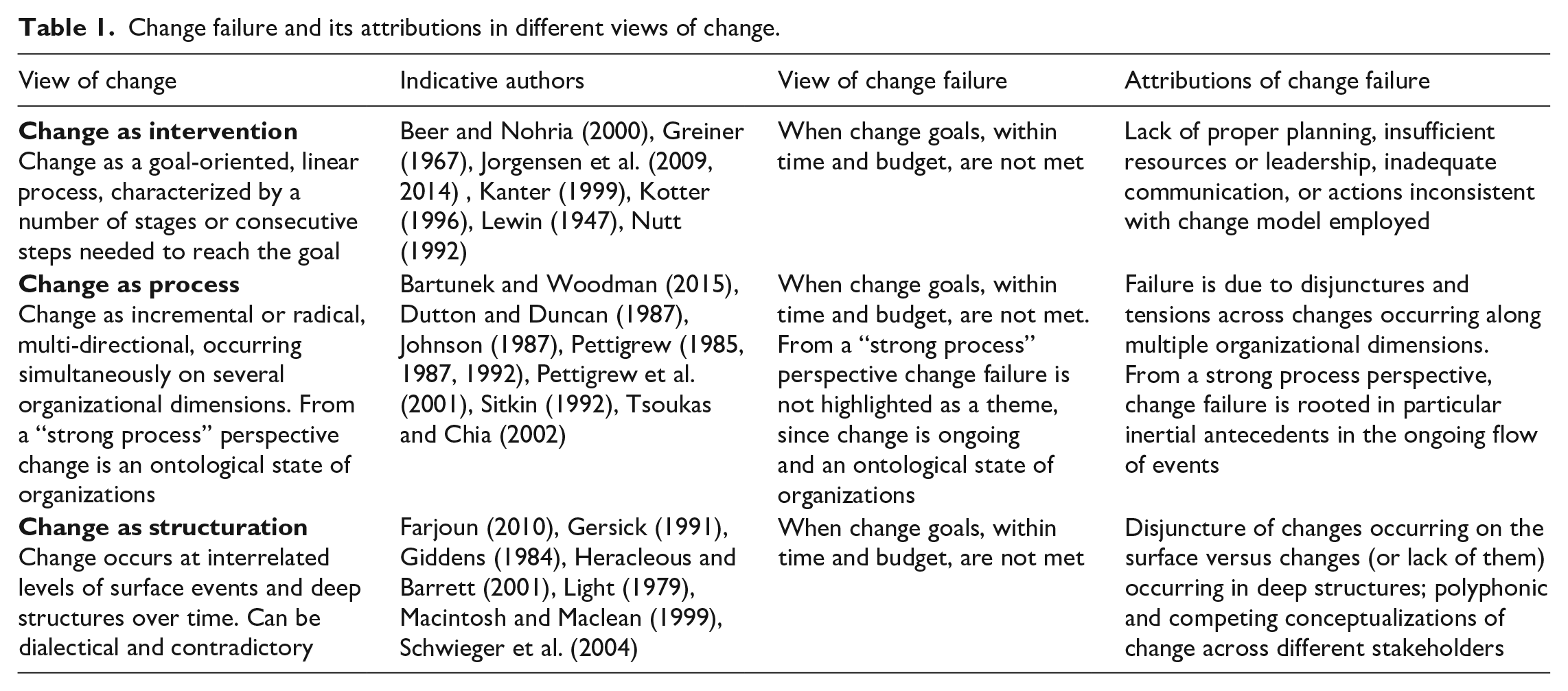
We outline in Table 1 the views of change failure and attributions of change failure of three views of change: change as intervention, change as process, and change as structuration; and we explore these ideas further below.
Change failure and its attributions in different views of change.
Entrance to the rabbit hole: Change as process
In Wonderland: ‘[the dodo] marked out a race-course, in a sort of circle, (‘the exact shape doesn’t matter,’ it said,) and then all the party were placed along the course, here and there. There was no ‘One, two, three, and away,’ but they began running when they liked, and left off when they liked, so that it was not easy to know when the race was over.’ (Carroll, 2011: 88)
Pettigrew (1985, 1987, 1992), Johnson (1987) and others championed a process view of change that involves understanding broader aspects of the content, context and process of change over time. From this perspective change may have a beginning or may be ongoing, rather than viewing change as a periodic intervention aimed at switching direction or organizational design toward a particular goal.
A process perspective draws attention to the complex relationship between success and failure. For example, Sitkin (1992) argued that continued success may engender liabilities such as restricted search, reduced attention, complacency, risk aversion and homogeneity. He further argued that small “strategic” or “intelligent” failures can lead to higher organizational resilience via greater attention to and recognition of potential problems, increased search for solutions, motivation to adapt, risk tolerance and requisite variety. Michael and Mirvis (1977) also noted that it is more valuable to think of apparent failures in terms of errors from which it is possible to learn important information for further development. From a process perspective, the idea of change as a planned series of discrete stages with a beginning and a successful end (or failure if the planned end is not reached) is questionable.
As Tsoukas and Chia (2002) argued from a “strong process” perspective (Jarzabkowski et al., 2017), in a field that has assumed stability as the foundation, organizations are instead continually in flux and becoming. Thus, change is far from a discrete and extraordinary set of events. Rather, it is the normal order of things, though normal doesn’t mean what it does above ground. For Alice, change subverts the normal linear progression (Kelly, 2011: 36). If change is continuous, and sometimes circular, and sometimes backwards (Greenwood and Hinings, 1988; Mantere et al., 2012) and is the fundamental nature of organizations, their very ontology, then the distinction between change success and failure becomes rather moot.
From a process viewpoint we could rather focus on the trajectory/ies of the organization and the unfolding of its processes (Chia and Holt, 2009; Van de Ven and Poole, 2005) in whatever directions they go or stay. Here, “the world is composed of events and experiences rather than substantial entities. Each event arises out of, and is constituted through, its relations to other events. Each event can be further analysed in terms of smaller events” (Langley et al., 2013: 5). As Farjoun (2010) showed, stability and change are not just oppositional but also complementary, simultaneously present, and mutually engendering. Similarly, success and failure are defined in terms of each other; they interpenetrate, and can co-exist.
Finally, a process perspective does not invalidate reference to change interventions per se, of the type analyzed by Kotter (1996), Beer and Nohria (2000), and others; or an understanding of attributions of change failure from the perspective of change as intervention. Rather, this perspective adds further dimensions, pieces of the puzzle, to appreciation of a complex problem. Apparent unintended consequences of a change are simply part of the process (Jian, 2007).
As we outlined in Table 1, the “change as process” perspective as expounded by Pettigrew (1985, 1987), for example, views change failure as deviation from expected goals, along similar lines to the “change as intervention” perspective. However, it views the causes as more complex, related to disjunctures or tensions across changes occurring along multiple organizational dimensions. Johnson’s (1992) “cultural web” model that integrates diverse, interrelated organizational aspects such as rituals and routines, stories and myths, symbols, power structures, organization structures and control systems is an example of this reasoning. Further, from a “strong process” perspective (Tsoukas and Chia, 2002), failure would be rooted in antecedents present in and recurring through routinized action in the ongoing flow of events, such as inertial patterns of actions or embedded worldviews.
Underground in Wonderland: Change as structuration
Organizational research that remains on the surface, looking for rational events and linear causes, is unlikely to find patterns such as the judgment scene in the last chapter of Alice in Wonderland in which the King “said to the jury in a low, trembling voice,” “consider your verdict.” But the White Rabbit replied, “There’s more evidence to come yet, please your Majesty” (Carroll, 2011: 166). There often is more evidence yet to come about change failure (or not), and it is likely to require much deeper exploration to be appreciated.
The wonderland into which Alice fell is full of contradictions (Kelly, 2011). To name just a few, when Alice makes use of advice from the mushroom, she inadvertently convinces the pigeon that she is a serpent, and so is dangerous. A baby who is being treated shabbily turns into a pig. Alice knocks on a door but can’t get it opened because the footman who is supposed to open it is on the same side she is.
The contradictions in these examples are crucial structural features of the story; they call into question “the essence” of time and space (Kelly, 2011: 37). As Rackin (1966: 314) comments, in Wonderland “old assumptions— . . . that longitude and latitude can always plot position, that size and growth must be fairly regular—have already proven ridiculously invalid” and “the ordinary concept of Space, too, is already on its way to oblivion.”
In other words, to understand change and its failure without appreciating its underlying contradictory dimensions is absurd. To understand change failure properly, it is necessary that we also cast aside surface-level assumptions about straightforward reasons for change failure and explore change from a subterranean perspective. This necessarily includes deep structures and complex temporal dimensions of change.
Of course, organization change can sometimes fail for straightforward reasons such as those we discussed above or erroneous diagnosis of what needs to change (Dutton and Duncan, 1987). But deep structure and temporal dimensions of change have not received sufficient attention, with the result that crucial aspects of organization change failure have remained unrecognized.
Deep structures
Kelly (2011: 26) notes that in Alice in Wonderland the reader encounters “the terrifying vision of the void that underlies the comfortable structures of the rational world.” Or, one might say, the reader encounters the deep structures of Wonderland. The contradictions and inconsistencies there mirror those found in the deep structures of many organizational settings (Sköldberg, 1994).
Deep structures as enduring dimensions of social systems that shape surface events
Deep structures are enduring aspects of social systems that operate at a subterranean level of social reality and shape events and actions on the observable, surface level. Deep structures have been central to a number of fields and can be found in semiotics (Fiol, 1989, 1991), narrative analysis (Sköldberg, 1994), organizational analysis (Dandridge et al., 1980; Gersick, 1991; Gomez and Jones, 2000; Light, 1979), sociology (Giddens, 1984) and structuralism (Saussure, 1983), among others.
Gersick (1991) described a deep structure as a “highly durable underlying order,” which is “what persists and limits change during equilibrium periods, and it is what disassembles, reconfigures, and enforces wholesale transformation during revolutionary punctuations” (1991: 12). Deep structures involve a “set of fundamental ‘choices’ a system has made of (1) the basic parts into which its units will be organized and (2) the basic activity patterns that will maintain its existence” (Gersick, 1991: 14). They may be “barely articulated” (Macintosh and MacLean, 1999: 305) but shape surface events including organizational change.
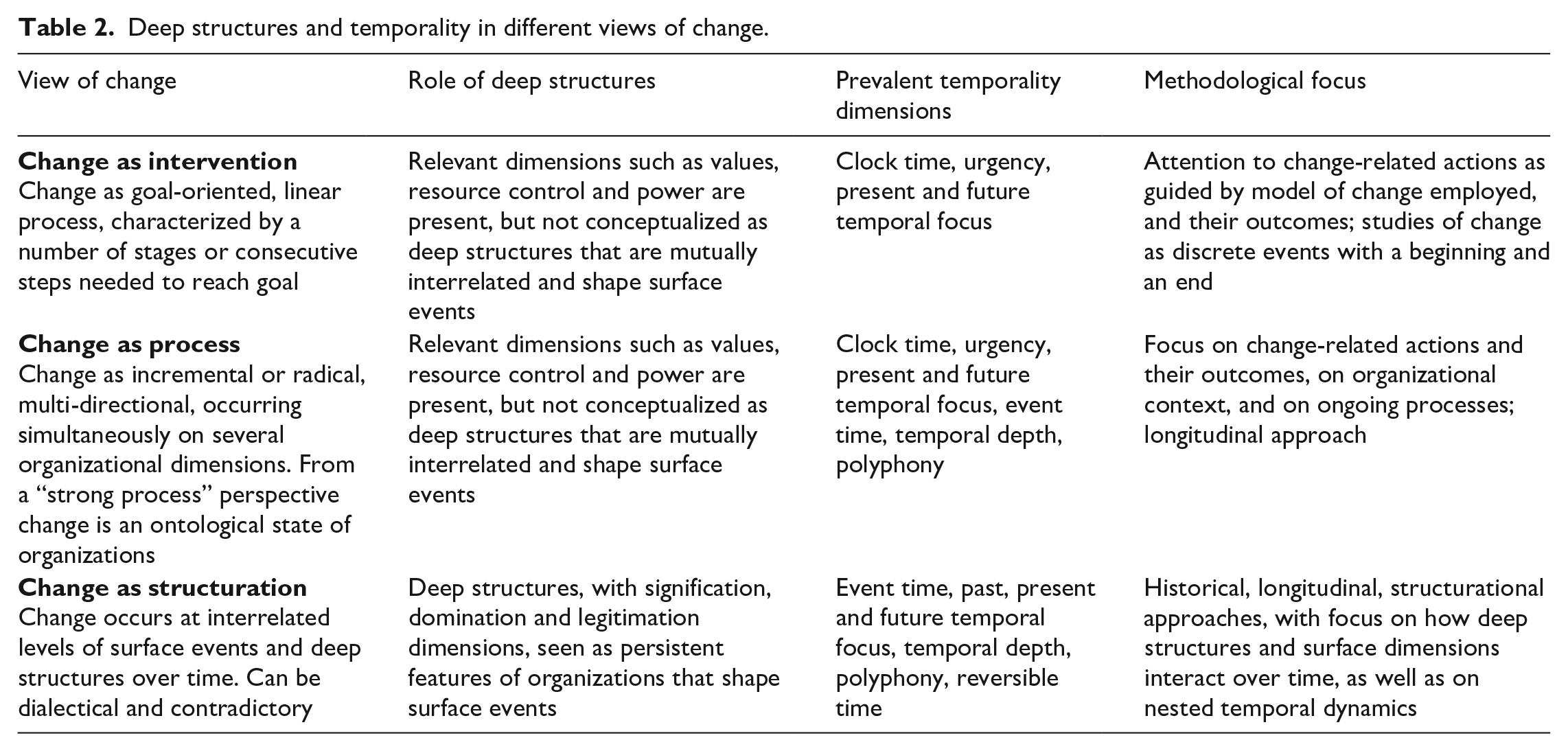
Giddens (1984: 326) suggested that his theory could be used as a “sensitizing device” for studying organizations. In this spirit, we draw from structuration theory as an inspiration for our “change as structuration” perspective as outlined in Tables 1 and 2. Structuration theory has been fruitful in guiding empirical research in a number of fields (Jones and Karsten, 2008; Pozzebon, 2004) and can be a useful meta-theoretical basis in this endeavor. We draw from Giddens’ (1984) structuration theory to identify three dimensions of deep structures: signification, domination, and legitimation. Signification refers to shared meanings; domination refers to power via the control of resources; legitimation refers to underlying norms.
Deep structures and temporality in different views of change.
A linguistic metaphor can clarify the signification dimension. Saussure’s (1983: 6) structural linguistics aimed “to determine the forces operating permanently and universally in all languages, and to formulate general laws which account for all particular linguistic phenomena historically attested.” In this formulation, everything that is said (langue) is shaped by deeper structures (parole), the specific, underlying rules of grammar through which unlimited spoken statements are generated and shaped. In semiotics, one aspect of deep structures is the underlying semantic oppositions that shape meaning in texts or groups of texts (Fiol, 1989, 1991).
That is, deep structures include tacit knowledge and conventions (Gomez and Jones, 2000) that may be reflected in narrative. For example, Sköldberg (1994) viewed reorganizations as drama, and explored the “hidden pattern” (p. 221) underlying them. He found that the narrative conventions of tragedy and romantic comedy acted as competing deep structures, and their interaction formed a third, paradoxical, mode of “fragmented satire” (p. 219), something like Wonderland itself.
With respect to legitimation, deep structures have a normative aspect and encompass deeply held values. For Dandridge et al. (1980), for example, the study of organizational symbols can reveal the unconscious shared values that they viewed as the deep structure of organizations. In particular, Dandridge et al. noted the “system maintenance” function of organizational symbols, in terms of “providing coherence, order and stability,” as well as “guiding acceptable patterns for change” (1980: 79). Schein (1990) referred to such unconscious shared values as an organization’s basic underlying assumptions, the deepest of three levels of organization culture.
With respect to domination, the role of power via control of resources has been an enduring aspect of organizational analysis (Krackhardt, 1990). This dimension includes the potential dominance of any particular ideology and the emergence of dominant groups. It also includes the mobilization of power to implement, benefit from and/or to subvert organization change (Greiner and Schein, 1988) as well as the possibility of power emerging though a kind of snowball process, rather than linearly (Sköldberg, 1994).
The appreciation of deep structures and their dimensions helps to expand recognition of what both change failure and change success may mean. For example, failure in particular change efforts may be occurring at the same time as ongoing, gradual shifts in deep structures over longer temporal frames that are intended to align the organization with its environment, as we will show later has been the case at NASA. Conversely, particular change programs may be deemed as successful, at the same time as the deep structures of the organization may be inertial or shifting away from environmental demands, as our Xerox vignette has shown.
Aspects of deep structures such as enduring underlying (contradicting) values and motivations derive from the historical trajectory of the organization and corresponding experiences of organizational actors (see Greiner, 1967). As Pettigrew (1992) argued, social reality is constructed in a “process of structural emergence via actions, and the tension between actions and structures is the ultimate moving force of the process . . . the legacy of the past is always shaping the emerging future” (1992: 8). Despite some notable exceptions (e.g., Bordia et al., 2011; Greiner, 1967; Sköldberg, 1994), these considerations have not been substantially heeded in most organization change research, which often remains at the surface rather than being historical and cognizant of the nature and effects of deep structures.
Thus, the notion of deep structures suggests that there is much more to underlying organizing than organizations and their members are aware of. Applied to organizational change, it suggests that there is also much more to organizational failure and success than organization members, consultants and scholars are aware of, and that much of what is crucial may have contradictory components.
As we outlined in Table 1, scholars that have employed structuration theory (e.g., Heracleous and Barrett, 2001; Schwieger et al., 2004) also tend to view change failure as occurring when change goals, within time and budget, are not met. However, the attributions of change failure from this perspective centre on disjunctures between changes occurring on the surface versus changes (or the lack of them) occurring in deeper dimensions. Such studies have also identified more explicitly the polyphonic nature of change and how competing conceptualizations or worldviews (signification dimensions of deep structures in terms of the above discussion) may derail any attempted changes on the surface.
Vignette: Deep structures at NASA
The concept of deep structures sheds light on why we can observe organizations that over time are able to change their business logic radically, even as individual change programs appear to fail. Consider the case of NASA, founded in 1958, and since then in charge of the US civilian space program, along with aeronautics and aerospace research.
Studies of NASA have lamented the challenges of accomplishing change in the agency (Donahue and O’Leary, 2012), and the path-dependence of the organization (Bruggeman, 2002). Yet, NASA’s deeper business logic (its deep structure) has shifted gradually over the decades from a hierarchical model during the Apollo program in the 1960s, to an international inter-governmental partnerships model with the construction and operation of the International Space Station in the 1990s, and then to an inter-organizational networks model with the Commercial and Crew Resupply Programs in the 2000s (Heracleous et al., 2018). This overall logic has provided an umbrella for a number of other institutional logics, often conflicting, that co-exist within the organization. These include logics of managerial rationalism, project management and scientific professionalism, and organizational persistence (Berente and Yoo, 2012). At any point in time, NASA’s deep structure, in this case expressed as its overall business logic and its various institutional logics, shapes surface events. Particular change initiatives have failed, but NASA continues to operate as the leading space agency in the world.
In other words, NASA shows that the failure of particular organization changes does not necessarily imply that there is no change at a deeper level to align with environmental demands and stakeholder expectations (Heracleous et al., 2018). Despite challenges in particular change initiatives, NASA—like some other organizations such as BP (Ruddle, 2008) and IBM (O’Reilly et al., 2009)—is able to change its deeper business logics in substantial ways, and may do so several times over the decades, usually not in a linear progression. Our understanding of change failure can therefore be more nuanced if it can take into account both surface change programs and deep structures and how these may be interrelated in particular organizations, as well as the temporal trajectories involved.
As the NASA example illustrates, deep structures are so influential because they are enduring, and this enduringness shows how closely, as we will show below, deep structures and temporality are intertwined in ontological terms. Deep structures shape organizational life because they manifest through practices that are routinized, and continuously re-enacted over time. The concept of reversible time also captures this repetitive, recursive process of actions and events shaped by deep structures. As Giddens (1984: 36) notes, “the reversible time of institutions is both the condition and the outcome of the practices organized in the continuity of daily life, the main substantive form of the duality of structure.” The concept of duality of structure captures the idea that routinized social practices not only result from, but also perpetuate structures (Giddens, 1984).
Temporal dimensions
Temporality starts Alice’s adventure (Beer, 2011). It was when the White Rabbit looked at the watch in his waistcoat pocket that Alice started following him to Wonderland: ‘Before her was another long passage, and the White Rabbit was still in sight, hurrying down it. There was not a moment to be lost: away went Alice like the wind, and was just in time to hear it say, as it turned a corner, ‘Oh my ears and whiskers, how late it’s getting!’’ (Carroll, 2011: 70)
The Hatter has his own problems with time, who “won’t do a thing I ask! It’s always six o’clock now” and thus, always tea time, never giving the chance to clean up from the last tea time. Further, for the Hatter time isn’t “it. It’s him” (Carroll, 2011: 130).
As Rackin (1966: 320) argues:
Such a view of Time as finite and personal, of course, comically subverts the above-ground convention of Time’s infinite, orderly, autonomous nature. This finally puts Time in its proper place—another arbitrary, changeable artifact that has no claim to absolute validity, no binding claim, in fact, to existence.
In Wonderland time is certainly not the logical, linear sequence as imagined by Lewin (1947).
Time is also not orderly and autonomous in organizational change processes. Thus, the second set of ideas that helps us contextualize the concept of change failure centers on temporality in organizational change (Bartunek and Woodman, 2015; Huy, 2001; Kunisch et al., 2017). We will begin with discussions of clock and event time.
The type of time that is most often used in surface considerations of change is clock time (e.g., Ancona et al., 2001: 514). This approach considers time as a “continuum as linear—infinitely divisible into objective, quantifiable units” such as days, weeks, reporting cycles and years. It assumes that change unfolds linearly as a clock ticks. Consistent with this notion, specific outcomes of organizational change are often expected to occur within a certain time period, and if this doesn’t happen they are deemed to be failures.
The notion of event time suggests that time gains particular significance in important events (e.g., Hernes, 2017), such as, for example, the introduction of new policies or a new leader. Some approaches to success assume that it should occur by the time of a particular event (Gersick, 1994); otherwise the change program has failed.
But time can get frozen at tea time, can go backwards, can shift shapes and can take many other dimensions as well. Organizational scholars such as Albert (2013), Albert and Bartunek (2017), Barrett (2012a), Bluedorn, (2002), Hernes (2017) and Kunisch et al., (2017), have shown how much there is much more to temporal dimensions of change than linear dimensions. Barrett (2012b), in particular, discussing his book about jazz and management Yes to the Mess, talked about
. . . the mess that we all face on a daily basis as the pace of change quickens. We live in a high-velocity world with so many cues and signals that don’t come to us with clear messages. We are constantly interpreting vague cues, and we have these unstructured tasks. And we have no guarantee whether our actions are going to be successful or not. We don’t know the consequences of our actions. So we’re constantly faced with a barrage of possibilities that could go in several directions.
We will focus on just a few of these possible temporal directions; urgency, temporal focus, temporal depth and polyphony. These are all underground characteristics of organizational change that are likely to be implicated in its success or failure, however and whenever these are considered.
The term “urgency” refers to “a consistent concern with the passage of time, with those higher in time urgency feeling generally hurried across situations” (Shipp and Cole, 2015: 243). As Kunisch et al. (2017) summarize, among other things, urgency leads to a perception of tight deadlines (Conte et al., 1999); which in turn leads to faster pacing, which in turn shortens the deadlines associated with change initiatives (Yakura, 2002). Finally, urgency often decreases the ability to coordinate with others (Leroy et al., 2015). The more the sense of urgency, the less time there is for successful change.
Temporal focus addresses how much people pay attention to the past, present, or future (e.g., Bluedorn, 2002), their past memories, what is happening now, and what the future may hold. Change leaders’ temporal foci affect their approaches to change. For example, Karniol and Ross (1996: 595) suggested that people with a future temporal focus “imagine various futures [and] . . . select their preferred end states” and then plan to achieve these. Strobel et al. (2013) suggested that a present temporal focus might lead people to emphasize immediate, short-term, proximal goals, while a past temporal orientation may lead people to complete unfinished business (e.g., Rafferty and Restubog, 2010). In other words, temporal focus affects what success and failure might mean, and whether people are aware of this or not. It also affects when such assessment might be meaningful.
Temporal depth refers to how far back “into the past and future that individuals and collectivities typically consider when contemplating events that have happened, may have happened, or may happen” (Bluedorn and Standifer, 2006: 201). Nadkarni et al. (2016: 1133) emphasize, “short time horizons provide flexibility and quick adaptation but also . . . temporal myopia and economic short termism . . . Long-time horizons lend foresight in management but delay short-term adaptation to changing environmental conditions.”
There are, of course, counter examples when one considers issues of urgency and temporal focus and depth. For example, apparently successful change in the short term can be deemed a failure in 2–3 years, such as in re-engineering programs (Hammer, 1990), where cost reductions almost inevitably involve mass layoffs (Grint and Case, 1998) that can reflect positively on organizational performance initially, but also lead to capability erosion that soon becomes obvious and leads to performance declines. From this perspective, change failure or success are to an extent a matter of temporal perspective as well as a matter of which level (surface events or deep structures) is being examined. The limitations of the received view of change failure as occurring when the expected outcomes are not reached are apparent. Things are not as simple as saying that a change program is successful if it meets its objectives, or a failure if it doesn’t.
Finally, Barrett’s (2012a) work makes evident the importance of attending to polyphony as a temporal dimension associated with determining success. Organizationally this refers to a time when multiple events are happening simultaneously, and how well their pacing meshes with each other affects how successfully any particular change will occur. Musically, polyphony is “a form of composition in which multiple melodies are performed at the same time, each retaining its own individuality as it harmonizes with others” (Albert, 2013: 155); in jazz it may be like a jam session (Barrett, 2012a). As we have shown, in Wonderland Alice encountered multiple activities going on apparently simultaneously, each somewhat independent of each other.
Vignette: Temporality at NASA
Several analyses of NASA (e.g., Boin and Fishbacher-Smith, 2011; Heracleous et al., 2018) follow a view of event time (Gersick, 1994). They trace the significance of key events such as NASA’s defining projects and accomplishments, as well as its setbacks, on the themes the analyses are exploring. Certainly, NASA has experienced its share of failures (Fox, 2009; Rogers, 2018). However, as we will discuss below, the meanings of success and failure of particular events depend on other temporal dimensions as well as those usually assumed.
Looking at NASA’s history from a long-term perspective makes evident that tragic accidents have acted as events that shaped aspects of the deep structures of the organization, such as the value of safety as a fundamental aspect of everything the agency does (Terrier et al., 2017: 23). According to the agency’s chief technologist, the organization’s values and emphasis on safety have acted as a shaping constraint to changes in various organizational aspects, including mission control:
If you go in the old control room over here, the Apollo control room, with the ancient technology. We used that up to 1996. So you’ll see the new control room with the computers and so on, and you see the old one, with analog technology and tubes . . . So you’d say, “Why would you do that?” And the organization would respond, Because even though I know—not that I’m stupid and I didn’t know there’s much better technology—but “I have known for 20 years, every fault, every possible scenario, every possible mistake, every possible anomaly, and I know how to deal with it, so I can never be surprised. The moment I introduce the new technology, man, now I’ve got a learning curve”. Who wants to be the guy that’s the flight director on that learning curve when these lives are at stake? Even when I’m aware that there’s a better system, I’m not taking the risk, right.
This quote suggests that, at least with regard to safety, NASA does not feel a sense of urgency to adopt new ideas immediately. Rather, NASA’s temporal focus includes the past as well as the future; it keeps maintaining older technology as long as possible as a safety net, while planning future missions that span decades, indicating the depth of its temporal horizons. This is consistent with what Orlikowski and Yates (2002) referred to as practice-based time, a temporal perspective constituted by recurrent human action, in this case, the practices through which safety is embedded in the organization.
Such a view implies that event-based timing is not immediate. Given the length of timescales that apply to the technologies and the programs at NASA, applying short-term temporal frames as a gauge to evaluate organization change success or failure at this organization would be premature and overly narrow. The disjuncture between decades-long timeframes for projects, and the short-term timeframe of recurrent funding appropriations (Conley and Cobb, 2012) compounds the temporal complexity at NASA, necessitating ways to manage these competing temporal perspectives. For example, the “temporal brokerage” practices identified by Reinecke and Ansari (2015) enabled the organization to develop “ambitemporality,” the ability to manage plural timeframes. Further, a complementary approach to exploring the relevance of temporality to NASA would be to consider how NASA’s deep structures such as its business logic change over time and the interrelationship between these shifts, surface organization change and change in the external environment.
Polyphony has been a fact of life for NASA since its beginning. NASA is a decentralized organization, with ten largely autonomous field centers with some redundancy and duplication of activities (Levine, 1992). NASA came into existence in 1958 as a conglomeration of three distinct organizations: the National Advisory Committee for Aeronautics, the Army Ballistic Missile agency and parts of the Naval Research Laboratory. Much needed integration across these entities never adequately took place (Levine, 1992). Further, NASA’s schedule is not just defined by its own plans and desires. Its decades-long project horizons have to somehow co-exist with the political 4-year horizons of government, and the often more immediate expectations of the general public. The causes of failed projects at NASA can often be found outside the organization. For example, a policy change can obviate a previously supportive environment for an ongoing, multi-decade mission. In other words, failure is rarely the result of events taking place in a single organization or a part of it.
Discussion
Summary of our exploration
We have referred to three levels of change based on their depth of understanding: change as intervention, as process and as structuration. From a structuration perspective, when failure of change is being analysed, authors (e.g., Heracleous and Barrett, 2001; Schwieger et al., 2004) view change failure in a similar way as in the intervention (Kotter, 1996; Nutt, 1992), and process views of change (Pettigrew, 1985, 1987). That is, change failure occurs when a change program or initiative fail to deliver their goals within time and budget. What is different, however, is attributions of failure, informed by the particular view of change that is adopted.
As can be seen in Table 1, those seeing change and change failure on a surface level (the “change as intervention” perspective) tend to focus on straightforward causal processes as the reasons for failure and view failure as the end of a chain of events where the proper change approach has not been followed. As Table 2 notes, dimensions of deep structures such as values, norms or power may be present in analyses from this perspective but are not deeply examined or understood as deep structures that may shape surface events. Consistent with the pragmatic, situational approach of accomplishing change goals within a specific timeframe following a particular process, prevalent temporality dimensions employed are clock time, urgency, present and future temporal focus.
Those who focus on the “change as process” perspective are more likely to see change failure as part of a larger pattern that may or may not be linear, but there is typically not a great deal of explicit attention to deeper processes, as Table 2 notes. Consistent with the interests of this perspective of understanding change processes along multiple dimensions over time, prevalent temporal dimensions employed incorporate and go beyond those of the “change as intervention” perspective to include event time, temporal depth and polyphony.
Those who view change from a structuration perspective see it as occurring across both surface and deep levels over time. It may dialectical and contradictory and does not have to take a particular linear path. Deep structure dimensions are explicitly researched here (e.g., Heracleous and Barrett, 2001; Howard and Geist, 1995; Witmer, 1997). Prevalent temporality perspectives pay less attention to short-term aspects such as clock time and urgency in favor of longitudinal, longer-term aspects such as incorporating past, present and future perspectives as well as reversible time.
As the structuration perspective makes evident, change and change failure cannot be adequately understood on surface levels. Rather, the surface level is the stage for particular change programs that are influenced and constrained by deep structures (Dandridge et al., 1980; Gersick, 1991). These deep structures, in turn, provide stability by means of both shaping surface events, as well as through the generative contradictions and paradoxes that characterize them (e.g., Smith and Lewis, 2011). They thus have a formative role in molding and constraining the successes and failures of organization change, however these are considered.
Stevenson et al. (2003), for example, studied an organization change program at a school where a new role was created that was charged with increasing links between different school departments. They showed that even when change agents did not perceive any change at the surface level at the end of the school year, at the deeper level there were contradictory movements both toward the change (more connections among individuals) and against it (higher structural autonomy of groups and individuals). In other words, outcomes of organizational change are more complex than is obvious on the surface. This study suggests the value of focusing on many levels simultaneously in studying and conducting change.
Where do we go from here?
How can we pay heed to these considerations? Alice’s conversation with the Cheshire Cat gives us a starting point. She started the conversation by asking:
“Would you tell me, please, which way I ought to go from here?” “That depends a good deal on where you want to get to”, said the Cat. “I don’t much care where-”, said Alice. “Then it doesn’t matter which way you go”, said the Cat. “-so long as I get somewhere”, Alice added as an explanation. “Oh, you’re sure to do that”, said the Cat, “if you only walk long enough”. (Carroll, 2011: 122)
Where do we want to “get to” with organizational change and change failure? This may sound like a simple question, but as we have shown in our discussion of deep structures and temporality, it is actually a profound one that recognizes that organizational change and attributions of failure are about much more, and deeper, than narrow surface aims without regard to what else is involved in any change over extended time periods. Change is sure to get somewhere.
The focus on incremental extension of theory rather than re-conceptualization of key aspects of change, and in our case change failure, have created theoretical straightjackets that have held the field captive to its own pre-existing theories (Schwarz and Stensaker, 2014). However, we suggest three ways, all inspired by the example of Wonderland, that may help expand this “thematic narrowness” (Schwarz, 2009) that has characterized organization change research (with implied understandings of failure) for decades.
First, scholars and practitioners can adopt a more reflective approach to organization change, including attributions of failure based on the view of change adopted. Van de Ven and Sun (2011) identify two modes of engagement with the process of change, the “action strategy” and the “reflection strategy.” In the action strategy change outcomes are compared with the change agents’ expectations and this leads to an evaluation of change success or failure. In this strategy, change agents adopt an action-oriented, problem-solving approach, they diagnose the situation and intervene to correct the situation if the change is not following the prescribed, expected pattern; the very process criticized early on by Greiner (1967). This is consistent with what we labelled “change as intervention.”
The “reflection strategy” (Van de Ven and Sun, 2011), consistent with Barrett’s (2012a) discussion of jazz as well as process and structuration approaches to change, suggests that change agents and scholars alike can give primacy to how change unfolds rather than to their predetermined expectations, and try to fit their mental models and their emergent theoretical frames instead to the empirical context.
Worley and Mohrman’s (2014: 217) “new theory of changing,” for example, involves ongoing cycles of awareness, design, tailoring and monitoring. Further, Pasmore (2015) suggests moving beyond consideration of single change programs towards continuous change that involves ongoing management of competing priorities, integrating multiple change efforts, and pursuing a feasible number of projects depending on the organization’s capacity to change. The reflection strategy, with its primacy on organizational unfolding rather than on prescribed expectations, is more sensitive to recognizing and researching considerations of deep structures and time as they shape the organization change process.
Further, the reflection strategy involves moving away from assuming that every change intervention that doesn’t work is necessarily a failure, and, instead, recognizes errors that occur and uses these as opportunities for learning. As Michael and Mirvis (1977: 317) suggested, this means “that errors in nonroutine situations are neither shameful nor best responded to by punishment.” Further, it implies becoming “learners as persons and organizations . . . learning how to become learners, and to be learners we must become embracers of error.” Thus also, a “central criterion of competence is the ability to facilitate learning, error embracing, and awareness in one’s self and others.” Wonderland is a place where errors abound, and none of them are definitive failures. This, of course, assumes a broad enough temporal depth so that errors can be incorporated as part of a long-term appreciation of the nature of change.
Second, as we outline in the “methodological focus” column of Table 2, scholars can employ research methods and frameworks that are sensitive to, and can capture deep structures and temporal dimensions, rather than focusing on episodes where short-term failure/errors occur. In other words, one-time cross-sectional investigations of perceptions are inadequate for studying deeper dimensions of change and longer-term studies are required that use multiple measures of change (e.g., Amis et al., 2004).
Structuration theory (Giddens, 1984) on which we based our “change as structuration” approach can assist in this regard. This theory has three relevant characteristics: first, it addresses both surface and deep-level dimensions; second, it encompasses their constitutive interactions and interrelations; third, it portrays these interactions taking place over time and in recursive patterns. Temporality dimensions are central to structuration theory since deep structures are enacted, perpetuated or challenged through routinized interactions over time (Heracleous, 2013). Giddens (1981: 28) drew a connection between surface practices and deeper institutional dimensions, suggesting that the “structural practices of social systems ‘bind’ the temporality of the duree of the day-to-day life-world to the longue duree of institutions.” His concept of “reversible time” (Giddens, 1984: 35) highlights the recursive and routine nature of practices that connects them to deeper institutional dimensions, such as temporal focus and temporal depth, each of which places shorter-term temporal notions for accomplishing a specific predetermined change in a larger context.
For example, Heracleous and Barrett (2001) employed a structurational approach in their study of how organization change in the London insurance market was shaped by the argumentations in use that framed the interpretations and actions of change agents and organizational actors more broadly in that context. They treated organizational discourse as a duality of communicative actions and deep structures and employed argumentation analysis to identify surface and deeper elements of discourse. They showed that shifts in the central themes and structure of arguments were associated with shifts in the trajectory of the change process, and that ultimate change failure could be illuminated by identifying arguments that acted as deep structures that constrained transformational change.
Consistent with polyphony (Barrett, 2012a), this study found that the differing deep structures of various key stakeholders, particularly in how they interpreted new technology, led to them talking past rather than to each other, leading to the eventual failure of organization change in this market. It should be noted that even using an approach that treats deep structures and temporality as inherent to change, these authors also treated change failure as the inability of market leaders to implement new technologies into the risk placement process of the London insurance market. That is, the view of change failure in this study was the change goals were not met within time and budget. But the attributions of change failure were different than the “change as intervention” view of change, along the lines we describe in Table 1.
Third, as we outline in the “prevalent temporal dimensions” column of Table 2, both scholars and practitioners can incorporate multiple and expanded conceptions of time in organization change research and in their interventions, in a way that is sensitive not just to particular change programs or even to a longitudinal timeframe of a few years, but rather ideally to a historical, decades-long temporal focus and depth, using a variety of conceptions of time. As we outlined in our extended NASA vignette, temporal depth is modelled by this organization, and can properly account for the influence of elements of deep structures, as well as different conceptions of time in particular contexts and how these may interact. Our Xerox vignette also showed how deep structures can remain largely unaltered even after decades of apparently successful change interventions in the form of restructurings, and that this is harmful in the long run when the external environment is changing in ways that the organization cannot adequately respond to.
The incorporation of a historical timeframe should be done in terms of what Kipping and Usdiken (2014) refer to as “history in theory,” “the use of the past as an integral part of the theoretical model itself” (p. 541, emphasis in original), rather than “history to theory,” the use of history to inform or extend existing theories. In other words, it should reflect a temporal focus that explicitly includes the past as well as the present and future on an institutional scale, and traces the interconnections and interdependencies among them. Organizations incorporate multi-levelled temporal dimensions. The temporality of organizational change programs is nested in, and interrelated with, the broader temporality of organizational life cycles and event cycles. These are in turn encompassed in the longer-term temporality of deep structures. It would be potentially fruitful for further research to explore these nested temporal dynamics and how they interact. Such an undertaking would provide useful perspective on the success or failure of surface change programs.
Conclusion
All of these recommendations, of course, reflect Alice’s adventures in Wonderland. They acknowledge the enduring contradictions to be found there, the non-linear temporal dimensions, and the fact that Wonderland existed quite well holding these contradictions. Although it might appear to be no more than a children’s story, Alice in Wonderland actually does a magnificent job of conveying the life to be found even when order is not well maintained. Understandings of failure that too soon assume away such contradictions are impoverishing the potential for organizational change.
What might Alice, following her experience in Wonderland, suggest to change agents who, assuming that they are operating on the surface, discover to their surprise that they have followed her down the rabbit hole? With much more colorful language than we are using, she might suggest that change agents have a broader view of change failure and not be quick to adversely judge a change process that does not seem to reach its goals in the short run. She might remind them that surface events are not all that occurs, that there are interrelated deeper dimensions that are instrumental to change processes, and that they may be more or less consistent with what seems to be happening on the surface. Further, these deeper dimensions likely do not operate based on the causal logics assumed by many of those who study and initiate change, but in much more complex ways. She might remind them that despite the Queen of Hearts’ instinctive cry of “off with their heads,” no one in Wonderland was ever executed. Rather, errors can be made, and learning can take place. She might remind change agents and scholars to pay attention to temporal diversity beyond clock and event time, to take temporal focus and temporal depth seriously, and appreciate what they mean in practice. She might remind them of the wonder that might, if one looks deeply enough, be found in change.
Footnotes
Acknowledgements
We wish to thank the editors and reviewers for their constructive comments and guidance through the review process.
Funding
The author(s) received no financial support for the research, authorship, and/or publication of this article.
