



Abstract
Organization research on stigma has mostly focused on the stigmatized, limiting the scope for exploring what is possible and lacking recognition of the structural conditions and unequal power relations that create and sustain stigma. Consequently, it overlooks how actors can organize to resist and potentially overcome stigmatization altogether. Addressing this question empirically, we studied the long-term unemployed in Spain using a longitudinal qualitative research design. We develop a typology of responses to stigmatization – getting stuck, getting by, getting out, getting back at and getting organized – that advances our understanding of stigma in several ways. First, our typology captures stigma as a multilevel phenomenon. Second, it makes explicit that stigma can only be understood in relation to its socio-historical contexts and unequal relations of power. Third, it captures how resisting stigma needs to be a collective enterprise and advances the importance of organizing to both challenge stigmatization and explore alternatives.
Keywords
Introduction
The increase in unemployment and the rise of precarious work has become a major source of disruption and social division. Since the Great Recession following the global financial crisis of 2008, employment conditions have changed across the world and employment risk is shifting from state and employers to citizens and employees (Bauman, 2004). Labour markets are characterized by a decline in attachment to employers, with an increase in long-term unemployment, underemployment and working poverty, and non-standard and contingent work (International Labour Organization [ILO], 2018; Kalleberg, 2011). In many regions, the ongoing lack of stable work leads to emigration, organizational and social displacement, disruption and division, as well as the hollowing out of communities. This environment of intensified work insecurity is mostly to the detriment of workers who are left adrift to resolve the resulting precarity themselves (Kalleberg, 2011).
Current neoliberal economic policies require unemployment to control inflation (Fryer & Stambe, 2014), shifting responsibility for solving the problem to the unemployed and conditioning any social support on engagement in activation programmes at a time when state support has diminished in many countries (Greer & Symon, 2014). Not surprisingly, unemployment has come to be perceived as a deviance, a stigmatizing condition that needs to be overcome personally, organizationally and institutionally. Indeed, the neoliberal paradox (Tracey & Creed, 2017) creates unemployment while making the unemployed responsible for finding solutions, and further stigmatizes them when they fail to do so.
Research on stigma and organizations has mostly focused on stigma as the ‘mark’ individuals have, with a secondary focus on how stigma can be managed (Zhang, Wang, Toubiana, & Greenwood, 2021). Underexplored are processes of stigmatization (Zhang et al., 2021), explicitly recognizing the structural conditions and unequal power relations that create and sustain stigma (Tyler & Slater, 2018), and how actors can organize to resist and potentially overcome stigma altogether (Hampel & Tracey, 2017). Stigmatization is socially and historically situated in the forms it takes and functions as ‘formal social control’ (Goffman, 1963) creating social exclusion and division. To cope with or manage stigma, therefore, is not enough; the stigmatized need to both challenge the legitimacy of their existing situation and fight the structural conditions perpetuating it. Thus, we need to understand how both coping and resistance strategies can help the stigmatized challenge and overcome their condition. Responding to recent calls for research that further explores the daily efforts of stigmatized actors to reject or overcome stigma and rethinks the interactions between different audiences and the stigmatized (Helms, Patterson, & Hudson, 2019), we address how stigmatized actors organize to resist and potentially overcome social stigmatization.
To answer this question, we followed a group of long-term unemployed (i.e. out of work and actively seeking employment for at least a year; ILO, 2018) for five years in Spain, which was hit particularly hard by the Great Recession (Sanz-de-Galdeano & Terskaya, 2020), to explore how they managed unemployment stigmatization. We generated 53 in-depth interviews and ethnographic observations of two collectives using a longitudinal qualitative research design.
Our results offer a typology of five different responses to stigmatization – which we call getting stuck, getting by, getting out, getting back at, and getting organized – outlining how the long-term unemployed deal with unemployment stigmatization. Those getting stuck became passive subjects of the neoliberal order, alienated from work, deprived of the benefits it affords, and unable to overcome their stigmatization as ‘non-contributing’ members of society. Those getting by and getting out sought to overcome their stigma through self-regulation (Creed, Hudson, Okhuysen, & Smith-Crowe, 2014). Using coping strategies focused on becoming resilient, they engaged in more ‘acceptable’ activities and practices, in keeping with a society that individualizes responsibility for stigmatization and uses the disciplinary power of systemic shame (Creed et al., 2014). While getting back at the system entailed resisting and deploying the ‘weapons of the weak’ (Scott, 1985) to make a living and reject stigma, such strategy was insufficient to meaningfully challenge the structural conditions or power relations that enable stigmatization. It was only those getting organized who displayed both the resilience and resistance strategies necessary to both challenge their stigmatization and to explore alternatives to the system. By presenting the long-term unemployed as active political agents engaged in purposeful collective action to overcome stigmatization, and by considering resilience and resistance as mutually supportive strategies, we show how stigmatization can only be understood in relation to its socio-historical contexts and unequal power relations and how resisting stigma needs to be a collective enterprise.
Theoretical Orientation
Understanding stigmatization
As an organizing concept, stigma is a way of seeing and interpreting a multitude of discriminatory social attitudes and practices. Defining stigma variously as an attribute that is deeply discrediting, a contaminated identity or a defiling condition, Goffman (1963) made four important claims in relation to stigma and the process of stigmatization: (1) stigma is a perspective generated in social situations; (2) people learn to manage the potentially devastating effects of being socially stigmatized by employing strategies of identity management; (3) stigmatization is socially and historically situated in the forms it takes; and (4) stigma functions ‘as a means of formal social control’ (Goffman 1963, p. 139), making stigma a key component in processes of social exclusion (Krug, Drasch, & Jungbauer-Gans, 2019). Exploring all four claims below, we note that the first two have dominated research, policymaking and anti-stigma initiatives, while the third and fourth, neglected by Goffman himself, remain marginalized in organization studies.
Stigmatization as a relational perspective
The earliest and most dominant focus within organization studies research has been on stigma at the individual level and on stigma as a ‘mark’ individuals possess (Zhang et al., 2021). Subsequently, what was seen as an individual-level construct was applied to organizations, defining stigma as a ‘spoiled image’ in the perceptions of external observers of the organization (Helms et al., 2019, p. 5). Missing has been a focus on stigmatization as a process and how stigma becomes a label affixed by others (Link & Phelan, 2001; Zhang et al., 2021).
Current research sees stigma as held in the perceptions of diverse audiences and not inherent to the targeted actor (Helms & Patterson, 2014). However, understanding the sources and impact of stigma needs to include not only the stigmatized targets but also the audiences and historical contexts from which it arises and spreads. For Goffman (1963), stigma involved the ‘normal’ and the stigmatized not as concrete individuals or collectives but as ‘perspectives’ generated in social situations. Thus, stigmatization is a relational perspective involving stigmatizers, the stigmatized, bystanders, and the social and historical context in which stigma occurs.
The stigma associated with long-term unemployment is a clear example of how stigmatization is a relational process generated and maintained through social interactions. The stigma unemployment generates arises from socially developed stereotypes about attitudes to work, personal deficiencies and negative effects for society (Krug et al., 2019). The unemployed become characterized as lazy, work shy or not trying hard enough to find work and as having shortcomings such as being inactive or incompetent, while also being criticized for not contributing to society and wasting state resources (Okoroji, Gleibs, & Jovchelovitch, 2021). Individuals out of work for a long time face systematically lower well-being, lower chances of being hired because employers interpret unemployment as indicating low qualifications, low motivation or general lack of abilities (Karren & Sherman, 2012; Mousteri, Daly, & Delaney, 2018). If that stigmatization persists over time, it also increases unemployment risk for future periods, creating a spurious relationship between current and future unemployment conditions (Brand, 2015).
Handling stigma through identity management strategies
When the stigmatized accept society’s negative evaluation and internalize stigma, they generate affective (e.g. embarrassment, shame), cognitive (e.g. lack of self-worth, reduced self-esteem) and behavioural (e.g. concealment of stigmatized condition, reluctance to seek help) reactions (Helms et al., 2019). In their efforts to manage stigma, actors use diverse identity management strategies, such as trying to influence the boundary between insiders (those who are stigmatized) and outsiders (those who are not), to reduce exposure to stigmatizing audiences, protect themselves and enable social support (Hampel & Tracey, 2017; Zhang et al., 2021). Alternative strategies are reframing the stigma in a more positive light, negating it (Lucas, 2015) or manipulating it strategically to gain increased attention and social validation from preferred audiences and decreased disapproval and hostility from others (Helms & Patterson, 2014). An alternative strategy is to resist stigmatization based on the belief that the levying of stigma is biased and unfair and that to fight back in every way possible is necessary (Zhang et al., 2021). Resisting stigma is an empowering response but is not for everybody, as it is exhausting and requires social support to be effective (Hill, Maslow, & Chung, 2016).
Most research on stigma adheres to the ‘coping model’, which focuses on avoiding negative consequences rather than creating positive ones (Zhang et al., 2021). However, besides long-term coping becoming draining and hurtful (Hill et al., 2016), successful individual coping sometimes sacrifices collective efforts because individuals can evade the negative effects of stigma with individual-level behaviours (Shih, 2004) without addressing the conditions that create stigma.
Stigmatization as socially and historically situated
The conceptual understanding of stigma inherited from Goffman, along with the use of micro-sociological and/or psychological research methods in stigma research, frequently excludes questions about when and where stigma is produced, by whom and for what ends (Tyler & Slater, 2018). Traditional stigma research has been challenged for its almost exclusive focus on the perspective of the stigmatized, while dismissing the structural conditions that create stigma, and for assuming that stigmatization is an extreme polar judgement that is unconnected to other processes, such as social exclusion and marginalization (Oliver, 1992).
Unemployment stigmatization is a clear example of how stigmatization is a historically and socially situated process. The demise of secure employment (Kalleberg, 2011) in favour of more precarious work and a baseline of unemployment required by neoliberal polices to control inflation (Fryer & Stambe, 2014) means that social support for the unemployed has shifted from being a right to a privilege to be earned. The result is that ‘corrective’ workfare is replacing ‘protective’ welfare (Greer & Symon, 2014) in many industrialized countries. The shift in social support from a right to a vector of discipline aims to make the unemployed ‘responsible’ citizens by teaching them ‘to accept their precarious position, to embrace it and to prepare for its continuation while remaining optimistic about its discontinuation’ (Arts & Van Den Berg, 2019, p. 67). Thus, the unemployed have become further stigmatized, expected to discipline themselves, bear personal culpability for their situation, strive to enhance their employability, and ultimately accept any job available, all to turn their lives around and transform from passive state assistance beneficiaries into active self-supporting individuals (Clarke, 2005).
Stigmatization as a means of formal social control
Power is a critical determinant for stigma to be created (Link & Phelan, 2001). Furthermore, stigma based on social structures and differential social powers can reproduce existing social inequity (Tyler & Slater, 2018). Not surprisingly, stigmatization is closely associated with efforts to regulate public behaviour through calculated strategies that inculcate humiliation and shame (Okoroji et al., 2021).
Stigma can be seen as a form of governmentality purposely mobilized by institutions to ‘nudge’ people into preferred patterns of behaviour (Tyler & Slater, 2018), such as ‘becoming resilient’ to overcome setbacks, positively adapt to adversity, and manage stigmatization without challenging it. Defined as ‘the process of effectively negotiating, adapting to, or managing significant sources of stress or trauma. . .[to] “bounce back” after an adverse event’ (Windle, 2011, p. 163), resilience is presented as positive, dynamic and agenting. However, ‘nudging’ towards resilience often supports and reinforces structural relations of power (Tierney, 2015), with common understandings of resilience predicated on the idea that ‘good subjects’ survive and thrive in any situation, while ‘bad subjects’ are part of the resilience challenge itself (Neocleous, 2013). The assumption is that resilience seeks accommodation and capitulation, not challenge.
Perhaps more significantly, ‘nudging’ towards resilience and coping lends itself to overemphasize the ability of those at the sharp end of social and economic exclusion to ‘bounce back’. Such a focus overlooks the role structural factors play, depoliticizing and shifting responsibility for dealing with stigmatization away from those in power (Tierney, 2015). It also creates an expectation that the stigmatized should individually ‘bounce back’, downplaying the importance of both collective action and public intervention (DesJardine, Bansal, & Yang, 2019). However, for many, stigma is more a lasting condition than an event to ‘bounce back’ from and, as prior research has shown, continuous resilience can erode resilient capability and lead to negative health outcomes over the long run (Hill et al., 2016). Therefore, current institutional encouragement to develop individual coping and/or resilience strategies serves mainly in legitimizing the status quo by encouraging the stigmatized to put up with stigmatization, relocating responsibility to the individual and deferring demands for change (Diprose, 2015). For resilience strategies alone to help in overcoming stigma, they must afford not only a means of adaptation but also simultaneously the possibility to ‘challenge the conditions that are experienced’ (Ryan, 2015, p. 313). Thus, resilience must still enable transformation to occur.
Resisting stigmatization
An alternative model is to think of the stigmatized not as passive targets of prejudice who focus only on avoiding negative outcomes by coping and becoming resilient but as active participants in society who seek to understand their social world and create positive outcomes (Oyserman & Swim, 2001). This more empowering way of thinking about stigmatization enables the stigmatized to engage in efforts aimed at resisting and removing stigma at the collective level (Corrigan & Watson, 2002). Stigmatized groups can actively use available resources to resist the stigmatizing tendencies of the more powerful group and, to the extent that they do, it is inappropriate to portray them as passive recipients of stigma.
While individual coping strategies and resilience discourses have been appropriated by neoliberal orthodoxy to accommodate the status quo, resistance presents an avenue to challenge stigmatization at a more structural level. Research has documented not only the pressures exerted by society and institutions on the stigmatized, but also some of the daily efforts the stigmatized engage in to reject or overcome those pressures (Schmid, 2012). For the unemployed, such research has uncovered acts of defiance, such as criticizing policies and practices, refusing to comply with requests, and participating in political protests (Edmiston & Humpage, 2017), as well as ‘everyday’ forms of resistance (Scott, 1985, 1989), such as exiting or avoiding workfare bureaucracy or developing alternatives to workfare (Daskalaki & Kokkinidis, 2017).
Resistance tactics have become accepted as a constructive response to challenge organized contexts that oppress, alienate or stigmatize (Mumby, Thomas, Martí, & Seidl, 2017). While research on resistance typically takes a macropolitical approach (Baaz, Lilja, Schulz, & Vinthagen, 2016) and looks at highly visible, collective struggles against structures of power, ‘everyday’ forms of resistance make explicit the day-to-day practices of stigmatized and marginalized groups, re-conceptualizing their actions as politically meaningful. Thus, scholars have been looking at more ‘quiescent’ struggles ‘within and around organizations’ over meaning, identity and affect (Mumby et al., 2017, p. 1162), noting different forms of resistance on a sliding scale: ‘withdrawal’ and ‘everyday resistance’ are understood in relation to other forms of overt resistance that might follow, such as riots, social movements and the formation of political parties.
‘Everyday resistance’ is the preferred form of opposition by the ‘subordinate classes’ who have too much to lose in overtly political organizing (Scott, 1985). These everyday forms of resistance are characterized by ‘no formal organization, no formal leaders, no manifestos, no dues, no name and no banner’ (Scott, 1985, p. 35). Those who resist power are sensitive to the risks that their actions present; everyday resistance is therefore ‘both subordinate and rebellious’ (Vinthagen & Johansson, 2013, p. 37). It is only when the perceived relationship of power shifts in favour of subordinate groups that covert resistance expresses unchecked anger and insurrection (Scott, 1989). Despite disagreements on their degree of usefulness for real emancipatory possibilities (Contu, 2008), everyday forms of resistance have the capacity to challenge institutional structures and power relations and, therefore, have the potential to help in overcoming stigmatization.
Resilience and resistance as supportive strategies to overcome stigmatization
To resist, however, is not enough either. Some forms of stigmatization are extraordinarily pervasive and embedded in daily life. The enduring nature of unemployment in the European South, for example, means that work scarcity has become normalized, and people must find ways of adapting to it as they might not always be able to actively ‘resist’ (Broughton et al., 2016). Thus, we need to understand how both developing resilience and resisting stigmatization, as supportive processes, rather than as binary exclusionary concepts (Neocleous, 2013), can help in overcoming stigmatization.
We see both resilience and resistance as socially developed responses that go beyond mere adaptation and survival to enable an active engagement with stigmatization. We consider resilience and resistance responses as being sustained through narratives and practices in a constant and continuous effort to both adjust to and challenge ongoing adversity (Garcia-Lorenzo, Donnelly, Sell-Trujillo, & Imas, 2018). This is an everyday sustainable resistance, which can help individuals and communities to adapt flexibly, improvise and try different options to overcome stigma. This is the kind of sustainable resistance that encourages actors not to fall into apathy but to engage purposefully and collectively to survive and persist in pursuing their own, as well as social and institutional, transformation. Because they both challenge the status quo and elaborate alternative ways of being and doing in the world, collectives fighting stigmatization warrant study from both a resilience and a resistance perspective.
Thus, cognizant of the different dimensions of stigmatization and of calls to explore how stigmatized actors tackle stigma, we now address the question: How can stigmatized actors organize to resist and potentially overcome social stigmatization?
Methodology
To address our research question we took a qualitative, longitudinal (October 2012 to January 2018), in-depth approach, employing multiple data sources (interviews, ethnography and desk research), to gather the accounts of actors experiencing long-term unemployment. We followed the protocol suggested by Gioia, Corley and Hamilton (2013) to ensure qualitative rigour from the guiding research question to the analysis.
Research context
We focus on the long-term unemployed to address our research question since unemployment is a stigmatizing condition and the longer the unemployment the more severe the adverse consequences (Krug et al., 2019; Okoroji et al., 2021). The stigma is compounded by neoliberal policies, which blame the unemployed for their condition, rendering them deficient actors unable to adjust to a world that values employment. At the same time, neoliberal approaches responsibilize the unemployed to resolve their situation and stigmatizes them for not trying hard enough, even when the number of unemployed exceeds the number of available jobs (Fryer & Stambe, 2014).
We focus on Spain because, among OECD countries, it was hit particularly hard by the Great Recession, such that by 2018 the share of the working-age population in employment was 4.7 percent lower than in 2007, while aggregate unemployment stood at 15.3 percent or almost seven percent higher than in 2007 (Sanz-de-Galdeano & Terskaya, 2020). Further, long-term unemployment remains pervasive in Spain, second only to Greece in the EU. Those unemployed for one to two years peaked at 26 percent of all unemployed individuals in 2010, falling to around 15 percent in 2018; those unemployed for two plus years peaked at 44 percent of all unemployed individuals in 2015, falling to 35 percent (or 5.3 percent of the labour force) in 2018, almost three times what it was before the Great Recession (Sanz-de-Galdeano & Terskaya, 2020).
Empirical design
Adopting purposeful sampling and using established networks, as well as personal contacts, we engaged with long-term unemployed actors across Spain. We spent time in the field and collected data using both in-depth interviews and participant observation.
Altogether, we completed 53 in-depth interviews with individuals and members of two collectives, which were digitally recorded and transcribed verbatim, along with observations of locations and communities. We ensured our interview protocol (covering personal context and situation, the experience of everyday life as long-term unemployed, involvement and engagement with the public sphere, and how informants saw their future) was thorough, not leading, and flexible, allowing us to follow our informants’ narratives in exploring the research question. We followed an iterative process of data gathering and analysis until no new data were forthcoming. Comprising 20 females and 33 males, our informants ranged from 14 to 38 months unemployed.
One of us observed two collectives composed of long-term unemployed actors, generating ethnographic accounts of recently evicted people (Corrala Utopia) and precariously employed flamenco artists (Flo6x8):
Corrala Utopia was formed in 2012 by 43 families that had lost their jobs, homes and welfare support. The researcher was part of the collective’s support group and was involved in its daily life, with access to all informal meetings and most assemblies. As a (social) psychologist, the researcher was asked to act as mediator and facilitator between the members of the collective when conflicts arose.
Flo6x8 was a collective of flamenco activists that, from 2008, used music and dance to transform bank branches in Seville from financial enclaves into sites of creative protest. From the end of 2012, the researcher gained access through an initial set of interviews with members of the collective, most of them in precarious or long-term unemployment. The nature of Flo6x8 actions was particular and difficult to follow, as they employed guerrilla tactics: they worked in extreme secrecy and only came into contact when they felt a need to stage an action in response to institutional wrongdoings. The researcher fulfilled several roles, such as press representative or assuming responsibilities for a joint action with Flo6x8 and Corrala Utopia in a bank branch in Seville.
Both collectives were exemplars of mobilizations emerging in response to the crisis (Brown, 2019; Martinez, 2019). The ethnography generated more than 2,000 hours of observations, and numerous field notes and diary entries.
Data analysis
Following the Gioia et al. (2013) protocol, we were all involved in the thematic coding of the data to assure analytic trustworthiness and ensure intercoder reliability. In cases of disagreement, we revisited the data and engaged in discussions to arrive at a consensus about how to strengthen the coding frame and thus improve the interpretations.
First-order concepts emerged inductively from the data. For this first step, we approached the data with a general question – how people managed long-term unemployment – in mind and, using the vocabulary of our informants as much as possible, we identified a total of 132 codes. Then, through an iterative process noting similarities and differences, we clustered codes to form 93 first-order concepts, giving each one a label, again preserving informant terms where possible.
With the second step, our analysis transitioned from open coding to more abstract coding, grouping, and labelling the first-order concepts into second-order themes. This step in the process represented a shift from inductive to abductive inquiry to generate themes that helped us describe and explain what we were observing. Through this process, we arrived at 27 second-order themes illustrating response patterns towards unemployment stigmatization. These second-order themes were further grouped into five aggregate dimensions according to the use of resilience (compliance with the status quo) and/or resistance (challenging the status quo) strategies by the long-term unemployed, as well as the level of strength of those strategies (i.e. whether they are likely to resolve stigmatization).
Findings
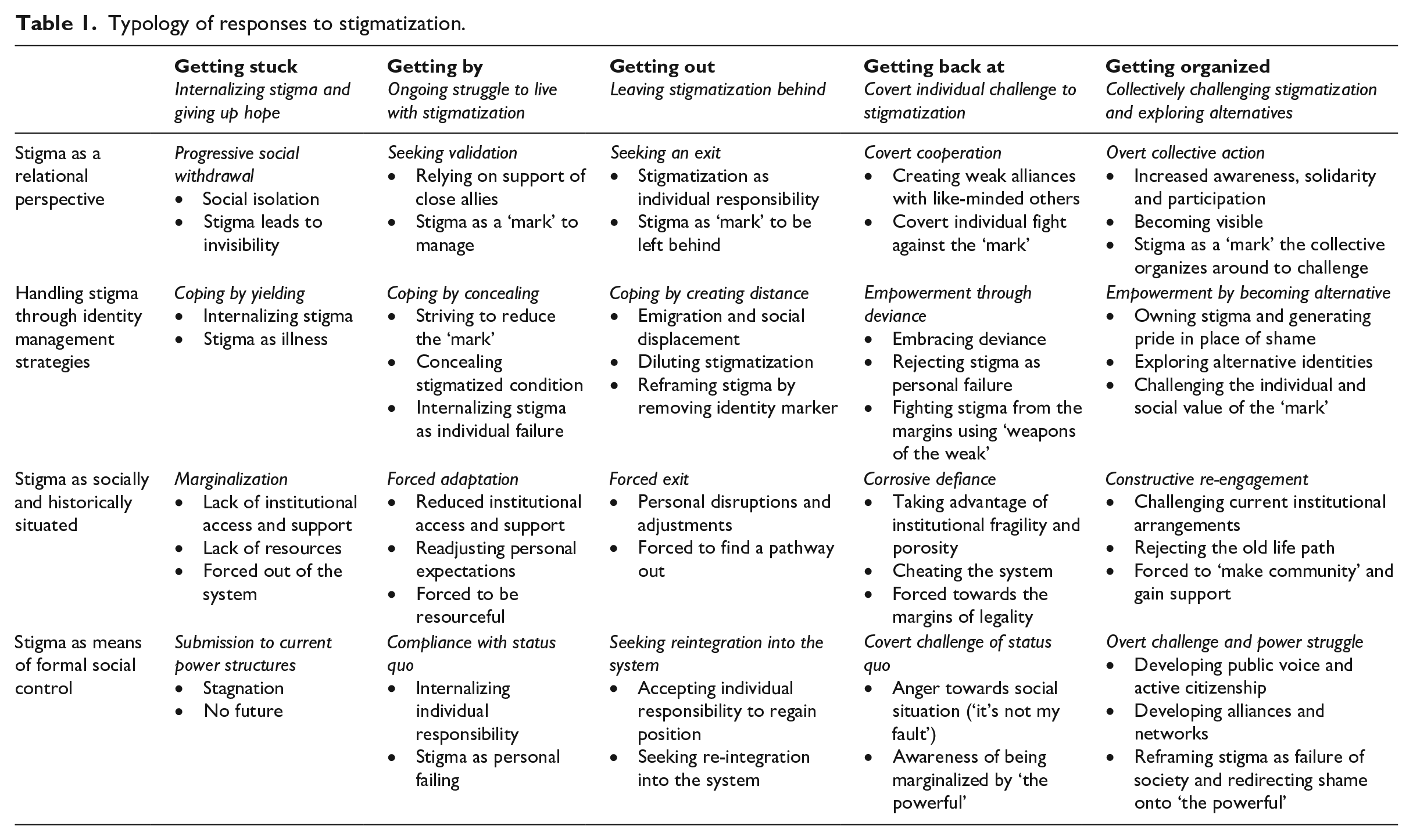
The aggregate dimensions, which are partially informed by Lister (2015), account for the following responses to unemployment stigmatization: getting stuck (internalizing stigma and giving up hope); getting by (ongoing struggle to live with stigmatization); getting out (leaving stigmatization behind); getting back at (covert individual challenge to stigmatization); and getting organized (collectively challenging stigmatization and exploring alternatives).
Getting stuck
Those getting stuck have become alienated from work and deprived of the benefits it affords, along with being stigmatized as ‘worthless’ members of society. They reported being ‘worn down’ by their situation and assume the stigma.
As a relational process, unemployment stigma disrupted interactions, introducing uncertainty into social relationships as the unemployed were seen as uncomfortable for peers and problematic for society, so those getting stuck progressively withdrew from social contact and became ‘invisible’. Internalizing the stigma resulted in respondents identifying themselves as ‘a burden’ or ‘worthless’. Furthermore, unemployment and the deprivation it brings increased lack of access to cultural, leisure and social opportunities, extending the social isolation. The result was depression, exclusion and general difficulties in coping with a life full of material losses and psychosocial illness.
You start to enter a tunnel where everything seems normal, but things are not like that either. There are many depressions, many obsessions, a lot of rejection by principle to everything. One also becomes ashamed, numb and forgets to pay attention to the most basic life processes. You ‘become’ unemployed. (Sofía)
The stigma attached to being unemployed can become a self-fulfilling prophecy by entering vicious cycles of discouragement and ever lower expectations of successfully leaving unemployment. Initially, to get by, people looked actively for work, but, as time passed without finding a job and the possibilities of returning to the labour market diminished, some respondents regarded their situation as ‘closed’, resulting in stagnation, reduced social interactions and increased social isolation. Long-term unemployment closed down hope for any ‘normal’ future and reduced the unemployed to passive subjects of the status quo and of current power structures. The extreme response to lack of hope was suicidal ideation as the embodiment of the stigma: assimilation of being stuck where the only way out was to end life.
At home, we talk about the same thing day in day out. ‘Let’s see if something happens today’. Every day we wake up with expectation and go to bed worse. (Rosario) I had several suicide attempts. I was in a rough situation and unable to get out of it. People tried to help me, and I rejected their help. At that time, for me, the way out was either to kill myself or to end up in a bad way. (Crow)
Thus, getting stuck is the response to the prevailing stigmatized understanding of unemployment as deprivation, where the unemployed lack the material, social and psychological benefits associated with employment. Alternative responses emerge, however, with many among our respondents deploying several strategies to manage unemployment stigma and create spaces to resist the stigma and fight for their needs, enact support and achieve social change.
Getting by
Resilience is evident in those getting by. Rather than challenging the system, they endorsed the stigmatizing logic by assuming the inevitability of unemployment stigmatization. They accepted that to be unemployed was a personal failing, not a failure of society, and worked towards achieving a positive social position. While some tried to justify their situation, thus concealing or reframing the stigma, they nonetheless saw their precarious situation as their personal failure.
Call it a failure, at my age and with no stable job . . . my problem, but also the context, the country I live in and its current history . . . But then we must survive. For moral reasons, I love to pay taxes, I swear. I also pay them with great pleasure . . . First, if I pay, it is because I am earning a salary. Second, because my social conscience tells me that thanks to the money I pay, I live in a better society . . . But it’s been a while since any of the jobs I had allowed me to pay taxes. They are precarious, without a contract, and very badly paid. (Cantillo)
While coping day-to-day was hard enough, becoming ‘productive members of society’ in an ‘empty job market’ was a very difficult goal to achieve. Given the stigmatization they suffered, getting by entailed adjusting expectations and priorities, changing lifestyles and living arrangements, keeping busy and being resourceful. As paid work became transient, different ways to get by emerged, such as bartering, vending unlicensed food, or working out alternative arrangements to make do and dilute the stigma by being productive.
Sometimes I do crafting workshops for birthday parties. Now I’m doing food bartering . . . I cook meals for people and keep half for my family. They bring the ingredients and I cook a nice stew, or traditional meals that need time. I offer services in exchange for half the meal to feed my kids. (Mercedes)
Respondents also attempted to dilute the stigma by following ‘activation policy’ expectations: filling their days sending out CVs, leveraging contacts, enrolling in training, or simply engaging in ‘activities for activities sake’ to avoid retreating into getting stuck. While reducing, altering or avoiding stigma aimed at acceptability, the taint of stigma remained when applying for jobs, with long-term unemployment counting against applicants.
I’ve sent a lot of CVs but being out of the market for such a long time doesn’t help . . . People have prejudices; they think my time is over. That’s what I’ve been told. (Peral)
It required much work to conceal being unemployed and avoid negative judgements. People felt at risk of their condition becoming known when, for example, they sought help from charities, or when they were seen in visible locations, such as food banks, which generated strong feelings of stigma.
Going to [charity] for food and necessities, we feel very ashamed. In the supermarket where I go, the cheapest around, I bumped into another woman who also goes to the charity. We both looked at the other’s trolley and felt uncomfortable seeing each other there. (Sara)
Respondents were careful as to who they disclosed their situation to, turning to family and close friends for financial and emotional support. But even that support could bring shame, such that respondents concealed their unemployment to pass themselves off as members of the non-stigmatized majority. Neither strategy proved satisfactory, and many relationships were lost, increasing the risk of further isolation and invisibility.
I’ve lost friendships. I don’t know if it’s the people who are pulling away because I can’t keep up, or it’s me, unconsciously shutting myself away. So yes, I have lost friendships. People meet to have a drink and I can’t, and one day you justify yourself, but you end up not being there, and suddenly you disappear. (Sara)
The reliance on others to validate their adequacy and the frantic day-to-day hard work of getting by shows the strength of their resilience, but also underscores the precariousness of their situation.
What sort of future am I giving my kids? It’s not about me anymore, the stigma goes on. We just survive. Every night, after dinner, I think ‘thank God, we made it today’. (Mercedes)
While they had lower expectations of finding employment, those getting by were stigma conscious and highly valued getting a job to be productive members of society.
Getting out
Those getting out also worked on overcoming the stigma associated with unemployment. They did not question their unemployment situation nor consider challenging the system over it. Rather, being an issue of personal responsibility, for some, responding to the disruption and exclusion from stigmatization meant finding work to become accepted by the non-stigmatized majority. They engaged in efforts to free themselves from the stigma by doing precisely what society expected of them, that is, by getting a job, no matter how badly paid, even if that entailed displacement through, for example, emigration. Others countered exclusion and stigma through redefining or de-centring employment as their main identity marker. The value of any job increased as a job provided the means to regain a position and endowed the subject with dignity and the acceptance afforded the employed.
I don’t want to be unemployed. I tried getting a job in what I was doing before. When those doors closed, I knew I had to take any work. You lower your expectations. So, through an acquaintance, I got a job cleaning buses. She said, ‘How are you going to do cleaning with a CV like yours?’ And I said, ‘I have a family, I can’t be squeamish.’ You need the monthly pay cheque. Sad that someone who has worked abroad with specialized knowledge is washing bus windows. But you must adapt to what is there. (Aitor)
Adapting is very much in keeping with the neoliberal expectation of individuals being responsible for their own unemployment situation, even if it meant displacement, uprooting, and having to leave the country to find work. Getting out by emigrating is part of the country’s collective memory as prior generations also left to escape famine or dictatorship. The destination was not always clear, nor whether they would return.
I’m 29 years old and have a degree in business administration. I had to run away from Spain because there is nothing there. The government doesn’t know how to sort it out. (Guillermo) Everyone is thinking about leaving the country to find work, but where to go? We all have relatives who left. My parents emigrated to Switzerland. My mother regrets coming back to Spain; she thinks we would have a better future there. (Mariluz)
Neither those getting by nor those getting out challenged their unemployment stigmatization or the system in any meaningful way. While they showed awareness of their condition and bemoaned the system that stigmatized them, they did not actively resist or challenge the way things were. Instead, understanding unemployment as a taken-for-granted part of life, as opposed to something socially and historically contingent, they sought to conceal the stigma (getting by) or leave it behind (getting out) in efforts to become more acceptable to a society that positioned them as inadequate for being unemployed. The expectation was that the unemployed would develop the resilience necessary to both contend with and overcome their stigma. In this way, neoliberal arrangements deftly deployed control to induce the unemployed to comply with the status quo, while at the same time relocating responsibility and suppressing any demands for change.
Getting back at
Not everyone accepted the stigma attaching to unemployment. Angry at being stigmatized for something that was not their fault, some unemployed were aware they were being marginalized by those more powerful and they engaged in covert resistance. Relying on weak alliances with like-minded others, they rejected the stigma connected with unemployment. Thus, the everyday or covert resistance of getting back at the system afforded a sense of empowerment to what were relatively powerless individuals in difficult conditions. As the system did not work for them, they took advantage of any institutional gaps to make a living and fight the ‘unproductive citizen’ stigma.
Embracing deviance and refusing to accept the stigma of unemployment as a personal failure, they fought the stigma from the margins using the ‘weapons of the weak’. To work in the black economy was a common, if difficult, choice, as it needed to be concealed to avoid attracting institutional sanctions and further stigma as ‘cheats’. For some, angry about their situation, ‘cheating’ the government out of taxes was a way to take from the state and give to those who needed it more.
When people ask, ‘how many people do you know working in the black economy’, I say, ‘ask me how many are working in the real economy’. The news said that one in five unemployed and one in ten working admit to being paid undeclared salaries. I am working in the black economy, giving English tuition. It’s the only way many people afford private classes for their kids. (Sofia)
For others, getting back at the system meant embracing such practices as stretching the truth, telling lies, or flirting with illegality, which risked yet more societal repudiation. But, in a context where survival was seen as an individual responsibility, the desperation was such that even morally questionable options were pondered, however fleetingly.
Me and my two brothers are unemployed, living with our mother. We all live off her €426 monthly pension and charity. We hope she will live for many years to come . . . I try to find work, but, sometimes, I wonder if I shouldn’t rob a bank or deal drugs, go to jail, get fed there, come out and get benefits. (Paco)
While they used whatever weapons they had to get back at the system, their resistance was insufficient to meaningfully challenge the way things were. Also, given its covert form, getting back at the system lacks the potential to engage the collective and to organize for change. Thus, while people opposed neoliberalism, in the absence of being able to organize, they were resigned to nothing changing.
People do not agree with austerity. It is resignation. They don’t know how to coordinate and confront the situation. They can’t project themselves forwards. They do not assume the institutional discourse is valid; rather, they are unable to act and coordinate themselves. So, people are still trying to find a way to engage actively. (Paca La Monea, Flo6x8)
Getting organized
In responding to the stigmatization wrought by unemployment, those getting organized acted collectively to construct empowered and de-stigmatized spaces to challenge both the system and their given position while exploring alternatives. Their resistance included organized collective actions in established and recognized public arenas (e.g. banks, squares, parliaments) and spontaneous uprisings and demonstrations in neighbourhoods that created informal and temporary political arenas. In getting organized to challenge their ‘spoiled identity’, the unemployed transformed from invisible precarious subjects into visible actors with a voice in the public sphere, able to develop new alliances within the community and with different social and political institutions. Working collectively towards a common ideal (‘utopia’), they encouraged high levels of participation and commitment from the collective.
I stood up, looked at the women and said, ‘The drums of war are beating. What we’ve been through can’t be ruined by a fucking press release, you can’t throw away a year of struggle, because some people are tired. We are lionesses, we fight tooth and nail until we are crushed, but we have to be crushed, we are not going to throw in the towel, right? Come on, what do we do?’ And they began to raise their hands and decided to hell with the bank threats. We were going to fight for the building. (Viqui)
For Corrala Utopia, getting organized entailed becoming active citizens by establishing and maintaining regular assemblies, working committees to deal with different tasks between neighbours and supporting organizations, parties to gather funds, professional training workshops, social mediation, theatre workshops for children, etc. Additionally, they set up a formal negotiating table between the building owners, the town hall, the local ombudsman and the regional government.
At Corrala Utopia, we are few, but we got it tight. We are committed, each one knows what she contributes to the group, not everyone is the same. We share the work, we discuss the issues from the assembly, and when there are mobilizations, the rest of the comrades pull in. Each one does the work she thinks fits, that she likes, and that is healthy. No one feels forced; we distribute the work in a fair way. (Verena)
Corrala Utopia participants held numerous demonstrations, lockdowns, camping events at official buildings, and even a hunger strike. Their level of activity was close to frantic, but they managed to legitimize their work, rejecting the stigma as a ‘mark’ of social disgrace, and generating pride in place of shame.
There is clear support amongst the collective, despite the stress and fear, as any day the police are going to come and evict them. Seeing how they made everything happen, without water and electricity for such a long time, the struggle brought them together. Social services even threatened to take their kids, and they raised hell, gaining the support of the whole neighbourhood. This spirit and support have carried them through all the way. You endure to resist. It changed them. (Candela)
Flo6x8 engaged differently, by exploring alternative modes of engagement and using the body, through music and dance, to challenge the stigma associated with unemployment, and to question the role of the government and the banking system. Their flamenco performances seemed spontaneous flash mobs but were, in fact, highly orchestrated, in a guerrilla style manner. They promoted anonymity and the use of alternative identities, for example, their participants used code names (e.g. ‘Maria La Deuda’ – ‘Mary the Debt’) to avoid personalization and strengthen the voice of the collective in questioning the system. The performers in front of the camera were constantly changing, but their use of flamenco as a combative language, the disruption of a bank branch’s working day as a brief ‘occupation’, for no longer than four minutes, and the use of social media networks remained a constant challenge to established institutional arrangements.
Flo6x8’s proposal is interesting. When talking about precarity, things are articulated from two standpoints – violence or compliance – as the only two ways of handling the complex situations people are facing. Our proposal is to go beyond those two poles. We are interested in going where we can fight and laugh, leaving behind precarity and challenging the neoliberal state. (Paca La Monea, Flo6x8)
Returning flamenco to its political origins, as a countermovement with strong symbolic power as a cultural expression of southern Spain, Flo6x8’s mobilizations served to strengthen the collective through resilience, while engaging in overt resistance.
Our performances empower whoever does them. It gives people a capacity to position themselves differently in the world. . . .Flo6x8 is not a panacea, it is a proposal within a very complex world. It is a breath of air, but then the world goes on with its many problems. Flo6x8 empowers people and provides an immersion in joy and excitement; it’s cathartic. (Moody, Flo6x8)
Through constructively re-engaging within their social and institutional context, the participants in both Corrala Utopia and Flo6x8 made community to protect each other against others’ judgements and enable support. They created strong feelings of groupness, counteracting their vulnerability to exclusion, and constructed safe spaces against stigmatization, going as far as creating a different understanding of society.
What is ‘public’ is being created by the people, and that is tremendously powerful when you see it happening. We’re really building community and democracy, down below, in the neighbourhoods. (Fiskalita, Flo6x8)
In defining a distinctive community, they came to realize that they were not on their own. Such realization brought with it a sense of worth and freedom, along with pride and dignity, to resist the negative influence of stigmatization.
In Corrala Utopia you cannot live with a closed door. The main door downstairs is closed, but in the building, all doors are open, and the neighbours live with each other daily. Individualism disappears in favour of the community and the community goes beyond your group of friends, or the neighbour next door to you. It goes beyond, to reach the whole collective. (Candela)
Members of Corrala Utopia and Flo6x8 became visible, developed a public voice and managed information to resist their stigmatization. They actively acknowledged their unemployment and homelessness, neither of which they saw as their fault, and challenged the associated stigma. Relatedly, to reshape interpretations, they sought to reframe the stigma as a failure of society and not the individual. In rejecting the stigma, they also refocused attention and explored creative alternatives to support themselves and challenge the very system responsible for their stigmatization.
It was a matter of saying it loud and clear: you are not to blame. Banks are. Once that was clear, we wanted to talk about the debt, how many generations will take to pay it. We wanted to name it, to spread it around, and we decided what sort of flamenco type to perform it . . . At times things don’t work out. You put an idea forward and the rest of the collective say, ‘take a chill pill’, you must start all over. Occupations are like that. It seems tactical, but it’s all about the strategy. (Pastako, Flo6x8)
Through personal narratives, political candour and the common sense emanating from the truths of their misfortunes, Corrala Utopia co-opted the imagination of the public in Seville and beyond, mobilizing supportive audiences in resisting their stigmatization. Housewives became community leaders and, through coming together, transformed the individualized guilt of the evicted into a collective demand for better housing. After two years of occupation, with no access to electricity or water, the members of Corrala Utopia were evicted (April 6th, 2016). The massive use of force by the police provoked a strong reaction from the city’s people and the mass media, which eventually resulted in most members getting social housing. Many of the women remain politically active to this day. Flo6x8’s actions, some of them viral, also demanded institutional accountability and social change. While their interventions happened in bank branches, effectively transforming the businesses into flamenco shows, they mobilized support against the stigmatization of the unemployed through co-opting those accidentally present at bank branches, along with the virtual audience on social media.
The members of Corrala Utopia, Flo6x8 and other collectives contested the stigma associated with unemployment, encouraging more proactive resistance. Over time, they disassociated unemployment from emotions like shame and failure, shifting towards becoming active, engaged and political. They practised overt resistance and articulated an oppositional culture to reject dominant views and negative social constructions, along with expressing dissatisfaction with dominant groups, including turning the shame back on them.
We want to overcome the stigma of unemployed workers. The ones to be shamed are our politicians, as they keep on paying, with our public money, for the crisis generated by the banks whilst they doomed us to emigrate or die of hunger. (Seville Unemployed Assembly, May 2014)
A typology of responses to stigmatization
Linking our empirical insights back to Goffman’s four claims in relation to the process of stigmatization presented earlier, we derive a typology of five responses to stigmatization (see Table 1). We elaborate on our typology, as part of our contributions, in the discussion that follows.
Typology of responses to stigmatization.
Discussion
Goffman (1963) defined stigma as a ‘mark’ of social disgrace, emerging within social relations and excluding those who bear it from full social acceptance. People with such ‘marks’ acquire a ‘spoiled identity’ leading to various forms of social exclusion. While there is much research looking at ‘what stigma is’ or how it can be managed at different analytical levels (Zhang et al., 2021), there is minimal research on what the stigmatized can do to potentially overcome stigmatization.
In contrast, we investigated how stigmatized actors, such as the unemployed, can challenge and potentially overcome stigmatization, uncovering a typology of five different responses. Our analysis shows how, under certain conditions, the stigmatized can contest and transform stigmatizing practices through collective action allowing for resistance and change. We show how the stigmatized respond to stigma by developing the skills, support networks and resources that enable them to: (i) think critically about their imposed negative identity; (ii) find the resilience and capacity to resist it; (iii) collectively develop more inclusive alternatives; and (iv) build the alliances and networks that would eventually facilitate change. What follows details how we expand research in organizing and stigmatization.
Repairing ‘tainted’ identities
Unlike research focusing on stigma as the ‘mark’ individuals must cope with or on its management in isolation (Zhang et al., 2021), we show stigmatization as a relational process involving the self, others, and the context where the ‘mark’ is produced, maintained and potentially contested. Stigmatization reduces the person ‘from a whole and usual person to a tainted, discounted one’ (Goffman, 1963, p. 3) so that stigmatized actors, such as the unemployed, are seen and acted upon as less than the normative other. People are then forced to manage the negative effects of stigmatization through strategies of identity management, such as coping (e.g. acceptance, concealment) or resistance.
Acceptance is the main response from those getting stuck as they progressively withdraw from social interactions, becoming ‘invisible’. Having no recourse, they cope by yielding to the power structures that stigmatize them. With decreasing institutional access and support, they become marginal, ‘wasted humans’, ‘redundant’ to the system, the ‘inevitable outcome of modernization’ (Bauman, 2004, p. 5). The experience of those getting by accords with existing research that assumes targets of stigma want to demonstrate they are, and be perceived as, ‘normal’ and decouple from stigmatizing practices to conform to broader social values (Hampel & Tracey, 2017). Great effort goes into concealing or managing the shame associated with unemployment, for example, along with distancing from it to appear ‘normal’. Therefore, getting by is not a passive stance, but an expression of active engagement in trying to manage a stigmatized identity, and it requires strong levels of resilience and resourcefulness. The difficulties experienced in getting by illustrate the hard choices the stigmatized must make and the vulnerabilities that can undermine their attempts to improve their situation. Getting out, which illustrates the inevitable ‘exit’ strategies the stigmatized use as ‘destigmatization’ (Hampel & Tracy, 2017), does not seek to overcome stigma but to dilute it or leave it behind and avoid (self-)demeaning identifications, ‘failing’ and getting stuck. Although ‘exiting’ (accomplished or simply aspired to) seems to be what many living with stigma are left with as an alternative to acceptance, it is simply part of the array of everyday practices necessary to deal with the ‘taint’ and repair the self. The objective of all those getting by or getting out is to regain voice and dignity, and to be proud again of their accomplishments, no matter how small (Martí & Fernández, 2013).
Stigmatization, as a relational perspective, exists also in the eye of the beholder, being imposed on others and often jarring with their sense of self (Goffman, 1963). This creates tension and a potential space of struggle and negotiation where those stigmatized can organize to challenge and so reject or at least disrupt stigmatization practices and ideologies (Shih, 2004). This is not a matter of ‘thinking oneself’ out of the structural realities of stigma; rather, it is a matter of organizing to mobilize collective anti-stigmatizing projects and build resistance. It is in getting back at the system and getting organized that the stigmatized, such as the unemployed, explicitly challenge their stigmatization and resist expectations of what it is to be unemployed. They provoke and experiment with new identities and lifestyles ‘against-in-and-beyond’ prescribed roles (Baaz et al., 2016), embracing ‘deviance’ and even owing the ‘mark’ itself (Johansson & Vinthagen, 2016). Our analysis uncovers the ways in which agents in stigmatized positions resist – eventually to perhaps overcome – stigmatization, making it possible to re-elaborate identities and redefine prospects and projects (Mumby et al., 2017).
Sustaining resistance to stigmatization
We expand research criticized for sidelining the structural conditions that create stigmatization while portraying the stigmatized as passive victims of those conditions (Helms et al., 2019). Certain stigmatized conditions, such as unemployment, are associated with relatively low levels of collective action (Giugni, 2016, p. 3), encouraging representations of the stigmatized as lacking collective agency. This is not surprising given the toll that stigma takes and the obstacles to getting organized. However, rather than being voiceless and unable to interact with those who stigmatize them, we show how the stigmatized are not only able to live with stigma or create distance by leaving it behind but, under certain conditions, they can challenge stigmatization through collective action enabling resistance and change (Helms & Patterson, 2014).
Most anti-stigmatization initiatives advocate training or ‘activation policies’ to ‘get out’ of stigma or resilience to cope with it (Schmid, 2012). However, for those getting by or getting out, the championing of resilience both sustains and institutionalizes the understanding that the unemployed, for example, are solely responsible for their own social and economic security (Krug et al., 2019). Such championing requires the unemployed to both ‘accept the necessity of living a life of permanent exposure to endemic dangers’ (Evans & Reid, 2013, p. 95) and be ready for and capable of adapting to unpredictable circumstances. Traditional conceptualizations of resilience (Neocleous, 2013) as bouncing back ‘heroically’ in reaction to the extraordinary event that shatters the ordinary are not useful for understanding how the stigmatized have to constantly adjust once the stigma becomes ‘ordinary’. Furthermore, being resilient is neither a ‘heroic’ behaviour to aspire to, nor the ‘hidden resource’ to tap into when tackling stigmatization and social exclusion (Diprose, 2015). Heroic understandings of resilience have been used to downplay the importance of collective action and public intervention, but, as our findings show, collective organizing is necessary for both survival and adaptation. Thus, resilience requires resistance to overcome stigma.
Getting back at emerges where there is resentment against the system and results in covert resistance practices such as oppositional cultural expressions and dissociation from traditional social arrangements. Unlike more overt forms of resistance, however, getting back at tends to be more individual, informal, covert and concerned largely with survival (Scott, 1985). It is in getting organized that the stigmatized explicitly challenge their stigmatization and the institutional power politics (Johansson & Vinthagen, 2016) that sustain the status quo and stigmatize them. In getting organized, stigmatized subjects transform into actors with a voice in the public sphere, able to develop new community relations, including with different social and political institutions.
Notably, organizing and mobilizing to resist stigma also requires resilience if resistance is to be sustained and highlights the importance of prefigurative organizing, where ‘everyday practices are used as building blocks to construct a hoped-for future in the present’ (Chatterton & Pickerill, 2010, p. 476). Resistance becomes sustainable through resilience. Sustainable resistance responses enable the stigmatized to engage purposefully to survive and develop in pursuing their own, as well as social and institutional, transformation. Sustainable resistance responses generate two interrelated cross-level outcomes: the stigmatized start to repair their own self-image, and move from stigmatized representations of the self, as they work on repairing depleted social fabrics by strengthening community and belonging.
Developing inclusive alternatives and building networks for change
Resisting stigmatization is a collective endeavour; the stigmatized cannot be left to take responsibility for bearing the very real consequences or ‘think themselves’ out of stigma. Through getting organized, we see the stigmatized coalescing around the ‘mark’ of stigma and their shared hardships and sacrifices and, through intense day-to-day organizing, build the ‘interpersonal relations of trust’ (Haug, 2013, p. 712) that make community and a collective sense of belonging possible. Those getting organized can draw strength from the participatory architectures they create to both negotiate and manage the significant stress and stigma of their situation. They can create spaces wherein to build and strengthen relationships and shared understandings, and informally negotiate and resolve tensions and conflicts. Such prefigurative organizing provides ‘an important means of forging ties of solidarity and reciprocal identification between members’ of the collective (Fominaya, 2010, p. 388), while at the same time building ‘nurturing capabilities, in effect developing resilience, empathy and coping skills that build community as a bedrock for more oppositional identities and actions’ (Chatterton & Pickerill, 2010, p. 481).
Getting organized entails developing safe spaces that can nurture strong feelings of groupness, both protecting from stigmatizing outsiders and enabling support, and creating participatory spaces that enable sustained and productive dialogue, allowing multiple voices to be heard. It entails building community relationships beyond traditional social structures with collectives in similar circumstances looking for ‘equality, comradeship, and common humanity outside normal distinctions, roles, and hierarchies’ (Olaveson, 2001, p. 93). Through such spaces and relationships, the stigmatized can develop shared feelings of ‘communitas’, the deeply felt (yet often temporary) sense of belonging and community (Turner, 2012). These communitas relationships give them a purpose and identity, allowing them to go from being disenfranchised to becoming actively engaged in challenging their stigmatization. Shared experiences of communitas are underpinned by an increase in self-understanding, a focus on social coordination and a collectively felt sense of new possibilities.
The fleeting experiences of communitas, cooperation and engagement might not always last, but their effects can be transferred to other social contexts where those who experience such effects feel ‘refreshed, renewed and reinvigorated’ (Matei & Britt, 2011, p. 3). These experiences can also serve as catalysts for change within wider social contexts. While communitas does not often endure in itself, ‘in disintegrating, [it] irradiate[s] the society with people who don’t forget the advantages but try to realize them in new ways’ (Goodman & Goodman, 1990, p. 109). Hence, individual changes due to stigmatizing experiences that bring about personal reflections can transfer more broadly to collective transformations. Further, these prefigurative and incomplete processes of collective organizing to resist stigmatization and social exclusion are illustrations of how ‘small wins’ and the ‘footprints’ they leave behind can enable progress and social change.
Contribution and conclusion
Our typology expands our understanding of stigma in several ways. First, it moves beyond the largely individualistic focus of extant research and its interest in managing the ‘mark’ to present stigma as a multilevel phenomenon that affects individuals but is mediated by material, political, institutional and symbolic contexts. In so doing, we highlight the importance of straddling the individual and macro-social analyses of stigma.
Second, our typology makes explicit that the operation of stigma can only be understood in relation to its socio-historical contexts and unequal power relations. Being ‘marked’ does not only ‘taint’ the stigmatized but also produces and sustains material inequalities and is anchored in histories of exclusion. Capturing different responses to stigmatization in one typology enables us to see the full spectrum of responses from individual compliance, to change, to resistance. Our typology shows that where there is power there may also be resistance and challenges perspectives that position the stigmatized as passive and non-political, thereby leaving social inequalities and the stigma they create intact.
Third, we show how resisting stigma needs to be a collective enterprise – something located within very particular circumstances, reliant on resources, resilience, and collective will. The stigmatized cannot be left to take responsibility for bearing the very real consequences of stigma, or ‘think themselves’ out of stigma. Anti-stigma initiatives need to address the material, historical and political nature of stigmatization, and explore the conditions and possibilities for an organized response to reassert dignity and agency, and produce social change.
Thus, drawing on Goffman (1963), our typology makes explicit that stigmatization is generated in social contexts, socially and historically situated, and employed as a means of social control. Further, rather than being a diversion from tackling the conditions that make stigmatization possible, getting organized shows us how stigma can be used to mobilize actors to both challenge the prevailing order that sustains it and explore alternatives.
Footnotes
Acknowledgements
The authors would like to thank Dr. Natalia Concha and Dr. Gonzalo Martinez for their outstanding research support in the early stages of this manuscript, as well as the three anonymous reviewers and Special Issue editors, especially Markus Höllerer, for their encouraging and constructive guidance.
Funding
The author(s) received no financial support for the research, authorship, and/or publication of this article.
