




Abstract
Increasingly we are faced with broad societal challenges that encourage us to rethink existing institutions. Yet many people also want to preserve institutions they cherish. This tension points to the need for change that can erode or discontinue unsustainable or problematic aspects of institutions while also maintaining what is sacred and valued. In this paper we ask how can organizations deinstitutionalize taken-for-granted practices while also preserving the institution? We answer this question by exploring how Trout Unlimited deployed visual and discursive tactics to push out unsustainable catch-and-harvest fly fishing practices and insert new catch-and-release practices. Our primary theoretical contribution is a model of repair-focused deinstitutionalization, illustrating how custodians utilize three forms of work to respond to threats—mending, caring, and restoring—all with an eye on deinstitutionalization via repair rather than disruption. Importantly, we show how the construct of repair is multipurpose, not limited to maintenance strategies, but can also be a catalyst for change. In addition, we extend research on deinstitutionalization by presenting a multimodal approach that goes beyond discourse, with particular attention to visuality and show how different modalities present different affordances in longer-term repair efforts.
Keywords
The Philosophy of Trout Unlimited. . .believes that trout fishing isn’t just fishing for trout. It’s fishing for sport rather than for food where the true enjoyment of the sport lies in the challenge, the lore and the battle of wits, not necessarily the full creel. It’s the feeling of satisfaction that comes from limiting your kill instead of killing your limit. It’s communing with nature where the chief reward is a refreshed body and a contented soul, where a license is a permit to use—not abuse, to enjoy—not destroy our trout waters. It’s subscribing to the proposition that what’s good for trout is good for trout fishermen and that managing trout for the trout rather than for the trout fishermen is fundamental to the solution of our trout problems. It’s appreciating our trout, respecting fellow anglers and giving serious thought to tomorrow.
This creed was authored by Trout Unlimited’s (TU) founders in 1959 and illuminates a fundamental shift in the way fly fishing was conceptualized and should be practiced. Although fly fishing was originally a means of obtaining sustenance, harvesting practices came under scrutiny in the wake of environmental scarcity and threats to the survival of wild and native trout. In response, and seeking to preserve fly fishing, catch-and-harvest practices were eroded—deinstitutionalized—and then replaced with catch-and-release practices, where a caught trout is carefully released back to the river unharmed.
As our example illustrates, deinstitutionalization can be an important vehicle for change. It is “the process by which the legitimacy of an established or institutionalized organizational practice erodes or discontinues” (Oliver, 1992, p. 564). As we are faced with broad societal challenges that encourage us to rethink existing institutional arrangements, understanding processes of deinstitutionalization has become increasingly important. For example, how might we adapt in response to various environmental threats, such as climate change, by shifting away from carbon-based economies? When change is necessary, but people also want to preserve cherished institutions, we may need to identify avenues that enable us to maintain what is sacred and valued, while simultaneously eroding unsustainable aspects. Efforts to balance preservation with adaptation spotlight some of the possibilities that deinstitutionalization presents for discontinuing unsustainable practices while also responding to societal challenges.
Existing literature on deinstitutionalization has illuminated some of the ways in which actors can destabilize established practices (Dacin & Dacin, 2008). For example, Maguire and Hardy (2009) found that outsiders working as activists used combinations of factual arguments and justified reasoning to erode the continued use of DDT. Hiatt, Sine, and Tolbert (2009) found that discursive criticism undermined the normative, cognitive, and regulative aspects of alcohol consumption, as the Women’s Christian Temperance Movement brokered prohibition to cripple what they perceived as an immoral industry. The literature on deinstitutionalization has, thus, characterized this process as one that is highly disruptive. That is, deinstitutionalization is usually the result of efforts aimed at institutional disruption, where actors seek to completely undermine an institution and push for its eradication. However, just as institutional change can involve both maintenance and disruption (Lawrence, Suddaby, & Leca, 2009), and drawing inspiration from examples of institutions facing entropy and crisis (Gutierrez, Howard-Grenville, & Scully, 2010; Montgomery & Dacin, 2020), we suggest that deinstitutionalization may also be focused on repairing rather than threatening institutions. We argue that this type of repair-focused deinstitutionalization is important as it allows invested actors to preserve valued aspects of the institution while changing other aspects that may have become unwanted or unsustainable.
The distinction between repair-focused and disruptive-focused deinstitutionalization is critical because the strategies deployed in disruptive-focused deinstitutionalization are frequently designed to threaten the institution itself. For example, environmentalists and First Nations groups turned to provocative tactics to disrupt institutionalized forestry practices in British Columbia, dubbing clear-cutting as “earth rape” and labeling forestry companies as “criminals” (Zietsma & Lawrence, 2010, p. 204). Disruptive strategies are often driven by outsiders waging a “direct assault” on an institution as a whole (Oliver, 1992); the deinstitutionalization of DDT we mentioned above was triggered by outsiders such as Rachel Carson (Maguire & Hardy, 2009), while the decline of French classic cuisine was inspired by cognate fields and protests (Rao, Monin, & Durand, 2003). Deinstitutionalization efforts aimed at repair and renewal, thus, can be expected to use different tools and tactics than those deployed in disruptive deinstitutionalization. Yet we know very little about this approach to deinstitutionalization. Specifically, rather than “attack” the normative systems and cognitive understandings underpinning the institution, actors may need to engage in more subtle efforts to convince individuals involved and embedded in the institution that certain long-standing practices need to be eliminated in order to preserve the institution and these shared conceptions. Repair-focused deinstitutionalization, thus, becomes a pathway towards renewal and institutional resilience (Montgomery & Dacin, 2020).
Seeking to extend our theorizing and understanding of deinstitutionalization, we ask the following research question: How can organizations deinstitutionalize taken-for-granted practices, while also preserving the institution? We explore this question by examining the deinstitutionalization of catch-and-harvest fly fishing practices, and the maintenance of fly fishing through a shift to catch-and-release practices.
We offer three contributions. First, our primary theoretical contribution is a model of repair-focused deinstitutionalization, detailing how custodians rely on three varieties of work to respond to threats—mending, caring, and restoring—all with an eye on deinstitutionalization via repair. Problematic practices are pushed out and new practices are inserted, all while the core of the institution is preserved. Our model adds to research where change is necessary, but actors also want to preserve valued aspects of institutions (Gutierrez et al., 2010). Second, we illustrate how repair can be more than an institutional maintenance tactic (Micelotta & Washington, 2013); repair-focused efforts can also be a catalyst for change in the spirit of renewal and resilience. Third, we advance research on deinstitutionalization by presenting a multimodal approach, moving beyond models limited to verbal and textual discourse (Maguire & Hardy, 2009) to also include visual tactics. Therein, we show how different modalities—images and words—present different affordances, all of which are important in longer-term repair efforts.
Repair-Focused Deinstutionalization
Deinstitutionalization and repair
Deinstitutionalization involves the processes by which established practices are disrupted, erode, or disappear (Oliver, 1992). Deinstitutionalization is widely viewed as both a component and consequence of institutional change. For example, in Greenwood, Suddaby, and Hinings’ (2002) seminal piece on institutional change, they theorized a change process whereby jolts trigger deinstitutionalization, leading to preinstitutionalization, theorization, diffusion and reinstitutionalization. More recently, Micelotta, Lounsbury, and Greenwood (2017) suggested that deinstitutionalization is the outcome of institutional change efforts. Similarly, Ahmadjian and Robinson (2001) examined the abandonment of institutionalized practices as an outcome of deinstitutionalization.
In most of these conceptualizations, deinstitutionalization is the result of efforts to change an institution. In this understanding, since institutions are defined as “more-or-less taken-for-granted repetitive social behavior that is underpinned by normative systems and cognitive understandings” (Greenwood, Oliver, Sahlin, & Suddaby, 2008, p. 5), deinstitutionalization has involved attacking these normative systems and cognitive understandings to eliminate the “social behavior”—a given practice. This sets the stage for new understandings and practices to be institutionalized via the pathways of theorization and reinstitutionalization (Greenwood et al., 2002).
Disruptive strategies working to challenge existing normative and cognitive understandings have often tended to be severe, setting aside any possibility of preserving aspects of a targeted institution. For example, the Women’s Christian Temperance Movement disrupted alcohol’s normative underpinnings by educating the public about its dangers and asking supporters to pledge to abstain from drinking as morally unacceptable (Hiatt et al., 2009). Mandatory scientific temperance instruction in schools painted alcohol as a source of societal problems, further challenging common cognitive understandings of alcohol. The movement’s primary goal was to eradicate drinking altogether, replacing alcoholic drinks with non-alcoholic alternatives. This example underscores how deinstitutionalization involves efforts to reshape meaning and public opinion (Clemente & Roulet, 2015)—challenging the cognitive and normative understandings of an institution to ultimately eliminate a practice.
In contrast to these disruptive deinstitutionalization efforts, a small scattering of studies suggest there may be a different approach to deinstitutionalization. In these cases, beloved aspects of institutions can be preserved, but slight modification becomes a possible pathway for renewal and resilience (Dacin & Dacin, 2008). For example, Gutierrez et al. (2010) revealed how deeply committed individuals of the Catholic Church were able to “Keep the Faith [but] Change the Church” in the face of sexual abuse of minors by priests. This included church members protecting their spirituality, while advocating for necessary changes in the church’s practices and governance structure to preserve its normative underpinnings. While this study did not theorize this process as deinstitutionalization, we believe such studies highlight the possibility of repair-focused deinstitutionalization. This raises the question of how organizations might successfully deinstitutionalize taken-for-granted practices, replacing them with new practices, while also preserving the normative and cognitive understandings that are “core” to the institution.
Maintenance and repair
While repair has not been central to the deinstitutionalization literature, if we look at the broader institutional maintenance literature, there is a collection of articles that portray repair as viable institutional work strategies (Heaphy, 2013; Lok & de Rond, 2013; Micelotta & Washington, 2013). In such studies, repair-type work is performed when disruptions emerge or practice breakdowns threaten existing institutions and their cognitive and normative underpinnings. When disruptions occur, actors working in custodial roles—those feeling a sense of protection for an institution’s past and future (Dacin & Dacin, 2008)—skillfully contain and patch institutions as part of their repair and maintenance efforts (Heaphy, 2013). For instance, Lok and de Rond (2013) examined how major breakdown episodes within the highly institutionalized system of the Cambridge University Boat Club were met with responses by custodians working to protect institutionalized scripts and longstanding traditions. However, while these studies tend to focus on repair as means to maintain an institution and ensure that taken-for-granted practices are protected, they are more about defense than adaptation. Illustrative of this point, Micelotta and Washington (2013, p. 1138) describe repair work as “[carried] out to ‘reverse’ the disruption and re-establish the status quo.” That is, custodians work to defend the institution from threat and ensure the institutionalized practices are maintained as the ultimate goal. Deinstitutionalization, thus, is not the goal, but something custodians are actively working to avoid.
What is generally missing from the literature, therefore, is a treatment of repair that emphasizes renewal and revitalization, one that has the potential to encompass the deinstitutionalization of unwanted practices while also instituting sustainable alternatives to preserve the institution’s core. Repair-focused deinstitutionalization is not about maintaining an institution’s ideal state, nor is it about radical disruption. Currently the literature reveals how to deinstitutionalize practices radically through disruption, or to maintain institutions via repair without allowing deinstitutionalization of certain practices. However, if all deinstitutionalization is seen as a battle between disruption and maintenance, it limits our understandings of the possibilities of change. Given the complex grand challenges that society faces, such as climate change and global poverty, missing important alternatives to change may be devastating. Some forms of deinstitutionalization might necessitate increased tactfulness and care to be successful to enable institutions to be both preserved and altered at the same time. As such, our research is motivated by a desire to theorize how organizations can deinstitutionalize taken-for-granted practices, while also preserving the institution.
Method
Empirical context
Fly fishing is an angling technique that uses a rod, reel, specialized weighted line, and artificial flies intended to mimic trout’s natural food sources. The technique has been likened to spirituality; Izaak Walton dubbed it contemplative recreation in his 17th-century book, The Compleat Angler, whereas Norman Maclean described it as religion in A River Runs Through It. These spiritual references reinforce common understandings that fly fishing is intertwined with a joy for the solitude and sanctity of being with and in nature. It holistically blends the mind, body, and spirit to experience the natural cadence of flowing water. Fly fishing was long viewed as a means of obtaining sustenance through catch-and-harvest practices. Fly fishing for trout is typically done in coldwater rivers, where water temperatures are consistently cool, rock and wood structures provide habitat, and moving water remains well oxygenated. Robert Traver wrote in Testament of a Fisherman, I fish “because I love the environs where trout are found,” which were coming under attack during the mid-20th century. Threats mounted, stemming from industrialization that polluted many rivers, timbering that clear-cut riparian habitats, and overharvesting that led to depleted trout populations.
It was these threats to coldwater fisheries that ignited the founding of TU in 1959 with the goal of preserving fly fishing by restoring coldwater fisheries and adapting from harvesting to releasing practices. For TU to be successful, fly fishing could not be part of the problem, but instead had to become core to the solution. Thus, TU’s efforts focused on eliminating unsustainable harvesting practices and restoring injured rivers, while also reinforcing the meaning and values of fly fishing.
Data sources
Archives
We collected all the archives of TU. This included charter documents, chapter by-laws, news clippings, correspondence, and detailed conservation plans. This data was important because we wanted to be able to illustrate how TU worked to deinstitutionalize harvesting practices while also repairing the institution. In part, this included their founding and expansion. To collect this data we had to digitize the physical archives of TU. We photocopied each page of every document and documented each chapter’s charter year and zip code.
Our second source of archival data included state-level trout management programs, which were the documents outlining catch-and-release fishing regulations. Though created later than TU’s founding, these provided us with dates/places where new regulations emerged as an outcome of deinstitutionalization. In particular, we were interested in identifying which states had trout management programs, when they were created, and how they enacted catch-and-release regulations. These archival data included restoration projects, some describing TU’s effort to pass catch-and-release regulations, along with other restoration projects including dam removals and replanting riparian habitats.
Magazine cover images
Our main data source included photographs published on fly fishing magazine covers, which are widely viewed as “the most valuable piece of real estate for any magazine,” exemplifying the organization’s “voice” (Spiker, 2015, p. 377). Images represent a growing and important source of visual data in organization studies (Barberá-Tomás, Castelló, de Bakker, & Zietsma, 2019; Klein & Amis, 2021; Lefsrud, Graves, & Phillips, 2020), and are especially insightful when exploring how organizations reshape meaning and practices over time (Munir, Ansari, & Brown, 2021). Images are useful for capturing visuality, including gaze, as well as the presence or absence of artifacts related to particular practices.
We used an “archeological approach” (Meyer, Höllerer, Jancsary, & van Leeuwen, 2013), photographing 1,748 magazine covers archived at Montana State University’s Trout and Salmonid Special Collection, with a particular focus on collections of longstanding magazines with complete or near-complete runs. Magazine covers function as time capsules for the perspectives and practices of the people and organizations they captured (Munir et al., 2021), including how visual depictions of artifacts might shift over time as a result of efforts to disrupt longstanding practices. Our sample included Trout magazine, TU’s publication, as well as magazines published by other organizations. The different publications helped us to compare and contrast historical shifts in meaning, both over time and as an adoption of TU’s efforts. Variations in image type and perspective are a noted strength of using visual data (Bullinger, Schneider, & Gond, 2023). Online Supplement 1 details the specific magazines and runs included as part of our data collection.
Editor interviews and columns
To deepen our understanding of the editors making decisions on the visual imagery and discursive text used within the magazines, as well as their role in deinstitutionalization more broadly, we interviewed eleven editors, photographers, and TU executives. Editors and photographers have discretion on what is captured and published, but within the constraints of the expectations of the magazine’s readership. Cover image examples helped to guide interviews. Emphasis was placed on “different philosophies and practices” and how editors work to portray philosophies and practices in ways that are “fully embraced by their membership.” Interviews were supplemented with press releases and videos produced by fly fishing magazine editors, sources where editors have explicitly provided commentary on cover design, image selection, and the visual inclusion or exclusion of specific artifacts as related to particular practices.
One of the key insights gleaned during the interviews was a distinction between the visual content chosen for cover images and the written narratives provided in editorials. Editors distinguished between subtle emphases on conservation and catch-and-release fishing practice portrayed in the visuality of cover images and a more provocative voice depicted in their written columns. This discovery prompted us to return to the physical archives to capture the editorial columns for Trout magazine, allowing examination of both the visuality of the cover images and the written words crafted in their editorial columns. Editorials provided discursive written expression by the editors themselves, complementing their selection of visual images depicted in magazine covers and oftentimes provided vivid explanations of cover images. We collected editorials spanning six decades (1959–2021), which were written by a variety of editors holding the post. Capturing the aspirations of many editors over time mirrors methodological approaches used in other articles relying on magazines as data (Munir et al., 2021). Alvin Grove, Editor of Trout magazine, underscored the colorful nature of editorials in a 1976 column: It is true that an editorial does, and rightfully so, reflect the attitude of the person writing it, but it should do more than that. It can be argued that the editorial is somewhat like a sermonette: it carries a moral or outlines the good and bad consequences of actions taken or about to be taken. Sometimes, it reflects what is being done, either praising or condemning it, and, at other times, it attempts to speak to what might or should happen. . . An editorial can be soft and sweet and find everything right with the world, or it can be one of hell and brimstone and find nothing right with the world. . .
Data analysis
We began by coding the magazine covers, including general information for each magazine cover: the magazine title, publication date, and cover dominance (e.g., <50% angler, <50% river landscape). We continued by using an open-coding technique to identify visual representations of specific artifacts (e.g., creels, stringers) and visual portrayals of particular practices (e.g., grip n’ grin, keep ‘em wet), providing us with a broad inventory of visual inclusions published on the magazine covers. Appendix 1 illustrates some of our open codes. This phase generated 25 different open codes, which were then used to document the presence or absence of each code for each magazine cover. For example, if the angler pictured was carrying a creel, a small wicker basket used to carry harvested fish, then the image was coded “1” for having a creel present. If a creel was not present, then creel was coded as “0.” Because we had initially coded publication dates, this binary coding scheme allowed us to systematically analyze the visual inclusion, emergence, and disappearance of specific artifacts associated with both catch-and-harvest and catch-and-release practices over time. Online Supplement 2 details our coding scheme, including the number of times each code was observed. This step produced 43,700 coded entries.
We continued by working back-and-forth between the raw data and open codes in relation to time and began to observe linkages between the visual presence or absence of certain artifacts and the performance of certain practices (e.g., stringers linked to catch-and-harvest practices). For example, magazine covers portraying the practice of “keep em’ wet” visually presented anglers without the artifacts used with catch-and-harvest practices, such as creels, stringers and spears, because those artifacts did not carry value when releasing the trout. “Keep em’ wet” is a form of catch-and-release fishing where the caught trout is handled and released all while remaining submerged in the water, eliminating the trout’s time out of its natural habitat and increasing the likelihood of survival following its release (Appendix 1). We continued by grouping codes around similar themes to develop an understanding of particular tactics. For example, by observing the visual disappearance of artifacts linked to catch-and-harvest practices over time, we were able to make sense of what we call “visual scrubbing”: the visual removal of critical objects, rendering harvesting practices unperformable. Similarly, by observing sustained shifts in how landscapes were presented linked with time, we were able to make sense of editorial efforts of “redirecting the gaze,” shifting the visual focus away from the angler and trout and towards the landscape as an abstraction focused on solitude and sanctity of being with and in nature.
The initial stages of our analysis spanned all magazine covers included in our sample. As we progressed, it became clear that TU represented the key actor working to replace catch-and-harvest practices with catch-and-release practices. Hence, we continued by narrowing our focus to TU. This pushed us to TU’s archival data with the goal of better understanding how TU organized in response to threats to coldwater fisheries. We coded the archival documents for chapter name, founding year, and geographical location using zip codes. This step resulted in 524 unique chapter founding dates and locations. We then converted zip codes to latitudinal and longitudinal coordinates, helping us to map expansion relative to time using ArcGIS. From this, we were able to produce heat maps showing intensity of chapters across regions, as well as a longitudinal narrative of when and where TU expanded.
Now that we had visual grouping of codes from the magazine covers and an understanding of how TU organized, the next step was to code the interviews. We began by reading through the transcriptions. Drawing inspiration from Munir et al. (2021), during our second reading of the interviews, we coded descriptive accounts of how editors selected images, their philosophy on editorial columns, and examples where editors talked about pushing the envelope and receiving pushback from readers. Coming out of these descriptive accounts was a clear distinction between the subtlety of cover image selection and how editors saw their columns as the place where they could engage more explicitly in controversial issues.
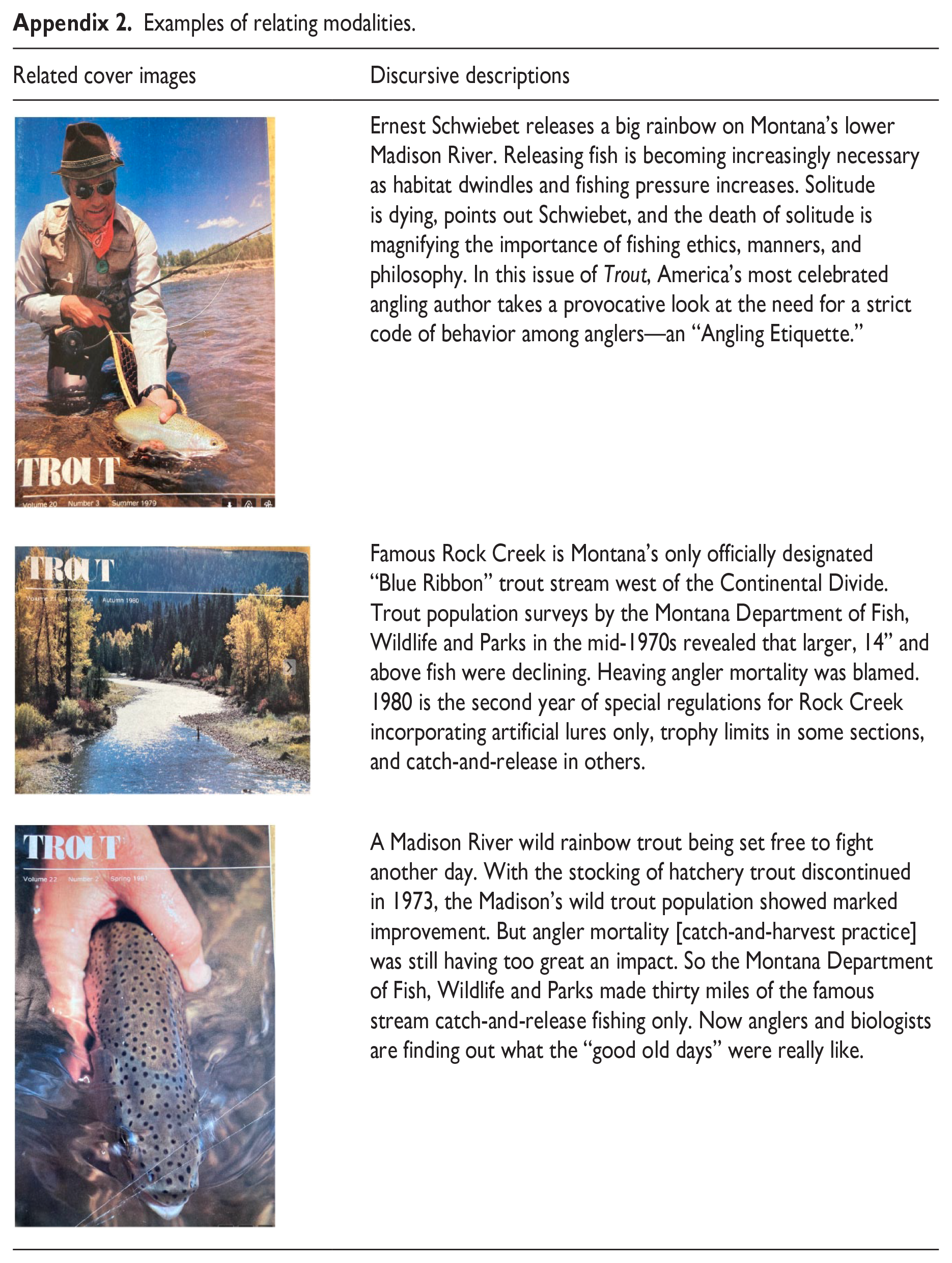
Building on this distinction between visual and discursive strategies, we continued our analysis by coding the Trout magazine editorial columns. We coded for descriptive accounts of the writing process and intention of editorials, brash language regarding river conservation, emotional language (specifically, occurrences of love and compassion), and all descriptions related to catch-and-harvest and catch-and-release practices. Descriptions of practices included both subtle inclusions about releasing fish and explicit statements about the philosophy of catch-and-release practices. We noted that many columns referenced the images published on the cover (Appendix 2). Rereading the editorials a third time, we coded textual descriptions of cover images. Drawing inspiration from others (Munir et al., 2021) this enabled us to see how editors related modalities between image and text.
Building on the intersection of images and text, we sought to identify tactics that combined modalities in support of repair. Our analysis continued by revisiting our visual coding of the magazine covers and textual coding of the interviews and editorial columns. Our aim at this point was to identify specific tactics emergent in our findings. We were able to identify types of work (mending, caring, and restoring) that represented part of the overall repair-focused deinstitutionalization efforts.
Findings
We find that repair-focused deinstitutionalization involves deliberately removing unwanted practices and inserting new ones without fundamentally threatening the normative systems and cognitive understandings that underpin the institution: the values and norms and “the shared conceptions that constitute the nature of social reality and the frames through which meaning is made” (Scott, 2013, p. 57; Greenwood et al., 2008). In the case of fly fishing, the preserved “core” is about valuing a connection to nature and the natural world, a relational connection that is made possible by shared conceptions about the craft and art of “catching,” specifically the “fight” and “battle of wits” with the trout, and a joy for the solitude and sanctity of being with and in nature.
Threat to trout
Coldwater fisheries faced existential threats during the mid-20th century in the United States. The impending destruction of fish populations was an outcome of rapid industrialization. The lumber industry ravaged riparian habitats along river corridors, eliminating critical habitat that moderated water temperatures. Dams constructed throughout western states blocked anadromous fish passage, eliminating spawning access. Without reproduction, wild fish populations plummeted. Mining operations led to acid drainage into rivers, much like production facilities spanning myriad industries along river corridors—dumping ravaged water quality. Overharvesting from recreational and commercial fishing operations severely depleted wild and native fish stocks. Even efforts to try and grow hatchery-raised trout to buttress the decline of wild populations failed as hatchery trout decimated natural food sources that would have previously supported wild fish. On occasion, hatchery-raised trout even spread disease, annihilating wild populations. The future looked bleak for wild trout, who require clean and cold water to thrive. The idea of fly fishing, including harvesting trout for personal consumption, became an additional threat to already compromised fish.
A custodian emerges
In response to growing concerns over the destruction of coldwater fisheries, TU was founded in 1959 along the banks of Michigan’s Au Sable River. TU was founded with two pursuits: repair and restore coldwater rivers and deinstitutionalize unsustainable catch-and-harvest practices with sustainable alternatives. Their emphasis was thus to find ways to respond to the environmental threat while preserving fly fishing.
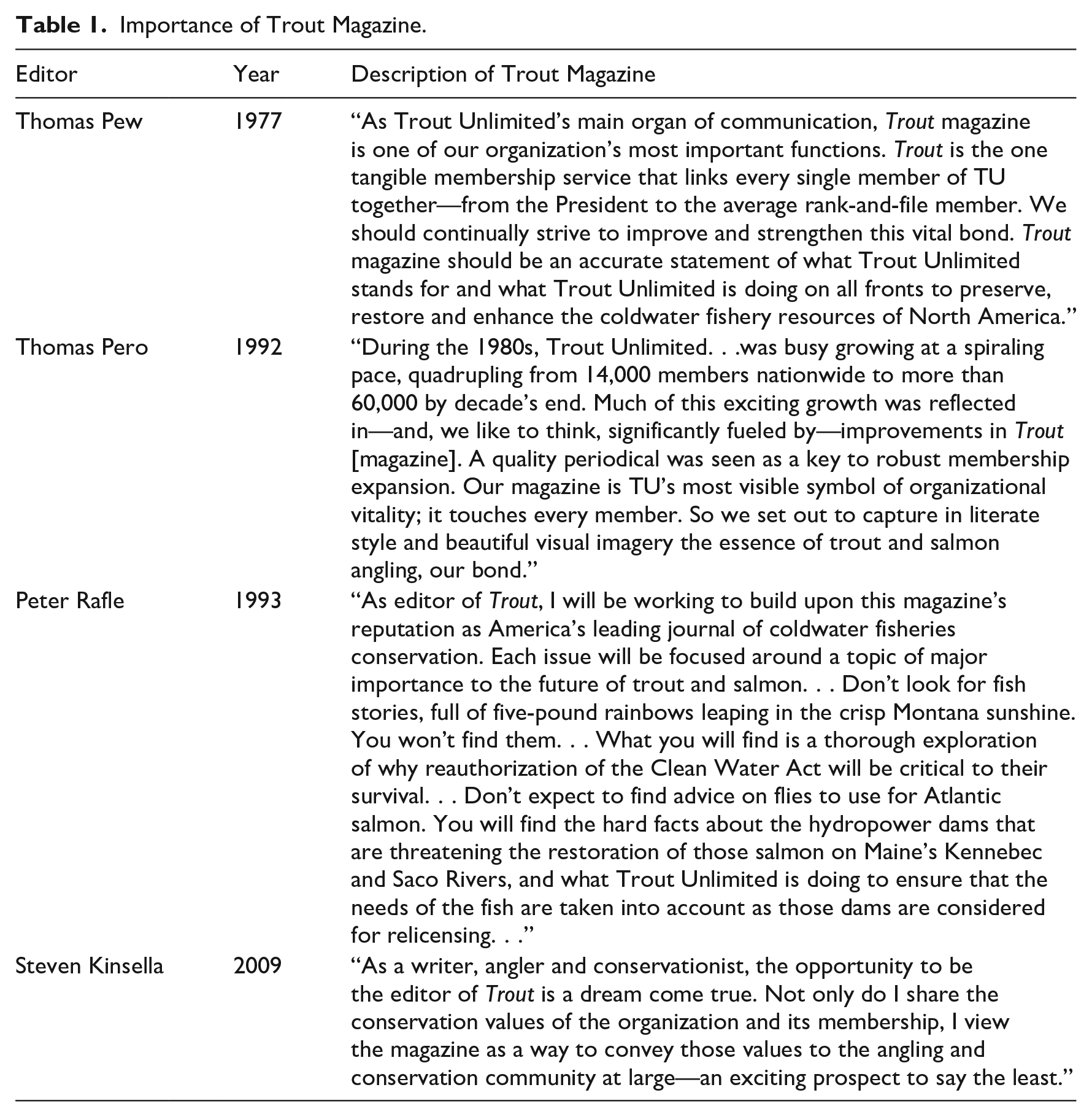
One key aspect of TU’s approach to achieve their mission was the creation of Trout magazine. The magazine enabled TU to reach a broad audience as they sought to deinstitutionalize catch-and-harvest practices. The magazine functioned as TU’s “main organ of communication” to its readers, as expressed by many of its editors in Table 1. Trout magazine would become the channel in which the editors would implement visual and discursive tactics to both undermine the taken-for-grantedness of catch-and-harvest practices and establish catch-and-release as the new taken-for-granted practice. Our analysis of these efforts shows them using mending, caring, and restoration work—to simultaneously change and preserve fly fishing.
Importance of Trout Magazine.
Mending work
Mending work includes actions targeted at “fixing” an aspect of an institution that is seen as “broken” or damaging to the institution’s survival. For TU, that meant subtly removing unwanted harvesting practices that were further threatening trout populations, while also reinforcing the normative and cognitive understandings of the institution. Our analysis revealed a pair of tactics—visual scrubbing and redirecting the gaze—both of which relied heavily on discursive visuality to erase old practices and erode their taken-for-grantedness.
Visual scrubbing
Our analysis of cover images published in Trout magazine revealed the first mending tactic which we call visual scrubbing. Visual scrubbing is the removal of particular artifacts, those that are damaging or problematic for the institution, from visual representations. Visual scrubbing can “erase” long-standing practices through the removal of important artifacts associated with performing problematic practices, which disrupts visual portrayals of actors performing those practices.
Prior to the publication of Trout magazine by TU, editors of fly fishing magazines commonly featured pictures that visually represented harvesting practices, including the prominence of creels, stringers, and spears in the images. What our analysis reveals is these three artifacts actively being scrubbed out of their imagery. Figure 1 presents declines in the visual presence of artifacts used in catch-and-harvest practices, marking a widespread and lengthy scouring of harvesting practices through collective editorial decisions across sampled publications as acts of visual scrubbing. This scrubbing of the artifacts subtly erodes the taken-for-grantedness of harvesting practices associated with fly fishing. Visual scrubbing helped editors “lead the way. . .to present fly fishing and fish photography in a way that’s commensurate with the idea of good catch-and-release practices,” supporting one editor’s desire “to present a different cover” that better “captured the soul of fly fishing.”
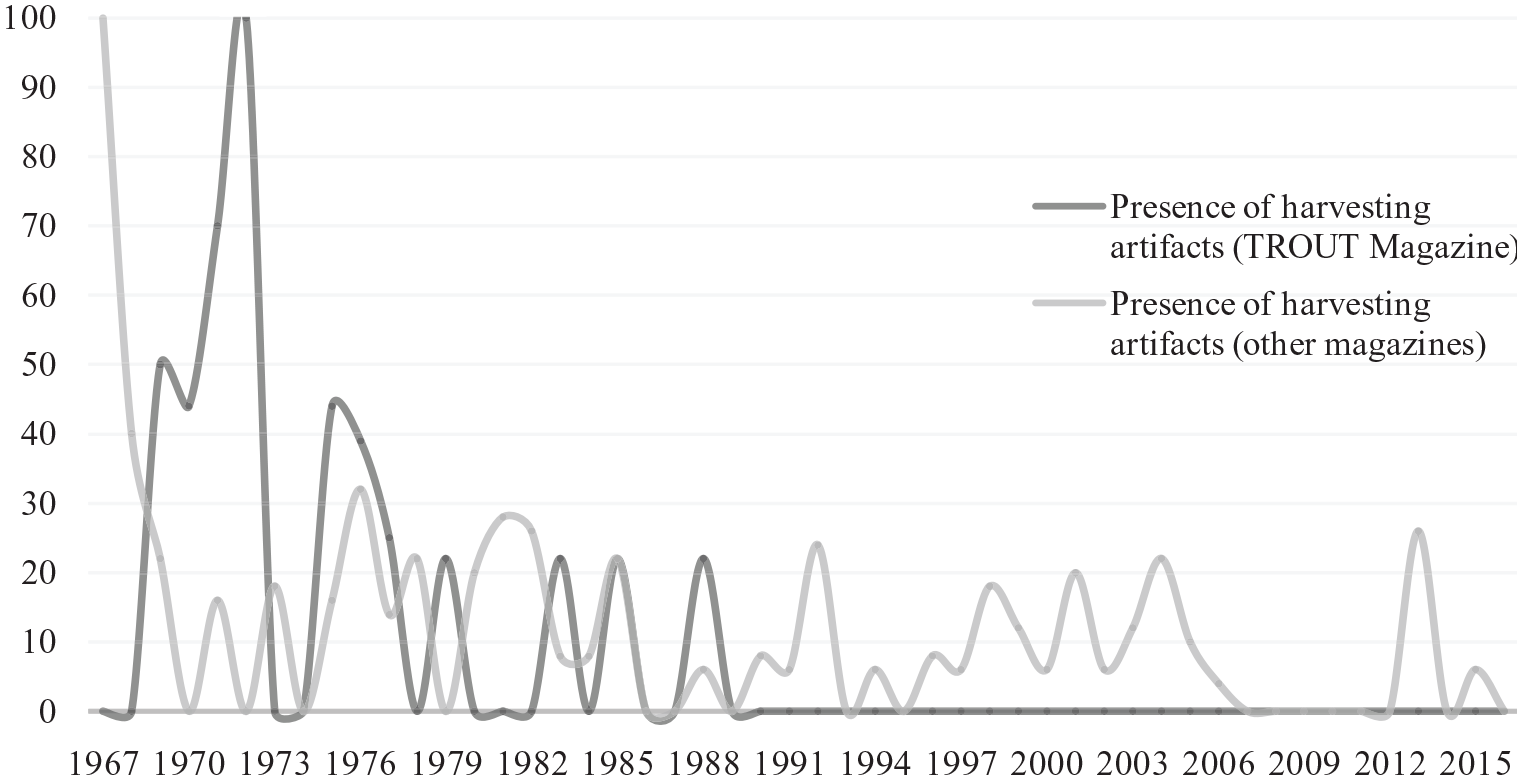
Visual scrubbing.
Illustrated in Figure 1, visual scrubbing efforts are first observed in Trout magazine. However, while TU began this initiative, we observe other periodicals following their lead and visually scrubbing away artifacts used to harvest trout. Prior to the creation of Trout magazine, the industry was dominated by corporate catalogues, such as L.L. Bean, and outdoorsy periodicals, including Outdoor America. Dating back to the early 1900s, such publications repeatedly depicted anglers holding stringers with dozens of harvested trout. Thus, the visual scrubbing that occurred pushes back on harvesting practices, implicitly calling for redefinition of the practices associated with being an angler. Following the 1980s and well before the banning of harvesting practices through catch-and-release regulations, artifacts used to harvest trout were visually non-existent on the covers published by Trout magazine. Other magazines continued to publish only trace numbers of images that included harvesting artifacts. Editors echoed these shifts, claiming that “creels and stringers are relics of the past,” suggesting that the only places that creels are found today “are in the corners of fly fishing shops covered in dust,” speaking to their lack of usage, except as shop decoration.
As this shift was purposefully seeking to avoid threatening fly fishing as a whole, many of the artifacts necessary for fishing, whether harvesting or releasing trout, remained the same, such as the fly fishing pole and reel. It was the harvesting artifacts that disappeared, as described in the following quote from Trout magazine in 1999: Many fundamentals of our angling experience haven’t changed much since the days of Walton and Cotton. Even if graphite [fishing rods] has replaced bamboo and monofilament [fishing line] displaced catgut, trout remain trout, and the basics of rod and line, imitation and presentation are unlikely to become obsolete. But one piece of angling gear is tough to find today. The creel, once standard equipment, is now something of a curio. It’s not hard to see why. . . an astonishing 20 million. . . fishermen call themselves “catch-and-release anglers.” The practice of limiting our kill, whether voluntary or mandatory, has done perhaps more than anything else to instill a conservation ethic among anglers.
As editors scrubbed away the visual presence of artifacts associated with catch-and-harvest practices, they, in effect, worked to erode the taken-for-grantedness of harvesting and disentangled the practice from the normative and cognitive understandings core to fly fishing, that is, the value and joy of “catching” a fish.
Redirecting the gaze
The second mending tactic used by editors was redirecting the gaze. Visuality relates to how things are “positioned with regard to the ‘gaze’ of audiences” with the intention of shaping meaning (Jones, Meyer, Jancsary, & Höllerer, 2017, p. 652). We discovered that TU used a strategy we call redirecting the gaze, whereby they sought to visually construct a new relationship between angler and fishing. Instead of the angler as “owning” or consuming the space and fish, they became part of the environment and the overall experience. Redirecting the gaze related to the mise en scène, or the arrangement of scenery. Fly fishing, thus, was not taking from but part of nature. In our study, redirecting the gaze references the zooming out to picture a vast landscape, where the angler is but a tiny inclusion in the image, if present at all.
Early covers included images where the angler and their catch dominated the cover. Oftentimes, non-TU magazines published images showing stringers of harvested trout stretching from one end of the cover to the other. We tracked the change over time and found a shift in emphasis, where the angler was often only a detail amongst a much larger emphasis on the river landscape. One editor commented on this spatial zooming out, “we want a scenic vision,” where if the angler was present in the image, they would be only “a part of the scene, but not disruptive to the scene.” In many cover images, this included redirecting the gaze so that the angler became very small and pictured without a trout. In this way, the angler becomes portrayed as part of nature and not disrupting it. Figure 2 depicts cover images where the landscape represented more than 50% of the entire cover image.
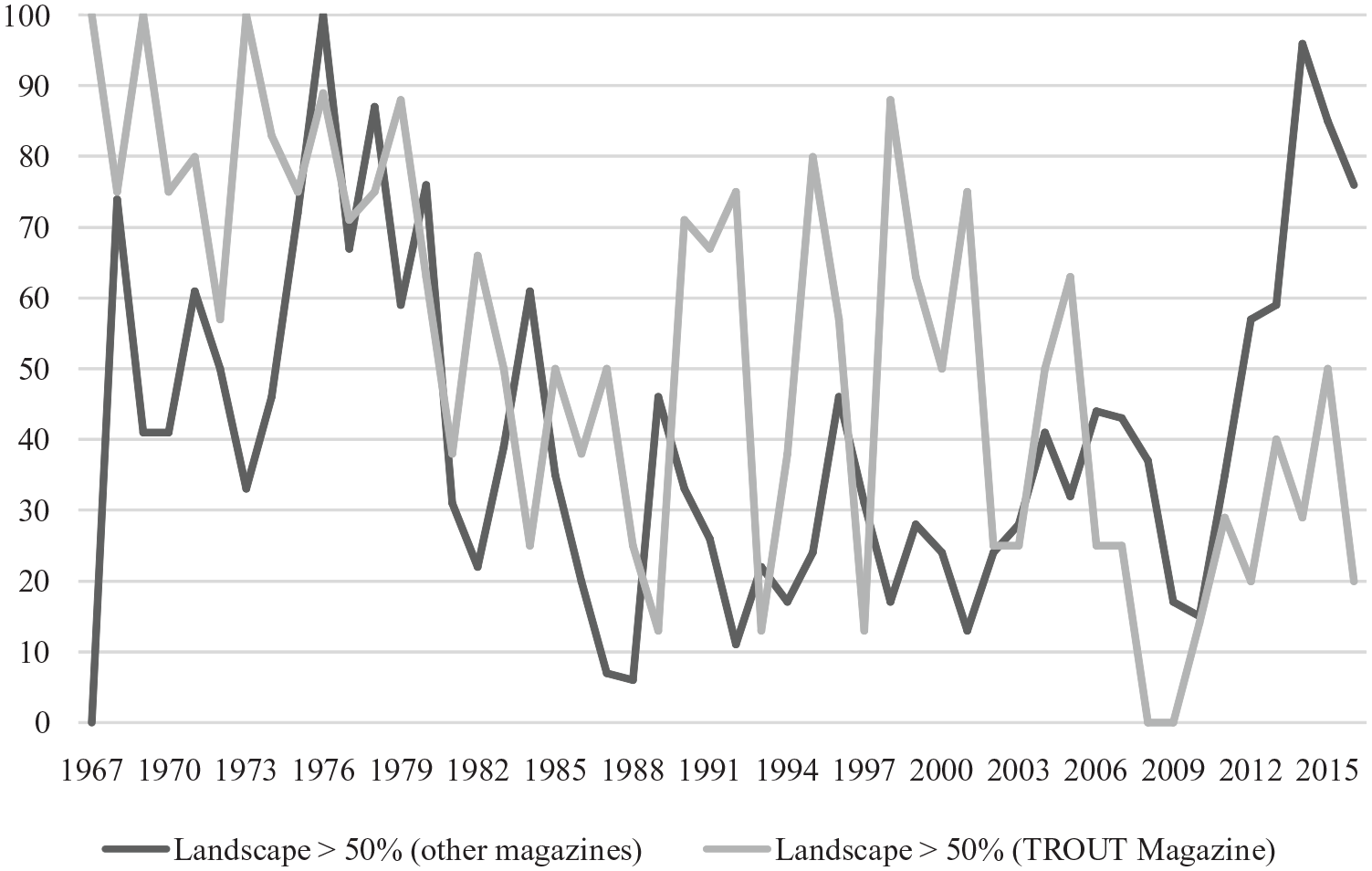
Redirecting the gaze.
To generate these images, editors encouraged photographers to capture the entire fishing experience, from beginning to end. This focused less on the trout themselves and more on the experience of the fishing trip: reinforcing fishing as being more about communing with nature than taking the fish. This description was offered by an editor during an interview: I always tell photographers. . .photograph the entire experience, not just the fish and the fishing. . . I want the story photographed from beginning to end, and everything that it entails. That’s the ideal that we shoot for.
Early on, it was TU who primarily used this tactic, which was then picked up by other periodicals in the late 1970s. We also note that since 2000, some newer magazines (e.g., Eastern Fly Fishing) publish only images where the angler is small or entirely undetectable within a grand landscape. One editor commented, “we very rarely, put a fish on the cover.” TU’s current editor expanded on this point in the Summer 2013 issue: A good friend of mine called me not long after receiving the last issue of Trout magazine to ask why, during my editorship, we had yet to put a trout image on the cover. . .Upon further reflection, I do think it is important to drive home the point that TU is about coldwater conservation on a broad scale. . . I’ve never thought trout fishing was about fish as much as it’s about people, places and natural details. Granted, TU founding member Art Neumann wisely said: “Take care of the fish and the fishing will take care of itself.” I wholeheartedly agree with that focus. But we believe that if we take care of the culture, the people, and the panoramic view in this magazine. . . well, the take care of the fish stuff doesn’t take care of itself. . . but the inspiration to do so does.
This quote emphasizes how TU was seeking to change the focus away from the trout and towards the overall fishing experience. Visuals were used to solidify and reinforce the value of nature and communing with nature that was always core to fly fishing. By shifting away from the “trout” as the reward, to the experience of fly fishing as a whole, TU reinforced the values and meaning of fly fishing while making it easier to shift away from harvesting practices. This shift enables TU to change harvesting practices, but without challenging fly fishing. Fly fishing involves a relational connection to nature and the fish, but this is about the experience, the sanctity of being in nature, taking and eating the fish is not “core” to its meaning. In this sense, by redirecting the gaze, they are mending the practice to shift away from “taking” to the experience and expressing benevolence for trout.
Caring work
We refer to caring work as the expression of feelings and concerns to shore up the ties between the new practice and what is believed to be the core of the institution. Caring slowly enmeshes the new practice with the values, norms, and shared conceptions of the institution, while also distancing them from the old, unwanted practice. Our analysis revealed two caring tactics: stirring the heart and handling with care. Both tactics worked to invoke concern for trout by curating deeply emotional connections between devoted anglers and trout and also instructing anglers on how to hold a caught trout without compromising its ability to thrive. Editors relied on both visual and discursive modalities to support caring.
Stirring the heart
Our analysis reveals that one way in which editors of Trout magazine sought to deinstitutionalize catch-and-harvest practices and preserve fly fishing was by stirring their hearts. That is, rather than engage in intense problematization, they sought to invoke and highlight their collective love of trout and the beauty and feeling of the angling experience. In this way editors of Trout magazine seemed to be working on stirring the hearts of anglers and their ties to the core values of fly fishing, relying on discourse that emphasized the enduring love for trout and trout fishing. Editors described their readers as “passionate anglers” and used textual discourse to remind readers of “our love for the sport,” that they can positively impact the fishery [they] care about,” and that “every TU member. . .loves to fish.” These frequent attempts to stir the heart most often appeared alongside images of beautiful river landscapes, pointing to the experience that was embedded in this relationship between anglers and trout. This poem published in place of an editorial column highlights this discursive strategy well: Carefully I reach out, and lift [the trout] in my net, But I make sure not to touch him, until my hands are wet. For not doing so would damage him, and that would not be right, For this indeed I owe him, for such a noble fight. As gently as I can, I remove the hook and set him free. . .
In the poem they discursively create the loving and gentle experience that catch-and-release fishing introduced to fly fishing. In this tactic, editors do not attack the old practice; they construct a feeling associated with its alternative. As they do so they reinforce core aspects of the institution: deeply valuing the connection between the trout and angler, the frame of “the fight” with the fish that now emphasizes communing rather than extracting, and instead of eating the trout, touching and then releasing it as a sign of respect. Because the trout survived a “noble fight,” the angler feels an indebtedness to gently release the trout unharmed so that it can continue to thrive. A similar, gentle nature came through in other subtle mentions of catch-and-release practices in editorial columns. For example, Editor Peter Rafle wrote in 1994 that, “After I returned the fish to the current, my hands throbbed for minutes, numbed by the frigid water” and again in 1995: “And with every bright and healthy fish I release back into the current, those dismal days of winter will seem far removed from reality as rising trout, tight lines, and mayflies dancing in dappled sunlight seem in February.”
Editors, however, did not reserve this emotional-discursive strategy to trigger only positive feelings. They also emphasized sadness and grief about the threats to the fish. Again, while they deploy negative emotions, editors avoid directly assaulting members’ use of catch-and-harvest practices. For example, one editor reminded readers of “mismanagement” of a river’s wild trout population, with grief and heartbreak, “a crying shame” and “it’s hard not to shed a tear” over the destruction. Taken together, we observed editors appealing to anglers’ hearts through positive emotions, namely love, while, at other times, turning to sorrow and grief to buttress concern for the well-being of trout. In this they work to build and foster the connection readers have with trout and fly fishing, while subtly linking this with the new practice. However, they are also careful not to incite debate by problematizing the practice; a love for trout is nurtured by spotlighting the values and experience tying it closely to the new practice.
Handling with care
Handling with care is a visual discursive tactic utilized to change the ways in which the angler relates to the trout after being caught. Traditional ways of holding up a trout when harvesting was by its gills. Since such a hold is almost always fatal to the fish, depicting imagery with such a hold indicates the intention to kill the trout. We discovered handling with care as a tactic by coding the purposeful decline of gill holds, where the angler’s hands penetrate into the trout’s gills, and the inclusion of alternate holds including “grip n’ grin” and “keep em’ wet.” Appendix 1 provides illustrative examples of each.
Images in Trout magazine shifted to include fish-friendly ways of capturing a trout. While “grip n’ grin” removes the trout from the river for a quick photograph, “keep ‘em wet” keeps the trout submerged and in its natural habitat. One editor commented during an interview on the “fish-friendly” nature of “keep ‘em wet:” In terms of presenting a fish that is going to be released in a catch-and-release society, [photographing the trout while being held underwater] is probably the most fish friendly you can get. And we’re trying to use more and more of those images ourselves just for that reason.
There is no challenge to taking a photo of the fish, or celebrating your win in the battle with the fish by having caught it. Instead we observed a purposeful shift by editors to eliminate pictures that indicate intention to kill. They remove the visuals associated with the practice, while preserving the glory and fun of fly fishing.
Figure 3 details handling with care, and how this tactic involved the removal of images portraying anglers’ hands having penetrated a trout’s gills, as well as the emergence of fish-friendly holds. Both grip n’ grin and keep em’ wet remain prominent today, while gill holds have been eliminated in cover images altogether, as described by an editor’s interview: “These days, if [an angler pictured] is holding a fish by the gills and there’s blood running down the flanks, that’s just not a good photograph.” Instead, when it comes to “cover selection,” editors aim “to represent the artistic side of the sport,” usually through “scenic images.”
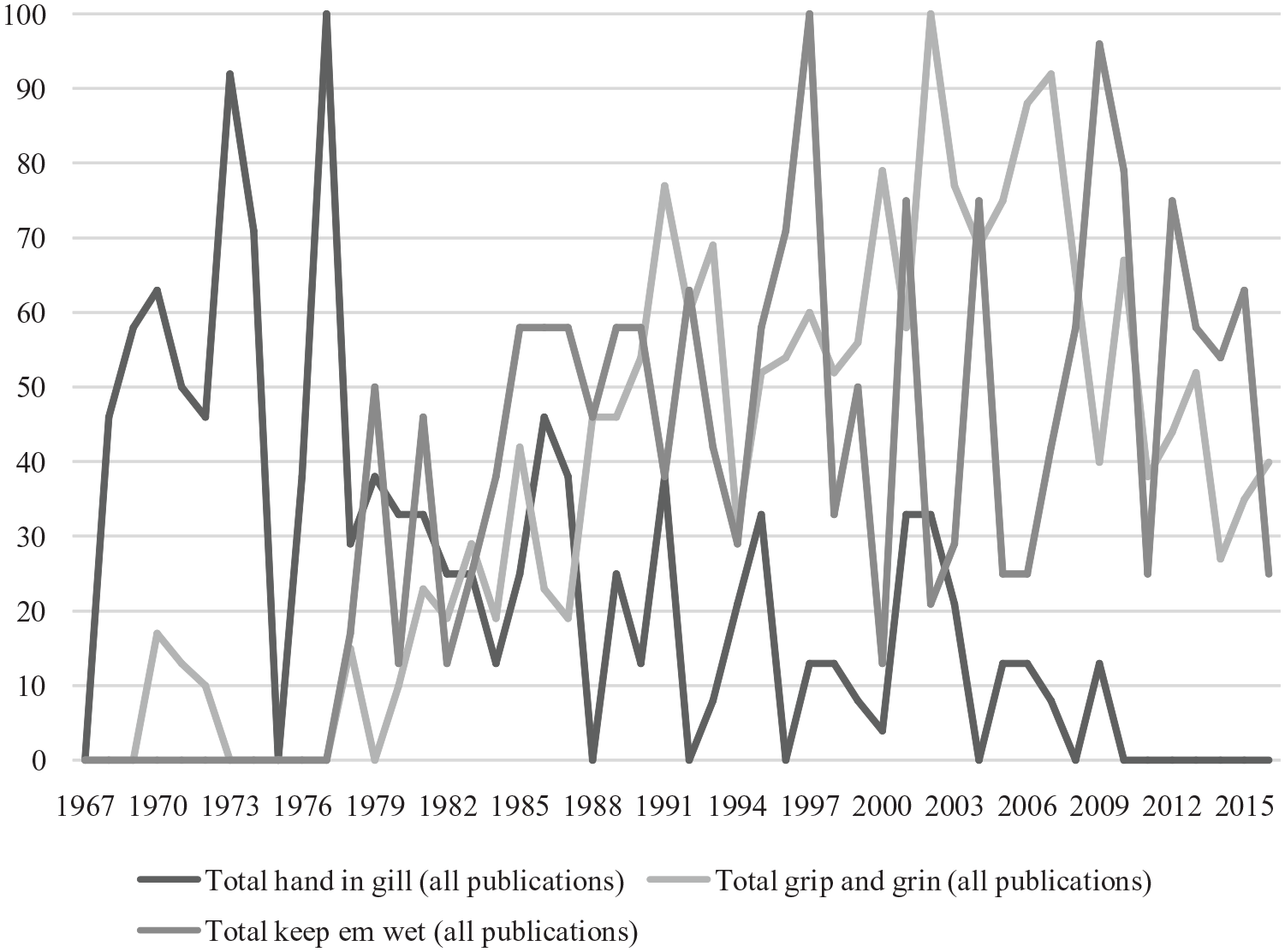
Handling with care.
Some editors generated images for cover selection by taking the photographs themselves, so that they could actively create the type of image and presentation that would align with their efforts to deinstitutionalize catch-and-harvest practices. One of the current editors described a past editor’s approach: John was a big advocate of fish-friendly catch-and-release techniques. And he wanted to present that graphically in the magazine. . . he decided rather than try to go out and find all those shots [from photographers], he would lead by example. . . he just “photograph[ed] the fish the way that I think they need to be photographed.”
Presenting careful and compassionate anglers engaging in catch-and-release practices reinforced their new taken-for-grantedness and became central to the joy of fly fishing.
Editors of Trout magazine also used discourse to emphasize handling with care by outlining how-to instructions for catch-and-release practices and asserting the practice’s importance. Published guidelines paired the hearts and minds of anglers, visible through love and celebration, with step-by-step directions aiming to build knowledge and care for the trout. “Rules of the river. . .” came through, first, with suggestions to “know and celebrate your native trout” and “learn what fish are native to the waters you love to fish.” Step-by-step guidelines then followed; “carefully remove and quickly release native fish” and “if you want to take a picture of the fish. . . do so quickly, and without taking it from the water.” Encouragement to keep the trout submerged in the river captures the “keep ‘em wet” movement exemplified in Appendix 1. Editors also published images of signs that focused on written words on the signs themselves. For example, an image on the banks of Yellowstone Lake directed readers’ attention to the written message, “Yellowstone Encourages Within fly fishing, we've become a lot more aware over the last 30 years, of the importance of catch-and-release, in the face of increasing fishing pressure on so many of our fisheries. . . Especially if you look around out here in the west, a lot of the native trout habitat, is further imperiled. Not just by habitat loss from human causes, but also from climate change. And so we’re in a situation now, where people are more aware of that, than ever. That had something to do with magazines essentially, probably leading the way.
Restoration work
Caring and mending work involved tactics that focused on the removal of harvesting practices and the insertion of catch-and-release practices, all while preserving the values and meanings associated with fly fishing. Beyond these efforts to repair fly fishing, TU sought to activate and inspire custodians for restoration work. Restoration work directly addresses threats to coldwater fisheries through local projects to further ensure the preservation of fly fishing. The survival of fly fishing was not only dependent on repairing certain practices, but also on addressing the threat to trout themselves.
Calling for custodians
Restoration work was enacted at the local level. TU’s chapter-based organizational structure enabled the environmental association to have custodians working in response to localized threats to rivers. Thus, a key aspect to responding to threats was for TU to create (or encourage the creation of) chapters as vehicles to react and preserve. For example, the following quote from TU’s Executive Director links river pollution threats in Colorado with calls for the creation of a new TU chapter to serve as a boots-on-the-ground custodian. Trout Unlimited will follow up on this particular problem and scream bloody murder about the fact that apparently nothing has been done. . . It serves to point up the continuing necessity for creation of a chapter in the San Luis Valley. Very often, despite our very strong presence in the State of Colorado, without a chapter in the local area, we just don’t get the word soon enough to be effective. Therefore, I beseech you and all the other Trout Unlimited members in the San Luis Valley to please get together, get organized and create your chapter. We need you and you need us.
Calls for custodians to conduct restoration work were linked with a common love for fly fishing, indicated by the following call for a chapter in a 1983 news clipping. Trout chapter planned: A South Shore fisherman. . .is eager to form a local chapter of Trout Unlimited, a national non-profit organization dedicated to protect, preserve and enhance coldwater fishery of North America. A minimum of 12 people are needed to form a chapter. . .the local chapter’s first activity would be to remove an old car from Trout Creek in Johnson’s Meadow. . .All those interested in preservation of our fresh water streams and enhancing our trout fishing, please plan to attend. . .
Protecting rivers was part of preserving fishing. Editors also called readers to action by recruiting them to participate in restoration projects on threatened rivers. They did this first by educating their readership about particular types of threats, evidenced through stories covering the destructive consequences of industrialization (“Road Builders Need Sense of Direction,”), dams (“How Dams Kill Rivers”), and hatchery-raised trout (“Habitat vs. Hatcheries”). Editors continued calling members to action, “TU Needs You” and “A Conservationist’s Work is Never Done.” Recruitment efforts were often embedded in stories of TU members working to “Protect Wild Places,” and also paired specific contexts, for instance, the Big Hole River in Montana (“Fight to Save Montana’s Big Hole”) and Henry’s Fork in Idaho (“Saving the Henry’s Fork”), with broader calls to action; “protect the places you love.” Publishing content about restoration work was viewed as one of the magazine’s “cornerstones,” helping TU to “sustain important populations of trout.”
These calls for custodians were ultimately successful. Figure 4 illustrates the explosion of chapters throughout the US through heat maps. Blue indicates the presence of a TU chapter. Red indicates a concentration of chapters, with yellow indicating a very high concentration.
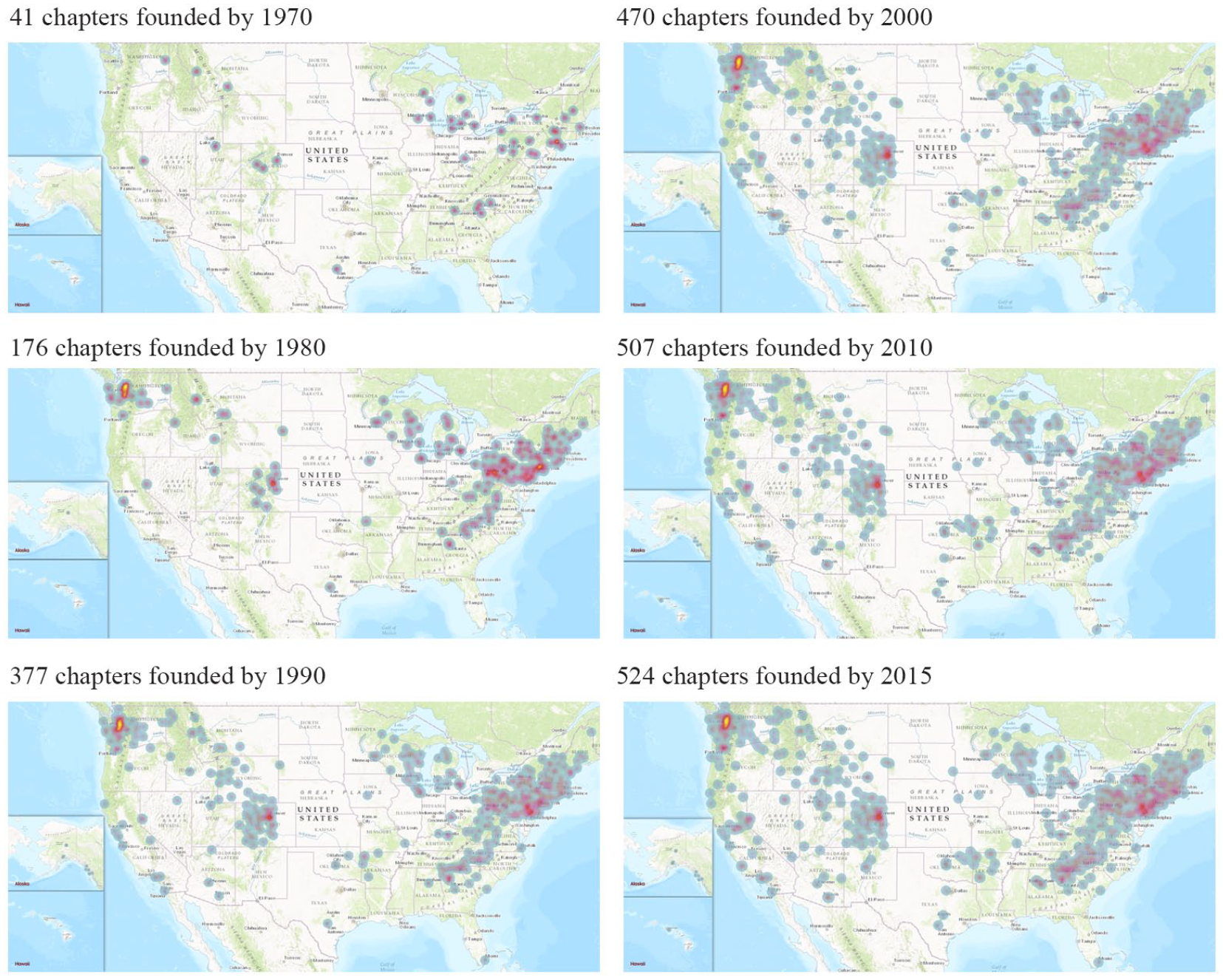
Historical emergence of Trout Unlimited chapters by decade.
Since the primary goal of individual chapters was to perform restoration work, the heap maps indicate both the vast reach of TU and the regions where TU wielded increasingly concentrated responses to threats to coldwater fisheries.
Directing enactment
Once established, chapters continued their calls for members to take action by actually working on restoration projects. Through these projects, TU was structuring opportunities to enact the institution’s core values. For example, the Neshannock Chapter in Pennsylvania used their 1986 newsletter to point out past triumphs (“bagloads of trash have been removed” during river cleanup events) and call members to action; “Additional work days are planned for this Fall. . .Much needs to be done before winter. HELP OUT!.” Other chapters used similar language; “This Chapter hopes it can count on YOU, the membership, for support and participation in upcoming events, so we can make a difference too.” Chapter responses to threats also included advocacy work. In Colorado, one chapter led an effort to protect the Gunnison River under the Wild and Scenic River Designation, “If we want a say in how our rivers are managed we must make our opinions known. The Gunnison is truly wild (River Otter, Peregrine Falcon, Wild Trout) and unforgettably scenic. It needs to be preserved.” It was the rapid growth of chapters that enabled TU to perform localized restoration work in response to the many threats to coldwater fisheries.
Examples of projects where TU directed enactment on the chapter level range from dam removals, for instance, on the Eklutna River in Alaska, “opening access to 22 miles of upstream spawning and rearing habitat for salmon for the first time in 89 years” to adding “a series of engineered step pools to allow upstream and downstream passage for all life stages of steelhead” on Pennington Creek in California to “riparian plantings” working to reestablish streamside habitat along Oregon’s Metolius River. The variety of projects is wide-ranging, meeting the needs of each chapter to restore their local rivers.
We show thus that repair-focused deinstitutionalization not only involved efforts to deinstitutionalize unwanted practices via mending and caring, but did so while working to preserve fly fishing and respond to the threat that triggered TU’s actions in the first place.
These efforts were ultimately successful and catch-and-harvest practices were deinstitutionalized and replaced with catch-and-release practices. Indeed, regulations rendered catch-and-harvest practices to be illegal
1
in many fisheries throughout the US and reveal the extent of these deinstitutionalization efforts. The Holy Waters section on Michigan’s Au Sable River, where TU was founded, implemented “no-kill” regulations in 1989. North Carolina created their Special Regulation Trout Waters Program in 1991, Colorado developed their Wild and Gold Medal Trout Management Program in 1992, Pennsylvania turned to a Catch-and-Release Fly Fishing Only designation as part of their Heritage Trout Program between 2004 and 2006, and Oregon began focusing their Wild Fish Policy on native fish in 2003. Thus, we see the clear regulatory deinstitutionalization of catch-and-harvest practices emerging 30–40 years after TU’s founding. Editors and leaders of TU saw their efforts as ultimately successful, described by TU’s President in 1999: It’s difficult to imagine how many of our finest trout waters could retain their quality without catch-and-release. . . limiting our kill has helped foster the understanding that fish don’t have to come from hatcheries, and that habitat and species management matter. Viewed from the perspective of four decades, I think it is fair to say that catch-and-release angling is an enormously positive development. . .
Discussion
A model of repair-focused deinstitutionalization
We present our model of repair-focused deinstitutionalization in Figure 5, helping us to draw connections between our findings and the deinstitutionalization literature. We highlight the ways in which custodians rely on mending, caring, and restoring work to engage in repair-focused deinstitutionalization in response to an existential threat to a beloved institution. Repair-focused deinstitutionalization is unique in that it is neither maintenance-based that rejects change (Micelotta & Washington, 2013) nor disruptive aimed at eroding an entire institution (Maguire & Hardy, 2009). Our treatment of repair focuses on renewal and reinforcing the normative systems and cognitive understandings underpinning the institution.
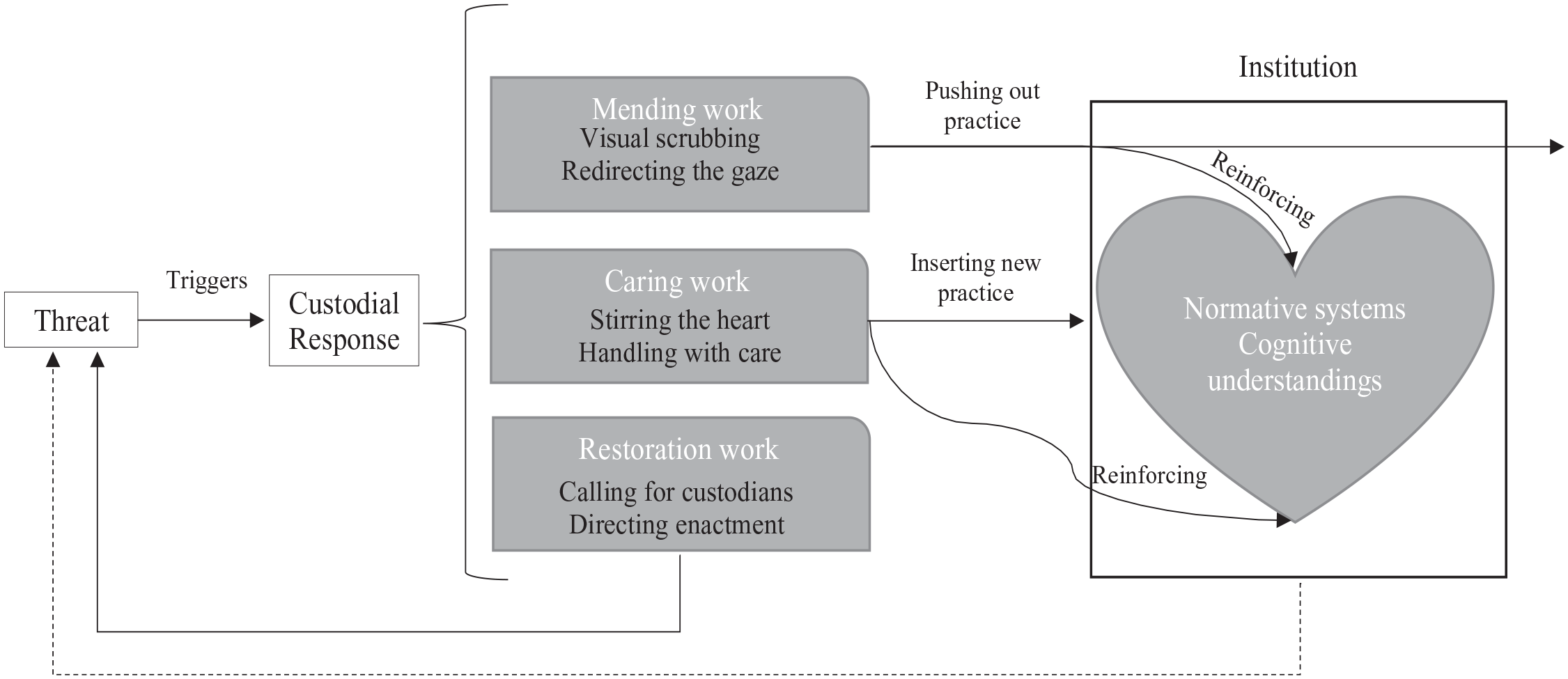
A model of repair-focused deinstitutionalization.
Our model begins with initial threats triggering custodial responses. For our study, this included the variety of threats to coldwater fisheries driving their degradation. Collectively, these threats created an existential threat to fly flying in that these threats had the potential to destroy or eliminate fly fishing completely. This led to the founding of TU as a custodian.
We discovered TU deployed three types of work as their response: mending, caring, and restoring. The first two types—mending and caring—work, in part, to address practice concerns, first by using mending tactics to push out unwanted practices—but carefully, deploying tactics that simultaneously reinforce shared understandings—and second, by using caring to insert new sustainable alternatives. These tactics were subtle and without direct engagement as controversy was avoided; mending was intentional but its subtlety rendered it inconspicuous and free from direct engagement. Both mending and caring were methodical, taking many decades to perform. We see them as “slow” forms of work, and as distinct from much more abrupt attempts to disrupt unwanted practices detailed in the deinstitutionalization literature (Den Hond & de Bakker, 2007; Maguire & Hardy, 2009).
Critically mending and caring worked to reinforce the normative systems and cognitive understandings underpinning the institution. That meant editors used their visual and discursive tactics to reinforce the value of connecting with nature and the natural world. Visually and textually, editors also commonly spotlighted the craft and art of “catching,” the “fight” and “battle of wits” with the trout; angling was depicted as celebrating the joy of solitude and sanctity of being with and in nature.
Distinct from mending and caring, both of which emphasize practices, the third type of work centered around custodial actions in direct response to threats. TU needed to do more than just fix the most problematic practices. They needed to also ensure they responded to threats centered around the decimation of coldwater fisheries. Fly fishing could not be part of the problem, but instead had to become core to the solution. Restoration work in this way was about calling anglers to action as custodians of coldwater fisheries working to rehabilitate decimated fisheries that supported fly fishing in the first place. Once the number of chapters had grown, those chapters then served as custodians tuned in to threats to local fisheries. Similar to other custodial responsibilities in environmental contexts (Crawford & Dacin, 2021; Montgomery & Dacin, 2020), the chapters embodied boots-on-the-ground actors, ready to enact the core values of the institution. Table 2 outlines these three forms of work and their objectives.
Types of work supporting repair-focused deinstitutionalization.
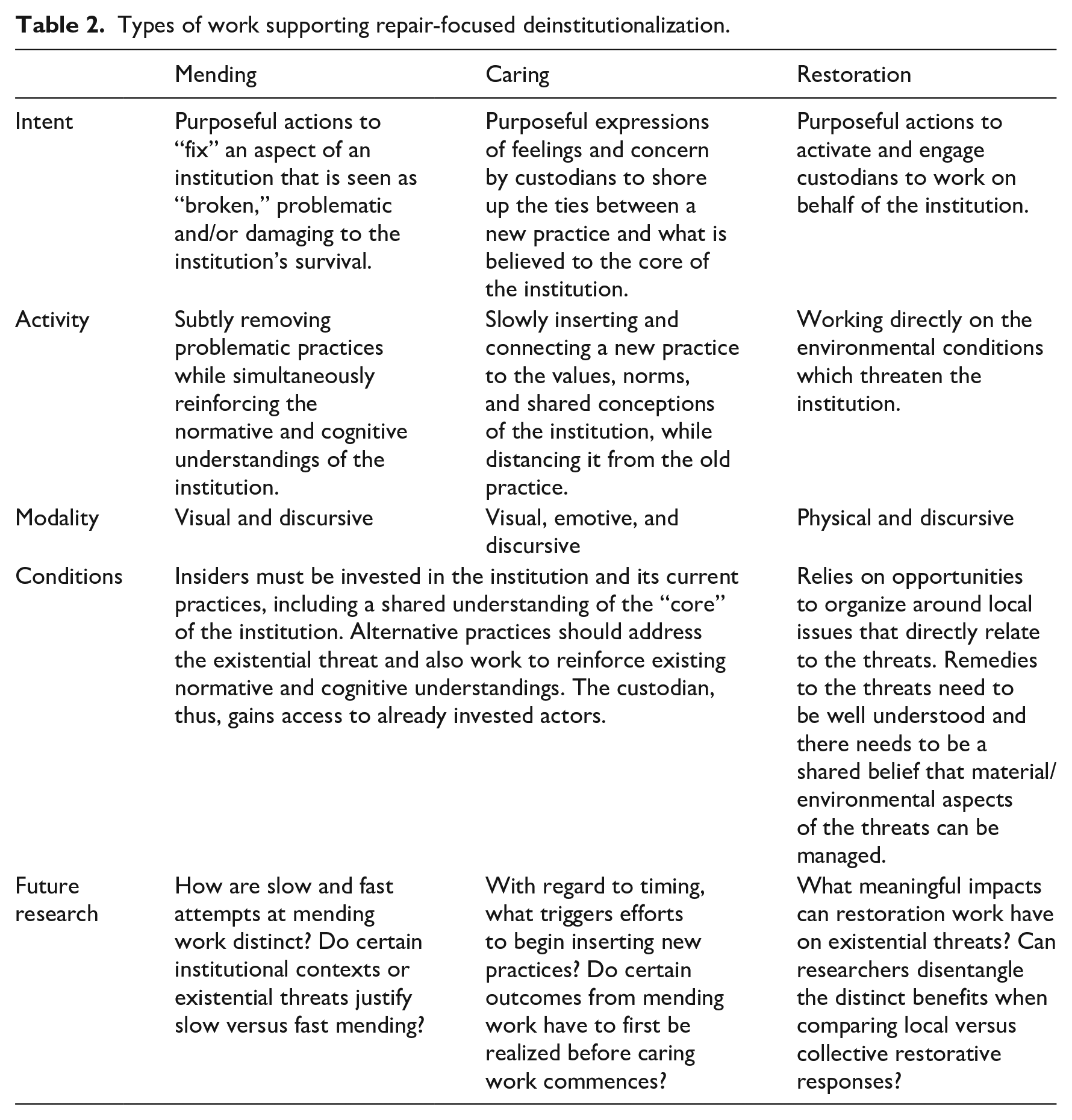
Unlike prior models of deinstitutionalization emphasizing eradication (Hiatt et al., 2009; Maguire & Hardy, 2009), our repair-focused model enables the institution, in its renewed state, to endure in a bolstered form. We see this as being distinct from occasions when an institution might endure, but only as a radically modified and partial version of its original state. Instead, the institution of fly fishing is more vibrant and TU’s footprint is larger than ever. Thus, we posit that one possible outcome of repair-focused deinstitutionalization is an institution that is stronger and increasingly agile to weather future threats because of the custodians standing guard. Repair-focused deinstitutionalization is a form of renewal and pathway to institutional resilience.
We argue our model is most relevant for situations when a clear existential threat to an institution exists, but that the problematic practice is identifiable and a well-defined replacement can be carefully coupled with the core of the institution. Looking to the deinstitutionalization literature, we see how traditional responses can backfire when faced with existential threats. While the producers of DDT (Maguire & Hardy, 2009) and stewards of classic cuisine (Rao et al., 2003) worked to defend against the threats that would render them obsolete, ultimate failure can be realized if they do not deal specifically with the unsustainable or problematic practice. In maintenance mode, insiders can deny or refute the “truth” of the threat rather than considering the possibilities of repair. On the other hand, challengers who seek to disrupt institutions can do so with such aggression that they trigger extreme defenses by those who hold the institution dear and, thus, are unable to make changes. Or if challengers do produce meaningful change, we run the risk of losing aspects that may have been part of the valued core of the institution in the process. We theorize an alternate path to change that may be more successful in dealing with existential-type threats to institutions. Consider the fossil fuel industry. If we want to change the fossil fuel industry, we might do better by not calling it dirty and attacking those who have worked in the industry for decades (Wright & Nyberg, 2015). What might work better is to really understand what is core to the institution—and begin to connect some of the normative and cognitive understandings to new practices, for example, if workers in the industry have common values around being industrious, tough, and builders of economies (Deka Kalita & Gehman, 2021). How might we craft mending and caring practices to alter the practices associated with fossil fuels into renewables while reinforcing their normative and cognitive understandings and attaching them to new practices? This type of work may help us bring into focus the “shared worlds of concern” (Creed, Hudson, Okhuysen, & Smith-Crowe, 2022) that more deeply connect us, and help drive sustainable transformations in new ways.
Contributions to literature on institutional change
We join a cohort of institutional researchers keen on exploring issues of repair (Heaphy, 2013; Lawrence & Suddaby, 2006). However, unlike prior studies that have treated repair as exclusively a maintenance tactic (Lok & de Rond, 2013; Micelotta & Washington, 2013), we illustrate that repair-focused efforts can also be a catalyst for change. Thus, we underscore the possibilities of repair in the spirit of renewal, rather than repair that rejects the possibility of change or works to reverse disruptions to the status quo (see Micelotta & Washington, 2013). We see our emphasis on renewal as particularly significant for exploring ways to organize in response to grand challenges (e.g., climate change, global poverty) and posit that repair-focused deinstitutionalization represents one possibility of seeking sustainable practices, but in the face of contexts where beloved institutions, who have fierce and skilled custodians, can continue to thrive. Our unique treatment of repair complements other contexts with similar needs for change. Examples include protecting the future of Canada’s timber industry by shifting towards “ecosystem-based management” practices (Zietsma & Lawrence, 2010) and preserving beloved institutions, such as the church, through changes that “keep the faith, change the church” (Gutierrez et al., 2010). One explanation for why our repair-focused model can address dualing needs is because it enables both renewal and ongoing vitality as change blends with nurturing the core of the institution and responding to significant threats. Repair becomes a means for both change and maintenance (Boutinot & Delacour, 2022). In the face of threats or during times of crisis, repair represents one possible pathway to build more resilient institutions. We do believe, however, that further research should explore how this form of deinstitutionalization blends both change and resilience. Might there be threats that such a response does not work? In our case, the existential threat to fly fishing could be repaired while also preserving fishing. However, if the threat does require more radical change, could repair still work? How might the visibility or contentiousness of the threat shape the possibilities of this approach?
We also see the possibility of a darker side of repair-focused deinstitutionalization, where actors who represent the sources of the threat might also become the custodians of the process. One strength of our model is that it provides a pathway of change for embedded actors who cherish their institution and become stark defenders of it. The potential negative is that in some cases, we might be better off eradicating the institution altogether, as was the case with eliminating DDT usage (Maguire & Hardy, 2009). Yet this repair-focused process could enable embedded actors to preserve what is problematic in the first place. Thus, we do see the possibility of repair-focused deinstitutionalization as contributing to our understanding of the darker sides of institutional theory as an enabler of misconduct (Khan, Munir, & Willmott, 2007).
Contributions to the literature on deinstitutionalization
We advance research on deinstitutionalization by proposing a novel type of deinstitutionalization, but we also highlight new tactics for engaging in deinstitutionalization. Similar to prior research on deinstitutionalization (Clark & Jennings, 1997; Hiatt et al., 2009; Maguire & Hardy, 2009), our study reinforces the importance of discourse as a viable tool for disrupting taken-for-granted practices. However, in contrast to those studies, we add an array of visual and emotional tactics supporting deinstitutionalization. Stemming from our findings, we discover that in some cases, visual tactics can be used in standalone ways (i.e., portraying landscapes rather than anglers), whereas other tactics, including the demonstration of new practices, might require both visual illustrations and textual instructions to educate audience members on performance expectations.
When it came to using visual tactics, we observed them being used carefully and slowly. This is unique when compared to recent articles (Barberá-Tomás et al., 2019; Klein & Amis, 2021) where images are relied on to generate much quicker (even immediate) reactions and shifts in meaning. Visuality, thus, is seen to be provocative, for instance, building an abrupt “moral shock” to motivate a targeted base (Barberá-Tomás et al., 2019). Instead, our findings illustrate how careful curations over the long term can leverage small and nuanced changes. Thus, not only do we offer a contrasting example that emphasizes visual subtlety, but perhaps this insight harkens to the versatility of visual communications (Lefsrud et al., 2020). Whereas talk and text are often used to be disruptive in deinstitutionalization (Hiatt et al., 2009; Maguire & Hardy, 2009), visuality presents greater versatility and, when used in combination with textual and verbal discourse, presents custodians with a Swiss army knife-type tool that can be customized to the unique needs of a particular context (also see Bullinger et al., 2023).
We suggest that “slow” forms of work with visuality and emotions may be particularly important when custodians are trying to drive change through “insiders” who have strong commitment to institutions. TU mobilized their deinstitutionalization efforts through anglers; shocking pictures of bloody “sad” fish, and emotive appeals to “stop eating fish, stop fishing” likely would have outraged TU’s audience and pushed them to morally disengage. Instead, and because TU had an army of committed anglers, they chose to gently reinforce normative systems and cognitive understandings that directed anglers away from problematic practices. By quietly pushing out harvesting artifacts and showing anglers that it was not actually harvesting that they held dear, TU opened up the possibility of offering a replacement practice instead. In this sense, slow visual tactics may be less likely to trigger resistance by easing insiders into change.
We also reveal the power and importance of positivity in visual depictions. There were no sad fish images in our data. Early on, visual portrayals of harvesting practices presented contented anglers and, once catch-and-release became the dominant practice, images always projected happiness. This treatment of visuality offers a stark contrast to the use of more inciting visual tactics used to highlight environmental and social concerns (Jarvis, Goodrick, & Hudson, 2019; Klein & Amis, 2021). Instead, we found that TU’s subscribing members were shown what could be and how they might aspire to experience angling practice as deeply connected with trout and rivers. We see the potential payoff of this approach as being able to generate (and maintain) the deep positive emotional connections with an institution while challenging certain practices. Paired with this visual positivity, it was through discursive means that editors raised concerns over the future of coldwater fisheries, helping us to see the use of visuality, on the one hand, as a means to propagate ideals and the use of text, on the other hand, to mobilize custodial action in the face of threats; build the love, show the beauty, describe the destruction, and mobilize custodians. In this way, our research suggests that repair-focused deinstitutionalization can use visual and textual discourse not to incite outrage to motivate action, but to build feelings of passion, love, and connection to the core so that altering a practice that could threaten it seems more understandable and even appreciated. We see this as important because it demonstrates how connections to an institution’s core can enable necessary change but through already committed insiders.
Conclusion
There is no shortage of threats—environmental degradation, exploitative practices, systemic racism—that challenge many beloved institutions. Indeed, mounting calls to respond to grand challenges buttress the notion that fine-grained tuning might be necessary to manage the relevance of institutions moving forward. We see our model of repair-focused deinstitutionalization as a potential pathway for organizing that blends institutional renewal with resiliency. Institutions can be repaired and preserved, even becoming more vibrant through such repair, while also being responsive to threats that otherwise challenge an institution’s vitality in the future.
Supplemental Material
sj-docx-1-oss-10.1177_01708406231159490 – Supplemental material for From Catch-and-Harvest to Catch-and-Release: Trout Unlimited and repair-focused deinstitutionalization
Supplemental material, sj-docx-1-oss-10.1177_01708406231159490 for From Catch-and-Harvest to Catch-and-Release: Trout Unlimited and repair-focused deinstitutionalization by Brett Crawford, Madeline Toubiana and Erica Coslor in Organization Studies
Footnotes
Appendix
Examples of relating modalities.
| Related cover images | Discursive descriptions |
|---|---|
| Ernest Schwiebet releases a big rainbow on Montana’s lower Madison River. Releasing fish is becoming increasingly necessary as habitat dwindles and fishing pressure increases. Solitude is dying, points out Schwiebet, and the death of solitude is magnifying the importance of fishing ethics, manners, and philosophy. In this issue of Trout, America’s most celebrated angling author takes a provocative look at the need for a strict code of behavior among anglers—an “Angling Etiquette.” | |
| Famous Rock Creek is Montana’s only officially designated “Blue Ribbon” trout stream west of the Continental Divide. Trout population surveys by the Montana Department of Fish, Wildlife and Parks in the mid-1970s revealed that larger, 14” and above fish were declining. Heaving angler mortality was blamed. 1980 is the second year of special regulations for Rock Creek incorporating artificial lures only, trophy limits in some sections, and catch-and-release in others. | |
| A Madison River wild rainbow trout being set free to fight another day. With the stocking of hatchery trout discontinued in 1973, the Madison’s wild trout population showed marked improvement. But angler mortality [catch-and-harvest practice] was still having too great an impact. So the Montana Department of Fish, Wildlife and Parks made thirty miles of the famous stream catch-and-release fishing only. Now anglers and biologists are finding out what the “good old days” were really like. |
Acknowledgements
We would like to thank three incredibly constructive reviewers, Charlene Zietsma, and the entire guest editorial team of this special issue for their feedback throughout the review process. We would also like to express our sincere gratitude to Tina Dacin, Cynthia Hardy, and Steve Maguire, as well as participants in the Melbourne ICRODSC Workshop and the Alberta Institutions Conference for their comments on earlier drafts. Finally, we appreciate the support we received from librarians at Montana State University and Central Michigan University, as well as Jeff Yates and his generous staff in helping us digitize Trout Unlimited’s archives.
Funding
The author(s) disclosed receipt of the following financial support for the research, authorship, and/or publication of this article. The authors received funding from the Purdue University Library Scholars Grant Program and the David Berg Center for Ethics and Leadership at the University of Pittsburgh.

Supplemental material
Supplemental material for this article is available online.
Notes
Author biographies
References
Supplementary Material
Please find the following supplemental material available below.
For Open Access articles published under a Creative Commons License, all supplemental material carries the same license as the article it is associated with.
For non-Open Access articles published, all supplemental material carries a non-exclusive license, and permission requests for re-use of supplemental material or any part of supplemental material shall be sent directly to the copyright owner as specified in the copyright notice associated with the article.
