




Abstract
This paper highlights the role of materiality in legitimising art organising as occurs at festivals and performances. Through ethnographic fieldwork pertaining to art events and projects, we documented how legitimacy is accomplished through the very performance of art. We observed that artistic practices materialise the very norms by which they are assessed and demarcate a normative space of their own. Our paper contributes to the research on legitimacy by showing that it takes place through connection with societal norms and also through a disconnection that fosters such a distinct space. Legitimation thus corresponds to configuring the specific situation where the actions under scrutiny are legitimate; it is a continuous process that is accomplished not for but with an audience.
Introduction
Art organisations face a unique ‘institutional paradox’, which Gond, Le Theule, and Sponem (2007, p. 1) summarise as follows: ‘to generate radical artistic innovation they have to break norms and frames; to survive in their institutional environment they need to be perceived as “acceptable” by society’. This paradox consists of an apparent contradiction between the often unruly content of artists’ work and its co-optation within broader institutional fields and societal norms, which also reproduces the distinction between ‘low’ and ‘high’ culture (Laermans, 1992). The legitimacy of art thus depends on exogenous norms, an extreme case being that some art forms, such as graffiti, are censored or criminalised (Weiner, 2019). Art organisations must therefore continuously navigate a shifting space of opportunities and formulate justifications for their work in light of dominant discourses (Alexander & Bowler, 2021), ceaselessly reframing their own work in light of evolving needs, tastes and work opportunities (Stokes, 2021). For instance, in what has been dubbed a ‘social turn’, many contemporary artists have attempted to demonstrate their relevance by addressing current issues (Asomatos, 2020).
The topic of art’s legitimacy is thornier than ever as the very principles of modern and contemporary art dictate that art should exist for its own sake, without concern for outside criteria (Sgourev, 2013). Artists and art organisations aim precisely at disrupting existing conventions and ‘irritating’ the discourse that constitutes dominant social systems (Luhmann, 2000). The difficulty with art’s external legitimation became evident when, in 1917, French artist Marcel Duchamp placed a urinal on a pedestal and called it a sculpture (Kilroy, 2018). Art historians consider this the moment that art became decoupled from aesthetics (Camfield, 1987) as the only distinction between Duchamp’s Fountain and an ordinary urinal was that the latter was part of an exhibition and that it drew its artistic character from institutional discourse (O’Doherty, 1999). However, since the Second World War, art practices have increasingly taken place beyond the walls of art institutions, and thus their legitimacy cannot rely on the discourse that surrounds those sites (O’Doherty, 1999).
Throughout history, famous art works have sometimes been rejected by art critics and institutions on the basis that they were, in fact, not art. Examples include Andy Warhol’s famous soup cans (Dyer, 2004) and The Gross Clinic by the American painter Thomas Eakins (Johns, 1991), the latter being considered too graphic to be displayed to the public. Similarly, when contemporary French artist Sophie Calle asked 107 women to respond to a break-up letter in 2008 (Krishtalka, 2008) and when Chinese artist Ai Wei dropped a two-century-old ceremonial urn in 1995 (Jones, 2014), both were met with disapproval from the general public and art experts alike. It is not always outsiders who reject artwork, as it was in fact artists who petitioned to have Picasso’s Guernica removed from display (Hofmann, 1983). These cases also show that whether something is art, and whether something is acceptable (hence: legitimate) art, are two questions that are hard to disentangle. Said otherwise, for art works not to meet resistance, the works need to be perceived not only as art (which was the case for The Gross Clinic and Guernica) but also as legitimate art. It is noteworthy that often the art works which are not considered legitimate art are not object-based but of a performative nature, as are the cases discussed in this paper.
In investigating what makes art legitimate, we look at the performing of the artwork itself and ask: how is it done? Relying on this analysis, we suggest that artists and artistic organisations only appear to face a contradiction if we expect their legitimacy to occur through discourse that is distinct from the aesthetic, sensory, embodied and material work through which art itself is produced, especially since those forms of expression are at times difficult to express verbally (Islam, Endrissat, & Noppeney, 2016; Meziani & Cabantous, 2020). Put differently, we must depart from the expectation that to produce legitimate art, artists must also produce non-art – that is, discourse about art – that duplicates it and may be mistaken for it (Artaud, 1938/1958). This expectation raises the question of precisely what is legitimate: the original art or the discourse about it?
The assumption that organisations must produce discourse to explain how their actions correspond to societal norms is particularly present in organisational studies (Suchman, 1995), where there is growing attention to discourse’s role in shaping organisations (see Phillips & Oswick, 2012). Meanwhile, though, research has recognised that some activities do not rely (solely) on discourse but also – like art – on embodied and material action, as in the case of religious organisations (Brummans, 2012) and craft work settings (Bell & Vachhani, 2020). However, current views of legitimacy, as we will see, may lead researchers to assume that organisations that do not rely on discourse for their work are less capable of demonstrating legitimacy. To move past the distinction between artwork and its description, we aim to document how artists produce legitimacy through their artistic practices.
Moving past such a distinction is even more consequential for art organisations’ legitimacy since they disrupt existing norms. In fact, their disruptive nature may account for their increasing popularity in organisation studies. Artists are often compared to entrepreneurs, who must also balance ‘fitting in’ and ‘standing out’ to be acknowledged as innovative (De Clercq & Voronov, 2009; Holm & Beyes, 2022), or to community-based organisation leaders, who cannot count on well-established institutional delineations for their legitimacy (Herlin, 2015). Furthermore, contemporary art is undergoing an ‘organisational turn’ (Holm & Beyes, 2022), and specific art works offer opportunities to rethink organisational issues (Cnossen, de Vaujany, & Haefliger, 2020). In that sense, art organisations are revealing examples that condense and exacerbate many of the same legitimation challenges that other disruptive organisations face.
Hence, we argue that we must observe legitimation practices among artistic organisations without presuming that they only occur through discourse. One avenue for such novel theorisation of legitimation is found in the rejection of the opposition between discourse and materiality formulated in research on the communicative constitution of organisations, or CCO (see Basque, Bencherki, & Kuhn, 2022). CCO suggests that communication is also material; it occurs through writing, through inscription in technology or through concrete, situated speech (Cooren, 2020). While the CCO research has rarely examined artistic organisations (one exception being Cnossen & Bencherki, 2019), viewing communication as material allows the observance of how artistic work and its legitimation both occur through material practices, of which discourse is but a special case. According to this line of thinking, legitimacy is not only something that people talk about; it can be studied as it materialises in conversations, embodied action and artefacts.
In this paper, we first review the current literature on legitimation practices and argue that they are not only discursive but also material. We draw on the CCO research to suggest an analytical approach that accounts for both discourse and materiality, allowing us to observe how artistic practice materialises the very norms by which it is assessed (Ashcraft, Kuhn, & Cooren, 2009). We then detail how our empirical research extends the theory of organisational legitimacy. We reveal that (1) legitimation takes place through connection with rules and norms, as well as with the action’s immediate environment, but also (2) through disconnection to form a distinct normative space; (3) that such connection and disconnection is discursive but also material; and (4) that these two movements contribute to configuring the specific situation where the actions under scrutiny are legitimate; (5) finally, we argue that legitimation is a continuous process that is accomplished not only for but with an audience.
Theories of Legitimacy: From Discourse to Materiality
In the arts and organisation studies alike, legitimation involves establishing the relationship between actions (e.g. artistic practice) and the norms through which audiences evaluate them (Alexander & Bowler, 2021; Weiner, 2019). Suchman (1995) notably distinguished between an audience’s perception of pragmatic, moral and cognitive legitimacy, and Reihlen, Schlapfner, Seeger, and Trittin-Ulbrich (2021) similarly noted that the public assesses the resources, the discursive and relational processes and the persuasive efforts that a firm deploys to establish its legitimacy. Legitimacy is in the eyes of those who evaluate it, and assessments can ‘stockpile’ to form the audience’s disposition towards the organisations (Baba, Sasaki, & Vaara, 2021).
In all cases, these assessments determine whether the organisation’s actions are ‘desirable, proper or appropriate within some socially constructed system of norms, values, beliefs and definitions’ (Suchman, 1995, p. 574). Should the organisation violate the latter, its spokespeople must provide some explanation, which mostly consists of affirming commitment to them or denying having transgressed them (Ashforth & Gibbs, 1990). There exists, therefore, an assumed societal framework of expected behaviour, and the ‘normative appropriateness’ of actions is ensured by linking them to that framework (Suchman, 1995). In other words, ‘the comprehensibility of organizations and their activities within a pre-existing framework is manifested through the ability of participants to mutually account for this ongoing social activity’ (Golant & Sillince, 2007, p. 1150).
In prioritising discourse as a means of connecting action to the norms by which it is evaluated, current research may leave aside organisations that do not rely as heavily on language and written documents as part of their everyday work. For example, Brummans’ (2012) research into a religious organisation has revealed the difficulty of finding words to express what occurs within such settings, even for the researcher. Similarly, the everyday activities of craft workers often rely on tacit and embodied knowledge that is hard to put into words (Bell & Vachhani, 2020). For example, perfume makers have been found to share ideas and recipes through their sense of smell more than through verbal description (Islam et al., 2016). Film crews rely on their intuition, which is a felt and embodied reality (Meziani & Cabantous, 2020). Requiring such craftspeople to legitimise their work through discourse would mean asking them to do so in ways that are disconnected from their everyday activities. Indeed, studies have suggested that ‘[l]egitimation practices go beyond producing verbal accounts, corporate mission statements, and text-based legitimacy claims’ (de Vaujany & Vaast, 2016, p. 766).
Some studies have hinted at materiality’s role in legitimation. For instance, Reihlen et al. (2021) note that strategic targets can be materialised in artefacts to make them durable. Furthermore, the selection of objects, furniture and spatial design can legitimise local actions with respect to a company-wide strategy (Arnaud, Mills, Legrand, & Maton, 2016). Similarly, an organisation may borrow from the authenticity of its building’s history (de Vaujany & Vaast, 2016), or, by contrast, it may adopt an architectural style that breaks with the past (Decker, 2014). Materiality can also interfere with discursive attempts at legitimacy by turning out not to be as described or less durable than expected (Nicolini, Reinecke, & Ismail, 2021). A richer view of legitimation that can account simultaneously for the roles of both discourse and materiality is necessary.
Considering Both Discourse and Materiality in the Study of Legitimation
Many organisation studies scholars have characterised the relationship between discourse and materiality (see Putnam, 2015). Others have advocated moving beyond the distinction altogether (Cooren, 2020). The ‘bifurcation’ between the two fails to recognise that communication and discourse, as well as seemingly abstract entities such as organisations, norms, values and beliefs, exist and are available to us because they are materialised (Cooren, 2018). Talking and writing, then, among other activities, are materialisations: when people talk – for example, about their organisation’s strategy – they are lending the organisation their voice and words, thus allowing it to impact their own behaviour (Bencherki, Sergi, Cooren, & Vásquez, 2021).
In this sense, we propose that legitimacy proceeds from a ‘vacillation’ over the source of action: the actions under scrutiny can be recognisably legitimate because their immediate author, in accomplishing them, also materialises norms, values or beliefs that can be said to co-author them (Cooren, 2010). Legitimation thus entails relationally linking an action to other actors – human or otherwise – that animate or motivate it through the very ways in which that action materialises them. Rather than situating the norms that serve to assess legitimacy within an external framework (Golant & Sillince, 2007; Suchman, 1995), we can observe how, through what people say and do, various agencies are materialised and assembled to compose a ‘situation’ that serves as a local legitimation framework. Said differently, legitimate action consists of doing what the situation requires while also contributing to shaping that very situation (see Bourgoin, Bencherki, & Faraj, 2020).
By collapsing the distinction between discourse and materiality, this theoretical framework also allows us to account for the special case of art, whose relationship with language is problematic: artistic practice does not always permit recourse to discourse and may even resist explanation. This resistance is built into artists’ endeavours in that they try to ‘experiment with how the social is apprehended, organized and inhabited’ (Holm & Beyes, 2022, p. 227). Indeed, art relies on perception rather than language, as Luhmann (2000) observed. It questions the relationship between perception and communication and, in doing so, ‘irritates’ dominant social systems that are communicatively constituted.
Today, conceptual artists have popularised the idea that anything can be art, creating a situation in which artists must constantly push the envelope and surprise with their work while simultaneously ensuring that what they produce is understood as art. Marcel Duchamp’s Fountain illustrates its ambiguous relationship with communication: ‘Fountain, as an act of communication, distorts the message it transmits; second, in doing so, it becomes part of this message’ (Kilroy, 2018, p. vii). In other words, while the exhibition venue sanctifies the artwork by materialising institutional discourse on art and attaching it to it, the artwork, in return, irritates that very message and denies its own legitimacy as art – and yet, the same urinal in an alley would be little more than trash. Art must continuously walk a tightrope and re-establish its legitimacy while defying the language that allows it to do so.
The first author’s interest in the role of materiality in legitimising artworks as art was piqued when she encountered an example of discourse’s limited capacity to legitimise. In 2014, she visited a newly installed artwork on a wharf in Amsterdam called the NDSM, referring to the company that used to operate the area, which had been turned into a trendy neighbourhood with cultural events, bars and a flea market. On the 20-minute ferry ride from Amsterdam’s main train station, the first author noticed a sign on the water that read ‘A Place Beyond Belief’, in letters composed of light bulbs. The sign was located just a few metres from the wharf’s shore and was in fact a prestigious artwork by the British artist and 2007 Turner Prize nominee Nathan Coley. However, seen against the backdrop of ‘cool’ company logos and signs belonging to hipster-style bars, the artwork looked surprisingly as though it were part of a city branding or ‘placemaking’ campaign. Despite the much more complex origins of A Place Beyond Belief, its situation in relation to its environment made it unrecognisable as a work of art.
Our exchange about this began in 2015, when the first author presented her insights during a workshop that the second author had organised. We began a discussion over the course of several years about language’s limited ability to distinguish art as art, particularly in urban spaces where other discourses/materialities vie for people’s attention. What, then, we wondered, is needed for artworks to become clearly recognisable and legitimated as art works, and consequently, what can be learned from this to understand how organisations gain legitimacy?
Methods
The empirical research on legitimation dynamics has typically relied on qualitative methodologies, using various data sources such as interviews, written content, media coverage or a mixture of these (e.g. Erkama & Vaara, 2010). Such methods stress the meaning people make of the actions they assess. However, to capture the difference materiality makes in legitimation, we must move beyond meaning. Research on materiality often uses ethnographic methods to directly observe the role that bodies, artefacts or documents play in legitimation processes (de Vaujany & Vaast, 2016; Nicolini et al., 2021). Other studies have video-recorded meetings to complement speech with gestures, gazes and use of documents and technology, etc. (e.g. Bencherki et al., 2021). Such direct observation reveals what goes on in and around organisations beyond what spoken and written language describes (Jarzabkowski, Burke, & Spee, 2015).
Accordingly, our research builds on the first author’s participant observation at two sites where she was present not only as a researcher but also as an art critic. She moved between roles and documented the events in both capacities, as is typical in fieldwork (Bruni, 2006). As she initially entered the field as an art critic, she had to obtain consent after the fact and revisit notes that she had not initially taken for the purpose of this study. Hence, as we explain below, the second author’s involvement allowed examining the data while maintaining analytic distance (Anderson, 2006), leading to a form of insider-outsider research team (Bartunek, 2008). Although the second author was familiar with the type of art practices the first author had observed, he had no experience of working as an art critic. During their conversations, the second author would prompt the first to articulate her observations using non-artistic terms, and his questions helped the first author move between different ‘work worlds’ (Gilmore & Kenny, 2015).
Empirical setting and data collection
Our theorisation builds on the first author’s engagement with artistic events and projects that had few resources and transient infrastructures and that could not rely on the legitimation strategies available to larger organisations. She has been working as an art critic for 10 years, contributing reviews and essays to various publications. Often finding herself at site-specific art installations, temporary art spaces or performances in unusual settings, such as shops or cafés, she began to wonder why she had never questioned whether what she was looking at was indeed art. While her opinions of the artwork varied, the fact that it was art – however ephemeral, improvised or ad hoc the setting – went unquestioned. This led her to ask how artists legitimated their works as art. She felt this was even more interesting given that art itself is a contested notion that is always subject to political and moral debate.
Drawing on the first author’s experience, we present here examples of art that, although exhibited outside of established institutions, differs from artworks that are typically situated on the street. While street theatre uses the outdoors to create a theatre-like setting (Munro & Jordan, 2013), and film festivals try their best to create a separate sphere apart from the city (De Molli, Mengis, & van Marrewijk, 2020), the examples we present seem to maintain their legitimacy as artworks despite their mundane surroundings. The type of art we studied is often site-specific in that it takes place in urban public spaces. Frequently, audience members are asked to participate, often by following performers and moving through space. The performances and installations we studied needed to be recognised as legitimate to ensure that people understood they were witnessing art and not something accidental, thus raising the question of how art may be legitimised in mundane settings outside the highly institutional venues in which it is typically encountered.
For the performance discussed in the first vignette, the author was familiar with the artists through previous research and had previously reviewed their artwork in her professional capacity. However, for this specific performance, she had bought a ticket and was a regular audience member. For the art event that became the focus of the second vignette, she was invited to attend as an art critic and was given extensive access. She agreed to adopt what could be described as a participant observation approach, take part in the event’s activities and use her time to conduct interviews with artists, record conversations and take field notes. She paid specific attention to the reactions of other audience members during and after the performance. She also returned to see the performance a second time to observe the reactions of audience members and passers-by.
The time spent in the field was directly related to the duration of the artistic activities and ranged from a few hours (the first vignette) to three days (the second vignette). The activities observed were part of the artwork or (particularly in the case of the second vignette) included preparation, informal conversation, relaxing, networking and eating. Notes were taken in a small notebook; pictures were taken using a smartphone camera. This visual documentation was supplemented with pictures from the professional photographers who were present. Finally, during the three-day event presented in the second vignette, conversations and presentations were audio-recorded on a smartphone, and the first author was included in e-mail correspondence before and after the event between the curator and artists. Contrary to fieldwork conventions but in line with ethnographic studies of artists (Thornton, 2009), in which reputation and recognition are important currencies (Rothenberg & Fine, 2008; Wohl, 2021), we did not anonymise the artists involved.
Analytical strategy
We first worked together to condense the first author’s recollections of the events into two narratives, written in the first person singular and in present tense, to convey the vividness of the first author’s presence in the field through a ‘narrative of the self’ (Richardson, 2000, p. 521). In our writing, we ensured a balance between accessibility to the reader and analytical precision (Chiseri-Strater & Sunstein, 1997). Following this first iteration, we noted the importance of objects and bodily movement in the stories we were writing, leading us to further explore this dimension in the first author’s memories and notes, going back and forth between the empirical material and the theory (similar to the approach described by Corbin & Strauss, 2015). This second step led us to note that certain norms regarding art materialised in the use of objects and bodily movements. We further investigated the concrete effects of these materialisations in making these actions recognisable as art, in which we also incorporated the reactions of other participants in those moments we focused on. We noticed that these effects often entailed a demarcation or separation of the art from its immediate environment. We summarise these materialisations and their outcomes in the analytical tables that follow each vignette.
Finally, we confronted the practices we observed with the existing literature on art practice to confirm that what was materialised indeed corresponded to them (e.g. Clark & Mangham, 2004) and rewrote the vignettes once more to ensure that these notions were visible to the reader. In revising our vignettes several times, as is common in ethnographic research (Ybema, Yanow, Wels, & Kamsteeg, 2009), we focused on the ways in which legitimation was achieved through materiality, thereby omitting other aspects of our data to present our findings within the scope of an article (Locke & Golden-Biddle, 1997). We define the achievement of legitimation as the absence – or the quick solving – of any visible confusion on the part of audience members or passers-by regarding what is going on. Hence, our analysis focuses on how the performances were legitimated as art in the moment and vis-a-vis all the people who were present.
Findings
1: Site-specific theatre performance: separating art from mundaneness
On the north side of Amsterdam lies a former industrial shipping wharf. A site for continuous industrial labour for most of the 20th century, the area has now become a cultural hotspot. With its modern look and quirky cafés and bars, the area is home to several art and music festivals. The festival I am visiting today is dedicated to site-specific independent theatre and draws a distinctly artistic crowd.
I am here to watch a performance by the art collective BetweenTwoHands. I reviewed their work for a performing arts magazine in the past, but today I am here as a regular audience member. Their performances revolve around strange, quirky and sometimes abject objects, which they design and craft with great care. For this new performance, they were inspired by rituals and rites of passage. I know they spent months in a renowned centre for ceramic art to master the art of creating small and highly detailed objects, and I am curious about the results.
Seated at a picnic table, I wait until the performance is about to start. I have been instructed to look out for a volunteer carrying a sign with the name of the piece since most performances take place in tucked-away corners of the shipping wharf. While I am waiting, one of the artists from BetweenTwoHands, Erin Tjin A Ton, comes to greet me. We chat for a few minutes before she has to leave and get into costume.
Fifteen minutes later, the volunteer with the sign has instructed me to leave the festival area and go to the water tap just outside the entrance, where the performance will start. There, I find Erin, who is now dressed entirely in white, looking like a high priestess with ceramic decorations completing her outfit. There are five participants, and without being instructed, we position ourselves in a half circle around Erin. Then, in a strict but calm manner, Erin asks us to wash our hands and gives us each a choice of ceramic object. All are white and hollow on the inside, and many are surprisingly lifelike renditions of human joints and organs. I choose a tiny heart. She then fills our chosen objects with water from the tap and gives them to us to hold. Her solemn manner makes us complicit in the action. By accepting the ceramic objects and agreeing to use them to carry water, I feel that we agree to participate in the activity.
Then she says, ‘We will be walking for a while now. You can follow my lead. From now on, I will not be speaking anymore.’ From there, she leads us away from the festival site and into an area where boats are docked. She walks with an enviable focus and at a calm pace, reminding me of a Buddhist walking meditation I once saw. The audience – who now realise they are also participants – are mostly quiet although some cannot help but giggle or utter a few words from time to time. We must look strange, all walking in line without talking, following someone dressed up as a cross between a spiritual leader and a science fiction princess. Moreover, the use of white objects is consistent with the colour of Erin’s costume, eliminating any chance of coincidence.
Although the water tap was located just outside the festival area, it was still within sight of the cosy and familiar features of cultural consumerism. Now, we are clearly exposed to the elements of the crude outside world, including random passers-by and people sitting at the terrace of a new hipster-style steak restaurant, sipping their wine and staring at us. While they appear somewhat uncomfortable, none of them look at us for a long time as they quickly seem to realise that we are part of an artistic performance.
Once we have arrived at the shore of this part of the harbour, we see a second performer dressed in a costume identical to Erin’s. Standing on the grass and holding up tiny houses made of white ceramic, she looks even more otherworldly. At the same time, the city’s skyline behind her reminds us of ordinary life. Both performers lead us a few hundred metres along the shore to an empty area on a small quay. In its centre stands a ceramic bathtub, which a third performer fills with water emanating from a hose in a dramatic arch. Next to her, on the ground, lies a collection of objects similar to those that we have been given.
What follows is a series of movements and gestures involving the water and the different objects initiated by the three performers and dutifully mimicked by the audience members. We place our objects on the ground, pick them up again and walk around with them, remaining in formation. Several times, we place the objects in the bathtub and in smaller reservoirs of water, reminiscent of baptismal fonts. Our compliance and continuous orientation towards the three performers, through the positions of our bodies and our attentive facial expressions, signals that we are engaged in something important. This also attracts the attention of a handful of passers-by, who stand still and watch us from the sidewalk within earshot. However, the soundscape of slow electronic tones accompanying the piece envelops the small, paved area on which we are moving, creating a bubble for the performance and preventing us from hearing any remarks.
While the onlookers are on the sidewalk, the small surface on which we are moving is also right in front of a houseboat. I peek through the windows of the main cabin and see a family. Halfway through the performance, several of its members come out to air a mattress on the front deck, an activity that I am sure other participants notice as well. Later, someone on the sidewalk starts their motorbike.
A drizzle begins falling, but I am so engaged in the activity that I hardly notice it. Towards the end of the performance, the awkward feeling of being stared at has been replaced by admiration for the performers for having created an experience that is in tune with its immediate environment yet stands on its own. When the performers bow to take their applause, the family on the boat joins in clapping.
Analysis
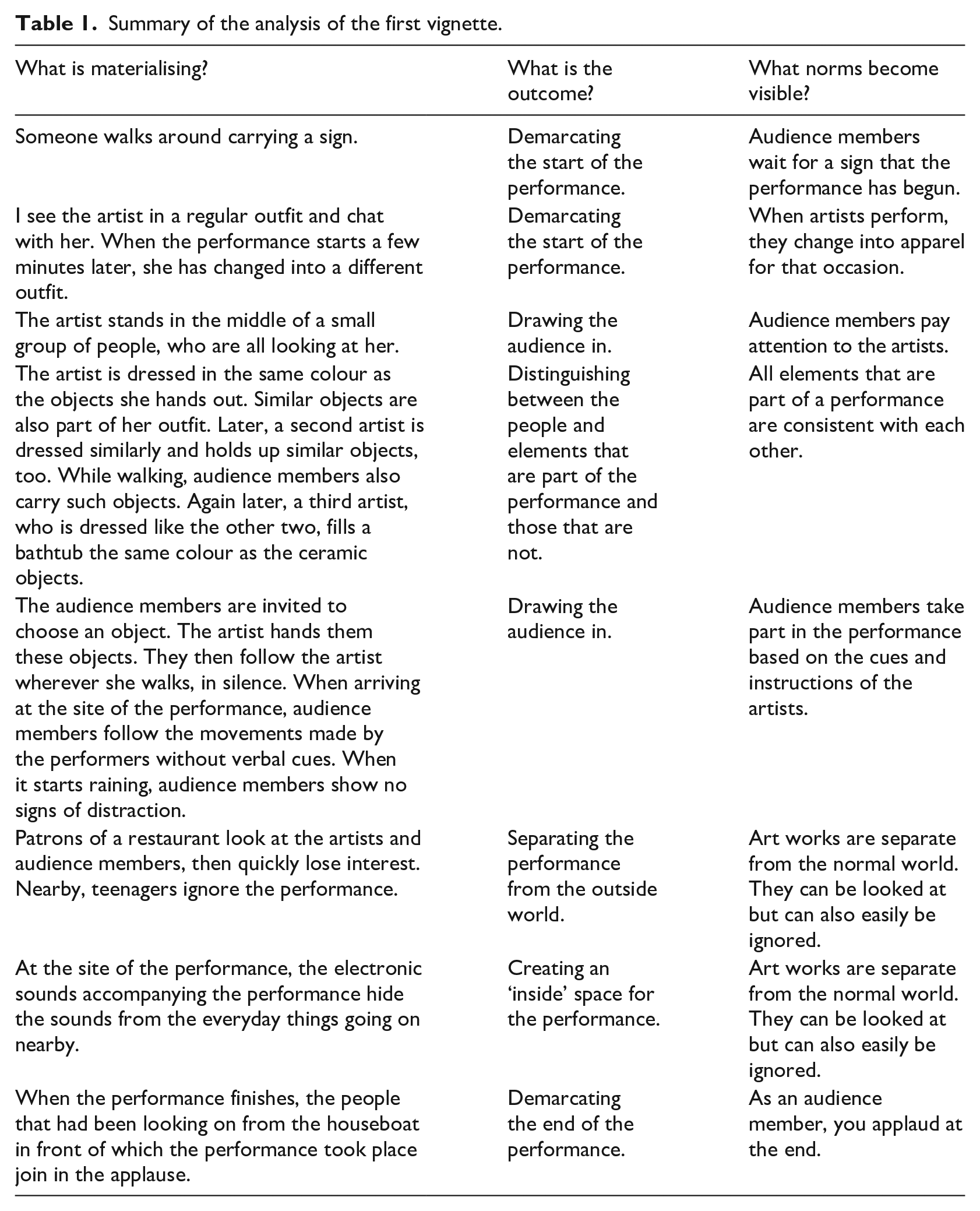
In the example discussed above, several material elements related the experience created by performers and participants to social norms and expectations regarding art. For instance, the event was temporally bounded, with its start announced using a sign that was carried around and its conclusion marked not only by audience members but also by accidental bystanders, who applauded. In doing so, they recognised the performance as art and set it apart from its environment. The event’s coherence was established through the clothing, which was identical in colour to the objects being carried, as well as through the soundscape, which gave unity to the performance. It was clear that audience members participated in the performance given that they followed the performers’ movements. As audience participation is typical of this type of theatre, this was indicative of the performance’s legitimacy as art.
Table 1 summarises these and other elements that were instrumental in legitimating the performance in relation to art norms. It presents an overview of what material elements are at play, what they produce in terms of boundaries and demarcations and how the norms of contemporary art practice are reaffirmed in this process. It clarifies how, even for passers-by unaware of the festival, the performance was clearly recognisable as an artistic activity because of those elements. In that sense, the performance is not exclusively associated with the particular festival it was part of but is also relevant to the idea of art in general.
Summary of the analysis of the first vignette.
2: The three-day shamanic art residency
There is a built structure in the middle of a public park in the eastern area of Amsterdam that blends in beautifully with its surroundings because of its subtle colours and large windows. It is used for temporary art projects and facilitates cultural events as well as longer-term artistic projects. One such event is Echoes of Shamanism, organised by the artists Nina Boas and Ieke Trinks. A year prior, she asked me to act as an art critic-in-residence, meaning I will be present throughout the entire event and will write a text about it afterwards. She selected artists from all over the world to come to Amsterdam for this project, which starts today. Although the artists come from different backgrounds and work with different media and styles, they all engage with what could be termed ritualistic, mystic or pagan art.
Once inside the Glass House, I recognise Russian-born and Amsterdam-based artist Irina Birger, who is setting up a table to the left with her materials. The other artists have just arrived from the airport or train station. Suitcases are standing around. Most of the artists are sitting and chatting at another table laid with tea and snacks, and I join them. Following some chitchat, Nina asks everyone to sit down in a circle on pillows for a round of introductions. When speaking about their artistic approach, the artists each mention major concepts, such as the universe, the cosmos, nature and humanity. They seem very much at ease with me recording and taking notes, as though it were normal for someone to record everything they say. They even suggest where to place my recording device for the best sound quality. Later, during dinner, they will direct me to websites that feature their work or previous projects.
Before this, however, and to mark the start of the project, Nina asks us to join her in a ceremonial cleansing of the space using sage. I feel quite uncomfortable about taking part in such a ritual, but to my relief, Nina gives us clear instructions, and within a few minutes, we all sweep evil forces out of the space using an imaginary broom. I try to focus but also notice that most of the artists seem to be much more seasoned space-cleansers than I am. With their fluid movements and concentrated yet calm facial expressions, they look as if they have entered a mental space that is clearly demarcated from the informal exchanges we just had. I am secretly relieved when the ritual is over and dinner is served.
The next day, the venue is open to the audience. Whereas yesterday afternoon was dedicated to getting to know one another, today the artists are asked to give insight into their artistic process to visitors. When I arrive, the artists are still busy preparing installations and fixing cables. Jasper Griepink, a Dutch artist who is inspired by druids and bards and makes, among other performances, pagan hip-hop, is currently lining up his publications and catalogues from former projects. He does this in a way that resembles the set-up of independent art bookstores, with equal spacing between the items and subtle price tags placed next to them.
On the third and final day of the event, performances take place. I am there before the programme starts and see that all artists are focused as they move around, fixing minor details on their installations. While the artists were in casual wear yesterday, some are wearing gowns and kimono-like attire today. Jasper Griepink is wearing a white catsuit and is applying make-up; he is hidden around a corner so that no early visitors see him. People are tucking away cables and quickly checking in with one another as to when their performance is scheduled. Outside, a sign welcomes visitors, while inside, printed programmes are handed out, which the visitors accept in a routine manner. Everything indicates that it is showtime.
While most artists perform during designated timeslots, Irina Birger has chosen to be present in the art space throughout the entire day. She has set up a table in the corner of the space and is dressed in an immaculate white shirt, looking serious and well put together. ‘Well, the artist is present!’ she jokes to me, in reference to Marina Abramovic’s legendary performance at the Museum of Modern Art (MOMA) in New York, where she sat in meditative silence across changing visitors for months. Indeed, her dark hair, facial features, white clothes and the table she chooses to sit behind all recall the renowned performance artist.
Once the visitors enter, she focuses herself and sits down behind her desk. Then, for the rest of the day, she will invite people to sit down in front of her as she draws intuitive portraits based on the stories they tell her. Her look exudes mystery and trustworthiness in equal measure, bringing to mind a psychotherapist, or a psychic. After hours of drawing and intense conversation, the drawings taped against the glass wall form an ad hoc artwork.
Analysis
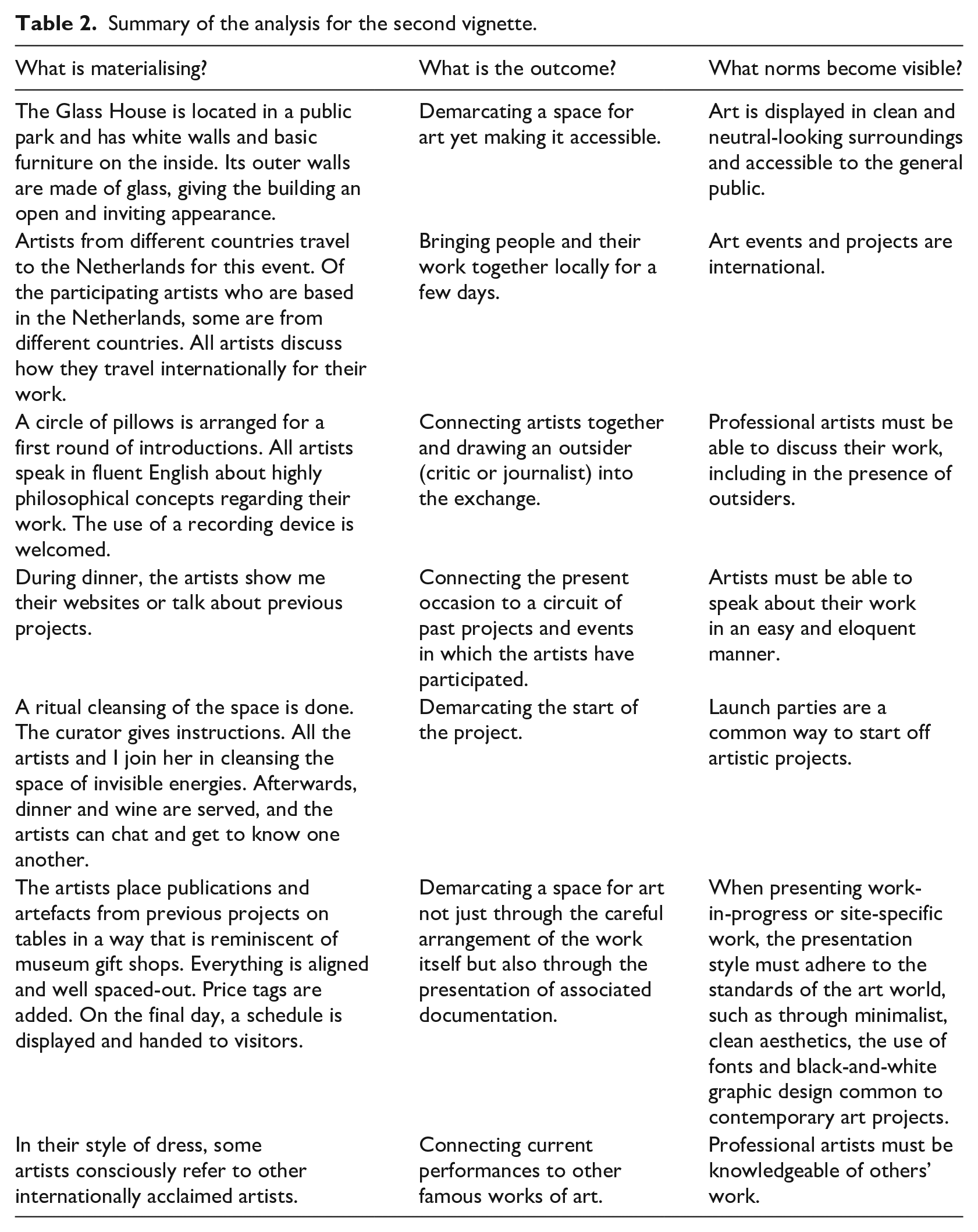
The event brings together a set of people and artefacts – the artists and their paraphernalia – in and around a building made of glass. The space has white walls and a neutral, inviting look that is typical of cultural venues, and its location in a public park also makes it look welcoming. Even oblivious dogwalkers who pass by can see that the people who are working here during this event are engaged in something that is to be shown to the public rather than a religious cult in the middle of a ritual, which they could easily be mistaken for based on their dress. While the artists occupy a niche in the realm of contemporary art practice, small actions reveal their acquaintance with the social norms of professional art. Examples include how they set up documentation of previous work and how they position the objects for their performances, or their installations, as well as their ease with being recorded and speaking publicly. The move from collegial exchange to the performing or exhibiting of their actual artwork is indicated through a different style of dressing and also through a more concentrated facial expression and orientation towards visitors. The visitors at the event seem to be aware of what is expected. They accept the programmes they are handed and move from one performance to the next according to the timetable. Seating areas in different parts of the space are arranged right before each performance is about to start.
Table 2 offers these and more examples of how the artists materially relate their performances and works to art norms. Moreover, the artists not only comply with the codes of the art world but also link their performances to one another to constitute an ‘art event’. Their conversations, the ritual cleansing they all share on the first day and the interactions with viewers are all ways in which they orient themselves towards one another and make the activities relevant to the broader activity at hand (i.e. the event).
Summary of the analysis for the second vignette.
Discussion
What stands out from our two vignettes and the analysis presented in Tables 1 and 2 is that the materialisation practices we observed can be categorised as either practices of separation and demarcation or of connecting and drawing in. In investigating how these seemingly contradictory practices occur simultaneously, we identify two principles through which art is legitimated as art in the context of the art events we studied. First, in the examples we presented, artwork was connected with the norms and expectations that define it as well as with its immediate environment. Second, art was also set apart from environing norms and elements either through connections with previous art events and existing artworks, thus reinforcing its belonging to a distinct normative space, or through material and spatial distinction from its immediate surroundings.
Connecting art to its norms and to its environment
The first materialisation practice consisted of establishing relations between art and the norms that make it recognisable as well as with its immediate environment. This first set of practices resonates with current research on legitimacy, which suggests that legitimacy proceeds by relating, in the audience’s perception, the actions under scrutiny with existing expectations (Reihlen et al., 2021). However, our findings extend this insight by demonstrating that this is achieved not only through discourse and persuasion but also through the material ways in which the actions are accomplished. We saw, for instance, that the performance in the first vignette materialises the principles of audience participation that are common in ‘post-dramatic theatre’ (Clark & Mangham, 2004) and that, in the second vignette, artists mimicked the displays of museum gift shops, thus borrowing the codes of legitimate art venues. We also tend to expect exhibition spaces to look clean and minimalistic (Eghenter, 2018) and to host projects and events that are truly international, as we saw in the second vignette (Rothenberg & Fine, 2008). Launch parties are also typical events associated with the initiation of artistic projects (Neff, Wissinger, & Zukin, 2005). We thus complement the research suggesting that material artefacts play a part in legitimation (Arnaud et al., 2016; Nicolini et al., 2021) by demonstrating that these artefacts grant legitimacy not only through their own virtue (i.e. because they are old or conform to organisational strategy) but also because they are implicated in practices that combine bodily, spatial and even auditory elements. These practices materialise norms in the ongoing situation, which in return legitimise the practices.
However, our ethnographic data show that the relationship pertains not only to norms but also to the concrete environment that immediately surrounds the performance. For instance, in Vignette 1, the artists’ use of water echoes the fact that the performance takes place on docks, and the soundscape envelops the performers, participants and bystanders in a coherent whole, while the family on a nearby boat takes part in the final applause. These elements establish a strong connection between the art performance and its environment in a way that is reminiscent of the recent ‘social turn’ in artistic practice, which suggests that art is legitimate inasmuch as it engages with current social issues (Asomatos, 2020). We show, however, that such engagement also entails tangibly connecting works and performances with their material surroundings.
Disconnecting art to create a space of its own
While much of the literature on legitimation emphasises the importance of (discursively) connecting the actions under scrutiny with norms and other elements from which they borrow their legitimacy, our data indicate that art must also do just the opposite: it must disentangle itself from its surroundings to claim a normative space of its own. While such separation is counterintuitive for the literature on legitimacy, contemporary art is, in fact, largely defined by an unwritten rule that art is separated from the real world (Aslan, 2017). This is achieved in two ways. First, art connects to existing art rather than to societal norms; for example, one of the artists in the second vignette compares her work to that of Marina Abramovic and also dressed like her and positioned her body in relation to visitors in a similar way. More generally, throughout the event in the second vignette, the works and performances, by having the same theme and similar aesthetics and sharing the same physical space, combined to create a ‘festival’ that legitimated each of its individual components. In a more discursive modality, artists also talked about their previous projects and showed each other their websites and other documents. In the first vignette, artists also related elements of their performance to one another: all the artists dressed similarly and moved at the same pace, and their clothes were the same colour as the ceramic objects; audience participants also moved similarly and handled the same objects.
Second, art also creates its own space by disconnecting from its surroundings. For instance, both events clearly signalled their commencement, the first with a person walking around with a sign and the second with a launch party. Changing clothes also visibly materialised a change in the sort of activity about to take place and in people’s roles (e.g. artists vs audience). Bystanders, in the first vignette, also help create that separation by exhibiting their understanding of what is going on (i.e. by either ignoring the performance or watching as ad hoc audience members) and by applauding to signal the end. Such separation, accomplished through the very materialisation of what the artists and others do, disentangles the performances and artwork from the norms that usually apply to the physical settings in which they take place, turning a specific portion of a dock or a park into a stage or festival space for a delimited period.
The precise nature of these two movements – of connection and disconnection – will depend on the specific situation where the actions under scrutiny take place. Comparing the two events already shows, for instance, that holding an event inside creates a more controlled setting, which, among other consequences, precludes the participation of random bystanders. Different organisations in different contexts, not to mention different countries with various material environments and different expectations as to what legitimate art may be, will offer yet other opportunities for connection or disconnection. What we offer, therefore, is not a list of the elements that participate in legitimation but rather a grammar for relating together the elements that compose each individual situation.
Contributions
Materialising legitimacy
Our data show that artists rely not only on talk and documents to legitimise their work: their very actions also establish their own legitimacy. The materiality of their actions simultaneously relates to external norms and other elements in their environment and marks a separation from them by establishing internal relations to other facets of art and a boundary from what is not art. In that sense, our observations contrast with current research, which has largely focused on how people produce discourse to legitimise their action after the fact – for instance, when asking interviewees to explain what has happened or investigating critical events (Gephart, 1992). Real-time studies, for their part, consider language to be the site of struggle over legitimation (e.g. Erkama & Vaara, 2010).
The analysis presented in the previous section indicates that many of the same issues identified in the literature on discursive legitimation also arise through material practices. This is the case, for instance, with stakeholder engagement, which the literature considers to both depend on and contribute to discursive legitimation (e.g. Hardy & Phillips, 1998) and which we have touched upon as audience and bystander participation. We also see that ‘narrative framing’ (Vaara & Tienari, 2011), which consists in relating the actions being considered to shared norms and expectations, also takes place through non-discursive means. The two sets of artists we observed did not state that they conformed to these rules nor did they attempt to steer observers’ sensemaking to convince them they did; they simply enacted the norms that legitimised them.
Without denying the importance of language, we extend prior research that has shown that buildings and other artefacts play a role in legitimation (de Vaujany & Vaast, 2016; Nicolini et al., 2021). We do so by showing that materiality is not merely a resource about which people can talk or a limit on interpretive flexibility (by resisting what people say about it). It also concretely materialises the very norms by which action is judged to be legitimate. Rather than actions on one hand and their description on the other serving to relate them to outside norms (with the audience assessing the success of this relationship), legitimation emerges as coextensive with the actions it concerns.
A relational and configurational view of legitimation
This means that legitimation is not achieved with respect to an external audience, as is implied by the focus on stakeholders’ perceptions (Reihlen et al., 2021; Suddaby, Bitektine, & Haack, 2017), incumbents’ recognition of legitimate new players in the field (De Clercq & Voronov, 2009) or the distinction between internal and external legitimacy (Drori & Honig, 2013). Indeed, the assumption that legitimation requires an audience rests on a conventional view of communication in which emitters ‘send’ legitimation signals to recipients.
Our findings highlight the materiality of legitimation. This leads us to adopt a performative view of communication, which focuses on its ability to constitute relations (Ashcraft et al., 2009; Cooren, 2018, 2020). Legitimation, in such a view, is less a matter of describing pre-existing action to match a given norm than it is a matter of accomplishing that action in such a way that it constitutes a situation that sets its own expectations and in which it is legitimate. In that sense, we propose that legitimation is about configuring human and non-human participants into situations that are recognisably legitimate. For instance, by assigning roles to audience members, creating immersive soundscapes and engaging in rituals together, the performances and installations brought individuals and artefacts together in ways that were consistent with art norms (e.g. audience participation, launch parties, etc.) and that, in themselves, constituted the normative space of the performance.
Legitimation thus involves the participation of all actors – human or otherwise: audience members or even passers-by are therefore not recipients in need of persuasion but rather participate in legitimacy’s accomplishment through the ways in which they position their bodies and their applause, for instance. However, as our data show, the performativity of legitimacy can configure people and objects in ways that exclude some of them. This is coherent, for instance, with the literature exploring how people in ‘dirty’ professions or those who are confronted with organisational crises (discursively) separate the ‘cleaner’ aspects of their work from the less desirable ones (e.g. Patala, Korpivaara, Jalkala, Kuitunen, & Soppe, 2019).
In this sense, legitimation is also about boundary work, and our analysis expands on existing research on the connection between materiality and boundary constitution (Leonardi, Bailey, & Pierce, 2019). Such boundary work may also be understood as a form of negative legitimation or refusal to be legitimated according to hegemonic norms, such as those of new trendy urban developments that incorporate art in ways that may ‘absorb’ even prize-winning installations, such as A Place Beyond Belief, as mere decoration. However, rather than defining boundaries – and their crossing – in terms of knowledge or understanding, as has often been the case (e.g. Sturdy & Wright, 2011), our analysis demonstrates that it should be understood in terms of practical participation or not in the activity in question and stresses that even physical boundaries define a perimeter of legitimacy.
The continuous nature of legitimation
Finally, our analysis elaborates on the insight that legitimation is a continuous process (Suddaby et al., 2017), specifying that when it is not an issue to participants who do not verbally address it, it is still accomplished through materiality. Drawing attention to artistic organisations, whose legitimate place in society is never definitively established, we demonstrate that legitimation is not merely an issue during exceptional times of crisis but that it must be re-enacted in each activity. Indeed, the literature has often privileged moments during which legitimacy is explicitly at stake, such as mergers and acquisitions (Vaara & Tienari, 2011), new entry into an industry (De Clercq & Voronov, 2009) or new partnerships (Herlin, 2015). However, our analysis indicates that the absence of discourse does not mean that legitimation is not taking place: we still do it (through embodiment), and we delegate responsibility for it to materiality.
While our study focused on the context of art organisations, our findings may be expanded to other organisational settings, wherever work takes place not only through discourse but also through material practice. Our study offers a grammar that invites looking at the way legitimacy results from particular and transient configurations of people and things. It also invites recognising that legitimacy is not reached once and for all but that people engage in legitimation practices even in their most mundane activities.
Footnotes
Acknowledgements
We are extremely grateful to the artist collective BetweenTwoHands and all artists involved in the Echoes of Shamanism event for inviting us to see their work and for generously sharing their reflections with us. We thank all members and participants of the Leuphana Organization STudies (LOST) group for their generous and insightful feedback on earlier versions of the paper. We are grateful to Lena Kostuj for her research assistance. We also thank the organisers, discussants and participants of the symposium A Place for Space at the Academy of Management conference in 2019, the COG-meets-LOST workshop at Copenhagen Business School in October 2019, and the Creative Industries Conference at Amsterdam Business School in May 2022 for their useful comments. Finally, our sincere thanks go to Senior Editor Janne Tienari and three anonymous reviewers for their constructive and detailed feedback.
Funding
The author received no financial support for the research, authorship, and/or publication of this article.
