



Abstract
This study adopts a qualitative approach in order to determine why and how the idiosyncrasies of family business influence path formation and path-breaking (and their outcomes) in strategically persistent family businesses. Findings are based on an analysis of six in-depth case studies of family businesses from Switzerland’s textile industry, including interviews with family and nonfamily firm members, archival data and expert interviews. The study finds that idiosyncrasies rooted in power hierarchy, chronicle orientation, and network embeddedness spur self-reinforcing mechanisms – in particular expectation effects and learning and investment effects – in path formation. However, at a later stage, they may become drivers of path-breaking. The study contributes to research on organizational path dependence by illuminating the role of power hierarchies in path formation and breaking. Path-breaking requires certain shifts in formal and informal power hierarchies; such shifts of power happen not only with respect to individual family members but also between family subgroups and nonfamily members. The study further identifies different strategic outcomes of path-dependent processes: protecting by renewing, pivoting and perfecting. While protecting by renewing and pivoting encompass path-breaking, perfecting occurs within the framework of a strategic path by leveraging incremental changes. In the case of protecting by renewing, businesses develop new revenue streams detached from the previous core business; these are partly used to subsidize the remains of the previous core business, thereby accepting inefficiencies for parts of the business. Pivoting refers to changing the business model without accepting inefficiencies. Implications for family and nonfamily businesses are discussed.
Introduction
Family businesses are defined as those ‘governed and/or managed with the intention to shape and pursue the vision of the business held by a dominant coalition controlled by members of the same family or a small number of families in a manner that is potentially sustainable across generations of the family or families’ (Chua, Chrisman, & Sharma, 1999, p. 25). The dominant coalition formed by the owner family and a transgenerational outlook underpin idiosyncratic family business behaviour. Decision-making processes and the owners’ underlying goals (often non-economic in nature) might affect strategic paths taken in family businesses (Gómez-Mejia, Cruz, Berrone, & De Castro, 2011). The transgenerational outlook of family businesses has been linked to their being rooted in tradition (De Massis, Frattini, Kotlar, Petruzzelli, & Wright, 2016) and acting with a long-term perspective (Lumpkin & Brigham, 2011). They are more persistent in their strategic behaviour than nonfamily businesses, due to their goal of preserving family tradition (Fang, Chrisman, & Holt, 2021). Such strategic persistence may help family businesses achieve non-economic goals by, for instance, creating and accumulating non-economic endowments for the owner family (Berrone, Cruz, & Gómez-Mejia, 2012) and by achieving higher levels of legitimacy and, in consequence, better economic returns (Schreyögg, Sydow, & Holtmann, 2011). However, such positive outcomes might interact with self-reinforcing mechanisms that cause firms to become path-dependent (Sydow, Schreyögg, & Koch, 2009). Organizational path-dependent processes can be defined as ‘processes that unintentionally develop their own pull and are driven by positive feedback’ (Sydow et al., 2009, p. 698). While path dependence is not necessarily dysfunctional, it likely leads to dysfunction over time, representing a threat to firm viability, especially when external conditions are unstable (Sydow, Schreyögg, & Koch, 2020).
An interesting pattern emerges regarding path dependence in family firms: extant research indicates that family businesses might be more prone than nonfamily businesses to path dependence because of their emotional bonds, emphasis on tradition, and inward-looking focus (Kammerlander, Dessi, Bird, Floris, & Murru, 2015; Lubinski, 2011). However, research on long-lasting family businesses shows that the integration of innovation and tradition is possible (De Massis et al., 2016), indicating that family businesses might be particularly able to break organizational paths, due to prevalent long-term perspectives (Bergfeld & Weber, 2011) and decision autonomy of the owner family (Carney, 2005). A handful of studies notwithstanding, the specific mechanisms associated with how and why family businesses become path-dependent and how they handle lock-in and potential path-breaking are poorly understood. Studying path-dependent strategic processes in family businesses is important for several reasons. First, while being path-dependent does not necessarily lead to negative consequences, by definition it has the potential to entail rigid processes and inefficiencies (Sydow et al., 2009), possibly detrimental for a firm when external conditions change (Schreyögg & Sydow, 2011). If family businesses are prone to path dependence, this potential threat would impede their goal of being sustainable across generations. Investigating path dependence offers an opportunity to extend current theorizing on the strategic behaviour of family businesses. Second, family businesses provide an interesting milieu for understanding contextual influence on path formation and path-breaking. These firms show idiosyncrasies related to ownership structure, organizational culture, and composition of the top management team (Salvato, Chirico, Melin, & Seidl, 2019). These aspects have received little attention in path dependence research, though these variables may both hinder and fuel strategic change (Cannella, Finkelstein, & Hambrick, 2008). Based on these considerations, we pose the following research question: Why and how do family business idiosyncrasies influence the formation of organizational path dependence and, in the case of a lock-in, path-breaking, as well as strategic outcomes?
A qualitative approach is taken to investigate this, combining data from six case studies from the Swiss textile industry, which has been declining for several decades (Dubler, 2014). All firms in the study have a history of producing textiles in Switzerland, are over 50 years old, family owned and in the second generation at least. We argue that firms remaining in the industry under these circumstances are strategically persistent, providing a particularly relevant context for investigation.
Bringing together the literature streams of organizational path dependence and family business research contributes to the literature in several ways; first, by advancing the understanding of the role of social processes and cognitions in the process of organizational path dependence. Specifically, we show how power hierarchies, network embeddedness and chronicle orientation interact during path formation and path-breaking. Researchers have highlighted a need for better understanding of these processes, especially the role of power hierarchies (Breslin, 2022; Sydow et al., 2020); these findings confirm their pivotal role. The dynamics of formal and informal power hierarchies are part of the idiosyncrasies of family businesses (Chrisman, Chua, Pearson, & Barnett, 2012). Compared to prior studies, our approach provides insights from a micro-level investigation, considering relationships between decision-makers and their stakeholders. We show that power hierarchies may further spur self-reinforcing mechanisms during path formation, with changes in power structures building the basis for path-breaking. Second, this study contributes a better understanding of what comes after path dependence, i.e. lock-in and path-breaking (Stache & Sydow, 2022; Sydow et al., 2020), by identifying different strategic outcomes. These strategic outcomes – protecting by renewing, pivoting and perfecting – show that being path-dependent in the context of deteriorating external conditions does not necessarily entail a firm’s demise. Showing that family businesses may remain successful by their own definition extends ongoing conversations in the literature about how family businesses handle the tension between being innovative and open for change, and simultaneously preserving traditions (De Massis et al., 2016).
Family Businesses and Path Dependence
In family businesses, ownership by members of the same family engenders pronounced power concentration (Astrachan, Klein, & Smyrnios, 2002). Even if boards are in place, they are typically structured according to family ideology (Anderson & Reeb, 2004). Sustaining power and control has been framed as an important family-centric, non-economic goal (Berrone et al., 2012). Firm behaviour aiming at achieving this goal may lead to strategic persistence (Fang et al., 2021). The owner family will make important strategic decisions at a point that, in hindsight, may be identified as a critical juncture, i.e. decisions which initiated path dependence (Sydow et al., 2009). Additionally, strategic decisions are linked to other family business idiosyncrasies: emotional attachment and identification, unique social capital, transgenerational intention, and generational involvement (Salvato et al., 2019).
Scholars have argued that family businesses may be prone to strategic persistence and, potentially, path dependence (Fang et al., 2021; Kammerlander et al., 2015; Lubinski, 2011) because of their idiosyncrasies, particularly their emphasis on tradition, emotional attachment and inward-looking focus. These characteristics make family firm decisions particularly ‘sticky’ and insulate decision-makers from (novel) external perspectives. Organizational path dependence theory has introduced specific mechanisms and concepts that differentiate path dependence from other related concepts such as strategic persistence or inertia (Sydow et al., 2009). The main conceptual difference between organizational path dependence and other concepts is the presence of self-reinforcing mechanisms as a defining element of the organizational path. Driven by positive feedback, self-reinforcing mechanisms at the individual, firm or industry level limit path-dependent firms’ room for strategic manoeuvre (Koch, 2011). For instance, expectations effects, complementarity effects, coordination effects, and learning and investment effects are perceived as important self-reinforcing mechanisms (Dobusch & Schüßler, 2013). Overlap between the family and the business system adds a new angle to the analysis of these mechanisms (Tagiuri & Davis, 1996) as it leads to close emotional ties between the family and the business, and the desire to continue the business across generations (Gómez-Mejia et al., 2011). The influence of the owner family shapes how family businesses interact with external stakeholders, and may affect self-reinforcing mechanisms, which are based on interaction with stakeholders. Furthermore, the overlap of the two systems gives the firm a prominent role in the family’s identity, implying that negative perceptions of the firm damage the social identity of the owner family (Berrone, Cruz, Gómez-Mejia, & Larraza-Kintana, 2010). This identity is enacted by family members, but also by nonfamily employees (Ponroy, Lê, & Pradies, 2019); such identity considerations might affect self-reinforcing mechanisms such as expectation effects. Lastly, some self-reinforcing mechanisms (e.g. investment and learning effects) are based on the accumulation of specialized, but non-transferable stocks of investment or knowledge (Dobusch & Schüßler, 2013), which can be affected by the owner family’s concentration of wealth within the business, long-term orientation of the family business, and focus on tradition (Salvato et al., 2019). The idiosyncrasies of family businesses may be expected to affect how self-reinforcing mechanisms unfold.
Why and how firms break their paths and leave a state of lock-in – i.e. switching between phases of path dependence and path-breaking – has received comparatively less scholarly attention (Stache & Sydow, 2022). Autonomous strategic actions emerge through exploration outside the scope of the current strategy, enabling entry into new product-market environments (Burgelman, 2002; Burgelman & Grove, 2007), resembling path-breaking. Excellence in one area, however, carries the danger of reducing scope for autonomous strategic action (Burgelman, 2002). The success of family businesses is often rooted in exactly that strength: being leaders in niche markets (Johann, Block, & Benz, 2021). The rich past and tradition of family businesses, and the lengthy tenure of their executives (Jorissen, Laveren, Martens, & Reheul, 2005), might further make them prone to beliefs about causes and effects of strategic action that no longer hold under changed external conditions (Prahalad & Bettis, 1986). Family businesses might then be expected to lack room for autonomous strategic action. However, evidence suggests that, in certain circumstances, family businesses should be able to achieve path-breaking (De Massis et al., 2016), since family owners and managers have ‘more to lose’ compared to decision-makers in nonfamily firms, because of their transgenerational intentions. As path dependence is detrimental for firms in deteriorating external conditions (Sydow et al., 2009), decision-makers in family firms are eager to find ways to ensure leaving paths if necessary to survive. High levels of command allow family firms to make more extreme decisions, compared to other organizations (Carney, 2005): possibly the root cause of both path formation and path-breaking. Empirical evidence on the longevity of family businesses (Chirico, Gómez-Mejia, Hellerstedt, Withers, & Nordqvist, 2020) supports the notion that family firms are able to break paths. While extant evidence suggests substantial conceptual links between family business idiosyncrasies and path dependence as well as path-breaking, how these relationships unfold remains unknown.
Method
Since this research addresses ‘how’ and ‘why’ questions, a qualitative approach was chosen (Yin, 2013) and investigation focused on historic case analyses (Dobusch & Kapeller, 2013; Eisenhardt, 1989; Sydow et al., 2020).
Research context and case selection
To observe the desired phenomena, it was necessary for case firms’ external environment to be subject to change, which should make strategic persistence less attractive than in a stable environment. One industry setting was selected, to keep overall industry effects stable and enable comparisons between cases: the Swiss textile industry, with a long tradition, but progressively declining and subject to external shocks since the 1990s. Therefore, we focus our investigation on the timeframe between 1990 and 2020. While 12% of all workers in Switzerland were active in the textile industry around 1870, the era of cheap mass production in Switzerland ended in the 1980s, as cost pressures from international competitors intensified (Dubler, 2014; Schüßler, 2009). External shocks such as the 2007 financial crisis, currency regulation problems in 2011 and 2015 that impacted exports, and closures following the 2020 pandemic hit the industry hard. Between 2000 and 2017, the number of employees in the Swiss textile industry shrank from 13,900 to 6,276. 1 We assume that the initial success of the industry and subsequent decline and external shocks provide a high likelihood of observing strategic persistence, path dependence and potential path-breaking (Sydow et al., 2020).
Family businesses that originated in the Swiss textile industry were selected as case studies because family businesses are particularly persistent in their strategic behaviours, owing to goals of maintaining family tradition and parsimony (Fang et al., 2021). The sample was restricted by several criteria. First, closely held family businesses where one or several families possess majority ownership, with a family member as chairman or CEO, were selected: these firms are particularly likely to be persistent in their strategies (Fang et al., 2021). Second, the sample was restricted to family businesses that are at least in the second generation, i.e. have experienced at least one transgenerational succession, to study ownership dynamics. Third, small and medium-sized enterprises were selected, to study paths in more informal, less professionalized organizations (Dekker, Lybaert, Steijvers, & Depaire, 2015). Fourth, firms had to still be in business, as interest lay in the theoretical tension of family businesses being more prone to path dependence, yet able to survive in declining industry conditions.
Within these frames, diverse cases were sampled (Seawright & Gerring, 2008). First, family business research understands family influence on the business to be gradual, leading to heterogeneity between family businesses (Astrachan et al., 2002). To capture this graduality, family businesses varying on two main dimensions were selected (Chua et al., 1999): family control (represented by different numbers of family owners, family branches, and family members involved in management) and the potential influence of their transgenerational perspective (represented by the generation the business is in). Second, we were interested in different strategic outcomes of companies, which could be related to their product portfolios; variance was therefore allowed for in the products at the time of investigation, while ensuring all were part of the Swiss textile-producing industry.
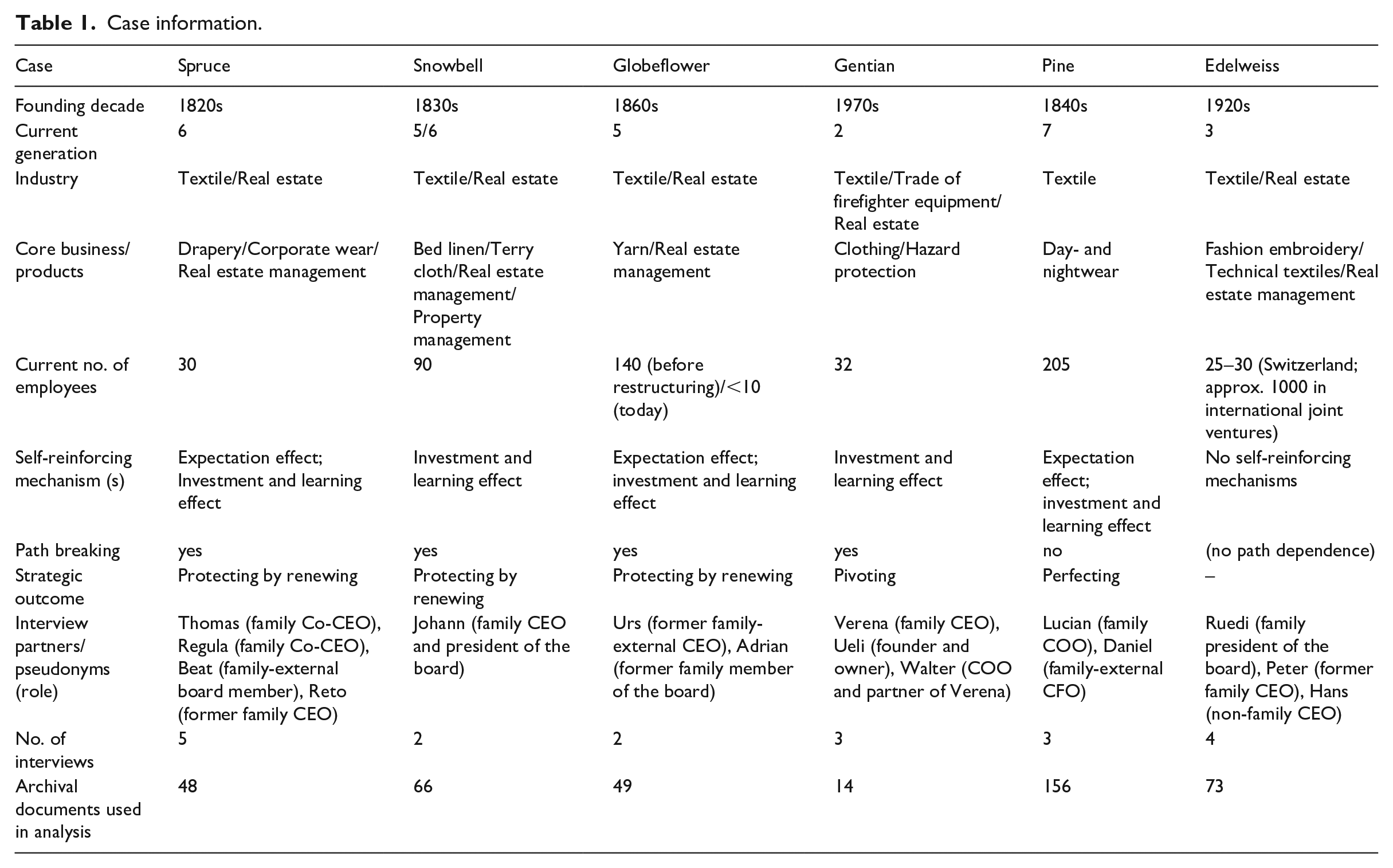
To identify suitable cases, first the member list of Swiss Textiles, an industrial association, was used. Second, a web search with a specific focus on family businesses was conducted. From the shortlisted firms, potential interview partners were identified and contacted, to verify that the firms matched the selection criteria. Ultimately, the sample consisted of six family business cases, detailed in Table 1. To ensure confidentiality we use pseudonyms for all firms and interview partners.
Case information.
Data collection
We collected rich data on all case studies, including secondary data and key informant interviews. 26 semi-structured interviews were conducted (in two rounds, in 2020), including 19 interviews with members of case study firms, and seven expert interviews. Interviews were based on guidelines, with questions focusing mainly on the period 1990–2020. While the guidelines were informed by organizational path dependence theory, given the qualitative nature of the research, we remained open to new aspects arising during data collection. Whenever possible, two researchers conducted face-to-face interviews, taking notes during and directly after interviews to record impressions. All interviews (average length: 63 minutes) were audiotaped and transcribed verbatim.
For each case, also secondary data consisting of press articles from various newspapers and company websites was collected. Five databases were used to identify appropriate newspaper articles: Google News, LexisNexis, Factiva, Swissdox.ch, and ARGUSavenue. In all databases, except for Swissdox.ch, which only allowed a search of the last four years, we considered articles from January 1990 to December 2019 totalling 451 text files.
Data Coding and Analysis
Data analysis followed several steps. First, we reconstructed the chronological history of the case firms along with important events, based on the data available, to create timelines of their relevant strategic development, 1990–2020 (see Figure 1) (Dobusch & Schüßler, 2013; Langley, 1999). Second, to address the research question, we assessed if and when the case firms became path-dependent. As this analysis is informed by organizational path dependence theory, we followed an abductive approach, going back and forth between the theory and the data (Sydow et al., 2009; Timmermans & Tavory, 2012). Because strategic persistence builds the broader conceptual basis for organizational path dependence, indicators were sought that the firms continuously followed similar strategic patterns, despite changing external conditions (Fang et al., 2021). All case firms showed strategic persistence to differing extents. We then abductively coded for indications of path dependence based on prior literature (Dobusch & Schüßler, 2013). We classified cases as path-dependent where mechanisms could be identified that were self-reinforced by positive feedback and had limited room for strategic manoeuvre (Sydow et al., 2009). We compared these mechanisms to types of self-reinforcing mechanisms already identified in the literature. Synthesizing extant research, Dobusch and Schüßler (2013) propose four types of self-reinforcing mechanisms: coordination effects, complementarity effects, investment and learning effects, and expectation effects, in line with recent empirical investigations of path dependence (see e.g. Breslin, 2022; Stache & Sydow, 2022). The data revealed that expectation effects especially, as well as learning and investment effects, were dominant in these family firm cases. Table 1 lists mechanisms identified; Table A1 in the online supplemental material provides a detailed overview of the coding of the mechanisms. We further searched for indicators that the firms had difficulty leaving the strategic path (indications of lock-in). This entailed analysis of the strategic discourse within the firms, and between protagonists (Brown, Colville, & Pye, 2015), triangulated with the secondary and industry data (Lincoln & Guba, 1990). Based on this analysis, five out of six case firms were classified as path-dependent. We kept the non-path-dependent firm, Edelweiss, as a contrasting case. We scrutinized whether subsequent path-breaking occurred for all firms demonstrating path dependence in the studied period. We defined path-breaking by the minimum condition of restoration of a choice situation and choice of a superior alternative (Sydow et al., 2009). More specifically, we searched significant changes in the firm’s setup and business model (e.g. restructuring, leveraging new revenue streams) to achieve firm survival (see Table 1). We discussed all classifications, categories and definitions, addressing discrepancies to ensure shared understanding.
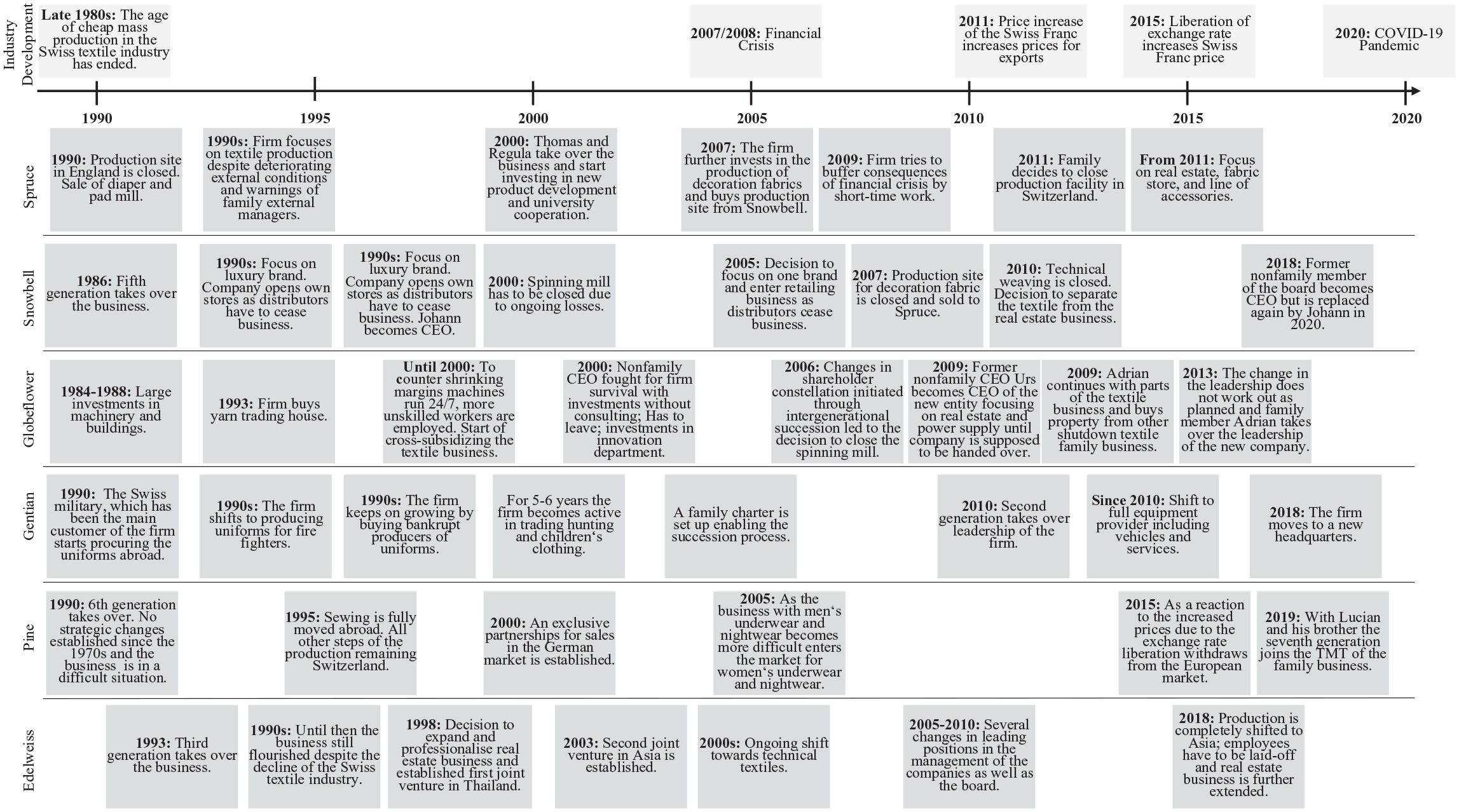
Case timelines.
Second, a cross-case analysis was conducted starting with inductive axial coding (Corbin & Strauss, 2008) and an exploration of whether first-order codes could be merged into concepts that might prove useful in explaining how family business idiosyncrasies influence the strategic process identified during analysis of strategic persistence and path dependence. To do so, an abductive coding approach was adopted, to reflect the findings in the context of extant literature (Timmermans & Tavory, 2012). Family business idiosyncrasies were specifically reflected upon; these have been identified as relevant to the context of strategic processes in organizations (Salvato et al., 2019). In the final step, we looked for dimensions underlying the second-order themes that could provide a basis for building a coherent data structure (Gioia, Corley, & Hamilton, 2013); an illustration of this appears in Figure 2.
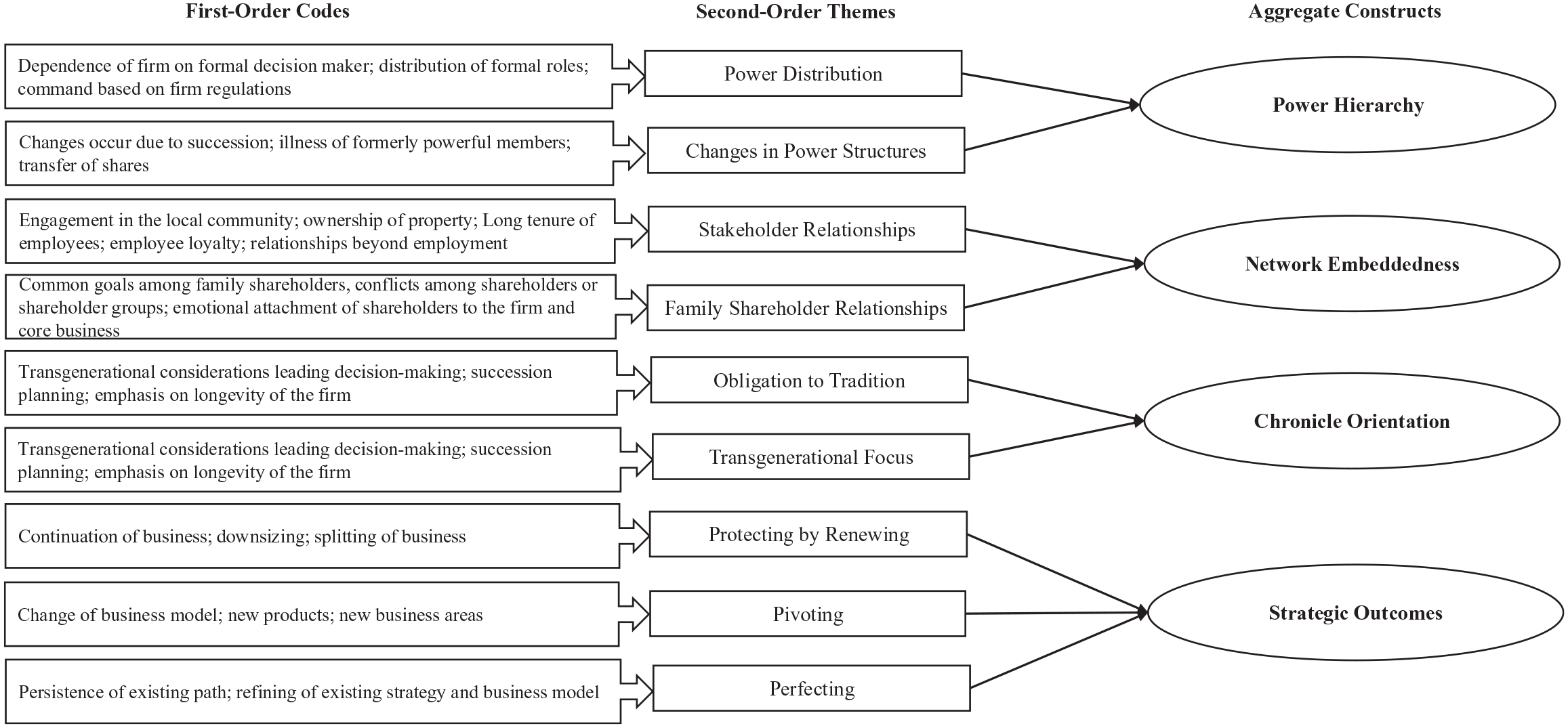
Data structure.
Three family-business-specific themes emerged as influencing factors at different stages of the process.
Power hierarchy, defined as the distribution of formal and informal power between individuals associated with the family business (power distribution) via ownership, management, or family membership, and changes thereto (changes in power structures).
Chronicle orientation, defined as attention paid to the time dimension of the business, encompassing the past (obligation to tradition) as well as the future (transgenerational focus).
Network embeddedness, defined by relationships between the family business and different stakeholders (stakeholder relationships), including external stakeholders, and the relationships among the family businesses’ shareholders (family shareholder relationships).
All second-order themes were identified in all cases; however, there was substantial variance in their manifestation. For example, Gentian showed fewer indications of being obliged to tradition than did other path-dependent cases. We further identified three different strategic outcomes of path dependence in case firms: protecting by renewing, pivoting and perfecting. Finally, we interrogated the data to understand how components interacted in the different phases identified by prior analysis. It required several iterations between the data and the literature, and extensive conversations between the authors, to arrive at the final conceptual model (see Figure 3) (Gustafsson, Gillespie, Searle, Hailey, & Dietz, 2021). In addition to the evidence provided in the findings section, an overview of the coding scheme (with sample quotations) appears in Table A2 in the online supplemental material. We also grouped our cases along whether they broke the path and whether this occurred together with succession (see Table 2).
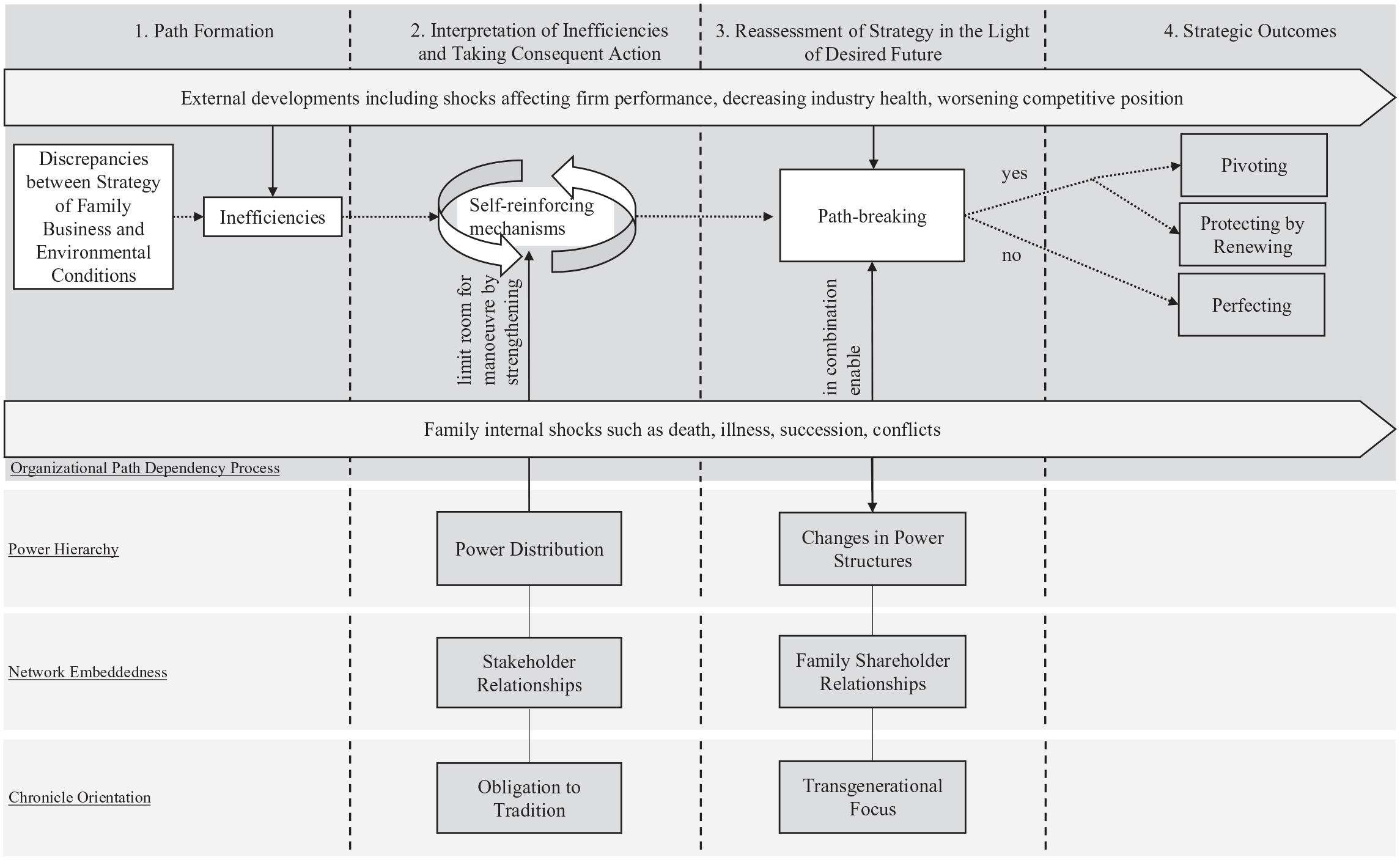
Integrative model of path formation and path-breaking in family-influenced businesses.
Overview of co-occurrence of path-breaking and succession.
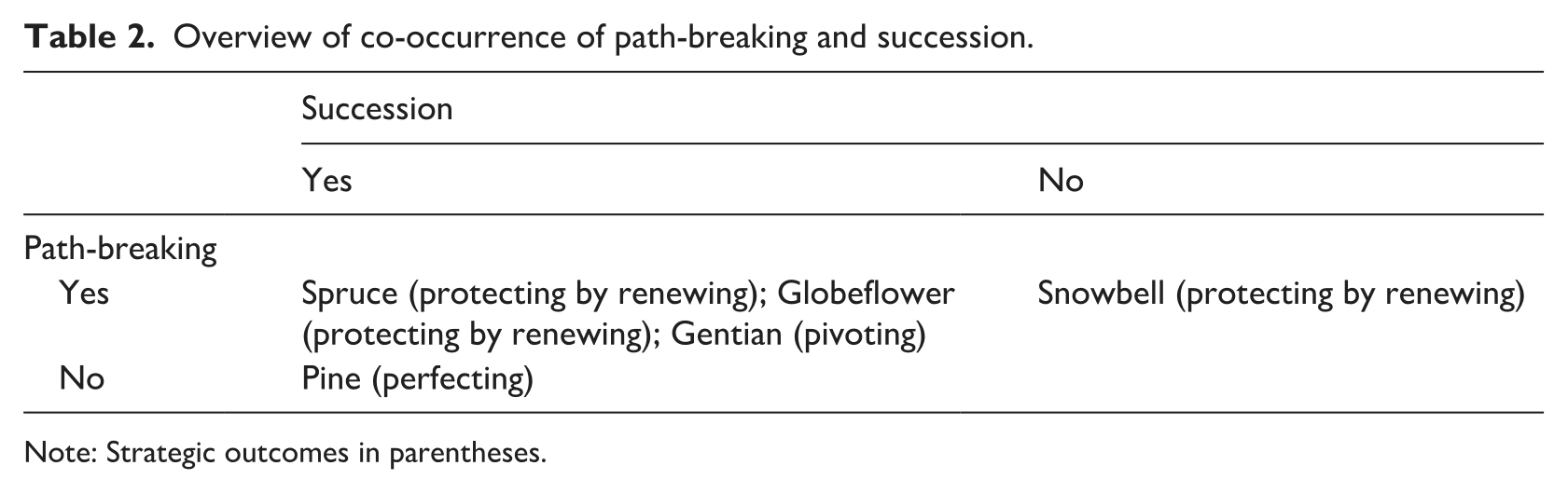
Note: Strategic outcomes in parentheses.
Findings
Below, we describe the paths of the individual cases, including interpretation thereof. Subsequently, we synthesize the findings and present an integrative model revealing the influence of family business idiosyncrasies on path formation and path-breaking.
Within-case analysis of strategic persistence and self-reinforcing mechanisms
Spruce
Spruce started as an intermediary between production by home workers and merchants (Ferggerei) in the 1820s. During industrialization, with new business opportunities, the company moved into producing fabrics and silk, focusing on mechanical weaving. Today, the textile area of the business encompasses fabric stores and accessories.
In the early 1990s, rising wages in Switzerland increased market pressure, and international competitors gained strength. Despite having been active in England, moving production abroad was not considered a strategic option; Spruce legitimized its Swiss location by prioritizing high quality standards. The owner family believed no one could surpass them, if they had the best machines and people.
We’ve always centralized everything and tended to pull it together, rather than producing externally or in low-wage countries. That closed off a lot of options for us, but we also knew what we were doing. (Thomas)
Hence, decision-makers at Spruce acted on the belief that customers expected them to deliver Swiss quality (expectation effect) and this would protect their business from international competition, which limited their decision space to options further enhancing the quality of their products.
Reto, the majority shareholder and CEO at that time, divested a pad-and-diaper mill that had belonged to Spruce since the 1950s, for economic reasons, further increasing dependence on textile production. Spruce’s strong focus increased efficiency, but required further investments in core business (such as buying a production site from Snowbell in 2007), where Spruce’s knowledge and experience were concentrated (investment and learning effect).
During this time, all decision-making power was concentrated in the hands of Reto (low power distribution) – which was also reflected in the focus of employees, customers and other family members: [My son] said: “Yes, but when you are at the table, the management always looks to you.” That’s ownership. I was simply the owner. (Reto)
So, no matter how good their suggestions were, everybody still waited for Reto to provide his opinion. The focus on Reto limited strategic options: no decisions could be taken without his consent, and he had very rigid ideas about the business’s development. Despite deteriorating economic conditions in the 1990s, Reto rejected major layoffs, due the firm’s strong stakeholder relationships with employees and the local community: The belief that you must take care of the employees certainly played a role. It still played a role when Reto led the business. And it strongly influenced the decision [about whether] to close the company. (Beat)
Reto also emphasized his obligation to the tradition of weaving, when explaining why he did not want to close production despite ongoing losses: Yes, of course, it’s been difficult to let go. Very difficult, crazily difficult, [. . .] weaving is my soul. [. . .] The urge to weave is something which, from an economic point of view, [. . .] makes no sense. We should have acknowledged, at some point, that weaving has no future. [. . .] We never thought about going into another industry, that holding on to traditions is a disadvantage of family businesses. [. . .] We’ve held on to [weaving] for too long. (Reto)
Hence, the firm’s power concentration, network embeddedness and chronicle orientation strengthened existing expectation, as well as learning and investment effects, aggravating path dependence. While the industry declined, change began at Spruce around the early 21st century. At the company’s 175th anniversary celebrations, Reto’s son Thomas and Thomas’ wife, Regula, decided to take over the business. Since 2000, they have shared the CEO role, greatly enhancing power distribution within the firm, although it took several years until everybody in the family and the firm was accustomed to the new power hierarchy. Alongside this change, Reto became ill, keeping him away from the business. Only then did stakeholders get used to the new power structures: And when [Reto] got better, he was almost a little disappointed that when he came back, [. . .] people no longer approached him. (Regula)
A new structure of the family shareholder relationships that had been set up during the management succession integrated more family members than before, enabling organizational changes. Early on, Thomas and Regula continued Reto’s legacy path, initiating several innovation projects in cooperation with universities due to their transgenerational focus. These initiatives did not lead to the outcome they had hoped for. In 2007, after further decline, they developed scenarios with the management team (further increasing power distribution) for shutting down part of the business, while still aiming to pass on other parts to future generations. Thomas and Regula defined a loss threshold for a potential closure: Then came the decision to get out in time. We also set limits internally in the Board of Directors [. . .]. So, certain losses would lead to an immediate decision; we’d already set such limits. The difference was that there were already more people [with decision-making power]. I don’t know if my father would have gone through it alone, as we did. Because of that, there was a different dynamic. (Thomas)
In 2011, the owner family decided to discontinue production, but retained other business elements, including fabric stores and accessories. Simultaneously, they repurposed buildings at the production location with apartments, recreational facilities and commercial property.
Today, Spruce uses the relatively stable real estate business to balance the volatile textile business – knowingly and willingly accepting inefficiencies associated with the textile industry. While more employees are employed in the textile sector of the family firm, the real estate part is more profitable. To retain parts of the original business, the family accepted that they could not expect high growth or revenues from these parts of the business. They intended to continue the tradition, but relinquish elements as necessary. Thomas summarizes the current situation as follows: We are a real estate company that still has its heart in textiles. That’s where we come from, that’s what we nurture, that’s where we don’t have to generate a return; we simply have to cover our costs. We’d like to keep that as well. It’s part of the industrial park. It’s also the heart of the industrial park. (Thomas)
We refer to this strategic outcome as protecting by renewing, because the part of the business regarded by the owner family as ‘the heart’ or ‘soul’ is saved for future generations by restructuring the business and leveraging new revenue streams.
Snowbell
Snowbell was founded as a mechanical spinning mill in the 1830s. It is now run by two families in the fifth and sixth generation, and is active in textiles and real estate. Snowbell established a highly successful consumer textile luxury brand in the 1950s and today supplies wholesalers with textile products for bedrooms and bathrooms, offering its product range in fully owned boutiques and an online store.
When external conditions started to deteriorate in the 1990s, Snowbell focused on its luxury brand. To save the business and to keep production in Switzerland, Snowbell acquired new businesses, investing in innovations, including organic cotton and extra-wide curtain fabrics, leading to specialized knowledge (learning effect). When specialty retailers folded, Snowbell opened its own stores, making further investments to retain most parts of the value chain in Switzerland. These investment spirals, targeted at optimizing the core business and aiming for economies of scale, limited room for strategic manoeuvre (investment effect). Though Snowbell managed to continue production in Switzerland for some time, it ultimately faced severe problems: As far as the production part is concerned, we were flooded with the others [firms in the industry] and with the globalization tsunami. The creative excursions that we made: no-one else has done similar things in the Swiss industry. If you look at the final result, though, we delayed closure of production for 10–15 years; but, in the end, we had to give it up. (Johann)
Johann, the powerful family CEO (low power distribution), believed in the textile business and was emotionally attached to it. This obligation to the tradition of the company led to further investments, thereby strengthening the investment effects.
For myself, it’s important that the soul that came from here [weaving] goes on. (Johann)
Like Spruce, the family and the company had close stakeholder relationships within their local network. Consequently, they anticipated negative reputational consequences if moving parts of the value chain abroad or employee layoffs (expectation effect).
However, in the 2000s, production closure became unavoidable: In the ’90s, it started; you felt that, at some point, competitiveness here would run out. You can still expand; you can absolutely still optimize efficiency. But at some point, you simply don’t have the structures to keep up with the price war. (Johann)
Unlike Spruce, where intergenerational succession (and hence internal changes) triggered path-breaking, Johann was still at the helm of Snowbell when path-breaking was initiated. At Snowbell, the severe external shock of the 2007 financial crisis alerted the owner family that adhering to the traditional business model would endanger the firm’s future (transgenerational focus). They were afraid of losing their traditional business, but more so of harming relationships with remaining employees, and they therefore wanted to get out in time. Consequently, they decided to leverage financial resources provided by prior generations to lay off employees, while keeping relationships intact: So, first and foremost, there was pressure to take care of the staff. You know, the people. In retrospect, we were incredibly lucky, or maybe it was also strategy; we had an internal recruiting office that tried to organize new jobs for all employees. We had a very healthy welfare fund, which our forebears had opened. We used it to provide incredibly generous severance pay, support in training in another area, or moving house. This cushioned everything extremely well. (Johann)
This decision was further enabled by increased power distribution, compared to earlier times. When entering the firm in 1986, Johann insisted on including nonfamily members in the board of directors; furthermore, he took care to manage family shareholder relationships so as to foster agreement on fundamental decisions for the firm’s future. According to Johann, having nonfamily members enabled the board to make difficult decisions around restructuring: And that’s perhaps the advantage now, that one of my conditions of entry into the company had been to fill the Board of Directors with external people. When I came, [the Board of Directors] was family members only. To be able to discuss and follow through in such a situation [closure] you need external board members who are unencumbered in that sense. (Johann)
Snowbell had always owned real estate, not only for production, but also to provide housing for its employees. However, not until 2010 was the real estate element turned into an independent business, to counteract fluctuations in the textile industry. The company was restructured, reaching its current form in 2011. So, like Spruce, Snowbell moved from focus on textile production to a combination of a smaller textile company and an actively managed real estate business. Today’s textile business has a design and retail focus, rather than a production focus. Again, we classify this approach as protecting by renewing.
Globeflower
Globeflower started as a spinning mill in the 1860s, expanding steadily until reaching maximum capacity in 1989. Subsequently, following the industry trend, Globeflower encountered serious issues, but rather than withdraw from the industry, family members on the Board of Directors initiated further investments to deepen knowledge about textile production and continue production in Switzerland (investment and learning effect): In 1990/91/92, we were close to shutting down the spinning mill. It is obvious why this idea arose at that time. However, the majority of the shareholders did not agree and saw other ways forward. [. . .] The spinning mill had relatively high debts, but had assets: for example, shares in other companies. These assets were liquidated and reinvested in the spinning mill, so it would have a chance to survive. We believed that there was a chance of survival [. . .]. The competition, or the people from the textile industry had said, that we were the ‘godfathers of spinning’, so it was considered the best cotton spinning mill in Switzerland, and worldwide. (Adrian)
As the quotation shows, the owner family perceived the positive image of the yarn quality as an asset, indicating the expectations of customers that they should continue producing the best yarn in the world (expectation effect).
In the 1990s, Adrian, a family member, joined the business. Despite lacking formal decision-making power, he soon took a prominent role in the firm, decreasing power distribution: The employees were focused on me at that time [. . .]. When visitors came, then they simply called me [. . .]. They looked to me as the boss, even though [I] wasn’t. (Adrian)
Together with likeminded family members, he used his power to ensure the firm remained in the spinning business. Arguments related to maintaining local stakeholder relationships with employees and people in the region played a more important role than business-related arguments: [Two family members] want[ed] the company to continue – their son, too – they all wanted this to continue. [. . .] I saw that [determination] on many occasions. Sometimes they didn’t even care about the big picture. It wasn’t about money. Instead, they were interested in the little things in the company: How are the employees doing? What do the surroundings of the company look like? And so on. And, how is the estate doing? (Urs)
Consequently, changing the business model was not an option at that time, and family firm idiosyncrasies strengthened the self-reinforcing mechanisms, fostering path dependence: There was nothing else that could have been done differently. You [focused] on that; you had to do that. (Adrian)
Things started to change at the beginning of the 21st century. After struggles with the owner family, the nonfamily CEO was replaced in 2000 with Urs, a nonfamily manager, who had been at the firm for decades. The new management team strove for new product development but could not halt the downward trend. At Globeflower, it was not a change in power attributed to specific individuals but changes in power structures across different branches of the owner family (who had had diverging opinions on the firm’s future since the 1960s) that provided opportunity for change. Shares were passed to the next generation and sold between family members. One family branch took this opportunity to install new board members, aligned with their view of the business: Family B had a lot of shares, and family A had very few shares. And so, of course, it was clear [. . .] When the Board of Directors changed, they said: ‘Now we’re closing down! We want to strive for a new setup of the company.’ (Urs)
At Globeflower, the varying levels of attachment to the business and different attitudes of members of the family branches led to conflicts (family shareholder relationships). These conflicts fostered change, when power distribution across the shareholders shifted. Because of family changes, Globeflower closed its original business in 2009, due to ongoing losses. 140 employees were laid off. Today, most family shareholders are involved in a new business entity, focusing on real estate. Adrian, who had advocated remaining in the textile industry, showed obligation to tradition, continuing with the textile business and buying premises from another former textile producer in the same region.
Where I sit now [the premises of the company] and what I have, that was not built up by me. That was passed on to me. [. . .] It was passed on by prior generations. What I’m trying to do is to perhaps also pass that on and maintain it. [. . .]. The business is going well and has a name. There is a tradition [. . .] that can be passed on. (Adrian)
Like Spruce and Snowbell, Globeflower leveraged its real estate to save the family business and continued the original business on a smaller scale. We therefore classify the approach as protecting by renewing. However, in this case, both business parts are separate, run by different family members.
Gentian
Gentian began producing Swiss military uniforms in the 1970s. Coming from an entrepreneurial family in the textile industry, Ueli founded the company and continuously expanded it by buying bankrupt firms. The initial success of this model encouraged him not to question the business model, but to make further investments in it; the result was increasing success but also increasing dependence on the military as main customer, leading to investment and learning effects.
That’s actually how it went. And when I started here [. . .] it [clothing for the military] was a relatively lucrative business, I have to say. Then, of course, I had a relatively large production with these people. Then I thought to myself, ‘I’ll look outside the canton, so [canton A], [canton B], and [canton C], and Zurich.’ I said, ‘I’ll go ask there if they have a lack of capacity.’ Then they [other cantons] gave me similar orders as well. A few years later it happened again, that Zurich said, ‘we have a larger company that is completely closed, would you be interested in taking over?’ (Ueli)
However, the focus on producing uniforms led to problems when the Swiss military decided to procure uniforms abroad in the early 1990s, which constituted a major external shock for Gentian, requiring a search for alternative business opportunities. Due to the firm’s lean management structure, consisting of Ueli and his secretary (low power distribution), Ueli had limited resources for developing new strategies. All business opportunities he considered originated from his idea of how to do business in the textile industry. Consequently, Ueli decided to produce hazard protection clothing for firefighters. Therefore, while the main customer changed, the business model remained the same. Again, he grew the business by buying bankrupt firms. The investment and learning effects that originated from the military-based business model were replicated with local firefighting departments as main customers.
For Ueli it was vital that he could take all important decisions himself (low power distribution). Hence, he ignored his parents’ wish to include his brothers in business-related decisions: I have three brothers. My father always said I should do business with them. [. . .] But with brothers or sisters in a business, I’m 100% convinced there will be huge arguments, sooner or later. I want to be independent. If I say something in the morning, I want it to happen; this is what has to happen. And if I make a mistake, then I make a mistake. Then I know it’s my own fault. (Ueli)
Ueli’s secretary and other employees supported the firm with exceptional work engagement. The resulting close stakeholder relationships made it particularly difficult for Ueli to let go of 40 workers when the military cancelled its orders.
Strategic decisions started to change when Verena, Ueli’s daughter, entered the business in 2010 and became the new CEO (changes in power structures): She did an internship for about half a year. And then she came back to me. We found a way for her to enter the business relatively quickly [. . .] I said, ‘she’s the only daughter I’ve got.’ If she’s interested, I’ll have to step back. If you [Verena] feel you can do it now [. . .] If you need me, I’m there, I’ll come. If you don’t need me, you can send me home and say, ‘I know how it works now.’ (Ueli)
Today, important decisions are taken by a triumvirate of Verena, Ueli and Walter, Verena’s partner, who is also part of the management. Verena has the final say on all important decisions, even though Ueli remains company owner. When Verena joined the business, she identified a need among their customers to reduce the number of suppliers. She concluded that extending their own product portfolio to serve as a ‘one-stop-shop’ for hazard protection equipment was a promising opportunity. She shifted the business model accordingly. Customers reacted positively, leading to quick growth. In 2018, the firm moved into new, larger premises. Today, the product range includes personal protective equipment and clothes (e.g. boots, helmets, gloves, uniforms), services (e.g. maintenance of hazard protection equipment) and hazard protection technology (e.g. vehicles). Verena emphasizes the importance of the company’s roots in the past of being a textile business for its future (transgenerational focus): It’s quite clear that we all bring extremely high emotional involvement with us. Otherwise, it wouldn’t work. I think to stay in the textile business. . .you come from somewhere, and I believe that you shouldn’t deny your roots; you should be able to keep them. (Verena)
While Spruce, Snowbell and Globeflower continued with only a small textile element, Gentian changed its business model. The firm is now a full-service provider, integrating the textile business into a new business model. In contrast to the other cases, which rely heavily on real estate to either stabilize or replace their original business model, the owner family of Gentian sees its real estate as completely independent of the main hazard protection business. We refer to this strategic outcome as pivoting.
Pine
Pine was established as one of the first jersey factories in Switzerland in the 1840s. Today, its product portfolio includes underpants, vests and pyjamas. During the company’s golden era in the 1960s, Pine employed up to 270 people. The company has a strong focus on its own brand but expanded into producing for third-party brands as well.
While the company has considered different options for diversifying over time (e.g. producing bras), it has always resolved to stick to its core business. Asked about ideas to change the business model, Daniel, CFO for over 20 years, responded: ‘No, no. Cobbler, stick to your last.’ Exchange rate changes in 2011 and 2015 made exports difficult for the Swiss company, but the owner family did not wish to upset Swiss customers by selling products at lower prices abroad.
The positive feedback on the ‘Swissness’ of its products led to a strong focus on the Swiss market and adjustments to expectations of Swiss customers (expectation effect). As another self-reinforcing mechanism, we identified an investment and learning effect, since Pine made further investments to keep the competitive advantage of Swissness. As a newspaper article about (former) family CEO Karl put it: For [Karl], who exports his products to Germany, Austria, Luxembourg and Asia, among other countries, Switzerland as a business location is also a commitment. He regularly turns down interested investors who want to buy his company, because [Pine] is not a cow to be milked until it drops.
Karl led the company as CEO and majority shareholder (low power distribution). The owner family strongly identifies not only with the company, its traditions and its loyal employees but with the region, further strengthening the desire to keep to the original business running (strong stakeholder relationships and obligation to tradition): Our family has been at home here for 170 years. I grew up here; I live here, five minutes’ walk from the company [. . .]. The company is a part of this place. Certainly, the administration or the creative [department] will remain. It will remain. A knitting factory, as long as it is somehow financially viable and gives added value, will also remain. (Lucian)
Pine takes great pride in company tradition, referred to as the firm’s ‘DNA’: Yes, certainly tradition, quality, and Swissness. [. . .]. If we gave up our knitting here, we could save a six-figure amount per annum easily. Without any issues. [. . .] The company belongs to a generation of investors, and the goal must be to be able to pass it on again in the same [. . .] good condition as you took it over, or to make it even better. (Lucian)
Power structures in the company changed when Lucian and his brother entered top management in 2019.
Now we decide in an extended body; strategic decisions especially are no longer implemented by him [Karl]. But in the past, clearly, he [Karl] made the decisions. He’ll certainly still [make decisions]; as long as he has the majority of shares, it’s also legitimate that he can still have a say. (Lucian)
Daniel, Karl’s former sparring partner, is still the company’s CFO, now working together with Lucian, the new COO, and his brother, who leads the marketing and sales unit. However, in contrast to the other cases, succession at Pine did not induce new strategic decisions; this can be traced back to a focus on stable family shareholder relationships and power structures. To avoid conflicts, the family set up a family charter, demonstrating a will to keep the family shareholder relationships stable: [The family charter] was developed with the whole family, and that was actually the basis for me, that we have this written agreement, where you can say, ‘now you can deal with it’ [the takeover of the family business]. That [succession] takes a long time and is a long-term narrative. It’s a decision you make for life. (Lucian)
The focus on stability (regarding family shareholders and tradition) further strengthened the central role of Swissness. As a consequence, the owner family decided to keep the business in the original (declining) industry, focusing on excellence and operational improvements without changing the business model: a strategic outcome referred to as perfecting.
Edelweiss
Edelweiss started as an embroidery company in the 1920s. Today, generations three, four and five are active as shareholders, with the company focusing on embroidery, technical textiles and real estate. For Edelweiss, just as for the other companies, times became hard in the 1990s.
In contrast to the other companies, Edelweiss did not make further investments in its current business model and production in Switzerland (no learning and investment effects). Compared to the other firms, its perception of the Swiss textile industry was less positive: I also think that [investing in joint ventures] is probably already what we’ve done better [than the competition]. We were actually ready earlier to take the step [abroad]. So back then, when others still felt that it was going well in Switzerland, we really gained an advantage over our competitors. (Ruedi)
The company went abroad when other companies attempted to keep production in Switzerland. Overall, Edelweiss exhibited a more pronounced openness for strategic options outside its traditional core business, reacting some ten years earlier to the industry changes than the other firms sampled. Neither self-reinforcing mechanisms nor path dependence could be detected.
This openness was supported by its family firm characteristics. Ownership of Edelweiss is distributed between different family branches and members from different generations (high power distribution). According to Hans, the nonfamily CEO, the family shareholder relationships with the firm are business-focused and rarely emotionally involved. A stronger focus on dividends motivated Edelweiss to actively manage the firm’s real estate.
The trigger was that I had a friend who worked in the real estate business. He always told me: Peter, you should do something in this area too. We immediately realized that [real estate] was a good business case, that we could build on it, that it really was a second mainstay, in addition to textiles. (Peter)
The leadership regarded real estate as an opportunity ‘to butter the bread’ (Peter) for shareholders, so they were likely to accept lower returns for the textile area of the business. External advisors supported the strategizing in the real estate part of the business.
The company went through a phase of strategic transition between 1998 and 2018, which included diversification (e.g. technical textiles for the medical industry) and internationalization (e.g. real estate business and textile production in Thailand and Sri Lanka). However, the tradition of the firm in the textile industry and the possibility of taking this business into the next generation remains important to some family members (transgenerational focus), but only as long as it is economically viable: Basically, in business, you shouldn’t be sentimental or think sentimentally. I believe that as long as we can do business from these locations abroad, no one will doubt that we will continue to be a textile company and not just a real estate company. (Peter)
For Edelweiss, it is important to have positive stakeholder relationships with the local environment where the company has its origin. Hence, it decided to retain its headquarters in the original location and sponsor local clubs in the area. However, compared to the other case firms, there is more distribution of power, less obligation to tradition and less emotional attachment in stakeholder relationships. Nonfamily advisors and decision-makers play a more prominent role, and family shareholders show a rational rather than an emotional relationship with the firm.
An integrative model of path formation and path-breaking in family-influenced businesses
All firms recognized that changing external conditions led to inefficiencies in their business operations. At Edelweiss, management decided to shift production abroad and actively manage the real estate assets, showing strategic persistence by deliberately remaining in the (declining) embroidery business, but leveraging business opportunities in Asia, exploiting alternative opportunities to optimize dividends. We therefore classified Edelweiss as not being path-dependent during the period of investigation. The other firms rejected closing production facilities in Switzerland, holding that customers expected them to continue locally. These firms opted to invest further, which became a self-reinforcing mechanism, limiting room for strategic manoeuvre. Hence, investment and learning effects combined with expectation effects were the dominant self-reinforcing mechanisms in the path-dependent cases. The self-reinforcing mechanisms were strengthened by family firm characteristics (power hierarchy, network embeddedness and chronicle orientation). The firms showed a very low level of power distribution. In most cases (Spruce, Snowbell, Gentian, Pine), power was focused on one individual, who insisted on following the traditional path (i.e. an ‘external lens’ on strategic decisions was missing). Efforts to sustain stakeholder relationships further strengthened self-reinforcing mechanisms, especially expectation effects, as firms wished to maintain a positive reputation with customers (e.g. being ‘godfather of spinning’) and employees (e.g. demonstrated by exceptional work engagement by the employees). Their obligation to tradition further limited their options as they could not imagine being other than a textile firm, and by providing the basis for non-transferable assets knowledge and with that investment and learning effects.
However, as the economic situation deteriorated, compounded by several external shocks (e.g. macro-shocks such as financial crisis, exchange rate fluctuations, and firm-specific shocks such as withdrawal of major customers), they reassessed their strategy. This reassessment served as a starting point for path-breaking in most of the firms observed. While the triggers for path-breaking were external, they needed to coincide with family-business-specific conditions that allowed for major change. While these conditions were already given for Snowbell (transgenerational focus and power distribution), the other case firms required internal changes (regarding the characteristics that initially strengthened the self-reinforcing mechanisms) to occur before path-breaking became possible. Changes in power structures, related to changes in the family system (e.g. illness [Spruce], aging [Gentian], conflicts [Globeflower]), shook the business setup in such a way that fundamental changes became possible. In this phase of reassessment, family shareholder relationships become more important. The relationships of family shareholders to the business and their evaluation of proposed changes are decisive, as they hold ultimate decision-making power. For example, they may set a threshold up to which they will accept losses. Furthermore, a shift to transgenerational focus (rather than looking to the past) helped the firm accept (non-financial) losses (i.e. losing parts of the business, laying off employees) in the present, to achieve family business success in the future. Figuratively speaking, the shareholders of Spruce, Snowbell and Globeflower decided to pull the ripcord by relinquishing parts of the textile business to save what was left, using real estate assets as a parachute. Edelweiss acted similarly; however, due to its earlier, bolder strategic moves, it had more options. The owner family of Gentian pivoted their business from focusing on textile production to becoming a full-service supplier, with textile production a part of this.
At Pine, internal conditions could not be identified that allowed reaction with substantial changes to the external shocks. Even though management succession occurred, the decision-makers focused on their obligation to tradition and did not engage in any path-breaking during the timeframe of the investigation. Instead, Pine perfected its business in a niche market. These findings were condensed into an integrated model of path formation and path-breaking in family-influenced businesses, shown in Figure 3.
Discussion
This study responds to calls to link organization studies with family business research, to cross-fertilize both fields. We do so by using family businesses as a context to extend and challenge extant theories from organization studies (Salvato et al., 2019). Our findings have theoretical implications for both fields.
First, the findings have implications for understanding the role of social processes and cognitions for organizational path dependence by showing the effects of power hierarchies, network embeddedness and chronicle orientation. In line with prior research, we identified investment and learning effects as well as expectation effects as important self-reinforcing mechanisms for the case firms (Dobusch & Schüßler, 2013). Our findings indicate that family firm characteristics do not represent self-reinforcing mechanisms in themselves, but rather serve as fuel for them. In particular, low levels of power distribution, strong stakeholder relationships and obligation to tradition enforced self-reinforcing mechanisms during path formation and the lock-in. Our findings thus support the prominent role of power hierarchies in the context of path dependence (Sydow et al., 2020). High levels of power concentration stabilized the path, which is in line with prior literature (Burgelman & Grove, 2007; Lubinski, 2011).
Changes in power structures were found to generally ‘open the window’ (Sydow et al., 2009) to initiate path-breaking. However, the findings also show that changes in formal management roles (e.g. transgenerational succession, new CEOs) might not be sufficient to initiate change. Particularly when the prior CEO remained a member of the supervisory board (e.g. at Spruce), path-breaking tended to be delayed until informal power structures had shifted due to changes in the family sphere. Prior research might suggest that succession is a necessary or even sufficient condition for path-breaking (Fang et al., 2021; Querbach, Bird, Kraft, & Kammerlander, 2020). However, these findings show that this is not the case: whereas Snowbell achieved path-breaking without succession (due to favourable family and firm characteristics), Pine remained path-dependent, despite succession (due to strong focus on family coherence and the past).
Additionally, forces originating from the power hierarchy within the firms pave the way for positive effects of chronicle orientation and network embeddedness to unfold in path-breaking. Transgenerational focus and family shareholder relationships together enable new power structures to culminate in strategic change. These findings further underline the importance of cognitive reassessment of current strategies with potentially different outcomes (Sydow et al., 2020), which has been referred to as an ‘external lens’ in prior literature (Sydow et al., 2009).
Prior research has barely considered whether firms are aware of their own path dependence. This analysis shows that some family members and nonfamily managers were aware of their firm’s path-dependence and related inefficiencies. However, other actors did not see (or did not want to see) path dependence, preferring to stick to the original path. Different actors often had different views of the firm’s strategy, and different views regarding the expectations of their customers and other stakeholders. These differing perspectives led to individual-level expectation effects, which partly translated into organizational-level expectation effects. Moreover, the investment decisions of key decision-makers often resulted in investment and learning effects at the organizational level.
More recently, researchers have raised the question of what it takes to break a path (Stache & Sydow, 2022; Sydow et al., 2020). For the path-breaking firms here, cognitive reassessment of the resources they already owned provided the basis to pursue a new setup. For instance, real estate had existed for several firms all the time but was initially overlooked as a potential solution. These findings highlight the important role of the different systems present in family businesses (Tagiuri & Davis, 1996) for path-breaking. Shocks to the firm (e.g. financial crisis, withdrawal of major customers, etc.) and shocks to the family system, such as conflicts or illnesses, play important roles. As elaborated in the model section, path breakage was often triggered by external shocks coinciding with family-internal changes. While these two systems are not in place in nonfamily firms, the findings still highlight the importance that social relationships might also have in other types of firm –so far given little thought in the context of path dependence (Breslin, 2022).
Second, we identified different strategic outcomes of path dependence in family businesses: pivoting, protecting by renewing, and perfecting. This finding contributes to calls to extend the theory of organizational path dependence beyond the three phases it currently suggests (Sydow et al., 2020). Prior research has already shown that family businesses can survive and remain successful by integrating tradition and innovation (De Massis et al., 2016). These findings show that it is not necessarily product innovation that leads the way out of path dependence. All case firms tried to leverage product innovation when they realized that their old business model would not ensure survival. However, these endeavours were not successful, as the companies had reached a dead end in their industry. Retaining parts of the business, and (in some cases) subsidizing these with other, more profitable businesses, emerged as a more successful avenue. This advances literature on downsizing and divestment in family businesses (Salvato et al., 2019). To date, most studies have argued that family influence makes divestment less likely (Kim, Hoskisson, & Zyung, 2019) and that, in times of crisis, family businesses tend to choose exit options that help them save elements of their socio-emotional wealth (Chirico et al., 2020). The strategic outcome of protecting by renewing shows that solutions between exiting and trying to continue the business are possible. Setting up the business under a new structure allows families to keep their traditional business in a smaller, modified version. This finding provides further evidence that family businesses are willing to forgo economic returns to save socio-emotional wealth (Berrone et al., 2012; Chirico et al., 2020; Chrisman et al., 2012) but also to continue to fulfil their role in the local community (Sasaki, Ravasi, & Micelotta, 2019). It also adds to the understanding of the temporal dimension in family businesses: their planning in longer time horizons slows change but also offers the opportunity to accumulate resources (Berrone et al., 2012). In times of need, these resources can be used to finance the changes needed for path-breaking, which then enables families to keep parts of the firms’ roots alive for the next generation.
This study has some limitations, though these represent avenues for future research. The Swiss cultural context is characterized by moderate overlap between the family and business spheres, compared to other cultural contexts (Gupta & Levenburg, 2010). As these findings and assumptions are closely related to the interaction of the family and the business, these may prove different in contexts with different levels of overlap. Future research could replicate our findings in different cultural contexts, to disentangle the role of the overlap between family and business. Second, our findings highlight the importance of the interplay between different family business idiosyncrasies. Researchers have pointed to the value of using different methods to investigate path dependence (Dobusch & Kapeller, 2013). Our findings highlight that one internal (e.g. succession) or external shock (e.g. increase in international competition) is not enough to trigger path-breaking: rather, a combination of internal and external conditions enable it. Applying qualitative comparative analysis to a larger firm sample could help to identify specific configurations of these factors that lead to path dependence and lock-in, or path-breaking (Leppänen, McKenny, & Short, 2019).
Supplemental Material
sj-docx-1-oss-10.1177_01708406221134229 – Supplemental material for Breaking with the Past to Face the Future? Organizational path dependence in family businesses
Supplemental material, sj-docx-1-oss-10.1177_01708406221134229 for Breaking with the Past to Face the Future? Organizational path dependence in family businesses by Julia K. de Groote and Nadine Kammerlander in Organization Studies
Supplemental Material
sj-docx-2-oss-10.1177_01708406221134229 – Supplemental material for Breaking with the Past to Face the Future? Organizational path dependence in family businesses
Supplemental material, sj-docx-2-oss-10.1177_01708406221134229 for Breaking with the Past to Face the Future? Organizational path dependence in family businesses by Julia K. de Groote and Nadine Kammerlander in Organization Studies
Footnotes
Acknowledgements
We thank Julienne Gasser and Benjamin Schmid for research assistance. We further thank Jörg Sydow and three anonymous reviewers for constructive feedback and guidance throughout the process.
Funding
The author(s) received no financial support for the research, authorship, and/or publication of this article.

Supplemental material
Supplemental material for this article is available online.
Notes
Author biographies
References
Supplementary Material
Please find the following supplemental material available below.
For Open Access articles published under a Creative Commons License, all supplemental material carries the same license as the article it is associated with.
For non-Open Access articles published, all supplemental material carries a non-exclusive license, and permission requests for re-use of supplemental material or any part of supplemental material shall be sent directly to the copyright owner as specified in the copyright notice associated with the article.
