




Abstract
Managing resources and tensions at the front line is crucial for organizational success. To advance our understanding of how frontline employees turn assets into useful resources under tensions, we draw on research on resourcing and practices of responding to paradoxical tensions. Our ethnographic study of employees in a multinational retail fashion company finds three resourcing practices – situational reframing, organizational preframing and institutional deframing – that enable frontline employees to balance tensions. We contribute to both the resourcing perspective and to research on individuals’ responses to paradoxical tensions, first, by identifying the varying scopes of meaning (situational, organizational or institutional) that employees infuse potential resources with; second, by extending the notion of framing to understand how resourcing is accomplished interactively in tension-laden situations; and third, by explaining how employees’ construction of tensions is related to their dynamic moves between resourcing practices.
This study explores resourcing under tensions – how individuals turn assets such as technologies, material artefacts and knowledge into useful resources to balance contradictory organizational demands. Resourcing under tensions is particularly evident in our study of frontline work, where customers expect high-quality service (i.e. customer orientation) and the company demands that employees follow guidelines, standards and efficient organizing to keep costs low. Building on insights into how individuals respond to tensions, we explore frontline employees’ resourcing practices as they draw on assets and infuse them with meaning to accomplish their objectives in tension-laden situations (Feldman, 2004; Feldman & Worline, 2012).
As a theoretical perspective, resourcing provides insights into situated practices, such as how less powerful organizational actors manage to convince top management (Howard-Grenville, 2007), how they handle cost pressures during strategic change (Wiedner, Barrett, & Oborn, 2017) or how in strained situations they strategically use ‘framing’ as a political resourcing mechanism to convince others (Kannan-Narasimhan & Lawrence, 2018). These studies show how individuals can interactively accomplish resourcing despite limitations (Deken, Berends, Gemser & Lauche, 2018; Howard-Grenville, 2007) and implicitly suggest that resources and resourcing are not independent from tensions. Experiencing tensions might even be heightened when resources are scarce (Miron-Spektor, Ingram, Keller, Smith, & Lewis, 2018) but the challenge and urgency tensions bring with them might also encourage improvisation and creativity in the use of resources (Smith & Lewis, 2011). However, previous research has not explicitly focused on how tensions relate to employees’ resourcing practices. To address this limited understanding, we draw on research that provides us with insights into how individuals – in everyday practices – can balance paradoxical tensions.
Literature on paradoxical tensions argues that contradictory yet equally important organizational demands (Lewis, 2000) require employees to reconcile conflicting roles and complex goals, which for them creates tensions, such as ‘frustration, blockage, uncertainty, and even paralysis’ (Putnam, Fairhurst, & Banghart, 2016, p. 68) (Denis, Langley, & Rouleau, 2007; Jarzabkowski, Lê, & Van de Ven, 2013). Paradoxical tensions are reflected in individuals’ micro-practices in everyday situations (Jarzabkowski & Lê, 2017), and researchers exploring individuals’ practices under tensions, meaning what people do in tension-laden situations, have revealed that micro-practices such as humour, irony, rhetorical strategies and metaphors lead to different individual experiences of and responses to tensions (Bednarek, Paroutis, & Sillince, 2017; Gylfe, Franck, & Vaara, 2019; Lê & Bednarek, 2017; Sheep, Fairhurst, & Khazanchi, 2017). The practice perspective on paradoxical tensions urges researchers to study individuals’ practices when they respond to tensions, and when combined with the resourcing perspective, provides a valuable lens for addressing our limited understanding of how frontline employees create resources under tensions.
To answer the question of how frontline employees use resourcing to balance tensions, we study customer interactions. Customer interactions at the front line is a setting of strategic relevance (Balogun, Best, & Lê, 2015; Smets, Jarzabkowski, Burke, & Spee, 2015) that underscores the importance of managing resources and tensions. We employed ethnographic methods – observations of customer interactions, interviews with sales assistants and documents – over four months in our study of frontline employees in a large multinational retail fashion company. This setting is ripe with tensions, as customers expect customer orientation but often have unpleasant experiences, such as long waiting times or additional fees for extra services. We find that employees use three resourcing practices: (1) situational reframing, in which frontline employees restore customer orientation after unpleasant experiences; (2) organizational preframing, in which they anticipate tensions and previsionally alter organizational procedures and meaning to maintain customer orientation; and (3) institutional deframing, in which employees draw on powerful institutionalized beliefs to de-emphasize customer orientation to justify the existing and potentially conflicting organizational procedures.
We contribute to research both on resourcing and on responses to tensions. First, our findings highlight that when facing tensions, individuals find innovative ways of resourcing by infusing a potential resource with meaning from different scopes (situational, organizational or institutional). These findings underscore the importance of studying resourcing under tension, and extend prior work on how resources are created by linking assents to meaning (Feldman & Worline, 2012). In addition to systematizing what previous research has illustrated as situational and organizational meanings, we also theorize resourcing as drawing on institutionalized meanings. We thereby show how frontline employees draw on various scopes of meaning in order to address performing and/or organizing tensions. Second, we build on studies that have identified the role of frames for resourcing (Kannan-Narasimhan & Lawrence, 2018) and extend the notion of framing to understand how meaning is interactively constructed in tension-laden situations. Specifically, we introduce reframing, preframing and deframing to account for varying degrees of ‘political resourcing’ depending on how employees construct the tension in the situation. Third, we add to research on individuals’ responses to tensions (Jarzabkowski et al., 2013; Jarzabkowski & Lê, 2017; Tuckermann, 2018) by showing that frontline employees construct tensions as either a performing or organizing paradox (i.e. either as being confronted with different role expectations or as tension resulting from the competing interests of customers and the company), which allows us to illustrate and explain how they dynamically move between resourcing practices.
Theoretical Framework
Resourcing: Creating resources from assets by infusing them with meaning
Compared to other research perspectives that consider resources as physical, human or organizational assets that are valuable because of some innate qualities (compare e.g. Eisenhardt & Martin, 2000; Miron-Spektor et al., 2018), the resourcing perspective, by contrast, illustrates how individuals make assets useful. It sees these assets as potential resources that only reach their full potential –become resources in use – when ‘organizational members take up and use assets as they pursue activities in line with what they wish to make happen in the world’ (Feldman & Worline, 2012, p. 630). This definition of resources shifts the focus, from understanding them as static assets to examining how practitioners enact them in dynamic and context-dependent practices, ‘[b]ecause resources are created and recreated through action’ (Feldman, 2004, p. 307). Resources in use are valuable and a source of authority in social interactions when individuals successfully connect assets with shared meaning to accomplish their objectives. Illustrating this notion of resourcing, Feldman and Worline (2012) describe the historical example of breadcrumbs during World War II: because meat was scarce, people turned breadcrumbs into a resource by using them to prepare meatballs, which allowed them to conserve resources and prepare a tasty family dinner. On their own, breadcrumbs have no inherent use or meaning, since they can be used in many ways to achieve different objectives. To the family adapting a meatball recipe to save money, though, breadcrumbs are a meaningful and valuable resource.
Organizational actors accomplish objectives such as organizational change or strategizing work through resourcing – linking assets to situational and organizational meanings. Sonenshein (2014) found that producing creative outcomes on the sales floor does not depend on the quantity of resources available to employees, as many studies on creativity assume, but is instead the result of frontline employees’ own resourcing on the sales floor. In her study of issue sellers – lower-level organizational actors who aim to draw managers’ attention to certain issues – Howard-Grenville (2007) demonstrates that assets such as relationships, expertise and knowledge only become resources when managers believe those assets to be meaningful. Wiedner et al. (2017) show that for organizational change to happen, the allocation of resources is less important than connecting them to meanings and values, both of which also influence power relationships and ultimately enable or constrain change. According to Kannan-Narasimhan and Lawrence (2018), when the objective of resourcing is aimed at convincing others, individuals might use resources for framing – that is, for politically constructing meaning for their interaction partners.
Research on resourcing provides insights on situated practices; how less powerful organizational actors, constrained by organizational procedures (Sonenshein, 2014) and situational pressures (Quinn & Worline, 2008), can interactively accomplish resourcing despite these limitations (Deken et al., 2018; Howard-Grenville, 2007). These studies implicitly suggest that resources and resourcing are not independent from tensions: a perceived scarcity of resources might heighten the experience of tensions (Miron-Spektor et al., 2018). The challenge and urgency that tensions bring with them might also lead to greater creativity in resourcing practices (Sonenshein, 2014). How tensions relate to employees’ resourcing practices, though, has not been the explicit focus of previous research. Next, we review research on how individuals, in their everyday practices, can respond to paradoxical tensions.
Individuals constructing and responding to tensions
Paradoxes in organizations – defined as ‘contradictory yet interrelated elements that exist simultaneously and persist over time’ (Smith and Lewis, 2011, p. 382) – often present themselves as contradictory demands that have to be fulfilled simultaneously, such as organizational efficiency and customer orientation. Research has provided insights into responses to contradictory demands (Jarzabkowski et al., 2013; Schad, Lewis, & Smith, 2019; Smith & Tracey, 2016), yet many studies have focused on organizational attempts to balance tensions rather than on how individual employees might experience and respond to them (Smith & Tracey, 2016). When studying individuals in organizations, however, we need to consider the ‘interplay’ of organizational and individual responses, with ‘organizations creat[ing] the conditions for staff to manage their own. . .tensions’ (Gümüsay, Smets, & Morris, 2020, p. 125).
The practice perspective on paradoxical tensions shows that ‘tensions are actually constructed in the micro-interactions through which people perform their contradictory tasks and roles’ (Jarzabkowski & Lê, 2017, p. 434). Seeing tensions as socially constructed (Child, 2019; Tuckermann, 2018) implies that ‘paradoxes [surface] from relational dynamics through dialogue, social interactions, and practices’ (Smith & Tracey, 2016, p. 458), and therefore requires researchers to focus on individuals’ situated practices. Jarzabkowski et al. (2013) showed that paradoxes might be constructed relationally across the macro (i.e. organizational structure), meso (i.e. group identity) and the micro (i.e. an individual’s goals and roles) levels. Inherent contradictions between organizational divisions and the resulting structural tensions can be described as an organizing paradox. It might spill over to the micro level, where it results in a performing paradox when individuals face tensions stemming from contradictory role and performance expectations.
Studies drawing on the practice perspective provide insights into various practices that individuals use to balance paradoxical tensions; for instance, irony (Gylfe et al., 2019), rhetorical practices that lead to moments of transcendence, in which both poles of the paradox can be seen as complementary and necessary (Bednarek et al., 2017); or humour, involved in individuals’ interrelated constructions of and responses to tensions as they share and co-construct their frustrations with organizational demands (Jarzabkowski & Lê, 2017). The practice perspective on paradoxical tensions urges researchers to study individuals’ practices when responding to tensions and, in combination with resourcing, therefore provides a valuable lens to overcome our limited understanding of how frontline employees construct and balance tensions by creating resources from the various objects and assets that everyday work situations usually contain.
Studying frontline employees’ everyday practices
For studying resourcing under tensions, we suggest – in line with recent calls (Barley, 2008; Smets, Aristidou, & Whittington, 2017) – that frontline work is a rich research setting to study individuals’ everyday practices and to advance theory on resourcing and responses to tensions. While much organizational research has focused on powerful decision-makers such as senior-level managers and elite professionals, successful organizations require lower-level employees to carry out organizational strategies (Balogun et al., 2015; Vaara & Whittington, 2012). Literature on resourcing resonates with calls to study frontline work as situated everyday practices: it requires researchers to explore how individuals bring ‘things’ into use in their micro-practices (Feldman, 2004; Reckwitz, 2002; Schatzki, 2001). Studying the mundane, interactive work of employees who have direct customer contact is therefore necessary for understanding how they make use of their local work settings and potential resources (Darr & Pinch, 2013).
While competing demands are pervasive throughout organizations, frontline work is especially prone to tensions because employees are expected to implement organizational strategies (Balogun et al. 2015; Lüscher, Lewis, & Ingram, 2006; Rouleau, 2005) while simultaneously dealing with customers and clients. The ‘often contradictory demands placed on frontline workers’ (Bolton & Houlihan, 2010, p. 380) mainly stem from the customers expecting high-quality service (i.e. customer orientation) and the company imposing guidelines, standards and efficient organizing to keep costs low.
Studying resourcing needs to consider that ‘everyday actions are consequential in producing the structural contours of social life’ (Feldman & Orlikowski, 2011, p. 1241), since organizational and institutional embeddedness gives actors’ practices meaning in concrete situations (Seidl & Whittington, 2014; Smets et al., 2017). Focusing on frontline work requires researchers to account for individuals’ everyday problems and tensions and for their embeddedness in the situational, organizational and institutional contexts (Wilhelm, Bullinger, & Chromik, 2019) that provide them with potential resources for addressing these problems and tensions. Frontline work requires action yet constrains actors’ room for manoeuvre, and is therefore the ideal setting to study such a pervasive and organizationally relevant phenomenon as resourcing under tensions.
Methods
Research setting
We studied customer interactions at xFashion (pseudonym), a retail fashion chain that is a typical example of a ‘customer-oriented bureaucracy’ (Korczynski, 2002, p. 64) facing two competing imperatives: improve efficiency by cutting costs and deliver high-quality service and customer orientation, the latter reflecting the widespread belief that ‘the customer is king’ (Korczynski & Ott, 2004). Together, these two demands are ‘the key tension of contemporary service work’ (Korczynski, 2002, p. 64) and the key task of managers and frontline employees is to ‘fashion a fragile social order’ (Korczynski, 2002, p. 64) between the two. For example, labour on xFashion’s sales floor is divided into several departments and into sales assistant, cashier and alteration tailor positions that together provide services and manage customer relationships.
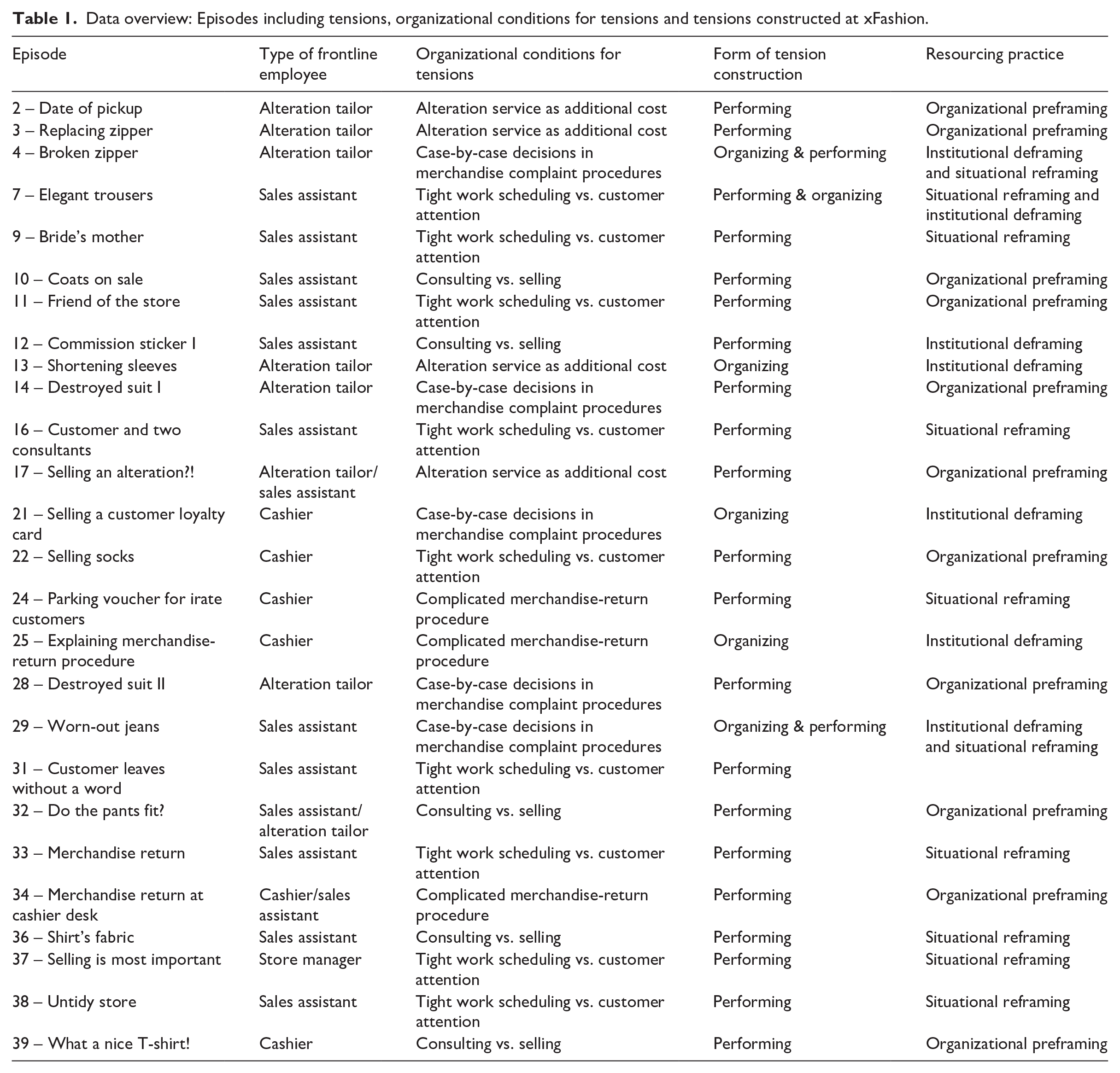
In everyday interactions on the sales floor at xFashion, frontline employees encounter the following organizational conditions (Gümüsay et al., 2020) from which they construct tensions: (1) tight work scheduling vs. customer attention, (2) consulting vs. selling, (3) the complicated merchandise-return procedure, (4) the alteration service as additional cost and (5) case-by-case decisions in merchandise complaints (see Table 1). These organizational conditions for tensions play out differently: in (1), the daily ‘turnover-to-number-of-scheduled-employees’ ratio is tightly calculated, and sales assistants have to carry out visual merchandising, tidy up and handle merchandise returns and complaints. As a result, attention to customers is often marginalized. In (2), sales assistants are expected to provide style advice and sell. Commission stickers placed on each item they sell track whether assistants meet daily sales targets even though some customers are uncomfortable with this practice. For customers, (3) the merchandise-return procedure is also complicated (‘a bureaucratic labyrinth’ [Int.]). Customers must first proceed to the department where they originally purchased their item and then go to the central cashier to receive either reimbursement or new merchandise. xFashion’s on-site alterations (4) cost extra, often resulting in discussions with customers, since local competitors offer free alterations. For merchandise complaints (e.g. pilling of a cashmere cardigan, rubbed-through spots in jeans fabric, etc.) (5) frontline employees have some discretion in how to handle them (e.g. accepting returns or giving a discount), which requires employees to make case-by-case decisions and often results in arguments with unsatisfied customers.
Data overview: Episodes including tensions, organizational conditions for tensions and tensions constructed at xFashion.
Field work
We conducted an ethnographic study (Watson, 2011) and collected data on, from and around the sales floor using observations, interviews and complementary documents. Access was facilitated by the first author, who had extensive previous work experience at xFashion as sales assistant and manager. This author, the principal investigator (PI), was the only one collecting data at one xFashion store, at which the PI had never worked before (to avoid influence from prior workplace hierarchies and relationships). From the outset of field work, the other two authors were involved in continuous discussions of the project. The on-site store manager helped obtain clearance from the local works council and to identify and introduce the PI to potential research participants. This resulted in in-depth access to 12 frontline employees (six sales assistants, three alteration tailors and three cashiers) working on the sales floor.
Observations
To study ‘how things work’ (Watson, 2011, p. 202) on the sales floor, the PI immersed herself in one store over a period of four months (February 2013 to May 2013) for three to four days a week, from three to six hours a day. Familiarity with the setting from previous work experience helped to quickly establish trusting relationships with research participants, enabling the ‘close-observational or participative research that is central to ethnographic endeavours’ (Watson, 2011). Each day the PI followed one or two frontline employees during their shifts, observing different employees on different days.
During customer interactions, the PI behaved like a regular customer (e.g. looking at the merchandise, pretending to try something on) 1 and taking field notes on primary (e.g. interaction length, number of participants involved, main content and course of interaction) and secondary observations (e.g. atmosphere, description of feelings displayed) as well as contextual data (e.g. objects, spatial arrangements). The PI engaged in extended memo writing either immediately after each observed interaction or towards the end of each shift, while preparing for the interviews. When no customers were around, the PI helped with visual merchandising, participated in department meetings, sat with employees at the cashier desk or in their atelier and went to lunch with them. At the end of each day, the observation memos were then expanded into a comprehensive memo with additional observations and dialogue reflection, which were transformed into electronic documents.
Interviews
To complement the numerous observations and sales-floor conversations, the PI conducted an additional 39 in-depth interviews. Familiarity with the setting and continued observation made it easier to spot interactions involving potential tensions and/or to capture different, outstanding or deviating use of potential resources. Interviews with frontline employees were then sampled based on those interactions the PI presumed involved tensions. These interviews (on average 30 minutes) encouraged employees to reflect on their activities during specific interactions and were recorded and transcribed verbatim. Interviews were conducted in German and the authors translated all quotes presented in the paper. Combining observations with interviewing is a frequently used method in ethnographic studies of frontline service work (see for example, Balogun et al., 2015; Rouleau, 2005).
Complementary documents
The PI also collected written material from xFashion – training documents, internal communication memos, meeting minutes and customer e-mail complaints – which helped to better understand frontline employees’ activities and to triangulate observations and interviews with contextual accounts of the company’s prevalent organizing principles. For data analysis, transcriptions, field notes, memos and other written material were uploaded to and coded in NVivo 12 software.
Data analysis
To illustrate the setting in rich detail, the PI wrote separate case stories of each observed customer-interaction episode and, together with the interview and other ethnographic material, developed thick descriptions (Geertz, 1973) of an ‘everyday workday’ of a sales assistant, a cashier and an alteration tailor. Applying Hendry and Seidl’s (2003; see also Jarzabkowski & Lê, 2017) notions of initiation, conduct and termination to separate customer interactions, each description captured the (potential) resources employed in each episode, the individuals’ activities and emotions displayed as well as the interactions between frontline employee(s) and customer(s). To check for plausibility (Jarzabkowski, Bednarek, & Lê, 2014), all authors discussed the thick descriptions and used them, together with the observations, interviews and documents, to analyse data and illustrate our findings in the form of a composite narrative made up of 10 representative vignettes exemplifying everyday work on the xFashion sales floor.
When analysing the data, we engaged in ‘insider/outsider’ coding (Gioia, Corley, & Hamilton, 2013) until we achieved team consistency in our interpretations. More precisely, one author, who had not been in the field, coded the data independently from the PI. Any discrepancies were then discussed collectively to update and refine the coding. In parallel and together with the third author, we engaged in a reflective process of iterating between multiple theoretical concepts, literature and refined coding (explained below), which helped the PI avoid the risk of ‘going native’ (Gioia et al., 2013, p. 19) and to counter potential biases and assumptions in the interpretations that could potentially result from adopting an informant’s view. We analysed the data in five steps.
First, we identified all episodes in which tensions were ‘visible’ (Tuckermann, 2018). We coded either for (a) a customer expressing dissatisfaction about the way things were done or how the interaction proceeded; and/or (b) frontline employees describing during the interview a tension resulting from how she or he was supposed to act versus how the customer would have liked her or him to act. This step eliminated 13 of the 39 episodes which had neither of the two criteria. Of the remaining 26 interaction episodes (see Table 1 for overview), we clustered typical and recurring problems and cross-coded them against the characteristics of the customer-oriented bureaucracy (Korczynski, 2002; Korczynski & Ott, 2004). Doing so showed that we had identified five business-model specific conditions for tensions, which relate to xFashion’s way of organizing itself as a customer-oriented bureaucracy (see ‘Research setting’ above).
Second, we looked for how frontline employees themselves constructed tensions during interactions. We used the following definition to code for tension constructions: ‘[T]ensions. . .are actually constructed in the micro-interactions through which people perform their contradictory tasks and roles’ (Jarzabkowski & Lê, 2017, p. 434; see also Smith & Lewis, 2011). We saw that frontline employees constructed tensions as a paradox of performing when they considered themselves as accountable for the issues customers raised during the interaction. For example, when putting the commission stickers on the merchandise tag, employees struggled to reconcile their role as a seller with their role as consultant, fearing that acting as a seller would appear illegitimate to customers. When the tension was between xFashion and customers, employees constructed tensions as a paradox of organizing, since xFashion – rather than the frontline employees themselves – was the source for the issues raised during the interaction. For example, merchandise-return customers often proceeded directly to the central cashier instead of first going to the sales department, which often left the customer frustrated. A cashier constructed this tension as follows: It is unfortunate [that] so many [customers] don’t know how it works here. . .We often have this situation and then they’re stressed or annoyed. As a customer I wouldn’t be happy about that [either], making me talk to three different people for a return. . .it appears a bit disorganized and incompetent if I get sent around all the time. . .This is really unpleasant for customers and not the kind of service they expect from xFashion.
We then cross-coded the two paradox constructions with the five organizational conditions for tensions. Except for one case, we saw that frontline employees constructed tight work scheduling vs. customer attention and consulting vs. selling as tensions related to the paradox of performing, while for the most part they constructed the complicated merchandise-return procedure, the alteration service as additional cost and the merchandise complaints as tensions related to the paradox of organizing (and in few cases also in relation to the paradox of performing).
Third, we coded the activities performed in each episode and noticed that they seemed to be directed at pursuing different objectives (see also Table 3) along two dimensions. One dimension was customer orientation, in which customers were either assured that they were ‘king’ or in which this notion was challenged; the other dimension was predefined organizational processes, which were either maintained or changed during interaction. We then analysed the activity-objective relationship across all episodes and kept seeing the same patterns across job positions, employees and the typical organizational conditions for tensions. For example, employees engaging in activities like ‘distracting the customer from unpleasant experiences’ and ‘promising that things will be better in the future’ were trying both to show customer orientation and to follow the pre-defined organizational processes. We used ‘framing’ to refer to activities of interactively constructing meaning with customers (Kannan-Narasimhan & Lawrence, 2018) and classified activities into one of three sets of activity objectives. Activities aimed at restoring customer orientation were clustered into the broader thematic category (Gioia et al., 2013) reframing. Activities like ‘seeking the cheapest alternative’ and ‘doing others’ tasks’ were clustered as preframing, where employees previsionally altered organizational procedures and meaning to maintain customer orientation. Activities like ‘explaining the merchandise complaint/return procedure’ were clustered as deframing, as they de-emphasized customer orientation and justified existing organizational procedures.
Fourth, we closely examined the ‘resources in use’ (Feldman & Worline, 2012) during each episode (e.g. company rules or technical devices involved) and their connection to the three activity sets identified above. We looked for ‘manipulating’ and ‘recombining’ (Sonenshein, 2014), both of which involve creative acts of infusing assets and objects with new or different meaning. We identified resources created by drawing on assets with meanings from the situation (e.g. flowers, apologies), from the broader organizational context (e.g. commission stickers, co-workers, or sales procedures) and from the broader institutional setting (e.g. professionalism, entrepreneurship). Studying the activity objectives-resources in use connections across episodes, we noticed that in each specific activity set employees created specific resources (see Table 3), hence they engaged in different resourcing practices. Accordingly, we labelled them situational reframing, organizational preframing and institutional deframing. We illustrate these three resourcing practices in our Findings section.
Fifth, we iteratively compared these resourcing practices with how frontline employees constructed tensions (step two) and uncovered distinct interrelation patterns: when frontline employees constructed the tension as a paradox of performing, they either engaged in situational reframing or in organizational preframing, yet when they constructed the tension as a paradox of organizing, they primarily engaged in institutional deframing.
In line with previous studies and suggestions (Berends & Deken, 2019; Smets et al., 2015), we build on our thick description of each episode and present a ‘composite narrative’, crafted to ‘make the author’s field experience. . .accessible to the reader’ (Jarzabkowski et al. 2014, p. 12). Drawn from multiple episodes and merged into a single workday of three frontline employees at xFashion – the sales assistant ‘Monica’, the alteration tailor ‘Maria’ and the cashier ‘Linda’ – this composite narrative presents the full breadth and depth of our data within a single story. It describes employees in various customer interactions, illustrating how they construct tensions and which resourcing practices they engage in to balance them.
Findings
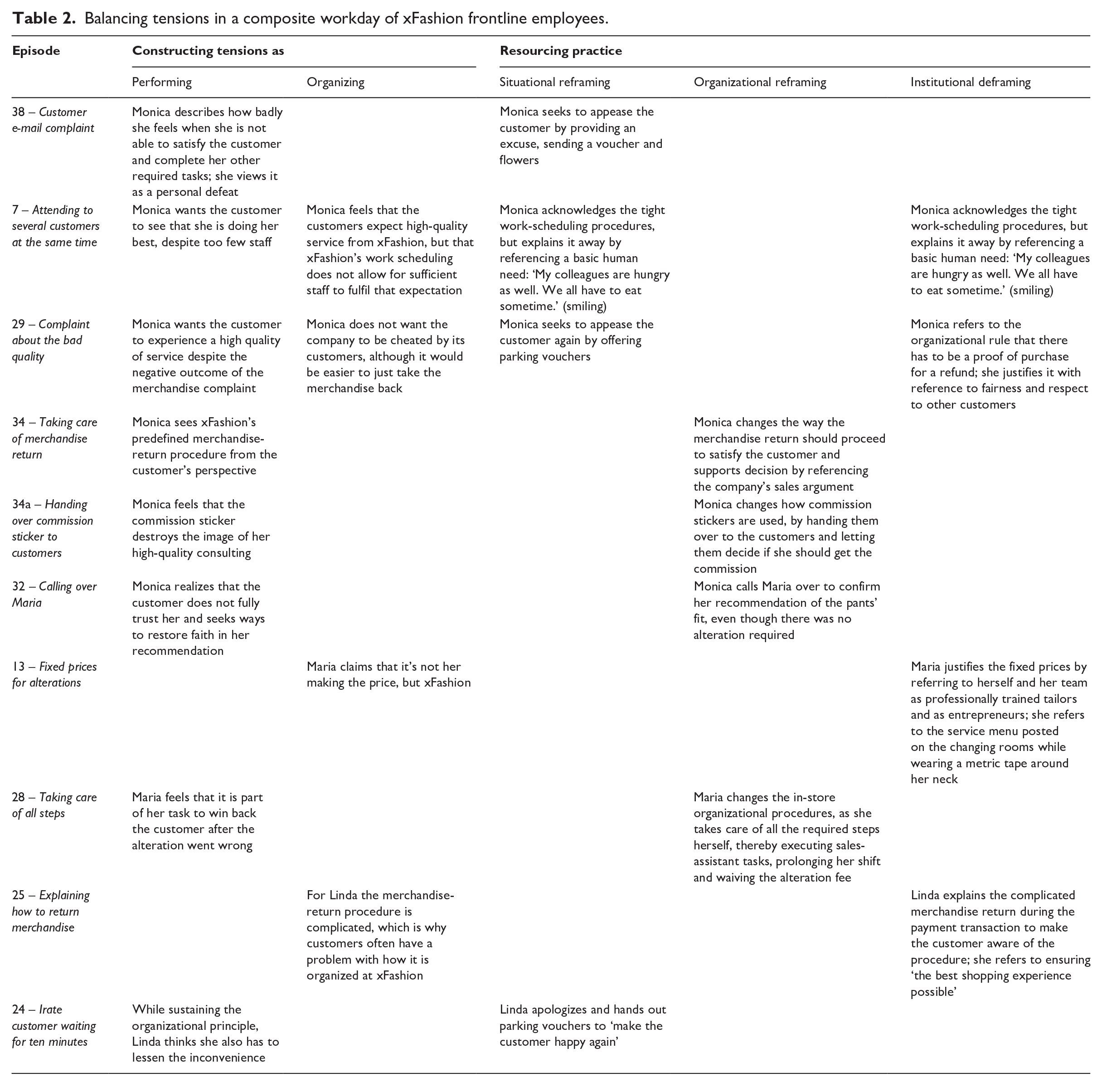
This section presents a composite narrative of an everyday workday illustrating the resourcing practices frontline employees use to balance tensions: (1) situational reframing, (2) organizational preframing and (3) institutional deframing (see Tables 2 and 3). In situational reframing, employees seek to re-establish customer orientation while concurrently maintaining the (inconvenient) organizational processes that potentially lead to tensions. In this practice, they rhetorically and/or symbolically distract the customer from an unpleasant experience through drawing on resources infused with meaning from the situation. In organizational preframing, frontline employees seek to pre-establish customer orientation by proactively attempting to avoid unpleasant customer experiences. In this practice, they draw on resources infused with meaning from the broader organizational context to alter potentially inconvenient organizational procedures. In institutional deframing frontline employees seek to maintain the potentially inconvenient organizational processes while questioning and de-emphasizing customer orientation. This practice explains and justifies predefined organizational procedures to convince customers to comply and draws on resources infused with meaning from the broader institutional setting. Table 2 connects each interaction episode from the composite narrative (in italics) to the resourcing practice employed.
Balancing tensions in a composite workday of xFashion frontline employees.
Representative data illustrating the resources created, the activities performed and the objective pursued during interaction.
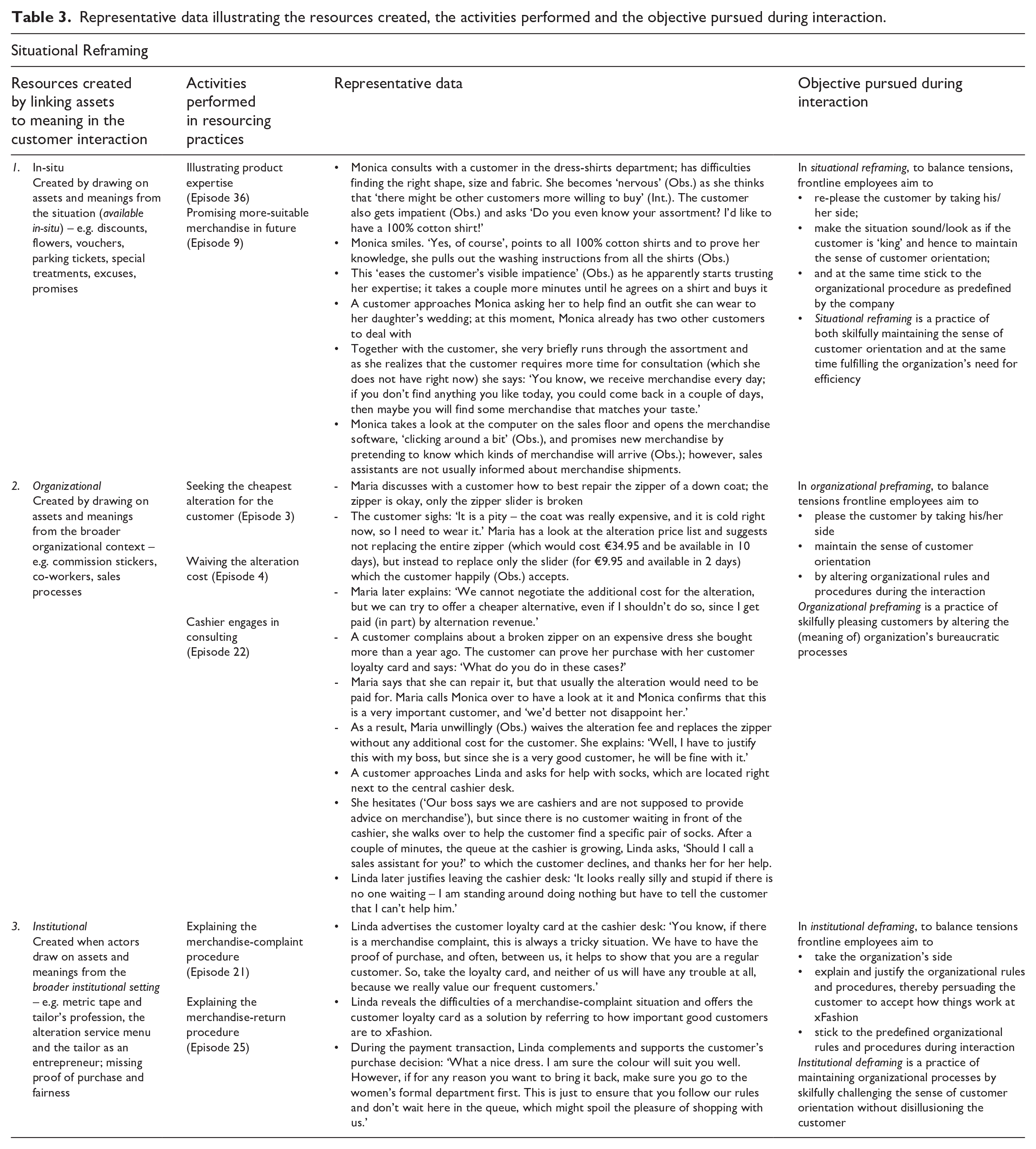
Table 3 links the three resourcing practices illustrated in the composite narrative with the broader corpus of our data and gives examples of resources created, activities performed and objectives pursued in each practice.
Balancing tensions in interactive service work at xFashion
Together with her colleagues, sales assistant Monica starts her day at 9 a.m. in the women’s casualwear department. First, she takes care of an urgent customer complaint about the. . .
. . .real mess in the women’s department, something I would only expect at the cheap retail chains but not in your store. In the future, I will consider not shopping at your store. You are about to lose a loyal and frequent customer. (Obs., customer e-mail complaint)
Monica sighs: Even if the customer is not right in front of me, this feels like a punch in the gut. I hate these moments, because we really try to give our best all the time. I was really down, and I always take such things personally. If you try your best to satisfy the customers and do all the required tasks and then don’t succeed, then you feel the pressure.
In her reply she apologizes and offers the customer a €10 voucher towards her next purchase, which she sends together with flowers to the address provided in the e-mail. The customer curtly replies that the department ‘is always like that’ (Obs.) and sending a voucher certainly ‘won’t change my impression’ (Obs.). Nevertheless, she credits xFashion for taking the complaint seriously, which is ‘beyond what I expected’ (Obs.).
Around noon, the store becomes crowded requiring Monica to attend to several customers at the same time and carry out different tasks: returning merchandise without a price tag, checking the stock room for another size and helping an elderly woman looking for some formal trousers. Monica travels among all three customers; however, the elderly woman seems annoyed (Obs.), trying on different trousers by herself and going back-and-forth to the sales floor to fetch other sizes. Finally, the customer makes her choice – without Monica’s help – and heads towards the checkout counter. At that moment, Monica reappears to ‘complete’ (Obs.) the customer interaction by putting her commission sticker on the trousers while charmingly asking if she ‘could do anything else?’ The customer cannot hide her frustration any longer and cuts Monica short: Is it only you in the department today? I’m a regular customer and normally I’m used to getting more service and consultation. I could get a pair of trousers like these somewhere else, maybe at a cheaper price, but I come here because you’re known for being, and claim to be, a service-oriented retailer.
Monica apologizes and adds: Yes, at the moment I’m alone, because it’s lunchtime. And my colleagues are hungry as well (smiling). We all have to eat sometime.
Despite Monica’s reasonable excuse, staff from other departments usually help with coverage during lunchtime. In the interview, Monica reflects on why she felt the need to justify the situation: It was quite crowded, yet I feel that customers expect more from xFashion, more premium service and more staff. And I didn’t want to say that there are always too few people. They [the customers] shouldn’t get this feeling. And usually we have more staff. So my aim was that she [the customer] would feel good and would see that, even though there were few staff, I did my best.
In the afternoon, a couple approaches Monica with a pair of jeans that look ‘dirty, worn out and old’ (Obs.), complain about the bad quality and want to be fully reimbursed. They claim they bought them one year ago and the jeans are xFashion’s house brand, which cannot be purchased anywhere else. They don’t have a receipt but claim that the purchase might be linked to their customer loyalty card, since they ‘are frequent and really good customers’. They hand Monica three different loyalty cards, which she checks in the back office. She can’t find this item, nor any other purchases, and explains back on the sales floor: Since we have neither the receipt nor any record on the customer loyalty cards, I can’t reimburse you. I am sorry. If it had been last week and we could remember you, maybe it would be different, but in this case it’s just too long ago. We just have to be fair here with respect to other customers.
The customers are ‘disappointed’ (Obs.) and insist that they ‘bought [the jeans] here at this store’. Monica gets ‘nervous’ (Obs.) and feels that she has to do something about the situation to ‘make them happy again’ (Int.) and offers them a parking voucher for the ‘inconvenience of coming here’. The customers’ faces become a bit friendlier (Obs.), they accept the voucher and leave. In the interview Monica recalls that ‘this complaint was unfair; they destroyed the merchandise by themselves’, which makes these situations difficult because ‘you can’t exactly tell them that’. Monica’s response sought to ‘elegantly escape this situation’ by claiming a need for proof of purchase ‘even though I knew that this was our merchandise’. She explains: Of course, the easiest way would be to take everything back. But people should not get the feeling that they can take advantage of us. However, it was important to me that they [the customers] realized that we take their complaint seriously. So with the parking voucher in the end, I think that it came across quite well that we are service-oriented, they shouldn’t be disappointed by our service. And they didn’t expect that, so I could make them happy again.
Later, while reorganizing T-shirts on a table, she observes a couple queuing at the cashier to return a premium-brand scarf. Linda (the cashier) explains that they have to go upstairs to find a sales assistant and then return to the cashier downstairs. Annoyed by this ‘silly way of organizing a store tour’ (Obs.), Monica joins them and offers to take care of the merchandise return by herself, even if sales assistants from the ground floor ‘shouldn’t do so’ (Obs.). Monica is concerned about. . .
. . .appear[ing] incompetent and disorganized. This is how xFashion organizes merchandise returns, but if I were the customer, I would perceive this as super uncomfortable. I’d really get annoyed . . . And what is more, this is a chance for me to sell something, which our supervisors are also very keen on. I just had a training session on this the other day.
The training session the week before was on handling merchandise complaints: ‘Merchandise exchange is one of our services and a chance to acquire and retain customers!’ (Training document). She manages to sell a different scarf from her department, and just as she is about to stick her commission sticker on the merchandise tag, she hands them over to her customers saying ‘These are the insignia of our success. Please put them on if you are satisfied with my service’, which the customers happily (Obs.) did. Asked why she handed over the stickers, Monica answers: Simply because many customers become suspicious when we put the stickers on. Some even feel uncomfortable and we [have] also had complaints about this. Other stores don’t do this, and after you have spent a lot of time consulting [with customers] it is weird to signal that we get commission. Some colleagues just put their sticker on any merchandise customers buy, even without consulting them. I don’t want [to do] this, that’s why I often hand my stickers over to customers. But clearly, at the end of the day, what counts is how much you sold.
Before leaving at 3 p.m., Monica consults a woman who is not entirely convinced of the loose fit of a pair of pants around the thighs, yet Monica claims that this is ‘latest fashion and the new style’(Obs.). The customer holds the seam together in front of the mirror and says, ‘I feel [like] it has to be tighter here’. Monica calls over Maria, the tailor, and asks if she would recommend altering the fit of the pants. Maria replies: No, I wouldn’t do that. Of course we can change it, but if you want my advice, then leave it as it is. Otherwise it’ll lose its shape. It looks really good like this now.
The customer ‘seems relieved’ (Obs.) by Maria’s confirmation of Monica’s advice and eventually buys the pants. In the interview, Monica explains why she called Maria over for support:
I knew that the customer was not sure about the fit, but I also got the feeling that she did not really trust my recommendation. And when I get that feeling, I think it is always better to offer the customer a third opinion, an expert, like Maria the tailor. It was simply a way to take away her insecurity about the fit.
How do you feel when customers don’t trust your recommendations?
I am totally okay with this. It’s just that I know I have to do something about it. Some customers just need a second and a third opinion.
Over in the women’s outdoor department, Maria finds herself in the middle of a heated debate about whether the sleeves of a down coat are too long. The customer is reluctant to shorten them (‘Can’t I just roll the sleeves up?’) because an alteration would cost €27.95, and asks ‘Can we do something about the price? As a favour? I am a frequent customer and have a loyalty card.’ Maria refuses, carefully explaining the alteration process, and adds, ‘You know, these are fixed prices. We’re all professionally trained tailors, and work like a proper company within the store.’ Still hesitant, Maria suggests the customer buy the coat without an alteration and bring it back whenever needed. The customer refuses (‘I don’t want to come in again’) and accepts (‘Well, if it is necessary, then let’s do the alteration’). Afterwards in the interview Maria reflects on the situation:
I felt that I had to justify, even sell the price of the alteration.
Why?
Well, some customers feel they can negotiate the price. So that’s why they should know that’s it not me making up some prices, but xFashion; I am just responsible for the high-quality execution of alterations and that’s what I tried to get across. And I think it worked pretty well.
Later, Maria calls a customer who has been waiting 10 days for a suit from another store, after a previous alteration had destroyed it. Since then, Maria has been taking care of all steps, such as ordering the suit from another store, informing the logistics department to call her as soon as the merchandise arrives and calling the customer to book an alteration. Maria explains: Last time I talked to him, he was really upset, and I understand: the alteration was not right. I now want to fix it personally so that we can win him back after so many things went wrong.
The customer agrees to come to the store immediately, requiring Maria to extend her shift. He seems quite happy and says, ‘You really made an effort to make it all right again. Thank you very much. I didn’t expect that.’ Maria accompanies the customer downstairs to Linda at the cashier desk, informs her that the alteration is free and says goodbye.
There is a long queue at the cashier because Linda is the only one left and the store is about to close. While processing a payment for one customer, she calmly explains to another that to return merchandise. . . . . .remember to always go first to the merchandise department. In your case this is the second floor. This is how it works here, and I want to ensure that you have the best shopping experience possible.
For Linda, she explains the complicated merchandise-return procedure upfront because: There are often customers who are not so familiar with shopping at xFashion, and who don’t know how it works with the merchandise returns. And then they wait in the queue here, just to learn that they have to go to the merchandise department first. This often causes problems, because other stores do merchandise returns at the cashier desk.
Linda processes a couple more payments until an ‘irate customer, seemingly in a hurry’ (Obs.) complains that he has now been waiting for ten minutes just to learn that he has ‘to go upstairs for the merchandise return?!’ Linda apologizes, calmly asks him to go upstairs, get the merchandise-return form and come back; ‘in the meantime, I will prepare some parking vouchers for you so that you can park for free [today] and [on your] next [visit]’. The customer grudgingly (Obs.) accepts these as an apology. Linda later explains: You must never tell our boss – promise – but we use these parking tickets for all sorts of little problems at the cashier desk. Also, sales assistants use them whenever there is a little problem, although we shouldn’t do so. But it is a good way to make customers happy again if something has made them angry.
Resourcing at the frontline: Activities, (material) assets and meanings in resourcing practices and employees’ movement among them
Examples of activities and assets involved in situational reframing are Monica apologizing for the messy store appearance and sending a voucher and flowers; assuring a customer that new merchandise will arrive shortly (without knowing for sure if it really will) by clicking and pretending to check the merchandise software; and Linda making up for the long wait time at the cashier by handing out parking vouchers. Frontline employees turn these assets into resources by infusing them with meaning from the situation. For example, checking the merchandise software and fibbing about new merchandise arrival becomes meaningful – becomes a resource – since it conveys to customers that Monica and Linda are really dedicated to fulfilling the customer’s specific demand. Situational reframing enables frontline employees to restore or maintain the notion of customer orientation despite customers’ unpleasant experiences with inconvenient organizational procedures.
Examples of activities and assets involved in organizational preframing are Monica calling Maria over to reassure the customer about the specific fit of pants; letting customers decide whether her service warrants commission stickers or not; and altering the merchandise-return procedure by referring to a specific training session she attended. Frontline employees turn these assets (e.g. commission stickers, co-workers or predefined sales processes) into resources by infusing them with meaning from the broader organizational context. For example, handing over commission stickers to customers becomes meaningful – becomes a resource – because it alters organizational processes and offers a workaround that avoids unpleasant customer experiences. Organizational preframing enables frontline employees to maintain the impression of customer orientation by proactively altering potentially inconvenient organizational procedures.
Examples of activities and assets involved in institutional deframing are Linda proactively explaining the merchandise-return process to ‘ensure the best shopping experience’; Monica rejecting a merchandise return by referring to a rule requiring proof of purchase and justifying her action as one based on the fairness principle; and Maria justifying merchandise-alteration prices by describing herself as a ‘professionally trained tailor’ while wearing a metric tape and a pin cushion to support the description and by referring to her department as a ‘company within the company’ and pointing to the alteration service menu. Frontline employees turn these assets (e.g. metric tape, the pin cushion and the alteration service menu) into resources by infusing them with meaning from the broader institutional setting. Institutional deframing enables frontline employees to maintain potentially inconvenient organizational processes and to de-emphasize the notion of customer orientation.
The composite narrative also highlights how different resourcing practices are flawlessly intertwined in and between service interactions on the sales floor and how frontline employees skilfully move from one resourcing practice to the other. Table 2 illustrates how resourcing at the front line uses one or more of the three practices and how those practices connect to employees’ constructing tensions. For example, when frontline employees construct tensions as a paradox of performing (i.e. as a tension between tasks and roles), they are most likely to engage in situational reframing or organizational preframing. In contrast, when they construct tensions as a paradox of organizing (i.e. as a tension between the customer and xFashion), frontline employees engage in institutional deframing, sometimes combined with situational reframing (see episode 7 in Table 2). For example, when Monica refuses a merchandise return, she enacts both, by referring to the fairness of a bureaucratic procedure (institutional deframing) and offering a parking voucher (situational reframing). While specific resourcing practices allow employees to balance tensions in interactions, moving between practices allows them to balance tensions in the stream of interactions.
Discussion
Our study explores how frontline employees create resources to balance tensions in their customer interactions, thereby advancing our understanding of resourcing in tension-laden situations and extending research on individuals’ responses to paradoxical tensions. We find that frontline employees engage in three different resourcing practices – situational reframing, organizational preframing and institutional deframing – each of which has different implications for how resources are created and how tensions are balanced. Compared to previous studies on resourcing, our explicit focus on resourcing under tensions allows us to show innovative ways of resourcing. We illustrate how employees infuse a variety of meanings (from the situational, organizational or institutional context) to create resources and use framing to a greater or lesser extend strategically. Our findings offer contributions to both research on resourcing and on responses to tensions, which we outline below.
Resourcing under tensions at the front line
First, our findings illustrate that to balance tensions in interactions, frontline employees find creative ways of infusing assets with meaning by drawing on the situational, organizational and institutional setting. Frontline workers construct a tension as relating either to the performance or to the organization paradox, and create resources drawing on different scopes of meaning (situational, organizational or institutional). Hence, resourcing under tensions requires employees to be innovative, not only in the assets that they turn into resources in use, but also in the meanings they infuse resources with to help them to achieve their objectives (Feldman & Worline, 2012). Several studies on resourcing have detailed how crucial the concrete situation is for resourcing, because it enables actors to infuse new or altered meaning to the situation and helps them create resources (Deken et al., 2018; Howard-Grenville, Golden-Biddle, Irwin, & Mao, 2011). Our findings add to these insights by showing how frontline employees take potential resources and link them to situational meaning in order to address performing tensions. Gifts and apologies can be used in a range of different situations, yet in our study these resources are situational, since their meaning in these situations is to restore customers’ belief that they are ‘king’ – which has been threatened by a previous unpleasant experience. Situational reframing, consequently, merely distracts from the underlying contradictions inherent to many modern businesses – simultaneously pursuing customer orientation and cost efficiency. This practice allows frontline employees to balance tensions and thereby carry out an organization’s strategy at the front line (Balogun et al., 2015).
We also find resourcing that draws on meanings from the organizational context to balance tensions that employees have constructed as a paradox of performing. We build on previous findings that have highlighted the importance of tapping into organizational meaning – especially the interests and norms held by important stakeholder groups in the organization – to allow less powerful actors to successfully pursue their objectives (Howard-Grenville, 2007). Complementing Sonenshein’s (2014) finding that organizational conditions and management’s permission and guidance enables frontline employees’ creative resourcing, we find frontline employees proactively reassigning new – and more customer-oriented – meaning to organizational procedures in order to balance tensions.
Drawing on the notion of practice-driven institutionalism – that situated practices are nevertheless institutionally embedded (Smets et al., 2017) – we are able to theorize how tensions might also require frontline employees to create resources by linking assets to meanings from the institutional setting. Feldman and Worline’s (2012) example of families resourcing breadcrumbs to prepare less-costly meatballs was a practice linked to the institutionalized meaning of supporting the war effort by using less of the valuable commodity meat, yet empirical studies on resourcing have so far not established an explicit link to institutionalized meaning – beliefs shared in organizational fields or societies. Our findings illustrate that when frontline employees construct a tension as a paradox of organizing, they infuse potential resources with institutionalized meaning, such as the principle of fairness or professionalism, to challenge the frame of customer orientation during interaction. Our study illustrates that frontline employees use resourcing to negotiate their relationship with customers, connecting institutional deframing to descriptions of institutional work as ‘changing normative associations’ in order to create new institutions (Lawrence & Suddaby, 2006) that use institutionalized beliefs to ‘[deny] the validity of institutional myths’ and question their legitimacy (Townley, 1997, p. 262).
A second contribution, by studying resourcing under tensions, is extending the notion of framing in resourcing studies. Building on the insight that resources and tensions are not independent of one another (Miron-Spektor et al., 2018), we find that the challenge and urgency of balancing tensions interactively leads to innovative ways of resourcing, as it brings out different ways of framing meaning in interactions. Frames are ‘construct[s] such as binary oppositions, conventions, recipes, scenarios, principles, and habits’ (Quinn & Worline, 2008, p. 505) that allow actors to communicate specific aspects of reality to influence individuals’ perceptions (Purdy, Ansari, & Gray, 2017). While Kannan-Narasimhan and Lawrence (2018, p. 724) highlight the strategic aspect of framing as giving sense to others and describe framing as a one-sided ‘political resourcing mechanism’, we find that when facing tensions, frontline employees not only engage in political resourcing and sense-giving, but also use framing to make sense of the situation for themselves. In the context of resourcing research, this finding is innovative and resonates with the interactionist perspective on framing, which recognizes that ‘frames are generated in a bottom-up process during an interaction to make sense of what is going on during it’ (Purdy et al., 2017, p. 2). To account for the different ways that frontline employees use framing as a response to tensions, we introduce reframing, preframing and deframing.
Reframing creates resources to restore a frame previously damaged by the tension, and aims to ‘turn around’ a specific situation. It resembles the strategic framing of sense-giving described by Kannan-Narasimhan and Lawrence (2018). Preframing, by comparison, also involves aspects of sensemaking, and therefore enables frontline employees to anticipate that a prescribed organizational procedure will likely lead to tensions and to proactively create resources to alter these procedures or their meanings, which are then presented to customers as a special service. Deframing challenges a dominant principle – in our case, customer orientation – by drawing on an institutionalized meaning (e.g. professionalism, the principle of fairness, etc.) that is equally or even more dominant than customer orientation. Frontline employees in this practice essentially ‘test’, question or justify the underlying values of the interaction (Dansou & Langley, 2012), strategically aiming to devalue the other’s frame.
Constructing and responding to tensions through resourcing
We add to the practice perspective on tensions (Bednarek et al., 2017; Sheep et al., 2017), as we focus on the ‘technologies or material artifacts [that] constrain and enable practices and, hence, become part of the construction of and response to tensions’ (Lê & Bednarek, 2017, p. 505) and identify resourcing practices under tensions. Adding to research that considers tensions as socially constructed in individuals’ everyday practices and interactions (Jarzabkowski et al., 2013; Sheep et al., 2017), we find that frontline employees in service interactions construct tensions as relating to paradoxes of either performing or of organizing: they either consider tensions as playing out in different and conflicting role expectations of sales assistants (performing tensions), or they think of tensions as ‘system contradictions’ (Lüscher et al., 2006) between the customers’ and the company’s interests (organizing tension). Our findings suggest that individuals have the capability to reflect and act on tensions that result from the company’s contradictory objectives of cost-efficiency and high levels of customer orientation without transforming these contradictions into their own performing tensions. By showing that employees can construct tensions on the micro level either as a performing or organizing paradox, we extend Jarzabkowski et al.’s (2013) findings on individuals’ tension construction and how paradoxes coevolve.
By illustrating how employees’ construction of tensions and their resourcing practices as a response are interrelated, we also complement research on responses to tensions (Child, 2019; Bednarek et al., 2017; Jarzabkowski & Lê, 2017; Sheep et al., 2017; Tuckermann, 2018). With the help of resources that have situational meaning, situational reframing allows frontline employees to interactively downplay the tension between contradictory demands by ‘minimizing the interaction between the two’ (similar to the ‘splitting’ response) (Jarzabkowski et al., 2013, p. 256). In our case, this means separating the demands of a concrete situation in which rhetoric and gifts are used to symbolize customer orientation from the organizational procedures that remain unchanged in the service of organizational efficiency. Situational reframing is therefore a local arrangement to prevent escalation, but because it does not tackle the underlying contradiction, it only brings temporary relief by postponing the problem. In contrast, organizational preframing involves ‘adjusting’ the ‘work practices. . .in order to support both sides of the paradox’ (Jarzabkowski et al., 2013, p. 261) and therefore actively engages with the contradictory demands and interactively establishes a compromise with the help of resources that have organizational meaning. It adjusts organizational procedures towards customer orientation. While situational reframing is a defensive practice employed to balance paradoxical tensions, organizational preframing is more active and potentially ‘virtuous’ for organizations (Jarzabkowski et al., 2013; Smith & Lewis, 2011). Frontline employees engage in these two resourcing practices when constructing tensions related to the paradox of performing, whereas when constructing tensions related to the paradox of organizing, they engage in institutional deframing. This latter practice, with the help of institutional resources, makes it possible to interactively ‘suppress’ (Jarzabkowski et al., 2013) one side – in this case the assumed interests of the customer – and give priority to another – here, the organization. Within each single situation, as a way of defensively engaging with contradictory demands, this practice only provides temporary relief and has a potentially ‘vicious’ (Jarzabkowski et al., 2013; Smith & Lewis, 2011) effect for organizations over time if institutionalized beliefs about the customer relationship are not changed on a larger scale. Analysing how responses to paradox coevolve over time, Jarzabkowski et al. (2013) describe how defensive responses – such as splitting and suppressing – may induce the active response of adjusting, which in turn may induce additional defensive responses. While these authors describe this process by examining the organization’s different embedding responses, we illustrate that the agentic ‘both/and’ construction of performing and organizing paradoxes also explains employees’ use of different resourcing practices, which shows how resourcing is an integral part of tension-response practices.
While different resourcing practices enable frontline employees to balance tensions during a single interaction, employees also balance tensions in and across interactions by agentically constructing tensions and dynamically iterating among all three resourcing practices. We therefore argue that successful companies depend on frontline employees being able to flexibly construct tensions and to dynamically employ different resourcing strategies in order to achieve an overall balance (i.e. in the stream of interactions; see Smets et al., 2015) of cost-efficiency through bureaucratic procedures and a high level of customer service.
Conclusion
Our study shows how frontline employees, typically less powerful actors directly engaging with customers and clients, can skilfully balance tensions in service interactions by creating resources. By identifying three distinct resourcing practices – situational reframing, organizational preframing and institutional deframing – we add to the research on resourcing an understanding of the varying scope of meaning (situational, organizational or institutional) that employees draw on to bring (material) assets into use when they interactively balance tensions. We also extend the notion of framing in resourcing, as we outline how framing – in our case, giving meaning to convince customers – can vary as the frame either reinforces the interaction partners’ belief in customer orientation or destabilizes this principle, while at the same time frontline employees change or maintain prescribed organizational procedures. We also discuss how resourcing practices vary depending on whether employees construct tensions as performing (e.g. role conflict) or organizing tensions (e.g. opposing goals of organizing).
While all frontline employees experience tensions vividly because of daily interactions with customers and clients, there are differences in frontline work in terms of autonomy, time pressure and possibilities for resourcing. Future research could address how tensions are differently constructed and how resourcing in frontline work differs under varying degrees of ‘authority’ that employees can draw on (Feldman, 2004).
Footnotes
Acknowledgements
We would like to express our gratitude to the three anonymous reviewers, Senior Editor David Arellano-Gault and Editor in Chief Daniel Hjorth for their valuable support, encouraging comments and guidance. Special thanks to Angela Aristidou, Luca Giustiniano, Martin Messner and Lukas Goretzki for their continuing feedback. We also thank participants at research seminars at University of Innsbruck, and University of Salzburg, and participants of the OMT paper session “To Be and Not To Be: Advancing Paradox Research” at the 78th AOM 2018 in Chicago, the 9th International Process Symposium 2017 in Kos, the 32nd EGOS Colloquium 2016 in Naples, and the 12th Workshop on New Institutionalism in Organization Theory 2015 in Lucerne, for their inputs on earlier drafts of the paper.
Funding
We acknowledge financial and institutional support from University of Innsbruck and the Tyrolean Science Fund.
