




Abstract
Creative collaboration often takes place in collaborative spaces that increasingly use virtual modes of interaction. To better understand the organizational conditions and organizing practices that facilitate collaboration in such spaces, we compare ethnographies of an online platform for collaborative songwriting and a physical songwriting camp, with each of these spatial settings coming with distinct advantages and disadvantages for creative collaboration. We identify the emergence of copresence – an active mutual orientation toward one another – as a common organizational condition for collaboration. Copresence was fostered by practices of regulating nimbus (i.e. making people more or less visible) and focus (i.e. directing attention to others) that not only stimulated moments of converging copresence marked by collaborative problem-solving, but also enabled diverging copresence marked by undirected attention and more serendipitous interactions. Our comparison reveals the challenges of negotiating between converging and diverging copresence to counteract tendencies towards excessive, or conversely, insufficient nimbus and focus of the participants, both of which are barriers to copresence. These insights contribute to ongoing debates about the organization of online and offline collaborative spaces by shifting the focus away from co-location towards copresence, highlighting the oscillation between converging and diverging copresence as important for a collaborative atmosphere and identifying practices by which copresence can be organized in different spatial settings.
Keywords
Introduction
Creativity has long been recognized as a collaborative and social process rather than an individual one (e.g. Koch, Wenzel, Senf, & Maibier, 2018; Thompson, 2018). Coworking spaces, incubators, open offices, maker spaces and fab labs are specifically set up to facilitate cross-disciplinary and cross-professional exchanges and connect dispersed individuals in creative or knowledge-based sectors (Montanari, Mattarelli, & Scapolan, 2021). Although scholars have studied what motivates individuals to participate in collaborative spaces (Capdevila, 2019), how they help creative workers in dealing with tensions and uncertainties (Lange, 2011; Merkel, 2019) and how a sense of community can develop (Garrett, Spreitzer, & Bacevice, 2017; Spinuzzi, 2012; Spinuzzi, Bodrožić, Scaratti, & Ivaldi, 2019), we still lack a good understanding of the organizational conditions and organizing practices that enable creative collaboration to occur in such settings (Montanari et al., 2021). In fact, people sometimes avoid collaborating in open spaces due to privacy needs or unfavourable social norms (Fayard & Weeks, 2007; Irving, Ayoko, & Ashkanasy, 2020). Increasingly, such collaborative spaces also involve digital platforms and multiple mediating technologies (e.g. Beyes & Holt, 2020; Toivonen, Idoko, & Sørensen, 2021). Thus, when examining how collaborative spaces enable creative collaboration, scholars must take the differences between physical and virtual settings into account (Slavich & Svejenova, 2016). Because physical proximity is widely considered important, yet insufficient for collaboration (e.g. Irving et al., 2020; Jakonen, Kivinen, Salovaara, & Hirkman, 2017), the question arises as to how copresence – understood as individuals’ active and mutual orientation towards one another (Zhao & Elesh, 2008) – can be organized as a basis for creative collaboration in different spatial settings.
The sociological concept of copresence, defined as a situation in which people have a sense of being with others based on signals of mutual accessibility (Campos-Castillo, 2012; Zhao, 2003; Zhao & Elesh, 2008), can replace a longstanding focus on physical co-location (Goffman, 1963) with a socially constructivist view on how actors become mutually oriented towards each other in a collaborative space (Grabher, Melchior, Schiemer, Schüßler, & Sydow, 2018). The difference between copresence and co-location is important, because perceived proximity might be high in virtual settings and low in physical settings (Wilson, Boyer O’Leary, Metiu, & Jett, 2008), even when the two are intermingled (e.g. Duff & Sumartojo, 2017). Thus, the concept of copresence can enrich our understanding of the practices and principles of organizing collaborative spaces (e.g. Blagoev, Costas, & Kärreman, 2019; Cnossen & Bencherki, 2019; Waters-Lynch & Duff, 2021). Creative collaboration involves moments of focused help-seeking, help-giving and collaborative problem-solving (Hargadon & Bechky, 2006) as well as moments of serendipitous, unfocused exchanges (e.g. Garud, Gehman, & Kumaraswamy, 2011). Physical settings offer multi-sensorial benefits conducive to creating atmospheres and eliciting emotional responses (Slavich & Svejenova, 2016), which can be missing from virtual ones. As such, laypeople as well as experts often consider virtual settings to be most suitable for focused, but not unfocused exchanges (e.g. Gibson & Gibbs, 2006; DeSanctis & Monge, 1999). To move beyond these commonly held assumptions, it is important to study the respective challenges of organizing copresence in both physical and virtual settings.
To that end, we conduct a comparative ethnographic case analysis of two temporary spaces specifically designed to foster creative collaboration among musicians: an online platform for collaborative songwriting and an in-person songwriting camp for professional popular music songwriters. We study the organizing practices of the hosts of these spaces as well as participants’ activities within them. We find that the hosts had to continuously employ organizing practices to address two main obstacles to collaboration: failing to find collaborators, and failing to attract attention from potential collaborators. To address these challenges, hosts had to regulate nimbus (i.e. increase and decrease participants’ visibility) and focus (i.e. steer participants’ attention towards or away from specific participants). These organizing practices facilitated focused interactions and collaborative problem-solving (converging copresence) as well as moments of undirected focus (diverging copresence) from which serendipitous interactions could arise. While these obstacles were different from setting to setting, the oscillation between converging and diverging copresence served as the basis for creative collaboration in both.
We contribute to the literature on collaborative spaces for creativity in three ways. First, our comparison clarifies that an oscillation between converging and diverging copresence needs to be organized irrespective of the particular spatial setting to not only enable moments of collaborative problem solving (e.g. Hargadon & Bechky, 2006), but also to create possibilities for serendipitous encounters and inspiration. Second, by highlighting excessive nimbus or a lack of focus as barriers to collaboration, we provide further insights into why people may avoid serendipitous encounters in collaborative spaces (Irving et al., 2020). Converging and diverging copresence might hereby constitute distinct elements of creating an atmosphere for collaboration (Jørgensen & Holt, 2019; Michels & Steyaert, 2017; Waters-Lynch & Duff, 2021). Third, by shifting the focus away from how collaborative spaces can be organized towards a focus on how copresence can be organized, we provide a conceptual language for studying creative processes that move through or simultaneously use physical and virtual modes of interaction (e.g. Duff & Sumartojo, 2017; Toivonen et al., 2021).
Organizing Creative Collaboration: The Role of Copresence
In line with a ‘spatial turn’ in organizational research (e.g. Beyes & Steyaert, 2012; Hernes, 2004), organization scholars have paid increasing attention to various kinds of collaborative spaces such as coworking spaces (e.g. Capdevila, 2019), open offices (e.g. Beyes & Michels, 2011) and learning or creative labs (e.g. Schmidt, Brinks, & Brinkhoff, 2014) by examining how spaces and organizing practices are intertwined and mutually co-constituted (Cnossen & Bencherki, 2019; Löw, 2008). Collaborative spaces are defined as offering unique opportunities for the exchange of information and cross-fertilization of ideas, thus providing the basis for creativity and innovation (Montanari et al., 2021). Collaborative spaces are particularly important in the context of creative production, which typically occurs in urban environments, as well as in temporary events such as workshops, conferences or hackathons specifically set up to foster collective creativity (Gegenhuber, 2020; Lampel, Banerjee, & Bhalla, 2020; Lange & Schüßler, 2018). Creative workers have also been ‘early adopters’ of digital technologies and digital platforms, which have fundamentally shaped the processes of creative production, value creation and appropriation (Mangematin, Sapsed, & Schüßler, 2014). The increasing use of digital technology poses different challenges, but also opens up new opportunities for organizing creative collaboration (Slavich & Svejenova, 2016).
Recent studies have illuminated how such spaces contribute to producing ‘organizationality’ in settings where work practices are dispersed and individualized (Blagoev et al., 2019) and facilitate the emergence of a community experience (Garrett et al., 2017). Spinuzzi (2012) pointed out that collaboration itself is an emergent outcome of people ‘working alone together’ in coworking spaces. Whereas the conditions of spatial proximity and co-location provide the basis for collaborative work, collaborative activity, i.e. ‘the organic development of shared projects between people based on trust and personal relationships’ (Irving et al., 2020, p. 1123), often emerges along with the development of a collaborative community based on a sense of connectivity and trustful relations (Spinuzzi et al., 2019) in an ‘affective commons’ that needs to be actively nurtured and governed (Waters-Lynch & Duff, 2021). While the physical infrastructure of places can hinder informal or serendipitous encounters (e.g. Duff & Sumartojo, 2017), providing open spaces does not automatically foster them (Jakonen et al., 2017). Rather, individuals may purposefully avoid collaboration, such as when they lack motivation (Irving et al., 2020) or identification (Wilson et al., 2008), or when social norms may not support informal interactions (Fayard & Weeks, 2007).
The sociological concept of copresence allows going beyond understanding the practices and principles of socially organizing spaces, whether physical or virtual, towards analysing the interactional basis for moments of collaborative problem-solving and serendipitous encounters. Traditionally, Goffman (1963) understood copresence as involving face-to-face interactions in a shared physical space, which for him was the primary unit of analysis. With the diffusion of new communication technologies, scholars such as Zhao and Elesh (2008) have differentiated co-location (i.e. positioning people within range of each other) from copresence (i.e. rendering people mutually accessible for contact). People can respond to and be present and available to each other as a basis for collaboration without physically being in the same place (Knorr Cetina & Bruegger, 2002), implying a shift from ‘being there’ to ‘being aware’ as a basis for collaborative interaction (Grabher et al., 2018). While most organizational forms can be expected to position people within range of each other (co-location), this does not automatically result in an active and mutual orientation towards one another (copresence) (Zhao & Elesh, 2008).
When understood as a perception rather than a context, copresence neither automatically develops in physical settings (e.g. people may be co-located on a bus, but immersed in their mobile phones), nor is automatically deficient in virtual ones (e.g. people may have an intimate conversation during a video call). In support of this argument, Wilson and colleagues (2008) showed that perceived proximity can be high in online settings such as open source groups, but low in many work teams, despite being co-located in the same office. Socially proximate interactions can also unfold via digital means of communication in situations involving physical copresence, as in the example of online exchanges among people sitting quietly next to each other in a hotel lobby (Brakel-Ahmed, Cnossen, & Schlegelmilch, 2021). Thus, a sense of copresence can increase or decrease depending on situations, actors and identities (Campos-Castillo & Hitlin, 2013).
As a particular type of collaboration, creative collaboration involves both moments of collective problem-solving (Hargadon & Bechky, 2006) and moments of unfocused, serendipitous exchange (Garud et al., 2011). Thus, both of these moments need to be fostered by organizing copresence. Digital technology offers certain opportunities in this regard, but also introduces new challenges. On the one hand, online tools are more open and participatory, involving more actors in the creative process without temporal and local barriers (Literat & Glăveanu, 2018). This involvement may facilitate problem-solving, because different actors bring with them different pieces of knowledge and expertise. More focused, anonymous and ‘sensory poor’ interactions during online exchanges can facilitate idea generation and knowledge sharing (e.g. Faraj, Jarvenpaa, & Majchrzak, 2011), not least because status filters are reduced (Grabher & Ibert, 2014). On the other hand, the potential asynchronicity of online settings can weaken the conditions that foster moments of social serendipity like repeated encounters, social facilitation, and identification of shared goals and reciprocal benefits (Olshannikova, Olsson, Huhtamäki, Paasovaara, & Kärkkäinen, 2020). Furthermore, visibility – and thus mutual accessibility – can be low in online settings that are not restrictive and exclusive (Dobusch, Dobusch, & Müller-Seitz, 2019; Hemetsberger & Reinhardt, 2009). Thus, both settings – which are by no means mutually exclusive, but typically involve multimodal interactions (e.g. Baralou & Tsoukas, 2015; Beyes & Holt, 2020) – can be organized to support or limit copresence.
Methodology
Comparative case design
We conducted two ethnographic studies of collaborative song production in temporary spaces: a physical songwriting camp and an online songwriting platform. Both were organized to facilitate creative collaboration in the early phases of song development and differ mainly in their spatial set-up, in line with our theoretical interest in copresence. Our cases are similar to other temporary spaces designed for collaborative experimental work that allow participants to temporarily ‘escape established routines in order to reflect on ideas and engage in creative activities’ (Schmidt et al., 2014, p. 236), create new networks and engage in mutual learning. Both of our cases were selected separately due to different but related initial research questions of the authors working together under the umbrella of a larger research project investigating creative collaboration. All authors were familiar with the two cases and, in the course of several project meetings, started recognizing their comparability with regard to the question of how to organize copresence for creative collaboration.
The first case, the February Album Writing Month (FAWM) (www.fawm.org) studied by the first author, is a member-initiated online community that provides an online space for professional, semi-professional and amateur musicians to collaborate on songwriting activities with the aim of writing 14 songs in 28 days. Burr Settles, a software engineer, computer scientist and singer-songwriter, launched FAWM in the United States in 2004, inspired by the website www.nanowrimo.org (National Novel Writing Month). FAWM’s design is regularly revised by Settles and his team. The camp ends at the end of February each year and, by the end of March, Settles removes all content from the site, which is relaunched by the end of January for the next FAWM cycle. Participants are invited to the workshop via advertising on various social media platforms and word of mouth. Volunteer moderators answer questions posted on online forums and ensure that participants comply with standards for community etiquette. Individual participants who are not officially moderators also engage in these activities. Between 2009 and 2013, FAWM members posted 39,301 songs to the site. In 2017, when the first author joined the community as a researcher and semi-professional musician, 2,338 members posted 11,168 songs on the site.
The second case, a physical songwriting camp studied by the third author, took place in Germany in summer 2017, hosting 16 professional songwriters and producers from all over Europe to write songs collaboratively. The camp lasted for four days, three of which were spent working on songs. This short timeframe was established to make time a rare resource and to leverage collaborative productivity. The main camp organizer was the legitimate authority who made preparations for the event and established the rules and aims. Each day, he split the participants into four teams and assigned each team to a different studio room.
In both settings, participation was free of charge and unpaid, and motivated by a desire to collectively generate promising ideas for songwriting within a limited timeframe. There were no monetary incentives for participation, and a ‘fair share’ copyright policy guaranteed that ideas generated in the space were either shared among the participating collaborators or retained by the members who contributed them. The spaces were spatially separated from the outside either by walls or by the website structure. Access was only granted through membership in the community or the songwriting camp. Together with the time constraints, membership protected participants from undesirable influences and judgements that could disrupt the creative process. Even though participants in the songwriting camp were selected and invited by the host, not all of them had previous experience participating in such events and working in teams. In this regard, the camp included both experienced and inexperienced collaborators, similar to FAWM.
While the two settings were comparable along many dimensions, they were also marked by some differences. The songwriting camp was shorter and initiated by a state-funded organization in the music industry, whereas the online workshop was run by a non-profit and community-driven organization and lasted for an entire month. Participants were selected for the songwriting camp via a top-down process, whereas participation on the online platform was accessible to anyone via a free membership. These differences are typical of physical versus virtual forms of interaction, with the latter allowing for wider participation, increased inclusivity and greater potential for asynchronous interaction. These differences imply different challenges of and opportunities for organizing copresence.
Data collection
The first author collected in-depth data on two successive FAWM cycles in February 2017 and February 2018. Since activities on FAWM are not limited to text posts, but also include listening, recording, uploading and collaborating on audio material, he actively participated on a daily basis as a semi-professional musician in an auto-ethnographic fashion during the month of February in both years. Activities included creating a profile card, uploading songs he had written and collaborating with FAWM members. He made his double role as a researcher and a participant visible on his profile page and asked his fellow collaborators for permission to document all interactions. In addition, the first author conducted 12 in-depth interviews with members and moderators via Skype, and two exploratory interviews with participants during the 2016 challenge (see Table 1). Rather than collecting all discoverable content in an undifferentiated manner, the author adopted a self-reflective process of participation and parallel documentation through field notes (Kozinets, 2015). This notetaking approach combined daily self-observation with observation of community members and their activities on the platform (Davies, 2012). These observations could subsequently be triangulated with additional visual/textual sources and interviews.
Overview of collected data.
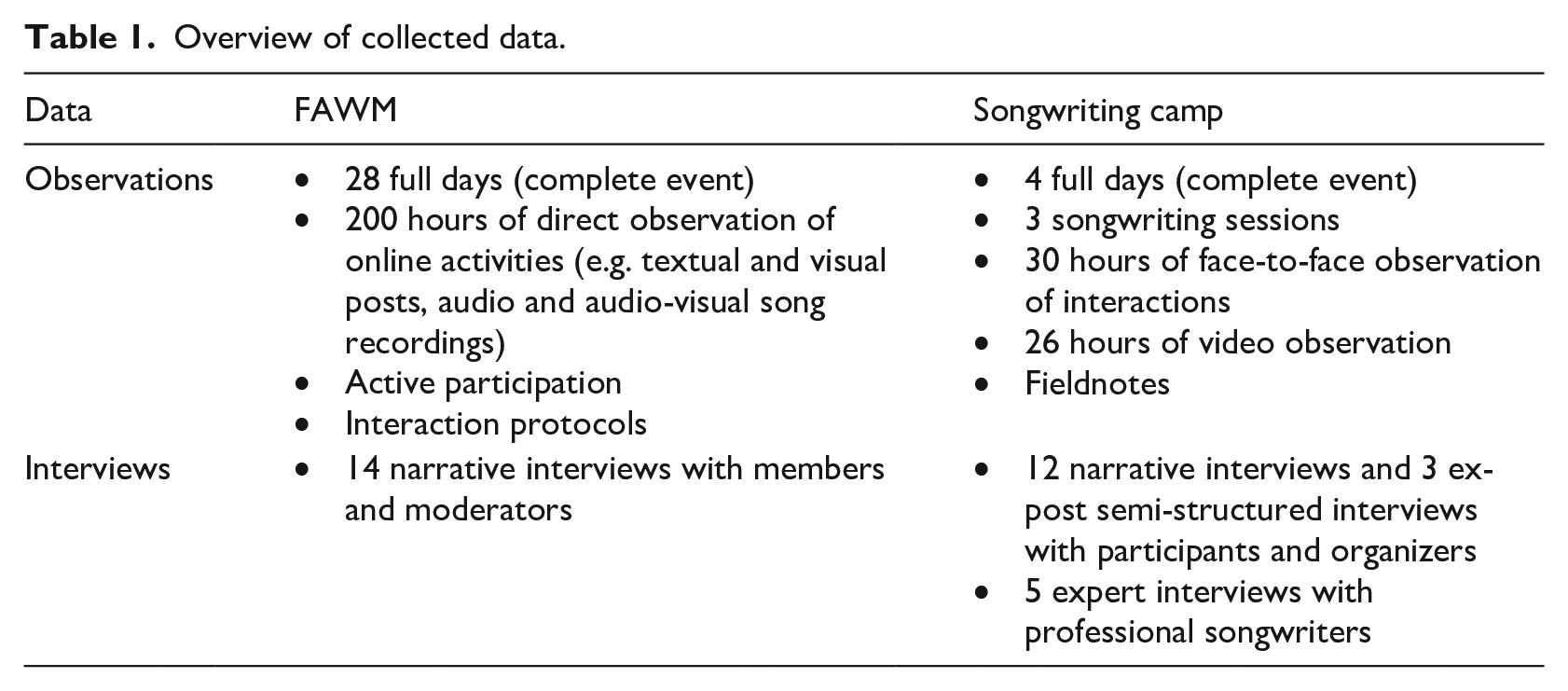
The third author engaged in similar field observations in the studio that hosted the songwriting camp. This was conducive to producing a focused ethnography, which is restricted in time and encompassed direct and videographic observations as well as semi-structured and unstructured interviews. He was overt about his status as a researcher, and also took on a legitimate role in the field as an assistant in the camp organization. As such, he helped organize the songwriting camp and prepare the studios, bought and prepared food and drinks, and handled technical issues with audio equipment. He attended a total of three songwriting sessions, each lasting from 8 to 12 hours. He constantly took notes on a smartphone and later expanded them into detailed field notes. To complement these data, he conducted videographic observations of the collaborative creative work, which yielded 26 hours and 35 minutes of video material. In addition, he conducted 12 unstructured interviews and three ex-post semi-structured interviews with attending participants and organizers, as well as five expert interviews with professional songwriters.
Both authors’ field notes included observations of the formation and dissolution of collaborations and the spatial and organizational conditions and practices responsible for them. In the interviews, both authors asked very general questions about how ideas were generated in both settings (e.g. ‘How do you come up with novel ideas during the camp?’) as well as questions about specific collaborative situations they had observed (e.g. ‘How exactly did you became aware of person X?’ or ‘How did you manage to not let yourself be dissuaded from the idea in situation X?’).
Data analysis
The first and third authors initially generated separate findings on each case based on the primary questions pursued in each case study. Hence, when we started comparing the cases, we were already quite familiar with our data. Together with the second author, who co-developed the overarching research project as well as a sub-project on spaces of creative collaboration, we started a comparative analysis focused on capturing the differences and similarities of the organizing practices that enabled creative collaboration. In an iterative process of open, axial and selective coding (Strauss & Corbin, 1990), we simultaneously engaged in constant within and cross-case comparison (Langley, Smallman, Tsoukas, & Van de Ven, 2013) and iterated back and forth between individual coding and a joint discussion and interpretation of emerging insights, collectively refining the codes and developing a conceptual model. Focusing on organizers’ and participants’ activities in facilitating creative collaboration, we identified two central obstacles that had to be overcome: being invisible and not finding collaborators (a problem that particularly occurred in the online setting), and being too visible (and audible) and deterring potential collaborators (a problem that mainly occurred in the songwriting camp). We recognized these obstacles as constituting the two sides of copresence: making oneself available to others and approaching others.
To conceptualize these observations, we found inspiration in early literature on computer-supported cooperative work (Benford & Fahlén, 1993), which differentiates an object’s focus from its nimbus (see Figure 1). While the term nimbus is commonly understood as prestige or, in religious terms, as a halo, Benford, Bowers, Fahlén, Mariani and Rodden (1994) used the term to refer to a subspace in a virtual environment in which an object makes some aspect of itself available to others, e.g. through its presence, identity, activity or a combination of these elements. Conversely, focus reflects the extent to which one object is aware of another one. Both are dimensional categories, and in temporary collaborative spaces, regulating focus can shape the extent to which collaboration is wide or narrow, whereas regulating nimbus can influence the extent to which participants are visible (and in our case, audible) as newcomers, experts or potential collaborators.
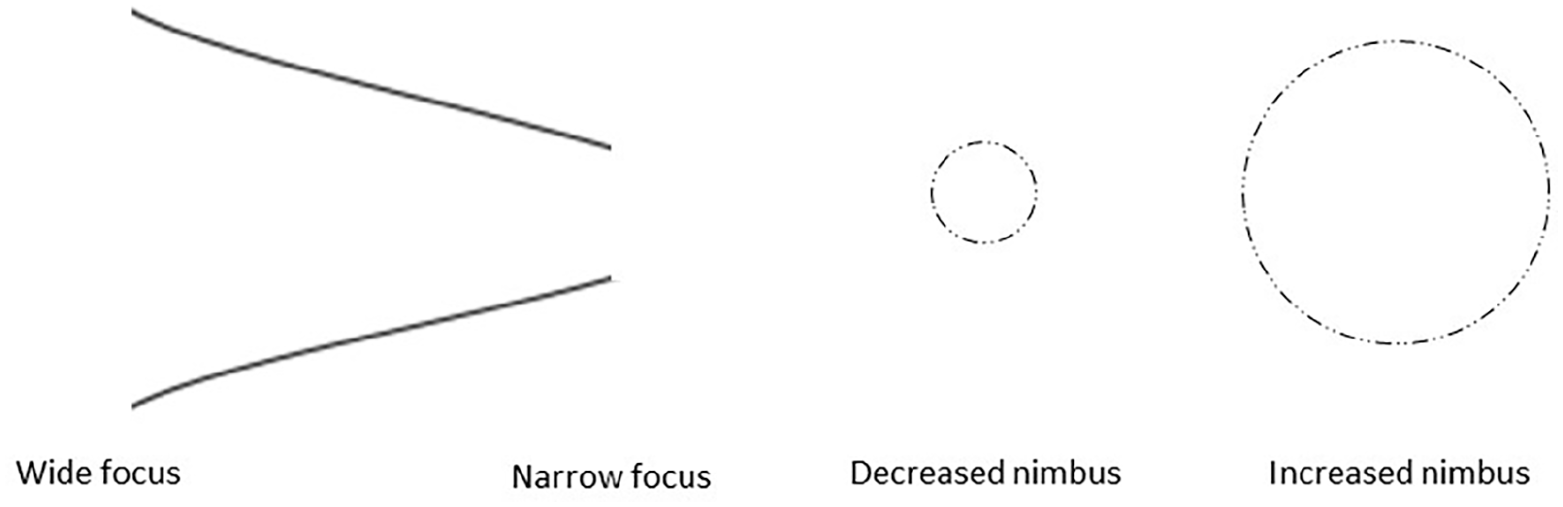
Focus and nimbus.
In the physical setting, focus and nimbus were intertwined: whether we observed a reaction to something and/or a signalling of something depended on the perspective of the observer. In the virtual setting, however, due to the asynchronous nature of interactions, postings that offered expertise (increasing nimbus) could be separated more easily from postings that responded to these requests (narrowing focus). Especially for the hosts of the virtual platform, it was crucial to differentiate between the two dimensions to make sure all participants (especially newcomers) were visible and that nobody got lost. Comparing the two settings thus sharpened our understanding of two forms of copresence resulting from different combinations of nimbus and focus: converging copresence, a situation marked by decreased nimbus and interactions with a narrow focus on a specific topic or project; and diverging copresence, a situation marked by increased nimbus and interactions with a wide focus involving general conversation or hanging out without much direct contact. Creative collaborations were enabled when participants oscillated between these two kinds of copresence and thereby avoided reaching excessive states of nimbus or focus.
Findings
Excessively seeking and displaying presence as core organizing problems
In both settings, we observed typical problematic combinations of various degrees of focus and nimbus. In the virtual setting, we often witnessed insufficient visibility (decreased nimbus) coupled with an excessive focus on individual members which, due to the structure of the website and the number of users, made it difficult to establish connections across the broader group of participants. Newcomers in particular could easily remain anonymous on the website by turning off their cameras and microphones as they tried to find their way around, thereby making themselves inaccessible. Figure 2 illustrates this problem, which we term excessively seeking presence, where the focal actor A has a narrow focus on trying to find potential collaborators, but is not able to establish collaborations, as documented in the field notes from FAWM: First day. I have set up my profile page. It was a messy start; I could manage neither the equipment nor the website. There are already 1,613 users from the first day who logged in. How do they get their collaborations? How do I make myself visible? I’ll just post on the forum and write to a few people. I don’t know if that will do it. It is easy to lose the overview because there is only one link under which you can find all users; the same for the songs, but nothing seems to be structured.
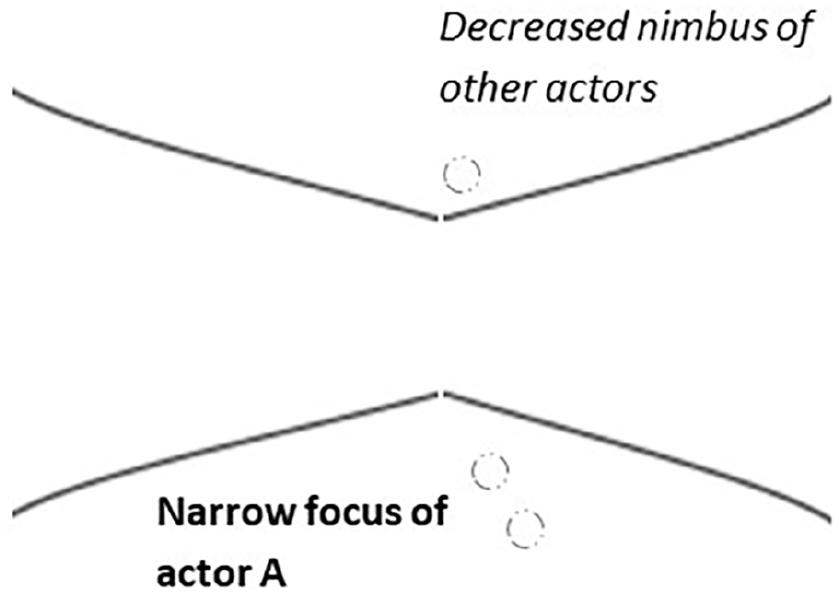
Excessively seeking presence.
In the physical setting, excessively displaying presence was a diametrically opposed situation. Here, individual songwriters were too loud and too much in the foreground, thereby hindering collaboration by rendering everyone else invisible. Participants tended to be overshadowed by those who engaged in too many parallel activities or dominated interactions. Figure 3 illustrates this problem, where actor A has a wide focus, but is unable to establish collaborations because of her increased nimbus and the increased nimbus of other participants. A participant in the songwriting camp described this problem: [Disqualifying yourself] actually happens very quickly. It also happens frequently here. . . . And why someone isn’t invited or disinvited or would never be invited again for a session is clear: ego. . . . The ego must always be able to be withheld. So, if you always want to assert yourself, then it’s definitely not advisable to work in a team . . . I think that’s the most important thing. The ego shouldn’t be in the foreground. Everything else just happens in interpersonal relationships.
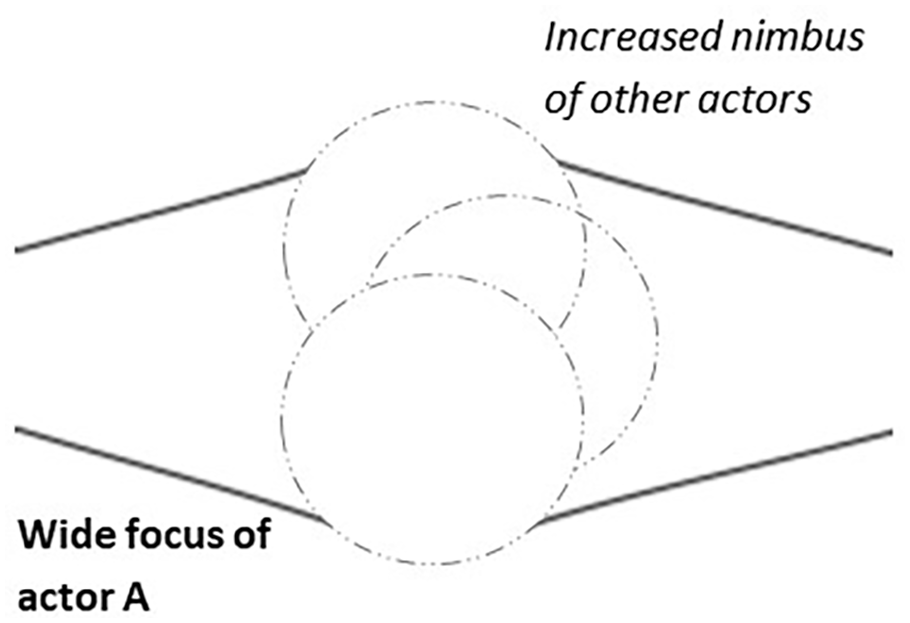
Excessively displaying presence.
Hosts addressed these problems by regulating focus and nimbus, moving participants out of these problematic constellations into converging or diverging forms of copresence. Figure 4 illustrates balanced situations of nimbus and focus where either actor A has a narrow focus on actor B, who has increased nimbus (in situations involving direct interaction, for example), or actor A has a wide focus and may overlook those with decreased nimbus (participants who are lingering in the foyer, for example).
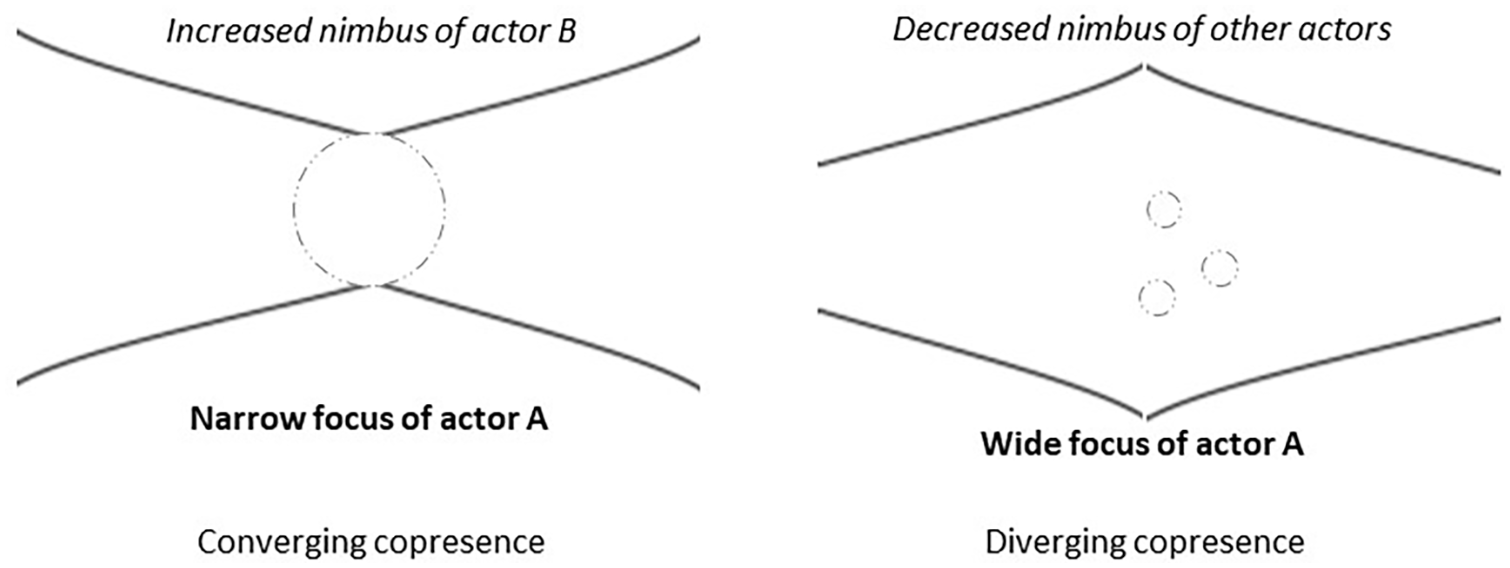
Converging and diverging copresence.
These organizing practices, which are summarized in Table 2 and illustrated below, had to be adjusted and maintained over time to facilitate both forms of copresence. In the physical setting, the practices of organizing nimbus and focus often occurred simultaneously, and participant interactions were typically marked by negotiations between nimbus and focus, i.e. to signal availability and shift attention. Hence, the practices are not as clearly divided in Table 2 as in the virtual case. These organizing practices relied on being enacted and ‘picked up’ by participants themselves, as our data illustrate.
Organizing practices for enabling creative collaborations.
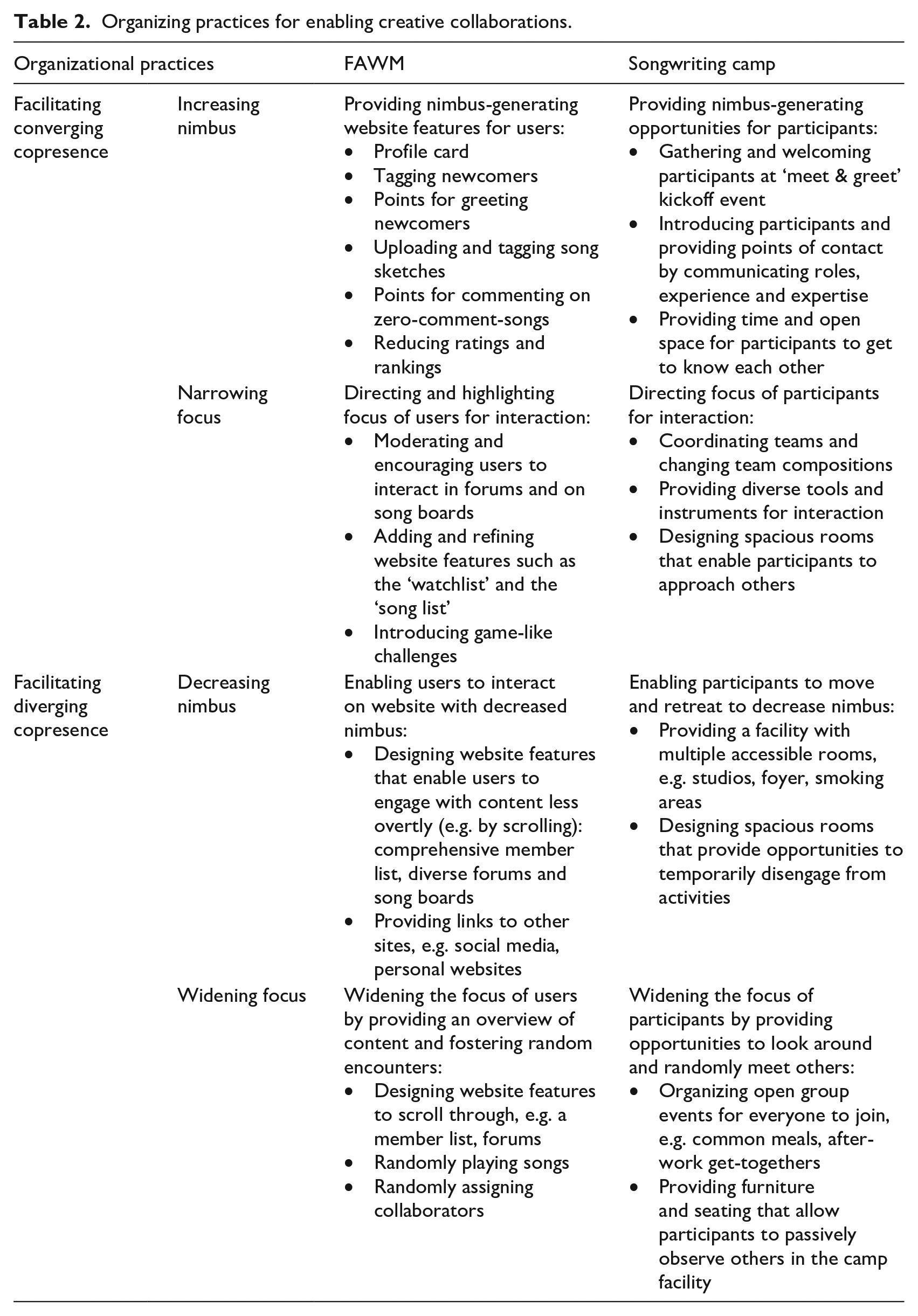
Facilitating converging copresence
In the early years when FAWM had few members, moderators helped participants increase their visibility by welcoming and introducing them to each other. However, as the community began to grow rapidly, these practices were delegated entirely to features of the platform. The moderators then took over the task of selecting, exchanging and adjusting these features. The first signal of availability at FAWM was (automatically) created after registration in the form of a retrievable profile card. This included biographical information, a picture, information on musical interests and expertise, as well as a ‘soundboard’ in the form of a bulletin board for communicating via posts and comments. Setting up a profile card involved agreeing to the ‘terms of use’ of the platform, which included rules about etiquette. Similar to the physical walls in a studio, FAWM’s community etiquette thereby enabled an ‘insider’ nimbus that distinguished it from the ‘outside’ world and ensured that most communication, song uploads and other collaborative interactions took place on the platform. The website increased nimbus by automatically tagging each newcomer to facilitate their integration into the community, as a failure to integrate new participants is a common problem when online communities grow. Newcomers were prominently displayed to everyone on the platform in the newcomer window (see Figure 5 for a website structure).
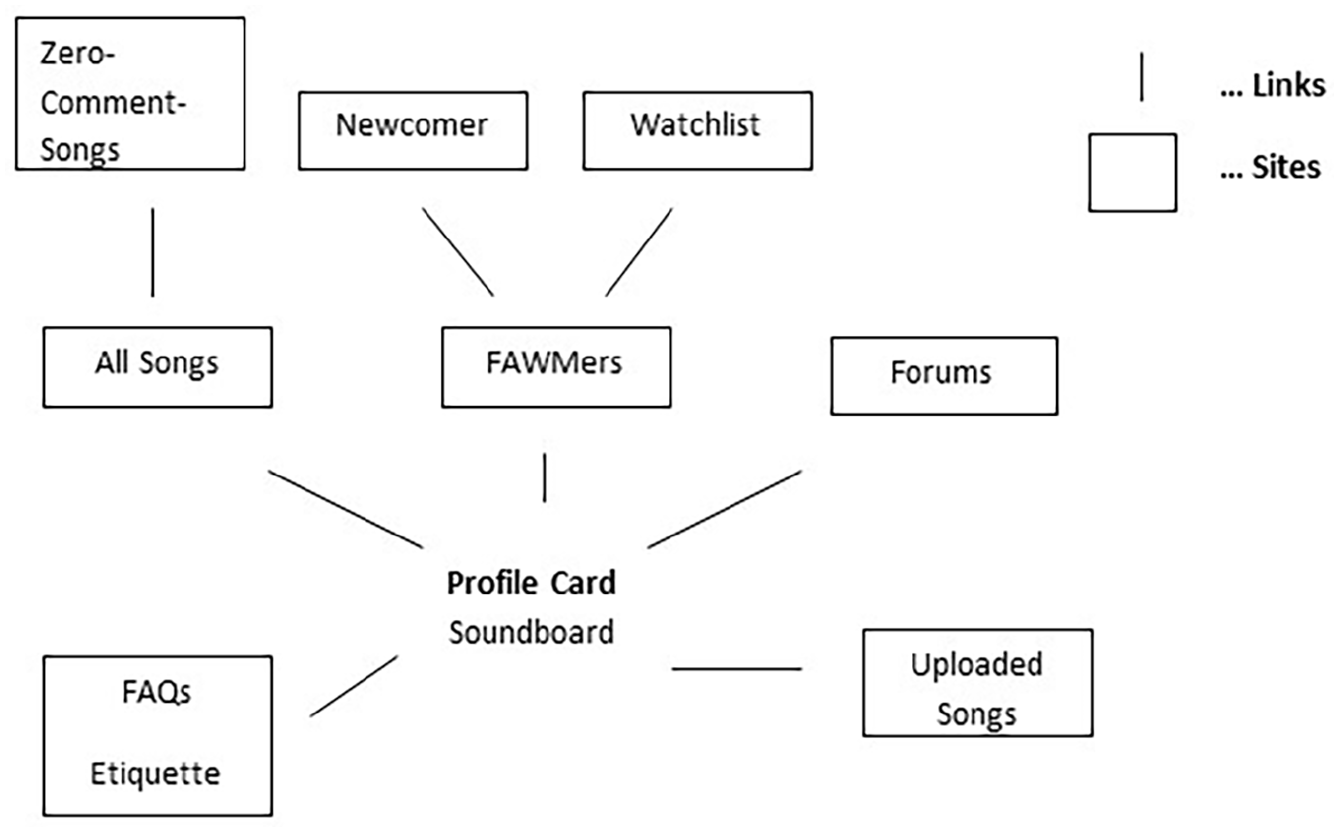
FAWM website and link structure (www.fawm.org).
Additionally, everyone who greeted a newcomer on their soundboard received a point on their own profile page for community engagement, which was visible to all. Participants who earned many points for greeting newcomers were celebrated in the forums. These features not only facilitated immediate interaction that could help establish or strengthen collaborations, but also created an atmosphere of intimacy and appreciation, which was especially important when new, unfinished ideas were shared. Consider the following field note as an example: I was greeted by several FAWMers on my soundboard as soon as I logged in today. It’s a good feeling, makes me feel welcomed. There are greetings from very different people, some of them even read my bio and referred to it. I thanked them and checked out their profiles.
A practice that increased nimbus was uploading song sketches and tagging them. Besides genres and instrumentation, song uploads could be tagged as incomplete and in need of collaboration. For example, a song was tagged as ‘#needsdrums’, or more general ‘#open-for-collaboration’. The website further tagged songs that had not yet received any comments as ‘Zero-Comment-Songs’. Again, participants could collect points by commenting on uncommented songs. Unlike other websites, songs could not be displayed as a list sorted by the number of comments (or ‘likes’) they received, nor could community members be displayed in a list sorted by the number of songs they produced. This decreased the nimbus of some very active members, but increased the nimbus of the majority of newcomers and less active members. These features were subject to ongoing review and adjustments. A ‘like’ button, for example, had been introduced on a previous version of the FAWM platform, but was subsequently removed because it led to competitive behaviour.
Increasing nimbus, however, was not sufficient to facilitate converging copresence. Hosts also had to continuously regulate focus. On FAWM, collaborations emerged based on reciprocal commenting and ongoing conversation threads. A common activity with a narrow focus, therefore, was commenting on other people’s song sketches. In addition to enabling commenting via so-called song boards, in 2009 FAWM further narrowed participants’ focus to a smaller group of individuals by publishing a scatterplot based on data from 2008 that revealed a positive correlation between giving and receiving comments on songs. Based on these data, members gained awareness that reacting to others was as effective or even more effective than tagging their own songs or posting in forums. Publishing the scatterplot was a form of moderation in the forum that reinforced FAWM’s collaborative community culture. The first author personally felt an unspoken obligation to reciprocate when others commented on his songs, resulting in a culture of trading focus for nimbus and vice versa. Another organizational practice for narrowing focus was designing features dedicated to ‘keeping track of what is happening’, such as watchlists, song lists and forums. FAWM’s ‘Frequently Asked Questions’ section for the watchlist feature highlights this practice:
Is the ‘watchlist’ feature sort of like a friends’ network?
Sort of, but unlike a lot of website communities where the goal is to get the ‘most friends’, you’ll probably want to keep your watchlist down to a reasonable size.
So s/he who is in the most watchlists doesn’t win?
No, s/he who writes at least 14 songs in 28 days wins.
Participants could access their watchlists from their profile cards to keep track of what other participants were doing. The watchlist again was a reaction to rapid growth of the community in 2007. The song list existed since the beginning of FAWM, and was a link that led to all published songs and also to a sub-site that directed focus to newly published songs. The forums were structured along certain topics including tips on ‘songwriting’ or ‘demo-recording’, as well as by country. Finally, the introduction of game-like challenges on the forums was another way to narrow the focus of the participants. Each member who participated was randomly assigned to a collaborator to write a song. This practice simulated a situation in which someone had her focus directed to someone else randomly.
The four days of the songwriting camp were kicked off with a reception event in the foyer of the studio complex the evening before the actual songwriting began. The foyer was the biggest room and also the focal setting of the camp. Due to amenities such as a fridge with drinks, a coffee machine, several seating options, and access to the toilets, the foyer continued to be a central meeting place throughout the duration of the songwriting camp. Furthermore, the foyer connected the four studio rooms with each other, as it was adjacent to the hallway (see Figure 6).
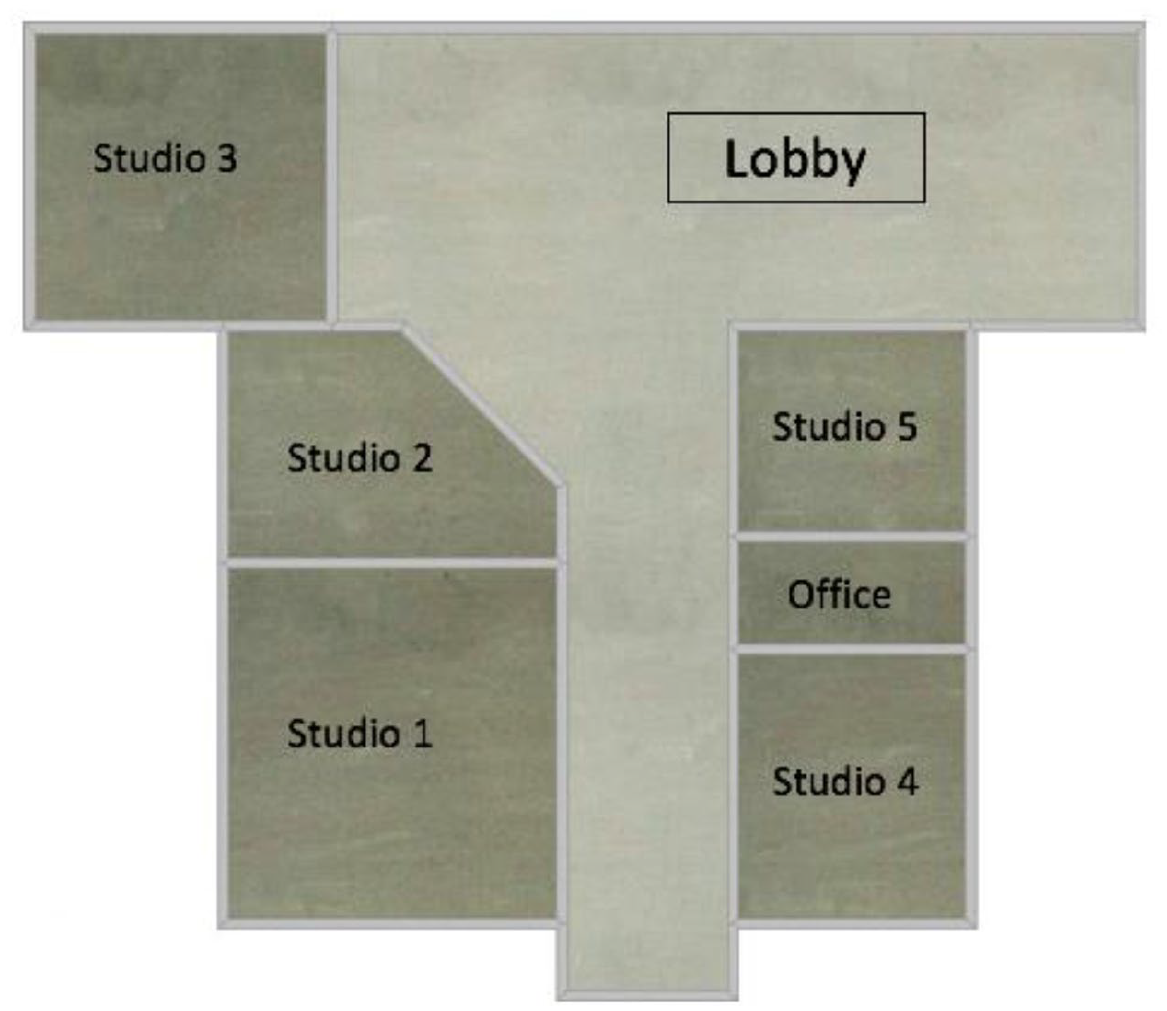
Songwriting camp floor plan.
In contrast to the virtual setting, nimbus and accessibility were fostered from the very beginning for all participants because they were face-to-face. At some point, the camp organizer called for attention and officially welcomed everyone. These introductions made each person visible to others as they provided information about themselves and their interests. The following excerpt from the field notes illustrates the general atmosphere during the kick-off gathering: Everyone meets in the foyer and introduces himself/herself. Small talk everywhere. There are drinks. I also get to talk to many different people, introduce myself, we talk briefly. . . . The camp organizer then officially introduces all the invitees, calls them by their names and says a few words about their music projects, releases, skills and affiliations. He explains the camp’s schedule. . . . Then he makes it clear that the overall goal of the camp is for everyone to have a good time working together and making new connections. The evening events, which include visits to concerts and beer gardens, also serve this purpose.
During this process of casually getting to know each other, songwriters provided additional information about their professional roles and expertise and thereby reproduced their nimbus. However, due to oversaturation resulting from the sheer number of new contacts and constant synchronous interaction, participants’ nimbus had already faded by the next day. Once again, the host introduced participants and described their roles and expertise. The following excerpt from the videographic observations on the third day reveals how songwriters renewed their nimbus throughout the camp:
So, so what’s your name again?
[Name].
[repeats the name. They shake hands, and both laugh.]
And you are? You do mostly. . .? What’s your speciality? [She moves her arms like a drummer.]
Mostly melodies, singing and lyrics.
Oh, okay.
And you?
Also [laughs]. But I also do arrangements and producing, stuff like that.
Yeah, cool. And you work with us today?
Yes. [Both laugh.]
Alright, it’s just because while he [camp organizer] was saying names, someone was speaking to me and I didn’t hear all the names in the team.
To prevent oversaturation, nimbus of certain individuals also had to be decreased so that others could gain visibility. The organizer mainly did this by allocating songwriters to four different teams each morning and assigning them to different rooms. With up to four songwriters working together in a studio room, nimbus increased in the small groups but decreased in the larger group.
In general, songwriters tried to draw attention to their ideas by describing or demonstrating them. The studios were equipped with musical instruments such as guitars, keyboards and synthesizers, as well as audio interfaces and speakers. A problem that arose in the studio rooms with multiple simultaneous activities was noise, which made it difficult for the participants to pay attention to others’ ideas. To enable narrow focus, participants changed positions within the studio room and moved closer to those whom they wanted to interact with. The following excerpt from field notes taken on the second day reveals how songwriters moved around in the studio rooms to share ideas with others during a songwriting session: At the moment, it is everybody for themselves. [Songwriter 1] is ‘just fooling around with the bass’. [Songwriter 2] is playing around with a guitar on the armchair. [Songwriter 3] has moved to the corner with her back to the room and is working on lyrics . . . [Songwriter 1] approaches [Songwriter 2] and they exchange ideas by making guitar noises with their mouths. . . . [Songwriter 3] continues to sit in the corner and hums to herself. Then she asks [Songwriter 1] whether he’d ‘like to have a look at the melody’. He agrees and comes over. [Songwriter 3] has explicitly asked for help and [Songwriter 1] shares his ideas on it.
Facilitating diverging copresence
In the virtual setting, decreasing nimbus and widening focus was mainly achieved by scrolling through a large amount of web content and switching between several windows: checking the profile page for requests, checking the forums for new discussions, checking who is online, and stumbling over songs. During an interview, one member described her daily ‘hanging around’: During the day I hang around and go to these sites – that is, songs – and I just go through it. First my watchlist, of course. And then I try to take random people and then comment on their songs. Even if I don’t like the genre or the style or anything; I always try to find something – because there is always something that is positive – and comment on that.
Activities were organized on a timeline, both in the forums and in the list of members to provide an overview (decreased nimbus) and potentially redirect attention (wide focus) through postings. Another form of diverging copresence involved following links to obtain additional personal information about individual members. Similar to a large room in the physical setting where unfocused (and undetected) observations can be made, users on FAWM were able to gather information about individual members via the links on their profile pages and observe them prior to initiating potential collaborations. FAWM also integrated a button that randomly played any song out of the uploaded content. By stumbling over songs from the random playlist, members could potentially find other interesting collaborators.
In the songwriting camp, diverging copresence was facilitated by the physical set-up. The open studio rooms with furniture and seating enabled participants to move around, stand at a distance or sit down to observe what others were doing without attracting attention to themselves. Chairs were moveable and were rearranged in the rooms to support collaboration. The sofas, in contrast, were not moveable and often not used for direct interaction, but to retreat into a state of diverging copresence by sitting back and observing what the other participants were doing, what they were working on, what instruments they were using and what ideas they were exploring. This enabled songwriters to identify various potential points of contact for collaborations by overhearing what others were doing and reacting to them when appropriate. The physical set-up also enabled participants to leave a studio room and go to a common meeting place with seating, e.g. for coffee breaks or to hang out in the foyer when their instruments were currently not needed. Doing so enabled them to have a look around (a wide focus) without necessarily signalling a willingness to interact (decreased nimbus), often resulting in random encounters with others involving exchanges of information about songwriting procedures. Furthermore, participants often dropped by other studio rooms to have a look around and hear what the other teams were working on.
The camp participants also came together for common events such as the daily briefing, lunch, dinner, after-work drinks and the final song presentation at the end of the camp. The following videography excerpt from the fourth day shows how such events led to a lot of movement and enabled serendipitous encounters resulting in joint improvisation: [Camp organizer] opens the door to the studio room. ‘There’s pizza in the foyer for you guys.’ Three songwriters leave the room. [Songwriter 1] stays and continues working on the digital audio workstation. A few minutes later [Songwriter 2] from another team enters the room.
Everything alright?
Definitely.
What kind of track are you doing?
A kind of R and B ballad. [He presses play on the digital audio workstation and the recorded instrumental plays.]
That sounds mega – awesome chords! It perfectly fits to her voice.
The recording plays in a loop and [Songwriter 2] starts humming additional melodies. Three more songwriters from other teams enter the room with slices of pizza in their hands. One of them starts rapping in a high-pitched voice to the melody.
How oscillating between converging and diverging copresence leads to creative collaboration
While the hosts facilitated both forms of copresence by regulating focus and nimbus, the participants actively contributed to oscillating between the two to alternately concentrate and relax, work with a specific focus and enable free association of possible ideas and inspirational encounters, move forward and avoid dead-ends or exhaustion. This oscillation was important, as a persistent state of diverging copresence stifled creative collaboration as much as a persistent state of converging copresence. Figure 7 captures this oscillation dynamic.
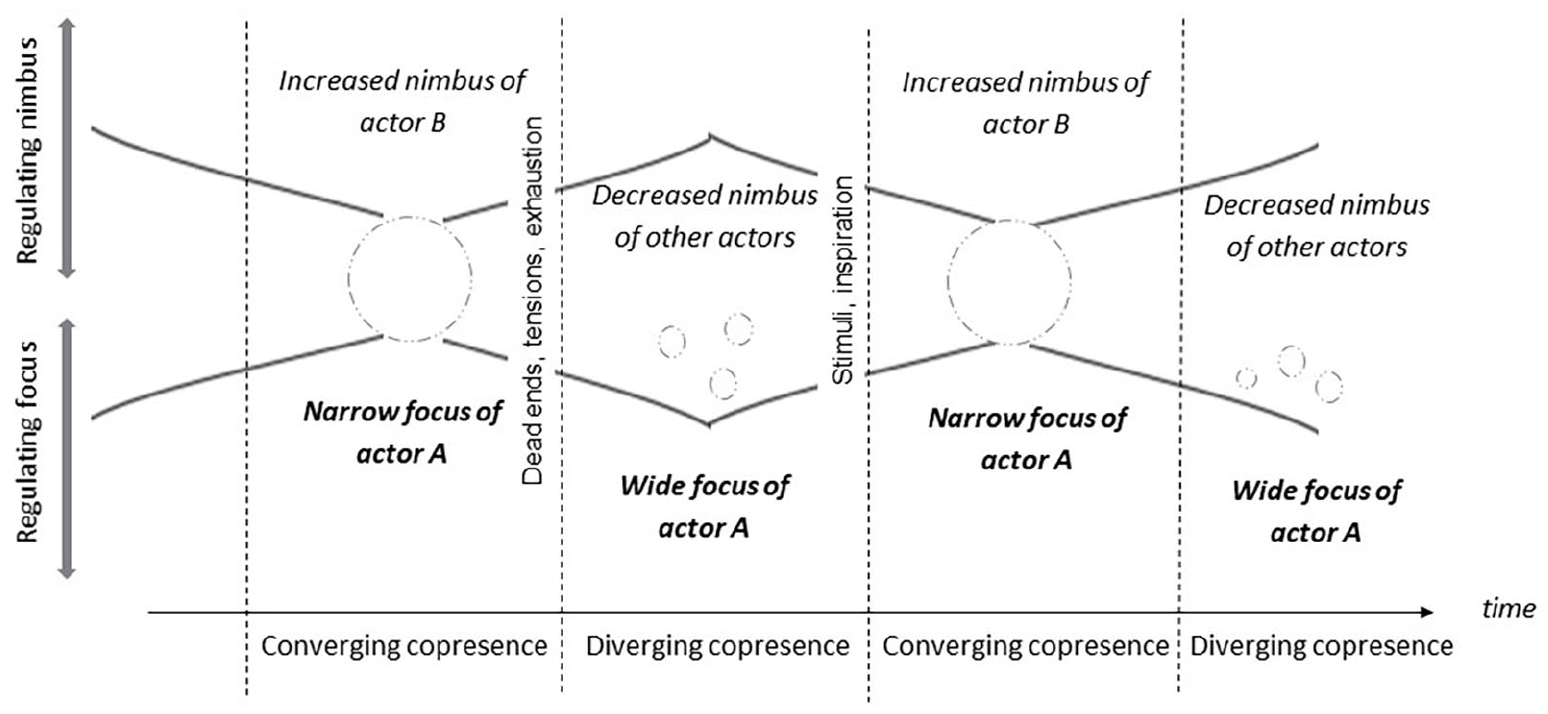
Oscillating between converging and diverging copresence for creative collaboration.
Unlike in a physical setting where oscillation between the two forms of copresence often is associated with bodily movement, in an online setting, participants oscillate by shifting between several tabs or screens on the computer or by clicking different links on a website. During the auto-ethnography, the first author regularly had one tab open for FAWM, one for Facebook where groups from the FAWM community interacted, and one for Soundcloud to upload songs and follow other artists. When interviews or direct collaborations took place, he also had a window open for Skype communication. He switched regularly between the different forms of copresence by simply changing the tab or window on the computer screen. Typically, FAWM participants followed a daily routine that involved switching between diverging and converging copresence: they started by checking forums and comments and then stumbled into new collaborations or continued working on established collaborative projects. During an interview, a songwriter described this daily routine: I check in and I probably spend two or three hours a day just when I am not at work and so I’ll open the forum . . . I check for comments. And I stumble over people. . . . suggesting things that I had never thought of and that just got me so pumped musically.
Later in the interview, the songwriter described a particularly successful collaboration: So, we both go into Google Docs. She starts writing, I am just recording music. . . . And I just started writing, like: ‘That’s gonna be the verse.’ And then I came up with eight measures that I felt like: ‘Okay, this is probably chorus chords.’ And I wasn’t singing anything. I was just kind of recording some guitars just to get a sound. . . . and meanwhile, she is typing lyrics. Like I can see the lyrics appearing over here – I have two screens, and on my other screen I am arranging the song. It was crazy how fast we did that.
Both quotes highlight the benefits of switching between two modes of copresence for inspiring encounters and for working concretely on their music. However, participants who engaged too long in diverging copresence without regulating nimbus and focus towards converging copresence could easily become disconnected from the group, even to the point of reaching a state of excessively seeking presence, as this excerpt from the field notes reveals: I have to be careful not to lose myself. There are a lot of platforms that are linked here, and getting from one to the other I easily lose the thread. I have written to a lot of people and most of them answer back. I have to be careful that I also deliver and collaborate when there are many requests.
In the songwriting camp, converging and diverging copresence often occurred synchronously and even in the same room. While some songwriters engaged in close and focused interaction to develop ideas, others sat on the sofa or in the corner of the room, experimenting with ideas on their own or observing. Copresence began to converge when participants explicitly presented ideas to others or when ideas of participants were overheard by others who provided feedback or elaborated them. Copresence began to diverge when participants paused an interaction for a moment, sat down to watch what others were working on, or left the room to take a break. The following excerpt from the videographic observations illustrates how the oscillation between converging and diverging copresence manifested in a team of four songwriters during the second day of the camp, particularly as Songwriters 3 and 4 shifted their focus to fostering converging copresence as the situation developed: [Songwriter 1] suggests a piano chord line as the leading mood of the song. [Songwriter 2] appreciates the idea and says that she loves electric pianos. Now [Songwriter 1] plays various chord lines on the Rhodes piano and [Songwriter 2] gives feedback. [Songwriter 3] repeatedly looks towards them and experiments with melodic add-ons on the guitar. [Songwriter 2] starts humming different melodies to herself and listens to vocal recordings on her mobile phone. Only very occasionally, a single word appears in her hum. At one point she says: ‘I can hear the song already finished, it’s just in my head.’ Then she keeps humming to herself. [Songwriter 3] on the guitar suddenly takes part in her humming, then sings loudly, in a high voice, a supplementary vocal melody with placeholder words. [Songwriter 2] is very enthusiastic: ‘Oh wow, it’s a hit!’ A high-five between the two. [Songwriter 3] on the guitar then comments on [Songwriter 1]’s chord line: ‘It’s so cool!’ [Songwriter 2]: ‘I’ve got some more ideas.’ [Songwriter 4] who works on the drumkit turns around and comments: ‘You guys sound ecstatic!’
These excerpts show the benefits of oscillating between the two modes of copresence for collaborative creativity. On the one hand, remaining in diverging copresence for too long would have hampered actual collaborative work on ideas that played a crucial role in ‘bringing things forward’, as one FAWM member put it. Staying for too long in converging copresence, on the other hand, could have limited diverse opportunities for mutual inspiration, become strenuous or led to oversaturation. Scrolling through the forums or moving around the camp space were suitable distractions that helped maintain an inspirational sense of belonging, what one FAWM member described as ‘hanging out in an inspiring environment’. During an interview, an expert songwriter described the need for oscillation as follows: At some point, you’ll go deaf, you know. . . . Then it’s not much use to keep working on it. Because then you don’t hear the difference anymore, or at least you don’t recognize it. I think I make more bad decisions when I try to push something even though I’ve already done a lot that day. Then sometimes it’s better to just wait and continue with fresh ears.
Discussion
Our aim in this study was to contribute to the literature on collaborative spaces for creativity by unpacking the role of copresence as a basis for creative collaboration. We further aimed to understand the particular challenges and opportunities of physical and virtual settings with regard to organizing copresence in creative collaboration. Rather than focusing on how individuals use collaborative spaces such as coworking spaces (e.g. Merkel, 2019) or how a community spirit emerges in such spaces (e.g. Garrett et al., 2017), we focused specifically on the organizing practices of the hosts of two comparable settings, one physical and one virtual. In an abductive research process, we identified the concepts of nimbus and focus as useful for capturing how participants in collaborative spaces become co-present with others. Regulating nimbus and focus enabled an oscillation between diverging and converging copresence among participants, which was beneficial for creative collaboration because it enabled them to engage in concentrated work on ideas as well as to relax, stumble across interesting new ideas of others, and avoid getting stuck. These findings contribute to our understanding of collaborative spaces for creative collaboration, the organization of collaborative spaces more generally, and the roles of physical and virtual spatiality in creative collaboration. They also have important practical implications.
First, our insights advance discussions on the practices of organizing collaborative spaces for creativity and hence contribute to a more situated understanding of organizing creativity (Schüßler, Svejenova, & Cohendet, 2021). By shifting the focus from organizing spaces to organizing copresence, we provide a conceptual language to study the social dynamics underlying creative collaboration in different spatial settings. Our case comparison hereby sharpens our understanding of what needs to be organized to enable creative collaboration. Without the comparison to the virtual setting, we might not have been able to analytically distinguish the practices of regulating nimbus and focus, as both are two sides of the same coin and typically occur simultaneously in physical settings. By disentangling nimbus (i.e. a person’s visibility) from focus (i.e. the object of a person’s attention) we were able to identify two forms of copresence that participants in collaborative spaces moved in and out of: converging copresence, marked by a mix of increased nimbus and a narrowing focus of two or more actors, and diverging copresence, marked by decreased nimbus and a widening focus. Diverging copresence describes a state wherein one can potentially enter a collaboration or interaction with someone else (a shift towards converging copresence) but can also choose to stay in the background. It is precisely this opportunity – rather than obligation – to interact that makes diverging copresence important for relaxed creative thinking and serendipitous encounters.
Our concepts of converging and diverging copresence link to the notions of convergent and divergent thinking as important cognitive skills for creative problem-solving (Guilford, 1962) in ways that go beyond their linguistic similarities. Divergent thinking generates many possible alternatives, whereas convergent thinking identifies a single correct answer. Our findings, which focus not on cognitive processes, but on dynamics of mutual attention and awareness, indicate that collaborative work implies a combination of focused refinement of ideas in moments of converging copresence, more akin to the problem-solving part of creative processes, and a zooming out of this problem-solving mode towards a loose overhearing and observation of others, more akin to the serendipity part. These insights complement extant work on collaborative creativity. Hargadon and Bechky (2006), for instance, highlighted that moments of collective creativity occur through activities of help-seeking, help-giving and collective reframing, and that these need to be encouraged by reinforcing behaviors. These activities played an important role in our collaborative spaces, too. However, we found that not all interactions followed this cycle of activities. Ideas were expressed openly, for instance, often without explicit calls for help. Recognizing the importance of oscillation between converging and diverging copresence to enable both problem-solving and serendipitous encounters thus fills a gap in our understanding of how creative collaboration can be deliberately enabled and ‘organized’. Participants shifted between activities and found a balance between converging and diverging copresence not only in response to interventions by the hosts, but also based on their own initiative, especially as they became more proficient in navigating the collaborative spaces, directing their energy and attention, and engaging in different aspects of the creative process.
Second, our study provides additional insights into why people may avoid serendipitous encounters in collaborative spaces more generally (Irving et al., 2020). Whereas open offices or coworking facilities typically provide a physical infrastructure that allows for diverging copresence while fostering organizational impulses for converging copresence, evidence has shown that interactions by no means occur simply by providing these infrastructures. Based on our findings, we argue that people may avoid visiting such spaces possibly because they want to avoid the excessive nimbus of those who make themselves very present in such spaces. Moreover, people may find it difficult to oscillate between converging copresence (which can be perceived as tiring and limiting in terms of developing new relationships and ideas) and diverging copresence. Thus, our findings suggest that organizers of collaborative spaces not only need to provide stimuli and opportunities for converging copresence, but also need to go beyond providing open spaces or the proverbial ‘photocopiers and water-coolers’ (Fayard & Weeks, 2007) to actively facilitate diverging copresence and oscillation between the two.
Diverging copresence can be enabled by hosts constraining the nimbus and focus of participants so they can enter a state of blurred visibility and undirected attention. Achieving this movement may entail working with the ‘affordances’ (Leonardi, 2011) of particular settings in certain situations, and working against them in others. An example would be ensuring that focus and nimbus are reduced during break times, when some individuals might seek to attract attention and others might avoid focused interactions, or providing stimuli that promote scrolling in online settings, even when the technology mainly affords direct and focused interactions. A key challenge for organizing collaborative spaces, then, is to actively mitigate the risk of participants either becoming too dominant or disappearing from the radar. In order to do so, ‘widening focus’ and ‘decreasing nimbus’ are important organizing practices that need to be paid attention to interdependently, but addressed in their own right.
A limitation of our study is its focus on two highly orchestrated, temporary spaces for creative collaboration, which contrasts with other, more loosely organized settings such as hotel lobbies, creative hubs or coworking spaces. While we argue that the idea of organizing copresence also applies to more permanent and less intensely orchestrated spaces, further research is needed to shed light on possible practices for regulating nimbus and focus in less constrained settings. Clearly, there are also limits to ‘managing’ and orchestrating spaces and even the danger of ‘micromanaging’ them. At the same time, because a lack of motivation to participate was ‘controlled for’ in our settings, we are able to elaborate more precisely on the conditions that create an ‘atmosphere’ for collaboration, which stems from ‘a site’s constellation of material and immaterial elements’ (Michels & Steyaert, 2017, p. 81) and can also be created in virtual environments (Jørgensen & Holt, 2019). We suggest that it is useful to think about converging and diverging copresence as distinct elements of this atmosphere. Scholars who are interested in the ‘assemblages’ of affectual, material and social elements of collaborative spaces (e.g. Cnossen & Bencherki, 2019; Jakonen et al., 2017; Stephenson, Kuismin, Putnam, & Sivunen, 2020) could differentiate between assemblages that support diverging copresence and those that support converging copresence as mutually constitutive parts of organizational spaces (Beyes & Steyaert, 2012).
Third, our study enables us to elaborate on the specific challenges and advantages of organizing digital collaborative spaces relative to physical ones (Slavich & Svejenova, 2016), while at the same time offering a pathway for overcoming this dichotomy. Although the practices of regulating nimbus and focus mattered in both settings, each setting posed distinct challenges to creative collaboration. In the songwriting camp, a main challenge revolved around maintaining a positive vibe and a constructive, collaborative climate in a highly constrained spatial setting that nonetheless provided various opportunities for zooming out and avoiding collaboration. In the online platform, a main challenge was facilitating visibility and focus in the first place, while also encouraging ‘hanging out’ on the platform with an undirected focus to enable serendipitous encounters. At the same time, we contrasted physical and virtual settings for creative collaboration as somewhat ‘pure forms’ and did not pay explicit attention to the multimodality of each setting, even though it also mattered in the contexts we studied. Additional research is needed to understand the entanglement of physical and virtual modes of interaction, for example, by examining whether norms of collaboration and dynamics of social interaction developed in a physical environment transfer to a virtual one and vice versa, as well as how shifting modes of interaction may influence creative processes and collaborative dynamics. We also did not explicitly attend to the aesthetic basis of creative collaboration (see Louisgrand & Islam, 2021) – in our case, the aesthetics of sound and music which differed substantially between the physical and the virtual setting. Whereas ‘overhearing’ others was both a form of diverging copresence and a way to initiate converging copresence in the songwriting camp, such auditory cues were entirely replaced by visual ones on the virtual platform. Whether and how these differences shaped the creative processes and the resulting creative products would be an interesting question for future research.
Conclusion
Our comparative ethnography of two spaces for creative collaboration, one physical and one virtual, has allowed us to identify two main obstacles to collaboration: failing to find collaborators, and failing to attract attention from potential collaborators. These obstacles can be addressed by practices of regulating nimbus and focus – increasing and decreasing participants’ visibility, and steering participants’ attention towards or away from each other – to alternately facilitate a more focused, problem-solving mode of interaction (converging copresence) and a more open, undirected one (diverging copresence).
As virtual forms of interaction become ever more widespread, our findings sensitize the organizers of virtual collaborative spaces to the importance of enabling moments of widening focus. Furthermore, while problems of visibility in virtual settings have already been recognized (Hafermalz, 2021; Hemetsberger & Reinhardt, 2009), our findings indicate that the visibility of participants not only needs to be actively increased – and sometimes decreased – by organizers, but also complemented with practices geared towards regulating focus. For the organizers of physical settings, our findings likewise point to the importance of organizing copresence as a basic condition for collaboration to occur. There is no ‘optimal’ level of copresence for collaboration, but participants must be able to adjust the level of copresence depending on situational needs. Organizing copresence thus involves working with the affordances of physical and virtual spaces in certain situations, and against them in others, and must be continuously practised. This insight paves the way for future process studies of organizational space (Stephenson et al., 2020), which could not only examine additional practices of organizing copresence in different spatial settings, but also unpack the shifts between converging and diverging forms of copresence as resulting from varying affectual, material and social elements of collaborative spaces.
Footnotes
Acknowledgements
We thank three anonymous reviewers and Timon Beyes, the handling OS Senior Editor, for their generous and constructive guidance in developing this paper. Earlier versions of this paper have been presented in the context of the Research Unit ‘Organized Creativity’ at Freie Universität Berlin, at the 35th EGOS Colloquium in Edinburgh, at the virtual WK Organisation conference, at the Austrian Early Scholars Workshop, at a research seminar at Manchester Alliance Business School organized by Joseph Lampel and at an internal research seminar at the Institute of Organization Science at JKU Linz. We are grateful for the feedback we have received in these contexts. Particularly, we want to thank John Amis, Robert Bauer, Giuseppe Delmestri, Gernot Grabher, Axel Haunschildt, Oliver Ibert, Judith Igelsböck, Verena Krause, Stefan Meisiek, Amalya Oliver, Birke Otto, Sigrid Quack, and Jörg Sydow for their detailed comments on previous drafts.
Funding
The author(s) disclosed receipt of the following financial support for the research, authorship, and/or publication of this article. We gratefully acknowledge funding by the German Research Foundation for supporting the Research Unit ‘Organized Creativity’ (grant no. FOR-2161) and by the Austrian Science Fund (FWF) [10.55776/I4884].
