




Abstract
We respond to the call for more research into the entanglement between multiple (including non-visual and non-verbal) modes of communication within organizations by exploring the relationships between rhetoric and materiality. We draw on archival sources concerning the Founder’s Building at Royal Holloway College (1874–1897). We discuss the building as a multimodal material object, inherently multiple, fluid and messy: the Founder’s Building is open to multiple encounters with sociality through multiple modes of communication. We find that such ‘messiness’ explains how the spatial, aural, sensual and visual modes embedded in a material object engage with each other, as well as with other visual, verbal and numerical modes, in the crafting of rhetoric: different modes sustain and oppose each other and evolve through absences and presences. We find that the messiness of material objects explains the engagement between rhetoric and materiality: materiality can limit or augment rhetoric, and materiality and rhetoric can co-evolve when the ‘rhetors’ (such as the founder and the governors of the College) and their audiences (such as students, visitors and tax authorities) attempt to transform the object (the Founder’s Building) into always something else, even an absent object.
Keywords
Introduction
Organization studies have recognized the importance of both rhetoric and materiality within organizations (Boxenbaum, Jones, Meyer, & Svejenova, 2018). The so-called ‘material and visual turn’ has emphasized the need for exploring how material objects engage with different aspects of sociality (Jones, Meyer, Jancsary, & Höllerer, 2017), particularly rhetoric (Quattrone, Ronzani, Jancsary, & Höllerer, 2021; Jones & Svejenova, 2018). Boxenbaum and colleagues (2018) call for multimodal approaches to both materiality and rhetoric through the ‘joint consideration of representations and interventions expressed in verbal language with those expressed in material and visual form’ (p. 599). Indeed, multiple modes of communication are profoundly entangled in the craft of rhetorical composition within and about organizations, providing for ‘multimodal rhetoric’ (Meyer, Höllerer, Jancsary, & van Leeuwen, 2013; Puyou & Quattrone, 2018).
Despite recognizing the importance of materiality, prior organization studies on multimodality have focused on visual and verbal modes, overlooking the ‘complex of semiotic modes’ embedded in material objects, and how this complex of modes also interacts with other modes (Höllerer, van Leeuwen, Jancsary, Meyer, Andersen, & Vaara, 2019, p. 14). According to Höllerer and colleagues (2019), addressing this gap should be highly valuable for understanding multimodal communication in organization and management. This paper aims to shed new light on the relationship between rhetoric and materiality, by researching the multiple modes of communication (including spatial, aural and sensual modes) through which rhetorical composition takes place and that are also embedded in material objects.
As highlighted by Meyer and colleagues (2013), and echoed by Höllerer and colleagues (2019), the view of material objects as inherently ‘multimodal’ is also shared by studies inspired by actor-network theory (ANT). Some of these studies have emphasized the multiple, fluid and ‘messy’ (Law & Singleton, 2005) nature of material objects. This messiness implies that the object is in continuous becoming, and can even disappear, as its features are enacted socially in multiple time-space contexts, providing for different, even opposing, enactments of the object (Law & Singleton, 2005). It follows that a multimodal object can be also understood as messy, as the multiple modes of communication open the object to multiple possible encounters with sociality.
For example, a material object like a building can communicate meanings, and encounter sociality, not just visually, through its architecture and aesthetic appearance, but also spatially, through the ways in which occupants are guided and move through its spaces: sensually, through feelings of heat and cold, aurally, through the various sounds of different rooms and floors, and even through the smell of the building’s bricks and paint. When a specific object is enacted socially, the multiple modes embedded in the object engage with each other, and with other modes not embedded in the specific object. Our first research question is therefore: How do multiple (spatial, aural, sensual and visual) modes embedded in the object engage with each other as well as with other modes?
To understand this engagement, we must delve into the material messiness of objects. This provides a new understanding of the relationship between rhetoric and materiality through examining how the complex of modes pertaining to the messy object engages with multimodal rhetoric. Many material objects, both physical and abstract, could be the subject of enquiry. We have chosen to examine a building, given the evident multimodality and messiness of such an object. We therefore address a second research question: How does the rhetoric about a building relate to the materiality of the building, as a multimodal messy object?
We examine the Founder’s Building at Royal Holloway University of London (originally Royal Holloway College), located in Egham, Surrey, erected between 1879 and 1886 (Figure 1). The magnificence of this building reflects the spirit and ambitions of the College’s founder, Thomas Holloway (1800–1883), a multimillionaire entrepreneur, whose wealth paid for the building. Using archival material from the period 1874–1897, we analyse how the complex of modes pertaining to the building are related through the messiness of the building, ultimately crafting, augmenting or limiting rhetorical possibilities.
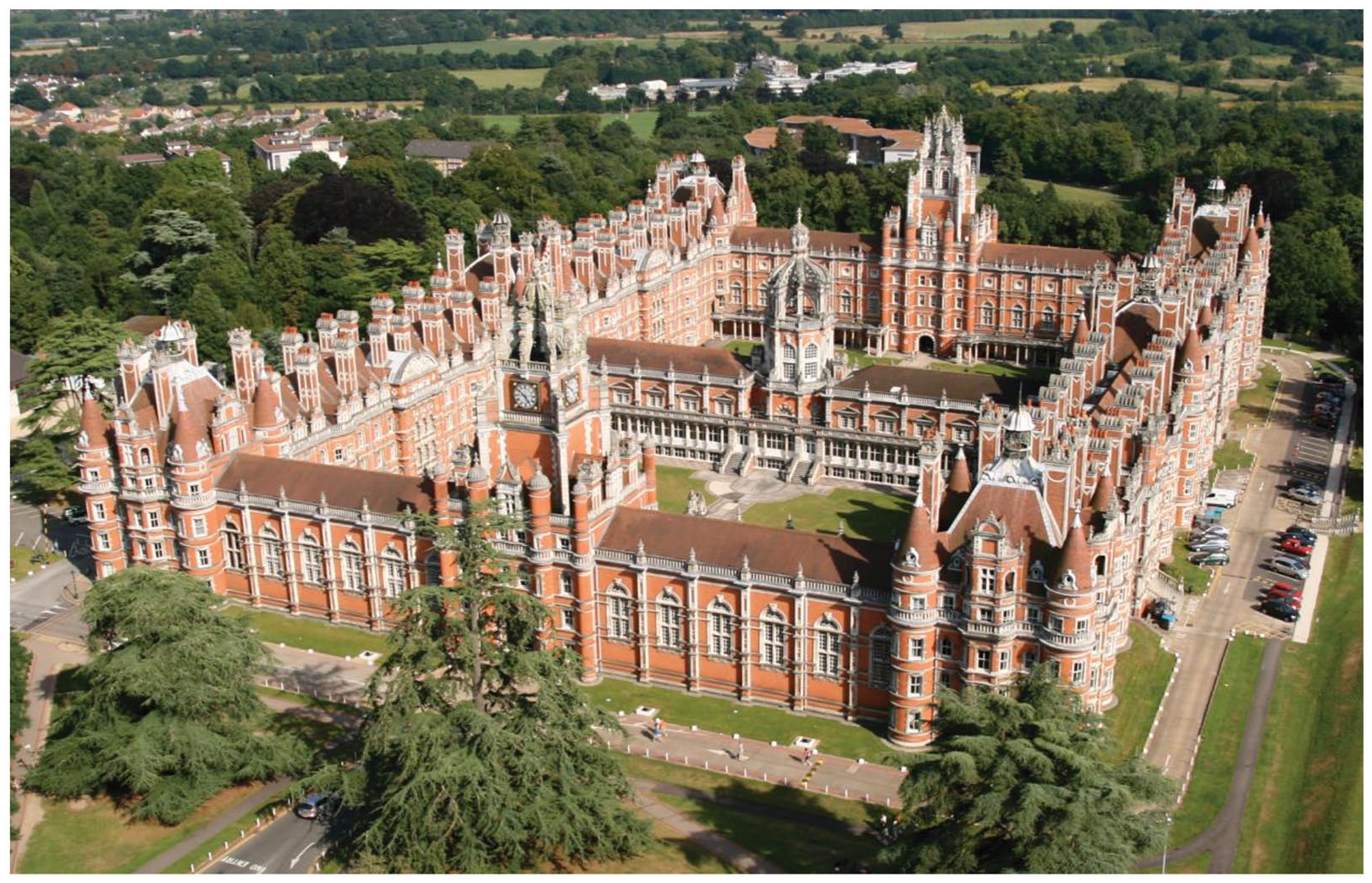
Royal Holloway College: the Founder’s Building (source: https://www.venue.royalholloway.ac.uk).
We make two contributions to the literature. First, we respond to recent calls for multimodal studies on the entanglement between multiple, including non-visual and non-verbal, modes of communication within organizations (Boxenbaum et al., 2018; Höllerer et al., 2019). We add to these studies by showing that spatial, aural, sensual and visual modes of the multimodal material object engage with each other, as well as with further verbal and numerical modes, in always different ways: sustaining and opposing each other, evolving or even disappearing, in the craft of rhetorical composition. We show that this engagement can be explained through the features of the messy object.
Second, we extend prior organization studies on rhetoric (Jones & Livne-Tarandach, 2008; Jones & Svejenova, 2018; Puyou & Quattrone, 2018) by shedding new light on how rhetoric and materiality engage: materiality both augments and limits rhetoric in the multiple time-space context of the messy material object. Further, rhetoric and materiality co-evolve through transforming objects into always something else, even an absent object. We also respond to the recent call for more research into absences in modes of communication (Quattrone et al., 2021). We show how not only present but also absent modes are relevant for understanding multimodal rhetoric: the ‘rhetors’ and their audiences can realize an ongoing transformation of the object, as the object is enacted always differently through the shifting engagement between multiple semiotic modes, whether these modes are present, absent, or only hypothetical. Considering the messiness of objects is therefore essential for understanding multimodal rhetoric.
On Rhetoric and Materiality
Rhetoric and multimodality
In organization, accounting and management studies, rhetoric has been related to language, and to visual, written, oral or numerical representations (Busco & Quattrone, 2015; Christiansen, 2018; Green, 2004; Quattrone, 2015). Suddaby and Greenwood (2005) note that rhetorical analysis has come to embrace ‘this interest in the role of language in structuring social action’ (p. 39), with a focus on persuasion and legitimation (Lefsrud, Graves, & Phillips, 2020), and on the rhetorical strategies to achieve the rhetors’ intentions. Studies have acknowledged the importance of ‘multimodal’ approaches to communication, discourses and rhetoric, encompassing multiple means of communication – what has been referred to as multiple ‘semiotic modes’ (Höllerer et al., 2019). In multimodal studies, a mode has been defined as a ‘semiotic resource for making meaning’ (Kress, 2010, p. 79). As Kress and van Leeuwen (2001) emphasize, modes have material properties engaging with sight, hearing, smell, taste and feel, thus ‘guaranteeing the multimodality of our semiotic world’ (Kress, 2000, p. 181). Therefore, modes have not only visual or verbal properties, but also spatial, aural and sensual properties. At different encounters with sociality, specific properties may prevail, thereby making it possible to regard modes as, for instance, visual, verbal, numerical, spatial, aural or sensual. It also follows that multimodality emphasizes a view of communication as ‘lived experience’ (Kress, 2000, p. 186).
By examining the spatial properties of a building, Wasserman and Frenkel (2011) show how these properties may communicate meanings that escape the intention of their designers as these properties are ‘lived’ by their users. Also, the meaning of an object’s touch, its weight, taste and temperature, require a lived bodily engagement with the object (Kress, 2000, p. 187): The object—appearing without the support of any language—communicates as effectively as does the written text of a set of instructions. The appearance of the object on the dinner table is—for the individual who is socialised into its use—an instruction, a command, as potent as any spoken command.
Drawing on multimodal studies, Höllerer, Jancsary and Grafström (2018) examine the rhetorical effects of verbal text, images and other visual artefacts as key resources for sensemaking about the global financial crisis. Ronzani and Gatzweiler (2021) examine how accounting numbers interact with other visual and verbal modes in performance measurement. Meyer, Jancsary, Höllerer and Boxenbaum (2018) discuss the rhetorical power of verbal and visual texts in processes of institutionalization. Lagerwerf and Meijers (2008) examine the rhetorical power of visual and verbal metaphors within advertisements. Jones and Svejenova (2018) distinguish between visual, rhetorical and material (specifically spatial) sign systems and show their entanglement in constructing the identity of a city. Puyou and Quattrone (2018) show how the aesthetic dimension of accounting signs involves a ‘multisensory apprehension’ (p. 726) that is never purely visual or purely textual and that is an integral part of rhetorical augmentation: ‘a craft that does not happen only in the mind but in a relationship with material and visual artefacts’ (p. 724). These studies acknowledge implicitly or explicitly the multimodal nature of rhetoric. However, most of these studies have concentrated on images and texts, and on verbal and visual properties of semiotic modes. As argued by Höllerer and colleagues (2019, p. 7): Given the vast amount of research conducted on organizations and organizing, it is astonishing that most studies have almost exclusively focused on verbal text. [. . .] By focusing on the verbal mode exclusively—or also by treating other modes as if they worked in the same way as the verbal—organization research ignores empirical material that is readily available and misrepresents the actual life-worlds of actors in and around organizations.
These considerations point to the need to understand how the multiple modes of material objects (including spatial, aural and sensual modes) engage with each other and with further verbal, numerical and other modes in augmenting or limiting rhetoric. Attaining a broader understanding calls for exploring multimodal rhetoric through the lens of materiality, which we attempt in the present study.
Materiality, messy objects and multimodal rhetoric
Awareness of the communicative and persuasive nature of physical objects, such as buildings and architectures, is not new in organization studies (Jones & Livne-Tarandach, 2008). This nature has been explored in relation to such grand material objects as buildings (Liu & Grey, 2018), cathedrals (Giovannoni & Quattrone, 2018), and architectural forms and styles (McGoun, 2004; McKinstry, 2008; Jones, Maoret, Massa, & Svejenova, 2012). For example, Jones and Svejenova (2018) analysed the material sign systems of Barcelona and Boston, including topography, landmarks and iconic buildings, and discussed how these systems engaged with visual and rhetorical sign systems in shaping, articulating and encoding the identities of the two cities. Whereas objects can communicate meanings, they can also provide for material limitations to sociality, including rhetoric.
Indeed, objects are enacted through sociality in multiple evolving ways. This has been explored by ANT-inspired studies on materiality. Mol (2002) refers to the disease atherosclerosis, which is experienced as a different object by patients, their families, nurses, doctors and others. Drawing on Callon (1986), Law and Lien (2012) show how a salmon is a multiple object that is enacted in different, even opposing, realities, some of which may not be entirely realized. This also implies that an object can be conceived as in a state of constant flux and becoming (see, e.g., Yu & Mouritsen, 2020), depending on how, when and where its different features are enacted: An object is not differentiated by multiple features within a single reality but each feature is a different but inter-related object, which produces a multiple reality. In this milieu, linear time is unnecessary to explain how an object can differ from itself for it is already and potentially other than itself. (Quattrone & Hopper, 2006, p. 220)
Law and Singleton (2005) capture this idea by referring to the notion of ‘messy object’. They draw on Mol and Law (1994) to characterize objects as ‘volumes’, ‘networks’ and ‘fluids’. Law and Singleton (2005) also highlight a further characterization: the ‘fire’ object. These characterizations are interrelated features of the messy object. Volumes are fields of homogeneous elements, with clear boundaries distinguishing one volume from another. Volumes are visible as they occupy space: they move around while maintaining their shapes.
Differently, the network object does not depend on boundaries. The object is enacted through relations: insofar as these relations remain stable, the network of elements retains its shape and the object is recognized as such. Law (2002, p. 93) explains this concept through the example of a vessel: ‘Navigators, Arab competitors, winds and currents, crew, stores, guns: if this network holds steady then the vessel doesn’t founder, it doesn’t get seized by pirates and it doesn’t sail on, lost, until the crew are broken by disease and hunger.’ The vessel is therefore an effect of its relations: it moves but it holds shape so long as the relations among the elements remain stable, defining what counts as a vessel at its encounter with sociality. In different time-space configurations, as the relations change, the object turns into something else. The object is ‘multiple’ due to its relational variety: it is enacted as an always different object in multiple time-space configurations at different encounters with sociality.
Further, the concept of fluid object emphasizes another aspect of the messy object. A fluid object is not simply a network of elements that can be combined differently, but the elements co-evolve, informing each other in always different ways. ‘So there are mixtures and gradients. And inside these mixtures everything informs everything else – the world doesn't collapse if some things suddenly fail to appear’ (Mol & Law, 1994, p. 659). It follows that the multiple time-space configurations in which the object is enacted are not independent but engage with each other. Also, whereas the volume object points to stable boundaries and the network object points to stable relations within the same network, the fluid object emphasizes both malleable boundaries and malleable relations. If one element of the fluid object loses its functionality, the fluid object does not dissolve (as would happen for the network object), because its elements evolve. The fluid object does not collapse easily (Mol & Law, 1994): ‘there is no single strongpoint to be defended in order to preserve continuity’ (p. 662), and no ‘obligatory point of passage’ (p. 661). There is no boundary and no network structure to be preserved. The fluid object adjusts itself ‘bit by bit’, as its existing elements are reconfigured or new elements are included (Law, 2002). This allows the fluid object to remain intact, maintaining identity and continuity.
According to Law and Singleton (2005), this argument also implies the possibility for the object to be enacted as an absence or to be generated by an absent reality. They capture this through the term ‘fire object’, which enables understanding the messiness of objects particularly through presences that both generate and are generated by absences. Differently from fluids, the transformation of absences into presences, and vice versa, takes the form of ‘jumps and discontinuities’ as presences dissolve into absences and absences need to be othered into always something else to continue to provoke effects while remaining absent. Fire objects emphasize juxtaposition between absences and presences: for example, the contrast between absent fuel or cinders and present flame. Fire objects ‘are generated in juxtaposition with realities that are necessarily absent, even though they bring versions of those realities to presence. At the same time, they work upon those presences and transform them’ (Law & Singleton, 2005, p. 345).
An object’s messiness has various important implications. First, the object is not only a shape with stable boundaries in a Euclidean space (volume). The network features of the object emphasize that the messy object is multiple: it is always a different object in the multiple networks of relations in which it is enacted. Second, the fluid features of the object emphasize that boundaries and relations are not stable (as respectively in volumes and networks) but evolve, so that the object adjusts its elements fluidly across different time-space configurations. Third, the fire features of the object emphasize that the object, and its elements, evolve through absences and presences that generate from each other, enacting always a different object.
This ANT-inspired view of objects and materiality is consistent with the so-called ‘practice approach’ to multimodality (Meyer et al., 2013; Höllerer et al., 2019). Following this approach, multimodal objects, such as a building, are open to multiple encounters with sociality through their modes of communication, depending on how these objects are ‘constructed, employed, and manipulated in various processes of organizing’, and as such depending on the actions that these objects ‘trigger, enable, or prevent’ as they are enacted socially (Meyer et al., 2013, p. 16). Understanding the messy (particularly, network, fluid, fire) features of the object is relevant to explore how the multiple modes of the object engage with each other and with other modes as they encounter sociality, eventually providing for a multimodal rhetoric. We explore this idea by examining a grand, messy object: the Founder’s Building at Royal Holloway College.
Research Method
Background
The Founder’s Building has been recognized as ‘by far the most unusual’ of 19th-century British women’s university college buildings, with its ‘exuberant and lavish character’ (Vickery, 1999, p. 118), resembling rather a palace than a university building. The building’s unusual physicality renders it particularly suitable for the purpose of this paper, given its unconventional architecture and aesthetic properties, and the multiple possible ways the building, and the semiotic modes embedded in its materiality, could be experienced by its inhabitants and visitors.
Following the choice of the Founder’s Building at Royal Holloway, we chose to investigate the period 1874–1897. The period begins with Holloway’s purchase of the land on which he planned to establish a women’s college and ends ten years after the first students entered the College. Between 1887 and 1897, the number of students grew from 28 to 107. Despite this growth, losses were recorded over the accounting periods 1893–1897 (except in 1894), and these losses prompted the governors of the College to reflect on the building and propose a programme of action about it. We chose this period because it enabled us to observe the relationships between the materiality of the building, the multiple modes the building embedded, and the rhetoric about the building over a sufficient span of time.
Data sources
Given our empirical research setting, we relied on the documents and artefacts available in Royal Holloway’s archive as primary sources for this research (a list of all primary sources is provided in Appendix 1). A growing number of studies acknowledge the importance of historical sources to understand the current nature of organizations and organizing processes (Rowlinson, Hassard, & Decker, 2014; Wadhwani, Suddaby, Mordhorst, & Popp, 2018). Our approach is in line with the call for a ‘historic turn’ in organization studies (Wadhwani & Bucheli, 2014). In this paper we adopt a ‘history to theory’ approach (Kipping & Üsdiken, 2014). We build on a historical setting to add to the theoretical understanding of multimodality and the entanglement between rhetoric and materiality in relation to objects.
In researching rhetorical strategies about the building, we concentrated on Thomas Holloway and on the main governing body of the College – the board of governors. The construction of the building followed Holloway’s intention, whereas the administration of the building was entirely headed by the governors. We began by considering archival records pertaining to Holloway, examining all his private correspondence (RHC GB 130.1) pertaining to the design and construction of the main building of Royal Holloway College. We did not consider Holloway’s letters that related to the College as an institution rather than dealing specifically with the building. Holloway’s intention about the building is also described in secondary sources documenting his life (Bingham, 1987; Vickery, 1999; Williams, 1985). This analysis enabled us to identify Holloway’s rhetoric about the building, as well as the modes of communication crafted and composed by the rhetor: Holloway’s verbal account about the building, and the palatial visual and spatial features of the building itself, designed by Holloway with the specific intent of surpassing other colleges in style.
The College opened to students in 1887, after Holloway’s death in 1883. We examined the archival records pertaining to the board of governors for the period to 1897. The principal records were the minutes of the board of governors (GB 110.1, 110.2) and the minutes of the finance committee, a sub-committee of the board of governors (GB 150.1, 150.2). Underlying the minutes were further records pertaining to the general administration and functioning of the College, including accounting records (see Appendix 1). The minutes of the board of governors and the finance committee frequently refer to the building, but we concentrated on the descriptions and accounting calculations that were drawn upon by the governors in composing rhetorical strategies about the building.
Also, as we aimed to examine the effects of the founder’s and the governors’ rhetorical strategies on their audiences, and particularly how the modes of communication pertaining to the building were perceived, we searched for recollections of inhabitants and visitors. We found the memoirs of an early student, Marion Pick (1950 – covering the period 1887–1939), and the reminiscences of one of the first lecturers, Lilian M. Faithfull (1924 – covering the period 1887–1894). In examining the minutes of the board of governors, we could reconstruct how different tax authorities perceived the rhetoric of the governors. We complemented the analysis of these records with secondary sources about the building, reporting how different features of the building were lived and perceived by its inhabitants, visitors and the general public (Bingham, 1987; Vickery, 1999; Williams, 1985). This analysis shows that the rhetoric of Thomas Holloway about the building persisted after his death, and therefore coexisted with the rhetoric of the governors.
Data analysis
In reviewing our sources, we noted all cases where attempts were being made to persuade. In each case, we identified who was attempting to persuade (the rhetor), the rhetoric being used, the semiotic modes crafted and used by the rhetor, who was being persuaded (the audience), and the modes as perceived by the audience. We looked not only for visual, verbal and numerical modes (particularly accounting calculations) pertaining to the building but also for visual, spatial, sensual and aural modes embedded in the building’s physicality. We came across various cases where the governors were trying to influence others about the College as an institution rather than about the building as such. For example, the governors tried unsuccessfully to secure relief from a tax called Inhabited House Duty by claiming that the College should be regarded as a ‘charity school’. However, the governors did not refer specifically to the building as part of their rhetorical strategy about the College. A more successful use of rhetoric allowed the governors to persuade the tax authorities that the College, as an institution, was entitled to a tax exemption available to ‘public schools’ (GB 110.2). The governors sometimes discussed aspects of the building, for example the building’s inefficient heating system (GB 150.2), without a strategic persuasive intent.
The examples presented in this paper are the most evident and best-documented instances when rhetors drew on the multiple semiotic modes of the building in crafting rhetoric. We used features of the messy object (network, fluid and fire) to analyse how the modes engaged with each other. We looked specifically at how multiple semiotic modes augmented and limited each other and co-evolved with rhetoric, and for absences and presences. Our analysis of the intersection between the different modes and features of the messy object is discussed in the following sections and presented in tabular form in Appendix 2.
In analysing our sources, we took inspiration from the ‘practice approach’ to multimodality (Meyer et al., 2013, p. 16). We reconstructed the effects that the multiple modes pertaining to the building triggered, enabled, or prevented at different encounters with sociality. In this analysis, we did not regard the building as an object that intentionally produced effects. Rather, we concentrated on how its features, as designed by humans, were drawn upon by the rhetors (Thomas Holloway and the governors) as modes of communication and how these modes were perceived and experienced ‘in situ’ by their internal and external audiences. We examined how these modes embedded in the building were composed by the rhetors with other modes of communication, investigating how both the rhetors and their audiences realized an ongoing transformation of the object, as the object encountered sociality in always different ways through its multiple modes.
The Rhetoric of Thomas Holloway and the Reaction of his Audiences
External audiences
Even before the Founder’s Building was physically present, Thomas Holloway attempted to persuade not only his friends but the general public that the building would be superior, unique and palatial (Vickery, 1999, p. 123). Following a visit to Cambridge, Holloway wrote to Henry Fawcett, an MP and a professor at Cambridge University. Holloway stressed that he intended the building to surpass other colleges in terms of style, and to persuade wealthy families to enrol their daughters: I propose that the ‘Ladies University’ at Egham, should be of its kind a grand imposing building that it may not by an insignificant style dishonour its name. You are aware I am sure that nowadays, it is necessary to fill the eye. (letter to Fawcett, 20 February 1875 – GB 130.1, p. 187)
For Holloway, the main building had to surpass anything of the kind at Cambridge. It will be all one style of architecture. We cannot boast of Libraries such as you have, nor chapels, nor some of the other things, but otherwise it will I think be unique of its kind. (letter to Fawcett, 10 April 1875 – GB 130.1, p. 229)
Holloway’s verbal accounts certainly persuaded his audience about the magnificence of the building, even before the building was present and visible. For example, Randall Davidson, the Dean of Windsor, said in 1883: An extraordinary thing is happening in this district. Mr Holloway. . .is erecting in the fields of Egham a building which both in scale and style will be unique in England. (quoted in Bingham, 1987, p. 39)
As the building took shape, its unique style and architecture reflected Holloway’s intention. Holloway wanted a building of the highest standard, and this policy continued after his death, as confirmed by the building’s contractor engineer (AR 510.1). The accounting records show a cost for the building of just over £400,000. Holloway’s total endowment, including a collection of 77 paintings (Napier & Giovannoni, 2021) and a portfolio of investments, was approximately £700,000 (over £100 million in current terms). This endowment was insufficient for the maintenance of the building and the functioning of the College. Holloway intended to persuade wealthy families to enrol their daughters in the College, through the magnificent visual and spatial features of the building, ‘surpassing’ other colleges with its unique style.
Indeed, the building’s ‘lavish and glamorous accoutrements may have lured many women to college, and probably did much to quell parents’ fears about their daughters leaving home’ (Vickery, 1999, p. 148). Visitors admired the building as ‘there had never been greater munificence in the original lay-out of a College’ (Pick, 1950, p. 15).
I understood that the comforts of R.H.C. were the result of our handsome endowments. Visitors from other colleges used to say enviously to us, ‘But of course yours is a rich College’. (Pick, 1950, p. 122, emphasis in original)
Holloway’s verbal accounts about the building, and the visual and spatial features of the building as intended by Holloway, constituted different semiotic modes that reinforced each other in sustaining his rhetoric of magnificence and uniqueness. Although external audiences were impressed by the building, internal audiences (students and staff) experienced the building’s semiotic modes in different ways.
Internal audiences
Life in the building was ‘designed from the very beginning to match the grandeur of the estate’ (Pick, 1950, p. 60). As early student Marion Pick observed: It is pleasant to visualize our Founder thinking of country-house life specially planned for those wishful to study, with a perfect library in constant use and delightful grounds in which to relax. (1950, pp. 10–11)
Students were impressed by the décor and furniture of the building: The dark green walls were covered over with embossed gilt cherubs . . . the shining table is the largest I have ever seen, the solid leather-seated chairs are fully in keeping, there is a stupendous leather-covered settee. (Pick, 1950, pp. 40–41)
As Pick commented: ‘To a First year on arrival, two private rooms were unspeakable bliss’ (1950, p. 47). Students’ studies and bedrooms were located in the long east and west blocks, whereas staff and lecture rooms were located in pavilions at the corners and in the centre, with ‘state rooms’ in the cross blocks (see Figure 2): ‘These are truly “State”, in keeping with the “ideals” of magnificence in the eighties’ (Pick, 1950, p. 15). Holloway planned a well-heated building, agreeing to pay £8,600 for ‘Heating the College by steam [. . .] to my [Holloway’s] satisfaction and that of my architect’ (GB 130.2, p. 45).
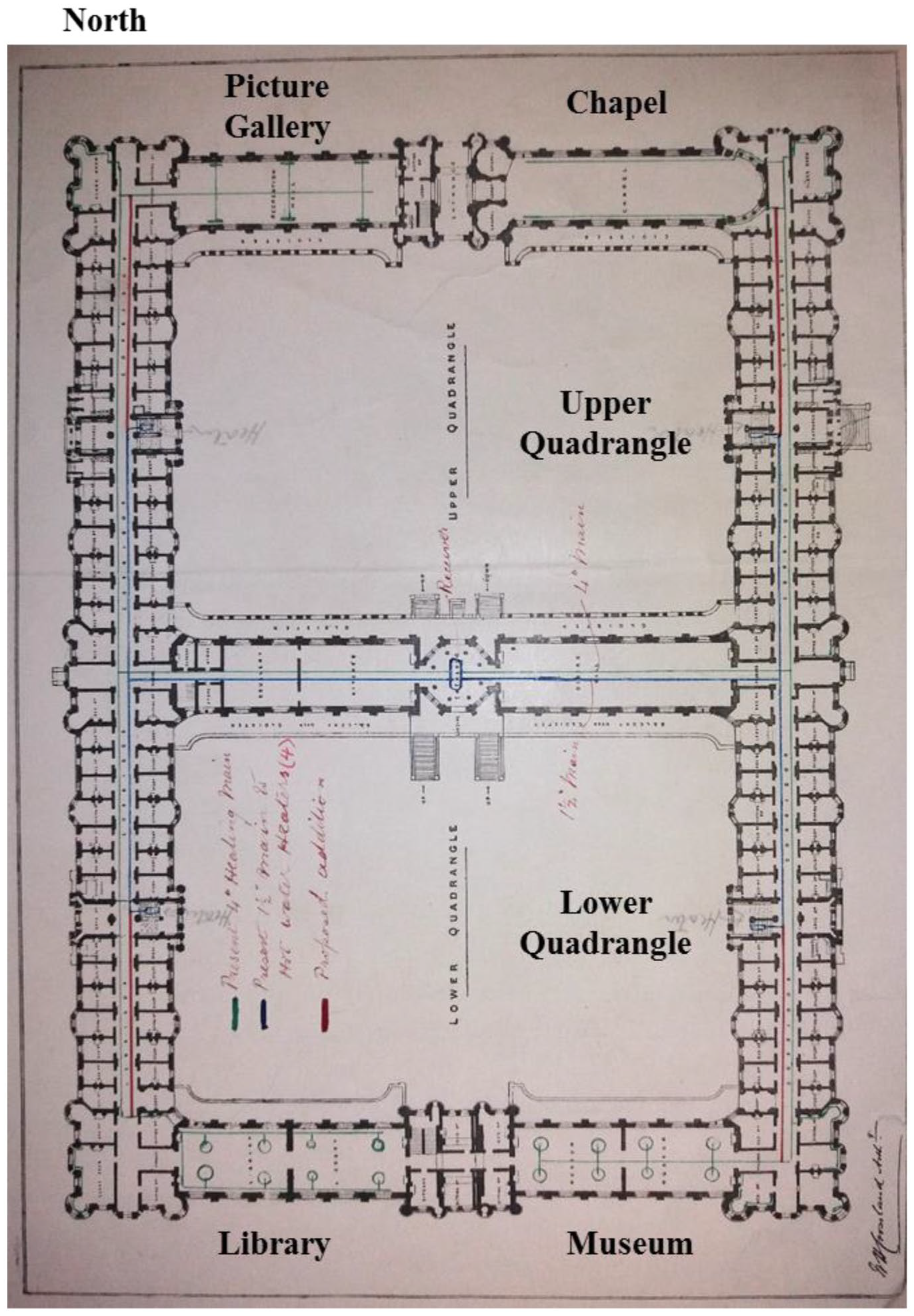
Plan of the Founder’s Building, showing heating system and main rooms (source: RHC AR 510.4 Archives, Royal Holloway University of London, with authors’ additions).
Despite the luxury and comfort promised by the building’s visual and spatial features, its grand structure revealed some internal layout problems, affecting students’ routines. The building was ‘potentially and already’ something different from the comfortable, relaxing and well-heated country house intended by Holloway. Features of the architectural structure of the building hindered the everyday life of its inhabitants and created inefficiencies. ‘The plan of the building was simple, but most unsuitable for a College’ (Faithfull, 1924, p. 88). There was, for example, no easy passage between the upper and lower quadrangles (which were on different levels) or for crossing from the west to the east corridor. Students had to walk through the library and museum to achieve this, although the use of the library as a passage was ‘strongly deprecated. Yet, it was the only dry crossing route’ (Pick, 1950, pp. 26–27).
Another deprecated practice enabled by the building’s physical structure was that students could hide on the fifth floor in rooms originally designed only for servants. As Pick reported: [The attics] housed dark rooms and store rooms. I have heard of one or two students camping there illicitly, unobserved after the session ended, when it was inconvenient for them to go straight home. (1950, p. 17)
The heating system was unsuitable for a building of its grand structure and size. The boiler house, where light and heat were generated, was distant from the building, causing a serious waste of energy. Heat was conducted to the building by hot water pipes running through a service tunnel, generating so much heat that it ‘caused the butter to melt in its transition to the larder’ (Faithfull, 1924, p. 8). Subsequent attempts to remedy this situation came to nothing because the existing structure of the building could not be changed except at great expense (Report by Chief Engineer, 20 May 1896 – AR.510.4). The tunnel itself was used to hide various domestic arrangements from staff, students and visitors: ‘Residents in the College building should not be offended by the sight of any utility cart’ (Pick, 1950, pp. 11–12).
The heating system was an inescapable feature of the building for staff and students. Pick (1950, pp. 36–37) observed: We all knew about the pipes, they would racket until fate ordained they should stop. [. . .] The awakening clanking of the pipes in the corridors indicated that the morning was beginning [. . .]. But sometimes the pipes exceeded themselves; thus in the North lecture room, as a student, I had observed [the mathematics professor] stalk up to an offending radiator and give the screw-cock an authoritative twist. So in my turn, when the pipes offended, I did just the same, and the noise abated.
The building’s magnificent appearance dominated how it was perceived, impressing visitors and students through its luxury, and persuading them that the College was rich. But under severe weather conditions and at night, the building changed dramatically, to a cold place of mystery: The length of the corridors was such that it was impossible to recognize those walking at the other end, and it took nearly five minutes to walk from the south end of the upper east corridor to the north end of the upper west. [. . .] A new student, who walked in her sleep, found herself on her first night in College in the library at midnight, with no power of determining how to go east or west. (Faithfull, 1924, p. 87)
The material features of the Founder’s Building provided multiple opportunities to its visitors and inhabitants to ‘live’ its space differently. Visually, the building is a magnificent palace with splendid internal decoration. Spatially, the building is both a country house where student life should match the grandeur of the estate and a place of mystery where students are induced to follow ‘deprecated’ practices for moving from one side of the building to the other. Sensually, the building is a dark and cold (or excessively hot) palace where students get lost and hide in dark attics during the summer vacation. Aurally, the building is a noisy place, with inhabitants awakened by, and having to beat, ‘offending’ pipes.
The Founder’s Building is certainly a multimodal object (Meyer et al., 2013), embedding multiple semiotic modes (Höllerer et al., 2019) that were not static features of the object, merely mirroring the intended messages of Holloway. These semiotic modes opened the object to multiple encounters with sociality, through which the building was in constant flux, becoming always something else – it was a ‘messy’ object (Law & Singleton, 2005). These encounters provide for more than interpretations of the object in the minds of its different inhabitants. They are effects stimulated by the messiness of the building. Each semiotic mode of the building enables the enactment of always different objects at different encounters with sociality.
At these encounters, multiple modes sustained and opposed each other. Visual and spatial modes enhanced Holloway’s rhetoric of the building as a magnificent and superior palace, a luxurious country house. Simultaneously, the building’s spatial features, with its labyrinth of corridors, as well as the aural and sensual features of the building, with its noises, coldness (or excessive heat) and darkness, provided for a different social enactment of the building as a place of limited comfort. Visually, the building ‘filled the eye’, as intended by Holloway, but spatially, aurally and sensually the building was already something else. Holloway’s rhetoric was therefore not as successful as he intended. Indeed, despite the consistent growth in student numbers, the building could not attract enough students to pay for itself, and instead generated inefficiencies, with a loss recorded in 1893. The challenges posed by the multiple modes of the building to Holloway’s intentions triggered new rhetorical strategies, as we show in the next section.
The Rhetoric of the Governors and the Reaction of their Audiences
The local assessment committee
Following the losses recorded for 1893 and again in 1895, the governors sought to improve financial performance. On 30th May 1896, the College Secretary was required by the finance committee of the board of governors to appeal against the assessment of the building’s annual value of £6,514 (gross), which determined the amount payable for the local Poor Rate. The committee considered that the valuation had been inflated because of the grand scale of the building’s construction, which should have no effect on its notional rental value. Detailed accounting calculations comparing Royal Holloway College with five Oxford colleges (including Christ Church) were provided in a table that compared the rateable value of student, staff and ‘state’ rooms (GB 150.2, p. 66). As the governors noted: Christ Church . . . is built on a scale of magnificence far above that of Holloway College. . . . The gross rateable value of Christ Church, the largest College at Oxford, with its magnificent cathedral, library, hall (the finest refectory in England), cloisters, kitchen, and quadrangles – all on a much larger scale than anything at Holloway College – is only £5,873, whereas the present gross rateable value of Holloway College is £6,514. (GB 150.2, p. 79)
This narration contrasts the grand structures of Oxford colleges against the ‘less large scale’ of Royal Holloway’s building, therefore claiming a reduction in the assessment of the letting value. In addition, in calculating the letting value it was necessary to consider that the College was ‘heavily handicapped in its competition with the other women’s Colleges’ by being isolated in the country, and therefore, ‘the letting value of Holloway College is less than it would be if at Oxford or Cambridge’ (GB 150.2, pp. 93–94). Applying this argument, the board of governors asked for a reduction in the rateable value of the building from £6,514 to £4,514.
As the College Secretary reported to the board of governors on 21st July 1896, the local assessment committee (responsible for determining the annual value) had been unanimous in their opinion that unless proof could be given of ‘deterioration in value’ of the building, they could not upset the assessment, and therefore they decided that the appeal could not be allowed (GB 150.2, pp. 93–94). For the assessment committee, what mattered was proof of a deterioration in the original structure of the building. The governors’ rhetoric of the building as being ‘of much lower scale and disadvantaged’ in comparison with Oxford and Cambridge colleges failed to persuade the assessment committee, and the governors did not achieve their intention to reduce tax.
In this episode, specific accounting calculations about the building were invented by the governors to show that Christ Church and other Oxford colleges were assessed significantly less than Royal Holloway for matters such as the Poor Rate. Also, the governors drew on visual and spatial modes (the magnificence, grand size, distribution of space between student and staff rooms and public rooms, and isolated location of the building) to provide verbal accounts of the disadvantages of the building compared to other women’s colleges. The spatial features of the building were combined with verbal and numerical accounts to craft the governors’ rhetoric.
However, the modes employed by the governors in the craft of rhetoric stimulated the opposite of their intended effects by reminding their audience, the assessment committee, that the building was already something else than a lower-scale building: it was a building surpassing other colleges with the uniqueness and magnificence of its style, as intended by Holloway. While the governors attempted to transform the building into a ‘lower scale’ and ‘disadvantaged’ building compared to other colleges, the spatial features of the building contradicted the governors’ rhetorical strategy. This contradiction allowed for new rhetorical possibilities. The assessment committee in effect did not fully reject the appeal. Rather they hypothesized a further possible reality in which the building had begun to wear out, as its magnificence became increasingly jaded, but concluded that the governors’ rhetoric did not yet speak to such a reality. Like Law and Lien’s (2012, p. 363) example of the salmon that were ‘almost but not quite created’, this hypothetical reality of the jaded building remained in a ‘penumbra of not quite realised realities’.
In this episode, the building was a fluid object. The reality of the building surpassing other colleges – supported by the aesthetic features of the building as intended by Holloway – opposed the reality of the building as one of lower and ‘disadvantaged’ scale – supported by the governors’ verbal and numerical accounts. Through this opposition both realities co-evolved and prefigured a possible third reality: that of the jaded building. The governors could compose further possible verbal and numerical accounts, to argue that the building had deteriorated. The ‘reality’ of the jaded building was, however, only hypothetical. The fluidity of the object shows how materiality and rhetoric co-evolve: in this case, as the building was shifting fluidly between different realities of the messy object, a further rhetorical possibility emerged.
The rhetoric of the lower-scale building was only partially undermined by the building’s physicality, as the possibility for this rhetoric to evolve into the rhetoric of the jaded building was left open by ‘hypothetical’ accounting calculations of deterioration, despite their absence, because of the possibility that these accountings could become present as deterioration took place. Differently, in the next episode, absent modes enabled rhetorical possibilities insofar as they remained absent.
The Land Tax Commissioners
On 30th May 1896, the College Secretary also reported an enquiry that he had made to redeem the Land Tax on the basis of the assessment of the estate as agricultural land, not incorporating the substantial increase in annual value following the construction of the Founder’s Building. The revised Land Tax assessment was £6,502, which the governors considered to be ‘unfair’ (GB 150.2, p. 87). Redeeming the Land Tax would reduce the annual tax payable considerably. On 1st June, the Secretary claimed for the redemption of the Land Tax based on the old assessment of £200. However, the Secretary was informed that it was only possible to redeem on the basis of the new assessment, the old assessment having ceased to exist. The Secretary reported that he had therefore taken no step to redeem on such a basis (GB 150.2, p. 87).
On 28th November 1896, the Secretary reported that he had ascertained that under the Finance Act of 1896, ‘any person could now redeem unconditionally on the basis of the Assessment last made and signed by payment of an amount as consideration equal to 30 times the sum assessed upon the property in such assessment’ (GB 150.2, pp. 113–114, emphasis in original). Having further ascertained that the new assessment (of £6,502) for the Parish of Egham for the year 1896–7 had been made but not actually signed, he at once attended before the Clerk to the Land Tax Commissioners and signed a contract to redeem the Land Tax based on the old assessment of £200.
This ‘legal gap’ (that is, the new assessment being made but not signed yet) was used by the governors to argue that the Founder’s Building was legally ‘non-existent’ and that the Land Tax should be based on the old assessment. Acting through the College Secretary, who could show that the new assessment had not been signed, the governors composed verbal and numerical accounts to persuade the tax authorities that the old assessment should be used. As a result, the Royal Holloway estate was assessed in terms of its pre-existent agricultural use, as if the Founder’s Building was simply not there, and the governors achieved their intention of reducing the College’s tax bills.
In this episode, the physical (spatial) features of the building had to disappear. It was not enough simply to erase this spatial mode through the craft of rhetoric. Instead, the spatial mode had to be both used by the rhetors and acknowledged by the intended audience as an ‘absent’ mode. Therefore, the modes do not need to be ‘present’ to produce effects. They can produce effects also because of their absence: whether this absence is recognized and used as such (as in the Land Tax case) or whether this absence can potentially become a presence (as in the Poor Rate case).
However, absences need to be othered to produce effects (Law & Singleton, 2005). In the Land Tax case, the rhetorical strategies of the governors were successful because the legal absence of the object’s physicality was othered into verbal and numerical accounts (such as the unsigned Land Tax assessment) that stressed the value of the original agricultural land and made the building erected on that land non-existent. In this instance, while erasing spatial modes, verbal and numerical modes were generated from an absent reality and had to be related, and juxtaposed, to this absence to provide for a successful rhetorical strategy. Therefore, the messiness of the object as a ‘fire object’ also means that rhetoric and materiality engage with each other and co-evolve through absences and presences.
Multimodal Rhetoric and the Messy Object
Multimodality and the messy object
Our first research question was: how do multiple modes embedded in the object engage with each other as well as with other modes? As noted by Höllerer and colleagues (2019), this is an overlooked area in the organization literature on multimodality. Our analysis of the network, fluid and fire features of the messy object extends prior work on multimodality (Boxenbaum et al., 2018; Höllerer et al., 2019; Meyer et al., 2018) by showing how multiple modes (including spatial, aural, sensual and visual) embedded in a multimodal material object, like the Founder’s Building, engage with each other, as well as with further verbal and numerical modes about the object. Here we extend the literature by showing that an effective examination of the multiple modes embedded in the object requires us to look at the messiness of the material object, with its network, fluid and fire features, at the object’s encounters with sociality. This examination makes it possible to shed new light onto how the multiple modes, not only visual, verbal or numerical, but also spatial, aural and sensual, engage with each other.
First, network. The network features of the messy object open the object to multiple encounters with sociality, within different networks of relations. According to Mol and Law (1994) within each network the elements of the network maintain a stable relationship. We extend this consideration to the modes of communication embedded in the material object. We show that within each network, the modes can reinforce each other in a multimodal communication of messages about the building. At different encounters with sociality, and therefore in different networks of relations, the modes of the building may work differently, and even oppose each other. For example, the spatial, aural and sensual modes of the building reinforced each other in providing messages (about an unsuitable and inefficient building – see section on ‘Internal audiences’), while opposing the visual, verbal and spatial modes of the magnificent building intended by Holloway (see section on ‘External audiences’).
This example explains another mechanism through which the modes of the multimodal object communicate and engage with each other and with other modes: modes can oppose each other although being embedded in the same object, and can also oppose further modes about the object. This opposition can be explained through the relational variety of the network object as the modes open the object to multiple encounters with sociality, providing for unstable relations across different encounters. Spatial, aural and sensual modes required a lived bodily engagement with the building, entering the space of the building, listening to it and feeling it. On the other hand, numerical, verbal and other visual modes pertaining to the building did not require audiences to enter the building to communicate meaning. The resulting different social encounters with the building provided by the different modes composed opposing meanings. This consideration extends the organization literature on multimodality: whereas this literature has mainly concentrated on verbal, numerical and other visual modes, we show that the consideration of spatial, aural and sensual modes of the object points to different engagements with the multimodal object, explaining its relational variety.
As emphasized by Mol (2002), the multiple object retains its shape although being enacted in multiple networks (see also Law, 2002). By extending the insights of the network object to the analysis of the multimodality of the object, we also shed light on how the different networks of the multiple object engage with each other instead of working as separate networks: they can oppose or sustain each other through the modes of communication pertaining to the object. Therefore, the multiple object is not ‘broken’, but it retains its shape: our analysis shows that this can happen through the reinforcement and opposition of the multiple modes, enabling the object to maintain its shape (as the Founder’s Building) while allowing its multiplicity (both a magnificent and an unsuitable building).
Second, fluid. When modes oppose each other, some of these modes may fail to achieve the intent of their designers as the other modes prevail. For example, in the Poor Rate case (see section on ‘The local assessment committee’), verbal and numerical modes are overcome by visual and spatial modes. We show that, because of its fluid features, the object does not dissolve because of the failure of some of its modes. This fluidity also explains why and how multiple modes of communication pertaining to an object do not only engage but also evolve: when some of the modes fail because of their opposition to other modes, the failing modes are adjusted into further, even hypothetical, modes. In the Poor Rate case, the failure of verbal and numerical modes suggested hypothetical modes concerning the deterioration of the building, letting the building evolve fluidly into a jaded building.
Third, fire. Examining the messy object as a fire object makes it possible to uncover the role of absent modes in multimodal communication. Whereas prior organization studies on multimodality have concentrated on present modes, none of them has discussed explicitly the effects triggered by absent or hypothetical modes, nor how absent or hypothetical modes engage with present modes. This is an unexplored area for organization studies on multimodality and rhetoric (Quattrone et al., 2021). We contribute by showing that modes of communication do not need to be present to produce effects but can be hypothetical (as in the Poor Rate case) or even absent (as in the Land Tax case). Hypothetical modes produce effects because they can become present and be used in the craft of rhetoric (such as the rhetoric of the jaded building). Differently, absent modes do not need the possibility to become present to produce effect. This can be explained through the fire feature of the object.
The fire object is based on juxtapositions between absences and presences, and how absences are othered into presences (Law & Singleton, 2005). Extending this consideration to the absent modes of communication about the object makes it possible to explain why the absent modes produce effects while remaining absent, thereby addressing the recent call for more research into absences by Quattrone and colleagues (2021). We found that absent modes are not just forgotten but are juxtaposed with their presence, thereby being recognized as absent. This can be seen in the Land Tax case where it is the juxtaposition between the spatial presence of the building and its legal absence that makes it possible to recognize the spatial mode of the building as absent, and it is this recognition that suggests new modes to emerge. It follows that absent modes are recognized as such, and therefore produce effects, through their juxtaposition with presence. Also, following this juxtaposition, absent modes can be othered into something else: for example, the verbal and numerical modes about the non-existent building suggested by the erased spatial modes in the Land Tax case. This also demonstrates that modes of communication can emerge from absent modes. The fire features of the messy object allow us to shed new light on how the modes embedded in an object engage with each other and with other modes pertaining to the object, whether all these modes are present, absent or only hypothetical.
Rhetoric and materiality
Prior organization studies have relied upon theories focused on rhetoric, aesthetics and visuality to show that a range of material signs and objects are drawn upon in the crafting of knowledge (Jones & Svejenova, 2018; Puyou & Quattrone, 2018). We extend these studies by drawing on the analysis of the messiness of the material object. Our second research question was: how does the rhetoric about a building relate to the materiality of the building, as a multimodal messy object? We show that the messiness of the object explains when materiality augments or limits rhetoric, and when materiality and rhetoric co-evolve, realizing an ongoing transformation of both the material object and the rhetoric about it.
The network features of the messy object suggest that the object is enacted as an always different object in multiple time-space configurations. By looking into this multiplicity we find that, due to the relational variety across different networks, the modes of communication of the material object can both support and undermine rhetoric. This can be seen in Holloway’s rhetoric of the magnificent building (see section on ‘External audiences’). As demonstrated by the reaction of the external and internal audiences, in some time-space configurations the spatial features of the building reinforced visual and verbal modes, augmenting Holloway’s rhetoric of the magnificent building. But in different encounters with sociality (particularly with the internal audience), the modes of the building worked differently. The building was already a different object, inefficient, dark and cold, opposing the reality of the magnificent building, thereby undermining rhetoric (see section on ‘Internal audiences’).
This opposition can be explained through the different social encounters provided by spatial, aural and sensual modes rather than verbal, numerical and other visual modes, which require only a ‘two-dimensional’ (Kress, 2000) engagement with the building. Spatial, aural and sensual modes required the audience to enter the building, thereby composing meanings that could oppose those intended by the rhetors. This consideration extends previous studies exploring the relations between the lived space of a building, as interpreted by its visitors, and the conceived space intended by its designers (see Wasserman & Frenkel, 2011). We extend the conclusion of these studies that lived and conceived space can oppose each other by showing that this opposition affects rhetorical composition, undermining or reinforcing rhetoric through the opposition or reinforcement among multiple modes.
Because of the fluid features of the messy object, rhetorical composition does not cease even when rhetoric is undermined by the building’s materiality. We find that as some of the modes overcome other failing modes, new rhetorical possibilities emerge, and the fluid object evolves, providing for different enactments of the object. This can be seen in the Poor Rate case in the composition of the rhetoric of the lower-scale building (see section on ‘The local assessment committee’): the visual and spatial modes of the magnificent building opposed verbal and numerical modes about the lower-scale building. The failure of the latter modes led to unsuccessful rhetorical strategies. Still, rhetoric did not cease but evolved, suggesting the enactment of the jaded building. Because of the fluid features of the messy object, materiality and rhetoric co-evolve. Even when materiality limits rhetoric, the fluidity of the object allows rhetors to prefigure further possibilities of rhetorical composition, thereby realizing an ongoing transformation of the object, even if only hypothetical.
Here, we also extend prior insights on the fluidity of the object (Law, 2002; Mol, 2002; Mol & Law, 1994) by adding that this fluidity can be explained through (and sustained by) rhetoric. As pointed out by Mol and Law (1994), fluids require malleable boundaries and relations to exist, but without abrupt ‘all at once’ changes that could undermine the object’s continuity (see also Law, 2002). We add that such fluidity can be sustained by the opposing modes of communication pertaining to the object. It is this opposition that triggers the craft of further modes and their re-composition through new relations. As can be seen in the Poor Rate case, failing modes of the object are adjusted and substituted, even if only hypothetically, through the craft of rhetorical composition about the object, transforming the object into something else (such as the jaded building) and, therefore, keeping the object fluid: the object is transformed through rhetoric. This transformation is not abrupt as it does not undermine the shape of the object as a building. The building is not broken; but its features are recomposed ‘bit by bit’ through rhetoric, shaping further possibilities, such as that of the jaded building.
The fire features of the messy object show that rhetoric and materiality engage with each other through absences and presences. According to Law and Singleton (2005), differently from fluid objects, fire objects evolve through jumps and discontinuities, provoked by juxtapositions between absences and presences. We extend this by finding that jumps and discontinuities can be stimulated by rhetoric as the object is made absent through rhetorical composition. This is evident in the Land Tax case, where the building is transformed by rhetors from a presence into an absence through the rhetoric of the legally non-existent building. More generally, we find that rhetoric is one of the ways through which an object can be a fire object, through the discontinuity between erased physicality and the rhetorical possibilities that emerge from this absence.
Conclusions
In this paper we have examined multiple modes of communication embedded in a material object, in this case a building. This is an innovative examination for organization studies on multimodality, where analysis has generally been limited to the visual and verbal modes. Our specific contribution is to exploit the messiness of the material object to investigate spatial, aural and sensual modes as they engage with each other and with visual, verbal and numerical modes (particularly, accounting calculations). Moreover, we contribute by considering not only modes that are present, but also modes that are absent or hypothetical. We did not consider other modes embedded in a material object, such as touch, taste and smell. Further research could extend this consideration of the messiness of the material object to these other modes, and to how modes evolve, for example as materiality takes an increasingly abstract rather than physical form.
We have also shown that the messiness of the material object, including the network, fluid and fire features of the messy object, enables us to understand how multimodal rhetoric and materiality engage with each other, augmenting or opposing rhetorical strategies and allowing the object, and rhetoric about the object, to co-evolve. Our specific contribution is to explain how the fluid object conception of Mol and Law (1994) and the fire object conception of Law and Singleton (2005) work, by demonstrating the crucial role of rhetoric. In this study, we have considered a magnificent building whose multiple semiotic modes are readily observed. Further research could tease out how the multiple semiotic modes of less magnificent material objects engage with each other in the craft of multimodal rhetoric.
Footnotes
Appendix
Analysis of rhetoric, modes and messiness.
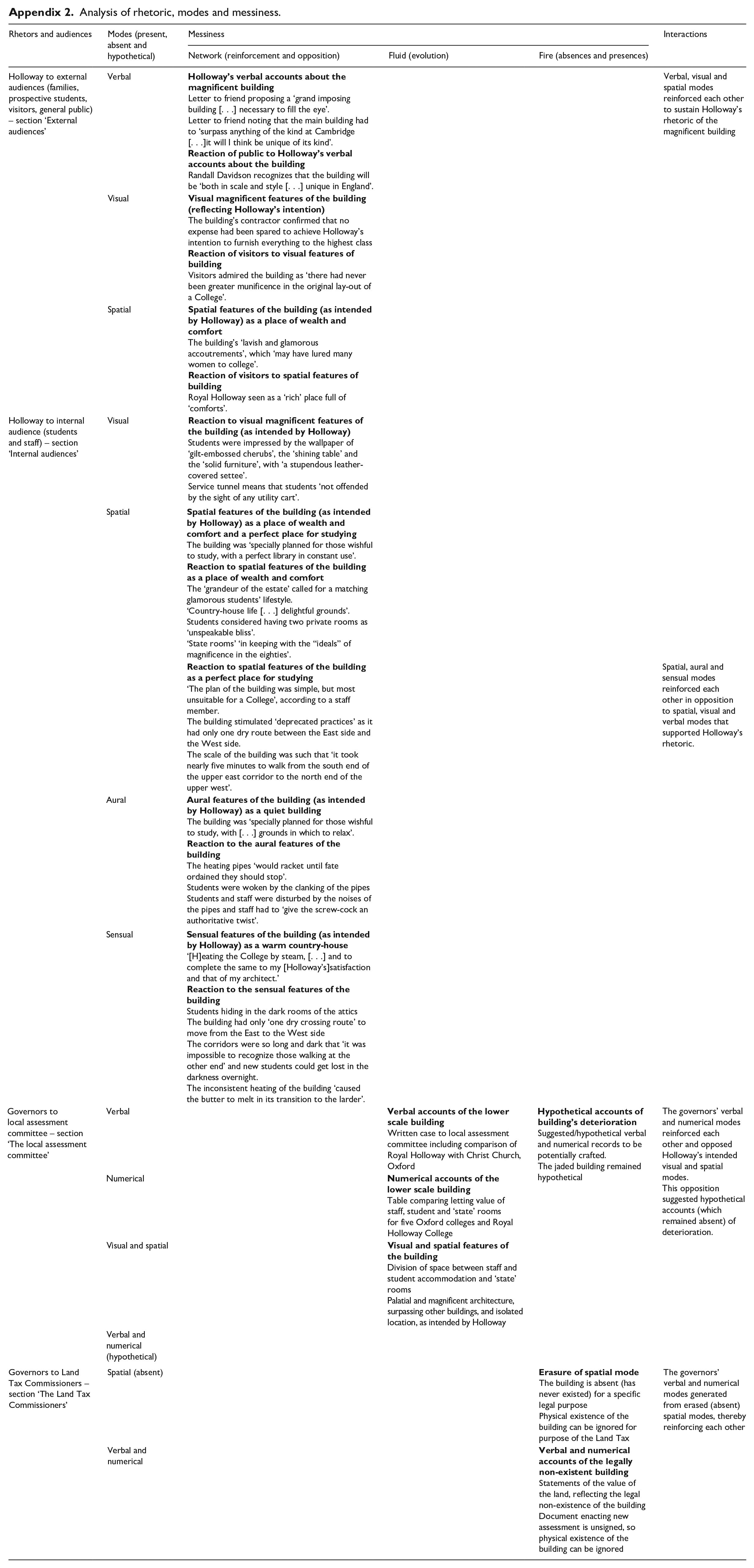
| Rhetors and audiences | Modes (present, absent and hypothetical) | Messiness | Interactions | ||
|---|---|---|---|---|---|
| Network (reinforcement and opposition) | Fluid (evolution) | Fire (absences and presences) | |||
| Holloway to external audiences (families, prospective students, visitors, general public) – section ‘External audiences’ | Verbal | Letter to friend proposing a ‘grand imposing building [. . .] necessary to fill the eye’. Letter to friend noting that the main building had to ‘surpass anything of the kind at Cambridge [. . .]it will I think be unique of its kind’. Randall Davidson recognizes that the building will be ‘both in scale and style [. . .] unique in England’. |
Verbal, visual and spatial modes reinforced each other to sustain Holloway’s rhetoric of the magnificent building | ||
| Visual | |||||
| Spatial | |||||
| Holloway to internal audience (students and staff) – section ‘Internal audiences’ | Visual | ||||
| Spatial | |||||
| Spatial, aural and sensual modes reinforced each other in opposition to spatial, visual and verbal modes that supported Holloway’s rhetoric. | |||||
| Aural | |||||
| Sensual | |||||
| Governors to local assessment committee – section ‘The local assessment committee’ | Verbal | The governors’ verbal and numerical modes reinforced each other and opposed Holloway’s intended visual and spatial modes. |
|||
| Numerical | |||||
| Visual and spatial | |||||
| Verbal and numerical (hypothetical) | |||||
| Governors to Land Tax Commissioners – section ‘The Land Tax Commissioners’ | Spatial (absent) | The governors’ verbal and numerical modes generated from erased (absent) spatial modes, thereby reinforcing each other | |||
| Verbal and numerical | |||||
Acknowledgements
The authors are grateful to Annabel Valentine and Harriet Costelloe, archivists of Royal Holloway Archives and Special Collections, for their help and support during the data collection process. Also, we thank the participants in the ‘Space and Time in Management Studies’ workshop, Egham, May 2016, the 14th World Congress of Accounting Historians, Pescara, June 2016, the 32nd European Group for Organizational Studies Colloquium, Naples, July 2016, and attendees at presentations of the paper at RMIT University, Melbourne, February 2016, the University of Sussex, April 2017, and Aston University and the University of Essex, May 2017, as well as colleagues in the Royal Holloway School of Business and Management, for their comments and feedback on earlier versions of the paper. The figures are reproduced courtesy of Royal Holloway University of London (Figure 1) and the Royal Holloway University of London Archives ( ). We are grateful for the valuable comments of three anonymous reviewers, the senior editor, Silviya Svejenova, and the editor-in-chief, Renate Meyer.
Funding
The author(s) received no financial support for the research, authorship, and/or publication of this article.