



Abstract
Although interest in meaningfulness is mounting in the growing stream of research dedicated to how professionals experience it, research has only just begun to investigate the complex relationships between the search for meaningfulness and the constitution of professional identity for emerging professional groups. This paper investigates how meaningfulness interacts with the formation and enactment of professional identity, focusing on the emerging professional group of corporate social responsibility (CSR) consultants. Relying on interviews with 39 CSR consultants, we induce two social mechanisms bridging meaningfulness and professional identity, namely ‘meaning-making through professional self-identification’ and ‘meaning-making through professional socialization’. Our results explain how these mechanisms produce distinct, and potentially contradictory, professional identities of CSR consultants, which themselves enable contrasted forms of professional identity enactment. The study advances meaningfulness research by clarifying how the self–other tension is played out through identity formation and revealing the gendered nature of meaningfulness. The research also contributes to studies on professional identity through the specification of meaning-focused mechanisms of identity formation, and ultimately to micro-CSR research by offering a nuanced approach to how CSR is involved in the production of work meaningfulness.
Work meaningfulness, occurring when individuals achieve through their work both self-actualization and contribution towards the greater good (Bailey, Madden, Alfes, Shantz, & Soane, 2017), is a central quest for professionals under 21st-century capitalism (Bailey, Yeoman, Madden, Thompson, & Kerridge, 2019). Major crises, such as the German refugee crisis (Florian, Costas, & Kärreman, 2019) and the Covid-19 pandemic, have made this trend even more salient. However, professionals may struggle to maintain work meaningfulness in professional identity – i.e. the patterns of characteristics, beliefs, values, motives and experiences that individuals employ to define themselves in a professional setting (Slay & Smith, 2011). This is because professionals are incentivized to make choices that are not necessarily informed by work meaningfulness, but rather by a calculation of related costs and benefits (Foucault, 2008): so, depending on the outcome, they might undertake meaningful work in one instance and meaningless work in another. Work meaninglessness refers to individuals that prioritize their own benefit at the expense of the greater good (Harding, 2019). Accordingly, professionals might enact different and, at times, antagonistic professional identities (Brown, 2019; Clarke, Brown, & Hope-Hailey, 2009; Wright, Nyberg, & Grant, 2012).
Research on work meaningfulness has not fully captured the complex influence of meaningfulness on professional identity (Lepisto & Pratt, 2017; Mitra & Buzzanell, 2017), as job role perception is linked with perceived meaningfulness, resulting in the expectation that, in professions traditionally associated with the greater good (e.g. doctors, teachers), meaningfulness will shape professional identity (Bailey et al., 2019). What is more, a heavy focus on how individuals understand meaningfulness, at the expense of how external influences play out in work meaningfulness (Robertson, O’Reilly, & Hannah, 2020), has complicated our understanding of how meaningfulness influences professional identity further. The fourth industrial revolution has complicated things even more as it has created numerous professional groups, many of which are promoted on the grounds of work meaningfulness (Brès et al., 2019) and challenge the meaning and operations of traditional professions (Fayard, Stigliani, & Bechky, 2017). Therefore we ask: How does meaningfulness interact with new professionals’ identity formation and enactment?
We address this question by focusing on the case of corporate social responsibility (CSR) consultants. On one hand, consultants epitomize the figure of the ‘professional’ in contemporary capitalism (Sturdy, Wright, & Wylie, 2015): They have come to dominate the formulation of organizational policies (Kipping & Clark, 2012) thanks to the promotion of their professional identity (David, Sine, & Haveman, 2013; Werr & Stjernberg, 2003) and expert knowledge (Abbott, 1988). On the other hand, as a new professional group emerging from the commodification of social and environmental issues (Brès & Gond, 2014), CSR consultants are thought to seek to advance ethical capitalism and social responsibility rather than just improve financial performance through their work. Like traditional professionals, such as doctors and teachers, CSR consultants are assumed to be following ‘responsible careers’ (Tams & Marshall, 2011), and meaningfulness is supposed to be part of their professional identity.
In this paper, we analytically induce two ‘social mechanisms’ (Stinchcombe, 1991) of meaning-making by which CSR consultants attach specific meanings to their work and profession: ‘meaning-making through professional self-identification’, which points to a self-focused route, and ‘meaning-making through professional socialization’, which points to a relational route. Our results show how these two mechanisms bridge meaningfulness and professional identity formation, and thus sustain the meaningless or meaningful professional identities of consultants – opportunistic, pragmatic and moral – and lead to distinct forms of professional identity enactment.
Our study contributes to organization theory in a threefold manner. First, we advance studies of work meaningfulness (Bailey et al., 2019; Florian et al., 2019) by proposing that depending on the social context, professionals working in meaningful professions may not always seek meaningfulness, and by revealing the gendered nature of meaningfulness by showing that women are more inclined to seek work meaningfulness than men. Second, we advance studies of meaningfulness and professional identity (Lepisto & Pratt, 2017; Rosso, Dekas, & Wrzesniewski, 2010) by specifying two meaning-making mechanisms, which acknowledge both the agentic role of individuals and that of others in forming professional identities (Goodrick & Reay, 2011; Reay, Goodrick, Waldorff, & Casebeer, 2017). We also contribute to the multiple identities discussion (Brown, 2019) and to calls for research on how gender influences the formation and enactment of professional identities (Vough, 2021). Third, and finally, our analysis contributes to micro-CSR research by clarifying how CSR, meaningfulness and professional identity relate to one another and offering a nuanced approach to how CSR is involved in the production of work meaningfulness (Aguinis & Glavas, 2019; Gond & Moser, 2021).
The Search for Meaningfulness in Professional Identity Formation
Meaningfulness is promoted as a concept that has a positive bearing on professionals’ views of themselves and significance they attribute to their work (Rosso et al., 2010). Usually, the definitions proposed for ‘meaningfulness’ focus on the ‘self’ and the ‘other’, and discuss the ‘self’ in terms of the self-actualization, satisfaction and fulfilment the individual obtains from work, and the ‘other’ in terms of the contribution of one’s work to society (Bailey et al., 2017). Meaningfulness is understood to occur when an individual achieves through their work both self-actualization and contribution towards the greater good (Bailey et al., 2019). Previous research suggests that the contemporary, fast-paced and constantly evolving professional working environment has influenced professionals’ work expectations and has made them seek not only financial benefits but something greater that gives them meaning (Wrzesniewski, Dutton, & Debebe, 2003). Put differently, it is argued that people are not merely seeking jobs, but also looking for work that offers them a sense of purpose and meaning (Dik & Duffy, 2009). Through meaningfulness professionals engage in tasks that are personally fulfilling or pleasant (Michaelson, 2021), that contribute towards the greater good (Lips-Wiersma & Morris, 2017) and that entail social status along with economic benefits (Colby, Sippola, & Phelps, 2001).
The meaningfulness literature identifies two complementary perspectives, which explain why and how professionals derive significance from their work and experience it as meaningful (Lepisto & Pratt, 2017; Rosso et al., 2010). The first proposes that meaningfulness is experienced through different pathways, which offer different sources of purpose (Lips-Wiersma & Wright, 2012). For instance, professionals experience meaningfulness through the individuation pathway, when work experiences and activities allow them to perceive themselves as capable and autonomous; through the unification pathway, when work experiences and activities make professionals experience companionship with others; and through the contribution pathway, when work experiences and activities make professionals feel that they are making a positive difference in the lives of others (Robertson et al., 2020).
The second perspective proposes that professionals experience meaningfulness ‘through a sense of fit between one’s perceived “self” and “purpose at work”’ (Robertson et al., 2020, p. 598). Accordingly, meaningfulness comes from ‘realizing the self’ (Lepisto & Pratt, 2017, p. 105), meaning the state when one is able to express one’s true and authentic self and is not influenced by the perceptions and views of others (Robertson et al., 2020).
The prevalent approach in the literature is to draw on psychological frameworks and focus on how individuals experience meaningfulness (Cohen, Duberley, & Smith, 2019). Meaningfulness is perceived as static and positive, allowing individuals to always satisfy their ‘passion for social issues, greater work–life balance or creativity’ (Mitra & Buzzanell, 2017, p. 595). Critical studies, however, highlights the need to perceive meaningfulness as a dynamic concept (Mitra & Buzzanell, 2017). Mitra and Buzzanell (2017) talk about the ‘messy role of meaningfulness’ and the need to identify the hidden meanings of work and inherent tensions, which make individuals react differently in their working environments. Hofmeister (2019) notes the lack of a gender dimension in discussions of meaningfulness and argues that searching for gender-related insights on meaningful work is like searching for a needle in a haystack. Yet, gender might significantly influence work meaningfulness, because men and women might experience meaningfulness differently. Lair, Shenoy, McClellan and McGuire (2008) suggest that an obsession with meaningfulness elevates some professions above others, and entails ‘an inherent elitism’ (p. 172), as it assumes that some professions have a larger potential to contribute towards societal good than others. This is why Bunderson and Thompson (2009, p. 40) approach meaningfulness as ‘a double-edged sword’ which, for some, might entail the positive benefits highlighted in the literature, but, for others, might lead to exploitation, personal imbalance (Lips-Wiersma & Morris, 2017), low pay, poor work–life balance and unsuccessful careers (Berkelaar & Buzzanell, 2015).
These insights are particularly relevant to the context of professional identity, as meaningfulness constitutes an important topic for identity work, i.e. individuals’ attempts to invent, shape and maintain desired accounts of themselves (Brown & Coupland, 2015; Sveningsson & Alvesson, 2003). Through meaningfulness individuals pursue selfless values and build grand narratives that promote them as ‘heroic’, ‘epic’, ‘moral’ or ‘rational’ (Wright et al., 2012). Discourse plays an important role in identity work, as it allows individuals to play with, and taste, different social and professional identities (Alvesson, 1994; Ellis & Ybema, 2010; Pratt, Rockmann, & Kaufmann, 2006), before attempting to construct coherent self-narratives that will convince them of their stable (Giddens, 1991) or multiple (Caza, Moss, & Vough, 2018) identities through time. Through their narrative, people link the past with the present harmonically, allowing a sense of continuity in self-perceptions (Ibarra & Barbulescu, 2010), and providing an opportunity for addressing the hybrid nature of their different identities (Clarke et al., 2009; Ibarra, 1999; Pratt et al., 2006).
A wealth of studies has shown how discourse is an important means of detecting professional identity. Most importantly for our study, research has explored the discursive accounts individuals use when describing their professional identity (Ibarra & Barbulescu, 2010; Pratt et al., 2006), with some studies highlighting the agentic role of individuals in shaping this process (Goodrick & Reay, 2011), and some showing the influence of others (Reay et al., 2017). Maclean, Harvey and Chia (2012), for instance, have demonstrated how wealthy entrepreneurs draw on philanthropic identity discourse to empower a view of the professional self that is both socially and self-oriented. Others have argued that managers’ identity work draws on a ‘grandiose discourse on management’ (Sveningsson & Alvesson, 2003, p. 1187) to enhance their legitimacy and present themselves as saviours of their organizations. Wright et al. (2012, p. 1466) have revealed how professionals’ identity work entails constructing discursive accounts of themselves as moral agents fighting against ‘adversity for a noble cause or the greater good’. Respectively, Reay et al. (2017) have highlighted the influence of others in professional identity, with evidence showing the agentic role of managers in shaping the professional identity of physicians.
We focus on new emerging professionals, because the fourth industrial revolution has transformed professions, creating new professional groups, many of which are linked to key global challenges such as climate change (Brès et al., 2019). These new professional groups challenge the meaning and operations of traditional professionals, such as doctors, lawyers and physicians, as they trade not on their expertise and knowledge alone, but on their ethos and values too (Fayard et al., 2017). The explicit focus of such professionals on the greater good, along with the promotion of both expertise and ethos, creates the expectation that meaningfulness will directly influence their professional identity. Yet we cannot be sure that this is the case, as professionals might attribute different significance to their work and might be driven by either meaningfulness or meaninglessness (Harding, 2019; Mitra & Buzzanell, 2017). Therefore we ask: How does meaningfulness shape new professionals’ identity formation and enactment?
Research Context, Method and Data
Research context: The case of CSR consultants
We have focused on CSR consultants as they present an interesting opportunity to investigate how meaningfulness interacts with professional identity in an emerging professional group. CSR consultants (Gond & Brès, 2020) have been portrayed in the literature as seeking to undertake ‘responsible careers’, i.e. careers ‘in which people seek to have an impact on societal challenges, such as environmental sustainability and social justice’ (Tams & Marshall, 2011, p. 110). Accordingly, it is assumed that these professionals will challenge the primary focus of businesses on profit maximization and that they will be influenced by morally driven discourses (Ghadiri, Gond, & Brès, 2015). Based on these insights, CSR professionals’ identity should be aligned with meaningfulness. However, in cases where CSR consultants are asked to address client demands for CSR to be used as a smokescreen or are required to implement only the CSR policies that lead to profit maximization, we may witness the formation and enactment of a professional identity that is antagonistic to both CSR and meaningfulness.
The social context where we collected our sample (Greece) might influence CSR consultants’ response to clients’ demands. Although the prolonged economic turmoil in Greece did not deter CSR penetration – as illustrated, for instance, by the adoption rates of CSR-related standards, which at least tripled (ISO, 2016) 1 – during times of economic crisis, gains in customer satisfaction become increasingly significant, as organizations strive to compete and to maintain their clientele (Kunc & Bhandari, 2011). Accordingly, CSR consultants who want to survive the crisis and compete might behave opportunistically, as doing so could increase their financial returns. At the same time, the proliferation of CSR standards provides opportunities for CSR consultants to grow their clientele. This offers fertile ground to CSR consultants who want to change how things are and perceive CSR as the means of doing so.
This variation in CSR consultants’ potential reactions to the economic crisis, combined with their clients’ diverse motives, could lead CSR consultants to adopt different and antagonistic professional identities that might not necessarily prioritize work meaningfulness, but instead purely economic interests.
Data collection
To investigate our topic, we adopted a qualitative and interpretivist approach. We relied on interviews, which we regarded as socially constructed events in which both the interviewer and interviewee ‘articulate ongoing interpretive structures’ (Holstein & Gubrium, 1995, p. 16). Interviewees could talk about topics that might contradict each other (e.g. talking about their work ethic through the lens of honesty and responsibility, and at the same time endorsing a window-dressing approach to CSR). This approach allowed the respondents to identify with multiple narrative positions, and the researcher to explore how the thematically significant narrative constructions linked and diverged. This enabled the formulation of a narrative pluralism, with consultants producing diverse accounts of their perception of knowledge and skills, responsibility and approach to CSR consulting. The honesty of consultants’ answers, in the sense that they talked openly about misconduct, suggests little evidence of social desirability bias.
We purposively sampled consultancies that offer CSR services and recruited respondents who had a minimum of three years’ experience. The latter criterion was informed by the primary researcher’s prior field experience and based on the premise that three years is sufficient time for consultants to have been involved in several projects, developed a good knowledge of consultancy activities, and experienced first-hand the outcomes of their actions. The interviews were conducted in the privacy of each informant’s office, audiotaped and transcribed. In all, 39 consultants agreed to participate. 2
Each interview lasted between 40 and 60 minutes and respondents were guaranteed compliance with ethical restrictions such as those relating to informed consent, and anonymity via the use of pseudonyms. The respondents were also informed that they could opt out of the research at any time. In all instances, the interviewer ensured that the interviewee fully comprehended the questions being asked and was replying in the appropriate context. To gain additional insights into the accuracy of the respondent’s answers, the interviewer took detailed notes of each respondent’s use of nonverbal modes of communication. Additionally, to let the respondent assess the adequacy of the interviewer’s interpretation, the researcher would recapitulate the interviewee’s answers. Respondents were asked a range of questions about themselves and their profession, such as ‘Why did you become a CSR consultant?’, ‘Suppose you were faced with the following situation: One of your clients asks you to adopt CSR standards without actually implementing them. What would you do?’ and ‘Please explain what “work ethic” means to you and describe yours.’
At the end of each interview, the respondent would be shown the interviewer’s notes and asked to evaluate their veracity. Reassuring interviewees on the spot about the content of the notes taken was deemed important due to the controversial nature of some of our questions. This allowed the interviewer to maintain the trust of the interviewees. Furthermore, to remedy bias stemming from the interviewees’ memory gaps and distortion, the narrative was built up from the accounts of diverse interviewees from the same consultancy firm and from the respondents’ biographical data as presented on the social media platform LinkedIn. Equally, to understand better the prevalent discourses with which our respondents interacted, we collected data from the companies’ websites and other relevant secondary material including strategy and internal communication documents.
Data analysis
Our iterative analytical procedure entailed four steps. In the first step of analysis, we established, through a first reading of all interviews, that meaninglessness/meaningfulness informed three distinct types of CSR professional identities, namely: opportunistic – focused on self-actualization only; pragmatic; and moral – focused on both self-actualization and contribution towards the greater good.
In the second step of analysis, we focused our attention on the role of meaningfulness in the formation and enactment of consultants’ professional identity. We created provisional categories and ‘first-order codes’. We started the actual data analysis by seeking similarities and differences in all transcribed texts and notes taken during the interviews. This allowed us to gain a comprehensive sense of the data and focus on emphasis, mood and intonation. By using ‘free nodes’ in the NVivo software package, we were able to combine all quotes on a certain topic from all interviews. This allowed us to analyse the interview texts more accurately and focus on emerging categories. We began by focusing on intrapersonal topics and identifying statements about ‘meaning-making’ through CSR consultants’ educational background and vocational training, professional calling and views of CSR.
The third step entailed axial coding (Corbin & Strauss, 2008). We explored whether the first-order codes could be merged into concepts that might prove useful in describing and explaining how meaningfulness informs CSR consultants’ professional identity. For example, the meaning consultants attributed to CSR varied significantly, with CSR perceived by some as a fad, by others as a set of strategic resources that would allow companies to address their economic, social and environmental responsibilities, improve their position in the market and maximize profits, and by yet others as an ethical imperative and as a means of changing the way business operated. We used the category ‘CSR idealization’ to capture these insights.
In the fourth and final step, we looked for dimensions underlying the second-order themes that could be used as the basis for building a data structure that would give a coherent picture of the data (Gioia, Corley, & Hamilton 2013). Moving back and forth between data and theory, we decided to adopt a ‘social mechanism’ approach to make sense of our two first aggregate constructs, which were focused on the production and stabilization of meaning-imbued professional identities. Social mechanisms are ‘bits of theory about entities at a different level (e.g., individuals) than the main entities being theorized about (e.g., groups), which serve to make the higher-level theory more supple, more accurate, or more general’ (Stinchcombe, 1991, p. 367). We focused on relationships between meaning construction and professional identity when analysing all our second-order themes, and could specify two mechanisms of meaning-making by which meaningfulness was embedded within professional identity, resulting in either work meaningfulness or work meaninglessness.
The first mechanism points to identification processes that involve the self, and we labelled it meaning-making through professional self-identification. The second mechanism is relational in nature, and we labelled it meaning-making through professional socialization. We then grouped the remaining second-order themes, namely ‘implementing CSR projects’, ‘addressing identity challenges’ and ‘performing the professional self’, into a third aggregate construct, which we labelled professional identity enactment. Figure 1 presents our data structure. Our first findings section provides a detailed analysis of how these two mechanisms led to the formation of distinct professional identities – pointing to work meaningfulness or meaninglessness – and how these professional identities are enacted in different ways. Our second findings section conceptualizes our results through a process framework.
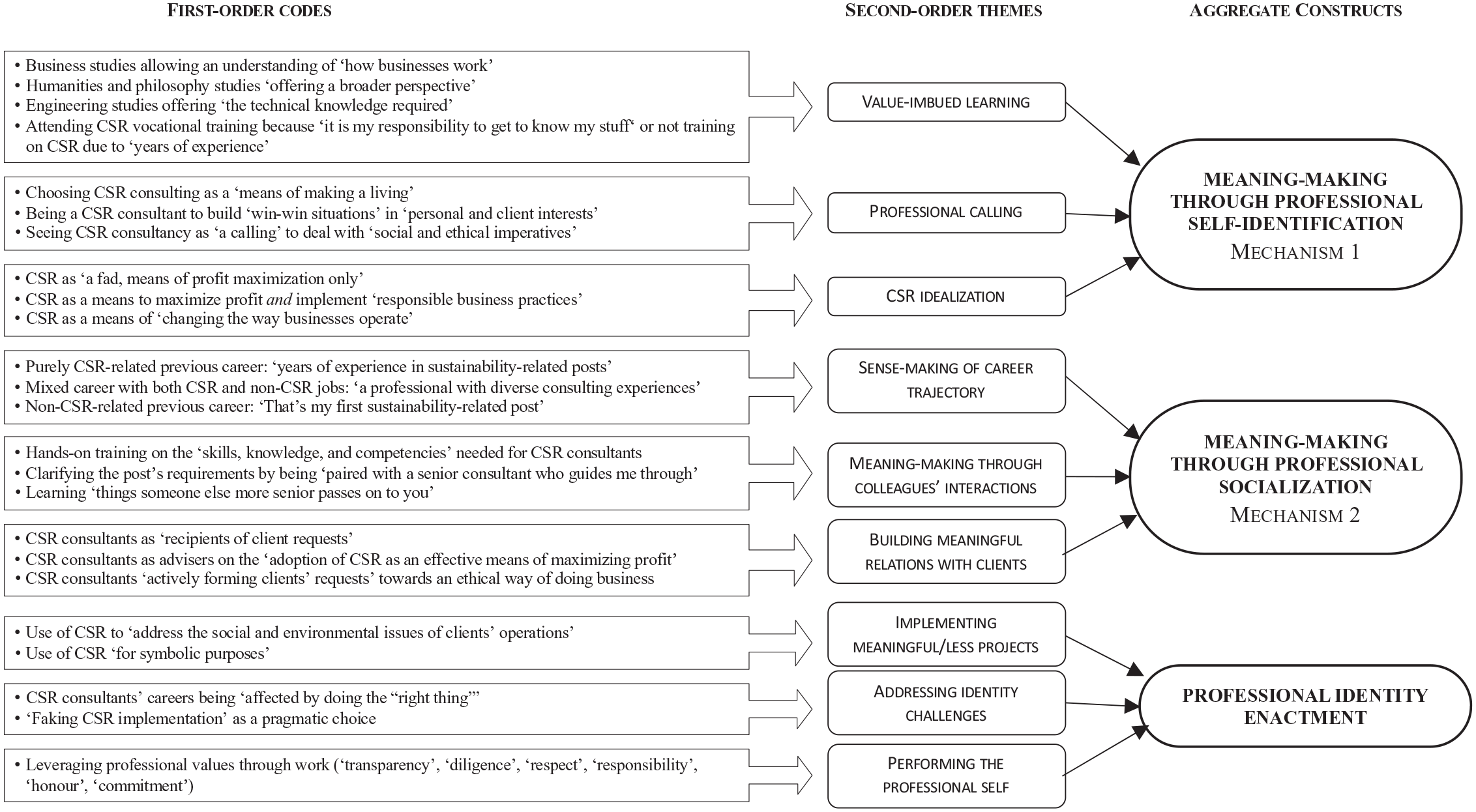
Data structure.
How Meaningfulness is Embedded in Professional Identity Formation and Enactment: Two distinct meaning-making mechanisms
Professional identity formation
Three main insights about CSR consultants’ identity formation became clear from the data analysis. First, in most instances, consultants made choices based on a calculation of related costs and benefits, and, depending on the outcome, they switched between meaningful and meaningless work. This was influenced by self-actualization only and not by contribution towards the greater good, and it informed the adoption of a dual and antagonistic professional identity that was solely aligned with economic benefits gained from mutually beneficial relationships with clients. In these cases, CSR was seen as a means of satisfying economic interests rather than one of seeking to contribute to wider societal challenges. Second, some consultants perceived CSR as a topic that could be used to address problems related to economic, social and environmental aspects of business operations. They believed that CSR could allow them to do both: to realize their personal potential and to contribute towards the greater good by improving the pathogenies of their local business environment. Third, a small group of consultants talked about a sense of purpose and self-actualization through their contribution to society. These consultants saw self-fulfilment as distanced from economic motives and aligned it with an ethical imperative to contribute towards the greater good.
Our analysis suggests that these distinct paths in terms of professional identify formation are explained by two social mechanisms that bridge professional identity formation to CSR. The first mechanism, meaning-making through professional self-identification, refers to identification processes that involve the self. It captures how our respondents’ educational background and professional training, professional calling and perceptions of CSR informed the degree to which they identified with their professional group in ways that influenced their job’s meaningfulness.
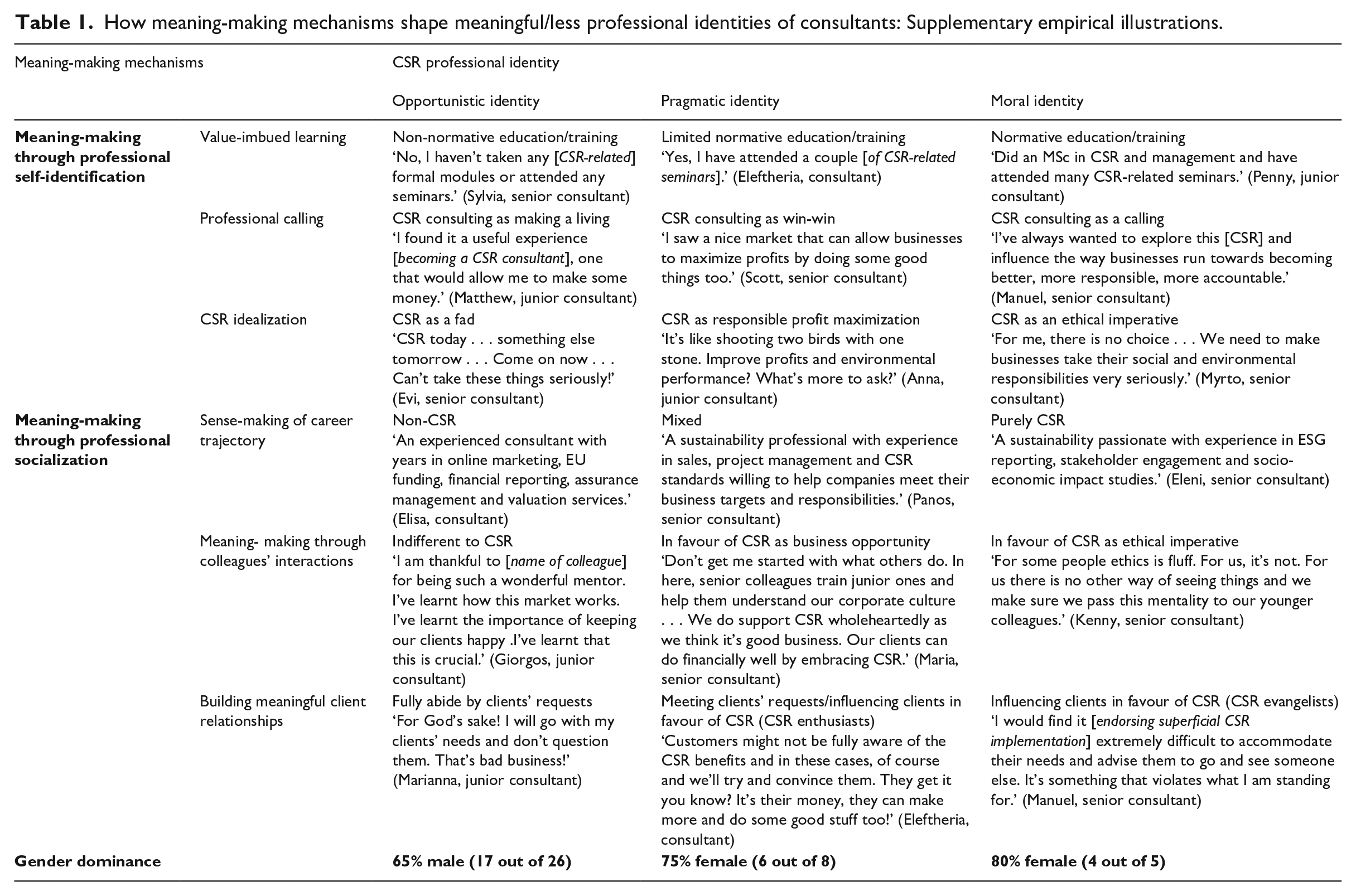
By contrast, the second mechanism, meaning-making through professional socialization, refers to identification processes that are relational in nature. It captures how CSR consultants’ career paths and interactions with colleagues and clients allow them to learn the job and adapt to the skills and abilities needed. Through this second mechanism, professionals keep decoding the profession’s norms and values, and figure out what is perceived as acceptable role behaviour. In the remainder of this section, we discuss our findings around these two mechanisms and offer illustrative quotes from our CSR consultants that encapsulate their meaning. Table 1 provides an overview of this analysis with supplementary empirical illustrations.
How meaning-making mechanisms shape meaningful/less professional identities of consultants: Supplementary empirical illustrations.
Mechanism (1): Meaning-making through professional self-identification
Our analysis of consultants’ learning revealed that exposure to normative education was associated with meaningfulness. In our data, normative education applies to the case of consultants who had an ethics-related postgraduate or undergraduate degree. Those in this category were exposed to ‘topics of right or wrong and . . . ethical dilemmas in workplace’ (Myrto, senior consultant) and talked about the ethics and purpose of CSR consultancy. Those whose learning had been less normatively driven talked mainly about business as usual and ‘were exposed to numerous managerial practices that could help business improve their productivity and financial performance’ (Maria, senior consultant). Due to their limited or non-existent normative education, these consultants were more likely to tolerate ethical misconduct.
Accordingly, consultants with more ethics training, as illustrated by their attendance at CSR-related seminars, offered discursive accounts of their professional training that were associated with work meaningfulness. Such accounts related to their ‘desire to gain a better knowledge of CSR’ and improve their expertise ‘so that it can be used to change business’ (Eleftheria, consultant). In contrast to this, consultants with no ethical training came up with discursive accounts that prioritized self-actualization and were not associated with the greater good.
Likewise, the professional calling of our CSR consultants and CSR idealization did not necessarily link with meaningfulness. Most described self-actualization through the pursuit of economic interests. Here, consultants did not have strong views about CSR and saw it as ‘a promising niche market’ (Charis, junior consultant) that would allow them to make a living. For them, a successful way of meeting their economic interests was to build long-lasting relationships with their clients on the ‘basis of trust and reciprocity so that clients know they can depend on you’ (Machos, senior consultant).
An interesting aspect of this group is that it was dominated by male consultants (17 out of 26), indicating that gender might play a role in work meaningfulness and CSR. This was further reinforced in our results, as consultants in the other two categories, which were dominated by females (10 out of 13), talked about meaningfulness. First, some consultants talked about a professional calling that did not prioritize self-actualization alone but highlighted the greater good too. These consultants had stronger views about CSR, seeing it through a pragmatic lens, and believed that it represented ‘a true business opportunity to address economic, social and environmental problems . . . and not a market trend’ (Panos, senior consultant). They thought that CSR would get them through troubled economic times, as it would allow them to pursue profit in a transparent and accountable way. One explained that ‘corporate responsibility isn’t social only but economic too and combining the two allows our clients [to] deal effectively with chronic problems [alluding to institutional ills] . . . and yes of course their stakeholders’ (Anna, junior consultant). In so doing, they saw CSR as a means of fighting corruption and improving the local business environment. Second, other interviewees talked eloquently about their belief in CSR, describing how their professional role offered them the opportunity to realize their capabilities through their contribution to wider societal challenges: I found it a fascinating topic that aligned well with my personal traits. CSR is right down my alley . . . it encapsulates my beliefs about how the private sector should run. I am very passionate about this job, you know. I can influence businesses. I can make them adopt socially and environmentally friendly practices. I can change them and make them sustainable. (Myrto, senior consultant)
Mechanism (2): Meaning-making through professional socialization
Our interview material, combined with an analysis of the consultants’ LinkedIn profiles, revealed that their career paths played an influential role in work meaningfulness. Consultants who had worked in CSR-related posts throughout their professional career were more likely to refer to meaningfulness and see CSR through moral reasoning. In both their interview replies and their LinkedIn profiles, these consultants described their career profile by referring to ‘values and personal ethics’, ‘social mission’, ‘making an impact’ and ‘passion and curiosity’. In contrast, the CSR consultants who had changed their careers and moved to CSR from posts unrelated to CSR distanced themselves from meaningfulness and talked about ‘revenue generation’, ‘return on investment’, ‘effective project management’ and ‘cost-effective change management’. For these consultants, their previous management-related experiences influenced their perceptions of CSR, which they saw as another management topic linked with business goals and shareholder primacy.
Aside from the career path, senior colleagues too played an important role in influencing CSR consultants’ work meaningfulness, as through mentoring they shaped consultants’ perception of their role and how they should meet its technical and social demands. We noticed discrepancies in respondents’ descriptions of the role of their mentors, with some focusing on the market and highlighting mentors’ role in ‘showing how to play the game . . . what to do and what to avoid’ (Marios, senior consultant), and others referring to values and talking about ‘a unique opportunity to instil the company’s values in the junior consultant’ (Eleni, senior consultant).
In turn, clients shape CSR consultants’ work meaningfulness through their relationships with them. The majority of our consultants distanced themselves from meaningfulness and talked about building and maintaining relations with clients on the basis of mutual economic benefits. For them, success was seen to be associated with the success of their clients, irrespective of clients’ views of CSR: I’ll do what my clients want. If they want me to assist them in changing the way they do things, I will do so. If they want the CSR thing for marketing purposes only, that’s fine with me too! (Mike, senior consultant)
Others linked their actions with meaningfulness by talking about helping their clients improve their financial performance and achieving something towards the greater good. In their view, the economic crisis required a different type of consulting, one that had clear, tangible benefits and promoted an ‘economically and socially responsible way of doing business’ (Julia, senior consultant). Another element of this articulation came from a few CSR consultants who talked about meaningfulness but did not talk about profit and economic interests as the other consultants did. They perceived meeting their own beliefs about CSR as more important, and mainly talked about a sense of purpose and wider societal benefits. As one consultant noted: I work with my clients . . . to infuse my enthusiasm and belief about the importance of CSR and how imperative it is to change the way we organize our economies, trade and consume. (Kenny, senior consultant)
Professional identity enactment
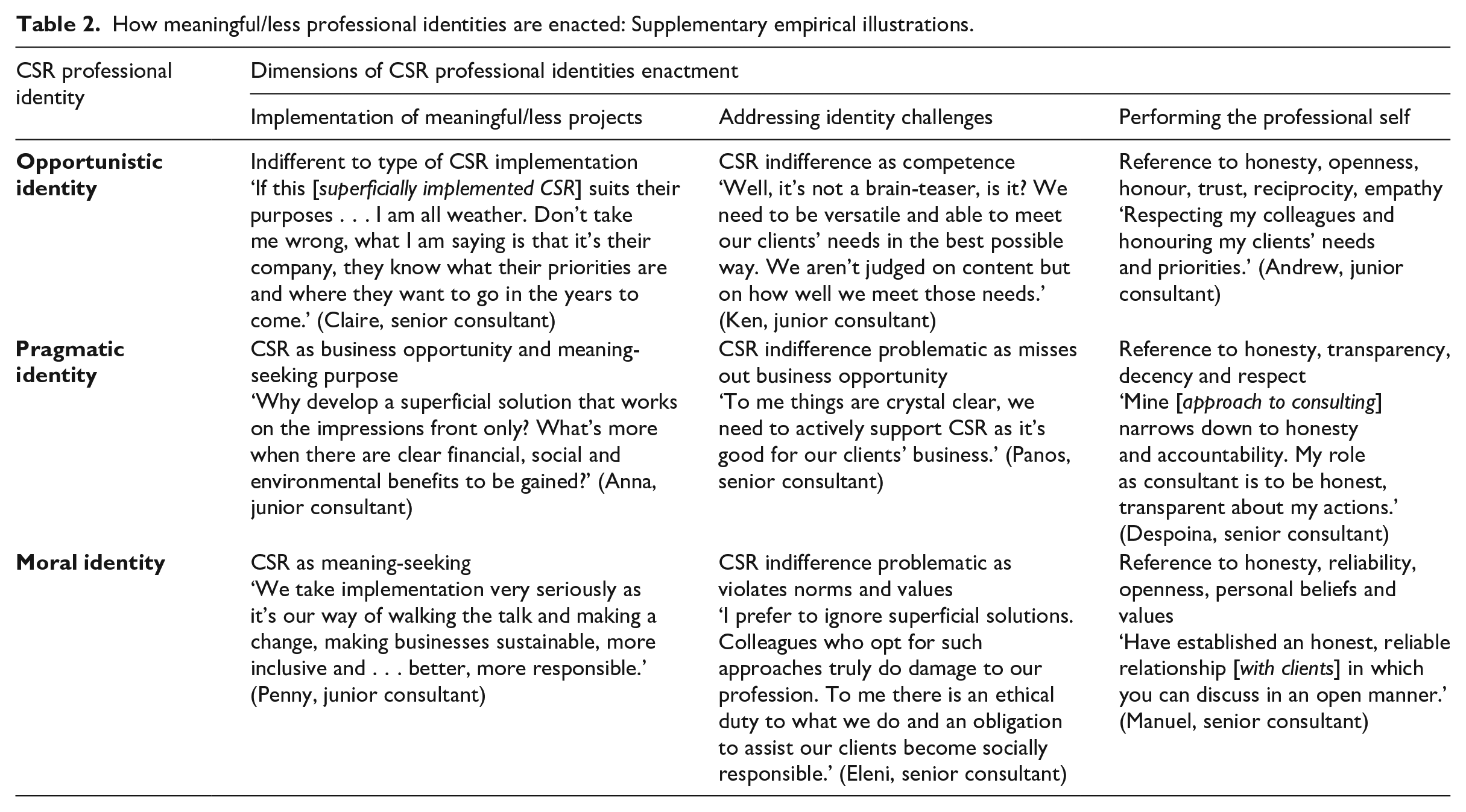
The different meaning-making discursive accounts of CSR consultants led to the formation and enactment of three distinct professional identities – opportunistic, pragmatic and moral – which were manifested through our second-order themes, namely ‘implementing CSR projects’, ‘addressing identity challenges’ and ‘performing the professional self’. Table 2 provides an overview of the outcome of our analysis, with supplementary empirical illustrations.
How meaningful/less professional identities are enacted: Supplementary empirical illustrations.
Implementing meaningful/meaningless projects
Most CSR consultants talked about experiences that had led to the enactment of a dual and antagonistic identity (26 out of 39). Their views embraced an opportunistic professional identity which distanced them from a collective CSR professional identity linked with work meaningfulness. These consultants were mainly indifferent to the CSR aspect of their professional role and talked about economic interests rather than a desire to contribute towards the greater good. Doing what their clients expected, and even using deception to meet clients’ needs (e.g. by faking CSR implementation), was perceived as the right thing to do and as the best way of meeting their own interests: It’s [the clients] who define how they want things done, and it’s us that help them to meet their needs. We develop the management system in line with their requirements, we approach auditors who are willing to excuse/forget in case of PR or are serious and rigorous in their approach in opposite cases. We work with our clients all the time to make sure we achieve a tailor-made solution. (Daria, senior consultant)
While reflections such as the above were dominant in most descriptions, a second category of CSR consultants embraced a pragmatic professional identity (8 out of 39). Their approach was influenced by economic interests and also by a need to contribute towards something greater. They perceived CSR as a business opportunity to change things and meet not only their clients’ needs but also their own meaning-seeking purposes. These consultants viewed themselves as ‘CSR enthusiasts’, and acknowledged that others treated CSR as a fad, or did not have strong views on CSR, and argued that the use of CSR for legitimization purposes could only harm a business: I can easily do that [advise clients to use CSR for image purposes only]. But then again, at some point, this will backfire. . . and will significantly harm my clients’ business. Then why do it? I think it’s cleverer to change the way one does business. . . if you do so, then by default your image will improve. Companies have lost lots of monies already [alluding to the economic crisis], I don’t understand why they should lose more. (Jacob, senior consultant)
A third category of CSR consultants put forward a moral professional identity (5 out of 39). These consultants referred to a social and environmental imperative and promoted an identity that internalized the virtues and values professed, and manifested these in their behaviour. They wanted ‘to make a change and convince companies that a different, more responsible way of operating is possible’ (Penny, junior consultant). They viewed themselves as ‘CSR evangelists’; they understood self-actualization through their contribution towards the greater good, and talked about consulting approaches that prioritized right and wrong, and a consultancy ethos that translated into substantively assisting firms in improving their CSR performance.
Addressing identity challenges
For the consultants who embraced an opportunistic professional identity, the enactment of a dual identity to meet clients’ preferences and engagement in meaningless projects did not imply a threat to their professional selves. What struck us was that in their stories they had no difficulty switching between work meaningfulness and work meaninglessness. Their replies revealed that they perceived the inconsistency of the two identities not as problematic but rather as an expression of competence and a means of ‘differentiat[ing] good apples from bad apples’ (Daria, senior consultant).
The consultants who embraced a pragmatic professional identity distanced themselves from these views and talked about work meaningfulness. They argued that they saw lying to protect their customers’ interests or faking CSR implementation as a short-sighted approach to consulting that would not allow the ending of the economic crisis. These CSR consultants believed that a successful professional identity did not necessitate an indifferent view of CSR implementation, but rather required a clear approach that linked CSR with financial performance, so that clients would be convinced that changing things and focusing on implementing CSR practices ‘entails significant financial benefits’ (Panos, senior consultant) and can ‘help us solve our prolonged economic problems and do something with our silly mentality’ [alluding to narrowly addressing economic issues only] (Doris, senior consultant).
Similarly, the consultants who adopted a moral professional identity exhibited a strong consistency between moral judgments and moral behaviour, and perceived lying in favour of their clients or faking CSR implementation as a violation of their professional norms and values: As they say in English: ‘Not my cup of tea.’ For others it is how they do business but not for me. I don’t want to have any involvement with this [i.e. consulting in a way that might not affirm CSR]. I think that if a client asks me to behave in such way [i.e. to merely abide by their requirements], they will disrespect me as a person. We are CSR consultants, not just consultants. This is what some people forget. (Myrto, senior consultant)
Performing the professional self
Irrespective of their professional identity, consultants’ discursive accounts on the enactment of their professional identity drew on professional values such as ‘honesty’, ‘honour’, ‘trustworthiness’, ‘commitment’ and ‘responsibility’, illustrating that the link between a person’s values and their behaviour is not linear. Even the ones who embraced an opportunistic professional identity and argued that they would consider breaking some rules to meet their clients’ needs claimed that they were entirely honest and open about their approach. Their view was that knowing how the market worked and playing by the rules of the game allowed them to honour and respect their clients’ needs: My work ethic lies on respecting my company’s policy, honouring my managers’ trust and respecting my clients’ demands. I work hard, don’t like slacking . . . if you’re lazy you won’t end anywhere . . . (Bryan, junior consultant)
The consultants who adopted a pragmatic professional identity thought that their role as consultants obliged them to be honest and transparent about their actions and ‘treat others with decency and respect’ (Anna, junior consultant). Equally, the consultants who adopted a moral professional identity argued that their main priority was always to help companies improve their social and environmental performance. They drew on the same behavioural tactics, but their discourse was more influenced by a sense of purpose and meaning: I do think that through work a person is able to fulfil their own aspirations and adopt conduct which is in line with their own personal values and beliefs. (Scott, senior consultant)
Meaningful Professional Identity Formation: Conceptualizing a Process Framework
Although our research design is not processual per se, the combination of accounts of individual experiences and secondary data about career trajectories from which we derived our findings enables us to conceptualize a parallel and recursive process model (Cloutier & Langley, 2020), which explains how meaningfulness shapes the formation and enactment of professional identities in ways that can push consultants’ CSR practices in potentially opposite directions. Figure 2 provides such a model that reorganizes our findings by specifying the relationships between aggregate constructs and second-order concepts that were presented in our findings section.
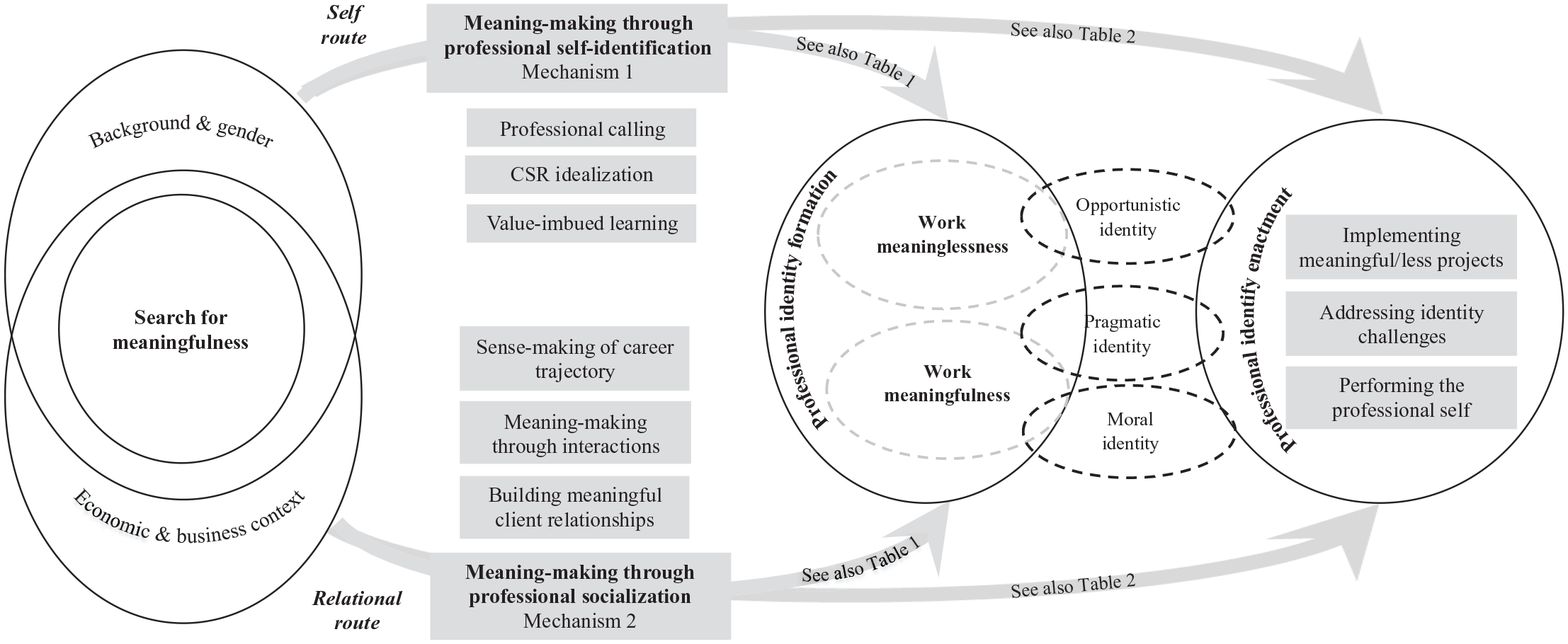
A meaningful professional identity formation framework.
In the left part of our model, meaningfulness is placed in the centre of two cycles, illustrating that the way individuals define themselves and attribute meaning to their actions arises ‘out of and mediating the space between a “core” self and a value-laden, socially complex’ environment (Hall, 1992, p. 276). The top cycle focuses on aspects of the core self. Gender appeared to be a useful predictor of the influence of meaningfulness on professional identity, with most male consultants distancing themselves from meaningfulness and prioritizing an economic logic, and most female consultants engaging with meaningful work. ‘Economic and business context’ refers to the multifaceted and dynamic influence of professional discourses.
Within these two contexts, we found that the search for meaningfulness was embedded in professional identity formation through two main mechanisms, (1) meaning-making through professional self-identification and (2) meaning-making through professional socialization. We depict these mechanisms with four arrows. Both mechanisms run across our model, as they influence not only the formation (first two arrows) but also the enactment of professional identity (last two arrows). Mechanism 1 illustrates individual aspects shaping meaningfulness, such as learning, professional calling and CSR idealization. Mechanism 2 depicts social/relational aspects shaping meaningfulness, such as career paths and interactions with colleagues and clients. Therefore our model conceptualizes the production of work meaningfulness as both intrapersonally and interpersonally oriented.
As indicated in the middle of Figure 2, these two meaning-making mechanisms show that we cannot assume sameness in meaningful professions and accept that the professionals concerned will share certain features that serve to identify them as members of their group. Accordingly, the model illustrates that the two mechanisms produce distinct, and potentially contradictory, meaningless or meaningful professional identities in CSR consultants – opportunistic, pragmatic and moral – leading to distinct forms of CSR implementation (see Table 1). CSR consultants who adopted an opportunistic identity focused on self-actualization only, and aligned their self-fulfilment with economic interests and their perception of their professional selves and subsequent professional conduct with clients’ needs and their own economic benefits. In contrast, those who adopted pragmatic and moral identities prioritized work meaningfulness.
When enacted, the three professional identities led to distinct manifestations of meaninglessness/meaningfulness and CSR. Opportunists adopted an economic logic and reframed work meaninglessness as work meaningfulness by drawing on professional values and presenting themselves as capable professionals catering for their clients’ needs. Consultants who adopted a pragmatic identity experienced work meaningfulness by realizing their own economic interests and simultaneously contributing towards the greater good by using CSR as a means of changing their institutional environment and helping their clients improve their social, environmental and financial performance. Those with moral identity understood self-fulfilment as distanced from economic narratives, aligned self-actualization with contribution towards the greater good, and talked about an ethical imperative in doing so. We depict these different relationships in the right-hand part of our figure (see also Table 2). Although our process framework describes only one iteration of the process linking the search for meaningfulness to the ultimate enactment of distinct professional identities, it can be expected that exposure to specific CSR projects resulting from the distinct modes of identity enactment would become self-reinforcing, as for instance being involved in superficial CSR projects might nurture an opportunistic identity.
Discussion, Implications and Conclusion
Through a qualitative analysis of the discourses of a group of CSR consultants, we have analysed how meaningfulness shapes the formation of three distinct professional identities in ways that could lead to potentially opposite outcomes in terms of CSR implementation. In this process, our analysis has produced a number of insights that could advance current understanding of how the ‘self versus other’ tension inherent in the search for meaningfulness is managed by individuals, how meaningful professional identities are produced, and how meaningfulness interacts with CSR professionals’ identity and practice. We now discuss these insights in detail, before presenting some of the boundary conditions of our analysis, and the perspective they open for future research.
Managing the self–other tension and the gendered nature of work meaningfulness
Our first contribution is to studies researching work meaningfulness (Bailey et al., 2019; Florian et al., 2019) and examining tensions between the ‘self’ and the ‘other’. We show that the ways in which professionals understand self-actualization, satisfaction and fulfilment from their work (self) and from the contribution of their work to society (other) can be influenced by the social context in which they work. The context of our research is one of prolonged economic turmoil. In it, most of our consultants did not seek meaningfulness through CSR but instead continued operating in a traditional transactional mode. Although we do not have data from before the economic crisis with which to determine a possible change in consultants’ conduct, this behaviour might be explained by the context of our study, because, during times of economic turmoil, gains in customer satisfaction increase in significance as companies compete to secure their clientele (Kunc & Bhandari, 2011). Accordingly, the fact that most of our CSR consultants’ opportunistic behaviour was linked to customer satisfaction might be attributed to their attempts to survive the crisis and increase financial returns.
Our results corroborate arguments that professionals switch between work meaningfulness and work meaninglessness (Harding, 2019), and, in contrast with studies suggesting that doing so might make professionals struggle in their work (Cohen et al., 2019; Mitra & Buzzanell, 2017), we show that this might not always be the case. Our professionals addressed the meaninglessness of their actions by reframing them as manifestations of professional competence in meeting clients’ needs, and, by pairing them with grand professional values, they reframed meaninglessness as meaningfulness. ‘Playing dirty’ was perceived as a necessary skill, but doing so did not demoralize our consultants, as illustrated by their reference to professional values such as ‘honesty’ and ‘honour’ in their discursive accounts of the enactment of their professional identity. In contrast, in what resembles the individuation pathway (Lips-Wiersma & Wright, 2012; Robertson et al., 2020), their work experiences allowed them to perceive themselves as capable professionals, who were able to advance their careers and obtain material rewards. At the same time, their belief that they were helping others meet their needs allowed them to reframe their self-oriented actions (Michaelson, 2021) as ones that made a positive difference in the life of others.
Simultaneously, our results highlight the dynamic and complex influence of the social context on work meaningfulness. In some cases (the pragmatic and moral professional identities), we found evidence pointing to the contribution pathway (Lips-Wiersma & Wright, 2012). Here, our consultants thought that their work experiences and activities allowed them to meet their own needs while also making a positive difference in the life of others, either by improving their social and financial performance (a case of pragmatic professional identity) or by advocating a normatively influenced change in the way businesses operate (a case of moral professional identity).
Overall, our study offers support to critical studies of meaningfulness (e.g. Florian et al., 2019; Mitra & Buzzanell, 2017), urging greater attention to how it influences professionals’ identity and conduct. By examining the case of a group of CSR professionals – who are presumed to be experts in organizational responsibility, performing work that is exceptionally meaningful – and illustrating the dynamic and complex influence of intrapersonal and interpersonal aspects of meaningfulness, our study points to potential impacts of the commodification of meaningfulness. The ‘inherent elitism’ (Lair et al., 2008, p. 172) in the widely held assumption that some professions are more responsible than others, and therefore more meaningful (Michaelson, 2021), requires critical treatment and puts in doubt the findings of previous studies that support positive and linear experiences of meaningfulness (e.g. Dik & Duffy, 2009; Lips-Wiersma & Morris, 2017).
Furthermore, we show that gender plays an important role in defining how meaningfulness influences professional identity. Our results support studies suggesting that women are more broadly concerned with ethical aspects of organizational performance such as environmental protection (Davidson & Freudenburg, 1996) than men, who are more likely to focus on economic aspects of such performance (Smith, Wokutch, Harrington, & Dennis, 2001). Accordingly, our study reveals the gendered nature of meaningfulness and shows that gender influences the professional self-identification and professional socialization mechanisms, with female CSR consultants being more likely to engage in meaningful work than male CSR consultants.
Contextualizing the production and enactment of meaningful professional identities
Second, we contribute to research investigating the role of meaningfulness in professional identity (e.g. Lepisto & Pratt, 2017). Our findings extend the literature on ‘meaningful’ professions by providing new insights from the case of CSR professionals and advance knowledge by specifying two social mechanisms bridging professional identity formation and CSR meaningfulness. These mechanisms enhance our understanding of how professionals align their sense of meaningfulness with the conditions of the social context in which they operate. What is more, these mechanisms demonstrate the need to broaden examinations of meaningfulness beyond the prevailing analyses of self-oriented mechanisms (Rosso et al., 2010) to approaches including multiple sources of meaningfulness (Robertson et al., 2020). Our research acknowledges both the agentic role of individuals and that of others in forming professional identities (Goodrick & Reay, 2011; Reay et al., 2017), and can help explore meaning-making dynamics in other vocational professional contexts, such as the research, education and ecclesiastical professions.
We are also contributing to research examining professional identities and showing that professionals can have multiple and contradictory identities (e.g. Brown, 2019; Clarke et al., 2009; Slay & Smith, 2011; Wright et al., 2012). Although most of our consultants fell into this category, some demonstrated consistency in the way they perceived their professional selves. These were the consultants who sought meaningfulness through their work (cases of pragmatic and moral professional identities). By recording this we have shown that meaningfulness may be associated with a consistent professional self rather than with multiple selves, which was mostly the case with consultants who distanced themselves from meaningfulness. At the same time, we are contributing to a less explored aspect of professional identity, that of intersectionality (Vough, 2021). Our results point to the influence of gender on the formation of professional identities and reveal that female CSR consultants may experience their professional identity differently from male CSR consultants. We show that being a female CSR consultant is more likely to imply a professional identity that is aligned with the greater good, while being a male CSR consultant is more likely to imply a view of the professional self and professional conduct that is self-oriented rather than socially oriented.
A pluralistic take on how meaningfulness shapes the identity of CSR professionals
Our third contribution is to an emerging stream of micro-CSR research that focuses on CSR professionals (Gond & Brès, 2020; Gond & Moser, 2021; Mitra & Buzzanell, 2017). Our framework sheds light on how CSR, meaningfulness and professional identity relate to each other through paths that lead to the formation of distinct professional identities, and result in distinct forms of professional identity enactment. This analysis enhances our understanding of how CSR is involved in the production of work meaningfulness (Aguinis & Glavas, 2019) or work meaninglessness, and how gender differences can be involved in this process.
We suggest that the explicit orientation of CSR towards serving the greater good does not necessarily imply that CSR professionals will be driven by a desire to contribute towards the greater good. In line with the popular view of the ‘typical’ consultant, they might instead develop a professional identity centred on material rewards and not, as suggested by previous studies (e.g. Tams & Marshall, 2011; Wright et al., 2012), on the greater good. Our conceptualization is aligned with works questioning the widely held assumption in the CSR literature that individuals are passive recipients of CSR policies (Aguinis & Glavas, 2019). We show that this might not always be the case, as a plurality of understandings of CSR supports the formation of three contrasted professional identities.
We thus show that the influence of CSR on professional identity might not always be positive and static as suggested by psychological micro-CSR studies (e.g. Glavas & Kelley, 2014), but it is more dynamic and complex. By shedding light on the individual differences in the meaningfulness associated with the experiences of CSR professionals, a topic often ignored by CSR scholars (Aguinis & Glavas, 2019), and highlighting the importance of the mechanisms individuals use to bridge CSR and meaningfulness/meaninglessness, our results contribute to the integration of sociological and psychological micro-CSR (Gond & Moser, 2021) and address calls for exploring the ambivalence of CSR influence on individuals (Aguinis & Glavas, 2019). Future studies could use our framework to explore whether and how individuals’ experience of CSR may not only fail to help shape socially meaningful professional identities, but also potentially lead to a form of meaninglessness.
Limitations and future research
Our study has limitations that correspond to boundary conditions of our analysis, and these could be explored in future research. First, the dimensions we identified in our two mechanisms are not necessarily exhaustive. Our choices were informed by empirical evidence, but there are additional factors that we could have addressed, such as the influence of family and socio-economic background in professional self-identification. Future research can address this topic and include other factors in addition to these two mechanisms. A second boundary condition of our analysis relates to our peculiar empirical context. Our framework might be influenced by the study’s social context but does not consider the role of national culture in shaping work meaningfulness. Future studies could enhance the insights of our paper by analysing similar contexts in countries with different cultures (e.g. more individualistic countries).
A third limitation relates to our design, which did not involve a longitudinal or sequential interviewing of CSR professionals. Future studies could document in more depth the process of CSR professionals’ socialization by adopting longitudinal and ethnographic approaches in the study of such professionals over months or years.
Despite its limitations, the framework set out here enhances our understanding of how newly emerging professional groups understand themselves and seek meaningfulness through their work.
Footnotes
Acknowledgements
We are grateful to Elizabeth Goodrick, Senior Editor of Organization Studies and the three anonymous reviewers for their constructive feedback throughout the review process. We are also thankful to Andrew Brown, Kerrie Unsworth, Charline Collard, Szilvia Mosonyi, the participants of BAM2018 conference, and those of Toulouse’s CSR professionals workshop for their comments on earlier versions of the paper.
Funding
The author(s) received no financial support for the research, authorship, and/or publication of this article.
