




Abstract
During the Covid-19 pandemic, citizens self-organized at an unprecedented scale to support vulnerable people in neighbourhoods, towns and cities. Drawing on an in-depth study of an online volunteering group that emerged at the beginning of the pandemic and helped thousands of people in a city in the United Kingdom, we unpack how citizens co-construct social media spaces to orchestrate helping activity during a crisis. Conceptualizing a novel synthesis of classical garbage can theory and virtual space, we reveal how emergent groups use ‘spatial partitioning’ and ‘spatial mapping’ to create a multi-layered spatial architecture that distributes decision-making and invites impromptu choice occasions: spontaneous matchmaking, proximal chance connects and speculative attraction. Our insights extend the study of emergent organizing and decision-making in crises. Furthermore, we advance a new line of theorizing which exploits garbage can theory, beyond its existing application in classical decision sciences, to posit a spatial view of organizing that paves the way for its novel applications in organization studies.
Introduction
Following the Covid-19 outbreak, local authorities, emergency services and civil organizations were stretched to breaking point, creating a void that left vulnerable groups frightened and isolated, unable to leave their homes for fear of contracting the disease. To help people in need, citizens created social media groups, enrolling thousands of people in acts of solidarity and mutual aid (Sitrin & Colectiva Sembrar, 2020). Citizens, whose only association was a common place identity and shared moral concern (Kornberger, Leixnering, Meyer, & Höllerer, 2018), built partial organizations (Ahrne & Brunsson, 2011) and coordinated widescale support across entire cities (Carlsen, Toubøl, & Brincker, 2021). As Jones (2020) reported, the people assembled a ‘volunteering army’ that safeguarded millions.
We were intrigued by how citizens used social media to organize and match vast resources and spontaneous volunteers (Trautwein, Liberatore, Lindenmeier, & von Schnurbein, 2020) to disparate problems and appeals for help (Carlsen et al., 2021) under extreme ambiguity (Hällgren, Rouleau, & de Rond, 2018; Weick, 2015). This puzzle led us to the crisis management literature, which provides accounts of emergent groups self-organizing on the ground (Lanzara, 1983; Majchrzak, Jarvenpaa, & Hollingshead, 2007), often using social media to source people and resources (Ahrne & Brunsson, 2011; Boersma, Kraiukhina, Larruina, Lehota, & Nury, 2019; Kornberger et al., 2018). Yet, few studies have theorized what Albris (2018, p. 350) calls ‘online-offline translations’, where emergent groups co-organize virtually to orchestrate help on the ground across broad geographical regions. This is a critical gap to fill. Social media offers enormous potential for organizing collective action (Leonardi & Vaast, 2017; Sæbø, Federici, & Braccini, 2020), but these possibilities cannot be fully understood or realized until theory better explains how emergent groups organize the chaotic milieu that ensues when crowds of compassionate citizens, those needing help, and disparate resources flood into online spaces during crises.
To address this theoretical gap, we ask: How do emergent online groups translate chaotic online interactions into offline helping activity during a crisis? To better understand online-offline translations, we look beyond direct coordination: organizers mediating the supply and demand of help (Kaufhold & Reuter, 2016) and directing people to locations (Albris, 2018). While direct coordination is important, prior studies have largely undertheorized how organizing through social media may also defy ‘our typical understanding of it as a process of human intention and goal directed action’ (Leonardi & Vaast, 2017, p. 180). In the maelstrom of a crisis, coordination choices may also be shaped by virtual co-presence (Subramaniam, Nandhakumar, & Baptista, 2013), temporal simultaneity (Cohen, March, & Olsen, 1972) and chance encounters (Irving, Ayoko, & Ashkanasy, 2020). While studies of emergent groups make passing reference to impromptu choices – e.g. ‘people passing by spontaneously started to assist’ (Boersma et al., 2019, p. 734), we unravel how emergent groups orchestrate online-offline helping by co-constructing a collage of virtual spaces that harness serendipity.
We analysed a city coronavirus support group (CCSG) that emerged at the start of the pandemic and helped thousands of citizens in a city in the United Kingdom. We found that impromptu encounters and choices were pivotal to how this group translated chaotic online interactions into offline helping. As we sought to theorize the importance of coincidences in time and space, we discovered that Cohen et al.’s (1972) garbage can model (GCM) provided an ideal conceptual lens to explain how collective action was accomplished utilizing social media. As Cohen, March and Olsen (2012, p. 29) suggest, garbage can processes are likely prevalent in ‘situations of crisis, turmoil, transformation’. By developing a spatial conception of garbage can theory, this paper provides novel insights into how dispersed citizens co-construct and organize social media spaces to orchestrate widescale helping in a crisis.
We reveal how emergent groups orchestrate action by spatial partitioning choice arenas, which function as garbage cans and manifest impromptu choice occasions: spontaneous matchmaking, proximal chance connects and speculative attraction. Through spatial partitioning and mapping, organizers construct a multi-layered spatial architecture and virtual cartography that distributes decision-making activity to places of need. These insights make two contributions. First, they advance scholarship on emergent groups and social media organizing by explaining how emergent groups orchestrate expansive collective action through spatial organizing. Second, they extend studies of decision-making in crises by highlighting the importance of spatial-temporal simultaneity in explaining how people arrive at choices.
Theoretical Orientation
From emergent group sites to emergent group spaces
Emergent groups are defined as ‘citizens who work together in pursuit of collective goals relevant to actual or potential disasters but whose organization has not yet become institutionalized’ (Stallings & Quarantelli, 1985, p. 94). With no pre-disaster existence, citizens motivated by compassion (Trautwein et al., 2020) and shared moral concern (Kornberger et al., 2018) spontaneously volunteer (Kulik, Arnon, & Dolev, 2016; Nissen, Carlton, Wong, & Johnson, 2021) and form emergent groups (Drabek & McEntire, 2003; Majchrzak et al., 2007). The desire to help alleviate suffering creates abundant resources and opportunities for organizing (Shepherd & Williams, 2014), but orchestrating mutual aid in the ‘fog of a crisis’ (Kornberger, Leixnering, & Meyer, 2019, p. 251) is complex and disorderly. As Majchrzak and colleagues (2007, p. 148) note, coordination is challenging within emergent groups because people ‘come and go as they have volition and resources to help, making membership in the group fleeting and often unclear, and resembling swarms rather than traditional groups’.
Studies on emergent groups have primarily focused on coordinating helping activities at physical sites, where spontaneous volunteers arrive en masse. Lanzara (1983), for example, described how citizens flocked to villages in Italy following an earthquake, with hundreds of groups forming and providing help. In many cases, emergent groups are organized under the auspices of civil society organizations (Simsa, Rameder, Aghamanoukjan, & Totter, 2019) or official agencies (Nissen et al., 2021; Tierney, 2019; Trautwein et al., 2020), receiving instructions, or self-organizing within given parameters (Kendra & Wachtendorf, 2006; Kulik et al., 2016). Recent studies have also explored how citizens self-organize outside formal responses (Whittaker, McLennan, & Handmer, 2015). For example, Boersma and colleagues (2019) described how citizens mobilized through social movements, creating bottom-up citizen initiatives to help refugees. Although these studies provide valuable insights about emergent group organizing in physical places, the virtual aspect of organizing online-offline translations often remains underexplored (Albris, 2018).
Conversely, studies on digital volunteering describe how social media offers new ways for citizens to participate in crisis responses (Reuter & Kaufhold, 2018; Whittaker et al., 2015). Online platforms are conceived as gateways into ‘information spaces’ that allow citizens to disseminate information (Starbird & Palen, 2011), make sense of events (Stieglitz, Bunker, Mirbabaie, & Ehnis, 2018), build resilience (Jurgens & Helsloot, 2018) and participate in online problem-solving, such as determining the identity of victims (Vieweg, Palen, Liu, Hughes, & Sutton, 2008) or creating digital crisis maps to support rescues (Pyle, Morgoch, & Boatwright, 2019). While such studies alert us to the affordances of social media (Leonardi & Vaast, 2017), they tend to privilege digital activities and are less clear about how people transform online activity into widescale helping on the ground.
Such online-offline translations require emergent groups to produce myriad coordination decisions under ambiguity (Hällgren et al., 2018). Albris (2018) likens the process to a ‘switchboard mechanism’ in which administrators connect volunteers to needed areas. Recent contributions in organization studies and crisis management suggest that online-offline translations are crucial for resourcing emergent group activities. The civil society start-up ‘Train of Hope’, for example, used social media as a sharing platform – an ‘uberification of help’ – to source and mobilize people and resources at Vienna’s central train station to help refugees (Kornberger et al., 2018). Such studies show how social media enables emergent groups to crowdsource volunteers and resources, which are assigned to areas of need (Boersma et al., 2019; Meyer & Simsa, 2018; Nissen et al., 2021).
However, online-offline translations become more complex when citizens must orchestrate more dispersed helping activities from within crowded social media spaces. Carlsen and colleagues (2021, p. 131) discuss how hundreds of Facebook groups created during the Covid-19 crisis had the ‘intention of matching those who wanted to help with those in need of help’, but they faced significant challenges delivering help to vulnerable people. Similarly, Birkbak (2012) studied Facebook groups created to help people during a blizzard (‘Bornholm needs help now’) and found little evidence of help being delivered on the ground. Such studies suggest that orchestrating online-offline translations is challenging when citizens must self-organize crowded virtual spaces, where heterogeneous problems, information and disparate resources pour in unabated. As Reuter and Kaufhold (2018, p. 51) concluded in their review of social media use, ‘chaos is a characteristic pattern’ of citizens’ self-coordination.
This chaotic pattern necessitates that we look beyond rational choice assumptions inherent in prior conceptions of how emergent groups coordinate (Majchrzak et al., 2007), mediate the supply and demand of help (Kaufhold & Reuter, 2016) and direct people to areas of need (Albris, 2018). To understand how helping choices are produced in the chaotic milieu of online crowds, we need theories that account for the ambiguity, disorder and complexity that confronts groups of citizens using social media. This includes recognizing that ‘alternative forms of orderliness’ (Kreiner, 2012, p. 417; Cohen et al., 2012) may be needed to tame and order chaotic interactions to produce, rather than hinder, online-offline translation choices. For this, we turn to garbage can theory, which we use to conceive emergent online groups as ‘organized anarchies in the making’ (Cohen et al., 1972).
Conceptualizing social media platforms as garbage can spaces
The term ‘organized anarchies’ conveys how emergent groups have the features of what Cohen and colleagues (1972) called organized anarchies in their garbage can model. That is, emergent groups, even in their primordial form, are characterized by fluid participation, problematic preferences and unclear technology (Cohen et al., 1972). As previously noted, emergent groups resemble ‘swarms’ with people coming and going (Majchrzak et al., 2007); there are ambiguous preferences as people face a bewildering crisis (Kornberger et al., 2019), and there is great uncertainty surrounding the group’s processes for delivering help.
The garbage can model (GCM) conceptualizes how choices are made in organized anarchies that display vague or inconsistent ideas about what they should do and how they should do it (Padgett, 1980). When organizations face ambiguity with poorly understood problems wandering in and out of the system (Cohen et al., 1972, p. 16), temporal simultaneity is the best explanation of how choices are made, not rational choice (March, 1994). As March (1978, p. 592) explained, to understand how collective choices happen under ambiguity, we must pay attention to timings and temporal conjunctions, where people, problems, solutions and choices happen to be ‘joined by the relatively arbitrary accidents of their simultaneity’. Hence, the GCM conceives choices as emerging from temporal relations.
In addition, Cohen and colleagues (1972) postulated that problems, solutions, participants and choice opportunities were relatively ‘independent streams’ that collide and connect unpredictably. Choice opportunities are garbage cans ‘into which various kinds of problems and solutions are dumped by participants as they are generated’ (Cohen et al., 1972, p. 2) and where situated conjunctions invite choices. As Martin (1981, p. 135) discussed, the streams ‘circulate in a kind of Brownian movement in a fixed decision space, that decision space being the garbage can’. Hence, decisions – the coupling of problems, people and solutions – are often haphazard and linked to the simultaneity of arrivals (Cohen et al., 2012; Cohen & March, 1986). As March (2018) stated, ‘If things arrive at the same time you pay attention, you tie them together.’ Thus, where and when streams intersect is often fortuitous timing, but when they do, participants react ‘to things coming at them, thrown there by others’ (Padgett, 2013, p. 474).
While this process may appear chaotic, Cohen and colleagues (2012, p. 28) insist that the GCM ‘portrays an orderly world, but one that achieves order in a way different from that glorified by the enlightenment’. The question we pursue is how emergent groups can harness this temporal order to produce online-offline translation choices. What is often missed in discussions of the GCM is that organized anarchies vary in their degree of order-disorder (Olsen, 1972). When an emergent group forms to confront a crisis, the group will resemble what Olsen (1972, p. 53) calls a ‘pure anarchy situation’. A surge of latent solutions will enter the group – e.g. resources, expertise and people with the means to solve issues – looking for problems (Cohen et al., 1972; March, 1994). Streams will circulate as participants come and go and problems, solutions and choice opportunities attach as a function of timing and coincidence (Olsen, 1972). The challenge for emergent groups is how to ‘bring order to disorder’ (March, 1994, p. 192), such that urgent online-offline helping choices are enabled.
We suggest this necessitates close attention to the organizing of virtual space, which will shape and order temporal relations. Prior GCM studies have shown that institutional orders, professional norms and organizational characteristics can create more ordered garbage can processes (Mezias & Scarselletta, 1994). Yet, space is rarely theorized as a principal ordering mechanism in the GCM literature, even though social media affords the fluid creation of virtual spaces that shape, delimit and partially order venues of interaction (Leonardi & Vaast, 2017).
Hence, we advance a spatial conception of garbage can theory by drawing an analytical distinction between garbage cans (i.e. bounded virtual spaces where choice opportunities happen) and choice opportunities (i.e. occasions of decision-making). This foregrounds garbage cans as spatially constructed choice ‘arenas’ into which problems and solutions arrive or are placed (Cohen et al., 1972). Approaching social media spaces as malleable garbage cans brings spatial organizing to the fore. It conceives garbage can creation as a means to organize chaotic streams into ordered spatial proximities that encourage impromptu temporal linkages, what Padgett (2013) calls ‘mating dances’. Thus, we focus on how emergent groups utilize social media affordances, in-built hierarchy, rules, moderation, access controls (Sæbø et al., 2020) to purposefully construct spatial orders (Stephenson, Kuismin, Putnam, & Sivunen, 2020) – i.e. assemblages of garbage cans – that inadvertently produce a wellspring of impromptu decisions that orchestrate widescale helping in a crisis.
Research Method
Research context
We conducted a case study of a Facebook group – City Coronavirus Support Group (CCSG) – formed in a UK city at the beginning of the pandemic. The CCSG expanded rapidly, attracting over 9,000 members by July 2020 and orchestrating an army of citizens who helped thousands of people impacted by Covid-19. This extreme context presented an ideal case to generate new theoretical insights into how citizen groups use virtual space to orchestrate widescale helping (Rouleau, Hällgren, & de Rond, 2021).
When the World Health Organization declared the Covid-19 outbreak a pandemic in March 2020, it was unclear how severe the impact would be and how the risks could be mitigated. Nobody knew how authorities would respond or how to deliver help with constantly changing information. On 13 March, ten days before the UK lockdown, four friends created the CCSG. They recognized that Covid-19 created huge threats and anxieties for people within the city; the Facebook support group was created to help them.
When the CCSG was formed, it attracted a torrent of citizens posting problems, questions, information, opinions, resources, advice and help. Within days the group had over a thousand members, drawing heterogeneous issues and resources together. However, this surge of contributions threatened to jeopardize the group. The CCSG became swamped, and organizers were concerned that vulnerable people could be overlooked. To address this, they worked tirelessly to organize the group so that support reached those who needed it. As Tim recalled: ‘We had to adjust how people used the group [. . .] during the first week, I was doing 120 hours a week!’ Our case centres on how Tim and other citizens organized the CCSG to translate chaotic online interactions into offline helping activities.
Data collection
Social media is an important data source for organization studies (Sæbø et al., 2020), providing ‘access to recorded traces of behaviour and discourse’ (Leonardi & Vaast, 2017, p. 182). To understand how organizing unfolded, we adopted a processual lens (Langley, 1999), collecting data on the emerging spatial order (e.g. group spaces, rules) and coordination choices (e.g. posts requiring help, exchanges around helping). This provided extensive data on how emerging spatial structures and procedures unfolded over a frenetic four-week period, beginning on 13 March. We focused on these initial weeks because they coincided with the onset of Covid-19 in the UK when the ground was constantly shifting. Further, all the elements of the spatial architecture that became central to our theorizing were created in this formative period.
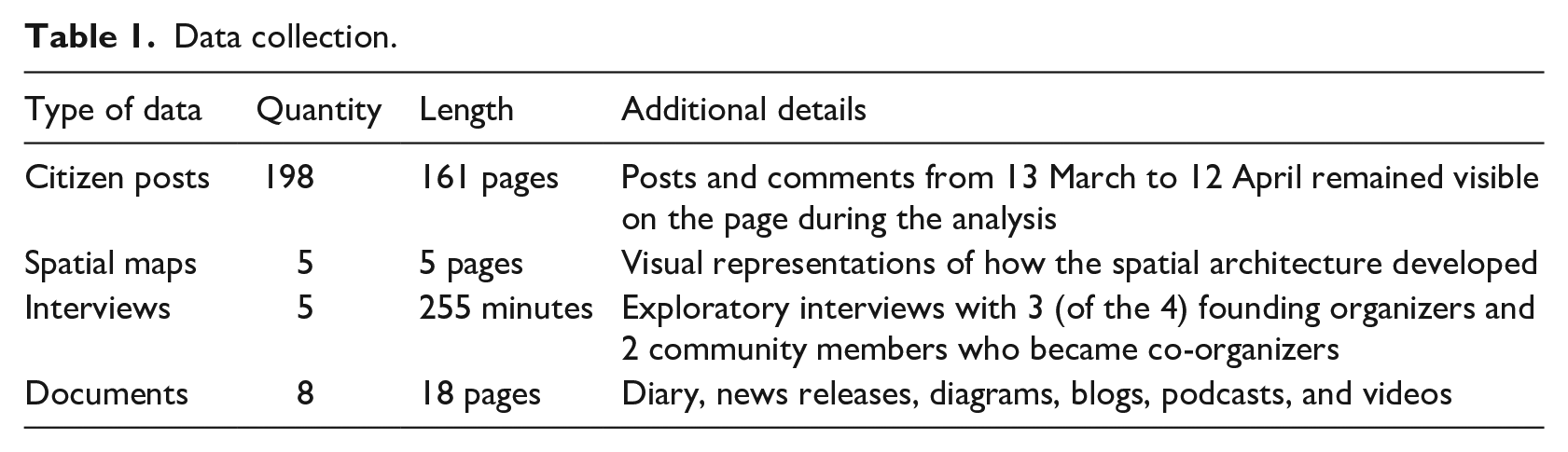
We initially concentrated on collecting and sorting posts chronologically. As the analysis proceeded, we focused on emerging categories deemed critical to how the group orchestrated helping. We frequently returned to the source data, performing targeted searches for data that substantiated and refined emergent themes – e.g. discussions about protocols and episodes of helping. We transferred salient posts and comments into Word documents for analysis, which generated over 160 pages of data, with observational (Obs.) data and memos included and timestamped.
We also conducted in-depth interviews with organizers and contributors to supplement the online data. During interviews, we probed areas not accessible on the Facebook page – e.g. the background of the CCSG creation; the thinking behind how the group would work; how and why various spaces and subspaces were created; the experiences of the organizers. We also drew on publicly available interviews that the organizers had given to local media to enhance and verify our interpretations and other data that organizers shared with us, e.g. a self-reflective diary. Table 1 provides a summary of the data.
Data collection.
Data analysis
We used an inductive theory-building approach (Strauss & Corbin, 1990). Each author immersed themselves in the data and undertook open coding on FB posts in iterative cycles – feeding observations into weekly coding discussions. We were immediately struck by how organizers delimited multiple spaces where seemingly random chance interactions produced coordination choices. Thus, we began to isolate and analyse data related to how the spatial architecture was constructed and how citizens arrived at these coordination choices.
At this point, we started to iterate between emerging themes and the literature to inform our inductive insights and theory development (Locke, 2001). We discovered that garbage can theory (Cohen et al., 1972) resonated strongly with the data and became sensitized to how group organizing involved creating nested spaces – analogous to ‘garbage cans’ – where people, problems and solutions met, and coordination choices happened. As we scrutinized data, we developed codes that captured how spatial-temporal simultaneity was producing coordination choices that orchestrated helping activity. We labelled these spontaneous matchmaking, proximal chance connects and speculative attraction.
The analysis then turned to how the primary group space and subspaces were co-constructed and partially organized (Ahrne & Brunsson, 2011). We created spatial maps to capture how the spatial architecture had emerged visually. These spatial maps were discussed in coding meetings and with organizers during interviews, and they validated our final visual representation presented in Figure 1.
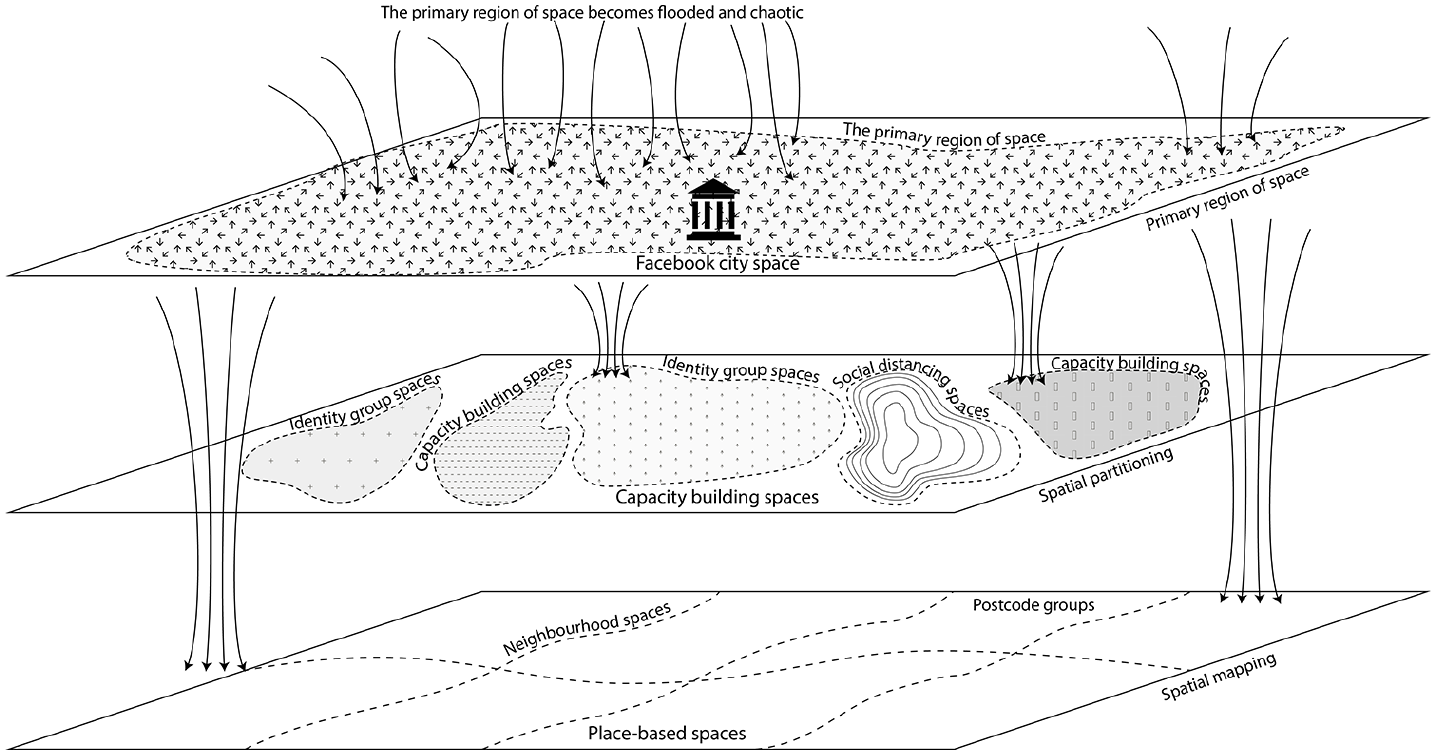
Spatial architecture of the emergent group.
Figure 1 represents the multi-layered spatial architecture that emerged, consisting of a primary region of space (i.e. the main Facebook space) and an assemblage of nested spaces – i.e. identity spaces for groups, capacity-building spaces, social distancing spaces and place-based spaces. We present these as layers for simplicity, but these spaces were interconnected and formed an expanding ecology of virtual spaces. Table 2 summarizes how the spatial ecology evolved, which we unpack in the findings.
Emerging spatial architecture.
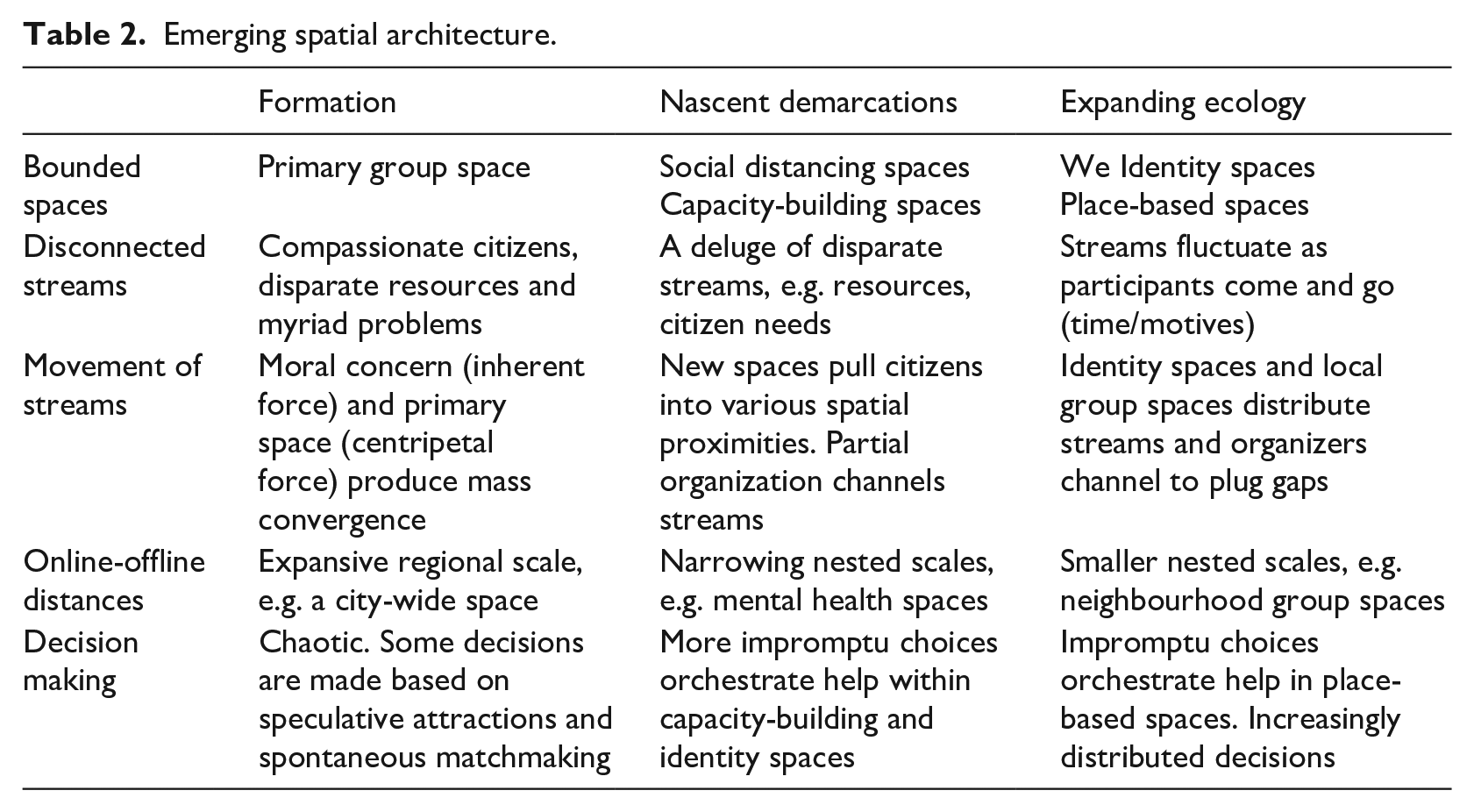
Our data analysis focused on developing a theoretical explanation of how these spaces were constructed to move streams and invite impromptu choice occasions. What was evident in the data was that the primary space became flooded and chaotic – see ‘grappling with bringing order to disorder’ and ‘impromptu efforts to orchestrate help breakdown’ in Table 3. Analysis revealed that organizers responded to this problem by demarcating subspaces (spatial partitioning) and using partial organizing to channel potentially compatible streams of problems, solutions and participants into new subspaces and corresponding spatial proximities. Theoretically, we conceived these spaces as ‘conspicuous’ garbage cans (Cohen & March, 1986) that exerted a centripetal force – pulling salient problems, solutions and citizens to them and creating ‘a degree’ of order.
Analytical themes.
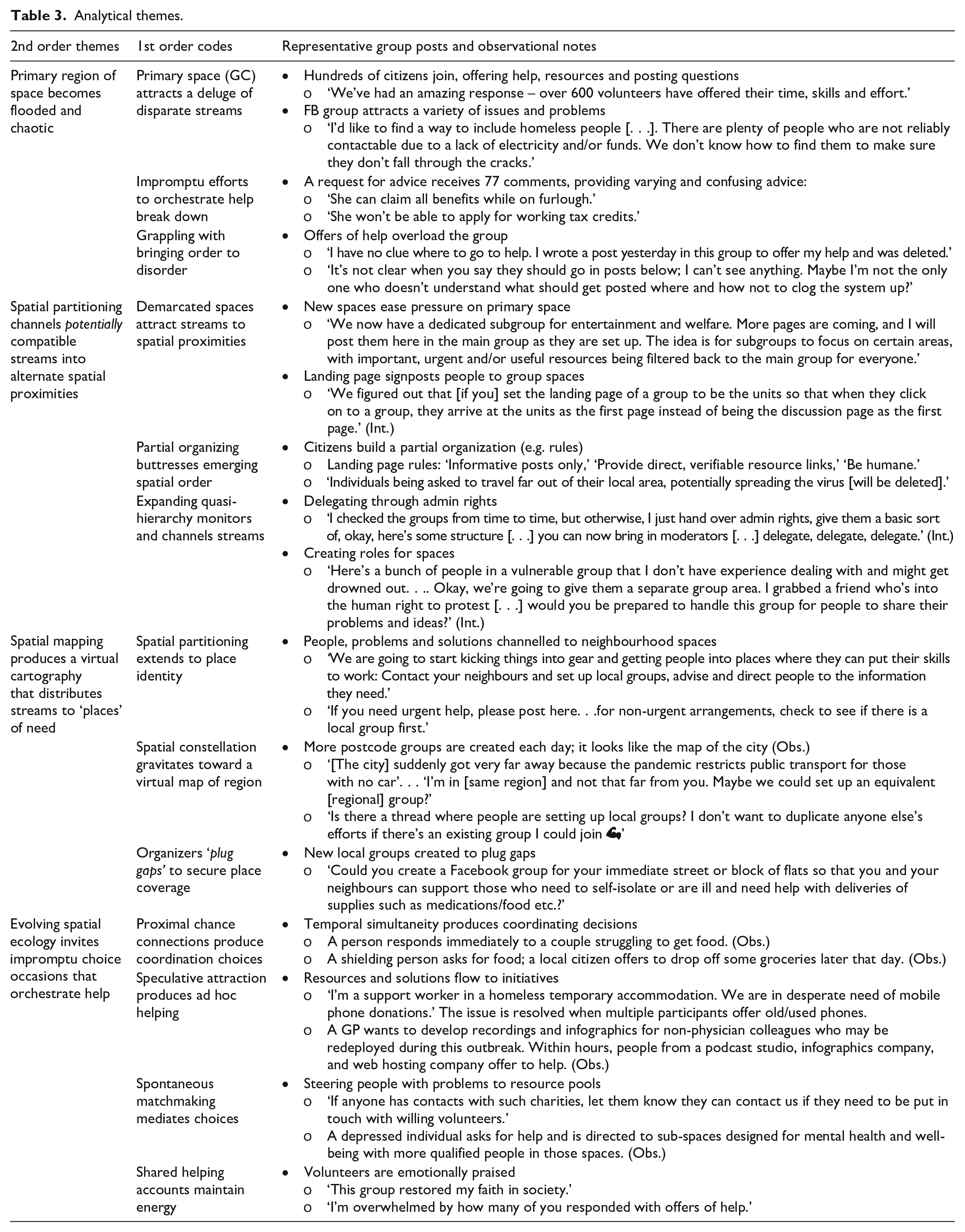
As we delved deeper into the decided order and classified spaces, we found that the spatial order gravitated towards ‘places’ as organizers created and linked to multiple neighbourhood group spaces (Figure 1, bottom layer), which narrowed online-offline distances (Table 2). In the disorienting world of a pandemic, with restrictions on movement, geospatial data (postcodes) and known place identities (neighbourhoods) provided citizens with a clear reference point to organize using what we call ‘spatial mapping’ (see Table 3). Here, we turned to cartography research in organization studies to theorize our findings (Newlands, 2021; O’Doherty, De Cock, Rehn, & Ashcraft, 2013) but found that our data pointed to a different view of virtual cartography insofar as citizens built a map of the city in virtual space, continuously ‘plugging gaps’ to secure place coverage. Our second-order theme, ‘spatial mapping produces a virtual cartography that distributes streams to ‘places’ of need’, reflects this novel and essential element of the developing spatial architecture.
Findings
The Covid-19 outbreak was sudden, taking the world by surprise. With a lack of information provided by the government, people were anxious and unclear about this new virus, what lay ahead, and how to respond, with many vulnerable groups under threat. Jake recounted: I trawled online media for articles, news, and opinion pieces, only getting lost in what has become a perpetually futile exercise in making sense of what may happen next: What does all this mean? (Diary)
Several days before the official lockdown, in anticipation of an impending humanitarian crisis, Tim, Jake, Jane and Mike decided to create the CCSG Facebook support group – a shared space for citizens in the city to give and receive help. Mike recalled how there was no clarity about what to do or how to organize a group to help people: It was very ad-hoc at the start, like we were figuring out what to do and how to do it and which outcomes to pursue. It was all very much made up along the way [. . .] the situation was unprecedented and evolving in real time. So it wasn’t even a matter of figuring out what to do because what to do kept changing! (Int.)
The primary region of space becomes flooded and chaotic
Primary space attracts a deluge of disparate streams
The group created a goal statement to make headway: ‘To connect those that can’t to those that can. No person left behind, and nobody left unaided when someone, somewhere, is willing to help.’ The name City Coronavirus Support Group (CCSG) communicated that the group had a broad remit to support all who needed help in the city – no person left behind. Initially, the Facebook group was private; the founders approved citizen requests for membership. However, this soon became untenable as the clamour to join the CCSG increased. Membership settings were changed to a public page, creating a porous and non-discriminatory space that allowed anybody in. This change opened the floodgates and created a surge in participation. The group went from 50 to 600 members in less than two days. To keep the group on track, founders moderated posts before publishing them on the CCSG. However, this became increasingly challenging as group membership soared and people, information and issues poured in. The primary Facebook space (henceforth primary space) was inundated with questions, requests for help, opinions, advice, resource offerings, skills, and so on. While the group had generated the energy of a social movement (Kornberger et al., 2018), the primary space was flooded with miscellaneous content as people sought and offered solutions. The organizers became concerned that the sheer volume of posts could jeopardize the purpose of the CCSG because ‘vulnerable people could be overlooked’ with requests for help buried under the avalanche of posts.
Impromptu efforts to orchestrate help frequently break down
In this crowded space, citizens struggled to organize assistance, and efforts to organize help broke down. Simple requests for aid would attract myriad responses, making it impossible to decide who would do what. The administrators also faced mounting pressure to clear the primary space so that urgent requests received attention. In one instance, Jannet, who was immunosuppressed and awaiting a transplant, was running out of liquid antibiotic soap for dress changing for her dialysis. She posted that she was ‘unable to go to the shops due [to] renal failure causing crippling exhaustion.’ She needed help urgently. However, there was a significant delay before her post was published because it took administrators a long time to read and filter irrelevant or redundant posts. A group administrator commented: I had to filter through a multitude of pending posts to see this one. If those had all gone up, this post could easily have vanished down the page and been missed, exactly what we’re trying to avoid. Hopefully, we can sort out some help for you, Jannet. Everyone else, PLEASE avoid posting unless you are aware of large-scale resources that have not already been mentioned below OR have urgent need of help. (Obs.)
Over 80 people responded to Jannet, and she received the antibiotic soap. However, organizers realized that the primary space and organization were inadequate. As Tim explained, the group initially functioned like a ‘radio station’ – if people ‘tuned in’ at the right time, they read posts and comments, but if not, posts and information were buried as new posts arrived. Thus, the spatial structure was insufficient to handle the torrent of incoming streams: The initial structure was. . .here’s a post, comment if you need help. Here’s a post, comment if you provide help. Really basic and frankly inadequate for what followed. (Int.)
Grappling with bringing order to disorder
The organizers ‘had daily WhatsApp chats in the morning to check what happened yesterday and what we will do.’ Managing the chaotic influx of people and information required significant time and energy that exceeded the administrators’ capacity. A solution to this problem was needed as a matter of priority. But how to enable volunteers was uncertain and ambiguous: “With the situation still developing and no further news or guidance, we have sought out as much reliable information as possible to provide some basics for volunteers.”
In this information vacuum, people were unsure how to organize aid with the risks not well understood. Some citizens with IT skills began working on an application to enable volunteering, only to abandon the idea when others pointed out the security risks and legal implications. Other citizens turned to basic solutions, such as sharing volunteering cards. For organizers, there were more questions about the group’s purpose and functioning, with growing concerns that vulnerable people and vital information were getting missed. Each question – ‘Elderly people will not be online, so is there a telephone number they could ring?’ – added more problems, complexity and chaos with unsustainable demands on the founders.
Spatial partitioning channels streams into alternate spatial proximities
Demarcated spaces attract streams to spatial proximities
In response, organizers began partitioning spaces, channelling streams into alternate spatial clusters. Here the findings centre on the middle layer of Figure 1, where the modus operandi of organizers switched to designing and constructing capacity-building spaces, identity spaces and social distancing spaces. First, organizers utilized the ‘social learning unit’ functionality of Facebook to create capacity-building spaces – ‘resources’, ‘ways to volunteer’, ‘volunteering safety’ and ‘requests for aid’ – to organize resources, channel conversations and guide helpers to deliver support. Second, organizers began creating identity spaces for community groups. These identity spaces were based on social groupings and demographics – e.g. parents, LGBT, disabled people. “Accessibility and disability usually get a bit side-lined. We were afraid it would get drowned out. . .[we said] we are gonna give them a separate group space” (Int.).
Finally, organizers created social distancing spaces to help people cope with isolation. A mental health space was created for people to access resources, exchange ideas and encourage well-being. An ‘entertainment for children’ space was created to help parents facing the prospect of working from home with children. This spatial partitioning happened quickly and initiated an expanding spatial ecology as organizers exploited the affordances of social media to keep branching out and fostering links to other social media spaces (e.g. charities and services like Food Hub) and groups emerging on specific topics (e.g. anxiety or hygiene).
From a GCM perspective, the growing constellation of subspaces attracted related streams to corresponding spatial proximities. It established a ‘degree’ of order as delimited spaces invited people with corresponding identities (e.g. ‘parents’), needs (e.g. ‘mental health’), problems (e.g. ‘requests for aid’) and solutions (e.g. ‘volunteering safety’) to go there. These subspaces were signposted in the CCSG so that posts and comments were directed to them. A ‘landing page’ was also established so that members could see relevant spaces immediately and go to salient discussions. Thus, a decided spatial order emerged where demarcated spaces functioned like valves, reducing pressure on the primary space and attracting salient problems, solutions and citizens into more compatible spatial proximities.
Partial organizing buttresses emerging spatial order
This emerging spatial order was underpinned by a partial organization that supported spatial delineations, established rules of engagement, and channelled issues, solutions and citizens to salient spaces. Facebook’s in-built hierarchical structure, consisting of administrators, moderators and members, allowed the organizers to distribute work and establish a quasi-hierarchy. Administrator and moderator rights were assigned to 18 members, creating a cadre of co-organizers, reducing the burden on the founders, and better utilizing an abundant supply of people, resources, skills and know-how. As new group spaces were created, new moderators were assigned – typically regular contributors with requisite technical skills and knowledge. Group moderators were given authority to weed out comments and questions that did not correspond with the purpose of designated spaces. With a good sense of what belonged in each group space, moderators and administrators worked to maintain the integrity of the spaces.
This included establishing quasi-protocols that directed citizens to appropriate subspaces and told them how to engage with information, resources and others. For instance, unsolicited posts offering volunteering help were forbidden: “One of the early rules we had was no individual offers of help [. . .] we directed those people towards local groups. This was because we had a lot of those posts early on that started clogging the place” (Int).
Other protocols were developed and modified as the crisis unfolded. For instance, commercial offerings were initially banned, but this rule was relaxed for offerings deemed necessary for community safety and needs, e.g. businesses advertising masks and food delivery schemes were permitted to meet spiralling demand: ‘We allowed someone from a supermarket to post about their new delivery scheme.’ Other protocols informed how citizens undertook online-offline translations. For example, safety protocols were created to protect citizens delivering and receiving help. These were constantly updated as new information and guidance about Covid-19 came to light. For example, citizens were encouraged to only support people in their local geographical areas to reduce the spread of the virus. In addition, new protocols formed out of virtual interactions. Protocols about data protection, for instance, were created in response to lengthy exchanges about protecting personal information.
Expanding quasi-hierarchy monitors and channels streams
The developing partial organization and protocols enabled a growing assembly of co-organizers to monitor and channel streams to appropriate subspaces, cultivating a growing sense of order. Citizen co-organizers, who had been enrolled and assigned rights, moderated exchanges in group spaces following protocols. They regularly channelled contributions, queries and problems to a growing assemblage of more ‘suitable’ spaces, both within and outside the CCSG – e.g. linking citizens to relevant websites, virtual groups, or services. Tim recounted: A lot of people were contacting us directly. . .this was too much for us. We needed to delegate and refer and basically redirect all the stuff we are dealing with either to an end outlet or refer [. . .] to a specific website. (Int.)
Creating legitimacy was also part of this emerging picture, which was, to a degree, handled spatially. The CCSG lacked the legitimacy of a traditional NGO, with no central organization or professional legitimacy. Creating group spaces to deal with issues created a way – ‘a space’ – for citizens with salient ‘expertise’, ‘professional experience’ and ‘knowledge’ to gather, volunteer and utilize their competencies to oversee activity. Thus, utilizing the vast latent expertise of citizens (e.g. mental health professionals) in subspaces (e.g. mental health) built credibility and ensured that guidance was appropriate. Legitimacy was also created by adding links to neighbourhood support organizations with better local knowledge of local systems and facilities. As Tim explained, these local groups ‘know the local area; they can organize things in a way we didn’t want to do’. The links to place-based groups and neighbourhood groups grew, and geographical places became a critical reference point for organizers and citizens to organize spatial arrangements and distribute help across the city.
Spatial mapping produces a virtual cartography that distributes streams to places
Spatial partitioning extends to place identity
Covid-19 required on-the-ground help to be organized virtually to minimize travel and reduce the risk of transmitting the virus. To overcome restrictions, spatial partitioning extended to place identity spaces (e.g. neighbourhoods) to support local helping. We label this ‘spatial mapping’ because organizers used geospatial data (e.g. postcodes) as a reference point to chart spatial arrangements and distribute help across the city. For instance, organizers developed a postcode group directory to connect the CCSG to different neighbourhood groups and postcode groups that had sprung up across the city, utilizing Facebook and social media platforms, such as WhatsApp.
The most important news is we are seeing local volunteer groups, large and small, spring up all over the city, organizing themselves and getting in touch to tell us that they are there, they are eager, and they want to help. (Obs.)
Members were asked to add local groups they were part of to the directory. The bricolage of place-based groups continued as new neighbourhood groups were discovered and incorporated. Unlike spatial partitioning, there was no intention to create new place-based spaces. Instead, the organizers sought to connect with as many pre-existing local groups as possible. As Tim articulated in a post: ‘We’re not setting up the groups, but are reaching out to contact those that do self-organize so they can help each other.’
Spatial constellation gravitates toward a virtual map of the region
Consequently, the spatial ecology of the CCSG gravitated towards a virtual map of the city, with each new local group representing a new geographical place (space) to distribute people and organize help. When citizens discovered geographical places without neighbourhood groups, they worked to plug gaps and secure place coverage. For instance, members posted: ‘Nothing for East [post code] covering their neighbourhood’ and ‘My area of [post code] doesn’t have a group.’ Then members created neighbourhood groups to plug these gaps. As a CCSG member told us, ‘Creating as many local groups as possible became a priority because the city suffered from the lack of local initiatives and local representation.’ Once links with postcode groups were established, administrators asked people to post requests concerning local issues there: ‘We moved to people either posting under their postcodes in the group finder subgroup or locating their local support groups and posting their needs there.’ Thus, postcode groups created new conduits that redistributed streams (people, issues and resources) away from the primary space.
In summary, the CCSG organizers used spatial partitioning and mapping to co-construct a web of interconnected spaces that helped orchestrate helping. Capacity-building spaces overcame the problem of citizens arriving with ‘little direction or knowledge about how to help’ (Starbird & Palen, 2011, p. 4). Social distancing spaces provided emotional support (Pyle et al., 2019). And identity spaces, including neighbourhood spaces, attracted streams into more organized and narrowly defined social groupings, e.g. shared place identity, shared social identity, or shared interests. This alleviated pressure on the primary group space and created more spaces for citizens to connect and self-organize.
Evolving spatial order invites impromptu choice occasions that orchestrate helping
Proximal chance connections produce coordination choices
Each new space invited social exchanges between people who had the potential to connect due to underlying commonalties: concern for the same social group, from the same neighbourhood, worried about mental health. Consequently, the assemblage of spaces functioned like virtual garbage cans producing swathes of impromptu coordination choices according to propitious timing, individual discretion and arbitrary acts of kindness. For instance, a vulnerable person posted that they needed help getting medicine, which attracted the attention of those present. Coordination choices emerged as details about the location and task became apparent, and a person assigned themselves (solution) to the problem (need). Garbage can processes proliferated as spaces brought people together and kept inviting temporal simultaneity and moments of decision. Consequently, CCSG became quite good at responding to emerging issues and unforeseen problems despite the chaos and uncertainty of the crisis. Indeed, organizers were surprised by how well the collective self-organized to render assistance and tackle problems.
I was impressed by the extent to which things self-organized. . .people spontaneously starting things. . .there are at least 70 mutual support groups. . .just these things popping out of the woodwork, getting in contact with other people, self-organizing and keying in [. . .] a huge amount of what was accredited to us was crystallization. (Int.)
Speculative attraction produces ad hoc help
The spatial order manifested two other types of choice occasions – ‘speculative attraction’ and ‘spontaneous matchmaking’ – that arose from spatial-temporal simultaneity. Speculative attraction conveys how actors organizing pandemic-related initiatives attracted pools of latent resources and expertise. As public awareness about the group increased, the primary space became a beacon for individuals and groups (including non-members) seeking solutions to bespoke problems or needing help. Individuals would ‘speculatively’ enter the group space to tap into the available pool of latent resources. For instance, a medical doctor was developing educational podcasts for frontline workers to work safely during the pandemic – something they could listen to while commuting. While providing the content for the podcasts was straightforward, the doctor lacked the technical resources and know-how to produce podcasts. She speculatively posted on the main page to ask if anyone could help. Within hours, a person from a podcast studio, a person from an infographics company and a web hosting company offered to help develop the material, free of charge. Thus, an unintended benefit of assembling a large emergent group was that processes of speculative attraction were greatly enabled, allowing the collective to spontaneously solve unique and bespoke problems, often in ways that went beyond what the organizers had envisaged.
Spontaneous matchmaking mediated choices
Spontaneous matchmaking also produced a bevy of coordination decisions. As members reacted to problems in the moment, they matched them to potential solutions, resources, or contacts. Here, members acted as brokers, matching community problems to potential solutions or spaces where solutions might be found or directing resources to places where they might be most needed and relevant. While matchmaking was purposeful, the coordination choices that emerged – e.g. who helped – were spontaneous and situated, depending largely on the availability of people with solutions in that space at that time. For instance, a person suffering from mental health issues and suicidal thoughts, exacerbated by the pandemic, posted on the group. Members recognized that this person needed the help of a qualified specialist. Hence, they directed the person to the mental health page, where more knowledgeable volunteers attended to them.
The partly random nature of choices was further illustrated when a homeless person posted that he was running out of money and food on the main page. He asked where he could get help, and a flurry of comments (solutions) arrived, directing him to help. Most were not feasible, and eventually, a kind-hearted citizen offered to give him some money to alleviate his problems. This helping decision was, once again, a product of the evolving spatial order and serendipity. Had the homeless person posted in a neighbourhood sub-group at a different time, the solution would have been different. In this way, space and impromptu choice occasions conspired to orchestrate widescale helping.
Shared helping accounts maintain energy
How decision-makers allocated time and energy to choice opportunities had a significant bearing on how decisions unfolded, in line with the GCM (Cohen et al., 1972). The group needed to maintain energy and resilience. As Tim explained, ‘There is a mixture between trying to keep the community alive and keeping the community relevant.’ We found that shared helping accounts maintained energy and momentum. Each day, people praised, encouraged and applauded volunteering efforts. Shared emotive accounts nurtured a positive collective ethos – ‘we are a community that does not leave people on their own’ – and uplifting posts energized members and sustained their efforts.
I’m overwhelmed by how many of you responded with offers of help [. . .]. I was the first person to post a plea for help early this morning. I’ve watched as hundreds of volunteers have joined, as moderators have organized themselves (without government direction) into something aiming to be all-encompassing. I believe people want to do good but still had fear over the panic that’s ensuing as I made my request. That has been replaced by a feeling of utter appreciation that strangers have given up their time, energy, resources and money to help someone they don’t know and didn’t even see at the door! I am hugely humbled. From every cell in my being, THANK YOU. (Obs.)
Discussion
The theoretical puzzle we investigated was how emergent groups self-organize the chaotic milieu that ensues when crowds of compassionate citizens, those needing help, and disparate resources flood into social media groups. Informed by a novel spatial conception of garbage can theory, we found that emergent citizen groups orchestrate helping activity through two modes of emergent organizing that are inextricably entwined. First, citizen organizers used spatial partitioning and spatial mapping to co-construct a multi-layered spatial architecture and virtual cartography that distributed streams into more ordered spatial proximities. Second, citizens helping choices manifested within a developing spatial ecology that invited impromptu choice occasions: spontaneous matchmaking, proximal chance connects and speculative attraction. In this way, the emergent group harnessed a generative interplay between order and disorder (Garud, Jain, & Tuertscher, 2008). Our findings suggest that social media coordination is a mutually reinforcing interaction between organizers orchestrating through spatial practices (constructing spatial order) and crowds of citizens self-orchestrating through serendipitous chance connects (harnessing disorder). Thus, space was not merely a canvas for organizing; it was constructed to self-organize in an emergent yet sophisticated way. Our results contribute to organization studies and crisis management literature in two ways.
Advancing a novel spatial conception of online-offline translations
Our first contribution is to scholarship on emergent groups and social media organizing. Emergent groups exhibit crowd behaviour, encapsulated in the language of ‘swarms’ (Majchrzak et al., 2007) and ‘chaotic patterns’ (Reuter & Kaufhold, 2018). When citizens converge, they confront an unfolding crisis generating disorder and ambiguity (Kornberger et al., 2019; Weick, 2015). We show how emergent groups initially become overwhelmed by myriad problems, indeterminate information, and citizens offering help. Within days, the primary group space resembled an anarchy situation (Olsen, 1972); an overloaded garbage can where choices were difficult to make (Coutu, 2006), problems were overlooked (Martin, 1981), and urgent issues were left without getting attention (Cohen et al., 1972). Revisiting garbage can theory – problems, solutions, participants and choice opportunities as fluid streams – and advancing a novel spatial conception of garbage cans (virtual spaces), we contributed a new theoretical perspective to study social media organizing that enabled us to expand our understanding of how citizens self-organize online-offline translations.
Previous crisis studies have approached social media through the prism of platforms, seeing them as relatively fixed structures. Organizers are cast as mediators, identifying demands for help, broadcasting what help is needed, and directing citizens to places where assistance is required (e.g. Albris, 2018; Kaufhold & Reuter, 2016). This mediation role is sometimes necessary because of a complex interface with emergency services, yet it puts an enormous strain on ‘heroic’ organizers who become overwhelmed. Our study, perhaps because it did not involve emergency services, discovered an alternative way of organizing online-offline translations, one that alleviates the burden on organizers to coordinate helping activities directly and which recasts them as ‘co-designers’ of an evolving spatial ecology that is ‘perpetually in the making’ (Garud et al., 2008, p. 356). We do not suggest that spatial partitioning and spatial mapping are unchallenging. On the contrary, and consistent with prior works, we show how organizers face disconcerting ambiguity and must ‘feel their way’ towards spatial orders amid a crisis (Kornberger et al., 2019). Nevertheless, our paper brings into focus how constructing and arranging spaces (Stephenson et al., 2020) enables organizers to orchestrate the locus of virtual interactions, channelling chaotic streams into spatial proximities that foster virtual co-presence (Subramaniam et al., 2013), serendipitous encounters (Irving et al., 2020), and impromptu choices (Cohen et al., 1972) that orchestrate help. In this respect, we contribute to the emergent group literature by showing how citizen organizers disburden the primary space and better utilize abundant streams of resources and compassionate citizens to enable online-offline translations.
These findings push research on emergent groups and social media organizing (Leonardi & Vaast, 2017) to rethink how order-disorder, space-temporality and purposefulness-serendipity work conjointly to orchestrate online-offline translations. Prior studies conceived social media platforms as ‘functional switchboards’ (Albris, 2018) and ‘sharing platforms’ (Kornberger et al., 2018) that afford new forms of organizing (Sæbø et al., 2020). Our findings complement this view by revealing how citizens utilized the functionality of social media – rules, moderation, access controls – to construct a partial organization (Ahrne & Brunsson, 2011) that pushed streams into more orderly arrangements. But our theoretical insights also direct attention away from the technology itself, its functional properties, toward a more spatial ecological understanding of social media organizing. In particular, our findings foreground how orchestrating online-offline translations is a spatial accomplishment (Stephenson et al., 2020), where constitutive elements of space – i.e. boundaries, movement and distance (Weinfurtner & Seidl, 2019) – are active in producing relations and decisions.
The concepts of spatial partitioning and mapping cast new light on how ‘distinction-drawing operations’ (Hernes, Bakken, & Olsen, 2006, p. 45) demarcate capacity-building spaces, social support spaces, identity spaces and place-based spaces. Spatial designations, epistemic delineations and ‘rules of inclusion’ establish identity boundaries (Santos & Eisenhardt, 2005) that signal which participants, problems and solutions should access spaces. Cohen and March (1986) noted long ago that actors could influence decisions by providing ‘conspicuous’ garbage cans that attract disconnected streams. We add to the literature on social media organizing by calling attention to the importance of attraction and movement, often overlooked in discussions about platforms and affordances. Returning to Aristotle, Weinfurtner and Seidl (2019) remind us how movement is triggered through an inherent force or an external force that pushes or pulls. We show how these forces underpin online-offline translations. Inherent force is generated by a ‘shared moral concern’ (Kornberger et al., 2018) that drives citizens to the primary space. Each new space – choice arena – generates a centripetal force that pulls ‘potentially’ compatible streams into corresponding spatial locations, creating conglomerations in places of need, and increasing the prospect of chance connects (Padgett, 2013). And organizers push and channel issues, solutions and people into spatial clusters by constructing a partial organization (Ahrne & Brunsson, 2011) and intentionally using quasi hierarchies and protocols to channel streams.
Our study also elucidates how online groups overcome problems of geographic distance. Social media allows distanced citizens to ‘connect, communicate, and exchange with multiple others beyond geographical or temporal distance’ (Vaast, 2019, p. 1675). The distance can be an asset when citizens are ‘enmeshed in a wider evolving ecology of online media and social network sites’ that enable members to share and triangulate information (Grabher & Ibert, 2014, p. 102). Yet, physical distance is equally problematic when online-offline translations must cover expansive territories. Spatial mapping as a cartographic practice transcends prior conceptions of crisis mapping (Pyle et al., 2019) and better explains how emergent groups construct spatial ecologies (virtual cartographies) that overcome remoteness, distributing streams to ‘places’ of need. In the CCSG, the map of the city and geospatial data (i.e. postcodes) provided representational images to navigate ambiguity: shared mental maps (Weick, 1995) to conceive virtual spaces, expose missing places and assemble people, problems and solutions in underserved territories. Prior studies conceived a dichotomy between online versus offline, seeing two separate worlds connected by mediating actors. Echoing prior discussions of place and space (Gieryn, 2000; Grey & O’Toole, 2020), we show how virtual space and place become transposed and intertwined. Through spatial mapping, citizens carve out place-based virtual spaces that become ‘infused with people, objects, symbols and meaning’ (Larson & Pearson, 2012, p. 245). Thus, a form of online-offline transposition unfolds, where virtual ‘collective constructions of place emerge’ (Grey & O’Toole, 2020, p. 207) as a precursor to, and product of, online-offline translations. Hence, ‘place is not merely a setting or backdrop, but an agentic player’ (Gieryn, 2000, p. 466) in orchestrating helping. Our paper thus invites scholars to rethink how online spaces and offline places are interrelated and co-constitutive.
We encourage future scholarship on online-offline translations to look beyond platforms and mediated agency and attend to how constructed spatial ecologies and serendipitous encounters jointly orchestrate activity. Our insights should be applicable in other crisis and disaster contexts, where unexpected events cause suffering and humanitarian needs (Shepherd & Williams, 2014), unleashing a wave of compassion (Trautwein et al., 2020) that needs to be organized virtually to orchestrate wide-scale helping. By contrast, our insights may be less applicable to firm crises and creeping crises like climate change unless they generate enough collective energy for crowds to converge online and spontaneously self-organize, as with extreme events (Lanzara, 1983; Shepherd & Williams, 2014). Indeed, an intriguing direction for future research would be to explore how responses to slower-developing crises, like climate change, can be acted on using online-offline translations.
Implications for organizational studies of decision-making in crises
Our insights also challenge studies of crisis decision-making to account more fully for how spatial arrangements and temporal simultaneity (Cohen et al., 1972) interact to influence decisions. In a crisis, actors confront ‘uncertainty, urgency and threat’ (Brinks & Ibert, 2020, p. 284) and ‘ambivalent possibilities’ (Reuter & Kaufhold, 2018, p. 42). Consequently, March’s (2018) logics of consequences and appropriateness have been deemed ‘insufficient guides to decision-making’ (Kornberger et al., 2019, p. 250). Recent empirical scholarship has focused on alternative decision-making logics as a solution to this dilemma. For example, Monllor, Pavez and Pareti (2020) found that volunteers used an effectual logic – i.e. experimentation, improvisation, on-the-go planning. Kornberger and colleagues (2019) built on von Clausewitz’s (1832/2005) work to introduce the ‘logic of tact’ as an alternative modus operandi during a crisis; managers making decisions by engaging in coup d’oeil – ‘feeling out’ situations, ‘forming impressions’ and building an ‘inner map’ – and courage d’esprit – formulating quick, decisive and measured responses. Other studies have explored fast-paced decisions (Schakel & Wolbers, 2021), distributed decision-making (Treurniet & Wolbers, 2021) and sensemaking (e.g. Dwyer, Hardy, & Maguire, 2021; Kendra & Wachtendorf, 2006). These studies can explain how organizers, in our case, grappled with ambiguity and purposively developed a spatial architecture, but tend to gloss over the importance of spontaneous choices and space.
Notably absent is a serious consideration of how spaces and serendipitous encounters interrelate to produce choices, a central finding in our case. Similar to Weir (2010), our study elucidates how spatial arrangements influence decision-making patterns. Chance interactions in circumscribed social media spaces produced vast organizing decisions, conceptualized as spontaneous matchmaking, proximal chance connects and speculative attraction. In Lefebvrian (1974) terms, these ‘lived spaces’ produced temporal connections as the assemblage of citizens ebbed and flowed (Weir, 2010). Disconnected people, problems and solutions were ‘joined by the relatively arbitrary accidents of their simultaneity’ (March, 1978, p. 592) that invited sporadic ‘moments’ of decision. Consequently, coordination decisions emerged from a partly random and partly ordered intersection of ‘citizens with problems’ meeting ‘citizens with solutions’. These insights go beyond theories about decision-making logics and sensemaking (Kornberger et al., 2019) and call for greater attention to how spatial co-presence (Subramaniam et al., 2013) and temporal simultaneity (Cohen et al., 1972) work synchronously to produce choices. Our conception of garbage cans as both ordered and disordered resonates with and extends ideas about the productive potential of incompleteness (Garud et al., 2008), undecided orders (Barberio, Höllerer, Meyer & Jancsary, 2018) and collaborative spaces (Irving et al., 2020).
In addition, our study paves the way for organization studies and crisis management scholars to reconnect with classical garbage can theory and rediscover its explanatory power in ‘situations of crisis’ where garbage can processes are prevalent (Cohen et al., 2012, p. 29). Prior research on the GCM ‘has been powered by computer simulations rather than by actual empirical studies’ (Glynn, Greve, & Rao, 2020, p. 126). As Padgett (2013, p. 473) lamented, we ‘prefer to isolate and study specific mechanisms rather than to revel in their collective interaction and cacophony’. Our study demonstrates the importance of studying collective interactions, especially how partial organizations and spatial structures unfold to attract cacophonous streams into something resembling order. The GCM has traditionally been used to explain how choices happen in established organized anarchies where ‘garbage can process does not resolve problems well. But it does enable choices to be made [. . .] when the organization is plagued with goal ambiguity’ (Cohen et al., 1972, p. 16). The key phrase here is enabling choices, which is critical in crises characterized by extreme ambiguity (Weick, 2015). We encourage future research to investigate further how actors can build partial organizations (Ahrne & Brunsson, 2011) to harness the potential of temporal and spatial sorting and loose linkages between dispersed people, problems and solutions (March, 1994).
Our spatial conception of garbage also challenges scholars to consider how ‘space’ is inextricably linked to temporal simultaneity (March, 1994). In the GCM literature, spatial images lurk in the background, persistently invoked in the nomenclature of ‘garbage cans’, ‘choice arenas’, ‘decision arenas’, but rarely theorized as a primary object of organizing. The backgrounding of space occurs because ‘garbage cans’ and ‘choice opportunities’ are used synonymously. In the original formulation, garbage cans constitute ‘occasions’ when actors are expected to produce a decision, e.g. an agenda item or contract that needs signing (Cohen & March, 1986; Cohen et al., 1972). To be sure, choice occasions happen somewhere, but space is rarely theorized. This conceals the spatial dimensions that contribute to temporal simultaneity (March, 1994) and underexploits theory development opportunities that lie in approaching garbage cans as spatial as well as temporal phenomena. Our spatial theorizing offers intriguing possibilities for scholars to explore how the chaotic randomness associated with organized anarchies can be spatially harnessed.
Practical implications
Finally, our study points to practical contributions that can inform official responses to social crises and disasters. A dilemma in crisis management is how formal agencies that rely on top-down approaches and command-and-control can connect with bottom-up citizen initiatives and utilize them in crisis management activities. Official responses could use our spatial organizing principles to leverage citizens’ vast and latent potential to provide resources, creative solutions and help in defined areas of need. For example, official agencies could create circumscribed spaces to orchestrate helping activity across a region, establishing rules of inclusion and identity boundaries (Santos & Eisenhardt, 2005), but allowing garbage can processes to drive the orchestration of humanitarian aid in a geographical place or epistemic domain.
Footnotes
Acknowledgements
We would like to thank our Editors, Martin Kornberger and Renate Meyer, and the three anonymous reviewers for their excellent scholarly support and guidance that enabled us to make the most of this study’s potential and elevate our results and ideas. In addition, we thank the citizens in an anonymized UK city who gave up their time to speak with us and thereby made this study and the paper that you have read or are about to read possible. This paper is dedicated to citizens worldwide who self-organized during the Covid-19 pandemic to protect and look after themselves, their friends and family, and their neighbours.
Funding
The author(s) received no financial support for the research, authorship, and/or publication of this article.
