




Abstract
This article develops the idea of ‘interlinking theorization’ in the context of management knowledge. We explain how management concepts are theorized through their direct co-occurrence with other management concepts, on the one hand, and their embeddedness in general business vocabulary, on the other. Conceptually, we extend a semantic network approach to vocabularies and suggest both cohesion between management concepts (i.e. a clustering in bundles) and their semantic equivalence (i.e. similar patterns of connectivity to general business vocabulary indicating specific types) as core dimensions of interlinking theorization. Empirically, we illustrate and further develop our conceptual model with data collected from magazines targeting management practitioners in the Austrian public sector. Our article contributes to existing literature by extending theorization to include different kinds of relationships between management concepts and focusing on direct and indirect relations across populations of management concepts as characteristics of the overall ‘architecture’ of management knowledge.
Keywords
Introduction
A substantial amount of research in organization and management theory addresses the question of how management knowledge is constituted, and how specific management ideas, tools and practices acquire meaning in different cultural contexts (e.g. Sahlin-Andersson & Engwall, 2002; Spyridonidis, Currie, Heusinkveld, Strauss, & Sturdy, 2016). Management knowledge shapes managerial thinking and organizing, and specific elements of management knowledge, here referred to as management concepts, diffuse widely as standardized solutions to typical organizational problems (e.g. Abrahamson & Fairchild, 1999; Heusinkveld, Benders, & Hillebrand, 2013; Røvik, 2011). How these become imbued with meaning has been a core question in organization and management research.
Previous literature has suggested theorization – i.e. the establishment of social categories and their causal relationships – as the key mechanism through which ideas and practices become socially meaningful (Strang & Meyer, 1993). For management knowledge, this involves the specification of typical organizational challenges as well as the justification of possible solutions (Greenwood, Suddaby, & Hinings, 2002). In fact, it is often not managerial practices themselves that spread widely, but their abstract theorizations (Strang & Soule, 1998). While, in principle, any novel idea can be theorized, we here focus on management concepts: prescriptive models, schemata, or typified solutions denoted by a particular label (for instance, ‘total quality management’ or ‘business process reengineering’), providing guidelines on how to deal with specific organizational issues (e.g. Heusinkveld et al., 2013). 1
There are indications in existing literature that theorization does not involve isolated acts of meaning-making but relates them to each other. It is in this sense that Strang and Meyer (1993, p. 500) suggest that a ‘network of congruent theories’ forms a comprehensive body of knowledge. Theorized linkages and similarities among ideas influence their aggregate meaning and, consequently, their diffusion. In a similar vein, arguments have been made that management knowledge can be understood as an ‘ecology’ and the totality of management concepts as ‘population’ (e.g. Wruk, Scheiber, & Oberg, 2013). Within such ecology, multiple management concepts may agglomerate, thereby forming distinct ‘families’ (e.g. Abrahamson & Fairchild, 1999). Diffusion studies have compared the interlinked trajectories of small numbers of management concepts (e.g. Abrahamson & Eisenman, 2008; Meyer & Höllerer, 2016; Shipilov, Greve, & Rowley, 2010). In addition, research has suggested that management concepts need to align with cultural meanings in order to become entrenched (Zeitz, Mittal, & McAulay, 1999), therefore stressing their embeddedness in broader management knowledge expressed in professional (e.g. Shenhav, 1999) or social discourses (e.g. Chreim, 2006), rationalized myths (e.g. Zilber, 2006), or the particular zeitgeist (e.g. Clark & Salaman, 1998; Grint, 1994). Work on translation and framing (e.g. Boxenbaum, 2006; Meyer & Höllerer, 2010; Wedlin & Sahlin, 2017) has addressed the cultural embeddedness of individual management concepts’ theorizations.
Despite the acknowledgement that elements of management knowledge are theorized in relation to each other, we lack a systematic conceptualization of how theorizations may be linked, and how this can be adequately studied (for some ideas in this direction, see Wruk et al., 2013). Neglecting the fact that individual management concepts are theorized as part of a population and as embedded in broader stocks of management knowledge renders it difficult to assess, for instance, whether an emerging management concept is novel, a variation of an existing one, a relabelling, or a bricolage of preexisting ones (e.g. Heusinkveld et al., 2013; Höllerer, Meyer, & Lounsbury, 2017). Similarly, such theorization facilitates a better understanding of the relationships (e.g. complementary, contradictory, or neutral) and hierarchies (e.g. whether one is a subcategory or specification of another) of different management concepts that are simultaneously or diachronically employed by an organization.
We therefore contend that there is a need for conceptually developing the idea of what we here dub ‘interlinking theorization’, acknowledging both (a) the direct relationships between management concepts, and (b) their indirect relationships in terms of similar or dissimilar embeddedness in general business vocabulary. We aim at addressing this gap by asking the following research questions: How do direct and indirect relations between management concepts imbue them with meaning and contribute to their theorization? What can be learned about the relational structure of management knowledge by studying the different dimensions of interlinking theorization?
Conceptually, we draw on a vocabulary perspective (e.g. Burke, 1935, 1937; Mills, 1939; Loewenstein, Ocasio, & Jones, 2012), and extend it to theorization. Research in this tradition ranges from in-depth analyses of dominant terminologies (e.g. Hirsch, 1986) to sophisticated analyses of semantic networks (e.g. Jones, Maoret, Massa, & Svejenova, 2012). We build on network approaches to vocabularies and suggest that management concepts are ‘keywords’ (Jones & Livne-Tarandach, 2008) embedded in ‘other words’ – in our case, general business vocabulary (e.g. efficiency, innovation, CEO, customer; see Ocasio & Joseph, 2005). This allows us to investigate the interlinking theorization of management concepts and the structural properties of management knowledge (i.e. its ‘architecture’) as characterized by two forms of vocabulary relations: on the one hand, frequent co-occurrences of certain management concepts (revealing what we call ‘cohesive bundles’) manifest as dense clusters and constitute direct relationships. On the other hand, similar patterns of connections between management concepts and configurations of general business vocabulary (revealing what we call ‘semantically equivalent types’) constitute indirect relationships. Elaborating the individual and combined effects of these two relations allows us to ‘zoom out’ of the theorization of individual management concepts and extend the current notion of theorization to entire populations of management concepts as well as to the architecture of management knowledge of which they are part.
To illustrate and further develop our proposed conceptual framework, we conduct a semantic network analysis (Carley, 1993, 1997) of the vocabulary in the area of public management reform in Austria. Our empirical data illustrates the usefulness of our conceptual ideas and prompts more fine-grained insights into the interlinking theorization of management concepts, the characteristics of cohesive bundles and structurally equivalent types, and the architecture of management knowledge of which they are part. Our article contributes to research on theorization by utilizing and further developing a vocabulary perspective. We add to existing work (e.g. Heusinkveld et al., 2013; Ocasio & Joseph, 2005) with a systematic framework that focuses on the relational character of interlinking theorization. In addition, our theory development adds to the literature on management knowledge (e.g. Spyridonidis et al., 2016), specifically from a vocabulary perspective (e.g. Jones & Livne-Tarandach, 2008; Ocasio & Joseph, 2005; Ocasio, Loewenstein, & Nigam, 2015).
The remainder of this article proceeds as follows. In the next section, we present our conceptual understanding of the architecture of management knowledge and further develop the concept of interlinking theorization as encompassing both the clustering of management concepts and their embeddedness in general business vocabulary. We then introduce the empirical setting, data and analytical procedures. After presenting our findings, we use our insights to elaborate on the proposed conceptual perspective, highlight our core contributions, and conclude the article by discussing promising avenues for future research.
A Relational Perspective on the Theorization of Management Concepts
Theorization, in its initial definition by Strang and Meyer (1993, p. 492), entails ‘the self-conscious development and specification of abstract categories and the formulation of patterned relationships such as chains of cause and effect’. It creates generalized models constituted through language. This feature makes theorization highly compatible with a vocabulary perspective. Loewenstein et al. (2012) define vocabularies as systems of words, used by collectives at different levels of analysis – groups, organizations, communities of practice or fields – in communication, thought and action. From a semiotic point of view, their vocabulary perspective stresses conventional associations between words (signifiers) and concepts (mental representations, i.e. the signified) (de Saussure, 2011). Theorization, then, ‘generates the categorical labels or expressions, as well as the conceptual meanings for referents in organizations and organizational fields’ (Ocasio & Joseph, 2005, p. 175). While basic applications rely on word frequencies as a measure for salience of concepts, the vocabulary perspective also stresses associative relationships between words as the central building blocks of social meaning (e.g. Loewenstein et al., 2012) and targets the structural properties of vocabularies as systems of social categories (Mohr, 1998). Pioneering research has drawn on a network theoretical perspective (e.g. Carley & Kaufer, 1993) and has already produced insightful studies in which shared meanings are traced as networks of co-occurrences of words (e.g. Jones et al., 2012; Mohr & Duquenne, 1997).
We draw on such insights and extend them in the context of the theorization of management concepts. Existing research in this area has suggested that management concepts exhibit distinct relationships to each other (e.g. Abrahamson & Fairchild, 1999; Meyer & Höllerer, 2016; Shipilov et al., 2010) and are also embedded in broader discourses or myths of modernity (e.g. Chreim, 2006; Shenhav, 1999; Zeitz et al., 1999). In what follows, we therefore (a) conceptualize the structural properties of management knowledge from a vocabulary perspective; (b) introduce co-occurrence of management concepts as a first relational dimension of their theorization; and (c) expand on equivalence of management concepts within the stock of management knowledge as a second relational dimension of their theorization. We then aggregate our conceptual ideas in a preliminary framework for interlinking theorization.
The architecture of management knowledge
As a start, we introduce two cornerstones of how management knowledge manifests in language. First, in structural semantic terms, there needs to be a distinction between management concepts (‘keywords’) and general business vocabulary, where the former ‘act as a radiating force’ around which the latter cohere (Jones & Livne-Tarandach, 2008, p. 1076). Second, management knowledge encompasses diverse elements, such as routines and practices, situational know-how, roles and identities, as well as models, cognitive schemata, broader cultural logics and specialized languages and terminology (e.g. Barley & Kunda, 1992; Hirsch, 1986; Jones & Livne-Tarandach, 2008; Loewenstein, 2014; Loewenstein et al., 2012).
In other words, theorizations combine different components in specific ways. Strang and Meyer (1993) mention typified adopters and practices, as well as procedures, techniques, outcomes and virtues as such components. Similarly, literature on management concepts suggests that theorizations encompass adopter roles, prescribed actions, organizational goals and virtues, and means of achieving them (Abrahamson & Fairchild, 1999; Clark & Salaman, 1998; Heusinkveld et al., 2013). These most salient components of the theorization of management concepts 2 also resemble four elements of Burke’s (1945) dramatistic pentad: acts (what takes place), agents (persons or types of actors), means (resources or instruments used) and purposes (the goals and virtues towards which an act is directed). The sum of all components of theorization of a specific management concept, then, influences its meaning, and the theorizations of multiple management concepts may or may not overlap with regard to these components (e.g. they may share acts but not purposes, share all components, or be completely different). Accordingly, separating components of theorization analytically facilitates assessing where and how theorizations are linked, and where and how they differ.
Although unpacking management knowledge in these ways reveals its architecture as assembled through a variety of relations that all impact the theorization of management concepts, research has so far focused on one kind of relation: the embeddedness of single management concepts in general business vocabulary (for an exemplary study, see Ocasio & Joseph, 2005). Our argument here is that it is necessary to go beyond the theorization of single management concepts and to acknowledge that (a) management concepts may co-occur with other management concepts to certain degrees, and that (b) they may share or not share general business vocabulary. Focusing on these two relational aspects in tandem enables us to substantially extend existing insights on theorization.
Grouping of categories according to relational patterns has been a cornerstone in network theory where it is generally associated with the concepts of cohesion and equivalence. In this research tradition, Burt (1987) was among the first to search for subgroups in networks via comparing cohesion (i.e. direct bonding that manifests as denser areas in networks as the basis for the formation of social groups) and structural equivalence (i.e. similar patterns of connectivity across the entire network as the basis for the formation of social groups). Research emphasizes possible complementarities between cohesion and equivalence, for instance in explaining social homogeneity (e.g. Friedkin, 1984), or the social adoption of innovations (Burt, 1987). Other work (e.g. Walker, Kogut, & Shan, 1997) combines cohesion and structural equivalence to assess the role of social capital in network formation. In the following, we further unpack cohesion and equivalence to develop two different yet interrelated relational dimensions of interlinking theorization.
Cohesion: Clustering of management concepts
A first relational aspect of theorization refers to relationships between multiple management concepts based on their co-occurrence in specific parts of discourse. In network terms, the co-occurrence of multiple management concepts creates links between them. Management concepts that co-occur consistently form interconnected clusters, which express cohesion.
In its original application in social network theory, cohesion refers to groups of actors that interact regularly (e.g. as friends, colleagues, etc.; see, e.g., Burt, 1987; Luce & Perry, 1949). The vocabulary perspective focuses on words, or concepts, rather than on actors. Word use is situated (Loewenstein et al., 2012), which means that cohesion points at shared relevance in specific social situations or contexts. Hence, clusters of frequently co-occurring words are part of the same subdomain within the overall system of words. Such conceptual ideas have guided, for instance, Kennedy’s (2005) study on the emergence of a new market in which the co-occurrences of producers in news media and press releases reveal the developing structure of competition, or Wruk et al.’s (2013) analysis of different relations between organizational practices co-occurring in various types of media.
We argue that relationships among management concepts based on direct association with each other ‘link’ their theorizations in the sense that they reveal shared relevance in the same context of theorization. Accordingly, although such direct associations leave open their actual meanings, management concepts that co-occur frequently are part of the same topics or debates. Clusters of management concepts based on co-occurrence – we use the term ‘cohesive bundles’ to denote these – can exhibit different degrees of cohesion. The ‘bundling’ of management concepts according to cohesion, then, is a first relational dimension of their theorization.
Equivalence: Embeddedness in general business vocabulary
A second relational dimension of theorization concerns management concepts’ embeddedness in general business vocabulary. We borrow the idea of equivalence from network theory to argue that management concepts that display similar overall patterns of connectivity in the architecture of management knowledge are indirectly connected as they rely on the same general business vocabulary as a source of their meaning.
In networks of actors, structurally equivalent actors occupy similar roles, for instance, based on similar patterns of treatment in relief organizations (e.g. Mohr, 1994). While these actors may never meet in person, they are linked by the same social knowledge governing their role and are therefore similarly positioned in the social structure (e.g. Buchanan, Ruebottom, & Riaz, 2018). In analogy, management concepts are embedded in specific parts of management knowledge and acquire meaning based on the general business vocabulary to which they link. Hirsch’s (1986) study on ‘hostile takeovers’, for instance, shows that the meaning of this practice changed depending on whether it was embedded in vocabularies of ‘warfare’ or ‘courtship’. Ruef (2000) shows how identities of organizational forms are positioned in a multidimensional space based on how they link to particular vocabularies expressing values, technologies, processes, personnel and other concepts. Jancsary, Meyer, Höllerer and Barberio (2017) use arguments based on structural equivalence to explore the multiple identities of a complex organization based on links to typical practices. These studies maintain that relations between organizational practices, forms and identities are developed discursively based on mediating symbols rather than through direct comparisons.
We use the term ‘semantically equivalent types’ to capture management concepts that exhibit similarities in their patterns of connectivity (i.e. indirect associations) regarding the different components of theorization (i.e. agents, acts, means and purposes). Importantly, being of the same type entails similarity in terms of the content of theorization. Management concepts exhibit different degrees of equivalence: from having no overlap in any component to instantiating the same type in all components. ‘Typifying’ focal management concepts according to semantic equivalence is, in consequence, a second relational dimension of their theorization.
Towards a preliminary framework of interlinking theorization
Interlinking theorization can be conceptualized in a basic framework by combing the dimensions introduced above (see Figure 1). First, this framework integrates the two relational dimensions within the architecture of management knowledge. It allows for identifying areas of debate (i.e. contexts of theorization) and typified meanings (i.e. contents of theorization), and reveals different structures (centre/periphery structures, modular structures, fragmentation, etc.) within the architecture.
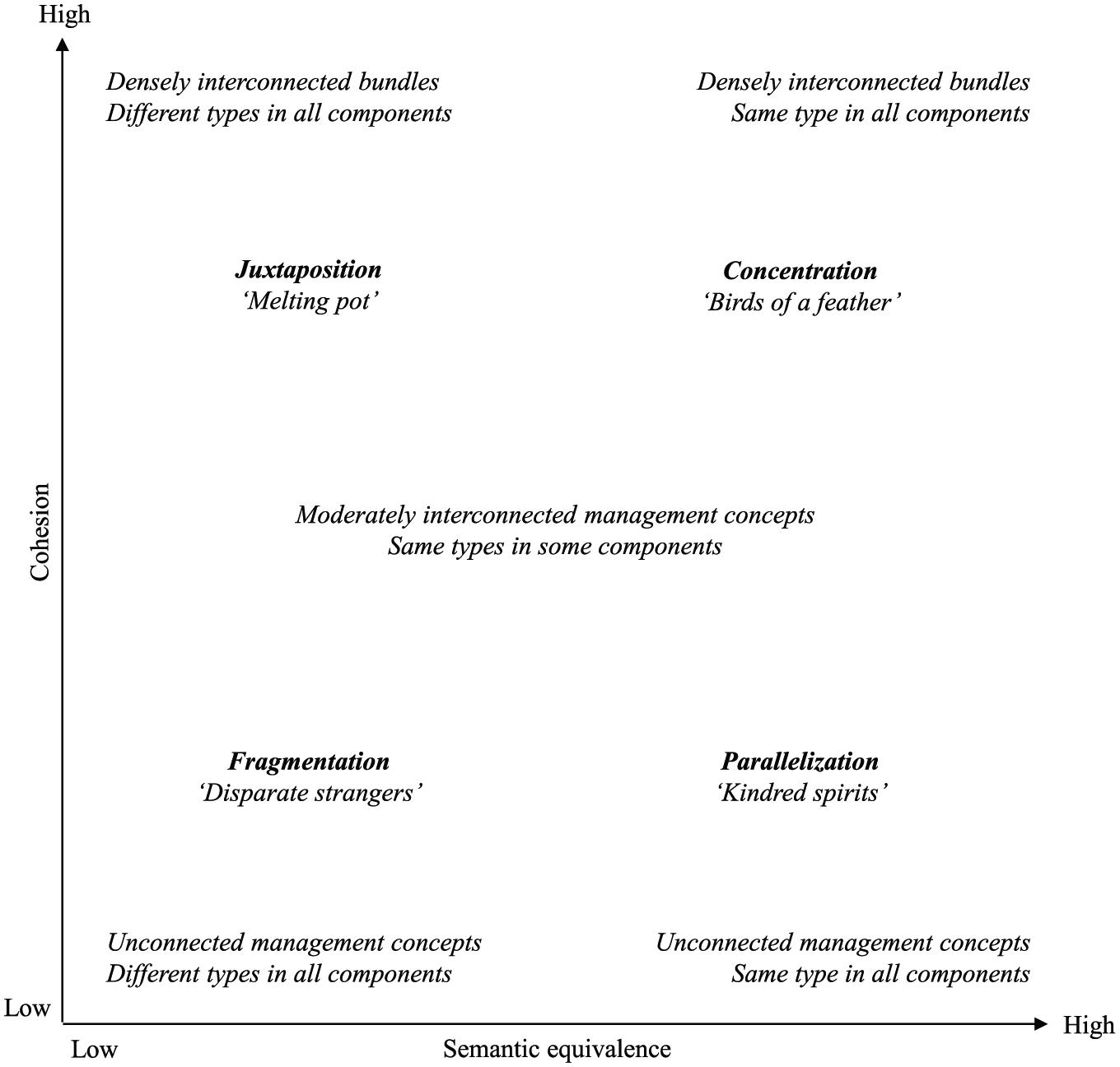
The two dimensions of interlocking theorization.
Second, any set of management concepts from a population can be characterized and compared in terms of their interlinking theorization based on this framework. If management concepts are neither part of a cohesive bundle, nor instantiate the same semantically equivalent type in any component of theorization, their theorizations are independent of each other (‘fragmentation’). Metaphorically speaking, they are ‘disparate strangers’ who have nothing in common and have never met. Conversely, management concepts that instantiate the same semantically equivalent type in all components and also co-occur as a cohesive bundle display a certain redundancy regarding their theorization (‘concentration’). The corresponding metaphor is that of ‘birds of a feather’ that ‘flock together’. When cohesion is high, but semantic equivalence is low, management concepts are part of the same debate but exhibit different contents of theorization (‘juxtaposition’). This is akin to a ‘melting pot’ in which different kinds of people share the same living space. Finally, cases where management concepts instantiate semantically equivalent types in all components but do not co-occur as a cohesive bundle point at a certain compartmentalization within the architecture of management knowledge. Since different labels for similar ideas are used in different debates (‘parallelization’), such management concepts can be understood as ‘kindred spirits’.
This framework is a considerable step towards an advanced understanding of theorization that takes seriously relations within and across populations of management concepts as characteristics of the overall ‘architecture’ of management knowledge. However, several issues remain. First, we wish to explore how useful our proposed conceptual framework is empirically, and what additional insights can be gained when tested with empirical data. For this purpose, we will utilize an adapted version of Figure 1 to discuss selected findings from our empirical illustration in the second part of this article. Second, we argue that our preliminary model is a helpful tool for reconstructing different relationships between management concepts within an entire population, such as hierarchy, overlaps, competition, complementarity, or specification. In order to address these questions, we will illustrate and further elaborate our conceptual ideas in the empirical context of Austrian public management reform. Providing a rich and vibrant – and at the same time relatively ‘bounded’ – discursive arena, we argue that this provides an excellent empirical setting for an investigation into how management concepts’ theorizations are interlinked.
Empirical Illustration
Data and sampling
Public sector reforms of recent decades, many of them under the banner of ‘new public management’ (e.g. Gow & Dufour, 2000; Hyndman et al., 2014; Pollitt & Bouckaert, 2011), have brought an array of management ideas and concepts into the public sector. Their relative novelty in legalistic Weberian-style administrations requires theorizations and makes this area a good empirical site to illustrate our model. We analyse three practitioner-oriented public administration magazines dedicated to public management and governance in Austria: Die Republik, Verwaltung Innovativ and Verwaltung Kompakt. We acknowledge that such sampling is hardly able to capture management knowledge or even management knowledge in the public sector in its entirety; nonetheless it captures a ‘discourse strand’ (e.g. Jäger, 2012) – a particular flow of discourse related to a specific topic, encompassing multiple subtopics: ‘modern’ public management in practitioners’ magazines.
With regard to theorization, such journals have been found to assume a ‘mediating function’ between legitimated theorists and adopters (Scarbrough, 2002; see also Mazza & Alvarez, 2000) as they contain rhetoric aimed at making the adoption of management concepts attractive. This is mainly achieved by anchoring them in a broader meaning system that goes beyond the organizational level. However, as scholars have noted (e.g. Nijholt, Heusinkveld, & Benders, 2014), resource constraints of professional magazines may create dependencies on external authors (like, for instance, consultants) and advertisers, creating a ‘filter’ that restricts which management concepts make it into the discourse strand and which do not. Also, Scarbrough, Robertson and Swan (2005) contend that management fashions are appropriated in magazines of different professional communities in particular ways. Such effects are mitigated in our study due to the fact that we focus on one broad professional community (public sector managers) and include the most prominent media outlets for this target group in a specific local setting. A brief comparison of contents between the magazines also confirms that there are no systematic differences between them in terms of management concepts addressed.
The three selected magazines differ only slightly with regard to their focus and overall mission. Die Republik defines itself as a media outlet directed primarily at executives as well as policy makers in the Austrian public sector. It reports on management solutions, know-how, successful projects as well as the careers of individual managers, covering a broad variety of policy fields. The second magazine, Verwaltung Innovativ, promotes innovation and innovative practice in public management while acknowledging accountability towards politics, citizens and broader society. Verwaltung Innovativ primarily features contributions from practitioners and experts in public administration and academia. Finally, Verwaltung Kompakt appears in the form of a newsletter informing public sector managers about recent events and developments. It covers topics in the areas of management as well as administrative law and features a special section on public sector modernization.
In order to collect a consistent sample across all three magazines, we include articles from two years (2011 and 2012). Our perspective is, consequently, synchronic. Still, the three magazines cover a broad and comprehensive spectrum of topics and perspectives and are characterized by different reporting styles; our sample therefore represents a good snapshot of the relevant debates in the early 2010s.
Methodological design and analytical procedures
We model the architecture of management knowledge as multiple semantic networks (one for each component of theorization) where nodes are words and links express meaningful association (i.e. semantic connections) between them (see also Carley, 1994, 1997; Jones et al., 2012; Vogel, 2012). While different network approaches to the study of semantic structures and categories exist (e.g. Breiger & Mohr, 2004; Franzosi, 2004; Mohr, 1998; Mohr & White, 2008), one of their common purposes is to reduce the complexity of texts to a formal model (i.e. network) of interconnections between the elements of a vocabulary and to measure discourse properties without losing the deep structure (i.e. meaning) that makes it understandable as a whole. We employ a mixed-method design combining quantitative and qualitative techniques in different analytical steps. Quantitative techniques are applied to model text as networks, and to explore clustering as well as patterns of connectivity and integration; qualitative techniques are used primarily for the identification of relevant concepts and the interpretation of network results.
Our study proceeded in the following analytical steps. First, common procedures for data preparation were conducted in order to model discourse as semantic networks (e.g. Carley, 1993, 1994, 1997; Diesner & Carley, 2005). 3 In a second step, we compiled a preliminary list of management concepts from the overall list of words. For preliminary decisions on inclusion we used the expertise of the co-authors – three of them with in-depth knowledge in public management – and, in addition, confirmed that the concepts chosen existed in the relevant community as theorized management ideas consistently denoted with a particular label. For this, we consulted German-speaking handbooks on public management (e.g. Blanke, Nullmeier, Reichard, & Wewer, 2010; Schedler & Proeller, 2011). Subsequently, one co-author read in detail all texts in which at least one management concept from the preliminary list appeared. By considering the particular linguistic context of the preliminary list, it was assessed whether these concepts were (a) used as a managerial solution to a managerial problem, and (b) used consistently with a limited number of labels defined as a ‘concept’, ‘model’, ‘approach’, or similar. Management concepts that did not meet these criteria (e.g. ‘task appraisal’, ‘good governance’, ‘organizational culture’ or ‘service orientation’) were eliminated from the list. All ambiguous cases were jointly discussed in the research team until consensus was achieved. Through applying these rather time-consuming procedures instead of completely automated searches, some of the drawbacks of sampling management concepts from print media, such as the inconsistent use of labels (see, e.g., Benders, Nijholt, & Heusinkveld, 2007), could be mitigated. In total, we identified 29 management concepts within our sample.
A third step, then, was concerned with the analysis of cohesion (i.e. with the reconstruction of bundles). For this purpose, we started by applying Newman clustering routines (Newman, 2006) to divide the population of management concepts into cohesive subgroups in which members are more connected internally than externally. We then deliberately took a conservative approach to the identification of bundles. Within each Newman cluster, we identified ‘cliques’, that is, subsets of the cluster that consist ‘of three or more members each in the symmetric relation to each other member of the subset, and provided further that there can be found no element outside the subset that is in the symmetric relation to each of the elements of the subset’ (Luce & Perry, 1949, p. 97). Accordingly, we selected, within each detected cluster, the triangle (i.e. the smallest possible clique) grouping the links with the highest cumulative weight (i.e. sum of frequencies of co-occurrence) and added additional nodes only if they connected to all three selected ones and increased the SILO index 4 for the same initial triad. One of the bundles we identified (the equality bundle; see also findings section) is an exception in this respect as it constitutes a Newman cluster with only three members. While it does not meet the symmetry criterion of a clique (each node is connected to all other nodes), it has three members and is the most cohesive triangle within the cluster.
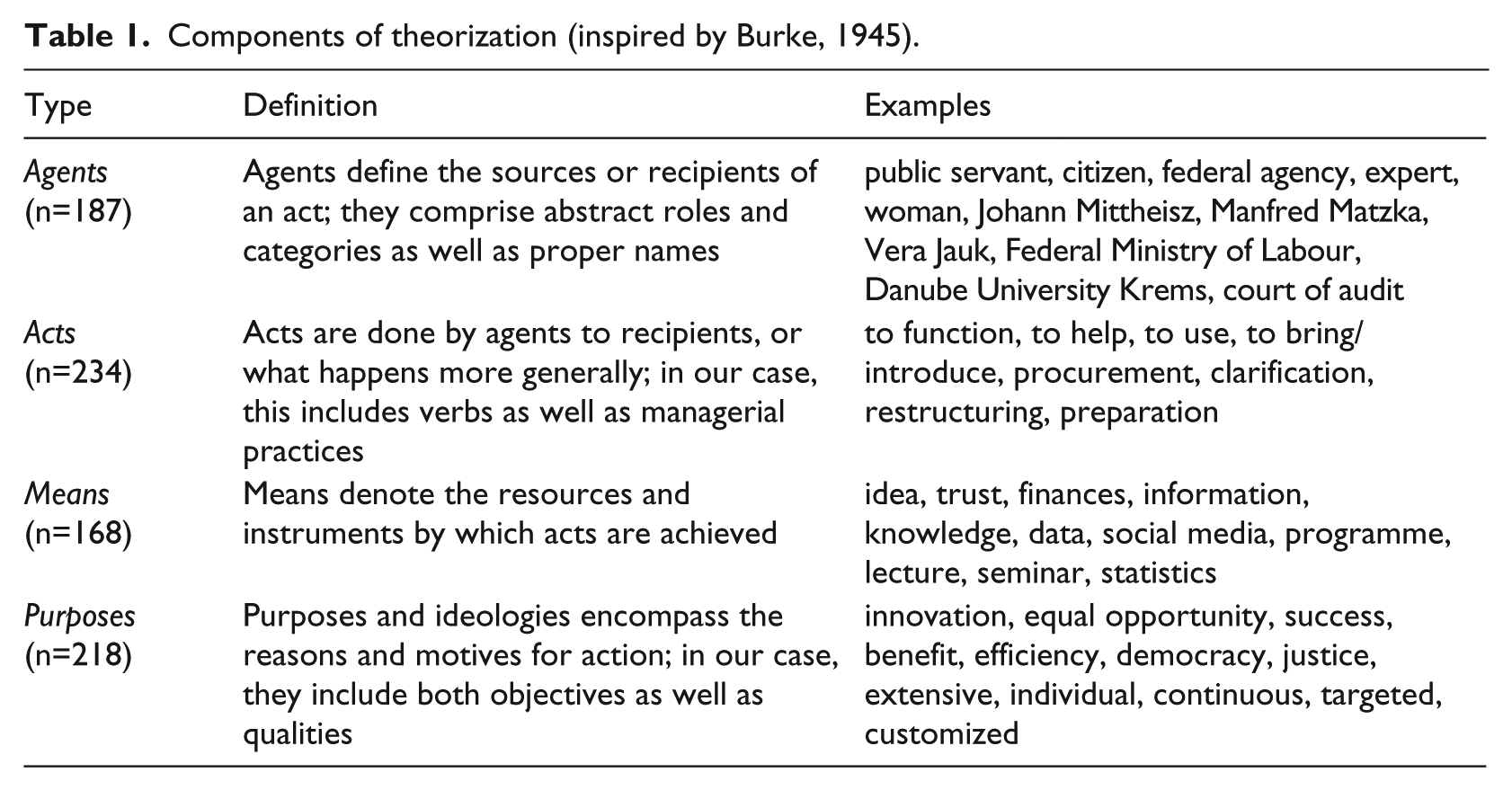
The fourth step was dedicated to analysis of semantic equivalence between management concepts based on the vocabulary in which they are embedded. We went back to the overall list of words generated through part-of-speech tagging (see note 3) and selected all words that were related to management 5 and had links to two or more management concepts. 6 This yielded a general business vocabulary of 807 words. We proceeded to analyse this vocabulary as follows. As a starting point, we classified words as agents (187 words), acts (234 words), means (168 words) and purposes (218 words). This helped us reconstruct the different components of theorization (see conceptual framework for details). Table 1 provides an overview of the coding scheme and a few examples for each component.
Components of theorization (inspired by Burke, 1945).
We then created separate two-mode semantic networks for each component based on the links of management concepts to specific agents, acts, means and purposes, respectively. We normalized links so that each link denoted the share of the linking capacity that a particular word ‘invests’ in a specific management concept (between 0 and 1). In order to focus on the most typical links, we deleted links below the average weight. There are multiple ways to assess patterns of structural equivalence (e.g. Wasserman & Faust, 2009) either as discrete groups of nodes (e.g. hierarchical clustering) or as continuous (spatial) models (e.g. multidimensional scaling). However, for our purposes and data, the CONCOR algorithm as a basis for block modelling 7 has been the most useful way of identifying semantically equivalent types of management concepts for each component of theorization for three main reasons. First, in order to obtain results comparable to our analysis of cohesion (i.e. reconstruction of bundles, see above), we need to model structural equivalence as a system of discrete groups (i.e. ‘blocks’ understood as types of management concepts) as well. Second, we need to reduce the complexity of representing patterns of equivalence based on a fairly large number of general business vocabulary (807 words). Finally, CONCOR allows for studying components of theorization separately and comparatively due to its ability to assess multiple layers of connectivity among the same sets of nodes. We visualized the resulting block models for each component as a two-mode network in which links are densities – i.e. ratios of realized connectivity – between blocks. For easier interpretation, we applied thresholds to link strength in order to stress the most distinct relations between blocks. Finally, we simplified and abstracted these relational block models.
By combining analyses of cohesion and equivalence, we captured both dimensions of interlinking theorization and interpreted their individual as well as combined effects in our data.
Findings
In the following, we present selected aspects of our empirical findings in a way that both illustrates our conceptual model and allows us to further extend and systematize our proposed framework. We have suggested that interlinking theorization can be analysed along two main dimensions: co-occurrence of management concepts (i.e. cohesive bundles) and similar patterns of connectivity of management concepts in a broader set of general business vocabulary (i.e. semantically equivalent types). Cohesive bundles point at shared relevance in the same context of theorization; semantically equivalent types provide insights into similarities within and across components of theorization.
Cohesive bundles of management concepts
Our core initial assumption was that the theorizations of management concepts are interlinked. Figure 2 represents one aspect of such interlinkage – namely cohesion – as a ‘map’ of debates (i.e. contexts of theorization) within the architecture of management knowledge. 8 Our illustrative analysis yields four densely interconnected bundles.
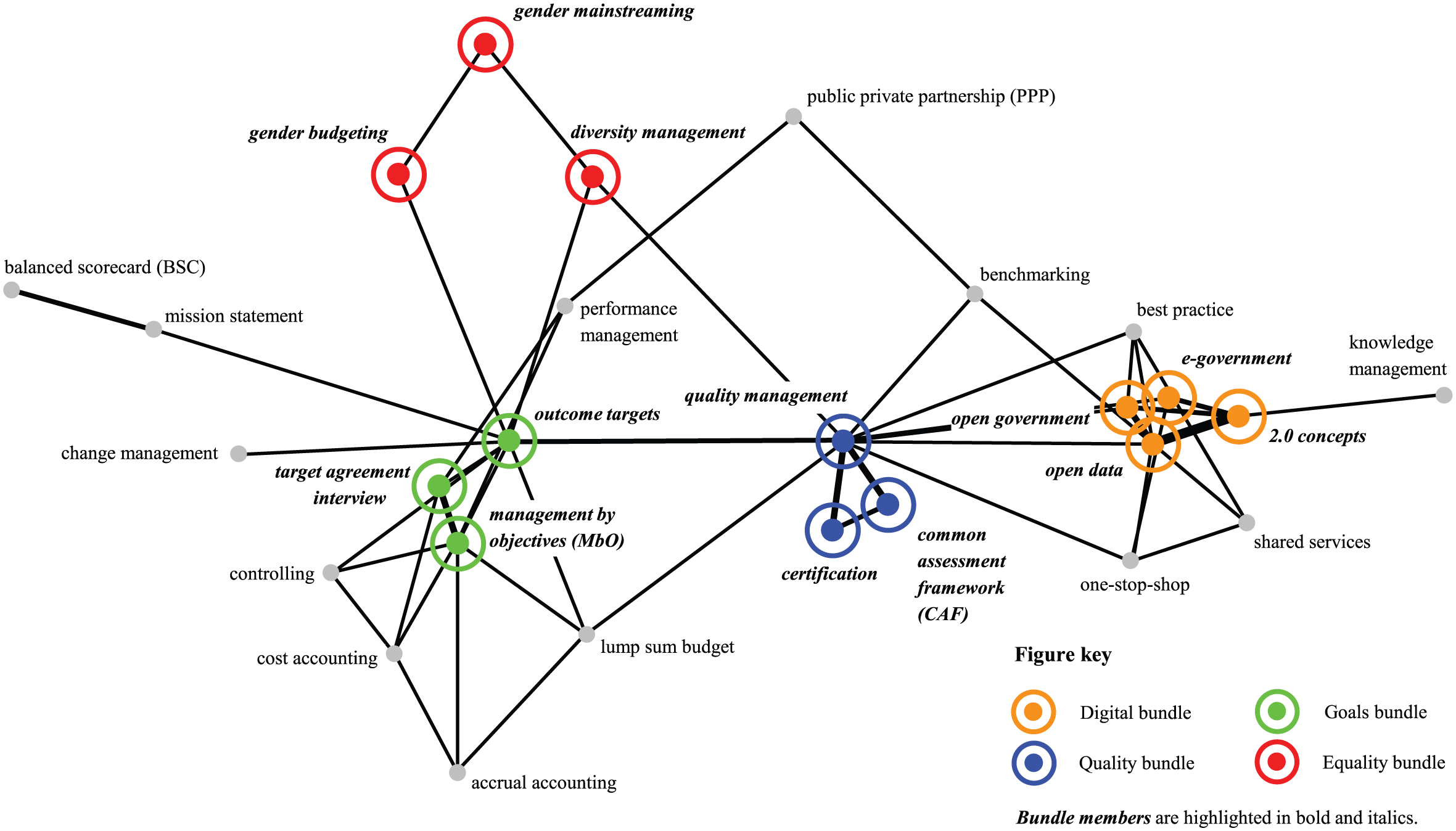
Bundles of management concepts (based on cohesion). 9
A first cohesive bundle (digital; far right, coloured orange in the network graph) manifests a broad and elaborate debate about digitalization and digital governance which has been claimed to be a new governance ‘paradigm’ in the public sector replacing new public management (e.g. Dunleavy, Margetts, Bastow, & Tinkler, 2006; Hyndman et al., 2014). The management concepts in this bundle are e-government, open data, open government, and various 2.0 concepts. A second (centre right, blue) and third (bottom left, green) bundle relate to debates within the ‘paradigm’ of new public management (e.g. Hood, 1995; Pollitt & Bouckaert, 2011). The former (quality) is concerned with issues of quality and standardization, encompassing quality management, certification and common assessment framework (CAF). 10 The latter (goals) comprises management by objectives, target agreement interview and outcome targets. It encompasses the debate about goal-oriented management and steering ‘at arm’s length’. A fourth bundle (top, red; equality) depicts a broader socio-political debate related to gender equality and equal opportunities in public sector organizations. It includes gender budgeting, diversity management and gender mainstreaming.
Figure 2 also shows that, in our empirical example, these debates exhibit a modular structure, meaning they do not ‘fall apart’. Goals and equality are connected through outcome targets which also links goals to quality. Digital would be isolated from the other bundles, were it not for quality which assumes a brokering position in the network. Overall, the population of management concepts in the area of public management in Austria is characterized by multiple overlapping debates held together by a concern for quality.
Semantically equivalent types of management concepts
Our analysis yields a different number of semantically equivalent types for each component of theorization: We find 8 agents-related, 8 means-related, 9 purpose-related and 10 acts-related types. Each of these types denotes semantic equivalence of its members with regard to the respective component of theorization. Figure 3 illustrates selected findings for the component of acts. 11
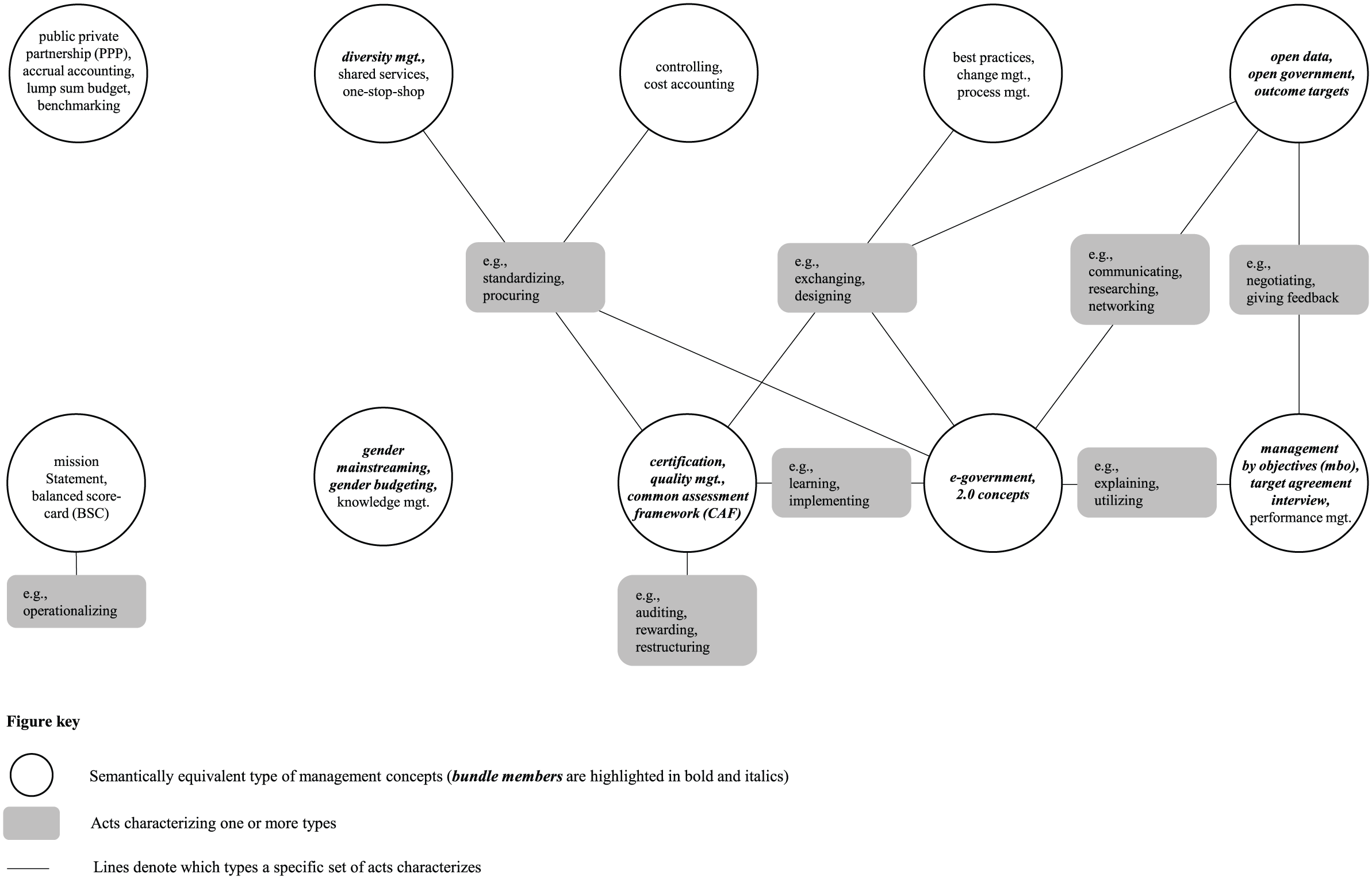
Semantically equivalent types of management concepts for the component of acts (based on equivalence).
Each type (white circles in Figure 3) can be characterized according to two aspects. First, each has a distinct set of members. For example, with regard to acts, controlling and cost accounting belong to the same type; certification, quality management and CAF belong to another. Second, each type is characterized by a configuration of acts that are common to its members (grey boxes in Figure 3 that link to a type). For example, regarding acts, certification, quality management and CAF are united by their relation to, for example, ‘auditing’, ‘rewarding’ and ‘restructuring’. In contrast, the type instantiated by gender mainstreaming, gender budgeting and knowledge management does not have any typical 12 vocabulary of acts. Note, however, that certain words in a specific component of theorization may characterize more than one type. Grey boxes in Figure 3 that link to multiple circles illustrate words shared by multiple types. This indicates that different types may exhibit some degree of similarity regarding the content of their theorization. Open data, open government and outcome targets are characterized by vocabulary related to ‘negotiating’ and ‘giving feedback’, acts that they share with the type instantiated by management by objectives, target agreement interview and performance management. In our empirical case, types regarding acts and purposes are more similar, whereas types regarding agents and means are less so.
Analytically separating components of theorization also reveals that co-membership of management concepts in semantically equivalent types varies across components. For instance, while controlling and cost accounting are of the same type regarding acts and agents, they are of different types regarding means and purposes. Certification, quality management and CAF are of the same type concerning acts, agents and means, but with regard to purposes, certification splits off. Management concepts that are of the same type in all components are completely equivalent semantically. In our empirical illustration, there is a limited number of such complete equivalence: e-government and 2.0 concepts, open government and open data, quality management and CAF, as well as MbO and target agreement interview. All these management concepts are also members of the same cohesive bundle.
Interlinking theorization: Combining cohesion and semantic equivalence
We have proposed that the theorizations of management concepts are interlinked. Based on selected findings, we now illustrate the potential of our framework with regard to: (a) the meaning of single management concepts; (b) overlaps and differences in meaning across multiple management concepts; (c) relationships between management concepts within one cohesive bundle; and (d) the architecture of management knowledge as the overall structure of interlinked theorizations.
With regard to the meaning of single management concepts, we use quality management to show how the combination of cohesion and equivalence provides insights into its theorization. Regarding content (i.e. semantically equivalent types), the theorization of quality management connects certain adopters (in particular, ‘health care and higher education institutions’) to experts (mainly ‘consultants’ and ‘quality agencies’). Further, acts and means related to structure (such as ‘restructuring’, ‘standardizing’, ‘regulations’, ‘procedures’) and incentive systems (‘awarding’; ‘auditing’, ‘indicators’) are combined to achieve internal (‘efficiency’) and external objectives (‘customer orientation’, ‘sustainability’). The management concept quality management shares bundle membership with certification and CAF and is therefore part of the debate about quality in the Austrian public sector. However, it also bears relevance beyond this immediate context of theorization, as is indicated by direct links to management concepts from other bundles (open data and open government from the digital bundle, diversity management from the equality bundle, outcome targets from the goals bundle), and to management concepts that are not part of any bundle (one-stop-shop, best practice, benchmarking, lump-sum budget).
Interlinking theorization further helps us understand overlaps and differences in meaning between multiple management concepts more systematically. For simplicity’s sake, we restrict our illustration to three pairs that vary strongly in their relationships to each other. Such analysis can, however, be easily extended to more than two management concepts. Figure 4 positions the three pairs in our two-dimensional framework of interlinking theorization. It also schematically unpacks the interlinking theorization of management by objectives and outcome targets in more detail.
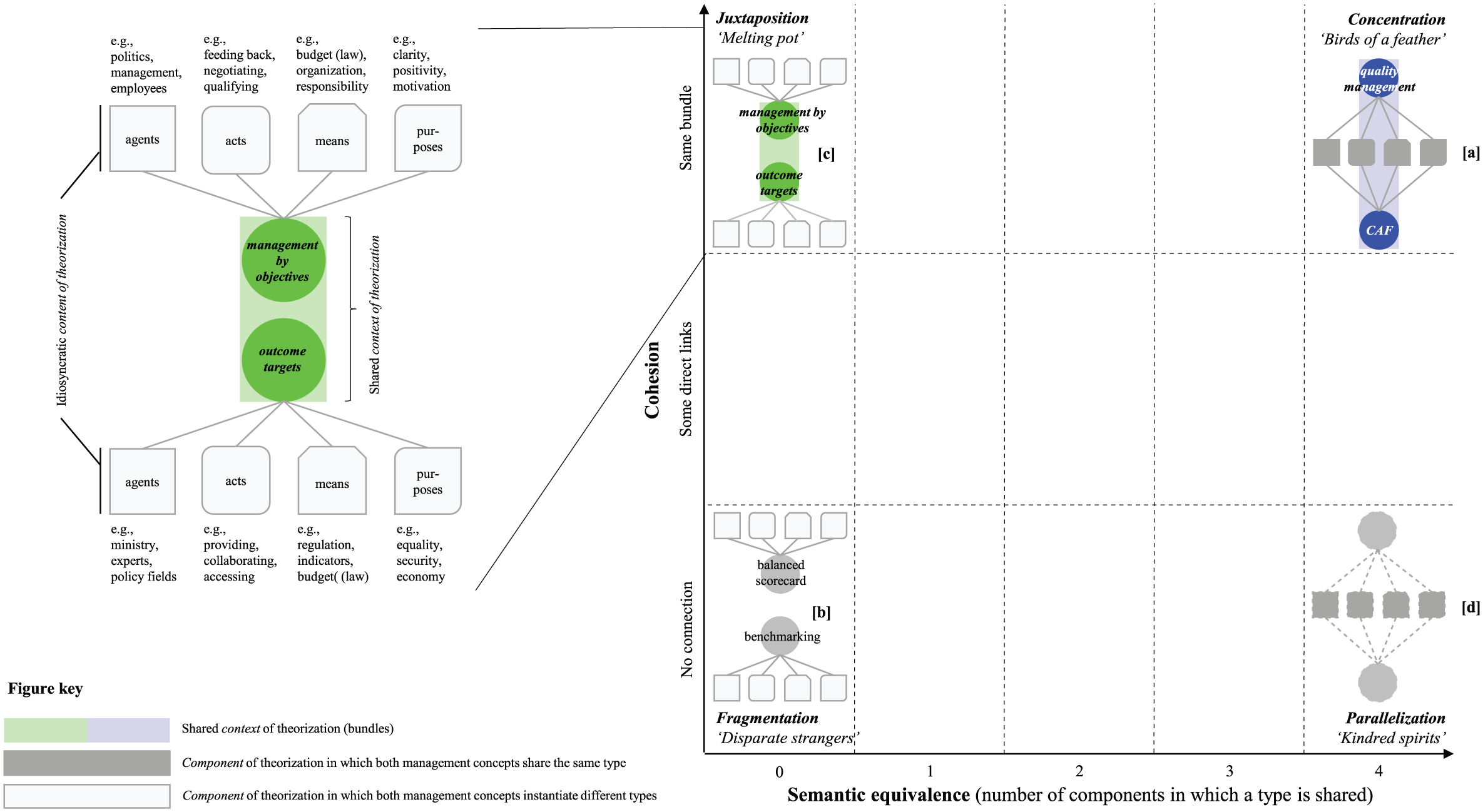
Examples of interlocking theorization from the empirical illustration.
In our empirical illustration, the theorizations of quality management and CAF are strongly interlinked (see cell [a] in Figure 4). Since they are members of the same cohesive bundle (quality) and of the same semantically equivalent types throughout all components of theorization (CAF fully shares the general business vocabulary of quality management outlined above), their interlinking theorization corresponds to a ‘concentration’ of meaning. However, despite their shared content and context of theorization, it is unlikely that they are synonyms, since both frequently co-occur in texts. Also, both are rather established, so a gradual replacement of one by the other is equally unlikely. We suggest interpreting this as exhibiting a form of hierarchy, where CAF is the more concrete version of quality management in the Austrian public sector.
On the opposite side of the spectrum, balanced scorecard (BSC) and benchmarking are neither part of the same debate, nor do they share any component of their theorization, which corresponds to a ‘fragmentation’ of meanings (see cell [b] in Figure 4). BSC is focused on typical private sector ideas, manifesting in agents such as ‘customers’, ‘banks’ and ‘management’, acts related to ‘measuring’ and ‘structuring’, and purposes like ‘quality’, ‘comparability’ and ‘customer orientation’. There are no typical means associated with BSC. In contrast, benchmarking has no typical agents and acts, its means (e.g. ‘legal matter’, ‘parameter’ and ‘awards’) are highly technocratic and legalistic, and its purposes are to be a ‘role model’, and to create ‘motivation’ and ‘value added’. Accordingly, we conclude that their theorizations are not interlinked in our empirical illustration.
Finally, management by objectives and outcome targets are members of the same cohesive bundle (goals) but instantiate different types in all components of theorization. This corresponds with a ‘juxtaposition’ of meanings (see cell [c] in Figure 4). Across all components, the vocabulary of management by objectives places it very broadly in ‘standard’ leadership tasks involving agents such as ‘managers’ and ‘employees’, acts such as ‘communicating’ and ‘giving feedback’, means focusing on HRM tools, and purposes including ‘motivation’, ‘agreement’ and the ‘achievement of potentials’. Outcome targets is more specific, as it features agents such as ‘ministries’ and ‘federal-level expert groups’, acts related to ‘providing services’ and ‘steering’, means such as ‘regulations’, ‘indicators’ and ‘budgets’, and purposes like ‘equality’, ‘economy’, ‘security’ and ‘independence’. What we see here is that outcome targets, a relatively recent management concept that has been introduced in the Austrian public sector with a new budgetary law, interlinks its theorization in a specific debate with a ‘standard’ management concept that evokes leadership and management tasks although the content of their theorization differs. Such anchoring of the new in the old, as a rhetorical device, promises potential legitimacy spillover effects from the latter to the former. Note that, in our empirical illustration, we do not find any management concepts that are fully semantically equivalent but not members of the same bundle (‘parallelization’; see cell [d] in Figure 4).
Our framework also allows for assessing the relationships between management concepts within a debate (i.e. a cohesive bundle). For illustration purposes, we discuss the interlinking theorization of the digital and the equality bundles in more detail. Figure 5 visualizes for both bundles which words in each component of theorization constitute the content of theorization of bundle members, and how links to such general business vocabulary overlap and vary between bundle members.
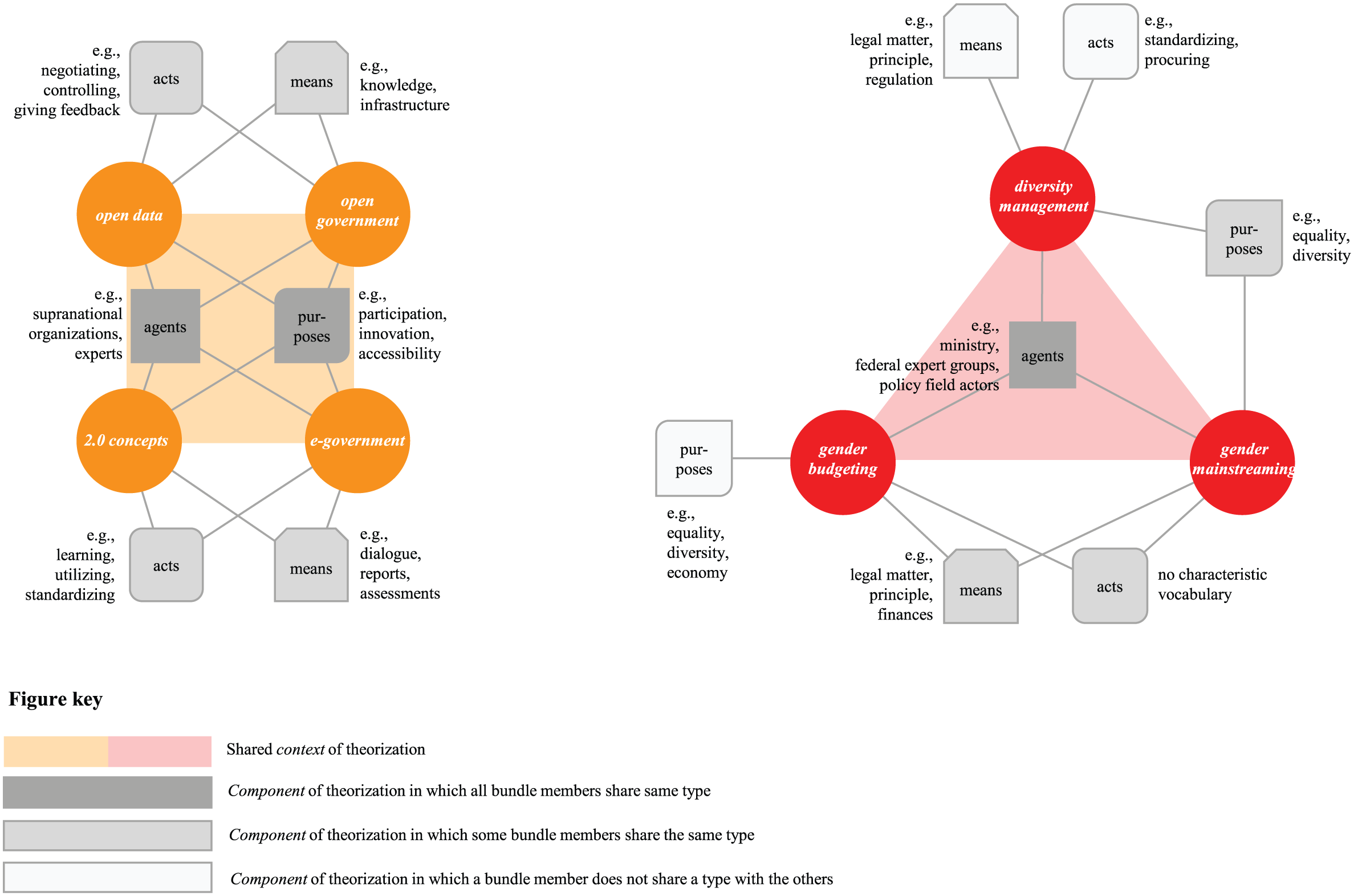
Relationships between the theorizations of management concepts within a debate (selected illustration).
The digital bundle connects four management concepts in the context of a debate that public management literature has called a new digital governance ‘paradigm’ (e.g. Dunleavy et al., 2006). The general business vocabulary seems to underline the ‘new paradigm’ claim: its size bears witness to a lively debate; its variety makes members of the bundle appear almost as a kind of ‘panacea’ that covers a great breadth of areas of application. As Figure 5 shows, all four members are theorized equivalently regarding agents (from ‘supranational organizations’, ‘public sector organizations’, ‘experts’ and ‘users’, to ‘citizens’) and purposes (covering a diverse set such as ‘participation’, ‘innovation’, ‘accessibility’, ‘openness’ or ‘efficiency’). For the components of acts and means, the bundle splits into two types, which, however, support and complement each other through specific foci. Acts such as ‘negotiating’, ‘controlling’ and ‘giving feedback’ characterize open data and open government, while ‘learning’, ‘utilizing’, ‘standardizing’ and ‘procuring’ are characteristic for e-government and 2.0 concepts. With regard to means, open data and open government share a focus on ‘knowledge’ and ‘infrastructure’, while e-government and 2.0 concepts are characterized by ‘dialogue’, ‘reports’, ‘assessments’ and ‘regulations’. Research has criticized that in the current debate the more socio-political concept of open government is conflated with the more technically-driven open data approach (Kornberger, Meyer, Brandtner, & Höllerer, 2017; Yu & Robinson, 2012) – an observation that our study confirms with regard to the interlinking theorizations of the two management concepts. Overall, the structure of interlinking theorization suggests that the four management concepts combine different strengths for the achievement of shared objectives.
In contrast, the equality bundle points to a socio-political debate about gender and diversity management. Cohesion is at the lowest level compared to other bundles in our study; semantic equivalence between bundle members is comparatively low and changes across components of theorization, as Figure 5 indicates. Only with regard to agents are all bundle members united; however, reach is limited: ‘ministries’, ‘federal expert groups’ and actors from different policy fields, such as ‘public schools’ or the ‘police’. No stable pattern of co-membership in types exists in other components: Gender mainstreaming and gender budgeting are equally positioned regarding acts and means, but not regarding purposes, where diversity management shares a type with gender mainstreaming. The debate is characterized by technocratic acts (in particular, ‘standardizing’ and ‘procuring’ for diversity management) and means (such as ‘legal matter’ or ‘principle’ for all three members), which indicates a strong focus on a legal/regulative perspective. This is supplemented with ‘softer’ forms of achieving compliance (such as ‘qualifying’ and ‘explaining’ for diversity management). Purposes include ‘equality’ and ‘diversity’ (all members), as well as ‘economy’ and ‘consistence’ (only gender budgeting). The debate represented by this cohesive bundle is the most restricted regarding its vocabulary – both in terms of size and richness – in our empirical illustration. The equality debate has a regulative flavour which is related to the requirements of federal budgeting in Austria to specify gender-related targets. The management concepts related to this debate are not theorized very enthusiastically in our practitioner-driven discourse, which feeds doubts as to their implementation.
Finally, management concepts’ membership in cohesive bundles and semantically equivalent types also allows for insights about the overall architecture of management knowledge. In our empirical example, membership in bundles and types strongly overlaps: cohesive bundles split into a maximum of two types in any component. Conversely, no structurally equivalent type brings together management concepts from more than two different bundles. Moreover, only members of the same bundle share three or even all four types in any component of theorization. Overall, we are therefore observing a stock of knowledge in which management concepts that are similar in terms of content are frequently evoked in the same debates.
Discussion
In this article, we have developed a conceptual framework on how different kinds of semantic relationships constitute interlinking theorizations of management concepts, while, at the same time, these relations also shape the architecture of management knowledge. We empirically illustrated and examined our framework in the context of Austrian public sector management and demonstrated how interlinking theorization involves both cohesion (co-occurrence of management concepts) as well as semantic equivalence (similar connectivity of management concepts to general business vocabulary). In this discussion section, we first elaborate how cohesion and equivalence, and especially their combination, contribute to, and extend, our understanding of how management concepts are theorized. Finally, we discuss the insights our framework provides into the structure of management knowledge.
Implications for research on theorization
Seminal work suggests that theorization involves the establishment of social categories and their relationships (Strang & Meyer, 1993). From a vocabulary perspective, theorization builds on the categorical labels and the conceptual meanings that vocabularies provide (e.g. Ocasio & Joseph, 2005). While previous research has provided important insights (see, e.g., Boxenbaum, 2006; Clark & Salaman, 1998; Chreim, 2006; Heusinkveld et al., 2013; Meyer & Höllerer, 2010; Zeitz et al., 1999), our theory development goes beyond the theorization of single management concepts.
As an extension of existing approaches, we conceptualize theorization as encompassing multiple relations, both among management concepts and between management concepts and general business vocabulary. We suggest calling such multi-relational conceptualization interlinking theorization. In this way, we address the concerns of scholars who contend that management concepts should not be analysed in isolation but are linked to each other in various ways (e.g. Abrahamson & Fairchild, 1999; Meyer & Höllerer, 2016; Shipilov et al., 2010). We build on and extend such literature by suggesting a conceptual framework that (a) covers a whole population of management concepts, and (b) allows us to disentangle direct and indirect relationships between management concepts and study their implications for theorization.
Cohesion, as a first relational dimension of interlinking theorization (see also Wruk et al., 2013), creates direct relationships between management concepts (i.e. co-occurrence as words in text). Cohesive bundles become apparent through clustering. Since cohesion points at shared relevance in the same context of theorization, it is a useful gauge for the degree to which the meanings and ‘fates’ of multiple management concepts become intertwined. On the level of an individual management concept, the analysis of cohesion is an opportunity to more systematically identify the main debate of which it is part. Cohesive bundles can be characterized according to their size which shows how many management concepts compete for attention as a prerequisite for theorization (e.g. Nigam & Ocasio, 2010). The degree of cohesion indicates how strongly theorizations are interlinked. In our empirical illustration, for instance, cohesion is stronger (i.e. in the form of a full clique) for the digital, goals and quality bundles than for the equality bundle.
Semantic equivalence, as a second relational dimension of interlinking theorization, highlights indirect relationships between management concepts based on their relational patterns towards general business vocabulary. For each component of theorization (agents, acts, means and purposes), these patterns indicate semantically equivalent types of management concepts. Sharing the same type means similarity regarding the content of theorization in one or more components. Moreover, the study of semantic equivalence reveals the actual words from the general business vocabulary that constitute such similarity in content.
Additionally, our findings suggest that each type can be characterized according to its vocabulary size (i.e. the number of unique words from the general business vocabulary used in the theorization of a management concept). Comparing the different types that a management concept instantiates across components then allows for an assessment of its vocabulary richness (i.e. how comprehensive the vocabulary is for each component). Both indicators provide insights into the elaboration of a management concept’s theorization. In our empirical illustration, the theorization of the equality bundle is based on a rather restricted vocabulary, while the vocabulary used to theorize the digital bundle is comparatively elaborate. Such analysis can be further supported by the use of quantitative linguistic measures, such as the type-token ratio (TTR) as a measure of depth versus breadth of theorization (e.g. Simonton, 1992).
Finally, relationships to general business vocabulary provide insights into the interpretive viability of management concepts’ meanings. Existing literature agrees that potential adopters focus on those parts of a management concept’s theorization that appeal to them and suit their purposes (Benders & van Veen, 2001; Clark, 2004; Giroux, 2006; Heusinkveld et al., 2013; Hirsch, 1986; Kieser, 1997). Our empirical case suggests that the digital bundle and the equality bundle may both have high potential for interpretive viability, but for different reasons: while the meaning of the digital bundle may be indeterminate due to its vocabulary being overly rich and polysemous, the equality bundle may be indeterminate because of a very restricted vocabulary. Both facilitate flexibility in usage and interpretation.
The combination of cohesion and equivalence provides novel insights into how the two dimensions of interlocking theorization overlap, and, thus, allows for a more comprehensive assessment of the relationships between management concepts’ theorizations. Our conceptual framework (see Figure 1) suggests that sets of management concepts can be located in a two-dimensional matrix. If both cohesion and equivalence are low, theorizations are largely independent of each other (‘fragmentation’). In our empirical illustration, the relationship between the balanced scorecard and benchmarking exemplifies theorizations that are not interlinked, although the literature sees the targets set in the balanced scorecard as opportunities for benchmarking (e.g. Kaplan & Norton, 1996). When both cohesion and equivalence are high, multiple management concepts with similar meanings tend to cluster (‘concentration’). This might indicate that relabelling (e.g. Heusinkveld et al., 2013) or replacement is under way. However, as our empirical example of quality management and CAF has shown, it could also indicate a hierarchy of management concepts. The high equivalence and strong cohesion of open government and open data reveals a technical take on a political concern, which may suggest neutralization (Kornberger et al., 2017). Low cohesion and high equivalence points to different contexts of theorization (e.g. different debates, industries, or fields) having developed their own independent labels for management concepts that are similar in content (‘parallelization’) – for instance, when a management concept is both ‘relocated’ from one context to another and ‘relabelled’ (e.g. Heusinkveld et al., 2013).
High cohesion but low equivalence describes multiple management concepts that are part of the same debate but have different contents of theorization (‘juxtaposition’). As this can have several explanations, a comparison of equivalence across different components of theorization is needed for more fine-grained clues on what this implies for their relationships to each other. We have interpreted our case of outcome targets as anchoring and legitimizing a novel concept by placing it within an established debate although its theorization is quite different. Equivalence in terms of purposes and agents, but differentiation in terms of means and acts, could point to functional equivalence, especially when different means and acts complement each other, such as in the digital bundle in our empirical illustration.
Although the precise relationship between management concepts cannot be determined by structural characteristics only, these provide a solid background for more qualitative and contextualized interpretations. With the concept of interlinking theorization, we contribute to previous literature by proposing to combine cohesion and equivalence to more holistically and systematically capture the relational properties of the theorization of management concepts and acknowledge their embeddedness in broader management knowledge.
Implications for research on the structure of management knowledge
Our conceptual developments also extend research on broader management knowledge (e.g. Spyridonidis et al., 2016), specifically, research that is interested in the (vocabulary) structure of such bodies of knowledge (e.g. Loewenstein, 2014; Loewenstein et al., 2012; Ocasio et al., 2015) – what we have called the architecture of management knowledge.
A first extension of literature on the structure of management knowledge is our systematic differentiation between management concepts and general business vocabulary. Ocasio et al. (2015) argue that clustering is a central characteristic of linguistic representations of social and institutional stocks of knowledge (see also Jones & Livne-Tarandach, 2008). They suggest that smaller clusters of categories indicate schemata that provide coherence and communication toolkits, while larger configurations of categories indicate the fundamental tenets that organize such schemata and provide governing logics for institutions. We build on these ideas and focus on clusters of management concepts (cohesion). Co-occurrence analyses create ‘maps’ that reveal fragmentation or interconnectedness of debates within a particular stock of management knowledge. In our empirical illustration (see Figure 2) we observe a modular structure, in which four distinct clusters of management concepts exist, which indicates that the practitioner-driven public management discourse in Austria is relatively bounded and close-knit. Other empirical studies in different contexts may find more fragmented architectures in which debates are largely independent of each other.
Previous research has stressed that general business vocabulary is derived from professional (e.g. Shenhav, 1999) or social discourse (e.g. Chreim, 2006), rationalized myths (e.g. Zilber, 2006) or the particular zeitgeist (e.g. Clark & Salaman, 1998; Grint, 1994). A second extension of the literature on the structure of management knowledge is the analytical separation of different components of theorization within the general business vocabulary, which enables a more detailed analysis of the architecture of management knowledge. Most basically, it reveals the size and richness of a specific stock of management knowledge within and across these components; that is, how many different actors and actor roles it contains, which purposes are paramount, and so forth.
Reconstructing equivalence structures across the entire architecture of management knowledge additionally gives insights into differentiation and integration of the stock of knowledge. For instance, the more types of management concepts that exist for each component of theorization, the more differentiated the stock of knowledge. At the same time, general business vocabulary that characterizes multiple types indicates areas of similarity among types and, accordingly, integration of knowledges. Reconstructing semantically equivalent types of management concepts and the general business vocabulary which expresses such equivalence therefore allows a more systematic study of how exactly a network of congruent theories forms a comprehensive body of knowledge (Strang & Meyer, 1993). Such differentiation/integration varies across debates and components of theorization. In our empirical illustration, we find that debates (i.e. cohesive bundles) are consistently characterized by a limited number of equivalent types across all components of theorization, which indicates a rather homogeneous set of meanings being debated. In other contexts, debates might encompass a variety of management concepts with completely contradictory contents of theorization. Combining cohesion and equivalence, accordingly, provides more fine-grained insights into the architecture of management knowledge in which management concepts are embedded.
Avenues for future research and conclusion
Since our contributions are conceptual and our empirics are merely illustrative, we call for future research that applies and extends our conceptual model in multiple ways. First and foremost, we see much value in future research on the dynamic and longitudinal development of bundles, types and architecture of management knowledge. Such research could, for instance, look at the supply-side dynamics of management knowledge (e.g. Heusinkveld et al., 2013) or assess in more detail how strategies such as broadening, normalizing, or relabelling management concepts (e.g. Höllerer et al., 2017) can be understood in terms of interlocking theorization. Other research could investigate paradigm and frame change (e.g. Hirsch, 1986; Zilber, 2002) and study how the infusion of a discourse with a new myth changes the architecture of management knowledge and the meaning of management concepts.
Second, future research could compare the interlocking theorizations of a given set of management concepts across contexts (e.g. professions, fields, genres and other institutional environments). For instance, it would be interesting to compare findings from practitioners’ discourse with research focusing on the theorization of management concepts in academia (e.g. Bort & Kieser, 2011), or the ways in which the translation of a management concept (e.g. Boxenbaum, 2006; Meyer & Höllerer, 2010) affects its position within the architecture of management knowledge.
Third, a conceptual limitation of our model is that it relies heavily on the interpretation of patterns of co-occurrence and discrete building blocks of meaning (i.e. cohesive bundles and semantically equivalent types). Future research could extend this by including, for instance, rhetorical elements of speech (e.g. Patala, Korpivaara, Jalkala, Kuitunen, & Soppe, 2019) or the social dimension of text production. Adding authorship of texts as an additional layer of meaning might reveal the ongoing negotiations and power struggles within debates (e.g. Slavich, Svejenova, Opazo, & Patriotta, 2019), and serve as an additional component of theorization and as explanatory aspect of vocabulary structure. On the other hand, more focused studies (i.e. with fewer management concepts and/or a more selective set of general business vocabulary) might generate interesting insights by modelling both cohesion and semantic equivalence in continuous and spatial ways, for instance, by using multidimensional scaling, multiple correspondence analysis, or similar techniques.
Overall, it is our hope that fellow researchers will find the ideas presented in this article useful, and we are confident that they will inspire the research agenda in this nascent field of scholarly inquiry.
Footnotes
Funding
The authors gratefully acknowledge financial support from the Austrian Science Fund (FWF) [Grant I 635-G17].
