




Abstract
In this article, we put forward the concept of ‘embodied inhabitation’ to bring a bodily and material perspective to bear on institutional maintenance. Using an ‘inhabited institutions’ framework, and drawing on autoethnographic, visual data, we develop a strategy of empathizing with field research participants that blurs the boundaries between human and non-human, social and material, and cultural and biological in understanding the embodied micro-level, situated interactions that maintain the institutional status quo. These have hitherto been overlooked in studies of institutional maintenance and institutional theory more broadly. Empirically, we explore how organizational imperatives designed to uphold the institution of the ‘safe system of work’ required by health and safety law in the United Kingdom play out in the course of the everyday work of e-waste recycling workers. Three vignettes relating to an overarching theme of ‘suffering’ consider institutional inhabitation as micro-level embodied interactions, and we show how socio-embodied discourses of commitment, skill and (working-class) masculinities legitimate the normalization of waste workers’ suffering, which in turn maintains institutionalized ideas of health and safety at work. We conclude by reflecting on the value of employing an ‘embodied inhabitation’ approach in other institutional settings.
Keywords
Introduction
The importance of socially situated practices and actors’ interactions to the maintenance of institutions is now well established in existing research (Lawrence & Suddaby, 2006; Lok & De Rond, 2013; Zilber, 2009). However, the roles of actors’ bodies and their shared bodily and material practices are less well documented. In this article, we address this lack through a visual, ethnographic case study of work in an e-waste recycling plant. We introduce the concept of ‘embodied inhabitation’ to show the value of taking a material perspective on institutional maintenance work (Suddaby, 2010).
Using an ‘inhabited institutions’ framework (Creed, Hudson, Okhuysen, & Smith-Crowe, 2014; Haedicke & Hallett, 2016; Voronov & Vince, 2012), we show how micro-level, shared bodily experiences and interactions are imbricated in the social interactions that maintain institutions. Using autoethnographic, visual reflection we explicate a methodology that is driven by the embodied inhabitation of the researcher herself, generating insights that not only ‘popula[te] institutional processes with emotionally and socially embedded people’ (Hallett & Ventresca, 2006, p. 216), but with their bodies too. ‘Embodied inhabitation’, then, is the sum of inhabitants’ bodily experiences and emotions (and their representations) that can be seen as visceral discourses that maintain institutional order through shared bodily meaning and communication structures. We argue that attention to this overlooked, material dimension is important if we are to fully recognize the human, fleshy cost of institutional maintenance and the very real impacts on the people involved.
Empirically, the article explores how organizational imperatives, rules, processes and policies, designed to uphold the institution of the ‘safe system of work’ required by UK health and safety law (HM Government, 1999), play out in the course of the everyday work of e-waste recycling workers. Institutional ‘instruction’ in this context comes from the Best Available Treatment Recovery and Recycling Techniques (BATRRT) document, which we refer to throughout the article. Through our visually grounded, bodily redolent micro-analysis of the ‘suffering’ experienced by e-waste recycling workers, we address the question: What is the role of embodied experience in institutional maintenance work? In doing so, we argue for attention to be paid to the felt interactions of bodies beyond their role as symbolic resources and/or situated vessels in the enactment of social practices (e.g. Hallett, Shulman, & Fine, 2009; Meyer, Höllerer, Jancsary, & Van Leeuwen, 2013; Suddaby, 2010). Recycling requires strength, stamina and endurance from those doing the job. Inhabiting the institution of e-waste recycling cuts hands, hurts airways and requires ingenuity and situated skill, often in difficult environments. This embodied labour is absent from – or at best ‘sanitized’ by – the mechanistic imperatives implied in policy documents intended to institutionalize health and safety at work in recycling plants and, as we have found, is valued, normalized and even silenced by the workers themselves. Understanding this absence is important in order to show how institutions are maintained – quite literally – on the backs of others. For example, Gregson et al. (2016, p. 542) have recently criticized ‘the representation of European resource recovery as clean and green’ for ignoring labour issues and paying scant attention ‘to how value is created from [the] paid labour that does the work’.
Taking bodily experience as the starting point for investigating institutional maintenance is a strategy that is conceptually useful as well as morally desirable. First, it humanizes processes of institutional maintenance by recognizing that institutional inhabitants enact their agency intercorporeally (Riach & Warren, 2015), that is, through interactions that take place between living, breathing, moving bodies. Grounding interactions in visceral discourse – as opposed to an emphasis on what people say or how they interpret social situations more rationally or cognitively – necessarily accounts for the body as always emplaced and indivisible from the environment it lives through (Dale & Latham, 2015). Embodied inhabitation calls into question distinctions between human and non-human, social and material, culture and biology as we show more fully below (Dale & Latham, 2015; Riach & Warren, 2015). We argue that this concept is useful to better take account of the physical context, of spaces, objects and sensations that institutionalization takes place within, which to date has tended to be overlooked by institutional theory (e.g. Suddaby, 2010). As Coole and Frost (2010, p. 2) remark, ‘foregrounding material factors and reconfiguring our very understanding of matter are prerequisites for any plausible account of coexistence and its conditions in the twenty-first century’. We contend that embodied institutionalization is a significant form of just such coexistence.
We begin by reviewing literature on institutional maintenance and inhabited institutions and the scant attention paid to the body in these accounts. We highlight how we extend previous studies’ concern with emotions before giving an overview of the research field, conceptual underpinnings for the study, our method and analysis. We then introduce the ‘safe’ recycling of e-waste as our institutional context, before using three vignettes drawn from our data relating to an overarching theme of ‘suffering’, to highlight the merits of taking a micro-level, embodied approach to institutional inhabitation. In our discussion, we show how embodied inhabitation plays out in discourses of commitment, skill and (working-class) masculinities, which served to legitimate the normalization of waste workers’ suffering – in turn maintaining institutionalized ideas of health and safety at work. We conclude by reflecting on the value of employing an ‘embodied inhabitation’ approach in other institutional settings.
Maintaining Institutions: The Perspective of ‘Inhabitation’
Lawrence and Suddaby’s (2006, p. 230) categories of institutional maintenance have inspired a growing body of literature highlighting the different tactics actors take. They range from the reinforcement of existing institutions (Dacin, Munir, & Tracey, 2010; Quinn Trank & Washington, 2009; Zilber, 2009), through activities individuals enact to secure their occupations when disrupted (Currie et al., 2012), to studies that focus on the less intentional micro-processes undertaken by institutional members that ‘stretch’ the institutional script (Micelotta & Washington, 2013) and contribute to a ‘plasticity’ of institutions capable of self-repair (Lok & De Rond, 2013). These micro-level practices support, repair or recreate the social mechanisms that ensure compliance with the institution and enable its continued existence (Lawrence & Suddaby, 2006, p. 230; Lok & De Rond, 2013; Zilber, 2009). Collectively, these authors warn against taking for granted ‘under the radar’ activities that reproduce institutional ‘scripts’ quietly at the micro level and which enable institutional stability.
Empirical attention to micro-level detail of this nature has found further theoretical purchase in the idea of institutions as ‘inhabited’ (Bechky, 2011; Creed et al., 2014; Hallett & Ventresca, 2006). The term comes from Scully and Creed’s (1997) reaction to the strangely disembodied character of writing on ‘institutional work’. Somewhat ironically, Lawrence and Suddaby’s (2006, p. 215) definition of institutional work as ‘the purposive action of individuals and organizations aimed at creating, maintaining and disrupting institutions’ itself emerged from a general dissatisfaction with the broader field of ‘institutional theory’ where micro-level practices had become positioned as less important than macro-level structures and discourse (Barley, 2008; Clegg, 2010). Theorizing in the ‘institutional work’ tradition was intended to reinforce the importance of individuals’ agency in everyday practice, recognizing them as aware, skilful and reflexive actors in the existence of institutions (Lawrence & Suddaby, 2006, p. 219).
However, it is this focus on the individual and the idea that agency is interactional that the inhabited institutions perspective sees as lacking in writings on institutional work (Bechky, 2011; Hallett & Ventresca, 2006, p. 216). Proponents of this approach advocate a need to return to symbolic interactionist traditions (Creed et al., 2014; Hallett et al., 2009; Hallett & Ventresca, 2006) and the detailed, empirical observations of institutional life these demand (Haedicke & Hallett, 2016). They recognize that people create collective understandings in their dealings with one another through interactions – rather than atomized individual agency – and that these are then constrained and enabled using a background stock of institutionalized knowledge (Bechky, 2011; Hallett & Ventresca, 2006; Lok & De Rond, 2013). Thus, the macro and the micro environments are linked through exchanges between people as ‘embedded agency’ (Delbridge & Edwards, 2013, p. 933), rather than originating in either one or the other. Regarding institutions as inhabited thus allows for consideration to be given to ‘the social, symbolic and interactive nature that [underpins] institutional arrangements’ (Creed et al., 2014, p. 7, italics added) and allows us to produce ‘less abstract, better specified and more interesting’ accounts of institutional processes (Bechky, 2011, p. 1161).
Bringing the inhabited institutions perspective to bear on matters of institutional maintenance, we see how micro-level practices ‘overcome the entropic tendencies that characterize most institutions’ (Lok & De Rond, 2013, p. 185; Bechky, 2011). From the perspective of interactions, we see how maintenance work ‘is not a stable property’ (Micelotta & Washington, 2013, p. 1138) but is a process whereby actors engage in a host of different activities in order to ensure continuity – making continual adjustments, workarounds and improvisations in their daily practices in and between themselves. Dacin et al. (2010), for example, studied Cambridge University’s formal dining rituals to explore how these individuals were socialized into acting in a more privileged manner, gaining a sense of an elite, which they reproduced outside the university, thereby creating and reinforcing the British class system. Currie et al. (2012) offer a similar analysis of professional elites in the UK’s National Health Service and the work they undertook to reinforce their occupational status. These included different strategies – such as the delegation of new tasks and co-opting incumbents from outside their group – to minimize threat to their occupational roles and standing during periods of change. As well as what happens in the here-and-now, Everitt’s (2013) research on the professional socialization of new teachers shows the importance of ‘prospective sensemaking’ in how recent entrants negotiated their agency in anticipation of the institutional logics they were expecting to encounter. Relatedly, Micelotta and Washington’s study of the Italian legal profession explains how individuals ‘stretch the institutional script’ (2013, p. 1139) by creatively asserting norms that re-establish individuals’ power and role positions when institutional arrangements are disrupted during a time of substantial change. They stress the importance of the social position, opportunity and willingness of incumbents to be able to undertake this ‘repair work’ effectively, suggesting that more marginalized players would be powerless to hold their line in response to institutional disruption. Haedicke’s (2012) investigation of local food co-operatives shows how leaders uphold social values in the face of market competition. He found that they engaged in processes of ‘translation’ which took the threatening commercial-economic value and reframed it into something to fit better with local meanings – thus maintaining the institution of mission-driven enterprise.
By contrast, Lok and De Rond’s (2013) ethnographic study of Cambridge University Boat Club (CUBC) revealed that less intentional institutional maintenance work was carried out through the micro-processes actors engaged in when faced with small and more major disruptions to institutional imperatives. It is important to note that Lok and De Rond’s (2013) usage of ‘reflexive’ refers to a ‘reflex’ as an involuntary, ‘knee-jerk’ reaction to stimulus and not the process of active and conscious consideration of one’s actions and impact on the social world (as is more common in qualitative research in particular). They define ‘reflexive normalization’ as ‘a distinct and specific form of reflexive accounting through which any tensions caused by divergent behaviour are (temporarily) smoothed over, thus temporarily containing its potentially disruptive effects’ (Lok & De Rond, 2013, p. 188).
Inhabiting Institutions: Recognizing the Emotional Body
What the above studies have in common is that they take an empirical, micro-sociological, interactional approach to exploring how wider macro-level institutions are maintained (Hallett & Ventresca, 2006). Yet despite these welcome advances, emphasis is still very much on the ‘socially cognitive’ dimensions of action rather than the material experiences of those practices enacted by bodies who feel, move and sense as they go about their business (Jones & Massa, 2013) – even in the case of Lok and De Rond’s (2013) rowers where the athletic context is intensely an embodied one. We contend that this ‘disembodied’ bias has resulted in a view of institutional work and the inhabitation of institutions ‘as dependent on cognitive (rather than affective) processes and structures’ (Lawrence & Suddaby, 2006, p. 218). Indeed, in a recent special issue of Organization Studies, Lawrence, Leca and Zilber (2013) noted that there is a dearth of research attending to the ‘mundane, ordinary ways in which institutions are embodied at a micro level and [particularly] how actors engage with them in their day-to-day activities’ (Lawrence et al., 2013, p. 1029).
To begin to counter this research gap, Voronov and Vince (2012), Hallett and Ventresca (2006) and Creed et al. (2014) all put forward meticulously argued theses on the role and importance of emotion in inhabiting institutions. Speaking of emotion generally, Voronov and Vince (2012, p. 59) stress that cognitive and/or rational reasons do not go far enough in explaining why agents are motivated to change or to defend the established institutional order. This void is apparent in Hallett and Ventresca’s (2006) re-reading of Alvin Gouldner’s Patterns of Industrial Bureaucracy, in which they show how the violation of the (emotional) bonds between workers and management was of fundamental importance in the workers’ rejection of the new bureaucratic regime and not necessarily the character of bureaucracy itself. Importantly, the experience of these violations was socially shared and made sense of, leading Hallett and Ventresca (2006, p. 227) to present the alternative conclusion to Gouldner’s work, that ‘bureaucracy does not exist apart from the workers and the management and it is through their interactions that bureaucracy is given its force and meaning’. Voronov and Vince (2012, p. 69) use the concept of ‘fantasmic frames’ to further explain actors’ commitments to institutions that clearly appear (to an onlooker, at least) to be detrimental to them. They argue that an emotional commitment to an alternative meaning structure overrides more ‘rational’ responses and that from this investment the person derives ‘meaning and pleasure and/or [a reduction of] anxieties and fears’ (Voronov & Vince, 2012, p. 69).
Creed et al. (2014) develop the emotional dimension one stage further by focusing on shame as an exemplar of a social emotion enacted through a ‘nexus’ that treats shame as part of the ‘social connective tissue’ (2014, p. 278) through which people make sense of macro-institutional structures. As such, they position emotions as non-cognitive, deeply felt and shared phenomena that invoke ‘notions of [the] social bonds, disciplinary power and subjectification’ (p. 276) necessary to achieve regulation of the institutional order. These are powerful because they ‘entail bodily sensations as well as appraisals of some person, event, object or situation’ (p. 278) and thus the institutional is not only made personal, but is shared (Voronov & Vince, 2012) and taken inside the body. Thus, our theoretical conjecture is that if emotion is socially shared connective tissue, then what significance does bodily connective tissue play in institutional inhabitation? What implications might somatically felt, visceral interactions have for the maintenance of institutions? To return to the research question stated at the outset of this article, What is the role of embodied experience in institutional maintenance work?
The next sections introduce our empirical context and case study, before beginning to unpack this question theoretically by considering the relationships between embodiment and practices. We then explain our research methods in more depth before going on to present the data they generated.
Disposing of E-Waste, a Safe System of Work?
E-waste is made up of electronic products such as computers and mobile telephones and is one of the fastest-growing waste streams worldwide at 41.8 million tonnes per annum (Baldè, Wang, Kuehr, & Huisman, 2015, p. 8). Our focus is on a particular type of e-waste – the computer. 1 Computers form part of a core category of e-waste that is forecast to increase exponentially. In 2008 global ownership passed one billion (Tanskanen, 2013), with an average of 300 million computers discarded annually, and projections show that by 2030 developing countries alone will throw away twice that number (Sthiannopkao & Wong, 2013). This projection presents a pressing need for governments and industry to find solutions as to what to do with all this ‘junk’, much of which is non-biodegradable, toxic and damaging to the environment. The recycling of e-waste has therefore emerged as a response to avert the crisis of being swamped by hazardous, space-consuming, discarded objects. However, if these products are not dismantled and recycled in a safe manner, they pose ecological risks to the natural environment and occupational health risks to those involved in their disposal (Asante et al., 2012). Computers can contain up to 1000 chemicals (Pellow, 2007) including toxic substances such as arsenic, cadmium, lead, mercury and phosphorus (Gosney, 2009). Workers exposed to these chemicals run risks to their health including blood poisoning, respiratory illness, endocrine failure, infertility and damage to major organs. These factors highlight the importance of effective, safe computer disposal management and in 2003 the European Union responded by passing the Waste Electrical and Electronic Equipment (WEEE) Directive, which was transposed into UK law (the context of this study) in 2006 (HM Government, 2006). WEEE aims to control electrical and electronic waste through the promotion of reducing, reuse, recycling and recovery. The interpretation, translation, negotiation and enacting of this legislation happens at multiple levels, cascading down from the EU to the member state, to their regional and local authorities and then to the organization – the level at which the data and analysis in this article are situated.
In the UK, it is the Best Available Treatment Recovery and Recycling Techniques (BATRRT) document that provides an institutional blueprint for how to treat, recycle and recover WEEE by organizations that have been delegated to do so by the UK government (Defra, 2006). Compliance with the regulatory rules laid out in the BATRRT document is encouraged in order to obtain the relevant licences to operate as an e-waste recycler. Although there is scope for organizations to interpret and implement their own policies, processes and guidelines, as we show below, our case study organization adhered fairly closely to the principles of BATRRT.
Field Research and Methods: ‘Recycling SME’
The data in this article were generated from a ‘critical case study’ (Yin, 2003). ‘Recycling SME’ (RSME) was established in 1961 as a family-run, private enterprise in the UK, operating a variety of recycling services based around the extraction and trading of scrap metal. The case is drawn from a wider investigation into the incorporation of e-waste management legislation into the working practices of a range of different organizations in the computer reuse, recycling, asset and waste management field in the UK (Stowell, 2012).
RSME was a ‘critical case study’ site for several reasons. Being in the recycling sector for over 40 years it provided useful longevity in practices surrounding e-waste disposal. The organization is a successful recycler accustomed to complying with legislation and adopting appropriate waste management practices, achieving several health and safety and environmental management certificates. At the time of this research RSME employed 105 male production workers who operate the recycling machinery, with 22 dedicated to the dismantling of scrap computers, plus five administrative staff who oversee the operational and strategic elements of the business. The workforce was a close-knit community, where employees ‘that typically stayed past four months’ were there for the duration of their careers (Waste IT Operations Manager RSME Field Diary, 2008, p. 65). An all-male team undertook the computer disassembly service functions and was comprised of the Waste IT operations manager, two dismantling workers, a hazardous waste foreman and 19 hazardous waste workers. The labour-intensive activities, including the hazardous waste work, were paid at minimum wage and the majority of training was carried out on-the-job unless requiring certification for specialist activities, e.g. forklift truck driving. There were specific scheduled breaks where workers downed tools and gathered together to smoke, eat and drink. During her time at RSME, Alison (the first author) took part in the daily tasks and routines of the waste workers and kept a field diary noting their comments, her observations and reflections.
Alison took 79 photographs 2 as ‘visual fieldnotes’ (Collier & Collier, 1986) to record the arrangement of the workplace, its general physical appearance and as a reminder of e-waste disposal practices when out of the field. However, the significance of these data to an embodied research agenda only surfaced quite some time after the field research took place, triggered in part by theoretical commitments, expertise and curiosity on the part of the second author (Samantha). The arguments in this article emerged from a three-stage data analysis process, which we discuss below in conjunction with literature on the value of photography in organizational research, the validity of autoethnography and critical reflection on Alison’s own socially situated embodiment as a female ‘outlier’ in a male-dominated environment.
Embodied inhabitation as socio-somatic interaction
As we explain further in this section, we regard embodiment as socio-somatic because it is as much a social phenomenon as it is located ‘in the body’. Furthermore, embodiment is always intercorporeal (between bodies and things) and intersubjective (socially infused and understood between people) rather than a phenomenon experienced purely within one’s own body (Adamson & Johansson, 2016; Csordas, 1990; Dale & Latham, 2015; Riach & Warren, 2015). Coole and Frost (2010, p. 4) and the contributors to their volume term these perspectives ‘new materialisms’, noting how developments in contemporary society demand a renewed engagement with the body, nature and matter which goes beyond language, discourses and social arrangements that human beings weave around them. As they explain, ‘complex issues such as climate change or global capital and population flows, the bio-technological engineering of genetically modified organisms, or the saturation of our intimate and physical lives by digital, wireless and virtual technologies … pose profound and unprecedented normative questions’ (Coole & Frost, 2010, p. 5). Likewise, we argue that focusing on the body and its material relations here allows us to question the normativity of micro-practices that maintain institutions, in ways that take better account of the physical environment that social interaction occurs in and through. Importantly, this might open up new lines of ethico-political critique about the realities of institutional maintenance that a more traditional focus on social interaction only would ‘explain away’, if it acknowledged them at all.
To operationalize the above, we see the value of embodied inhabitation in blurring the boundaries between (1) human and non-human, (2) social and material and (3) culture and biology in accounts of institutional maintenance. Taylor (2013, p. 690) reinforces that ‘all things’ matter as bodies are ‘lived spatially’. First, human and non-human assemblages produce or recreate meaning through a ‘distributed confederacy of agentic materialities’ (Taylor 2013, p. 701), hence the need to remove the distinction between body and things, human and non-human. Bodies are emplaced and indivisible from their lived environments and this can have ethical effects – for example, deciding who is defined as ‘disabled’ and in what ways, based on the technologies with which they are imbricated (Dale & Latham, 2015).
Second, an embodied inhabitation perspective brings the social/material distinction into question. In their research on classroom teaching, Millei and Raby (2009, p. 2) describe the way discourses intersect through the teachers as situated bodies in space and time with a history and a set of dispositions. In other words, they show how an understanding of how the teaching body acts, moves and comports itself in relation to the bodies of students and the paraphernalia of the classroom cannot be effectively gained without also knowing what the teacher believes ‘good teaching’ is, e.g. the social discourses they have internalized (cf. Everitt, 2013, discussed above). Essén and Vårlander (2013, p. 399) take these ideas further by suggesting a pre-conscious dimension to this in their discussion of how academic labour (specifically, writing) is both knowledge and body work and cannot be reduced to either one or the other, observing that the ‘body constitutes an extraordinary resource with agency’ (Essén & Vårlander, 2013, p. 416) and acts before we notice it doing so. This dimension of embodied inhabitation is especially fruitful in our present study since, as we discuss above, the micro-practices of institutional maintenance and repair work are often pre-conscious and ‘reflex-ive’ (Lok & De Rond, 2013), meaning that action appears as a material manifestation without the actor being aware that his/her actions are as much socially driven as they are materially performed. As we discuss further below and in a similar move to Creed et al. (2014), Alison came to understand the ‘felt’ experience of her own pain as a normal part of the job, through her social interactions with fellow workers and things, yet the shared experience and understandings of suffering cannot be reduced to those social interactions, since they remain forcefully embodied through pain and discomfort.
This shared experience is perhaps easier to exemplify through the third beneficial effect of an embodied inhabitation perspective, the dissolution of distinctions between culture and biology. Similar to the social/material divide, but more far-reaching, the dichotomy between what is cultural and what is biological has a more rigid ontological status in the popular imagination than either of the previous two dimensions. However, as Riach and Warren (2015) show using the phenomenon of smell in office environments, even processes we might think of as inherently biological – e.g. the olfactory act of smelling – are always also cultural, since reactions to and meanings of smells depend on the culture of the smeller within the context in which they are smelling. Importantly, the ontological character of these smells is the cultural interpretation and we argue that this holds true for the kinds of embodied experiences we discuss in this article. Blackman (2016), in her introduction to a special issue on ‘The New Biologies’, explains that while these views are becoming more pervasive in the social sciences (for similar reasons to those put forward by Coole and Frost (2010) above), the human, so-called ‘natural’ sciences are also starting to recognize that biological ‘facts’ could look very different when conceptualized with alternative cultural explanations. For example, the division of organisms into two sexes may in fact be inaccurate when reproduction is removed as the primary definitional principle, something which the social sciences have long recognized and argued for (Blackman, 2016, pp. 8–9).
Thus, epistemologically, we see embodied inhabitation as a bodily redolent, ground-up and interactional process through which institutions are negotiated in situ and in-the-flesh as they meet with the ‘top-down’ socially derived imperatives. Embodied inhabitation, therefore, has important consequences for any attempt to (re-)embody institutional work, since if the boundaries of the body are corporeally porous – calling into question the reach and separation of human and non-human, social and material, cultural and biological elements – then what we look for as implicated in institutional inhabitation will be much broader than just the sense perceptions of the individual ‘reacting’ to institutional scripts and norms. Methodologically, these foundations have given rise to the process we describe below, beginning with the power of Alison’s photographs to evoke her bodily experiences in the field.
First stage: Photo-interview
Using the photographs as a prompt, Samantha questioned Alison about her sensory and experiential recollections from the field, following the principles of ‘participant-led photo interviewing’ (Vince & Warren, 2012). This is a technique where research participants produce a set of photographs in response to a study theme before being questioned about them by the researcher. The aim is to bring the participant’s subjective material experiences to the fore (as depicted by the photographs) in order to set the agenda for the interview. The researcher probes points of interest as per classic conventions for qualitative interviewing to explore often tangential but rich themes in relation to the research topic, which often draw in spatial, material and aesthetic elements of the photographer’s emplaced body (Pink, 2009; Shortt, 2015; Warren, 2008). Thus it was the visual manifestation of the material, embodied, dimension of Alison’s fieldwork that gave rise to the ideas within this article and our contributions to theorizing institutional inhabitation and maintenance work as materially infused.
Photographs are valuable ‘sensory windows’ that open out onto the participant’s world (Pink, 2009; Warren, 2012). Although photographs can never be seen as truth, their striking resemblance to (what we commonly perceive as) reality means that they have an allusive power to evoke bodily recollections and experiences which are immediate and direct in ways that words are not (Barthes, 1982; Wagner, 1979). This evocation is particularly so for the photographer who, upon later viewing, is forcefully ‘transported’ back to the place, time and sensations when the photograph was taken. But this process also happens for other viewers as they place themselves empathetically in the place of the photographer when looking at the image (Strati, 1999). Indeed, this ‘point of view’ effect is one of photography’s most striking features since it positions the viewer in a (seemingly) direct relationship with the scene. This effect enables a particular subject position and ethical relation with what is viewed (Campbell, McPhail, & Slack, 2009; Mulvey, 1989) and evokes a semblance of shared bodily experience (Scarles, 2009).
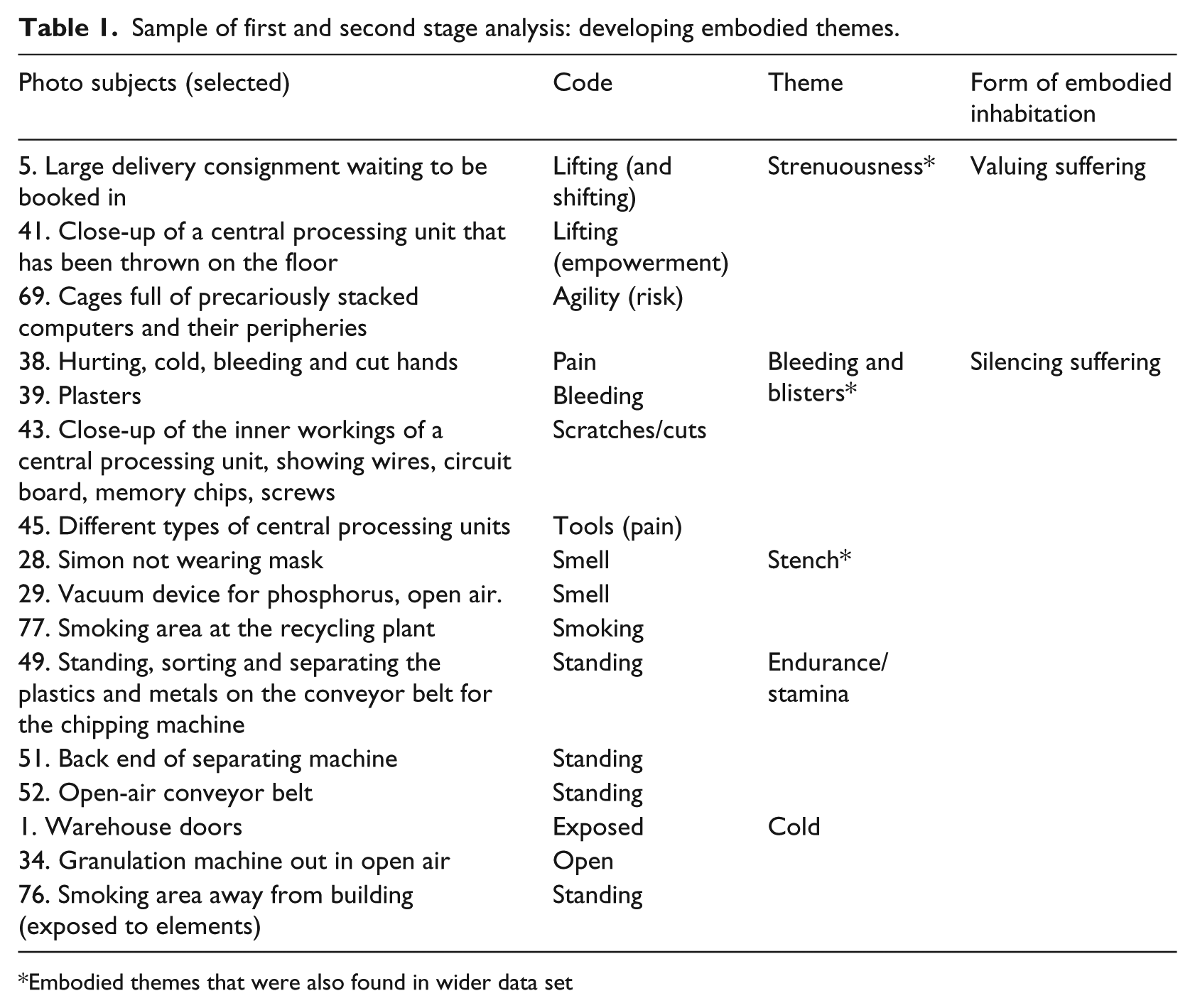
As the two authors worked through all the photographs, Alison explained the stories behind each photograph, and the photographs (and notes made about their associated narratives) were classified into groups based on the kind of bodily experiences they stood for. This first stage of analysis was led by bodily concerns – the autoethnographic experiences of cold, fatigue, noise, smell, strain and so on and how these intersected with the tasks being performed, what Spry (2001, p. 724) refers to as ‘emancipating the body from the shadows’ of academic research (see Table 1). Themes that did not speak from the body were discarded at this stage.
Sample of first and second stage analysis: developing embodied themes.
Embodied themes that were also found in wider data set
Second stage: Auto-ethnographic theming
As the photo-discussions unfolded, the classifications were further informed and renegotiated by Alison’s knowledge of the wider data set and the extent to which she recollected her experiences were ones that had been shared with the other waste workers at RSME. Table 1 shows further detail of this process, with the first three rows showing themes identified from Alison’s photographs that were also shared with RSME’s waste workers (as noted in her field diaries). In this sense, the data which drove this article are initially autoethnographic in character. Although several ‘auto-ethno’ relationships are possible (Denshire, 2013) the validity of all variants of autoethnography stems from the extent to which accounts ‘intimately connect the personal to the cultural … the micro with the meta’ (Boyle & Parry, 2007, p. 186). As Ellis, Adams and Bochner (2011) summarize, good autoethnographers write about their own experiences of being in a particular setting while at the same time ‘consider[ing] ways others may experience similar epiphanies … us[ing] personal experience to illustrate facets of cultural experience’ (Ellis et al., s. 2). This blurring of the ‘distinction between researcher and researched’ (Doloriert & Sambrook, 2009, p. 30) is particularly important because the body is ‘positioned as the focal point [for] heuristic and theory’ (Allbon, 2012, p. 67) beyond the researcher’s own lived experience. This means that an empathetic engagement with the field begins from the researcher’s body as an inside-out approach to researching culture rather than an outside-in dynamic – a process which fits with our theoretical position that embodiment is intercorporeal and understood through interactions (Adamson & Johansson, 2016; Riach & Warren, 2015).
Third stage: Mining of wider ethnographic data set
Alison then returned to her fieldnotes to expressly look for instances of interactions with the RSME workers on these embodied themes. Those that did not appear to resonate with the experiences of the waste workers (as recorded in her diaries) were set aside. For information, we have shown examples of these in the final two rows of Table 1. Thus those themes where a greater degree of interaction was apparent were emphasized while the themes not explicitly shared with the waste workers were discounted (see Table 1). The outcome of this process were the three vignettes of embodied inhabitation we present below: (1) strenuousness (2) bleeding and blisters; and (3) stench. We have taken these to represent an overarching theme of ‘suffering’, which in turn make up the two forms of embodied institutional work – valuing and silencing suffering – that were central to maintaining the institution of ‘safe work’ at RSME.
As we have already discussed, the value of autoethnographic data is in its ability to connect subjective experiences to others’ realities. The extent to which a researcher can empathize authentically with their research participants has been a subject of long-running debate in qualitative research (e.g. Adamson & Johansson, 2016; Coffey, 1999) and this is perhaps particularly so when we are considering empathy at the level of felt experience. ‘Our own sense of personhood – which will include age, race, gender, class, history, sexuality – engages with the personalities, histories and subjectivities of others present in the field’ (Coffey, 1999, p. 57). With this in mind, a reflexive account of Alison’s subject position vis-a-vis the workers at RSME is important. Alison is female and was gathering data in an exclusively male environment characterized by manual labour and, as we present below, harsh working conditions. Furthermore, the waste workers occupied ‘lower’ socio-economic classifications and were minimally educated (Bozkurt & Stowell, 2016).
All this might suggest that it would have been difficult for Alison to share much in common with the waste workers, given that she apparently came from a very different world – of intellectualism and relative privilege – not to mention being a different sex. However, recent writing on ‘embodied intersectionality’ (Adamson & Johansson, 2016, p. 2205) cautions us not to overplay the monolithic significance of traditional social categories – such as gender, race, age and class. Doing so has the potential to obscure complex and subtle similarities and differences between and within seemingly quite different individuals, ‘the compositions of which become salient in particular circumstances’ (Adamson & Johansson, 2016, p. 2205) Alison’s biography is not that of a ‘typical middle-class academic’. Her pre-academic career was in information technology, a heavily male-dominated environment, and prior to returning to study as a mature student, her working-class social and occupational life had brought her into contact with people from similar backgrounds and life experiences to the RSME waste workers. Alison had worked in a garden centre, as bar staff and in property maintenance working closely with builders and tradesmen. As she negotiated her fieldwork relationships, Alison shared these details to reduce the apparent distance between her own subject position and those of the waste workers, often during frequent cigarette breaks – another source of connection between them.
Although we do not claim that Alison’s experiences could ever be directly commensurate with those of the waste workers, as Mason and Davies (2009, p. 601) point out, sensory and/or aesthetic experiences seem particularly amenable to empathetic connections beyond ‘abstracted social categories’. This is a cornerstone of Kantian aesthetic theory and that which links the subjective to the universal: ‘What one feels derives from a process which everyone can feel; therefore what one feels, although one feels it, is not private, but public’ (Zimmerman, 1967, p. 393; emphasis in the original). So although my pain, suffering, warmth or joy is almost certainly quite different subjectively from yours (and can never be known), we can agree that we all feel something and that allows for a sharing of experience (see also Strati, 1999).
With the above in mind, we see situated differences between researcher and participants as a generative space. Similar to Lok and De Rond’s (2013) explanation of practice breakdowns, we contend that Alison’s unfamiliarity with the setting and differences in subject position located her as an ‘outlier’ through which the significance of bodily endeavour in the disassembly and recycling or computers was all the more apparent. By being ‘different’ she was able to legitimately highlight bodily matters that the workers had long taken for granted or deemed irrelevant to their work. Of course, there were unavoidable identity performances and/or impression management as each party projected a certain image of themselves to the other (Coffey, 1999). But as we illustrate in our data below, we contend that these processes are instructive rather than obstructive, since they spotlight the workers’ desired identities and behaviours, throwing their everyday normalization into relief, e.g. tough, resilient masculinity in the face of ongoing bodily suffering.
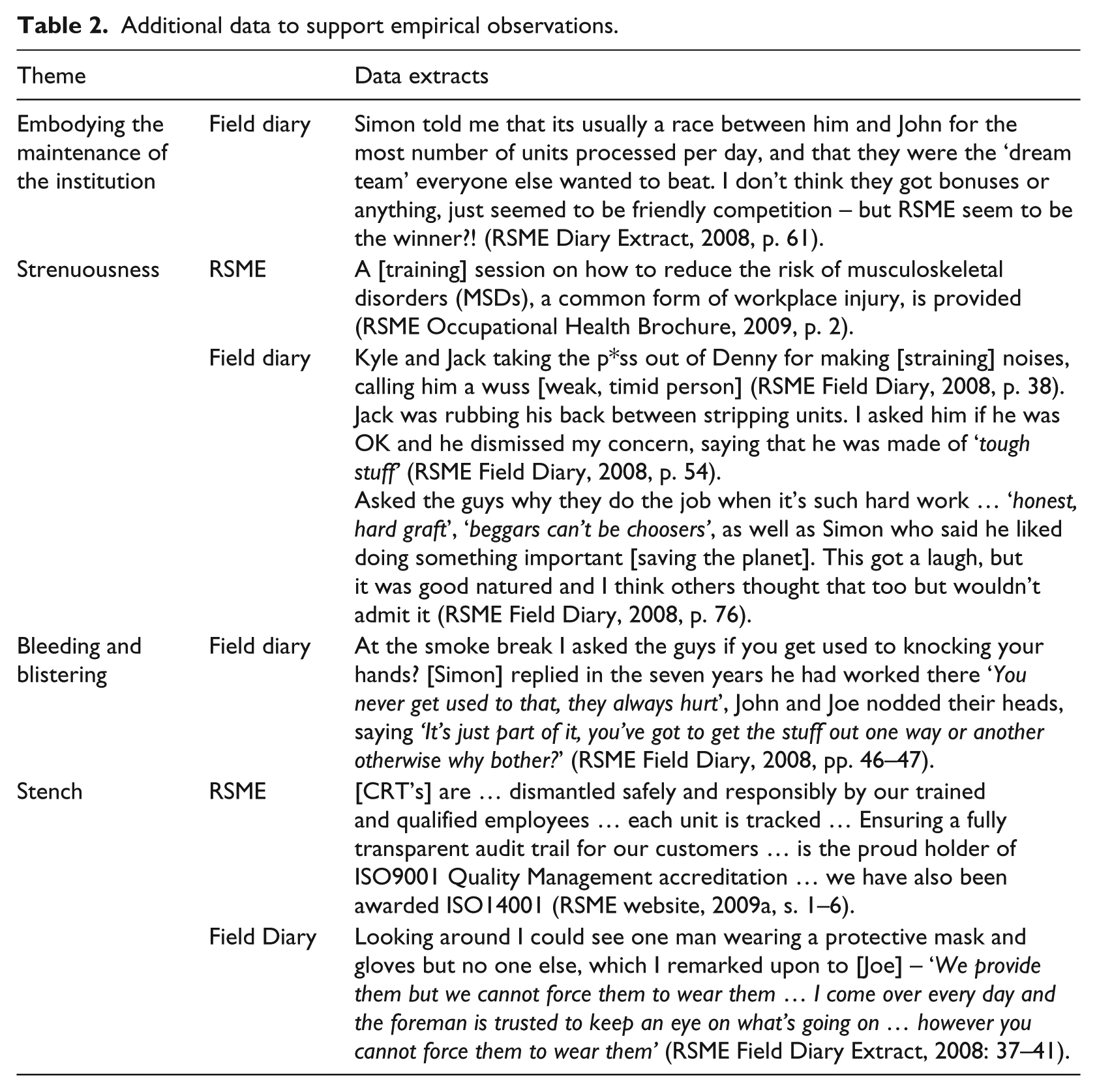
In the data below we juxtapose relevant excerpts from the BATRRT document and extracts from RSME policy and organizational documents with Alison’s photographs and entries from her field diaries. For the most part, we have left these data to ‘stand alone’ with limited explanatory context, so as to show the disjuncture between the espoused logic of the organization and the bodily realities of performing the role. 3 In so doing, we aim to highlight the institutionalization of pain and suffering of the actors involved. In order not to overly clutter our presentation, we have included additional data in Table 2 to provide further illustration for the discussions that appear in the main text. The findings presented below are then taken forward into our discussion of legitimating discourses, explaining why workers normalize their suffering as ‘part of the job’, yet without outright rejection of or resistance to health and safety imperatives maintaining safe systems of work as an institution.
Additional data to support empirical observations.
Recycling Computers at RSME: Embodying the Maintenance of the Institution
We begin with an overview of the process undertaken by the workers at RSME, before moving to our three vignettes: strenuousness, bleeding and blisters, and stench.
Waste is recovered or disposed of without endangering human health or the environment. (Defra, 2006, p. 2, our emphasis) We are pioneers and early adopters of many modern recycling techniques. Our processes are rigorously tested and constantly improved. (RSME Brochure, 2008, p. :3)
The recycling process begins when a consignment of computers arrives at RSME’s warehouse. The waste workers physically haul the bulky, often grimy and sometimes sharp or broken equipment from the vehicles and tightly packed cages in which the goods are typically transported. The work is made harder because speed is of the essence, given that RSME’s overriding aim is to process as many computers as possible per day, an objective very much bought into by the waste workers, who took pride in their swift work and high throughput of units.
Laughing, he saw I had not finished – ‘you need to be quicker than that if you worked here’ he teased … [Simon] reassured me that I was only doing the task to get an idea of what was involved … to be cost effective I would have had to strip 100 units a day! One every five minutes. (RSME Diary Extract, 2008, p. 17)
Considerable strength and agility was therefore required as well as a tacit bodily co-ordination between workers as they bent, stretched, twisted, balanced, took the strain, crawled into vans and hung precariously off cages in unpacking the load as fast as possible. Alongside the sheer physicality of the offloading task, a complex sorting operation was taking place. Workers distinguished often very similar components by eye and even seemingly by feel since they did not always look at the items they were handling, recognizing them solely by weight and shape and placing them in bins arranged to streamline subsequent recovery processes. This ensured the most efficient trajectory of the materials through the dismantling process and ultimately into a form that maximized their economic value. All the while, they joked, laughed, shouted and swore at each other over the noise of trucks and machinery. Monitors were stacked carefully on pallets ready to be transported by fork-lift truck to the hazardous waste unit, and keyboards and mice had their wires removed with hand cutters as soon as they arrived – dropped or tossed with quite some dexterity into their respective storage containers. The central processing units (CPUs: the main computer bodies) were piled up in specific ways so as not to topple over while awaiting removal to the workbenches for disassembly.
We now turn to our vignettes of embodied inhabitation which together show how the RSME waste workers ‘valued and/or silenced their suffering’ and which we argue represents embodied institutional maintenance work.
Strenuousness: Lifting, shifting, throwing
’40. Removal may be by manual or mechanical means. Items should be safely removed as a whole where the material items concerned are hazardous and to do otherwise would lead to manifest pollution of the waste stream. Items may be removed as materials where the benefits gained by their removal, as a whole in health and safety or environmental terms, would be disproportionate to the costs involved. (Defra, 2006, p. 9) Using advanced [recycling] equipment our trained employees separate WEEE … Our recycling facilities are managed to ensure the highest standards of quality and safe working practices. (RSME, 2009 Website s. 3-6)
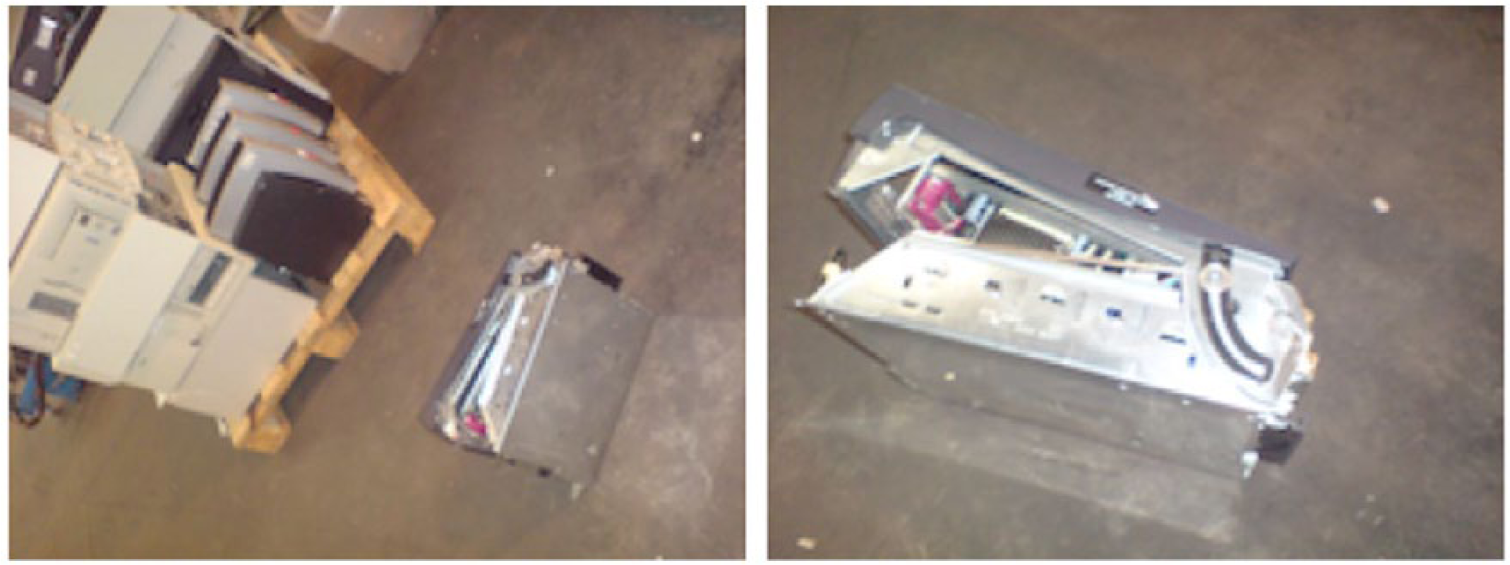
Strenuousness, dropping the computer.
The BATRRT simply states that component extraction should take place ‘manually or mechanically’ (Defra, 2006, p. 8). There is nothing concrete in this policy or RSME’s guidance that explains how these activities can be achieved. The expectation is that the workers know how to access and remove the necessary screws and the circuit boards and cut off the surplus wire. However, in practice this was somewhat different, as Alison discovered, feeling ‘an idiot’ or ‘clumsy’ when she was unable to loosen the screws. Despite being shown a ‘bewildering’ array of tools, depending on the type of fixing, to either use in a traditional unscrewing action or as levers to free the seal or damaged screw heads, it was evident that she was not up to speed.
[Simon] gave me some advice – ‘smash it on the floor’ if it does not open … I had no idea what height to drop the CPU from and my first attempts were pathetic with the unit just denting. Raising the part to head height seemed to work! The computer hit the ground with a satisfying thud … [Simon] could see I was tired … he laughed when I told him my hands, legs, arms all ached – he said I would get use[d] to it … I asked the guys if smashing the computer [CPU] was the only way and was told unanimously ‘That’s just what we have to do…. It’s just how we do it.’ (RSME Field Diary, 2008, pp. 17, 20, 61, 86)
The photographs above were taken to remind her of this strenuous act. Lifting a bulky computer case was not easy, requiring balance and timing, and it took several attempts for the case to break sufficiently to enable Alison to complete the removal of the components inside. While she was working, she was approached by the RSME CEO, who appeared fully aware that this was regular practice, and remarked, ‘It was good to get your hands dirty when most of the time you had to think about things all day so doing something that was physical was good’ (RSME Field Diary, 2008, p. 20). This sentiment seemed to condone the strenuous and dangerous activity, despite RSME’s policy to the contrary. Likewise Simon’s reassurance above that ‘she would get used to it’ shows the legitimation and taken-for-granted-ness of bodily suffering. Indeed, this seemed to be a pattern throughout the disassembly crew, with notes from Alison’s field diary recording similar observations (see Table 2).
Bleeding and blisters: intricate, confined work
116. Safe systems of work should be devised to ensure, so far as is reasonably practicable, the health and safety of workers. Dutyholders should ensure that control of risk is achieved by implementing controls that prevent exposure. (Defra, 2006, p. 19) RSME are committed to ensuring, so far is reasonably practical, the health, safety and welfare at work … employees are expected to observe the company’s rules, policies and procedures, which are designed to provide a safe and healthy environment. The policy is communicated to all persons working under the control of the company upon induction … and is posted in prominent positions at all sites. (RSME Health and Safety Policy, 2008, p. 1)
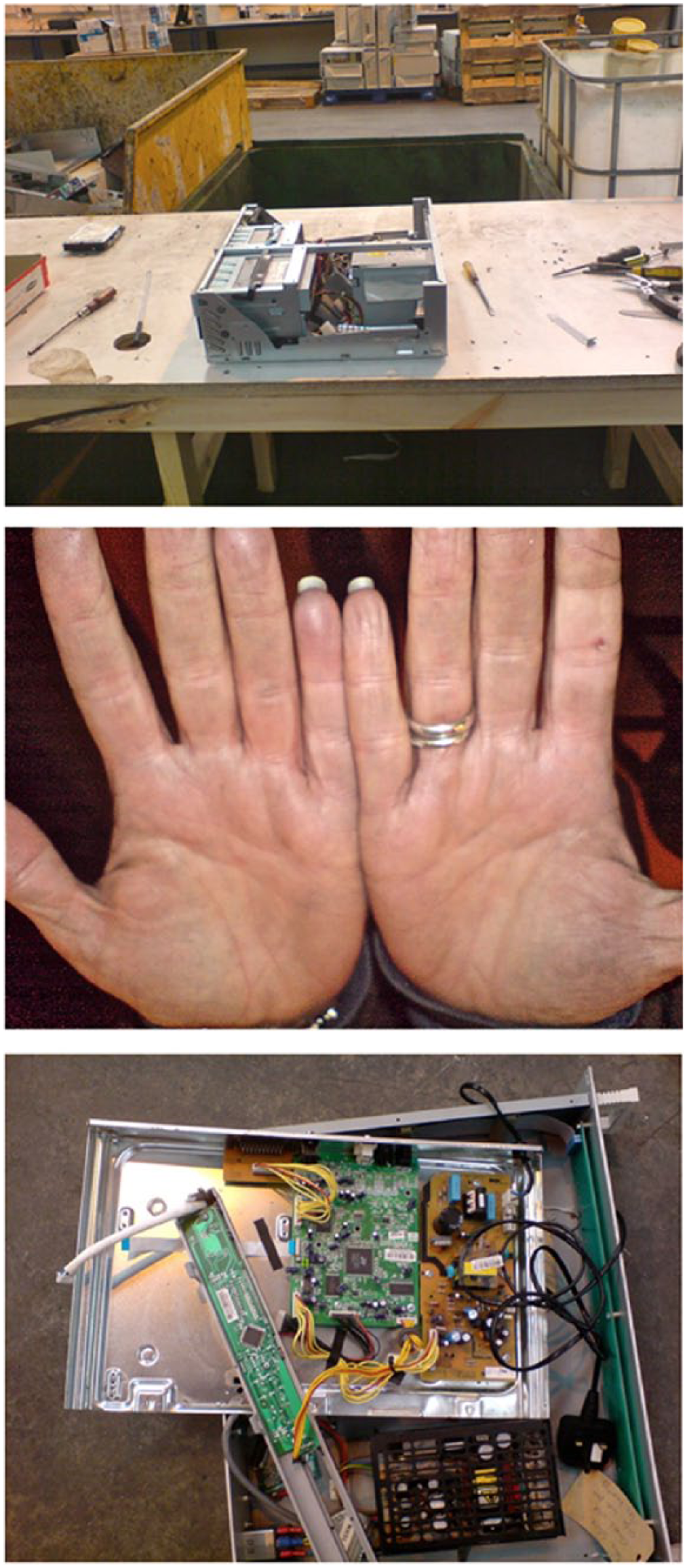
Bleeding and blisters.
The BATRRT document acknowledges that the type of work associated with computer disposal can ‘expose workers to risks from … cuts and lacerations, musculo-skeletal injury’ (Defra, 2006, p. 19) and this was taken seriously in the RSME health and safety policy and indeed by the waste workers themselves. Specialist gloves were provided to guard the waste workers’ hands while they removed the circuit boards. But as Alison quickly realized, the bulky fabric inhibited her ability to move her hands inside the tight spaces of the CPU case to extract the different components. Because of this inhibition, very few of the RSME waste workers actually wore their gloves despite being regularly injured, yet they still cautioned Alison to wear hers.
[Simon] provided words of caution, ‘Be very careful of your fingers as the circuit boards are sharp, you can cut yourself without realizing’. Wearing gloves, I attempted to remove the board but could not get my hands into the corner of the opened unit. The screwdrivers and screws were so tiny and the gloves were bulky and extremely thick … after a short while I found myself mirroring [Simon] and not wearing any as it was easier that way … but by lunchtime I had managed to lacerate my fingers several times … there were no more plasters available in the warehouse first aid kit. (RMSE Field Diary, 2008, pp. 17–19)
The only way to ensure safety in this instance appeared not to do the job, positioning suffering as a necessity, as further data in Table 2 shows. This necessity of suffering became abundantly apparent to Alison when she was requiring sticking plasters to the extent that she depleted the organization’s supply, which resulted in her being teased. They also told her stories – somewhat proudly – of wounds and the ability to endure repeated injury, for example, ‘You never really get used to [hand cramps] … they always hurt’ and she was shown many scars workers had accumulated over the course of their employment.
Stench: Ambient inhalation
’82. Handling of CRTs can present a danger of implosion. As a consequence, safe systems of work will need to be used to control the risk to operators. This would typically include enclosure of the process to prevent flying glass entering the working area. (Defra, 2006, p. 15) Our [yards] are managed to ensure the highest standards of quality and safe working practices. (RSME Health & Safety and Quality Assurance 2010, website s. 9)
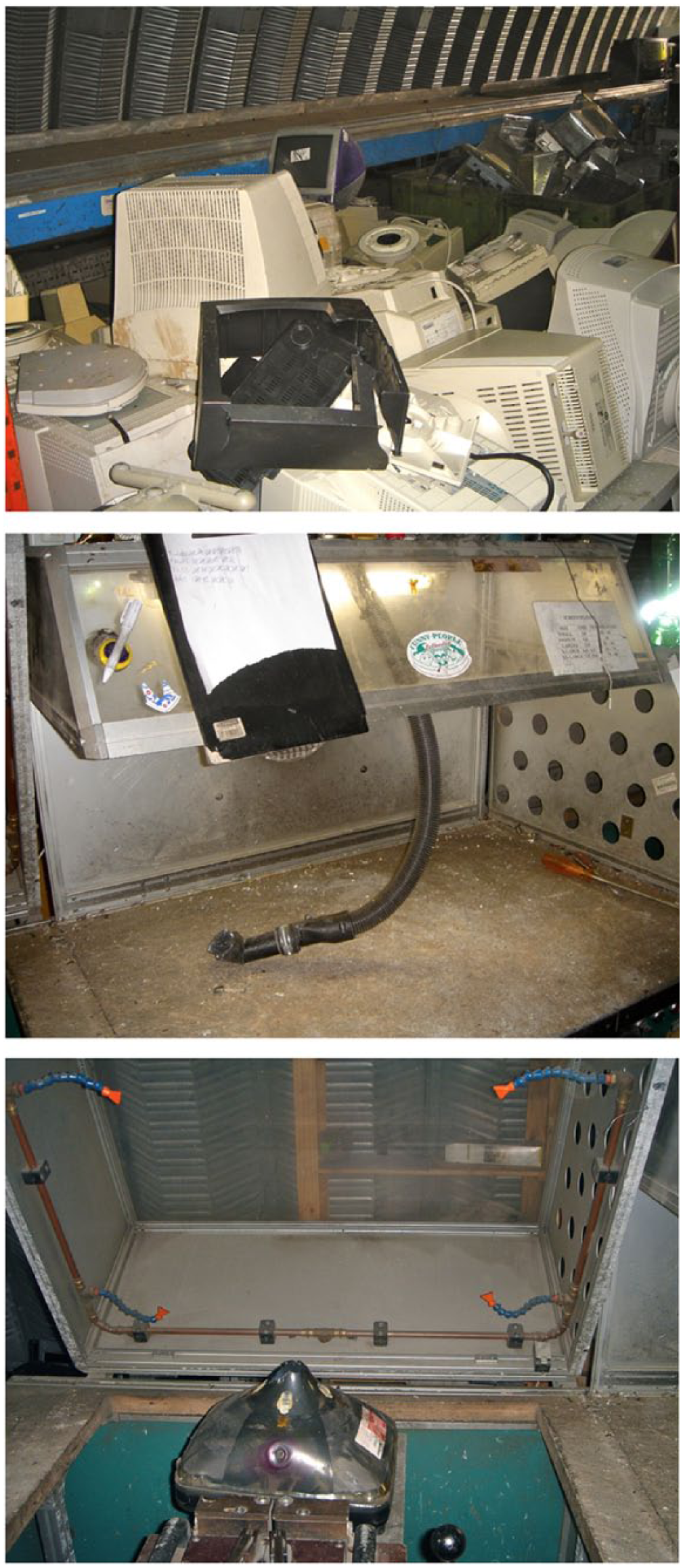
Stench.
Given that cathode ray tubes (CRT) are considered one of the higher-risk hazards associated with computer recycling, the BATRRT prescribes extracting this substance through the separation of ‘the lead-containing cone glass’ by ‘using a hotwire, laser or cutting disc’ (Defra, 2006, p. 15) and RSME state that they are dismantled safely and responsibly. Adopting these practices maximizes phosphorus extraction while minimizing contamination of the other materials in the monitor, protecting the financial value to be gained from selling each substance as unadulterated. Despite including additional specific usable advice, this straightforward, rational account – albeit safety cognizant – could not have been further away from the realities of actually performing the task. Alison took the photographs above as a reminder of the acrid stench that arose from dismantling CRT monitors and, when viewing these images, she still recoils at the sensory memory of visiting the hazardous waste team. Such is the allusive power of the photograph to evoke bodily recollection.
Entering the hazardous waste area I was overpowered by the stench, the smell hit the back of my throat making it hard to breathe for a few moments, it felt as if my nostrils were trying to close. I had never smelt anything like it; it was vile … potent … leaving a metallic taste in my mouth. … The [disassembly] unit was well ventilated, as it had no doors … ‘This is the most boring job ever and the guys all have to wear masks and protective clothing’ Simon told me. (RSME Field Diary Extract, 2008, pp. 6, 37–41)
Procedures appeared to be being properly followed (separate, enclosed work area, shrink-wrapped monitors, masks and gloves); however, the air was still thick with particles. Even though Alison was observing in a well-ventilated ‘open air’ unit, she could still taste the acrid tang in her mouth and feel burning in her nose – nothing stopped the stench from stinging her airways. Despite this discomfort, Alison noticed that not all workers were wearing protective clothing and it was not immediately obvious to her that it had been provided (see Table 2). It was not as if the waste workers were not aware of the dangerous effects of working with phosphorus, and this disregard for health and safety was puzzling given that in other situations the workers did wear the correct personal protection equipment when they could. When entering the recycling areas for example, workers wore a boiler suit, steel toecap boots and on occasions high visibility waistcoats, jackets and hard hats.
The three vignettes above – ‘strenuousness, ‘bleeding and blisters’ and ‘stench’ collectively make up the ‘suffering’ that must be endured to adequately undertake the task of computer recycling, at RSME at least. Theoretically, we have read these data through an ‘inhabited institutions’ lens to draw out the mechanics of micro-level processes of bodily interaction through which Alison made sense of her own reality and through which we have drawn inferences about the embodied maintenance of safe e-waste recycling at RSME. The next section theorizes these findings.
Discussion: Embodying Maintenance Work
Starting with the researcher’s embodied inhabitation before empathizing with others in the field proved a powerful methodology to break down the ontological distinctions between ‘people and things’ in a variety of ways we have found useful for understanding how institutions are reproduced and maintained. Despite their welcome focus on the negotiated social skill of the actors involved (Lawrence & Suddaby, 2006), emphasis on everyday routine, rituals and practices (Dacin et al., 2010; Quinn Trank et al., 2009; Zilber, 2009) and the small-scale micro adjustments institutional actors undertake to repair institutional breakdowns as they occur in the moment (Currie et al., 2012; Lok & De Rond, 2013; Micelotta & Washington, 2013), studies of institutional maintenance have hitherto conceptualized stability and order as disembodied and acontextual processes that overlook objects and the physical environment (Suddaby 2010). Even the inhabited institutions perspective, with its roots in symbolic interactionist traditions and claims to redress the disembodied view of institutions, could go further in considering material grounds (Hallett et al., 2009; Hallett & Ventresca, 2006). Despite concepts such as ‘embedded agency’ (Delbridge Edwards, 2013, p. 933) and Bechky’s (2011, p. 1162) aim of ‘developing fully fleshed out theories’, institutional inhabitation – on paper at least – remains strangely cerebral, cognitive and/or rational.
Our focus on embodied inhabitation is intended to address this lack. Earlier, we showed how it helps us pay attention to the blurring of boundaries between human and non-human, social and material and culture and biology in organizational research and here we extend these discussions to show how embodied inhabitation contributes to our understanding of the micro-processes that maintain institutions.
Embodied inhabitation: Destabilizing ontological boundaries
In our vignettes, we first see how human and non-human are difficult to divide. In ‘strenuousness’, the configuration of the tool, the type of CPU case, condition of the fixing and the strength and agility of the worker come together in the worker’s decision about how to break open cases. Second, the blurring of boundaries between hands, gloves, tools and CPU cases in vignette 2, ‘bleeding and blisters’, prevented the extraction of the circuit boards, necessitating unsafe practices to do the job. Third, the acrid ‘stench’ of the CRT disassembly area is both non-human – in that it is particles of the chemical itself (e.g. Riach & Warren, 2015) but at the same time human – in the burning and stinging of the airways experienced by the workers. It is a striking example of the indivisibility of human from non-human that powerfully brings to life the more theoretical discussions we have engaged with in this article.
Undertaking the work herself as an outsider, Alison was able to surface experiences that the waste workers more usually took for granted. Lok and De Rond’s (2013, p. 188) concept of ‘reflexive normalization work’ outlined above is helpful here. To recap, their term refers to the involuntary ways in which actors make sense of exceptions as ‘business as usual’ using their background stock of (institutionalized) knowledge and ‘maintenance work can involve the paradoxical use of divergent actions to validate and strengthen the very principles these divergent actions threaten’ (Lok & De Rond, 2013, p. 205). But to extend their ideas here, it is on account of embodied conditions that such improvisation and normalization are needed – the cases must be opened at all costs in order to maintain the ‘green veneer’ (Gregson et al., 2016) that e-waste recycling is safe, non-problematic and a productive process – even though physically challenging. The body is both constitutive of the decision to throw the computer on the floor and simultaneously ‘written out’ in the reflexive normalization of the act and, importantly, this custom and practice is shared. Embodied inhabitation therefore allows a more sensitive contextual understanding of ‘under the radar’ micro-practices, fully recognizing the vitality of non-human dimensions.
This ‘writing out’ shows how the body (material) is also caught up with the social. The encouragement Alison received from the waste workers to ignore her bleeding and blistered hands when dismantling the CPUs is an exemplar here. She found it impossible to carry out the dismantling task while wearing the protective equipment provided to ensure her safety, while at the same time being exhorted to ‘take care’ and ‘wear gloves’ by her fellow workers who were themselves working with unprotected hands. The waste workers thus validated pain and injury as unavoidable by-products of what they socially constructed as a perfectly reasonable process, even proudly telling stories and showing scars as evidence of this undertaking. The power of shared language, jokes and stories eclipsed their material realities through social sense-making, eventually coming to experience pain and suffering as something else, that normally remained unremarked upon.
The waste workers’ shared bodily practices constructed a belief system that this type of work should be undertaken in this way, e.g. with suffering, which supports Voronov and Vince’s thesis that in any given institutional context, there exists a ‘taken-for-granted and unquestioned codification of the emotional displays and emotional experiences that are valid and valued within it’ (Voronov & Vince, 2012, p. 63). In this case, it is the body (or more realistically a denial of the body’s frailty) which plays a leading role in the silencing and even valuing of suffering that is necessary to sustain safe systems of work. Its ontological character as suffering is called into question under these cultural conditions. Suffering is perhaps no longer suffering, but a ‘badge of honour’ to be displayed. Recognizing this takes us further than (just) an empirical dissolution of the human/non-human divide and beyond an explanation that blurs social and material in the sense-making processes of the waste workers. In valuing their suffering, we can see how the biological reality of suffering becomes transfigured through cultural valorization.
Valuing and silencing suffering
Identifying these two dynamics in our data does not go far enough in understanding the mechanics of how they arose, however. The research question for this article is to explore the role of embodied experiences in institutional maintenance – and as we have shown through the conceptual and methodological discussions above, this entails drawing in social and cultural understandings in order to explain how embodiment maintains institutions.
RSME’s waste workers were male, working-class, some from disadvantaged social circumstances and proud to be working for RSME – they were committed to their employment and grateful for what they saw as ‘proper’, ‘worthwhile’ jobs, which required them to develop skilled expertise over a period of time. Moreover, they saw themselves as pivotal to and importantly responsible for the organization’s mission to extract maximum value from the e-waste. The normalization of their suffering and its silencing or valuation may have been because to recognize their suffering as suffering may have been at odds with their conceptions of their own working-class masculinity, particularly as they constructed that masculinity to a female, academic researcher.
Alison observed a variety of masculinities exhibited in various ways. Most obviously these included banter, competition and bravado, particularly around bodily processes such as cuts, aches and pains, hand cramps and painful airways. Normalization of suffering within this frame would simply be what is required to fit this version of maleness and exhibit the level of skill described above. However, a more subtle, caring and responsible paternalism was also evident in Alison’s interactions with the waste workers, partly on account of her presenting identity as an educated woman, but was also observed in interactions between the workers themselves, exhibited through benevolent teasing, pecking orders and the pride they took in having responsible, regular employment to provide for their partners and families.
Although a full discussion would take us beyond the scope of this article, these ideas have found recent support from other researchers investigating working-class masculinities and ‘dirty’ and/or heavy labour. Slutskaya, Simpson and Hughes (2016, p. 178) in particular found ‘bodily capacities for hard work and endurance’ and ‘pride in continuous employment’ (p. 173) as ways in which refuse collectors and street cleaners generated dignity and pride in their ‘superior embodied capacities’ for doing work that others (women, educated people, ‘foreign’ workers) were not perceived as able to do. This pride in a ‘tough job well done’ was also borne out by Chan (2013). Taking an intersectional approach and researching homosexual construction workers, Chan’s (2013) study found that skill overrode other potential sources of division, e.g. homosexuality and class, which once again reminds us not to overplay the salience of singular social categories. Skills were not necessarily linked to education or even training, but interactional products of what constituted a ‘good worker’ in a given context – keeping the body fit to withstand demands of the job and a sensory engagement with tasks (e.g. ‘knowing paint’ by its smell and colour) were two examples that strike a chord with our data for their embodied and taken-for-granted character (Chan, 2013, p. 824). With explicit regard for workplace safety issues, Stergiou-Kita et al. (2016) found that male electrical tradesmen returned to work sooner than advised after workplace accidents on account of the ‘valorization of the “tough” worker’ that was institutionalized as a workplace belief (Stergiou-Kita et al., 2016, p. 725).
Creed et al. (2014, p. 297) remind us of the importance of affective bonds between inhabitants and communities that act as a ‘mechanism through which commitments to institutional arrangements emerge’. The waste workers wore their scars as evidence of their resilience and loyalty to each other, the organization and, perhaps, its mission, and as minimally educated people their work provided a sense of status that may have been denied them in other ‘unskilled’ occupations. Their expertise was at the level of the body – tacit sorting of components, co-ordination and sorting according to process and ‘feeling one’s way’ around inside discarded computer equipment.
Conclusion
Suffering has real, material effects. It damages bodies and hurts the health of e-waste workers. The BATRRT document itself states that ‘items may be removed as materials where benefits gained by their removal as a whole in health and safety … would be disproportionate to the costs involved’ (Defra, 2006, p. 8). But if the costs of bodily suffering are not recognized by the e-waste workers themselves and instead explained away as just part of the job through a ‘politics of silence or erasure’ (Gregson et al., 2016, p. 552), then they cannot appear in the cost-benefit analysis advocated in the BATRRT, further contributing to the idea of ‘the clean and green veneer’ (p. 552) that removals of materials is safe. (Re)embodying institutional maintenance, therefore, has implications for policy makers who we suggest might give more consideration to ‘fit working conditions’ when envisaging the translation of policy activities into practice and as researchers we have a moral imperative to highlight the unglamorous occupations that appear to exist at a physical cost to workers (Gregson et al., 2016; Lawrence et al., 2013).
An embodied inhabitation perspective brings to the fore the way human and non-human actors interact, (re)embodying institutional processes and (re)introducing human concerns and ethical commitments or needs, e.g. the experience of suffering for those working with e-waste discussed in this article, but we might imagine many others, as we suggest that our findings may hold true regardless of the institution in question. For example, the studies we cite in this article could all be re-read for their material dimensions, e.g. Dacin et al.’s (2010) dining room rituals entail cutlery, tables, the bodily functions of eating food and digestion as part of the establishment of appropriate etiquette. Lok and De Rond’s (2013) findings were intensely embodied, involving concerns of peak physical condition, oars, boats and the river – as well as the social structures and negotiation on which their research focused. Indeed, it would be interesting to explore embodied inhabitation in virtual institutions to see how the body is reconfigured in digital relations such as call centres (Mirchandani, 2015), customer service now arguably being an institution in advanced consumer society. Of course, the salience of the body to age, race and gendered encounters makes any study of embodied institutional processes involving these dynamics particularly important from an ethico-political stance.
In conclusion, we have introduced the concept of ‘embodied inhabitation’ to show the value of taking a bodily and material perspective on institutional maintenance work, blurring boundaries between human and non-human, social and material, culture and biology in understanding the embodied micro-level, situated interactions that maintain the institutional status quo. Empirically, we showed how organizational imperatives play out in and between the bodies of organizational members in the course of their everyday work and upheld the institution of ‘safe system of work’ for e-waste recycling workers. Using three vignettes, relating to the overarching theme of ‘suffering’, we highlighted the value of taking a micro-level, embodied approach to examine the dynamics that led to the normalization of suffering (valuing and silencing). Thus, we hope to have shown that just ‘explaining’ why workers engage in such normalization processes is not the whole story, since their bodies remain forcefully involved through pain, suffering and real material effects. It is this refusal to ‘explain away’ the body that we argue an embodied inhabitation perspective brings and this is an ethico-political endeavour.
Footnotes
Acknowledgements
We would like to thank the organisers and participants of the Visualising Institutions and Knowledge track at EGOS 2014, and participants at the Methodologies for Extreme Contexts workshop at the University of Umeå, Sweden for their early input into our ideas. We would also like to thank the three anonymous reviewers and Editor of this article for their exceptionally constructive and helpful comments on earlier versions of this paper.
