




Abstract
Institutional theorists have predominantly focused on the symbolic and cognitive side of institutions. So far, the role of materiality has been largely overlooked in institutional studies. Material aspects of organizing can nevertheless critically shape actors’ responses to institutional pressures, not least because material and ideational aspects are often intermingled. In this paper, we extend Oliver’s (1991) conceptual framework of strategic responses. We show how managers assess and compare the material and ideational aspects of new institutional requirements with their existing material and ideational situation and balance both aspects in their strategic responses. We find that the degree of (mis)alignment subsequently shaped their evaluation of the consequences of (non)conformity and the breadth of responses available to them. In fact, we find that the nature of institutional requirements – material versus ideational – actually restricts the range of strategic response options.
Introduction
In this paper, we build on previous research on strategic responses to institutional pressures (cf. Goodstein, 1994; Ingram & Simons, 1995; Oliver, 1991). A central premise of this literature is that organizations gain support and legitimacy by responding in an appropriate way to social pressures from their internal and external environments (Love & Cebon, 2008; Oliver, 1991; Ruef & Scott, 1998). Institutional pressures, like changing normative beliefs or newly enforced rules, can impact on both the ‘ideational’ and ‘material’ make-up of organizations (Friedland & Alford, 1991; Jones, Boxenbaum, & Anthony, 2013; Thornton, Ocasio, & Lounsbury, 2012). For instance, new safety prescriptions of regulative authorities can demand the redesign and reconstruction of buildings or technologies often in the interest of safety (Scott, 2008, p. 82). Next to being actively shaped by institutional pressures, these same physical objects also transfer meaning, norms and values imposed by institutional requirements, because physical objects embody prevailing ideas, beliefs, norms and values (Barley, 1986; Jones & Massa, 2013; Orlikowski, 2000; Scott, 2008). Nevertheless, the ‘material side’ of institutions has received far less attention from institutional scholars who predominantly focused on symbolic aspects (Jones et al., 2013; Lepoutre & Valente, 2012; Orlikowski & Scott, 2008; Scott, 2008).
Material aspects of organizations have been a central object of study among engineers and information technologists. Material and visual artifacts can have important social implications, as they embody ideas, travel through time and space, constitute objects of (re) interpretation, capture our imagination and trigger a range of cognitive, emotional and substantive responses (e.g. Fiol & O’Conner, 2006; Friedland, 2013; Gieryn, 2002; Jones & Massa, 2013; Rafaeli & Vilnai-Yavetz, 2004; Raviola & Norbäck, 2013; Stigliani & Ravasi, 2012; ). However, in their translation to organizational theories, these material elements seem to be lost along the way (Jones et al., 2013). Material elements either received comparatively little attention, or they are conflated with symbolic aspects (Orlikowski, 2005, 2006; Orlikowski & Barley, 2001). This is surprising, particularly given the pervasive empirical presence of materiality in everyday organizational practice (Zammuto, Griffith, Majchrzak, Dougherty, & Faraj, 2007; Orlikowski & Scott, 2008), and secondly because ideational aspects often exist in relation to a material world, where variables of a material nature are institutionally shaped (MacKenzie & Wajcman, 1999; Scott, 2008). Ironically, even the majority of studies on ‘technology and organizing’ have largely downplayed the role of technology itself in favour of social and cultural explanations (Leonardi & Barley, 2010, p. 32).
This paper examines how decision-makers perceive, interpret and assess the material and ideational implications of new institutional requirements, and how they respond to their (mis)alignment with the existing material and ideational aspects of their organization (George, Chattopadhyay, Sitkin, & Barden, 2006; Kennedy & Fiss, 2009). As both aspects affect organizations in potentially different ways, they may trigger a variety of organizational responses (Oliver, 1991; Pache & Santos, 2010). We use the term ‘ideational’ to refer to cognitive frames and symbols, whereas material aspects refer to representations of these cognitive frames and symbols in physical objects (Jones et al., 2013). By accounting for both material and ideational aspects we pursue a better understanding of the variety of organizational responses to the same institutional mandate (Friedland & Alford, 1991; Law & Mol, 1995; Orlikowski, 2006, 2007; Orlikowski & Barley, 2001; Zilber, 2006)
We study managers in the Dutch childcare sector. More specifically, we show how these managers assess and compare the material and ideational aspects of new institutional requirements with their existing material and ideational situation and include both aspects in their strategic responses. The research question we raise in this paper is formulated as follows: In what way does the configuration of material and ideational aspects of institutional pressures shape decision-makers’ strategic responses?
We pursue two contributions. First, we build on Friedland and Alford’s (1991) notion that talking about institutions requires looking at the ideational and material world simultaneously (Friedland, 2013). Oliver (1991) would conceptualize such broadening of ‘institutions’ as refining its ‘content’ from ideational only to ideational and material. This paper pursues a contribution to these ideas by a systematic exploration of configurations of interrelated material and ideational aspects. These configurations allow us to show how new institutional requirements generate more or less alignment between material objects (buildings, playgrounds) and ideational aspects. We focus on how their specific interrelationship shapes the nature of organizational responses to new institutional pressures (Jones et al., 2013; Leonardi & Barley, 2010).
Second, our study builds on Oliver’s (1991) conceptual framework of strategic responses. In particular, we show and compare the range of strategic responses induced by material misalignments of institutional pressures relative to ideational misalignments. According to Oliver’s strategic response theory, managers have a broad range of strategic responses at their disposal to address institutional requirements. However, neither Oliver nor the researchers applying Oliver’s strategic response framework (Goodstein, 1994; Ingram & Simons, 1995) explicitly considered the possibility that the nature of the institutional requirements – material versus ideational – might restrict the range of response options. From our results, we indeed find that in a situation of material misalignment the most likely responses are compliance and compromise, whereas avoidance is absent. Material requirements are seemingly harder to circumvent for managers, because their implementation is easy to assess. Therefore, material misalignments attract more attention from stakeholders, which makes it more difficult for managers to resist such requirements openly. Defiance and manipulation are especially likely to occur when material and ideational misalignment are presented to decision-makers together.
This paper has the following structure. First, we present our theoretical framework. Next, we describe the research context in which we present the institutional pressure of interest. Subsequently, we describe our methods and present our findings. Finally, we discuss the implications of looking at both the material and ideational aspects of institutional pressures in understanding the variety of response repertoires available to actors.
Theoretical Background
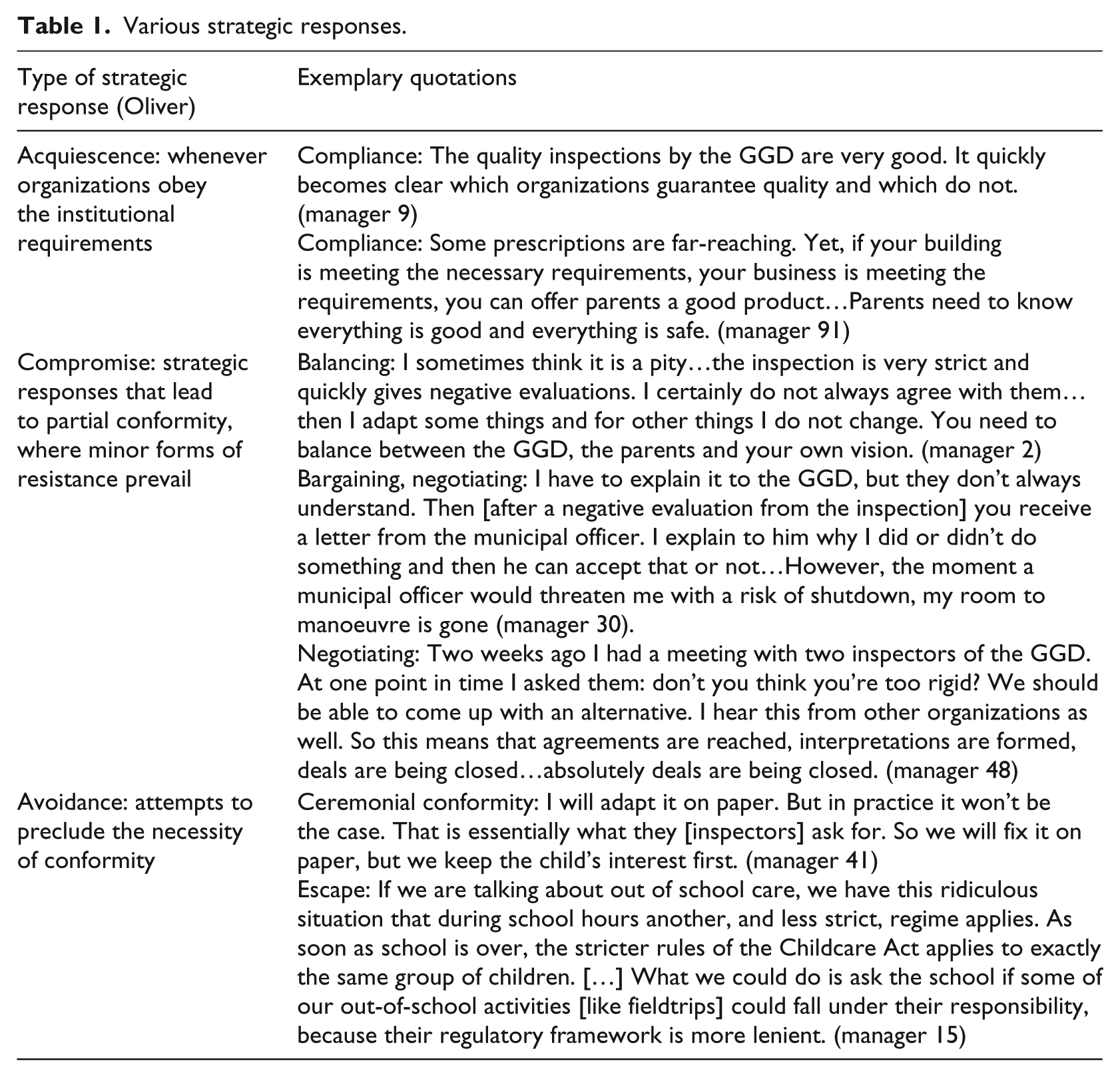
In conceptualizing organizational responses to institutional demands, we start from the work of Oliver (1991, p. 145) who devoted ‘explicit attention to the strategic behaviors that organizations employ in direct response to the institutional processes that affect them’. Oliver (1991) suggested that organizations could respond more strategically, relaxing the assumption of homogeneity of strategic responses. She identified five possible responses to institutional pressures: acquiescence, compromise, avoidance, defiance and manipulation. Acquiescence refers to a situation where organizations obey institutional requirements. Compromise refers to strategic responses that lead to partial conformity, such as negotiation or balancing, where minor forms of resistance prevail. Organizations can also attempt to preclude the necessity of conformity using an avoidance strategy by concealing their nonconformity, buffering themselves from institutional pressures or escaping from institutional rules or expectations. Defiance is an active form of organizational departure from institutional pressures where institutional pressures are dismissed or actively challenged, whereas manipulation pertains to an organization’s opportunistic attempt to actively change or exert power over the content or source of the pressure, for instance by influence tactics (see Oliver, 1991, pp. 152–159 for a more elaborate explanation of her strategic responses).
Oliver’s work triggered valuable subsequent studies that focused on the various ways in which organizations may respond to institutional pressures (e.g. Goodstein, 1994; Greening & Gray, 1994; Ingram & Simons, 1995; Pache & Santos, 2010; Raaijmakers, Vermeulen, Meeus, & Zietsma, 2015). According to these insights, pressures arising from the institutional environment do not affect all organizations in similar ways, and organizations differ in the responses they deploy (Greenwood, Oliver, Sahlin, & Suddaby, 2008). Most of this strategic response literature focused on the nature of various strategic responses and its antecedents (e.g. Goodstein, 1994; Ingram & Simons, 1995; Oliver, 1991; Pache & Santos, 2010). Westphal and Zajac (1994) illustrated manipulative symbolic actions of corporations when announcing the adoption of incentive plans. Fiss and Zajac (2004) emphasized the symbolic adoption of shareholder value orientation, and Goodrick and Salancik (1996) provided evidence for doctors’ partial compliance with institutional pressures.
Oliver (1991) also identified several antecedents of strategic responses, including, for instance, whether compliance to expectations from external actors will result in increased social or economic fitness; how dependent the organization is on the normative order of constituent actors exerting institutional pressures; whether there are multiple conflicting expectations exerted on an organization; how consistent the institutional pressure is with organizational goals; whether the pressure will impose constraints on the organization; and how uncertain and interconnected the organization’s context is (Oliver, 1991, pp. 161–171). However, the ‘material’ side of these antecedents received far less attention.
How material and ideational worlds collide
Several authors have conceptualized material and ideational aspects of organizations as interrelated. Orlikowski, for example, claimed that ‘there is no social that is not also material, and no material that is not also social’ (Orlikowski, 2007, p. 1437). Friedland claims that observable objects are ‘the means by which practices are anchored, affected and oriented’ (Friedland, 2013, p. 37). Jones et al. (2013, p. 55) add to this claim that ‘materials…are also vehicles enabling ideas and symbols to travel across time and space’. This duality of material and ideational aspects of organizations pertains to the fact that organizational ideas, norms and values are translated into practices that partially take on the shape of physical objects, or shape the material specifications of such objects.
The issue we address is that ideas do not necessarily translate easily into material objects. New material requirements often make current practices and their physical embodiments obsolete, or cannot be easily aligned with the existing routines and actually induce ideational conflict. Some recent studies that examine the reciprocity between materiality and ideational factors provide substantial evidence for this potential conflict. For instance, Friedland and Alford (1991, p. 247) gave the illustrative example of the inability of non-Western societies to incorporate the material goods or technologies of the West without radical cultural transformations and – vice versa – the inability of the West to absorb non-Western values, without the necessary material transformations. Likewise, Jones and Massa (2013, p. 1101) point to the critical role of materiality in the instantiation, diffusion and institutionalization of novel ideas.
An overarching inference from these studies is that material objects or technologies are neither objective nor deterministic forces. They are subdued in an organizational world and have to be aligned to multiple social and symbolic factors. This alignment can be more or less difficult and unleashes a larger or smaller variety of strategic responses. We build on these insights by examining a coercive institutional pressure that brings about new material and ideational requirements that affect the material side of the organization (e.g. a building). Next to possible material changes in buildings, playgrounds and hygiene protocols, these requirements are simultaneously evaluated in light of the pre-existing cognitive frames, routines, practices and symbols of the decision-makers.
We expect that any type of (mis)alignment between newly imposed institutional requirements and the pre-existing situation – both material and ideational – may result in tensions, and induces a decision-maker to consider alternative strategic responses. After all, conformity to a new institutional requirement may conflict with the existing notions, norms, values, practices or material aspects within the organization (Powell & Colyvas, 2008; Seo & Creed, 2002). In such ambiguous situations, organizations are inclined to exercise some level of strategic choice, because more than one course of action may be considered ‘appropriate’. In this way the taken-for-granted character of institutional mandates is challenged, as it makes actors aware of alternative courses of actions (Clemens & Cook, 1999; Dorado, 2005; Friedland & Alford, 1991; Greenwood, Raynard, Kodeih, Micelotta, & Lounsbury, 2011; Lepoutre & Valente, 2012; Oliver, 1991; Pache & Santos, 2010; Seo & Creed, 2002). However, one could ask whether there are specific institutional requirements that constrain the set of strategic responses as identified by Oliver (1991). Faced with contradictions between macro pressures and the specific local situation within the organization, key decision-makers are required ‘to make decisions as to what demand to prioritize, satisfy, alter or neglect’ while at the same time secure support and ensure survival (Pache & Santos, 2010, p. 462). In the remainder of this paper, we will explore the relationship between ideational and material aspects of institutional requirements and the variety and nature of organizational responses this may generate.
Methods
Research context
Our empirical context is the Dutch childcare sector. The services offered by childcare organizations are care, supervision and development of children between the ages of 0 and 12. Until the age of 4 children may attend daycare; when they grow older they can attend out-of-school care. We believe this field is an appropriate context to explore our research ideas, because the childcare sector is rife with strong normative and regulatory pressures, which influence both the meaning of the work carried out and its various material aspects (e.g. safe furniture, ‘approved’ toys).
In 2005, the Dutch government implemented the Childcare Act. This law provided the sector – for the first time in its history – with its own regulatory framework. The Act governed the financial structure of the sector and provided a set of basic quality requirements. Previously childcare was governed under the Welfare Act, where municipalities coordinated childcare organizations. The new set of national and uniform quality requirements in the Childcare Act replaced the heterogeneous regulations of the municipal authorities and made the childcare provider responsible for providing good quality care. From 2005 on, the GGD (public health service) was responsible for the quality inspections and municipalities are accountable for the enforcement of the rules.
The basic quality rule in the Childcare Act regulates that the ‘childcare provider has to guarantee that he/she offers responsible childcare, which means childcare that contributes to a good and healthy development of the child in a safe and sound environment’. This implies the childcare provider needs ‘both personnel and material of sufficient quantity and quality to take this responsibility’ (article 50 of the Childcare Act) and ‘develops organizational policy that ensures to the greatest extent possible the safety and health of the children in each of the rooms’ (article 51).
These basic quality rules concerning children’s safety, health and well-being, are further specified into a larger number of specific rules, prescriptions and guidelines, which are summarized in the ‘Beleidsregels Kwaliteit Kinderopvang’ (Policy Rules on Quality in Childcare) and a screening framework (Hol & Vaes, 2012; Verschuur, 2006). Here one can think about building prescriptions, interior design, the number of employees relative to the number of children, hygiene instructions, the availability of heater covers, safety glass etc. This elaborate framework of rules has several purposes. First, it guides childcare providers in the implementation of the legal quality requirements of the Childcare Act. Second, it serves as a guideline for the quality inspectors (the GGD inspectors) during their quality controls. Third, it specifies what parents can expect concerning the quality of care in a childcare centre.
As well as the quality rules which follow from the Childcare Act and the Policy Rules specified above, childcare organizations also need to comply with a substantial set of – partially interrelated and sometimes conflicting – rules and norms related to building regulations and building permits; fire regulations; rules concerning food and food safety; norms and rules related to the safety of commodities such as toys and playground equipment; and the Work Conditions Act, which for childcare has specific rules about the height of changing tables for instance. As such, quality in childcare is governed by a broad variety of institutional requirements (Hol & Vaes, 2012, pp. 229, 300).
This set of norms and rules regarding children’s health, safety and well-being within childcare organizations, together with their inspection and enforcement, constitute the institutional pressure of interest in this study. As the above illustrates, this institutional pressure is rather complex in nature, especially because it consists of a gradually growing inventory of additional rules, norms or guidelines embedded in other pieces of regulations.
Research approach
In this paper, we draw on a qualitative methodology to understand how decision-makers evaluate and balance material and ideational aspects of new institutional requirements relative to their pre-existing material and ideational situation and how this shapes the nature and variety of strategic responses. We believe a qualitative methodology is most appropriate in this case, as it suits the explorative nature of this study. A qualitative approach can grasp actors’ interpretations of events or situations and provide us with their own accounts and justifications for their responses (Lee, 1999). Although we acknowledge that a decision-maker’s interpretations of institutional pressures and an organizational response may represent different levels of analyses, a vast majority of childcare organizations has only one key decision-maker who determines the course of organizational action.
Data collection
We selected the key decision-maker of the childcare organization (whom we also refer to as ‘manager’) as our interview respondents. These key decision-makers are key actors in understanding the process behind organizational responses. In total we conducted 93 semi-structured interviews, in which nine decision-makers were interviewed twice. In order to prepare for the interviews and become acquainted with the childcare field, its history and regulation we also analysed relevant key documents. These documents included the new Childcare Act and its policy rules, (newspaper) articles related to the new Act and several (governmental) reports. Moreover, we read several inspection reports of the GGD that carries out the quality inspections within the childcare sector.
For the selection of our respondents we used a convenience sampling strategy in two phases. For the first phase (33 interviews conducted between 2006 and 2009), we used a list of organizations provided to us by the largest professional trade association in the field (covering 80% of all childcare placements in the Netherlands). The second phase, consisting of 60 interviews, was carried out at the beginning of 2010. The organizations in our sample varied in size (with large differences in the number of childcare places and number of locations), are distributed across the Netherlands (ranging from small rural areas to large cities) and our respondents had different backgrounds (ranging from a whole career in the childcare sector or welfare sectors, to broad commercial experience). Thereby we captured some important variation in the population of Dutch childcare organizations.
The in-depth semi-structured interviews lasted between about 45 minutes and over two hours, with an average length of about one hour. The interviews were tape-recorded, transcribed and subsequently coded. To start, we asked managers to describe their vision on childcare, the mission of their organization in delivering care, their view on the main purpose of organized childcare and how they experienced the role of the government in the field. To explore the role of material and ideational aspects we asked them to describe topics such as issues governing building and playground design, important characteristics of a childcare location, their pedagogical vision, and what in their opinion ‘good’ childcare entails.
Additionally, we invited the decision-makers to reflect on how the rules regarding children’s safety, health and well-being influenced their playground, the building and the activities within the childcare centre. This open question captured their assessment of the consequences of these rules, their inspection and enforcement. We asked respondents whether they ever encountered a situation in which they were not able or willing to comply with the rules, and if so to describe this particular incident or situation in detail and inform us about the rationale driving their inability or unwillingness to conform. In situations where managers came up with multiple examples, we asked them about the specifics of each situation. Next, to capture the organizational response, we asked them to describe which decisions they had made in the situation(s) encountered. We explicitly asked the respondent to explain ‘what action they took and why’ or ‘which steps had been taken’. For example, if respondents indicated they did not agree with a particular rule – so they gave their opinion but did not indicate how they responded – we asked them to describe the specific situation and tell us what actions they took when conflict over the rules surfaced.
Data analysis
We analysed the transcribed interviews in several stages. After initial readings of the data we started with a basic coding procedure, in which we manually assigned labels to relatively small text units. During this initial stage, we mainly used descriptive codes. These codes represent issues mentioned by the respondents (Miles & Huberman, 1994). Examples of these codes include playground design, harsh inspections, adaptation costs, negotiate with inspector, convince GGD, rigidity, parents’ voice, learning opportunities, ridiculous rules, old building. After coding each interview in this way, we indicated the most salient points and summarized them. On the basis of this first step we learned that material aspects and pedagogical accounts could be strongly interrelated. For instance, one organization had a farm at their playground, which was one of the cornerstones of their pedagogical plan. Moreover, we learned that consequences of safety and hygiene rules could be far-reaching for the material make-up of the organization (e.g. the design and technical specifications of beds, toys, playgrounds etc.).
Next, we focused on managers’ accounts of particular incidents or situations, and traced their descriptions of material and ideational impacts of each situation. We compared fragments and clustered codes that referred to the same underlying rationale (Miles & Huberman, 1994). These categories represented: the managers’ perceptions of the impact of the rules on pedagogical and material aspects of organizing (perceived ideational/material impact of rules); managers’ judgement about the rules or inspection in light of material/ideational (mis)alignment; anticipated material and ideational consequence of a particular response strategy. Based on our coding, we derived four configurations of material and ideational (mis)alignment. Situations described by the managers which were governed by the Act of Childcare but that were not related to children’s safety, health or well-being – such as rules regarding parental involvement – were left out of the analysis.
After categorizing each situation in this manner, we identified the organizational response for each situation by marking those codes and related data segments that depicted managers’ actions in dealing with the rules in the particular situation(s) at hand. We used Oliver’s response strategies to categorize these fragments, while following the data as closely as possible. In general, Oliver’s (1991) response categories fitted well with the responses we observed in our data (see Figure 1 and Table 1). One of the authors identified and coded the responses. A research assistant checked this coding with Oliver’s framework. In case of doubt (4% of the responses), fragments were discussed, after which the codes were adapted based on mutual agreement. For instance, we discussed fragments that described ‘having a conversation with the inspector’. Such fragments could point to ‘compromise’, but also to ‘manipulation’. In such cases, we critically looked at the broader context and tone of the interview. Someone who was very negative about the inspections was more likely focused on proving that he or she was right (and thus pursuing a manipulation strategy) than to find a workable solution on the basis of mutual agreement (which would be an indication of a compromise strategy).
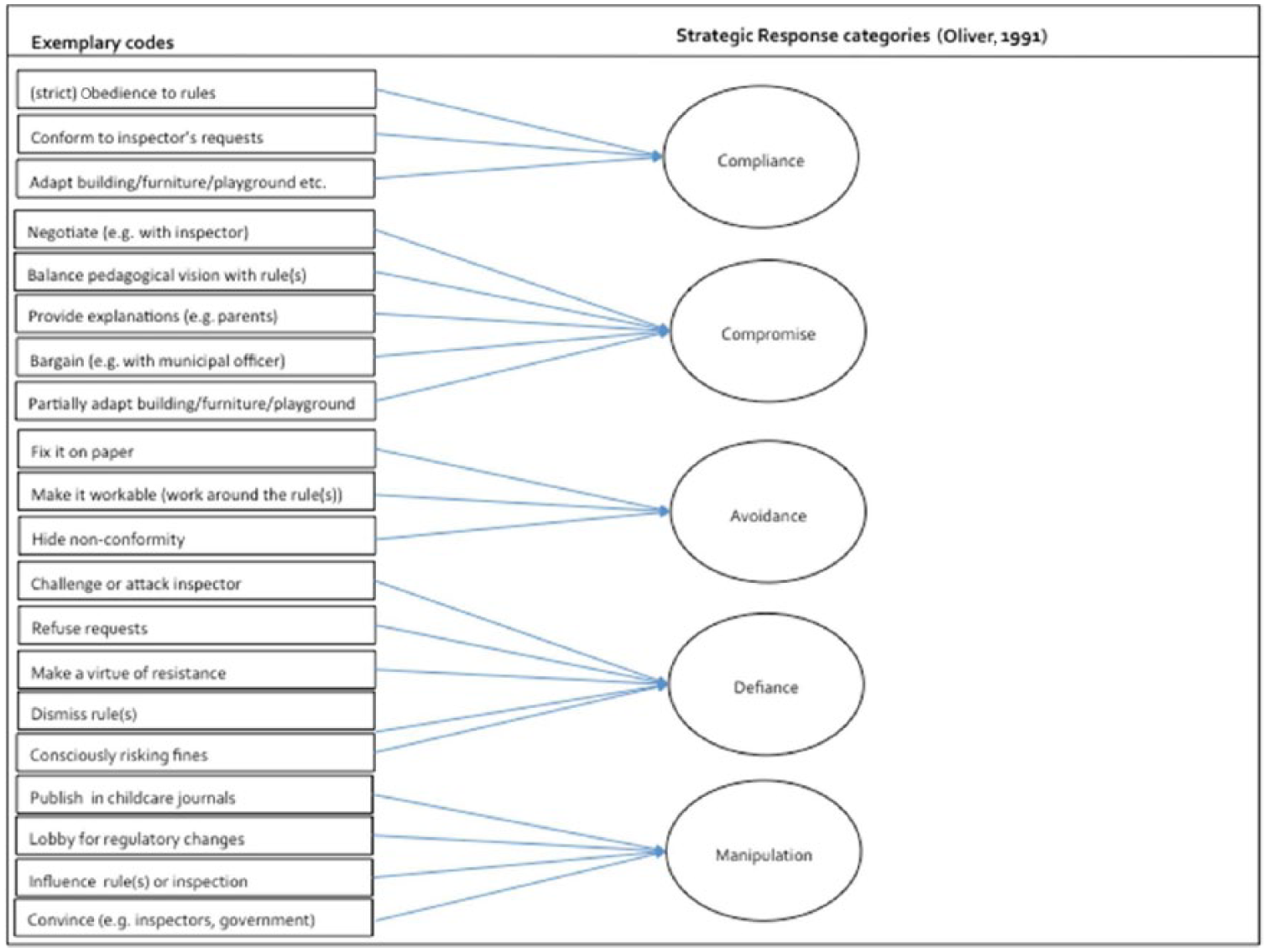
Coding strategic responses.
Various strategic responses.
The coding described above resulted in a matrix (covering over 40 pages) with three columns: (1) the situation(s) each manager encountered, (2) the identification of the type of (mis)alignment per situation, and (3) the corresponding response. We left out those situations that lacked sufficient detail in order to establish the type of (mis)alignment and/or the type of response. Based on this matrix we determined for each of the four configurations of (mis)alignment the frequency of each response strategy (see Table 2).
Material and ideational (mis)alignment and the frequency of organizational responses.
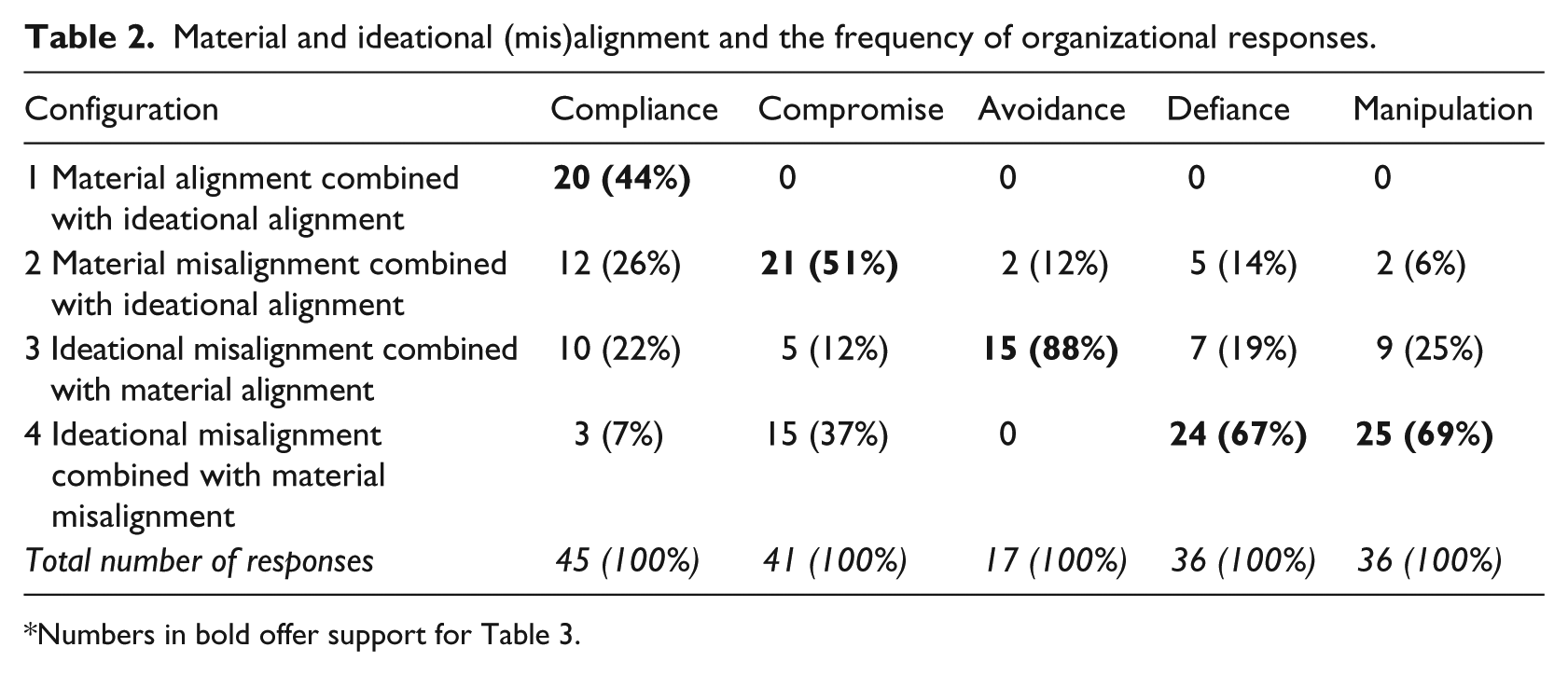
Numbers in bold offer support for Table 3.
Findings
In this section we first illustrate the material and ideational implications of the new law and show how material and ideational aspects are interrelated. Next, we describe four distinct configurations of material and ideational (mis)alignment and we show how decision-makers enacted and responded to the new law.
Material and ideational implications of the law
From our data it became clear that the institutional pressures concerning children’s safety and health had a direct bearing upon the material ‘design’ of the childcare organizations.
In childcare we think and design in terms of ‘rooms’, like classrooms in a school. For a large part this is due to the regulatory demands, which prescribe the maximum number of children in a group, as well as the number of square meters per child …. So a ‘simple’ calculation teaches you how much in- and outdoor space you need. Besides this, numerous safety and health prescriptions exist…like the plastering of walls, covers for the heaters, the need for door protectors… (manager 28)
The rules concerning children’s’ safety, health and well-being prescribed or influenced the design, construction and usage of buildings, playgrounds, toys and furniture. Therefore, some objects had to be adapted or replaced, as they no longer qualified as ‘safe’. Depending on the existing material layout of the childcare accommodation, the organizations needed either minor or more rigorous adaptations in order to conform to the rules. To meet the regulatory requirements, this material misalignment implied either that rooms were redesigned or that the number of children they cared for per day had to be reduced. Both adjustments decreased the profitability of the organization.
Besides discrete material implications, managers also experienced ideational implications of the new legislation and the invigorated audits. An interesting example comes from an organization with a small children’s farm in its backyard, where children took care of rabbits and goats. The auditing made this backyard contested because this children’s farm constituted the organization’s ‘philosophy’: children learn how to take care of animals. Applying safety and hygiene rules made these highly valued pedagogical principles even more salient, as they prescribe how the health and safety requirements actually dictate the design of childcare accommodation.
Our interviews underscore that physical objects are often more than ‘just material’, and turn out to embody pedagogical ideas and transfer meaning (cf. Scott, 2008). For instance, the size and design of the rooms and the accompanying children to teacher ratios strongly relates to the material aspects of the new law. But it also reflects a strong conviction about the relation between space and child development, and these beliefs ‘materialize’ in prescribed spatial specifications that children need to move around freely in the playground and the building itself.
The way in which material artifacts are endowed with pedagogical meaning becomes very clear in the following quote, where a manager nicely illustrates the many meanings of a chair to children:
We should enable children to be creative, to use their imagination… instead of us [adults] prescribing how to play… For children a chair is not just a chair, it can be a table or a place to hide or something to jump from… it can be a train, a truck… Looking at objects through the eyes of children shows multiple purposes of just one simple object. This is the way we look at material and want to design our rooms. This is what I call a ‘pedagogical perspective’. (manager 15)
The above illustrates the recursive nature of the relation between a pedagogical vision and material requirements to support children’s development. The design and layout of a playground provides another good example of the interrelatedness of ideational and material requirements. Whereas some organizations stressed that the playground should mainly be a ‘safe place to play’, other organizations stressed that it should be an environment where children can ‘explore the world and grow confident’. Consequently, their playgrounds looked rather different as well; some organizations had rubber floors and plastic toys; other organizations used sand and trees in the playground. Interestingly, all these organizations are subject to the same governmental regulations, while its material and ideational impacts were quite different. In the following paragraphs, we explore how this can trigger different organizational responses.
Ideational and material (mis)alignment shaping organizational responses
Even though none of the managers completely rejected all the safety and health rules, we do see substantial variation in their responses (Tables 1 and 2). Most managers argued that children are ‘just too vulnerable to be left to market forces’ and a certain level of compliance was needed in order to keep their licence and sustain a ‘logic of confidence’ (Meyer & Rowan, 1977; Roberts, 2011). Below we show how these responses relate to the interpretation of the new institutional pressure in terms of its (mis)alignment between the required and existing organizational situation on both material and ideational dimensions.
Ideational alignment and material (mis)alignment
The first configuration combines material alignment with ideational alignment, and refers to situations where managers indicated that compliance to a rule or requirement within the childcare organization was straightforward on both material and ideational grounds. Organizations facing such situations did not have to change much in order to conform.
As can be seen in Table 2 (first row), managers who face material and ideational alignment tend to comply, without any further variation in responses. In such a fully aligned configuration decision-makers mainly stressed the benefits of full compliance. The new regulatory system made it possible to make quality more visible to parents, for example, as implemented safety practices. Some managers even argued that compliance with the rules directly translates into legitimacy gains vis-a-vis non-compliant organizations. Our respondents claimed that compliance was also important from a liability perspective. Since reporting became mandatory, employees have ‘something they can rely on’ and ‘they can prove they acted appropriately in case anything might happen’. Managers indicated that this has become increasingly more important over the years as childcare remains a sensitive social issue. However, in the case of material and ideational alignment, compliance is rather straightforward. For instance, in newly built accommodation the chance of a material misfit is rather small. In situations of ideational fit, managers also do not experience a mismatch between the rules and their pedagogical beliefs.
The second configuration entails a situation of material misalignment combined with ideational alignment. In these situations, a discrepancy is due to material prescriptions that are not in line with the pre-existing material situation in the organization. Despite the absence of ideational objections, material misalignment prevented these managers from complying fully with the regulations. Table 2 shows that in this case compromise strategies are the most prevalent. The type of material misalignments that respondents mentioned referred to furniture, play equipment, the interior design of rooms, the exterior design of the playground, and building prescriptions. Several managers indicated that the rules were accompanied by high costs. Although on ideational grounds they had no objections to strict safety measures, they had severe hesitations due to the significant investments needed. One example concerns rules that prescribe the distance between the bars in children’s beds:
…as the rules regarding the distance between the bars in children’s beds change, we have to buy new beds… If we are lucky they decide on a transition period, because in general we did not get a chance to write off our investment…And you just won’t believe how expensive these beds are. (manager 86)
For some organizations, especially those occupying older buildings, compliance was constrained by the existing layout and design of their building. Managers facing such situations tried to strike a balance by partially complying with the rules or by negotiating for legally and technically feasible solutions with the inspector or municipal officer. Similar situations of material misalignment concern the size of the rooms or the size of the playground. Childcare providers are supposed to offer the required three square metres per child. In cities such as Amsterdam or Rotterdam outdoor space is hard to find, hence several organizations did not meet the prescribed space requirements. Although these organizations wanted to offer a larger outdoor play area for their children and do support the idea behind that rule, they simply could not acquire it. The quote below shows how a manager tries to reach a compromise:
Here in Amsterdam we lack outdoor space and a lot of the locations in the city center have no options to enlarge the playground…we just lack the space. Then you need to be creative…At one of my locations we have this municipal playground across the street, so I’m negotiating with the municipal officer and the inspectors to count that as outdoor space. (manager 48)
Some managers talked about the ways to bargain with the municipal officer as well. Because material discrepancies are easy to observe and therefore hard to discount, organizations engage in all kinds of compromise tactics in order to prevent the negative consequences of a bad evaluation. According to the managers, good relationships with inspectors or municipal officers are key in these situations:
You have to make sure to invest in good relationships with those who do the site inspections… We have one inspector who is more lenient than the other…in conversations I have with her I explain the situation and we’re able to work things out… And I frequently talk to the municipal officer. These relationships are essential…if you get along with the officer the inspection report is less important. (manager 30)
Ideational misalignment and material (mis)alignment
The third configuration pertains to situations of ideational misalignment combined with material alignment. In these situations, although the rules did not match their ideology or pedagogical beliefs concerning good or proper childcare, it did not result in serious material discrepancies. For instance, respondents talked about rules that prescribed certain procedures or routines, such as hand washing policies or policies concerning changing diapers, which were so strict that it would render the work of the childcare professionals almost unmanageable to some degree. Moreover, managers indicated that the administrative workload of employees related to risk administration and writing protocols increased heavily due to the new regulatory demands.
The rules are fine as long as they are balanced. But slowly this balance seems to disappear…if one complies with the law. If children have runny noses and you have seven children in a row standing in front of you after playing outside…you need separate tissues and you must wash your hands after cleaning every child. However, if I do that, the other six ‘will have eaten their mucus before I return’. Therefore, I do seven and then clean my hands. Officially, that is wrong. I believe that goes too far. (manager 55)
In these cases, managers claimed that the routines prescribed by the regulatory pressures distracted attention from their core business, which should be caring for, talking to or playing with the children. As such, these rules did not align with their existing beliefs or ideas about ‘good’ childcare. Many managers complained that some rules consumed too much time, at the cost of time spent with the children. Whereas materially this did not create a serious problem (e.g. a few tissues more were not considered problematic), the regulations conflicted on ideational grounds (not being able to give children proper attention). For this reason, they indicated that they ‘worked around the rules whenever possible’:
Each time a childcare professional changes a diaper they should clean the changing table before changing another baby…. Instead of wasting time with all this cleaning I would rather have them talking to the babies a little longer. (manager, 62)
As becomes clear from Table 2, we see a large variety of strategic responses in this configuration of ideational misalignment and material alignment. For instance, with manipulation strategies managers tried to convince inspectors about the importance of their pedagogical arguments. Compromise strategies were used to find a workable balance between the pedagogical vision, the interest of parents, and legal demands. The most likely response strategy mentioned by managers to deal with a situation of ideational misalignment combined with material alignment is that of avoidance (Table 2). Managers used concealment tactics, such as ceremonial conformity in which they deliberately pretend compliance (Oliver, 1991). Several respondents indicated that they would ‘fix things on paper’ or write down the required routines in policy handbooks, without employees using them. In anticipation of scheduled site inspections by the GGD, these organizations would display these expected activities, only to shelve them shortly after the inspectors had left the premises:
My employees think some rules are just ridiculous, and refuse to conform to them. Some of the things they do follow up upon, other things they still refuse. And to be very honest…in anticipation of the scheduled site inspections by the GGD, my employees do show the ‘appropriate’ behaviours. I could tell you, this does not happen, but it does….that is the result of site inspections that are announced in advance. So on that day, they do it and that’s fine with me…and that happens in the majority of organizations I bet you. (manager 17)
The last configuration concerns situations of ideational misalignment and material misalignment, in which managers talked about the incompatibility of some of the rules with both ideational and material aspects. Some of the institutional requirements concerning children’s safety, health and wellbeing resulted in completely different – or even opposite – demands on the organizations than the manager considered desirable from their pedagogical perspective. We came across many examples where managers stressed that the strong focus on safety induced by the law conflicted with their pedagogical beliefs about children’s development and the way their organization should guide children:
Children are not allowed anything anymore… If we have a table here with a sharp edge or a chair that is too high, with a risk of falling, we get a ‘below average’ in the inspection report…I think it is irresponsible to raise children in such a riskless environment. When they grow up, they cannot handle anything…if we treat them that way. I am not suggesting that we should encourage children to do extremely dangerous things, but if we do not have children walking around with bandages once in a while…we do something terribly wrong. (manager 3)
Because the material layout and design of the daycare accommodation often reflect pedagogical beliefs, some rules caused a misalignment with both ideational and material aspects. This became very evident for those rules that influenced the design of the playground. Many managers argued that the playground design determines the degree of excitement and challenges posed to children. They claimed a playground is a place where children should be able to run, and fall, explore and learn while playing with each other. Yet, according to these managers the safety rules – and more importantly the interpretation of these rules by the inspectors – prohibited the use of many objects that contributed to such a rich learning environment. Some prevalent examples that managers mentioned illustrate this point. Trees are considered dangerous because children might climb trees, bushes are dangerous because it reduces oversight, and pieces of wood can cause splinters.
When managers reported these tensions, they claimed ideational aspects were ‘at risk’. For example, they were concerned that the strict safety and health requirements will hinder children’s natural development ‘as children learn from their mistakes’. Although valuing safety, they commented that the implementation of such rigid rules lead to children ‘being overly protected’.
It is every child’s right to fall out of a tree once in its childhood…that’s the way they learn. And of course there is a possibility they will fall and break their arm. But, we should not put such a dense web of safety rules around the children, that protects them from even the smallest scratch. (manager 24)
This implies that managers have to strike a balance between safety requirements and the development and learning opportunities for children. Since their pedagogical ideas about children’s learning and playing instantiated in the spatial design of the rooms, the playground and the materials used, their deviation from the rules was highly visible as well. Confronted with a situation of both material and ideational misalignment, many organizations claimed that they tried to negotiate, influence and persuade the inspectors and/or the municipal officer.
But how would you otherwise discover that wood can splinter? This is at odds with our vision on playing outside. And then I enter a debate with the GGD inspectors and convince them why I think this is better for children. Luckily we have the parents on our side. (manager 87)
Central arguments in such discussions would be the detrimental effect some of the rules had on children’s development or that more trust should be placed in the professionals working with children: ‘They know how to deal with children and they should be given more leeway (manager 30). Some managers tried to influence the rules directly, for instance by starting a campaign to lobby the government or professional bodies, or by inviting people from the Ministry (see Table 1).
Apart from manipulation tactics, a situation of material and ideational misalignment elicited defiant responses where managers dismissed or actively rejected some of the rules (see Table 2). One manager reported that she had been ordered to cut down a tree at the playground to prevent children from the risk of falling. However, the tree had ideational value – like the value of children’s contact with nature, the possibility to learn from mistakes, the joy of climbing trees – and therefore the manager refused to cut down the tree and actively challenged the GGD inspectors:
I take my responsibility…in our organization every child ‘could fall out of a tree once’. Of course we do take a few safety precautions, but we will not cut down that tree…I refuse. (manager 24)
The response of this organization is not mere resistance; it transfers the norms and values in a substantial way, as the tree (that was still standing in the playground) represents the way in which this organization balances safety and learning. Another organization had decided to take a similar situation to court.
In sum, in situations of both material and ideational misalignment, managers feared that compliance with the imposed rules would hinder children’s development. Table 2 shows that this configuration elicited the highest prevalence of defiance and manipulation responses. Managers stressed their social responsibility in ‘raising the next generation’ and argued that they could not fulfil this task in a world without risks and challenges. Even though some of them would try to negotiate with the inspectors to ‘work things out’, when that discrepancy was too large, managers clearly deviated from the rules and displayed fierce resistance. Hence, due to the interdependence of material objects and pedagogical ideas, non-compliance was highly visible and therefore ceremonial responses were less attractive as they were practically unfeasible. In these situations, the managers considered the ‘risks’ of full compliance (i.e. hindering children’s development and creating a riskless society) to be bigger than the risks of non-compliance, such as having to pay a fine.
Discussion and Conclusion
We set out to investigate how childcare managers assess and compare the material and ideational aspects of new institutional requirements with their existing material and ideational situation and balance both aspects of institutional pressures in their organizational responses. Our study in the Dutch childcare field underlines the notion that material and ideational worlds are intertwined, or ‘are constitutive’ (Orlikowski, 2007) of the day-to-day activities inside organizations. Various material artifacts (such as buildings, playgrounds and toys) determine the joy and learning possibilities for children and shape the daily work of childcare professionals. Moreover, these same material artifacts are a translation of pedagogical meaning and beliefs. When organizations face new institutional demands the (mis)alignment of material and ideational aspects become manifest for decision-makers, and provide important enabling as well as constraining conditions to adapt to those new pressures. We explored how institutional pressures governing children’s safety, health and well-being largely affected both the ideational and material world of childcare organizations. Our findings reveal that health and safety requirements induce a particular type of response: when configurations are completely aligned, compliance is the most prevalent response. The other configurations trigger a larger variety of responses: strategies such as compromise strategies (balancing or bargaining), attack in favour of pedagogical views of the decision-makers, or ceremonial response options. In Table 3 we show the four configurations of material and ideational (mis)alignment and the most likely strategic responses.
Material and ideational (mis)alignment and organizational responses.
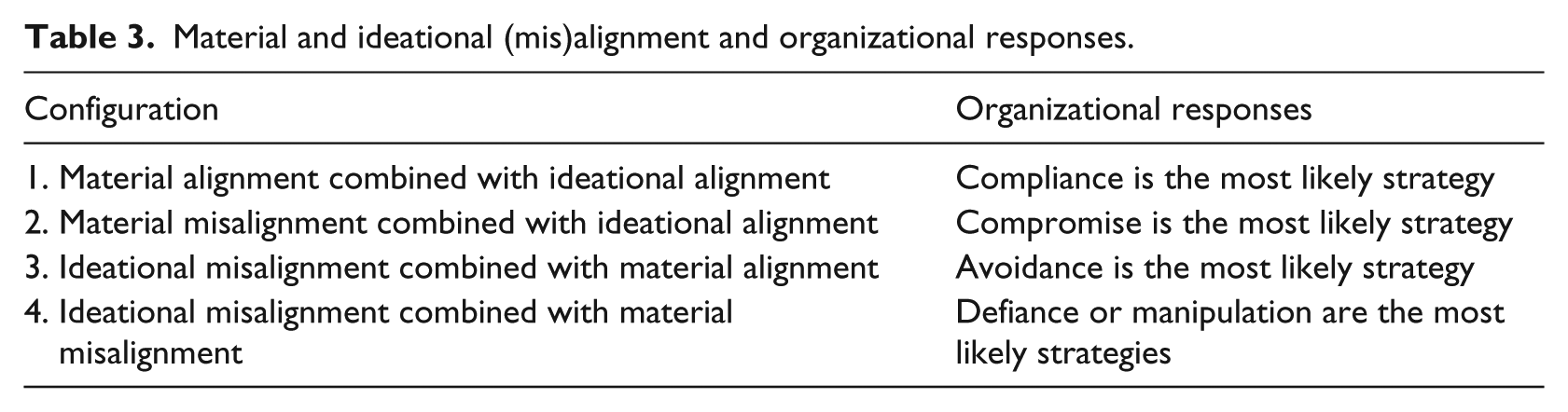
In configuration 1, material and ideational alignment, decision-makers predominantly stressed the benefits of compliance, as rules hardly caused any problems. In configuration 2, material misalignment and ideational alignment, managers predominantly resorted to all kinds of compromise tactics as they tried to strike a balance between the various consequences of the rules. When the institutional pressures induced an ideational misalignment, managers stressed the downsides of the strict health and safety regime, and warned of ‘a world full of children without bruised knees’ or the inability to give children proper attention. In configuration 3, where ideational misalignment coexisted with material alignment, we saw many instances of avoidance, such as ceremonial responses. In configuration 4, where ideational misfits occurred in tandem with material misfits, decision-makers mainly responded with active forms of resistance, like defiance or manipulation. In sum, our results show that although organizations can respond based purely on material grounds, in the absence of ideational incongruence (active) resistance is less likely. In a similar vein, although organizations could show resistance based on purely ideational grounds, in combination with material misalignment symbolic forms of compliance become less likely due to the visibility of non-compliance and the prevalence of active resistance increases.
In line with recent calls for scholars to take materiality into account, we have shown the role material aspects can play in shaping institutional conditions and effects, albeit that the effects gain salience in tandem with ideational aspects traditionally so prominent in institutional research (Jones et al., 2013). We have shown how key decision-makers include both material and ideational considerations as they grapple with the institutional contradictions that new institutional demands may elicit (Greenwood et al., 2011; Pache & Santos, 2010; Powell & Colyvas, 2008; Seo & Creed, 2002). Our findings indicate that limiting our focus to ‘the ideational or symbolic’ at the expense of ‘the material’ necessarily limits our understanding of the underlying motivations that drive organizational actors to exhibit differential responses (Jones & Massa, 2013; Jones et al., 2013; Thornton et al., 2012). Therefore, we infer that specifying the content of institutional pressures by including both material and ideational aspects of institutions enhances our understanding of the nature of organizational responses.
Our study clearly points out that a coercive institutional pressure imposed by one constituent – The Dutch Government – spawns a plethora of effects on the targeted population of daycare centres. Our examination of the variety of responses to the organizational impacts of the Childcare Act and the associated policy rules and regulations revealed that this law has prompted multiple effects, as it simultaneously and differentially impacts ideational and material aspects of organizing. As such, even a demand stemming from one constituent can elicit complex situations for organizations, due to the effects on both material and ideational aspects of organizing (Lepoutre & Valente, 2012).
In addition to better understanding the variety of strategic responses following a similar institutional mandate in a field, this study has another broad implication for the research agenda on materiality and responses of organizations. Our results suggest that the extent to which (non)conformity is clearly visible for institutional referents directly matters to the strategic leeway organizations have in responding to institutional requirements (Lawrence, 2008; Meyer, Höllerer, Jancsary, & Van Leeuwen, 2013). For instance, the act of resisting a mandate to cut down a tree in a playground is likely to be clearly visible to institutional referents. In the institutional literature ‘ceremonial strategies’ have long been put forward as a manner for organizations to deal with the tension that arises when institutional demands are not aligned with organizational goals or local work activities (e.g. Meyer & Rowan, 1977; Oliver, 1991; Westphal & Zajac, 1994, 1998). In such cases, organizations may disguise nonconformity behind a facade of acquiescence (Oliver, 1991, p. 154) or work around the rules whenever possible. However, an implicit theoretical assumption is that institutional referents would be largely unaware of the misalignment ‘between the walk and the talk’ (Greenwood et al., 2011, p. 351; Pache & Santos, 2013). Yet, in situations where institutional pressures have clear material implications, ceremonial strategies may be risky or nearly impossible, because deviating from the requirements is clearly visible and thus readily observed by auditors. In our case, we found that avoidance tactics were less likely in situations where the demands created a clear observable material misfit. In case of a clear observable material misfit and ideational alignment we found that the stronger negative strategic responses, such as manipulation, defiance and avoidance, were less prevalent. Avoidance tactics predominantly surfaced in situations of ideational misalignment combined with material alignment. Material and ideational misalignment together also trigger strong resistant responses.
We started our study presuming that Oliver’s reconceptualization of deterministic assumptions of neo-institutional theory applied in this setting. Her approach implied some responses to be more likely under some conditions than in others, yet strategic choice was considered to be rather unconstrained (see also Scott, 2008). However, our findings point in a different direction, namely, that of ‘restricted organizational responses’, when deterministic forces such as physical and material requirements are institutionally imposed. The inclusion of materiality in our study design significantly refines the strategic choice assumption from an unrestrained to a constrained choice model. Seemingly, ideational institutional requirements can elicit every response of Oliver’s response model, whereas material institutional requirements elicit higher prevalence of compliant responses. Stronger resistant responses are only induced when both ideational and material requirement are misaligned, causing a clash between soft values (pedagogy) and hard matter (cutting trees).
It is important to investigate whether our findings hold any external validity in other contexts than the childcare sector. The context of our case and the methodology deployed limits the generalizability of our findings and call for further research. Strong regulatory and normative undertones characterize this sector, because it ultimately concerns the safety and well-being of young children. This raises the question whether the type of tension that we identified in our case is specific to industries with practices and product offerings that have a strong normative connotation. Similar dynamics may exist in fields such as education and healthcare (cf. Dunn & Jones, 2010; Hallett, 2010; Heimer, 1999; Quirke, 2013) and comparative future research between sectors can explore how specific our case may be, that is, to what extent our results are influenced by the specifics of the childcare sector and/or the institutional context in the Netherlands. Moreover, a potential boundary condition of this study is that we have mainly focused on the institutional demands generated by one constituent, namely the state. Even though coercive pressures can be complex enough, we did not investigate the responses of other constituents such as parents or employees (Turco, 2012), who simultaneously might also influence the leeway which organizations have in responding to new pressures. According to Friedland and Alford (1991), there is not a one-way relationship between an institution and its meaning. We can add to their notion that turning to both material and ideational aspects of institutions is important for understanding this relation and its ultimate link to individual and organizational action better.
Footnotes
Funding
This research received no specific grant from any funding agency in the public, commercial, or not-for-profit sectors.