




Abstract
What do the relaxed social events held by companies and organizations do for continued gender inequality? This article argues that outings, barbecues and parties offer opportunities for members of an organization to challenge unequal gender regimes. But they can also end up maintaining these inequalities instead. The article draws on Joan Acker’s theory of gendered organizations, and Judith Butler’s notion of gender performativity. Based on 208 accounts of organizations’ social events, it identifies the following four areas of gender performativity and their varying significance in reaffirming or challenging unequal gender regimes: gender images, status differences, the body and sexuality. The findings indicate that practices reaffirming unequal gender regimes outnumber practices that possibly balance or break them. Paradoxically, practices that challenge unequal gender regimes, when joined with powerful responses from the hitherto privileged party, can form a vicious circle which again ends up continuing unequal gender regimes. The article provides a more nuanced understanding of ambivalences and the contested nature of gender regimes which is important in identifying avenues for gender equality.
Keywords
Introduction
Since Joan Acker’s (1990, 1992, 2006a, 2006b) ground-breaking analyses of gendered organizations, an extensive literature on the mechanisms that create and maintain gender and power relations in organizations has emerged. In particular, scholars have shown the gender-segregating consequences of management practices such as recruitment (Bryant & Jaworski, 2011; Handy & Rowlands, 2017); job evaluation, performance measurement and pay systems (Castilla, 2012); work-life balance policies (Mescher, Benschop, & Doorewaard, 2010); plus corporate strategies (Dye & Mills, 2012). Scholars consistently conclude that, despite intensified governmental and business initiatives towards gender equality, unequal gender regimes still prevail.
This article turns attention to a hitherto under-researched area that substantially contributes to the persistence of unequal gender regimes while at the same time offering the opportunity to challenge them. We maintain that organizational social events, such as parties and group outings, are cultural practices that carry and reinforce values, norms and habits woven into the organizations’ gender regimes. Social events make an interesting subject for study as they are an important part of organizational life. Meanwhile, cultural practices are powerful sustaining mechanisms within gender regimes because they are intermeshed with all other organizational practices and so emphasize their effects (Alvesson, 2013; Gherardi, 1995; Gherardi & Poggio, 2001).
A special concern of this article is to address the contested nature of gender regimes and the potential to oppose them. Although gender research historically is tied to the political aim of changing unequal gender regimes and emancipating oppressed groups (Calás, Smircich, & Holvino, 2014; Thomas & Davies, 2005), existing literature on the gendered organization in large part focuses on those processes that create and maintain gender regimes. In contrast, research into the opposite processes, those that challenge unequal gender regimes, is scarce. Acker, in her work on the gendered organization, addresses change only marginally. Taking her considerations as a starting point, and emphasizing the performative nature of gender in the sense of Butler (1988, 2008), this article explores the potential of social events to challenge unequal gender regimes. Viewing gender regimes as discursively fabricated through ritualized acts helps us not only to understand how unequal gender regimes are reproduced at social events, but also to identify the potential for disrupting their reproduction.
This paper contributes to literature on gendered organizations in the following three ways. First, by focusing on seemingly ‘innocent’ practices at organizational social events, using rich empirical data it offers a novel explanation of the persistence of unequal gender regimes. Second, different from existing gender literature concentrating on the exclusion of women from organizational social events, this study illuminates what happens if women are included in such events. Third, this article extends and refines the theory of gendered organizations. Specifically, it considers the contested nature of gender regimes, concrete behavioural patterns of organizational members, heteronormativity and masculinity as well as gender performativity in the sense of Butler.
Organizational Social Events
By ‘organizational social events’ we mean collective activities that take place within an organizational social context, but away from the participants’ workplaces and often away from their organization’s premises. We consider events organized by management, events initiated by employees and mixed forms. Examples include work outings, barbecues, Christmas parties, group trips and team days. These activities have in common that they are supposed to build a close community, enable integration of individuals into an organizational collective and enhance employees’ work motivation and identification with their organization (Martin, 2002; Trice & Beyer, 1984). Because social events are extraordinary, highly visible and often the subject of talk before, during and afterwards, they can highlight and crystallize the social conditions of organizational life.
The question of how organizational social events contribute to individual identity building and social ordering has been addressed in the early literature on organizational culture. For instance, McCarl (1984) shows in his analysis of a retirement dinner for a professional firefighter how cultural practices and rituals shape the identity of the retiree. Rosen (1985, 1988) examines an annual breakfast and a Christmas party in an advertising agency, linking cultural action, symbolism, social drama and the reproduction of the company’s social structure. Young (1989), in a study of a small manufacturing firm, shows that frequent meetings for leisure activities by members of the core workforce serve to maintain boundaries between core and peripheral employees. Van Maanen and Kunda (1989), in their analysis of culture management techniques at Disneyland and at a high-tech firm, maintain that social events can be ‘subtle yet powerful form(s) of organizational control’ (pp. 88–89). More recently, Dacin, Munir and Tracey (2010) show how dining rituals at Cambridge colleges serve to maintain the British class system.
Whereas in the previously described studies gender only plays a minor role, several studies within gender literature highlight the relevance of social events for gender equality. The majority of these studies revolve around women’s exclusion and the portrayal of male-typed images of the heterosexual ‘ideal worker’ through social events. For instance, Pierce (1995) notes in her study of law firms that the ‘Rambo-like’ masculine culture excludes women lawyers from social events. Similarly, Anderson-Gough, Grey and Robson (2005) find that female managers of public audit firms refrain from social events or participate without their partner, because they feel they do not fit expected gender roles. Morgan and Martin (2006), in their research on business-to-business sales women, also identify exclusionary ‘homosocial settings’, such as golf courses and strip clubs. However, women’s participation in social events can be disadvantageous, too, as these authors show for ‘heterosocial settings’ such as one-to-one dinners in which women experience sexual advances and become targets of gossip.
Further evidence of masculine cultures being reinforced through social events appear in Purcell’s (2013) study of a retail fashion company, where cultural capital hinges on sports and fitness, and Gregory’s (2009, 2011) analyses of male ‘locker room’ behaviour in the advertising industry, e.g. bonding, humour and banter among men. The significance of symbolic artefacts is highlighted by Rippin (2011) who shows that headgear, such as tinsel halos and reindeer antlers, worn at office Christmas parties underscore power and the feminine/masculine body.
To summarize, existing literature indicates that organizational social events entail various cultural practices that contribute to the creation and reproduction of gendered identities and social orders. However, focusing on the exclusion of women and the pressure on women to adapt to male norms (and of homosexual men to adapt to heterosexual male norms) ignores the fact that gender regimes are ‘contested terrain’ and may be challenged and defended at social events.
Organizational Gender Regimes
To examine the links between organizational social events and gender regimes we draw on the theory of gendered organizations by Acker (1990, 2006a) and post-structuralist feminist approaches, in particular the notion of gender performativity by Butler (1988, 2008).
Following Acker (1990, 2006a) who builds on basic notions from Connell (1987), we maintain that organizational practices produce (inherently unequal) gender regimes – that is, the ‘internal structures, processes and beliefs that distribute women and men into different tasks and positions’ (Acker, 2006a, p. 195). Gender regimes are culturally-historically shaped power systems that encompass manifold facets of domination and subordination along the lines of gender and sexuality. They are maintained through social processes of differentiation and hierarchization that in industrialized societies historically position the ‘hegemonic male’ over ‘the female’, thereby taking heterosexuality as a norm (Pringle, 2008).
Acker (2006a, p. 196) describes four so-called points of entry for gendered processes that build on the gendered substructure of organizations: first, ordinary, often daily, procedures and management decisions; second, images, symbols, ideologies and forms of consciousness that portray and give legitimacy to gender inequalities and differences; third, face-to-face interactions in which organizational members ‘do gender’; and fourth, identity and the making of the self as an adequate, and gendered, organizational performer. While this conceptualization offers comprehensive understanding of various points of entry, the social dynamics linking the points of entry with one another and back to the organization’s gendered substructure remain somewhat shadowed. To bridge this gap, in our analysis we use Butler’s notion of gender performativity.
From a post-structuralist feminist perspective, we think of the social practices that constitute gender regimes as performative acts (Butler, 1988, 2008). That is, we take the ontological stance that there is no ‘reality’ – hence, no ‘gender’ – before human perception and discourse, but reality is produced through repetitive constitutive acts. The notion of gender performativity helps to explain how unequal gender regimes persist. Specifically, repetitiveness of gendered discourses and social interaction contribute to the reification and naturalization of gender categories and their meaning. As Calás et al. (2014, p. 36) highlight, such an understanding of the underlying processes on ‘how taken-for-granted social categories are naturalized and maintained with gendering effects’ is also necessary to implement change or at least to challenge unequal gender regimes.
Butler in her work also brings ‘gender trouble’ (2008) to the fore, that is, the displacing, transgressing and changing of gender norms. She maintains: ‘In its very character as performative resides the possibility of contesting its reified status’ (Butler, 1988, p. 520). However, as several authors point out, breaking gender regimes is an extremely difficult endeavour (Kelan, 2010; Pilgeram, 2007; Powell, Bagilhole, & Dainty, 2009). While Butler (2004, 2008) emphasizes the subversive potential of parody, whether a certain practice leads to change or rather reifies existing norms always depends upon the social context (Kenny 2009; Nentwich, Ozbilgin, & Tatli, 2015). Likewise, although gender literature on micro-emancipation highlights manifold ways in which women succeeded in building their identities by transgressing existing gender norms, freeing themselves from social sanctioning and maintaining their agency (e.g. Gherardi & Poggio, 2001; Pilgeram, 2007; Pio & Essers, 2014), much of the work on resistance in organizations and employee voice shows that often more open and collective practices are needed in order to change power relations and the material working conditions (e.g. Mumby, Thomas, Martí, & Seidl, 2017; Wilkinson & Barry, 2016).
Methodology
The investigation of gender regimes and gendered organizational cultures is methodologically challenging (Gherardi, 1995; Martin, 2002). Interpretive and critical approaches have been recommended as particularly fruitful; these include participant observation, self-reflective techniques, narrative methods and discursive methods (Alvesson, 2013; Gherardi, 1995; Martin, 2002). Organizational members’ accounts are of particular value, as they combine first-hand descriptions of happenings with ascriptions of meaning (Czarniawska, 1997).
In line with these recommendations we adopted a qualitative approach, drawing on retrospectively written reports that we collected from students in our university courses. We decided on this approach because we aimed for a large-scale analysis of ‘real-world’ descriptions. The reports were part of an examination assignment, with an allowed preparation time of two to ten weeks and a required length of 500 to 2,000 words. To instruct the students, we provided them with a book chapter containing a framework of various cultural practices at organizational social events and their relation to gender regimes (Ortlieb & Sieben, 2011). To reduce the risk of exaggerated descriptions, we emphasized that we based the grading of the reports on analytical arguments around gender issues rather than on how graphically authors described the events.
The students could freely choose between two kinds of data sources. The first option was to draw on their own observations at social events they had participated in as an employee in the past. Anecdotal evidence and the collected reports indicate that the majority of students had several years of work experience. To enable students without own experience to complete this assignment, the second option was that they draw on interviews with other people. Although different data sources do not automatically provide comparable evidence, we see the advantages of a larger sample size and a broader variety of accounts, due to the heterogeneity of the interviewees in terms of gender, age, organizational tenure and occupations. We could not identify systematic differences between collected reports resting on own experience of the authors and those resting on interviews. Still, our data-gathering procedure has some drawbacks. The accounts describe happenings at an organizational social event only in the way in which a single participant was able to observe it, to recall and to express his/her perceptions in writing. Those cases where the author drew on an interview conducted with another person include an additional communication interface. These limitations should be kept in mind when interpreting the study findings.
Also, our method has ethical concerns, as the students might appear to have been forced to participate in our study. Thus, we allowed them to switch to another task, either to a completely different topic or to an analysis of films, websites or other documents related to social events. Moreover, due to our retrospective approach we could not obtain informed consent from the social events’ participants. However, since we manipulated neither the social events nor the behaviour of participants and since we guaranteed full anonymity, the most important criteria for research ethics are fulfilled.
We collected 200 written reports in Austria and Germany between winter 2009/10 and summer 2015. We excluded nine reports from the analysis: three drew on film or document analyses, three did not refer to work organizations and another three referred to non-EU and non-industrialized countries that are very different from the Austrian and German culture context. As some students analysed more than one event, the number of accounts exceeds the number of reports, summing up to 208 accounts. Table 1 presents a summary of the sample.
Sample description.
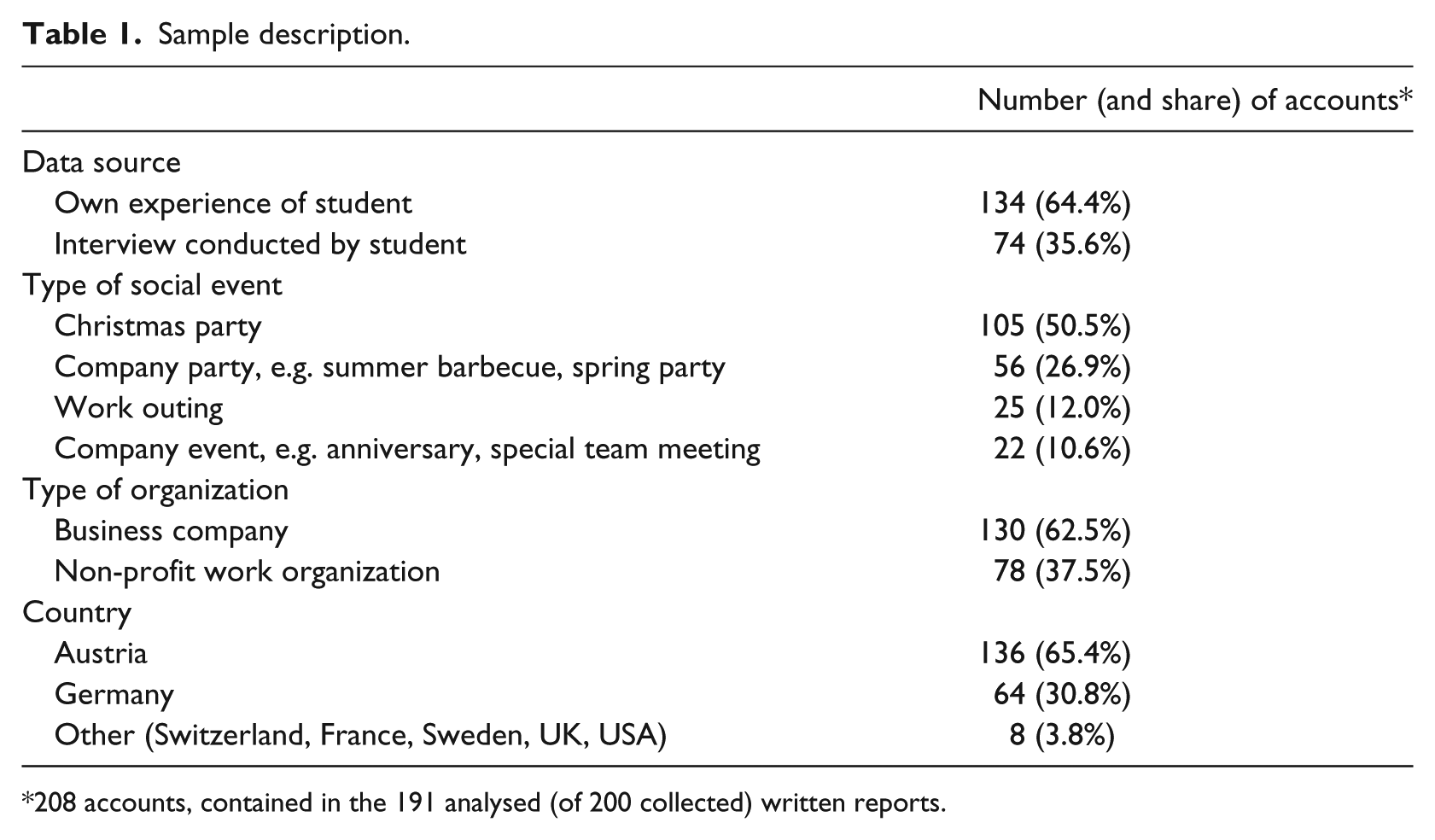
208 accounts, contained in the 191 analysed (of 200 collected) written reports.
We coded the 208 accounts using NVivo software. Regarding gender regimes, after several rounds of reading the accounts the following three categories emerged: (1) instances where an unequal gender regime was reaffirmed; (2) instances that indicated a balancing of unequal gender regimes; and (3) instances that indicated a breaking or at least challenging of unequal gender regimes. Accordingly, we created the following three codes in reference to unequal gender regimes: ‘reaffirming’, ‘balancing’ and ‘breaking’. As level of coding we chose instances within the accounts, that is, self-contained units of interrelated practices and discourses.
Further, we employed the following four a priori codes according to our preliminary framework (Ortlieb & Sieben, 2011): ‘the event as a whole and single elements thereof’, ‘task assignments’, ‘bodily actions’ and ‘intimacy and eroticism’. We used these codes as sensitizing concepts that guided the exploration of the empirical material. We then teased out from the accounts those practices that seemed to be particularly tightly linked to gender regimes. During this procedure, we specified and refined these a priori codes, re-coded text passages and eventually identified the following four areas of gender performativity within which certain practices that potentially reaffirm, balance or break unequal gender regimes enfold: first, gender images attached to the entire setting of a social event or single elements thereof, such as games and presents; second, status differences regarding jobs and hierarchies associated with gendered assignments of tasks during an event; third, the body, enacted for instance through physical activities and dress styles; and fourth, sexuality, manifested in intimate activities or invitations, also in the form of sexual harassment.
This coding allowed us to systematically trace the relative prevalence of reaffirming, balancing and breaking instances and their relation to areas of gender performativity. We applied the codes in a non-exclusive way in order to take account of the ambiguity inherent in the analysed social practices. That is, instances of reaffirming and balancing or breaking an unequal regime can overlap and/or alternate within one account; and each instance can be related to more than one area of gender performativity.
Findings
In the following, we first describe the four areas of gender performativity and how these relate to gender regimes, thereby exploiting the width of our empirical material. Then we zoom in on three selected social events in order to analyse the contested nature of gender regimes and the ambivalent nature of related practices in more depth.
Four areas of gender performativity at organizational social events
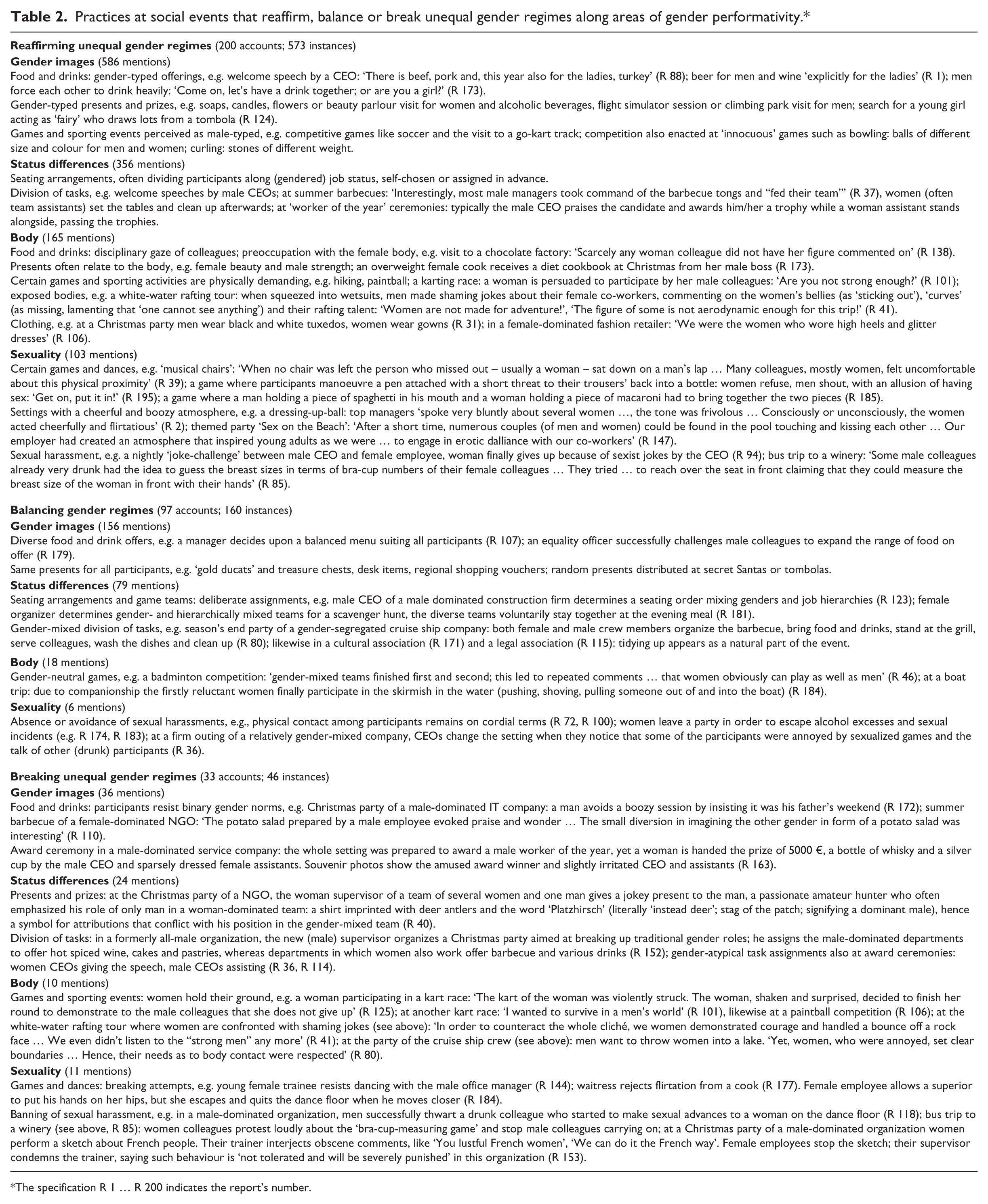
The empirical accounts depict a wide spectrum of observations linked with gender performativity. Table 2 presents examples of practices at organizational social events that reaffirm, balance or break unequal gender regimes along the four areas of gender performativity. It is important to note that those instances that we categorized as indicating ‘balancing’ or ‘breaking’ unequal gender regimes do not automatically lead to (or reflect) an actual change of the organization’s gender regime. Rather, these are instances where we identified at least some potential for disrupting the reproduction of unequal gender regimes.
Practices at social events that reaffirm, balance or break unequal gender regimes along areas of gender performativity.*
The specification R 1 … R 200 indicates the report’s number.
As Table 2 details, practices reaffirming unequal gender regimes are especially common. Of the total 779 instances coded, 573 instances (73.6 per cent) indicated a reaffirmation of unequal gender regimes, 160 instances (20.5 per cent) their possible balancing and only 46 instances (5.9 per cent) their possible breaking.
All four areas of gender performativity matter within these instances. In the accounts, gender images appear as particularly relevant for constituting gender regimes. Gender performativity in this area refers to culturally embedded cognitive schemes that ‘are invented and reproduced’ (Acker, 1990, p. 140) within organizations. Stereotypical binary gender images are ascribed to women/men and their behaviour as well as to material objects, thereby creating legible subjects (Butler, 2004; Kelan, 2010; Hancock & Tyler, 2007).
As the second area of gender performativity we identified status differences. This area relates to the gendered job segregation and its ‘amazingly persistent pattern’ (Acker, 1990, p. 145) that still prevails today (Calás et al., 2014). As the examples in Table 2 illustrate, seating arrangements as well as the division of tasks among participants at summer barbecues and award ceremonies often reflect an organization’s formal hierarchy (Dacin et al., 2010), including gender segregation and the invisibility of much work done by women (Fletcher, 1999).
The body is the third area of gender performativity we identified. The body is crucial in the theory of gendered organizations. Acker (1990) highlights how, for example, body references intrude into (presumably) disembodied job descriptions. And it is crucial for Butler who addresses bodies as ‘intentionally organized materiality’ (1988, p. 521). At the analysed social events, the vigilance over the female body regarding food and drinks, the ideal of a fit and able body including physical strength and endurance at games and sporting events (Bryant & Garnham, 2014; Coupland, 2015; Trethewey, 1999) as well as gender-differentiated ways of clothing and adorning the body were especially salient.
The fourth and final area of gender performativity is sexuality. According to Acker, sexuality is a core component of gendered organizations that maintains the gendered hierarchy through ‘tacit controls … helping to legitimate the organizational structures created through abstract, intellectualized techniques’ (Acker, 1990, p. 152). For Butler, ‘it is through the body that gender and sexuality become exposed to others, implicated in social processes, inscribed by cultural norms, and apprehended in their social meanings’ (Butler, 2004, p. 20). The instances depicted in Table 2 suggest that social events offer a broad forum for physical and (hetero)sexual contact and symbolic violence reproducing male dominance in organizations (Flam, Hearn, & Parkin, 2010).
As the examples in Table 2 indicate, instances that we categorized as potentially balancing or breaking unequal gender regimes often include deliberate role switching, counteracting gender norms, banning sexual harassment as well as (additionally) using humour. However, the examples in Table 2 also clearly show that many balancing or breaking instances are accompanied by reaffirming practices, in particular because they invoke common gender binaries. We will come back to these paradoxical effects and the ambiguity inherent in organizational gender regimes later.
Concerning the four areas of gender performativity, Table 2 suggests overlaps. Nevertheless, it is useful to analytically distinguish between these four areas, because each area shows a varying prevalence of mentions in the analysed accounts. In particular, sexuality and the gendered body appear relatively more often in instances of breaking unequal gender regimes than do gender images and status differences. One reason for this relation may be that offensive behaviour in these areas especially touches the (female) ‘sexed being’ (Braidotti, 2003). Hence, it presents a stronger identity threat, triggering stronger responses.
The contested nature of gender regimes
We selected three cases to analyse the contested nature of gender regimes and the ambivalence of practices that potentially balance or break unequal gender regimes in more depth. Each of these three accounts describes a prototypical gender composition: a traditional male dominated one, a gender-balanced one and a female dominated one. Our main rationale for the case selection was that some kind of practices challenging the existing gender regime were noticeable. Of the cases fulfilling this criterion we selected those accounts that offered most detail. Table 3 presents key characteristics of the three cases.
Key characteristics of the three selected cases.
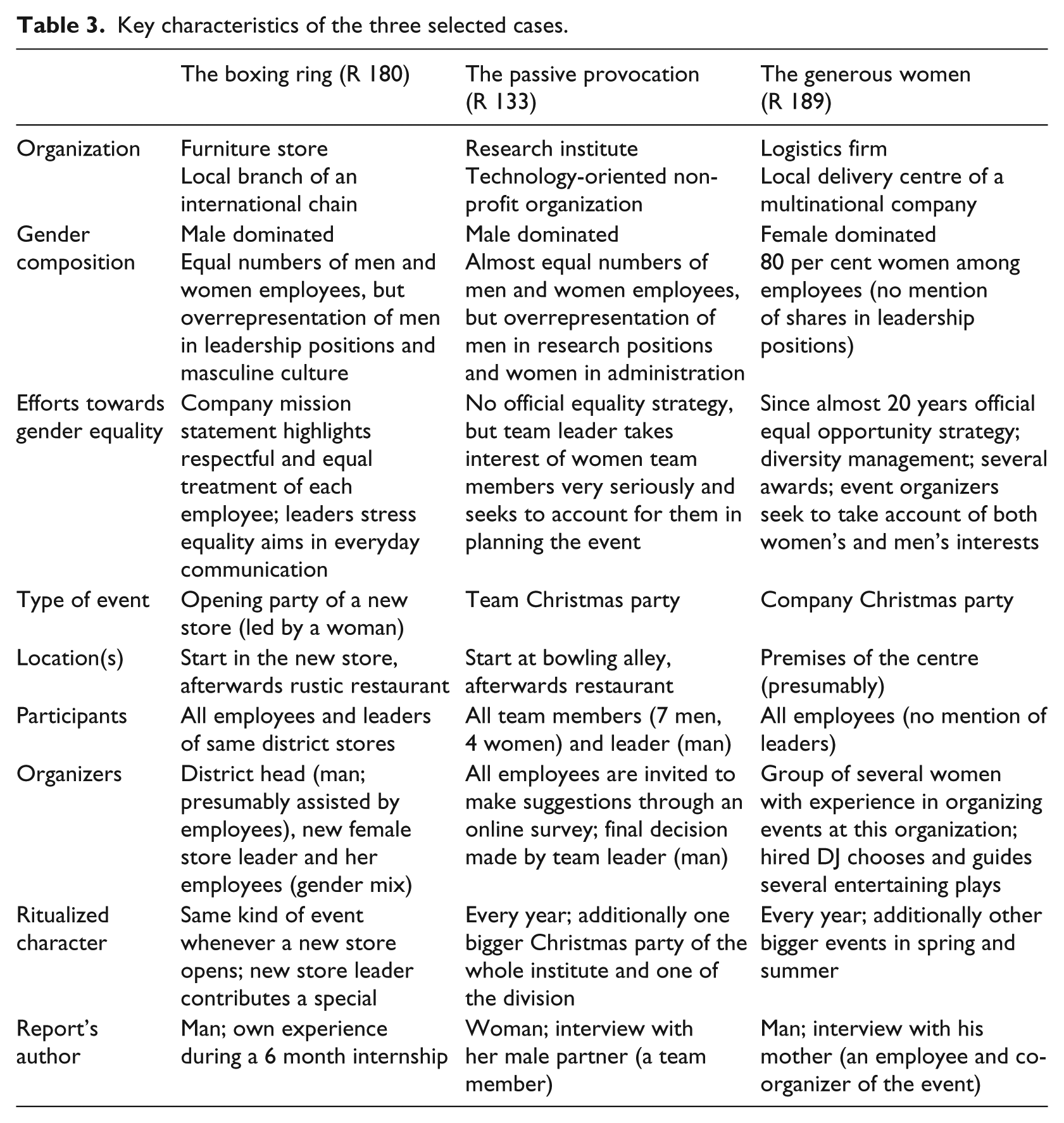
The three cases of a furniture store, a research institute and a logistics firm expose practices that challenge unequal gender regimes in different ways. We first recount the observations from our empirical material. Then we tease out how certain practices in the four areas of gender performativity evoke responses that in turn reaffirm unequal gender regimes. Juxtaposing the three cases allows us to examine the contested nature of gender regimes and to theorize about the paradoxical effects of performative acts that challenge gender regimes.
The boxing ring
At the opening party of the furniture store, two women welcomed the employee participants at the entrance. The participants wore their company uniform, comprising unisex shirts with ties worn by men and neckerchiefs worn by women. Women had decorated the store, whereas men had moved tables and put up a stage. At each table, a woman and a man would each sit side by side, as indicated by name cards. These name cards were ornamented with a picture of a beer glass for men and flowers for women. On the tables stood a glass of beer for men and a glass of Prosecco for women. In an award ceremony, the male leader of the store with the highest revenues was applauded, while standing between two decorative women who were his employees. Loudspeakers played ‘We are the Champions’ by the rock band Queen, and everyone joined in bawling out the lyrics. In an entertaining competition, two male store leaders had to assemble a table, each assisted by the woman sitting next to him. The new store leader and her employees staged a special kind of boxing fight: male leaders of other stores had to sit down on chairs, and the women of the new store, only lightly dressed and wearing boxing gloves, skipped around the sitting men pretending to beat them. There was a ring card girl, too, and the music played ‘Eye of the Tiger’ by Survivor. In the audience, the women triumphantly screeched whereas the men looked bewildered and expressed their dissent through whistles.
The passive provocation
At the planning stage of the team Christmas party of the research institute, one of the men proposed a visit to a thermal bath. He shared his plan with the team colleagues, stressing the relaxing effect of the bath. All women of the team were strictly against this proposal, as they viewed the thermal bath as a ‘meat market’. The male team leader took account of the protest and refused the man’s proposal. The team jointly decided for a visit to a bowling alley, proposed by a woman. The bowling alley at first sight appeared to be no place of unequal treatment, but there were small, light, coloured balls for the women and big, heavy, dark balls for the men. Women formed one bowling team, which caused astonishment among the men. To the surprise of all, the women’s team won. The men belittled the women’s performance by calling the successful throws ‘chance hits’ and smiling at them. For the joint dinner, the team leader had chosen a restaurant offering vegetarian food, because two of the women were vegetarians. Similar to previous Christmas parties, the men were annoyed about this choice, and they made fun of the vegetarian women. In the past, one of the vegetarian women complained about discrimination, as she believed that a vegetarian man would not receive such jibes.
The generous women
At the Christmas party of the logistics firm, men were to choose a new dancing partner every 30 seconds to compensate for being outnumbered by the women four to one. The men staged a satirical award ceremony with prizes ranging from ‘best…’ to ‘laziest worker of the year’. To tease the women, the man in charge awarded only men with the positively connoted prizes and women with the negatively connoted ones. The women responded to this performance with laughter and comments such as ‘Normally, they [the men] have no bed of roses here’, or ‘Allow men to have fun once in a while, too’. In competition during the entertainment, participants had to thread a 5-metre length of rope through their clothes, starting at the legs and ending at the head. To speed up this procedure, participants unbuttoned their clothes in front of the audience. A 20 minutes striptease show was performed by a hired dancer. The all-women team that had organized the event included the striptease show in the programme as a special surprise for some men who were to move to another business unit soon after the Christmas party. While the men were pleased with the striptease show, many women felt offended, as the organizing team had not shared their plans with them beforehand. They complained that, at least, there should have been a male striptease dancer, as well – why should only men have fun?
What the cases tell us
The three cases display different patterns of practices in the four areas of gender performativity. Table 4 condenses the insights from the cases. We posit that in all three cases the contested nature of gender regimes and the ambivalence of practices that challenge existing gender regimes is salient. However, we identify especially strong ambitions to challenge an existing gender regime in those cases with clear male or female dominance, i.e. in the furniture store and the logistics firm. In contrast, in the gender-balanced research institute the contested nature of gender regimes rests on practices that are rather passive. Likewise, whereas we identify status differences as the most salient area of gender performativity in relation to challenging an existing gender regime in all three cases, the body and sexuality appear more relevant in the two cases with clear male or female dominance.
Contested gender regimes in the three selected cases.
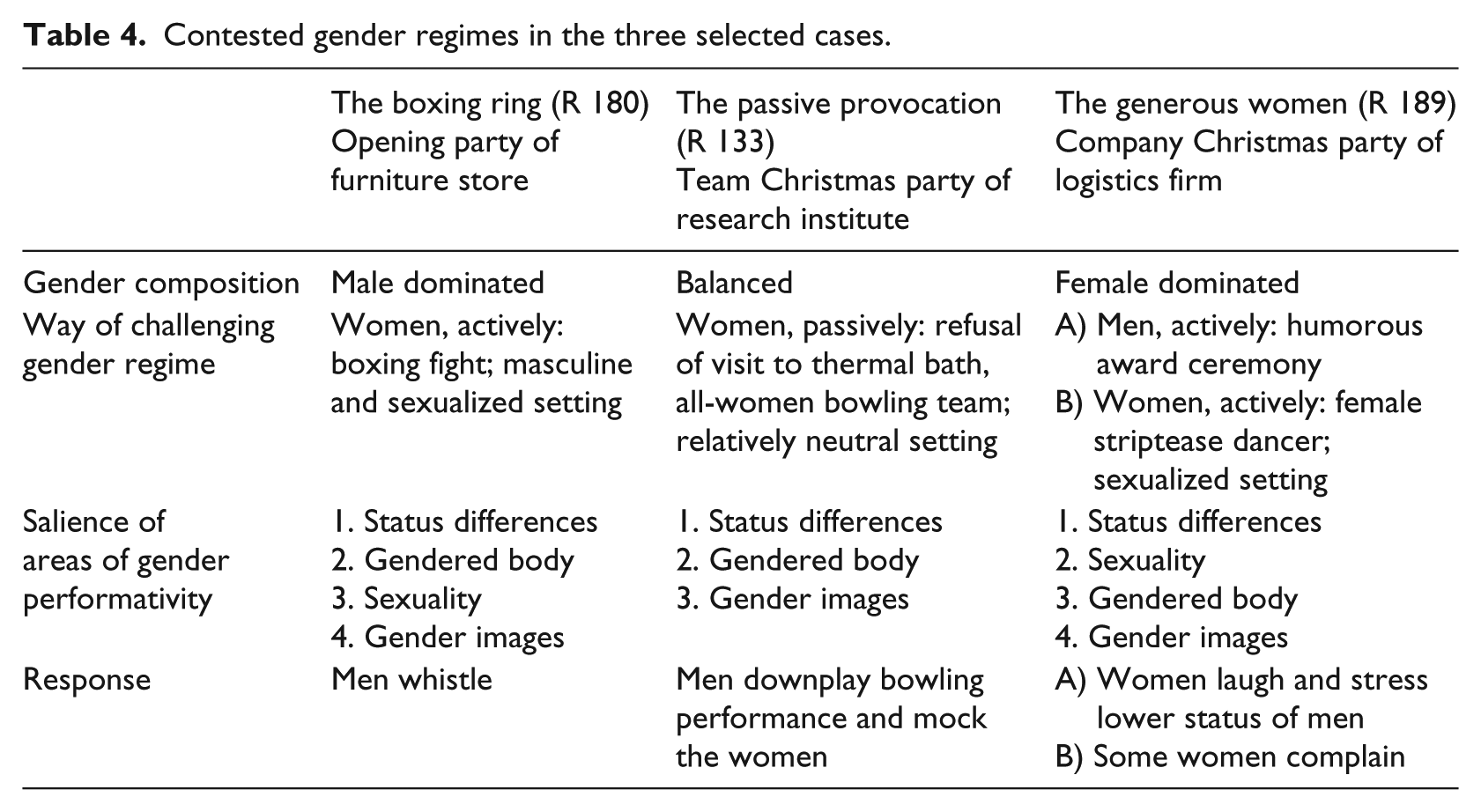
Compared with the other three areas of gender performativity, and echoing our findings presented in the previous section, gender images appear to be less salient in relation to practices that challenge an existing gender regime. Rather, performative acts in this area tend to reaffirm unequal gender regimes.
The case of the boxing fight at the furniture store’s opening party is an interesting example in this regard. The women attacked the established higher status of their male colleagues, using a weird mixture of props associated with the masculine sport of boxing, a sound system spurring on aggression, pugnacity and revenge as well as a sexualized style of dress for the women. However, while the women intended to subvert gender norms and hierarchies, at the same time their performance, including the ring card girl, conforms to the terms of the heterosexual matrix, notably to norms of feminine attractiveness and heterosexual desire. Moreover, other parts of the opening party evoked a set of stereotypical gender images. Examples include the working uniforms, name cards and drinks that clearly differentiated between women and men, the song ‘We are the Champions’, evoking male-type competition and glory, and the sexy dress style of the boxing women. Citing heteronormative gender images alongside the performance of gendered status differences such as the allocation of tasks in preparing the location and the table assembling competition, undermined the women’s attempt to challenge the existing gender regime. Finally, as in the remaining cases, in the furniture store the women’s attack did not remain unanswered, but led to men’s protests in the form of an ostensible bewilderment and whistles. This response again points to the ambivalence and different kinds of paradoxical effects of activities that unsettle existing gender norms. The men’s loud protest is a prompt counterattack in the struggle over domination in this setting. And it is a manifestation of internalized norms that are part of the heterosexual matrix – irrespective of whether the whistling expressed dissent from the staged subversion of gender norms, bewilderment or merely delight in seeing ‘sexy’ women.
Discussion
The aim of this article was to explore how organizational social events contribute to the gendering of organizations in the sense of Acker (1990, 2006a). Drawing on the notion of gender performativity by Butler (1988, 2008), this article contributes to organization studies in three ways.
Persistence of unequal gender regimes
There is considerable consensus among scholars that unequal gender regimes favouring masculinity and heterosexuality persist, despite large political and managerial efforts towards gender equality (e.g. Benschop, Helms Mills, Mills, & Tienari, 2012). This article adds to this body of research by shedding light on a hitherto under-researched area, namely organizational social events. In doing so, it offers a novel angle to explain why unequal gender regimes persist and official strategies aimed at gender equality may fail. Although previous research has considered an organization’s culture as a crucial element of successful change initiatives (Ely & Meyerson, 2010) and as a barrier for women to succeed in masculine domains of organizations (Gherardi & Poggio, 2001; Purcell, 2013), this is the first study that systematically addresses concrete organizational cultural practices in the form of social events and their significance for gender regimes.
The analysis reveals that organizational social events offer rich opportunity for reaffirming, balancing or possibly breaking unequal gender regimes. We identify four areas of gender performativity at organizational social events, namely gendered images, status differences, the body and sexuality. While all four areas of gender performativity are related to reaffirming, balancing or breaking instances, we found that instances of reaffirming unequal gender regimes clearly outnumber balancing and breaking instances (in a quantitative relation of almost four to one). In addition, many of the identified balancing and breaking instances could be interpreted in a different way, as in the case of the women who repelled sexual harassment. This behaviour can also be interpreted as demonstrating female modesty, in line with existing gender norms.
Moreover, practices to balance or break an existing gender regime may have the paradoxical effect of reaffirming an unequal gender regime (Fleming, 2007; Kornberger, Carter, & Ross-Smith, 2010). For instance, a person seeking to counteract gender stereotypes always runs the risk of invoking and perpetuating stereotypes rather than removing them (Pilgeram, 2007). Likewise, while switching gender roles may challenge an existing gender regime, this practice has ambivalent consequences, because differentiating and hierarchizing processes along gender lines are still in effect. Thus, as is known from resistance research, challenging and reaffirming are ‘frequent bedfellows’ (Mumby et al., 2017).
The analysis especially highlights the contested nature of gender regimes (Calás et al., 2014). Juxtaposing three selected cases revealed that such struggles were stronger in settings with a clear dominance of either men or women than in rather gender-balanced settings. We suppose that they follow typical patterns of pressure and counter-pressure, or attacks and defence. That is, each attack from one party will be responded to by the other party with similar or greater strength. Furthermore, our findings suggest that practices challenging an existing gender regime typically are accompanied by reaffirming practices that evolve within other areas of gender performativity.
The empirical findings of this article go beyond existing research into gender performativity. Empirical studies of gender performativity in organization studies so far are scarce. Moreover, existing studies used either job advertisements (Hancock & Tyler, 2007), popular movies (Griffin, Harding, & Learmonth, 2017) or television series (Pullen & Rhodes, 2013; Tyler & Cohen, 2008). In contrast, this study uses real-world descriptions of happenings in organizations, as perceived by organizational members. The accounts provide rich empirical insights, in terms of both breadth (as depicted by Table 2) and depth (in the three selected cases).
Consequences of inclusion may be disadvantageous for women
The second contribution of this article is to show what happens if women employees are included in organizational social events. While previous studies underscored the problem of women feeling excluded from social events (Anderson-Gough et al., 2005; Morgan & Martin, 2006; Pierce, 1995), this study shows that in very many cases women are not only participating at social events, but they also are involved in practices that reinforce unequal gender regimes.
Previous studies have pointed out that women entering a male-dominated space often are forced to assimilate to the masculine culture (Bryan & Garnham, 2014; Gherardi & Poggio, 2001; Powell et al., 2009). Our findings additionally show how, with an increasing proportion of women in business organizations, such assimilating processes contribute to the ostensible ‘naturalness’ of unequal gender regimes (Benschop et al., 2012; Kelan, 2009). Many of the reaffirming instances we have identified may be viewed by the participants themselves as mere entertainment or community-building activity, without noticing the links to problematic gender inequality and power asymmetries. They see the ‘normal’ gender regime of their organization, often amplified by internalized gender norms attached to the private family context, for instance at Christmas parties or summer barbecues. Thereby, societal macro-discourses contribute to the naturalization of unequal gender regimes in organizations, also leading to the denial and silencing of symbolic violence (Flam et al., 2010). However, it is exactly this ‘naturalness’ which gives happenings at social events particular strength in perpetuating unequal gender regimes. This ‘naturalness’ is also an important feature of gender performativity. As Butler (2011) puts it: ‘Performativity is … always a reiteration of a norm or set of norms, and to the extent that it acquires an act-like status in the present, it conceals or dissimulates the conventions of which it is a repetition’ (p. xxi).
Our findings indicate that gender performativity plays a role in all parts of organizational social events, resembling a key concern of Acker’s (1990, 2006a) work according to which gender is tightly intertwined with organizational structures and practices. At the same time, our findings indicate that participants (of both genders) use organizational social events to break unequal gender regimes. Next to straightforward practices such as banning sexual harassment and creating an environment free from gender stereotypes, they explicitly challenge existing gender norms, especially by drawing on the critical potential of humour (Kenny & Euchler, 2012), a carnival atmosphere (Islam, Zyphur, & Boje, 2008) and parody (Butler, 2008).
However, it is unclear whether instances of humour and parody at an organization’s social event have had a longer-lasting effect on its gender regime. Theoretically, what Butler (2008) views as a medium to interrupt the repetition of gendered discourses is termed by Contu (2008) as ‘decaf resistance’ with only limited potential for organizational change, because it is ‘without the risk of really changing our ways of life or the subjects who live it’ (Contu, 2008, p. 367). In a similar vein – though from a functionalist perspective – Trice and Beyer (1984) point out that organizational social events allow for breaking with behavioural codes, but ‘tend to reassert the importance and rightness of these codes by the clearly temporary and exceptional basis on which the usual prohibitions have been lifted’ (Trice & Beyer, 1984, p. 663). On the other hand, the same authors also assert that ‘letting off steam’ helps in conveying messages about conflicts. And the happenings may edit cognitive schemes of the participants (Harris & Sutton, 1986), leading to modified workplace behaviours and perceptions in the future.
Empirically, the link between areas of gender performativity at an organization’s social event and a long-term change in its gender regime cannot exactly be identified in this study, because our accounts typically present snapshots without much information about how gender identities and other features of a gender regime travel between the temporary social event and the usual workplace.
Thus, future research should use more contextual information and observe the organization over a longer period of time, lasting several years rather than only some months. A major implication from our study findings for both future research and practice is that next to the directly exclusionary character of organizational social events, the consequences of being included in an event should be considered. In that regard, researchers and practitioners should keep in mind the risks of reaffirming unequal gender regimes and seek for avenues to break them.
Extending the theory of gendered organizations
The third contribution of this article is to extend the theory of gendered organizations. First, whereas Acker (1990, 1992, 2006a) concentrates on how organizations become gendered and how gender regimes affect organizational processes, this study additionally outlines patterns of challenging gender regimes, emphasizing their contested nature. Second, unlike Acker’s (2006a) influential analysis ‘The gender regime of Swedish banks’ and the majority of studies in that tradition, which focus on management practices as well as on institutional and structural conditions, our analysis additionally shows the manifold ways in which the concrete behaviour of organizational members – both women and men – can reproduce or challenge unequal gender regimes. Third, we extend Acker’s gender focus by considering issues related to heteronormativity and masculinity. Our analysis revealed many practices that remind male colleagues that they are subject to the ‘gaze’ of masculinity demanding heroic behaviour and a docile body (see also Coupland, 2015).
Fourth, and perhaps most importantly, we apply the notion of gender performativity in the sense of Butler (1988, 2008). Our framework comprising four areas of gender performativity proved to be particularly helpful in specifying the contested nature of gender regimes. Overall, we suppose that combining the perspectives of Acker and Butler is a fruitful endeavour although they rest on different ontological and epistemological assumptions. Yet in line with Kelan (2010), Nentwich et al. (2015) and Riach, Rumens and Tyler (2016), who bring in individuals’ agency into the notion of gender performativity, we maintain that combining the two perspectives is not only feasible but also especially useful in studying the ambivalences of practices aimed at changing unequal gender regimes.
However, our theoretical considerations in the previous paragraph about how gender performances connect to longer-term changes raise further questions concerning Acker’s conceptualization of gender regimes. In particular, from our reading Acker endorses a view of organizational gender regimes that resembles an ‘integration perspective’, according to the categorization of organizational culture paradigms by Meyerson and Martin (1987). That is, an organization has (or is) an overall, monolithic gender regime, whose members share values and meanings. From this perspective, change means organization-wide, revolutionary alterations, often initiated by top management. In our empirical material we identified only a few such happenings. Rather, micro-practices of various organizational members appeared to challenge existing unequal gender regimes. Thus, our findings – as well as the notion of gender performativity – fit better with a so-called ‘ambiguity perspective’ that is characterized by an awareness of ‘confusion, paradox, and perhaps even hypocrisy’ (Meyerson & Martin, 1987, p. 638) and suggests ‘that all cultural members, not just leaders, inevitably and constantly change and are changed by the cultures they live in’ (ibid., p. 642). Following Meyerson and Martin, we recommend that researchers use several lenses simultaneously in order to specify the notion of gender regimes.
Finally, an important caveat of our study relates to the shattering of gender norms. Both performativity studies – as well as a larger stream of post-structuralist feminist literature – seek to subvert the binary norm in gender issues (Braidotti, 2003; Butler, 1988, 2008; Calás et al., 2014). While we are equally critical of writing about gender as a dichotomous social category and seek to evade essentializing social categories and identities (Harding & Gilmore, 2014), in this study it was unavoidable to name ‘women/femininity’ and ‘men/masculinity’, particularly to make the related inequalities visible (Knights & Kerfoot, 2004). We think that this fundamental dilemma of reproducing gender binaries will always persist despite recent efforts to advance methodologies that are appropriate to empirically study organizational phenomenon through a post-structuralist feminist lens (Kelan, 2010; Riach et al., 2016). Nevertheless, future research is needed to explore novel methodologies in order to better address the notion of gender performativity and to advance the theory of gendered organizations.
Conclusion
This article shows that organizational social events are powerful hotbeds for traditional gender regimes. The findings offer an explanation for the persistence of gender regimes. The study identifies a large number of practices at organizational social events that are related to varying areas of gender performativity. It also shows that gender regimes have to be viewed as ‘contested terrain’, in which typically forces that draw on unequal gender regimes prevail over forces challenging an existing gender regime.
Our extension of Acker’s theory of gendered organizations – especially through the notion of gender performativity – as well as our empirical illustrations should stimulate both researchers and practitioners to think about how to break the vicious circle of reproducing unequal gender regimes through social events. How can gender binaries be shattered effectively (Knights, 2015)? How can scenarios of postgender (Hearn, 2014), gender multiplicity (Linstead & Pullen, 2006) or gender excess (Muhr, 2011) be staged in such a way that they act on organizational gender regimes? How can the subversive potential of humour (Kenny & Euchler, 2012) and parody (Butler, 2008; Pullen & Rhodes, 2013) be used? The present study hints at answers to these questions and calls for further research efforts.
Footnotes
Acknowledgements
We wish to thank Vanessa Bernauer and Christina Kreuzer for their research assistance. The paper benefited from discussions in Munich, Berlin, Graz, Montreal, Philadelphia, Vienna, Hasselt and Copenhagen. Special thanks go to Koen van Laer, Frank den Hond and three anonymous reviewers.
Funding
The authors acknowledge the financial support for Open Access publication by the University of Graz.