




Abstract
Building communities is one way to limit inequality in the global development process. In Indonesia, that principle can best be illustrated in the Hindu Balinese compound. But does discrimination against women, especially those of lower class and caste, fundamentally undermine the community? Feminists contend so, but what is the nature of the pressure on Balinese women? Why is this experienced? How could this discrimination be resolved? Drawing on a wider intersectional feminism, primary data from 72 people and thematic analysis, it seems both the reproductive and property rights of Balinese women are constrained. But ordinary Balinese women, activists, and intellectuals do not share the Western feminist case of dismantling communities for individual human rights. Instead, Balinese people largely advocate Hindu community alternatives, at the heart of which is strengthening the institution of ‘nyentana’. This alternative helps to decolonize “gender,” and reproductive justice, while putting the case for studying social economics a bit more in development studies.
“The Economic Way of Life” and the Community Alternative
In his Nobel Prize Lecture, Gary Becker summarized his life’s work as follows:
The analysis of fertility has a long and honourable history in economics, but until recent years marriage and divorce, and the relations between husbands, wives, parents, and children had been largely neglected by economists. . . . The point of departure of my work on the family is the assumption that when men and women decide to marry or have children or divorce, they attempt to maximise their utility by comparing benefits and costs. So they marry when they expect to be better off than if they remained single, and they divorce if that is expected to increase their welfare. (Becker, 1992, p. 46)
This “economic way of life” is inconsistent with communities as ideal places to live. The best of the two worlds of city and country, communities have long been promoted in social economics (see, for example, Gordon-Nembhard, 2008, 2023) as one effective way to address gendered ecological inequalities. “Unlimited inequality contradicts the very notion of community. The goal for an economics of community is … limited inequality” (Daly & Cobb, 1994, p. 331).
In Indonesia, the tension between Becker’s (1992) “economic way of life” and Gordon-Nembhard’s (2008, 2023) or Daly and Cobb’s (1994) ideal of community can best be seen in the Hindu Balinese compound. Community and family are the pivots in Balinese society, as correctly pointed out in a special issue of Bali Now! On “Bali: A Family Affair” (see Bali Now! 2023, pp. 34–39). Feminists have pointed out the dark side of community harmony by showing how it is undermined by discrimination against women, especially those of a lower caste and class. Neoclassical gender economists and some feminists have proposed statutory marriage, private property rights, individualized divorce rights, and human capital development—in short, “the economic way of life”—as panaceas (Berninghausen et al., 2012, pp. 33–60; Cameron et al., 2019). In this way, the purpose of marriage, to quote Stanley Jevons’s definition of economics more generally, is “to maximize happiness by purchasing pleasure as it were, at the lowest cost of pain” (cited in Ozanne, 2016, p. 7). These archetypical solutions reflect a long-standing colonial and neocolonial understanding of Bali in which Dutch colonizers sought to impose Western solutions for what they perceived as Balinese problems (Creese, 2016). Resolving marital problems this way broadly reflects a diverse range of theories of divorce (Mo, 2016), from neoclassical economics (Becker, 1973, 1974, 1992) to feminist works (e.g., Quah, 2015, 2020). Irrespective of their reasons, such proposals either do not build community or undermine community, and while some might promote alternative communities, such studies, as Hu (2019) points out, do not pay sufficient attention to religious and statutory rules of marriage for diverse classes, castes, and histories.
Balinese intellectuals (e.g., Bakker, 1993) and ordinary Balinese people, including many Balinese women interviewed for this study, recognize historical and current impediments to their reproductive autonomy, defined in the literature as the inability “to be fully empowered agents in their reproductive needs … without interference or coercion” (Senderowicz & Higgins, 2020, p. 147). However, they do not share the case for dismantling the community. Instead, they advocate alternatives that transform local institutions, particularly nyentana, which is also the most difficult to realize. Still, putting the focus on this collective alternative is worth it because it can strengthen community “in the ways structures and environments are transformed to enable people’s autonomies” (Nandagiri, 2021, p. s228). This is a radical alternative to the individualist, free choice, or voluntaristic tool advocated by mainstream analysts of the conditions of women in Indonesian society. Fundamentally, this alternative helps to rethink and retheorize “gender” in development. We arrive at this conclusion empirically, by drawing “on a wider intersectional ontological feminism and (a) interviewing women and men who live in the Balinese compound, (b) interviewing the leadership of the Balinese compound, and (c) interviewing leaders of Balinese women’s shelters, along with a range of people such as constitutional justices and lawyers. The rest of the article fleshes out this argument in three sections, respectively, examining ‘Studying the Invisible,’ ‘Utopia or Apocalypse,’ and ‘Neither Utopia Nor Apocalypse’.”
Studying the Invisible
Women are invisible in mainstream economics. The religious woman is even more so. Cooke (2008), in her article in the Journal of Feminist Studies in Religion, showed this invisibility in the case of Muslim women. Veiled or not, the Muslim woman’s identity is distorted both within and outside her household. Hindu women are, perhaps, the most invisible. Both in science and in fiction, the archetypical Hindu woman is invisible, even though she is uncovered and visible to all in places like Bali, Indonesia. But invisibility does not mean nonexistence. Even in economics, women have had what Becker (1992, p. 46) called “a long and honorable history in economics”. It is an account elaborated by Giandomenica Becchio’s (2020) detailed A History of Feminist and Gender Economics. It shows that there has often been some interest in studying women in mainstream economics. So, “invisibility” means misrepresentation (Ellison, 1952/2014), a projection of how others view women. Occasionally, reflecting years of mainstream distorted and simplistic representation percolates how invisible people view themselves, too (Ellison, 1952/2014, pp. XIII–XIV).
This misrepresentation can be seen in the new home economics and gender economics, which are both examples of orthodoxy (see, for a discussion, Becchio, 2020). Home economics itself initially provided a space for women’s representation (Dreilinger, 2021), but it increasingly became mainstreamed into reinforcing stereotypes about women who were given a rigid place in the home or household division of labor (Becchio, 2020, pp. 8–9). In all these misrepresentations, the focus on the rational, utility-maximizing individual is paramount. Gender—social relationships between a variety of genders (e.g., women and men)—matters, but the tools for its study are borrowed from neoclassical economics.
Feminist economics provides a radical alternative. Here, the assumptions about Homo economicus could be relaxed, if not removed. Scholars such as Nancy Folbre and Julie Nelson have developed a large number of studies challenging these approaches—both male-centric and female-centric orthodoxies (see, e.g., Folbre & Nelson, 2000; Folbre, 2021). Yet, even in the resulting heterodoxy, much less attention has been given to landed property (Najjar et al., 2020). Instead, feminist studies emphasized wage relations more, work more, and home or the household more, not so much women in colored communities (Banks, 2020). Akasha (Gloria T.) Hull et al. (1982) summarized the case in the title of their book, All the Women Are White, All the Blacks Are Men, But Some of Us Are Brave: Black Women’s Studies.
Intersectionality developed as a way of “Mapping the Margins” and studying different forms of “Violence against Women of Color” (Crenshaw, 1991). So, scholars such as Kimberlé Crenshaw, Dzodzi Tsikata, and Irene Browne worked on non-White women, race, caste, property, and land, often highlighting how colonially mangled customary property relations discriminated against women, not only because of their gender, as earlier feminists had tended to emphasize, but also because of their other identities, such as race, caste, migrant status, whether they were mothers or not, and their class position (see, e.g., Crenshaw, 1991; Tsikata & Torvikey, 2021; Browne & Sullivan, 2023).
This intersectional feminism opened up overlooked or marginalized spaces of research joined by not only a new brand of feminists but also old Marxist and heterodox feminists. But there is a growing tension between doing intersectionality right and doing the right intersectionality. Consider the work of Silvia Federici, an eminent feminist whose work includes gender and property. While accepting the complicity of customary rules on discrimination against women, she suggests that such women sometimes obtain some covering from custom itself. However, for the most part, she argued that a focus on women and land could be given more attention. Accordingly, she pointed to registering land titles to provide support for women (Federici, 2011). Does this suffice in Indonesia?
Lyn Parker (2003, pp. 47–65, 159–201) and Berninghausen et al. (2012, pp. 33–60) appear to concur. They argue not only that there are constant conflicts within the Balinese compound but also that women face substantial discrimination, which is inherent in the Balinese customary and religious practices. Hence, it is impossible to address these problems within the same system of community in the compound. Other feminist-traditionalists, such as Luh Ketut Suryani, founder of the Committee Against Sexual Abuse, advocate that the persistence of community is both possible and desirable (Berninghausen et al., 2012, p. 41). Indeed, she argues that Balinese women do not seek career success. Such Hindu women see their role as being part of a wonderful family, in alliance with men, to raise strong children and families (Suryani, 2004).
Critics disagree. “Intellectuals who address gender issues on the island tend to reject criticism of traditional roles and advocate resisting the imported values” (Berninghausen et al., 2012, p. 59). Yet Suryani’s argument is more nuanced. In her own words:
Balinese Hindu society does not view women as weak creatures who need to be protected. On the contrary, women are viewed as having extraordinary power that can create both beauty and danger. In daily life, the husband and wife cooperate to build their household, extended family (clan), and community. Although men and women perform different tasks, women nevertheless have the same abilities as men in developing themselves. (Suryani, 2004, p. 217) This is a different way of thinking about gendered relationships. Women’s rights activists try to get Balinese women to see themselves from the perspective of a different value system. They see Balinese women as second-class citizens who do not inherit, are not free to speak in public, and rarely take part in politics. The problem is that the values underlying these ideas for emancipation clash with Balinese values and lead to confusion and misunderstanding. (Suryani, 2004, p. 223)
A Balinese Hindu intellectual, Ketut Suryani (2004) accepts that there are challenges but rejects existing Western feminists’ combative solutions. How to address this imbroglio is a recurrent issue. For Western feminism, the vision is how “to adapt to and integrate positive influences while retaining a meaningful identity with ties to their traditional roots” (Berninghausen et al., 2012, p. 60). For Balinese feminism, “it is equally essential to come up with understandings of emancipation in ways that are congruent with Balinese values—ways that will lead to fuller realization of their potential in all spheres, including the economy, the sciences, and politics” (Suryani, 2004, p. 229). To resolve these issues, it is necessary to ask three questions: What is the nature of the pressure on Balinese women? Why is this experienced? How could this discrimination be resolved?
Compared to White women, whose experiences are characterized by hypervisibility, Asian women’s experiences have been invisibilized (Liew, 2015, pp. 126–127). The Journal of Feminist Studies in Religion has tried to fill the gap, publishing works on both Christian women (e.g., Mangililo, 2015) and Muslim women (Cooke, 2008) in Indonesia, but Hindu women have not, as yet, received the attention their instructive experiences deserve. Indeed, the Routledge Handbook of Urban Indonesia contains an entry on Muslim women and space (Augustina et al., 2023). So, with the rigorous case study, we set out to address these research questions using the experiences of Hindu Balinese women. According to Markusen (1999), unlike other case study approaches that are largely anecdotal, a rigorous case study approach is comprehensive and analytical. This is achieved by doing comparative studies or, simply, linking one’s case studies to other cases as part of one’s analysis. Alternatively, rigor can be developed either by using quantitative data to supplement the analysis, or by using regression analysis, or by combining the two. A third strategy is to ensure that the processes of data collection and analysis are transparent (e.g., in field notebooks used), so that another qualitative researcher can follow the research, if they seek to “replicate” it.
Combining all these features, we focus on land as an explanation within a period of 4 months—May–June and August–September 2022—from Penglipuran, Ubud, Bali. The combination of an urban area and an urban village, Penglipuran, is a particular scientific representation (Ducheyne, 2012): a limiting case that offers important features to address our research questions. What is the nature of the pressure on Balinese women? Why is this experienced? How could this discrimination be resolved? Drawing on our data, we address these questions in the rest of the article.
To understand it in the Indonesian context, it is crucial to situate the problem in social economics of development, engage officers of Masyarakat Profesi Penilai Indonesia/Indonesia Society of Appraisers (MAAPI), the Indonesian National Land Agency, and the Constitutional Court of Indonesia notaries, judges, and lawyers. The klian desa adat, the leader of the urban village in Bali, is clothed as the repository of knowledge on Balinese customary land, so he too needed to be engaged. Planners are involved in spatial development, while estate agents are active in serving liaisons between tenants and landlords. Most crucially, the residents of the compound, both women and men, must be engaged to appreciate their experiences. Because many of these have been studied and documented in archives, documents, reports, and the media, we also conducted archival research at the Institute of Indonesian Studies at the Australian National University, which is second only to Indonesia in the wealth of insights produced about Indonesia. All this fieldwork took place between May and September 2022 and in August 2023. Table 1 contains details of our interviews.
Schedule of Interviewees.
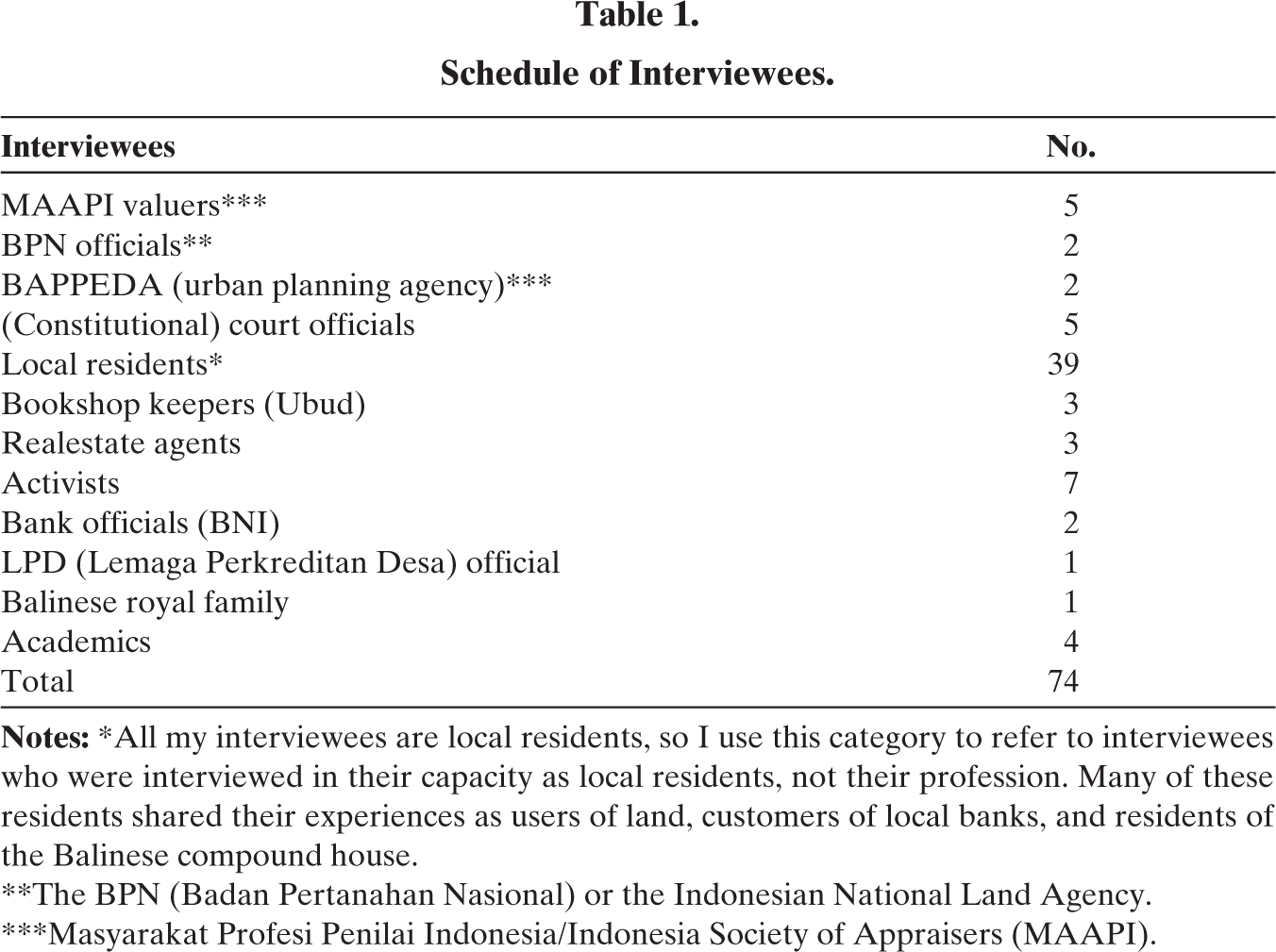
**The BPN (Badan Pertanahan Nasional) or the Indonesian National Land Agency.
***Masyarakat Profesi Penilai Indonesia/Indonesia Society of Appraisers (MAAPI).
As Table 1 shows, we also engaged activists, studying their experiences of urban development and injustice, particularly the intersectionality of gender, race, class, religion, and caste. A wealth of gray literature can be found in local bookshops, including the Constitutional Court library, so we interviewed librarians and bookshop keepers, too. Our interviews with a former constitutional justice, a librarian in the Constitutional Court of Indonesia, and other officers of the court were necessary to understand which decided cases to consult, how to cite opinions, judicial philosophy, and how to interpret court decisions about land in Indonesia. This triangulation of multiple sources of data facilitated the pursuit of rigor in data collection.
Rigor and validity in our analysis were pursued in three ways. First was by choosing a limiting case: Penglipuran. Scientifically, a limiting case does not require representativeness (Ducheyne, 2012). Second, the constitution or awig-awig of Penglipuran (Awig-awig Desa Adat Penglipuran, 1989) was carefully analyzed with the help of the klian of Penglipuran, in whom the authority for interpretation and implementation are invested. The klian also discussed the perarem, or regulations/additional rules that flesh out the tenets in the awig-awig of Penglipuran. Third, we were guided by the principle of saturation point (Fusch & Ness, 2015). This was the stage in our study in which answers became repetitive even though we kept diversifying our sources. We analyzed the data thematically (Attride-Stirling, 2001), coding them into utopia or apocalypse, neither utopia nor apocalypse, and towards inclusive community.
Utopia or Apocalypse?
Desa Wisata Penglipuran, according to our interviews with a leader of the community, is a community in Bali, predominantly occupied by the Sudra people, the lowest caste in any Hindu settlement. It is built on adat (customary/traditional) land. Yet, this village community has urban ways of life, opening its doors widely to cosmopolitans who visit the settlement almost daily. Such tourists are also welcome to stay for a while in Penglipuran. So successful is this community that a delegation from the G20, for example, visited the settlement on August 26, 2022.
In 1989/90, it was built incrementally and collectively as well as sustainably because it started on the grounds of coexisting with nature. Residents committed themselves to collective labor and collective building, collective local planning principles, and sustainable building practices and materials. Clean and green, collective and communal, Penglipuran reflects the quintessential adat land and adat way of life. Security is also offered collectively. Four people, drawn from the various families, guard one security post.
The land economy of this community is equally intriguing. The residents commonly engage in rice farming on adat land. Bamboo farming is also practised, as is light-scale manufacturing in the form of crafts. Plants are nursed and sold. In general, many other goods and services are sold in informal economies, which are attached to various compounds. These initiatives are individually owned, but adat and adat-related revenues are shared. This sharing is of two kinds: social and familial. Socially, the money goes to the maintenance of group practices such as maintaining the temple, constructing schools, and funding rituals. Individually, the revenue could be shared among families, too. Either way, on a monthly basis, rice, cooking oil, and other basic needs are shared in the community. All sharing in Penglipuran is on a universal, not means-testing, basis. People from the village run the economy; they are the farmers. They are the teachers, planners, carpenters, and builders. They are the gardeners and guardians. This is a self-sufficient land economy.
Politically, the adat is run by a leader who is collectively chosen. While the leader must be a man, his wife, who, in turn, leads the women, plays a significant role in governing the women of the village. Men’s power, then, is largely limited to men. No partisanship or any other type of politicking is allowed. Confidential nominations by all family members lead to a community nomination. The nominee, if he accepts, holds the position for five years. During this period, he accounts for his stewardship regularly. Meetings with the representatives of the families to resolve conflict are held in the Balai Banjar Adat. The leader also resolves conflicts, but he is assisted by several committees, including those responsible for finance and marketing.
In 1993, the Penglipuran Community Bank (LPD) was established to meet the financial needs of the residents. Workers are from the village. In such LPDs, the mood is usually convivial, not corporate. Borrowing is far more flexible and not as cumbersome as banking. Profits from LPD are reinvested in the village to develop the social sustainability of the community. Also, during events, LPDs make social contributions, for instance, ceremonies (20% of the cost), cremation (50%), village temple maintenance (10%), and desar Banjar maintenance (15%). Penalty for the inability to repay debt on an agreed date is rare, whereas banks exact penalties for default. LPD staff are locals, from the village, but banks can recruit from around Indonesia, even overseas. Indeed, if a woman in an LPD marries from outside the community, this is a strong community.
A memorandum of understanding for co-management was signed between the Adat and the Indonesian government. The Indonesian state, in exchange for its promotion of Penglipuran as a tourist site, legalizing it and offering training, roads, and other amenities such as parking, took away 60% of all gate proceeds. The remaining 40% was given to Penglipuran. This was a problematic formula that existed between 1993 and 2020. The owners of the village, those whose ideas and labor built and maintained the village, were paid much less than the government. In 2016, however, after years of protest, the government backtracked, switched the formula around, and ceded 20% more to Penglipuran. Whether this resolves the issue is controversial, but, at least, the situation now better reflects the relative contributions of the party.
This system of autonomous and Indigenous development attracted significant local and international interest within the wider construction of Bali as a tourist site. Penglipuran itself has opened the lives of its people to the world. It has adapted its compounds for the tourism industry. Penglipuran offers the ideas and maintenance of the grounds and scenes that attract people to the village. They clean, build, maintain, guard, manage, and run the village. Since tourism has entered the local economy, the people have run the tourism business, too. Not only do they have a marketing team, but they also run a homestay social enterprise. The entire tourism industry in Penglipuran is run by the villagers. It is community-based tourism and is quite a successful social enterprise and local development.
There are 78 representatives of the compounds. From our interviews in the village, we learned that these compounds are occupied by about 280 families. On average, the gross proceeds from the gate fees amount to some 3 billion rupiahs per year. But this revenue stream ebbs and flows. In 2019, gross gate proceeds amounted to 4.5 billion rupiah. During the 2020 COVID-19 shutdown, there were no proceeds, but by 2021, gross gate proceeds went up to 3.7 billion. By May 2022, the gross gate proceeds were 4 billion rupiah, following a ‘hockey-stick’ pattern in the local flow of finance. Tourism clearly brings in the most income, but it is not the only source of income for community members. Peoples’ basic needs are addressed through other economic activities, too. It is the institution of adat in its fuller form that offers the innovation. For example, during the COVID-19 pandemic, when there was not as much revenue from tourism, the entire village called on the adat account to survive. Money was shared among compounds, all of them. Penglipuran’s and the wider Balinese rituals and practices might come across as excessive to others, some of whom contend that such practices throw spokes into the ebullient Balinese. This appears erroneous. It is precisely these ceremonies that drive the Balinese economy—the magnets that bring people to Bali. This would appear to be some additional illustration that Indigenous or customary land can provide one model of economic transformation (see also Grant et al., 2005; Obeng-Odoom, 2008, 2013).
Simultaneously, this transformation reflects one model of sustainable development. Dorn (2012) has captioned her reflections on this feature as “the sacred ecology of Penglipuran.” This conception of development has three meanings. First, the village (Desa) is based on collective living and labor. Labor is collective, even if there is a division of who does what. Women do the bulk of the preparation for offerings, but men cook in special ceremonies, make specific offerings in the temples, and craft bamboo decorations. Collective labor also implies much less individualism at work and far more cooperation, although these broad values are mediated by particular institutional arrangements pertaining to where the community members work, whether within or outside the community. Second, the family structure is monogamous. A man is not allowed to take two wives. On average, women have two children. Both family and fertility structures are collectively thought through. Singular and smaller families are understood to be in the interest of all people; children can get the best form of care while living collectively with cousins, uncles, and more. Third, there is harmony between economy, society, and ecology, locally referred to as Tri Hita Karana. So, people in this village live in harmony with one another, with living plants and animals, and with their ancestors. The entire village is largely developed from bamboo and local materials. The irrigation system, the subak, for the rice fields and bamboo farms comes from natural sources and is maintained as a common unit. According to Geertz (1972, p. 27, italics in original), “the subak is at once a technological unit, marked out by the collectively owned dam and canal; a physical unit, an expanse of terraced land with a defined border around it; and a social unit, a corporation consisting of people owning land in that expanse, serviced by the dam and canal. It is also . . . a religious unit” because it is the focus of worshipping the rice goddess, to whom rituals and offerings are made recurrently (Geertz, 1972, p. 30).
These three distinctive features work together. For instance, the village bamboo farm is collectively run. This community-based resource management is also informed by strict adat rules against building with concrete on the farm, polluting the farm, or altering the ecosystem in destructive ways. To reiterate what Dorn (2012, p. 27) writes about a “conservation ‘by nature’” means there is respect for nature. Consider the Tumpek Uduh ceremony, in which trees show gratitude for contributing to the ecosystem that has supported the people of the village. In general, there is humility toward one another, toward society, and toward nature, symbolized in the arch of the penjor, which, although it is a high-rising bamboo displayed in the village during ceremonies such as Galungan, bends at the top and at the neck as a symbol of humility. Penglipuran, therefore, provides one way of resolving anthropocentric approaches to sustainability.
In terms of planning, too, this village is an exemplar. Our interviews with officers at Badan Perencanaan Pembangunan Daerah, the planning authority in Denpasar, revealed what the organization thought of Penglipuran. It is regarded as a paragon of planning. Without any external oversight, the village is well laid out. Rules are followed. Slums are nonexistent. Everyone is decently housed. Building standards are complied with so that buildings are uniform and uses are concentrated where they should be. People participate in the planning process locally. Conflicts are resolved collectively. Here, “urban community” is not an oxymoron; it can be seen in action. So, if Balinese subak is regarded as a “perfect order” (Lansing, 2006), the totality of Penglipuran could be seen as the apogee of this perfection.
But critics point to a dark side: a particularly stubborn Balinese reproductive injustice. Discrimination against women is rife. Women bear the bigger load of the work. Men have responsibilities, too, but they are seen as leaders. “It seems that Balinese women can do anything. However, there are just many other things they are not allowed to do and this discrimination goes largely unnoticed by the casual visitor” (Berninghausen et al., 2012, p. 33). “Feminist advocates … have repeatedly condemned the patriarchal customary law of Bali, because women have no right to inherit, because they have no voice in family and community and because the paternal line retains custody of children after divorce” (Berninghausen et al., 2012, p. 41). Feminists also point to the disruptions that characterize polygamous relations (Berninghausen et al., 2012, p. 34). Yet, while one critic we interviewed would praise Penglipuran for preventing polygamy and securing women’s rights in this respect, the question about what happens when extramarital affairs occur is important. As one critic pointed out, when women are found to have had an affair with a man, they are excluded from the community, while the men with whom they had the affair remain in the community. For Balinese women, such a treatment, even if not tantamount to banishment, in the sense that the said women are still part of the community, means cutting them off from their ancestors and from rituals whose purpose is to offer spiritual protection and connect with the next world. So, such a treatment is not simply about family exclusion; it is also about spiritual marginalization.
One way to modernize this system has been offered by the Indonesian government: modernizing the land tenure system so that women can have the freedom to own property. From this perspective, women can then build their financial capital. Greater capital—including human capital—could ensure greater empowerment, as the mainstream economics literature (e.g., Cameron et al., 2019; Amri et al., 2022) makes quite clear. BPN, the National Land Agency of Indonesia, has started a massive registration of the community lands to further this objective. As our interviews at BPN confirmed, the registration of all Balinese land is more than 50% complete. The case, as presented to a leader of Penglipuran and conveyed to me in our interviews, was that registration would increase the land value, improve the status of the land, facilitate financial inclusion, and bring land management in the village in line with the law. Our interviews with MAAPI valuers, real estate agents, and BPN staff show their staunch support for this government policy. Also in support is the World Bank, which provides considerable funding for the land title registration scheme (Pratiwi, 2009, p. 284).
Yet each of these aspirations is quite contestable. Our interviews with the leadership of Desa Wisata Penglipuran about the nature of the conflicts that he resolves show that for the last 1–2 years, there has been no conflict about unregistered land. According to Constitutional Court Decision No. 35/PUU-X/2012, adat is legal. Registration does not give infeasibility to the title, but it is correct that the marketization and market value of land dramatically increase with registration. But this is precisely the concern of the adat leaders, who contend that this is a way to undermine adat. How can they tell? It is, as they pointed out, because some “Penglipuran residents have registered land in their individual names, so they can sell”. Also, “in other villages, this mortgaging has occurred. The village has lost land”.
How to respond to this uncertainty has become a recurrent point of discussion among community leaders. For the most part, the registration is in the name of the adat, so this can serve as an impediment, theoretically, to not losing the adat land. Where there is no registration in terms of adat, the leaders now try to nominate two to three people. The strategy seems to be to try to prevent unilateral decision-making. Whether this is sufficient foil against the booming property market in Bali is controversial.
Elsewhere in Bali, the rule is that foreigners cannot buy land. They can lease some of it, but land cannot be sublet. A 2022 law—translated as “Protected Rice Field Area”—tightened security against foreign encroachment by “protecting” certain parcels of land. Protected land can be bought and sold, but it cannot be developed or built. Rice farming is allowed, and developers who were already building while the law was not in force can continue, but new development on protected land is banned. Even so, “investors still buy this land and hold it. Maybe the law will change” (BREAE, 2023, estate agent). Others actively try to influence the authorities (planners, police) with money, establishing a rule of 10 m Rp for 100 m2. “It has been one year now, but I have not heard of a success story” (BREAE, 2023, estate agent). It seems that not even the law can protect the impulses of speculation. Some investors from the Global North typically hide behind Balinese people to obtain property on their behalf. Others from elsewhere in Indonesia are also quite active in buying and selling Balinese land. This is freehold interest, so the legal title is with the Balinese, but the effective title is with foreigners. Leaseholds granted are long and renewable. Such leases can exist for the entire lifetime of the tenant. Villas are not usually where Balinese people live. So, even if they revert to the Balinese people, they are unlikely to live in them. Balinese people could offer such villas on the property market.
Neither Utopia nor Apocalypse, but Intersectionality
Bias against women is real, but the construction of “women” in Western feminism is biased. In Balinese society, what matters is the intersectionality of gender, class, and caste. The historical place of divorce and widowhood in Balinese society can be studied from the excellent work of Helen Creese (2016). The current situation could be elaborated on a bit more.
At the time when they are married into a compound, women are a minority because they must live with a generation of men’s family. Even if a newly married woman can bond with other women who have been married into a Balinese family, their position is still much weaker than that of their husbands, who live with a fuller array of their families. As women are settled, they can neither lead a compound built on adat land nor inherit adat land. Similarly, they cannot use the temple where they live during their menstrual cycle. When they become widows, women can, in general, continue to live on adat in their compounds, but this is especially so if they have had children, especially a male child, and make direct economic contributions to the compound. Women who do not have children have a less strong position, although they can, and often do, live in the compound even after becoming widowed. Upon divorce, women face the risk of losing their contribution to maintaining lands, temples, and housing, as well as rice fields or other farms. Women also risk losing their children to the family of their ex-husband upon divorce.
Although in 2010, the High Council of Customary Villages (MUDP) changed the 122-year-old tradition, practices are slow to change. Indeed, by 2022/23, when I conducted my interviews, both female and male interviewees were under the impression that traditionally women were not at all entitled to anything after their divorce. As one woman (WTB, 2023, Resident) noted, “No they cannot,” pointing to the recent case of her own brother, who divorced her sister-in-law but gave her nothing. The MUDP ruling is itself limited: women get only about half of what men can obtain, and children given to women need to be returned to their fathers’ compound upon puberty (Berninghausen et al., 2012, pp. 35–36), suggesting that this is only a temporary solution. Indeed, in our interview with one such woman, she was in tears even after years of reuniting with her child lost to the family of her ex-husband.
These are serious problems. But the claims of loss of privacy, toxic homes, perpetual conflict, and other similar criticisms are not necessarily a problem of collective living. These problems are real, but they depend on the economic class of the people involved, the leadership style of the grandparents in the compound, and the communication strategies used in the compound. When women have a bit more income, they can have a bit more space for their use, so that they do not have to live in the same room or share the same in living arrangements with others. Indeed, in many settlements, living standards are not so high, but many have their own houses within compounds.
In any case, individualization is not such a straightforward solution. Women who are, in theory, allowed to register their own names on the title certificate usually do not. In at least one case in our interviews, a woman who is acknowledged as an “owner” of landed property had her brother’s name on the title certificate and, hence, could not complete a transaction of her own land. She needed her brother for that purpose. “Land title registration,” one Balinese woman pointed out, “cannot solve this problem” (BREAE, 2023, estate agent).
Indonesian law itself has a provision that allows women to transact in property in their own right, but adat leaders seem to prefer to make the decision to sell a lot harder to maintain collective land. Activists seem to prefer that women are given land by their parents during their lifetime, and the strongest feeling is not to change Balinese ways of life, but to transform them. The activists themselves base their teachings partly on experience, partly on Balinese culture, and partly on Hindu teachings. Also, Balinese people have learned to live in compounds. It would seem that the problems of privacy do not arise; they have lived with and continue to live with one another. The question of “barrenness” is somewhat “mitigated” by allowing marriage to happen after a woman dating a man becomes pregnant. Also, Balinese culture allows adoption, so it is possible to adopt a male, as long as the adopters are married, which is the criterion to adopt a child under Indonesian law.
The conditions for women in Bali can be concerning. The rising number of divorce cases since the 2020 COVID-19 pandemic illustrates the point (Bali Sun, 2020). In the literature (e.g., Heaton et al., 2001; Amri et al., 2022), the interpretation of this trend is that women are more financially independent, are becoming much better educated, or are less poor. In short, women are now free to make utility-maximizing choices. In the feminist literature (e.g., Quah, 2015, 2020), however, the emphasis is less on individual choices, but the interpretation of divorce is still celebratory, highlighting escape from abusive relationships. The government of Indonesia has indeed promoted this view (see Suryani, 2004). Women can ask for divorce, obtain an equal share of marital property, and demand child support as well as ex-spousal maintenance until they are remarried. These freedoms have prompted more cases of divorce at the insistence of women (see Suryani, 2004). Creese (2016) has shown that this notion of “easy divorce” is a Dutch colonial creation. Yet, divorce rates are not such a straightforward proof of “progress” in women’s empowerment, nor is divorce itself to be celebrated as a solution.
Take the example of children. Balinese activists who were interviewed pointed out that after divorce such children remain stigmatized as bearers of poor upbringing for the rest of their lives. Consider a woman from a high caste marrying a low-caste man, an example used by one Balinese feminist. Such women tend to be rejected by their own families, so divorce is not an option. “Going back is impossible” (BIA, 2022, activist). Also, the woman’s caste would have diminished after the marriage, as she takes on her husband’s low-caste name, so they do not enjoy any respectful treatment mandated by Balinese culture. They must suffer in silence or, sometimes, by expressing themselves in indirect but painful ways such as shaving off some of their hair, yelling, or smashing household wares, as one interviewee recalled. Also, Balinese culture is not only about the here and now. It is also about the future, the after-years. If evicted from the compound, where would their souls go upon death? The compound usually organizes the burial and cremation much later (for low-caste people) or immediately (for high-caste people or low-caste people with a “priestly status”). In a divorce, under the new laws, children could be given to the mother, but they are returned to their father’s compound upon adolescence. The trouble, as Ketut Suryani (2004, p. 223) suggests, is that as they do not grow up in the compound, they become strangers in their own homes. More generally, a detailed and systematic review of research on “father absence and child well-being” (Sigle-Rushton & McLanahan, 2002) shows that it is particularly critical for children to have their fathers involved in their upbringing. Divorce can impede this fatherly love and support.
So, advocating divorce is a tricky solution. Evidence from two female shelters is mixed. Women are becoming more empowered. There have been fewer cases of domestic abuse reported at one shelter in the six months leading to our interviews; the numbers of people coming to the shelters had fallen by more than half. Calls for help had declined, too, although in the last eight years since the shelter was established, more than 700 women, about 70% of whom are Balinese, had been empowered to be economically independent. But in the second shelter, the evidence is the reverse: the situation is getting worse. Before the COVID-19 pandemic, fewer than 50 complaints were lodged, but after the pandemic, there are more than 50 cases per year. Men’s economic frustration from loss of work and their dominant place in their compound are largely the cause, not collective living. Perhaps, these factors help to explain why, apart from Papua (1.13%), Bali (1.34) is the place in Indonesia with the least number of divorce cases (Amri et al., 2022, p. 2).
The solution proposed by Balinese activists and professionals is threefold: economic empowerment of both women and men. The resulting wealth is being increasingly ring-fenced by younger Balinese women in prenuptial agreements and the use of contracts for ring-fenced items obtained during marriage. “Many of my friends, the younger generation of Balinese women, are doing that” (BREAE, 2023, estate agent). Some of this strategy has been documented in the literature (see, e.g., Parker, 2003, pp. 182–201; Putra et al., 2016; Amri et al., 2022). A second is to promote greater collectivization, but with gifts of land in one’s lifetime, not waiting upon death. Third, and more fundamental, is bringing men into female compounds (nyentana). This relocation of men into female compounds and intercaste marriage can be difficult because men often feel as if they are under women, a signal of their weakness and a symbol of shame. Also, to maintain their status in high-caste families, even if they accept nyentana, the man must be from the same caste, a near impossibility because society has taught these men to have pride in their position. A high-caste woman can therefore have it rough: to find not only a man who can accept nyentana but also someone from the same high caste. Even when a man agrees for nyentana, “he might become irresponsible knowing that he is freed of any traditional obligations. As a result, he might sometimes gamble a lot” (BRLR, 2023, local resident) and could become “insecure” (BREAE, 2023, estate agent). But gambling is a common issue, with quite distinct drivers, as the studies of Clifford Geertz (1973) and others (e.g., Smith, 2008) show. One interviewee looking for nyentana observed that “laziness and gambling are not issues driven by nyentana. If the man has that mindset, he will be lazy and gamble regardless of whether he is nyentana or in a regular marriage” (SBDR, 2023, local resident). A male interlocuter concurred, “gambling is a different issue” (SBAR, 2023, local resident).
Three conditions could help in this situation. The first is when a woman, her family, or both are of high-class status and, hence, quite wealthy. Men could more easily accept nyentana in those cases. As one local resident pointed out, “my friend recently found a man willing to nyentana … I think it was not difficult for her because she is rich and lower caste” (SBDR, 2023, local resident). Even here, it is not so straightforward. “The men feel insecure with high-achieving women, with good grades and prospects. Actually, I have been looking for nyentana. I am single until now because it is so difficult to find one” (BREAE, 2023, estate agent). “Men think that they will become like housewives” (SBDR, 2023, local resident). Also, “those who agree to the nyentana might feel that they do not need to take any responsibility. One of my friends has this problem. Her husband does not do anything. He is always gambling instead” (BRLR, 2023, local resident). But gambling is a problem that can afflict both the diligent and the indolent.
When a man is from a low-class family, from a broken home, or from a homeless background, he can more easily accept nyentana as the woman’s family becomes a refuge. Indeed, even where the man is not from a broken home but resources are scarce in his own compound and there are space constraints, nyentana is possible, even desirable. Many Balinese men have no land, even if they are not from broken homes, as one landless interviewee pointed out. This finding is consistent with the work of Dina Najjar and her colleagues. They found that “large numbers of men did not have any form of title or deed to the land they occupied … many men may also have precarious, contingent, and anxious relations with land than may appear if we lump all men together as the inevitable beneficiaries of patrilineal inheritance” (Najjar et al., 2020, pp. 139–140).
Again, even in the case of orphans or men from broken homes, it can be difficult for women to persuade them to leave their homes where they live alone. “Would my wife’s family treat me badly after I give them a son? Would family fight me as I live in their compound?” “These questions are so important for Balinese men” (SBAR, 2023, local resident, personal communication). In one case, an interlocuter pointed out,
Actually, I am dating a man whose father passed away and his mother remarried. He lives alone and is of a lower caste. I try to convince him to nyentana to my home, but he says he has fond memories of his home and his parents in that home. (SBDR, 2023, local resident)
This position seems commonplace. “My family does not want to perform ceremonies to adopt him to a higher caste. Even though they can, my family prefer pure blooded higher caste man” (SBDR, 2023, local resident). In general, for the man’s family, there is an unwillingness to “give up” their only boy for a nyentana. That means, for families with only one male, nyentana is an existential threat. A third reason is institutional. Only a few villages allow the nyentana institution. These communities are Banjar Kekeram, Penantahan, Penebel, Tabanan, and Penglipuran, my case study.
My interviews showed that nyentana families are common in Penglipuran. One percent of the people constitute nyentana families. These nyentana women cannot be evicted from nyentana homes upon divorce. To complement the relatively pro-women orientation of Penglipuran, women who cannot have sons can adopt them from elsewhere. Also, polygamy is outlawed. Punishment in the form of banishment to Karang memadu (a polygamy compound on the outskirts of Penglipuran) has been instituted. This is also a serious deterrent. Offenders cannot go to the temple. They cannot go to the village through its front gates. The ritual for the second marriage does not, and cannot, be witnessed in the village temple, either. My interviews show that, while problems of infidelity are resolved through mediation, not divorce, there have been no polygamy offenders over the years. Constitutionally, monogamy and nyentana are supported in Penglipuran. Article 6 (p. 18) of the Penglipuran awig-awig/constitution clearly makes the point. A small condition is that, as neighbors who live facing each other are considered “family” in Penglipuran, nyentana is not allowed for such families. Otherwise, both inter-caste and intra-caste nyentana do well. Also, nyentana is allowed for both those who live within or outside the community.
A win-win solution is that men get free accommodation and leadership. Indeed, a recent decision (Pesamuhan Agung III) suggests that men can even inherit from their fathers-in-law (see Diatmika & Sujana, 2018, for a discussion). The Pesamuhan Agung III decision also affirms that, in a divorce, children from a nyentana marriage must be left in the custody of women. Indeed, women maintain majoritarian leadership in the sense that they are in their own families and have free accommodation, too, as well as the greatest support ever, including support for caring responsibilities. Fundamentally, in a nyentana family, the woman’s name can be registered as head of the family and, hence, as landowner. These advantages are strongly championed by one women’s group, which sees the case for nyentana as a solution as part of a wider approach. “A man who can nyentana is a hero” is one of their slogans. So, overall, it might be that, even within the current system, there is a way to resolve problems of discrimination against women. For me, the visit on August 26, 2022, by a G20 delegation of the Ministerial Conference on Women’s Empowerment is meaningful. Its motto, “recover together, recover stronger,” echoes what intersectional inclusion can do to hold together communities.
Communities and Transformation: Toward a Stronger Social Economics of Development
Communities are idyllic places. They combine urban ways of life within villages (Anderson, 1959). Ecologically sustainable settlements show that the merits of city life could be somewhat maintained while maintaining the best parts of rural living. For “our common good,” that is, living ecologically, we need urban communities (Daly & Cobb, 1994).
Yet communities face the recurrent pressure of disintegration. Inequality constitutes a particular threat to the survival of communities. Whether socially, economically, or environmentally, inequality can tear communities apart. Becker’s (1992) “economic way of life” and its many variants, including those in feminist works, have been proposed as panaceas.
This article has focused on the experiences of Balinese Hindu women, particularly those who live in Penglipuran, a quintessential community—a special case, no doubt. What is the nature of the pressure on Balinese women? Why is this experienced? How could this discrimination be resolved? Drawing on interviews, the institutions of the community, and the wider Balinese context, we have tried to address these questions.
In various sections of this article, including utopia or apocalypse and neither utopia nor apocalypse, we have seen that the community is flourishing. It is seen as an example of ecologically sound living, effective planning, and a vibrant economic society. Yet, at the same time, the difficult experiences of women in this and other communities in Bali raise significant questions. While many feminists raise individualism as a way to address the problem, we have seen that collectivism offers a much sounder way to address these challenges. So, the community in Bali can have its own structural solution to its fundamental problems. Inequality could be addressed by improving the economic standing of both women and men of low and high caste. The rest—preventing women from inheriting land—could be changed, too. The evidence suggests that women can be enabled to own land, for example, through Hindu nyentana marriage.
My findings challenge “the economic way of life” and its many variants, but they are consistent with intersectional feminist work, which cautions against “exaggeration of women’s marginalization in landownership” (Najjar et al., 2020, p. 139). Women are, indeed, marginalized in landownership in Bali, but this situation could be reversed. Balinese women can, in principle and in practice, use local institutions such as nyentana to transform their communities for social and spatial development. This collective approach within social economics is a much firmer path to reproductive justice.
Footnotes
Acknowledgements
This paper is dedicated to my interlocutors. Their help, insights, and support enabled me to complete the work. Also, many thanks to the late Professor Anne Haila, the originator and leader of the ‘Urban Land Tenure’ Project, to which this paper is a modest contribution. The supportive comments of the JDS Managing Editor and JDS reviewers are gratefully acknowledged. The usual disclaimer applies.
Declaration of Conflicting Interests
The author declared no potential conflicts of interest with respect to the research, authorship, and/or publication of this article. The author confirms that this work is original and has not been published elsewhere, nor is it currently under consideration for publication elsewhere.
Funding
The author acknowledges funding from the Academy of Finland Urban Land Tenure Project.