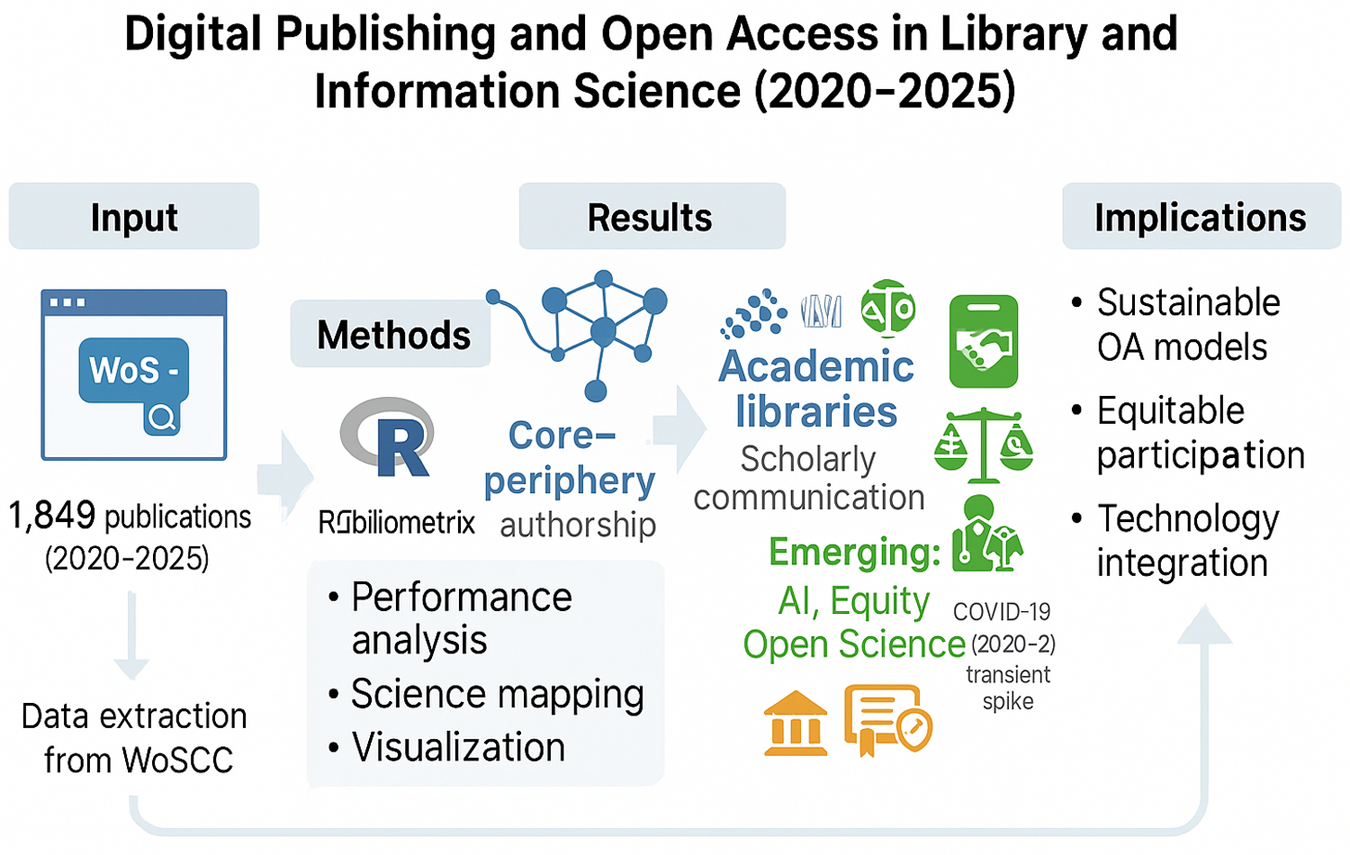
Purpose: This study maps the intellectual and thematic evolution of research on digital publishing and open access (OA) in Library and Information Science (LIS) between 2020 and 2025, identifying major trends, influential contributors, and emerging frontiers.
Methods: A bibliometric and science-mapping analysis was conducted on 1849 publications indexed in the Web of Science Core Collection. Performance indicators captured productivity and citation patterns, while science mapping examined co-authorship, co-citation, and keyword co-occurrence networks.
Results: Publications show steady growth, peaking in 2024, with the United States, China, and the United Kingdom as leading contributors. A core–periphery authorship structure is anchored by prolific scholars such as Abrizah A, Xu J, Jamali HR, and Nicholas D. Highly cited works in JASIST, Journal of Academic Librarianship, and Library Hi Tech form the intellectual backbone of the field. Thematic mapping reveals continuity in topics such as academic libraries and scholarly communication, alongside newer themes including artificial intelligence, equity, and open science. COVID-19 temporarily reshaped research dynamics (2020–2022), highlighting the community’s responsiveness to global disruptions.
Implications: The study deepens understanding of LIS research dynamics within Web of Science–indexed venues and offers guidance for libraries, policymakers, and publishers. It highlights the need to foster context-sensitive OA models, support more equitable participation in APC-driven environments, and integrate technological innovation into scholarly communication infrastructures.
SuberP. Open access. Cambridge, MA: The MIT Press, 2012.
2.
TennantJPWaldnerFJacquesDC, et al. The academic, economic and societal impacts of Open Access: an evidence-based review. F1000research2016; 5: 632.
3.
BjörkB-C. Scholarly journal publishing in transition from restricted to open access. Electron Market2017; 27(2): 101–109.
4.
LarivièreVHausteinSMongeonP. The oligopoly of academic publishers in the digital era. PLoS ONE2015; 10(6): e0127502.
5.
FyfeACoateKCurryS, et al. Untangling academic publishing: a history of the relationship between commercial interests, academic prestige and the circulation of research, 2017, https://zenodo.org/records/546100
6.
PinfieldSSalterJBathPA. A “Gold-centric” implementation of open access: hybrid journals, the “total cost of publication,” and policy development in the UK and beyond. J Assoc Inform Sci Technol2017; 68(9): 2248–2263.
7.
PiwowarHPriemJLarivièreetV, et al. The state of OA: a large-scale analysis of the prevalence and impact of Open Access articles. PeerJ2018; 6: e4375.
CullenRChawnerB. Institutional repositories, open access, and scholarly communication: a study of conflicting paradigms. J Acad Librar2011; 37(6): 460–470.
10.
KennanMAKingsleyDA. The state of the nation: a snapshot of Australian institutional repositories. First Monday2009; 14(2): 2092.
11.
TenopirCAllardSLFrameM, et al. Research data services in academic libraries: data intensive roles for the future. J Escience Librar2015; 4: e1085.
12.
ZiaS. Glance at the perception towards open access scholarly communication: a meta-synthesis of the literature. Int J Inform Stud Librar2024; 9(2): 1–19.
13.
MorrisonH. Scholarly communication for librarians. Amsterdam: Elsevier, 2009.
14.
LewisDW. The inevitability of open access. Coll Res Librar2012; 73(5): 493–506.
15.
AmanullahSWAbrizahA. The landscape of research data management services in Malaysian academic libraries: librarians’ practices and roles. Electr Librar2023; 41(1): 63–86.
16.
JamaliHR. Copyright compliance and infringement in ResearchGate full-text journal articles. Scientometrics2017; 112(1): 241–254.
17.
XuFMaL. Exploring the research themes and their relationships of LIS in China from 2013 to 2018 using co-word analysis. J Acad Librar2021; 47(1): 102295.
18.
SolomonDJBjörkBC. A study of open access journals using article processing charges. J Am Soc Inform Sci Technol2012; 63(8): 1485–1495.
19.
ShavellS. Should copyright of academic works be abolished?J Legal Anal2010; 2(1): 301–358.
20.
Van DisEABollenJZuidemaW, et al. ChatGPT: five priorities for research. Nature2023; 614(7947): 224–226.
21.
DonthuNKumarSMukherjeeD, et al. How to conduct a bibliometric analysis: an overview and guidelines. J Bus Res2021; 133: 285–296.
22.
GargouriYHajjemCLarivièreV, et al. Self-selected or mandated, open access increases citation impact for higher quality research. PLoS ONE2010; 5(10): e13636.
23.
PinfieldS. A mandate to self archive? The role of open access institutional repositories. Serials2005; 18(1): 1830.
24.
WayD. The open access availability of library and information science literature. Coll Res Libr2010; 71(4): 302–309.
25.
TavernierW. COVID-19 demonstrates the value of open access: what happens next?Coll Res Libr News2020; 81(5): 226.
26.
DasAK. UNESCO recommendation on open science: an upcoming milestone in global science. Sci Diplomacy2021; 39.
AriaMCuccurulloC. bibliometrix: an R-tool for comprehensive science mapping analysis. J Inform2017; 11(4): 959–975.
29.
CoboMJLópez-HerreraAGHerrera-ViedmaE, et al. Science mapping software tools: review, analysis, and cooperative study among tools. J Am Soc Inform Sci Technol2011; 62(7): 1382–1402.
30.
ChenC. Science mapping: a systematic review of the literature. J Data Inform Sci2017; 2(2): 1–40.
31.
ZhuJLiuW. A tale of two databases: the use of Web of Science and Scopus in academic papers. Scientometrics2020; 123(1): 321–335.
32.
SmallH. Visualizing science by citation mapping. J Am Soc Inform Sci1999; 50(9): 799–813.
33.
LiJFeiXWangS, et al. A bibliometric analysis of the WoSCC literature on the use of selective serotonin reuptake inhibitors as antidepressants. Drug Design Develop Therap2024; 18: 4961–4974.
SowaKPrzegalinskaACiechanowskiL. Cobots in knowledge work: human–AI collaboration in managerial professions. J Bus Res2021; 125: 135–142.
36.
MongeonPPaul-HusA. The journal coverage of Web of Science and Scopus: a comparative analysis. Scientometrics2016; 106(1): 213–228.
37.
AtkinsonKMKoenkaACSanchezCE, et al. Reporting standards for literature searches and report inclusion criteria: making research syntheses more transparent and easy to replicate. Res Synth Method2015; 6(1): 87–95.
38.
DervişH. Bibliometric analysis using bibliometrix an R package. J Scientometr Res2019; 8(3): 156–160.
39.
Moral-MuñozJAHerrera-ViedmaESantisteban EspejoA, et al. Software tools for conducting bibliometric analysis in science: An up-to-date review. Profes Inform2020; 29(1): 3.
40.
ChaiCP. The importance of data cleaning: three visualization examples. Chance2020; 33(1): 4–9.
41.
PassasI. Bibliometric analysis: the main steps. Encyclopedia2024; 4(2): 1014–1025.
42.
Van EckNWaltmanL. Software survey: VOSviewer, a computer program for bibliometric mapping. Scientometrics2010; 84(2): 523–538.
43.
CallonMCourtialJPLavilleF. Co-word analysis as a tool for describing the network of interactions between basic and technological research: the case of polymer chemistry. Scientometrics1991; 22(1): 155–205.
44.
HeQ. Knowledge discovery through co-word analysis. Libr Trends1999; 48(1): 133–159.
45.
ZhuXZhangY. Co-word analysis method based on meta-path of subject knowledge network. Scientometrics2020; 123(2): 753–766.
46.
PritchardA. Statistical bibliography; an interim bibliography. London: North-Western Polytechnic, School of Librarianship; 1969, 69 p. (PB-184–244).
47.
JungMSaadWJangY, et al. Performance analysis of large intelligent surfaces (LISs): asymptotic data rate and channel hardening effects. IEEE Trans Wireless Commun2020; 19(3): 2052–2065.
WickhamHChangWWickhamMH. Package ‘ggplot2’. Create elegant data visualisations using the grammar of graphics. Version2016; 2(1): 1–189.
50.
MerinoMTornero-AguileraJFRubio-ZarapuzA, et al. Body perceptions and psychological well-being: a review of the impact of social media and physical measurements on self-esteem and mental health with a focus on body image satisfaction and its relationship with cultural and gender factors. Healthcare2024; 12: 1396.
51.
TarnarisKPrekaIKandrisD, et al. Coverage and k-coverage optimization in wireless sensor networks using computational intelligence methods: a comparative study. Electronics2020; 9(4): 675.
52.
NagpalMPetersenJA. Keyword selection strategies in search engine optimization: how relevant is relevance?J Retail2021; 97(4): 746–763.
53.
GarfieldE. Citation analysis as a tool in journal evaluation: Journals can be ranked by frequency and impact of citations for science policy studies. Science1972; 178(4060): 471–479.
54.
BornmannLLeydesdorffL. Scientometrics in a changing research landscape: bibliometrics has become an integral part of research quality evaluation and has been changing the practice of research. EMBO Rep2014; 15(12): 1228–1232.
55.
FangFCSteenRGCasadevallA. Misconduct accounts for the majority of retracted scientific publications. Proc Natl Acad Sci2012; 109(42): 17028–17033.
56.
KatzJSMartinBR. What is research collaboration?Res Pol1997; 26(1): 1–18.
57.
GlänzelWSchubertA. Analysing scientific networks through co-authorship. In: MoedHFGlänzelWSchmochU (eds) Handbook of quantitative science and technology research: the use of publication and patent statistics in studies of S&T systems. Cham: Springer, 2004, pp. 257–276.
58.
MoedHF. Citation analysis in research evaluation. Cham: Springer, 2005.
59.
Archambault BeauchesneÉOHCarusoJ. Towards a multilingual, comprehensive and open scientific journal ontology. In: Proceedings of the 13th international conference of the international society for scientometrics and informetrics, Durban, South Africa, 2011, https://www.science-metrix.com/pdf/Towards_a_Multilingual_Comprehensive_and_Open.pdf
60.
LiuSSunY-PGaoX-L, et al. Knowledge domain and emerging trends in Alzheimer’s disease: a scientometric review based on CiteSpace analysis. Neur Regene Res2019; 14(9): 1643–1650.
61.
WaltmanL. A review of the literature on citation impact indicators. J Inform2016; 10(2): 365–391.
62.
LewisJSchneegansSStrazaT. UNESCO Science Report: The race against time for smarter development, Vol. 2021. Paris: UNESCO Publishing, 2021.
Perianes -RodriguezAWaltmanLVan EckNJ. Constructing bibliometric networks: a comparison between full and fractional counting. J Inform2016; 10(4): 1178–1195.
65.
Washington Academy of Sciences. Journal of the Washington Academy of Sciences. Washington, DC: Washington Academy of Sciences, 1922.
66.
EggheL. Expansion of the field of informetrics: origins and consequences. Inform Process Manag2005; 41(6): 1311–1316.
67.
NewmanME. The structure of scientific collaboration networks. Proc Natl Acad Sci2001; 98(2): 404–409.
68.
Moral-MunozJA and et al. Science mapping analysis software tools: a review. In: GlänzelWMoedHFSchmochU, et al. (eds) Springer handbook of science and technology indicators. Cham: Springer, 2019, pp. 159–185.
69.
BorgattiSPEverettMG. Models of core/periphery structures. Soc Netw2000; 21(4): 375–395.
70.
LiuYXuXLiS. Understanding of evolutionary features in the library and information science with interdisciplinary network analysis. Scientometrics2025; 130(2): 781–808.
71.
de Solla PriceDJ. Little science, big science. 1963: New York: Columbia University Press, 1963.
72.
ParkHWLeydesdorffL. Longitudinal trends in networks of university–industry–government relations in South Korea: the role of programmatic incentives. Res Pol2010; 39(5): 640–649.
73.
ZittMBassecoulardE. Internationalisation in science in the prism of bibliometric indicators. In: MoedHFGlänzelWSchmochU (eds) Handbook of quantitative science and technology research. Cham: Springer, 2004, pp. 407–436.
74.
AgarwalNKOhKEWilliamsRD, et al. Standing out in the academic LIS job market: an interactive panel not just for doctoral students. Proc Assoc Inform Sci Technol2020; 57(1): e286.
75.
FreemanLCRoederDMulhollandRR. Centrality in social networks: II – experimental results. Soc Netw1979; 2(2): 119–141.
76.
PriceDDS. A general theory of bibliometric and other cumulative advantage processes. J Am Soc Inform Sci1976; 27(5): 292–306.
77.
KuhnTS. The structure of scientific revolutions, Vol. 962. Chicago, IL: University of Chicago Press, 1997.
78.
VakkariP. What characterizes LIS as a fragmenting discipline?J Document2024; 80(7): 60–77.
79.
LeydesdorffLBornmannLMarxW, et al. Referenced publication years spectroscopy applied to iMetrics: Scientometrics, Journal of Informetrics, and a relevant subset of JASIST. J Informetr2014; 8(1): 162–174.
80.
GarfieldE. The history and meaning of the journal impact factor. JAMA2006; 295(1): 90–93.
81.
OpthofTLeydesdorffL. A comment to the paper by Waltman et al., Scientometrics, 87, 467–481, 2011. Scientometrics2011; 88(3): 1011–1016.
82.
AbramoGD’AngeloCAFerrettiM, et al. An individual-level assessment of the relationship between spin-off activities and research performance in universities. R&D Manag2012; 42(3): 225–242.
83.
AbramoGCiceroTD’AngeloCA. Revisiting the scaling of citations for research assessment. J Informetr2012; 6(4): 470–479.
84.
TenopirCTaljaSHorstmannW, et al. Research data services in European academic research libraries. LIBER Quart: J Assoc Eur Res Libr2017; 27(1): 23–44.
85.
XiaJ. Positioning open access journals in a LIS journal ranking. Coll Res Libr2012; 73(2): 134–145.
86.
SugimotoCRLarivièreV. Measuring research: What everyone needs to know. Oxford: Oxford University Press, 2018.
87.
RafolsI. Towards multiple ontologies in science mapping: a tribute to Loet Leydesdorff. Scientometrics2025; 130: 3229–3255.
88.
MertonRK. The Matthew effect in science: the reward and communication systems of science are considered. Science1968; 159(3810): 56–63.
YanYChenYMiaoJ. Eco-innovation in SMEs: a scientometric review. Environ Sci Pollut Res2022; 29(32): 48105–48125.
91.
KennanMACorrallSAfzalW. “Making space” in practice and education: research support services in academic libraries. Libr Manag2014; 35(8/9): 666–683.
92.
PinfieldSCoxAMSmithJ. Research data management and libraries: relationships, activities, drivers and influences. PLoS ONE2014; 9(12): e114734.
93.
HolmbergC. Swedish nursing research: a bibliometric and content analysis revealing author and institute collaborations, impact, and topics. Nordic J Nurs Res2024; 44: 227583.
94.
Vicente-SaezRMartinez-FuentesC. Open Science now: a systematic literature review for an integrated definition. J Bus Res2018; 88: 428–436.
95.
DemeterMPelleVMikulásG, et al. Higher quantity, higher quality? Current publication trends of the most productive journal authors on the field of communication studies. Publ Res Quart2022; 38(3): 445–464.
96.
ChristenPMichalowJNaidooT, et al. Examining gender and ethnic disparities in scientific authorship to promote a culture of equity, diversity and inclusion at a university school of public health. Medrxiv2025; 292: 321228.
97.
BenderEM. Resisting dehumanization in the age of “AI”. Curr Direct Psychol Sci2024; 33(2): 114–120.
98.
BorgmanCL. Scholarship in the digital age: information, infrastructure, and the Internet. Cambridge, MA: MIT Press, 2010.
KlingRMcKimG. Not just a matter of time: field differences and the shaping of electronic media in supporting scientific communication. J Am Soc Inform Sci2000; 51(14): 1306–1320.
101.
FecherBFriesikeS. Open science: one term, five schools of thought. In: BartlingSFriesikeS (eds) Opening science: the evolving guide on how the internet is changing research, collaboration and scholarly publishing. Cham: Springer International Publishing, 2013, pp. 17–47.
102.
LaaksoMBjörkB-C. Anatomy of open access publishing: a study of longitudinal development and internal structure. BMC Med2012; 10(1): 124.
103.
BroadusR. Toward a definition of “bibliometrics”. Scientometrics1987; 12(5–6): 373–379.
104.
NoorhidawatiAMohd KhalidYIANorZM, et al. Characteristics of Malaysian highly cited papers. Malay J Libr Inform Sci2017; 22(2): 85–99.
105.
LotkaAJ. The frequency distribution of scientific productivity. J Washington Acad Sci1926; 16(12): 317–323.
106.
PaoML. Lotka’s law: a testing procedure. Inform Process Manag1985; 21(4): 305–320.
107.
GlänzelWDebackereKThijsB, et al. A concise review on the role of author self-citations in information science, bibliometrics and science policy. In: Proceedings of the Annual Conference of CAIS/Actes du congrès annuel de l ACSI, The University of Western Ontario, London, Ontario, Canada, 2–4 June 2005. doi:10.29173/cais283.
108.
CraneD. Invisible colleges; diffusion of knowledge in scientific communities. Chicago, IL: University of Chicago Press, 1972.
109.
LeydesdorffLRafolsI. Indicators of the interdisciplinarity of journals: Diversity, centrality, and citations. J Informetr2011; 5(1): 87–100.
110.
CoxAMKennanMALyonL, et al. Developments in research data management in academic libraries: towards an understanding of research data service maturity. J Assoc Inform Sci Technol2017; 68(9): 2182–2200.
111.
ChanJOoSChorCYT, et al. COVID-19 and literature evidence: should we publish anything and everything?Acta Bio Med: Atenei Parmensis2020; 91(3): e2020020.
112.
GlänzelW. National characteristics in international scientific co-authorship relations. Scientometrics2001; 51(1): 69–115.
113.
WagnerCSParkHWLeydesdorffL. The continuing growth of global cooperation networks in research: a conundrum for national governments. PLoS ONE2015; 10(7): e0131816.
114.
DavenportTHDychéJ. Big data in big companies. Int Inst Anal2013; 3(1–31): 1–31.
115.
RowleyJ. Knowledge management: an integrated approach. Leeds: Emerald Group Publishing Limited, 2006.
116.
BucchiMTrenchB. Routledge handbook of public communication of science and technology. London: Routledge, 2021.
117.
RogersE. Diffusion of innovations. 5th ed.New York: Free Press, 2003.
118.
HolmbergU. Stock returns and the mind: an unlikely result that could change our understanding of consciousness. J Conscious Stud2020; 27(7–8): 31–49.
119.
AndersonCNissleyCAndersonC. The long tail: why the future of business is selling less of more. New York: Hyperion audiobooks, 2006.
120.
SeckerJMorrisonCNilssonI-L. Copyright literacy and the role of librarians as educators and advocates. J Copyr Educ Libr2019; 3(2): 6927.
121.
Khoo SY-S. Article processing charge hyperinflation and price insensitivity: an open access sequel to the serials crisis. LIBER Quart: J Assoc Eur Res Libr2019; 29(1): 1–18.
122.
BrewerJMHookSJSimmons-WelburnJ, et al. ARL: a bimonthly report on research library issues and actions from ARL, CNI, and SPARC. Number 234. Washington, DC: Association of Research Libraries, 2004.
ArashOHassaniZYousefiB, et al. Scientometric analysis of scientific productions in sports sciences in Web of Science. Casp J Scientometrics2023; 10(2): 53–64.
125.
EveMP. Open access and the humanities. Cambridge: Cambridge University Press, 2014.
126.
ChubinDEHackettEJ. Peerless science: Peer review and US science policy. New York: State University of New York Press, 1990.
127.
LiZPiaoSDongC, et al. Robustness analysis on self-ensemble. In: Proceedings of the databases theory and applications: 35th Australasian database conference (ADC), Gold Coast, QLD, Australia and Tokyo, Japan, 16–18 December 2024. Cham: Springer Nature
128.
Archambault, et al. É. Comparing bibliometric statistics obtained from the Web of Science and Scopus. J Am Soc Inform Sci Technol2009; 60(7): 1320–1326.
129.
HarzingA-WAlakangasS. Google Scholar, Scopus and the Web of Science: a longitudinal and cross-disciplinary comparison. Scientometrics2016; 106(2): 787–804.
130.
DidegahFThelwallM. Determinants of research citation impact in nanoscience and nanotechnology. J Am Soc Inform Sci Technol2013; 64(5): 1055–1064.
131.
WangJ. Citation time window choice for research impact evaluation. Scientometrics2013; 94(3): 851–872.
132.
PriemJOarraCPiwowarH, et al. Uncovering impacts: CitedIn and total-impact, two new tools for gathering altmetrics. In: Proceedings of the 2012 iConference, Toronto, Ontario, Canada. New York, NY: Association for Computing Machinery, 7–10 February 2012, pp. 9–11.
133.
CallonMCourtialJ-PTurnerWA, et al. From translations to problematic networks: an introduction to co-word analysis. Soc Sci Inform1983; 22(2): 191–235.
134.
CreswellJWClarkVLP. Designing and conducting mixed methods research. London: SAGE, 2017.
135.
CaseDOGivenLM. Looking for information: a survey of research on information seeking, needs, and behavior. Leeds: Emerald Group, 2016.
136.
MeagherK. Introduction: the politics of open access – decolonizing research or corporate capture?Develop Change2021; 52(2): 340–358.