



Abstract
The coronavirus pandemic has illustrated the lack of a holistic approach in implementing Open Science (OS), leading to an inability to fully utilise its potential to inform prompt, evidence-based policy responses. In this view, this study aims to identify and categorise the factors influencing the adoption of OS and proposes possible actions for decision-makers to develop relevant policies. To achieve this, semi-structured interviews were conducted with 36 experts from Australia, France, the Netherlands, South Korea, the United Kingdom, and the United States as well as eminent international entities. During the interviews, they were asked to answer a range of questions that emerged from a systematic literature review. The responses were coded and analysed using a grounded theory approach. This led to the identification of four thematic clusters, containing a total of 24 factors that can either enable or inhibit OS practices, namely, (a) external; (b) institutional and regulatory; (c) resource-related; and (d) individual and motivational. Drawing upon Ostrom’s Institutional Analysis and Development framework, we also propose a conceptual model that integrates these factors, accompanied with corresponding actions, into a tangible process of OS policy design and implementation.
1. Introduction
Open Science (OS) is increasingly recognised as a critical accelerator for achieving the United Nations Sustainable Development Goals (UN SDGs) to reduce the existing inequalities in science, technology and innovation (STI) by making the scientific process more transparent, inclusive and democratic [1]. UNESCO, in its recent ‘Recommendations on OS’, defined it as an inclusive construct that combines various movements and practices aiming to make scientific knowledge openly available, accessible and reusable for everyone; to increase scientific collaborations and sharing of information for the benefits of science and society; and to open the processes of scientific knowledge creation, evaluation and communication beyond the traditional scientific community. [1, p. 7]
Considering the multiplicity of OS definitions [2], this concept is typically associated with the availability and reuse of scientific knowledge and information within and beyond research communities through open, collaborative scholarly communication processes/practices. The latter are often considered the main components of the OS and are known as ‘OS practices’ [3–5]; sometimes called as ‘open research practices’/‘open scholarship practices’ [6], ‘trends on OS’ [2], ‘open behaviours’ [7] or ‘OS building blocks’ [8]. Based on the above-mentioned literature, examples of OS practices include preregistration of the study design, methods and hypothesis prior to commencing the research; Open Access (OA) to scientific publications (including preprints); open research data sharing and research data management (RDM); making software, models, algorithms and workflows produced by researchers openly available; open collaboration (e.g. scientific knowledge co-creation with societal actors via crowdsourced and citizen science projects).
In this study, we define OS practices as open and collaborative processes of production, distribution (sharing) and consumption of digital scholarly resources (i.e. OS information/outputs) that affect a scholarly domain, making it more transparent, accessible, participatory and democratic. We adapted this definition from the definitions and approaches related to a higher-order concept of ‘openness’ [9–11], which manifests itself in different forms (applications), most of which are directly related to information and communication technologies (ICTs). These include OS, Open Government, Open Education and Open Innovation.
In addition, the coronavirus disease 2019 (COVID-19) pandemic has further highlighted the urgent need for OS. At the beginning of the pandemic, international organisations, such as the UN specialised bodies and the Organisation for Economic Co-operation and Development (OECD), were among the first to raise global concerns about the untapped potential of the OS to bolster knowledge-sharing and trust-building across the science community, policy-makers and the general public, which underpin effective scientific advice [12,13].
Numerous OS initiatives and projects have been triggered by the pandemic. For example, several large publishers have positively responded to calls for OA [14,15] by offering access to their coronavirus-related publications, for reading and text-mining, at no charge, for as long as the pandemic lasts [16]. Belli et al. [17] reported that the average percentage of OA articles on coronavirus between 2001 and 2020 was about 59%, but due to the actions of commercial publishers responding to the emergency, it reached about 91% in 2020. Several other initiatives, such as the European COVID-19 Data Portal (covid19dataportal.org), were aimed at sharing research data related to the virus genome sequences and protein structures and providing data analysis tools. In addition, there has been an unprecedented engagement with preprint servers to disseminate and access COVID-19 research information [18]. The above-mentioned initiatives, such as the OA for coronavirus-related publications provided by commercial publishers, encourage a transition in the research culture towards a more resilient and sustainable OS ecosystem to respond to future infectious and chronic diseases, natural disasters, environmental issues and other societal challenges. However, these initiatives seem to be a temporary response to the crisis rather than an established trend [19].
The pandemic revealed that even though some countries made explicit OS commitments long before the crisis, OS practices were unsystematically planned and implemented, and the existing OS infrastructure was fragmented, fragile and lacking capacity [20]. For example, according to Glinos [21], there have been inadequate data infrastructures to respond to a complex and dynamic situation, unprepared research assessment systems that are unable to offer OS-related incentives and rewards and outdated scientific publishing models that lack transparency and agility to openly disseminate the latest research.
The objectives of this study were to identify and categorise the factors that affect OS practices, define possible actions regarding the identified factors, and propose a conceptual model to integrate the identified factors and actions into a holistic OS policy design and implementation process. To address these objectives, we used a semi-structured interview approach as the main data-gathering technique to reveal the perceptions and experiences of the key stakeholders. This approach has been recognised as one of the primary methods of qualitative enquiry [22], especially in the field of policy research [23]. We interviewed various OS stakeholders, including researchers and academics, information service providers, academic publishers and representatives from international organisations, during the COVID-19 outbreak. Most of the interviewees were closely engaged with the outbreak as a part of their research or job responsibilities.
Previous studies investigating the factors influencing OS practices, positively and negatively, have paid primary attention to open research data sharing [24–34]. A few studies examined this OS practice in a public health emergency context and identified certain general factors – fear of misuse of shared data, the self-interest of the data owners to profit from the data before sharing, insufficient incentives for compliance with data sharing policies and the availability of data repositories – that are applicable beyond the emergency context [35–38]. In general, most previous studies primarily focused on motivational factors, attempting to explain scientists’ behaviour towards data sharing, with minimal attention to the perception of OS among other stakeholders responsible for actual OS operationalisation. Kim and colleagues [24–26] proposed a conceptual categorisation of potential research data-sharing factors into three broad themes/groups: (1) institutional/regulatory factors, such as the funding agency’s policy; (2) resource factors, such as the availability of data repositories; and (3) individual/motivational factors, such as scientists’ perceived efforts and benefits. It has been argued that these are complementary factors and must be studied together.
However, the above-mentioned studies, with their rather narrow focus, do not provide a holistic picture of the OS domain, encompassing all the various OS practices. The factors identified in these studies often have a generic and abstract nature, failing to examine deeper conceptually-grounded solutions in real-world practices. Thus, our research offers a detailed typology of enabling and inhibiting factors affecting OS practices across disciplines, grouped into four clusters (the categorisation of the factors into broad thematic clusters has been adapted and extended from Kim and Adler [24] and Kim and Stanton [26]) and supplemented by recommended actions. This was possible due to our engagement with a broad range of stakeholders beyond researchers and academics, who were the main target of previous studies. In addition, our research attempts to integrate the identified factors and corresponding actions into the development of a conceptual model of OS Policy Design and Implementation Process based on Ostrom’s Institutional Analysis and Development (IAD) framework (see section ‘Factors and actions as building blocks of a conceptual model of OS policy design and implementation process’). To the best of our knowledge, this is one of the first attempts to employ this theoretical framework in OS research.
2. Methodology
Table 1 presents the research design of this study, which covers the research questions and corresponding methods and links them with the outcomes in the ‘Results’ section.
Research design.
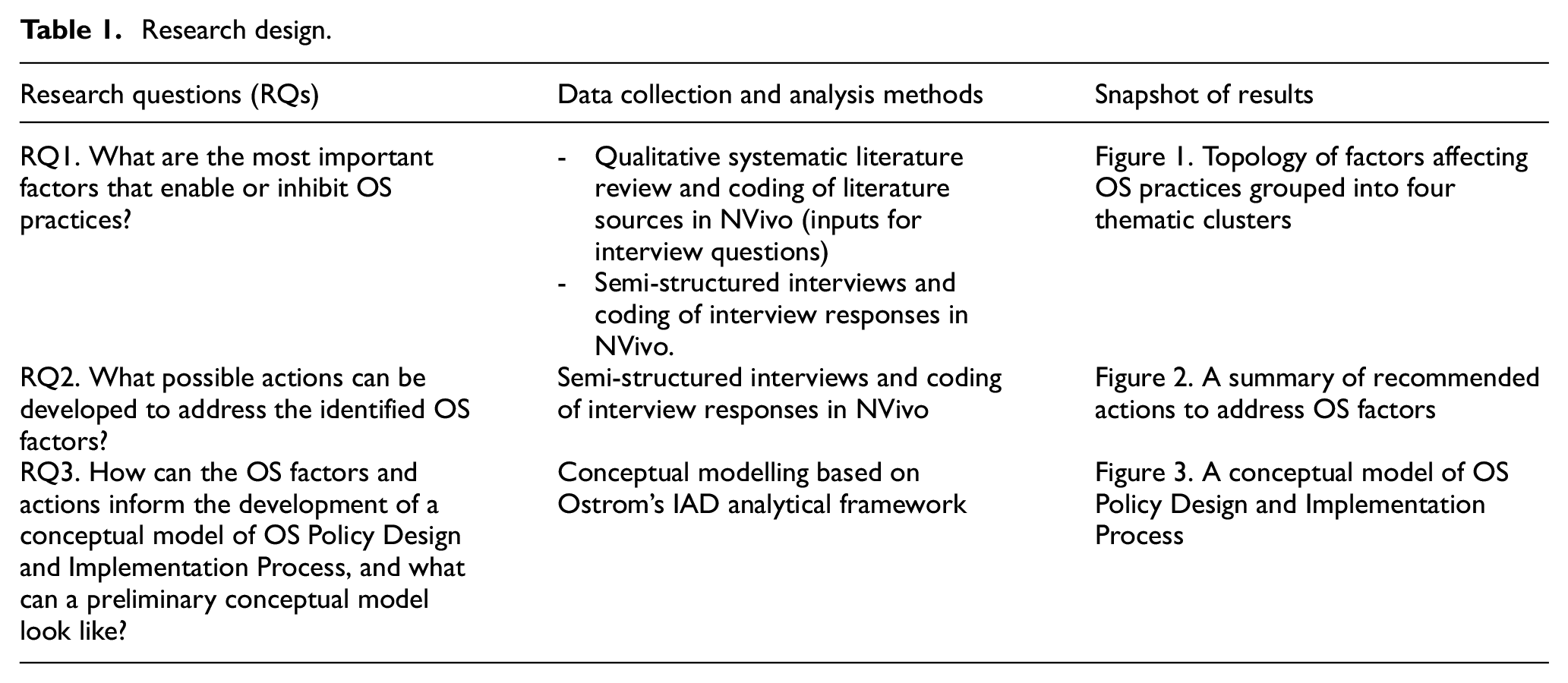
The research comprised four main phases: (1) a preparatory phase; (2) an interview phase; (3) a data processing and analysis phase; and (4) a conceptual modelling phase.
2.1. Preparatory research phase
The preparatory phase formulated the interview questions and selected relevant experts to be interviewed. The questions were drawn from the findings of a systematic literature review, followed by the coding of relevant literature sources in NVivo 12 Plus software [39]. During the systematic literature review, we searched the Web of Science and Scopus databases, using queries such as ‘open science AND factors’, ‘open science AND enablers’, ‘open science AND barriers’, ‘open science AND inhibitors’, ‘open science AND data sharing AND factors’, and ‘open access AND barriers’. The screening of titles and abstracts and a subsequent full-text assessment of the retrieved records were then conducted, with inclusion or exclusion decisions applied at both stages. Finally, a total of 93 papers were selected for the NVivo qualitative full-text analysis.
NVivo analysis of the selected studies was based on a mixed approach of deductive (concept-driven) and inductive (data-driven) coding [40]. In the first step, using a concept-driven strategy for building a coding framework, we created four deductive categories, known in NVivo as ‘nodes’, to cover four broad clusters of OS factors – external, institutional and regulatory, resource-related and individual and motivational factors (we added ‘external’ to the categorisations proposed by Kim and Adler [24] and Kim and Stanton [26]). After this initial stage, we read and coded relevant text sections from the respective literature by applying an open, axial and selective coding procedure rooted in the grounded theory approach [41]. This generated the inductive sub-categories, known in NVivo as ‘child nodes’. Each child node represented a particular factor, gathering all the relevant texts in one place. The final coding framework, built upon concept- and data-driven strategies, formed the basis for the interview questions.
To find potential interview participants, we employed a purposive sampling technique commonly used in qualitative research [22,42]. In particular, during the preparatory research phase, a priori criteria sampling, one of the purposive sampling approaches [42], was used.
There were two main criteria for selecting the interviewees. First was the representation of the regions that have demonstrated good performance in adopting OS practices. Notably, to our knowledge, there is no agreed approach for the comprehensive assessment of countries’ OS maturity. According to a 2019 study by the European consultancy group Science|Business [43], the entire European Union (EU), South Korea, Australia and the United States made significant efforts to adopt OS initiatives. For example, South Korea adopted dedicated policies and initiatives for the sharing and reuse of publicly funded research data to promote big data-driven innovation [44]. We selected the Netherlands and France in the EU since the former had initiated OS development in Europe during the Dutch Presidency of the Council of the EU in 2016 [45]. In addition, both countries set up a dedicated national OS plan and strategy [46,47; these countries updated their strategies following the interviews], which was considered important for OS progress. Currently, only a handful of countries have made similar attempts. UK experts, too, were considered because the United Kingdom, a leading research power, has been acknowledged for making substantial progress towards OA following the 2012 report by Professor Janet Finch [48]; in addition, United Kingdom is the home of the Wellcome Trust, which has consistently demonstrated a strong commitment to OS in the research it supports.
Since multiple stakeholders play a role in OS operationalisation [1], the second criterion for interviewee selection was the diversity of respondents’ expertise. The target participants were mainly researchers and practitioners from Biomedical and Health Sciences, STI policy and OS/OA areas and those involved in scientific information service design and provision.
To find relevant participants, we analysed multiple sources, such as information about the experts on the websites of relevant international conferences (e.g. the Munin Conference on Scholarly Publishing, the International Conference on ICT-enhanced Social Sciences and Humanities and the Asia OA Meeting 2020), the COVID Information Commons website (covidinfocommons.datascience.columbia.edu) with information about the National Science Foundation (NSF)-funded researchers addressing the COVID-19 pandemic, web pages with information about the speakers from the Netherlands on OS-related topics (openscience.nl/en/speakers) and information about Korean national experts, provided by authors’ affiliated organisations. In the interview phase, we used another purposive sampling approach, snowball sampling [42], by asking the interviewed participants to recommend other experts.
This interview-based study received approval from the Research Ethics Committee of the Korea Institute of Science and Technology Information (an affiliated organisation of the first author who conducted the interviews). Written informed consent to be interviewed was obtained from all the participants. In particular, the conditions of participation and future use of data, together with a copy of the interview guide (outline of the interview questions), were sent to the potential interviewees by email, and individuals provided their consent by replying to the invitation email.
2.2. Interview phase
The interviews were conducted with 36 experts from May 2020 to January 2021, either face-to-face, on the telephone or through Zoom. Interviewees were affiliated with diverse organisations in South Korea, Australia, the United Kingdom, the United States, the Netherlands and France (e.g. research institutes, universities and university medical centres, information service providers, among others). In addition, representatives of international entities were interviewed, including UNESCO, the International Science Council (ISC), the Research Data Alliance (RDA), SPARC Europe, the Consortium of European Social Science Data Archives (CESSDA), the Wellcome Trust, the Centre for Open Science, Elsevier and F1000. Details of the anonymised interviewee profiles are presented in Supplemental Material.
The participants held positions as specialists (including senior managers) (18, that is, 50%), researchers (13, that is, 36.1%), professors (3, that is, 7.8%) and medical practitioners (2, that is, 5.5%). The largest single group of all interviewees (10, that is, 27.8%) had over 20 years of experience in the field. A total of 29 interviewees (80.6%) had experience reusing open research data/outputs, while 24 (66.7%) had experience sharing their research data/outputs. A large majority of interviewees (26, that is, 72.2%) had research and/or job responsibilities related to the COVID-19 outbreak.
2.3. Data processing and analysis phase
The interview outcomes were transcribed and sent to the participants, upon request, for verification and approval. The transcripts, together with additional materials provided by the participants (e.g. papers, policy documents and grey literature), were analysed in NVivo by applying the coding approach used in the preparatory phase. The previously created coding framework, comprising the four clusters of factors served as the basis for analysing transcripts and participants’ materials. This approach allowed the identification of new sub-categories within the four clusters and the revision of some of the previously established sub-categories.
2.4. Conceptual modelling phase
At this stage, we developed a preliminary conceptual model (see section ‘Factors and actions as building blocks of a conceptual model of OS Policy Design and Implementation Process’) to demonstrate how the identified OS factors and corresponding actions may be integrated into a holistic OS policy design and implementation process.
To elicit the generic components of the proposed conceptual model, we primarily relied on Ostrom’s IAD framework [49]. The IAD framework, widely utilised in diverse contexts, serves as a flexible analytic tool in policy analysis and design. Its primary focus is the governance systems of various types of shared resources or ‘commons’– including natural-resource commons like land and knowledge commons – which are typically classified as ‘common-pool resources’ and ‘public goods’ [50]. This framework was applied in this research because, in our view, OS information – at the core of OS practices – is for the fundamental public good.
3. Results
We identified 24 factors that could potentially affect OS practices and divided them into four clusters – (1) external, (2) institutional and regulatory, (3) resource-related and (4) individual and motivational factors. A full list of all the factors is presented in Figure 1. Depending on the context, these factors can either serve as enablers, which are positive contributors that facilitate the adoption of OS, or as inhibitors, which encompass both barriers and the absence of necessary efforts or capacities. Among these factors, the clear inhibitors include F2, F4 and F6 in the institutional and regulatory cluster, F3 in the resource-related cluster and F1, F2 and F4 in the individual and motivational cluster.
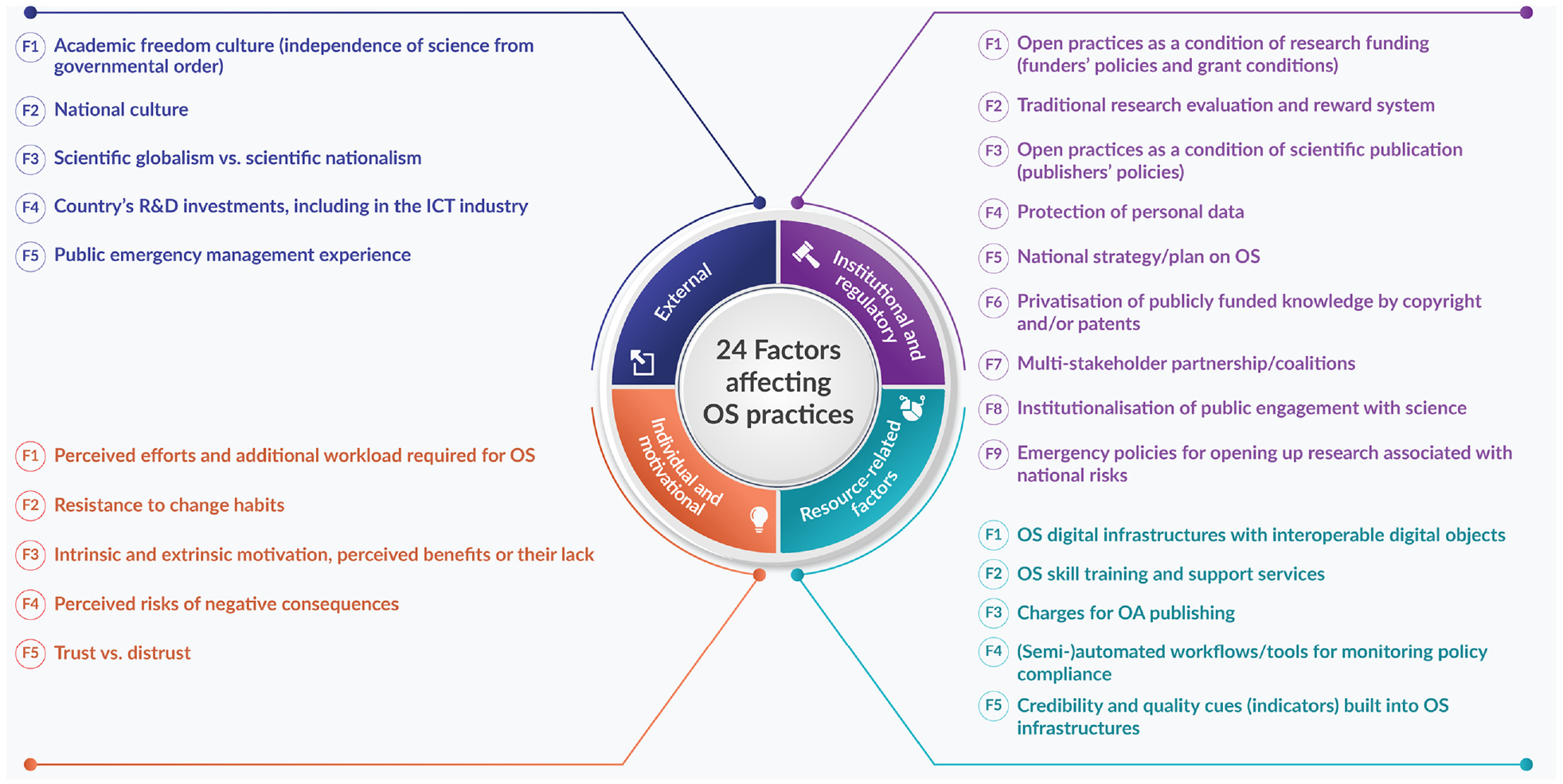
Typology of factors affecting Open Science practices grouped into four thematic clusters.
The following sections describe the factors by clusters, supported by relevant quotes from interviewees (see the interviewee profiles in Supplementary Material to align a quote with the interviewee’s background information), while also presenting a summary of the key actions associated with each factor.
3.1. Cluster A: external factors
This thematic cluster subsumed the factors, which cover, for example, the basic characteristics of the country, its culture, (inter)national political context, global trends, external situations or pressures outside the direct control of scholarly communication systems. These factors are not directly related to scholarly communication; however, they have the potential to influence it to varying degrees.
(F1) Academic freedom culture (independence of science from governmental order)
Academic freedom culture, which refers to researchers’ independence from the government in terms of research conduct and dissemination, is generally favourable for OS development. OS movement has historically been driven by a range of bottom-up and grassroots initiatives in societies where scientific communities have substantial freedom and autonomy. However, in societies with strong academic freedom traditions, mandatory OS policies may be considered as a violation of researcher’s rights, which could result in slower OS adoption. For example, in a North American context, a broader understanding of academic freedom often includes, inter alia, the researcher’s full freedom in publication of results, which makes harder to introduce and implement mandatory OS policies (e.g. OA mandates specifying compliant publishing venues) that could be considered as an infringement of academic freedom [51]: Researchers in France have what we call ‘academic freedom’, which is a very strong principle, and they are very committed to defending this principle. You cannot force or oblige researchers to do something that they don’t want to do. If they don’t want to open their publications or want to publish in a journal that is not open, you cannot oblige them to do the other way. (Interviewee N 31)
(F2) National culture
Researchers’ willingness to make their outputs, including research data and results, openly available to others may depend on the shared cultural values and norms that prevail in a society, such as the emphasis on individualism and competition or collectivism: The Dutch culture is a bit of ‘What is in it for me?’ and ‘How is it going to help me?’ However, Chinese researchers support, ‘Alright, we want OS. What can I do to make it happen?’ (Interviewee N 35)
(F3) Scientific globalism versus scientific nationalism
International scientific cooperation and science diplomacy, especially intensified during the COVID-19 pandemic, facilitate national and global OS developments. However, the so-called ‘scientific nationalism’ with a focus on nation’s economic competitiveness and prestige [52] has been also detected (e.g. in the development of vaccines against COVID-19) and it militates against OS: The COVID-19 is giving rise to greater openness, but also giving rise to what I’d call ‘greater nationalism in science’, where people in certain countries say, ‘We want the science that affects us; our country’. We can see it in a number of countries, including China. We can see it in the US. (Interviewee N 19)
(F4) Country’s R&D investments, including in the ICT industry
Gross domestic spending on R&D, in general, and ICT R&D, in particular, have influence on OS operationalisation. For example, high-speed Internet connectivity and computing infrastructure for data storage and processing are prerequisite (facilitating conditions) for OS practices: We [in Korea] have a strong ICT industry, which provides basic ICT services to the public ... Internet, cell phones and SNS. Countries, which do not have such a strong ICT industry, cannot develop proper OS infrastructure. (Interviewee N 8)
(F5) Public emergency management experience
Experience of emergencies, such as devastating natural hazards and epidemics, have led to the practical value of OS being acknowledged by all stakeholders. This not only amplifies OS practices, such as OA to scientific publications and preprints sharing, during a crisis, but can also foster a national OS agenda and arrangements following the crisis. Remarkably, positive and negative experiences during emergencies were seen as drivers of OS improvement. Especially negative experiences during emergencies (e.g. sloppy science and research waste detected during the COVID-19 pandemic, such as studies on hydroxychloroquine [53]) could be powerful arguments for future actions towards more open and transparent science: By the time we got to the COVID situation, we had learnt some lessons from the bushfires. In Australia, bushfires happen every year, but with the scale of bushfires we had this summer [2020], we haven’t had that for a hundred years. That forced coordination between the states and highlighted the challenges of openly sharing data. (Interviewee N 13)
3.2. Cluster B: institutional and regulatory factors
This thematic cluster subsumed the factors concerning laws, regulations, norms and institutional and contractual arrangements associated with scholarly communication.
(F1) Open practices as a condition of research funding (funders’ policies and grant conditions)
Research funders have the most power to enforce OS as a part of their policies and grant conditions. Government research funding agencies and non-profit foundations increasingly favour various forms of openness (e.g. OA requirement for publications arising from funding and RDM requirement), while commercial funders are less concerned with openness. The European Commission (Horizon programme), the Bill and Melinda Gates Foundation and the Wellcome Trust were frequently mentioned by the interviewees as key funders with the most robust OS policies. However, availability of funders’ policy documents may not necessarily have a positive impact on adoption of OS practices by funded researchers, if there are no rigorous mechanisms for monitoring and enforcing policy compliance: The Wellcome Trust is really taking the lead and is slightly ahead of the governments in pushing OS. Foundations and charities can usually move more quickly because they are more independent. (Interviewee N 27)
(F2) Traditional research evaluation and reward system
The traditional research evaluation and reward system is a bottleneck in OS. The reputation economy of scholarly communication incentivises researchers to publish in prestigious journals with a high impact factor (IF), which are often non-OA journals. However, OS practices, such as sharing of high-quality research data, are neither properly rewarded nor used yet as performance indicators for promotion and tenure: Inserm [French National Institute of Health and Medical Research] is a signatory of DORA, but Inserm does not use DORA at all in evaluating their researchers and is still looking at the Impact Factor and the number of articles published in journals. (Interviewee N 29)
(F3) Open practices as a condition of scientific publication (publishers’ policies)
Publishers’ policies, containing certain OS requirements (e.g. making all data necessary to replicate the study’s findings Findable, Accessible, Interoperable and Reusable (FAIR) [54]) as conditions for publication, can positively affect adoption of OS practices by researchers. However, in many cases, commercial publishers prefer to avoid requiring such practices: You cannot publish a research article on our site [F1000 publisher] unless the data has been made FAIR. (Interviewee N 26)
(F4) Protection of personal data
Open sharing practices involving research data with information relating to an identified or identifiable natural person (i.e. personal data) are restricted by personal data protection laws. This primarily concerns ‘health data’ (sensitive data, including data concerning health and genetic data [55, p. 19]) in the health research context. In general, data protection regimes, such as the EU General Data Protection Regulation/GDPR [56], strictly prohibit access and reuse of health data by third parties. Even though there are certain derogations from the general prohibition for processing such data for scientific research in the public interest (e.g. Article 9(2)(j) GDPR), there are still complexities and uncertainties in matters of data sharing and reuse in this context: We are a long way in terms of publication of clinical trial results in comparison with trial registration. As for clinical trial data sharing – not at all. Even if you ask your hospital to share the data, they will oppose it because of the GDPR. They will tell you that, in the context of the GDPR, they don’t even know if/how they can share the data. Especially in a hospital, the data protection officials feel threatened to share the data because of the risk of re-identification of the participants. In France, we have a specific authority, called the CNIL, to protect citizens’ privacy. It sometimes makes things difficult from an administrative and regulatory point of view. (Interviewee N 29) I cannot just say ‘I am a researcher from CNRS and I want to access the hospital data of my town’. I need to describe the project I want to make and so on. There is always an authority that gives approval to access sensitive data. (Interviewee N 36)
(F5) National strategy/plan on OS
The availability of a national strategy/plan, a formal written document typically (co-)developed by government units such as the Ministry of Science, tends to positively affect OS adoption by providing a holistic approach to strategically align, coordinate, implement and manage relevant policies and initiatives at both national and institutional levels: There are three levels of ‘carrots’ [policies]. The highest level ‘carrot’ is public sector funding ... the ‘golden rule’. It means that the one who puts the gold makes the rule. The second level is the national level. The third level is the institutional level, which is very close to the PCI (Practical Commitments for Implementation). All of these are types of ‘Russian Dolls’... a little one, inside another one, inside another one. I would like the Russian Dolls to have the same dress because then it will be the same approach. It would be fantastic if all these policies become consistent. (Interviewee N 34) One of our biggest problems in Australia is that we don’t have a national approach, strategy for OS. (Interviewee N 14)
(F6) Privatisation of publicly funded knowledge by copyright and/or patents
Protection of Intellectual Property/IP (private) rights, whether by copyright or patent, in its very nature, is in tension with making scientific knowledge widely accessible in the public interest. In particular, exercise of copyright control is a barrier for OA, since it requires obtaining authorisation to access and use of copyrighted material (e.g. through paid licences). Often, if a researcher-author submits material to a publisher (mainly subscription publisher), the publisher requests for a transfer copyright (‘copyright transfer agreement’) or an exclusive licence. When an author gives, at no cost, complete copyright control to the publisher, the latter exploits the rights for commercial benefits in a way that restricts immediate and free access to the published research output. Another problem that can challenge OS practices is when research outputs are the subject of patents: This is an antiquated act of piracy, where you have publicly funded science – great cost, enormous cost – and the result of that is privatised, and people who privatise it are publishers who pay nothing for it; it is given to them. So copyright is a major issue. (Interviewee N 24)
(F7) Multi-stakeholder partnerships/coalitions
Formal and informal partnerships between diverse stakeholder groups (e.g. national governments and research funders, research organisations, learning societies, publishers, infrastructure and service providers, international organisations) are important for negotiating, developing and implementing consistent OS policies and practices. However, multi-stakeholder partnerships may also result in complicated decision-making and may be time-consuming: The strength of OS in the Netherlands lies in the collaboration of small data providers and small institutions working together to propagate and achieve OS. (Interviewee N 35)
(F8) Institutionalisation of public engagement with science
Incorporating a dedicated public engagement strategy (i.e. communicating science and its products to a wide non-scientific audience in a comprehensible manner) within formal structures and procedures of publicly funded research institutions helps to better align science with society’s needs, increase transparency and build public trust in science. This, in turn, creates favourable conditions for promoting and realising various OS practices: What I see in the Netherlands is that we have key persons. We have very popular professors who appear on TV programmes or set up their series, which explain popular topics. And now, in COVID, you see that some doctors are very good at explaining items in simple words. It is not necessary to be a researcher or a doctor to deliver such content, but it can be a spokesperson who can explain the scientific findings; the person who does so should be reliable, respectful and popular. (Interviewee N 16)
(F9) Emergency policies for opening up research associated with national risks
Currently, there is no alignment between OS policies, on one hand, and national risk management, emergency preparedness and response policies, on the other. Having certain emergency-specific ad hoc provisions in OS policies within the research areas directly associated with major national risks can enable a prompt appropriate emergency response through OS in the time of the event: OS units and emergency policies need to work together to understand the behaviour and the implications of releasing early results during public health emergencies and the nature of media reporting around these types of outputs ... A good example is the recent vaccine news where we had a protocol published for the exact point for which early-stage analysis was about to be conducted. (Interviewee N 21)
3.3. Cluster C: resource-related factors
This thematic cluster subsumed factors concerning tangible resources, including ICT, financial and human resources, associated with scholarly communication.
(F1) OS digital infrastructures with interoperable digital objects
OS digital infrastructures sustain various digital objects (outputs and their metadata) and enable collaborative practices, including sharing, linking and reusing those objects. Such infrastructures, for example, cover the following types: large research infrastructures (e.g. ESFRI – roadmap2018.esfri.eu/projects-and-landmarks/browse-the-catalogue), single point of access portals with metadata of and URL links to (multi)disciplinary scholarly information resources (e.g. ARDC Research Data Australia – researchdata.edu.au, Korea’s NTIS – ntis.go.kr), digital repositories (archives) for research outputs (e.g. data repositories registered in re3data.org, PubMed Central – ncbi.nlm.nih.gov), study protocol registries (e.g. ClinicalTrials.gov, Open Science Framework registries – osf.io/registries), code sharing platforms (e.g. GitHub), innovative OA publishing platforms (e.g. Open Research Europe – open-research-europe.ec.europa.eu, OpenEdition.org) and citizen science platforms (e.g. Zooniverse.org): We [the Dutch portal NARCIS] are trying to link up much more outputs, so you have the dataset linked to publications, to a researcher, linked to other outputs like software etc. I think the future is linking up all this scholarly information. NARCIS harvests all the institutional repositories, and all the metadata is aggregated in NARCIS. It goes to CRISes, research information systems of universities, to collect all the information on researchers. We have different ways of harvesting and scrolling and collecting and aggregating those different research outputs and a researcher’s information. (Interviewee N 32)
(F2) OS skill training and support services
OS awareness and specific skill sets in researchers and other stakeholders (e.g. data stewards, librarians and funders) enable operationalisation of OS. However, interviewees reported associated challenges, pointing to the lack of proper competences and the inadequacy of efforts directed towards their development: The ones you should really educate are the senior researchers [middle and late career researchers], all these kinds of guys you will never get to a classroom to teach what good science is. They just know what they have been doing for so long. It is really difficult to approach them. (Interviewee N 29)
(F3) Charges for OA publishing
The ‘author-side’ payment model, including individual Article Processing Charges (APCs), is currently the dominant, although not sustainable. These charges are especially unaffordable for low- and middle-income countries (LMIC) and can influence researchers’ publishing choices in favour of subscription journals with no author-side charges: You have journals in certain areas, which have no money to cover the OA publishing cost. Subscription is the only approach that works [for them]. There are a lot of areas where Gold OA charges are equivalent to a year’s research funding. It just does not make sense. A part of the world, especially low- and middle-income countries, simply cannot afford it. (Interviewee N 26)
(F4) (Semi-)automated workflows/tools for monitoring policy compliance
(Semi-)automated compliance assessment tools and workflows can reduce the workload imposed on stakeholders (e.g. research beneficiaries and funders) and have the potential to improve the adoption of OS practices in an effective and compliant manner. However, such automated workflows were considered feasible to be developed for simple, well-structured compliance procedures only, such as monitoring compliance with Data Management Plans (DMPs). Notably, these automated workflows may be impractical for emergencies, which require some degree of policy flexibility owing to the volatile nature of the emergencies: We want to have policies that are machine-readable so that compliance checking is possible. And that’s not the case at the moment. (Interviewee N 28)
(F5) Credibility and quality cues (indicators) built into OS infrastructures
Availability of cues (indicators) built into digital infrastructures sustaining scholarly information resources to visually signal the degree of their quality and credibility can positively affect wider adoption of OS practices. This can be especially useful for non-researchers-users who lack the expertise to interpret quality of scholarly information: One of the problems with OS is a lot of those well-established indicators of quality ... are not present or not as obvious for researchers. So well-established conventions of being able to recognise quality may not be present or not in the same way in open resources. Because they haven’t established there quality flags in the same way. (Interviewee N 19)
3.4. Cluster D: individual and motivational factors
This thematic cluster subsumed factors concerning personal OS-related drivers and the (de)motivations of those involved in scholarly communication.
(F1) Perceived efforts and additional workload required for OS
The greater the perceived effort (intellectual work, cost and time) for OS-related activities, the more reluctant the researchers are to practice OS: Everyone has open access, but YOU paid to make it happen, so you wish that it costs money for others as well. (Interviewee N 25)
(F2) Resistance to change habits
Many researchers do not want to adopt OS because it requires them to change their traditional ways and approaches of doing research, that is, their habits. In particular, it can be difficult to make middle- and late-career researchers start practicing OS: Researchers do not want to change their attitude, research style. OS is a very new way of doing science. If the researcher accepts OS, he will need to change his habits. (Interviewee N 2)
(F3) Intrinsic and extrinsic motivation, perceived benefits or their lack
According to interviewees’ responses, most researchers are primarily driven by extrinsic motivation directly related to academic hiring, promotion and reputation building. Only a few interviewees felt that intrinsic motives, that is, a feeling of contribution to science and society, affected the OS practices of the researchers. It is important to note that most of those responses were regarding the particular situations of emergencies, such as the COVID-19 pandemic. It was stressed that in normal situations, intrinsic motivation does not affect OS practices to a great extent: I am absolutely not interested in money if my research does not bring attention, if enough people do not use my research for further research, if the community cannot use my papers as a new standard or if the contribution I make to the community does not mean that new knowledge has been gained. I would say, as a researcher, this is the most important incentive. But, on the other hand, I would agree with you if you say, ‘I have a family to feed, and I need to earn some money to have a decent living’. There needs [to be] a balance between these two. (Interviewee N 35)
(F4) Perceived risks of negative consequences
The most significant concerns inhibiting OS practices include compliance with personal data protection laws, the risk of being ‘scooped’ (particularly related to unpublished ideas and outputs) or not fully leveraging the data for additional publications, apprehension about losing reputation due to revealed mistakes or misuse/misinterpretation of the results by others, concerns about the ‘Ingelfinger Rule’ [57, p. 68], which relates to a journal’s refusal to consider manuscripts that have circulated as preprints, and the misconception that all OA journals are predatory and lack quality and rigorous peer review: The biggest concern, especially for early-stage scientists, is that they need to prove themselves through publications and grant funding. And if you make the results available, your competitors may use them. They will report it before your results are published. That does, unfortunately, happen. You need to be mindful of exactly how much information you are putting out. ‘I am working on a really exciting project, and I am not going to tell you anything except that it is really exciting. In a few weeks, maybe, I can say more’. (Interviewee N 25)
(F5) Trust versus distrust
Different dimensions of trust can affect OS practices, including (a) trust in the research community, research institutes and individual scientists (in terms of their ability to produce reliable knowledge and share it reciprocally) and (b) trust in information service providers and infrastructures (in terms of data reusability properties and service quality): Probably the most important thing is trust within a research community and its reciprocal action. If you share, others will share with you. (Interviewee N 14)
3.5. Recommended actions to address the Open Science factors
This section outlines potential actions for various stakeholders to address the factors that can enable or inhibit OS, as identified in this study. The recommended actions are summarised in Figure 2. Even though certain actions are primarily assigned to individual stakeholders (e.g. government departments responsible for research and innovation policies, research funders, research organisations and their libraries, learned societies, publishers, infrastructure and service providers, international organisations, OS advocacy groups), the majority of them should be viewed as collective measures that demand collaborative efforts among different stakeholders. It is worth noting that certain actions may be applicable to several factors.
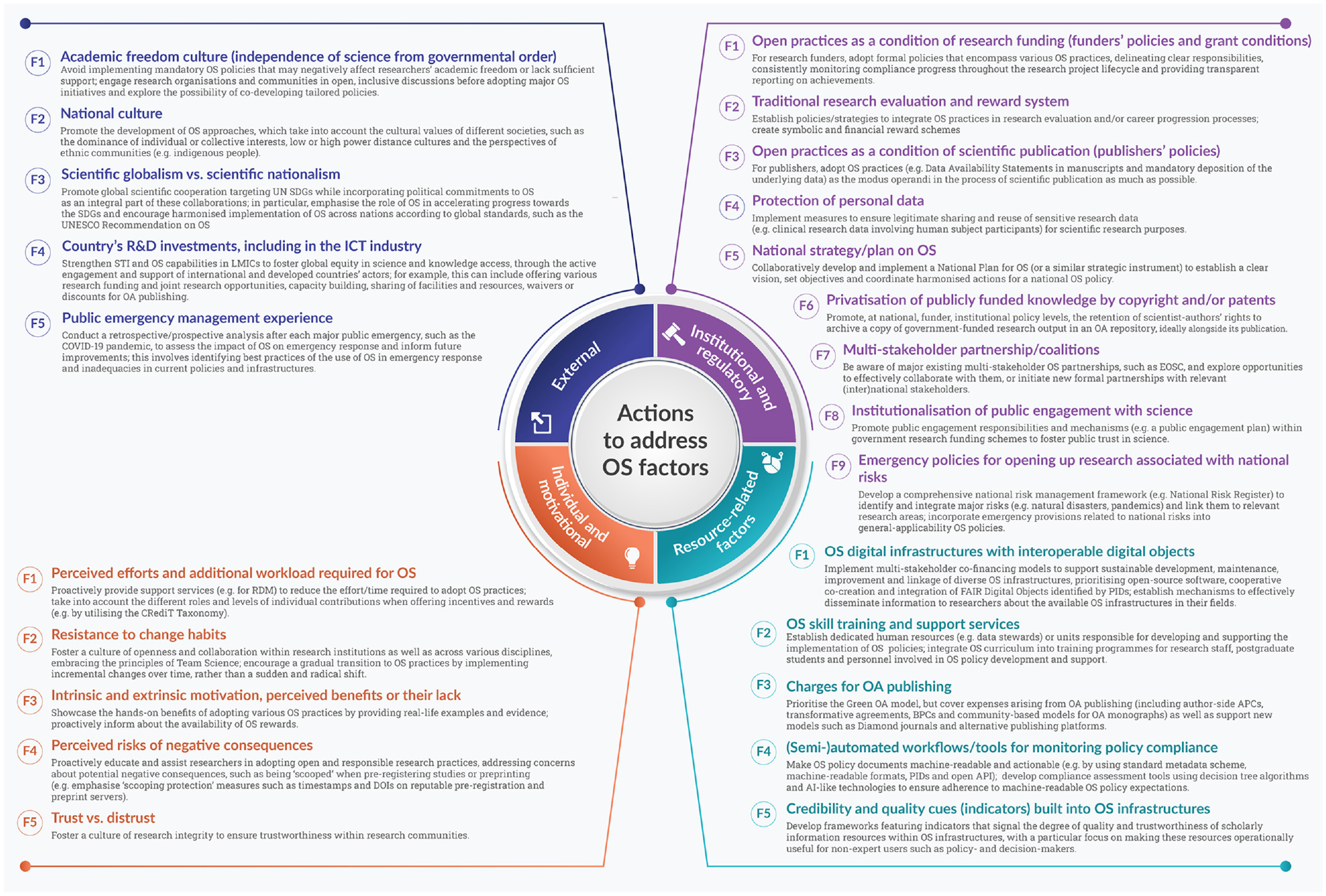
A summary of recommended actions to address Open Science factors.
One example of recommended actions to address the ‘external’ OS factors, such as factor F3, is for international organisations, and other stakeholders, to promote global scientific cooperation towards achieving UN SDGs, incorporating political commitments to OS as an integral part of science diplomacy efforts. Specifically, international organisations like UNESCO should emphasise the role of OS in accelerating progress towards the SDGs and encourage harmonised implementation of OS across nations (e.g. in national OS strategies/plans) according to global standards, such as the UNESCO Recommendation on OS [1], fostering positive international standing for countries that adhere to these principles.
Within the ‘institutional and regulatory’ cluster of OS factors, promoting rights retention policies, which support the Green OA model, at national legislation, funder and institutional levels is a key action proposed to specifically address the inhibitory effect of factor F6. These policies should secure legal precedence over any future agreements between authors and publishers that might require copyright transfer to the publisher, thereby potentially limiting Green OA. Furthermore, they should ensure that scientist-authors retain sufficient rights to archive a copy of government-funded research output in an OA repository, ideally concurrent with its publication or within a limited delay period predefined in the policy. A notable example of a rights retention policy at the research funder level is the zero-embargo cOAlition S Rights Retention Strategy [58], which requires the inclusion of specific language in grant conditions, thus enabling an automatic application of a Creative Commons Attribution Licence (CC-BY licence) to all future Article Accepted Manuscripts (AAMs) supported by the grant. The French Digital Republic Act (Article 30-I) [59] provides an example of incorporation of rights retention provisions in laws, though it does not mandate immediate Green OA and accommodates delay periods. The LIBER Draft Law for the Use of Publicly Funded Scholarly Publications [60] serves as a ‘template model law’ with rights retention provisions ensuring immediate Green OA.
One example of the recommended actions for the ‘resource-related’ category of factors, specifically factor F1, involves governments stepping up to lead the implementation of co-financing models in supporting the sustainable development, operation, enhancement and interconnection of shared OS infrastructures. Importantly, these models should utilise both financial and in-kind contributions from various stakeholders, including the private sector. The European Open Science Cloud (EOSC) ecosystem, with dedicated support through the EU research and innovation funds and contributions from various stakeholders, serves as a prime demonstration of such a co-financing model. Further, the French National Fund for OS [61] stands as another representative instance of a co-financing model, supporting digital infrastructures (e.g. the open archive HAL, hal.science) and other OS capacities. This fund is sustained through regular allocations from the Ministry of Higher Education, Research and Innovation, as well as contributions from French research organisations made possible through their cost savings from ‘Big Deals’ cancellations.
To tackle the factors within the ‘individual and motivational’ cluster, such as factor F3, it is important to showcase the hands-on benefits – including academic, economic or societal impacts – that can be gained through adopting various OS practices. This can be achieved by sharing evidence, illustrative examples and success stories (e.g. OpenAIRE’s illustrative Data Reuse Stories [62]). In addition, to mitigate the inhibitory effect of factor F1 within this cluster, research organisations should offer tailored support services, such as those for RDM, to help reduce the effort and time required for researchers to adopt OS practices.
3.6. Factors and actions as building blocks of a conceptual model of OS Policy Design and Implementation Process
We believe that the identified OS factors and corresponding actions, as detailed in previous sections, can be incorporated into the creation of a conceptual model of OS Policy Design and Implementation Process. A schematic representation of a preliminary conceptual model is depicted in Figure 3. In the context of this model, ‘policy’ is broadly understood as ‘a purposive course of action followed by an actor or set of actors in dealing with a problem or matter of concern’, encompassing multiple decisions made in shaping and guiding that course of action [63]. The proposed model comprises five interdependent blocks or stages of the iterative process of OS policy design and implementation:
OS factors (inputs), including enablers and inhibitors;
OS policy action arenas, encompassing various stakeholders making decisions and taking actions in response to the OS factors;
Interaction and coordination mechanisms among stakeholders within and across different action arenas;
Outcomes derived from collective actions; and
Evaluative criteria and associated performance measures, which are applied to both outcomes and the processes of achieving outcomes, potentially inducing changes at different levels via feedback loops.
The first stage involves identifying, analysing and prioritising concrete factors that can either positively or negatively affect the development of OS. These factors fall into broad categories: institutional and regulatory, individual and motivational, resource-related and external factors. An exemplary set of OS factors has been identified in this study and discussed in the previous sections. However, it is important to note that the final list of factors and their priorities may vary, as the model can be utilised by different stakeholders and adjusted to various levels and contexts.
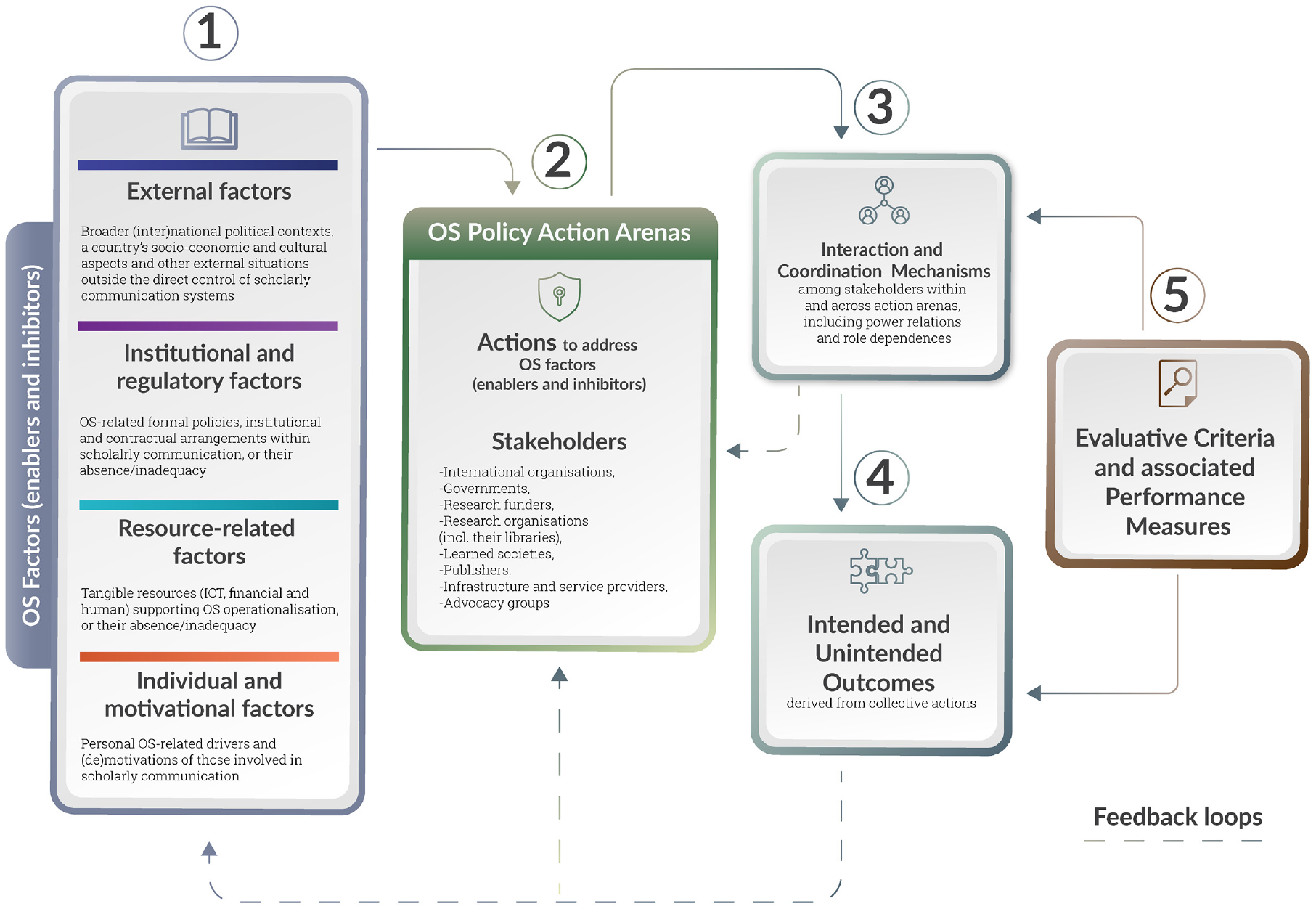
Conceptual model of Open Science Policy Design and Implementation Process based on Ostrom’s IAD framework.
The second stage of the OS policy design and implementation process, termed as ‘OS policy action arenas’, involves the decisions and deliberate actions that relevant stakeholders have taken, or plan to take, in dealing with the factors identified in the previous stage. For instance, it may be a decision to formulate a national strategy on OS, engaging multiple stakeholders, or a funder’s decision to establish a dedicated fund for OS. Figure 2 of this article outlines a list of suggested actions that correspond to the identified factors, offering a starting point for planning policy actions at various levels.
The third stage entails the identification, analysis and/or planning of structured interaction and coordination mechanisms among stakeholders within a specific action situation, as well as across linked action situations. In particular, this requires capturing power relations and dependencies of stakeholders’ roles, that is, mapping out and understanding how the role of one stakeholder is contingent upon others to accomplish the goals of collective actions. This becomes particularly important in countries with high power distance cultures, where, for instance, the decision of a public research institute to adopt an official OS policy can be significantly influenced by various agencies within the hierarchical structure of the government-funded R&D ecosystem. Visualising role dependencies and interaction patterns through diagrams, a common tool in systems analysis, can help to gain a comprehensive understanding of these dynamics.
The fourth stage captures outcomes, which can represent both intended and unintended consequences and changes – whether positive or negative – that are brought about by collective actions. For example, an intended outcome could be the creation of a national OA repository/archive in a country, achieved through actions like amending legislation to include rights retention provisions and allocating government funding for the development of national infrastructure to support Green OA. An unintended outcome may arise in the form of an underpopulated repository, with only a limited number of researchers depositing their works, due to their preference for using institutional OA repositories.
The final stage of OS policy design and implementation process involves assessing both policy outcomes and patterns of interactions among stakeholders that contribute to those outcomes, using predefined criteria and associated performance measures, with a primarily focus on realising public values and fostering benefits for the involved stakeholders. The analysis and evaluation of outcomes can stimulate feedback loops, iterating the entire OS policy design and implementation cycle. For instance, this could involve uncovering of new driving factors. Below, potential evaluative criteria for assessing OS outcomes are presented, adapted and extended from Ostrom’s IAD [50, pp. 62–66], accompanied by examples of associated performance measures:
- Increasing open scientific knowledge (e.g. percentage of OS outputs, such as OA papers, versus closed/proprietary ones across disciplines and institutes);
- Enhancing FAIR properties of open scientific knowledge for humans and machines (e.g. percentage of OS outputs with minimum metadata in English, including clear information about licences and globally recognised PIDs such as DOI and ORCID, versus those lacking it);
- Broadening uptake and application of open scientific knowledge (e.g. number of citations of OS outputs in policy documents, textbooks and other relevant professional literature);
- Ensuring sustainability of OS (e.g. number of research organisations endorsing and contributing to an OS infrastructure tracked via official statements or mentions in institutional policies and output deposits);
- Economic benefits/efficiency of OS (e.g. cost savings associated with accessing research outputs, such as reduced expenditure on subscription fees due to OA models, and value of time savings in accessing research outputs);
- Redistribution equity and fairness of OS (e.g. assessment of the affordability of Gold OA publishing across different types of research organisations and for researchers from various backgrounds and regions, availability of institutional Diamond OA publication service); and
- Public participation in OS (e.g. number of citizen/community/public science initiatives, availability of draft OS policies for public consultations).
4. Discussion and conclusion
This study identified and categorised a range of factors influencing OS practices, outlined possible actions addressing the identified factors, and presented a preliminary conceptual model that integrates these elements into a holistic OS policy design and implementation process.
The study has demonstrated that OS is a complex phenomenon shaped by a diverse range of interrelated factors. The identified OS factors were categorised into four broad thematic clusters. Three of them (i.e. institutional and regulatory, resource-related and individual and motivational) subsumed factors that are an inherent part of scholarly communication processes; while the external cluster included factors extending beyond scholarly communication, such as cultural aspects and availability of public emergency management experience, but with the potential to influence OS matters in varying degrees.
The majority of the factors were not distinctly inhibitors or enablers, but rather context-dependent ones. One example is funders’ policies and grant conditions, which were also mentioned in previous studies as an important factor driving the realisation of OS practices [33,64]. However, this study stressed that this particular factor is context-dependent and may not necessarily have a positive impact on OS practices unless the funder had explicit OS requirements and proper mechanisms to ensure compliance and enforcement. In addition to context-dependent factors, there were several factors clearly viewed as inhibiting. These included, for example, the traditional research evaluation and reward system, protection of personal data, privatisation of publicly funded knowledge by copyright and/or patents and perceived efforts/additional workload required for OS activities. This supports the findings of previous studies [33,65,66], which concluded that the current academic career reward system remains a challenge for accomplishing OS potential. Likewise, previous research has acknowledged that legal norms associated with the protection of personal data [67] and IP rights such as copyright control [68] deter OS practices. In addition, a recent study [69] pointed out to the efforts required to organise research data as the most perceived barrier for researchers.
This study showed that, in addition to factors of general applicability (e.g. OS digital infrastructure and OS skill training), there is a special category of public emergency-related factors that should be considered for planning national approaches to OS development. This was in line with the argument that a public health emergency (e.g. the Zika virus) was a factor that created new (mandatory) conditions for conducting research and disclosing information [36].
We have identified two emergency-specific factors. First is the availability of public emergency management experience as such. This is a particular type of experience acquired for managing public emergencies, such as the COVID-19 pandemic, which manifests the practical value of OS and fosters the development of national OS approaches for routine non-emergency research practices following the crisis. To address public emergency management experience as an input for the development/improvement of national OS strategies and policies, this study suggests the need to conduct a comprehensive retrospective/prospective analysis after each public emergency. The analysis should assess the impact of OS on emergency response, codify the best OS practices, which emerged in the emergency context, identify inadequacies in current policies and infrastructures and facilitate their improvements.
The second emergency-specific factor is the presence of an ad hoc category of OS policies aimed at rapid, fast-track sharing of research outputs and data during major national risks. This entails mandatory special provisions, for example, for the release of interim research results/data during an emergency to different expert and non-expert communities. Such emergency-specific provisions, driven by stronger ethical considerations, could be developed in addition to general OS policies by agencies responsible for funding and managing research associated with national risks. This resonates with previous studies, which argued that OS requires a cautious approach during pandemics in terms of ‘sharing very early [research] results in publicly accessible venues, and this is particularly true when publishing about contested topics of significant public interest’ [70,71].
We argue that OS factors and their corresponding coordinated actions form an integral part of a conceptual model of OS Policy Design and Implementation Process, as proposed in this paper. The model conceptualised several successive stages of OS policy design and implementation, including inputs (factors), processes (policy action arenas realised through stakeholder interactions) and outcomes. In addition, the model incorporates continuous monitoring of OS progress based on predefined evaluative criteria, performance measures and feedback loops. From a practical perspective, it can be used as an analytical tool for various stakeholders involved in scholarly communication, facilitating the adoption of a structured and comprehensive approach to OS.
One limitation of this research was that the interviewee sample did not cover more regions, such as South America, a region that has been making significant efforts to adopt OA publishing [72]. Another limitation was related to the difficulty in the early period of the COVID-19 pandemic (when the interviews were conducted) to interview more experts from governments and funding agencies for a better balance in the views obtained from other affiliations, such as research institutes and information service providing organisations.
There are several avenues for future research to build upon the findings of this study. For example, by employing survey techniques, the proposed typology of OS factors could be analysed to identify the priorities of individual factors and their respective clusters. This could be followed by a series of co-creation workshops with a broader audience of experts to recommend further actions and propose more comprehensive evaluative criteria and measures to assess the impacts of OS outcomes. In exploring these future research directions, the model of OS Policy Design and Implementation presented in this paper may be further developed.
Supplemental Material
sj-xlsx-1-jis-10.1177_01655515231205496 – Supplemental material for Identifying key factors and actions: Initial steps in the Open Science Policy Design and Implementation Process
Supplemental material, sj-xlsx-1-jis-10.1177_01655515231205496 for Identifying key factors and actions: Initial steps in the Open Science Policy Design and Implementation Process by Hanna Shmagun, Jangsup Shim, Jaesoo Kim, Kwang-Nam Choi and Charles Oppenheim in Journal of Information Science
Footnotes
Acknowledgements
We thank the interviewees who participated in this study.
Declaration of conflicting interests
The author(s) declared no potential conflicts of interest with respect to the research, authorship, and/or publication of this article.
Funding
The author(s) disclosed receipt of the following financial support for the research, authorship, and/or publication of this article: This research was supported by the Korea Institute of Science and Technology Information (K-23-L01-C05-S01).

Supplemental material
Supplemental material for this article is available online.
References
 Enhancing the effectiveness of public research with Open Science practices]. Research Report of the Science and Technology Policy Institute (STEPI), 2018
Supplementary Material
Please find the following supplemental material available below.
For Open Access articles published under a Creative Commons License, all supplemental material carries the same license as the article it is associated with.
For non-Open Access articles published, all supplemental material carries a non-exclusive license, and permission requests for re-use of supplemental material or any part of supplemental material shall be sent directly to the copyright owner as specified in the copyright notice associated with the article.
