




Abstract
Recently, virtual reality (VR) technology has become more widespread. Humans increasingly interact with information in VR, and a detailed look into those activities is warranted. Thus, a scoping literature review (PRISMA-ScR) is conducted. It overviews all relevant literature about information-seeking behaviour in VR, focusing on existing models and theories. Out of 536 publications, 37 qualify for this review. Eight publications show an understanding related to information behaviour theories from information science. Pressingly, no publications relate models, frameworks or general theories of information seeking to VR. This review overviews VR-related cognitive and behavioural human factors based on this research gap. Those factors include immersion and presence, affordances, embodiment, cognitive load, human error, flow and engagement. The review is concluded with an explorative framework for future research that is constructed with Marchionini’s process model of information seeking as a baseline and in conjunction with the discussed human factors.
Keywords
1. Introduction
The ability to actively seek out useful information might be one of the most important and defining skills of modern humans. With the ever-increasing prevalence of information and communication technology, information seeking (IS) within digital systems has become a daily activity for billions of people.
At the same time, recent developments in virtual reality (VR) technology have renewed the interest of the tech industry, the general public and researchers alike. While there are various interpretations of what virtual reality exactly is, most definitions include that an organism (most often a human) is subjected to an artificially generated sensory stimulation (typically computer-generated) with the overarching goal of providing as realistic of an experience as possible [1–3]. As Stanney et al. [4] detail, virtual reality is now used more widely than ever before. Individuals might encounter VR in medical schools [5], at their workplace at a car manufacturer [6] or at home using their own devices to visit a virtual museum [7] or for entertainment purposes [4]. Entertainment, and especially VR video games, is currently the biggest market for customer VR software [8]. The store page of a popular VR hardware platform gives an overview of its current top-selling apps: 49 of 50 entries are either a game, fitness or other entertainment experience [9]. While many of these usage scenarios certainly involve information in general (e.g. for education and learning), there is currently no popular VR search engine to use, nor are other popular tools that focus on information seeking [10].
Since there is no prominent example of an IS system in today’s VR software, one could look at the more speculative forms of content. There is no shortage of detailed descriptions of 3D interfaces and environments in fictional literature, movies, TV shows or video games. These descriptions include holodecks, large floating AR interfaces and the like and some of these are similar to Sutherland’s description of the ultimate display, where ‘[…] the computer can control the existence of matter’ [11]. Taking inspiration from fiction is by no means unheard of in the human–computer interaction community [12], and has already inspired the design of an IR VR system [13]. Such speculative design [14] might inspire the creation of new IS VR systems or components of which there are several [15–17] (more are overviewed by Schleußinger [18]). These systems often stem from computer science. Consequently, existing research on IR systems in VR focuses more on technical and algorithmic aspects of IR, such as input and interaction techniques, result-representation or the comparison to established 2D interfaces. On the other hand, information seeking has been established as a human-focused research area. Ingwersen and Järvelin [19] describe ‘Research in Information Seeking and Information Retrieval constitute two disparate research areas or camps. Generally, Information Seeking is rooted in Social Science with a background in Library Science whereas much of IR is based on Computer Science approaches’ (p. 2). Information retrieval (IR) is primarily concerned with ‘finding material (usually documents) of an unstructured nature (usually text) that satisfies an information need from within large collections (usually stored on computers)’ [20]. A recent review of current research in interactive information retrieval in VR identified several systems that feature novel ways of interacting with search queries or search results [18]. None of them put the human at the centre of their considerations. However, there are many unanswered questions surrounding human information seeking in VR environments: How does effective, and human-centred information seeking in immersive VR look like? Would it be similar to the conventional search engines that are known and used today, where textual information is most prominent? The interfaces of current commercial VR systems already include 2D web browsers that can be displaced in the 3D environment and allow for a quick web search. How will these general search engines adapt?
As is already shown in existing research, VR offers new ways of formulating, consuming and generally interacting with text (queries) [13]. It even allows the interactive construction of 3D objects as a new kind of query [17]. Search results can be displayed in different ways [21–23] Will users create 3D environments with documents and other objects that act as memory palaces? [24] [And how does all of this aid the human user in information seeking activities? Overall, what is the current state of the research that considers the human side of information seeking behaviour in VR?
1.1. Contribution of this paper
To form an understanding of the existing research landscape and to motivate future research, this review aims to identify any existing research that relates information behaviour and VR, especially if information seeking or information search is in focus. This leads to the following central research question: What research about information seeking behaviour in VR environments exists, and how does it relate to theories about information seeking? In order to be able to answer these questions and to encompass all relevant literature, a thorough literature review with a scoping methodology (PRISMA-ScR) is conducted. All available published literature is considered, by searching major general academic databases (Scopus, Web of Science, Dimensions and, to some extent, Google Scholar) and four specialised databases (ACM, IEEE, LISA, LISTA). Existing publications that discuss information behaviour in VR environments are overviewed and further analysed through the lens of information seeking theory. Motivated by the results of this literature review, the current body of published research is discussed in detail, focusing on human factors that could potentially influence the information seeking process in VR scenarios. The review is concluded by suggesting a basic framework that extends an existing, general model of information seeking with potentially influencing human factors. This framework directly informs and motivates future research.
2. Theoretical background
Two areas of existing research need to be introduced in order to contextualise this review:
The existing research on information seeking behaviour with a focus on existing theoretical models,
The distinction between the various terms and concepts of extended reality technology, including a working definition of VR for this review.
2.1. Information seeking
Case and Given [25] give a relatively recent definition of information seeking: ‘Information seeking is a conscious effort to acquire information in response to a need or gap in your knowledge. Information also comes through serendipity, chance encounters, or when others share information that they believe may be useful to you’ (p. 6). As such, the term includes using a digital information system to formulate search queries and browsing result sets. Wilson [26] defines the term information search behaviour as information seeking activity between a user and a computer-based system. Wilson further provides a nested model for the research areas of information behaviour, seeking and searching. Here, the more general field of information behaviour (IB) encapsulates all information seeking behaviour. Furthermore, information-seeking encapsulates information search behaviour.
2.1.1. Models of information seeking behaviour
While thinking about the role of information seeking in VR, a reasonable starting point is information seeking in established (digital) scenarios. In this regard, many information seeking models have been conceptualised and, to some extent, evaluated. Information seeking has received particular attention in the field of information science. Generally, these models aim to describe information seeking across various scenarios and to establish a ground truth without focusing much on concrete implementations.
Among many others, Ingwersen and Järvelin [19], Wang [27], White [28] and Liu et al. [29] all already give summaries and selective overviews of some of the most commonly discussed information-seeking models. Hence, these models are not all overviewed here again. Examples include the ASK Hypothesis by Belkin [30], the Berry-picking Model by Bates [31], the Information Foraging Theory by Pirolli and Card [32], the Cognitive Model and Polyrepresentation by Ingwersen [33] and the Stratified Model by Saracevic [34]. These models can also be categorised in several ways. For example, White [28] distinguishes between cognitive, stratified, strategic, and process-based models. The latter category features models that divide information seeking into several steps that are often related to various attributes of human behaviour. Examples are Ellis’s information-seeking behaviour Model [35] with six central behavioural aspects related to the design of information retrieval systems, Kuhlthau’s Information Search Process (ISP) Model [36] with six stages, including feelings, thoughts and actions at each stage and Marchionini’s information seeking Process Model [37] with eight steps and default, high and low probability transitions in between. Still, some of these models focus on analogue or established digital contexts (e.g. interaction with a librarian or using a conventional digital text-focused interface). Examples are the information-seeking behaviour model by Ellis [35] and the ASK model by Belkin [30].
White [28] makes important observations about these models: [m]any of the models [. . . ] have also largely been conceived, evaluated, and applied in library settings, restricted domains or websites, or digital libraries. While these environments remain a critical setting for information seeking, much of the general population performs their electronic searching via generic Web search engines. (p. 138)
If these models do not fully describe real information searching activities with traditional interfaces (e.g. a mouse and keyboard and a 2D display), it remains unclear if and how these models fit a novel context, such as information systems in immersive VR environments. On the other hand, White also observes that [h]uman information behaviour has also been shown to be remarkably consistent across a variety of search settings, and many of the core principles emphasized by these models can and should influence the design of search support in online services and retrospective analyses of logged behavioural signals. (p. 138)
So, it should be worthwhile to consider the existing information-seeking models when looking at VR contexts that can feature new interactions and representations.
2.2. On augmented, mixed, virtual and extended realities
Today’s immersive VR systems envelop a user to a much greater extent than conventional computers, laptops or mobile devices: Typically, a VR headset is placed on a user’s head, allowing full-depth perception with high-resolution displays and thus replacing all of a user’s perceived reality with a simulated one [3]. VR setups often include auditory output with headphones or nearby speakers as well as controller input, some with haptic feedback [3]. This review does not discuss technical details of past or current VR hardware and aspects of human physiology. The basic assumption is that these are either solved or solvable engineering challenges. These challenges need to be considered when developing software artefacts and conducting studies, but they are not fundamental properties of VR. The technologies that surround VR have nowadays gained widespread attention, and as such, several new terms have become popular to describe similar but also different technologies and concepts. Jerald [1] define VR as ‘[…] a computer-generated digital environment that can be experienced and interacted with as if that environment were real’ (p. 9). Other definitions are sometimes more detailed [2] or more inclusive [3], but Jerald’s definition is used for this review. There are also technologies and concepts that are similar to VR. They should be defined as well: augmented reality (AR) describes the use of technology to add (e.g. visual) information to a recipient’s perceived reality [3]. Since there are significant differences and additional influences when introducing actual reality into search systems, this can be seen as a distinct branch of research. Therefore, augmented reality is not a focus of this review. Mixed reality (MR) and extended reality (XR) are terms that are either used to describe digital experiences that blend virtual and real environments more equally (MR) or even to encompass the entirety of different related experiences and technologies [2]. The terms telepresence and virtual environment (VE) are also commonly found in published research, especially in older publications [3]. For this review, VR is the preferred term as defined above. The other terms are considered primarily for the database searches for this review.
3. Methods
A systematic literature review often summarises all available evidence for a given research topic. However, there are cases where the scope is too broad, or the evidence is too scattered to conduct a systematic review. Here, a scoping review can still work through all available literature and identify research gaps in a structured and reproducible manner [38]. This review utilises the methodology of a scoping review to identify all relevant existing research regarding publications on information behaviour in VR environments. The review follows the extension of the PRISMA guidelines for scoping reviews [39]. Since this scoping review is not limited to just studies but includes other reviews, theses and books, the steps data charting process and data items are omitted. Also, no critical appraisal is done. The review process is summarised in a flow diagram (Figure 1).
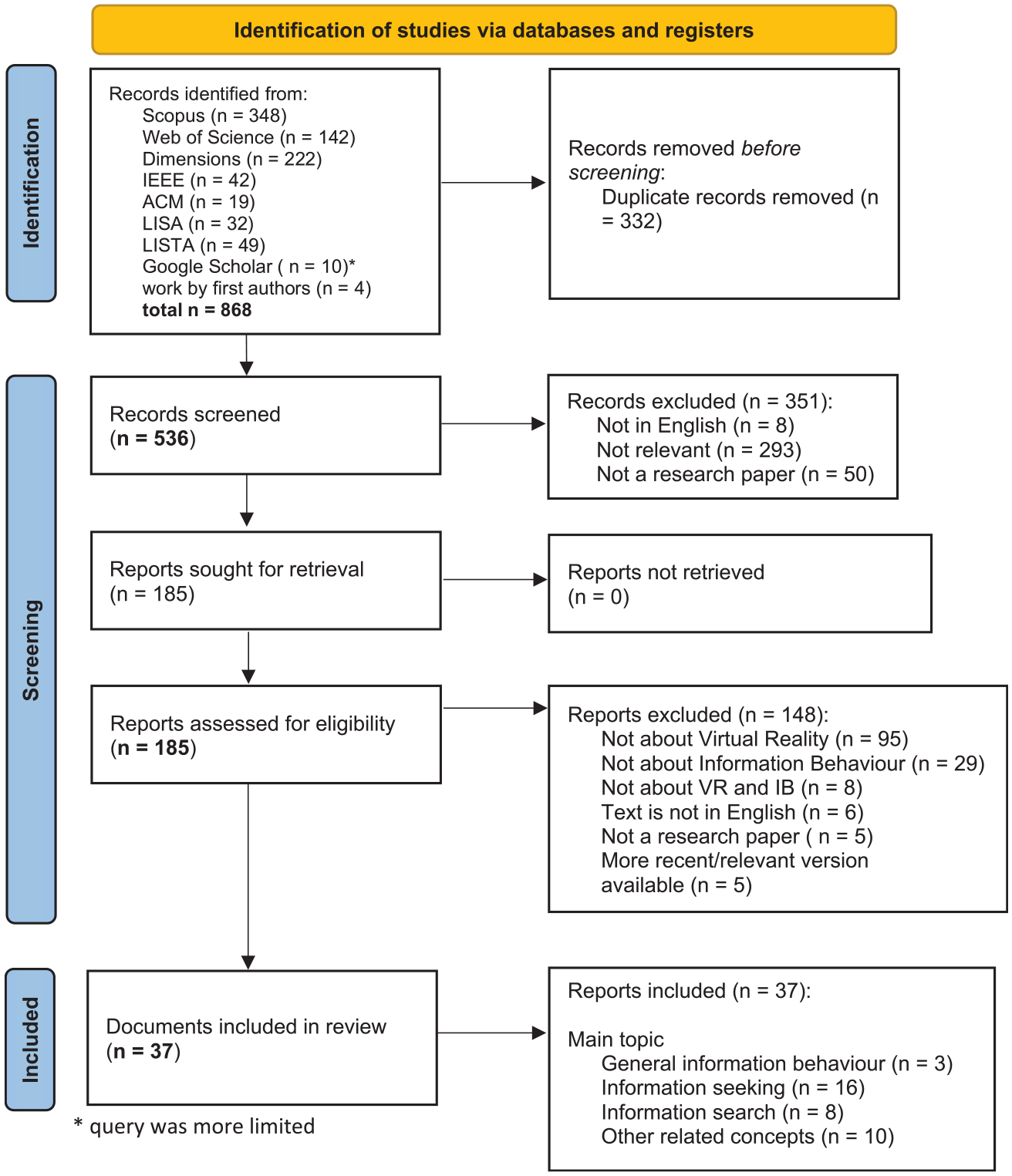
PRISMA flow diagram of database searches and screening process [40].
3.1. Eligibility criteria
The eligibility criteria were defined before the screening took place. Publications need to be written in English and should be peer-reviewed academic publications. However, preprints and student theses are not explicitly excluded (although the selected databases do not fully index such documents). All types of research are considered, including quantitative, qualitative and mixed-design studies, reviews, opinion pieces and books that are indexed by the selected databases. There is no limitation to the publication date to include all relevant works. Relevant publications should discuss information behaviour within VR environments (as defined above). As this should also be a focus of these relevant works, they should mention related terms in the title, abstract or publication keywords. Works that discuss non-immersive virtual environments, such as Second-Life, video-games or similar, are not eligible.
3.2. Selected databases
Three major general databases for scientific publications, Web of Science, Dimensions and Scopus, are included in the literature search [41]. In addition, many computer science outlets are closely linked information seeking, information search and primarily VR. So, the ACM and IEEE databases are also included (also, ProQuest databases are included in Web of Science). Similarly, Library and Information Science Abstracts (LISA) and Library, Information Science & Technology Abstracts (LISTA) two databases that index publications from information science are queried. Finally, a selective search with Google Scholar is done since it is also known to capture results that are not indexed in the other databases [42]. Only here, the query was simplified and limited to the title of documents due to system limitations. Otherwise, it would have resulted in a large and imprecise result set. General web content (blogs, websites) or grey literature is not included.
3.3. Search
To limit results to potentially relevant works concerning the earlier mentioned research interest, queries for the databases include search terms surrounding VR and information behaviour (specifically information seeking and related terms). All search terms need to appear in the title, keywords or abstract. This results in this general, abstract query:
The queries were adjusted based on the specific query requirements of each database system. For each database, all available catalogues are included (e.g. for Web of Science, the KCI-Korean Journal Database and MEDLINE database were also included). The database searches were executed in March and April 2022. The specific database queries are linked as research data.
3.4. Selection of sources of evidence
There were two rounds of relevance assessment in total. The assessment was done by one researcher. In the first round, records were screened (based on title and abstract) to check if they matched the eligibility criteria (publication language, publication type and content). Records were only excluded if their irrelevance was entirely apparent, for example, if only entirely unrelated topics were discussed or if either information behaviour or VR were not discussed at all. Otherwise, they were included for further review. For the second round, the full texts of all remaining records were retrieved. All eligibility criteria are assessed again, resulting in a final list of relevant works for this review. As shown in Figure 1, the first round takes place at the step called Records screened. The second round is called Records assessed for eligibility.
3.5. Synthesis of results
Publications were first categorised by type (e.g. reviews and studies) based on the publication itself, and the primary research area based on the publication outlet (e.g. the Journal of Marketing). Second, the primary topic of information behaviour (e.g. information seeking) and the extent to which it is discussed were determined. Here, publications could explicitly mention general information behaviour, information-seeking behaviour or information search behaviour, as well as other related concepts (e.g. information gathering or information needs). Furthermore, it was assessed if a detailed definition or discussion was given. Alternatively, existing research that discusses such terms and theories could be cited to indicate an understanding of information seeking theory. Often, phrases like seeking information are also used in a more general way and without relating to the information seeking research, This was also assessed. All of this information is summarised in Table 2. Publications that closely match the desired criteria are detailed and discussed in text form.
4. Results
Querying the databases resulted in 868 documents in total (Scopus: 348, Web of Science: 142, Dimensions: 222, ACM: 19, IEEE: 42, LISA: 32, LISTA:49, Google Scholar: ten), including duplicates. Out of 536 unique documents, and based on the described screening and selection process, 37 documents are deemed relevant to answer the central research question of this review. Reasons for removal are detailed in Figure 1. For five papers, only the latest and most extensive version was included instead.
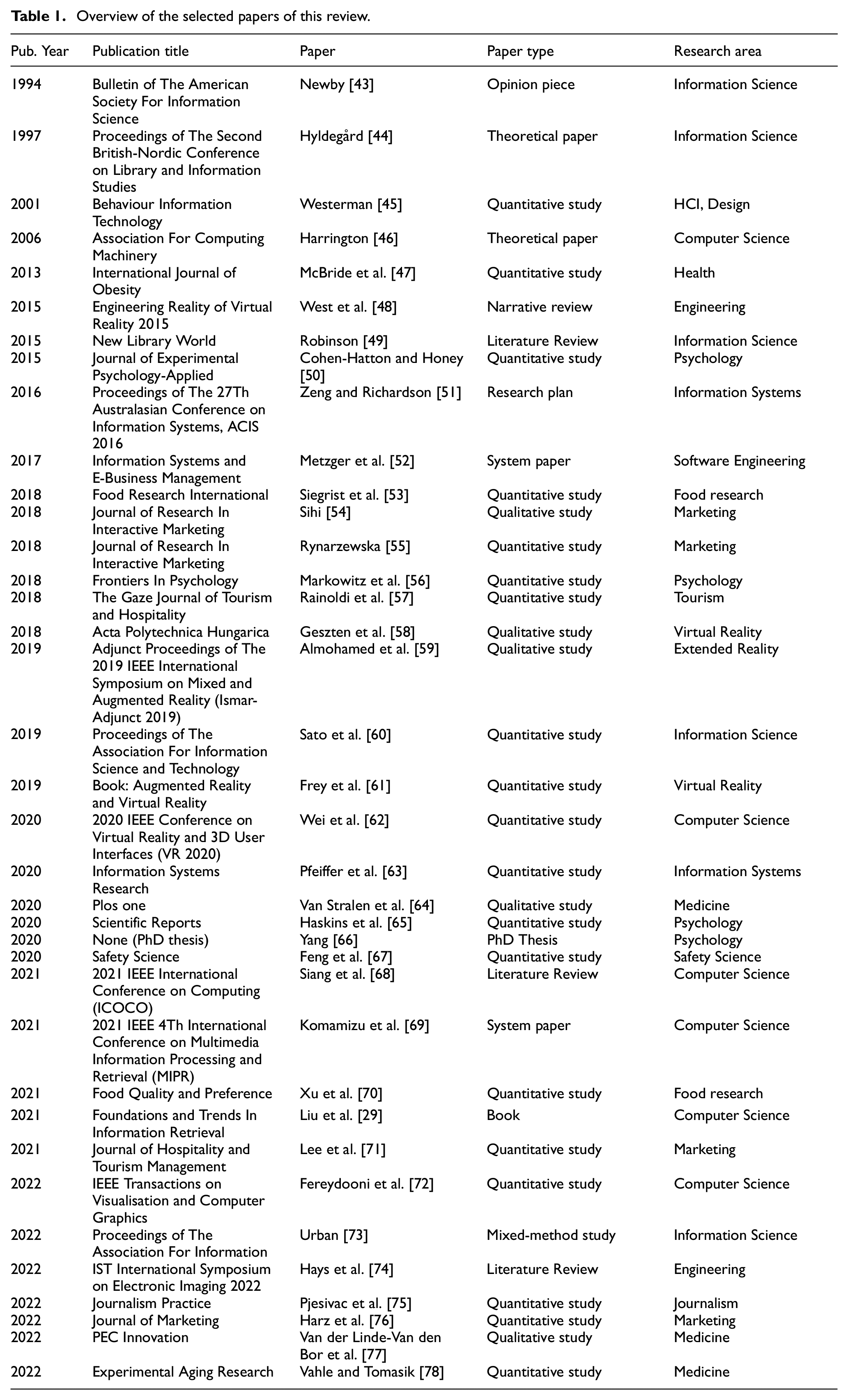
The 37 relevant publications are overviewed in Tables 1 and 2. A table that includes all results from the database searches has been made available as research data? In total, seven publications explicitly mention information behaviour at some point in the text. In all, 19 publications explicitly discuss information seeking, while information search is explicitly mentioned in 10 publications. In all, 11 publications also mention different but related concepts, such as information sharing, information gathering or information needs.
Overview of the selected papers of this review.
Overview of information behaviour topics in the selected papers.
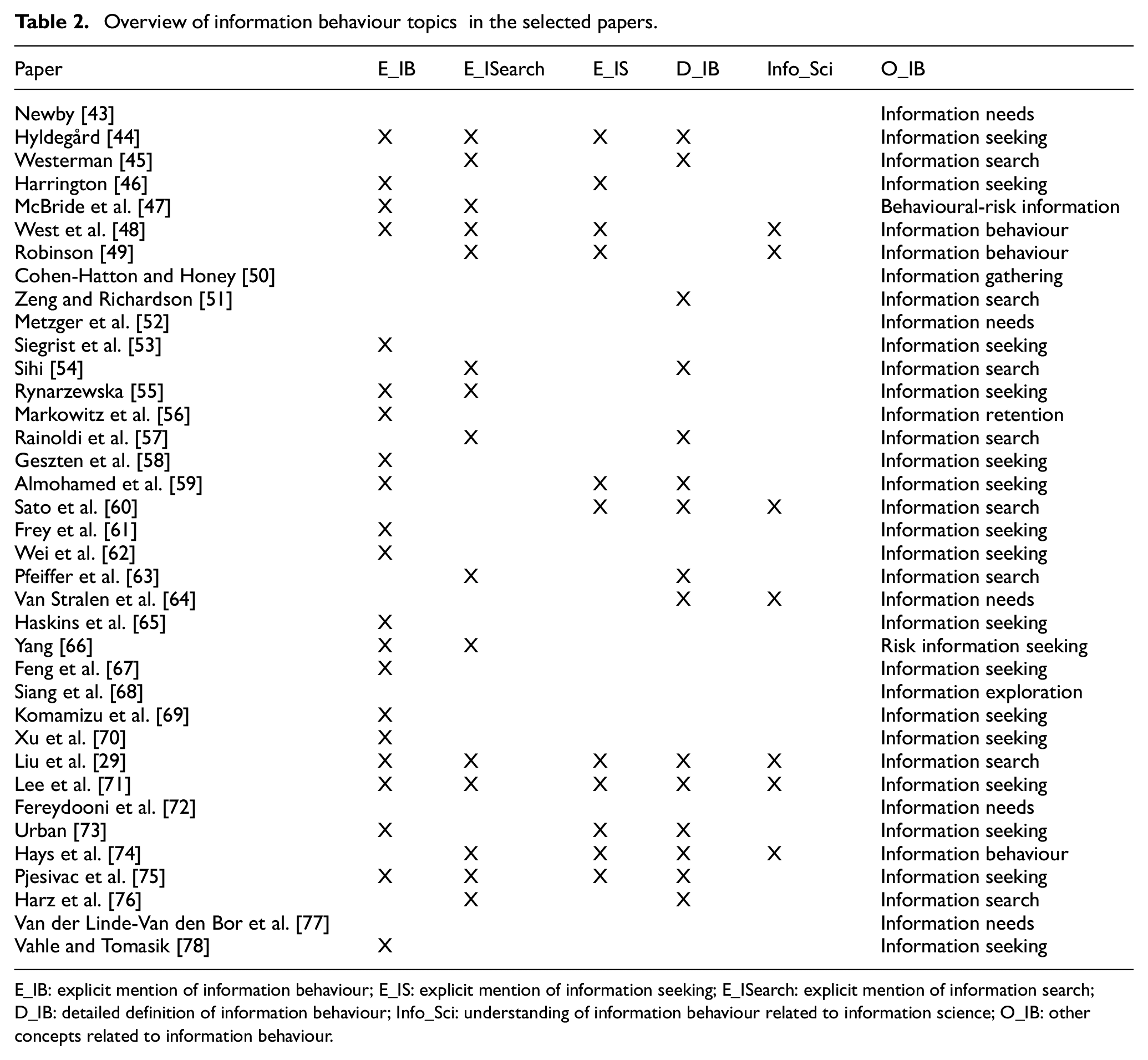
E_IB: explicit mention of information behaviour; E_IS: explicit mention of information seeking; E_ISearch: explicit mention of information search; D_IB: detailed definition of information behaviour; Info_Sci: understanding of information behaviour related to information science; O_IB: other concepts related to information behaviour.
A detailed understanding of the concepts mentioned above is indicated in 13 publications. Finally, eight publications discuss such concepts in a way that is related to either general information behaviour or, more specifically, information seeking or information search behaviour (see Table 2).
Regarding the primary research area and as defined by the publication outlet (journal, conference), six publications are from the computer science area, five are from the information science area. Four publications each are from marketing, psychology and medicine or health science. Furthermore, three publications each are from virtual or extended reality and software or general engineering. Finally, two publications each are from food research and information systems. One publication each is situated in tourism, journalism and human–computer interaction. See also Table 1.
4.1. Synthesis of results
The publications can be overviewed best by grouping them by their prevalent information behaviour theme as suggested by Wilson [26]:
General information behaviour,
Informationnformation seeking, and
Information search
They are grouped by the concept that is discussed the most. For example, in some publications, information seeking is mentioned once but not further explained or discussed and instead, general information behaviour is the focus.
4.1.1. Publications that focus on general information behaviour to VR
Overall, three publications mainly discuss general information behaviour and provide detailed definitions of the term as it is understood in information science.
In a narrative review, West et al. [48] overview the state of mixed and VR technology and the industry and extract common themes from the narratives of technology companies. They directly relate the concept of presence in virtual environments to information behaviour and call for more research in that area. Overall, they focus on mixed reality and mention existing work about information behaviour in AR. Their work can be seen as a summary and analysis of existing VR (and related) technologies and a call for further research on information behaviour in XR. They do not discuss information-seeking models or theories.
In a literature review, Robinson [49] focuses on a concept they call Immersive documents. Their work can be situated in the field of information science. They see immersive documents as a new kind of document (or a new way of looking at documents). These documents would be pervasive and multi-sensory and could include entire virtual experiences. Among other aspects, Robinson relates technologies such as augmented and VR (or even future developments of such technology) as essential for the emergence of immersive documents. They conclude that further research on information behaviour in relation to these immersive documents is essential. At a speculative stage, the focus is on general information behaviour but not on information-seeking models or theories.
Finally, Hays et al. [74] conducted a literature review scoping at the effect of embodiment on information behaviour in extended reality contexts with an additional focus on shared (collaborative) experiences and eye-gazing. Through the analysis of empirical studies from various sources and fields, they found that a shared gaze in collaborative extended reality experiences could enable or improve communication and increase the impression of co-presence. Notably, the review is not limited to information seeking behaviour and includes studies from various backgrounds that do not necessarily discuss information behaviour theory. As such, theories of information (seeking) behaviour are not in focus.
4.1.2. Publications that focus on information seeking in VR
Sixteen papers discuss information seeking in relation to VR environments. Of those, four show a more detailed understanding of information seeking. Six understand the term as it is defined in information science, and three publications match both criteria:
As early as 1997, Hyldegård [44] discusses the possibilities of information seeking within a VR IR system. With an emphasis on design issues, there is a focus on the transparent user interface, which enables a user to ‘feel they are working directly on a certain kind of task in a very intuitive way (natural way)’. According to Hyldegård, information in VR should be represented visually and information browsing should be possible. Hyldegård concludes that many questions about the design of an interface for information seeking in VR remain unanswered.
Lee et al. [71] provide a detailed definition of information seeking as it is used in information science. They studied the relevance of information seeking in VR for marketing purposes. In their quantitative study, they directly measure information-seeking variables. They hypothesised that the vividness and interactivity of a VR experience would influence the perceived media richness which in turn influences information sharing and information-seeking behaviours. Notably, it is unclear if participants had an actual experience in VR, or rather browser-based 3D experience with conventional (2D) devices before answering a survey. In this study, information seeking is discussed exclusively through the lens of marketing and consumer behaviour.
In their book, Liu et al. [29] discuss information seeking models in detail and in a way that fits into information science. However, the only connection to VR is only drawn at the end of the book with a brief mention, emphasising how promising the technology is for the development of future search interfaces and research.
Pjesivac et al. [75] compare traditional print news with what they call 360° journalism, an immersive form of journalistic for VR. Among 100 participants, they found an increased perceived enjoyment compared with the print news and an increase in intention to seek out further information. While they embed their work in information science theory, this is done to point out that the role of entertainment is important but understated in existing information-seeking models.
4.1.3. Publications that focus on information search in VR
A total of eight publications mainly discuss information search behaviour. Six of those publications provide a detailed definition of the concept, while two show an understanding related to information science, with an overlap of one publication, a recent book by Liu et al. [29] Here, theoretical and practical considerations of the design of search interfaces are discussed, including a detailed overview and discussion of information seeking models. In conclusion and for future work, they see VR as one of the ‘emerging trends’ that are relevant for the future of search (interfaces).
4.1.4. Other information science concepts related to VR
Finally, 10 publications do not focus explicitly on any of the aforementioned concepts explicitly (although some mention them briefly). Instead, they discuss concepts that are closely related to or even a part of information seeking, information search or general information behaviour. These concepts are information gathering, exploration, needs or retention, as well as behavioural risk information and risk information seeking. Two publications feature detailed definitions, but none are embedded into information science research.
5. Discussion
To answer the research question of this review in detail, the relevant publications that could be identified are now discussed. Motivated by the lack of existing work, human cognitive and behavioural factors that could be of interest in VR scenarios are introduced. A framework that builds on an information seeking process model and VR-related human factors is suggested to inform and motivate future work. Finally, the strengths and limitations of this review are reflected.
5.1. A lack of existing research
This review categorised 37 qualifying publications based on their understanding of information seeking theory and depth of discussion. The research question of this review formulates an interest in information seeking and information search behaviour in VR.
Regarding the 25 empirical studies in the list of review results, two statements from Case and Given [25] on the usage of the terms information seeking and information behaviour become relevant:
‘Most accounts of empirical investigations do not bother to provide a definition of information seeking, taking it for granted as what people do in response to a need for information. Instead, studies tend to rely on operational definitions of seeking, that is, what actions are observed by investigators, or reported by the respondents in the study’ (p. 91)
‘[t]oo many evaluations of searching skills or system features are now labelled “information seeking” or “information behaviour”; these terms have simply become too popular to be descriptive’. (p. 357)
This review confirms these observations: 11 out of 15 empirical studies that mention information seeking do not define it at all.
Of those relevant publications that are situated in computer science or information science, only three publications relate concepts of information behaviour with VR in detail [29,44,49]. Evidently, virtual or extended reality technology has not yet fully reached the information seeking community.
Seven publications showcase an understanding of concepts of information behaviour as it is common in information science. However, these publications still do not focus on the most specific research interest of this review (the intersection of information seeking behaviour theories and VR).
Overall, not a single publication builds upon existing theories, frameworks or models about information seeking behaviour to understand information seeking processes in VR. While this answers the initial research question, it also opens up the pressing need for new research in that area in the future.
5.2. Towards a research effort about information seeking behaviour in VR
Since no existing research responds to the initial research question, this review successfully identified an evident and prominent research gap. This gap is not entirely surprising. Ingwersen and Järvelin [19] and White [28] point out that there is generally a rift between theoretical research in information seeking and empirical research. While they suggest that this gap motivates future work [28,29], the direction and focus of such future work remain unclear.
More extensive work has been done on the general effects, challenges and possibilities of human interaction with VR technology. To keep a human-oriented lens, factors that influence human behaviour in VR are now overview. These factors are also called dimensions, aspects, concepts or constructs in the relevant literature. From here on out, they are called human factors. This overview is not exhaustive, but rather a selection based on their potential relevance to information seeking behaviour-related activities in VR scenarios and how often they occur in published literature. Some extensive books on VR and 3D interfaces that discuss human factors include Jerald [1], LaViola et al. [79] and Sherman and Craig [2].
5.2.1. Immersion and presence
Jerald [1] defines immersion as the ‘[…] objective technology that has the potential to engage users in the experience’ (p. 46), while presence is defined as ‘[… ]a sense of “being there”’ and an internal psychological state” (p. 46). This strict distinction between the terms is not present in all published literature, as Sherman and Craig [2] and Suh and Prophet [80] distinguish between physical and mental immersion and define the latter as presence. As the term immersion gains more traction in literature, it is increasingly used to describe the subjective sense of “being there”. Immersion is a defining quality of VR [1], and should therefore be essential for information seeking in VR. However, the exact influence of immersion on information seeking is unclear, though it has been investigated in other VR scenarios [81]. Does high immersion benefit information seeking? Is there a limit to that effect or could high immersion distract from the seeking activity? And does it depend on the context and goal of the information seeking activity?
5.2.2. Affordances
Affordances play a crucial role in any designed interactive process, especially in a complex human–computer interaction for information seeking. Affordances can divided into multiple levels, such as physical affordances from the surrounding location, affordances of the VR system and its software and more. Recently, Zhao et al. [82] investigated the effect of affordances in VR on medical students. Interestingly, they observed ‘that users’ perceived affordances of immersive technologies are not a solid outcome but a dynamic process’ (p. 278). First, students saw the system as entertaining, while learning, instrumental and socialising affordances were perceived during continued use. As affordances are relevant for any interactive software system and considering the novelty of using VR for many users, affordances and their effects should be analysed throughout the information seeking process.
5.2.3. Embodiment
In short, embodiment describes a ‘sense of body ownership’ in VR and similar environments (p. 84) [80]. The magnitude of the influence of embodiment over humans in VR is best shown by its effect on human pain perception, which can be influenced by varying the level of embodiment in VR scenarios [83]. While Hays et al. [74] reviewed what they call embodied information behaviour, they inferred the concept of embodiment from a broad list of interdisciplinary studies. Also, they did not specifically hone in on embodiment and information seeking in VR (understandably, since there are no publications in this area). The effect of embodiment on information seeking activities in VR remains unclear.
5.2.4. Cognitive load and information overload
Cognitive load plays a role in human–information interaction and can occur at different stages and in different strengths during information seeking [84]. A balance between interactivity and cognitive load in seeking systems is desirable [19]. Similarly, information overload can be caused ‘by presenting too many images, concepts, messages and other elements’ (p. 45) [85]. How interactive should a VR information seeking system be and when does information overload occur?
5.2.5. Human error
Human error occurs when a human actor cannot complete a task or achieve a defined goal adequately. They can occur for various reasons and may occur throughout an entire population, specific demographic groups or individuals. As for any information seeking, human error should also be considered in VR scenarios. Furthermore, ‘Human error and mental load are also related, as the unavailability of mental resources can produce erroneous behavior’ (p. 113) [79].
5.2.6. Flow
The concept of the flow state is summarised by Jerald [1] as ‘[a] psychological state where a person is entirely focused on an activity or task’ (p. 509) and ‘[f]low occurs at just the proper level of difficulty’ (p. 151). Previous work also confirmed a positive effect of the flow state on creativity in a VR environment [86]. Together with other factors a positive effect on perceived workload and stress in a learning scenario [81]. So, does flow occur easier in VR scenarios and is it helpful or even detrimental for information-seeking activities?
5.2.7. (Dis)engagement
Engagement enables the information seeking process: A search system should be designed to engage the user so they may realise their information need. O’Brien et al. [87] argue that engagement also has a negative side (binding a user to a system for as long as possible). As such, it could even distract during the various steps of information seeking. They see ‘[…]disengagement as part of the natural course of engagement[…]’ (p. 6) and that software systems should ‘[…]make space for disengagement[…]’ (p. 9). Should the information-seeking process in VR begin with high engagement but allow for disengagement as well?
5.2.8. Other human factors
There are (potentially many) other factors that influence information seeking in VR, such as perception, attention or biases [88]. Some may be more related to the features and design of VR experiences, such as the degree and kind of interactivity or the various elements of the VR ‘world’ itself. Here, an interconnection with the concept of affordance becomes apparent as well. These additional influencing factors should be identified and investigated in future research.
5.3. From a general information seeking model to a research framework
Established information-seeking models can be consulted to identify a departure point for investigations of information-seeking in VR. Process models see information seeking as a sequential process with steps including the identification of a person’s need for information, a search based on a query and the exploration and evaluation of the results. To some extent, it has become a shared consensus of experts in the field that information-seeking behaviour in humans generally can be seen as a process. Well-known process models have been provided by Ellis [35], Kuhlthau [36] and Marchionini [37] (among many others). White [28] notices that ‘[m]ost situations involving information seeking can be characterized by Ellis’s model’ (except for exploratory search, p. 107). While Kuhlthau lists similar steps, their model focuses on the involved individual’s feelings, thoughts and actions. Marchionini, on the other hand, keeps the general process of information seeking simple and primarily describes information seeking within electronic (digital) systems. The main contribution of the model is the much more concrete individual steps (e.g. Examine Results instead of Browsing or Differentiating in Ellis’s model) and emphasises the transitions between the steps (including default, high probability and low probability transitions). When looking at some of the original descriptions in Ellis’s model, it becomes apparent that it was conceived before digital search systems and general web search became widely adopted [28]. Liu et al. [29] also use Marchionini’s model as the basis to look into search interfaces and their design. While there are many newer and more detailed models, Marchionini’s process model of information-seeking behaviour in digital contexts is a good starting point when looking into a major, novel context, VR environments. It is a suggested departure point for future research into information seeking in VR.
Figure 2 shows a possible framework for future research into information seeking in VR. It features the discussed human factors as possible influences on information seeking activities in VR. A simplified version of Marchionini’s process model of information seeking [37] serves as an initial point of departure. Case and Given [25] note: [m]odels can also be exploratory in their design, such as in qualitative studies where emergent findings lead to model development; these models may then evolve or change over time as new research data are gathered in later projects to further advance model development. (p. 143)
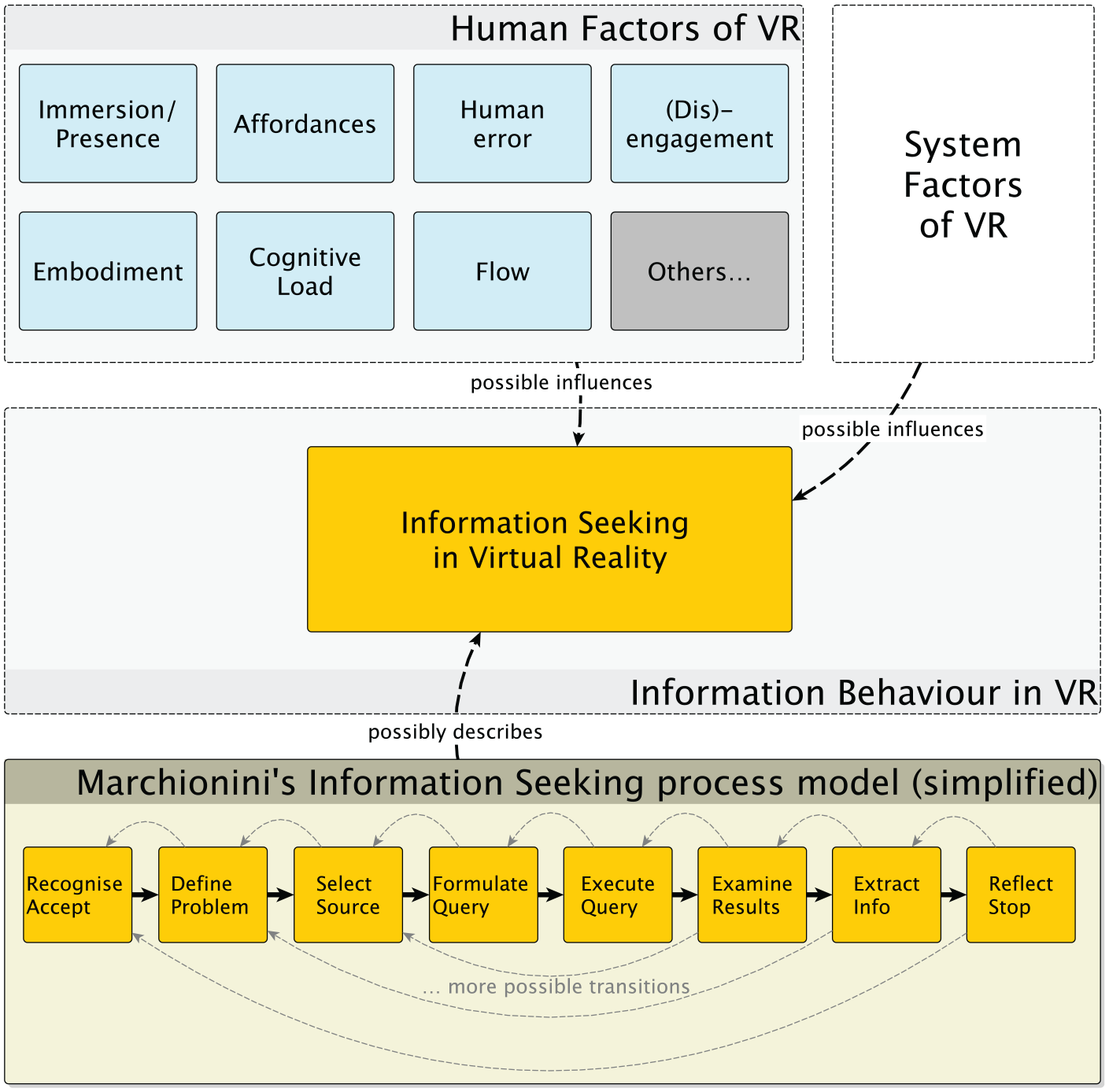
Marchionini’s information seeking process model (simplified) adapted as an initial research framework with possible influencing factors in VR.
In the same spirit, the current version of this framework is expected to change with future investigations. At this early point, the exact influences of the listed factors are unknown. Furthermore, how could an implemented system make use of these factors? Immersion, presence and embodiment have been discussed in the VR community at length and might be relatively straightforward to implement. But, how what about cognitive load or flow? These factors describe complex cognitive concepts that are not easily measurable. It becomes clear that there further (empirical) investigations into information seeking in VR are needed. As a starting point, insights from the relevant fields of computer science can inform implementation design and many of the human factors are continuously investigated within cognitive psychology.
It should further be noted that this framework does not necessarily include all potentially influencing factors. System factors could potentially influence the information seeking process in several ways. Such attributes could be interactivity, the number of users that are engaged, the overall design of the virtual world, the overall user experience or the design and nature of the information objects specifically. Again, further investigation is much needed.
5.3.1. Information objects
Within information retrieval, documents are typically defined as mainly text-based [89] or at least with a textual interpretation (metadata). As Robinson [49] suggests, immersive VR might require rethinking the concept of a document at large. Are documents in VR still text-based? Will there be visual representations of entire books floating in 3D space of a future IS system in VR? Or could VR also provide the opportunity (or even the necessity) to change what a document is entirely? Hansen et al. [90] follow a notion by Marchionini and others where information objects are different from information artefacts (books, documents, …) in their focus on a user’s information need. In existing research on information retrieval in VR, Ward et al. [91] introduce a prototyped system and evaluate interaction types and different search result pages (SERPs). They pay special attention to what they call abstract information objects (AIO), ‘[…] a text, video, or image-based object used to convey information about an underlying web page or document to the user’ (p. 2601) and note that these objects have been used in VR environments before (namely by Bowman et al. [92]). Hence, they use such objects to represent search results in their system. Since future information systems in VR should make use of the full capabilities of the medium, it is unlikely that a mere replication of traditional 2D interfaces in 3D space will become the norm. Then, will arrangements of information objects replace static search result pages in VR information search? Furthermore, Cool and Belkin [93] described a shift in the history of information retrieval and information objects from closed-stack libraries with an obligatory intermediary towards independent, interactive and more direct information seeking. Today, individuals can directly access and repeatedly interact with different databases, interfaces and systems to retrieve relevant information objects on their own. But what is the next step in that evolution? Could future information seeking (in VR) enable information objects to have independent agency? Instead of a user seeking the information objects, these agency-driven information objects could seek out users instead (provided they have the means to assess the users’ information needs accurately).
5.3.2. Collaborative information seeking
Also, most information seeking models and related theories imply that only a single actor is involved in the process (including the proposed framework at this stage). But, what about group activities? In Collaborative information seeking, a relatively new research endeavour, groups of people work together to seek information and solve their information needs [94]. Some researchers see great promise in VR for social and collaborative activities [3] and Hays et al. [74] already investigated the benefits of shared experiences in VR and general information behaviour. Hence, future research should investigate collaborative information seeking in VR.
5.3.3. Interactivity
Cool and Belkin [93] illustrate the relevance of interactivity for information seeking. They explain the different views and traditions between information retrieval and interactive information retrieval, where ‘the former ‘refer[s] only to the non-interactive aspects of the general problem’, while the latter includes the study of the interactions of people, information and information retrieval systems’ (p. 4). They see interactive information retrieval as ‘one of the guiding frameworks in information retrieval research’ (p. 14). Hansen et al. [90] further note that there is no precise consensus on the interpretation of information interaction (p. 14). However, it is often used to describe human interaction’ with information retrieval systems and there are ‘technological, artefacts, and human components’ to it (p. 15). With these multiple facets of interactivity for information seeking activities, there are probably significant considerations about interactivity to be made when entering an information seeking system in VR. Notably, interactivity has been described as a ‘crucial component’ of VR as well [3] (p. 6).
5.4. Strengths and limitations
This review answers the initial research question confidently by querying well-known academic databases with inclusive queries. This review is highly reproducible by following established methodology (PRISMA-ScR) to document each step of the review process. With an extensive discussion and the construction of a framework for future work, this review also exceeds beyond merely summarising the existing work. All reviewed records are available as research data in the spirit of good scientific practice.
There are some limitations to consider as well. Based on the formulated research interest, this review does not explicitly cover any form of augmented or mixed reality. Thereby, any research related to the information behaviour with such systems is excluded. Such research is undoubtedly exciting and important to pursue. However, it helps little to form an explicit and detailed understanding of human information behaviour within immersive and entirely virtual environments. Furthermore, by having a mixture between the actual world and a virtual one, many new considerations need to be made when studying such phenomena.
Some of the included quantitative or qualitative studies directly attempt to gather data on IS or similar behaviour in VR contexts. How and how well these studies were conducted is not detailed in this review, but could be of interest to researchers who want to conduct similar studies. Such a review should be conducted once there is a larger body of existing works.
Finally, the proposed framework of information seeking in VR currently focuses on only two things: promising cognitive, and behavioural human factors and a process model of information seeking. However, there will be other influences, such as the design and features of the information-seeking system and the virtual world at large, and established factors such as efficiency, ease of use, usability, and the entirety of the virtual world. Arguably, it makes a big difference to concentrate on a retrieval task next to a convincingly simulated active volcano compared with an empty room. Human physiological factors could also influence the information seeking process, such as perception, attention, and accessibility. It is also unclear how big of a role affective and emotional reactions play (e.g. described by Kuhlthau [36] for traditional information seeking).
6. Conclusion
This review identified all relevant works discussing information-seeking and similar concepts related to VR scenarios. Existing studies evaluated information seeking in VR with the implicit assumption that the role of information-seeking behaviour in VR is clear or trivial. Publications with a detailed understanding of information seeking are broad in scope and speculative. To answer the initial research question: There are no existing publications that build upon existing theories, frameworks or models about information seeking behaviour to understand information seeking processes in VR (based on the methodology of this review and to the best knowledge of the author). This prominent research gap motivates future research. To that extent, this review overviewed cognitive and behavioural human factors that are of importance in VR based on existing work. Those factors include immersion and presence, affordances, embodiment, as well as cognitive load, human error, flow and engagement. An established information-seeking process model and the discussed human factors form a first, speculative framework of information seeking in VR to inform future work.
From here on, future work needs to construct generalisable knowledge about information seeking and general information behaviour, step by step. A possible start could be truly immersive information objects, which might replace the more traditional documents of today’s information retrieval systems. What should they look like and how should they behave to best aid information seeking?
In 2010, Wilson [95] looked back on 50 years of information behaviour research and formulated predictions for future research directions. One of those predictions was that technological advances would continue to drive information behaviour research. Virtual (or extended) reality might be the most significant technological advance that changes how humans interact with information in a fundamental way. Thus, human information seeking behaviour will change with the increased use of VR technology and warrants detailed investigation today already.
Research Data
sj-csv-1-jis-10.1177_01655515231174384 – Supplemental material for Immersive information seeking–A scoping review of information seeking in virtual reality environments
sj-csv-1-jis-10.1177_01655515231174384 for Immersive information seeking–A scoping review of information seeking in virtual reality environments by Maurice Schleußinger, Preben Hansen and Robert Ramberg in Journal of Information Science
Research Data
sj-md-2-jis-10.1177_01655515231174384 – Supplemental material for Immersive information seeking–A scoping review of information seeking in virtual reality environments
sj-md-2-jis-10.1177_01655515231174384 for Immersive information seeking–A scoping review of information seeking in virtual reality environments by Maurice Schleußinger, Preben Hansen and Robert Ramberg in Journal of Information Science
Footnotes
Declaration of conflicting interests
The author(s) declared no potential conflicts of interest with respect to the research, authorship, and/or publication of this article.
Funding
The author(s) received no financial support for the research, authorship, and/or publication of this article.

Supplemental material
Supplemental material for this article is available online.
References
Supplementary Material
Please find the following supplemental material available below.
For Open Access articles published under a Creative Commons License, all supplemental material carries the same license as the article it is associated with.
For non-Open Access articles published, all supplemental material carries a non-exclusive license, and permission requests for re-use of supplemental material or any part of supplemental material shall be sent directly to the copyright owner as specified in the copyright notice associated with the article.
