




Abstract
Young informal carers (YICs) are non-professional young individuals providing care and support in various forms, usually to immediate family members, afflicted from a diverse range of both long- and short-term health conditions. Although there is significant knowledge about the information needs of adult carers in general, information needs and information seeking characteristics of the YICs’ community are understudied and are different. This study aims to identify the information needs of YICs communicated over the Internet and understanding their information seeking characteristics through a three-stage qualitative content analysis of posts written by YICs on two notable Internet forums. The analysis of 323 posts dated between March 2010 and April 2019 finds YICs’ needs are categorised by two types of online expression of needs, situational and information. Situational needs are illustrations of current difficult conditions and information needs are direct requests for information. Under situational and information needs, we identify four types of needs expressed: personal and professional growth, health (self and caree), finance and relationships. In addition, the findings indicate 94.36% posts in the sample as situational needs, which depict the uncertainty experienced by YICs under caring circumstances. The findings can assist government organisations and charities by improving the indexing of advice pages of their websites appropriate to the YICs’ search words, better availability of information and advertising, in addition to building quality mobile applications or digital support tools.
Keywords
1. Introduction
Young informal carers (YICs) are non-professional young individuals providing unpaid care and support in various forms to individuals, usually immediate family members, afflicted from a diverse range of both long- and short-term health conditions, and in some instances, parenting [1–6]. Generally, YICs are thought to be aged between 16 and 25; however, surveys indicate that they can be as young as 5 and as old as 35 [6–9]. Within England, it is estimated there are 166,000 YICs between the ages of 5 and 17 years [10]. A wide range of reasons lead to YICs taking up caring responsibilities. Different health illnesses, death and disability of either one or both parents/guardians, parenting, financial burden and cultural aspects are some of the identified reasons [1,4,11–15].
Studies have found YICs more likely to be either facing difficulties or absent from education, employment and training (NEET) due to taking up informal caring responsibilities. YICs are also more likely to suffer from different forms of ill-health, especially mental health issues, social isolation and low quality of life [6,15–19]. In addition, various charities assert that YICs are subject to bullying and shaming in schools or workplaces, receive insufficient state or workplace support and are highly likely to become economically disadvantaged [20–22]. The International Monetary Fund (IMF), Office for National Statistics (ONS) and the National Health Service (NHS) indicate that the unpaid wages to YICs probably run into several hundred million; additionally, research indicates that the burden of care mainly rests on female YICs [23–25]. Despite the increase in the number of YICs in society today and research in this area, government and health services are yet to develop appropriate strategies to identify and locate YICs [26–31]. This study focuses on the information needs of YICs communicated through Internet-based forums and also attempts to differentiate their needs as informational or situational.
2. Background
2.1. Information needs and information seeking
As YICs are untrained individuals pushed into performing caring duties, the new and challenging scenarios they experience form the basis of their information needs. Information needs assist in learning new skills and solutions, sensemaking of scenarios, acquiring new behaviours and increasing a sense of preparedness [32–35]. Studying information needs and information seeking behaviours offers an opportunity to appreciate an individual’s self and their environment [36,37]. Information needs can be of four types according to Taylor (1968) – (a) visceral, characterised by reflexive ill-defined feelings; (b) conscious needs, characterised by unclear statements, like situational information needs ill-defined needs [3,38,39]; (c) formalised needs, characterised by well-defined and specific statements [39]; and (d) system functionalities, characterised by the variability of a need. Linguistic differences have been observed within information needs, especially between conscious and formalised needs [40]. Conscious needs are found to be situational, more emotional and sensitive, and indicating helplessness [3,40]. Situational information needs can also be complex, leading to information behaviours, that is, information avoidance and selective choosing due to behaviours governed by themes of information being sought, importance, bias and other cognitive aspects of the seeker [39–41]. This study attempts not only to explore the information needs of YICs, but also to differentiate their needs as informational and situational.
Information seeking is a process explaining how individuals seek information to satisfy their information needs [42]. It is a widely studied topic considering cognition, environment, language, mental models and physical activities and so on [37,43,44]. In the context of the seeking process itself, seekers of information are classified as – (a) active seekers, who are characterised by actively seeking to connect with the information source and interact with questions; (b) active scanners, who are characterised by someone who has identified a possible information source and takes the opportunity to ask a question; (c) non-directed monitors, characterised by someone who has come across the information source through serendipitous browsing and interacts in various ways; (d) proxy seeker, characterised by someone who has been directed to the information source and who interacts on command [36,37,45]. Understanding YICs’ information seeking behaviours will assist in clarifying their types of information needs, availability of information sources and the information needs itself [1]. Information needs, however, is still a poorly understood topic with Savolainen (2017) commenting ‘‘even though information need is probably the most widely used construct explaining why people engage in information seeking, this concept is still vague’. Despite the challenges, studying the information needs of YICs perhaps offers the best chance to observe their self, environment and information seeking behaviours [1].
2.2. Information needs of formal and informal carers
Information needs of formal carers have been well documented in current literature. The main information needs of formal caring staff include treatment-related queries and post-treatment management for the patients, stress management and self-care [46–51]. Formal staff in all most cases sought information in-person from their colleagues, reliable/official Internet-based information sources related to their profession, their accreditation organisations and sometimes, Internet forums [52–55]. Although information needs of informal carers are well documented, there appears to be a gap in literature on the information needs and seeking behaviours of YICs [1,53,55–58]. Informal carers communicate with various sources, that is, government and non-government organisations, friends and family, healthcare workers, work colleagues, Internet resources and private help when seeking information about caring [53,56,59–62]. Past research has indicated that informal carers’ information needs mainly include knowledge around finances, their health and that of the cared, government services, contacts and support services [60,61,63,64]. Information needs are further refined by specific health conditions of the carer and cared, country of residence and financial situations [58,65,66]. YICs, especially children, were specifically found to express information needs in-person around attainment, in addition to health, government and support services [15,67–69]. Assessing their information needs from online sources is difficult due to the difficulty in identifying YICs online as they prefer to stay anonymous. This study attempts to study their needs through reliable online forums, taking a secondary qualitative approach. In addition, on relevant online platforms, there is a perceived sense of anonymity offered to the YICs, allowing them to share any situations or seek information without hesitation, which sometimes is not possible through physical information seeking. Uncertainty of current and future care situations, confidence in advice being offered by various sources, hesitation to ask (for the fear of being ridiculed), social accessibility and attainment and so on are some of the factors affecting all types of informal carers [16,68,70–72].
2.3. The Internet as a source of caring information
The Internet has been and is progressively becoming a source for information among the carers’ (both formal and informal) community. Many carers depend on Internet sources, that is, discussion groups, forums and websites, in general, to seek information about various aspects of caring, despite the varying quality of information and wavering confidence on the information [52,73–75]. Information or advice can be attained through websites such as the NHS, on various health conditions, and from participants in the discussion groups and forums. However, the quality of information varies depending upon the source, and in all cases, it is suggested to rely on high-quality sources, that is, government agencies and registered charities [76–79]. In addition, the Internet, especially discussion forums, is found to be a reliable point to seek information due to various reasons, that is, seeker anonymity, perpetual availability, different people sharing different experiences, a common space, shared understanding of a topic and emotional support and so on [80–83]. Consequently, Internet-based applications and interventions have been tested successfully for various conditions, care needs and general medical advice [8,80,84,85]. Interventions and tools such as mobile applications, online resources or portals, search indexes, video streams, and websites have been applied with varying degrees of success [86–89]. However, Internet-based interventions are influenced by various aspects, that is, access to technology, financial strength, training and education [90–92]. Hence, it becomes necessary to take these factors into consideration when designing Internet-based tools in the field of health/care information. There are plenty of studies on Internet-based health/care information seeking behaviours of both formal and informal carers [59,60]. However, there is insufficient scholarly discourse on Internet-based information seeking behaviours of YICs, although it is generally agreed that they mainly seek information on finances, and government support and so on [53,56,59,60–62]. In the view of the difficulty in establishing who YICs are, a gap in literature focusing on the information needs of YICs, YICs’ Internet contact time and recent developments in Internet-based interventions, this study aims to establish (a) the information needs communicated by YICs on the Internet and (b) the process of information seeking by YICs.
3. The study
3.1. Aim
This study seeks to explore the information needs communicated by YICs online through the following questions:
RQ1: What are the information needs of YICs communicated over Internet-based forums?
RQ2: What are the information seeking characteristics of YICs over Internet-based forums?
3.2. Design
A qualitative content analysis of 323 individual posts by different individuals in two popular online young carer forums is the design of this study.
3.3. Sample and data collection
The sample for this research was obtained from the ‘Young Carers’ message board of Childline’s and CarersUK’s ‘Young adult carers’ message board support forums. Both the samples are openly available. Childline is a UK-based charity providing free, private, and confidential service to anyone under 19 regarding anything [93]. CarersUK are also a national charity supporting carers with various aspects of caring [20]. Childline and CarersUK are well-established websites and have been utilised or recommended in various investigations [94–96]. In addition, the forums were chosen due to the availability of sufficient and quality information, and similarities in the background characteristics of the individuals attracted to forums [97]. Both the forums require individual to be signed-up prior to posting a question or request for information and claim to provide a safe space for individuals to freely discuss any issues, thereby mitigating any apprehensions held by the posters. The forums consist of individuals declaring themselves to be young carers requesting information, some adults and charity staffers who mainly respond to questions or requests for information. Posters can choose which personal information they can make public, that is, age and location. Very few posters made this information public, and it is assumed the posters accurately stated their age. Each original post is followed by responses by other members of the forum relating to the original post. Responses are either direct provisions of information requested or shared experiences. For data curation purposes, YICs were defined as non-professional carers within the 5–35 age range, performing unpaid caring duties to family or friends. As this research is interested in the information needs of YICs, only the original posts by YICs were recorded for analysis, and additionally, posts by individuals whose claimed age is beyond 35 and who performed paid duties are disregarded. Location information about the posters was only available from a few posts (all based in the United Kingdom), all the posters appeared to be UK domicile and the posts were in English. Timeline of the posts from both the forums ranged from March 2010 to April 2019. Finally, post-application of the study criteria, 323 distinct (251 from Childline and 72 from CarersUK) original posts were retained from the overall sample for analysis and copied onto an MS Excel spreadsheet to form the data set for analysis.
3.4. Ethical considerations
This research did not require ethical approval from the authors’ institutions as the secondary data collected were from Internet forums, where post creators’ names were either pseudonyms or shortened. However, identification of anonymous posters on online forums has proved to be possible [98,99]. Hence, the quotes depicted in this article are in paraphrased forms of the original quotes to curtail identification [98,100].
3.5. Data analysis
The study applies a multi-stage content analysis as depicted in Ruthven et al. [3]. In the first stage of coding, an initial set of codes were collated from existing literature on the information needs of informal carers and YICs [6,9,15,53]. The coding scheme focused on health/care information for themselves and the individual being cared for, government and financial support, and attainment. The data set was coded at post-level using the initial coding scheme both to identify missing codes and check their viability [101]. The second coding stage involved re-examining the posts to develop more accurate codes, with the sub-codes mostly related to health, care, personal development, relationships and financial advice and so on. Furthermore, coding was based on best-fit category of the sub-codes, where two members of the research team collaborated to finalise the codes using the posts as a guide [101]. The third coding stage involved re-coding the entire data set against the developed final codes and the obtained sub-codes were categorised under education, financial advice, relationships, health and development [101].
3.6. Validity and reliability/rigour
Two procedures were conducted to ensure reliability of the attained codes. The first procedure involved taking the coding the CarersUK forum against the codes attained from the Childline forum (the larger data set), which did not reveal any new topics [3]. This indicates that the codes attained from the Childline data set are valid for other YIC forums [102]. Saturation was determined at this stage where new codes, different from existing theory, arrived and where no new codes arrived through cross-coding the data set which is spread over a 9-year period [103]. The second procedure involved conducting an inter-coder reliability test to ensure reliability of the attained codes [104,105]. The data set was coded independent of the first coder by a member of the research team. Furthermore, Cohen’s kappa was calculated between the two coders and interpreted [106]. In addition, as the research recorded posts from a 9-year period, the information needs communicated by YICs over the Internet can be comprehensively obtained [3,103].
4. Findings
A total of 323 posts which met the study criteria were posted between March 2010 and April 2019. The multi-stage content analysis revealed four major overarching themes, or the information needs communicated online by YICs: Personal and Professional Development, Health (both self and caree), Finance and Relationships. Corresponding sub-codes and the classification of whether the post is a situational or informational information need are described in Table 1. Situational needs, which are illustrations of current difficult conditions but not a direct request for information and informational needs, are direct requests for information [3]. The table further provides information on the number of posts and corresponding percentages of the classifications.
Information needs expressed by informal carers online.
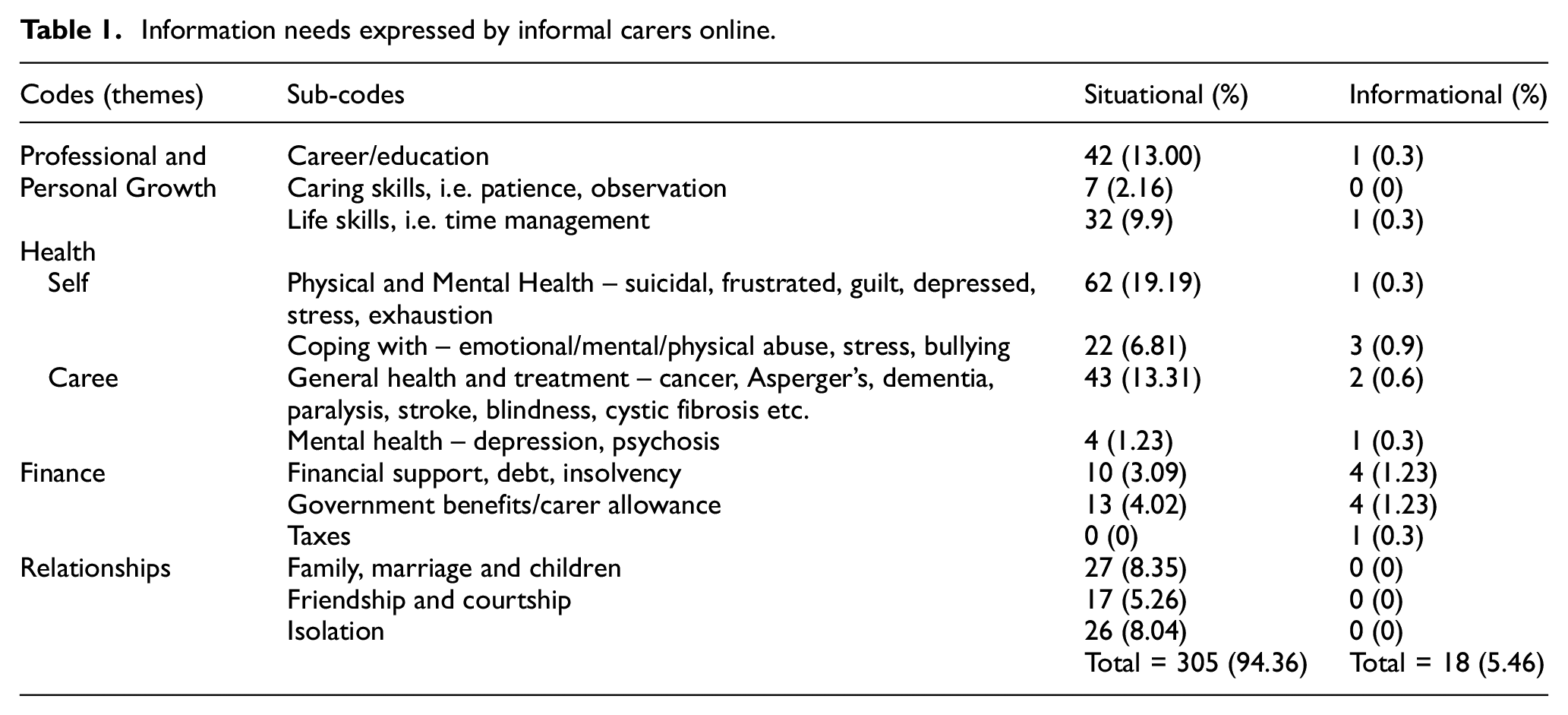
During analysis, each post was allocated a single code and sub-code; however, some sub-codes overlapped with the codes. For example, a post mentions ‘I’am unable to manage time because of taking care of my mother at home, due to which my working hours are reduced. This is putting financial strain on the family. Please help’. This post is a situational need as the YIC is thinking through their situation; however, they are not asking a specific piece of advice. In these cases, the reader forms a question in a way to best help the YIC. In this post, time management was chosen as the sub-code in agreement between the authors, as seeking time management tips would help the YIC work longer and therefore minimise financial strain to an extent. In contrast, a post depicting an informational need is ‘How do I apply for carer’s allowance’. This is a direct request for information. The results indicate that posts referring to situational needs (94.36%) for information are significantly higher than direct informational needs (5.46%) in YICs (χ2 = 22.84,p < 0.01). An inter-coder reliability test to decide whether a post is situational or informational returned a Cohen’s kappa coefficient of 0.83, indicating a strong agreement between the coders. In addition, the second round of inter-coder reliability tests to decide the sub-codes returned a Cohen’s kappa coefficient of 0.68, also indicating a strong agreement between the coders. The posts which the coders disagreed were venting of nature, hence establishment of agreement of codes and sub-codes of these posts was difficult. These posts were highly emotional with mostly negative emotions, were situational and were only mental descriptions of their situations, hence establishing code agreement difficult. However, the posts fell under with conscious information needs as described by Taylor and Ruthven [34,40].
4.1. Personal and professional growth
This theme is indicated in posts relating to the personal and professional development of the YICs. In total, 25.66% of the posts were related to this theme; however, most of the posts are situational needs for information and only two (0.6%) of the posts were towards seeking informational needs. Most of the queries under the theme sought information about the YICs’ education, future career prospects and life management skills. The situational needs posts clearly had an undertone of worry as it appears YICs are worried about their future growth during their current caring duties. For example, ‘I want to go to Uni and have a career, but I have no time to prepare well for my A-levels as I’am caring for my father who has cancer. Please help’. In contrast, informational needs were more direct, for example, ‘How can I apply to Open University’. Only seven (2.16%) posts were related to improving one’s caring skills and fell under situational needs in entirety. For example, ‘How can I be more patient towards caring for my mother with so many things going on in my life’ and again, depicted an undertone of worry.
4.2. Health
Queries regarding health are classified as into two categories: queries about the YICs’ health during the caring process and second, health queries about the caree. These posts constituted a total of 42.64% of all the posts analysed and that more posts of situational needs were present than informational needs.
4.2.1. Self
Information needs about the YICs’ health during the caring process constituted 27.2% of the total posts. The posts again were mostly situational and specifically contained two distinct sub-categories: physical and mental health, coping strategies. Queries about physical and mental health dwelled around self-care when afflicted by flu, stress, exhaustion, suicidal tendencies and negative feeling and so on. For example, ‘I’am stressed exhausted trying to manage my life around caring for my mother. I feel lonely and useless. Help!’. The second set of queries is coping strategies against the bullying and physical/mental/emotional abuse. It is found that YICs are bullied and are physically/mentally/emotionally abused by an acquaintance or their caree. For example, ‘I’am caring for my father who maybe abusing me. I’am struggling to cope with the whole situation. Please help’. Informational queries in contrast were more direct in nature, for example, ‘How do I register with a GP?’.
4.2.2. Caree
Information needs about the caree’s health constituted 15.44% of the total posts. The posts were mostly situational, requisitioning information on how to take better care of the caree ailing from a specific illness and circumstances they might encounter, such as mood swings when a caree is specifically being treated for a major mental illness, that is, clinical depression. One post specifically describes a situation need seeking information on best practices in administering a ‘jab’ to the caree. Other examples include ‘My mother has been diagnosed with epilepsy. How can I take better care of her’. Another example, ‘My father has a history of mental illness and has certain episodes. What can I do in these episodes to protect myself’.
4.3. Finance
Queries regarding financial advice constituted 9.87% of the total posts with situational needs for information being the higher constituent. YICs posted questions about government benefits and carer allowances available to them through the state or employers. In addition, queries were also asked about how to deal with debt as a result not being able to work due to caring duties and how to ask for financial help either from relatives or other entities. Informational posts were once again found to be direct, that is, ‘How can I claim carer’s allowance?’ Another post indicated an interest in caring as a profession: ‘What is the wage for a carer and how is it taxed?’ However, this will be further discussed in the next section as there was also an aversion towards caring as a profession due to the experiences from their situation. In contrast to informational posts, situational posts described a certain situation to seek advice. For example, ‘I’am really struggling with money with all the care work around the house. What can I do to get support?’ As evident from the posts, YICs are referring to substantial amount of domestic care work leading to their financial difficulties and again there is an undertone of worry.
4.4. Relationships
Posts about various aspects of personal relationships contributed to 21.65% of total posts and all the posts were situational needs of nature. The posts described the YICs’ relationships under current caring circumstances and seeking advice to maintain/amend the quality of the relationships. In addition, YICs also described their isolated circumstances due to caring duties and sought advice on making friends in-person or through digital means. Some of the posts indicated an aversion towards caring/nursing as a career, mainly due to current experiences and some not being able to identify themselves as carers. For example, ‘I look after my baby sister almost everyday–after school, entire weekends and whenever my mother is not around. Am I a young carer? How can I make friends?’ This post also describes the YIC unable to form social relationships due to caring duties.
5. Discussion
5.1. YICs’ information needs
Internet-based forums provide a common platform to anonymously seek reliable information from experts and individuals sharing similar experiences [80–83]. Young people continue to seek information online due to accessibility, convenience, reach and availability of information and so on. This study investigated the information needs of YICs aged under 35 in online forums. It finds that YICs are no different and from the details of the posts analysed. YICs find Internet forums related to their state as a platform where individuals in similar situations can discuss their issues and expect experts to fulfil their information needs. Previously, it has been identified that YICs, through physical resources, mostly seek information regarding finances, health, state support and other third-sector support services [56,60,61,63,107,108]. The study finds YICs seek information online regarding finances, health, relationships, personal and professional development.
Research in this field indicates that informal carers’ attainment is affected due to insufficient study time, lack of attendance and socialisation, tiredness and loss of focus as a result of caring duties [16,68,70–72]. Correspondingly, this investigation finds that YICs present queries regarding attainment (a university degree and certain career etc.), either in the form of a specific question or guidance in attainment alongside their current caring duties. From the analysis, it is clear that YICs are anxious regarding the uncertainty of their attainment due to being burdened by current caring duties. The investigation also finds the YICs’ intentions of going into a caring-based career, with some individuals acquiring a dislike of caring-based careers due to negative experiences in current caring situations and some individual’s intention of going into one, through questions seeking information on improving caring skills, that is, patience and observation. Career choices in young adults appear to be influenced by both their personal and professional past experiences, especially in caring-related careers and can explain this information seeking behaviour [109,110]. In addition, it is observed that YICs specifically seek information and guidance to improve life skills such time management, assertiveness and adaptability and so on to better adjust their lives around current, perceived and expectant caring duties [111].
Health information are a major set of queries posed by informal carers [56,60,61,66,107]. The investigation also finds YICs post queries requesting information regarding health. This study contributes by further classifying the types of health information sought by YICs into health information for ‘self’ and the ‘caree’. Under ‘self’, we further classify the needs into information regarding specific physical/mental ailments and information regarding coping strategies against stress and bullying and so on because of current caring duties. It is also observed that YICs experiencing mental health issues are overwhelmed with current, perceived and expectant caring duties. Awareness of self-care appears to be emergent in informal carers and can explain their queries in this investigation [112,113]. With regard to the queries on information about the health of a caree, the YICs’ queries can be classified as specific information about treatment and procedures for certain ailments, and regarding the mental health of the caree. As the burden of caring falls on YICs, combined in availability of information and voluntary concealment of their caring duties due to the fear of bullying, YICs post these queries online [114,115]. In some of the posts, it appears that the YICs are responsible for administering potentially dangerous procedures, that is, administering injections and physically lifting the caree, in line with findings of previous works in the field [67,116]. The implications of these situations might put both the caree and the carer at risk of accidents. Internet-based services, that is, videos and live videoconferencing, can be offered by health services and relevant charities, in addition to school-based in-person training in performing such procedures [116–118]. Joseph et al. [115] suggests keeping in-person training offered at places, that is, schools inconspicuously as YICs might not want to be identified due to fear of embarrassment and bullying.
YICs are prone to financial difficulties in the forms of debt, limited working hours, costs of care in countries offering no state support and inadequate living wage [10,58,65]. This can explain the investigation’s observations in several posts by YICs requesting guidance of information regarding various financial topics such as dealing with debt, requesting financial assistance from relatives and the state and specifically regarding the acquisition of carer or young carer allowance from the state. In addition, it is identified that queries also emerge because of both the current situation and uneasiness due to perceived and expectant financial difficulties in the near future. For example, a few posts state the condition of a parent being taken off work due to a health condition and the YICs requesting information on how to seek support expecting financial difficulties caused by unemployment of the parent.
Most of the current literature specifies the complex nature of YICs’ relationships with their families and friends [119,120]. This investigation further contributes to the current literature by showcasing the YICs’ ambitions to achieve life goals such as marriage and starting a family, and their interest in seeking out guidance or information regarding their goals alongside their current caring duties. Situational queries depicting their isolation and requesting guidance in making new friends or meeting a potential partner while managing caring duties are evident from the posts. Current research indicates that YICs suffer from social isolation due to caring duties and hence leading to a low quality of life [6,15–18]. The posts analysed by this research indicate a similar scenario by observing the nature of queries indicated by the YICs.
5.2. Information seeking characteristics of YICs online
Although the quality of information available on the Internet may vary, individuals rely on the Internet for information due to accessibility, availability, anonymity, mobility, homophily and so on [121]. YICs appear to be no different; however, from the posts it appears that a major reason for them to seek information or guidance in online forums is due to perceived anonymity. Most posts analysed by this investigation find that the poster names are either pseudonyms or abbreviated. YICs are known to hide domestic caring duties to prevent shaming and bully within their social circles [20–22], explaining their need for anonymity while seeking information or guidance online.
Ruthven et al. [3] surmise using Belkin et al. [38] that individuals seeking information or guidance through situational queries are unsure about the exact solution which may resolve their present condition. Situational posts indicate a state where ‘an individual doesn’t know what they want’ and a state of helplessness. In our findings, 94.36% of the total 323 posts are situational, a clear depiction that the YICs are unclear about their situation and want to measure up all the options posted by different responders. In addition, situational posts appear to be specifically directed towards potential responders who had faced a similar situation. These queries were clearly distinguished by the posts containing phrases, that is, ‘Has anyone …’ and ‘Has anybody …’. This homophily behaviour can be explained by YICs seeking information from individuals experiencing informal caring duties and similar personal attributes [122]. Along the lines of situational posts, some posts indicated that the YIC was venting out in the forum about their current situation; however, no specific need of guidance or information was requested. Nonetheless, responders posted back guidance to resolve the problem and, in some cases, the original poster acknowledged the responders. Situational posts in the data set were longer in description, more emotional (especially negative emotions) and in most cases contained fewer thinking words as described by Ruthven [40]. In addition, it is also known that situational needs could be quite complex and include behaviours, that is, information avoidance, due to ignoring information which goes against a previous set of beliefs and information behaviours governed by the themes of information sought [39,40,60]. All the situational posts were conscious information needs consisting of a mental description of their current situation [34].
In contrast, YICs posting informational posts appear to be more confident about dealing with their current circumstances and posted very specific questions, similar to formalised information needs [34]. This provides a unique opportunity for government organisations and charities to organise their advice pages on situational posts using natural language processing techniques where situational information can be classified around the information needs and presented to the seeker [123,124]. Furthermore, informational posts by YICs were significantly lower in word count when compared against situational posts, which Ruthven et al. [3] imply is a result of someone being in their early stages of a situation. From the posts it is understood that the YICs are (a) first-time YICs, (b) YICs encountering a situation for the first time. YICs within Internet-based blogs can be classified as active seekers and active scanners of information who have come across the forums by making active contact and interacting through pre-planned questions or have identified a possible source and used the opportunity to ask questions [37]. In addition, there is a possibility that YICs are seekers by proxy, having been referred to these forums by a third person and asked to interact; however, it needs to be considered that YICs prefer to keep their informal caring duties inconspicuous due to various reasons. Non-directed seekers, characterised by seekers coming across information through serendipitous encounters, seem less of a possibility on Internet forums, however, could be possible on social media.
6. Conclusion and further work
YICs are known to prevent themselves being identified or hide their domestic caring duties for the fear of being bullied and shamed. This furthers their precarious situation because they are unable to perform basic acts of information seeking through physical entities. The Internet, however, acts as a common space for YICs to ask for information or guidance by posting specific questions or narrating their current situations. Over the Internet, information is available from search engines to websites catering specifically to YICs (in the form of forums), where advice is available from experts or fellow YICs. In addition, the perceived sense of anonymity allows them to share any situations or ask any type of questions without hesitation, which sometimes is not possible through physical information seeking. We therefore investigated the information needs of YICs communicated online through Internet forums.
The study, nevertheless, is limited to individuals having access to the Internet and cannot go into detail, as offered by interviews and focus groups. The study focuses on an online data set acquired primarily from sources located in the United Kingdom; however, in previous studies, it has been identified that the information needs of YICs around the world are essentially the same, except for a few differences due to varying cultural aspects. Identifying YICs online is the biggest challenge for researchers; hence, this study had to rely upon verified forums to capture secondary data. For future studies intending to collect primary data, we recommend creating an online platform with a conversational chatbot where YICs could have their queries answered and researchers could capture their information needs and behaviours. The findings by taking a primary online approach may extract novel findings in relation to the research question.
The investigation finds that YICs primarily seek information about personal and professional growth, health information for themselves and the caree, financial information and information about personal relationships. The findings not only reaffirm previous studies on the information needs of YICs (through physical entities), but also contribute towards newly identified information needs especially around the area of personal relationships, professional growth and caring needs. Classification of the types of needs as situational and informational allows the identification of confidence levels of the YICs by understanding ‘if they know what they want’. The study shows that about 94% of the needs in the data set were situational, hence suggesting that the YICs are looking for suggestions to deal with certain situations, rather than ask specific pieces of information which can resolve their situation. In addition, it can be understood that YICs are looking for reassurance from the forums to check whether a situation is normal under current circumstances. The contribution of the study is twofold: (a) identifying the information needs expressed by YICs, additionally identifying the needs from online forums specifically catered for YICs, thereby also holding methodological novelty and (b) showcasing how YICs seek information in online forums, mainly through differentiating between situational and informational needs. The practical implications of this study are envisaged to assist government organisations and charities by improving the indexing of advice pages of their websites appropriate to the YICs search words, better availability of information and advertising, in addition to building quality mobile applications or digital support tools. As the high percentage of situation needs depict uncertainty, relevant organisations need to recognise the genuine urgency which YICs require. Moreover, YICs are classed as vulnerable and can be prone to misinformation over the Internet. In these circumstances, it is necessary for relevant organisations to create a dedicated, well-advertised (through public schools) platform where their needs are fulfilled. YICs inherently trusted the source of the information from the forums studied in this investigation as they are actively managed by two renowned charities. Similarly, various organisations missioned at helping YICs should maintain high visibility.
In addition, over social media, relevant organisations supporting YICs can share proactive information on the information needs identified by this study and other studies with ‘verified badges’. However, in most cases, it is expected that YICs on social media would use direct messages to acquire information, rather than post their need, due to their anxiety of being identified. In terms of information needs, investigating data sources, that is, social media and dedicated applications, could reveal novel information needs as different platforms have a tendency to be used for asking different needs. As some of the findings indicate, potentially dangerous procedures required to be performed by the YICs and some desperate situations. In these cases, it is essential that tools such as instant chats, helpline details and video guides are offered. Also, dynamic data monitoring applications can be built into platforms to monitor typed text consisting of words indicating self-harm, suicide and desperation, to initiate appropriate responses for YICs’ welfare. Furthermore, these organisations should make themselves more visible online through search engine optimisation, social media pages and through the public schooling system, to make their information available to YICs.
Footnotes
Acknowledgements
The authors would like to thank the reviewers and the editor for their constructive comments which immensely helped the quality of this article.
Declaration of conflicting interests
The author(s) declared no potential conflicts of interest with respect to the research, authorship and/or publication of this article.
Funding
The author(s) disclosed receipt of the following financial support for the research, authorship and/or publication of this article: This work was funded by the iSchool research fund.
