




Abstract
This article analyses the classification of musical forms in Western art music. It examines how some sources in the music domain classify musical forms, and the categorisations and complexities inherent within these classifications. It analyses the table of contents from music domain textbooks, treating them as knowledge organisation systems, as well as analysing music domain descriptions of the knowledge organisation of forms. Form is found to be a complicated type of information, with an intriguing relationship to genre. The analysis of domain classifications reveals five key categorisations: texture, sectionalisation, size of structure, definable-ness and medium. Various complexities about form are elicited, such as form-as-process, complicated whole-part form relationships, an interesting spectrum of definable-ness, and the dependency of form on medium and texture. This article examines a rarely discussed type of information, form, and its approach could be usefully extended to other subjects.
1. Introduction
Musical form is an important aspect of musical compositions, especially in Western art music. Furthermore, musical form is typically one of two or three of the most important facets in bibliographic classifications or facets of music (alongside medium, and sometimes also with function), either as a facet in its own right (‘form’) or combined with genre (‘form/genre’ – see, for example, Smiraglia [1], Elliker [2]). Various musical forms are found within Western art music, with each form acting as an exemplar of a different way to structure and organise music. Examples of musical forms in Western art music include the sonata form, binary form, theme and variations, fugue and so on. This article analyses the organisation systems of musical forms inherent within knowledge that is produced by music scholars.
While there is much literature from a knowledge organisation (KO) perspective about the practical applications of music classification (see Lee [3], Lee [4] for an overview), there is far less literature which offers theoretical accounts of music classification. As well as the literature which identifies form as an important facet – or, at least, form in conjunction with genre – it is useful for this study to also note key features of musical medium, which is another fundamental facet of music. (This article uses the term facet loosely and following this broad definition by Broughton [5] (p. 382): ‘a group of terms within a subject field produced by one broad principle of division’.) In their deep analysis of the classification of musical medium – the forces required to play or to sing a musical work – Lee and Robinson [6] found fundamental divisions between voices and instruments followed by a less pronounced division by overall number of players/singers. While the classification of genre has received attention from KO scholars such as Rafferty [7], Lee and Zhang [8], Zhang and Olson [9], Hider and Spiller [10] and Hider et al. [11], especially about fiction and film genres, the classification of forms is seldom discussed. (Note that even when form is given as a topic area, such as discussions about the Library of Congress Genre and Form Terms (see, for example, Rafferty [12]), it is often not formed that is being considered; many of the most prolific forms being discussed in this article, including sonata form and binary form, do not appear in Library of Congress Genre and Form Terms, as arguably this resource covers genre and how the format of the document.) The exceptions include the occasional supporting role within discussions about genre, such as Zhang and Olson’s [9] conceptual article about the nature of genre, which mentions form usually in its distinctness (or not) from genre; Lee and Zhang’s [8] analysis of genre in Anglo-American cataloguing guidelines also includes discussions of form within bibliographic description, especially in the context of form being part of genre or co-existing with it. Nevertheless, there is a dearth of KO literature which has the classification of forms as its focus, which demonstrates how this article’s focus on the classification of forms is relatively rare.
This article is interested in how those within the music domain classify musical forms, namely those who are creating music knowledge. (As musical forms are written about and are of interest to those working in and learning about a variety of sub-disciplines of music, such as music theory and composition, this essay will use the generic term of ‘music expert’ when referring to someone who writes about form in the music domain.) The study of the organisation of knowledge within a domain is of long-standing topic of interest within KO and is considered to be an important direction of exploration. So this article’s focus on domain experts’ KO of forms draws upon the analysis of domain classifications germinated by Hjørland [13], Beghtol [14,15] and others, while looking at a type of knowledge (form) that has seldom been explored in such studies. ( ‘Domain classification’ is used in this article to refer to a classification created by those working in the domain (e.g. music). This is in contrast to a classification created by those managing information and typically for the purpose of information retrieval, such as a bibliographic classification schemes for the primary purpose of information retrieval. This distinguishes the domain classification from a special classification scheme, which is a bibliographic classification scheme created by those managing information for a specific subject (such as music).) Furthermore, this article extends the more typical domain classification approach slightly: it focuses on non-explicit manifestations of knowledge organisation such as table of contents (ToCs), where the table of contents becomes the object of the KO research itself. In doing so, this expands our understanding of the analysis of domain classifications. Ultimately, this study elicits a better understanding of the organisation of music by dissecting the music domain’s presentation of this type of music information, while also adding to our thinking about domain classifications.
This article asks three questions. How does musical form work as a classificatory device? How are musical forms organised within the musical domain? What does this exploration of musical form tell us about KO more generally? As the concept of form varies in different types of music, this article focuses on Western art music, which has its own distinct forms [16]. (It should also be noted that form does not even necessarily have the same importance across different types of Western art music. This idea is related, perhaps, to the strictness or freedom of the formal qualities. This is discussed in more detail later in the article.) While it would be fascinating to also compare the music domain’s classification with how musical forms are organised in bibliographic classification schemes, this is too big a topic to include here and will be a future and separate piece of research.
This exploration of the KO of musical forms starts with an introduction to musical form, which asks what musical form is and explores the nebulous and problematic boundary between form and genre. The main part of the article is a substantial exploration of the classification of musical forms in the music domain, using texts from the music domain as KOSs.
2. Introducing musical form
2.1. What is musical form?
Initially, we need to ask, what form is in a general way. Levine [17], writing from a broad disciplinary structure that cuts across literary theory, critical theory and cultural studies, suggests that form is ‘patterning, shapes, and arrangements’, Baldick [18] writing about form as a literary term, partly defines it as ‘structure or unifying principle of design’. Furthermore, form is often depicted in light of its counterpart: content [18]. While content describes what is said, form is concerned with how it is said [19]. The content/form dichotomy is also discussed in music; for example, Cooke [20] also describes how musical form and content are considered opposites. Yet, in Cooke [20] and in discussions of non-musical form (e.g. Baldick [18]), it is also agreed that despite a theoretical and abstract separation, content cannot exist completely independently from form.
So, what about musical form? Music experts suggest that defining musical form is not straightforward – for example, it is a ‘precarious enterprise’ (p. 11) [21] – while the term can refer to a lot of different things [22]. The idea of form being a mechanism by which to organise things is a key idea. For example, the opening statement of the Grove entry on form defines it as ‘The constructive or organizing element in music’ [23]. Form being a plan or design is also important in definitions by Prout [24] and Cole [25]. So a musical form will show the system of organisation within a musical composition. Form-as-space also emerges as part of this organisation: for example, Grimley [26] defines it as ‘The shape, layout, or arrangement of a piece of music’ (p. 346) – before moving on to say how difficult it is to define more finely. Interestingly, some scholars highlight that form is a process as well as being a result. Leichtentritt [27] describes form as ‘the logical application of certain formal principles’ (p. v), and Spencer and Temko [28] entitle their chapters as specific types of processes or procedures, rather than labelling them as forms. So, form is also the doing, as well as being a type of thing – an idea that will be returned to, especially when considering classification by texture.
Music experts also ask ontological questions about the mode of communication in musical form. For example, Santa’s [29] textbook seeks to enable students to learn about forms just by listening to music, rather than relying on seeing the musical notation. From the classification of forms perspective, this suggests that the classifications we are considering are of things which exist only in the aural – rather than notated – sphere. Cone [30] suggests you must be able to hear the form of a piece of music for it to be considered an artwork. This adds poignancy to our examination of classifications of musical forms, as the domain classifications are presented or elicited as textual lists.
2.2. Distinguishing form and genre
However, one of the interesting aspects of discussing the classification of forms is distinguishing it from another idea for which it is often used synonymously: genre. This is not limited to music. For example, Levine [17] states that literary scholars use the terms ‘form’ and ‘genre’ interchangeably, while Lee and Zhang [8] unpick how form and genre are often used synonymously in cataloguing guidelines. Musicological writings also often implicitly treat forms and genres as synonyms: for example, Whittall [23] says that their article about forms is not about specific ‘forms or genres’.
However, while there is terminological crossover, genre and form as abstract concepts do describe different things. For instance, Frow [31] says that a genre is ‘the relationship between textual structures and the situations that occasion them’ (p. 13). Note in particular how genre here is defined as connections between intrinsic features such as structure, and extrinsic ideas related to context, time and space. When musicological writings discuss genre, they suggest it consists of many features including form and other ingredients; for instance, Dahlhaus [32] states that genre is constituted by text, function, medium and form.
So, in this article, we take the following approach. We are interested in the structural and organisational properties of music, as discussed above (e.g. Whittall [23]). Therefore, in cases where the term ‘genre’ has been used to describe something which is concerned with the structure or organisation of types of music, we will still include this material in our study; for example, while we might find that a textbook chapter uses the term ‘form’ or ‘genre’ (or both) to describe the symphony, we will enfold it within our analysis as long as the discussion is focussed on the structural and organisational elements. This way, we will transcend the terminological issues that impregnate this area of music, while also allowing the article to focus on form – not genre, its more visible and more frequently discussed relation.
2.3. Introducing types of musical forms
This article is interested in how specific types of musical forms – such as binary form, sonata form, fugue, and so on – are classified. It seeks to ascertain and explore how the universe of musical forms is organised. The relationship between the general idea of form and specific types of musical forms is interesting: for instance, Whittall [23] defines the idea of form as ‘… what forms have in common’, so stating that form is an idea which emerges from the specific forms rather than vice versa. (We could argue that this has similarities to defining a facet by looking at all the foci within it.) This suggests that to understand form as a facet, it is useful to understand the types of form. However, music experts also describe how the idea of there being generic and abstract types of musical forms is debatable [33]. An oft-used quote from Marx, who was writing in the mid-19th century, says that ‘there are as many forms as works of art’ (from A.B. Marx, as quoted in Whittall [23]), meaning the concept of the binary form or sonata form is actually only an ill-fitting approximation of the structure of actual musical compositions. (Note that this article will discuss the ‘sonata form’ and the ‘sonata’, which are two different (but related) concepts. The sonata form refers to the structure within a single section of music (called a movement) whereas the sonata refers to the whole piece of music (typically three or four movements) with different forms for each of these movements. More about sonata forms and movements will follow later in the article.) Nevertheless, this article will still analyse the KO of these generic and abstract musical forms, because they represent the knowledge of the music domain whether they match musical compositions or not.
2.4. The importance of classification to those writing about musical form
Classification appears to play a significant role in the music domain by those contemplating musical form. For instance, in his textbook about musical forms, Berry [34] suggests that he has spent much time contemplating the classification of forms. Furthermore, music experts such as Marx [35] and Bussler and Cornell [36] include typologies or discussions about classification in their writings about musical form.
Green [22] suggests, in an example of a Mozart minuet, that there need to be enough examples for a form category to exist. This suggests that the form categories in the music domain are based on the real (musical) world, rather than types of musical form existing because they are theoretically possible. This links to the classification idea of literary warrant [37], where inclusion in a classification scheme is based on published knowledge. We could even term it ‘musical warrant’. Ultimately the strong links between music experts and form classification highlight again the usefulness of studying domain classifications for this area of knowledge.
2.5. What is musical form made of?
The next question to contemplate is what these formal types are describing, delineating, and distinguishing. For example, Green [22] says musical form has two aspects: design and tonal structure, and in later chapters about free forms suggest that musical form is a combination of tonal structure and thematic structure. So, this separates out harmony from melody. Webster [38] says that ‘…. form is a synthesis of the tonal structure, the sectional and cadential organization and the ordering and development of the musical ideas’. This matches Green’s [22] ideas about tonal structure and thematic structure, while adding a division into sections and another by harmonic movement (including the cadences). Fontaine [39] claims that melody is the most important harbinger of musical form and that it is actually the source of other structural features such as harmonic scaffolding and movement. So, though different writers may disagree on the details, we can say that musical form is determined by different aspects of the music including tonality/harmony, division into sections, and a melodic/thematic component.
2.6. Musical form as an independent facet
It is interesting to note that, at a conceptual level, musical form has key connections and dependencies on other types of musical information. Prout [24] suggests that forms have a connection to musical medium, which in classification terms is a separate facet of music. He states that ‘When a composer sits down to write a piece of music, its form will be to a greater or less extent influenced by the nature of the instruments for which he is writing’ (p. 2) [24]. This suggests that the concept of form, as it appears in individual compositions, is not purely about structure and internal organisation. Prout [24] conceives of two types of musical form: abstract form; applied form – specific realisation of forms that are contingent on the medium. As mentioned above, Dahlhaus [32] extends this idea further, conceiving a genre as a compound subject consisting of text, function, medium and form. Prout’s [24] idea of applied form and Dahlhaus’ [32] constituents of genre are synthesised and visualised in Figure 1. This figure suggests that an individual musical work has an abstract sense of form, an application of that form specific to medium, and then a function and perhaps text, and this addition of function (and text where appropriate) completes the transformation of the applied form into genre. So, we could take Beethoven’s Symphony No. 9 in D minor (‘The choral’) as an example. In the central circle are its abstract forms which are contained in its four movements, which include sonata form, theme and variations, and so on. The next circle contains its applied form which is what we could call symphony form, which exists in conjunction with its medium of orchestra/vocal soloists/mixed choir. Then, in the outermost circle, we have its genre of symphony, which links across to all the symphonies which have gone before it and come after it, and how this symphony influences what is to come next. In this final circle we also have its function – a concert piece, see Lee’s [4] chapter on function as a facet – and the text contained in the symphony’s finale (Schiller’s Ode to joy).
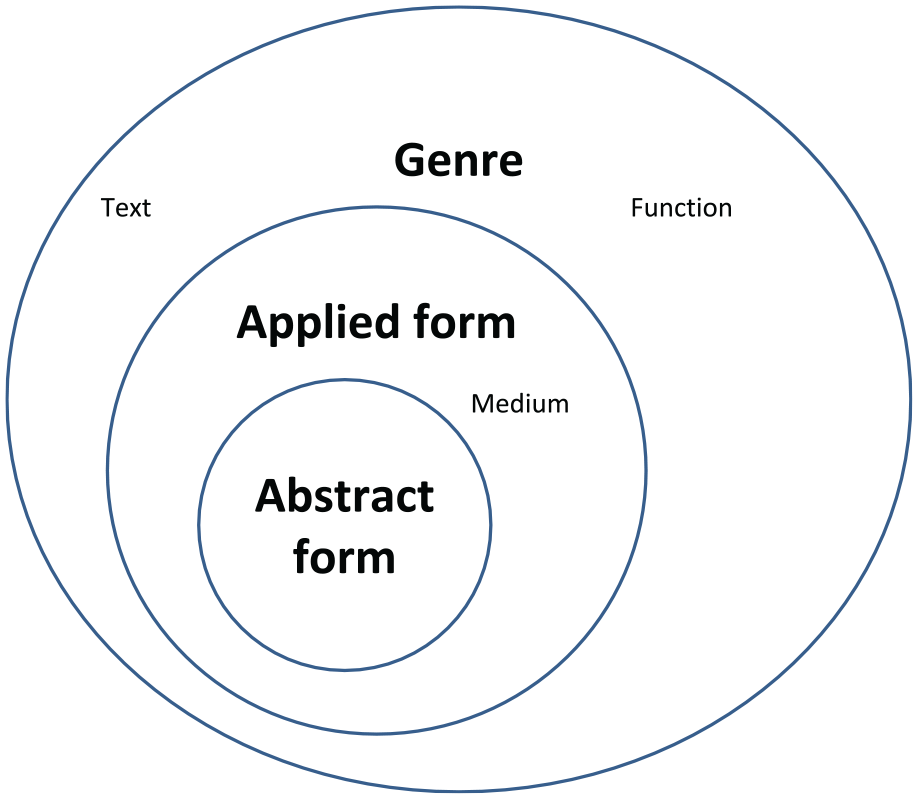
Connections between types of music information relating to form.
In classification terms, having one facet (form) being dependent on – or not orthogonal with – another facet (medium), presents an issue: facets are traditionally defined as being orthogonal [40,41]. However, in reality, many facets are not (entirely) orthogonal. Lee et al. [41] discuss this, stating that there are non-orthogonal sections even to Ranganathan’s Colon Classification, which pioneered the fully faceted classification scheme. So, form can still be a facet even with this dependency on medium, if we follow the precedent of existing faceted classification schemes.
3. Methodology
This research utilises two different methodologies, which are qualitative methods and loosely based on content analysis. Both methods originate in a broader concept of KO than that limited to library and information studies, taking KO as found in scholarly music literature [42]. The first method analyses KO systems (KOSs) of form in the music domain. Ascertaining the music domain’s KO of musical form is difficult, as there is not the foundational domain KOS that we find in other subject areas, such as musical instruments, mental disorders, or chemical elements. Instead, we need to turn to more intrinsic domain classifications: ToCs from music domain outputs, which can be analysed as KOSs. The ToCs could be viewed as being part of Ørom’s [43] third level of KO within an institution, the level for secondary document types which synthesise and organise the domain’s knowledge. The ToC method is not common but does have precedent in KO research. For example, Abrahamsen [44] uses ToC analysis as one method to discuss how music history is organised in the music domain, while Ørom [43] analyses the organisation of a particular art history text including its chapter titles to discuss KO approaches. Nevertheless, this article is innovative in its methodology by the ToCs (and contextual information from elsewhere in the texts) being the primary object of the KO research and source for findings. So we could call this the ToC-as-KOS method.
In this research, the organisational structure of the following 17 books is used, each given with their date for context: Pauer [45], Ouseley [46], Prout [24], Bussler and Cornell [36], Goetschius [47], Tapper [48], MacPherson [49], Morris [50], Leichtentritt [27], Stein [51], Fontaine [39], Cole [25], Kohs [16], Green [22], Berry [34], Spencer and Temko [28] and Santa [29]. They were selected first because each discusses a gamut of musical forms, meaning that they are useful as KOSs of musical form. This general coverage means that almost all the works could be considered ‘textbooks’, and most have a pedagogical focus. They were also selected based on convenience sampling: using only books that were available in printed or electronic form in the city that the researcher lives; focussing on works in English, partly as a consequence of the geographic availability and partly for simplicity. Although one consequence of this is that most of the ToCs reflect the Anglo-American musicological tradition, German music theory is represented in the musicological writings examined – see later in this section.
While the majority of the earlier books are for students of composition (e.g. Prout [24], Goetschius [47]), the later books are largely for those wishing to learn to analyse musical works (e.g. Spencer and Temko [28], Santa [29]) or for students of multiple sub-disciplines of music (e.g. Kohs [16]). So, this is a domain study of musical form from the perspective of multiple sub-disciplines of the music domain, including composition and analysis/music theory. The 17 books are slightly more weighted towards the early- to mid-20th century due to the number of form textbooks published in this period, and this reflects the changing market and motivation for writing general books about musical form. While the books represent a writing period of over 130 years, surprisingly there proved to be few relevant differences in terms of coverage and organisation between the earlier and later publications. The main differences include reference in later books to song forms especially relevant to popular music, and forms which were positioned in a ‘modern’ section in 19th-century textbooks moving to the main categorisations in later books. On the rare occasion where there is a noticeable classificatory difference seemingly based on the books’ dates, this is duly noted.
The ToCs of the 17 books were extracted and analysed. A ToC shows how the information in a book is grouped together and ordered, and the following aspects of the books were determined: the main grouping of material into chapters; the grouping and order of material within chapters where it revealed further classification information; the order of chapters, which was used where possible to ‘calculate’ the order of characteristics of division. From this, various categorisations and classification phenomena emerged. Chapters and sections which were not dedicated to specific types of musical form were generally ignored. Importantly, the terms for the classification of forms found in the books, such as ‘Classification by defineable-ness’, ‘Classification by sectionalisation’ and ‘Classification by medium’ were not derived directly from these sources. The reason for this is that the sources did not usually discuss their internal organisation. Instead, these terms were imposed by the author after analysing the sources, and using the ToCs to calculate how the forms had been classified. In some cases, a known music or music classification term could be utilised and then converted into a label for that classification (e.g. texture, medium), and in other cases, a new term needed to be introduced (e.g. sectionalisation, size of structure). The five terms used for the classifications are discussed in more detail in the relevant sections below.
The analysis is qualitative, apart from the occasional broad statement around the frequency of categorisations, and even these are offered with caution due to the non-statistically representative set of example ToCs. While the ToCs were the main source of classification information, sometimes they needed to be clarified by additional information taken elsewhere in the book. For example, sometimes it was not clear what forms were included in a chapter just by looking at the ToC, or significant section divisions were not listed in the ToC. One methodological issue emerged from this atypical type of KOS analysis: the potential disjuncture between the purpose of a KOS and the organisation of information within a book. Organising information within a book has a number of purposes such as providing a narrative and pedagogical aims, which are not typically shared with other types of KOSs. This means that the categorisations and ordering extracted from the ToCs may not always purely represent the music domain authors’ views on the organisation of musical form knowledge.
The second method supplements the ToCs by adding the qualitative analysis of three musicological writings. Each of these explicitly discusses specific categorisations of musical forms and/or presents a loose classification of musical forms. The three sources are as follows: the hierarchical arrangement and description of various musical forms from Marx’s [35] foundational and seminal essay ‘form in music’ (first published in German in 1856); Green’s [22] explanation of their form categorisations and a typology of formless works; Caplin’s [52] theoretical discussion about specific classifications of musical form. The loose typologies are analysed as KOSs, while a form of content analysis is used for the writings to extract key ideas about the categorisation of forms. (Note that like for the ToCs, the classification of form terms was derived from the analysis (e.g. classification by sectionalisation, classification by medium)), not directly from the sources themselves.)
Finally, it is important to briefly note the various philosophical contexts in which this article is situated. These include the context of the musical works themselves, the categorisation of musical forms and design of musical-form-KOSs, and the authors’ philosophical position to the analysis of these KOSs. As musical form is an artificial construct, used to generalise and abstract features of multiple musical works, the philosophical concept of musical works is not directly relevant for this study. The philosophical positions underlying the categorisations used in this study are interesting – such as the ToCs, other structural features of books, and writings about form. Two particularly pertinent ideas emerge. First, the ideas of form contained within the KOSs are generally founded on formalist aesthetics [23], where the beauty of the artwork is contemplated from its internal structural qualities rather than any external features. Interestingly, we will see in the analysis how non-form features still seep into categorisations of form. Second, the KOSs are based on generalising forms and there being hierarchical categorisations of the universe of musical forms, which in turn lead to the structures of books and typologies that this article analyses. We could consider this to be an Aristotelian (or Aristotelian-type) approach, based on a philosophy of categorisation. Note that despite other philosophical stances about forms making headway during the 20th century, such as poststructuralist and deconstructionist approaches [23], the KOSs found for this study predominantly still take a formalist aesthetic, categorical stance. For example, even the 2010 textbook consulted in this study [29] appears to take a formalist aesthetic approach to form and is organised on categorical principles. Of course, the selection of the KOSs is largely predisposed to a formalist aesthetic, categorical approach: we are looking for sources which provide examples of categorisations in order to analyse them, and categorisations are more probably to exist for internal qualities as these are generally easier to group and generalise. Finally, there is also the philosophical standpoint of this article itself: the analysis and discussion takes a hermeneutic, pragmatic approach [53]. The research acknowledges the KOSs in the time period and contexts in which they were written, as well as discussing the KOSs as practical objects written to organise the domain of music.
4. The classification of musical forms
When analysing the ToCs and writings about music, five categorisations of musical form emerged. They are discussed in a logical and narrative order. Note that in all cases, the categorisations are not explicitly named in the sources; instead, they are deduced and labelled by the author.
4.1. Classification by texture
The music domain classifications indicate a key categorisation: division into homophonic and polyphonic forms. Put simply, homophony describes music which usually consists of a single melody and a clearly defined accompaniment; whereas, polyphony sees multiple, independently moving parts. While the ToCs and other sources do not explicitly give this categorisation a name, we can label this as classification by texture, as homophony and polyphony are generally considered to be two categories of texture [54–56]. Note that the ToCs and other sources often do not label homophonic and polyphonic forms collectively, so we infer this grouping from the specific forms which are named in the chapter or section titles. When the categories are given, it is usually only polyphony (not homophony) and often a synonym is used: for example, Leichtentritt [23], Stein [27] and Cole [25] use the term ‘Contrapuntal forms’ and Santa [29] and Spencer and Temko [28] use the term ‘imitative forms’ in their ToCs, both of which are synonyms for polyphony. Despite these alternative names, this article imposes the terms homophony and polyphony on these categories due to this seemingly standardised use in definitions of texture – see below.
However, what about the categorisation – texture – itself? Texture is a notoriously difficult concept to define in abstract – see, for example, how De Souza [56] starts their chapter about texture with positing the categories of texture, rather than attempting to define texture itself. When music experts define texture, there tend to be two areas of meaning: the combination of different lines of the music (‘the vertical aspects’) [55] or the ‘coordination of parts’ [56] (p. 161); and, ‘material qualities of sound, involving timbre, density, and register’ [56] (p. 161). For the purposes of this study of musical forms, we use the term ‘texture’ as the first of these meanings. Interestingly, writings on texture discuss its categorisation into four or two categories. De Souza [56] starts their writing on texture by saying it is ‘… commonly described in terms of four categories’ (p. 160), which are given as monophony, homophony, polyphony, and heterophony; meanwhile, Dunsby [54] uses the same four categories as associates of texture but also suggests these categories are not actually ‘categorically distinct’ (p. 49). Meanwhile, the definition in [55] talks of a distinction in types of texture, and gives the two categories as homophony and polyphony. (Note that monophony and heterophony are unlikely to be useful for distinguishing the musical forms found predominantly in musical form textbooks, due to the types of music they typically pertain to. So these two categories are not discussed further.) So, we can see that classifying textures into categories including homophony and polyphony is a known domain categorisation.
The music domain sources reveal that the division between polyphonic and homophonic forms is an important categorisation: it appears unequivocally in all the music sources examined, especially the grouping together of all the polyphonic forms. For example, Cole [25] has a chapter specifically for the fugue, one of the important polyphonic forms; the division between polyphonic and homophonic forms is the top level of hierarchy in Marx’s typology [35]. A number of interesting aspects of this texture categorisation can be understood. The ToCs indicate the importance of the fugue as a form: for example, the organisation of Morris [50] suggests that the polyphonic forms are measured by their relationship to the fugue, with chapter titles of ‘the antecedents of fugue’, ‘the fugue’, ‘special types of fugue .’… Related to this, some of the ToCs put canons after fugues despite fugues typically being the more substantial form. We could interpret this as a flow from less strict structure (fugues) to more strict structure (canons) – a sort of order by definable-ness. Furthermore, for polyphonic music in particular, there is an interesting question about polyphony as a composition process versus polyphony as a form, which then potentially obscures form as a type of information. The fugue-as-process-or-structure is a debate in musicological writing [29].
In books which include both polyphonic and homophonic forms, the texture categorisation is sometimes the primary one (e.g. Morris [50]). Furthermore, in almost every source consulted the texture classification occurs at least before the division by sectionalisation – see section below – suggesting that different criteria are needed to subdivide homophonic and polyphonic forms. Interestingly, a few of the (later) books offer an exception to this, such as Santa [29], Spencer and Temko [28], and Khos [16], where the chapters about polyphonic forms bisect the harmonic forms and interrupt the classification by sectionalisation taking place within homophonic forms. We could surmise that this is for pedagogical reasons: for example, Santa [29] explains in his introduction that there was a need to teach contrapuntal forms before certain more complex homophonic ones. This opens up an interesting idea about curriculum-based or pedagogically-driven KO. In some sources, only homophonic works are covered at all, such as Goetchius’s [47] and Bussler and Cornell’s [36] textbooks. Here, we could argue that texture categorisation is still present and is actually more powerful: the texture categorisation is a shadow categorisation that is illuminated by what is absent – polyphonic forms.
4.2. Classification by sectionalisation
Within the homophonic forms, a significant classification occurs by how the work is divided into sections. ‘Sections’ is a term used in music writings to refer to large blocks of music making up a form. For example, a sonata form may be defined in part by its number of sections: ‘A typical sonata-form movement consists of three main sections .’.. [38]. So, a division of musical forms by sections is the number of sections the form is divided into (e.g. binary form versus ternary form), the separation between so-called simple and compound forms (e.g. simple ternary form versus trio form) or the types of connections between sections (e.g. the exposition and recapitulation of that exposition at the basis of a sonata form versus the series of thematic variants which characterises the themes and variations form). This category has been labelled by the author as ‘Classification by sectionalisation’, to show how this categorisation is the idea of thinking of forms in terms of how they can be divided into sections.
The division into number of sections – usually two (binary form) or three (ternary form), but occasionally later textbooks also include a one-section form as well – is shown to be a strong division in music domain classifications of form, and will be the main focus of this discussion about classification by sectionalisation. For example, Macpherson [49] describes the binary/ternary division as ‘a custom’ (p. v), and Caplin [52] presents it as one of a number of ‘binary oppositions’ (p. 22) in a pedagogical exercise with students about defining form. All the ToCs have evidence of classification by this type of sectionalisation, whether by having named chapters for binary and ternary forms, implicit chapters for them without using these terms, or strong divisions within a chapter to separate out the binary and ternary forms. However, the ToCs do not all necessarily keep every chapter about types of ternary form together: for example, in Fontaine [39], chapters for the more complex ternary forms of rondos and sonata forms do not follow on immediately from the early chapters which cover simple ternary forms. It should also be noted that the placing of forms into the binary or ternary categories is not always straightforward, with, for example, Prout [24] and Machpherson [49] engaging in much discussion (and intellectual disagreement) about the placement of the rondo within the binary/ternary categorisation.
The sonata form plays an interesting role in form classifications. It developed from existing ternary forms, and then itself spawned variations on its structure, such as the sonata-rondo. The sonata form appears to occupy a position of importance in the ToCs, with most sources having at least one chapter for sonata forms and some framing other forms as variations or extensions of the sonata form. Furthermore, sonata forms present some fuzziness between form and genre: there is the form of sonata form; the typically three-movement form called a sonata but could be considered to be a genre; and the genres such as overtures, concertos and other types of work which utilise the sonata form as their structural base.
4.3. Classification by size of structure
The ToCs illuminate a fascinating characteristic of division based around what size of structure the form covers. Not only does this characteristic of division help to explain the classification of musical forms, it also introduces some intriguing ideas about categorising the connections between different parts of the musical work. Essentially, this categorisation separates out forms which describe a single movement of a musical work, and forms which describe the structural features of a combination of movements. (A movement is a portion of a musical work, and these portions are normally separated by a short duration of no music [57], though determining where one portion truly ends or is just a pause is not always straightforward.) For example, sonata form, fugue, and binary form, are forms which depict a single movement; conversely, the sonata and symphony describe multiple movements as well as the relationships between those movements – though to complicate matters, these examples are also questionably on the form/genre boundary as they also could be said to depict medium and function. Again, a ready-made term is not available for this division, even though the difference between a single movement and a combination of movements is easily identifiable. So, the term ‘size of structure’ has been introduced by the author, to describe the division. (Note that ‘number of movements’ was not selected, due to the complications of single-movement works, as described below.)
Prout [24] defines the forms of entire musical works as ‘… works in which two or more movements are combined to form a homogenous whole’ (p. 242). From this definition, we can see how this categorisation is based both on number of movements yet also hints at something more: the whole-work form is also about the connections between each movement. Terminology varies for what we should term the resulting categories. For example, Prout’s [24] choice of term for whole works – cyclical forms – is interesting, but different sources use it to encompass different things. So, this article will use the invented term of ‘intra-movement forms’ to describe the structures of individual movements and ‘inter-movement’ form when describing the structures of multiple movements.
Most of the ToCs and writings about the classification of forms illustrate a clear categorisation between intra-movement and inter-movement forms (e.g. Prout [24], Macpherson [49] and Stein [51]). There are a few notable exceptions where the intra- and inter-movement forms are dealt with together (e.g. Tapper [48] and Santa [29]) or the unusual case of Fontaine [39] which appears not to include multi-movement forms at all. Correspondingly, classification by the size of structure – when it is present – is generally a more primary division than classification by sectionalisation. So, when intra-movement forms and inter-movement forms are separated, the resulting scattering would see, for example, the sonata form in one place while the whole sonata would be discussed many chapters later. The categorisation of forms by size also illuminates an interesting whole-part relationship between a whole composition and its constituent movements.
There is an intriguing question about a third category of size. Some types of musical work only consist of a single movement, such as the overture or fantasy, and there is a question about how these are classified. This also questions the exact units of the size categorisation: is the division by size about the number of movements being discussed, the form being the form of the whole composition, or about the relationship between the whole and the part? For instance, the first of these would see the overture classed with sonata form, the second would see the overture classed with the whole sonata, whereas the third would see the overture in its own category with other forms which were similarly complete in one movement. On a conceptual basis, classification by size could be considered as a ‘classification by partitive relationship’. This would result in three – not two – types of musical form: single movement forms (the part in the whole-part), multi-movement forms (the whole in the whole-part) and forms of the whole work where the part is also the whole. These three types of forms-by-size are depicted in Figure 2 which shows their relationships to various parts of the musical form, and also models the relationships between the forms of individual movements and the whole composition. In terms of how music domain classifications treat the one-movement forms, there are mixed results; in fact some ToCs (e.g. Pauer [45]) have much space dedicated to intra-movement forms and complete-in-one forms, but no space for the inter-movement forms (such as the sonata). Ultimately, there is an important categorisation of musical forms by the size of the form being discussed, but there is not necessarily agreement (or awareness) about the exact quality being categorised.
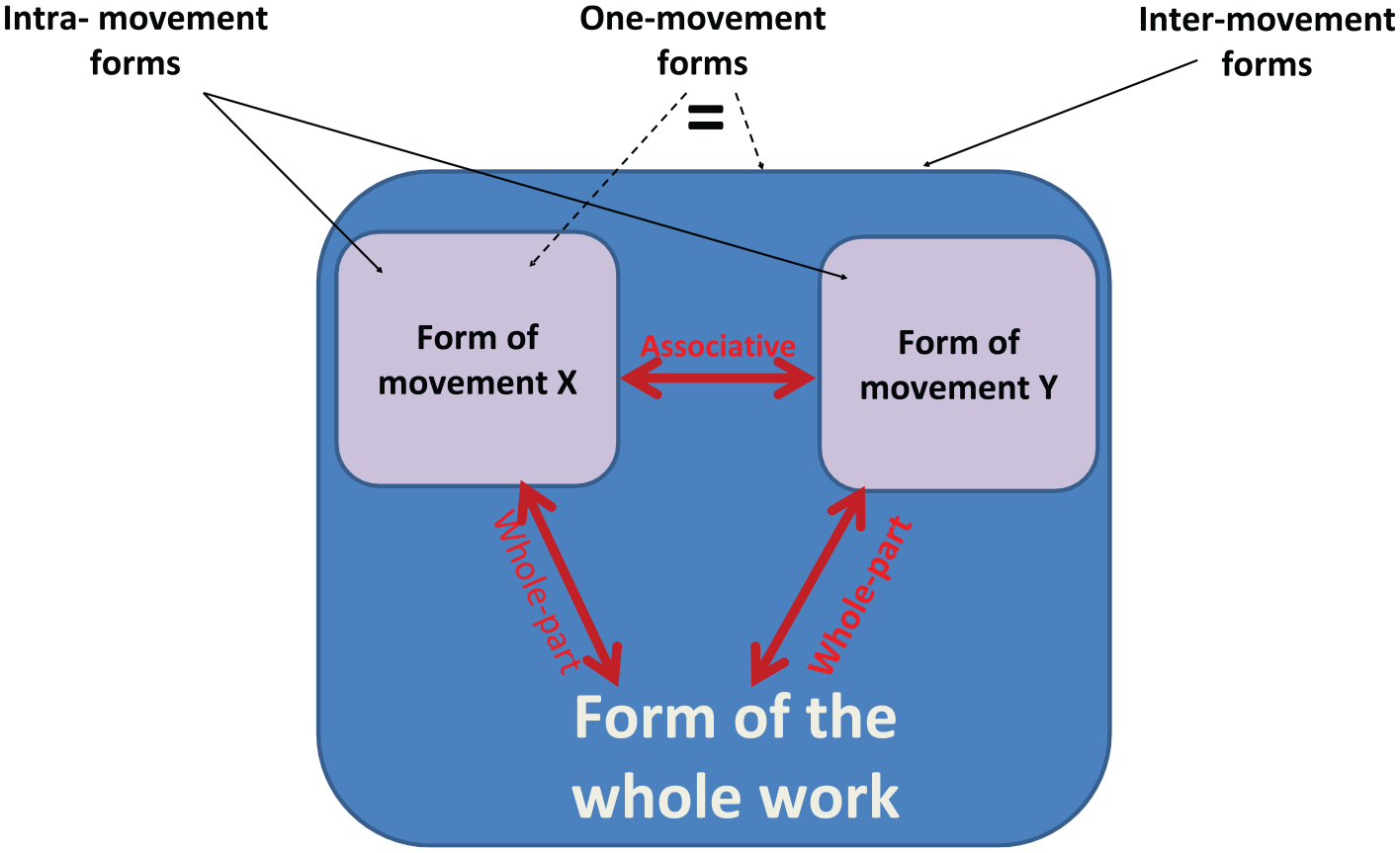
The classification into intra-movement, one-movement and inter-movement forms.
As a postscript, we could view the classification by size of structure and classification by sectionalisation to be two parts of the same thing. At their essence, they both classify forms by their structure: they are just using different sizes of building blocks, especially if we consider that the difference between multiple sections within a single-movement work versus a work in multiple movements can be hazy. In fact, we could think of this categorisation as division (classification by sectionalisation) versus multiplication (classification by size of structure). Even the whole-part relationship between forms of the whole and of individual movements (see Figure 2) could be potentially applied to an intra-work form and its sections – indeed, see Lee’s [58] proposition that there are hierarchical relationships within intra-work forms. So, while enjoying different uses and priorities in domain classifications, conceptually we could also think of there being a classification by structure which encompasses both classification by sectionalisation and by size of structure.
4.4. Classification by definable-ness
As well as different types of form, the music domain KOSs point to an additional categorising quality: whether the form is defined or instead is considered to be free. Furthermore, this quality also accounts for the different ways a composition may deviate from one of the standard forms and to the degree of that deviation. This characteristic is usually describing a freedom from a closed set of standard forms, rather than an absence of form. Indeed often these sections also include the so-called free forms which have names, such as the fantasy, fantasia, and more. Unlike the other classifications considered so far, this characteristic is found in only a selection of the ToCs (e.g. Prout [24], Macpherson [49], Stein [51], Leichtentritt [27], Ouseley [46] and partially in Fontaine [39]), as well as discussed explicitly in writings by Green [22] and Marx [35]. Terminology is complicated for this quality. The labels for the resulting categories vary in the sources, so this article uses the terms ‘defined forms’ and ‘undefined forms’. The idea of ‘definable’ has been deliberately used here, in order to encompass a wider category than just the so-called ‘free forms’. As there is no standard name for this idea as a characteristic or in English, this article creates the somewhat clumsy invented word of ‘definable-ness’ for this division.
Unsurprisingly, the sources place indefinite forms near the end of the classifications, sometimes even after multi-movement forms. In KO terms, the result will be that homophonic free forms – and by definition, polyphonic forms cannot be free as the polyphony is governed by rules as to its construction – are scattered from other homophonic intra-movement or one-movement forms. However, just because the undefined class is near the end of the KOS, does not mean that this division is unimportant: in fact, in many cases, we could surmise that it is one of the first characteristics of division applied. Whether the absence of form is a form itself though, is an interesting question. Perhaps this division based on definable-ness is a meta-categorisation of musical forms, as it could be argued that it pertains to the attributes of form rather than being a type of form.
The quality of undefinable-ness could be stretched to encompass the forms which are deemed to only exist within a single musical composition. Green [22] discusses this phenomenon in detail, and his five categories offer up what we could interpret as a typology of such forms/compositions: uniqueness by combination of forms; existing thematic structure but using the tonal structure of another defined form; existing thematic structure but using a unique tonal structure; standard tonal structure but using a unique thematic structure; unique thematic and tonal structure. This typology highlights that there are different types of information at play in forms, with tonal structure and thematic structure occupying separate dimensions. It also presents an interesting idea around combination of classes, an idea which is echoed in Fontaine’s [39] penultimate chapter which includes a section for ‘hybrid forms’ among its free forms of fantasies, toccatas and etudes. Furthermore, the existence of Green’s typology [22] also further accentuates the importance of KO of forms to music experts. It is important to note that in most examples from the music domain, chapters or writings about undefined forms are concerned with the types of (undefined) forms, rather than assessing how far any individual composition fits into a category of a specific (defined) form. This means that the quality of undefinable-ness is not quite the same as fuzziness in discussions about logic.
So, we could see the characteristic of definable-ness as existing on a scale. Figure 3 visualises what this might look like: it sees named free forms such as the fantasia as a point along the progression of free forms, the unique forms categorised according to a reworking of Green’s typology [22] as points along the progression of free forms, then the conceptual idea of every composition embodying its own completely individual form as the natural end-point of this scale. Interestingly, Figure 3 also suggests that if there are variations of the definable-ness in undefined forms, there might also be degrees of definable-ness within defined forms. We have seen this idea already when discussing texture: sometimes different polyphonic forms are distinguished from each other by the rigidness of their compositional instructions. So, we could perceive the strict musical form of the canon sitting firmly on the left hand side of the diagram, with the fugue a little further along the decreasing definable-ness spectrum, and with both being more rigid than the homophonic forms, which sit much closer to the defined/undefined boundary. This approach demonstrates a novel framework for thinking about the categorisation of musical forms and perhaps could be applied to the classification of other artforms.
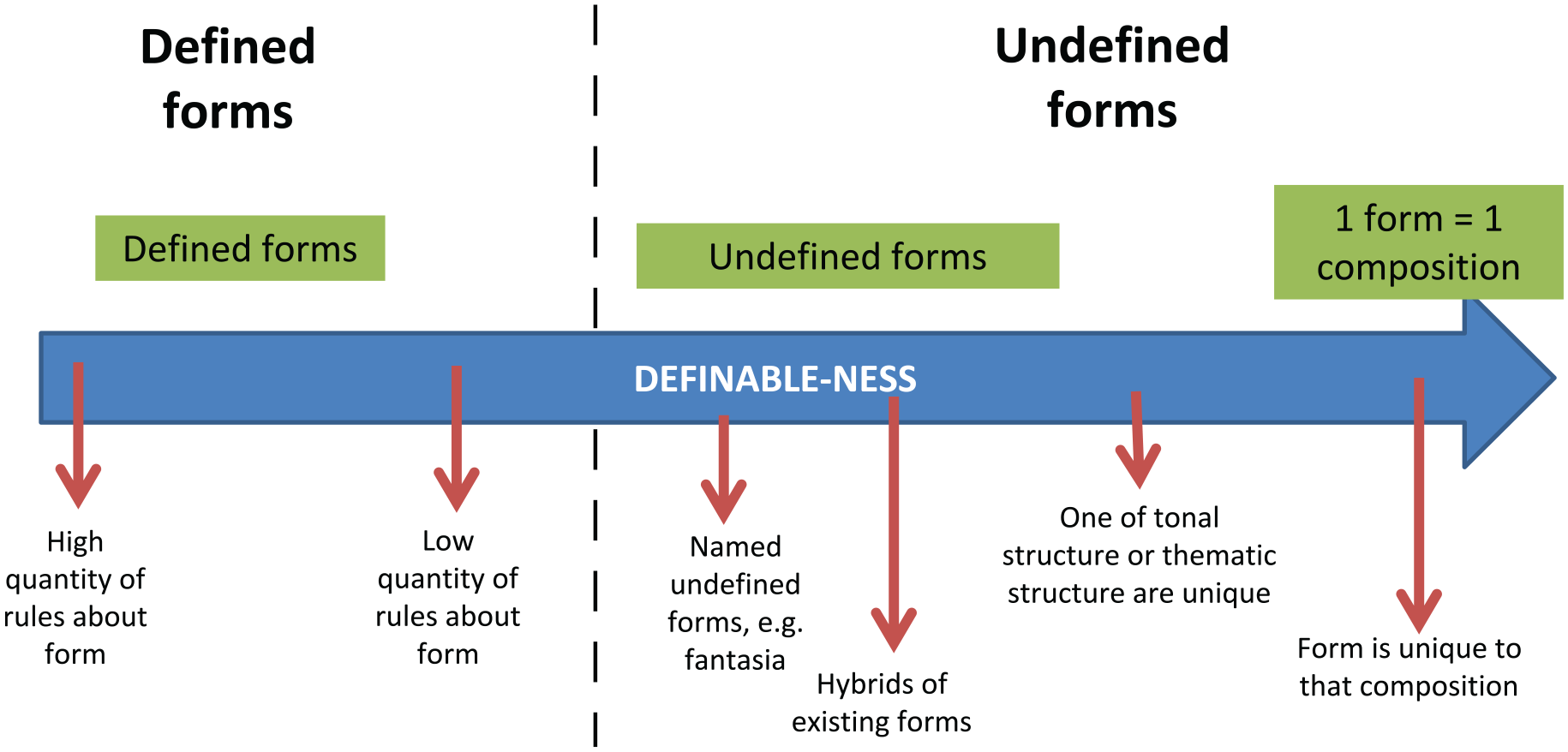
The definable-ness classification.
4.5. Classification by medium
Finally, the examination of domain classifications of forms indicates another classification in place: division by medium, which is the forces needed to play or sing a musical work, and in particular the division between vocal forms and instrumental forms. Like the other divisions, the term ‘medium’ is imposed on these classifications, as the sources do not label the divisions used to organise the forms. However, the term is a standard one for classifying music (see, for example, Elliker [2], Lee and Robinson [6]).
In general, the works consulted either virtually exclusively covered forms which were associated with instruments, or, instrumental forms were the norm and vocal forms had minimal space and were only covered in outlying chapters (e.g. Prout’s [24] final chapter for vocal forms, or Morris’ [50] appendix covering vocal forms). The importance of the division by medium is neatly encapsulated by Bussler and Cornell’s [36] discussion and short typology of forms: this typology has a top division of form by instrumental and vocal categories, and then moves on to categorising form by the different quantity of players/singers. Note that in some sources there are interruptions to this categorisation: fugues are a form which can be vocal or instrumental, some of the sections on simple binary and ternary forms are equally applicable to vocal music, and some discussions about specific forms document their move between vocal and instrumental mediums (e.g. Leichtentritt [27]). Nevertheless, we have a primary division of forms based on the categorisation from another facet (medium), and this is worthy of further consideration.
Possible reasons for these divisions and the dominance of instrumental music can be extracted from the music literature. Macpherson [49] states explicitly that his work focuses on instrumental music because he believes that design is more pronounced in the absence of words or drama. From a classification perspective, this suggests that the facet of form is dependent on the presence of non-medium qualities such as dramatic function or text. Green [22] suggests that unique forms – in other words, forms which have no definable-ness – are much more common in vocal music, giving examples of opera finales and oratorio movements. So we could hypothesise that perhaps one reason that vocal forms are ignored or not prioritised is their lack of defined form, rather than their vocal-ness per se.
The stark difference between instrumental and vocal forms asks some complex questions about form as a type of information. First, if form mostly only applies to one set of musical compositions then it might have an impact on form’s position as a facet within other KOSs, such as bibliographic classification schemes. Second, the issues with form could be part of the general issue of form and genre-sharing space. For example, different types of opera are considered to be sub-genres not ‘sub-forms’, even if those opera sub-genres are defined by their structural information. From a KO perspective, the division and different treatment of forms associated with vocal versus instrumental mediums provide more perspective on the seemingly conjoined form/genre facet.
5. Conclusion
This article explored how musical form works as a classificatory device. The general discussions about musical form in ‘Introducing musical form’ introduced the idea of form, while ‘The classification of musical forms’ revealed five major characteristics of division which also hinted at connections to other types of music information. So, a depiction of musical form as a facet is presented in Figure 4, which visualises the facet of musical form from the perspective of the music domain.
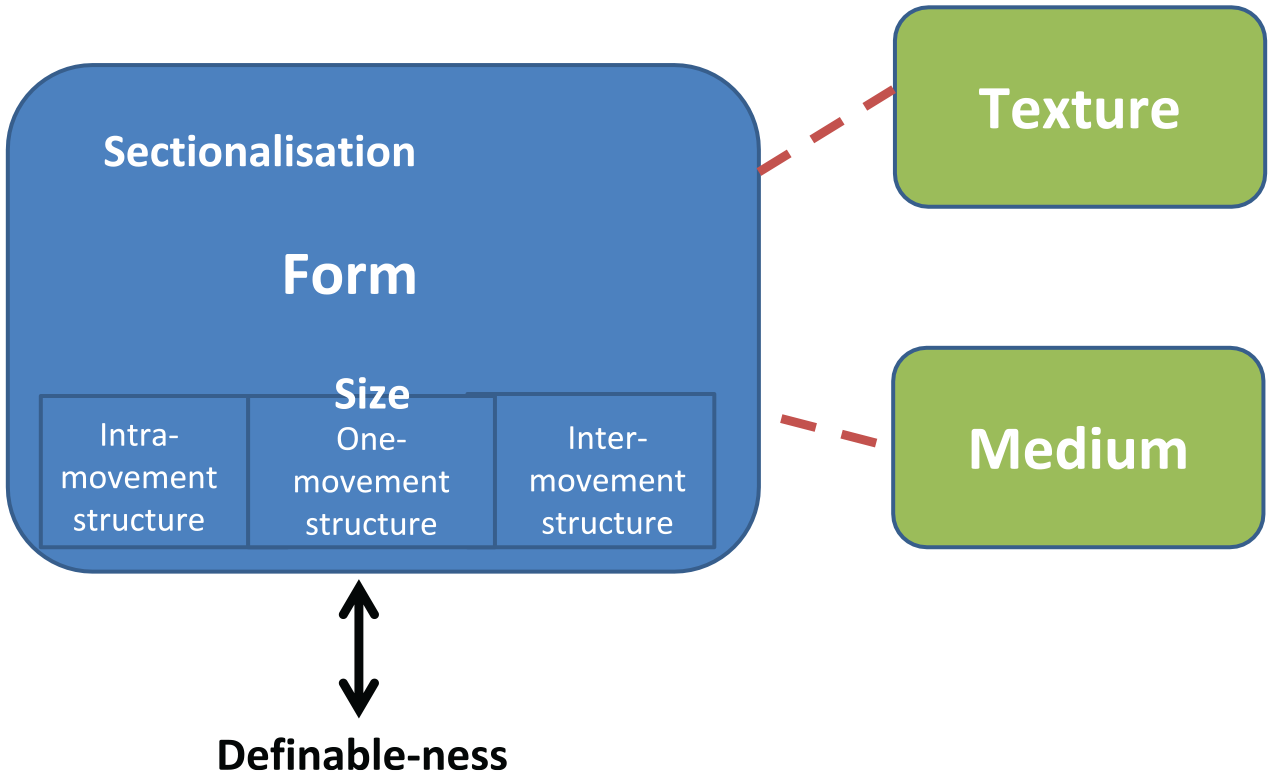
The facet of form from the perspective of music domain KOSs.
Three types of relationship are presented in Figure 4. First, the facet is shown as being centred on structure: it is split between intra-movement/one-movement/inter-movement forms, and the intra-movement structure of sectionalisation is also indicated. Second, definable-ness, which shows how forms are divided into those considered to be defined and standard and those which are not, is depicted as an arrow. This is to indicate the ‘meta’ quality of this categorisation device. Third, this model posits that some of the classifications discussed earlier are actually connections to other facets. So, the classification by medium, especially the division between vocal and instrumental forms, is actually a connection to another facet. This resonates with the findings in Lee et al. [41], which argues that there is a strong dependency between the medium and form/genre facets, especially the vocal/instrumental categorisation. Classification by texture is also presented as a separate, but dependent facet, but it presents a conundrum. Texture is arguably a separate type of information from form, as it describes how the different lines of music interrelate, and we have seen how some forms such as the fugue are considered to be a composition method rather than a form. Yet texture is not a universally established facet in the KO literature in the same way as medium, and even if texture is a composition process, it is one which arguably is specifically about creating a form. We could relate texture to the earlier discussion about form versus content: texture-as-content is separate from form, but also cannot exist without it (see ‘What is musical form?’).
However, these connections to other types of music information as depicted in Figure 4 do not detract from form’s existence as a facet, as they occur in the characteristics of division within the form facet rather than in defining it. Earlier, we utilised the following definition of a facet: ‘a group of terms within a subject field produced by one broad principle of division’ [5] (p.382). Using this definition of facet as a guide, the findings of this article including Figure 4 do not appear to unseat ‘form’ as a legitimate facet of music, despite the complexities of the characteristics of division within it.
This article makes three key contributions to KO research. First, it looks at a type of information – form – which is seldom considered in KO and which has value for music classification and beyond. The findings suggest that form is an interesting type of information, as different types of structure can be differentiated both on information directly related to structure and that which is not – see the dependent facets of texture and medium in Figure 4. Furthermore, as form constitutes part of one of the most significant facets of music in bibliographic classifications (form or form/genre), this study is also the first step in a future study in bibliographic classifications of music, and importantly, for developing a much fuller understanding of music information. This research about form could be usefully extended, to look at the classification of structures within other types of music, such as Folk music or Blues, and future research could ask whether similar classifications of musical structures are found in these musics. This article’s findings could also be extended to other arts, for example, looking at how literary forms are classified or typologies of form within architecture. As form and formal analysis are considered a critical – and complex – part of the history of art [59], it seems appropriate in future research to draw together the findings of this study of the classification of musical forms, and studies of formal analysis in art history. Furthermore, form research built from this article could examine the connections between form as a type of information across many different art-forms, and engender further understanding of interdisciplinary classification – perhaps bringing to life the ‘metalanguage’ [59] (p.372) of formal analysis across all art as suggested by Summers.
Second, this article furthers research in domain classifications, adding to literature which focuses on KO within the (scholarly) music domain. Furthermore, this article adds to general knowledge about domain classifications in its use of a non-traditional, implicit classification: ToCs. It shows the value of extracting quasi-KOSs, in order to understand the KO of those creating scholarly domain knowledge, and builds on KO’s sporadic previous examples of the ToC-as-KOS method. In addition, this article shows some of the limitations of the ToC-as-KOS approach, for instance, the difficulties in determining the order of characteristics from a ToC.
Third, an interesting idea about pedagogical KO emerges from the ToC analysis. Santa’s [29] explanations about his chapter orders suggested a type of KO that is based on curriculum needs. Santa’s [29] order and grouping of topics was focused on pedagogy. For example, two unrelated subjects had to be early enough in the ToC to allow for a later subject which pedagogically included ideas from both subjects, which meant scattering related topics and splitting up the topic-based organisation of this book. Also, certain sub-topics were deliberately repeated across the book for pedagogical purposes, which is counterintuitive to traditional KO which prefers similar topics to go together and no repetition of topics. Contemplating curriculum and pedagogy through a KO lens would be a fascinating future strand of research, and would build on Szostak’s [60] work on using KO as a basis for textbooks. Such emerging discussion about pedagogical KO would add to the important contemplation of KO’s usefulness.
In conclusion, this article has taken a novel look at music classification by considering a hitherto understudied yet rich type of music information, and one whose classification seems fascinating to those in the music domain. Moreover, in understanding the classification of musical forms, we are closer to understanding the classificatory nature of music itself.
Footnotes
Acknowledgements
The author would like to thank Prof. Philip Hider for his insights and feedback when reading a late draft of this article, as well as his support for this research.
Declaration of conflicting interests
The author(s) declared no potential conflicts of interest with respect to the research, authorship, and/or publication of this article.
Funding
The author(s) received no financial support for the research, authorship, and/or publication of this article.
