




Abstract
Several authors emphasise the need for a change in classification theory due to the influence of a dogmatic and monistic ontology supported by an outdated essentialism. These claims tend to focus on the fallibility of knowledge, the need for a pluralistic view, and the theoretical burden of observations. Regardless of the legitimacy of these concerns, there is the risk, when not moderate, to fall into the opposite relativistic extreme. Based on a narrative review of the literature, we aim to reflectively discuss the theoretical foundations that can serve as a basis for a realist position supporting pluralistic ontological classifications. The goal is to show that, against rather conventional solutions, objective scientific-based approaches to natural classifications are presented to be viable, allowing a proper distinction between ontological and taxonomic questions. Supported by critical scientific realism, we consider that such an approach is suitable for the development of ontological Knowledge Organisation Systems (KOSs). We believe that ontological perspectivism can provide the necessary adaptation to the different granularities of reality.
1. Introduction
The term Knowledge Organisation Systems (KOSs) includes different artefacts that are commonly grouped together and are the results of distinct organisational processes, usually conducted in an intentional and informed manner on a given domain of knowledge. Common to these KOS is the act of classifying, understood as the most indispensable process for their construction [1–3]. This might also suggest that all KOSs are classification systems, something that in some way may cause confusion and ambiguity since the term is also used to designate a specific kind of KOS. Even, as Gilchrist [4] points out, considering some overlaps between thesauri, taxonomies and ontologies, when we look at their applications, they remain different systems. Thus, it is important to stress that we are referring here to the procedural aspect of classifying, somewhat akin to the wide meaning of classification proposed by Hjørland [5], (p. 99): ‘the process of distinguishing and distributing kinds of “things” into different groups’.
Several authors [6–9] stress the need for change in classification theory. The main concerns implied by these authors are related to the influence of a dogmatic view associated with a monistic ontology supported by an outdated essentialism. Although they may vary in intensity and detail, the claims and respective solutions focus on the fallibility of knowledge, the need for a pluralistic view, and the theory-ladenness of observations. Although these concerns are legitimate, they need to be carefully approached and perhaps moderated, not to fall into the opposite relativistic extreme.
We believe that a middle-ground between positivist and relativist approaches is needed in both theory and practice. Some proposals in the direction of a moderate realist approach in the Library and Information Science (LIS) literature are: Mingers’s [10] ‘Critical Realism’, Jashapara’s [11] ‘Realist Theory of Organisational Knowledge’, Kleineberg’s [12] ‘Classification-as-Ontology/Epistemology’, Frické’s [13] ‘Augmented Reid’s Theory’ and Ridi’s [14] ‘Moderate Constructivism’.
Based on a narrative review of the literature, we intend to contribute with an additional instance of the discussion about the theoretical foundations of classification. Specifically, the aim of this article is to reflectively discuss the theoretical foundations that may serve as a basis for a moderate realist position supporting objective criteria regarding pluralistic ontological KOS. To achieve this, different approaches to the notion of natural kinds and the possibility of differentiating the taxonomic question from the ontological question are discussed. The discussion is preceded by a presentation of the generic realist thesis, focussing on the two fundamental dimensions (existence and independence) of the thesis. Then, we address some concerns with realism raised by LIS authors and a brief discussion about the relation between scientific, common-sense and naive realism. This article also addresses the real and ideal existence as a criterion for ontological analysis, and also the conflation between ontological and linguistic questions.
2. Existence and independence as two dimensions of realism
The terminological issues around the term realism are rooted not only in its polysemy but also in the lack of a straightforward and clear-cut choice between being a realist and a non-realist about a particular subject. According to Miller [15], it is possible for a person to be selectively realist about various topics and more-or-less realist about a particular subject. Generically, the realist thesis postulates the existence of a set of entities and their properties to which independence from beliefs and linguistic practices is ‘granted’ [15]. We could say that realism is about the possibility of obtaining a description of what the structure of the world will be. The opposite stance claims that only our representation of the structure of the world can be accessed, sometimes even completely denying its existence. These two possibilities of a non-realist position are respectively related to one of the two fundamental dimensions of the realist thesis – that of independence and that of existence [15].
Although it could be argued that those who denied the existential dimension do it only partially, ‘people are only ever non-realist about matters with which they are not practically engaged’ [16], (p. 6). The situation is directly related to the impossibility for a sceptic person to truly and fully live their scepticism, in that they must suspend all judgements about reason, belief, and truth. The consequence is that: ‘when one has seen how radically the skeptic must detach himself from himself, one will agree that the supposed life without belief is not, after all, a possible life for man’, as Burnyeat [17] (p. 235) concluded.
This is not to say that one should discard the arguments of sceptics’ all together, as they are embodied in science’s ethos [18]. The key issue is moderation since an integral nihilist would have serious difficulties living in society, as Bunge [19] suggested. It would not be an exaggeration to say that, ultimately, human behaviour is underpinned by realist assumptions (that even when they are not explicitly stated, they are implicit in their actions). However, there are still many ways to be ‘more-or-less’ anti-realist about some particular subjects. In addition, even within the spectrum of so-called realist theses, we can find more-or-less explicit anti-realist features, making them realist only in name. Examples are Lewis' [20] modal realism and Putnam's [21] internal realism. In the latter, the world’s structure is presented as relative to conceptual frameworks [20], while in the former it is stated that whatever is conceivable exists simpliciter, regardless of its real or logical existence [21]. In these two theses, the dimensions of existence and independence seem more aligned with idealism or nominalism. Interestingly enough, the historical use of the term realism is linked to the opposition of both theses: ‘before Kant, realism usually meant anti-nominalism. After Kant, it usually meant anti-idealism’ [22] (p. 108). These theses tend to be part of the same mentality to which the position designated by the term realism is opposed.
Whichever relation we may see between nominalism and idealism, such positions can be logically distinctive. Although, as in almost every issue related to epistemic positions, this distinction can be complex. Nominalism can be linked to the negation of the existential dimension of realism, and idealism to the negation of the one of independence [15], or the other way around: ‘idealism is a thesis about existence. In its extreme form, it says that all that exists is mental, a production of the human spirit’ [22] (p. 108, emphasis in original). In contrast, even the extreme nominalist would not deny the existence of concrete individuals [23,24], but may introduce a total independence negation in the way we classify: ‘nominalism is about classification. It says that only our modes of thinking make us sort grass from straw, flesh from foliage. The world does not have to be sorted that way; it does not come wrapped up in “natural kinds”’ [22] (p. 108, emphasis in original).
With this epistemological background, even discarding theses that are only realist in the name, realism is not a homogeneous current, but a spectrum of more or less aligned positions built up onto the subscription to the independence and existence dimensions. Within that spectrum, the variety of realism proposed here is moderate not only because it stands between relativistic positions and dogmatic or naive ones (we will address this issue in Section 4), but also due to a connection with the historical moderate realism of Aristotle: Aristotle held that we could explain universal cognition by appealing to a process of intellectual abstraction from what is received in sensation from sensible objects. However, Aristotle also suggested that our universal cognition has an extramental basis in the natures of sensible objects. Though he rejected a radical form of realism that posits universals as Platonic Ideas, he nonetheless accepted a kind of ‘moderate realism’ that takes universals to have a kind of existence in the natural world [25] (p. 2).
The value of the Aristotelian thesis can be attested by its recurrent use. Historically, for example, it was used as the basis for scholastic moderate realism [26]. In our time, and directly connected with KOSs, the importance of Aristotle’s studies for the field of formal ontology is highlighted by several authors (e.g. [27,28]), and its theory, duly updated, is actually used in more than one classification artefact (namely in the Basic Formal Ontology [29] and in the Unified Formal Ontology [30]). Given the antiquity of Aristotle’s works, their current use is remarkable, and their updating is perfectly expected. In that respect, our position is aligned with Arp et al.’s [29]: ‘we depart from Aristotle in a number of ways, however, many of which have to do with the fact that Aristotle lived before the Darwinian era’ (p. 14). This particular issue will be addressed in Section 5.4, while in the following section, we will focus on the discussions about realism in the field of LIS.
3. Some concerns with realism in LIS
Although the focus of the present article is the discussion of the ontological dimension of KOSs, the question of realism cannot be disconnected from epistemological and methodological questions. In relation to this, there seems to be some conflicting views in LIS on the concepts of realism, objectivism, positivism, empiricism, interpretivism and relativism, among others, in the literature. Wildemuth [31], in her paper on post-positivist research in LIS, suggested that the difference between positivist and interpretive paradigms is that the positivist recognises an objective reality that is not dependent on the researcher and the interpretative paradigm sees reality as subjective and socially constructed. This idea has been echoed, for instance, by Olson [32], while talking about the methodological aspects of the area, who also cited Morgan and Smircich [33] on the ontological and epistemological difference as follows: They devised a spectrum from subjectivist to objectivist which embodies ontological stances of reality as a project of human imagination/socially constructed to reality as a concrete process or structure; and the epistemic stances of knowledge for the purpose of revelation and for understanding of social construction to knowledge for construction of a positivist science [32] (p. 4).
In Olson’s interpretation of this for knowledge organisation and the construction of KOSs [34], while an example of epistemic stance on the subjectivist extreme would be poststructuralism (that assumes multiple realities), an example of epistemic stance on the objectivist extreme would be empiricism (that sees reality as a concrete structure and aims to construct a positivist science). Bawden and Robinson [35] summarise the following view in relation to the relevance of philosophy in information science: A realist perspective, for example, asserting that an objective external world exists, and we can understand it to an extent, underlies the systems paradigm in information science, and research methods such as experiment and quantitative surveys. A constructivist or constructionist perspective, asserting that reality is, at least to a degree, subjective, and created by individuals and groups, underlies the cognitive paradigm, and a preference for holistic and qualitative research, focusing on individuals’ knowledge and experience [35].
Later on, in the context of methodology and information research approaches, the authors state that: A rough distinction can be made between studies conducted from a positivist viewpoint, where it is assumed that an objective reality exists, which the researcher may identify and study, and those conducted from a constructivist or interpretivist viewpoint, which assumes that reality is subjective and must be constructed or interpreted by the researcher [35] (pp. 353–354).
In this sense, a connection seems to be drawn between realism and positivism, as both are opposed to constructivism/interpretivism. However, as one anonymous reviewer comments (and we agree with them), this connection could be misleading, as in the philosophy of science positivism and realism are presented as two opposed views (Olson would rather link positivism to empiricism). The spurious connection between positivism and realism is reinforced by the use, in current parlance, of the former term as meaning an absolute confidence in scientific progress to explain phenomena [36], something that has also been rejected by poststructuralist and critical views. In this vein, realist authors [16,22,37] have also emphasised the non-realist tendency of positivists, not only because they restrict reality to the observable but also because they are against causes and are dubious about explanation. In this respect, we also find it relevant to quote the following observation by the anonymous reviewer: ‘Paradoxically, it can be argued that empiricism and positivism are idealist views because they rely only on sense-impressions, thus disregard the theory-laden nature of observations, and let the data speak for themselves rather than interpret them’.
This complex panorama sets the scenario for different views on classifications that, although sometimes in conflict, claim to be realist positions. Examples are Hjørland’s ‘pragmatic realism’ [38] and the version of ‘epistemological realism’ defended by Arp et al. [29]. The main source of conflict between the two positions seems to be the different understanding of the role of the concept in KOSs. Hjørland [6] follows what can be considered the LIS mainstream view: ‘KOS are primarily about the organization of concepts and that concepts are units of knowledge’ (p. 14). Whereas for Smith et al., in some specific KOSs (that can be called ontological models [39]), there is a need for another unit, the so-called types or universals [40]. It can be argued that these two alternatives are just other names for concepts [41]. However, for Klein and Smith [40], the parallelism between concepts and types is only partial, being the latter within a much more restricted scope: ‘concept systems may be much richer, since they may include many nodes which correspond to no types on the side of reality’ (p. 440). The relation between types and reality must be framed within a non-conventionalist framework, such as the moderate realism we advocate here since it is directly linked to natural classifications. We will talk more about it in Section 5.
Although much more is involved in this debate (see, e.g. [42,43]) for further argumentation related to the two views on the role of concepts in KOSs), we consider it important to emphasise the common ground between the two views. Namely, that ‘KOS should be based on knowledge developed by scientist’ [6] (p. 15), without the illusion of infallibilism, since: ‘even though our current scientific theories are the best source, we have of statements that are candidates for expressing truths about reality, it may nevertheless be the case that some of these statements are false’ [29] (p. 45). In this context, we should not consider that there is only one kind of material unit adequate for all KOSs, either concepts or types.
If we assume a dispositional approach, we can agree that we cannot do without concepts. Whatever the position is, either in the pragmatic negotiation of meanings [42], or in the abstraction of kinds and properties of entities in the real world [44], or even in something in between, such as the formation of Dahlberg’s [45] unit of knowledge or Gnoli’s [46] ontological phenomena, there are always concepts involved. However, using concepts as material units for KOS, we might not be able to distinguish between real and ideal existence in ontological modulation. We will address this question in Section 4.2.
Alongside the debate between different realist positions, other authors argue for the rejection of realism completely. A rejection that sometimes is based on this conflation between realism and positivism, or by associating the use of propositional knowledge as a hallmark of an outdated realism. An argumentation that appears to follow this reasoning is presented by Marradi [8]: The belief in the superiority of propositional knowledge (theories, laws, explanations, etc.) on pre-propositional knowledge (concepts, classifications, tipologies, etc.) stems both from a hidden survival of a realist epistemology (terms have a one-to-one relationship with concepts, which photographically portray facts, events, states of affairs, etc.) and from the persuasion that any item of propositional knowledge, or combination thereof, is decidable, i.e. can be found to be unequivocally true or unequivocally false (p. 130).
As we said, an outdated infallibilist view of propositional knowledge seems to be the motivation for its rejection. Furthermore, it is not clear what type of non-propositional knowledge concepts, classifications, and so on, these could be (see, e.g. [47,48]). A similar position, in relation to an inadequacy of propositional knowledge for LIS, comes from Buckland: The central concern of information studies and information services are, in practice, more directly concerned with knowing about than with knowing how or knowing that. Knowledge in everyday life is belief, is cultural, and is not necessarily well-justified or true in any strong sense [49] (p. 5, emphasis in original).
In this case, the alternative proposed by Buckland is not a form of non-propositional knowledge, although, but a putative third type, the knowledge about. However, if we attend to the description of knowledge about, made by its proponent, we see a form of propositional knowledge called weak or fallibilist conception of knowledge reflected in it [50,51].
Both authors, Buckland and Marradi, emphasised the same thing, that is, the improbability of a clear and unambiguous determination of the truth or falsity of knowledge. Arguably, it is this epistemic position of infallibility that both authors associate with propositional knowledge and, consequently, reject it. Speculatively, we can find in this association a possible justification for the apparent contradiction found in a critical Delphi study about the theoretical foundations of LIS: ‘it seems that nearly all the panel’s definitions presented above explicitly or implicitly reflect propositional conceptions, although only I specifically use the term propositional knowledge’ [52] (p. 488, emphasis in original).
Marradi [8] goes further with its association, linking infallibilism with realism, and with what he describes as the ‘essentialist fallacy’ pointed out as a reflection of a ‘pre-evolutionistic thinking’ (p. 130). We hope to demonstrate in the following sections that an adaptation to a post-Darwinian era does not necessarily mean a total abandonment of some premises associated with essentialism. Also, the variety of realism committed with infallibilism (if any) is not the moderate variety here advocated as suitable to LIS. This moderate realism does not ignore the complexity of the epistemological questions involved, but only, embedded with the scientific method, seeks a progressive approximation towards truth and objectivity. Maybe a naive realist would believe that certified truth is easily accessible, but even this view is an extreme position that has to be distinct from common-sense realism when properly used within an ontological approach to classifications. We will address this relation in the following section due to its importance for the moderate position we advocate.
4. Laying some groundwork for moderate realism
The gist of the advocated realist position is moderation, so its fallibilist attitude towards truth comes as no surprise. On the other hand, the subscribed connection between epistemological and methodological dimensions through science may be seen as a hallmark of positivism. However, contrary to the positivist, we do not state that science is the only legitimate source of beliefs about reality. The moderate attitude implies a more cautious formulation, stating ‘that science, as we know it today, is the best method (or at least a better method than any other) for pursuing knowledge’ [53] (p. 5, emphasis in original). In this sense, scientific knowledge is obtained through an approximation to truth: The best explanation for the practical success of science is the assumption that scientific theories in fact are approximately true or sufficiently close to the truth in the relevant respects. Hence, it is rational to believe that the use of the self-corrective methods of science in the long run has been, and will be, progressive in the cognitive sense [53] (p. 10).
In fact, positivism is not a realist thesis, the scientific view of moderate realism is, instead, in line with Niiniluoto’s [53,54] critical scientific realism and his notion of truthlikeness, as we will discuss in the following sections.
4.1. Ontological perspectivism: bridging scientific and common-sense realisms
In the subscribed epistemic framework, and despite the frequent incompatibility of common-sense views with more accurate scientific theories, these views may be, at least in domains that are relevant to everyday life, approximately true, as their cognitive value without commitment to their strict truth can be appreciated. As so, the combination without contradictions between common-sense realism with scientific realism is deemed possible [53]. This interpretation of common-sense realism is at odds with the naive realism view. Notions such as approximate truth or truthlikeness are absent in the naive view.
One methodological strategy to achieve compatibility between common-sense and scientific realism is ontological perspectivalism. It should be clarified that this perspectivism must be clearly differentiated from that of thinkers such as Friedrich Nietzsche (1844–1900) or Michel Foucault (1926–1984), basically with regard to the relationship with the ‘scientific view’ of the world which, however, should be synthesised with the level of granularity of ‘day-to-day’ objects and processes [55]. To that extent, it is rather compatible with the kind of perspectivism advocated by Von Bertalanffy [56], developed in response to a position he understood as ‘reductionist’ and where reality is reduced to the perspective presented by physics: ‘within our own science, other symbolic systems, such as those of taxonomy, of genetics or the history of art, are equally legitimate although they are far from having the same degree of precision [achieved by physics]’ [56] (p. 261).
Perspectivism stems from the recognition that reality is too complex and varied to be encompassed in its entirety in a single scientific theory [29]. There are multiple accurate descriptions of reality, often derived from different levels of granularity. For example, the microtheory in condensed matter physics in which ordinary macroscopic objects are mostly empty spaces between electron orbitals does not make them any less solid, real or impenetrable to our finger. The conflict arises only when ‘we try to see them on the analogy of the mathematical continuum of the real numbers, which is scale-independent, showing the properties of continua on all size scales’ [57] (p. 34).
The discussed relation presupposes a complex scientific perspective, far from the naive one. Nevertheless, the scientific perspective seems to be absent in a usual way of addressing this relation: ‘it might be thought that realism is too obviously true to be worth saying; or it might be thought that anything so obvious to commonsense is probably false’ [16] (p. 3). This common line of thought proceeds in a reduction of realism to a naive commonsensical view. As a result, the view is rightly rejected, because it is wrong, but its less naive replacement does not need to be a non-realist one. If we adopt a position where truth is relevantly coupled with healthy scepticism about our progress towards knowledge, scientific realism will be the natural option (see, in particular, the epistemological dimension in Table 1).
Dimensions and partial theses of generic scientific realism [19] (pp. 29–30).
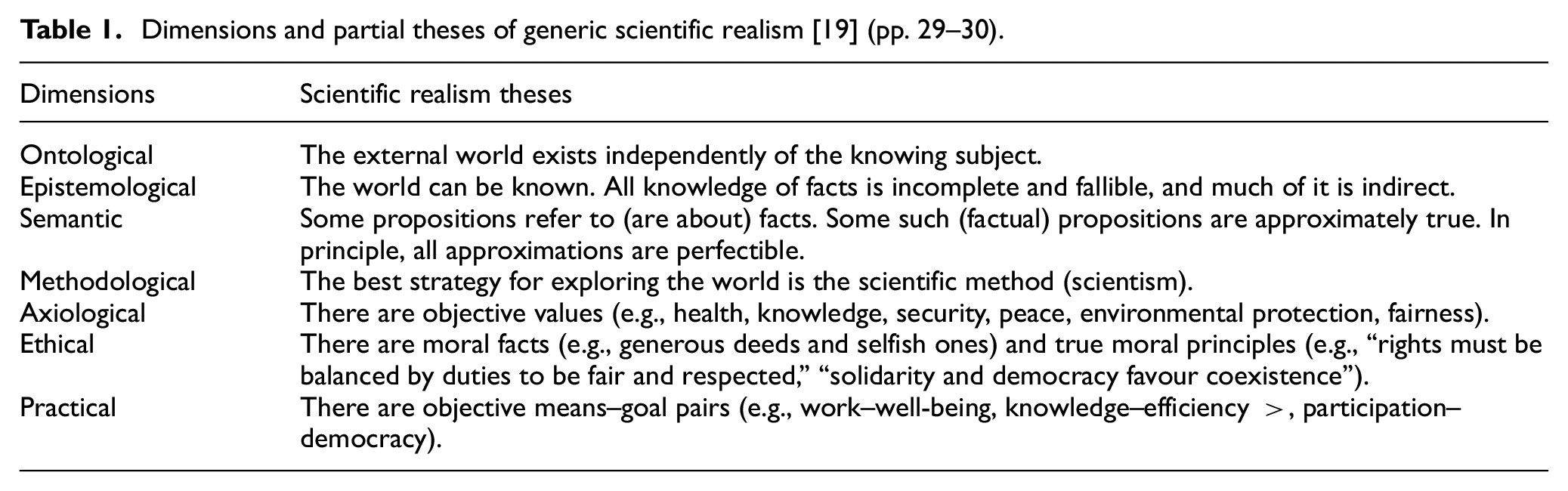
Adopting theses from Table 1 for the development of ontological KOS does not necessarily mean adhering to a strict physicalist materialism. Economics, politics, culture and similar social aspects can be perfectly accommodated within the framework of scientific realism in theses such as the emergent systemic materialism of Bunge [19], the non-reductive naturalism held by Niiniuloto [53] or the integrative materialism proposed by Wimsatt [57]. Among the common traits in these theses is the distinction between real and ideal existence (to be dealt with in the following section), and an emphasis on emergent properties of systems that the respective components do not have. Emergence in this context can be taken in Wimsatt’s [57] sense as ‘a relationship between a property of a system and properties of its parts’ (p. 173).
Another relevant notion within the theses depicted in Table 1 is objectivity, in particular in the methodological dimension. We have stressed, in previous sections, the importance of the scientific method for the endorsement of moderate realism. The interconnection between this method and the development of KOSs is exemplified in the following description: The scientific method is the wish to attain objective truths, that is, data and hypotheses that are adequate to their objects or referents, regardless of the mood or preference of the investigator. And using this method involves transcending sense data and constructing conceptual systems, such as classifications and theories, that contain only predicates representing primary properties – unless the theory happens to refer to phenomena such as tastes, smells, colours, and feelings, as is the case with certain neuroscientific and psychological theories [19] (p. 87).
Classifications can be equated with scientific theories if they follow the same methodological development, that is, when differentiating between primary and secondary properties. Bunge [19] ascribes to contemporary scientists the enrichment of Galileo’s primary-secondary dichotomy about properties, dividing the primary ones into superficial ones (such as temperature and visual acuity) and deep ones (such as quantum tunnelling and neuronal plasticity). The scientific method also involves what Bunge [19] calls reality checks: ‘the confrontation of a proposition, in particular a hypothesis, with the pertinent empirical data and pertinent theories’ (pp. 263–264). It is important to note that a direct confrontation of a proposition with the fact that it refers is not possible. The confrontation must be between the proposition and the datum about the fact that the proposition refers to, or between the proposition and another proposition.
Regarding scientific objectivity, Reiss and Sprenger [58] state that, despite the potential inadequacies of the classical value-free ideal, it can ‘still be a useful heuristic for fostering scientific integrity and objectivity’ (sec. 8). The authors emphasise that: Although entirely ‘unbiased’ scientific procedures may be impossible, there are many mechanisms scientists can adopt for protecting their reasoning against undesirable forms of bias, e.g., choosing an appropriate method of statistical inference, being transparent about different stages of the research process and avoiding certain questionable research practices. [58], (sec. 8)
In addition, some alternative interpretations of objectivity can be employed, such as Hacking’s [59] negative approach: ‘objectivity is not a virtue (I have claimed), it is the proclaimed absence of this or that vice’ (p. 32). Or the risk account of scientific objectivity by Koskinen that, incorporating Koskinen's [60] stand, ‘identifies imperfect epistemic agents, context-dependent epistemic risks, and strategies developed for averting them as integral elements of objectivity’ (pp. 1204–1205). For Reiss and Sprenger [58], the strength of Koskinen’s interpretation is that none of the threats to a peculiar analysis compromise scientific objectivity; and that ‘we can (and in fact, we do) rely on scientific practices that represent the world from a perspective and where non-epistemic values affect outcomes and decisions’ (sec. 7). This would be a moderate perspective in which, as Koskinen [60] points out, objectivity does not necessarily imply certainty, ‘it should also allow comparisons, making objectivity a degree concept’ (p. 1197), allowing us to say that something is more objective than something else without claiming to be perfectly objective. As researchers, as well as participants of virtually any human activity, we need to be able to declare what makes something increase or decrease the objectivity of our work. Examples of this type of position in LIS would be Ridi’s [14] suggestion to ‘use the terms objective and subjective only in a relative and not in an absolute way’ (p. 250), and Kleineberg’s [12] conclusion about the integration of different perspectives: ‘each of them might be partially true and none of them might be finally privileged, but this does not mean that all taken perspectives are equally valid or that we are not able to organize them in a meaningful way’ (p. 359).
4.2. Real and ideal existence
The distinction between real and ideal existence may be understood of utmost importance for anyone who is engaged in an ontological approach to the development of KOSs. By this, we mean doing a rigorous categorical analysis of entity types related to the portion of reality of concern to develop a proper realist ontological model, as described in Almeida [61] and Machado [62,63]. Such ontological analysis should start with the aforementioned distinction. This is not a trivial task, but we can use the arguably universal physical property – energy: ‘material things, unlike abstract objects, possess energy and the ability to absorb it and release it: they are changeable’ [37] (p. 99). Energy can be seen as the only trait that is common to only and all material things. In contrast, ‘when we say that concepts, hypotheses or theories change, we mean that the brains that used to think of them are now thinking different ideas’. [37] (p. 64), that is, the part of the process in which the energy acts upon, and the change happens (i.e. the brain) is not the ideal or logical entity itself, but its carrier [64,65].
Thus, the distinction between real existence and ideal existence can be drawn by the presence or absence of energy in the respective entities. However, even with this general criterion we will surely find some complex or diffuse cases, such as scientific-based theoretical entities. In this vein, we need to bridge ontology to normative epistemology, that is, methodology to put forward some specific criteria like the ones proposed by Bunge: Criterion 1 (necessity and sufficiency). An object: (1) is likely to exist really (materially) if, and only if, the hypothesis of its existence is plausible, i.e., it belongs to a theory that has been confirmed empirically, or to one that coheres with other well corroborated theories; (2) exists really (materially) if, and only if, it has been detected directly (by the senses) or indirectly (with the help of scientific instruments). Criterion 2 (sufficiency). An object exists really (materially) if: (1) it reacts (kicks back) when acted upon; (2) it has been reproduced or made [37] (pp. 70–71, emphasis in original).
In this framework, it is in changeability and its technical word energy [19] (p. 12), which lies the key notion in respect of existence. Put in a slogan form: to be material is to become and to be ideal is to be immutable [37] (p. 274). This two-tier slogan would be the realist counterpart of the monistic slogan of idealistic flavour: to be is to be perceived; or the more contemporary linguistic and operationalist varieties, respectively: to be is to be talked about and to be is to be measured. Those idealist conceptions, common in the late 19th and through the 20th century, are rooted in a conflation of ontology with methodology that created extra difficulties for the already complex task of ontological analysis. In that dominant epistemic context, ontological analysis is deemed as unimportant or even nonsensical, partially due to some, using Aune’s [66] words, ‘bizarre theories of reality’, but mainly because of the neo-Kantian systematical delegitimization of ontological inquiry in favour of its epistemological transformation or reduction [67].
On top of that, linguistic prejudices were introduced in different ways, namely by the use of first-order logic language to deduce ontological categories [68]. This use can be regarded as a misconception of what logic is: ‘logic is, by construction, ontologically and epistemologically uncommitted: it presupposes nothing about the world or about the strategies to explore it. This is why it is called formal’ [37] (p. 14, emphasis in original). Ironically, the revitalization of the ontological investigation has a direct relation with first-order logic due to its use in the formalisation of the so-called computational ontologies. Again, if one wants such artefacts to properly work, supporting artificial intelligence applications, rigorous ontological analysis is required [69].
The use of first-order logic in computational ontologies, that intend to be formal models of the world, may lead to a conflation between real and ideal existence. Take, for example, the so-called existential quantifier (∃) that supposedly remedies the imprecision of the term exist, as, according to Bunge [19], claimed by modern logicians, from Russel to Quine. However, that logic symbol would not differentiate the two types of existence, since it works in a mathematical context where it deals exclusively with ideal entities. In this sense, mathematical entities would fall under the same category as concepts, hypotheses and theories, which only change with human action and not by themselves. That is why ‘to bridge mathematics to the real world we must enrich it with semantic assumptions (or “correspondence rules”)’ [19] (p. 201).
4.3. ‘Terminologism’
The need for semantic assumptions can, if not properly addressed, be the source of another bias resulting from the subordination of ontological issues to linguistic ones. One example is the logical-linguistic approach of Frege. Not only did his work have a direct impact on how the use of first-order logic can lead to the above-mentioned conflation between real and ideal existence, but it has also influenced the LIS area in other aspects. We consider it necessary to briefly sketch Frege’s theory of reference and meaning to contextualise this influence.
Frege established in his theory two essential categories belonging to the ‘realm’ of references: objects (designated by proper names) and functions (which includes properties, relations, and concepts). For Frege [70], concepts are the reference of common names or, as he prefers to put it, the reference of a ‘conceptual name’. The link between a name, proper or common, and its respective reference, an object or a concept, is indirect because the senses always mediate it. These Fregean senses, that some LIS authors, for example Frické [71], use as the explanation for what concepts are, would not be concepts for Frege himself. Senses would be the different cognitive contents or ‘modes of presentation’ that referents can present in propositions [72]. However, despite the categorical difference made in Frege theory between objects, concepts, and senses, he considers them all equally real and objective. It has been argued (e.g. [72,73]) that this equivalence stems from logical-linguistic necessities resulting in an ontological conflation between real and ideal existence. Although not negligible, logical-linguistic aspects are per se an unreliable guide to ontology.
The influence of this logical-linguistic approach in general, and of Frege in particular, is felt in LIS in different degrees of intensity. For example, in an indirect form, we can point out Quine’s influence. Advocating for the use of first-order logic to display what the world is like [74], Quine [75], (p. 64) claims that: ‘ontological questions can be transformed, in this superficial way, into linguistic questions regarding the boundary between names and syncategorematic expressions’. It is worthy to mention that, in the view of Smith [76], ontology for Quine does not correspond to the study of ontological commitments but to the commitments themselves. In a more direct and explicit form, Frege’s influence is found in the predicative and descriptive function of a referent attributed to concepts in Dahlberg’s [77] theory. Despite this influence, already in her early works, Dahlberg [78] warns against what she calls Terminalismus, which would lead to considering semantics only from the linguistic point of view.
Dahlberg [77] was also greatly influenced by Wüster’s work, although her view of concepts as objective units of knowledge differs from Wüster’s view of subjective units of thought. Also, whereas in Dahlberg’s [79] model for concept construction its reference includes a ‘universe of items’ not restricted to linguistic ones, in Wüster’s [80] model only linguistic items seem to exist: In the lower half of his model, the physical world outside the brain, Wüster mentions only speech individuals. He tries to present the contrast of language system and speech. However, this is where the world of all individual material objects also lies, for where else should they be found? [81] (p. 34).
We can appreciate this particular influence of Wüster’s view in the distinction, or lack thereof, between real and ideal existence in the principles and methods set out by the technical committee for terminology standardisation (ISO/TC 37), that Wüster ran for the first decades of its existence. In ISO 704:2022 [82], we can find the following definition: ‘in terminology work, an object is anything perceivable or conceivable’ (p. 2, emphasis in original). The issue is not so much the use of such encompassed definitions for object but, as Smith [44] pointed out: ‘that ISO allows no other term which would be used to distinguish those terms which are intended to be directed towards real things and those terms which merely refer to objects in this very loose sense’ (p. 87). As a document intended for those involved in terminological work, its vague definitions run counter to its own main objective of semantic disambiguation. Comparing early versions of the same standard, we can acknowledge the efforts of ISO/TC 37 towards further clarification of the issue. However, this does not seem to be resolved. Starting from the position according to which ‘the link between an object and its corresponding designation or definition is made through the concept’ [82], we could conclude that, since KOSs only represents concepts, there is no need to distinguish between perceived and conceived objects. Yet, KOSs for areas such as biomedicine need to make that distinction [40].
Wüster [80] terminological view of the relation language-world, or ‘wording the world’ as himself put it, seems to reduce it to a unidirectional one. This relation should be, instead, reciprocal. If the structure of language seems to determine which features of reality are abstracted, that same reality determines and forms language [56]. Depending on the area of concern, the two elements of the relation may have different weights, for example, agreed-upon standard terms for manufacturing area and reference entities in reality for biomedicine [83]. However, insofar as our interpretation is correct, the recommendation by ISO 704:2022 [82] for terminological works seems to put the weight always on the linguistic side: ‘discussions on whether an object actually exists in reality are unproductive and should thus be avoided. Attention should be focused on how one deals with objects for the purposes of communication’ (p. 5, emphasis in original).
5. Natural classifications
Outlining the complex scenario, albeit in a generic way, of moderate realism, we will now turn to the question of the naturalness of classifications. In a nutshell, the main issue is related to the existence of natural classifications besides those conventionally made by our linguistic-conceptual schema (see nominalism in Section 2). Another issue relates to the existence of putative entities designated with the term natural kinds. These two issues are intertwined, making the matter even more complex. As we will see next, Aristotle’s thesis, that is, his essentialism, has a relevant role to play in the discussion about this topic.
5.1. Ontological and taxonomic questions
The aforementioned complexity is evident in Aristotle’s notions of essence, substance and form that, directly or indirectly, are constantly brought to the discussion about natural kinds. This is particularly due to the controversy about the biological species, considered paradigmatic cases of Aristotle’s natural kinds: He [Aristotle] claims, in particular, that forms are the essences of natural beings, that essences are the objects of definition, and that definition is a fundamental goal of scientific knowledge or understanding (epistêmê). There is also good reason to think, further, that natural kinds, especially living beings and biological species, represent paradigm cases for Aristotle of substance and definable form [84] (p. 33).
The complexity is visible in the difficulty, according to Bonevac [85], of finding in the Aristotelian corpus something that fully meets the criteria that Aristotle himself imposed on its notion of substance. Given the role that Aristotle attributed to it, substance should be underlying all other entities, namely primary, individual or simple (in the sense of not being composed), admit contrary qualities but no contraries or gradations, as well as not be predicable or present in any other entity. In the end, Aristotle settles his substance with two senses, as explained by Bonevac [85]: It follows, then, that ‘substance’ has two senses, (A) ultimate substratum, which is no longer predicated of anything else, and (B) that which, being a ‘this’, is also separable and so this nature is the shape or form of each thing (pt. 26: 42, emphasis in original).
In sense (A), substance loses the component of individuality, and in (B), its primary nature. The two senses, proposed by Aristotle, might be justified by the fact that, as Bonevac [85] puts it: ‘there is no simple way to understand what substance really is’ [85](pt. 28: 08). It would also be possible to link these two meanings to the distinction between the taxonomic question and the ontological question made in the context of the discussion of natural kinds by Magnus [86] (p. 1428, emphasis in original): ‘The taxonomy question: What distinguishes a category which is a natural kind from an arbitrary class? The ontology question: What manner of stuff is that – that is, what being has it got?’ Meaning (A), focussing on basic entities, would be related to the ontological question, while the focus of meaning (B), on ‘individual things’ and their parts, would be related to the taxonomic question.
Answers to the ontological question typically involve greater metaphysical depth that are deemed unnecessary under the taxonomic focus [86]. Concrete instances can have different identity conditions; for example, ‘mountain A’ differs from ‘monkey B’ because the first instantiates a geological formation, and the second instantiates a living organism. In a realist view, ‘geological formation’ and ‘living organism’ are ontological categories, but ‘mountains’ and ‘monkeys’ are more specific. Indeed, ontological categorization operates at a higher level of abstraction than the taxonomic classification of empirical sciences such as geology and biology. Furthermore, taxonomic approaches are characterised (in logical terms) by the subsumption relationship, usually called the ‘is-a’ relation; on the other hand, ontological approaches require more theories for one being able to reach the desired understanding: for example, the theory of identity, mereology, topology and mereotopology, to mention a few, and several different types of relationships such as inherence, participation, instantiation, exemplification and characterization. In addition, there are different lines of thought, some are restrictive yet moderate [87], while others adopt less orthodox tenets [88]. In these two lines, different treatments can be applied. For example, instances of artefacts – human-made entities – in an orthodox view, can be concrete individual objects, bearers of properties that exist in space and persist in time, associated with certain types. Within this context, however, it is not clear how one can assume the existence of these types of entities in reality. On the other hand, in less orthodox views, artefacts are allowed in the ontology even though identity conditions cannot be called ‘stable’.
According to Magnus, much of the contemporary dispute over natural kinds would be simplified if the two foci were treated separately. The two approaches, frequently understood as two incompatible alternatives, appear in several recent works about the possible ways of classifying the world, or, using Plato’s metaphor, carving nature at its joints. An example can be found in Brzović [89]: Questions arise as to how we identify suitable candidates for such ‘natural openings’ and where we should draw divisions between objects in the world. One good place to look for them would be in the discipline of particle physics because it appears that, if there are some objective divisions in nature, they will surely be found at the level of fundamental entities that comprise all existing things. … Alternatively, one might argue that the approach of finding the most basic constituents of matter is too restrictive and that there are many other objective categories to be discovered (sec. 1).
Preceding the debate on such ‘natural openings’ would be the contestation of their existence, leading to the rejection of natural classifications altogether. This would be the nominalistic position, following Hacking’s description (as seen in Section 2). However, some authors with assumed nominalistic positions (e.g. [90–92]) do not reject natural classifications, but rather what they refuse is giving any ontological status to natural kinds [93]. This kind of nominalism will be compatible with strict naturalism (i.e. a physicalist materialism, see Section 4). In addition, to be a consistent position, instead of an ontological approach to natural kinds, it would take a semantic one. If we consider the difference between this position and conventionalism, we will see Hacking’s description of nominalism framed under the conventionalist position: ‘naturalism about natural kind classifications contrasts with conventionalism (also called constructivism or constructionism), the view natural kinds don’t exist independently of the scientists and others who talk about them’ [93] (sec. 1.1.1, emphasis in original).
5.2. The semantic approach
The semantic approach to natural kinds derives from Kripke and Putnam’s theories of reference. The works of the two philosophers in the 1970s had the effect of revitalising the Aristotelian discussion around essences [94]. However, being a semantic approach, it also introduces a number of linguistic distractions: First, accounts often hang or fall on intuitions about things like Twin Earth cases. This creates a lot of debates about where labels should go in cases where there are plausibly multiple natural kinds in play. Second, natural kinds can fall out of the picture entirely [86] (p. 1433).
The typical case of the Twin Earth is a thought experiment conceived by Putnam. It is about a world that is exactly the same as Earth except for the substance called water, which, unlike on Earth, does not have the chemical composition H2O, but rather XYZ. The exercise aims to demonstrate that, despite the similarities between the two and the fact that they share the same name, water, the distinct molecular structures make them two different substances. Although the Twin Earth experiment presents arguments in favour of ‘modern essentialism’, the position advocated by Ellis [94], the author puts reservations to them. The use of thought experiments, common practice in philosophy, starts from the premise of being logically possible without concern for being also ontologically possible. As addressed in Section 4.2, this attitude may lead to the disregard of the ontological neutrality presupposed to logic.
In agreement with Ellis’ suspicions, in the particular case of the Twin Earth, Headley [95] points out that if the two ‘Earths’ are identical, their natural histories would also be identical, so it is very unlikely that the chemical systems of both would be so radically different. Headley [95] himself does not argue that nature is already provided with clear and defined boundaries and categories, and thus it is necessary to impose human differentiation and classification on an ‘external permanency’, but this ‘is not to suggest that categorization and classification are arbitrary and amenable to a nihilistic frenzy of an anything goes situation’ (p. 499).
This extreme anything goes view that fuses nominalism with idealism, might lead to some nonsensical positions accepted by relativistic postmodernist followers [96]. It could be argued that, unfortunately, the influence of such views is widespread: ‘one simply finds the minds and mental acts of the traditional disputes replaced by observers, detectors and various physical settings in some contexts, by “computation” in others and by symbols and interpretations in still others’ [97] (pp. 226–227). Nonetheless, the imbrication of the classificatory question into the existential one is unavoidable. It is present, for example, in the discussions about the dependence of both its identity and the very existence of an entity on its essence: The argument that essence implies existence is premised on the idea that an essence concerns a thing’s nature or identity. Nonetheless, many of the arguments for natural kind essentialism do not address questions of essence in these terms. Instead, discussions of natural kind essentialism that follow the paths of Kripke and Putnam generally hold it to be sufficient to establish an essence for a natural kind that one can show that a certain feature is possessed by all instances of a natural kind in every possible world [98] (pp. 1409–1410).
In the semantic approach to natural kinds of Putnam and Kripke, the essence seems to derive from necessity. However, it could be argued that the direction should be the other way around, as pointed out by Bird and Tobin [93]. In addition to the causal contradiction between necessity and essence, Magnus [86] also criticises both authors’ lack of argumentation regarding their views on natural kinds, comparing them to the detailing that was done by Ellis in his essentialist thesis.
5.3. Different approaches to the same taxonomic need
The essentialist approach to natural kinds is the one that imposes more restrictions on them. According to Bird and Tobin [93], the six often suggested criteria of a natural kind classification are:
All members of a natural kind must have some intrinsic properties in common;
All natural kinds must allow inductive inferences;
Natural kinds must participate in the laws of nature;
The members of a natural kind must form a genuine kind (the requirements of this criterion are not clear, often explained through examples of groupings that do not form natural kinds, for example: white things, things negatively charged or things with a mass of 1 kg);
Natural kinds must form a hierarchy, any overlap between two kinds will result in a genus–species relationship or will they be identical;
Natural kinds must be categorically distinct, that is, there cannot be a smooth transition between two kinds.
In essentialism, essential properties must necessarily be common to all members. This constraint to the first of the six criteria listed can be seen as a hallmark of the essentialist position. We can appreciate this in the following summary of Ellis’ thesis made by Sankey [99] (p. 291): For Ellis (1999, 19), the essential properties of natural kinds are intrinsic properties shared by all members of the same kind. The essential properties of natural kinds of things are dispositional. They have ‘the nature of powers, capacities and propensities’. Natural kinds are characterized by the intrinsic causal powers of the things that belong to those kinds.
This is also mirrored in the so-called Aristotelian definitions. The role of these definitions in the main structural organisation of computational ontologies is emphasised by Arp et al. [29] (p. 31): ‘stating the genus and differentia of a type is a crucial part of providing what we shall refer to as an “Aristotelian definition” of that type. Taxonomies and definitions are closely interconnected in ontology design’. In this context, the resulting taxonomic structure serves as the backbone of the ontology to be built. Despite the relevant disambiguation function performed by the Aristotelian definitions in the context of computational ontologies, their formulation is time-consuming and sometimes impractical due to the gaps in scientific knowledge [100]. To that extent, other less demanding definitions, such as the partial and the prototypical ones, may be applied. In the latter, the full set of conditions stipulated in the definition of the kind only applies to typical instances of the kind. In partial definitions, the stipulated conditions may be applicable to instances of other kinds. As we have an association between Aristotelian definitions and essentialism, those two types of less demanding definitions, that is, the partial or prototypical ones, are related to another type of approach to natural kinds. This is generically called the cluster kind view: Cluster kind approaches offer a less strict view of natural kinds. In accordance with these views, to belong to a kind, its members need not to share a set of necessary and sufficient properties; it is enough that they share some subset of properties that tend to cluster together due to some underlying common causes [89] (sec. 2.b).
The most famous cluster approach – family resemblance – is due to Wittgeinstein. One such approach within the natural kinds debate is the homeostatic cluster proposed by Boyd [101] (p. 67, emphasis in original): ‘the natural explanatory definition of one of these homeostatic property cluster kinds is provided by the members of a cluster of often co-occurring properties and by the (“homeostatic”) mechanisms that bring about their co-occurrence’. These clusters would be a natural kind as long as it met specific conditions, namely being employed in an inductive inference for the purposes of scientific explanation [93]. This characteristic (listed as the criteria ii of a natural kind classification) and three other characteristics (iv, v, vi) are common to the homeostatic properties cluster view and the essentialist position. By contrast, characteristic iii (participation in the laws of nature) is relaxed for only a few members, in the same sense of the criterion of belonging to the same kind, already mentioned.
Another perspective on natural kinds, called promiscuous realism by its proponent – Dupré [102], further relaxes the criteria accepted by advocates of cluster kinds. In promiscuous realism, not only the last two criteria (of the hierarchy of kinds and of the categorical distinction) are rejected, but the intrinsic nature of the properties common to the members of a natural kind is also denied. Dupré’s realism appears to be very close to a conventionalist position given Brzovic's [89] description: Dupré introduced this view by offering the example of different crosscutting categorizations into species, depending on which species concept is used in various biological subdisciplines, and classification practices outside biology. One of the hallmarks of promiscuous realism is that it does not prioritize scientific classifications over folk categories (sec. 2.c).
Here, an extrapolation concerning natural classifications seems to be at play, starting from the problematic case of biological species as a paradigmatic example for all cases of natural kinds. This is a suspicion reinforced in the following statement by Bird and Tobin [93]: ‘taking the biological classification of species as an example, he [Dupré] argues that there are countless ways of taxonomizing species, depending on the model of biological systematics that is used. There are equally legitimate, objectively grounded ways of classifying natural kinds’ (sec. 1.1.3).
Despite this position, Dupré [103] hypothesises the existence of disinterested classifications, particularly in the area of Chemistry. However, regarding the international disagreement on the term jade and its application to two distinct minerals (nephrite and jadeite), the biological species are immediately called upon to fulfil their role as a counterexample: ‘this illustrates the general point, which becomes much more obvious when we move from chemistry to biology, that classifications devised for different goals can be cross-cutting and overlapping’ [103] (p. 30). However, if the question is that there are potentially obscure interests underlying classifications, in the case of Biology, it has been argued otherwise: TC [taxonomic classifications] is neither logically nor causally anthropocentric. It neither refers implicitly but essentially to the desires and practical interests of human beings, nor causally depends on those practical interests. Indeed, it is very difficult to say what the ‘practical interests’ of biologists might be [104] (p. 13).
By focussing on biological kinds, promiscuous realism tends to be increasingly promiscuous [105]. However, even with his promiscuous metaphysics, Dupré [105] still seems to have some doubts about the total non-existence of natural kinds: ‘often there are ways of classifying organisms in ways that correspond to modestly natural kinds, but often there may not be. … So I am inclined to say that some species are real natural kinds, but many are not’ (p. 217). Even in the worst-case scenario for natural species, he stresses the need for taxonomic order: But even if there are no species in the Aristotelian sense, and no species in the sense of real units in nature reliably produced by the evolutionary process, we still have good reasons to impose some taxonomic order on the biological world [105] (p. 217).
Dupré seems to point out that a quasi-conventionalist solution to taxonomy in the biological area is the only plausible one. The question will be related to the association of the notion of biological species to the immutability of the ancestral Aristotelian model, considered definitively unauthorised in the post-Darwinian period.
5.4. The need to adapt to a pos-Darwinian era
In fact, prima facie, the demanding and restrictive criteria of essentialism would have a restricted application to foundational ontological levels. Ellis [94], adopting this restriction, concludes that ‘the material world is fundamentally structured into natural kinds, for, on close examination, the chemical elements and compounds all turn out to be natural kinds according to some very strict criteria’ (p. 26). The apparent incompatibility of the essentialist position with evolutionary dynamism in the biological domain is a common criticism: ‘there are no properties of species that all and only members of a species share. But even if we were to find some, we would expect that they could easily be changed by evolutionary mechanisms’ [89] (sec. 1.a). Ellis [94], while responding to these criticisms, argues for an essentialist view that is compatible with Darwinism: Many critics are, no doubt, motivated to discredit the old Aristotelian idea of fixed species of organisms, each having its own specific essence. But modern essentialists have no wish to defend this ancient doctrine anyway, and do not try to do so. On the contrary, the cluster concept of species, which any sensible modern essentialist would defend, combines the kind of genetic determinism that Darwinism requires as a basis for selection with the variability of outcomes that is needed if evolution is to occur (p. 156).
Interestingly, we can find some pluralistic interpretations of the Aristotle’s position, such as Henry's [106], that place it very close to Ellis’ essentialism: ‘despite this pluralistic approach to classification, Aristotle remains committed to realism and thus shares an affinity with traditional scientific realists who hold that there are objective kinds in nature (such as chemical kinds) delineated by real, mind-independent boundaries’ (p. 199). Nevertheless, Ellis’s cluster concept of species is in line with the view of natural kinds as a cluster of homeostatic properties. In this sense, the cluster kind view accommodates biological species: Biological species and chemical elements and compounds are the paradigmatic philosophical examples of natural kinds. I have argued elsewhere that there are a number of scientifically important natural kinds (properties, relations, etc.), biological species among them, whose natural definitions are very much like the property-cluster definitions postulated by ordinary-language philosophers except that the unity of the properties in the defining cluster is mainly causal rather than conceptual [101] (p. 67).
In addition to relieving the restrictions imposed on natural kinds, Boyd [101] concedes to the critics of the essentialist position the importance of human intervention. On the other hand, this human interference is framed in the notions of causality, truth and knowledge, where the same interference is discarded: Causation is not a social construction: we do not make causal relations, except in so far as we ourselves function as ordinary causal phenomena. Truth (about natural kinds, causal relations and the other fundamental subjects of science) is correspondence truth - socially constructed truth won’t do. In so far as the knowledge of facts about the world is concerned, knowledge and rationality are matters of certain causally reliable tendencies towards approximately (correspondence-wise) true beliefs [101] (p. 67, emphasis in original).
Bird [98], another supporter of this view, considers these natural kinds, identified with clusters of non-accidental properties, a potential explanation for the ontological fundamental questions related to natural kinds: ‘the identification of kinds with non-accidental (e.g. homeostatic) property clusters, for example, provides one plausible explanation of why natural kinds are natural, why they are kinds, why they exist, and why they are complex universals’ (p. 1424).
The resort to a cluster kind view is not the only less promiscuous alternative for the taxonomic order on the biologic world. By applying the distinction between ontological and taxonomic questions (discussed in Section 5.1), Schulz et al. [107] propose a mereological approach capable of harbouring different theories concerning biological species: Our view of species as the totality of organisms belonging to one specific species, which can be generalized from species to taxa. … It is essentially based upon the assumption that every biological organism, population or biological matter has some inherent taxon quality. Since it does not raise further reaching ontological claims, our approach largely bypasses the ongoing dispute on species concepts (p. i320).
Their proposal ‘is to interpret the relation of a biological object to a given taxon as the ascription of a quality’ [107] (p. i317). The species Homo sapiens, for example, is a quality that inheres in any human organism, tissue or cell. This means that the quality is not only attributed to whole organisms, but also to parts of organisms, their constituting cells and their derived cell lines. In the relation of the several biologic taxa, the authors give the following example: ‘the quality of belonging to the phylum Chordata is a quality that inheres in any biological object that is part of or derived from an organism the species of which belongs to the phylum Chordata’ [107] (p. i317).
In view of the debate around competing schools in systematic biology, namely cladistics, phenetic taxonomy and, as a middle way, evolutionary taxonomy [108], Schulz et al. [107] approach present a potential solution as it ‘advocates neutrality towards the conceptualization of species and is apt to coexist with both monistic and pluralistic approaches’ (p. i320). A solution that suits KOSs with distinct classification approaches, for example, the Basic Formal Ontology and the Descriptive Ontology for Linguistic and Cognitive Engineering [107]. This means that this moderately realistic approach can be used without having to follow one of the competing schools’ positions, in the absence of more robust knowledge to make the choice (i.e. knowledge with a variety of independent means of assessment [57]). There is yet another alternative that implies the difficult task of combining common origin and similarity as classification criteria. Although it could be argued about the viability of this alternative, it is actually used in the Integrative Levels Classification through a ‘dialectic between morphological and genetic principles’ to classify phenomena [109].
6. Conclusion
The rejection of the generic realist thesis may take on varying levels of gradations and specifications, but in all of them, it comes up against the realist assumptions of human behaviour itself. However, given that the generic thesis does not place restrictions on the nature of reality, which it posits as independent, the possibilities for variations in realism are immense. If the epistemic position vis-à-vis the notion of truth is placed as a reference, assuming it to be relevant, the scientific variation of realism stands out as an intermediate between scepticism and naivety, as it regards progress towards knowledge.
Moderate realism embodies the scientific method and the fallibilist attitude of scientific realism and, while using ontological perspectivism, accommodates multiple perspectives without falling into an ‘anything goes’ attitude. In this respect, the notion of robustness analysis, proposed by Wimsatt [57] appears to be an adequate device for classification procedures following the realist epistemic framework presented in this study. Although this possibility is beyond the scope of this article, we think it is possible to get a sense of its potential by looking at the general procedures and goals of robust analysis. According to Wimsatt [57] (p. 44), there are four general procedures: (1) to analyse a variety of independent derivation, identification or measurement processes; (2) to look for and analyse things that are invariant over or identical in the conclusions or results of these processes; (3) to determine the scope of the processes across which they are invariant and the conditions on which their invariance depends; and (4) to analyse and explain any relevant failures of invariance. All these procedures contribute to highlight what is ‘ontological and epistemological reliable and valuable’ and ‘distinguishing of the real from the illusory; the reliable from the unreliable; the objective from the subjective; the object of focus from artifacts of perspective’ [57] (p. 46). We intend to explore this potential for KOSs devolvement in future studies.
Another issue that has not been explored in depth was the question of real and ideal existence. Lack of space did not allow us here, for example, to address the relation between existence and instantiation, associated with the orthodox view [65]; as well as issues related to the representation of fictional entities, an important subject for an ontological classification of bibliographic collections, already presented elsewhere [110]. The focus placed on the disregard of ontological aspects in favour of linguistic ones stems from the importance of the terminological issues for the development of KOSs. This importance is easily overestimated, leading to a conflation of the representant (the term) with the represented (the entity).
It is possible to see in the semantic approach to natural kinds the above-mentioned conflation, leading to some linguistic distractions of the real issue. In addressing the ontological problem of natural kinds, the complex case of biologic species emerges as the pivotal point. Against one more-or-less conventionalist solution, objective scientific-based approaches to natural classifications were presented as feasible, contributing to this, the due distinction between taxonomic and ontological issues, that is, what distinguishes a category which is a natural kind from an arbitrary class, by one hand and, by the other, what manner of stuff is that. In this context, the updated version of Aristotelian essentialism for the Darwinian era was shown to be very useful for the classification process.
Relying on a moderate position such as the one presented here, as a theoretical foundation, we believe that such an approach to classifications is suitable for the development of ontological KOSs. In the view presented here, ontological perspectivism, as a methodological strategy, has an important role to play, particularly in the necessary adaptation to the different granularities of reality required to meet the different needs for which the KOSs are developed.
Footnotes
Declaration of conflicting interests
The author(s) declared no potential conflicts of interest with respect to the research, authorship and/or publication of this article.
Funding
The author(s) received no financial support for the research, authorship and/or publication of this article.
