




Abstract
This article explores the role of information in high risk consumer decision making. Forty-two qualitative interviews were undertaken with international non-EU postgraduates when making the high risk decision to study in a UK Business School. Prospective international postgraduates moved iteratively through the stages in Kuhlthau’s Information Search Process model and learnt from the search process they had undertaken in a continuous cyclical manner. Word-of-mouth recommendations were the most influential sources of information gathered, and online sources were perceived to be credible regardless of their origins. The perception of risk impacted the rigour of the information search process. An iterative decision making cycle model is proposed with Kuhlthau’s model and word of mouth information at its core, which reflects the connectedness of individuals in this digital era. This study provides new insights by combining both marketing and LIS models and extends Kuhlthau’s research into a new context.
Keywords
1. Introduction
International postgraduates are making a life-impacting and complex purchasing decision when choosing to study at a university overseas. There are high levels of risk when deciding on which postgraduate qualification to study due to its intangibility, cost, high importance and impact on the prospective student [1]. An understanding of international postgraduates’ information behaviour at all stages of the high risk decision making process is required; from the time they recognise a need to study, through evaluation of alternative countries, cities, courses and universities, application and enrolment in a university course to the post purchase stage. This is even more important after a year of significant changes which have impacted on international student recruitment. This study will help information providers such as the government and universities to support international postgraduates with the information they need to select an overseas university.
The most widely recognised model of the consumer decision making process, that has been utilised over the years by well-known marketing and consumer behaviour scholars, is linear and sequential in design with five stages; need recognition, information search, evaluation of alternatives, purchase and post purchase evaluation [2–5]. Previous studies regarding the student decision making process used this linear model to study undergraduate students [6–9] or postgraduates [10]. These linear decision making models have been critiqued as being outdated. It is argued that they do not represent the interconnectedness of consumers and media channels in this digital era and variations in the use and perceived credibility of information sources, including consumers’ reliance on word of mouth (WOM) information [11].
Cyclical and iterative decision making models have been proposed [12–17] some of which focus on international and domestic postgraduates [11,18,19]. However, there was only one model that recognised that information may be gathered at more than one stage during the decision making process [9].
The author hypothesised that postgraduates would look for information throughout the decision making process rather than just at one stage, and they would revisit prior sources and types of information as they made their decisions, so the process was iterative rather than sequential.
In this qualitative study, 42 semi-structured interviews were conducted with taught international non-EU postgraduate students studying at a UK business school between August 2018 and July 2019. The aim of the study was to explore the role of information in their decision making cycle when making the high risk decision to study for a university qualification. This article considers the following timely research questions:
What are the links between the information searching and decision making processes for international postgraduates when making their high risk decision to study at a university overseas?
How does Kuhlthau’s model of the Information Search Process relate to the information behaviour of international postgraduates when making this high risk decision and what factors impact on the process?
What were the sources and types of information international postgraduates gathered when deciding on a university?
This study proposes a new iterative decision making cycle model with information search and the pool of information at its core. This research-based model builds on models from marketing scholars and Kuhlthau, a Library and Information Science (LIS) academic. Kuhlthau’s [20] research is extended into a new context as the focus is on the postgraduate as an information seeker and their use of information when making a high risk purchase decision. New insights are derived by looking at the theories of information behaviour alongside marketing as requested by Wilson [21].
2. Literature Review
The literature review focuses on three themes based on the research questions for the study; information search in high risk decision making, information behaviour models and postgraduates’ information sources and types.
2.1. Information search in high risk decision making
The decision to choose a postgraduate course was classified as high-risk [22] because the course was an intangible service [23] with a focus on the student’s experience when interacting with the university rather than the functional benefits derived from the service [24]. The intensity and length of contact between the postgraduate and the university, and the efforts that they both needed to make to gain a successful outcome in the form of a degree, added to the perceived risk [25].
Perceived risk was also high as postgraduate courses were expensive, purchased, once-in-a-lifetime, difficult to experience prior to purchase and there were significant differences between universities and relatively few alternatives [26]. Studying for a postgraduate qualification had high personal importance to the student as it could affect their future lives and careers. The risk perceived by the postgraduate tended to be greater if they were self-funding because the risk of making the wrong selection could be costly due to the fees being paid and the opportunity cost of not working [27].
A prospective international postgraduate student had a series of decisions to make concerning whether to study abroad and then the country, city, university, programme, delivery mode and level of study to choose [28]. International students also needed to appraise additional factors when selecting a university including culture, safety, visas, entry requirements, likelihood of employment, learning environment, friendship groups, weather and lifestyle. The complexity of the decision making process and the heightened possibility of making a wrong decision added to their perception of risk [29–31].
In theory, such high risk, high involvement purchases would lead to rational and extensive information searching and decision making processes [4]. Prospective postgraduates would spend time during each stage of the decision making process as they chose their university [32] and would gather information before evaluating alternative universities and courses [3]. According to scholars the more complex the decision and the higher the perceived risk, the more rigorous the search for information [33]. In practice, researchers have found that information searching among prospective students might not be extensive [34]. This study will investigate the information search processes of international postgraduates when making their high risk decision to study at a university overseas.
2.2. Information behaviour models
Many LIS scholars have developed models to illustrate information behaviour [20,35–46]. These models have tended to focus on information seeking behaviour and the information seeker rather than looking at the role of information in the process of making a decision. The sequential linear models have been critiqued by LIS scholars who have developed models which represent the information seeking process as a cyclical and iterative process [36,47–56].
Kuhlthau’s [20] influential model of the Information Search Process (ISP) was ground-breaking as it provided a holistic picture of the interplay between affective, cognitive and physical dimensions of information seeking. Secondary school students moved through the stages of the ISP; initiation, selection, exploration, formulation, collection and presentation when gathering information for a research assignment (for a full description of stages, see [57]). Kuhlthau’s ISP is presented as a sequential and linear model; however, Savolainen [58] argued that Kuhlthau’s model had iterative and cyclical features. Other studies have investigated non-linear aspects of Kuhlthau’s model [59,60].
Kuhlthau has verified her initial findings in a diverse range of studies in different environments [61–65] and the ISP model has been used in a variety of contexts with students of different ages and a wide range of occupational groups as outlined in Kuhlthau, Heinstrom and Todd [66]. The consumer research which has considered information seeking when making a purchase [67,68] browsing in store [69,70], buying houses [71] and sense making in advertising [72] has not referred to Kuhlthau’s work.
In terms of the breadth and length of information search, information behaviour scholars found that individuals were limited in the amount of information that they could cognitively process, and if they experienced information overload, they would dispose of information in order to take a shortcut to the final decision [73]. Individuals would adopt a ‘satisficing strategy’ and choose the first acceptable solution rather than optimise their information searches [74].
Robson and Robinson [49] identified the factors that impacted on information behaviour as context, demographics, expertise, psychological factors, information user need and motivating factors, information provider need, features of the information seeking process and characteristics of the information and sources. Kuhlthau [75] identified certain factors that impacted on the choices made during the information searching process, such as prior knowledge and experience, interest, information available, time and the requirements of the problem. Kuhlthau did not, however, explore the influence of these factors in her research.
This study took the opportunity to use Kuhlthau’s model in a new context and explore the iterative and cyclical nature of the ISP while postgraduates made the high risk decision to attend a university and the factors that impacted on the process.
2.3. Postgraduates’ information sources and types
Many studies have reported on the information sources used by international students looking for both undergraduate and postgraduate courses rather than considering the requirements of prospective international postgraduates as a distinct group with specific information needs. Manns and Swift [76] did focus on international postgraduates from China through 27 interviews and 450 questionnaire responses. They identified the influential sources of information when choosing to study in the UK as home and foreign university lecturers and agents. Moogan [77] studied 35 international MBA students in 28 focus groups and claimed that the most important sources of information when researching UK universities were the Internet, agents, advertisements and social media such as Facebook, Instagram and LinkedIn. WOM and electronic WOM (eWOM) sources such as parents, family members, partners, agents, friends, employers, academic staff, current students, alumni and reviewers were found to be the most relevant sources of information for international postgraduates in 34 interviews, when deciding to attend a UK university [78]. Towers and Towers [11] conducted seven focus groups among 50 UK and overseas postgraduate students and found that there was a greater reliance on WOM and online sources when researching universities. WOM sources were perceived to be more credible, impartial and reliable [79]. Online sources of information, such as university websites, rankings, search engines, online reviews and staff blogs were becoming increasingly important to prospective postgraduates when deciding on a university [11,80].
The types of information required by prospective postgraduate students were often different from those of undergraduates because they were often older with more specialised interests [81] and a range of types of information were used [82]. Renfrew et al. [83] identified three core questions that prospective postgraduate students would need to ask when deciding on an institution: Am I going to get a job? Is it value for money? Am I going to enjoy the experience?
Previous research has not focused on the sources and types of information gathered by specifically international postgraduates from a variety of countries when deciding on a UK university, which will be addressed in this study.
3. Methodology
In order to explore the role of information in the decision making cycle of international postgraduates a systematic search of the literature was undertaken. A quantitative scoping study, based on the author’s previous research, was used as an exploratory framework to help design the qualitative data collection [10].
Kuhlthau’s ISP [20] model was used as a framework to investigate the information search processes of postgraduates. A deductive approach was therefore taken to the testing of Kuhlthau’s theory. The methodological approach was underpinned by an interpretivist philosophy because the author felt that, in relation to postgraduate student research, reality was relative and there were multiple realities [84], which depended on other systems for meanings [85]. Postgraduates created different meanings as they experienced different social realities [86]. The resulting knowledge gained from the research was not objectively determined but socially constructed [87]. The challenge for the author was to enter the social world of the postgraduates and understand their unique experiences of decision making [86].
Qualitative research was considered to offer the best opportunity to build a deep understanding of the user’s experience of the decision making cycle and the role of information at each stage in order to build a new conceptual model [20,86]. The author adopted a reflexive approach to the research whereby she viewed the interviews as both a resource for gaining detailed information from interviewees and a topic of investigation as she studied the interaction between herself and the interviewee [88].
Research ethics approval was gained from the two universities involved prior to the study. 42 interviews were conducted among 39 international non-EU postgraduates studying for a business qualification at the university under an inductive research approach. Interviews were conducted from August 2018 to July 2019 until saturation occurred and no new findings were observed [89].
Non-probability volunteer sampling was used to select the postgraduates to interview. The author gained permission from lecturers to personally go into eight classes of postgraduate students at various points in the year to ask for volunteers, which ensured that postgraduates from different countries did not feel coerced into taking part in the study and were happy and willing to participate [86]. Purposive sampling was also used to select a few participants who met certain criteria in terms of gender, course studied and ethnicity to ensure that the sample reflected the postgraduate population in the University’s Business School. These students were emailed from class lists and asked if they were willing to take part in the study. In total, 235 postgraduates were given the opportunity to take part in the study.
The author conducted one-to-one semi-structured interviews face-to-face with postgraduate students as they allowed the full exploration of each postgraduate’s unique information searching process [90]. Postgraduate students were interviewed throughout the academic year; when they first arrived at university, in semesters one, two and three, and then at the end of the course. The author was asking participants to reflect back on their experiences prior to enrolment; however, data saturation occurred and the same themes emerged from the interviews, which confirmed that the findings were valid.
The qualitative data was gathered by using an experience-centered narrative research style [91]. The author asked participants to tell stories of their experiences and how they felt as they progressed through the decision making process before purchasing a postgraduate qualification. Participants were first asked: ‘Can you talk me through the point at which you first started thinking about studying a postgraduate qualification. Please describe that experience to me and how you felt at the time’. They were then asked to describe their experiences and feelings as they took each next step on the way to applying to study at a university and then deciding on the final university. Probing questions were used to explore their information searching experiences at each stage. They were also asked to reflect on their experiences of providing information to other students. The style of questioning was particularly appropriate in order to explore the affective and cognitive responses of participants aligned to Kuhlthau’s model [92].
The interviews lasted from 25 min to 1 h, were conducted in English and took place in the university meeting rooms. The interview guide was pilot tested on three international postgraduates. It contained structured and unstructured sections with open ended and standardised questions in line with the research objectives.
The interviews were recorded with the participants’ consent, transcribed and uploaded to the qualitative data analysis software NVivo version 12. Twenty hours of interviews were transcribed. Thematic and interpretative phenomenological analysis (IPA) were carried out on the full transcripts. First, IPA was used to explore each individual participant’s unique information searching processes and the factors that impacted on the process. Initial notes were made on transcripts and codes generated, preliminary themes were identified and then grouped as clusters, and finally themes were placed in a summary table for each participant [93]. Thematic analysis was then used to focus on the analysis of patterns of meaning across the entire data set to elicit key themes from the data which were common to the participants. Thematic analysis was undertaken in six stages and the IPA codes and themes were considered at each stage: familiarisation with all transcripts together, inductive generation of initial codes then linked to transcripts in NVivo, search for themes, review themes, define and name themes and produce report [94].
The degree to which the author was able to gain in depth responses to probing questions was influenced by participants’ language ability, cultural background, and their relationship with the researcher as a lecturer [95]. Some participants found it difficult to articulate their feelings and provided responses that reflected group rather than personal thinking [96]. Others desired to appear knowledgeable and provide answers that participants perceived the researcher wanted or felt that it was not necessary for them to provide detailed responses. The author adapted her interviewing style to gather the information she required and felt that her role as an academic, who taught some of the participants, encouraged them to express their opinions and emotions.
The sample for the qualitative study was 39 international non-EU postgraduates, of whom 18 were male and 21 were female participants. Participants were aged from 22 to 39 years and enrolled in seven postgraduate business qualifications. 15 countries were represented in the qualitative sample, with 25 participants from South East Asia (Thailand, Vietnam, Cambodia, Malaysia and Indonesia), three from Bangladesh and two from China and the USA. There was one participant from each of the following countries: India, Mauritius, Kenya, Ghana, Russia, Brazil and Syria. Participants had studied a range of business and non-business subjects at undergraduate level. Two of them had undergone a postgraduate degree prior to enrolling on the postgraduate course at the university. Participants had studied previously in their home countries (n27) or overseas (n12), with 23 participants having studied at partner universities.
The study adopted a case study approach in a single university because it gave the opportunity to gain in-depth insights into the unique nature of the experiences of individual postgraduates as they made the decision to attend the University and then while they were studying there [97]. The University was chosen as the case study institution as it was a large post-92 university in England which attracted a large cohort of international non-EU postgraduate students to its Business School from which to take the sample.
4. Results and discussion
The qualitative results pertaining to the impact of risk perception on postgraduates’ information behaviour linked to Kuhlthau’s model and the decision making process are presented.
4.1. Impact of risk perception on information searching
Many participants perceived the decision to study at a university abroad as a high-risk decision, especially as they had no prior experience of making such an important decision: ‘Yes it was a huge decision. It is sometimes I consider it was an outrageous decision’. They referred to the ‘gamble’ they took and claimed: ‘I put all my chips into going to [the University]’.
The main type of risk to participants was financial risk due to the high cost of postgraduate courses, with those participants who were paying for the qualification perceiving the highest level of risk: ‘I wanted to measure options. This is a lot of money you are putting somewhere else. You just have to be keen on where you are investing the money’. Other risks included fear of not making friends at the university, the opportunity cost of studying compared with staying in the home country, and the risk of failing to obtain the qualification [30].
Perceived risk was found to be linked to the profile of participants. Participants who were female, older, had no experience of studying abroad, traveling or working, or who were self-financing, perceived the highest levels of risk. Those who made the decision alone and did not have access to WOM recommendations also had a high risk perception.
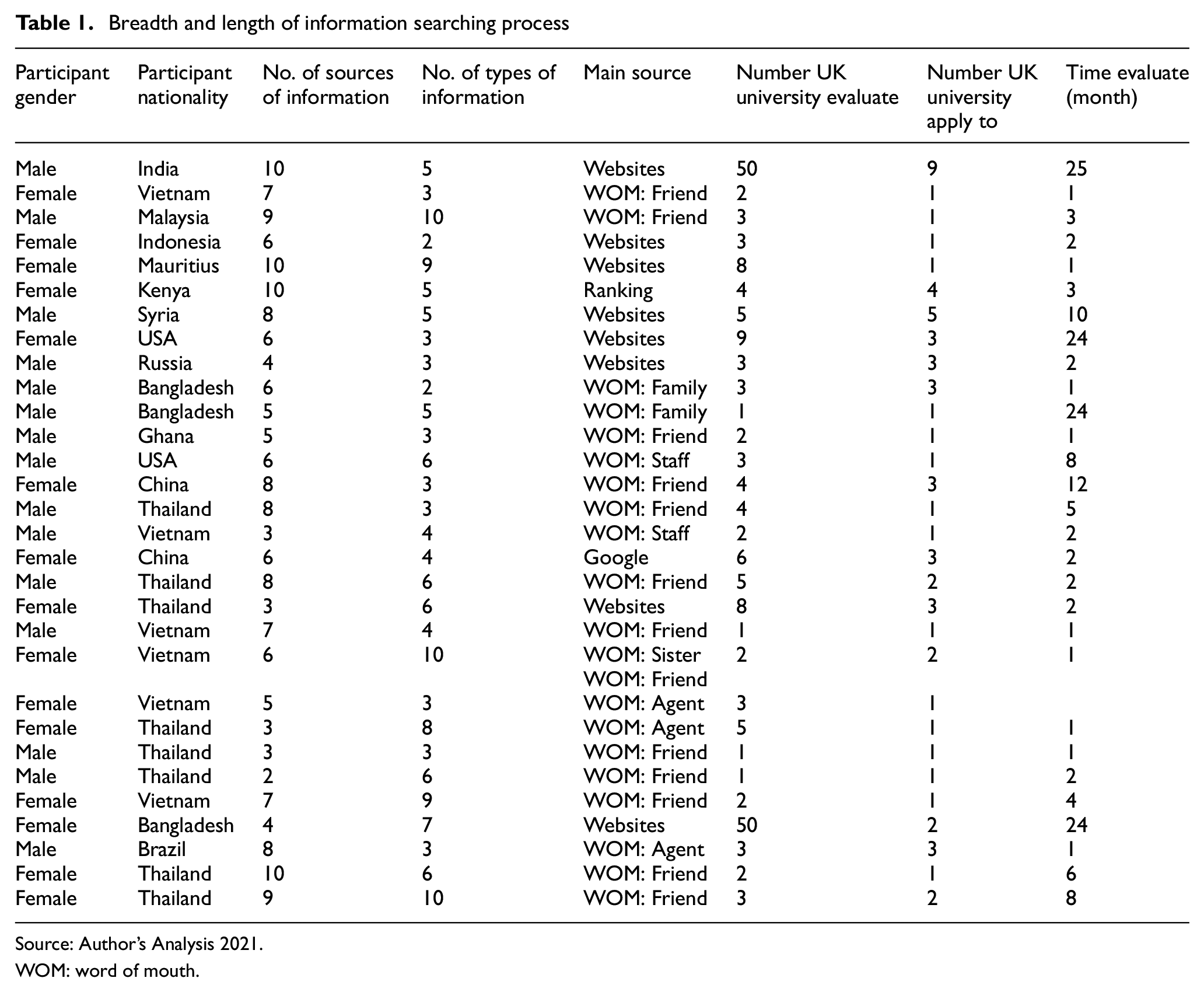
The level of risk perceived by participants when making their decisions impacted on the breadth of the sources and types of information gathered and the length of the process. Table 1 shows the data gathered from 30 participants whose interviews focused on this topic in depth.
Breadth and length of information searching process
Source: Author’s Analysis 2021.
WOM: word of mouth.
The breadth of information sources ranged from two sources, which were typically WOM sources such as friends and agents, to 10 sources, which included a range of WOM and online sources. The number of sources in each category ranged from one friend to an extensive search of websites through Google. Similarly, there was a range of types of information evaluated by participants, from two to 10 types. The number of universities evaluated varied from one university to 50 universities. The majority (n16) of participants applied to one university.
The length of time that participants spent looking for information to evaluate universities varied. The majority of participants took one (n9) or two (n7) months to make a decision. Four participants took 24 or 25 months to search for information.
The level of informedness of participants therefore varied and was directly related to the level of perceived risk. Participants (n15) who perceived high levels of risk engaged in complex information searching at each stage of the decision making process over a longer period of time and evaluated more universities and sources and types of information. Two self-financing participants, who lacked knowledge of universities and had no WOM information, took two years to systematically screen universities. One chose 50 universities from a longlist of all available UK universities and shortlisted three, while the other comprehensively screened UK and US universities: ‘I created a Google document and I basically pinpointed all the universities for consideration. And it was up to nine universities at one point’. Those participants (n15) with a lower perceived risk spent less time searching for information to inform their decision.
Cultural norms also influenced the breadth and length of the information searching process. Participants from collectivist cultures tended to involve a wider range of family and friends in the decision and relied on them for WOM recommendations, so curtailing the search for information. One participant’s fatalistic attitude and emotional approach to looking for information and making the final decision were linked to his cultural norms.
4.2. Kuhlthau information search process linked to decision making process stages
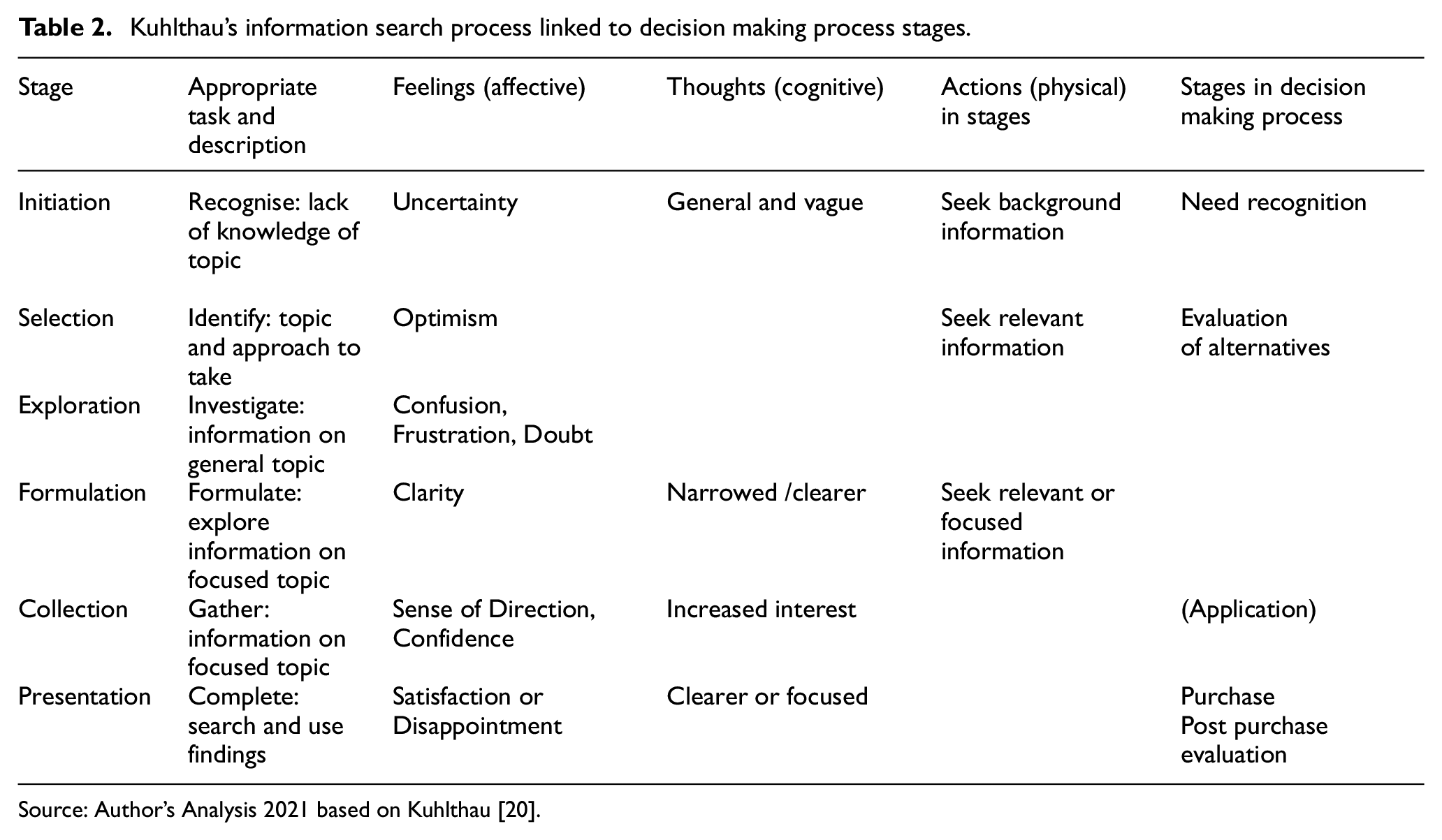
For the first time in this study, Kuhlthau’s ISP model was tested in a consumer decision making context. The ISP model was found to accurately reflect the information searching behaviour of participants, the actions that they undertook at each stage, and their thoughts and feelings as they gathered information to decide on a university to attend. The stages in the participants’ decision making process were found to be linked to Kuhlthau’s ISP model stages as shown in Table 2.
Kuhlthau’s information search process linked to decision making process stages.
Source: Author’s Analysis 2021 based on Kuhlthau [20].
Table 2 shows that the initiation stage of the ISP mirrored the need recognition stage of the decision making cycle as in both stages, participants’ need for a postgraduate qualification was triggered, which commenced the information search process. Participants would look for background information, as they did in Kuhlthau’s study [75].
Once participants acknowledged the need to study for a postgraduate qualification, they entered the evaluation of alternatives stage of the decision making process. High risk participants were often uncertain and apprehensive about the process of searching for information, as Kuhltahu’s students were [75]. Many had the option of studying a postgraduate qualification in any country, city and university that they had the qualifications to apply to, and the thought of gaining the information to make an informed decision was very daunting: ‘In the beginning I had the need, which was that I want to do a Masters, but then I was like really uncertain about looking for universities’.
Faced with the choice of numerous universities and countries, one participant felt overwhelmed by the prospect of searching for information and was ‘in an emotional state’. One high risk participant tried to reduce his level of anxiety by retrieving information as quickly as possible: ‘I’d say in the beginning information search was a bit hectic just so I could get it all wrapped up by June and would not be stressed out about it’.
When identifying how they were going to undertake the search process in the selection stage, participants planned an extensive search of online sources if they did not have access to WOM recommendations to help them make their decision. The lack of WOM information sources among high risk participants led to feelings of being ‘so confused’ and uncertain: ‘So it was depressing, and I didn’t really know where to start’. This is contrary to Kuhlthau’s original 1983 research where feelings of optimism were more common in the selection stage [75]. These feelings do, however, align with Kuhlthau’s 2008 study [66], where there were some who approached the search for information in the selection stage with apprehension. Other studies found that when students encounter problems and obstacles in accessing information, they become confused and frustrated [98,99].
In the Exploration stage, high risk participants undertook a broad search for information and gathered facts about different countries and universities so they could reject some options at later stages and reach a decision. However, the sheer volume of information collected and the large number of options available made it difficult for participants to sort through the information to help them come to a decision, and they experienced feelings of confusion, doubt and frustration. Gathering new information to inform their decision that then conflicted with previous information, or was inconsistent with it, added to their uncertainty. These findings agree with Kuhlthau’s studies [66,75]. One high risk participant started to search for information on 50 universities: ‘In the initial stages it was very confusing because there are 50 mouths saying 50 different things to you. So it creates a chaos in your mind’.
In the Formulation stage, the search process became more focused, and the goal was to obtain relevant information to help narrow down their search. Many high risk participants would have a list of countries and universities to consider with alternative options regarding courses offered by these universities. They would gather information to screen out universities from their longlists, which contained from two to 50 universities, in order to form a shortlist of up to nine universities. They again felt overwhelmed by the volume of information they had to process, lacked confidence that they had gathered the information they needed to make an informed and correct decision, and were confused: ‘A bit confused. Because I don’t know how about [P University] and about [the University]. I also got a lot of information […] that my friend and agency recommended to me’.
This is in contrast with Kuhlthau’s research where the Formulation stage was the turning point in the process when individuals began to feel less uncertain, more confident and had a sense of clarity [75]. Holliday and Li [100] suggested that the ISP model matched the behaviour of students who found searching for information easier due to the Internet. However, this led to some students skipping stages, especially after focus formulation, as they felt that they had completed the process.
During the Collection stage, participants would look for additional focused and relevant information that would help them make a final shortlist of universities to apply to and then accept. There were high risk participants who still lacked the confidence that they had undertaken an adequate information search and were uncertain that they had the information they required to make a decision. They did not feel that they knew what direction they should take in terms of searching for further information and ended up taking a shortcut to the final decision: ‘I had a lot of confusion. I had offer letters from nine universities so it was very difficult for me to choose one. I chose [the University] because they were the first one to give me an offer. So I just went with my gut feeling’. At this stage, Kuhlthau’s students felt less uncertain and more confident [75].
In the last stage of Presentation, the participants would make the final decision as to which university to enrol in and would purchase a postgraduate qualification. They then entered the post purchase evaluation stage of the decision making process and felt satisfaction or dissatisfaction with the information searching process and the decision they had made at the same time. The feelings of uncertainty of some high risk participants diminished as they made their final decision. Some felt confident that the information searching process that they had gone through had led to the right decision: ‘It was confusing looking for information […] As I was searching for information things became clearer to me. Once I made the decision to study marketing at [the University] I felt confident that I had made the right decision’.
Others still felt under confident despite rigorous information search: ‘It was a lot of work for me to do when searching for information and even when I chose [the University] I was not one hundred percent certain that I had made the right choice’. Hyldegard’s [101] students similarly reported feelings of uncertainty at the end of gathering information.
The rigour with which high risk participants had approached the information searching process and the degree to which they had gone through its stages impacted on their feelings of uncertainty. Participants who had little time available to search for information and had not undertaken the degree of information search that they wanted experienced negative feelings at this time: ‘I was depressed because I only spent two months deciding and choosing universities […] So I didn’t have that much time to do the research’.
Lower levels of risk were perceived by those who had reliable WOM recommendations, which often meant that they had a number of people in the decision making unit supporting their decision. They relied on WOM information in the Selection stage when they were commencing their search to relieve any uncertainty that they felt: ‘luckily I got a lot of friends who had studied in the UK before […] I got a lot of recommendations of what to do and where to start researching’.
Similarly, if participants had experience of studying at the university or a similar institution and were dependent on others, such as family or employers, to pay for the qualification, they felt there was less risk when making the decision. They tended to spend less time searching for information, relied on fewer sources and types of information, and skipped stages in Kuhlthau’s ISP model: ‘But my friends said [the University] is suitable for me and so that is why I come here’.
Some low risk participants who felt overwhelmed with the information search process experienced a dip in their confidence levels in the Exploration stage, which aligns with Kuhlthau’s findings [75]. After searching for information in a semi-systematic way, certain low risk participants made a quick decision based on an offer from the university or a gut feeling: ‘Actually it’s hard to like to decide, but finally my feeling is prefer [the University]’. The information overload that the postgraduates experienced [73] led to a ‘satisficing strategy’ leading to a quick decision as to which university to attend [74]. Others had undertaken a limited information search and took shortcuts to the final decision, especially if there were clear WOM recommendations from friends and agents: ‘No it was not difficult for me to choose a university in the UK as [Thai University 1] has many students who have already studied at [the University] and they gave me advice on why I should study at [the University] and what I should study …’. Studies have identified the importance of WOM sources such as parents, siblings and friends to help especially when contradictory sources are found [75,102].
There were therefore low risk participants who felt certain that they had made the right decision despite the fact that they had performed a limited information search, as they were confident in the WOM sources gathered throughout the process.
4.3. Iterative information search process
Previous decision making process models depicted information search as a distinct stage in the process [3,4,16]. The findings from this study showed that information search was undertaken by participants throughout the process as they gathered information to inform all the decisions that they made concerning the country, city, course and university to attend.
The ISP process was found to be iterative rather than a sequential or linear process. Participants moved backwards and forwards through the stages and revisited prior stages, sources and types of information on the way to making the final decision regarding the university and course. Chung and Neuman [60] also found students’ gathering, selection and use of information to be dynamic and iterative.
Some participants started broadly researching one type of course in the Exploration stage, gathered further information in the Formulation stage, and then changed their minds and opted to go back and search for information on a different course. Participants initially searched for information on finance, international management and hospitality programmes and then decided that these courses were not suitable for them and started to search for information on alternative courses in the formulation stage: ‘Yes I was looking for human resource information for all universities. But later on I chose business’.
Other participants researched universities in a number of countries in the Exploration stage, decided on a country of choice in the Formulation stage and then went back to search for additional country information to ensure that they were making the right decision. Participants looked at Australia, America, Canada and Switzerland before deciding at this point to study in the UK:
I remember applying for one university in Canada but later I concentrated on the UK because of its one-year Masters programme.
Having received offers from universities some participants were unsure as to which offer to accept and they revisited the sources and types of information they had previously evaluated to help them decide. In the Presentation stage, after purchase, participants would return to earlier sources and types of information to reassure themselves that they had made the right decision to help them feel more certain. ‘I feel like I’m not confident. I am afraid that I’m not gonna finish the graduation […] And just looking, what should I prepare before study here to reassure myself’.
4.4. Cyclical information search process
The ISP process was also found to be cyclical, as discussed by Savolainen [58]. Participants learnt from the ISP that they had undertaken, and their experiences affected the way they planned to search for information in the future in a continuous cyclical manner. The participants who had systematically and rationally gone through the ISP model stages over a period of time were satisfied with their information search process and the choice of university they had made. ‘I’d say the whole decision making process went well for me. I tend to […] plan ahead, be strategic, be deductive in my decision making’. In terms of making future decisions, this participant had learnt to consider unexpected factors: ‘My experience of this decision making process has taught me to account for variable change […] I have to consider that there may be a couple of missing pieces of information that I should continue to take into consideration for future decisions’. For these participants, the positive experience of information searching meant that they would look for information in the same rigorous way in the future.
In contrast, those participants who did not spend time at each stage or took a shortcut to the final decision and skipped stages were less certain of the decision they had taken and were more likely to approach the information searching process in a more systematic and thorough manner in the future.
One participant had learnt from the decision making process that he had gone through to think more critically when making decisions in the future: ‘So thinking things out and not doing just the first thing that comes to my mind’.
Once at university, participants remained in the post purchase evaluation stage of the decision making cycle, and they would start to search for information on the personal and academic aspects of their university experience. Information searching was found to be a continuous process throughout the participants’ time at university. Participants would go through Kuhlthau’s information search process many times, returning to the initiation stage at the start of each information search. Whether any of the stages were missed out and the length of time spent at each stage depended on the level of importance, risk and involvement with the type of information required and the number of sources that needed to be consulted in order to obtain the information.
4.5. Sources and types of information
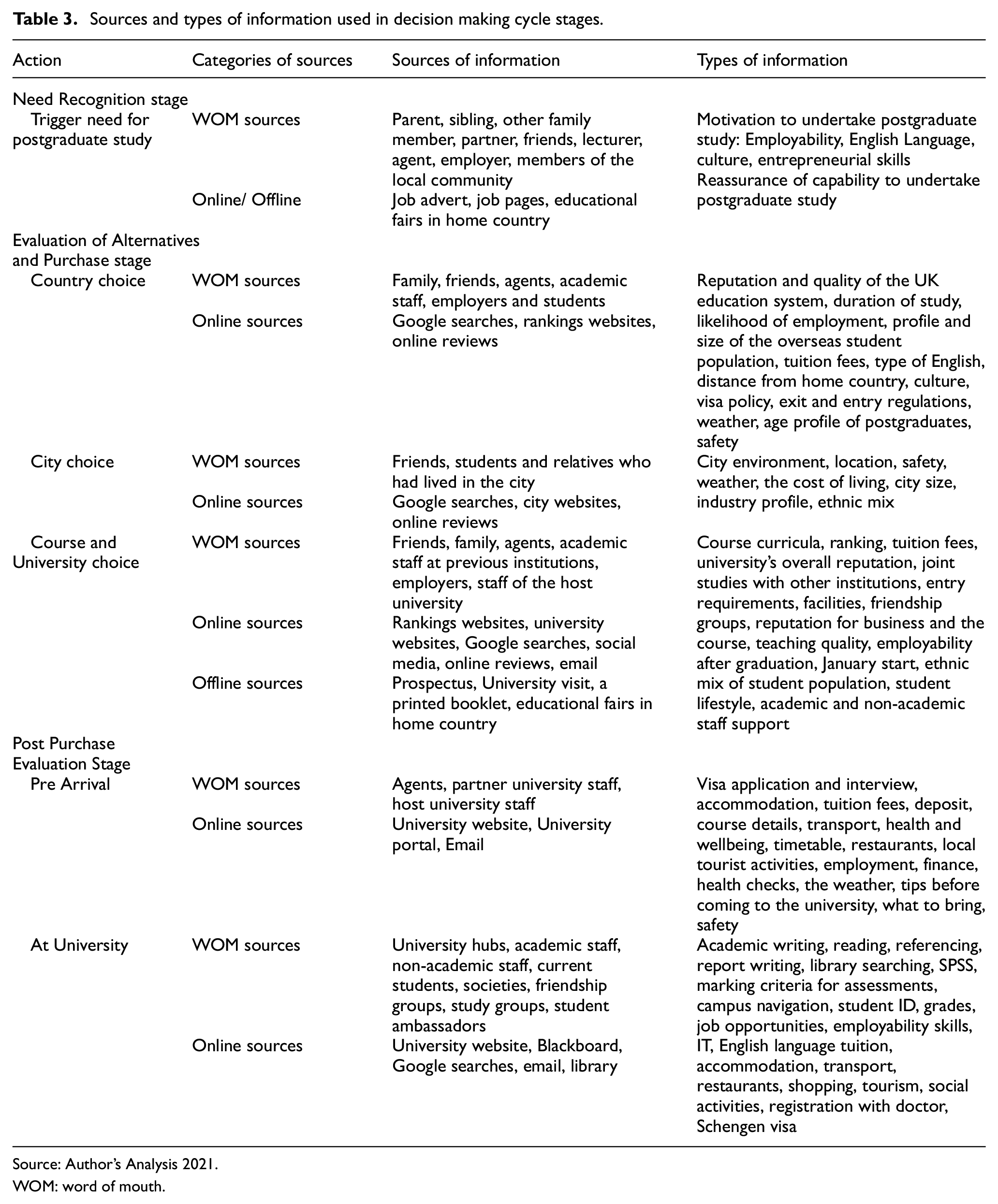
Table 3 is a summary of the most important sources and types of information used by participants as they progressed through the decision making cycle. The significance of WOM and online sources reflected the searching behaviour of individuals brought up in this digital era.
Sources and types of information used in decision making cycle stages.
Source: Author’s Analysis 2021.
WOM: word of mouth.
This study highlighted the importance of WOM information, especially from current students, alumni, family, academic staff and agents. WOM sources were the most important sources of information for 20 prospective postgraduates when making the decision to study at a university and while studying at the institution. WOM recommendations were perceived to be more credible, impartial and trustworthy than marketer generated sources: ‘I think it is about the word of mouth […] when someone told the experience that they faced before […] it’s the credible information for me’.
Reliance on WOM recommendations from friends when evaluating universities often led to shortcuts being made in the ISP before a final decision was made: ‘I just go to [the University] website […] and many people around me’.
WOM recommendations contributed to the pool of information available to postgraduates throughout the ISP. As information searchers prospective postgraduates would use the pool of WOM information when they were deciding on a country, city, university and course. Similarly, while at university, postgraduates acquired information from the pool when they were searching for answers to their queries. As information providers, prospective or current postgraduates and alumni contributed information to the pool of information available to other postgraduates.
In this digital era, participants relied on online sources such as websites, rankings, reviews and Internet search engines to look for information when deciding on a university. They could not remember the websites they visited and did not evaluate their quality because they trusted Google and Baidu as search engines and did not have the level of interest or energy to undertake rigorous research: ‘I look at the website and I think like this is a good one’.
Contrary to Rekhter and Hossler’s study [103], only a few participants, who did not know any students at the university, actively went onto social media to find out information. Email was only used by participants who were genuinely interested in the institution, once the decision to apply to the university or accept a place had been made.
5. Conclusion
A new conceptual model, the Iterative Decision Making Cycle Model, is proposed in Figure 1 based on the findings. The model builds on Kuhlthau’s ISP model and theoretical models from marketing and consumer behaviour scholars. It is therefore unlike other models as it includes both decision making and information seeking theory and reflects a new approach to thinking about the interaction between information, purchase and consumption.
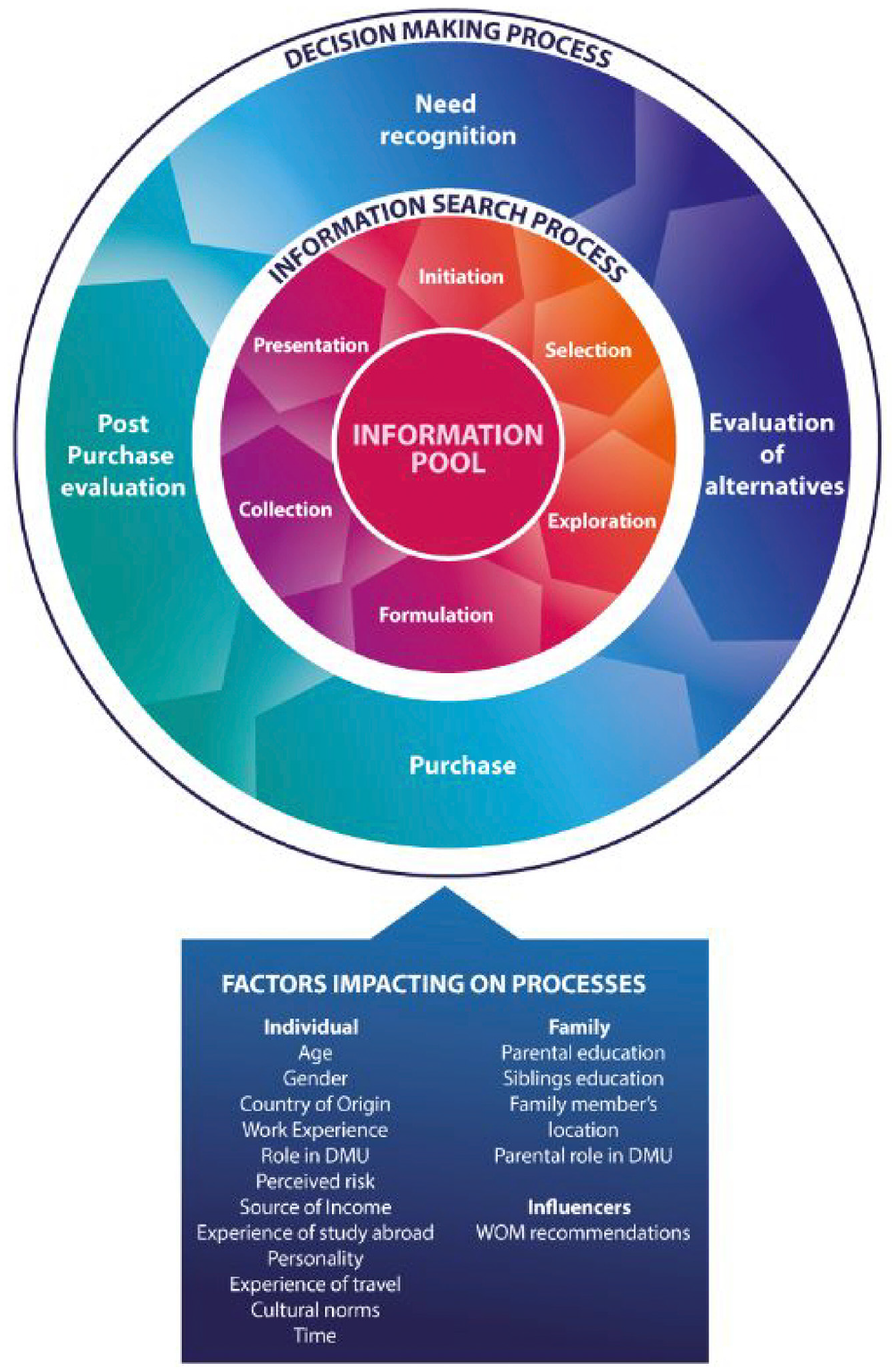
Iterative decision making cycle model.Source: Author’s Analysis 2021.
Kuhlthau’s ISP model was found to reflect information searching behaviour in this consumer context. The model was positioned in the inner ring of the new model as prospective postgraduates gathered information to inform their decisions through all the stages of their decision making process, rather than information search being a distinct stage in the process as proposed in previous models.
In creating a model built on the research surrounding well established models, the author answers LIS scholars’ criticism (see, for example, Todd [104]) that LIS research fails to build on existing theory and creates new models that are not valuable. The proposed research based model is a useful addition to the models already provided as it provides a framework that can be used to explore information searching behaviour within the context of making complex decisions pertaining to the purchase of high risk goods and services and in other contexts.
Kuhlthau’s ISP model was found to have the flexibility to accommodate prospective postgraduates who perceive differing levels of risk when making their decisions. It covered those high risk postgraduates who spent a considerable amount of time progressing systematically through each ISP stage as they looked for multiple sources and types of information to make their final decision on university. It also accommodated those low risk postgraduates that proceeded with less rigour, missed out on stages, took shortcuts and made decisions based on emotional criteria.
The cyclical and continuous nature of the decision making and ISP processes were reflected by a circular ring. Postgraduates learned from the ISP process, which impacted on how they would search for information when making high risk decisions in the future. The iterative nature of the ISP is shown by the backwards and forwards arrows, which represent the fact that prospective postgraduates revisited previous stages and gathered further sources and types of information as they made their decisions.
Previous scholars have not examined information search linked to the post purchase evaluation stage of the decision making cycle. This model reflects the qualitative findings that showed how important information search was during the post purchase stage. After purchasing a degree, postgraduates looked for information to reassure them that they had made the right decision of university and course and to prepare themselves for study. Once they had arrived at university postgraduates, would search for academic and practical information on a daily basis.
The information pool is located at the core of the model due to the importance of WOM information as a credible and impartial source at all stages of the ISP, when deciding to attend a university and then while studying there. Postgraduates contributed information to the pool and acquired information from the pool as they progressed through the stages of the ISP. Once at university postgraduates would provide information to the pool available to current and prospective postgraduates. A virtuous circle of communication was therefore established, whereby the pool of information supported postgraduates and encouraged future applicants to the university.
The factors shown in the model that impacted on the information searching process included those factors identified in the literature [49] and additional factors linked to the level of risk perceived by participants. Younger male participants who were relying on others for finance and had experience of work, travel or study overseas perceived the purchase to be less risky. Similarly, those participants who had WOM recommendations and a large DMU, which could be linked to their collectivist cultures, had lower perceived risk. They performed a less rigorous and systematic search for information compared with high risk individuals.
This study found that despite living in an information rich world, many low risk postgraduates did not perform an in depth search for sources and types of information and were not well informed when making their final decision.
This study builds on Kuhlthau’s work. Kuhlthau [75] acknowledged the use by an information seeker of formal and everyday sources of information, but she did not consider the types of information sources used, the role of the information provider, an individual’s information needs or the contextual factors of the search that led to the person recognising that they had a need for information [73]. This study adds to the current body of knowledge in the field of LIS as it investigated a postgraduate’s information needs in terms of the sources and types of information required, their role as information provider and the contextual factors that impacted on their search for information. By looking at the role of information in making a decision rather than focusing on information seeking behaviour, and the information seeker, this study provides an insight into how information is used by the postgraduates.
Those postgraduates who perceived the decision to undertake postgraduate study as a high risk purchase were the most anxious when searching for information. In order to minimise the risk, some postgraduates attempted to gather information from multiple sources in order to evaluate universities, but then became overwhelmed with the sheer volume of information they had collected and could not sort it out effectively. This information overload further contributed to their feelings of uncertainty and anxiety and led some postgraduates to selectively filter the information they evaluated in order to reduce the scale of the task or abandon the search and make a quick decision. However, a lack of rigour in the information search process then resulted in feelings of anxiety when the final decision was made.
WOM sources of information, especially from current students, alumni and agents, were very important to prospective postgraduates when making the decision to study at a university and reduced their levels of perceived risk. Postgraduates did not evaluate the motives of those providing these recommendations or question the reliability of the information provided and often took a shortcut to the final decision based on what could sometimes be classified as insubstantial evidence.
The interconnectedness of members of the DMU in this digital era and their reliance on online sources of information such as websites, rankings, reviews and Internet search engines was evident. These sources were perceived to have credibility regardless of their origins. Reputation and rankings were key indicators used to choose potential universities, but for those with access to WOM sources, the experiences of current students and alumni were more important when choosing a postgraduate qualification, even though they could be biased and unreliable sources.
High risk decision making was found to be a very complex process. The information behaviour that accompanied the making of a high risk decision was also seen to be complex, multifaceted and challenging, which is represented in the author’s model.
5.1. Future work and limitations
Postgraduates from one institution were interviewed, which could be a limitation. Future research could be undertaken in a number of different universities to obtain a broader insight into the decision making cycle of postgraduates. The model developed was analytically generalisable rather than statistically generalisable. There is an opportunity to test the model with further courses and nationalities.
The model succeeds in bringing information behaviour research into the marketing discipline and demonstrates the value of this research to other contexts, in this case the process of making the high risk decision to purchase a postgraduate qualification. The author has benefitted from the insights gained from studying LIS research when constructing her model and perceives that there is an opportunity to test the model in alternative high risk decision making situations in a variety of contexts.
Footnotes
Declaration of conflicting interests
The author(s) declared no potential conflicts of interest with respect to the research, authorship and/or publication of this article.
Funding
The author(s) received no financial support for the research, authorship and/or publication of this article.
