



Abstract
This work’s aim was to investigate what verbal means are used by English-speaking Twitter accounts to describe the pandemic while focusing on extralinguistic factors that are the primary catalysts for linguistic transformations in society. A critical discourse analysis of the lexeme ‘Covid-19’ and words accompanying it was applied. A total of 1736 English-language tweets (6844 lexical units) posted during March to April 2020 were selected for the analysis. Functional discourse analysis allowed systematising and commenting on sampling results as well as provided the opportunity to make the following conclusions. In tweets, the lexeme ‘Covid-19’ is combined not only with the actual name of the virus. This lexeme became a productive ground for derivation into various linguistic structures: substantive word combinations, abbreviations, neologisms and anthropomorphic metaphors. The research results application in international practice will allow linguists to interpret neologisms that emerged as a result of the pandemic and foster the understanding of axiological indicators of native speakers.
1. Introduction
The public health crisis that emerged in 2020 due to the coronavirus (Covid-19) pandemic has had a sudden but lasting effect on the international community. Faced with the high infection and mortality rates noted immediately after the virus emerged in China in December 2019, national governments have quickly implemented a series of measures to slow the spread and impact of Covid-19 in their territories [1]. Thus, in European countries, for example, a strict lockdown shutting down nonessential businesses, strongly encouraging telecommunication, and keeping family and social contact to a strict minimum was introduced already in mid-March 2020 [2]. All this forced separation and inability to communicate has made people use the media more actively than before. And along with the new realities, language has also become the subject of significant transformations. It hastily became clear that the epidemic and the containment situation had prompted a considerable amount of statements, questions and criticism from the public, which resonated on social media. Even though politicians adopted quite radical measures on social contacts, people began to share information and express their opinions more intensively using social networks like Twitter [3]. As a result, along with the virus’s spread, original neologisms have become increasingly created, leading to notable language changes. Perhaps the most widely used linguistic element for creating new lexical units is the ‘Covid-19’. However, unfortunately, most neologisms coined on its basis carry a negative meaning. Recent studies have shown that the pandemic and isolation have raised the anxiety level of the population [4]. Social media that played a crucial role before the outbreak of the virus continue to play it as the disease spreads around the world. After China adopted strict quarantine restrictions as an intervention (e.g. closing cities, schools and using self-isolation), Chinese social media platforms (e.g. Weibo, WeChat and Toutiao) became a lifeline for almost all people who had been isolated for over 30 days and relied on these channels to get information, share opinions, communicate and order food [5]. Social media, being the only method of communication during the lockdown, was the trigger for the modification of languages. Existing research [6–8] suggests that Twitter data can provide useful knowledge about epidemic diseases, fill the reader’s mind with new terms (e.g. H1N1 and Ebola), track fast-changing public sentiment, measure public interests and concerns, assess real-time disease activity and trends and follow up reported disease levels.
The use of social media as a vector of opinion and a tool for dialogue has increased slightly because of the extended lockdowns [9], the crisis and the perception of social media as a means for fast and direct communication [10]. And in modern conditions, the lexeme ‘Covid-19’ is the best choice for situational representation of crisis communication in 2020.
Crisis situations have been the subject of many research works focusing on the linguistics and axiology of an often-used term. The bulk of this research is devoted to methods of crisis management and the public response to it through the use of linguistic neologisms associated with the ‘Covid-19’ lexeme [11]. This has led to the creation of crisis response models [12], often concentrating on the linguistic aspects of the messages exchanged in such conditions [13] or even models applied to social networks in their specificity (the mediated crisis communication model) [14].
Scientific novelty of this article resides in the fact that it provides an interpretation and evaluation of the personal and practical impact of the global Covid-19 pandemic on the speech and cognitive processes of English-speaking Twitter users. In addition, it unveils the peculiarities of changes in the language as a global phenomenon, not only in Twitter and its content strategy.
The relevance of this article stems from many linguistic variations that occur every day in many world languages. Crisis language development is a wide field for linguistic research. The ultimate goal of this study is to conduct a preliminary investigation of the axiology of Covid-19 as a linguistic phenomenon and uncover how it is named, what it refers to, what the population thinks and says about it in social media, how the crisis is perceived during self-isolation and how it changed the language.
1.1. Literature review
A new coronavirus disease has become a watershed moment for society. The Covid-19 pandemic has been declared international public health, world economic and all human activity emergency [15]. In addition to economics and health care, significant deviations have been observed in the development of linguistics. Language as a dynamic concept fully reflects the state of society [1]. Extralinguistic factors may cause its significant modifications, generating layers of new words and expressions, as well as changing the way of using once exclusively sociological, psychological and medical terms (lockdown, incubation period, infection, etc.). Since language is a hereditary, interpersonal and social phenomenon, it is natural that our vocabulary expands and becomes more diverse [3]. Situationality generates neologisms by filling the needs of communication. Such language development is designed to fill the gaps in an official discourse that emerged in the course of specific events and reflect the life experience of people under isolation [16].
Since the pandemic has led to the cancellation of many social activities (work, conferences, school classes, debates), the prevailing part of interactions moved online. Against this background, the use of social media intensified, and Covid-19 has become the main topic of communication. Thuswise, it is quite reasonable that platforms like Twitter have turned into the hub of the technological and social infrastructure that gives us the chance to stay connected even during the lockdown [3].
The language of social media is characterised by relative linearity. Linguists mark the following trends in Internet discourse: aggravation of the personal component, stylistic dynamics, expressiveness and tendency to language neologisation [12]. The most productive linguistic phenomenon in this perspective is the emergence of neologisms. Lamsal interprets neologisms as a modified linguistic category. He states that neologisms are mainly referred to as the result of breakthroughs. It is innovations in all spheres that stimulate the emergence of new lexical units [9].
According to Olimat, the development of new vocabulary is primarily related to geopolitical and social processes, especially negative ones. Every time a crisis occurs, there is an increase in new notions, and it is a normal process of social expression [17]. The importance of frequent usage of new lexemes is highly emphasised these days. For lexicography, this means that neologisms will then dominate the global discourse and even replace most other expressions [17]. A good example here would be the medical terminology associated with Covid-19. As far as it is used daily, it has become dominant in global discourse over the year [18].
The conditions resulting from the global pandemic have made social media a major place for linguistic life. It is the analysis of such content that will allow inferences regarding the linguistic development of axiological trends present in this time period [4]. Social networks act as a subject of the formation and transmission of society’s axiological meanings, being a certain value filter [1]. The nature of the selection of new lexemes in use is determined by the nature of the addressee and the prevailing circumstances [8]. However, the current situation is such that new concepts acquire mainly negative connotations describing the pandemic realities. The motivation of studying the axiology of such vocabulary is to gain an idea of the archetype of modern thinking expressed in the lexemes depicting direct perception of the phenomenon by the discourse participants.
This work intends to study the variations of the lexeme ‘Covid-19’ on the material of the English-language content of the Twitter platform with the help of functional discourse analysis. The main objective is to reveal the peculiarities of the functioning of this lexeme in the Internet discourse.
2. Materials and methods
The methodological basis of this work was the functional discourse analysis, a relatively innovative interdisciplinary method directed at studying different reactions of people in a socially stressful situation. This article followed the principles of broad analysis of discourse as the fundamental domain of language communication in all its formal and situational manifestations [19]. The discourse-centred approach analyses social content in a broad socio-economic, ideological and cultural perspective, taking into account the social interests and goals of social network users. It focuses on the perceptual competence of discourse as a means of forming new linguistic units and allows scrutinising the function of action in verbal communication and its pragmatic potential multiplied through the use of visualisation (memes, emoji, gifs). Linguists note that social networks’ influence on the development of language is realised by a variety of techniques that can shift the mode of perception of real social events, including crises. In this perspective, discourse analysis helps identify transformations in the discourse structure and their reasons. The new stereotypes and lexical units are formed with the help of an entire system of concepts. They develop directly in the discourse, are distributed across its levels, and suggest the formation of new perceptual competence. At the same time, the essence of social networks is in the very process of information exchange and in how this information affects people. Discourse displays the real world in its diversity [20].
The central feature of discourse is speech manipulation. It acts as a hidden influence on the recipient modifying the emotional and psychological background and axiological aspects [21]. The units of discourse analysis can be the individual, the situation, the perception and the content of functional and personal components. Communication via social networks is characterised by an obvious and, simultaneously, hidden assessment of actual events by means of certain communicative strategies and tactics. Their usage enables a versatile interpretation of reality in an evaluative tone set by the recipient, often with true informativeness distorted. Language strategies as methods of speech behaviour are implemented under the so-called ‘global control’ [22]. At the moment of crisis situations, the reaction of social network users is immediate. The characteristic feature of social network texts is the block syntax – an alternation (and often combination) of a standard and expression [22]. Such a manner of material delivery enables multiple and exhaustive presentations of socially important events (in our case, the Covid-19 pandemic). The persuasive focus of social media discourse has an axiological specificity associated with bifurcation situationality [3]. However, these studies have limitations – only qualitative manual coding of a very small number of tweets. They need better methods to improve accuracy when studying public opinion and sentiment. In addition, the public online response to Covid-19 remains unknown. The vast majority of articles on Covid-19 and 2019-nCoV focus on epidemic control, such as the transmissibility of the virus [18], clinical characteristics of infected cases [23] and patients’ screening [24]. This makes it possible to potentially describe the same thought processes at the extralinguistic level and in different registers. Thus, along with the actual content of messages in social networks, the prominent role is played by the axiological component [25]. Correspondingly, discourse analysis can provide high-quality consideration and interpretation of linguistic changes in the context of the global pandemic.
2.1. Research design and materials
The research material was a sample of 1736 tweets (a tweet was considered every single post) of English-speaking accounts (6844 lexical units) published during March to April 2020. In order to study such content, a discourse analysis of the corpus of tweets related to the Covid-19 was used [9]. This provided the opportunity to examine lexical neologisms resulting from crisis and isolation. Apart from this, this study also benefitted from a semantic approach to analysing tweets that are associated with the crisis and emphasise the concerns of citizens who, due to circumstances, focus on communication and pandemic image. The investigation of formal linguistic aspects enabled describing the axiology of the Covid-19 crisis and the resulting lexical creativity. This formal review concluded with a semantic approach to situational referents.
The collection and analysis of tweets with a discourse approach allowed responding to the sudden nature of the global Covid-19 crisis and the ways in which it affects axiology and linguistics. The choice to collect corpus from Twitter was based on the results of numerous studies in the field of linguistics and communication, which showed that this social network is very popular for research and dissemination of information related to critical events [5,26,27]. The corpus sample was composed by means of the Twitter-based Application Programming Interface (API) for data (tweets) extraction and assessment [13,14,28]. The extraction of tweets was performed according to the following keywords: covid*, corona*, ncov*, sars* and sras* (an asterisk indicates possible variants after the last letter). The collection began in March 2020 and ended in early April 2020.
The discourses of citizens were of particular interest for this study because of the intensification of public involvement in creating (publishing), responding (commenting) and disseminating (sharing) information in times of crisis. A sample of tweets analysed within the current research showed dynamic representativeness. A growing body of literature related to the topic under investigation [10,20,29] underlines the need to expand knowledge about the pandemic using a purely linguistic perspective. For this reason, the current research used methods that allow extracting linguistic features from tweets related to Covid-19 and response to the global crisis [21,22,30].
Specificity analysis based on comparison with the exclusion corpus found overused expressions in the nested tweets corpus compared with all collected tweets [6–9]. This method allowed identifying communicative strategies and language habits of particular population strata or at a particular moment of crisis.
Tableau Public Edition 2020 visualisation software made it possible to analyse trends’ development over time. As in the case of all exploratory research works, the findings presented have limitations and require many other developments. Insofar as the approach used in this study is monologic, there is a need for more close consideration of the dialogical aspects of English-speaking citizens and deepened analysis of the emotional component, in particular through methods of automatic classification of tweets.
The theoretical significance of this article is related to the interest that social media content has drawn to discourse analysis as a sociolinguistic method of the study of the moral disposition of humanity in crisis.
3. Results and discussion
Language transformations are always connected with geopolitical and socio-historical factors. Although, in most cases, filling the language with new lexemes is done by means of creating or adopting neologisms with their subsequent synonymisation. It should be noted that the synonymic range of the key lexeme (in our case, ‘Covid-19’) is as diverse as is the circle using this concept. Therefore, this study focuses on tweets of a variety of English-speaking populations. This representativeness should not be understood in a statistical sense but rather in terms of the diversity of Twitter accounts to reach socio-economic and demographic diversity of followers’ population:
males, females and political parties;
athletes;
journalists and the media;
industries, institutions, organisations and law-enforcement agencies (police, military, etc.);
celebrities (artists, royalty, YouTubers).
The research results show that the following synonyms are used to replace ‘Covid-19’ (Figure 1).
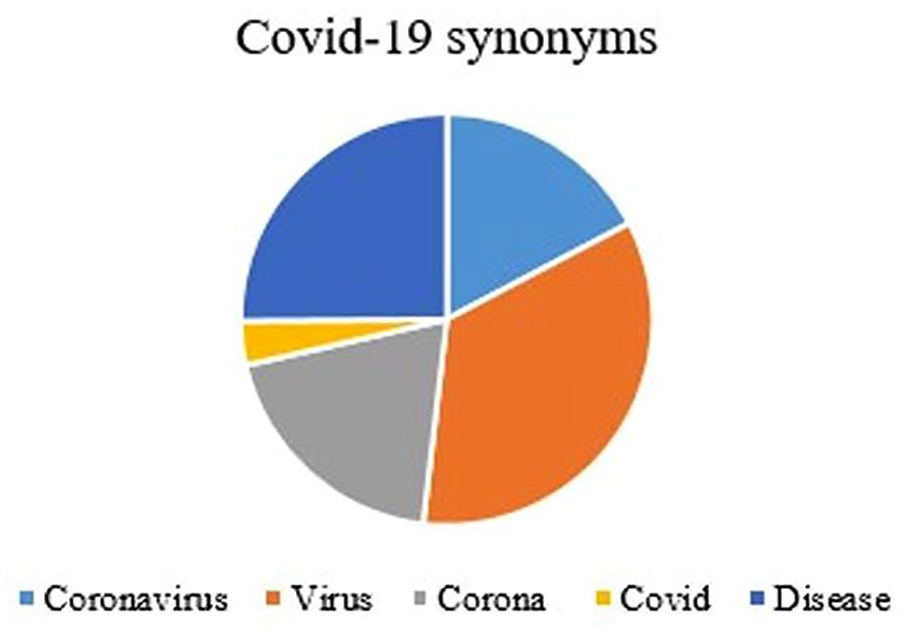
Covid-19 synonyms.
As can be seen, the synonymic series of the virus name is as follows:
Coronavirus – 1300;
Virus – 1708;
Corona – 1340;
Covid – 1060;
Disease – 1436.
As a rule, these lexemes acquire many meanings and are used without changing their sense only in the tweets of medical orientation. Correspondingly, it can be said that the lexeme ‘Covid-19’ expands its semantic potential.
Table 1 below presents the axiological linguistic transformations of the lexeme ‘Covid-19’.
Linguistic transformations of the lexeme ‘Covid-19’.
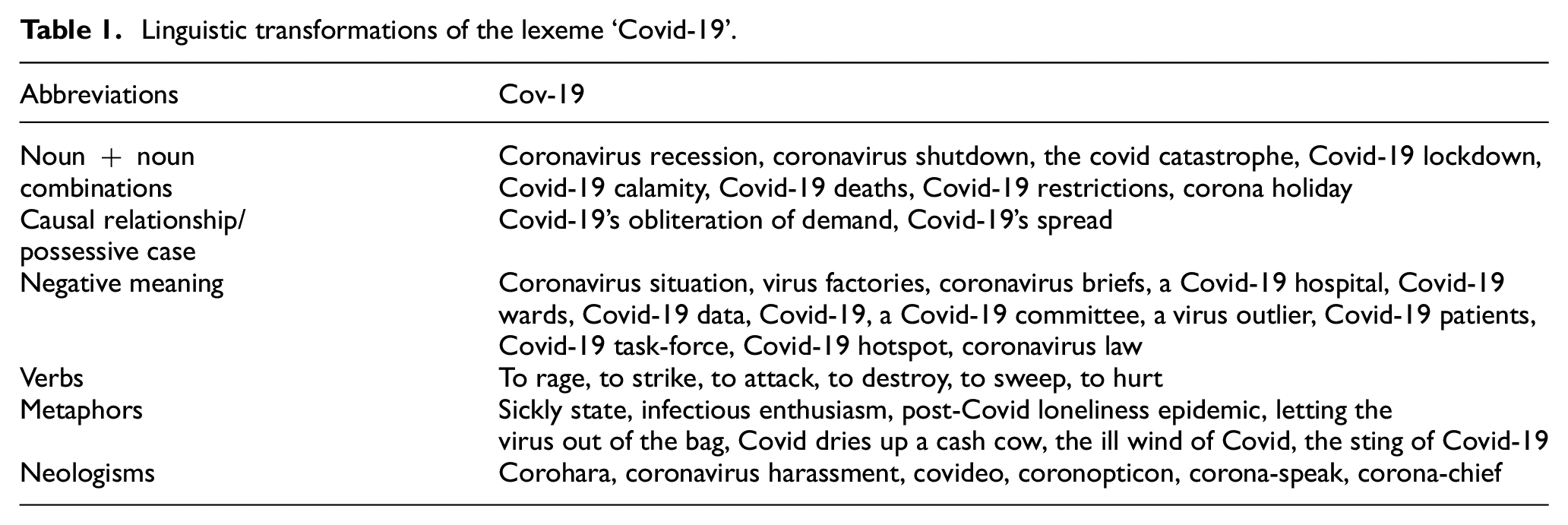
As evidenced above, only one abbreviation of the lexeme ‘Covid-19’ is used in the sampled tweets, whereas noun + noun phrases are met most often. Some combinations are built on causal relations, and for others, the possessive case is used. It is quite interesting that most examples presented have a negative axiology, predominantly pressing semantic load; verbs expressing cruelty or destructive action are used very often. Another fascinating detail is that verbs and adjectives ‘new’ and ‘novel’ are probably to be used with noun phrases. The lexeme ‘Covid-19’ is also often combined with anthropomorphic metaphors and frequently represents the basis for creating neologisms. Since neologisms denote a sporadic and historically defined phenomenon, they constantly renew the language reflecting all the stages of its existence. Furthermore, in times of social crisis, the processes of linguistic genesis are even more pronounced and accelerated [31–33]. In general, the semantic and axiological combination of the listed lexical modifications describes the axiological portrait of the lexeme ‘Covid-19’. In particular, it becomes clear that all of them carry a negative connotative meaning.
The obtained findings make it possible to assume that the axiological axis of humanity is reflected in the linguistic units, especially those capturing the state of crisis. Thus, the main criterion for understanding the transformations is the word meaning in crisis communication that reflects the picture of the that-time world [34–36]. The discourse analysis of the sample of lexemes retrieved from English-language tweets allows the inference that linguistic deformations in the axiological conditions of Covid-19 pandemic are conveyed with the help of abbreviations, substantive phrases, causal relations, possessive case, phrases carrying a negative semantic load, adjectives, anthropomorphic metaphors and neologisms. The lexeme ‘Covid-19’ carries a substantial axiological load. It entered our everyday life and became a source of formation of new English words, displaying the picture of the pandemic. A further investigation of Twitter content related to the Covid-19 is expected to unveil the social results of this crisis.
Modern linguistics considers social media as a generator of the universal atmosphere and axiological display of the actual critical point in society. Social networks are often viewed as a tool situationally directing people’s thinking and perception in the ‘necessary’ direction, thereby forming axiological values and dictating changes in crisis communication [22,37]. Indeed, it is impossible to disagree with such conclusions because social networks are leading these days in terms of usage, are an important source of information, a catalyst of social opinion and a method of influence on society. The modern academic community pays a great deal of attention to pandemic circumstances and variability of its perception, seeing the use of Covid-19-related humour in political communications and the media as subjects with their own social functions [11,24,38]. The primary idea here is that politicians or heads of health agencies should carefully consider the choice of language means when publishing posts about Covid-19 interspersed with humour [39]. In addition, content creators, both in traditional and social media, can significantly benefit from analysing their readership (their age, gender or approximate location). This will let them properly calibrate the delivery of Covid-19 messages with respect to emotions that may arise in their followers. This study is fully consistent with the considerations of other authors on the importance of studying the axiology of Covid-19 from the perspective of linguistical psychology since it is the one that can relieve the mass tensions in society.
The semantic aspect of the pandemic-related words was also investigated by Moroń and Biolik-Moroń [40]. They claim that categorisation of these lexemes could stimulate more extensive analysis of new data, while systematic comparison of nonspecific neologisms would expand the linguistic potential. Indeed, the codification of linguistic neologisms may give a new impetus to the development of most languages, introducing new elements into use.
The works devoted to the mythologisation of time in Internet memes during the COVID-19 pandemic are of particular interest within the framework of the present research [41–43]. Modern social mythology is highly actualised in the context of the digital humanities. The practice shows that the digitalisation of human existence leads to the emergence of digital mythology, which makes us aware of new electronic social reality and influences the formation of a particular worldview. The myths of the digital age are embedded in the tools of social communication, one of which is the Internet meme [44]. By and large, the Internet meme can be defined as a part of digital culture and a communication phenomenon that can transmit emotionally coloured information and influence its perception. Internet memes contain myth elements that allow communicants to perceive the transmitted information efficiently. They create an opportunity for Internet users to describe the realities of a fast-changing world while at the same time comprehending it at high speed through the popularisation of the myth. Myths about the time have gained particular relevance during the pandemic because of the need to adapt to new conditions of existence and accelerate digital transformation [22, 45]. Besides, Internet memes about 2020 demonstrate the features of the mythologisation of time in the pandemic period and help understand the existing situation from different perspectives. However, to date, there is limited research into the linguistic analysis of Covid-19 in this vein.
The case of linguistics in the given context is often considered from different perspectives as, to date, there is limited research on the linguistic analysis of Covid-19. Some works [19, 46] aim to contribute to the linguistic studies of Covid-19 by applying a corpus approach for data analysis. Others analyse the emotionality of lexemes created in pandemic conditions and point to the positive role of memes, gifs and tweets in decoding emotions [17, 47]. Still others claim that Covid-related vocabulary in online newspaper reports carries predominantly negative connotations [48]. This research supports the latter. Colloquialisms generally reflect the fear, anxiety and insecurity that most people experience. This shows how the virus takes a toll not only in terms of economics but also in social life.
The current work also concurs with the opinion of foreign scholars [8,14,49] about the undoubtedly significant role of social networks, which form a collective opinion, determine value orientations and influence the culture of communication. Alvarez affirms the universal impact of social networks in communicative processes noting the active development of ways of influence on society and language evolution [50].
The works of Russian authors [15,42,44] are also important to mention in the given context. Some of them [15] focus on the specifics of the paroemic space of the coronavirus discourse, in which new images of typical situations related to the coronavirus pandemic are formed. Researchers declare that the coronavirus narrative affects the use of phraseological units and paroemias, which, despite their stable structure, are subject to various modifications. In parallel, scholars confirm the general thesis that linguistic modification and partial neologisation are a consequence of the pandemic.
Another interesting work on the topic [42] is devoted to the study of the axiology of Covid-19 as a linguistic phenomenon. It uses a comprehensive linguistic analysis of the research material, which includes the complex analysis method, classification and description of the material, and semantic approach similar to that applied in this article. An identical methodology was also used to study the pragmatic and semantic features of the axiological assessment by the example of organised sentences. Although, despite the fact that the category of evaluation of new Covid-19 lexemes was also given in relation to value concepts, it was studied on the basis of fiction texts [44]. Overall, this research supports the theses of Russian authors about the active use of new lexemes related to the Covid-19 pandemic both in speech activity and axiology of being.
4. Conclusion
In summary, this article presents somehow double-natured conclusions concerning the communicative Covid-19 crisis and its axiological aspect. On one hand, the study results confirm tendencies observed during other turning points in the world and history, but, on the other hand, they seem ad hoc for the pandemic of 2020. The main outcomes of this article are as follows. In the analysed tweet corpus, the lexeme ‘Covid-19’ merges not only with the name of the pandemic (coronavirus). More complex forms have been constructed with the help of different parts of speech, metaphors and neologisms. Aside from that, it was noted that for English-speaking Twitter users, the semantic variations of the lexeme ‘Covid-19’ are given masculine gender.
The crisis period was marked by the introduction of semantic and lexical neologisms as the topic of Covid-19 has given extensive material for debates in English-language discourse. Although, at the same time, the discussion of the Covid-19 outbreak was challenged by the sudden and unusual nature of the introduced lockdown, after which the number of talks on the topic dropped sharply (50%) in less than a month. It became clear that users are rather interested in the ‘behaviour’ of Covid-19 (humanisation, spread and disappearance of the virus). The vocabulary used in the tweets addressing this topic carries a largely negative semantic load. Furthermore, it was uncovered that the evaluative component of what is happening is very important because it reflects the real emotional state of people.
In the Covid-19 circumstances, social media are often condemned as a measure of panic spreading among the population. The results of the analysis of tweets sampled during the lockdown of 2020 allowed creating a corpus of expressions related to fear (concerning pandemics, mortality, self-isolation, job loss, depressive states). Interestingly, their number was far fewer than linguistic neologisms with positive connotations. Accordingly, one can confidently claim that the axiology of the world pandemic has not exposed humanity to negative attitudes but motivated unification and optimism.
4.1. Future perspectives
Conduct a similar study for Russian-speaking Twitter users and compare the data obtained with already available findings to make an overview of the axiological tendencies of the Russian Federation as a response to the pandemic crisis.
The practical value of this work stems from the potential for further use of its findings and methodology to form a linguistics corpus on the material of other countries. In particular, the chosen method of linguistic analysis will allow analysing the lexeme ‘Covid-19’ in the Russian discourse. This will enable forming an informational picture of the world, showing the peculiarities of Russians’ worldview and system of values.
Footnotes
Author contributions
A.A. contributed to the conceptualisation, methodology, data curation, formal analysis, funding acquisition and writing – review and editing. L.L. contributed to the investigation, project administration and roles/writing – original draft. E.K. contributed to the resources, software, supervision, validation and visualization.
Declaration of conflicting interests
The author(s) declared no potential conflicts of interest with respect to the research, authorship and/or publication of this article.
Funding
The author(s) disclosed receipt of the following financial support for the research, authorship and/or publication of this article: This study was supported by the RUDN University Program Priority 2030.
