




Abstract
We present a model of information that integrates two competing perspectives of information by emulating the Chinese philosophy of yin-yang. The model embraces the two key dimensions of information that exist harmoniously: information as (1) objective and veridical representations in the world (information as object) and (2) socially constructed interpretations that are a result of contextual influences (information as subject). We argue that these two facets of information cocreate information as a unified system and complement one another through two processes, which we denote as forming and informing. While the information literature has historically treated these objective and subjective identities of information as incompatible, we argue that they are mutually relevant and that our understanding of one actually enhances our understanding of the other.
1. Introduction
Information is one of the most central yet elusive concepts of our era. Not only is it a defining principle for information studies but it is also a fundamental concept in other disciplines ranging from economics to physics [1,2]. For example, information has been defined based on ‘entropy of a random variable’ [3], chemical processes [4] or certainty in decision-making [5], reflecting different disciplinary foci.
Conceptualisations of information are often divergent from ‘incommensurable assumptions’ about the nature and existence of information [6–8]. This makes it difficult to establish a productive discourse around the concept of information as definitions of information in information studies are either absent, taken for granted or disjointed due to irreconcilable differences. As a clear example of the latter issue, the objectivity and subjectivity of information has preoccupied the information studies discourse for decades [9–12]. For these reasons, Floridi [13] argues ‘work on the concept of information is still at that lamentable stage when disagreement affects even the way in which the problems themselves are phrased and framed’ (p. 351).
Commonly held definitions present information as a phenomenon reducing uncertainty or entropy [3], a ‘difference that makes a difference’ [14], ‘the pattern of organization of matter and energy’ [15] or ‘a basic property of the universe’ [16]. These conceptions may be cogent but can appear too embracive with little guidance on what is considered and what is not considered information. More recent formulations of information have categorised it as a theoretical concept, but they are often divergent in how they perceive information [17]. Specifically, they can be divided into ‘narrow’ or ‘broad’ conceptualisations of information [18].
Under a narrow definition, information is presented as signals or a property of a message, and its utility can be objectively measured based on how it helps reduce uncertainty. This perspective is commonly espoused in economics of information or decision sciences [19] and corresponds to an objective view that treats information as an observer-independent object, token or thing [20,21]; information exists in the world independent of humans ‘and would do so whether or not any living being were present to experience the information’ [22]. In contrast, information under a broad sense is associated with a subjective process, which results in situational understandings and changes in one’s knowledge [9]. Seen this way, information is observer-dependent, socially constructed and contextual, meaning how it comes about and acts depends on ‘a context – situation, task, problem-at-hand’ [18].
These views are helpful in describing key roles of information, but alone can generate some distinctive blindspots. A plurality of definitions around the concept of information per se is not the culprit here, but the specific ontological assumptions and epistemological commitments affiliated with these definitions may elide the key elements of information [23]. For example, the narrow/objective view loses sight of the process through which meaning is generated and becomes a part of information as well as the underlying cultural and social contexts of information. In contrast, the broad/subjective view, even though taking a more dynamic position, may gloss over the properties of information that remain intrinsic and inherent to it (and not part of the social context in which it is interpreted) and enable information to transcend particularities of contexts, time and space.
Past work has already highlighted the two dimensions of information (i.e. objective vs subjective). For example, Mingers and Standing [24] argue that definitions of information should be sensitive towards both objective and veridical nature of it and subjective meanings that take shape in people’s state of mind. More notably, Marcia Bates, as a celebrated information scientist, has made great strides in her research programme over the years, emphasising that information is simultaneously an objective (what she terms ‘Information 1’) and subjective phenomenon (what she terms ‘Information 2’) [22,25]. However, how the two are interlaced and more importantly cocreate information as a unified system has been less explored.
This article aims to offer some conceptual clarity by articulating an integrative framework on the information phenomenon and highlights the duality of the subjective and objective as a central problem in information studies [26,27]. Our premise is that information as an emerging social phenomenon cannot be reduced to objective facts or subjective interpretations alone. In integrating these perspectives, we take a pragmatic approach, which recognises differences in epistemological foundations but calls for paradigmatic coexistence and dialogue. Drawing on the pragmatist school, we argue for ‘whatever philosophical and/or methodological approach (that) works best for the particular research program under study’ [28]. In this context, the primary goal of a pragmatic approach is not to suppress epistemological differences and foundational principles but to ‘open the doors to multiple methods, different worldview and different assumptions’ [29] (p. 9). It also facilitates dialogue between various traditions to address vexing problems that require varied perspectives [30]. As such, we subscribe to the pluralistic argument that each view of information addresses a different practical problem [31] and therefore, can potentially complement one another.
In this article, we proffer a framework of information with two specific contributions in mind: (1) to build on the strengths of each perspective – subjective and objective – and (2) to bring together the duality of object and subject and their interactions in the same framework. The framework could serve as a pragmatic foundation based on which the information phenomenon can be presented and understood. It also provides opportunities for much needed constructive interactions and synergies between different conceptualisations of information [32].
A framework of fundamental dimensions of information and their interplay can be relevant beyond its theoretical contribution. Analyses of information, its key characteristics and how they emerge contribute to effective design and delivery of information services [23] and the lingering debates over how something is considered to be or not to be information, and the concept of misinformation.
In capturing the paradoxical dimensions of object and subject, we draw on the dialectical approach of yin-yang, as a promising way to illustrate how opposites can not only exist but also complement each other. In particular, we employ this framing to explain how the two opposing forces of objective and subjective play out and cocreate the information phenomenon. It is important to note that to present our argument, we offer a ‘representative’ coverage of the literature, focusing on ideas and conceptualisations that are deemed representative of broader typologies (rather than providing an exhaustive portrayal of the literature landscape) [33].
2. Yin-yang and dialectical thinking
Yin-yang presents a holistic and dialectical perspective [34,35]. It is tied to the principles of Daoism [36], which has penetrated Chinese society and philosophy and traces of it can be found in Chinese nomenclature and language [37]. For instance, the Chinese term used to describe information, xiaoxi (消息), follows the yin-yang way of understanding the world and embraces the ‘logic of correlative duality’ [38]. 1 Similar to all dialectical thinking, the concept of yin-yang helps explore the world through the dynamic interaction between two forces that shape each other through contradiction [39,40].
The dialectical system of yin-yang is, however, different from its counterparts in the West due to dissimilar approaches to contradiction [35,40,41]. Under the Aristotelian, Hegelian and Marxist modes of dialectical thinking, contradictions are something to be changed, synthesised and perhaps overcome, whereas ‘Chinese dialectical thought denies the reality of true contradiction, accepts the unity of opposites and regards the coexistence of opposites as permanent’ [41] (p. 1067). From a yin-yang perspective, seemingly opposing forces can be understood as ‘mutually complementary’ and the two polarities as ‘contrapletion’; in other words, they do not eliminate each other, oppose each other or subordinate to one another [39].
The concept of yin-yang further emphasises the appreciation and integration of two primal but opposing factors and considers them as natural properties of every system–everything has both yin and yang. In principle, yin and yang always coexist, and for examining any phenomenon holistically, both yin and yang aspects of it have to be taken into consideration. Yin-yang forms an open and evolving system, which constantly interacts with its broader environment, and the interaction between the two forces over time ushers in continuous changes in the nature and scope of the system [42].
The principles of yin-yang are illustrated in Figure 1: (1) everything has yin and yang aspects (represented by the two interacting hemispheres in the diagram) and (2) the two are always interacting (represented by the dynamic and fluid shaping of each other). These not only suggest coexistence but also co-creation in that yang is created from yin and yin is created from yang [43]. These are also complementary as yin ensures the stability of the system, while yang provides avenues for change and movement [40,42,44].
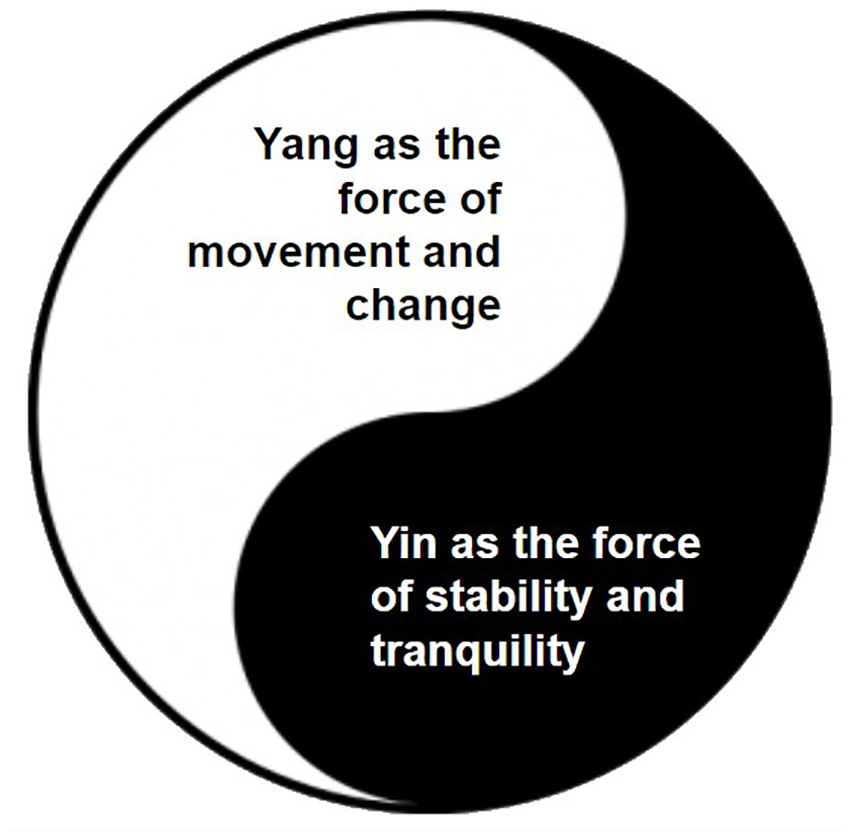
Two complementary forces in yin-yang adopted from Chen et al. [42].
In what follows, we draw on a yin-yang perspective to provide an integrative framework of information as embodying both subjective and objective dimensions and their symbiosis. Our premise is that these two dimensions should not be thought of as separate and mutually exclusive. Not only do the two dimensions exist in tandem, but they shape each other through the forming and informing processes.
3. An integrative model of information
Information can be understood as a system embodying objective and subjective dimensions. The information synergy is rooted in the co-constitution of these two opposing forces as yin-yang; they mutually shape each other and the information phenomenon as a whole (see Figure 2). Below, we describe these two forces and identify underlying assumptions of the perspectives affiliated with them.
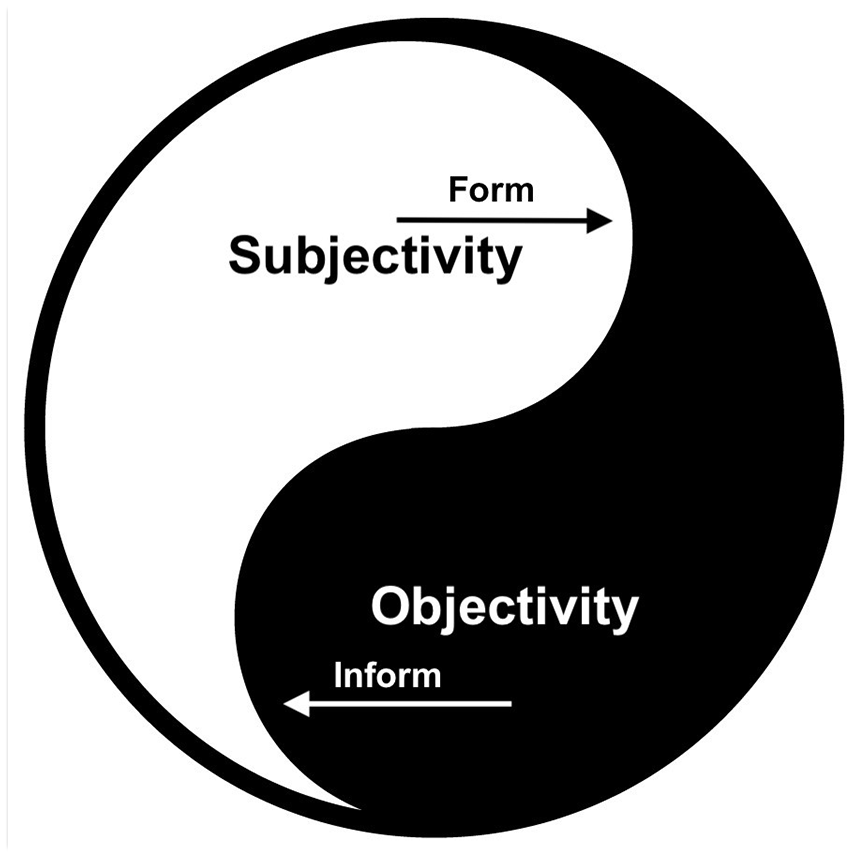
Information as co-constitution of objective and subjective dimensions.
3.1. Information as object
This perspective of information bears on the objective ways that natural sciences often observe empirical evidence and define information. Within information sciences, information can be seen as an objective entity that can be articulated, stored, retrieved, transferred and measured. For example, information retrieval researchers often treat information as an object and are concerned with concrete manipulations and retrieval of explicit information artefacts (e.g. search results). To some, this may even take a concrete physical form. Farradane [45] presented one of the early conceptions of information in information science as ‘any physical form of representation, or surrogate, of knowledge, or of a particular thought, used for communication’ (p. 4). Mingers and Standing [46] present information as an objective concept (in that information can exist independent of the observer or receiver) and true/correct (in that wrong or false is not information, but misinformation or disinformation). Objectivity of information may include concrete physical forms, but objectivity goes beyond just form and encompasses features and characters that can act in context- and observer-independent fashions.
Information as an object reflects the immutable nature of information, which makes it accessible and transferable across contexts. As such, because of these properties, information is not completely ephemeral and amorphous and may take some life and journey of its own, representing a more consistent system of meaning. Information existing objectively in the world implies two meanings; first, it can take an observer-independent form, and second, it can be presented in objective, impartial ways.
The first meaning of objectivity corresponds to the veridical nature of information and includes irrefutable and context-independent facts; these facts bear on ‘details about an event or a situation in the past, the present or the future, or an indisputable and consistent scientific fact, such as pi = 3.14’ [47] (p. 11). In this way, information serves as an accurate and true representation of realities, events and activities [48].
The second meaning implied in the term objectivity pertains to concrete information forms and structures that sustain themselves across contexts and users. Information can be contained and presented in the forms of signs, messages or signals in a way that renders it less dependent on the observer, so it can exist ‘out there’ in some independent and recognisable forms. French documentalist Suzanne Briet underscores this function of information as self-preserving forms, which help reconstruct or serve as a proof for a phenomenon [49]. Bates [22] highlights this dimension as an ‘objectively existing phenomenon in the universe’ (p. 1034).
These objective dimensions are often recognisable by diverse communities of users and are entrenched in the norms of a community. So this dimension of information is less equivocal [50], in that people find it unambiguous and indisputable. Taking the following tweet as an example, there is almost no dispute about some elements of the tweet, such as
The tweet was sent by Donald J Trump, the 45th president of the United States (the blue badge confirms it is a verified account).
This was sent late at night (local US time) when the result of the election in the United Kingdom was already called.
The winner of the election in the United Kingdom on 12 December 2019 was Boris Johnson and his conservative party.
It is necessarily brief, constrained by the media channel (Twitter).
Objective elements are the genesis of ‘information materiality’ as properties of information that transcend space, time and context specificities, and shape how different users engage with, experience and make sense of information [51]. It is through these objective contours that information invites or extinguishes possibilities for certain interpretations and uses [52]. As such, even though these objective elements do not necessarily and fully determine interpretive outcomes, they are still consequential and hence material [53]. For example, one typically does not question the fact the Tweet depicted in Figure 3 is endorsed by Donald Trump, though different groups of observers could react to it differently.

A Tweet by President Trump congratulating the British prime minister.
3.2. Information as subject
This conception of information derives from the ways behavioural and human sciences theorise information as a subjective matter. These subjective aspects of information are reflected by interpretive approaches, which see information as an intangible, subjective phenomenon. Subjective aspects of information interpret information and derive meaning in relation to a context [9]. In this sense, information is relational and socially constructed [31]. It is not objectively existing in the world, but lives in people’s minds and practices. This view of information is central in intellectual communities ranging from ethnomethodology to more critical perspectives, such as information ethics [54]. From a critical perspective, information affordances can have disparate implications for various stakeholders that come to interact with the information object [55]; for example, it can empower or disadvantage different groups of people [56,57].
The subjective dimension centres on how human behaviour and social forces shape information access and knowledge-building. Information can be treated as meaningful, understandable and relevant only in relation to subjects and contexts, what is often referred to as ‘contextual embeddedness’ [58]. For example, Solomon [59] directs attention to personal contexts, and ‘how you shape what turns out to be information to you in your own way as a reflection of your own interests and concerns’ (p. 232). Hjørland [60] argues that an object as simple as a stone can be subject to multiple interpretations: A stone on a field could contain different information for different people (or from one situation to another). […] People have different educational backgrounds and play different roles in the division of labor in society. A stone in a field represents typically one kind of information for the geologist, another for the archaeologist. (p. 111)
The subjective elements are context-centric and generative to new interpretations. In other words, these elements are varied and fluid across communities and contexts and can serve as boundary objects [61]. These elements are a source of equivocality where interpretation of information and its meaning can be manifold and conflicting [62]. What is considered an unquestionable assumption in a community can be disputable in another community, and these differing understandings are rooted in the norms that are formed over time. For example, as an astronomical object with nearly identical properties across contexts, the moon created divergent symbolism and mythology in different eras. Whereas, the primitive hunting cultures commonly considered the moon a masculine entity and a preeminently evil or dangerous figure to women, agricultural traditions regarded it as feminine and a ‘benevolent ruler of the cyclical vegetative process’ [63].
Symbolism is tied to the subjective elements and is profoundly human-centred [64]. In other words, as opposed to emerging intelligent systems (powered by artificial intelligence) which are well positioned to interact with the objective elements of information (e.g. storage and retrieval of information artefacts), humans enjoy ‘fluid intelligence’ which makes them capable of interpreting and interacting with these deeper and more metaphoric, figurative elements. For example, the ad by McDonald’s in Figure 4 uses a picture of Albert Einstein, which invokes the symbolic significance of him as an epitome of intelligence and curiosity. A realisation of the symbolic power is not necessarily an immediate property of the information object but is something that emerges as an outcome of collective interpretation and sensemaking.

Symbolism involved in the subjective elements.
This deeper interpretive layer is shared by a collective understanding that builds on the objective dimension, and it extends the generativity of information in different contexts [65]. It, therefore, indicates the dynamism inherent in the concept of information. Going back to the tweet in Figure 3, multiple and conflicting interpretations can flourish based on the same objective elements. For example, critics can debate with supporters of President Trump and call into question the connotation normally conveyed by the term ‘massive’; furthermore, there could also be very different interpretations about whether a new deal between the United States and the United Kingdom could be any more lucrative than that in place with the European Union.
The subjective elements of information can have both positive and negative consequences. On the positive side, information can be farsighted, contemplative and reflective [66]. In effect, subjective elements interweave with value-added, tacit understandings of information. These elements can be purveyors of conceptual, creative and critical thinking. Subjective interpretations can result in abstract ideas that go beyond limits of time and space (i.e. theorisation process); they can harness information objects but also surpass them and serve as springboards for innovative uses and creative imagination. They can finally move past the apparent, objective forms and structures of information, scrutinise how it was created (e.g. through critical thinking) and reveal the context of information creation and sources of potential flaws, such as power asymmetries and social biases. In short, this is where information transcends its objective structures and turns into a foundation for more valuable concepts, such as knowledge and wisdom.
The subjective interpretation of information can also be a source of negative consequences. For example, confirmation bias is a psychological heuristic that acts as a filter in the sensemaking process and prevents a comprehensive and systematic interpretation of objective facts to emerge. The role of community and collective sensemaking can be equally problematic. In close-knit communities, where access to channels to alternative interpretations and theories is either discouraged or limited (e.g. online conspiracy groups), people are often more prone to building on commonly held ideas that are less tied to objective facts and therefore spread and consume misinformation [67].
4. Co-constitution through forming and informing
The subjectivity and objectivity of information builds on and shapes one another through the forming and informing processes. Both forming and informing processes are emergent and situated where meaning is produced, negotiated and reproduced recurrently.
4.1. The forming process
The forming process is an inherent dynamic of information as the term information can be traced to its Latin root, informatio, which connotes shaping or giving form [68]; researchers in the past have commonly employed the notion of ‘in-formation’ to define information [69,70]. Through the forming process, people put out a representation of reality in the form of information. The result of this process can be described as ‘syntactically well-formed and meaningful data’ [71] (p. 92), or ‘the true or veridical propositional content of data and signs’ [72] (p. 11).
In the forming process, people create and transform the information object and inscribe meaning into it (this meaning is not constant and can be reenacted in the informing process). Much like the informing process, people engage in ongoing actions in a specific context and time and create subjective construction of their experience into information objects [22]. Forming is closely tied to sensemaking processes through which information is generated and takes shape as both a key resource to and outcome of the process [73].
The information object takes form in a sociocultural context [74]. So as a human artefact, an information object is produced and reproduced within a social situation and represents a cultural packaging (e.g. a commonly held set of symbols) that helps other users decode and interpret it [75]. For example, nuances of the English language get embedded into a tweet and a sensitivity towards these sociocultural backgrounds helps the reader understand and decipher it even though they may not necessarily infer the same meaning.
A central aspect of the forming process is transforming information into a conveyable form and structure, what Bates [22] calls ‘a durable medium’ (p. 1039). The medium has a clear bearing on how recorded information is formed and transformed; for example, the invention of the printing press drastically revolutionised how information was produced and disseminated in the form of written materials, and the way people become informed. The same can be said about the impact of digital media on the speed with which information is created and presented across contexts (often captured through the concept of media affordances [76]). These forms and structures through which information manifests itself have profound effects on the longevity and accessibility of it over time.
For years, information professionals have played a central role in the formation process by creating and reinforcing information structures (e.g. categorisations, index languages, representations, metadata, displays) [59]; these structures would protect the integrity of information objects and facilitate information reuse and interoperability across contexts. However, the infusion of user-generated content (promulgated by the rise of technologies, such as social media) has given the users of the information a more active role in forming information.
4.2. The informing process
The information object shapes the information subject through what we call the informing process. Through this process, the information object serves as a key resource that undergirds subjective interpretations but does not alone determine the outcomes. People draw on other sensemaking resources, such as past experiences and their unique information context [77]. For instance, confirmation bias strongly influences how people interpret information objects they encounter; those that disconfirm previously held beliefs and positions (however objective and fact-centred they appear) can be offhandedly dismissed and may not result in any meaningful engagement with information and changes in one’s mindset.
Informing is an active and fluid sensemaking process, whereby meaning is derived from the information object. In this process, humans take an active role by extracting, appropriating and extending meaning. This may not necessarily be an individualist process since humans as social actors engage in conversation with others; that is, intersubjective meaning emerges out of interaction among conscious minds.
Meadow and Yuan [78] describe the informing process as ‘message[s] understood by the informee and which changes that person’s knowledge base’ (p. 705). Through this process, new knowledge is created as people begin internalising and contextualising information objects; they use it in new and innovative ways, and create potentially value-added understanding based on how it may relate to unique contextual factors (e.g. others’ attitudes towards the new information objects; uncertainty and complexity of the situation). Innovative uses are directed at solving new problems; information’s value is evaluated based on its affordances for fixing problems [68,79]. As such, problems presented by information scientists as ‘information gaps’ invite people to employ information objects to bridge these gaps [73].
5. Implications
5.1. Object as Yin and subject as Yang
Subjectivity and objectivity and their co-constitution as yin-yang are the coherent fabric of information, and the concept of information cannot be accommodated without due attention to not only the two aspects but also how they interact. Their complementary relationship means that one does not exist without the other, and both are enmeshed in and conducive to a larger system. Based on the concept of Daoism, it is not possible to talk about yin without a reference to yang and vice versa. The objective aspects of information can be considered yin (more stable nature of information), while the subjective aspects of information can be seen as yang (more flexible nature of information generative to myriads of interpretations). Such distinctions made between the two are primarily for analytical convenience and they are intertwined and inseparable in practice. The role of subject and object is relational to each other and shaped through their intra-action [80]. This is consistent with an insight from Science and Technology Studies (STS), which emphasises the ontological inseparability of subject and object [81].
The coexistence and mutual shaping of the subjective and objective dimensions guarantee information’s vitality and relevance across contexts and over time. These two dimensions of information are provisional in that they are constantly reconstructed to reflect evolving needs and contextual contingencies. The objective dimension of information as yin underpins stability and longevity of information, while the subjective dimension as yang ensures generativity and adaptability of information (see Table 1).
Symbiotic relationship between objective and subjective dimensions ensuring both stability and generativity of information.

Information understood from the perspective of yin-yang emphasises how the information phenomenon is an open system sustained through the dynamics of the objective and subjective dimensions. On one hand, if the information structure is a closed and rigid system, it may lack generativity and flexibility, overly restricting subjective interpretations and uses. For example, Pettigrew [82] documented the inflexible structural elements (e.g. the layout of the building) that limited the opportunities for information discovery in a foot clinic for the elderly. Generativity is the basis for adaptability of information; McKinney and Yoos [31] note that, ‘in a world characterized by unpredictability and ambiguity, treating information as adaptation enables more systems to survive and prosper’ (p. 340).
On the other hand, information structures are a set of rules and resources that are embedded with information objects and facilitate the subject’s interactions with and around information. If the information is too ephemeral and transitory (lacking any structures and forms that sustain it), it may fail to persist and transcend its context of discovery. For example, because of the magnificence of the architectures, such as the pyramids, there is a consensus that ancient Egyptians must have formulated and taken advantage of advanced project management techniques [83]; however, the details and scope of these techniques are not adequately known due to a lack of documentation.
5.2. Information and misinformation
Using the lens of yin-yang, we can possibly reexamine the concept of misinformation. Modern-day misinformation spread has become a growing and contentious research area [84,85]. Misinformation can come in many forms, such as false information, information put in false context, satirical content and manipulated content [86,87]. In many ways, social media has ignited this new wave of research interest because of unique affordances, such as virality [88,89]. The spread of misinformation is still poorly understood as researchers are still studying the impact of new methods of circulation like bots and algorithms [88,90,91,92]. However, there is a need to look beyond the technical aspects of how information spreads and considers the contextual and interpretive dimensions to clarify what constitutes misinformation [93,94].
The definition of misinformation is contested [95]. We argue misinformation should not be considered a bastardised version of information that is considered the opposite of knowledge. Regardless of the message, the intent of the creator and the impact of the information on the observer, the so-called misinformation is not separable from information because of its information structure. As such, there should not be a dichotomy between the two – information and misinformation – as the yin-yang concept reinforces this point.
To reiterate, in the yin-yang dynamic, both the concrete and objective elements (yin) and the interpretive and contextual (yang) elements exist in mutual harmony. To understand misinformation, though, it is important to delineate different aspects of information. Continuing with the example of Trump’s tweet (Figure 1), the information object consists of objective components (the yin) like the date the tweet was sent and the number of retweets. Those characteristics transcend contexts of time and space and are indisputable. Yet when the people use the term misinformation, they tend to refer to the veracity of the content, for example, hyperbolic claims, misleading statistics used outside of its context, doctored photos – all of which contribute to misinformation only if there is a human observer to interpret or judge the information (the yang dimension).
The process of interpretation is a crucial element of the misinformation identity. Tandoc et al. [96] call attention to the role of the audience of the information, asking: Does fake news remain fake if it is not perceived as real by the audience? This relates back to the informing process, in which humans actively engage in sensemaking and appropriate meaning related to the information object [97]. Thus, since the conditions of misinformation are so tightly linked with how people form and interpret their reality, misinformation is born from the subjective aspects of information.
This articulation of misinformation calls into question the common misconception that misinformation is anti-knowledge. The language of text or visuals through which the misinformation is operationalised reveals only the surface of a deeply embedded cultural system. To decipher and negotiate the truthfulness of the information (even the veridical, context-independent facts), it requires one to navigate through their own cultural assumptions. All things evolve – that applies to biological organisms and cultural artefacts, such as language or memes. For example, the symbolism of the McDonald’s ad was a form of social commentary, a snapshot of the time. Yin (the text) acts as the stabilising force and yang (the symbolism) acts as the destabilising force. For this reason, the so-called misinformation part of an information object still produces shared knowledge about the creator, the time and the context.
Like misinformation, the concept of algorithmic bias has recently become a target of much research interest. Algorithms in social recommender systems have been criticised for reinforcing existing inequalities [98]. For example, in the field of criminal justice, recidivism algorithms disproportionally charge black defendants as higher risks when calculating prison sentences [99]. Algorithms also mediate employment practices – hiring, promoting and even advertising. Another study showed that women were less probable to see ads for science and math jobs simply because young women are a more expensive demographic [100]. One may argue that algorithms align with the information as an object and the informing process because algorithms have no consciousness; therefore, they cannot inscribe meaning into the information objects they transform. However, the key goal of algorithms is to optimise from a set of choices that are born from the process of classification (especially classifying people into a set of attributes). Optimisation implicitly assumes intention, which can only be subjective. Though the engineers intended for the advertising algorithm to be gender-neutral in its delivery, because it was designed to be cost-effective, it favored certain demographics. Therefore, like misinformation, algorithmic bias demonstrates both the subjective and objective facets of information.
6. Conclusion
The significance of the concept of information demands a more effective engagement with it in information studies [17,101]. As Ma [23] suggests, ‘Whether a study presents the processes of information seeking, information behavior, algorithms for improving information retrieval, or citation patterns, one question is often left unanswered in these research studies: What is information and what makes it ‘information’?’ (p. 722).
In this article, we argue for a more comprehensive understanding of the information phenomenon which emerges from the complementary integration of the objective and subjective perspectives. In articulating our framework of information, we take a pragmatic approach, which believes ‘in an external world independent of the mind as well as that lodged in the mind’ [29] (p. 9). A pragmatic approach does not call for homogenising and reconciling different epistemological positions but instead focuses on the research problem at hands and provides a more constructive dialogue about the important dimensions of information. This approach is problem-oriented and builds on the premise that information as a complex problem requires a multidimensional and innovative approach. As Capurro and Hjørland [12] suggest, In scientific discourse, theoretical concepts are not true or false elements or glimpses of some element of reality; rather, they are constructions designed to do a job in the best possible way. Different conceptions of fundamental terms like information are thus more or less fruitful, depending on the theories (and in the end, the practical actions) they are expected to support. (p. 344)
Current conceptualisations already bring into focus different aspects of information as a polymorphic and multidimensional phenomenon [8,22,46,48,102]. We extend this discussion by illuminating ways that the two may mutually shape one another in an integrative framework. Our integrative framework of information brings together subjectivity and objectivity as part of a holistic yin-yang system. Each conception of information (i.e. objective vs subjective) contributes to this framework by directing attention to a key dimension of information. The vibrancy and versatility of the information phenomenon as a holistic system rests on the constant and dynamic tension between these two paradoxical but complementary forces as yin and yang. One without the other can be dysfunctional and may result in the demise of information as a system that embodies and manifests elements of both stability and change. After all, yin-yang ‘involves a process of harmonization ensuring a constant, dynamic balance of all things’ [103].
Finally, it is noteworthy that yin and yang themselves are not fixed and both are in the constant state of change. This can be understood as a limitation of our application of the concept while one may argue for the need for a fundamental ontological adjustment when conceptualising information; an ontological modification that embraces not only substantial and relational ontologies but also a processual ontology [104].
Footnotes
Acknowledgements
We appreciate Barbara Wildemuth and Elliott Hauser for their insightful feedback on earlier drafts of this manuscript.
Declaration of conflicting interests
The author(s) declared no potential conflicts of interest with respect to the research, authorship and/or publication of this article.
Funding
The author(s) received no financial support for the research, authorship and/or publication of this article.
