




Abstract
A sense of purpose in life may promote health by fostering a future-oriented perspective, but little research has examined whether purposeful individuals think more about the future in everyday life, or whether this varies by age. This study investigated links between sense of purpose, age, future-oriented thinking, and physical activity. A total of 256 younger and older adults in Canada and Hong Kong (Mage = 48.0, SD = 24.6, range = 18–85; 68% women) completed electronic surveys three times daily for 10 days, reporting their current thoughts and how future-focused they were. A subset also reported physical activity at baseline and at 6-month follow-up. Multilevel models showed that individuals higher in purpose reported more future-oriented thoughts over the study period, controlling for demographics and self-rated health (b = 3.48, 95% CI = 0.61–6.35, p = .017). This link did not differ by age group. However, future-oriented thinking did not mediate the relationship between purpose and 6-month changes in physical activity. These findings suggest that adults who are higher in purpose think more about the future in daily life, regardless of age. Further research is needed to determine if and how future-oriented thinking connects sense of purpose with health behaviors.
Keywords
Introduction
Having a sense of purpose in life has been shown to predict healthy aging outcomes across the span of adulthood (Pfund & Lewis, 2020). Sense of purpose, the perception that one has an overarching life aim or direction, is associated with an increased likelihood of engaging in protective health behaviors such as physical activity, better diet and better sleep (P. L. Hill et al., 2019; Hooker & Masters, 2016; Kim et al., 2020). Despite the links between sense of purpose and health behaviors, it is still unclear what motivational processes underlie them. Previous theoretical work has suggested that a more salient purpose in life may encourage health-promoting behavior via a future-oriented time perspective in one’s everyday goals and actions (Lewis, 2020; McKnight & Kashdan, 2009). Supporting this notion, common measures of sense of purpose in life frequently include items assessing one’s perception that they have plans for the future and goals that extend beyond the present moment (Lewis, 2020). The present study sought to investigate this in the context of daily life, examining whether those with a stronger sense of purpose direct their everyday thoughts more toward the future, and whether thinking more about the future in daily life mediates associations between sense of purpose and physical activity.
Although research on sense of purpose and future time perspective remains limited, some studies have found that people with a strong sense of purpose report a more future-oriented temporal focus. One study found that a stronger sense of purpose in life predicted a more expansive future time perspective, and that future time perspective moderated associations between sense of purpose and well-being (Pfund et al., 2022). Other cross-sectional studies have observed moderate correlations between sense of purpose and a more future-oriented time perspective (K. C. Hill et al., 2025; Pethtel et al., 2018). However, these findings include only general measures of future time perspective measured on a single occasion and less is known about whether sense of purpose predicts differences in future-oriented thinking in daily life.
Thinking About the Future in Everyday Life
Socioemotional Selectivity Theory (Carstensen, 1992; Lang & Carstensen, 2002) provides a theoretical framework for understanding how developmental changes in individuals’ perceptions of future time impact motivation. According to this theory, as we age, our perceived future time horizons shrink, leading older adults to prioritize current emotionally meaningful social interactions and goals. On the other hand, individuals with an expansive future time perspective tend to prioritize goals that invest in longer-term outcomes, such as knowledge acquisition and maintaining health (Gellert et al., 2012; Löckenhoff & Carstensen, 2004). For instance, a meta-analysis noted that people with a more expansive time perspective were more likely to engage in regular physical activity (Kooij et al., 2018). Thus, an individual’s temporal focus can shape their daily health behaviors, which, in turn, may influence long-term health outcomes.
Although future time perspective is often treated as a trait-level characteristic, emerging evidence suggests it may fluctuate over time and across different contexts (Smallwood & Schooler, 2015). Events that shift our perceived future time horizons—such as political changes or other normative history-graded events, or anticipating significant life events like retirement—can lead to changes in future time perspective and influence the goals we set for ourselves (Fung et al., 1999; Simons & Thomas, 1983). Experimental research has demonstrated that future time perspective is not a static trait, but something that can be manipulated. For example, studies have shown that temporal focus can be experimentally altered by asking participants to imagine a scenario that either limits or expands their perception of the future (Hoppmann & Blanchard-Fields, 2010; Jiang et al., 2016). Such manipulations have been found to affect motivation and goal selection, underscoring the idea that future time perspective is dynamic and can be influenced by external events or internal psychological states, and suggesting our sense of the future is malleable and responsive to both contextual cues and personal experiences.
Recent research using daily life assessments supports the idea that future time perspective fluctuates within individuals over short timescales (K. C. Hill et al., 2024; Katana et al., 2020). Daily life assessments involve repeatedly assessing participants’ thoughts and behaviors in real time, offering greater ecological validity in capturing daily life processes as they occur in their natural context (Bolger et al., 2003; Hoppmann & Riediger, 2009; Shiffman et al., 2008). Studies involving repeated assessments of future time perspective have found that about 20% of the variance in temporal focus is due to within-person fluctuations, suggesting that individuals’ future time perspectives can shift throughout the day or week, potentially influenced by situational factors and individual experiences (Allemand & Hill, 2019; Katana et al., 2020). This highlights an important avenue of research on temporal focus, emphasizing the need to explore contextual factors and consequences of this state-level variability on motivation and health behaviors in everyday life.
It is important to clarify that the present study does not directly assess future time perspective as it is traditionally conceptualized in Socioemotional Selectivity Theory—namely, as the perceived length (more expansive vs. more limited) of one’s remaining time in life (Lang & Carstensen, 2002). Instead, we focus on the momentary content of individuals’ thoughts, operationalized as “thinking about the future” in everyday life. This construct captures whether individuals’ attention is directed toward future-related content (e.g., upcoming plans or goals) during their daily activities. Although this differs from the broader motivational orientation assessed in future time perspective scales, we argue that future-oriented thought patterns may serve as a proximal expression or behavioral manifestation of future time orientation. Individuals with an expansive future time perspective may be more inclined to engage in future-focused thought in daily life—planning, imagining, or problem-solving—which may help translate broader motivational perspectives into concrete goal pursuits and health behaviors.
While prior research has linked a stronger sense of purpose with a more expansive future time perspective using cross-sectional and global self-report measures (e.g., Pethtel et al., 2018; Pfund et al., 2022), these studies have not examined how purpose relates to future-oriented thinking as it unfolds across everyday life. The current study extends this literature in several ways. First, by using repeated daily assessments, we capture temporal focus in its natural context, providing ecologically valid insights into how individuals with a higher sense of purpose engage with the future in their daily thought patterns. Second, while the focus of our primary research questions is at the between-person level, our use of intensive longitudinal data allows for more robust estimates of these trait-like associations than cross-sectional studies can provide. Third, we examine a novel behavioral outcome—physical activity at a 6-month follow-up—to test whether person-average future-oriented thinking helps explain how a sense of purpose translates into action. Finally, by using multi-site samples including younger and older adults in Canada and Hong Kong, our data are positioned to speak to potential cross-national differences in associations.
The Current Study
The current study examined the temporal focus of everyday thoughts, which we refer to as thinking about the future, using repeated daily life assessments from four samples of younger and older adults in Canada and Hong Kong. We sought to address three research aims: to examine (1) whether interindividual differences in sense of purpose predict future-oriented thinking in daily life; (2) whether such associations differ between younger and older adults; and (3) whether thinking about the future in everyday life mediates prospective associations between sense of purpose and physical activity measured at a 6-month follow-up. We controlled for the following demographic characteristics: gender, country, ethnicity, and education, as well as self-rated health and perceived socio-economic standing, which have been shown to have associations with sense of purpose and thoughts about the future (P. L. Hill et al., 2019; Kooij et al., 2018). Based on previously observed associations between sense of purpose and future time perspective in cross-sectional studies (Pethtel et al., 2018; Pfund et al., 2022), we hypothesized that participants higher in sense of purpose would report thinking more about the future in daily life. We also anticipated that thinking about the future would mediate the relationship between sense of purpose and physical activity.
Methods
Transparency and Openness
The hypotheses and analytic plan for the study were not preregistered. We report all data exclusions, transformations, and how we arrived at the final sample. Study materials, deidentified data, and analytic code are available on Open Science Framework (https://osf.io/2kaw3). Models were run in R version 4.4.1 (R Core Team, 2021) using the lme4 package (Bates et al., 2015).
Participants and Procedures
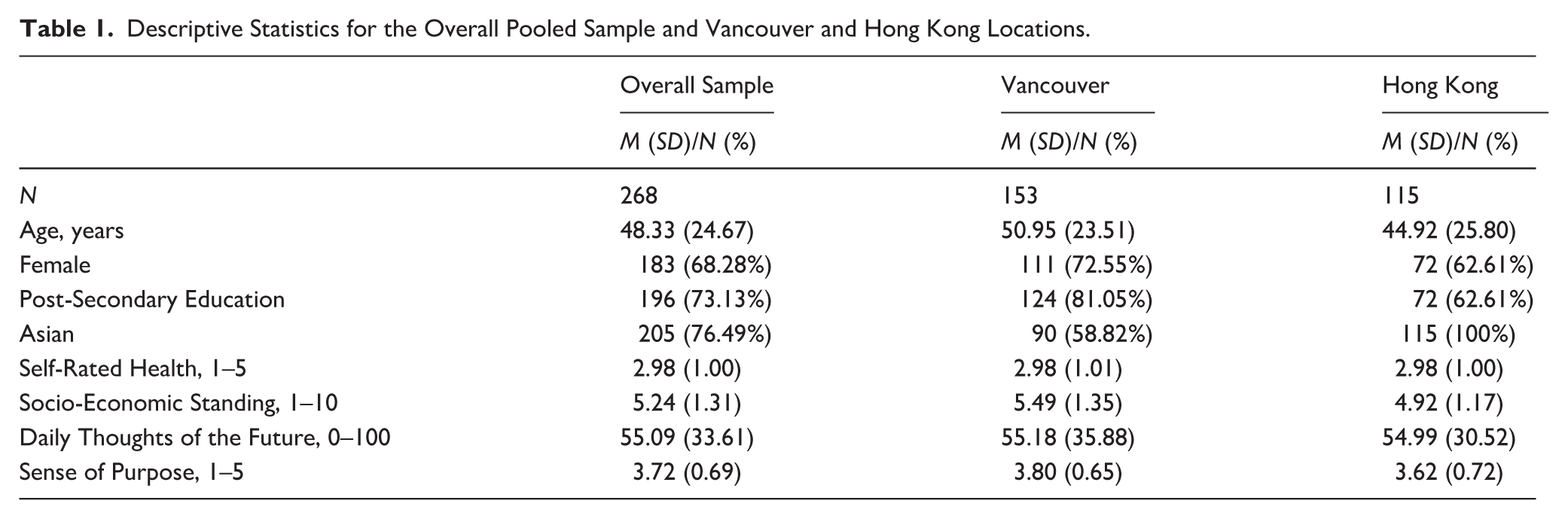
Data for the current study come from 268 individuals from four separate but coordinated studies in Canada and Hong Kong (Mage = 48.33, SD = 24.67; 68% female; 77% Asian; 73% with post-secondary education). The pooled sample included 100 community-dwelling older adults and 53 university students living in Vancouver, Canada, and 56 community-dwelling older adults and 59 university students in Hong Kong. Descriptive statistics for the overall sample and for each study location are presented in Table 1. The original sample included 285 participants, but 17 were excluded for missing data on key analytic variables. The study design at both sites included a baseline session assessing demographic information and individual differences, 10 consecutive days of daily life assessments, and an exit session. Participants completed three tablet-based assessments per day of their current affect, location, activities, and thoughts. Materials were available in English, Cantonese, and Mandarin at both sites. All data were collected between August 2014 and January 2017. Additional information on the study sample and procedures has been provided elsewhere (Archer Lee et al., 2022; Choi et al., 2024; Lay et al., 2019; Lay, Fung, et al., 2020; Lay, Pauly, et al., 2020; Pauly et al., 2018, 2019).
Descriptive Statistics for the Overall Pooled Sample and Vancouver and Hong Kong Locations.
Measures
Thinking About the Future
At each repeated daily life assessment, participants recorded their current thoughts and indicated the extent to which these were directed toward the future. Participants responded to the prompt “I was thinking about something happening in the future” using a sliding scale from 0 = not at all to 100 = very much (M = 55.09; SD = 33.61). In addition to the quantitative ratings, participants had the option to provide brief qualitative descriptions of the content of their thoughts through written response or audio recordings. These qualitative responses were not analyzed in the present study due to substantial missingness and differences in detail reported, which limited systematic interpretation across occasions. Illustrative examples of these qualitative thought descriptions have been reported in Supplementary Materials from prior work with these data (Choi et al., 2024).
Sense of Purpose in Life
Sense of purpose in life was assessed in the exit session survey using the 3-item subscale of the Ryff Psychological Wellbeing Scales (Ryff, 1989; Ryff & Keyes, 1995). Items were “some people wander aimlessly through life, but I am not one of them,” “I live life one day at a time and don’t really think about the future” (reverse coded), and “I sometimes feel as if I’ve done all there is to do in life” (reverse coded). Prior work suggests that this brief measure shows strong construct validity, predicting theoretically relevant outcomes such as higher well-being and lower depressive symptoms and is highly correlated with the 7- and 9-item purpose scales (Ryff & Keyes, 1995). Participants rated agreement on each item from 1 (Strongly Disagree) to 5 (Strongly Agree), and item responses were averaged to create a mean sense of purpose score (M = 3.72; SD = 0.69). Internal consistency was poor for this 3-item measure, McDonald’s ω = 0.47.
Physical Activity
Physical activity was measured via self-report at baseline and again at a 6-month follow-up assessment in the Vancouver older adult sample only. Physical activity was assessed using the International Physical Activity Questionnaire (Craig et al., 2003). Participants were asked to indicate how much time they had spent in the past 7 days engaging in moderate physical activity (e.g., carrying light loads, bicycling at a regular pace, or doubles tennis), vigorous physical activity (e.g., heavy lifting, digging, aerobics, or fast bicycling), and walking at a steady pace. Responses were transformed into Metabolic Equivalent of Task (MET) minutes using weighting derived from the median metabolic equivalent values for the example activities (Ainsworth et al., 2011). Minutes of walking were weighted using a metabolic equivalent value of 3.3, a value of 4 for moderate activities, and 8 for vigorous physical activities. The weighted values for each of these activity types were then summed, creating a score representing overall activity MET minutes for the past week. The World Health Organization recommends a minimum of 600 MET minutes per week, though meta-analytic work suggests that health benefits of physical activity are most apparent above 3000 MET minutes per week (Bull et al., 2020; Kyu et al., 2016). In the present sample, participants were relatively active, reporting a mean of 2,204.85 (SD = 2,699.80) MET minutes at baseline, and 2,435.59 (SD = 2,702.12) at follow-up.
Statistical Analyses
Multilevel models examined associations of sense of purpose in life and age with thinking about the future at each assessment. Two-level multilevel models were run with assessments (Level 1) nested within persons (Level 2). Though conceptually these models have three levels of analysis (assessments nested within persons, nested within sample locations), there is insufficient variability at the location level to properly model just two locations (e.g., McNeish & Stapleton, 2016). We instead included location as a model covariate to account for mean-level differences across samples. In the first model, sense of purpose in life and age were included as person-level predictors of momentary thinking about the future. A second model tested for potential age differences in the effect of sense of purpose by including a sense of purpose by age group interaction term. Both models adjusted for demographic characteristics of age (younger adults = 0, older adults = 1), gender (men = 0, women = 1), location (Vancouver = 0, Hong Kong = 1), ethnicity (Non-Asian = 0, Asian = 1), self-rated physical health (1–5 scale; 1 = poor, 5 = excellent; M = 2.98, SD = 1.00), and perceived socio-economic standing (1–10 scale; M = 5.24, SD = 1.31) on the McArthur Scale of Subjective Social Status (Adler et al., 2000).
Additional exploratory analyses examined whether thinking more about the future mediates associations between sense of purpose in life and physical activity. Physical activity was measured at baseline and at 6-month follow-up assessment in the Vancouver older adult participants (n = 98, 91.59% response rate). Of this sample, 10 participants did not complete the physical activity survey, and an additional 10 had missing data on key demographic predictors, resulting in an analytic sample of 78 participants for these additional physical activity analyses. Mediation analysis 1 was performed using the PROCESS procedure in R (Hayes, 2017), using bootstrapping with k = 5,000 bootstrapped samples to generate bias-corrected confidence intervals. This model included a direct effect of sense of purpose on physical activity at 6-month follow-up, as well as a mediation effect through the person-mean of daily thinking about the future. The covariates of baseline physical activity, age, gender, education, ethnicity, self-rated physical health, and subjective social status were included on each pathway in the mediation model.
Results
Demographic Information
Descriptive statistics for the overall sample and each study location are presented in Table 1, and variable intercorrelations are presented in Table 2. Adherence was high, with an overall completion rate of 84.80% (M = 25.44 completed surveys per participant). There was variability in everyday thoughts of the future, with around 78% of variability representing within-person fluctuations in thoughts of the future across assessments, and the remaining 22% of variability attributable to between-person differences (ICC = .219).
Correlations for Key Variables at the Baseline Assessment (n = 268).
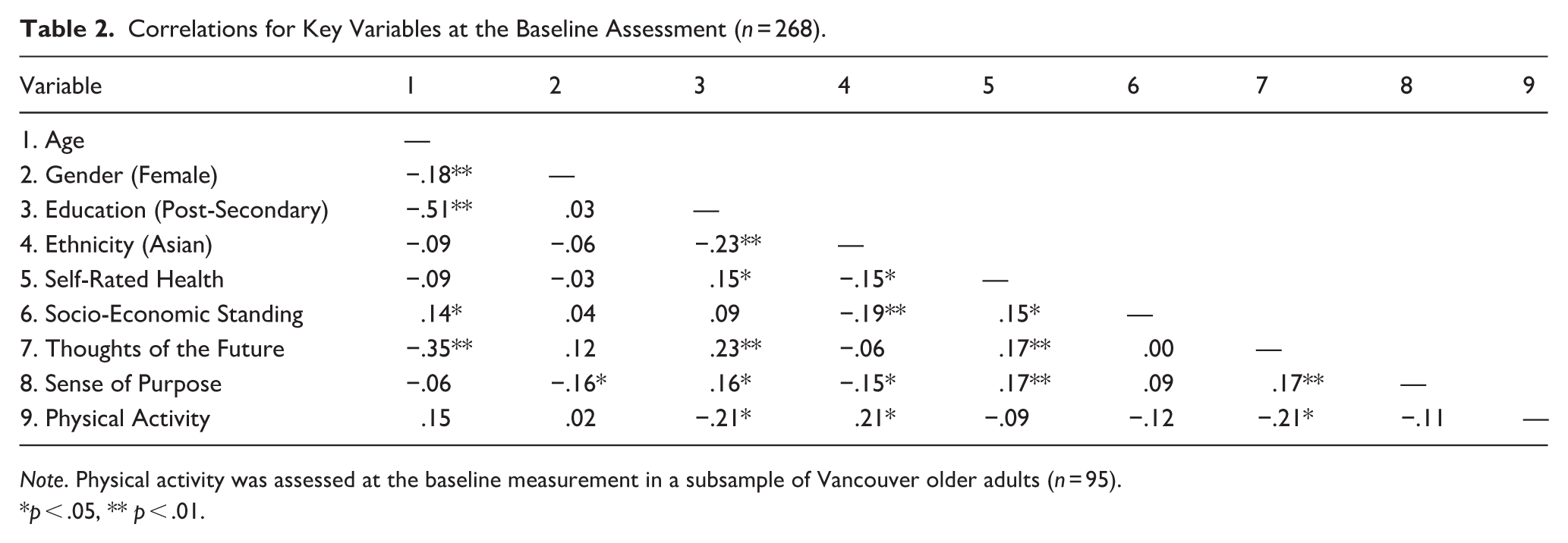
Note. Physical activity was assessed at the baseline measurement in a subsample of Vancouver older adults (n = 95).
p < .05, ** p < .01.
Sense of Purpose and Thinking About the Future in Everyday Life
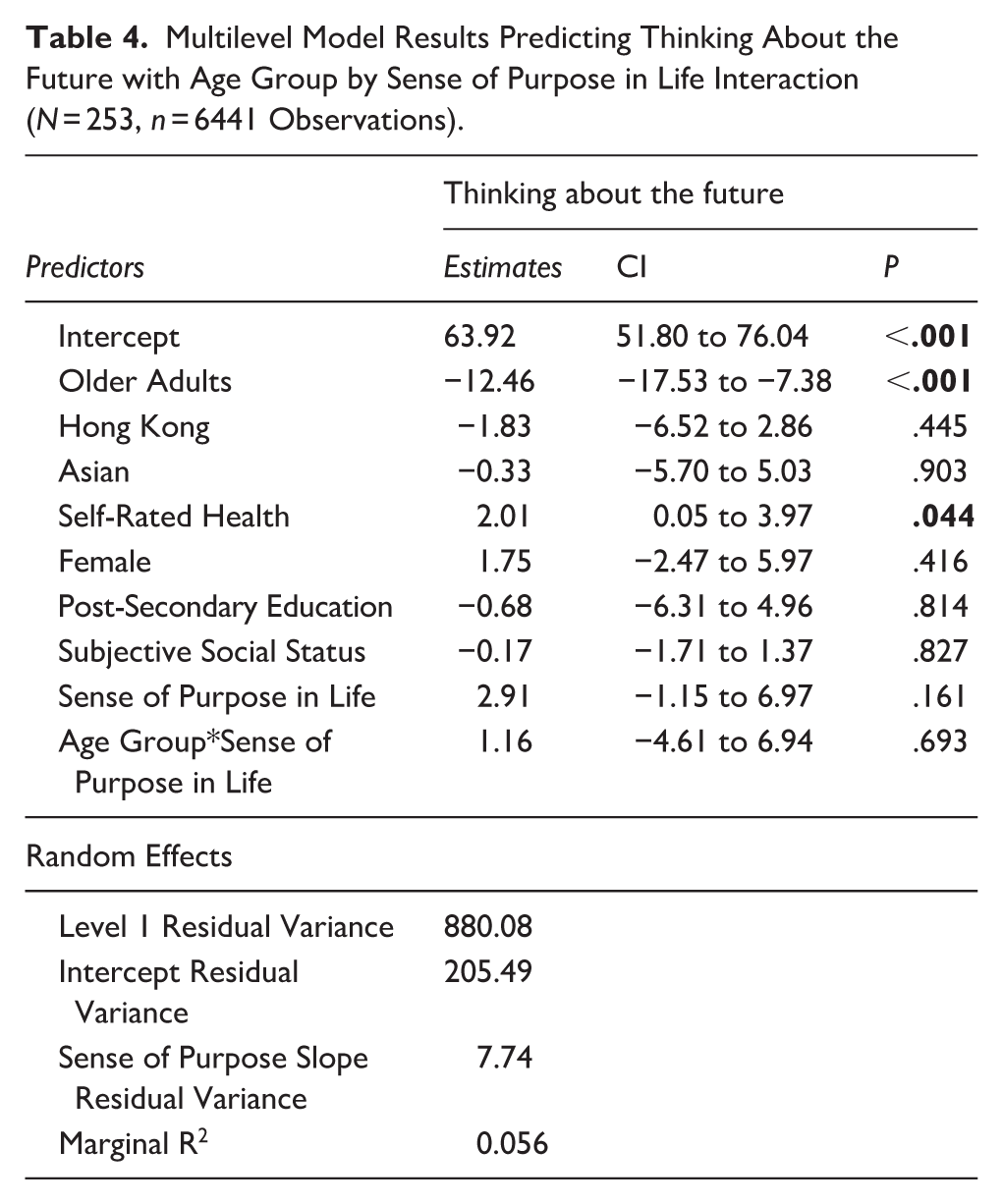
In the first set of analyses, we used multilevel modeling to examine whether sense of purpose in life was associated with thinking more about the future in everyday life. Results of this model are presented in Table 3. Supporting Hypothesis 1, participants with a stronger sense of purpose in life reported thinking more about the future during daily life assessments. In addition, younger participants, and those who rated their physical health higher, reported more future-focused thoughts on average across the 10-day period. Despite significant effects of age, self-rated physical health, and sense of purpose in life, this model accounted for only 5.50% of the variance in daily thinking about the future. There was no significant interaction between sense of purpose with age group (Table 4) or with measurement location (Supplementary Table 2), suggesting minimal differences in this association between younger and older adult participants and those in Vancouver and Hong Kong.
Multilevel Model Results Predicting Thinking About the Future (N = 253, n = 6,441 Observations).
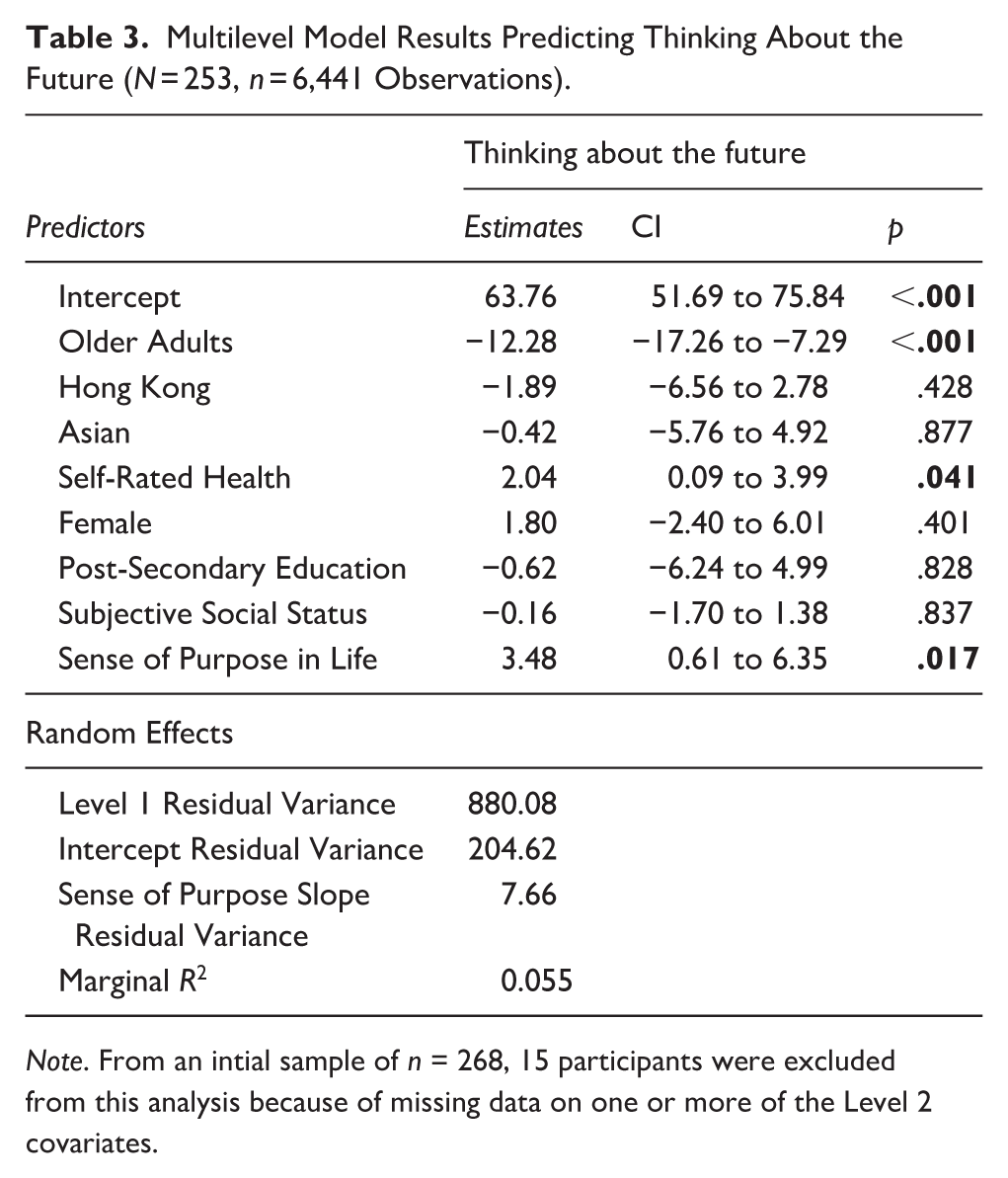
Note. From an intial sample of n = 268, 15 participants were excluded from this analysis because of missing data on one or more of the Level 2 covariates.
Multilevel Model Results Predicting Thinking About the Future with Age Group by Sense of Purpose in Life Interaction (N = 253, n = 6441 Observations).
Sense of Purpose, Thinking About the Future, and Physical Activity
In addition to the above models, an exploratory mediation analysis was run to examine whether thinking more about the future accounted for associations between sense of purpose and physical activity in a subsample with follow-up physical activity data. Results of this model are presented in Supplementary Table 1. In this smaller subsample of n = 78 older adults, sense of purpose did not predict change in MET minutes of physical activity directly (b = −217.46, 95% CI [−1,147.12, 712.20], p = .642). The mediation pathway was also not significant; sense of purpose was unrelated to mean thoughts of the future in this subsample (b = −.01, 95% CI [−6.95, 6. 95], p = .990), and mean thoughts of the future were unrelated to physical activity (b = −22.09, 95% CI [−54.69, 10.51], p = .181).
Discussion
Sense of Purpose and Thinking About the Future in Everyday Life
Past research suggests that having a strong sense of purpose in life is associated with health benefits and increased engagement in a variety of health-protective behaviors (P. L. Hill et al., 2019; Pfund & Lewis, 2020). Although several cross-sectional and longitudinal studies have aimed to identify mechanisms underlying these benefits, it remains unclear what psychological and behavioral factors drive these associations in the context of everyday life. Using a daily life assessment design, the current study assessed whether people with a strong sense of purpose direct their thoughts more toward the future, and whether this association was moderated by age. In support of our main hypothesis, we found that people higher in sense of purpose thought more about the future in daily life. This extends cross-sectional work showing that those higher in sense of purpose report a more expansive future time perspective (Pethtel et al., 2018; Pfund et al., 2022) by demonstrating similar associations in daily life.
One possible explanation for these findings is the role one’s sense of purpose may have on goal engagement and motivation. When individuals have a clear sense of purpose, they are more likely to define goals that are meaningful, aligned with their core values, and focused on long-term fulfillment (McKnight & Kashdan, 2009). Purpose in life has been described as self-organizing and acting like a compass (Kashdan et al., 2024), motivating people to direct resources toward some goals and away from others by reinforcing goals that align more closely with this purpose. Indeed, one’s purpose in life is thought to promote a hierarchical goal structure, influencing long-term, higher-order goals, as well as subgoals that permeate everyday thoughts and behavior (Lewis, 2020). The hierarchical nature of purpose-driven goals is likely to bring one’s future more into the context of everyday life. For those with a strong sense of purpose, smaller, more achievable subgoals may be seen as more closely tied to larger life aims, making the future more salient in daily life and reinforcing future-oriented thinking (Lewis, 2020; McKnight & Kashdan, 2009). Furthermore, pursuing these hierarchical goals may drive purposeful individuals to engage more in planning and anticipation of future obstacles and outcomes of these goals. Thus, this purpose-driven goal motivation may influence the general perception that one’s future is expansive and promote more future-oriented thoughts in daily life.
In line with key tenets of Socioemotional Selectivity Theory, as well as past daily life research (Allemand & Hill, 2019; Katana et al., 2020), we found that younger and healthier adults engaged more in daily future-oriented thinking relative to older adult participants. These age differences, typical in healthy adult samples, could result from shrinking time horizons prompting older adults to focus more on current events in their daily life (Lang & Carstensen, 2002) as well as on day-to-day responsibilities (e.g., in response to changing social roles in retirement) and away from future goals and achievements. Despite such age differences, we found that age did not moderate the relationship between sense of purpose and daily thoughts about the future. This contrasts with some daily life research showing that age moderates associations of daily future time perspective with affect and arousal levels (Katana et al., 2020). However, our findings add to previous research that has noted fairly consistent associations of sense of purpose with outcomes such as daily stress (P. L. Hill et al., 2018), cognitive functioning (Lewis et al., 2017), and health behavior engagement (Weston et al., 2024), across the span of adulthood.
Consistent with previous daily life research (Allemand & Hill, 2019; Katana et al., 2020), we observed that the temporal focus of one’s thoughts fluctuates within individuals in daily life. Our observed intraclass correlation of .22 suggests a much larger proportion of variability was within persons in our samples relative to the within-person variability of around 20% in previous studies (see Katana et al., 2020). This may be attributable to differences in measures used to capture temporal focus in daily life. Previous studies (Allemand & Hill, 2019; Katana et al., 2020) utilized a modified version of the Future Time Perspective Scale (Lang & Carstensen, 2002), which may be less sensitive to within-day fluctuations in temporal focus. Taken together, these findings suggest that although future time perspective has been previously considered to be relatively stable across time, there is variability in momentary temporal focus. Notably, research by Allemand and Hill (2019) found that while there were day-to-day carry-over effects in daily future time perspective, there was significant variability across daily life contexts, supporting a trait–state conceptualization of future time perspective. This represents an important future avenue for research on temporal focus: To evaluate contextual factors and consequences of state-level variability in temporal focus on motivation and behavioral decisions in daily life.
Sense of Purpose, Thinking about the Future, and Physical Activity
In the mediation analyses, we did not find support for future-oriented thoughts as a mechanism connecting sense of purpose with physical activity. In contrast to findings observed in the full sample and prior literature, sense of purpose was not significantly associated with thinking more about the future in this smaller subsample. This discrepancy likely reflects restricted statistical power rather than a substantive divergence, and underscores the need for further research with sufficient sample size to test this mediary pathway. Contrary to past research using both self-report (P. L. Hill et al., 2019; Holahan et al., 2011; Sutin et al., 2021) and accelerometer-based measures of physical activity (Hooker & Masters, 2016), there was no significant relationship between sense of purpose and change in physical activity engagement in this sample. Surprisingly, we also found that thinking more about the future was negatively correlated with physical activity at baseline and follow-up. This appears to contradict a fairly large body of research showing associations between broader future time perspective and higher physical activity (Kooij et al., 2018; Sweeney & Culcea, 2017). However, this finding aligns with recent work using repeated daily life assessments, suggesting that a more limited daily future time perspective is associated with more health behavior engagement, including more frequent physical activity (K. C. Hill et al., 2024). Though further research will be needed to replicate these findings, they raise the interesting possibility that temporal focus may have different impacts at the between- and within-person levels. Hill and colleagues (2024) posit that future time perspective may have contrasting impacts on motivation at these different levels. A dispositional tendency to have an expansive time perspective may make people more likely to consider future consequences of their behavior and encourage exercise, but at the within-person level, a more expansive future time perspective may make the consequences seem more distant, and thereby be less likely to motivate physical activity.
Limitations and Future Directions
The current study has several strengths, including the use of repeated daily life assessment data to capture within-person fluctuations in thinking about the future in the context of daily life, as well as incorporating different cultural contexts from multiple samples in Vancouver and Hong Kong. Moreover, the pooled sample of nearly 300 participants was relatively large compared to typical repeated daily life assessment samples (Wrzus & Neubauer, 2023) with high adherence to the study protocol, resulting in over 6,000 assessments across 10 days. Nevertheless, this study is limited in some ways that should inform future investigations. First, this study uses a correlational design, and thus, we cannot make causal inferences about the observed associations. Though we discuss these findings as sense of purpose supporting thinking about the future in daily life, it is important to acknowledge that the reverse direction or even bidirectional effects are possible. Thus, future research with repeated daily purpose assessments is needed to evaluate whether thinking more about the future may drive within-person fluctuations in sense of purpose. Second, information on physical activity engagement was not available for most of the present sample, limiting our statistical power. As such, the mediation findings should be interpreted cautiously within the context of this more restricted sample, though the small negative correlation between thinking about the future and physical activity does align with recent research findings within-person associations in daily life assessments (K. C. Hill et al., 2024). Further research would benefit from testing the potential mechanism in a larger sample with physical activity data, as well as by including repeated daily life assessments of accelerometer-measured physical activity to better substantiate these findings. Further, additional research is needed to test for non-linear relationships in the association of sense of purpose and thinking about the future with physical activity.
Third, the measure of sense of purpose in life had poor reliability and was only available at the exit session measurement, meaning we were unable to evaluate within-person fluctuations in sense of purpose across days. Future research would benefit from using a longer version of the Ryff purpose in life scale (e.g., 9-item measure) to disentangle some of the unique item influences on everyday thoughts of the future. Some work has used single-item daily purpose measures or scales adapted from between-person measures for within-person assessments, but it is unclear how well these assess sense of purpose at the daily level. Given that several commonly used scales exhibit different factor structures at the between- and within-person levels (Rush & Hofer, 2014), future work is needed to develop a validated measure of sense of purpose in life for shorter timescales. Finally, future research could also consider potential cultural differences in the relationship between sense of purpose, temporal focus, and physical activity. Despite the current study using data from Canada and Hong Kong, we did not observe differences in thinking about the future across measurement sites. Nevertheless, further investigations of correlates of sense of purpose are needed given the paucity of research examining sense of purpose outside of Western contexts (Sutin et al., 2022).
In conclusion, this study found that individuals with a stronger sense of purpose in life engaged in more future-oriented thinking, and that this association did not differ between younger and older adults. While these future-oriented thoughts were consistently associated with a sense of purpose, they did not appear to directly influence physical activity over the long term. These findings suggest that while a sense of purpose may shape the extent to which people think about the future, additional factors may contribute to health behavior decisions, warranting further investigation into the mechanisms linking purpose, future thinking, and health outcomes in daily life.
Supplemental Material
sj-docx-1-jbd-10.1177_01650254261432812 – Supplemental material for My Purpose Drives Me Forward: Sense of Purpose and Thinking About the Future in Daily Life
Supplemental material, sj-docx-1-jbd-10.1177_01650254261432812 for My Purpose Drives Me Forward: Sense of Purpose and Thinking About the Future in Daily Life by Nathan A. Lewis, Yoonseok Choi, Jennifer Lay, Minjie Lu, Da Jiang, Helene H. Fung, Peter Graf, Atiya Mahmood and Christiane A. Hoppmann in International Journal of Behavioral Development
Footnotes
Acknowledgements
We thank Hao Wang, Sandra Petrozzi, Kitsilano Neighbourhood House, and the University of British Columbia Learning Exchange for their support on this project. Preliminary results from this study were presented at the 2024 Gerontological Society Annual Scientific Meeting.

Ethical Considerations
Ethics approval was provided by the ethics boards of the University of British Columbia (Health and Intergenerational Activities Research Project; Behavioural Research Ethics Board No. H12-03117) and the Chinese University of Hong Kong Survey and Behavioural Research Ethics Committee.
Consent to Participate
All participants provided written informed consent prior to participating in the study.
Funding
The authors disclosed receipt of the following financial support for the research, authorship, and/or publication of this article: This work was supported by Vancouver Foundation grants UNR12-0926, UNR13-0484 to Christiane A. Hoppmann, Sandra Petrozzi, Atiya Mahmood, and Peter Graf; by a South China Programme Research Grant, Chinese University of Hong Kong to Helene Fung, Christiane A. Hoppmann, Da Jiang, and Jennifer Lay; by a direct grant, Faculty of Social Science, Chinese University of Hong Kong to Helene Fung; by a University of British Columbia Faculty of Arts small research grant to Christiane A. Hoppmann; and by a University of British Columbia Alma Mater Society grant to Jennifer Lay. Yoonseok Choi gratefully acknowledges support from a Four-Year Doctoral Scholarship from the University of British Columbia and a Postdoctoral Fellowship from the Canadian Institutes of Health Research.
Declaration of Conflicting Interests
The authors declared no potential conflicts of interest with respect to the research, authorship, and/or publication of this article.
Data Availability Statement
Supplemental Material
Supplemental material for this article is available online.
Notes
References
Supplementary Material
Please find the following supplemental material available below.
For Open Access articles published under a Creative Commons License, all supplemental material carries the same license as the article it is associated with.
For non-Open Access articles published, all supplemental material carries a non-exclusive license, and permission requests for re-use of supplemental material or any part of supplemental material shall be sent directly to the copyright owner as specified in the copyright notice associated with the article.
