




Abstract
This study examined the association of masculine and feminine personality traits with peer victimization in college and the moderating role of previous peer victimization experiences. Using a longitudinal sample of 716 participants (58% women), victimization in childhood and adolescence was assessed through peer- and self-reports. At age 19, participants evaluated their victimization in college and gendered personality traits. Control variables included body mass index, harsh parenting, and socioeconomic status. Results showed that men with more feminine traits and women with more masculine traits were more victimized in college than their peers with gender-conforming personality traits. However, this was only evident among those who had already frequently been victimized in childhood and adolescence. In contrast, no such association was observed among individuals who had suffered little to no prior peer victimization. Chronic peer victimization during the school years may reinforce certain behaviors related to femininity or masculinity traits that—if contrary to prevailing gender-role norms—may increase the risk of further victimization when individuals enter college. The findings emphasize the need for interventions to reduce bias against gender-nonconforming youth.
Keywords
Introduction
Peer victimization is a common problem that transcends all age groups, with significant negative consequences for health and well-being (Turanovic, 2018). Peer victimization can be experienced physically (e.g., punching, pushing, etc.), verbally (e.g., insults, threats, etc.), or through more indirect or relational means (e.g., intentional exclusion from a group) (Casper et al., 2015). Although peer victimization generally decreases with age (Bowes et al., 2015), emerging and young adults are still at relatively high risk of being victimized compared to older individuals (Perreault & Brennan, 2010). Indeed, around 20% to 25% of college students report being physically or verbally victimized in their learning environment (Lund & Ross, 2017). Importantly, both retrospective and prospective studies indicate that many of these victims already endured similar abuse from their peers in elementary and secondary school (Chapell et al., 2006). To prevent such continued suffering, it is important to understand what explains the persistence of victimization across time and contexts. Examining predictors of peer victimization during emerging adulthood is important, as challenges encountered during this period impact individuals’ well-being and adaptation in subsequent stages of life (Macmillan & Hagan, 2004). To this end, the present study focused on the role of gendered personality traits (i.e., masculinity and femininity) as well as gender nonconformity in explaining peer victimization from childhood and adolescence to emerging adulthood (i.e., at age 19).
Risk Factors of Peer Victimization: The Role of Gendered Personality Traits
Environmental factors (e.g., harsh parenting and low socioeconomic status), as well as individuals’ characteristics (e.g., obesity) have been identified as risk factors for victimization across different contexts (Bowes et al., 2013; Kim et al., 2009). Still, some individuals are victimized although they do not present any of these risk factors. Some researchers have therefore focused on personality characteristics, notably gendered personality traits as potential risk factors of victimization (e.g., Wright & Wachs, 2020).
Gendered personality traits refer to personality characteristics traditionally considered as either more typical for men (i.e., masculine) or more typical for women (i.e., feminine). Conceptualized by Bem as two independent continua, masculinity refers to behaviors socially expected in men and femininity refers to behaviors expected in women (Bem, 1981). Fundamentally, masculinity refers to traits of instrumentality and agency (e.g., independence, assertiveness, ambitious, dominant), whereas femininity is associated with traits of expressiveness and communion (e.g., caring, gentle, compassionate, collaborative) (Heilman, 2012). According to Bem’s (1981) gender schema theory, children form cognitive patterns about roles and behaviors expected of each gender by observing or interacting with different socialization agents, such as family, teachers, peers, or the media. Individuals’ expression of masculinity or femininity depends on their social learning and degree of internalization of these gendered traits or behaviors. However, some studies have nuanced the gender schema theory by showing that biological processes, such as prenatal testosterone levels and genetics, are also involved in the expression of masculinity and femininity (Lippa, 2005). Individuals expressing feminine traits tend to behave in a more submissive and passive way (Cole & Sabik, 2010), which may put them at risk of being targeted by bullies across different contexts such as schools and on social media (Eraslan-Çapan & Bakıoğlu, 2020; Rosen et al., 2012). It has been suggested that bullies interpret such behaviors as cues that potential victims are unable to defend themselves (Eraslan-Çapan & Bakıoğlu, 2020). In contrast, a high level of assertiveness—characteristic of masculine individuals—can protect against peer victimization (Koparan et al., 2009). Nevertheless, individuals with more masculine traits may also evoke responses in others that promote confrontation and violent exchanges (Daigle & Mummert, 2014). From a theoretical standpoint, both traits may thus be considered potential risk factors for victimization, despite more heterogeneous findings for masculinity.
Empirical evidence linking femininity or masculinity traits with peer victimization has been found in several studies. For example, a study of cybervictimization among 13- to 14 year-olds revealed that the most victimized girls and boys reported greater self-perceived femininity, whereas the least victimized reported higher levels of masculinity (Wright & Wachs, 2020). Moreover, engaging in so-called feminine activities (e.g., jumping rope, creating bracelets) was associated with lower social acceptance and more victimization by peers than engaging in more “masculine” activities (e.g., physical play, playing team sports, building structures or objects) in a sample of 9- and 10 year-olds (Kreiger & Kochenderfer-Ladd, 2013). However, other research suggests that it may not be femininity or masculinity per se but rather a non-stereotypical gender expression (e.g., dominance or assertiveness in girls/women and gentleness or submissiveness in boys/men) that increases victimization risk. Research on gender stereotypes—which includes beliefs about behaviors considered appropriate for women and men—consistently identified two core personality dimensions: communion and agency. Traditional interpretations of these traits emphasize that they emerge from interactions between biological sex differences and socially structured expectations. Average differences in physical strength and reproductive demands shaped cultural beliefs about typical dispositions, reinforcing associations between masculinity and agentic traits—such as ambition, assertiveness, and competitiveness—and between femininity and communal traits, including warmth, compassion, and expressiveness, which over time became internalized as traditional gender stereotypes (Eagly et al., 2020; Wood & Eagly, 2012). Although gender norms and stereotypes encompass broader aspects of identity, including physical appearance and expression, preferences, roles, and values, the present study focuses on these gendered traits because they are often conceptualized as relatively stable and dispositional. Despite substantial social change and increasing challenges to traditional gender views, empirical evidence indicates that men’s perceived advantage in agency has remained stable in public opinion polls since the 1940s, while communion has become more strongly associated with the feminine stereotype over time, underscoring the continued relevance of traditional gender stereotypes (Eagly et al., 2020).
Physical, verbal, or psychological harassment may serve as a means by which individuals are pressured to conform to traditional gender stereotypes (Ewing Lee & Troop-Gordon, 2011). For example, a study of 12- to 18 year-olds found that femininity is associated with several forms of peer victimization for boys, whereas masculine traits is positively associated with (verbal) peer victimization for girls (Navarro et al., 2011). Similar results were reported in 18 year-old women (Zavala, 2020) and in 10- to 12 year-old girls and boys (Navarro et al., 2016). The latter study suggests that masculinity may even protect boys against peer victimization (Navarro et al., 2016). Other research also shows that boys experience greater social pressure to conform to gender norms and that gender nonconformity may be more strongly associated with peer victimization among boys (Van Beusekom et al., 2020). Indeed, the timing of pubertal development may influence adolescents’ peer experiences through its association with conformity to gender norms. Specifically, delayed pubertal onset in males has been linked to increased social vulnerability, including heightened susceptibility to peer victimization, particularly when boys are perceived as less masculine, whereas early pubertal development has been linked to increased peer victimization in girls (Hamlat et al., 2015; Pascoe, 2007).
Together, these results indicate that nonconformity to gender norms may be a risk factor for victimization. Still, few studies have investigated the links between gendered traits and victimization experienced beyond childhood and adolescence, and no study has examined the link between these two gendered personality traits and victimization in college specifically. It is also not clear what role gendered personality traits play in the continuation of victimization across time and different contexts.
Potential Interactive Effects Between Gendered Personality Traits and Previous Victimization Experiences
One mechanism that may help explain the persistence of victimization over time and across contexts is the development of a cognitive schema of victimization, which involves a generalized perception of the self as helpless, incompetent, and unworthy of others’ respect, and of others as threatening and untrustworthy (Rosen et al., 2007). The emotional response elicited by such a cognitive pattern may inhibit accurate processing of social information and adequate responses especially in ambiguous social situations. When the cognitive schema of victimization is activated, the individual generates goals and behaviors aimed at reducing distress by avoiding or eliminating the potential threat, which may lead to either passive-submissive behavior or reactive aggression, which—in turn— increase the risk of further victimization (Calvete et al., 2018; Rosen et al., 2007). Because passive–submissive behavior—historically associated with femininity (Cole & Sabik, 2010)— is both a risk for and a consequence of victimization (Brendgen et al., 2015), prior experiences of victimization may contribute to greater expression of this trait and, in turn, to heightened vulnerability to subsequent victimization. There is also evidence that girls are more likely than boys to respond passively or employ avoidance strategies when experiencing school victimization, particularly if they have a history of frequent victimization (Owens et al., 2005). However, no study has explored the possible interaction between gendered personality traits, sex and previous victimization to predict subsequent victimization in adulthood. Femininity may be an especially important risk factor of continued victimization for boys and men, as such traits presumably violate prevailing gender norms. However, masculinity may also interact with previous victimization experiences to foster maladaptive behavioral reactions, notably reactive aggression, and thus increase the risk of future victimization. Indeed, reactive aggression is a consequence and a predictor of victimization (Averdijk et al., 2016) and positively associated with masculinity (Malonda-Vidal et al., 2021). Such a potential interactive effect between masculinity and previous victimization may be especially—or only—observed in girls and women due to the gender nonconformity of masculine personality traits in women. In contrast, boys and men with highly masculine traits may be protected against chronic victimization because they conform to the gender stereotype. To date, research examining these potential interactions remains limited, although theoretical models such as the diathesis-stress model provide a rationale for their existence. Indeed, gender-nonconforming individuals are at greater risk of victimization (Van Beusekom et al., 2020), and earlier victimization experiences may amplify this risk by shaping cognitive schemas associated with being victimized.
Hypotheses
This study examined a) the interactive links of gendered personality traits and victimization in school during childhood and adolescence with later victimization in college during emerging adulthood and b) whether these associations vary between young women and men. As suggested by previous research among adolescents (Navarro et al., 2011), it was hypothesized that femininity would be a greater risk factor for victimization in college in men than in women. In contrast, masculinity should be a risk factor only for women, but a protective factor against victimization in college for men. Moreover, we expected an interaction between femininity and previous victimization, such that femininity would be a more important risk factor for victimization in college for individuals who already suffered chronic peer victimization in childhood and adolescence. Similarly, masculinity should be a more important risk factor for victimization in college for women who experienced chronic peer victimization during the school years than their less victimized counterparts. These latter predictions were based on the aforementioned findings that a) displaying feminine or masculine traits may be especially perilous when it violates societal gender norms, b) men experience greater social pressure to conform to gender norms, and c) victimization may reinforce the expression of certain behaviors associated with femininity and masculinity (e.g., passive-withdrawal and reactive aggression) through the development of a cognitive schema of victimization. These associations were expected while controlling for other victimization risk factors mentioned previously, such as parental income and education level (Kim et al., 2009), coercive parenting practices (Bowes et al., 2013) and participants’ weight (Kim et al., 2009).
Methods
Sample
Participants were part of a sample of 662 pairs of monozygotic (MZ) and dizygotic (DZ) twins. Importantly, twin samples have been used previously to address research questions lacking genetic content (e.g., Brendgen et al., 2016). Participants were recruited at birth from the Quebec Newborn Twin Registry, which covered all twin births in Quebec, Canada, between 1995 and 1998. All parents of babies in the registry who lived in the greater Montreal area (n = 989 households) were invited to participate, and 662 families agreed and gave their written, informed consent. The participants’ sociodemographic characteristics matched those of families with a 5 month-old baby in a representative population sample (Jetté & Des Groseillers, 2000). In both samples, 95% of parents lived together, 66% of mothers and 60% of fathers were between the ages of 25 and 34 (compared to 66% and 63%, respectively, in the single sample), 17% of mothers and 14% of fathers had not completed high school (compared to 12% and 14%, respectively, in the single sample), 28% of mothers and 27% of fathers had a university degree, 83% of parents had a job (79% in the single sample), 10% of families received unemployment insurance and 30% of families had an income of less than $30,000 (29% in the single sample). At the time of recruitment, the twins’ ethnicity was representative of the overall population of the Greater Montreal according to the 1996 census (Statistics Canada, 1996). The sample was tracked longitudinally and the current study used data from kindergarten, primary school (grades 1, 3, 4, and 6), secondary school (grades 7, 8, 9, and 11), and at age 19. The study design and hypotheses were not preregistered, and all analyses are thus deemed exploratory.
Only participants with valid data on at least one wave of peer victimization in childhood and adolescence, as well as valid data on both the gender personality traits and victimization in college (see description of measures and missing data below) at age 19 were included in the analyses. Of the participants who completed the gender traits measure (n = 887 individuals; 55% girls), 81% (n = 716 individuals; 58% girls) also completed the college victimization measure if they were enrolled in post-secondary education. The 887 participants who completed the questionnaire at age 19 did not differ from those excluded or lost due to attrition with respect to overall sociofamilial risk, mother’s age at twins’ birth, coercive parenting practices or mother-rated aggression or anxious behavior in childhood. However, participants in the final sample included more girls, had lived more time with both biological parents, and their mother’s education level and family income were higher.
Measures
Gendered Personality Traits
Femininity and masculinity traits were measured at age 19 using 20 self-reported statements (10 items per trait) from the Sex-Role Inventory-Short (BSRI-S; Bem, 1981). Masculinity represents instrumentality and assertiveness (e.g., “How dominant are you” or “How forceful are you”), whereas femininity represents traits of benevolence, accommodation, and expressiveness (e.g., “How gentle are you” or “How sensitive to the needs of others are you”). Participants indicated how well each item describes them, with responses ranging from 1 (never or almost never true) to 7 (always or almost always true). The neutral items of the BSRI-S were not administered because they do not measure femininity and masculinity. The self-reported version of the BSRI-short shows adequate convergence and construct validity as well as excellent internal consistency (Brems & Johnson, 1990) and high test–retest reliability over 4 weeks (masculinity r = .90; femininity r = .90) (Holt & Ellis, 1998). Mean scores for femininity (Cronbach’s alpha or α = .89) and masculinity (α = .80) were created.
Peer Victimization During Childhood and Adolescence
Peer nominations were used to measure peer victimization during childhood. They were carried out in each target participant’s classroom at three different times: kindergarten, grade 1, and grade 4 (which roughly corresponds to ages 6, 7, and 10 years, respectively). Every student who got permission from their parents received a roster with the names of all participating children in their class. During the sociometric assessments, children were asked to suggest up to three classmates who were frequently “called names” and “pushed or attacked” by other children. These questions were taken from the Victimization subscale of the modified Peer Nomination Inventory, which has strong predictive validity and test–retest reliability (Hodges et al., 1997). Each participant’s total nominations on each question were calculated and z-standardized within the classroom. The correlation between the two item scores was significant at all grade levels (kindergarten: r = 0.39, p < .001; Grade 1: r = 0.47, p < .001; Grade 4: r = 0.61, p < .001) and item scores were averaged within a given grade (test–retest correlations between consecutive assessments rs = 0.31, ps < .001).
Peer victimization during adolescence was measured using self-reports with nine items adapted from the Social Experiences Questionnaire in grades 6, 7, 8, 9, and 11 (which roughly correspond to ages 12, 13, 14, 15, and 17 years, respectively) (Crick & Bigbee, 1998). The self-reported version of the SEQ shows good internal consistency and high test–retest reliability over 4 weeks (Crick & Bigbee, 1998). Based on the highest factor loadings (Crick & Bigbee, 1998), four out of five items were selected from the “relational victimization” sub-dimension and three out of four items were selected from the “direct victimization” sub-dimension. For example, participants had to indicate how many times in the last year another student in their school “called them names or said mean things,” “said mean things about them to others,” “prevented them from being part of the group,” or “pushed, hit, or kicked them.” Another statement was added to measure extortion: how many times in the past year has someone forced you to give them something that belonged to you.” A statement measuring cyberbullying was also added (“how often has someone said mean things to you via email, chat room, or cell in the last year”). Responses were rated on a three-point scale ranging from 0 (never) to 2 (frequently). Item scores at each time point were averaged to a global peer victimization score (α = 0.79 in grade 6, 0.78 in grade 7, 0.75 in grade 8, 0.71 in grade 9, and 0.93 in grade 11). Self-reported peer victimization scores were significantly correlated between consecutive assessments (rs ranged from 0.42 to 0.60, ps < .001).
The eight peer victimization scales in childhood and adolescence were used in a latent profile analysis (LPA) to investigate whether different profiles of peer victimization during childhood and adolescence could be identified. This approach allowed us to capture interindividual differences in the longitudinal profiles of peer victimization despite using different variables across different time points. These analyses are described in a previous publication (Brendgen et al., 2021). Briefly, the goal of LPA is to find the fewest possible profiles on the indicator variables, while simultaneously optimizing intergroup differences and reducing intragroup differences (Berlin et al., 2014). In addition, for each participant and each profile group, LPA generates a model-estimated posterior probability that quantifies the likelihood that the individual will belong to a particular group, ranging from 0 to 1. One- to eight-class models were estimated and compared to find the ideal number of profiles. Robust Full Information Maximum likelihood estimation (FIML-R) was used to manage missing data (34.05% of data points). Seventy-three percent of the participants had reliable information for at least four of the eight indicators of peer victimization. Consistent with prior methodological approaches (e.g., Oncioiu et al., 2020), participants were included in the longitudinal latent profile analysis if they had at least one valid assessment of peer victimization. The identified profiles revealed that 39.7% of participants belonged to a “Consistently-Low” group, 42.8% belonged to a “Low-Moderate” group, 8.8% belonged to a “High-Decreasing” group and 8.7% belonged to a “High-Increasing-Decreasing” group, which were the most frequently victimized participants. The latter group experienced an increase in victimization during childhood to a very high level and then slowly decreased during adolescence.
Victimization in College
Victimization in college was measured via self-reports at age 19 using an adapted version of the Social Experience Questionnaire (SEQ) (Crick & Bigbee, 1998). The previously employed SEQ-based items were modified to represent physical or relational abuse encountered in college (nine items). Participants were asked, for example, how many times in the previous year someone in college had “put you down in front of others,” “said bad things about you or threatened you using email, chat room, cell phone, or social media,” “insulted you,” “physically threatened you,” or “was physically rough with you (pushed you, hit you, etc.).” These items are consistent with those employed in prior research on college victimization (Chapell et al., 2006). Responses for each statement were scored on a three-point Likert-type scale ranging from 0 (never) to 2 (often). An average was calculated from the item scores to create an overall college victimization score (α = .91, M = 0.10, SD = 0.18). The SEQ adapted for the college context is positively associated with previous peer victimization in childhood and adolescence and predicted by participants’ internalizing and externalizing problems (Brendgen et al., 2021).
Control Variables
When the children were in grade 8, parents reported their education level and income. The level of education of the parents was scored from 0 (no high school diploma) to 9 (e.g., doctorate in medicine with a specialization). Family income was scored from 1 (less than $10,000) to 11 (greater than $100,000). Mothers’ and fathers’ responses were averaged to obtain parents’ average education level (M = 3.41 or college diploma, SD = 1.70) and income (M = 7.35 or $70 000, SD = 3.03). Mothers reported on harsh parenting practices in grades 9 and 11 using three items adapted from the Parenting Practices Scale (Strayhorn & Weidman, 1988). This scale measures the frequency of physical punishment (e.g., “How often did you use physical punishment?”). Response options ranged from 1 = never to 5 = always. Scale scores (αs = .86 and .88) were averaged across time points (test–retest r = .42, p < .01) to obtain an average harsh parenting score. Self-reported body mass index at age 19 was obtained by dividing weight in kilograms by the square of height in meters. Approximately 64% of participants were at a healthy weight (Centers for Disease Control and Prevention, 2022).
Plan of Analysis
Preliminary analyses examined descriptive statistics and bivariate associations between the study variables. To test the main hypotheses, the three-step approach proposed by Asparouhov and Muthén (2014) was used. Specifically, after having identified the optimal number of distinct profile groups through LPA in Step 1, the posterior assignment probabilities from that model were used to determine each individual’s most probable profile group and to assess classification certainty (Step 2). Subsequently, we re-conducted the LPA (Step 3), incorporating each individual’s most likely profile group as an indicator variable. This variable was assigned fixed logits based on the uncertainty rates from the previous step to address classification uncertainty in the prediction of the dependent variable (i.e., victimization in college). In that final stage, we also included sex and the gendered traits (femininity and masculinity) as well as the main control variables (family income, parental education, harsh parenting and BMI) as independent variables. In addition, we included two-way interactions between sex and each of the two gendered traits. This model also tested whether these two-way interactions significantly varied depending on the latent peer victimization profile, using the Consistently-Low profile as the reference group. All independent variables were allowed to covary. In all analyses, twins were analyzed as individual cases, and interdependence within twin pairs was addressed using the Huber–White robust sandwich estimator via the cluster option in Mplus, which adjusts standard errors for within-family correlation while assuming conditional independence given the model. Moreover, because zygosity was not related to victimization in college or the predictor variables (ps from 0.140 to 0.607), it was not included as a control variable in the analyses. Cases with missing data (8.7% of overall data points) were included using Robust Full information maximum likelihood estimation (FIML-R). Detailed missing analysis showed that there were no participants with missing data for college victimization variable and sex. For the victimization profiles, 7% (51 participants) had missing data. Missing data among the control variables were as follows: 22% (161 participants) of the parental education level data, 23% of family income data (164 participants), 12% (89 participants) of body mass index data, and 10% (75 participants) of the coercive parenting data. For masculinity and femininity, 1% (9 participants) of data was missing. Given that multiple imputation assumes independent observations, we chose a conservative approach and opted against its use due to the violation of this assumption in twin samples. Moreover, the sample size used in the primary analyses (N = 707) differed only minimally from the number of participants who attended college (N = 716).
Results
Preliminary Analyses
Descriptive statistics are presented in Table 1. Bivariate correlations of the study variables in Table 2. The results of one-way analyses of variance examining differences in the previous victimization profiles regarding the other study variables are presented in Table 3. There was a small positive correlation between masculinity and femininity, suggesting that some participants possessed androgynous traits. As expected, men were more masculine than feminine, whereas the opposite was true for women. Previous victimization profiles significantly differed regarding the level of college victimization, with the High-Increasing-Decreasing and Low-Moderate profiles showing higher levels of college victimization than the Consistently-Low profile. No association was found between the previous peer victimization profiles and masculinity or femininity, respectively.
Descriptive Statistics for the Study Variables.
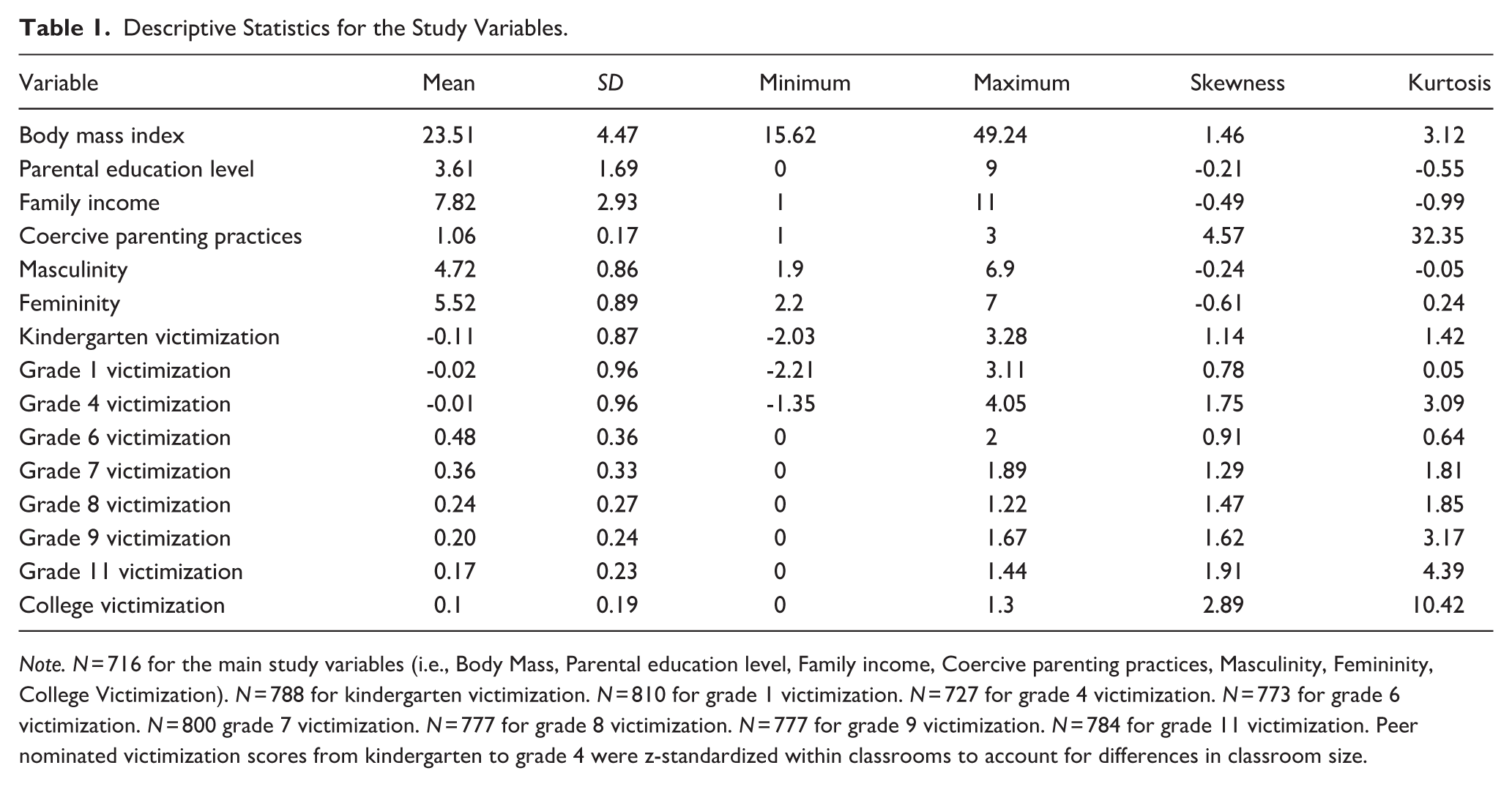
Note. N = 716 for the main study variables (i.e., Body Mass, Parental education level, Family income, Coercive parenting practices, Masculinity, Femininity, College Victimization). N = 788 for kindergarten victimization. N = 810 for grade 1 victimization. N = 727 for grade 4 victimization. N = 773 for grade 6 victimization. N = 800 grade 7 victimization. N = 777 for grade 8 victimization. N = 777 for grade 9 victimization. N = 784 for grade 11 victimization. Peer nominated victimization scores from kindergarten to grade 4 were z-standardized within classrooms to account for differences in classroom size.
Bivariate Correlations Between the Main Study Variables (Except School-Age Victimization Profiles).
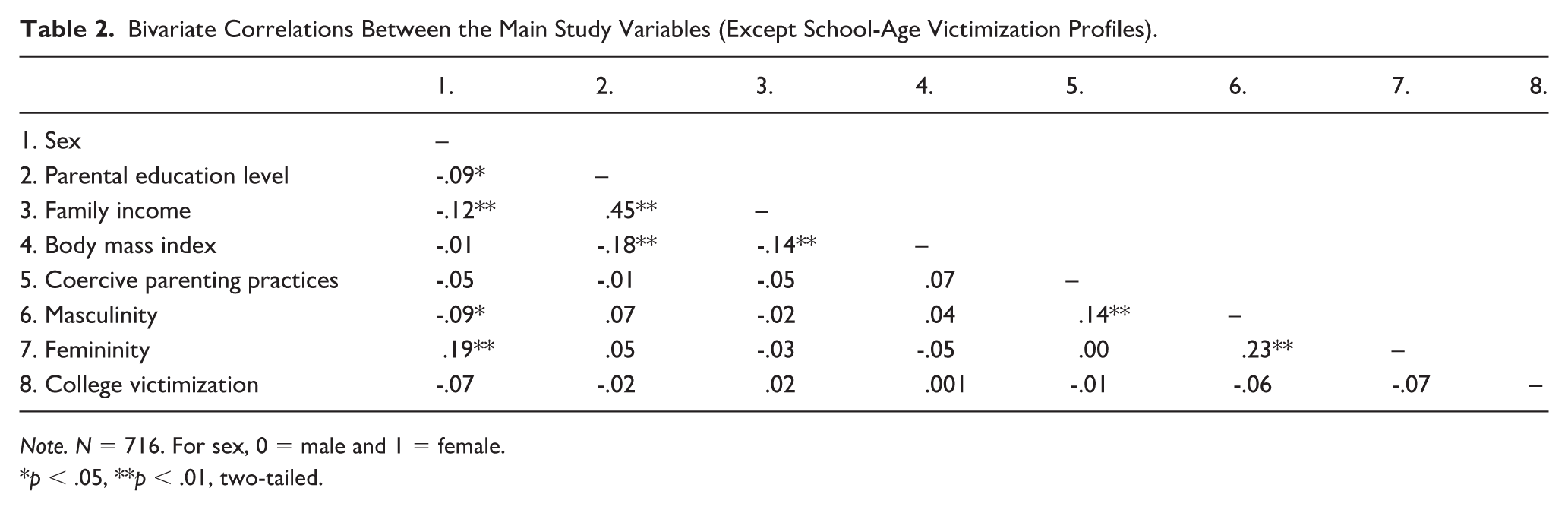
Note. N = 716. For sex, 0 = male and 1 = female.
p < .05, **p < .01, two-tailed.
One-Way Analyses of Variance Examining Differences between the School-Age Victimization Profiles Regarding the Other Study Variables.
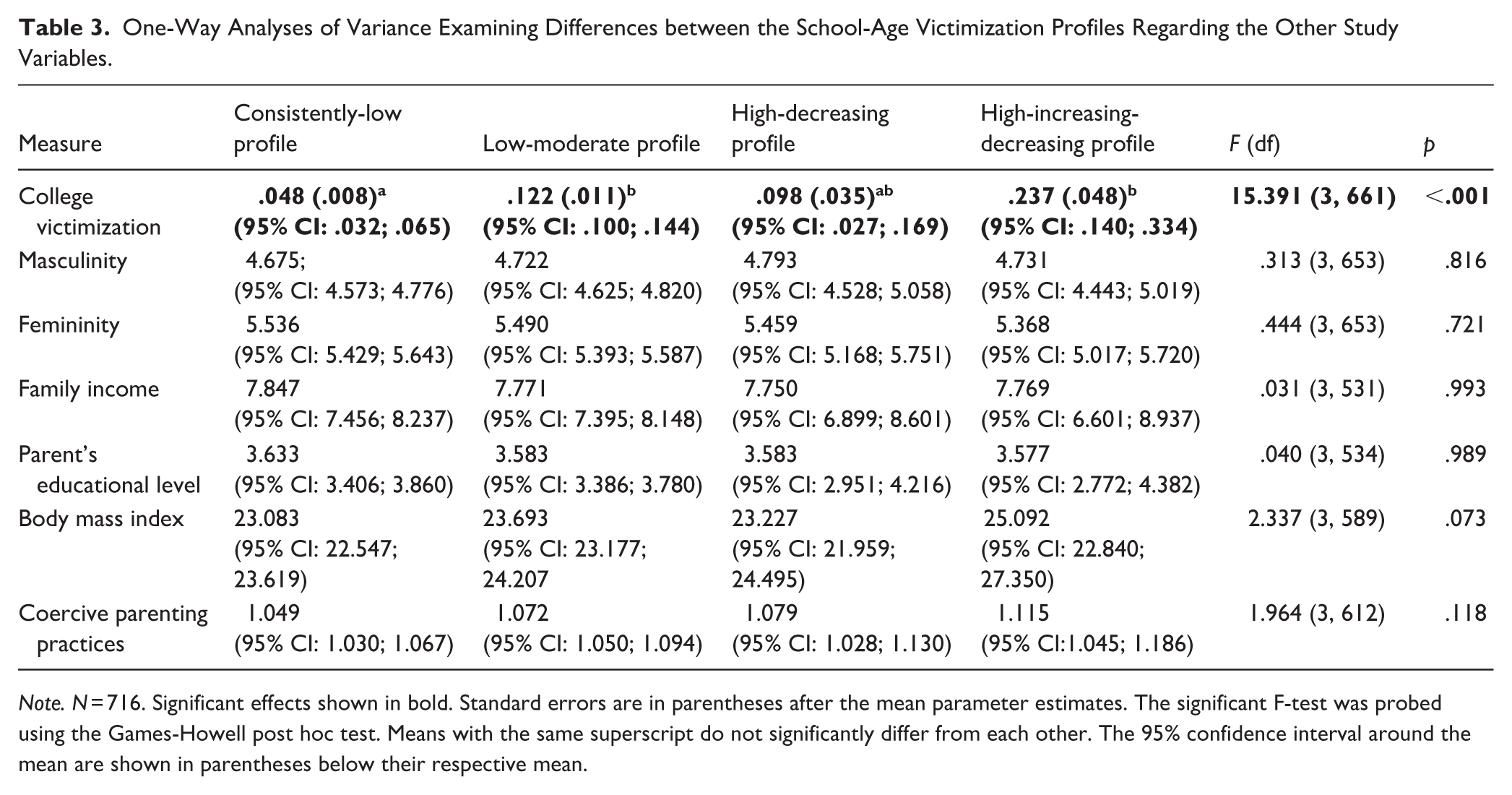
Note. N = 716. Significant effects shown in bold. Standard errors are in parentheses after the mean parameter estimates. The significant F-test was probed using the Games-Howell post hoc test. Means with the same superscript do not significantly differ from each other. The 95% confidence interval around the mean are shown in parentheses below their respective mean.
Main Analyses
Results of the main analysis predicting victimization in college are presented in Table 4, using the Consistently-Low school victimization profile as reference. Compared to those with the Consistently-Low school victimization profile, participants in the Low-Moderate profile and the High-Decreasing profile were more often victimized in college at age 19 (b = 3.53, p < .001, and b = 2.77, p < .001, respectively). Women were somewhat more victimized than men (b = .05, p = .003). Masculinity and femininity were not associated with victimization in college for the participants in the Consistently-Low profile. However, there were significant three-way interactions between sex, masculinity, and each of the more elevated school victimization profiles, using the Consistently-Low profile as reference (b = .70 p = .001, for the Low-Moderate profile, b = .65, p < .001, for the High-Decreasing profile, and b = 1.22, p < .001, for the High-Increasing-Decreasing victimization profile). Moreover, there were significant three-way interactions between sex, femininity, and two out of the three more elevated school victimization profiles, compared to the Consistently-Low profile (b = -.38, p < .001, for the Low-Moderate profile and b = -.81, p < .001, for the High-Increasing-Decreasing victimization profile).
Results of Extended 3-step Analysis Predicting College Victimization.
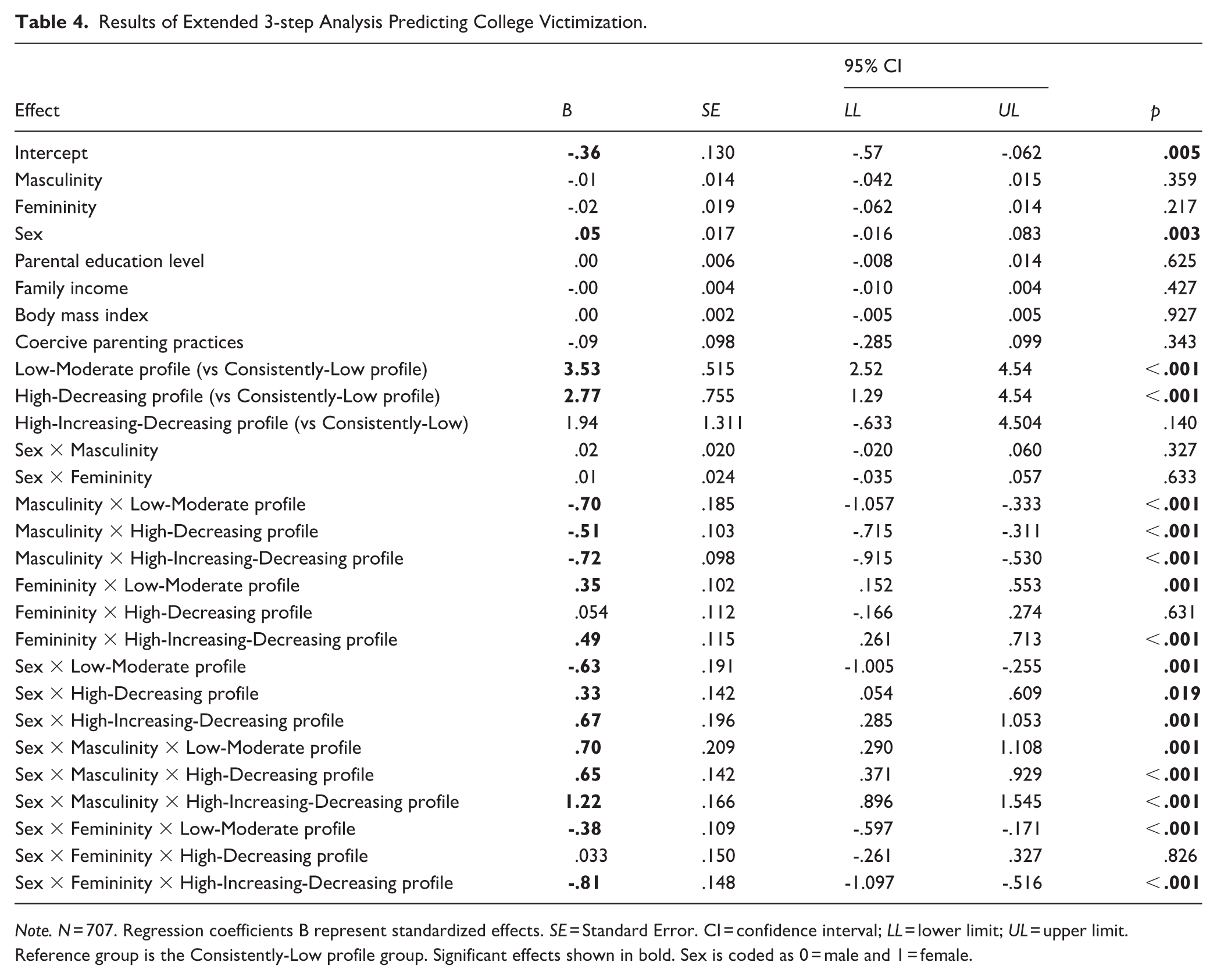
Note. N = 707. Regression coefficients B represent standardized effects. SE = Standard Error. CI = confidence interval; LL = lower limit; UL = upper limit. Reference group is the Consistently-Low profile group. Significant effects shown in bold. Sex is coded as 0 = male and 1 = female.
Probing of these interactions revealed that, for men, masculinity was associated with lower levels of victimization in college regardless of their victimization profile in school (b =-.71, p < .001, for the Low-Moderate profile, b =-.53, p < .001, for the High-Decreasing profile, and b =-.74, p < .001, for the High-Increasing-Decreasing victimization profile). For women, masculinity was associated with higher levels of victimization in college, but only for those in the most elevated school victimization profile (b = .51, p < .001, for the High-Increasing-Decreasing school victimization profile, as opposed to b = .01, p = .932, for the Low-Moderate profile, and b = .14, p = .206, for the High-Decreasing profile). In contrast, femininity was associated with higher levels of victimization in college for men in the Low-Moderate (b = .33, p = .001) and in the High-Increasing-Decreasing (b = .46, p < .001) school victimization profiles (but not in the High-Decreasing profile, b = .03, p = .793), compared to the Consistently-Low profile. For women, femininity was not associated with victimization in college for the Low-Moderate profile (b =-.05, p = .452) and the High-Decreasing profile (b = .07, p = .438), but it was associated with lower levels of victimization for the High-Increasing-Decreasing school victimization profile (b =-.33, p = .001).
Discussion
This study examined the association between gendered personality traits (i.e., femininity and masculinity) and victimization experiences in college in emerging adulthood while considering the potential moderating role of sex and previous victimization in school. Because of the greater risks associated with gender nonconformity for boys and men reported in previous research (Navarro et al., 2011; Van Beusekom et al., 2020), femininity was expected to more strongly predict peer victimization for men than women. Moreover, masculinity was expected to predict victimization only for women, yet reduce the risk of victimization in men, because this trait—while generally associated with protective characteristics such as assertiveness—may be conceived as violating gender norms in the former but not in the latter. These associations were expected to be stronger for individuals who suffered chronic peer victimization in childhood and adolescence.
The Role of Gendered Personality Traits
When sex and prior victimization were not considered, femininity and masculinity did not predict college victimization, suggesting that traditional gendered traits alone may not function as independent risk factors in emerging adulthood. Moreover, contrary to the notion of gender nonconformity of personality traits as a general risk factor (Hu et al., 2023), femininity did not predict victimization in college for all men, but only those who with elevated levels of peer victimization during the school years (as discussed below). Similarly, masculinity was a predictor of victimization in college only for women who had suffered some form of peer victimization in childhood and adolescence. These findings contrast with previous studies that did not test for moderators of gender nonconformity of personality traits and focused on younger samples, where gender nonconformity emerged as a general risk factor for all participants (Navarro et al., 2011, 2016). Taken together, these results suggest that, with age, gender nonconformity of personality traits may become less important as a general risk factor for victimization and instead operate in a more context-dependent manner. There is evidence that peer group pressure regarding gender conformity is stronger in early and middle adolescence compared to later life (Van Beusekom et al., 2020). In addition, gender nonconformity may become less strongly associated with victimization as individuals acquire greater assertiveness and social skills that reduce vulnerability to peer attacks (Beauchamp & Anderson, 2010). However, not all young people develop these skills to the same extent, particularly those who experience elevated or chronic peer victimization during childhood and adolescence. For these more vulnerable individuals, violating societal gender norms may remain especially hazardous. In this context, physical, verbal, or relational victimization may function as a strategy through which vulnerable gender-nonconforming individuals are pressured by their social environment to conform to prevailing gender norms (Ewing Lee & Troop-Gordon, 2011). Evidence suggests that such pressure may be effective, as higher levels of victimization have been shown to predict subsequent reductions in feminine behaviors among boys (Ewing Lee & Troop-Gordon, 2011). The present findings also align with evidence that gender policing is more severe for boys and men (Reigeluth & Addis, 2016) and that gender-nonconforming males are disproportionately victimized (Van Beusekom et al., 2020). Indeed, in the present study, masculinity emerged as a risk factor only for women in the most victimized group (i.e., the High–Increasing–Decreasing profile), whereas femininity was a risk factor for men in both the High–Increasing–Decreasing and Low–Moderate profiles.
While femininity was not significantly associated with college victimization for most female participants of our study, it emerged as a protective factor for the most severely victimized women (i.e., in the High–Increasing–Decreasing profile). Because higher levels of femininity reflect interpersonal tendencies that are especially socially valued in women, this trait may facilitate their peer acceptance in college (Wood & Eagly, 2015) and thus mitigate the risk of continued victimization across different social contexts. In parallel, potentially for similar reasons, masculinity was associated with lower levels of victimization in college among male participants with prior victimization histories (i.e., those in the Low–Moderate, High–Decreasing, and High–Increasing–Decreasing profiles). Taken together, these findings suggest that gender conformity may be socially rewarded through increased peer acceptance and reduced victimization, which may be particularly beneficial for individuals with histories of social marginalization. Notably, masculinity was protective across more victimization profiles for men than femininity was for women, indicating that conformity to masculine norms may confer greater social benefits than conformity to feminine norms, consistent with evidence of asymmetries in gender norm enforcement and social valuation (Reigeluth & Addis, 2016; Wood & Eagly, 2015).
The Role of Previous Victimization in Childhood and Adolescence
As hypothesized, the predictive effects of gendered traits that violated gender norms on victimization in college were only observed for participants with elevated victimization profiles in childhood and adolescence. Indeed, the association was strongest for those with a High-Increasing-Decreasing profile, i.e., who had been victimized the most in the past. Children and adolescents who are rejected and bullied by peers often develop feelings and cognitions that are characteristic of a cognitive schema of victimization (e.g., feeling worthless and rejected or expecting that others will intentionally hurt them). In turn, these cognitive schemas can influence the victim’s behaviors and act as a mechanism for continued victimization over time and different contexts (Calvete et al., 2018). Chronically victimized youth may be more likely to develop a cognitive schema of victimization, which could exacerbate specific behaviors associated with masculinity (e.g., reactive aggression; Malonda-Vidal et al., 2021) or femininity (e.g., submission or passivity; Cole & Sabik, 2010) that may increase the risk of re-victimization. In line with this notion, compared to unvictimized teenage girls, teenage girls who had been sexually victimized had lower self-esteem and adhered to gender stereotypes justifying the submission of women, putting them at risk of re-victimization (Lacasse & Mendelson, 2007). Gender-nonconforming youth who were not or rarely victimized in the past may not have developed a cognitive schema of victimization, thereby reducing the risk of victimization in other contexts once they reach adulthood.
Strengths, Limitations, and Conclusion
The present study has many strengths, notably the use of longitudinal data from age 6 through age 19 years, a large sample size, and the use of different sources for the study variables. Moreover, compared to past studies that focused on categorical gender identity or gender expression (i.e., men, women, masculine, feminine), gendered personality traits were operationalized as continuous variables. This conceptualization allowed a more nuanced assessment of personality traits, since the expression of masculinity and femininity varies among individuals. In addition, analyses controlled for multiple confounders, including parental income and education level, coercive parenting practices and participants’ BMI.
The study also has several limitations, including the fact that previous victimization was measured only in the context of school peer victimization. The study would have benefited from measuring victimization in other contexts, such as the family. Indeed, youth who experience maltreatment in their family have a higher risk of peer victimization (Ssenyonga et al., 2019). Although harsh parenting was controlled, it is not a proxy for maltreatment effects (Berthelon et al., 2020). Moreover, although the included control variables (i.e., family socioeconomic factors and obesity) were theoretically relevant, they were not significantly associated with college victimization in our study. Alternative covariates such as social status (Hawker & Boulton, 2000), the school administration’s attitude toward victimization (Coulter et al., 2018), and self-esteem (Egan & Perry, 1998) should thus be considered in future research. Furthermore, since masculine and feminine traits were not measured during childhood or adolescence, we were unable to examine these constructs longitudinally. Also, while the Bem Sex-Role Inventory-Short is a valid and reliable tool for measuring masculine and feminine behaviors (Fontayne et al., 2000), it is impossible to know whether participants’ responses were influenced by social desirability, reflecting societal value endorsement or efforts toward positive self-presentation. In addition, the BSRI has demonstrated inconsistent factor structures and item loadings across countries and participant samples (Choi & Fuqua, 2003) and the instrument lacks sub-dimensions for the two gender trait conceptions. Future studies might examine which specific sub-dimensions of gendered personality traits (e.g., communality, expressivity, subordination, dominance, independence) are most predictive of victimization in different contexts. This would enable researchers to isolate the specific traits (for example, submissiveness among men or dominance among women) that underlie associations with victimization, rather than attributing effects to broad masculinity or femininity constructs. Future studies may also differentiate between the risks that various types of gender nonconformity—such as gendered personality traits, physical appearance, preferences, roles, and values—pose for victimization in college. Because this study did not consider sexual orientation or transgender identities, which are linked to higher victimization rates among college students (O’Neill et al., 2022), future research should examine whether gender-nonconforming personality traits increase risk for these groups. A limitation associated with LPA (Masyn, 2013) is that these analyses are sensitive to sample characteristics and sample size, which may limit the generalizability of the identified profiles. Finally, the results may not generalize to other cultures. Participants grew up in Quebec, which would rank 5th in the world in the 2020 Global Gender Gap Index if it were a country (Castelan, 2020), signaling a smaller gender gap. Gender-nonconformity of behaviors and traits may be a stronger risk factor for victimization in cultures with greater gender gaps.
Notwithstanding these limitations, the current study found that gender-nonconforming traits increase vulnerability to victimization in college, particularly for individuals with a history of repeated victimization. These findings point to the need for targeted interventions for gender-nonconforming students, such as counseling and skills-based programs that affirm diverse personality traits, strengthen self-concept, and teach safe assertiveness strategies for responding to peer harassment. Youth experiencing chronic victimization related to nonconforming traits may require ongoing mental health support, proactive monitoring, and individualized coping strategies to reduce the risk of continued victimization across different contexts (Troop-Gordon, 2017). More broadly, the results highlight the link between societal intolerance of gender diversity and persistent victimization, suggesting that rigid gender norms and stigma-based harassment contribute to chronic vulnerability. Accordingly, educational initiatives and institutional policies aimed at reducing violence and promoting safety for gender-nonconforming people should complement individual-level interventions to promote effective prevention (Toomey et al., 2012).
Footnotes
Ethical Considerations
The Ethics Review Committee of the Azrieli Research Center of the CHU Ste. Justine Hospital in Montreal approved the study (approval: 2015-820, 4038) on November 11 2014.
Consent to Participate
Respondents gave written, informed consent for review and signature before participating in this study.
Consent for Publication
Not applicable
Funding
The authors disclosed receipt of the following financial support for the research, authorship, and/or publication of this article: Funding for this study was provided by the Social Sciences and Humanities Research Council of Canada (project grant 435-2014-1536).
Declaration of Conflicting Interests
The authors declared no potential conflicts of interest with respect to the research, authorship, and/or publication of this article.
Data Availability Statement
The datasets generated during and/or analyzed during the current study are not publicly available due to ethical restrictions and legal requirements outlined in the consent forms signed by the participants and the requirements outlined by the Institutional Ethics committee who approved the study. However, data can be made available on reasonable request from the corresponding author by completing the appropriate Data Access Request form at  .
.