




Abstract
Inclusive classrooms aim to promote the social participation of children with learning difficulties (LD). Research shows that children without LD view it as fair to include their peers with LD into the classroom community. Still, children with LD often face social exclusion. This study addressed this gap by investigating how children reason about challenging LD-based exclusion. One objective was to document the distinction between children’s personal goals and their expectations of their peers’ goals when confronting exclusionary behavior toward a peer with LD. Swiss elementary school children (N = 349, 7–13 years, 48% female) were introduced to a scenario about a classmate with LD who was excluded from a group task. They reasoned whether and why they would intervene and what reactions they expected from the group and the perpetrator. The results showed that the vast majority of children personally intended to intervene, primarily for moral reasons. However, children’s expectations about their peers were different. They expected a wide range of responses, including negative group dynamics and LD-stereotypes. Higher perceptions of inclusive classroom norms were related to fewer expectations of negative group dynamics. Moreover, older children’s reasoning was more differentiated and included multiple concerns simultaneously. These findings inform strategies for creating inclusive classrooms.
Inclusive classrooms aim to improve the social participation of children with learning difficulties (LD) in society (UNESCO, 1994). By bringing together students with different learning abilities, inclusive classrooms aim to foster connections and positive relationships among diverse students (Juvonen et al., 2019). However, despite these efforts, children with LD, who require individualized and additional learning support, still remain at greater risk of social exclusion, victimization, and rejection (Grütter et al., 2015). Social exclusion negatively affects children’s well-being, health, and academic achievement (Russell et al., 2012). Moreover, when exclusion is condoned, it also sends a message reinforcing normative expectations that justify excluding others who are perceived to be different (Killen et al., 2013). Thus, investigating how negative dynamics can be prevented is a salient issue, particularly given the lack of a substantive body of research on the topic of children’s evaluations of LD-based exclusion (Juvonen et al., 2019).
The current study addressed this gap by investigating children’s reasoning about challenging the exclusion of peers with LD in the classroom. Although research suggests that children exhibit strong moral sensitivity and a desire to include peers with LD (Barth & Grütter, 2024; Gasser et al., 2017), exclusion of children with LD persists. Therefore, the current study aimed to shed light on potential reasons that could hinder children’s intervention in situations of exclusion of peers with LD. More specifically, drawing from literature on social and moral development and bystander behavior (Palmer & Abbott, 2018; Spadafora et al., 2020), we investigated whether the anticipation of negative social group dynamics and stereotypes about LD would serve as barriers to intervention. To achieve this goal, Swiss elementary school children were presented with a scenario about a new classmate with LD being excluded from a group task in school. Based on this scenario children provided open-ended reasons about whether and why they would intervene, and how they expected the group and the perpetrator to react. This approach followed the social reasoning developmental (SRD) model (Killen et al., 2013) which provides a theory and methodology for coding how children balance moral concerns, group dynamics, and LD-stereotypes in their reasoning.
To investigate how group dynamics (e.g., the anticipation of negative peer reactions) might affect children’s decision-making about challenging exclusion, it is essential to develop a detailed understanding of how children perceive and reason about these group dynamics. Building on research on advanced social-perspective-taking and theory-of-mind development in middle and late childhood (Diazgranados et al., 2016; Osterhaus & Bosacki, 2022), this study investigated whether there were significant differences depending on children’s age. Moreover, this study examined whether the perception of inclusive classroom norms related to children’s reasoning about social group dynamics as these findings would offer novel insights for educators on how to design age-appropriate classroom interventions that promote the inclusion of children with LD.
Children’s Reasoning About the Exclusion of Peers With LD
In school contexts, children with LD often face social exclusion based on stereotypes associated with their academic achievement (“They don’t do well in school so people think these kids can’t learn anything”; Nowicki et al., 2014, p. 351) or traits (“They get upset easily and ruin the whole game”; Nowicki et al., 2014; p. 351; see also Haft et al., 2023). When children are socially excluded based on stereotypes associated with group identity, this form of exclusion is often related to concerns about morality, fairness, and discrimination (Rutland et al., 2022). The SRD model (Killen et al., 2013) postulates that children coordinate three different domains when reasoning about stereotype-based exclusion: (1) the moral domain, including concerns about fairness, others’ welfare, and the wrongfulness of discrimination, (2) the social-conventional domain, including concerns about group functioning, group dynamics, and social norms; and (3) the personal domain, including concerns about personal autonomy. Which domain they prioritize is related to their inclusion motivation. Moral concerns often motivate children to reject exclusion (“It would be unfair and the excluded child might be sad”; Gasser et al., 2017, p. 4). Group concerns, on the other hand, are often prioritized in situations when group cohesion is important for accomplishing a goal. If children perceive that inclusion may interfere with this goal, group concerns can serve to justify exclusion, for example when excluding an academically low-achieving peer from a math group task (“Because one cannot work well with the excluded child”; Gasser et al., 2017, p. 4; see also Yüksel et al., 2025).
While previous work within the SRD model has mainly focused on children’s reasoning about exclusion based on ethnicity (Beißert & Mulvey, 2022), gender (Horn, 2019), or socioeconomic background (Grütter et al., 2024), little is known about LD. The limited available evidence on LD (Barth & Grütter, 2024; Gasser et al., 2017; Mulvey et al., 2020) suggests that children exhibit strong moral sensitivity toward the inclusion of peers with LD. For example, third to sixth-grade Swiss elementary school children reported a strong preference for including a peer with LD over one without LD in an academic group task and condemned exclusion as unfair. Furthermore, when justifying their inclusion decisions, group-related concerns were rarely referenced while moral concerns were highly salient (Barth & Grütter, 2024; Gasser et al., 2017).
While these studies suggest that children have a strong moral desire to include peers with LD, it remains unclear how they balance this desire with contextual factors that may counter moral motivations. The current study aimed to address this gap by investigating the role of social group dynamics as potential barriers to children’s intervention in an exclusionary LD context. To enhance children’s focus on these dynamics, children’s reasoning was not only assessed from their own perspective but also from the group’s and the perpetrator’s perspectives, since previous evidence suggests that social concerns become more salient in third-person rather than first-person reasoning (Gönültaş et al., 2022; Palmer et al., 2022).
Children’s Reasoning About Group Dynamics of Social Exclusion
Social exclusion is a group phenomenon and involves different roles (Salmivalli, 2014). While the excluded child or the perpetrator are the actors typically studied, bystanders also play an important role in reducing social exclusion because their intervention may significantly reduce negative peer dynamics (Salmivalli et al., 2011). Given the potential for bystanders to reduce peer aggression, research in developmental social psychology has increasingly focused on identifying individual- and peer-relational factors that influence bystander behavior in educational settings (Ma et al., 2019). One key factor influencing children’s likelihood of intervening is the anticipation of their peers’ reactions. In line with this concern, the fear of negative group dynamics, such as being singled out, losing social status, or becoming the next target of exclusion, seems to be a key barrier to bystander intervention in elementary and middle school (Spadafora et al., 2020; Strindberg et al., 2020; Thornberg et al., 2018). Conversely, when perceiving social support from peers, such as their friends, children in elementary and middle school appear to be more likely to engage in proactive bystander behavior (Evans & Smokowski, 2015; Wu et al., 2023).
Building on this evidence, the present study explored how children perceived social support or potential social repercussions from the group or the perpetrator when challenging the exclusion of a peer with LD. A consistent finding in the developmental literature is that, with age, children recognize that groups often act to preserve their identity and enforce group loyalty (Laursen & Veenstra, 2021). Group loyalty often counters moral inclinations which children struggle with when making decisions (Mulvey & Killen, 2017). Thus, even when children recognize exclusion as unfair, they may hesitate to intervene if they expect low support from the peer group. This notion is supported by previous research, indicating that children often expect their peers to be less prosocial (Levy-Friedman & Kogut, 2024), less resistant to unfair group norms (Mulvey & Killen, 2015), and more likely to hold pro-bullying attitudes compared with themselves (Dillon & Lochman, 2022). Furthermore, when reasoning about social exclusion, children and adolescents expressed high moral motivation and inclusive intentions themselves. However, they expected their peers to have lower inclusive intentions and to be more concerned with stereotypes and group dynamics rather than with moral considerations (Beißert & Mulvey, 2022; Gasser et al., 2017). To investigate how the anticipation of such group dynamics may affect children’s decision-making about challenging exclusion, and how they coordinate potential social repercussions with their own moral motivation, it is essential to consider developmental differences and perceptual biases in children’s reasoning about these group dynamics.
Developmental Differences in Children’s Reasoning About Group Dynamics
Making predictions about others’ reactions requires advanced social perspective-taking and theory-of-mind (ToM) abilities, which increase during middle and late childhood (Diazgranados et al., 2016; Osterhaus & Bosacki, 2022). While children at the age of seven have acquired a solid understanding that others can hold perspectives different from their own, their ability to engage in more complex social reasoning, such as understanding why others might hold different views and recognizing social ambiguity, continues to develop during middle and late childhood (Devine & Hughes, 2013; Osterhaus & Bosacki, 2022). For example, fourth- to eighth-graders increasingly recognized the existence and motives of different actors involved in a hypothetical school bullying scenario, and reasoned about how these actors might think and feel depending on their role and circumstances (Diazgranados et al., 2016). In addition, during this developmental period, children become increasingly able to coordinate both moral and nonmoral aspects in their social reasoning (Nucci & Ilten-Gee, 2021). Consequently, when reasoning about group dynamics, children might increasingly identify ambiguities and different motives of the actors involved and expect a wider range of responses.
Inclusive Classroom Norms and Children’s Reasoning About Group Dynamics
Furthermore, children’s reasoning about group dynamics might be shaped by perceptual biases. Accordingly, children often project their individual attitudes or recall their experiences within a significant reference group when making predictions about their social world (Schulze et al., 2021; Thijs & Verkuyten, 2016). Classrooms constitute an important social reference group for children where they experience meaningful social interactions with peers (Farmer et al., 2019). Social interactions with peers are key to children’s social perspective-taking development and build a foundation for children’s broader social understanding (Carpendale & Lewis, 2004; Kim et al., 2024). Consequently, children may draw on their peer experiences in the classroom when reasoning about group dynamics in their social world. Supporting this idea, research showed that third- to sixth-grade children who perceived higher inclusive classroom norms (i.e., higher prevalence of inclusive behaviors in the classroom) also expected higher inclusive intentions from their friends and an unknown peer in a hypothetical inclusion scenario (Barth & Grütter, 2024). Expanding on these findings, children who perceive higher inclusive classroom norms may also anticipate more positive group dynamics in response to an intervention.
The Current Study
The current study examined how children reason about challenging social exclusion of peers with LD in the classroom. Specifically, we focused on the role of group dynamics as potential barriers to intervention. Swiss elementary school children (7–13 years) were introduced to a scenario about a new classmate with LD who was excluded from a group task in school. Children indicated from their own perspective whether and why they would intervene and what reactions they expected from the group and the perpetrator in response.
The Swiss Context
The study was conducted in Switzerland, where approximately 5% of students are classified as having LD (Swiss Federal Statistical Office, 2020). Since 2002, inclusive education policies have enabled these students to be placed in regular classrooms, to foster their social participation. In these inclusive classrooms, students with LD receive either highly individualized support from a special education teacher and/or have reduced learning goals in at least one school subject (Swiss Federal Statistical Office, 2020). While this inclusive policy creates a diverse student body with varying academic abilities in elementary school, the Swiss education system introduces academic tracking above Grade 6, separating students into different pathways for secondary education based on their performance. This emphasis on academic achievement may increase the risk of exclusion for students with LD, particularly in the years before the upcoming transition. Accordingly, research showed that children consider the exclusion of peers with LD as more acceptable when grades are at stake (Bottema-Beutel et al., 2019) or when classrooms have high competitive norms (Gasser et al., 2017). When social exclusion is judged as more acceptable, children are also less likely to intervene as bystanders (Mulvey et al., 2020). Consequently, the Swiss context provides valuable insights into how children navigate the tension between academic performance and inclusive norms when reasoning about challenging exclusion of peers with LD in school.
Hypotheses
The hypotheses and planned analyses of this study were preregistered at the Open Science Framework (https://osf.io/ef2qc/). We formulated hypotheses depending on the perspective from which the reasoning was assessed (self, group, perpetrator).
Reasoning Across Perspectives
Across perspectives, based on research within the SRD model (Gönültaş et al., 2022; Killen et al., 2013; Palmer & Abbott, 2018; Yüksel et al., 2025) and research on bystander behavior (Spadafora et al., 2020; Strindberg et al., 2020), we hypothesized that decisions pro-intervention would be justified predominantly with moral prosocial reasons (H1a) while decisions anti-intervention would be justified predominantly with concerns about negative group dynamics or stereotypes about LD (H1b).
Reasoning From Own Perspective
Considering previous research indicating children’s high moral desire to include peers with LD in the classroom (Barth & Grütter, 2024; Gasser et al., 2017) we expected that most children would predict to intervene (H1c) and, we expected more moral prosocial reasons than other reasons, overall (H1d).
Reasoning From the Group’s Perspective
Previous research suggests that children often perceive their peers as having low inclusive intentions toward classmates with LD, and as being generally less concerned about morality and less resistant to unfair group norms and stereotypes in exclusionary contexts, compared with themselves (Barth & Grütter, 2024; Beißert & Mulvey, 2022; Gasser et al., 2017; Mulvey & Killen, 2015). Consequently, we hypothesized that most children would expect low peer support for an intervention and predominantly anticipate negative group dynamics and LD-stereotypes when reasoning about the group’s reaction (H1e).
Reasoning From the Perpetrator’s Perspective
Similarly, we hypothesized that children would predominantly anticipate negative group dynamics and LD-stereotypes when reasoning about the perpetrator’s reaction (H1f).
Age Differences in Children’s Reasoning
Considering the development in children’s advanced social-perspective taking and theory-of-mind abilities during middle and late childhood (Devine & Hughes, 2013; Diazgranados et al., 2016; Osterhaus & Bosacki, 2022), we hypothesized that older children would demonstrate more differentiated reasoning about group dynamics. More specifically, we expected that with age, children would increasingly consider multiple perspectives and ambiguity in their reasoning about the group’s (H2a) and the perpetrator’s (H2b) reactions.
Inclusive Classroom Norms and Children’s Reasoning
To assess children’s perception of inclusive norms, they indicated how many of their classmates would include a peer with LD in school activities. Based on literature suggesting that children rely on their experiences with inclusion in their classroom when predicting group dynamics in their broader social world (Barth & Grütter, 2024; Carpendale & Lewis, 2004; Kim et al., 2024), we hypothesized that children who perceived higher inclusive classroom norms would expect fewer negative group dynamics when reasoning about the group’s (H2c) and the perpetrator’s (H2d) reactions.
Methods
Sample and Procedure
The data were collected in two assessments in spring 2022 and spring 2023. The sample of these two assessments combined included 349 children, 7 to 13 years (Mage = 10.66 years, SDage = 1.22, 48% female) attending 22 inclusive primary school classes in German-speaking Switzerland. For the students, parents or primary caregivers provided informed written consent for their study participation, with 356 (83%) consenting. As seven children were ill on the day of the interviews, the final sample was reduced to 349 children. Forty-two percent of the 349 children reported having a migration background, defined as having at least one non-Swiss nationality (most frequently cited: 13% Germany, 12% Italy, 11% Kosovo, 6% Serbia, 6% Macedonia, and 6% Portugal). Furthermore, teachers provided information on children’s LD criteria. LD was defined according to the official and most commonly supported documentation scheme for special needs education in Switzerland (Swiss Federal Statistical Office, 2020), and included two criteria: (a) receiving additional support from a special educational needs teacher, and/or (b) having reduced learning goals in at least one school subject (i.e., not being able to achieve the minimum requirements of the standard curriculum in this subject). Both criteria require an assessment process involving the expertise of at least one special educational needs specialist. In total, 8% of the sample met at least one of the two criteria for LD.
The research project was part of a larger study on children’s peer relationships and classroom dynamics and approved by the Ethics Committee of the University of Konstanz [number: 15/2022]. Before study administration, all participants provided verbal assent (children above the age of 11 provided written assent). In line with the Helsinki Declaration, the World Health Organization (WHO), and the American Psychology Association (APA), they were informed that their participation was completely voluntary, that they could withdraw from the study at any time, and that their data were treated as confidential. Children completed one-on-one interviews with trained research assistants which lasted 20–30 min.
Social Exclusion Task
Children were first introduced to a scenario about a new classmate with LD (see Figure 1 for an overview). This scenario was based on previous research (Gasser et al., 2018) and adapted for the current study context in a participatory approach with children in local focus groups. It was gender-matched and accompanied by pictures (see Supplementary File S1). The girl version was as follows:
Sarah, a new classmate you haven’t met before, joins your class. Your teacher tells you that Sarah has great difficulties at school. She takes a long time to complete tasks and needs lots of support. During break time, your class sells drinks, fruit, and sandwiches to raise money for an upcoming trip. You are the first one to manage the stand when you notice Sarah approaching. She looks at you expectantly, as if wanting to help. Just as you are about to respond, your classmates arrive. Denise, one of your classmates, says, “We don’t want Sarah to join because she’s slower than us and not as good at school. She probably can’t do math well either, and we’ll end up earning less money.” The other children remain silent.
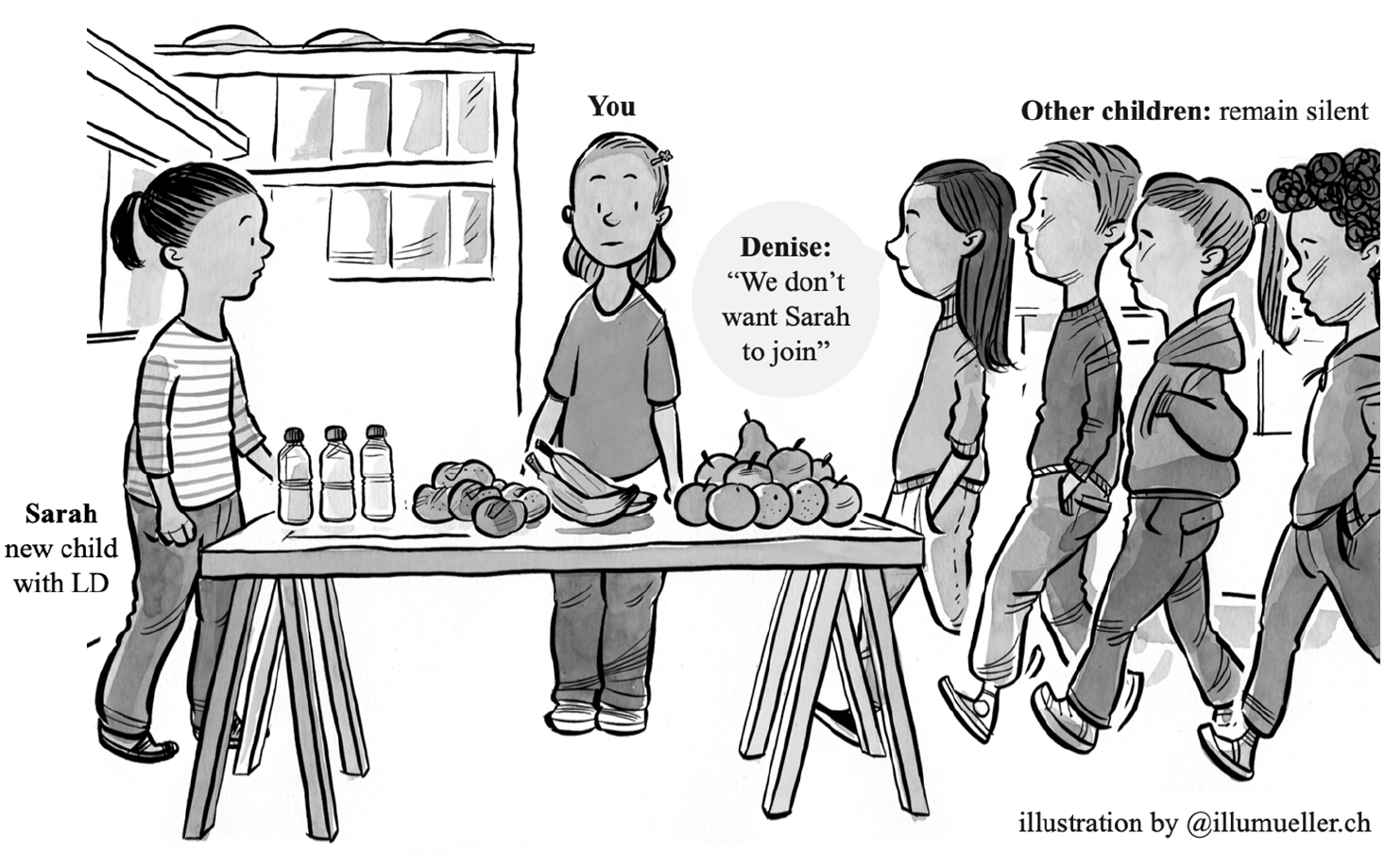
Social Exclusion Task.
Evaluation and Reasoning About the Exclusion
Based on the scenario, children provided open-ended responses from three different perspectives (adapted from Mulvey et al., 2020; Palmer et al., 2022). From their own perspective, they indicated their intervention likelihood (“How would you react?” n = 343) and their reasoning (“Why?” n = 343). From the perspectives of the group and the perpetrator, they reasoned about their reactions (Group perspective: “What would the other children think about you if you [expected reaction]?” n = 315; Perpetrator perspective: “What would Denise think about you if you [expected reaction]?” n = 305). In addition, a subsample of children, who participated in the second assessment, provided quantitative ratings of the group’s reaction (“Do the other children think it is okay or not okay that you [expected reaction]”?), on a 0 [really not okay] to 5 [really okay] Likert-type-scale; M = 2.76; SD = 1.20, n = 195).
Reliability Coding
The coding process of the four open-ended answers followed the recommendations of Conry-Murray et al. (2024) which provide detailed explanations and guidelines for quantifying reasoning responses (for more details on the development of the coding scheme, see Supplementary File S2). Children’s responses to the four open-ended questions were recorded by the research assistants during the interview and later transcribed. To develop the coding manual, answers were coded into various conceptual categories drawn from the SRD model (e.g., Mulvey et al., 2020), literature on stereotypes about students with LD (Haft et al., 2023; Nowicki et al., 2014), and bystander research (Spadafora et al., 2020; Strindberg et al., 2020). Two independent raters, who had been trained using the coding manual, coded the data. Interrater reliability was calculated based on 30% of the answers (n = 106) and was high for all four questions (Cohen’s k > .85).
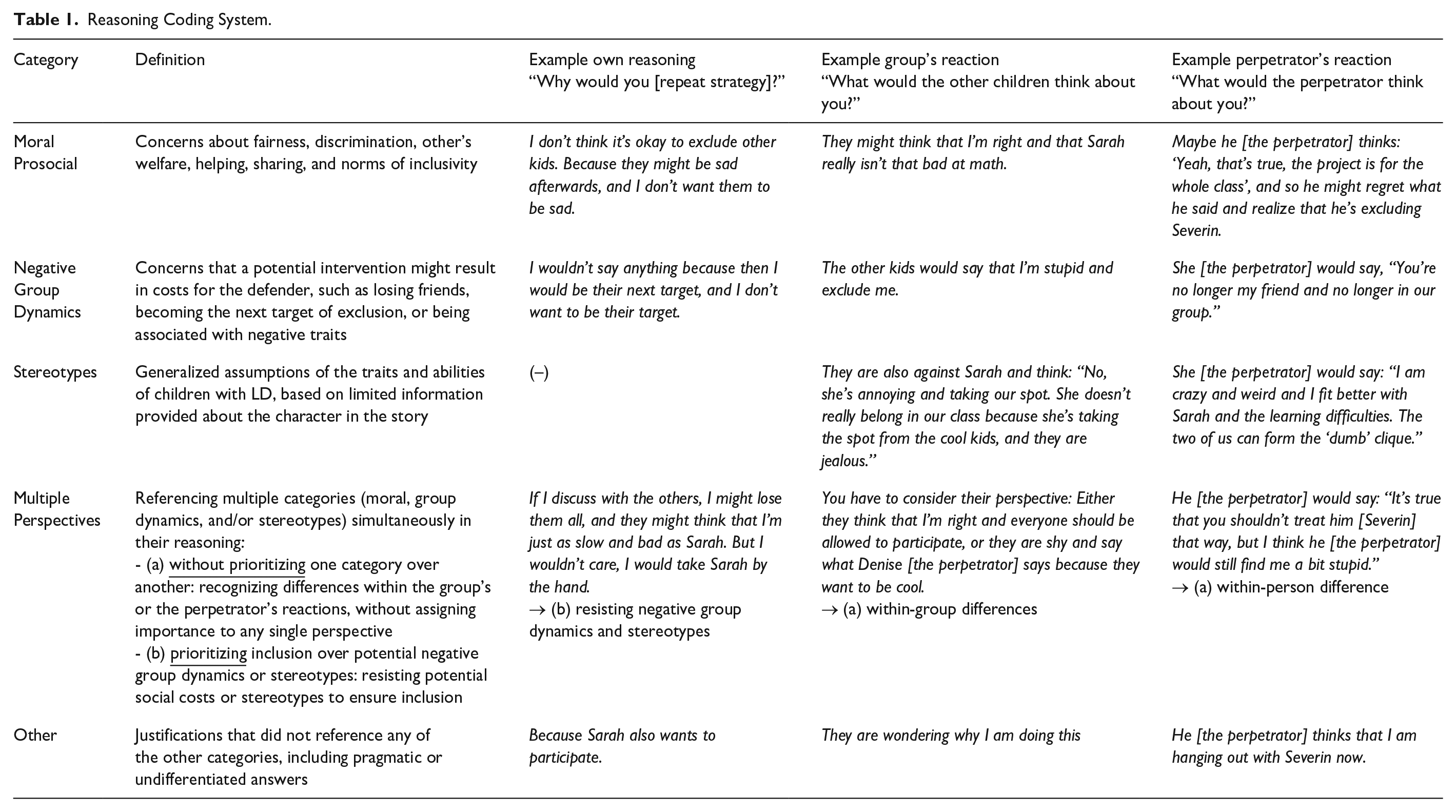
Children’s intervention likelihood was coded into three exclusive categories: (0) no intervention, (1) intervention, and (2) uncertainty. Children’s reasoning from their own, the group’s, and the perpetrator’s perspectives were coded with another coding manual (see Table 1). The reasoning categories were: (1) moral prosocial, (2) negative group dynamics, and (3) stereotypes about LD. While most children provided answers that fitted into a single of these categories (i.e., one code could be assigned per answer) some children, particularly when reasoning about the group’s reaction, demonstrated more differentiated reasoning that fitted multiple categories. To account for this differentiated reasoning, we created a fourth category (4) recognizing multiple perspectives. This category included answers where children mentioned at least two categories (4a) without prioritizing one, or (4b) prioritizing inclusion over concerns about negative group dynamics or stereotypes (for more details on this category, see Supplementary File S2). Undifferentiated, pragmatic answers or answers that did not fit into any of the aforementioned four reasoning categories were classified as (5) other and excluded from the statistical analysis to increase statistical power.
Reasoning Coding System.
Perception of Inclusive Classroom Norms
Based on the scenario described above, children indicated their perception of inclusive classroom norms with two items: (1) “How many of your classmates would like to get to know Sarah better?”; and (2) “How many of your classmates would like to hang out with Sarah during lunch break?.” Answers were provided on a 0 [no one] to 3 [all of them] scale (adapted from Gasser et al., 2018). The two items were aggregated to form the inclusive classroom norms scale (r = .53; M = 1.63, SD = 0.51, n = 345).
Control Variables
As bystander studies indicated gender differences in children’s intervention likelihood (Ma et al., 2019; Mulvey et al., 2020) we included gender (0 = male, 1 = female) as a control variable. In addition, as children’s reasoning may differ when representing a minority group (Gasser et al., 2017), we included information on children’s LD (0 = no LD, 1 = LD) and migration background (0 = no MGB, 1 = MGB) as control variables in our models.
Data Analytic Strategy
All analyses were conducted using R Version 4.2.1 (R Core Team, 2022). Missing cases were excluded from the analyses. We calculated separate models for each dependent variable, ensuring missing data for one did not affect the analysis of another. Predictors were also analyzed in separate models. Covariates had no missing data. Thus, listwise deletion occurred only in a few cases where a child had complete data for the dependent variable but missing data in the predictor or vice versa (for more details on the handling of missing data, see Supplementary File S3).
Since all our dependent variables (reasoning about self, group, perpetrator) were measured at nominal scale levels, we calculated Multinomial Logit Models (MLMs) with the multinom-function from the nnet-package. MLMs estimate the likelihood that a certain reasoning category is chosen over a predefined reference category. For all our hypotheses, except for H2a and H2b, we defined moral prosocial as a reference category. For H2a and H2b, we chose multiple perspectives based on the nature of the hypotheses. In the first step, to test H1d–H1f, we fitted intercept-only MLMs for each dependent variable. The model intercepts of MLMs indicate the likelihood that a category is chosen relative to the reference category. In a second step, we fitted MLMs with the predictor variables to examine the remaining hypotheses. The specifications of each MLM depended on the hypotheses, including differences in the dependent variables, the reference categories, the predictors, and the sample size (see Table 2 for an overview).
MLMs on Children’s Reasoning About Challenging Exclusion.
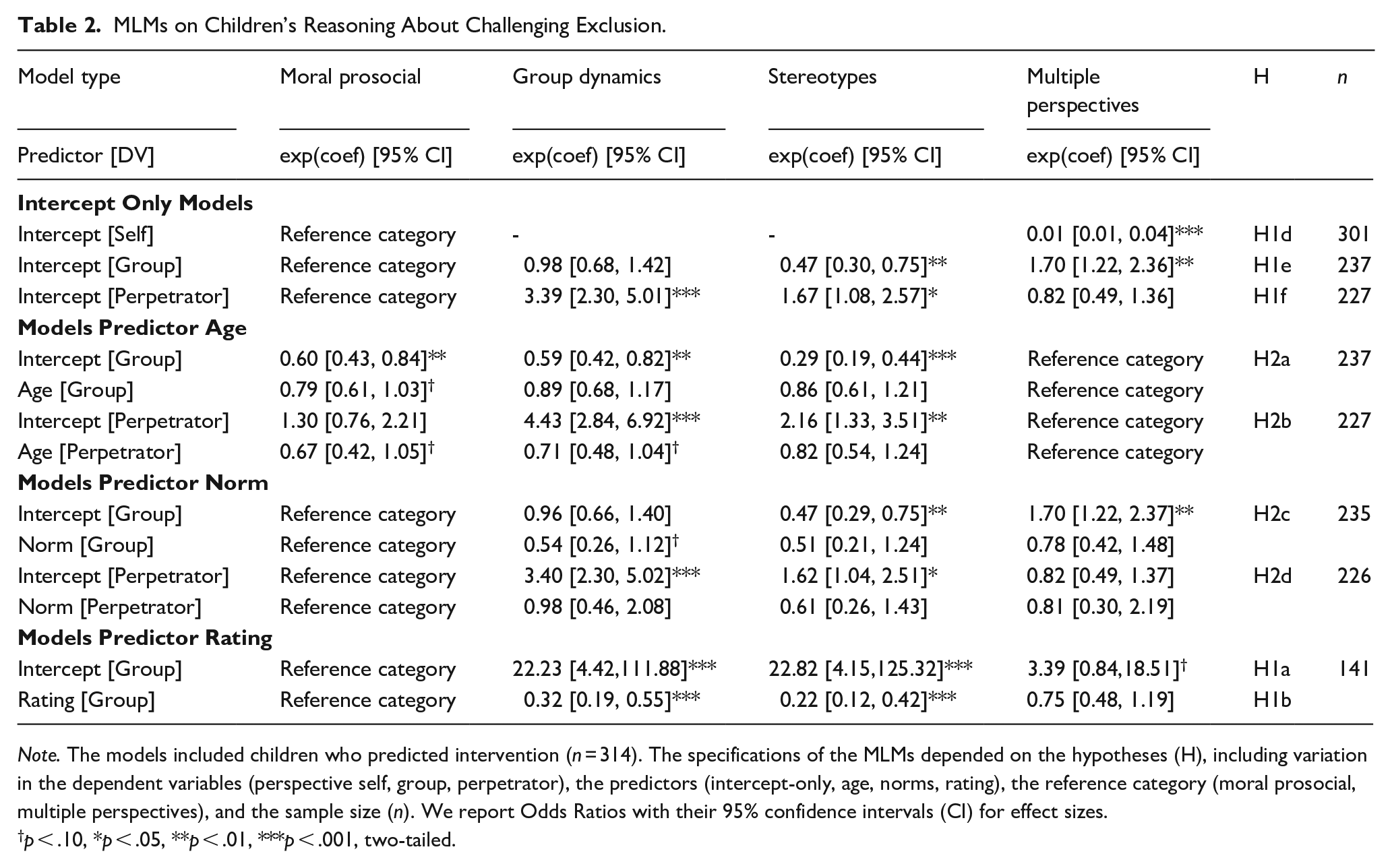
Note. The models included children who predicted intervention (n = 314). The specifications of the MLMs depended on the hypotheses (H), including variation in the dependent variables (perspective self, group, perpetrator), the predictors (intercept-only, age, norms, rating), the reference category (moral prosocial, multiple perspectives), and the sample size (n). We report Odds Ratios with their 95% confidence intervals (CI) for effect sizes.
p < .10, *p < .05, **p < .01, ***p < .001, two-tailed.
Preliminary analyses were performed to account for the control variables. Therefore, we included students’ gender, migration background, and LD in the respective MLMs. No significant effects were found for gender and migration background (ps > .05), so we excluded these variables from further analyses to enhance statistical power. Regarding children’s LD, there was an imbalanced distribution, as teachers only identified a small number of children with LD (n = 29). Hence, the model estimation including this control variable resulted in infinite standard errors. To determine whether there were differences with regards to children’s LD, we conducted supplementary analyses, where we compared the results of models including the whole sample with models including only children without LD. No significant differences were found (for details, see Supplementary File S4).
Results
Reasoning Across Perspectives
To analyze whether there was a pattern in how children justified intervention or non-intervention, we related their own reasoning to their intervention likelihood. Moral prosocial reasons (n = 305) were used to justify intervention but not non-intervention. Vice-versa, concerns about negative group dynamics (n = 4) or LD-stereotypes (n = 2) were used to justify non-intervention but not intervention. Children who were uncertain referenced all reasons. Considering that descriptive results were exclusive, we did not compute MLMs.
In addition, we related children’s reasoning about the group’s reaction to their quantitative ratings of the group’s reaction. MLMs with the ratings as predictor (see Table 2) indicated that children who expected a higher agreement with their intervention were more likely to reason about moral prosocial reasons than negative group dynamics or stereotypes. In summary, these findings support H1a and H1b, indicating that moral prosocial reasons were predominantly cited to justify intervention, whereas concerns about negative group dynamics and LD-stereotypes were used to oppose it.
Reasoning From Children’s Own Perspective
The majority of children (92%) expected to challenge the exclusion, whereas only 3% expected not to intervene, and 6% were uncertain. Of those who predicted to challenge the exclusion (n = 314), 99% cited moral prosocial reasons (see Figure 2). Intercept-only MLMs (see Table 2) indicated that moral prosocial reasons were significantly more frequent than any other reasoning category. These findings support H1c and H1d, indicating that children personally displayed high intentions and moral sensitivity to challenge LD-exclusion.
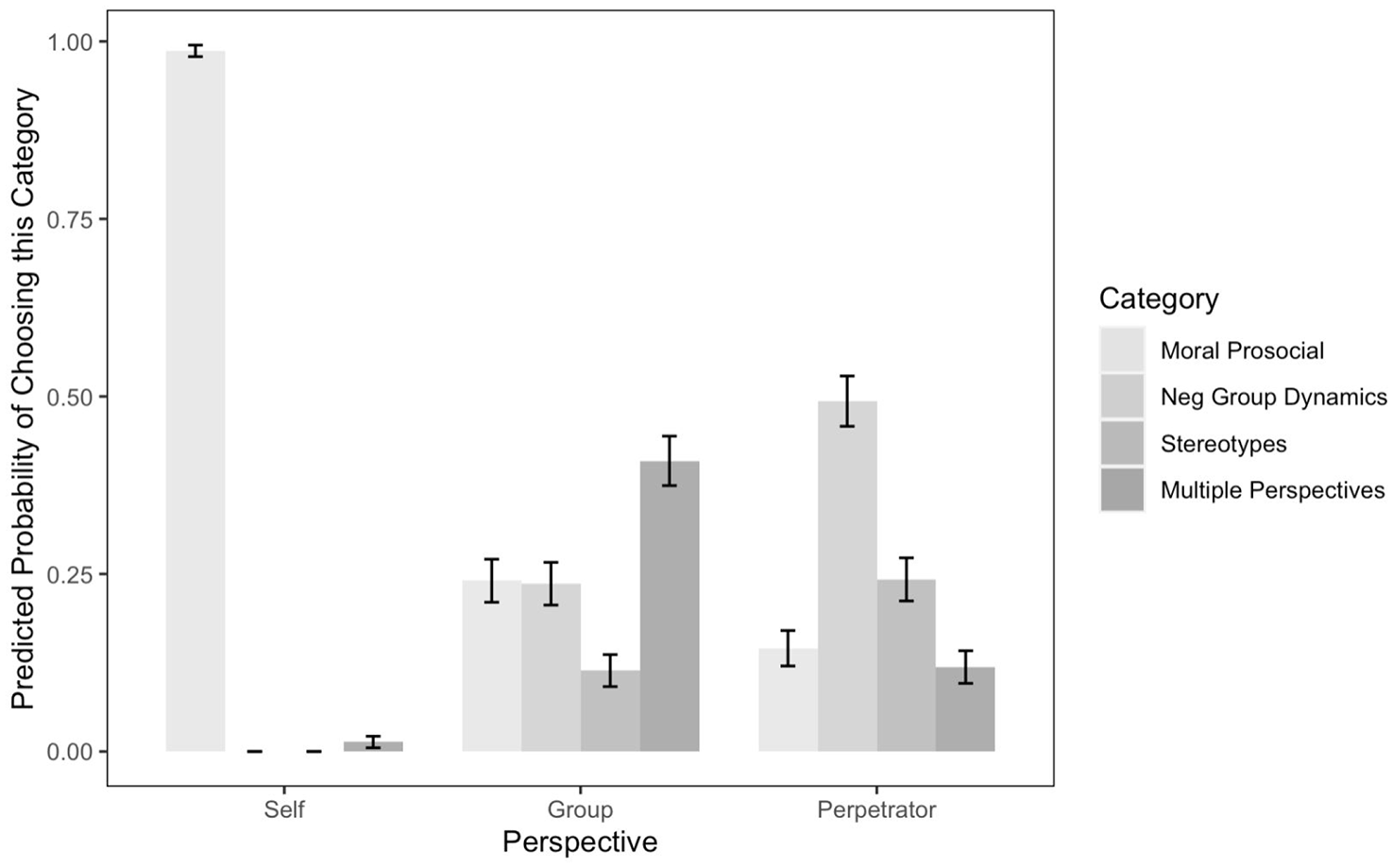
Reasoning About Challenging Exclusion From Different Perspectives. The bars represent transformed Log-odds of the likelihood of referencing a specific reasoning category (based on intercept-only MLMs that included only children who predicted they would intervene). The 95% confidence intervals are depicted.
Reasoning From the Group’s Perspective
Children’s reasoning about the group’s and the perpetrator’s reactions may vary depending on their intervention likelihood. However, because of the small number of children who predicted non-intervention or expressed uncertainty (n = 28), no reliable model estimates resulted when including intervention likelihood as a control variable in the MLMs. Therefore, we decided to focus solely on analyzing children’s expectations about the group’s and the perpetrator’s reactions to an intervention, limiting our analysis to children who predicted they would intervene (n = 314).
Figure 2 displays children’s reasoning about the group’s reaction to an intervention: Twenty-four percent expected the group to be concerned for moral prosocial reasons, 24% anticipated negative group dynamics, and 11% predicted the group would reinforce stereotypes. Notably, 41% (n = 97) referenced more than one reasoning category (n = 70 without prioritizing one category over another and n = 27 prioritizing inclusion over negative group dynamics or stereotypes). Contrary to H1e, the results of intercept-only MLMs (see Table 2) indicated that children were not more likely to perceive negative group dynamics or stereotypes as compared with moral prosocial reasons. Instead, their expectation of the group’s reaction was mixed and differentiated.
Reasoning From the Perpetrator’s Perspective
Figure 2 displays children’s reasoning about the perpetrator’s reaction to an intervention: 15% of the children expected the perpetrator to be concerned for moral prosocial reasons, 49% anticipated negative group dynamics, and 24% predicted the perpetrator would reinforce stereotypes. Only 12% of the sample referenced multiple perspectives. In line with H1f, intercept-only MLMs (see Table 2) indicated that children were more likely to perceive negative group dynamics or a reinforcement of LD-stereotypes than moral prosocial reasons.
Age Differences in Children’s Reasoning
To assess age differences in children’s reasoning about others’ reactions, we fitted two MLMs (see Table 2, models predictor age): one with the group’s reaction as the dependent variable and the other with the perpetrator’s reaction as the dependent variable (reference category was set to multiple perspectives). When reasoning about the group, with increasing age, children were more likely to reference multiple perspectives compared with moral prosocial reasons alone. Similarly, when reasoning about the perpetrator, with increasing age, children were more likely to reference multiple perspectives than moral prosocial reasons or negative group dynamics. In summary, these findings support H2a and H2b, indicating that older children were more likely than younger children to consider multiple perspectives in their reasoning about the group’s and the perpetrator’s reactions.
Inclusive Classroom Norms and Children’s Reasoning
To assess the role of inclusive classroom norms for children’s reasoning about others’ reactions, we fitted two MLMs (see Table 2, models predictor norms): one with the group’s reaction as the dependent variable and the other with the perpetrator’s reaction as the dependent variable. With regards to the group’s reaction, the higher children’s perception of inclusive norms, the less likely they were to reference negative group dynamics compared with moral prosocial reasons. These results provide support for H2c, suggesting that the perception of high inclusive classroom norms correlates with fewer anticipations of negative group dynamics. In contrast to H2d, no significant relationship was found between children’s perception of inclusive classroom norms and their reasoning about the perpetrator’s reactions.
Discussion
The findings of the current study highlight the social complexity involved in children’s decision-making about challenging the exclusion of peers with LD, particularly when reasoning from different perspectives. When reasoning from their own perspective, children expressed high intentions to challenge the exclusion of their peers with LD and justified these intentions with moral prosocial reasons. These reasons included concerns related to the unfairness of exclusion, the others’ well-being, but also concerns about the unfairness of excluding someone based on group identity (“We shouldn’t exclude children, independent of whether they are good or bad in school, have a different skin color, or are from another country. Because it’s mean . . . and it makes them think that they are not welcome”). This finding supports our hypothesis and aligns with research within the SRD model, demonstrating children’s high moral desire to include peers with LD in the classroom (Barth & Grütter, 2024; Gasser et al., 2017).
When reasoning about the group, children anticipated a diverse range of responses. While they did not expect the group to fully support their intervention, they also did not anticipate that the group would entirely side with the perpetrator. Accordingly, they were equally likely to expect the group to be concerned about moral prosocial reasons as to anticipate negative social group dynamics. Only a minority predicted that the group would reinforce stereotypes about LD. Notably, the largest proportion of children referenced more than one reasoning category and recognized that the group could react differently (“You have to consider their perspective: Either they think that I’m right and everyone should be allowed to participate, or they are shy and say what Denise [the perpetrator] says because they want to be cool.”). These findings contrast earlier quantitative work on LD, in which Swiss elementary school children (Grades 3−6) expected low inclusive intentions from their peers (Barth & Grütter, 2024; Gasser et al., 2017). Instead, our study revealed more mixed expectations of peer support, highlighting the benefits of open-ended assessments that allow children to express their expectations in own words, with fewer constraints than forced-choice formats (Conry-Murray et al., 2024). Furthermore, this study provides novel insights, demonstrating that children perceive differences between their own intentions and the goals of a group which often lead to exclusionary strategies. Future research could include assessments of how children reconcile conflicting goals and motivations of the perpetrator, bystanders, and the challenger to better understand the social-cognitive processes involved in resistance to and conformity with peer pressure.
Finally, when reasoning about the perpetrator’s reaction, children’s reasoning pattern was less heterogeneous. The largest majority expected negative group dynamics or a reinforcement of the stereotypes that motivated the exclusion. This is consistent with previous work where concerns about social repercussions were cited as main barriers to intervention (Spadafora et al., 2020; Strindberg et al., 2020). Our study provided new evidence that these concerns were primarily associated with the perpetrator rather than the group. Future research can explore whether children who perceive a high risk of punishment from the perpetrator but also anticipate strong support from the group might be more likely to resist social repercussions and decide to challenge the exclusion (Evans & Smokowski, 2015).
In summary, children personally displayed high moral intentions to challenge exclusion, but expected a variety of reactions from their peers, including social repercussions. Based on these findings, there are two practical implications for educators on how to design interventions that promote the inclusion of children with LD in the classroom. First, it may be beneficial to increase children’s perception of peer approval and support for interventions. Although nearly all children in our study expressed the intention to intervene for moral reasons, they also expected that other group members might not share the same moral concerns. This creates a phenomenon known as pluralistic ignorance, where children mistakenly believe their peers are less inclusive, prosocial, or concerned with moral issues than they actually are (Dillon & Lochman, 2022; Levy-Friedman & Kogut, 2024). As a result, children may downplay their own intentions to intervene, assuming that their peers do not support the intervention. Correcting this misperception and highlighting that others share similar intentions (e.g., Dillon & Lochman, 2022) could, therefore, be effective in fostering more inclusive behavior. Second, educators could guide students in navigating the conflict between the moral and social aspects of exclusion situations. While it may not be effective to focus solely on promoting education in the moral domain, teachers could assist students in recognizing conflicting elements in exclusion situations and guide them to question unfair group norms (Nucci & Ilten-Gee, 2021). Teacher-led classroom discussions about social exclusion have been shown to effectively foster this understanding (e.g., Killen et al., 2022).
These discussions should be tailored to the students’ development, taking into account age-related differences in children’s reasoning about group dynamics. When reasoning about the group’s and the perpetrator’s reactions, older children in our study increasingly identified ambiguities and anticipated a wider range of responses. This finding aligns with research on children’s advanced theory-of-mind and social perspective-taking development in middle and late childhood (Diazgranados et al., 2016; Osterhaus & Bosacki, 2022) by showing an increased ability to acknowledge that reactions of the different actors can vary based on their roles and motives. Educators could foster children’s ability to consider multiple and justified perspectives by implementing collaborative small-peer-group discussions that engage children in active argumentation about social and moral dilemmas (e.g., Kim et al., 2024), including concerns about peer group dynamics (e.g., Grütter et al., 2025).
In addition, our results highlight the role of perceived inclusive classroom norms for children’s reasoning about challenging exclusion. Specifically, children who perceived their classmates as more inclusive anticipated fewer negative group dynamics from hypothetical peers in the scenario. This finding adds to the literature on social projection in childhood (Schulze et al., 2021; Thijs & Verkuyten, 2016), indicating that children’s subjective experiences in the classroom may play a significant role in shaping their broader understanding of social group dynamics. These insights are particularly relevant within the Swiss context, where, following elementary school, children’s interactions with classmates of varying learning abilities decrease due to ability tracking in secondary school. As such, perceiving inclusive norms in elementary school may be important for the development of an inclusive identity in later years. Previous research has shown that peers contribute significantly to moral identity development in middle and late childhood (Krettenauer, 2020). Future longitudinal research should explore whether children’s perception of inclusive classroom norms in elementary school influences their reasoning and perception about the inclusion of peers with LD in adolescence and adulthood.
Limitations and Future Directions
In our study, a significant number of children expressed concerns about negative social group dynamics in response to an intervention. To encourage children to challenge the exclusion of peers with LD, it is essential to investigate whether and when they are likely to resist these potential negative group dynamics and whether concerns about inclusion and fairness may serve as motivators (Mulvey & Killen, 2017). Notably, a small minority of children in this study reasoned about resisting negative dynamics and prioritized inclusion. Future research could build on this finding and the reasoning categories from this study and experimentally present children with distinct motivations for challenging exclusion (e.g., concerns about fairness, discrimination, inclusive norms, helping), along with potential risks (e.g., becoming the next target of exclusion, loss of social status).
In addition, future studies could explore how children’s peer status influences their reasoning about challenging exclusion. Research has shown that popularity is associated with a higher likelihood of intervention (Laninga-Wijnen et al., 2023). Examining whether popular children exhibit different reasoning patterns compared with their less popular peers could provide valuable insights into the factors that shape their decision-making.
Finally, this study employed a hypothetical scenario, a widely used measure throughout the field of social and moral development, that provides a window into children’s motivations, intentions, and desires. Previous studies have revealed that children’s responses to such scenarios correlate with their real-life behavior in the classroom, for example with their inclusiveness toward peers with special needs (Freitag & Dunsmuir, 2015). However, it is unlikely to expect a direct link between intention and behavior in the classroom, as other peer-relational and contextual factors may moderate this relationship. Future research should build on the findings of this study and investigate how the interplay between individual reasoning and expectations of peer reactions in hypothetical scenarios relate to children’s actual behavior in the classroom (e.g., Gasser & Malti, 2012).
Conclusion
This study contributes new empirical evidence regarding children’s reasoning about challenging exclusion of peers with LD. Overall, our findings underscore the importance of exploring how children reconcile moral concerns with the risks of negative social group dynamics (“Because it’s a difficult situation when the whole class is in front of you, but on the other hand I don’t want to be unfair to Sarah.”). To enable the social participation of children with LD and promote resistance to their exclusion, educational interventions could focus on guiding students to navigate these competing concerns in their reasoning.
Supplemental Material
sj-docx-1-jbd-10.1177_01650254251348216 – Supplemental material for Children’s reasoning about challenging social exclusion of peers with learning difficulties
Supplemental material, sj-docx-1-jbd-10.1177_01650254251348216 for Children’s reasoning about challenging social exclusion of peers with learning difficulties by Carmen Barth, Melanie Killen and Jeanine Grütter in International Journal of Behavioral Development
Footnotes
Acknowledgements
The authors are grateful to the research assistants who assisted in the data collection (Sophie Bernlochner, Sarah Bunz, Jana Carstensen, Rebeka Gabathuler, Franziska Greiner, Esther Hegnauer-Camille, Anne-Madeleine Kamm, Esther Krukowski, Lea Schellenbaum). They also thank Ramona Mutschler for her support in the data collection and her assistance in the development and reliability coding of the reasoning data. They also would like to express their gratitude to the teachers and students who supported and participated in the study.
Data Availability Statement
The data, analytic code, and materials necessary to reproduce the analyses and replicate the findings presented in this study are not publicly accessible but are available from the corresponding author on reasonable request.
Declaration of Conflicting Interests
The author(s) declared no potential conflicts of interest with respect to the research, authorship, and/or publication of this article.
Funding
The author(s) disclosed receipt of the following financial support for the research, authorship, and/or publication of this article: The first author was funded by a fellowship of the German Academic Exchange Service (DAAD), number: 57647579. The second author was supported, in part, by grants from the National Science Foundation, BCS#1728919, and the National Institute of Child Health and Human Development, R01HD093698. The last author was funded by the Swiss Federal Office for the Equality of Persons with Disabilities, number: 18.l.059, and received additional funding from the Paul Scherrer Fonds, the Teacher University Lucerne, and the University of Konstanz.
Ethics Approval and Informed Consent
The study procedure was approved by the ethics committee of the University of Konstanz (number: 15/2022) and is in line with the ethical recommendations of the Helsinki Declaration, the American Psychology Association (APA), and recommendations from the World Health Organization (WHO). For the students, parents or primary caregivers provided informed written consent for their study participation. In addition, before study administration, all participating children provided verbal assent, and children above 11 provided written assent, to participate in the study.

Preregistration
Supplemental Material
Supplemental material for this article is available online.
References
Supplementary Material
Please find the following supplemental material available below.
For Open Access articles published under a Creative Commons License, all supplemental material carries the same license as the article it is associated with.
For non-Open Access articles published, all supplemental material carries a non-exclusive license, and permission requests for re-use of supplemental material or any part of supplemental material shall be sent directly to the copyright owner as specified in the copyright notice associated with the article.
