




Abstract
Child positive affectivity (PA) remains an underexplored topic in temperament research, with varying findings on developmental outcomes potentially influenced by different measurement approaches. Employing a multi-method approach, this study investigated associations between child PA and internalizing and externalizing problems among 100 families with two siblings (mean age = 3.86). Child PA was measured using five scripted episodes from the preschool version of the Laboratory Temperament Assessment (Lab-TAB) battery, including Gift, End of the Line, Snack Delay, Corral of Balls, and Stranger Approach episodes, as well as a parent-rated questionnaire. The findings supported the heterogeneous nature of child PA as a function of both measurement approach and contextual specificity and revealed intriguing associations between PA and different profiles of internalizing and externalizing symptoms. Implications for future studies are discussed.
Keywords
Introduction
Child positive affectivity (PA), defined as the tendency to experience and express enjoyment and to be responsive to reward, is commonly regarded as an approach emotion by temperament scholars (Bates, 1989). One of the most influential theories on child temperament developed by Mary Rothbart and colleagues (2000), identified PA as a sub-component of the extraversion/surgency dimension, alongside activity level and sociability. Theoretically, positive emotions are believed to serve fundamental psychological functions that facilitate coping, build resilience, and further lead to enhanced well-being (Fredrickson, 2001). Higher levels of positive emotionality have been associated with a lower likelihood of experiencing psychopathology during both childhood and adolescence (Compas et al., 2004; Gilbert, 2012; Stifter et al., 2020), such as anxiety and depressive symptoms. Children who expressed more PA were found to not only develop better core academic abilities during their school years (Davison et al., 2019; Gartstein et al., 2016; Hayden et al., 2006) and later in adulthood (Coffey, 2020), but also to display higher levels of social-emotional competence, such as improved emotional processing and more prosocial behaviors (Volbrecht et al., 2007). However, compared to a conventional emphasis on negative affectivity, explorations on PA have been limited, posing challenges to understanding the nuances of its role in child development (Gagne & Goldsmith, 2021). One emerging emphasis among temperament research on child PA is on the heterogeneous nature of PA. That is, expressed smiling and laughter among children may have different implications depending on the social situation under which PA was observed, which in turn may show different patterns of association with outcomes (Kochanska et al., 2007). In this study, we employed a multi-method approach using various scripted lab scenarios and parent ratings, to examine how child PA relates to internalizing and externalizing symptoms depending on the measurement approach.
Relations to Internalizing and Externalizing Symptoms
Previous research has explored the relationship between children’s PA levels and the development of internalizing problems, such as anxiety, depression, and withdrawal symptoms (e.g., Compas et al., 2004; Gartstein et al., 2012; Putnam & Stifter, 2005). Children who exhibit greater tendencies for positive emotions are found to be less prone to developing internalizing symptoms (Northerner et al., 2016; Zhou et al., 2009). For instance, self-reported PA among school-aged children has been linked to protective effects against concurrent and future depression (e.g., Lonigan et al., 2003), as well as anxiety symptoms (Uhl et al., 2019). Despite evidence of the protective role of PA against internalizing problems, some studies have shown that children who experience intense excitement or high levels of pleasure are more prone to externalizing problems (Dougherty et al., 2010; Gartstein et al., 2012; Oldehinkel et al., 2004; Zhou et al., 2009). This indeed aligns with findings that indicate higher levels of positivity are more associated with increased approach behaviors and impulsivity, while linked to lower levels of inhibition in children (Dyson et al., 2012; Putnam & Stifter, 2005). Yet, the findings are not always consistently aligned. Some studies did not find such connections (e.g., Bridgett et al., 2009), while some reported contradictory results. For instance, Kim et al. (2007) reported a negative association between positive emotions and externalizing problems among school-aged elementary students.
One noteworthy aspect of these contradictory findings is the adoption of mixed measurement approaches and different informants. Some studies used questionnaires completed by parents and teachers (e.g., Northerner et al., 2016; Zhou et al., 2009), some used self-reported measures of school-aged children (e.g., Kim et al., 2007; Uhl et al., 2019). Besides surveys, behavioral observations are also widely implemented in the assessment of child PA (e.g., Dollar & Buss, 2014; Olino et al., 2011), using protocols like the Laboratory Temperament Assessment (Lab-TAB) battery (Gagne et al., 2011). Child PA is usually quantified through facial expressions, gestures, and bodily posture and movements, using standardized coding manuals (Gagne et al., 2011). Each measurement approach to child PA is valuable in its unique perspective, contributing to the overall understanding of children’s PA tendency (Davis et al., 2015). However, reliance on any single index of child PA insufficiently captures this complex construct and contributes to inconsistent findings in the literature on the associations between PA and other developmental outcomes (Gagne & Goldsmith, 2021). Therefore, a multi-method approach is essential to expanding our knowledge of the role of child PA considering its heterogeneous nature.
Heterogeneity of Child PA: Context and Intensity
An important aspect of measuring child PA is that it should be tailored to specific contexts. There has been low concordance rate reported between parent ratings and laboratory observations on child PA in prior investigations (e.g., Dougherty et al., 2010), indicating that these two measurement approaches may tap different aspects of the construct, given the variations of the context of the assessment (Davis et al., 2015). Parent ratings typically require caregivers to report on their children’s behaviors retrospectively according to their memories, which reasonably reflect child PA under natural social settings and interactions (e.g., CBQ; Rothbart et al., 2001). Laboratory observations, however, are scripted scenarios that intend to elicit certain levels of emotional reactivity among children and are administered in a novel lab environment (Gagne et al., 2011). Kochanska et al. (2007) examined child PA by coding expressions of joy among children from 9 to 45 months under two different types of social conditions: naturalistic mother-child interactions, and scripted Lab-TAB procedures. Their results showed that, although being moderately intercorrelated, child PA in mother-child interactions and in scripted Lab-TAB episodes are associated with self-regulation capability in substantially different directions. Children who expressed more joy during daily interactions with their mothers also had higher scores in effortful control and rule-compatible conduct. In contrast, child PA in the scripted Lab-TAB procedures had a significant negative relation with self-regulation abilities. These findings suggest that the social contexts under which child PA was measured and observed have a significant impact on its relationship with other developmental outcomes.
Moreover, the context-specific nature of child PA can be evident even across laboratory observations. The PA observed in different episodes can carry different meanings, as each experimental scenario may involve unique social demands and cues. Children’s positive emotions in these settings may reflect different strategies depending on the context. In the preschool version of the Lab-TAB, episodes such as “Puppets,” “Pop-up Clown,” and “Peek-a-Boo” are PA-specific and used to assess children’s high and low intensity pleasure, contentment, and positivity (Gagne et al., 2011). Yet, other episodes, though not created for assessing PA, are also informative of children’s tendency of experiencing positivity under various circumstances (e.g., Dougherty et al., 2010). For example, Dollar and Buss (2014) used a series of various Lab-TAB episodes (e.g., Stranger Approach, Snack Delay) to capture diversities of child PA in different situations, and categorized them by levels of threat/intensity of stimulus in the situation. Results showed that children who expressed high approach and high levels of PA under both non-threat and low-threat situations were rated as high in externalizing problems by mothers, while those demonstrating increased approach but low PA in moderate-threat situations had a lower risk for developing internalizing problems. Their findings suggest that context characteristics play a significant moderating role, with PA in different social contexts likely reflecting functionally distinct adaptations to specific social situations. Similarly, Olino et al. (2011) coded children’s displays of both positive and negative affect during various tasks originally designed to elicit fear, general anxiety, and performance anxiety. Their findings revealed that child PA reactivity was highly sensitive to environmental characteristics. Specifically, children whose mothers had a history of depressive disorders exhibited lower levels of PA. These findings highlight the importance of examining children’s positive emotional reactivity in contexts that are not typically designed to elicit positivity. Observing PA in such diverse scenarios provides more nuanced insights into its context-specific nature. Despite this, few studies have utilized a multi-method approach that combines parent ratings with laboratory observations across different settings, which limits our understanding of how child PA is expressed differently under different contexts, and its intricate relationships with other outcomes.
Another factor that may contribute to inconsistencies in the PA literature is whether researchers focus on the high-arousal or low-intensity aspects of PA in their measurements (Dollar et al., 2022). Low-intensity PA usually captures pleasure (i.e., smiling or laughter) experienced under a non-stimulating situation, while high-intensity PA refers more to rigorous excitement emotions under situations involving high-intensity stimulus (Putnam & Rothbart, 2006). Children who had higher levels of low-intensity PA are less likely to develop internalizing difficulties (e.g., Durbin et al., 2005), such as depression and anxiety symptoms (McManus et al., 2019). In contrast, those who experience high levels of high-intensity positivity, such as excitement, are more likely to show lower levels of self-regulation and control over behaviors and emotions, which is further associated with difficulties in learning and social emotional competence (Dollar et al., 2017). Indeed, high-intensity PA serves as a defining characteristic of surgency/exuberance, an important temperamental dimension that also consists of high approach, high interest, and high activity levels, that may contribute to an increased risk of behavioral problems (Stifter et al., 2020). Supporting this, Poole and Schmidt (2019) observed that children who showed both high positivity and high avoidance during an intense emotion-eliciting episode also had higher levels of behavioral activity compared with those in the low positive but high avoidance group. The differentiating role of intensity-specific PA has also been shown in longitudinal studies. For instance, Dollar et al. (2022) revealed that high-intensity positivity at age 5 was associated with lower self-regulation (i.e., effortful control) at age 7 and more risk-taking behaviors during adolescence whereas low-intensity positivity at age 5 was linked to greater levels of self-regulation abilities in later childhood.
As discussed above, as a heterogeneous construct, childhood PA differs depending on both intensity and characteristics of social situations under which the positivity was elicited and observed. Furthermore, expressed childhood PA may contain various implications in response to the specific situation, and be indicative of different developmental adjustment later. Distinguishing childhood PA under diverse social contexts serves a critical role in further understanding the mixed associations between positive emotionality and child adjustment. Although some preliminary evidence has supported the heterogeneity of childhood PA, less is explored regarding how that reflects in its relations to internalizing and externalizing symptoms among young children. Furthermore, a multi-method measurement strategy employing both parent ratings and scripted Lab-TAB episodes is rare among previous studies.
Present Study
The present study sought to examine how child PA assessed using different measurement approaches (i.e., scripted Lab-TAB episodes, parent ratings) relates to various internalizing and externalizing symptom profiles among preschool-aged children. To do this, we utilized data from a family study on child temperament, and its relations to children’s cognitive and behavioral development in the preschool stage. Child PA was measured using both scripted scenarios from the preschool version of Lab-TAB, and parent ratings of child pleasure. The Lab-TAB episodes of Gift, Snack Delay, Corral of Balls, End of the Line, and Stranger Approach were utilized.
Based on prior evidence of the impact of child PA, we hypothesized that parent ratings of child PA would be negatively associated with both internalizing problems and externalizing problems. Regarding laboratory observed child PA, we hypothesized that the associations between child PA and different profiles of internalizing and externalizing symptoms would differ depending on the contexts. Since this aspect of the investigation is relatively exploratory in nature, we have no specific hypothesis for the direction of the relations.
Methods
Participants and Procedures
One hundred families with two siblings between 2.5 and 5.5 years of age (mean age = 3.86 years, SD = 1.04) were recruited from the Dallas-Fort Worth Metroplex area. The sample consisted of 201 typically developing children, including 104 boys (mean age = 3.77 years, SD = 0.99) and 97 girls (mean age = 3.96 years, SD = 1.08). There were 57 full siblings, 10 identical twin pairs, 32 fraternal twin pairs, and one set of triplets in our sample. The majority of the sample was White (84% of children; 88% of mothers; and 87% of fathers), followed by Hispanic or Latino (13% of children; 7% of mothers; and 8% of fathers), multiracial (11% children; 5% mothers; and 4% fathers), and African American (4% children; 4% mothers; and 7% fathers). Less than 3% of the participants were reported as Asian American, Pacific Islander, and other races. The average years of education were 15.82 years for mothers and 15.2 years for fathers and the average annual household income was around US$70,000, ranging from US$20,000 to over $200,000.
We recruited families through flyers on campus, at pediatrician’s offices, and day care centers, as well as posting on the internet and study websites. A pre-screening process of the participants was conducted for eligibility before data collection according to the child’s age and developmental status. Qualified participants were asked to complete online surveys through SurveyMonkey. A total of 126 families completed the online surveys, of which 100 families consented to participate in the following laboratory visit. During the laboratory visit, different behavioral and cognitive assessments described as “fun games” were conducted with children. Main caregivers (predominantly mothers) also reported on a set of additional questionnaires during the visit. Participants received a US$25 gift card for completing the online surveys, and an additional US$50 gift card after the laboratory visit. All research procedures were reviewed and approved by the University Institutional Review Board at Texas A&M University in 2018 (Study #2017-0820D).
Measures
Laboratory Temperament Assessment Battery (Lab-TAB)
Child temperament was assessed during the laboratory visits with the preschool version of the Laboratory Temperament Assessment Battery (Lab-TAB; Goldsmith et al., 1995), a comprehensive lab-based temperament assessment that consists of specifically designed episodes corresponding to different aspects of child temperament. Five Lab-TAB episodes were used in the current study, including Corral of Balls, End of the Line, Gift, Snack Delay, and Stranger Approach. During the administration of the Lab-TAB episodes, children’s behaviors were videotaped and later coded in the laboratory by trained graduate assistants.
The Corral of Balls episode provided a novel, non-threatening, non-social situation for measuring physical activity, where the child was offered the opportunity to play in a corral enclosure that was filled with rubber balls. The originally targeted response from this episode is the activity level temperament dimension. In the End of the Line episode, a novel toy was first demonstrated to the child, and then retrieved by the experimenter without any reason. This unreasonable prohibition of a pleasant stimulus originally targeted negative affectivity such as anger or sadness. In the Gift episode, the child was given a gift-wrapped toy and told not to touch it and wait to open the gift. The duration of the wait was 2 min. In the Snack Delay episode, the experimenter presented the child with snacks (usually M&Ms) and put one under a transparent cup, asking the child to wait a certain amount of time before eating it. Both Snack Delay and Gift focused on the inhibitory control temperament dimension. The last episode was Stranger Approach, which situated the child in a social interaction with a stranger. The child was faced with a novel, slightly threatening person who entered the room and started talking. The targeted responses in this episode are shyness and fear.
Among them, the Corral of Balls episode is a non-threatening and free-playing scenario tapping activity level, while Gift, End of the Line, and Snack Delay are self-regulation episodes that require children to regulate their desires for toys and snacks. The Stranger Approach episode is targeting social shyness and fear, which to a certain extent, also triggers self-regulation of emotions.
Coding of PA Scores
The behavioral coding was carried out based on a modified version of the preschool Lab-TAB coding protocol (Goldsmith et al., 1995). Following the suggested procedures, PA was coded in all five episodes based on the presence of smiling or laughter (“0 = no smile, 1 = smile”) for approximately every 10 s in the Corral of Balls, Gift and Stranger Approach episodes, on average every 30 s in the End of the Line episode, and around every 25 s in the Snack Delay episode. Sometimes the child was not facing the camera and the coder was not able to score for the presence of PA without facial expressions. These epochs were coded with missing values in the dataset. All coders were trained to a 90% agreement with the master coders before coding independently. For all episodes, 20% of the sample was re-coded by a separate coder to assure reliability and the agreement exceeded 85%. The mean value of PA throughout the period was calculated for all five episodes. Higher scores indicate more expressions of smiling and laughter during the episode.
Parent-Rated Child Temperament
The Toddler Behavior Assessment Questionnaire-Revised (TBAQ-R; Goldsmith, 1996) was used to measure parent-reported child temperament. Parents answered questions regarding their child’s behavior in the past month based on a 7-point scale from 1 (“never”) to 7 (“always”). The subscales of pleasure (e.g., “When playing quietly with one of her or his favorite toys, how often did the child smile?”) was used. The Cronbach’s alpha was 0.78 in our sample, consistent with reported typical scores (Goldsmith, 1996).
Child Internalizing and Externalizing Symptoms
Child internalizing and externalizing symptoms were assessed using the Child Behavior Checklist (CBCL; Achenbach & Rescorla, 2000), a standard questionnaire with 100 items measuring child social-emotional functioning and behavioral outcomes. Parents were asked to rate their children’s behaviors in the past two months on a scale from 0 (“not true”) to 2 (“very true or often true”). The broadband internalizing scores, anxious-depressed symptoms, anxiety problems, and withdrawn symptoms subscales were used. Sample items include “Gets too upset when separated from parents,” and “Avoids looking others in the eye.” Cronbach’s alpha was 0.87 for the 36-item broadband internalizing scale, 0.70 for the 8-item anxious-depressed problems subscale, 0.70 for the 8-item withdrawn problems subscale, and 0.68 for the 10-item anxiety problems subscale.
We used the broadband externalizing scores, aggressive behaviors, DSM-oriented ADHD (Attention Deficit/Hyperactivity Disorder), as well as DSM-oriented ODD (Oppositional Defiant Disorder) subscales to capture child externalizing problem profiles. Sample items include “Can’t sit still,” and “Disobedient.” Cronbach’s alpha was 0.90 for the 24-item externalizing problems scale, 0.89 for the 19-item aggressive behaviors subscale, 0.81 for the 6-item ADHD subscale, and 0.80 for the 6-item ODD subscale, suggesting good internal consistency.
Assumption Checking and Analysis Plan
Prior to our substantive analyses, we screened our data for outliers, missing data, and checked the tenability of statistical assumptions. Little’s MCAR test was conducted to evaluate the pattern of missing data for all variables of interest to determine if the pattern was consistent with Missing Completely at Random (MCAR; Little, 1988). Results showed that the MCAR assumption was tenable (χ2(189) = 200.06, p = .27). We found no evidence of extreme outliers (e.g., leverage, Cook’s D values were acceptably small; Judd et al., 2017). Regression assumptions were checked for models regressing main predictors on four types of child internalizing problems (e.g., Q-Q plots showed acceptable normality; Cook-Weisberg tests indicated violation of heteroskedasticity assumptions). Therefore, robust standard error estimation was used in all following regression analyses. In addition, since our data holds the structure of children nesting within family, intraclass correlation score (ICC) was calculated to determine if multilevel modeling is required. Results suggested the necessity of employing multilevel modeling in all following regression analyses (e.g., ICC scores larger than 0.30). Therefore, multilevel mixed-effect regression analysis was conducted to examine the effect of Lab-TAB PA scores and parent-ratings of pleasure on different profiles of children’s internalizing and externalizing symptoms. Specifically, Lab-TAB PA scores from five episodes (i.e., Corral of Balls, End of the Line, Gift, Snack Delay, and Stranger Approach), and parental rating of pleasure were included as predictors. Child age was controlled as a covariate in all models. Although our research questions focus on child-level variables, a random intercept was specified to account for clustering of observations within families, controlling for shared familial influences. Separate models were tested for each profile of internalizing and externalizing symptoms. Models were estimated using Restricted Maximum Likelihood (REML), an approach that provides unbiased estimates of variance components and is well-suited for mixed-effects models. All the analyses were conducted using Stata 18.0 (StataCorp, 2023).
Results
Descriptive and Correlation Statistics
Table 1 presents both descriptive statistics and correlation coefficients for PA scores across five Lab-TAB episodes. Results showed significant, small to moderate zero-order correlations among Lab-TAB PA scores from the five episodes, with coefficients ranging between .19 and .38. These correlations suggest that even though these episodes were not solely intended for eliciting positive emotion, the Lab-TAB episodes effectively and consistently captured children’s expressed PA.
Descriptive and Correlations Between Lab-TAB Positive Affectivity Scores Among the Five Episodes.
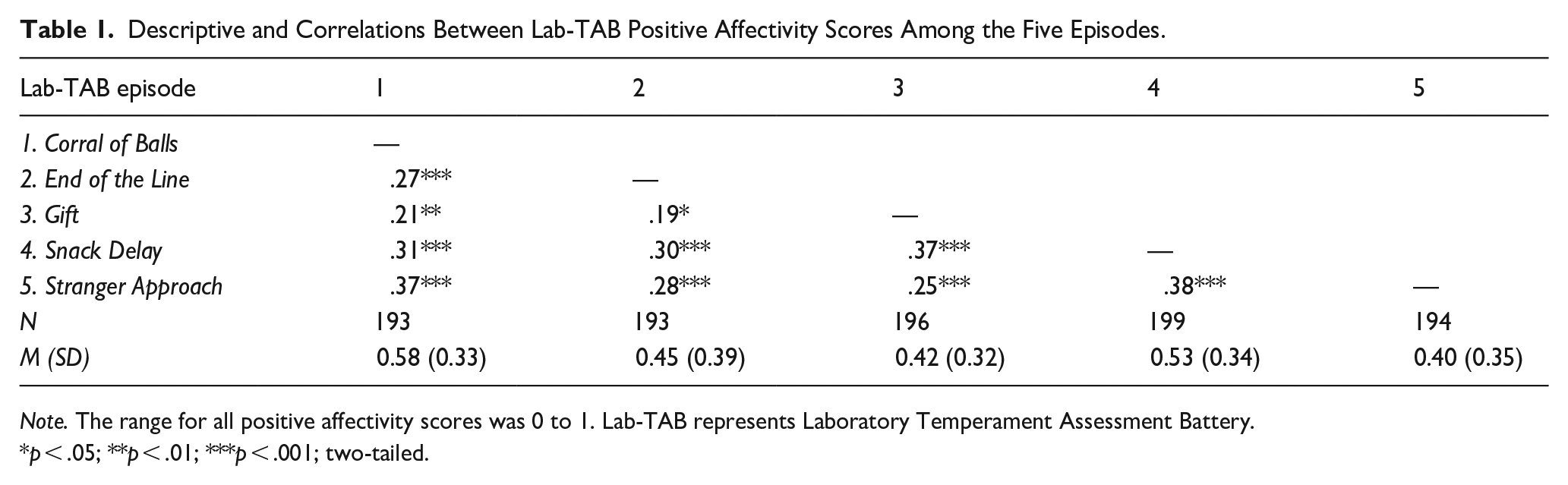
Note. The range for all positive affectivity scores was 0 to 1. Lab-TAB represents Laboratory Temperament Assessment Battery.
p < .05; **p < .01; ***p < .001; two-tailed.
To explore the situational specificity of child PA under different Lab-TAB episodes, we then conducted an analysis comparing mean levels of PA across the five episodes. The analysis yielded significant differences in PA scores among the episodes, F(4, 970) = 9.13, p < .001. Specifically, post hoc comparisons indicated that PA was significantly higher during the Corral of Balls episode compared to the Gift, End of the Line, and Stranger Approach episodes. In addition, participants exhibited significantly more laughter and smiles in the Snack Delay episode than in both the Gift and Stranger Approach episodes.
Prior to performing multilevel regression analysis, we explored bivariate correlations among Lab-TAB PA scores, parent-rated pleasure, and parent-reported internalizing and externalizing symptoms (as presented in Table 2). Results demonstrated distinct relationships between PA scores from different Lab-TAB scenarios and internalizing symptoms. Notably, PA scores from the Gift and Stranger Approach episodes were significantly inversely related to anxiety problems and anxious-depressed symptoms. Similarly, PA in the Snack Delay episode was inversely associated with anxiety problems. On the other hand, higher levels of parent-rated pleasure correlated with lower scores on measures of broadband internalizing and withdrawn symptoms. As for externalizing symptoms, we found no significant correlations with Lab-TAB PA scores. However, parent-rated pleasure was significantly negatively related to several externalizing symptom profiles, including broadband externalizing, aggressive symptoms, and ODD symptoms.
Descriptive and Correlations Between Lab-TAB Positive Affectivity Scores, Parent-Rated Pleasure, and Internalizing and Externalizing Symptoms.
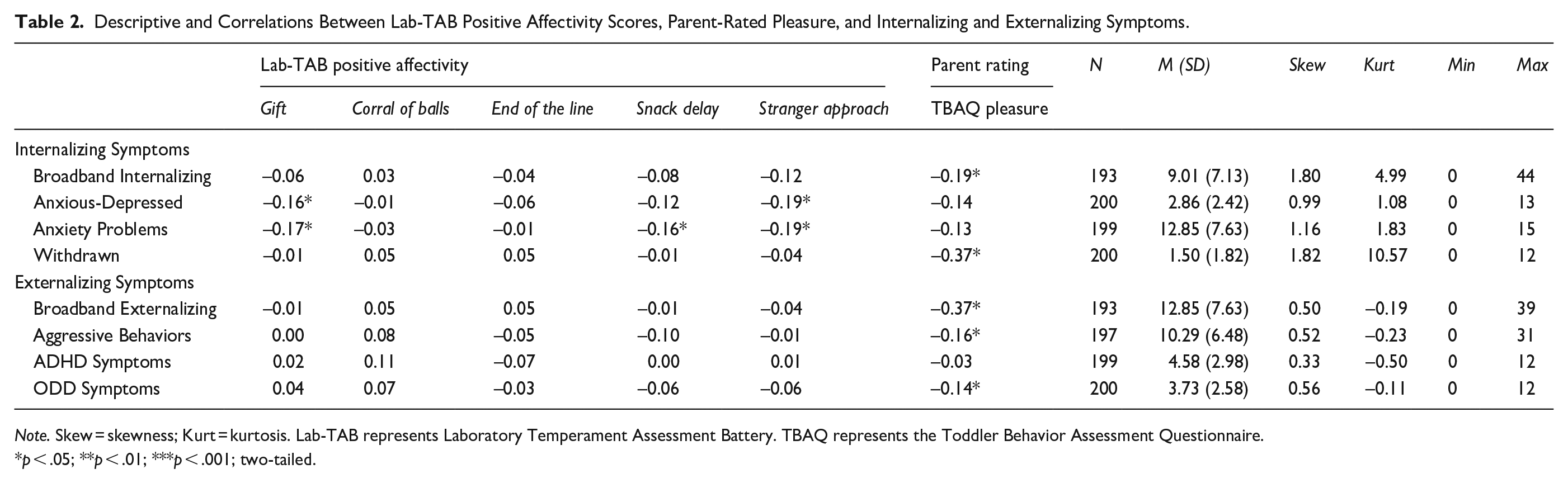
Note. Skew = skewness; Kurt = kurtosis. Lab-TAB represents Laboratory Temperament Assessment Battery. TBAQ represents the Toddler Behavior Assessment Questionnaire.
p < .05; **p < .01; ***p < .001; two-tailed.
As shown in Table 2, CBCL internalizing and externalizing subscale scores exhibited moderate positive skewness and varying levels of kurtosis. Since our sample is population-based, the majority of the participants fell within the normative range. This suggests that while there is variability in symptom subscale scores, the sample predominantly represents a non-clinical population.
Multilevel Regression Analysis
Next, we conducted a series of multilevel regression models, using Lab-TAB PA scores and parent-rated pleasure to predict children’s internalizing and externalizing symptoms. Models were conducted separately for each outcome, with child age accounted for as a control variable.
Lab-TAB PA and Parent-Rated Pleasure: Predicting Internalizing Symptoms
Controlling for child age, significant associations emerged between Lab-TAB PA assessed with the Stranger Approach episode and several internalizing symptom profiles, including broadband internalizing (estimate = −3.46, p = .03), anxious-depressed symptoms (estimate = −1.32, p = .006), and anxiety problems (estimate = −1.31, p = .02). These findings indicate that higher PA expressions during the Stranger Approach episode were linked to lower parent-reported internalizing symptoms. In addition, a negative association was observed between Lab-TAB PA from the Gift episode and parent-rated anxiety problems (estimate = −1.42, p = .03). No significant relationships were found between Lab-TAB PA scores and withdrawn symptoms. However, a negative association was identified between parent-rated pleasure and withdrawn symptom scores, controlling for Lab-TAB PA scores and child age (estimate = −0.97, p = .001). These results are detailed in Table 3.
Multilevel Regression Models Predicting Internalizing Problems Using Lab-TAB Positive Affectivity and Parent-Rated Pleasure.
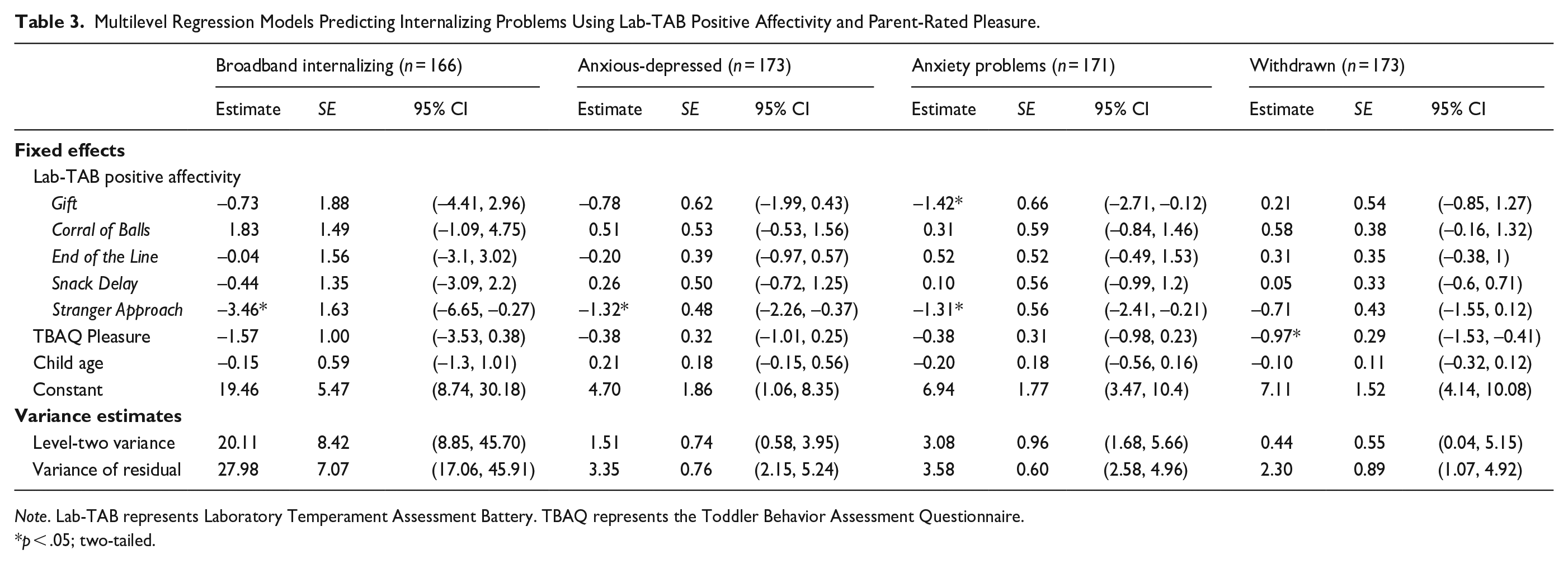
Note. Lab-TAB represents Laboratory Temperament Assessment Battery. TBAQ represents the Toddler Behavior Assessment Questionnaire.
p < .05; two-tailed.
Lab-TAB PA and Parent-Rated Pleasure: Predicting Externalizing Symptoms
Regarding externalizing symptoms, Lab-TAB PA assessed with the Corral of Balls episode was positively associated with three parent-rated externalizing symptoms profiles, including broadband externalizing (estimate = 3.07, p = .03), aggressive behaviors (marginally significant; estimate = 2.12, p = .07), and ADHD symptoms (estimate = 1.55, p = .01). This suggests that children who exhibited greater levels of laughter and smiling during the Corral of Balls episode also had higher levels of externalizing symptoms rated by parents. No other associations were observed between Lab-TAB PA scores and externalizing symptoms. Furthermore, model results indicated significant negative associations between parent-rated pleasure with both broadband externalizing (marginal; estimate = −1.53, p = .06), and ODD symptoms (estimate = −0.58, p < .05). Children who had a lower level of parent-rated pleasure also had fewer externalizing symptoms reported by parents. Child age emerged as a negative predictor for broadband externalizing (estimate = −2.00, p < .001), aggressive behaviors (estimate = −1.30, p = .001), and ADHD symptoms (estimate = −0.94, p < .001), after controlling for other predictors. These relationships are detailed in Table 4.
Multilevel Regression Models Predicting Externalizing Problems Using Lab-TAB Positive Affectivity and Parent-Rated Pleasure.
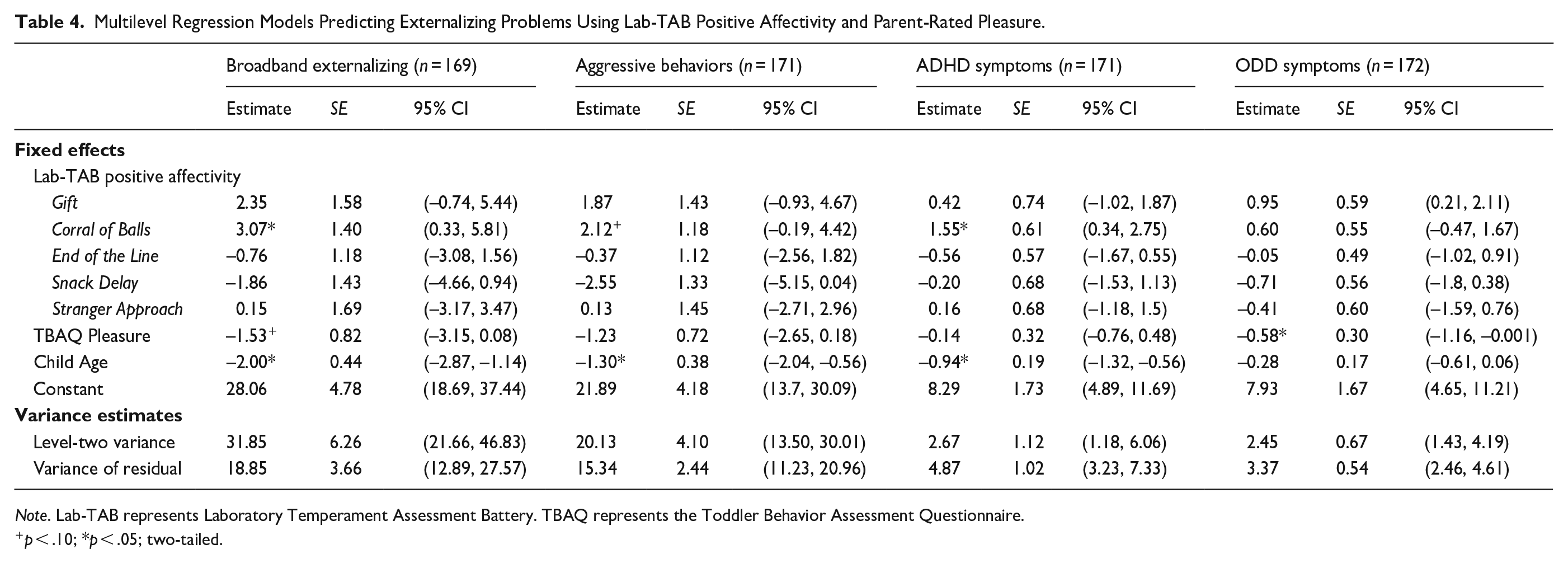
Note. Lab-TAB represents Laboratory Temperament Assessment Battery. TBAQ represents the Toddler Behavior Assessment Questionnaire.
p < .10; *p < .05; two-tailed.
Discussion
Childhood PA has long been recognized as a key aspect of child temperament, playing a crucial role in shaping various developmental outcomes later in life (Stifter et al., 2020). Yet existing findings have typically shown inconsistent patterns with regard to the associations between child PA and behavioral development outcomes. Emerging evidence suggested that such inconsistency in the literature may, partially, be due to the heterogeneous nature of child PA. That is, the results of child PA investigations may depend on the variations of measurement and informants (e.g., Dollar et al., 2022). However, how these nuances contribute to the variances in findings on the associations between child PA and internalizing and externalizing symptoms remains unclear. The primary objective of this study was to investigate how child PA, measured across different social situations, relates to internalizing and externalizing symptom profiles in preschoolers. To capture child PA in various contexts, a multi-method approach was used, incorporating both structured Lab-TAB episodes and parental ratings of pleasure.
Findings from the current study generally supported the heterogeneous nature of child PA as a function of the measurement approach (e.g., scripted Lab-TAB episodes vs. parent ratings). Such heterogeneity also reflects the relationships between child PA and various profiles of internalizing and externalizing symptoms. In the zero-order correlational analysis, negative correlations were revealed between child PA, both in laboratory observations and parent ratings, and profiles of internalizing and externalizing symptoms. This aligns with the notion of the protective role of the high tendency to experience positive emotions against maladjustment (Davis et al., 2015). Interestingly, different patterns occurred in the correlations between PA and outcomes depending on the measurement approach. Parent-rated pleasure was associated with broadband internalizing and withdrawn symptoms, while Lab-TAB PA was related to two anxiety-related profiles-anxiety problems and anxious-depressed symptoms. Specifically, in Lab-TAB episodes, PA measured in Gift, Snack Delay, and Stranger Approach were negatively associated with anxiety-related symptoms. Although Stranger Approach was considered a moderate-threat situation (Dollar & Buss, 2014), the expression of PA in this scenario could also reflect the coexistence of self-regulation of fear. This suggests that children who express more positive emotions under situations where self-regulation is required are less likely to develop anxiety problems, though the magnitude of the correlations was small. In addition, variations were observed in how child PA was associated with externalizing symptoms in the correlational analysis. None of the Lab-TAB PA scores were related to any externalizing symptoms, yet parental-rated pleasure was negatively linked to three types of externalizing problems, including broadband externalizing, aggressive behaviors, and ODD symptoms. These findings align with prior research showing that observational measures of child PA tend to have low agreement with parental reports (e.g., Dougherty et al., 2010), suggesting that Lab-TAB observations and parental questionnaires may capture distinct dimensions of children’s overall PA (Davis et al., 2015).
The associations between child PA and profiles of internalizing symptoms showed similar patterns in the linear mixed models. Children who exhibited more smiling and laughter during the Stranger Approach episode had lower scores in three types of internalizing symptoms, including broadband internalizing, anxious-depressed, and anxiety problems. Parental-rated pleasure was also found to be protective against withdrawn symptoms. Interestingly, more variation occurred in results from mixed models examining the associations between PA and externalizing symptoms. Specifically, child PA in the Corral of Balls episode was revealed to be positively predictive of three types of externalizing symptoms. Considering that the Corral of Balls episode was designed for assessing children’s activity level (Gagne et al., 2011), the expressed PA in this scenario is likely more prone to high-intensity PA that was found to signal low inhibition and more behavioral problems among children (Poole & Schmidt, 2019; Putnam & Stifter, 2005). On the other hand, parent-rated pleasure was negatively correlated with both broadband externalizing and ODD symptoms, consistent with prior findings of high levels of low intense PA being predictive of better self-regulation abilities and less risk-taking behaviors (Dollar et al., 2022). It is likely that parent-reported measures, which often require caregivers to retrospectively rate their children’s behaviors, may capture more subtle, low-intensity expressions of positivity. This may explain the significant emphasis on PA as a protective factor in developmental psychopathology research, especially given the widespread use of parent-report measures (Davis et al., 2015).
Our findings underscore the complexity of child PA, suggesting that it can serve as both a risk factor and a protective factor for internalizing and externalizing symptoms in young children, depending on the context and the informant. The variability in PA reporting across different methods highlights the need for a more nuanced understanding of how PA functions in early development and its implications for both resilience and vulnerability to mental health challenges.
Limitations and Future Studies
There are several limitations that the current study acknowledges. First, due to the design of TEXAS Family Study, our sample was composed of 100 pairs of siblings and their primary caregivers. Although linear mixed models were employed to account for the nested data structure, future research would benefit from a larger and more diverse sample to increase statistical power and enhance the robustness of the conclusions. In addition, our sample primarily consisted of White families with middle to high socioeconomic status, which limits the generalizability of the findings to more diverse populations. Furthermore, a larger and more heterogeneous sample would allow for the exploration of potential interactions between socioeconomic factors, race/ethnicity, and child PA, providing a more comprehensive understanding of how these variables influence developmental outcomes. Second, despite our focus on investigating children’s emotional reactivities for PA, the scripted Lab-TAB episodes used in the current study are not originally designed to capture childhood PA, but for negative emotionality (i.e., anger and fear), inhibitory control, and activity level. This study did not specifically assess child PA using PA-specific Lab-TAB episodes, such as “Puppets,” “Pop-up Clown,” and “Peek-aBoo” games (Gagne et al., 2011). This limitation may have affected the extent to which we were able to fully observe and measure PA across different contexts. Future research on PA should include a wider range of Lab-TAB episodes specifically designed to elicit positive emotions, allowing for a more comprehensive assessment of PA across diverse situations. Third, the reliance of the cross-sectional design in this study inherently reduces the applicability of the findings, making it challenging to determine causal relationships between the observed associations. Future studies should consider adopting longitudinal designs, which would enable researchers to track developmental changes and patterns over time, potentially uncovering how early emotional reactivity influences long-term mental health and behavioral trajectories. Fourth, as a lower-order trait, PA constitutes only a specific facet of the broader construct of surgency. Future research should investigate how different dimensions of surgency, including its behavioral components (e.g., activity level), are captured across various measurement approaches and how these dimensions differentially relate to developmental outcomes. It is worth noting that, given the non-clinical nature of the sample, our findings likely capture variations in behavioral symptoms rather than severe psychopathology. Future research could examine whether these associations hold in clinical populations.
Conclusion
This research adds onto the existing literature by investigating child PA, an understudied aspect in temperament research, under various contexts and measurement approaches. Using a multi-method approach, the current study investigated the associations between child PA, measured by both laboratory observational coding and parental ratings, and multiple indices of both internalizing and externalizing problems in preschool-aged children. The findings support the heterogeneous nature of child PA as a function of both measurement approach and contextual specificity and revealed intriguing specificities in the associations between PA and different profiles of internalizing and externalizing symptoms. Future research should take into consideration the complexity of child PA with regard to the choice of measurement and how it reflects on the impact of PA on later psychosocial development among children. Finally, although much temperament research focuses on laboratory studies with convenience samples rather than community settings, future work would benefit from investigations that incorporate the applied, community and educational implications of child PA.
Footnotes
Acknowledgements
The authors thank all TEXAS Family Study children and families for their participation, and all undergraduate and graduate students, and staff at University of Texas at Arlington and Texas A&M University who contributed to this project.
Data Availability Statement

Declaration of Conflicting Interests
The author(s) declared no potential conflicts of interest with respect to the research, authorship, and/or publication of this article.
Funding
The author(s) disclosed receipt of the following financial support for the research, authorship, and/or publication of this article: This study was supported by University of Texas at Arlington and Texas A&M University. The funders had no role in study design, data collection and analysis, decision to publish, or preparation of the manuscript.
Ethical Considerations
The University of Texas at Arlington and Texas A&M University Institutional Review Boards reviewed and approved all research procedures for this study.
Consent to Participate
Participants (parents) were given consent forms in accordance with the ethical standards of the institutional review board before commencement of questionnaires via SurveyMonkey.