




Abstract
Shyness in childhood and adolescence is associated with problems in social, academic, and psychological adjustment in today’s China. However, the functional meaning of shyness needs to be examined in the developmental context. This 1 year longitudinal study explored the relations between self-reported shyness and indexes of adjustment in Chinese children and adolescents. The participants included 2,308 students in China, with 1,062 initially in the fifth grade (Mage = 11.50 years, 539 boys) in elementary schools and 1,246 initially in the eighth grade (Mage = 14.27 years, 641 boys) in middle schools. Shyness was assessed using a self-report measure, and data on social and school adjustment were obtained from multiple sources. Among the results, shyness was negatively associated with later academic performance and positively associated with later behavioral problems and peer victimization in childhood. For adolescents, whereas shyness was not significantly associated with academic performance or behavioral problems, it contributed to decreased peer victimization. The results indicate the importance of understanding shyness from a developmental perspective.
Shyness refers to the display of vigilant, anxious, and inhibited behaviors in response to social novelty or social-evaluative concerns (Rubin et al., 2009). Unlike other forms of social withdrawal, such as unsociability which represents a non-fearful preference for solitary activities, shyness is believed to arise from an internal approach-avoidance conflict; shy individuals are motivated to interact with peers but simultaneously refrain from doing so due to fear and anxiety (Asendorpf, 1991; Bowker et al., 2022; X. Chen, 2019; Coplan & Armer, 2007). In Western societies, shyness in children and adolescents has been generally found to be a risk factor for maladaptive development including academic disengagement, peer difficulties, and psychological problems (e.g., Baardstu et al., 2020; Coplan et al., 2013; Hughes & Coplan, 2010; Schmidt et al., 2017). Nevertheless, researchers have suggested developmental timing effects on the implications of social withdrawal (e.g., Coplan et al., 2019). As such, the consequences of shyness may vary across childhood and adolescence. The goal of the present study was to examine the relations between shyness and indexes of social-behavioral and school adjustment among Chinese students in two developmental periods.
X. Chen et al. (1992, 1995) found in several studies in the early 1990s that shyness was positively associated with social competence and school achievement in Chinese children. According to the authors, the restrained behaviors that shy children display in social situations have traditionally been viewed as indications of social maturity and accomplishment, which helps shy children obtain social approval and support. Over the past several decades, however, as China changed toward a competitive market-oriented society in which social assertiveness and self-expression are increasingly appreciated (Cai et al., 2020; X. Chen, 2024), shyness in children has become maladaptive and associated with adjustment problems in recent years (X. Chen et al., 2005; Zhang & Eggum-Wilkens, 2018), which was similar to the results based on Western samples (X. Chen, 2019; Liu et al., 2015).
Shyness and Adjustment in Childhood and Adolescence
Whereas shyness is generally associated with negative outcomes such as peer difficulties and indexes of internalizing problems (e.g., Tsui et al., 2017; Zhang & Eggum-Wilkens, 2018; Zhang et al., 2021), researchers have been interested in differences in the association across developmental periods. Schmidt et al. (2017) found that a shyness trajectory increasing from adolescence to adulthood was associated with poorer demographic and social outcomes, whereas shy children who outgrew their shyness were indistinguishable from their non-shy counterparts. Ding et al. (2023) found that although self-reported shyness was positively associated with internalizing problems such as loneliness, depression, and social anxiety and negatively associated with wellbeing, the associations were stronger among adolescents than among children. Liu et al. (2017) found that peer-assessed shyness was positively associated with peer rejection and victimization more strongly in adolescents than in their younger counterparts. Results from meta-epidemiologic studies (e.g., Solmi et al., 2022) denoted adolescence as an important transitional period as many mental disorders tend to have onset when dramatic biological changes in the brain occur, which may further shape the implications of shyness as a child enters adolescence.
Different results have also been found concerning age differences. Tsui et al. (2017) reported no moderating effect of age on the relations between parent-reported shyness and social anxiety. Whereas some self-reported outcomes such as social anxiety and loneliness were found as more severe for shy Chinese adolescents (Ding et al., 2023), no significant age differences were found with behavioral problems and academic achievement (Liu et al., 2017). Thus, further investigation is needed on the implications of shyness in childhood and adolescence for adjustment across different domains.
Theoretically, the relations between shyness and adjustment outcomes in childhood and adolescence may be viewed from different perspectives. On the one hand, as indicated by Coplan et al. (2019), social interactions become more extensive and intensive from childhood to adolescence, and consequently, shyness and associated restrained behaviors in social settings may be associated with increasing adjustment problems. Age-related norms and expectations for a higher level of social engagement make shy adolescents at greater risk than their younger counterparts for social and psychological difficulties. In today’s China, adolescents are highly sensitive to the emergent ideas of assertiveness and self-confidence (X. Chen et al., 2024). As a result, the traditional values of shyness and social wariness in the Chinese society are likely to play a marginalizing role in social interactions from childhood to adolescence.
On the other hand, it has been argued that with the growth of social-cognitive abilities, adolescents are more capable than children of regulating emotions and seeking instrumental support from others to cope with social challenges (Zimmer-Gembeck & Skinner, 2011). As such, shy adolescents may be less vulnerable than their younger counterparts to the adverse experience of anxiety and wariness in social situations and develop fewer social and school problems. Early adolescence marks the highest percentage of people who label themselves as being currently shy (Cheek et al., 1986). It is possible that with the development of social-cognitive abilities, shy adolescents may recognize, understand, and accept the experience of being shy. Moreover, they may gradually learn strategies to avoid or reduce the adverse experience in challenging social settings by directing their attention to the pursuit of personal interests (e.g., playing instruments), engaging in non-social constructive activities (e.g., working on academic tasks), and participating in small group activities with familiar peers (X. Chen et al., 2024). They may also attempt to express their anxious feelings in socially acceptable manner, such as displaying compliant and cooperative behaviors. In addition, as adolescents develop more intimate social relationships with age (Rubin et al., 2015), shy adolescents may receive greater support from their close friends when experiencing stress in social settings, which helps them overcome adjustment problems.
Peer Evaluations and Self-Reports of Shyness
Research has consistently shown that shyness based on peer nominations was only modestly correlated with that reported by children and adolescents themselves (e.g., Ding et al., 2014; Spangler & Gazelle, 2009). Peer evaluations and self-reports may tap into different aspects of shyness, with the former focusing more on external, overt behaviors and the latter focusing more on internal motivations and emotions (Ding et al., 2014). It is possible that the personal feelings of shy children and adolescents do not directly translate to behaviors that are visible to peers at school, resulting in disagreement between results based on assessments using these different methods (Eggum et al., 2022; Zhang & Eggum-Wilkens, 2018). Eggum et al. (2022), for example, found in a sample of US early adolescents that whereas peer-assessed shyness was not significantly correlated with peer disliking and positively correlated with peer victimization, self-reported shyness was negatively correlated with peer disliking and victimization.
Peer evaluations have been used to measure shyness in most studies with Chinese children and adolescents (e.g., X. Chen et al., 2005; Yang et al., 2015), although self-reports have been increasingly used in recent studies (e.g., M. Chen et al., 2021; Coplan et al., 2016; Li et al., 2021). To our knowledge, two of the studies (Ding et al., 2023; Liu et al., 2017) directly compared relations between shyness and adjustment in childhood and adolescence. In Ding et al.’s (2023) study, self-reported shyness was mostly associated with self-reported emotional problem and psychological well-being, such as loneliness, depression, and social anxiety. Liu et al. (2017) found that peer-nominated shyness was associated with social and psychological problems as assessed by peer- and self-reports. In both studies, the associations were more evident in adolescence than in childhood.
Adolescents are highly sensitive to sociocultural signals, particularly emergent standards and values in the society such as those concerning social assertiveness and self-expression in China today. Peer assessments, which are based on social perceptions of individual behavior, tap its social salience that is susceptible to contextual influences (Hartup, 1996). Relative to peer assessments, self-reports more directly capture individuals’ awareness of their own characteristics and associated experiences, which is the basis for self-regulatory processes. These processes may help shy adolescents learn strategies to regulate their behaviors in social situations and engage in constructive activities, which in turn may reduce negative social reactions and adjustment problems in the school context. The present study focused on self-reported shyness and its contributions to social and school outcomes in children and adolescents.
Gender Differences in Shyness and its Relations With Adjustment
Research has shown that boys and girls may not differ on the level of shyness in childhood (e.g., M. Chen et al., 2021). However, adolescent girls tend to self-report being more shy than adolescent boys (e.g., Liu et al., 2018; Murberg, 2009), although the results are not consistent in the literature (e.g., Ding et al., 2014). Moreover, due to gender-stereotypical beliefs and cultural norms such as masculinity, shyness is often viewed as less acceptable and is responded to more negatively by others in boys than in girls (X. Chen, 2019). Thus, shy boys tend to experience more difficulties in adjustment than shy girls (Doey et al., 2014; Rubin et al., 2009).
We examined gender differences in shyness and its relationship with adjustment in this study. We expected that boys would report a lower level of shyness than girls. Moreover, we expected that shyness would be associated with adjustment problems more strongly in boys than in girls, especially in adolescence.
The Present Study: An Overview
Limited research has been conducted on the relations between self-reported shyness and adjustment in Chinese children and adolescents with a focus on age-related developmental differences. Moreover, many studies of the correlates of shyness used a cross-sectional design, which provided little information about causal directions in the relations. In addition, previous research focused mainly on relations between shyness, particularly self-reported shyness, and limited aspects of adjustment, often internalizing problems such as social anxiety (e.g., Ding et al., 2023). To fill the gaps, we conducted the present longitudinal study to examine mutual contributions of self-reported shyness and social, behavioral, and school adjustment in a sample of children and adolescents in China. The study would help us further understand the functional meanings of shyness in the Chinese context across developmental periods through direct comparisons of its relations with adjustment in childhood and adolescence.
According to Ladd et al. (2000), the adjustment of students is concerned with how they adapt to the school environment. In this view, students’ success in school adjustment is indicated by the levels of cooperative classroom participation, following school rules and expectations, positive interaction with others, and performance on academic tasks. Thus, besides academic achievement, it is important to consider students’ competence in fulfilling various other school demands including engaging in social activities, behaving according to school guidelines, and maintaining healthy relationships with peers. To assess these aspects of school adjustment, we collected data on academic performance, social competence, behavioral problems, and peer victimization. The data on shyness and adjustment were obtained from multiple sources, which helped reduce biases from shared method variances.
The present study was conducted in a region, consisting mostly of towns, small cities, and surrounding areas in 2013 and 2014. While falling behind major cities, such as Beijing and Shanghai, in social and economic development, rural and suburban regions have been undergoing considerable social change in which individualistic values from urban regions and Western societies, such as those of autonomy and self-expression, have been increasingly accepted in social interactions (e.g., X. Chen, 2024). In this context, as our main hypotheses, we expected that self-reported shyness would be negatively associated with social and school competence and positively associated with adjustment problems. Moreover, based on the discussion about the expectations of more extensive and intensive social interactions from childhood to adolescence (Coplan et al., 2019) and in keeping with the previous findings (Ding et al., 2023; Liu et al., 2017; Schmidt et al., 2017), we expected that shyness would predict later adjustment variables more strongly in adolescents than in children. As there were relatively limited studies about the predictors of self-reported shyness among Chinese children and adolescents, our analyses of the relations between adjustment variables and later shyness were mainly exploratory in nature.
Method
Participants
Participants included 2,308 students (1,180 boys) who were initially in the fifth and eighth grades in a region, consisting mostly of towns, small cities, and surrounding areas, in east China. In the sample, the fifth-grade students (n = 1,062; 539 boys) came from 19 classes in five elementary schools, and the eighth-grade students (n = 1,246, 641 boys) came from 22 classes in two middle schools. The initial average ages of the participants were 11.50 years (SD = .69) and 14.27 years (SD = .57) for fifth- and eighth- grade students, respectively. From the original sample, 2,045 (88.6%) students participated in the follow-up study 1 year later. Most participants came from families with low to middle socioeconomic backgrounds.
The schools were regular public schools that accepted students from the residential area nearby (i.e., students were not selected based on their academic performance). The core curriculum is identical across schools, and the schools have similar structures and organizations. Switching classes is not allowed. One head teacher is assigned for each class, where he or she often teaches one major course and is responsible for the daily activities of the class. At school, students follow a similar schedule of social and academic activities.
Measures
Shyness
Students’ shyness was assessed using a self-report measure, adapted from the Children’s Shyness Questionnaire (Crozier, 1995). Participants were asked to respond, on a three-point scale (1 = No, 2 = Sometimes, 3 = Yes), to 10 items describing shyness (e.g., “I feel nervous when I join a new group,” ‘‘I feel shy when I have to read aloud in front of the class.’’). The average scores of the items were calculated, with higher scores indicating higher levels of shyness. The measure was used and shown as reliable and valid in previous studies with Chinese students (Ding et al., 2014, 2023). In the present study, the internal reliabilities of the measure were .83 and .85 at Times 1 and 2, respectively.
Academic Achievement
Information on students’ academic performance in Chinese, mathematics, and English was obtained from the school records. Scores (the grades) of the three subjects were based on objective examinations conducted by the school. For each subject, the maximum score was 100, and a score of 60 usually represents the cutoff between a pass and a failure. Chinese, mathematics, and English were the three major subjects in Chinese elementary and middle schools. Scores on the subjects were significantly correlated (rs = .37–.65, ps < .001) in the present study. Consistent with the procedures used in previous studies (e.g., Fu et al., 2020), the subject scores were summed and standardized within the class to form a single index of academic achievement. Academic grades were used and shown to be a valid measure in other studies with Chinese students (X. Chen et al., 2005, 2019).
Teacher Ratings
The head teacher of each class rated each student in the class on academic performance, learning problems, social competence, behavioral problems, and peer victimization based on measures adapted from the Teacher–Child Rating Scale (Hightower et al., 1986). Teachers rated academic performance on a 5-point scale, ranging from 1 (poor) to 5 (excellent) and the items in the other subscales on a five-point scale, ranging from 1 (not at all) to 5 (very well), in terms of how well each item in the measure described the student. The teacher rating scores were standardized within the class to adjust for the teacher’s response style and to allow for appropriate comparisons.
Academic performance and learning problems
The head teacher rated each student’s academic performance on Chinese, mathematics, and English. The six items in the learning problems subscale assessed students’ difficulties in academic performance (e.g., “Having difficulties in learning academic subjects,” “Poorly motivated to achieve”). The measures were used and shown to be valid in previous studies with Chinese students (e.g., X. Chen et al., 2019). The internal reliabilities were .86 and .88 for academic performance at Times 1 and 2, and .83 and .84 for learning problems at Times 1 and 2, respectively.
Social competence
There were 20 items in the social competence subscale (e.g., “Is friendly toward peers,” “Participates in class discussion,” “Copes well with failures”), involving various aspects of school-related social competence such as prosocial behavior, leadership, frustration tolerance, and peer social skills. The average scores of the items were computed, with higher scores indicating higher levels of competence. The measure was used and shown to be reliable and valid in previous studies with Chinese students (X. Chen et al., 2005, 2019). In the present study, the internal reliabilities were .91 and .94 at Times 1 and 2, respectively.
Behavioral problems
There were six items in the behavioral problems subscale (e.g., “Disruptive in class,” “Overly aggressive to peers (fights)”). The measure was used and shown as reliable and valid in previous studies with Chinese students (e.g., Fu et al., 2016). The internal reliabilities were .77 and .79 at Times 1 and 2, respectively.
Peer victimization
There were four items in the peer victimization subscale (e.g., “Other students pick on this student,” “Other students hit or push this student”). The measure was used and shown to be reliable and valid in previous studies with Chinese students (e.g., Fu et al., 2016). The internal reliabilities were .79 and .80 at Times 1 and 2, respectively.
Procedure
We group administered to the whole classroom a self-report measure of shyness during a regular school time. Head teachers were requested to complete the rating scales for the students. Data concerning academic grades on Chinese, mathematics, and English were obtained from school records. The study was approved by the Institutional Review Board at Shanghai Normal University. All students were invited to join the study with no criteria for exclusion. Active written consent was obtained from the participants and their parents through the school. The participation rate at each time was approximately 95%. A group of psychology faculty and graduate students in China administered the measures. During administration, students were provided extensive explanations; no evidence was found that the students had difficulties in understanding the measure. The first wave of the data was collected in 2013, and the followed-up data were collected 1 year later.
Data Analytic Plan
A series of structural equation modeling was used to examine the reciprocal contributions of shyness and adjustment variables, with the concurrent relations and stabilities considered simultaneously. The latent construct of academic performance was formed by academic grades, teacher-rated academic achievement, and teacher-rated learning problems. Constructs of shyness, social competence, behavioral problems, and peer victimization were formed based on the corresponding items.
We first tested measurement invariance for the constructs across time. Then, we conducted multigroup analyses to examine grade differences in models in which shyness and each adjustment variable at both times were included, with gender control. Specifically, we compared the constrained model in which regression paths and latent outcome intercepts were constrained to be equal across grade levels with the unconstrained model in which all parameters were freely estimated. A significant result from the Satorra-Bentler Scaled Chi-Square Difference Test would indicate the presence of between-grade difference. When the grade difference was significant for the overall model, we would then compare the model in which each individual path was constrained with the free model to detect the source of the difference.
We also conducted multigroup analyses to examine gender effects in the models. Specifically, we compared the model in which the interaction between the predictor and grade was constrained as equal across genders with the free model. The analyses were conducted in Mplus Version 8.10 (Muthén & Muthén, 1998–2012). Maximum likelihood estimation with robust standard errors (MLR) was used to adjust for potential non-normality of variables with large sample sizes.
Results
Descriptive Data
The Little’s (1988) MCAR test showed that the data were missing completely at random at each time (χ2(113) = 130.746, p = .121 at Time 1, and χ2(111) = 106.628, p = .600 at Time 2). As suggested by other researchers (e.g., Graham, 2009), we applied the full information maximum likelihood (FIML) estimation to handle missing data. Classroom-level intraclass correlations were small (0 to .07) for the variables, indicating no clustering effects of the classroom in the present study.
Results of repeated measures multivariate analysis of variances (MANOVA) indicated significant main effects of gender and grade on the variables, Wilks’ λ = .77 and .91, F(14, 527) = 11.44 and F(14, 527) = 3.63, p < .001, η2 = .23 and .09. Follow-up univariate analyses showed that at both times, girls had higher scores on academic grades, academic performance, and social competence and lower scores on learning problems and behavioral problems than boys. In addition, girls had higher scores on T2 shyness and lower scores on T1 peer victimization than boys. As for grade differences, eighth-grade students had higher scores on shyness than fifth-grade students at both times. Tables 1 and 2 present the means and standard deviations for boys and girls across the grades and the correlations among the variables.
Means and Standard Deviations of Variables for Boys and Girls in Elementary and Middle School Students.
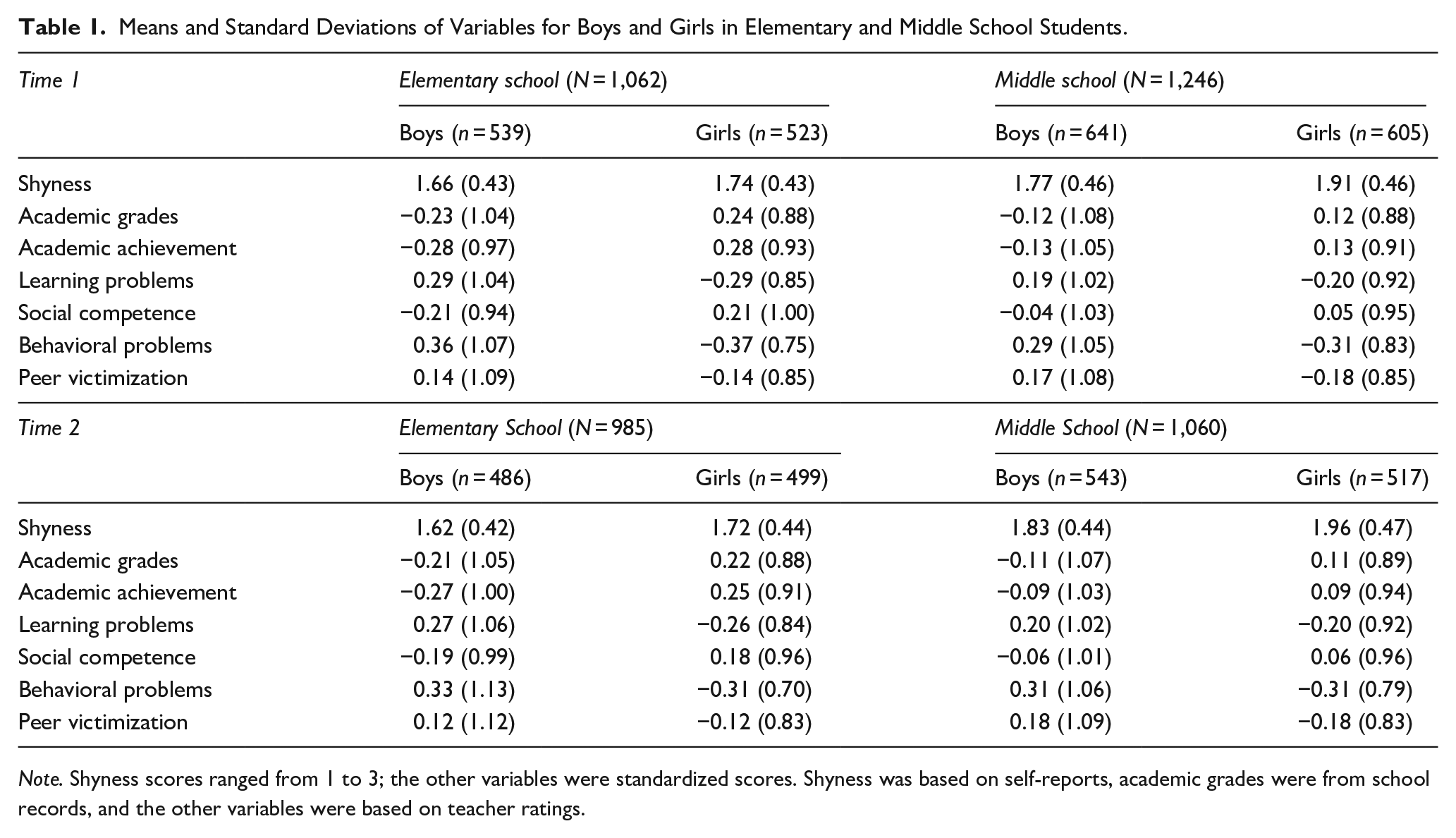
Note. Shyness scores ranged from 1 to 3; the other variables were standardized scores. Shyness was based on self-reports, academic grades were from school records, and the other variables were based on teacher ratings.
Correlations Among Study Variables for Elementary and Middle School Students.
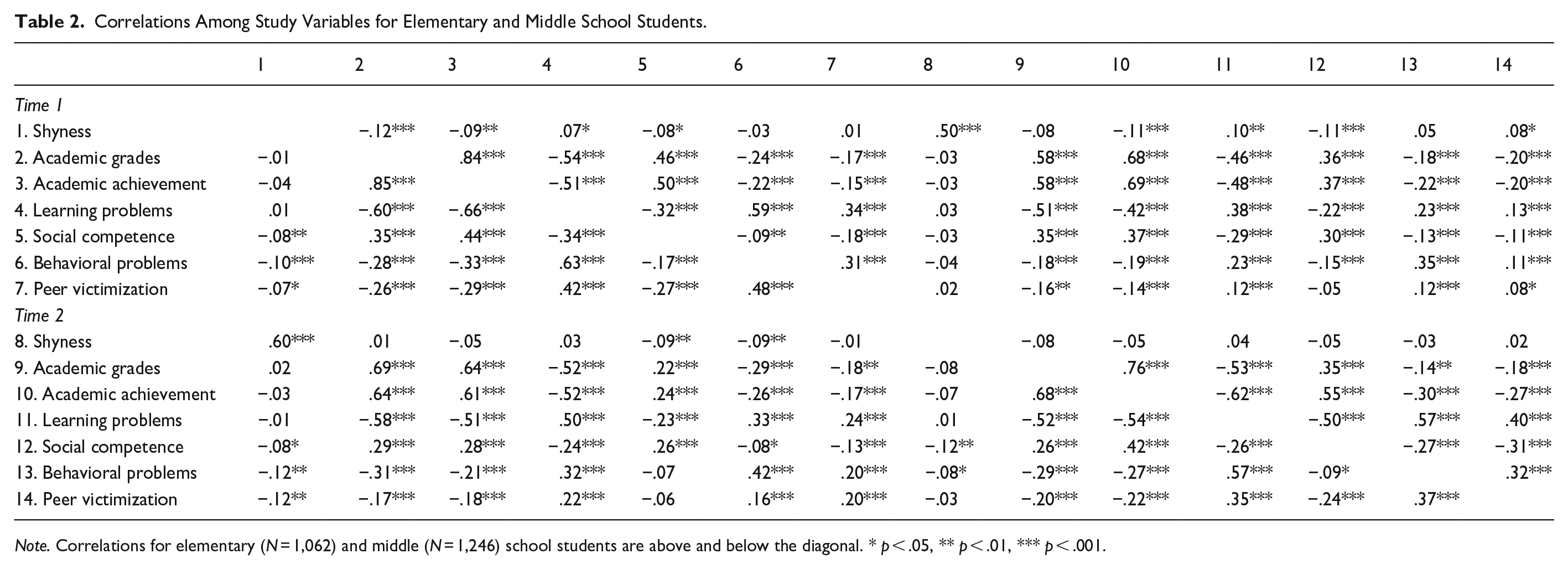
Note. Correlations for elementary (N = 1,062) and middle (N = 1,246) school students are above and below the diagonal. * p < .05, ** p < .01, *** p < .001.
As suggested by other researchers (e.g., Cheung, 2008), a series of longitudinal measurement invariance tests was conducted for shyness and the other latent constructs. The analyses compared an unconstrained configural model, in which factor loadings were freely estimated across times, with the metric model, in which the factor loadings were constrained to be equal across times. Following the instructions in F. F. Chen (2007), we used changes in fit indexes, including CFIs (ΔCFI ⩾ −.010), RMSEAs (ΔRMSEA ⩾ .015), and SRMRs (ΔSRMR ⩾ .030), as the criteria. The results of the invariance tests indicated support for full metric invariances across times for all constructs, which allowed for further longitudinal analysis. We also conducted measurement invariance tests across grade levels and gender for the latent constructs. The results indicated support for full metric measurement equivalence.
Longitudinal Relations Between Shyness and Adjustment
The fit of the overall models was acceptable for shyness and the adjustment variables, including academic performance [χ2(688) = 2,241.255, p < .001, χ2/df = 3.26, CFI = .904, TLI = .902, RMSEA = .044], social competence [χ2(797) = 2,475.757, p < .001, χ2/df = 3.11, CFI = .902, TLI = .900, RMSEA = .043], behavioral problems [χ2(1,037) = 2,650.995, p < .001, χ2/df = 2.56, CFI = .902, TLI = .900, RMSEA = .037], and peer victimization [χ2(796) = 2,126.257, p < .001, χ2/df = 2.67, CFI = .903, TLI = .902, RMSEA = .038]. We compared models with paths constrained to be equal across grades with the unconstrained models. The results showed significant differences between elementary and middle school students on all the overall models, Δχ2(6) = 39.76 to 47.76, ps < .001. Further analyses indicated significant grade differences on paths of T1 shyness to T2 academic performance, T2 behavioral problems, and T2 peer victimization, Δχ2(1) = 4.89, 9.78, and 14.37, p < .05, .001, and .001, respectively. No other significant grade differences were found. The results concerning cross-lagged paths for elementary and middle school students are presented in Table 3. Separate coefficients for elementary and middle school students are presented in Figure 1 when significant grade differences were found in multigroup analysis.
Path Coefficients in Cross-Lagged Models Between Self-Reported Shyness and School Performance Variables.
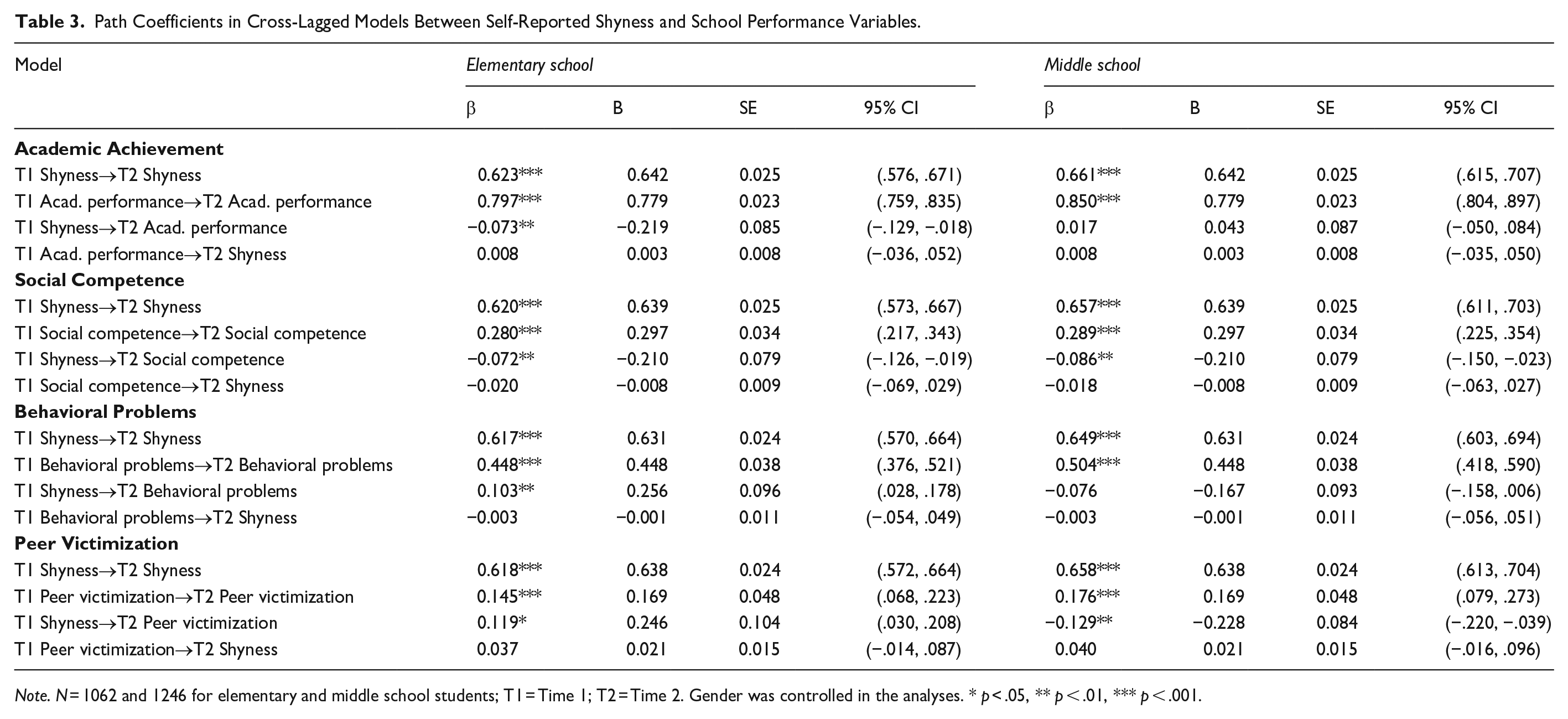
Note. N = 1062 and 1246 for elementary and middle school students; T1 = Time 1; T2 = Time 2. Gender was controlled in the analyses. * p < .05, ** p < .01, *** p < .001.
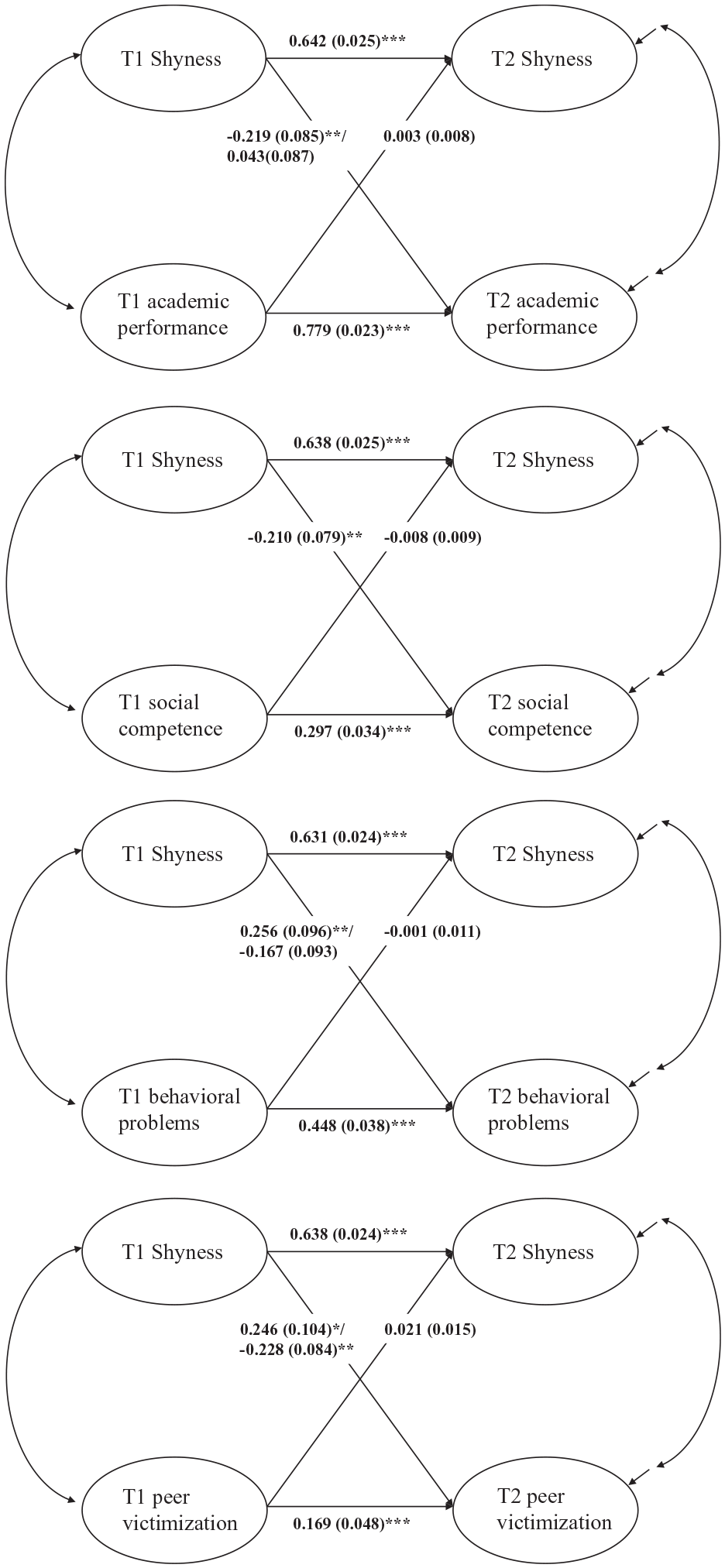
T1 = Time 1; T2 = Time 2. Unstandardized coefficients and standard errors (in brackets) for relations between shyness and adjustment. For paths with significant grade differences, the upper and lower coefficients are for elementary (N = 1,062) and middle (N = 1,246) school students, respectively.
The results showed that for elementary students, T1 shyness was negatively associated with T2 academic performance and social competence and positively associated with T2 behavioral problems and peer victimization. For middle school students, T1 shyness was negatively associated with T2 social competence and peer victimization. T1 shyness did not significantly predict T2 academic performance or behavioral problems. T1 adjustment variables did not significantly predict T2 shyness in elementary or middle school students.
We also tested gender differences using multigroup analysis by comparing unconstrained models and models with paths constrained to be equal across gender. There were no significant gender differences in the relations, suggesting that the relations were consistent for boys and girls.
Discussion
It has long been argued that the nature and significance of individual characteristics, such as shyness, need to be understood and investigated in developmental contexts (Coplan et al., 2019). Childhood and adolescence represent two important developmental periods for the growth of social-cognitive abilities and the establishment of supportive social relationships, which likely play a role in shaping the adjustment outcomes of shyness. This argument was supported by the different patterns of the relations between shyness and later social and school adjustment among Chinese children and adolescents in this study. Specifically, for elementary school students, shyness negatively predicted later academic and social competence and positively predicted later behavioral problems and peer victimization. For middle school students, shyness negatively predicted later social competence. However, shyness did not significantly predict academic performance or behavioral problems. Moreover, it negatively predicted later peer victimization. The study added to the literature on the adjustment of shy children and adolescents and provided valuable information about the functional meaning of self-reported shyness from a developmental perspective.
Relations Between Self-Reported Shyness and Adjustment in Children and Adolescents
The results showed that self-reported shyness significantly predicted the indexes of adjustment 1 year later, but the patterns of the predictive relations differed among elementary and middle school students. Shyness contributed to later maladaptive outcomes among elementary school students. The results were consistent with previous findings that self-reported shyness was associated with socioemotional difficulties in Chinese children (Ding et al., 2014). Due to the massive social change, the adaptive value of shyness has declined in the past decades in China as it does not fit with the new norms of self-confidence and expression required for achieving success in the competitive environment (Cai et al., 2020; X. Chen, 2018, 2023). Whereas Ding et al.’s (2023) study showed positive associations between self-reported shyness and negative emotions and feelings, such as anxiety and loneliness based on self-reports, the present study indicated pervasive negative effects of self-reported shyness on later adjustment across social, behavioral, and academic domains.
Our study showed that self-reported shyness positively predicted later behavioral problems in elementary school students, which was somewhat unexpected. The positive link between shyness and behavioral problems was also found in studies such as Kopala-Sibley and Klein (2017) with American boys and in meta-analysis such as Zhang et al. (2021) with Chinese children. It has been suggested that shyness may be a risk factor for externalizing problems, especially in childhood, because shy children may use ineffective methods of coping, including aggression, in response to stressful social situations (Ding et al., 2014). It is important to note that different findings were reported in other studies showing negative associations between shyness and aggression (e.g., X. Chen et al., 2015; Eggum et al., 2012, 2022), which supported the argument about the protective role of shyness against the development of externalizing problems in childhood (MacGowan & Schmidt, 2024). Therefore, the issue needs to be investigated further in future research. It should also be noted that, the positive link between shyness and behavioral problems may contribute, in part, to the positive association between shyness and peer victimization in elementary school students, given the social difficulties, such as peer exclusion and victimization, that children with behavioral problems often experience (e.g., Rubin et al., 2015).
Self-reported shyness predicted mixed outcomes in middle school students. Similar to the results in elementary school students, shyness negatively predicted social competence, suggesting that social anxiety, fear of negative evaluation, and lack of self-confidence of shy children and adolescents in social settings may have inherent adverse effects on the development of social skills and the display of competent behavior in interaction with others (Coplan & Armer, 2007; Rubin et al., 2009). However, shyness was not associated with later academic performance or behavioral problems, and more importantly, it negatively predicted later peer victimization in adolescents, which was inconsistent with our hypothesis. The results indicate that, unlike shy children, shy adolescents may not lack the social-cognitive abilities to complete academic tasks and regulate their behavior in social interactions. Interestingly, although shyness in adolescence predicted lower social competence, it contributed to reduced negative peer experiences. The results were partly in line with those of Eggum et al. (2022) that self-reported shy students had low peer liking and, at the same time, low disliking and victimization. The results seem to suggest that shy adolescents might learn strategies to handle challenges in social situations and become less likely to be victimized by peers. From a different perspective, Eggum et al. (2022) argued that although adolescents do not approve shy behavior, they may not perceive it as so aversive that it elicits mistreatment by others. Adolescents may understand shy classmates’ internal experience of anxiety and distress in challenging social situations and have sympathy for them. Regardless of the specific processes, the results of our study indicated that self-reported shyness in adolescents was not associated with later problems, particularly negative peer experiences, as evidently as in children, providing a new perspective on the age-related implications of shyness.
For practical implications, the results indicate the necessity to support shy children and youth, and more importantly, in an age-appropriate manner. Middle school students reported a higher level of shyness than elementary school students, which was similar to findings in previous studies with Chinese students (Ding et al., 2014, 2023). However, self-reported shyness was more strongly associated with later adjustment problems in multiple domains in childhood. Thus, parents, teachers, and professionals should be aware of different effects of shyness in childhood and adolescence and use different strategies to support shy children and adolescents. For example, displaying shyness in adolescents may be less of a concern given its relatively weaker or no associations with adjustment problems. It may be a useful strategy to help shy adolescents engage in constructive activities, such as concentrating on academic tasks and pursuing personal interests, and develop self-confidence when engaging in social interactions. More attention should be paid to adjustment problems of shy children. It is important to help these children to improve social skills and develop confidence in peer interaction and to provide support for them to cope with challenges in social settings (Liu et al., 2019; Zhang et al., 2021).
For students in both elementary and middle schools, the adjustment variables did not significantly predict changes in self-reported shyness. The results were consistent with the literature indicating that shyness, as a personal characteristic that is dispositionally rooted, tends to be established in the early years and resistant to the influence of other factors during development (Rubin et al., 2009).
Gender Differences
In the present study, girls were found to have higher scores on academic performance and social competence and lower scores on learning and behavioral problems and peer victimization than boys. Similar results were reported in previous studies with Chinese students (e.g., X. Chen et al., 2019; Fu et al., 2016). In addition, girls reported higher levels of shyness than boys, which was also consistent with previous results (Ding et al., 2023). The gender difference in shyness may be related to stereotypical norms and beliefs in Chinese society that shyness is less acceptable in boys than in girls (X. Chen, 2019), which may lead to greater effort by boys to control their shy behavior.
We were interested in whether the relations between shyness and adjustment differed in boys and girls. Results of multigroup analysis indicated no significant gender effects, suggesting that the relations were consistent across gender. Thus, shyness appears to be associated with adjustment in a similar manner for boys and girls. The similar relations seem to suggest that gender-related factors, such as gender stereotypes, may not play a major role in affecting the significance of shyness for students’ performance and adjustment. Nevertheless, given the social nature of shyness in children and adolescents (X. Chen, 2018), this issue should be further examined in future research.
Limitations and Future Directions
There are several limitations in the present study. First, based on the literature (e.g., Rubin et al., 2009; Zimmer-Gembeck & Skinner, 2011), we discussed the contributions of shyness in terms of social-cognitive and social-interactional processes, such as self-regulation and social support. However, these processes were not examined in the study. For example, the results showed that shyness predicted adjustment problems less evidently in adolescence than in childhood. Researchers should investigate how shy adolescents learn and use strategies to cope with stressful social experiences in challenging social situations. Relatedly, shyness may contribute to adjustment in broader contexts (e.g., Rubin et al., 2009). It will be important to study how social contexts, such as school or classroom norms regarding shyness, peer groups of shy students, and teacher support for shy students, moderate the relations between self-reported shyness and social, behavioral, and academic outcomes.
Second, the present study focused on social-behavioral functioning and school performance as indexes of adjustment. We did not include children’s and adolescents’ psychological functioning, such as social anxiety and depression, partly due to the consideration of potential assessment biases (e.g., shared method variance among self-report measures). Adolescence is a developmental period in which individuals are particularly vulnerable to social anxiety and other negative emotional experiences (Solmi et al., 2022). Future research should examine internalizing psychological problems and their relations with shyness and their mediating effects on relations between shyness and social and school adjustment in children and adolescents.
Third, peer victimization was measured using teacher-reports in this study. Researchers should consider in future studies using other methods, such as peer nominations and self-reports, to assess children’s and adolescents’ experiences in peer contexts.
Fourth, we collected two waves of data and conducted cross-lagged analysis to examine the longitudinal contributions of shyness and school performance. An alternative design is to collect multiple waves of data and apply the random intercept cross-lagged panel model (RI-CLPM) to differentiate temporal within-person effects from time-invariant between-person effects (e.g., Hamaker et al., 2015). This approach may help us gain a better understanding of the mechanisms in the longitudinal associations from a within-person perspective.
Finally, the present study was conducted in a region consisting mostly of towns, small cities, and surrounding areas in South China in 2013 and 2014. As indicated earlier, although falling behind major cities, rural and suburban regions of China have experienced considerable social, economic, and cultural changes over the past decades, which may have implications for the development of shyness. Thus, the study needs to be replicated with children and adolescents in these regions in more recent years. Moreover, considerable regional differences exist in China in social and economic conditions. Thus, one needs to be careful in generalizing the results to other regions, such as larger cities (e.g., Beijing and Shanghai) where Western values are more accepted or more remote rural areas where traditional values are more maintained.
