




Abstract
The quadripartite violence typology categorizes aggression into rage, revenge, reward, and recreational aggression. Furthermore, the general aggression model highlights the interaction between personal and contextual factors in shaping aggressive behavior. Whereas the four types of aggression are considered as personal factors, a contextual distinction can be made between offline and online contexts. To date, only the Cyber-Aggression Typology Questionnaire (CATQ) and its offline counterpart, the Face-to-Face Aggression Typology Questionnaire (FATQ), operationalize each aggression type specifically for offline and online settings. However, this questionnaire set presents limitations in its applicability due to its item count and exclusive validation in university students. In this two-study article, we developed and validated short versions (CATQ-S/FATQ-S) utilizing Graf et al.’s original dataset (N = 587 university students, Study 1) and revalidated them in a new sample of secondary school students (N = 1,064, Study 2). In Study 1, structural validity of the CATQ-S/FATQ-S could be confirmed. All scales of the CATQ-S showed acceptable to good reliabilities. Whereas the revenge and recreational aggression scales of the FATQ-S showed acceptable to good reliabilities, the reliabilities of its rage and reward scales were slightly below the threshold of .70. All short scales showed substantial correlations with their corresponding full scales. Similar correlational patterns for the short and full scales with external criteria could be found. In Study 2, structural validity of the CATQ-S/FATQ-S could be confirmed. All scales of the CATQ-S/FATQ-S showed acceptable to good reliabilities and criterion validity was largely observed. This research supports the four-factor model of aggression in both offline and online contexts and provides a practical instrument designed for the efficient measurement of four-factor aggression in secondary schools.
Introduction
Bullying is known as a subtype of aggressive behavior (Smith, 2004). Hence, studies on individuals’ motives to bully others often draw on classic aggression theories, focusing on proactive and reactive aggression (e.g., Raine et al., 2006). However, this dichotomy has recently been criticized and extended to include two additional motives: revenge and recreational aggression (Graf et al., 2020, 2022; Runions et al., 2017, 2018). According to the general aggression model, not only personal characteristics, such as aggression, but also their interaction with contextual factors, such as characteristics of offline and online contexts, contributes to the understanding of bullying behavior (Anderson & Bushman, 2002). With the growing significance of online communication in adolescents’ lives, understanding how the characteristics of offline and online contexts influence the motives behind bullying is essential for researchers and practitioners aiming to reduce harm in both settings. However, research on differential motives for offline and cyberbullying is still scarce. One reason for this research gap is the lack of practical instruments. Currently, only the Cyber-Aggression Typology Questionnaire (CATQ) and its counterpart the Face-to-Face Aggression Typology Questionnaire (FATQ) address aggression beyond the reactive–proactive dichotomy (Graf et al., 2020; Runions et al., 2017), while taking the context (offline/online) into account. Nevertheless, their applicability is constrained by their item count and validation sample consisting exclusively of university students. This research aims to develop and validate shorter versions (CATQ-S/FATQ-S) utilizing Graf et al.’s (2020) original dataset (Study 1) and validate them in a new sample of secondary school students, enhancing their applicability in school settings (Study 2).
Beyond the Reactive–Proactive Dichotomy: Four Types of Aggression
Traditional research on bullying motives often distinguishes between reactive and proactive aggression (e.g., Raine et al., 2006). According to frustration-anger theory, reactive aggression involves impulsive behavior driven by negative emotions like anger and humiliation (Berkowitz, 1993). In contrast, proactive aggression, as proposed by social learning theory (Bandura, 1978), is characterized as calculated aggression aimed at personal gains such as social status (e.g., Roland & Idsøe, 2001). Although this traditional perspective provides a simple explanation for aggression (e.g., Jung et al., 2017), it is suggested that the functions of aggressive behavior should be considered in a more nuanced way (Dane et al., 2022). One restriction of the traditional view is its conflation of affective valence and self-control (Howard, 2011). That is, reactive aggressive behavior is seen as consistently instigated by frustration and enacted impulsively, resembling expressions of rage, whereas proactive aggressive behavior is seen as consistently motivated by the pursuit of rewards and executed with deliberate control (Graf et al., 2020, 2022; Howard, 2011; Runions et al., 2017, 2018). The quadripartite violence typology (QVT, Howard, 2011) addresses this constraint by integrating affective valence and self-control as distinct orthogonal dimensions. Within this framework, two additional types of motives can be considered: Aggressive behavior may arise from frustration yet be executed in a controlled manner, resembling actions of revenge, and be motivated by reward-seeking tendencies but carried out impulsively for recreational purposes (i.e., to seek thrill and fun, Graf et al., 2020, 2022; Howard, 2011; Runions et al., 2017, 2018). Taken together, the QVT takes into account rage, reward, revenge, and recreation (thrill/fun) as motives for aggressive behavior. For a visual representation of the QVT and the four types of aggression, see Figure 1.
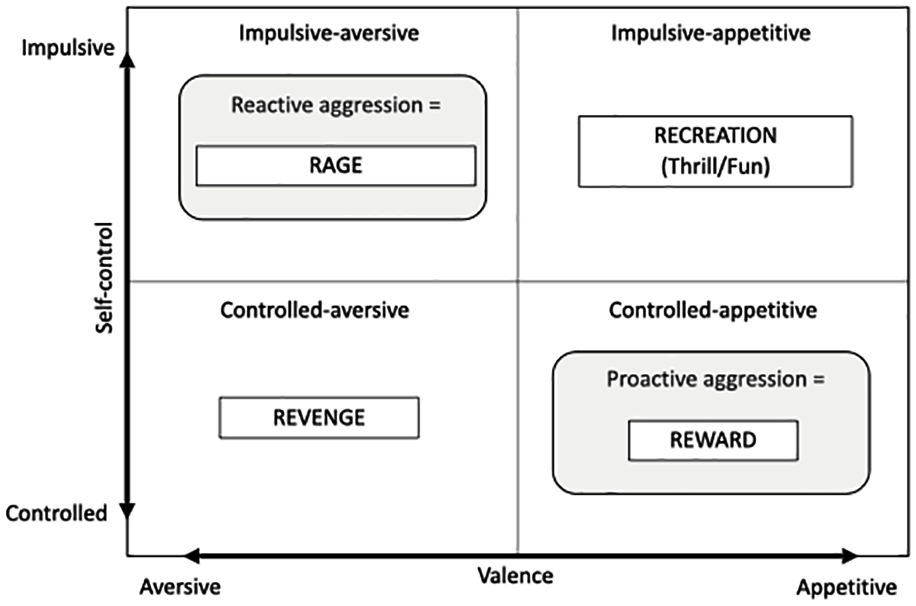
Visual Representation of the QVT and the Four Types of Aggression.
Offline versus Online Communication
Debated distinctions between offline and online communication include anonymity, the presence of semantic, nonverbal, and emotional cues, the presence of authorities, audience size, and the immediacy of reactions (e.g., Graf et al., 2019; Runions, 2013; Runions & Bak, 2015; Suler, 2004). Perceived differences in these characteristics may interact with individual traits and influence whether and how drivers of bullying lead to bullying behavior (e.g., Graf et al., 2019, 2022). For instance, perceived higher anonymity, fewer authorities, reduced cues, and delayed responses from communication partners might systematically influence social information processing in online interactions (Runions, 2013; Walther, 2015). This mode-specific processing of affective and cognitive content might lead to online disinhibition and more extreme behavior than in offline communication (Suler, 2004). In addition, the interpersonal alienation inherent in online communication may reduce moral self-sanctions like remorse and guilt, potentially weakening the development of moral standards in relation to cyberbullying (e.g., Pornari & Wood, 2010; Runions, 2013). Consequently, this may facilitate aggressive behavior for recreational purposes, such as seeking thrill and fun. In offline settings, recreational aggression is typically associated with sadistic and dependent personality disorders (Howard, 2011), suggesting a lesser role for this motivation type in offline bullying. However, due to the unique characteristics of online communication and their impact on social information processing, this form of aggression might play a more significant role in cyberbullying (Graf et al., 2022).
Indeed, several findings indicate that individual motivational factors are differentially associated with offline and cyberbullying. For example, Graf and colleagues (2019) found that sensation seeking, a reward-related construct closely linked to impulsivity, was more strongly associated with cyberbullying than offline bullying. Moreover, perpetrators were more likely to report thrill or fun as a motive for cyberbullying compared to offline bullying (Graf et al., 2022). In sum, understanding how the characteristics of offline and online contexts interact with personal traits like aggression can reveal important similarities and differences between offline and cyberbullying. Certain types of aggression may be more relevant online due to the distinctive features of digital communication, underscoring the need for a nuanced examination of bullying motives across different contexts.
Measures of Rage, Revenge, Reward, and Recreation
Based on the QVT, Bjørnebekk and Howard (2012) first developed and validated the 20-item Angry Aggression Scales (AAS) with samples of adolescents with and without behavioral problems. They confirmed the proposed four-factor structure and demonstrated convergent and discriminant validity. Adolescents with conduct problems showed consistently higher scores for all four types of aggression compared to adolescents without conduct problems. However, the communication mode (offline vs online) with which aggressive behavior can be conducted was not taken into account. Runions et al. (2017) recognized this gap and developed the CATQ, which is specifically tailored to the cyber context. They adapted items from the AAS and introduced new ones and validated the 29-item CATQ with a sample of 314 university students. Their results confirmed the proposed four-factor structure and partially supported convergent validity (Runions et al., 2017).
With the aim to develop a tool to measure four-factor aggression in offline and online communication simultaneously, Graf et al. (2020) developed the CATQ/FATQ based on a sample of 587 university students. The authors adapted the CATQ to the offline context and named this face-to-face version FATQ. Based on standardized factor loadings, modification indices, and theoretical considerations, items that were not transferable from the online to the offline context were removed from the FATQ. To obtain two parallel versions, these items were also removed from the CATQ resulting in a questionnaire set consisting of 24 items per communication mode (offline vs online). The authors could demonstrate the four-factor structure of each questionnaire, metric measurement invariance between the modified version of the CATQ and the FATQ, and largely convergent validity (see Graf et al., 2020). Developing symmetric questionnaires to measure four-factor aggression in offline and online contexts enabled researchers to compare the drivers of aggressive behavior across communication modes. However, while bullying is primarily studied in schools (e.g., Smith, 2004), the CATQ/FATQ questionnaires have only been validated in university settings. In addition, a shorter version of the 48-item CATQ/FATQ could save important resources in busy school environments.
The Present Research
In Study 1, we aimed to develop a short version of the CATQ/FATQ (CATQ-S/FATQ-S) and evaluate its psychometric properties using the original validation data (Graf et al., 2020). We aimed to confirm the four-factor structure of the CATQ-S and FATQ-S questionnaires (Hypothesis 1) and expected them to meet three criteria: reliable measurement of all constructs (Hypothesis 2), reproduction of the original version’s information (Hypothesis 3), and embeddedness within the same nomological network as the long version (Hypothesis 4, Gogol et al., 2014).
In Study 2, we aimed to validate the CATQ-S/FATQ-S in a sample with secondary school students. We expected to confirm the four-factor structure (Hypothesis 5), achieve satisfactory reliabilities (Hypothesis 6), and find meaningful correlations with external criteria: Given that bullying is a subtype of aggressive behavior (Smith, 2004), we anticipated positive associations between all aggression types and both offline and cyber perpetration (Hypothesis 7a). Furthermore, social information processing theory (Dodge & Crick, 1990) suggests that individuals with high aggression perceive social information in ways that increase aggressive behavior; hence, we hypothesized that all types of aggression would be negatively associated with perceived injunctive norms (Hypothesis 7b). According to the compensatory internet use model (Kardefelt-Winther, 2014), which posits that negative experiences lead individuals to excessive online activity, we hypothesized that rage and revenge (i.e., aversive aggression) would relate positively to social media addiction (Hypothesis 7c). According to uses and gratification theory (Katz et al., 1973), which has been applied to study the link between appetitive aggression and social media addiction (e.g., Wong et al., 2022), we expected reward and recreational aggression (thrill/fun, i.e., appetitive aggression) to be positively associated with social media addiction (Hypothesis 7d).
Study 1
Methods
Participants and Procedure
In Study 1, we reanalyzed data described by Graf et al. (2020). According to national guidelines, ethics approval was not required for this retrospective data analysis of anonymized, non-interventional data. In total, 587 university students (63.7% female, Mage = 21.85 years, SD = 4.18) from six Austrian universities answered questionnaires via smartphones. Participation was voluntary and participants provided informed consent. Data collection took place during regular class hours. A trained research assistant was present at all times. During the data collection, the CATQ and FATQ were administered in a counterbalanced order, with items within each questionnaire presented in a randomized sequence. These procedures were implemented to reduce systematic measurement error related to item order.
Measures
CATQ/FATQ: For each communication mode (offline/online), rage, revenge, reward, and recreational aggression were assessed. On a four-point response scale (1 = not at all true of me; 4 = very true of me), participants had to assess the extent to which selected statements applied to them. The cyber-related items were introduced after stating, “The statements below are related to your behavior in cyberspace (e.g., communication on the internet: (group)chats, social media, forums, blogs),” while the face-to-face items were introduced after stating, “The following statements are exclusively related to your behavior in direct, personal contact (‘face-to-face’).” Table S2 (supplemental material) shows the reliability coefficients (ω) of each subscale. Confirmatory factor analysis (CFA) showed satisfactory results (see Graf et al., 2020 for details).
Selection of CATQ-S and FATQ-S Items: Based on standardized factor loadings, face validity, and conceptual considerations (e.g., comprehensibility for adolescents), a committee of academic psychologists selected four items per aggression type and communication mode to construct the CATQ-S/FATQ-S. The factor loadings of all items selected were above 0.5 and can be considered good (Hair et al., 2014). The original and selected CATQ-S/FATQ-S items can be found in the supplemental material (Table S3).
Correlation with Criteria: To test whether the CATQ-S/FATQ-S is embedded in the same nomological framework as the CATQ/FATQ, criterion validity was assessed in relation to constructs used in the original validation study. Specifically, the dichotomous conceptualization of reactive and proactive aggression was measured via the Reactive–Proactive Aggression Questionnaire (Raine et al., 2006) and behavioral inhibition (anxiety and frustration) and behavioral activation (drive and gratification) sensitivity was measured via the short-form of the Action Regulation Emotion Systems Questionnaire (ARES-K, Hartig & Moosbrugger, 2003). For details, see Graf et al. (2020).
Analytic Strategy
A series of CFAs based on factor models with ordered categorical indicators (see Bovaird & Koziol, 2012) using the robust weighted least squares (WLSMV) estimator was conducted to investigate the structural validity of the CATQ-S and FATQ-S. The measurement models were evaluated using the fit indices CFI, TLI, RMSEA, and SRMR based on common cut-off criteria (see West et al., 2023). To evaluate the psychometric quality of the CATQ-S and FATQ-S, the short forms were systematically compared with their corresponding long forms based on the following criteria (see Gogol et al., 2014): (1) reliability, (2) information reproduction, and (3) relation in nomological network. More specifically, the categorical omega reliability coefficient (Green & Yang, 2009) was computed for each subscale of the CATQ/FATQ and CATQ-S/FATQ-S. The amount of reproduced information was investigated by computing the product-moment correlation coefficients between the scores obtained from the CATQ/FATQ and CATQ-S/FATQ-S, while applying Levy’s (1968) correction to statistically control for the measurement error shared by the long and short forms. To the best of our knowledge, there is no established criterion for assessing information reproduction based on the proportion of shared variance. However, it seems reasonable to interpret information reproduction of at least 50% as sufficient (i.e., r = .707), while information reproduction of less than 50% is considered insufficient (see, e.g., Steinberg et al., 2024). The degree to which the CATQ-S/FATQ-S reproduces the relation with constructs in the nomological network obtained by the CATQ/FATQ was investigated by using 95% bias-corrected bootstrap confidence intervals based on 5,000 bootstrap samples. Non-overlapping confidence intervals indicated differences in correlation coefficients. Analyses were conducted in Mplus 8.10 (Muthén & Muthén, 1998–2018) and R 4.4.1 (R Core Team, 2024) using the R package misty 0.6.5 (Yanagida, 2024).
Missing Data
A total of 0.18% of data were missing, stemming from 33 incomplete records. The percentage of missing values across the 91 variables ranged from 0.00% to 0.51%. Pairwise deletion and proration (i.e., averaging the available items) were used to deal with missing data.
Results
Structural Validity
Results of the CFA showed a good model fit for all scales of the CATQ-S and FATQ-S (see Table S1, supplemental material). Accordingly, the four-factor measurement model exhibited an acceptable model for the CATQ-S (
Psychometric Characteristics
Table S2 (supplemental material) shows the psychometric characteristics of the CATQ/FATQ and CATQ-S/FATQ-S.
Reliability: Scales of the CATQ (ω = .84−.91) and CATQ-S (ω = .78−.83) showed acceptable to excellent reliability. Scales of the FATQ (ω = .73−.82) showed acceptable to good reliability. The FATQ-S, however, showed reliabilities below the threshold of .70 for the rage (ω = .69) and reward (ω = .66) scales, while reliabilities for revenge (ω = .77) and recreation (ω = .80) were acceptable to good. Note that it has also been suggested that values between .65 and .70 can be considered minimally acceptable reliability (DeVellis, 2016).
Information Reproduction: All CATQ-S (r = .74−.79; i.e., 54.8%–62.4% shared variance) and FATQ-S (r = .59−.76; i.e., 34.8%–57.8% shared variance) scales showed substantial correlations corrected for the measurement error with their corresponding CATQ/FATQ scales. The rage, revenge, and reward scales of the FATQ-S, however, showed less than 50% shared variance with their long counterparts.
Nomological Network: The CATQ/FATQ and CATQ-S/FATQ-S scales showed similar correlational patterns with criteria used in the original validation study. All confidence intervals overlapped, indicating no significant differences (see Table S2).
Discussion
In Study 1, we developed a short version of the CATQ/FATQ (Graf et al., 2020), which measures rage, revenge, reward, and recreational aggression separately in online and offline contexts. The reanalysis of the original data confirmed the four-factor structure of the CATQ-S and FATQ-S as well as solid measurement properties for each individual scale. Satisfactory reliability for all scales of the CATQ-S/FATQ-S except the FATQ-S rage and reward scales was found. Moreover, we found significant associations between all scales of the short and original versions, indicating that the CATQ-S/FATQ-S reproduces the information obtained from the CATQ/FATQ. The rage, revenge, and reward scales of the FATQ-S, however, shared less than 50% variance with their long counterparts, implying some limitation in their information reproduction. One explanation for these attenuated relationships may be the approach to correlate the mean scales of the short and long forms while using Levy’s correction to solely statistically control for the measurement error shared by them. We recommend the use of these short scales in particular when practical considerations, such as time efficiency, participant engagement, and reduced fatigue, take priority over capturing the full nuance of offline rage, revenge, and reward aggression. Furthermore, all confidence intervals found for the associations between the CATQ/FATQ and external criteria overlap with all confidence intervals found for the associations between the CATQ-S/FATQ-S and the same external criteria, suggesting the embeddedness of both versions in the same nomological network. In summary, our results indicate the structural and criterion validity of the CATQ-S/FATQ-S. In terms of reliability, we observed largely satisfactory results. However, the FATQ-S rage and reward scales showed a reliability coefficient of slightly under .70. The interpretation of the results with reference to these specific scales should therefore be made with caution.
Study 2
Methods
Participants and Procedure
In Study 2, we administered the CATQ-S/FATQ-S to secondary school students. In total, 1,064 adolescents (57.95% female, Mage = 14.07, SD = 2.15) from 71 classrooms in 17 Austrian schools answered questionnaires during regular school hours. School principals and teachers ensured that a written informed consent from parents and students was obtained. The study followed the Declaration of Helsinki. In line with Austrian regulations, ethical approval was granted by the federal school boards of the federal states where the study was conducted (Lower Austria: decision Präs.-420/2662-2020 and Upper Austria: decision Präs/6 – 14/03 – 2020).
Measures
All cyber-related items were presented after the following statement: “The statements below are related to your behavior in cyberspace (e.g., communication on the internet: (group)chats, social media, forums, blogs),” while the face-to-face items were introduced with: “The following statements are exclusively related to your behavior in direct, personal contact (‘face-to-face’).”
CATQ-S/FATQ-S: For each communication mode (offline vs online), rage, revenge, reward, and recreational aggression were assessed. See Table S3 (supplemental material) for items.
Correlation with Criteria: To examine the criterion validity of the CATQ-S/FATQ-S, we selected meaningful external criteria with regard to the target population of secondary school students.
Cyber and Face-to-Face Bullying Perpetration: Self-reported cyber and face-to-face bullying perpetration was measured via the European Cyberbullying Intervention Project Questionnaire (Del Rey et al., 2015). Students indicated their engagement in bullying over the past 2 months on a five-point response scale (1 = no, 5 = yes, more than once a week). An example item for cyberbullying is: “I hacked into someone’s account and stole personal information” and for face-to-face bullying: “I hit, kicked, or pushed someone.” Reliability coefficients, as well as results of the CFA for cyberbullying (ordinal Cronbach’s α = .91,
Perceived Online and Offline Injunctive Norms: On a seven-point Likert-type scale (1 = not true at all; 7 = completely true), participants had to indicate how much they believed that others would disapprove of their bullying behavior in online and offline contexts (three items each). The items were based on Ho et al.’s (2017) study. An example item for online injunctive norms is: “Others would not like it if I sent mean comments to others online (using a computer or a smartphone)” and for offline injunctive norms: “Others would not like it if I said mean things to someone personally.” Reliability coefficients, as well as results of the CFA for perceived online (ordinal Cronbach’s α = .97) and offline injunctive norms (ordinal Cronbach’s α = .94) were satisfactory (
Social Media Addiction: Social media addiction was measured using the social media disorder scale (van den Eijnden et al., 2016). Participants had to respond on nine dichotomous items (no/yes) whether they had experienced symptoms of social media addiction over the past year. An example item is: “Did you often feel bad when you couldn’t use social media?” The reliability coefficient for the scale (ordinal Cronbach’s α = .85) as well as results of the CFA (
Analytic Strategy
In line with Study 1, structural validity of the CATQ-S and FATQ-S was assessed via a series of CFA based on factor models with ordered categorical indicators (see Bovaird & Koziol, 2012) using the WLSMV estimator. Categorical omega reliability coefficient (Green & Yang, 2009) was computed for each subscale of the CATQ-S/FATQ-S. Correlation coefficients including 95% bias-corrected bootstrap confidence intervals based on 5,000 bootstrap samples were estimated using the maximum likelihood estimation method while taking into account the non-independence of observations due to the hierarchical data structure.
Missing Data
A total of 0.02% of data were missing, stemming from 10 incomplete records. The percentage of missing values across the 91 variables ranged from 0.00% to 0.19%. Pairwise deletion and proration (i.e., averaging the available items) were used to deal with missing data.
Results
Structural Validity and Reliability
Results of the CFA showed a good model fit for all scales of the CATQ-S and FATQ-S (see Table 1). Accordingly, the four-factor measurement model exhibited an acceptable model for the CATQ-S (
Confirmatory Factor Analysis Results (Study 2): Model Fit for FATQ-S and CATQ-S.
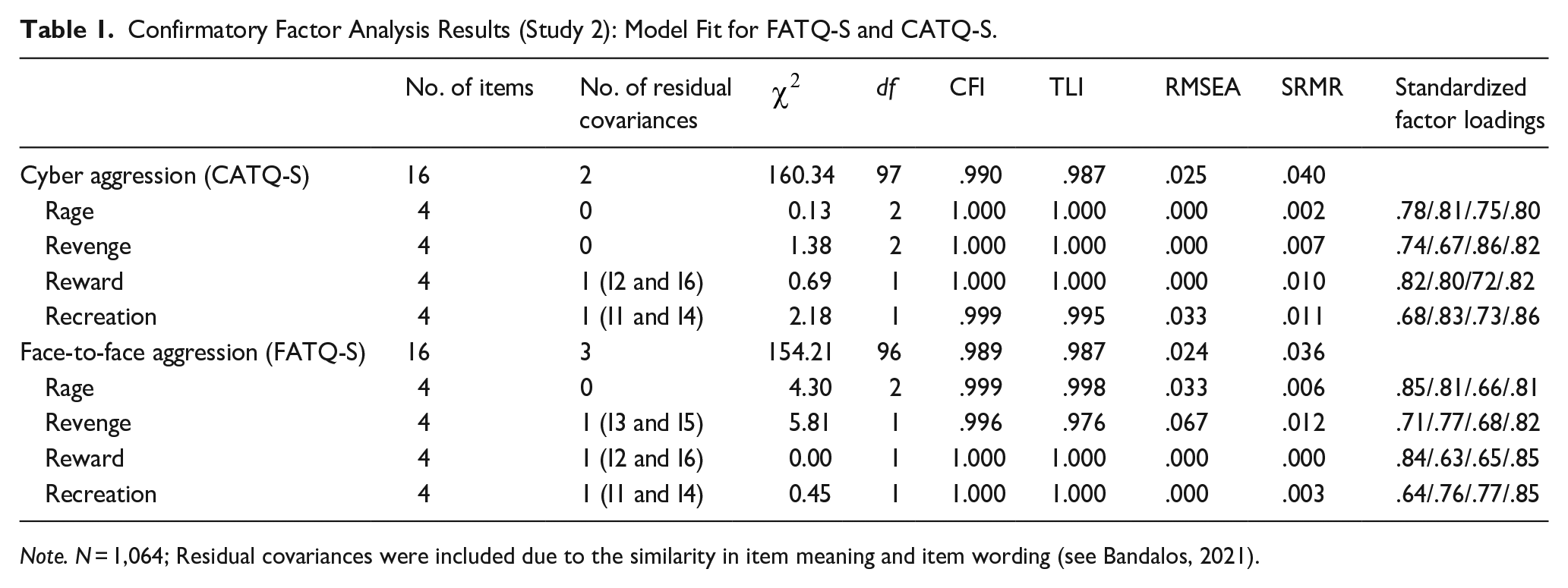
Note. N = 1,064; Residual covariances were included due to the similarity in item meaning and item wording (see Bandalos, 2021).
Criterion Validity of the CATQ-S/FATQ-S
Correlation coefficients between the CATQ-S/FATQ-S and external criteria are shown in Table 2. As expected, all scales of the CATQ-S and FATQ-S were positively associated with cyber perpetration (CATQ-S: r = .40 to .66; FATQ-S: r = .21 to .52) as well as offline perpetration (CATQ-S: r = .32 to .51; FATQ-S: r = .33 to .60). In line with our hypotheses, the reward and recreation scales of the CATQ-S and FATQ-S (CATQ-S: r = −.21 to −.16; FATQ-S: r = −.15 to −.12) and the CATQ-S revenge scale (r = −.13 to −.11) were negatively associated with perceived offline and online injunctive norms. However, contrary to our expectation, associations between the FATQ-S revenge scale as well as the CATQ-S rage scale and perceived offline and online injunctive norms were not statistically significant. Furthermore, the FATQ-S rage scale was not associated with perceived offline but positively associated with perceived online injunctive norms (r = .09). Finally, as expected, all CATQ-S/FATQ-S scales were positively associated with social media addiction (CATQ-S: r = .23 to .33; FATQ-S: r = .26 to .28).
Psychometric Characteristic of the CATQ-S/FATQ-S: Reliability and Correlation with Criteria.
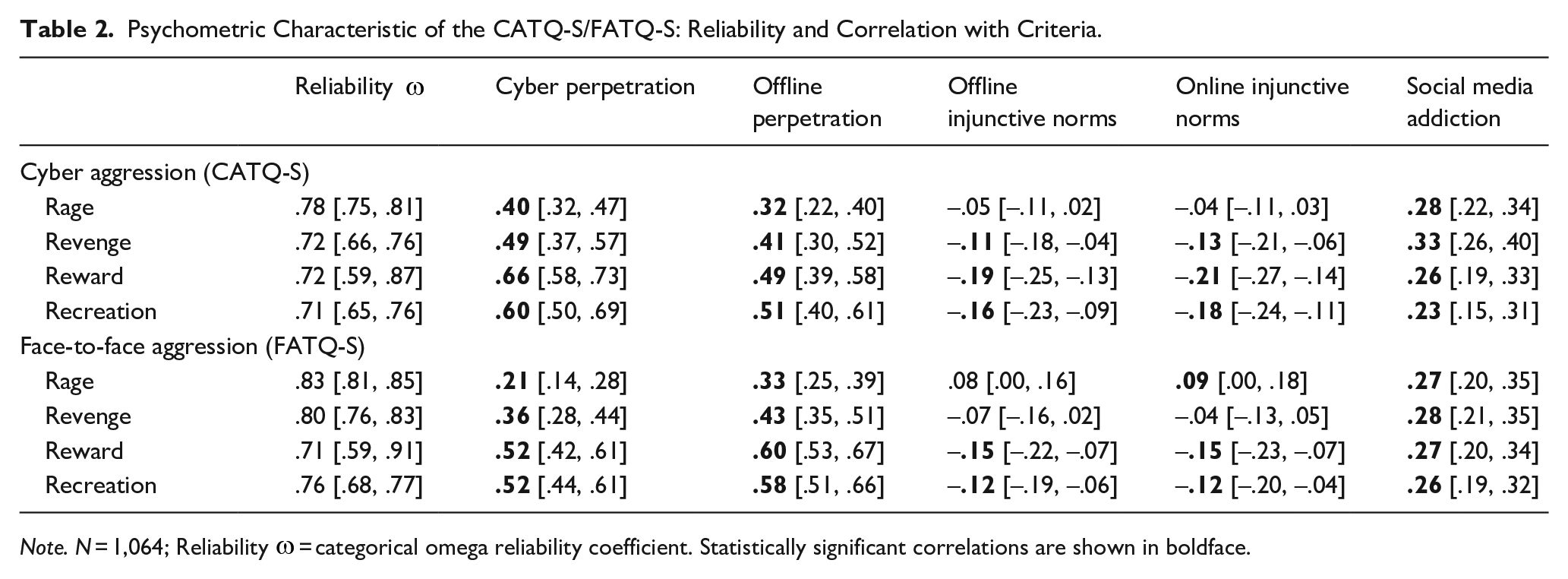
Note. N = 1,064; Reliability
Discussion
In Study 2, we aimed to enable the use of the CATQ-S/FATQ-S in school settings. Therefore, we validated the questionnaire in an adolescent sample and selected meaningful external criteria within this context. The four-factor structure for the CATQ-S and the FATQ-S and sound measurement properties for all scales could be shown. All scales showed satisfactory reliability. Moreover, we found largely comprehensive associations between CATQ-S/FATQ-S scales and external criteria. That is, all types of aggression were positively related to offline and cyber perpetration in both contexts (offline/online). The context-specific aggression scales were most strongly related to the corresponding context-specific perpetration scales (i.e., all online aggression scales were most strongly related to cyber perpetration and all offline aggression scales were most strongly related to offline perpetration). Furthermore, we showed that, for the most part, types of aggression across both contexts were negatively associated with perceived social injunctive norms in both contexts. Finally, we found that regardless of context, all types of aggression were positively associated with social media addiction.
General Discussion
According to the general aggression model (Anderson & Bushman, 2002), both personal (e.g., aggression) and contextual (e.g., offline/online) factors should be considered to explain the emergence of aggressive behavior (e.g., bullying). With respect to personal factors, traditional research on aggression considers reactive (i.e., rage) and proactive (i.e., reward) aggression as drivers for aggressive behavior (Raine et al., 2006). This dichotomous distinction, however, was criticized repeatedly due to its conflation of affective valence and self-control and extended by incorporating revenge and recreational aggression alongside rage and reward (Howard, 2011).
To date, only the CATQ/FATQ measured the four factors of aggression while accounting for the communication mode (offline/online). Although bullying is primarily studied and highly relevant in school settings (Smith, 2004), the CATQ/FATQ had only been validated in a sample with university students. In addition, the questionnaire’s item count limited its practicality. Therefore, the current research developed a short version of the CATQ/FATQ (CATQ-S/FATQ-S) and validated it in a sample consisting of adolescents.
The benefits of the CATQ-S/FATQ-S are manifold. In addition to economic aspects (e.g., time efficiency, increased participation, reduced fatigue), it enables research on a more comprehensive understanding of adolescents’ aggressive behavior by taking different contexts and nuanced motivations into account. For instance, adolescents might bully for different reasons online than offline. As Graf et al. (2022) have shown, individuals are more likely to indicate to bully for thrill/fun in online contexts than in offline contexts. However, in their study, the motives for bullying were measured retrospectively, asking participants why they had bullied someone after they reported engaging in bullying behavior. To avoid cognitive biases such as memory distortions or post-hoc justification processes by students regarding their behavior, the CATQ-S/FATQ-S can be used to assess the driving forces behind bullying, independently of whether individuals have previously reported engaging in bullying behavior. Furthermore, the nuanced perspective on aggression in different contexts enables researchers to examine whether certain types of aggression lead to certain forms of bullying (e.g., verbal, relational) and whether the patterns are the same across contexts. Such applications of the CATQ-S/FATQ-S could provide valuable insights into the similarities and differences between offline and cyberbullying and contribute to the development of context-sensitive prevention and intervention strategies.
Limitations
Despite numerous strengths of this research, such as providing a practical tool that measures aggression in a nuanced way and considers both offline and online contexts, several limitations should be noted. First, in the university student sample, we observed that the reliabilities for the FATQ-S rage and reward scales were below the threshold of .07. Although it has been suggested that values between .65 and .70 can be considered minimally acceptable reliability (DeVellis, 2016), the results with reference to these specific scales should be interpreted with caution. Second, the rage, revenge, and reward scales of the FATQ-S shared less than 50% variance with their long-form counterparts. Users should be aware that these short scales do not capture the full nuances of these offline aggression subtypes. Third, for economic reasons, only the short version of the questionnaire was administered in the adolescent sample (i.e., the data from Study 2 were drawn from a larger data collection that included additional research questions beyond the scope of the present research). Consequently, the validation of a long version in an adolescent population remains an objective for future research. Fourth, our analyses are based on cross-sectional data. Future studies could provide additional evidence for the validity of the measurement instruments by using longitudinal data and evaluating test–retest (i.e., stability over time) and predictive validity (i.e., the ability of the measures to predict future outcomes).
Supplemental Material
sj-docx-1-jbd-10.1177_01650254241306113 – Supplemental material for Rage, revenge, reward, and recreation: Validating short-form measures of adolescents’ aggression across offline and online contexts
Supplemental material, sj-docx-1-jbd-10.1177_01650254241306113 for Rage, revenge, reward, and recreation: Validating short-form measures of adolescents’ aggression across offline and online contexts by Daniel Graf and Takuya Yanagida in International Journal of Behavioral Development
Supplemental Material
sj-docx-2-jbd-10.1177_01650254241306113 – Supplemental material for Rage, revenge, reward, and recreation: Validating short-form measures of adolescents’ aggression across offline and online contexts
Supplemental material, sj-docx-2-jbd-10.1177_01650254241306113 for Rage, revenge, reward, and recreation: Validating short-form measures of adolescents’ aggression across offline and online contexts by Daniel Graf and Takuya Yanagida in International Journal of Behavioral Development
Supplemental Material
sj-docx-3-jbd-10.1177_01650254241306113 – Supplemental material for Rage, revenge, reward, and recreation: Validating short-form measures of adolescents’ aggression across offline and online contexts
Supplemental material, sj-docx-3-jbd-10.1177_01650254241306113 for Rage, revenge, reward, and recreation: Validating short-form measures of adolescents’ aggression across offline and online contexts by Daniel Graf and Takuya Yanagida in International Journal of Behavioral Development
Footnotes
Funding
The author(s) disclosed receipt of the following financial support for the research, authorship, and/or publication of this article: This research was supported by the INVEST Research Flagship Centre, funded by the Research Council of Finland (Decision Number: 345546), and the Challenge Project (ERC-AdG 2019: 884434; awarded to Prof. Christina Salmivalli). Open Access funding was provided by the University of Turku, including Turku University Central Hospital.

Supplemental Material
Supplemental material for this article is available online.
References
Supplementary Material
Please find the following supplemental material available below.
For Open Access articles published under a Creative Commons License, all supplemental material carries the same license as the article it is associated with.
For non-Open Access articles published, all supplemental material carries a non-exclusive license, and permission requests for re-use of supplemental material or any part of supplemental material shall be sent directly to the copyright owner as specified in the copyright notice associated with the article.
