




Abstract
This longitudinal study investigated whether classroom norm salience toward aggression moderated the association between parental education and children’s overt aggressive behavior development from third to sixth grade of elementary school. Children (N = 1,205, 51% girls) from 46 Dutch elementary schools were annually followed from third to sixth grade. Norm salience was operationalized by within-classroom correlations between individual children’s peer-nominated social preference and aggression scores. Results from multilevel latent growth models showed that norm salience development from third to sixth grade, but not norm salience in third grade, was a significant moderator. That is, results suggested that in third grade, children of lower-educated parents showed higher levels of overt aggressive behavior than children of higher-educated parents, irrespective of the norm. However, in classrooms where norm salience became more favorable toward aggression over time, children of lower-educated parents showed a slower growth rate of overt aggressive behavior than children of higher-educated parents from third to sixth grade. In classrooms where norm salience became less favorable toward aggression over time, the development of overt aggressive behavior was similar for all children. Findings suggest that classroom norm salience may become more important in the later elementary school years and that children of higher-educated parents may be more able to adapt their behavior toward the classroom norm.
Children’s experiences in elementary school may set the stage for (mal)adaptive developmental trajectories (Dodge et al., 2008; van Lier et al., 2012). Overt aggression, such as physically attacking or threatening others, is a common childhood behavior that usually decreases in frequency when children grow older (Bongers et al., 2004). However, if children show increases or stable-high levels of aggressive behavior throughout elementary school, they run the risk of a myriad of problems including social skills and peer relationship difficulties, lower academic achievement, mental health problems, affiliation with deviant peers, and criminal behavior (Dodge et al., 2008; van Lier et al., 2012).
One important factor that is associated with aggressive behavior is parental education. In fact, parental education is a robust predictor of children’s development, with its effects being stronger in childhood than in later life course stages such as in adolescence (Reiss, 2013). Parental education relates to child development through several mechanisms including parenting strategies, financial stress, social and cultural capital, and parental mental health (e.g., Conger & Donnellan, 2007). As regards aggressive behavior, children of lower-educated parents are, on average, more likely to exhibit (stable-) higher or a faster growth rate of aggressive behavior levels than children of higher-educated parents throughout elementary school. That is, compared with children of higher-educated parents, children of lower-educated parents not only show higher levels of aggressive behavior at the beginning but also at the end of elementary school (Horoz et al., 2022a). This puts children of lower-educated parents at risk for developing mental health problems both during and after their elementary school years. Indeed, parental education in childhood has been shown to associate with the severity and persistence of behavioral problems, including problems with aggression, in adolescence and adulthood (McLaughlin et al., 2011). It is therefore critical to identify factors that may exacerbate or impede development of aggressive behavior in children with varying parental education backgrounds. Identifying factors at a formative stage like that of the elementary school may yield novel insights and thereby contribute to early aggression prevention and intervention efforts.
Previous research provided valuable insights into the factors that play a role in the aggressive behavior development of children of higher- and lower-educated parents. These studies examined individual child or household-level moderators such as stressful life situations and mediators such as social competence, parenting practices, marital conflict between parents, and financial hardship (Cabello et al., 2017; Hosokawa & Katsura, 2017; Oude Groeniger et al., 2023; Reiss et al., 2019). Yet, social ecological theory posits that understanding the interplay between individual-level characteristics and broader social contexts, also those beyond the household level, is critical to understand human development, including aggressive behavior development (Bronfenbrenner, 1977; Espelage, 2014). Therefore, studying factors that are within children’s social contexts, but that extend beyond the individual and household levels, could contribute to our understanding of aggressive behavior development of children with varying parental education backgrounds. One such social context might be the peer social context within the classroom environment, particularly classroom norm salience. This longitudinal study, therefore, investigated whether the development of classroom norm salience toward aggression moderated the association between parental education and children’s overt aggressive behavior development from third to sixth grade of elementary school.
Classroom Norm Salience
Classroom norms are implicit social standards which determine the acceptability of certain behaviors. Norm salience is defined by within-classroom correlations between children’s social status among peers (e.g., how socially preferred they are, how popular they are) and their specific behavior (e.g., aggressive behavior) and can therefore be regarded as an indicator of behaviors that are valued and influential in classrooms (Dijkstra et al., 2008; Dijkstra & Gest, 2015). Note that in this study norm salience is based upon social preference, which refers to how well a child is liked by the peers in their classroom, and not upon popularity, which measures the extent to which a child is perceived to be popular by their peers. Norm salience, when compared with descriptive (i.e., the frequency of the behavior within the classroom) and injunctive norms (i.e., the attitudes toward a specific behavior within the classroom), has been shown to be the strongest driving factor in the behavioral adjustment of children and adolescents (e.g., Dijkstra & Gest, 2015; Laninga-Wijnen et al., 2017).
Children have a fundamental need to belong and to feel accepted by their peer group (Baumeister & Leary, 1995). Children whose behavior deviates from the norm are more likely to be rejected or excluded, while children who conform to the norm are more likely to be accepted and included (Wright et al., 1986). Hence, the fundamental need to belong and to feel accepted may influence children’s behavior. This can be further explained by the Social Impact Theory (SIT; Latané, 1981), which suggests that individuals’ behaviors are influenced by the presence or the actions of others. It explains social impact as a “social force field” which pressures or pushes individuals to behave in a certain way. More specifically, it states that the strength (i.e., the status of the source of influence), the immediacy (i.e., the closeness in space or time), and the number of people who are the source of influence may determine the impact of the “social source field.” Peers may, thus, imitate the behaviors of higher status peers to profit from social benefits such as peer acceptance, development of friendships, and the maintenance or enhancement of their own peer status. Therefore, in classrooms where norm salience is more favorable toward aggression (i.e., where more aggressively behaving children are more socially preferred), children may imitate behaviors of more socially preferred peers out of a fear of not fitting in or out of a fear of being rejected within the classroom. In classrooms where norm salience is less favorable toward aggression (i.e., where more aggressively behaving children are less socially preferred), being aggressive would be regarded as norm-defying and children may be more likely to refrain from such behaviors insofar as they do not lead to social benefits.
Previous studies in adolescent samples showed that in classrooms where higher (vs. lower) levels of aggressive behavior were associated with higher status (measured by popularity), adolescents exhibited more aggressive behavior and sought to affiliate with aggressive peers (e.g., Dijkstra et al., 2008; Laninga-Wijnen et al., 2017). Most studies operationalized norm salience using popularity scores (but see Brendgen et al., 2015; Correia et al., 2022; Tieskens et al., 2019). Children with higher status, those who are popular and socially preferred, not only are on top of the social ladder but also maintain a central position and social control among their peers. Yet, while the two dimensions (i.e., popularity and social preference) of social status are related, and moderately statistically correlated, they are also distinct. That is, not all socially preferred children are popular, and not all popular children are socially preferred (van den Berg et al., 2020). In line with this, Garandeau and colleagues (2022) found that there was a nonsignificant correlation between bullying-popularity norm and bullying-rejection norm, suggesting that in classrooms where more aggressively behaving children were more popular, they may not be necessarily liked and accepted. Moreover, social preference is primarily related to communal social goals whereas popularity is primarily related to agentic social goals (Caravita & Cillessen, 2012; van den Berg et al., 2020) and that the association between social preference and popularity weakens from childhood to adolescence (van den Berg et al., 2020). Therefore, operationalizing norm salience based upon social preference rather than popularity could offer novel insights into the development of norm salience, thereby complementing the existing literature on norm salience based upon popularity.
While there is a considerable amount of research on adolescent classroom norms in general (Brendgen et al., 2015; Dijkstra et al., 2008; Dijkstra & Gest, 2015; Laninga-Wijnen et al., 2017), to our knowledge there are no studies examining classroom norm salience toward aggression longitudinally across consecutive elementary school grades (but see Correia et al., 2022; Velásquez et al., 2021). Yet, already in elementary school, the dynamic interplay between peer experiences and externalizing behaviors including aggression becomes apparent (van Lier et al., 2012). In addition, social hierarchies become increasingly important from early to middle childhood (Stauffacher & DeHart, 2006). Therefore, it is necessary to consider the peer social context longitudinally, such as the development of classroom norm salience, when studying aggressive behavior development in this fundamental period.
Norm Salience as a Moderator of the Association between Parental Education and Overt Aggressive Behavior
The majority of the studies (but see Brendgen et al., 2013, 2015) examined whether norm salience toward aggression impacts the behavioral adjustment of all children. However, norm salience could also affect aggressive behavior development of children with various social backgrounds differently, such as children of parents with different education backgrounds. Drawing upon SIT, the association between parental education and overt aggressive behavior may be more pronounced in classrooms where norm salience is more favorable toward aggression than in classrooms where norm salience is less favorable toward aggression.
In formulating our hypotheses, we regarded lower parental educational attainment as a social vulnerability as it is often correlated with indicators of socioeconomic deprivation such as financial stress, lower family income, and parental mental health problems, which may increase children’s risk of developing mental health difficulties (e.g., Hosokawa & Katsura, 2017; Oude Groeniger et al., 2023). Indeed, lower parental education was associated with higher levels of problems across a wide range of outcomes, including aggressive behavior, throughout elementary school (Horoz et al., 2022a). Moreover, we consider being a member of a classroom where norm salience is more favorable toward aggression to be a risk factor, given the higher levels of aggressive behavior present in such classrooms (e.g., Dijkstra et al., 2008). In what follows we explain our hypotheses of direction of the associations in classrooms where norm salience is more favorable toward aggression and in classrooms where norm salience is less favorable toward aggression.
Classrooms Where Norm Salience Is More Favorable toward Aggression
Due to their more vulnerable social backgrounds, children of lower-educated parents may be affected by the risk environment in two distinct ways:
On the one hand, in classrooms where norm salience is more favorable toward aggression, children of lower-educated parents may show higher levels or a faster increase of aggressive behavior than children of higher-educated parents. Risk factors for aggression development in multiple domains (i.e., individual [household] and classroom levels) have been shown to have an effect on aggression development (Dodge et al., 2008; Espelage, 2014). The risk of developing aggressive behavior for child X, who is growing up in a lower-educated household (i.e., social vulnerability) may be exacerbated when they are in a classroom where aggression is positively reinforced by peers (i.e., risk factor for aggression) compared with child Y, who is growing up in a higher-educated household. A previous study examining moderation effects showed that children of lower-educated parents exhibited more mental health problems, including behavioral problems, in stressful life situations, including problems in school, than children of higher-educated parents (Reiss et al., 2019).
In contrast, it is also conceivable that in classrooms where norm salience is more favorable toward aggression, children of lower-educated parents may have lower levels or a slower increase of aggressive behavior than children of higher-educated parents. In such classrooms, children of higher-educated parents may use their resources to maximize their social status through peer acceptance. Children of higher-educated parents on average show better cognitive flexibility, working memory, inhibitory control and social information processing skills (Bookhout et al., 2021; Cabello et al., 2017; Ursache et al., 2016). Consequently, they may be better at processing social cues in their environment and also at selecting behaviors that “fit in,” that meet the expectations of their peers, and that are likely to help them become more socially preferred. In other words, in such classrooms, they may use aggression as a strategy to gain social benefits. In comparison, children of lower-educated parents may be slower in interpreting and responding to environmental cues and may face more challenges in adjusting their behavior toward the norm. A previous study found that more vulnerable children (i.e., children who are victimized by peers) showed increases in risk-taking behavior when norm salience based on social preference was unfavorable toward risk-taking and showed decreases in risk-taking when norm salience was favorable toward risk-taking (Tieskens et al., 2019). These results suggest that more vulnerable children may be less able to adjust their behavior toward the norm and may even engage in norm-defying behavior (Tieskens et al., 2019). Thus, in the context of this study, it is also possible that children of lower-educated parents may be less able to adapt their behavior toward the salient classroom norm than children of higher-educated parents.
Classrooms Where Norm Salience Is Less Favorable toward Aggression
In classrooms where norm salience is less favorable toward aggression, behaving aggressively would be considered to be norm-defying since in these classrooms aggression may be less valued and not be positively reinforced. Therefore, children may be less likely to engage in aggressive behavior. Yet it is still conceivable that children of lower-educated parents may exhibit higher levels of aggressive behavior than children of higher-educated parents since lower parental education was previously associated with aggressive behavior development throughout elementary school (Horoz et al., 2022a). In contrast, children of higher-educated parents may be more likely to refrain from aggressive behavior since in these classrooms aggression may not lead to social benefits.
Present Study
This study aimed to extend previous research by investigating whether the development of norm salience toward aggression moderated the association between parental education and overt aggressive behavior development from third to sixth grade. To our knowledge this study was the first to examine classroom norm salience longitudinally across consecutive elementary school grades and to consider a classroom-level moderator in the association between parental education and aggressive behavior. Specifically, we tested whether the level of classroom norm salience toward aggression in third grade as well as its development (i.e., rate of change from third to sixth grade) moderated the association between parental education and the level and development of children’s overt aggressive behavior from third to sixth grade of elementary school. This study aimed to provide insights into the developmental nature of norm salience based on social preference and into the potential context-dependent nature of aggressive behavior development of children of higher- and lower-educated parents across the late elementary school years. Thus, the knowledge gained from this study could inform classroom level interventions in elementary school.
It should be noted that our study was relatively exploratory in nature. We expected norm salience toward aggression in third grade and over time to be significant moderators. Because of the novelty of this study and the mixed findings in the literature, in classrooms where norm salience is more favorable toward aggression in third grade and over time we have competing hypotheses on the direction of the associations between parental education and overt aggressive behavior development in third grade and over time. In classrooms where norm salience is less favorable toward aggression in third grade and over time, we hypothesized that children of lower-educated parents would have higher levels in third grade and a faster increase or slower decrease in overt aggressive behavior levels over time than children of higher-educated parents, but less so than their counterparts in classrooms where norm salience is more favorable toward aggression.
Method
Participants
Participants came from two similar longitudinal research projects (Project A; de Wilde et al., 2016 and Project B; Witvliet et al., 2009b) on children’s behavioral, emotional, and social development that followed children annually throughout elementary school. Both projects used convenience samples and recruited the first schools that agreed to participate upon invitation. Inclusion criteria for this study were (a) parental consent, (b) data on household-level parental education, and (c) at least two completed (teacher-reported) assessments of overt aggressive behavior between third and sixth grade. The final sample consisted of 1,205 children from 46 schools and within, on average, 126 classrooms across each studied year. Of the 1,205 children, 714 came from Project A and 491 came from the Project B. Children were on average 9.11 (SD = 0.45) years old in third grade and 51% were girls. Furthermore, 78% had a native Dutch background (both parents born in the Netherlands), which is comparable to the general population in the Netherlands (75%; Statistics Netherlands, 2022). The rest of the sample had at least one parent born elsewhere, such as Türkiye (4.5%), Morocco (4.0%), Suriname (1.8%), and other countries (9.5%).
Children who did not meet the inclusion criteria (i.e., excluded children) did not differ from included children with regard to gender distribution, χ2(1) = 2.46, p = .116. In third grade, included children (N = 1,173, M = 9.11, SD = 0.46) were younger than excluded children (N = 1,576, M = 9.20, SD = 0.53), t(2,747) = −4.96, p < .001, Cohen’s d = 0.50. Furthermore, except for sixth grade, excluded children showed higher levels of overt aggressive behavior than included children across all years (ps ⩽ 0.001), but the effect sizes of the mean differences were always small (Cohen’s ds < 0.18).
Children from Project B had higher levels of overt aggressive behavior and parents with lower education levels compared with children from Project A. Norm salience toward aggression and the school-level percentage of children with lower-educated parents (i.e., school-level parental education) did not significantly differ between schools in the two projects. See Supplementary Material, s Table 1 for the descriptive statistics of children from both projects.
Procedure
Procedures were similar between the two research projects. Data were collected annually for 4 years from the spring of third grade to the spring of sixth grade. At the start of both studies, all parents/caregivers were asked for active written informed consent. Each subsequent year, children and parents/caregivers were informed about the data collection plans and could withdraw their consent and revoke participation at any time (i.e., passive informed consent). Parents of new children who entered a classroom that participated in the study were asked for active written informed consent. Parental education data and teacher-reported overt aggressive behavior were obtained from parents and teachers via online questionnaires, respectively. In both studies, teachers were asked the same questions. Peer nominations were obtained in classrooms during a regular school day. Children received a list of classroom peers and could nominate an unlimited number of peers that they liked and disliked and that fit the description of showing aggression. During the measurement, children were supervised by trained research assistants and were seated in exam style to ensure privacy.
It should be noted that through a randomized control trial, a preventive classroom management intervention was implemented in first and second grades within some schools of Project B. Schools in control and intervention conditions of Project B were free to implement any intervention from third grade (the first wave of this present study) onward but this was no longer monitored. Similarly, whether schools in Project A implemented interventions within the study period was also not monitored. Of the 1,205 participants, 340 participants were in the intervention condition in first and second grades. More details of the study design and procedures of both projects are described elsewhere (de Wilde et al., 2016; Witvliet et al., 2009b). This study was approved by the Medical Ethical Committee of Erasmus University Medical Center (protocol number: MEC 199.979/2001/53) and the Medical Ethics Review Committee of Vrije Universiteit Amsterdam (protocol number: NL37788.029.11; 2012; 2017).
Measures
Parental Education
Parental education was measured using parents’ highest completed education rated according to the Dutch Standard Education Classifications (Statistics Netherlands, 2008), which are in line with International Standard Classification of Education (ISCED; United Nations Educational, Scientific and Cultural Organization [UNESCO] Institute for Statistics, 2012). Following the ISCED classifications, parental education levels were coded using an 8-point scale, with education levels ranging from 0 = no education/early education, 1 = primary education, 2 = lower secondary education, 3 = upper secondary education, 4 = post-secondary non-tertiary education, 5 = short-cycle tertiary education, 6 = bachelor’s degree or equivalent, to 7 = master’s degree, equivalent or higher. Parental education scores were based on the highest completed parental education level per household. That is, if a child had one parent with upper secondary education (3) and another parent with a short-cycle tertiary education (5), then we coded this child’s parental education level as having short-cycle tertiary education (5). The parental education levels were reverse coded so that higher scores indicated lower parental education levels.
Classroom Norm Salience toward Aggression
Classroom norm salience toward aggression was operationalized by within-classroom correlation between individual children’s social preference scores and their aggression scores, both assessed via peer nominations. In each classroom, each participating child nominated classmates by answering the following questions: “Who hits other children?” (aggression nomination), “Who do you like?” (like nomination), and “Who do you dislike?” (dislike nomination). The peer-nominated aggression, like and dislike scores were calculated for each child by using the proportion of received nominations for each construct. These scores could range from 0 (no nominations) to 1 (nominated by all classmates). For example, if in a classroom of 20 students, 14 peers nominated peer X as aggressive, then peer X’s individual-received-peer-nomination score would be 0.74 (14 ÷ (20–1); self-nomination was not allowed). Higher aggression scores indicated more aggression nominations. Social preference scores were calculated by subtracting children’s dislike scores from like scores. Social preference scores therefore ranged from 1 to −1, with higher scores indicating more social preference. Classroom size for norms calculations ranged from 5 to 31 students, with a mean of 12. Rates of peer nominations within these classrooms ranged from 77% to 100%, with a mode and median of 100%. Per class correlations of aggression and social preference scores were then calculated and subsequently transformed to Fisher z-scores to obtain a normal distribution. This was done by following the formula: z’ = .5[ln(1 + r)-ln(1-r)] (Fisher, 1925; Laninga-Wijnen et al., 2020).
Children’s Overt Aggressive Behavior
Overt aggressive behavior was measured by the overt aggression items of the conduct problem subscale of the Problem Behavior at School Interview (PBSI; Erasmus MC, 2000). The PBSI employs a 5-point Likert-type scale ranging from 0 (never applicable) to 4 (often applicable). Overt aggressive behavior was assessed by six items such as “starts fights” and “attacks others physically.” Higher scores indicated higher levels of teacher-reported overt aggressive behavior. Cronbach’s alpha across grades ranged from .921 to .936. A previous study using a subsample of this study showed adequate convergent validity, by showing a correlation of 0.75 (p < .01) between the behavioral scale of the PBSI and the Teacher’s Report Form (Achenbach, 1991; Witvliet et al., 2009a). Furthermore, another study found no major violations of longitudinal measurement invariance of the conduct problems subscale between children of lower- and higher-educated parents. This suggests that teachers’ ratings of children’s aggressive behavior reflect the true mean differences between children of higher- and lower-educated parents and do not reflect teacher (rater) bias or differences (Horoz et al., 2022a).
Cluster Variable
Classroom Membership Profile
Classroom compositions could change as children transitioned from one grade to another in elementary schools in the Netherlands. Following the procedure used in a previous study (Tieskens et al., 2019), classroom membership profile was computed for each child and was used as the cluster variable in our multilevel model. To compute classroom membership profiles for each child, we assessed whether they transitioned into a classroom with the same classmates or (partly) new classmates. Children who transitioned into the same classroom from third to sixth grade were categorized into the same classroom membership profile. However, it was also possible that due to slightly different classroom compositions from year to year, some children did not transition into the same classroom. Note that classroom membership profiles could only be calculated for children who participated in this study within the participating classrooms and that classroom membership profiles do not refer to classroom size. Classroom norm salience calculations were computed within third-, fourth-, fifth-, and sixth-grade classrooms and not within classroom membership trajectories. There were 192 classroom membership profiles that included at least two children and 135 singletons (i.e., clusters with only one child which represent children who did not transition to the exact same classrooms with other peers across the 4 years). The number of children within a membership profile with more than one child ranged from 2 to 21, with an average number of six children.
Statistical Analyses
We used a multilevel latent growth curve model (ML-LGM) to test our hypotheses in Mplus version 8.0 (Muthén & Muthén, 2017). Our ML-LGM had a two-level time-nested-within-individual data structure. Level 1 represented variation across individuals and Level 2 represented variation across clusters (i.e., classroom membership profiles). The development of both overt aggressive behavior and of norm salience toward aggression from third to sixth grade was estimated by latent growth parameters: latent intercepts and latent slopes. The latent intercepts represented overt aggressive behavior levels and strength of norm salience toward aggression in third grade and the latent slopes represented rate of change in overt aggressive behavior levels and norm salience toward aggression from third grade to sixth grade. For a graphical representation of our model, see sFigure 1 in Supplementary Material.
We used multilevel latent growth models with cross-level interactions to test whether intercept and slope parameters of classroom norm salience toward aggression moderated the association between parental education and the intercept and slope parameters of overt aggressive behavior. For more specific details, see the Supplementary Material. When significant, simple slopes were calculated to estimate the associations of parental education and overt aggressive behavior in classrooms where norm salience was (a) more (M + 1 SD) and (b) less favorable (M – 1SD) toward aggression in third grade and over time. We controlled for the effect of gender on within-level overt aggressive behavior and for the effect of school-level parental education on cluster-level overt aggressive behavior and on norm salience. In addition, cluster-level overt aggressive behavior was regressed on norm salience.
Two sensitivity analyses were performed to ensure that our results were robust (a) across samples (controlling for project A and B) and (b) when excluding singletons. Mplus code and output files are publicly available in OSF (https://osf.io/w6gaf/?view_only=ff866d7a318047cc91d3a5d93b22d11a)
Results
Descriptive Statistics, Unconditional Latent Growth Models, and Main Effect Model
Descriptive statistics of the study variables, results from unconditional growth models and from the main effect model are presented in detail in the Supplementary Material. Results from unconditional growth models (see Supplementary Material, sTable 3) showed that overall children’s overt aggressive behavior levels decreased from third to sixth grade. Furthermore, results showed that in third grade, children exhibiting higher levels of aggressive behavior were less socially preferred (i.e., there was a negative correlation between peer-nominated aggression and social preference; norm is less favorable toward aggression) than children exhibiting lower levels of aggressive behavior. However, norm salience toward aggression on average became less negative from third to sixth grade (positive slope parameter of the norm), indicating that children exhibiting higher levels of aggressive behavior became more socially preferred (i.e., less disliked or more liked) over time. In addition, main effect results showed that in third grade children of lower-educated parents and children in lower parental education schools showed higher levels of overt aggressive behavior. For more details on main effect results, see the Supplementary Material.
Classroom Norm Salience as a Moderator in the Association between Parental Education and Overt Aggressive Behavior
Results from ML-LGMs with cross-level interactions are presented in Table 1. Results showed that the intercept parameter of norm salience did not moderate the association between parental education and intercept and slope parameters of overt aggressive behavior. In other words, the association between parental education and aggressive behavior did not depend on norm salience in third grade. However, the slope parameter of norm salience was a significant moderator in the association between parental education and the development of overt aggressive behavior. This indicates that the overt aggressive behavior development of children of higher- and lower-educated parents depended upon the rate of change of the classroom norm salience toward aggression from third to sixth grade.
Classroom Norm Salience toward Aggression as a Moderator of the Association between Parental Education and Overt Aggressive Behavior.
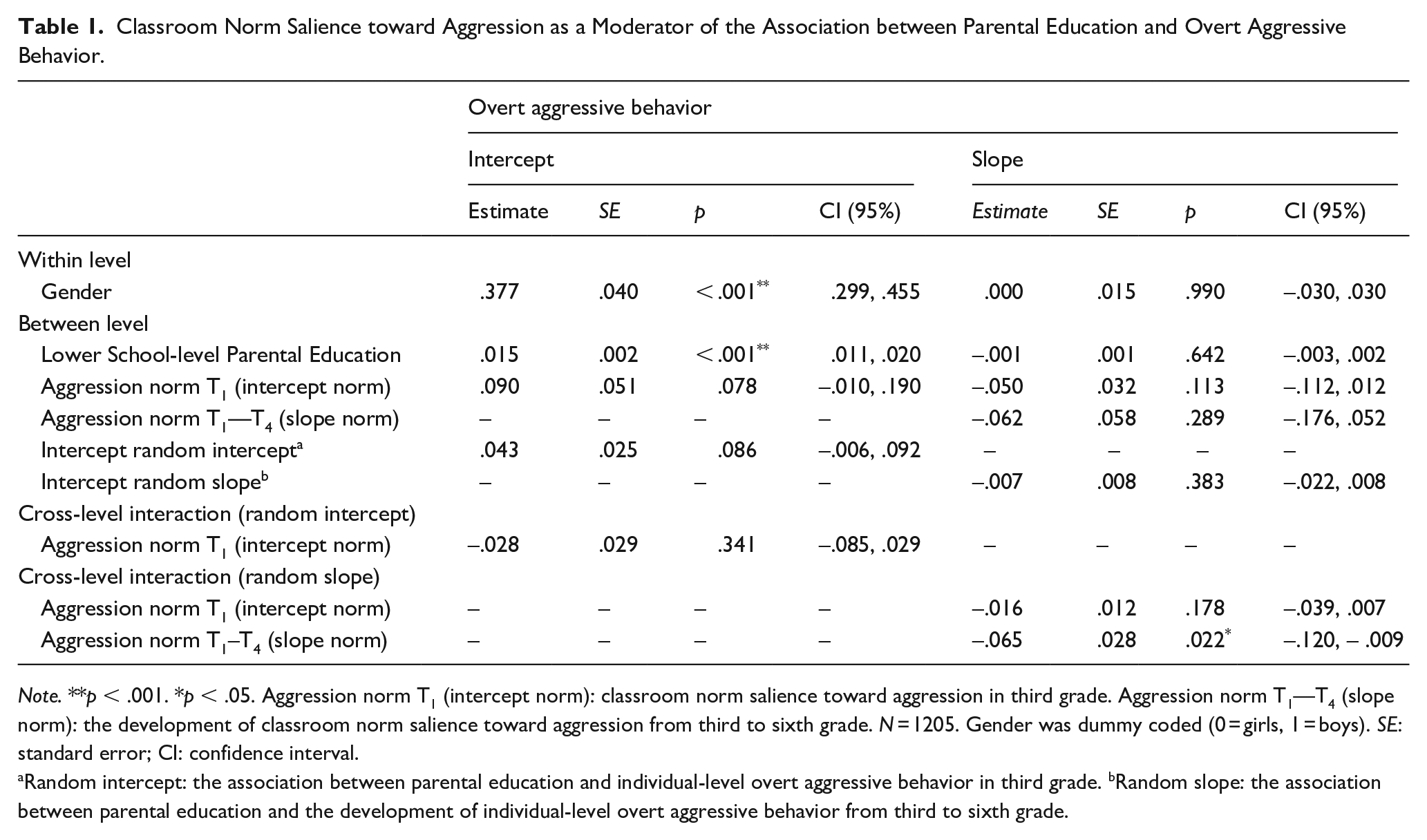
Note. **p < .001. *p < .05. Aggression norm T1 (intercept norm): classroom norm salience toward aggression in third grade. Aggression norm T1—T4 (slope norm): the development of classroom norm salience toward aggression from third to sixth grade. N = 1205. Gender was dummy coded (0 = girls, 1 = boys). SE: standard error; CI: confidence interval.
Random intercept: the association between parental education and individual-level overt aggressive behavior in third grade. bRandom slope: the association between parental education and the development of individual-level overt aggressive behavior from third to sixth grade.
Probing the interaction effects showed that in classrooms where norm salience became more favorable toward aggression over time, children of lower-educated parents showed a slower growth rate of overt aggressive behavior levels compared with children of higher-educated parents (B = −.027, SE = .013, p = .034, 95% CI [−.052, −.002]). However, in classrooms where norm salience became less favorable toward aggression over time, no significant association between parental education and the slope parameter of overt aggressive behavior was found (B = .004, SE = .008, p = .648, 95% CI [−.012, .019]). In such classrooms, the development of overt aggressive behavior of children of higher- and lower-educated parents did not differ (see Figure 1).
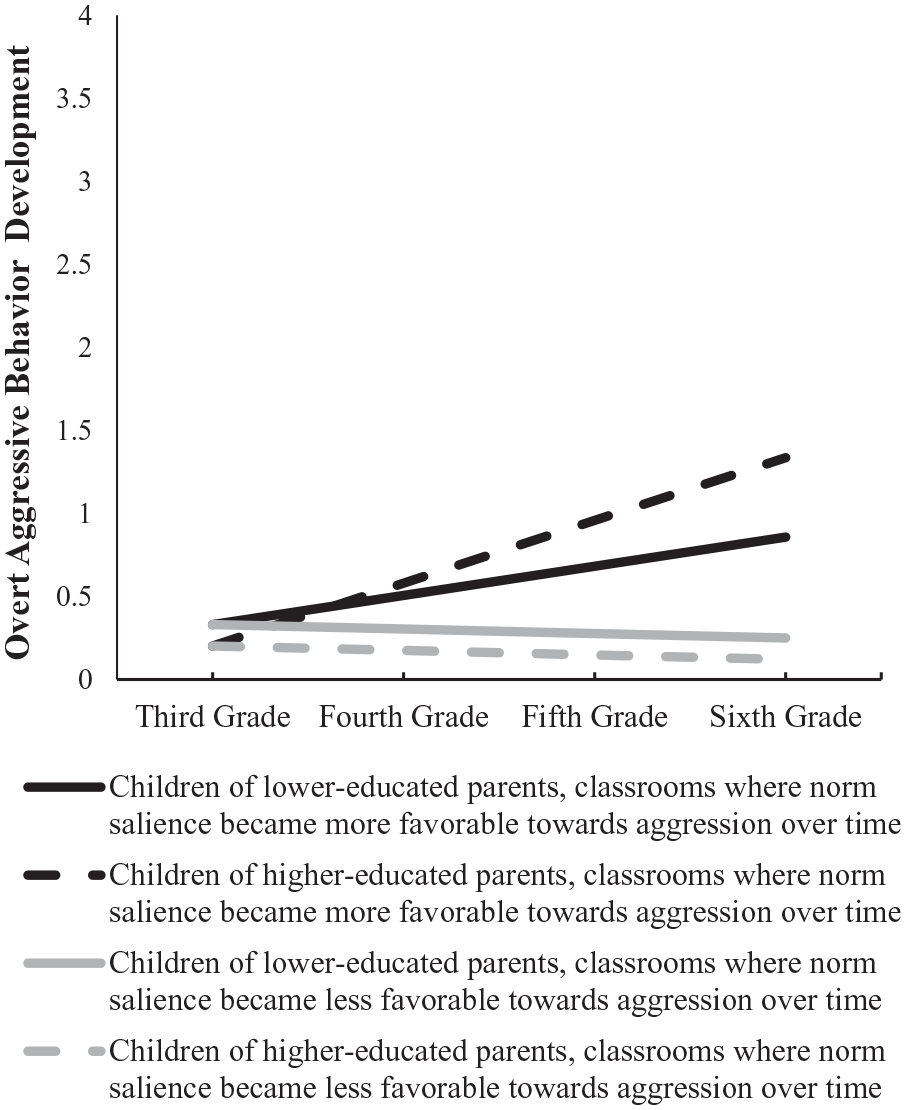
The Cross-Level Interaction Between Parental Education and the Development of Norm Salience Toward Aggression on the Development of Children’s Overt Aggressive Behavior.
The two sensitivity analyses showed no changes in the interpretations of our results (see Supplementary Material, sTables 4 and 5).
Discussion
This longitudinal study investigated whether the development of classroom norm salience toward aggression moderated the association between parental education and children’s overt aggressive behavior development from third to sixth grade of elementary school. It is noteworthy that the results from unconditional models showed that consistent with previous research (Bongers et al., 2004), aggressive behavior levels on average decreased from third to sixth grade. With respect to norm salience, more aggressively behaving children were less socially preferred than less aggressively behaving children in third grade. Although the correlation between aggression and social preference remained negative from third to sixth grade, in general more aggressively behaving children became more socially preferred (i.e., less disliked or more liked) over time. Norm salience in this study was an implicit rather than an explicit norm. Thus, our novel findings show that such implicit classroom norms are already present in elementary school and evolve over time.
The main results of this study showed that norm salience toward aggression in third grade was not a significant moderator of parental education and overt aggressive behavior development, but the rate of change (i.e., development) of norm salience from third to sixth grade was. Thus, the results partly supported the hypotheses. They showed that in third grade, children of lower-educated parents exhibited higher levels of overt aggressive behavior than children of higher-educated parents, independent of the salient norm. Yet, in classrooms where norm salience became more favorable toward aggression over time, the growth rate of overt aggressive behavior differed between children of higher- and lower-educated parents. That is, children of lower-educated parents showed a slower growth rate of overt aggressive behavior levels than children of higher-educated parents from third to sixth grade. In contrast, in classrooms where norm salience became less favorable toward aggression over time, the relative difference found in third grade between children of higher- and lower-educated parents remained stable until sixth grade.
These findings are striking because, in general, research shows that children of lower-educated parents exhibit higher levels or growth rates of aggressive behavior than children of higher-educated parents throughout elementary school (Horoz et al., 2022a). The results of this study showed that while children of lower-educated parents exhibited higher levels of aggressive behavior in third grade, the development of aggressive behavior of children of higher- and lower-educated parents depended upon classroom norm salience. The effect of the interaction was small; thus, results should be interpreted with caution before they are replicated. Nevertheless, results suggest that context may matter: classroom peer context may provoke a faster growth rate of aggressive behavior levels in children of higher-educated parents than in children of lower-educated parents. Thus, results extend the literature by showing that the rate of change of the salient norm in elementary school influences children from different social backgrounds differently. Furthermore, they highlight the context-dependent nature of aggressive behavior development.
Our results lend support to the social-ecological framework, which posits that aggressive behavior development does not only stem from individual (and household) characteristics but also from interactions within broader environmental contexts, such as peer relations, classrooms, and schools (Bronfenbrenner, 1977; Espelage, 2014). The results also supported SIT by showing that the “social force field” had a differential impact on the aggressive behavior development of children of lower- and higher-educated parents. Results indicate that children of higher-educated parents may be more able to adapt their behavior to social norms than children of lower-educated parents. These results are partly supported by a previous study which showed that vulnerable children (i.e., children who were victimized) were less likely to adapt to the classroom norm salience toward risk-taking than less vulnerable children (Tieskens et al., 2019). Furthermore, research has shown that children of higher-educated parents exhibit better skills in social information processing and executive functioning (e.g., Bookhout et al., 2021; Ursache et al., 2016). One might conjecture that they may be more able to process and interpret social cues in their classroom environment, to evaluate and select favorable responses for desired outcomes, and thereby to redirect their behavior toward the salient norm more effectively than children of lower-educated parents. In other words, children of higher-educated parents may be more able to use their resources to take advantage of their environment to gain or maintain social acceptance. This could also suggest that children of higher-educated parents may engage in more proactive aggression rather than reactive aggression and contribute to the salient classroom norm.
It is noteworthy that the development of the norm, but not the norm in third grade, was a significant moderator. This may be due to peers becoming increasingly important from early to middle childhood (Stauffacher & DeHart, 2006), but also to the general increase of norm salience found in this study (unconditional models). It could be that children realize and appreciate the social rewards of behaving aggressively over time. It is also plausible that the social-cognitive skills, which are important for processing and navigating social cues, may not be fully developed in the early elementary school years.
Taken together, our results suggest that classrooms where norm salience became more favorable toward aggression over time may serve as a risk factor for aggressive behavior for all children, but a stronger one for children of higher-educated parents. In contrast, classrooms where norm salience became less favorable toward aggression may serve as a protective factor against aggressive behavior development (for all children). This is because children in these classrooms followed the normative trajectory of decreasing aggression levels, which is similar to previous findings on normative aggression development from early childhood to late adolescence (Bongers et al., 2004).
Implications for Practice and Research
Our findings have several implications for practice and research. School leaders and staff should be keen to note a potential increase in aggression appreciation toward the end of elementary school years (result from unconditional models). Since school-level parental education did not play a role in the development of norm salience, all schools, irrespective of their parental education compositions, should work toward modifying aggression appreciation. For instance, strategies within classrooms that offer meaningful and prosocial roles to children as alternatives to aggressive behavior could be used (see Ellis et al., 2016).
Moreover, our results suggest that aggression may be an adaptive and context-dependent behavior, which can be used as a tool to enhance or maintain social preference within the peer group. From a developmental perspective, our results highlight the dynamic nature of norm salience and aggressive behavior. Thus, results show that in addition to the general recommendation to closely monitor and support children of lower-educated parents, there is also a need to monitor children of higher-educated parents when they are in classrooms where aggression is increasingly valued over time. This is necessary because using aggression as a strategy to gain social acceptance may manifest itself in future risk environments (e.g., involvement with deviant peers). Therefore, early identification and prevention efforts are needed to support children who are at risk of developing aggression in such settings. For instance, prevention efforts could include implementing universal classroom management interventions, like the Good Behavior Game, with proven effectiveness across parental education backgrounds (Horoz et al., 2022b) or could specifically focus on social norms in classrooms (Tolmatcheff et al., 2022). While the need to target social norms in intervention efforts has been acknowledged, it is necessary to investigate whether such interventions have similar benefits for all children, regardless of their social backgrounds.
Furthermore, our results suggest that already in elementary school, children of higher-educated parents may be better at leveraging their resources and maneuvering within their social environments. To better understand the underlying processes in found associations, further research can investigate underlying mechanisms (e.g., skills in social information processing and executive function) that could contribute to the differences in aggressive behavior development between children of higher- and lower-educated parents in classrooms where norm salience became more favorable toward aggression. It would also be insightful to uncover whether the aggressive behavior observed in this study was proactive or reactive in nature.
Limitations and Future Directions
Limitations should be considered when interpreting the findings of this study. First, we used a convenience sample. Compared with the national percentage of low educational attainment in the Netherlands, parents in our study had higher levels of education (Statistics Netherlands, 2018) and the children excluded from our study had on average slightly higher levels of aggressive behavior than included children, which indicates selective attrition. Second, cluster sizes were small. We were not able to study three-way interactions (e.g., Parent Education × Gender × Norm) due to low power. Third, although social preference scores were used in conceptualizing norm salience in previous studies (Brendgen et al., 2013, 2015; Tieskens et al., 2019), other studies operationalized norm salience using popularity scores (e.g., Dijkstra et al., 2008; Laninga-Wijnen et al., 2017, 2020). We were unable to calculate such norms because we did not have data on popularity in this age group. While popularity and social preference are moderately related to each other, they are also distinct (van den Berg et al., 2020). For instance, it was found that in classrooms where more popular children were more aggressive, they were not necessarily liked or accepted (Garandeau et al., 2022). In addition, popularity is primarily related to agentic social goals (Caravita & Cillessen, 2012). When interpreting the results of this study it is important to consider the similarities and differences between these two dimensions of social status. Furthermore, we also did not have child self-report data on aggressive behavior. Fourth, we assumed that salient aggression norms would influence aggressive behavior. When possible, future studies should control for the bidirectional associations and explore the processes behind how the salient aggression norm develops with respect to parental education. Fifth, future studies could explore different types of aggressive behavior used to gain or maintain social benefits, such as relational aggression. Relational aggression refers to the intent to harm or hurt peers’ relationships or social status. It includes behaviors such as ignoring, ostracizing, and gossiping. Relational aggression has been shown to be positively related to popularity but negatively to social preference (Kraft & Mayeux, 2018). As such, future studies could also consider different types of aggressive behavior when operationalizing norm salience and when studying aggression as an outcome, since distinct results could be found (e.g., Correia et al., 2022; Kraft & Mayeux, 2018). Finally, parental education should not be regarded as the sole explanatory factor behind our findings. Due to data unavailability, we were not able to control for factors that are often associated with parental education such as household income, financial stress, and learning materials at home. While our findings provide novel insights, our study should be considered exploratory and calls for replication and further investigation.
Supplemental Material
sj-docx-1-jbd-10.1177_01650254241279794 – Supplemental material for Context matters: Norm salience toward aggression moderates the association between parental education and childhood aggressive behavior development
Supplemental material, sj-docx-1-jbd-10.1177_01650254241279794 for Context matters: Norm salience toward aggression moderates the association between parental education and childhood aggressive behavior development by Nil Horoz, Nienke van Atteveldt, Pol A. C. van Lier, Tanja A. J. Houweling, Joost Oude Groeniger, Frank J. van Lenthe, Hans M. Koot and J. Marieke Buil in International Journal of Behavioral Development
Footnotes
Acknowledgements
We would like to thank all the participating schools, children, teachers, and parents.
Declaration of Conflicting Interests
The author(s) declared no potential conflicts of interest with respect to the research, authorship, and/or publication of this article.
Funding
The author(s) disclosed receipt of the following financial support for the research, authorship, and/or publication of this article: This study was supported by a grant from the Netherlands Organization for Health Research and Development (ZonMw) (project No. 531003013) and by ZonMw Grants #26200002 and #120620029. This study was also supported by the European Research Council (ERC) under the European Union’s Horizon 2020 research and innovation program (grant numbers 646594 and 648082), the Netherlands Organization for Scientific Research, program medium sized investments (grant number 480-13-006) and the Netherlands Organization for Health Research and Development, program Youth (grant number 15700.4001). T.A.J.H. was funded through a grant awarded by the Norwegian Research Council (project number 288638) to the Center for Global Health Inequalities Research (CHAIN) at the Norwegian University for Science and Technology (NTNU).

Supplemental Material
Supplemental material for this article is available online.
References
Supplementary Material
Please find the following supplemental material available below.
For Open Access articles published under a Creative Commons License, all supplemental material carries the same license as the article it is associated with.
For non-Open Access articles published, all supplemental material carries a non-exclusive license, and permission requests for re-use of supplemental material or any part of supplemental material shall be sent directly to the copyright owner as specified in the copyright notice associated with the article.
