




Abstract
Executive functions (EF) and task persistence are key factors in academic development. However, EF and persistence have rarely been examined together, and it remains unclear whether these two constructs are independently related to intellectual development. The present study addressed this gap by examining whether EF and persistence in kindergarten predict math and reading achievement in second grade. We assessed 88 children (51% female; mean age = 73.4 months) on EF and persistence tasks at T1 and obtained teacher ratings of their academic competence at T2 (mean age = 94.6 months). Regression analyses showed that both EF and persistence predicted math achievement, but only EF predicted reading achievement. To sum up, our findings suggest that persistence may be particularly relevant for math, reflecting the ability to endure and sustain. These are skills that are typically not captured by EF measures. Consequently, early interventions should target EF and persistence to support children’s mathematical potential.
The classroom environment poses significant challenges for self-regulation. Typically, the child must pay attention, avoid distractions, and work autonomously. These essential self-regulation skills, which include executive functions (EF) and persistence, are critical to academic achievement. Existing studies have separately identified EF and persistence as key predictors of academic success (Mokrova et al., 2013; Spiegel et al., 2021). Yet, persistence and EF’s combined and unique contributions to educational outcomes remain largely unexplored. To address this gap, we assessed EF and task persistence in kindergarten and examined their long-term relationship with math and reading achievement in second grade. Understanding how these constructs contribute to academic growth is essential for developing tailored interventions to support children to reach their full academic potential.
EF refer to a set of neurocognitive control processes that modulate goal-directed behavior (Bailey & Jones, 2019). Persistence is defined as the enduring ability to engage in a task to achieve a challenging goal (McCall, 1995). Theoretically, EF and persistence are rooted in different theoretical research traditions. Whereas EF has its roots in neurocognitive research (e.g., Zelazo & Müller, 2002), the origin of persistence lies in temperament research (Rothbart & Bates, 2006). Conceptually, there is an overlap between EF and persistence: (a) both constructs involve the ability to resist distraction and stay focused (Diamond, 2013; McWayne et al., 2004); (b) both constructs modulate attention (Lunkenheimer et al., 2019; Zelazo, 2020); and (c) both are critical learning-related behaviors (Bailey & Jones, 2019; Li-Grining et al., 2010). Thus, although there is a clear conceptual overlap between EF and persistence, it is assumed that there is a critical aspect of persistence that EF does not capture. This aspect refers to the ability to sustain or maintain a behavior in the face of a challenge.
Most studies that study both EF and persistence report a positive relationship, thereby confirming the conceptual and theoretical overlap. For example, studies using behavioral measures of persistence and EF have found a significant positive association between persistence and EF (Lunkenheimer & Wang, 2017; Oeri et al., 2020). Similar associations between EF and persistence have also been reported for teacher ratings of persistence and EF (Berhenke et al., 2011; Vitiello et al., 2011). In some studies, however, no relationship between persistence and EF has been found (Torgrimson et al., 2021). Furthermore, when studies find a significant relationship between EF and persistence, the low to moderate coefficients suggest construct specificity. More precisely, while there is a partial overlap between EF and persistence (theoretically and empirically), the magnitude of the correlation coefficients suggests they are complementary and include unique aspects. However, it remains largely unknown whether the two constructs uniquely predict academic achievement.
The relationship between EF and academic achievement has been extensively studied, with previous research providing robust evidence for a relationship between EF and educational outcomes (for a meta-analysis, see Cortés Pascual et al., 2019; Spiegel et al., 2021). For example, EF skills in early childhood have been found to predict school readiness in math and reading (e.g., Blair & Razza, 2007). In addition, a meta-analysis of children aged 3 to 18 years revealed concurrent and predictive moderate associations between EF and academic achievement. These associations were similar across age groups, EF subcomponents, and measurement types (Jacob & Parkinson, 2015). Furthermore, a longitudinal study showed that EF deficits in kindergarten were associated with a higher risk of developing domain-general academic difficulties in elementary school (Morgan et al., 2019).
There is less research on the relationship between persistence and academic achievement. Nevertheless, existing studies have consistently demonstrated that persistence is associated with school readiness and academic achievement (Berhenke et al., 2011; Mercader et al., 2017; Mokrova et al., 2013). More specifically, persistence has been linked to reading comprehension, reading fluency (Mägi et al., 2018), and reading growth from kindergarten to third grade (Newman et al., 1998). Persistence has also been linked to math skills (Schmerse, 2020) and math achievement trajectories (Li-Grining et al., 2010). Longitudinal data further indicate that persistence in childhood is associated with academic trajectories that extend into adolescence (Andersson & Bergman, 2011). Together, these findings highlight the significant roles that EF and persistence play in academic development when investigated separately.
Very few studies have examined persistence, EF, and academic achievement in a single analysis. Two studies with preschool samples found that persistence did not predict improvements in school readiness (Vitiello & Greenfield, 2017) or academic achievement (Brock et al., 2009) beyond the effect of EF. These findings suggest that persistence may not play a unique role in academic development. However, both studies assessed persistence using teacher ratings, whereas EF was measured with behavioral tasks, increasing the risk of a methodological confound. In their review, Toplak et al. (2013) argue that behavioral, performance-based measures and rating measures might not accurately capture the same aspects of a skill. Consequently, it is crucial to ensure methodological consistency in measuring EF and persistence when investigating their simultaneous effects.
Taken together, despite recognizing conceptual and empirical overlaps and distinctions between EF and persistence, the question remains whether there are facets of persistence that lie beyond the scope of EF independently contributing to intellectual development. Investigating this question is crucial in determining the potential need for greater emphasis on persistence to foster academic growth. In the past two decades, EF has become a prominent target of preschool interventions aiming to promote academic skills (Mattera et al., 2021). However, if persistence is found to independently contribute to academic skills, integrating persistence into such interventions becomes crucial. Put differently, to comprehensively enhance academic skills, identifying self-regulatory constructs that uniquely contribute to academic development is necessary.
To address this issue, the current longitudinal study aimed to examine the specific contributions of task persistence and EF to academic achievement in children aged 5–8 years. During this age range, self-regulation skills develop rapidly (Carlson, 2016; Montroy et al., 2016), and interventions are frequently implemented (Muir et al., 2023). It is also the age at which children in Switzerland transition from kindergarten to formal schooling. Therefore, it is crucial to understand this period. Children were tested twice. At the first measurement point in kindergarten, they completed a behavioral persistence task and two EF tasks that captured the subcomponents of inhibition and working memory. We chose these two subcomponents because they are assumed to develop before the third component, shifting. Research suggests that shifting requires and builds on inhibition and working memory (Garon et al., 2008). At the second measurement point in Grade 2, teachers rated children’s math and reading competence. Based on previous research that established a robust link between EF and academic skills, our first hypothesis was that EF in kindergarten would predict math and reading achievement in second grade. Given that a conceptual and empirical distinction between EF and persistence could be established, and both constructs were assessed using behavioral tasks to maintain methodological congruency, our second hypothesis was that persistence, beyond the effects of EF, would predict math and reading achievement in second grade.
Methods
Participants
The sample consisted of N = 88 children (51 % female). Only children who completed assessments at both measurement points were included in the current study. The attrition rate between measurement points was 14%. Children were recruited from nine public kindergartens in urban and rural areas of Switzerland. At the first measurement point (T1), children attended kindergarten and were between 5 and 6 years old (M = 73.4 months, SD = 4.8 months). At the second measurement point (T2), children attended second grade and were between 7 and 8 years old (M = 94.6 months, SD = 4.3 months). The interval between T1 and T2 ranged from 17 to 24 months (M = 21.2 months). The children’s parents (mothers and fathers) had different educational backgrounds: 31.0% of mothers versus 35.3% of fathers had a university degree; 28.6% of mothers versus 28.2% of fathers had a University of Applied Sciences diploma; 2.4% of mothers versus 4.7% of fathers had a higher education entrance qualification; 35.7% of mothers versus 29.4% of fathers had completed vocational training; and 2.4% of both mothers and fathers had completed compulsory schooling (9 years). The parents in our sample were, on average, more highly educated than the general population. Mother’s and father’s education was multiplied and used as a proxy for socioeconomic status (SES) in the analyses. The Faculty Ethics Committee approved the study (Approval No. 2017-04-00006).
Procedure
Before testing, parents provided written informed consent, and children provided verbal consent. Trained experimenters assessed the children individually in a quiet room at their kindergarten or school. The two computer-based EF tasks were administered on a tablet (Lenovo, Yoga Tab 3 Pro) using OpenSesame software (Mathôt et al., 2012). Children were thanked for their cooperation and given a small gift at the end of the testing.
Measures
Persistence
Task persistence at T1 was measured using the Puzzle Box task (Eisenberg et al., 1996). In this task, a wooden puzzle was placed in a box with a curtain covering it. Children had to slip their arms through sleeves to access the puzzle. They could easily cheat by lifting the curtain and looking at the puzzle. The instructions were to complete the puzzle within 5 minutes without looking, and to call the experimenter if they completed it earlier. The experimenter left the room, and two hidden cameras recorded the children’s behavior. Persistence was coded as the time (in seconds) that the child spent trying to solve the puzzle. The persistence variable was calculated by dividing the persistence time by the total task time. Interrater reliability was very high (ICC = .99).
Inhibition
A computerized version of the Fruit Stroop Task (Archibald & Kerns, 1999) was used to assess inhibition at T1. The task consisted of 3 blocks, each comprising 24 trials. In each trial, a target stimulus was presented for 1 second, followed by four colors (green, yellow, blue, red) appearing on the screen. Children were instructed to touch the corresponding color on the screen as quickly as possible. In the baseline block, colored squares were presented as target stimuli. In the congruent block, four different fruits and vegetables appeared as target stimuli in their original color. In the third block, the same fruits and vegetables were presented in incongruent colors. Children were asked to choose the original color (i.e., the color of the fruit or vegetable in real life). The dependent variable was the accuracy of the incongruent block.
Working Memory
Working memory was assessed using a backward color span task (Zoelch et al., 2004). The task was embedded in a story about a dwarf who loses colored disks. Sequences of colored disks appeared on a tablet screen, with each color being presented for 1 second, and children were asked to recall the colors in reverse order. Only colors with monosyllabic names were chosen. After three practice trials, each child began with a two-item sequence. If the child correctly recalled three of the six sequences at a given level, the sequence length increased by one item. The dependent variable was the total number of correctly recalled sequences. In the analysis, we used a sum score of EF, including inhibition and working memory performance. The sum score was built by adding the z-scores for both variables.
Academic Achievement
In second grade, teachers reported children’s academic performance in reading and math on a 4-point scale of not meeting, partly meeting, meeting, and exceeding learning goals. A higher score indicated better performance. It is important to note that in Switzerland, formal schooling (instruction in reading and math) begins in first grade, not in kindergarten.
Statistical Analysis
Missing values were imputed using multiple imputation techniques with the R packages missMDA (Josse & Husson, 2016) and FactoMineR (Lê et al., 2008). Occasionally, children’s motor difficulties or technical difficulties distorted reaction times in the Stroop task. Therefore, they were excluded if reaction times were less than 150 ms or deviated more than three standard deviations from the subject’s mean reaction time. This applied to 2.1% of all reaction times. Data analysis was performed with Jamovi 1.6 (The Jamovi Project, 2022) running on R (R Core Team, 2021).
First, bivariate correlations were calculated to examine the relationship between EF, persistence, and academic achievement. In addition, gender, age, and time since the first assessment were included in the correlation analysis. Second, multiple regression analyses were conducted to predict academic achievement. Variables that were significantly correlated with the dependent variables were included as control variables in the regression analyses. Data, materials, and analysis code for this study are available by e-mailing the corresponding author.
Results
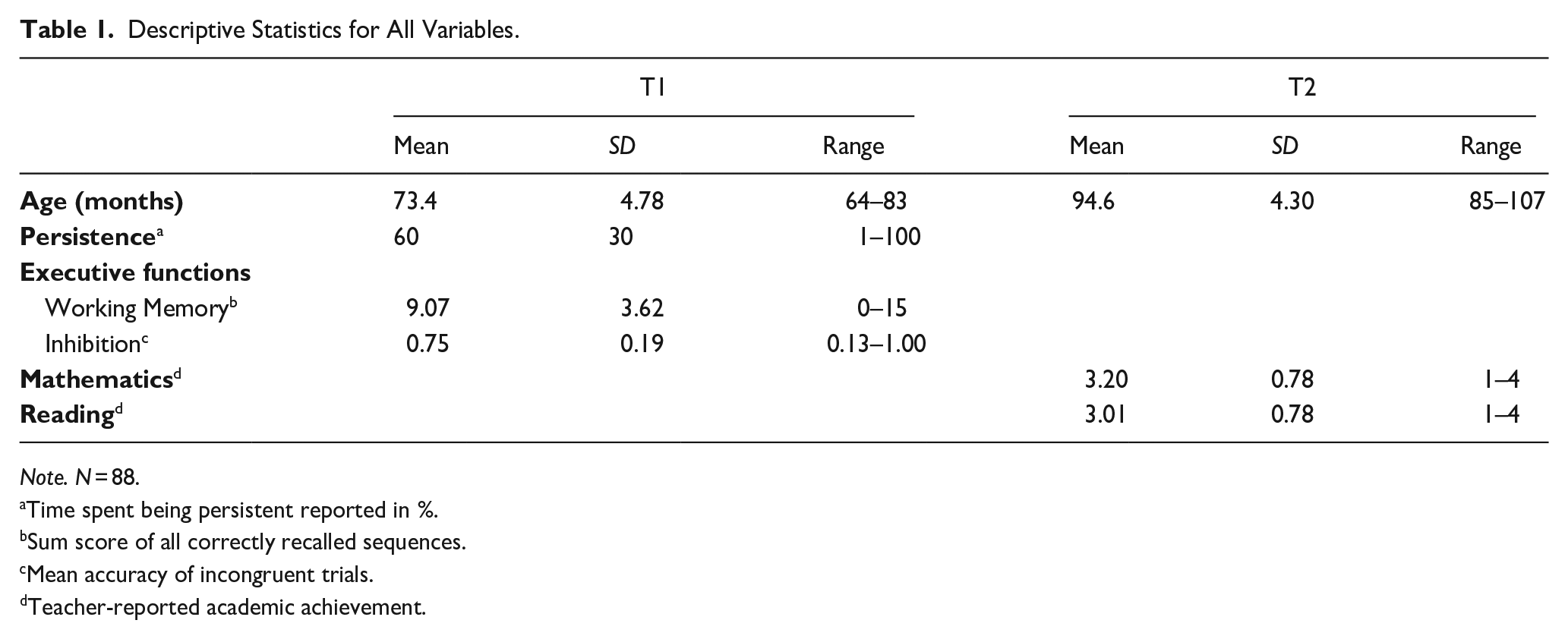
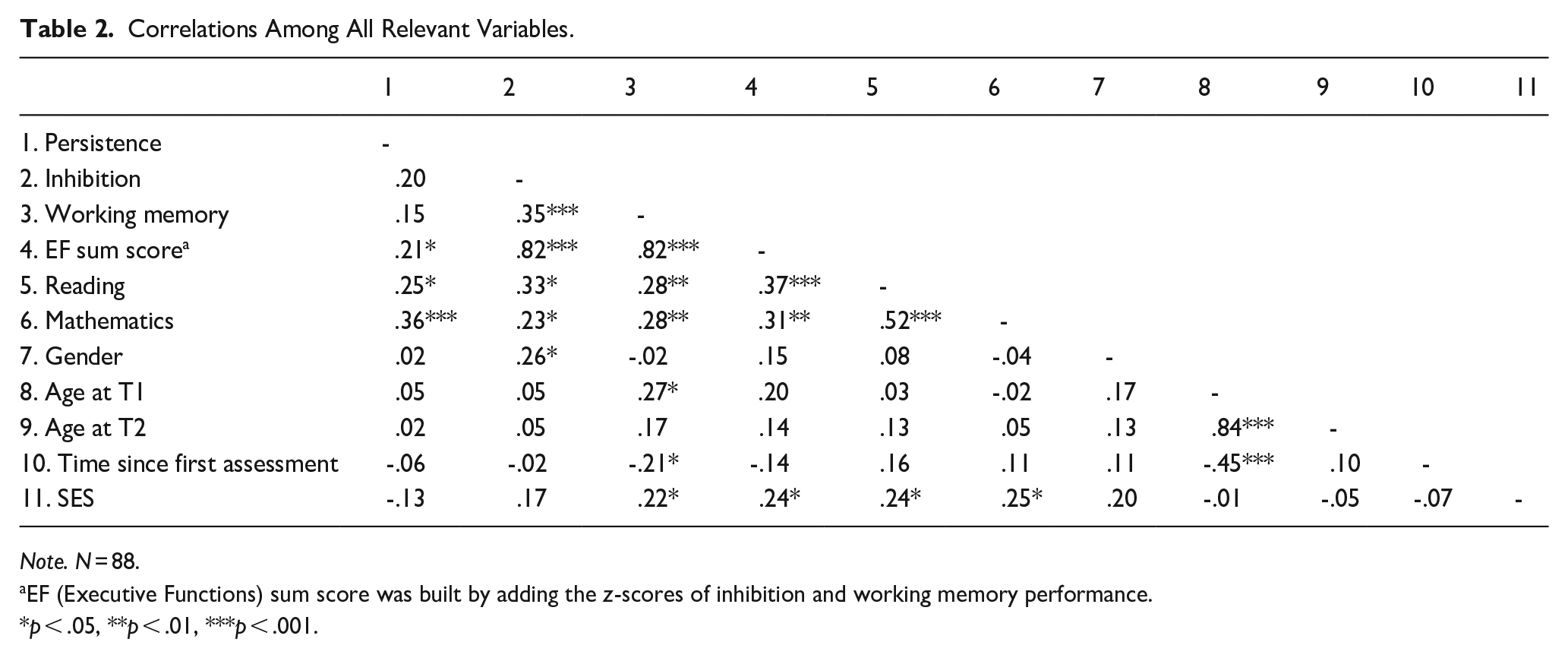
Table 1 shows the descriptive statistics for all variables. Table 2 presents correlations between all variables. Persistence and EF in kindergarten were significantly and positively related to second grade math and reading achievement. Math and reading achievement were also significantly and positively correlated. However, persistence did not show a significant correlation with EF, either for the sum score or for the subcomponents. We controlled for gender, age at T1, and SES in the subsequent regression analyses because they showed at least one significant association with one of the dependent variables.
Descriptive Statistics for All Variables.
Note. N = 88.
Time spent being persistent reported in %.
Sum score of all correctly recalled sequences.
Mean accuracy of incongruent trials.
Teacher-reported academic achievement.
Correlations Among All Relevant Variables.
Note. N = 88.
EF (Executive Functions) sum score was built by adding the z-scores of inhibition and working memory performance.
p < .05, **p < .01, ***p < .001.
Prediction of Academic Achievement
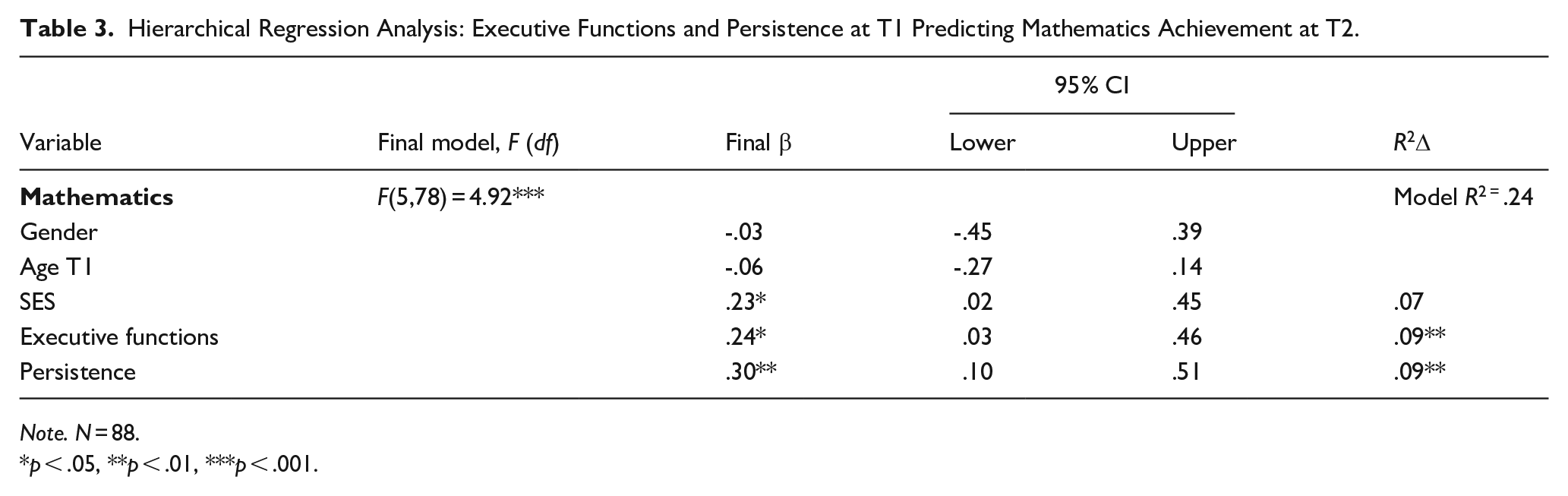
Hierarchical multiple regression analyses were computed to test the unique predictive contributions of EF and persistence to academic skills (see Tables 3 and 4). First, the control variables (gender, age at T1, and SES) were entered into the analysis. Then, EF and persistence were entered separately. The results showed that both EF and persistence significantly predicted second-grade math achievement after controlling for the effects of gender, age, and SES. The model explained 24% of the variance in math achievement. EF and persistence each accounted for 9% of the variance, while the control variables accounted for 7% of the variance. SES was the only significant predictor among the control variables.
Hierarchical Regression Analysis: Executive Functions and Persistence at T1 Predicting Mathematics Achievement at T2.
Note. N = 88.
p < .05, **p < .01, ***p < .001.
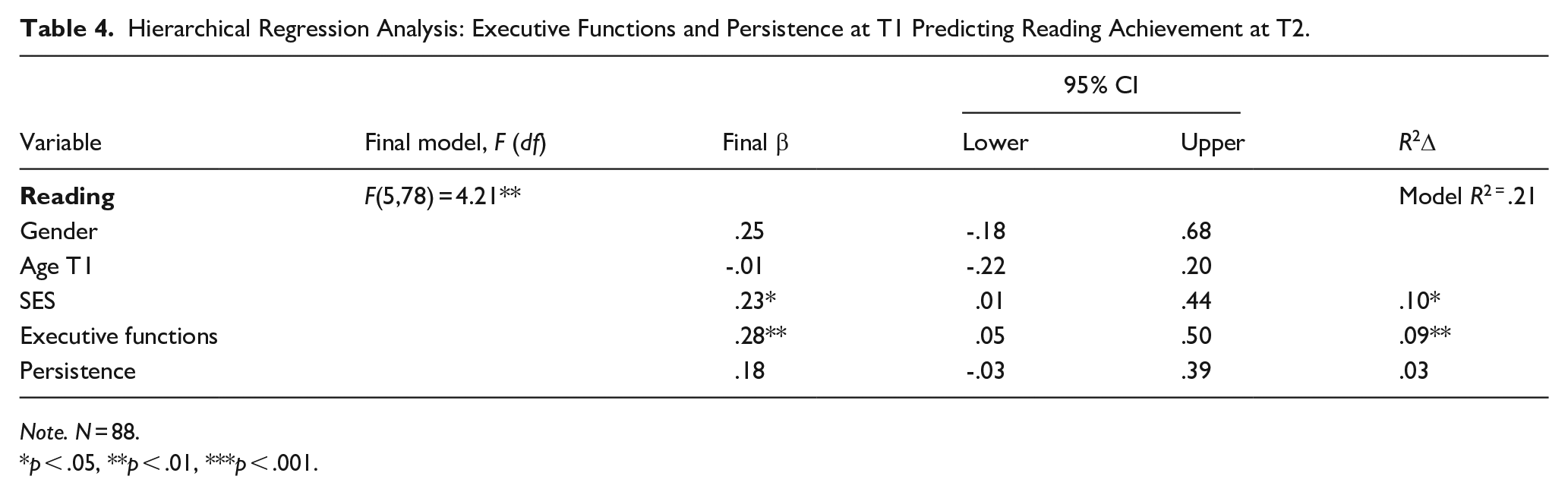
Hierarchical Regression Analysis: Executive Functions and Persistence at T1 Predicting Reading Achievement at T2.
Note. N = 88.
p < .05, **p < .01, ***p < .001.
For reading skills, the results were different. Regression analysis showed that only EF, but not persistence, significantly predicted reading achievement. Of the control variables, SES was the only significant predictor of reading achievement. The model explained 21% of the variance in reading achievement. EF accounted for 9% of the variance, while the control variables accounted for 10% of the variance.
Discussion
This study examined the longitudinal relationship between self-regulation skills (persistence and EF) in kindergarten and academic achievement in second grade. The aim was to investigate whether aspects of persistence can be differentiated from EF by uniquely contributing to intellectual development. We hypothesized that persistence and EF would be independently related to academic achievement. Our hypothesis was supported only for math achievement but not for reading achievement. Specifically, persistence and EF were significant predictors of math achievement in second grade. However, for reading achievement, EF was a significant predictor. In addition, as expected from prior research (e.g., Reardon, 2011), children’s socioeconomic background significantly predicted academic achievement. Beyond SES, the associations between EF, persistence, and academic achievement were significant, strengthening the robustness of the findings.
Previous research has shown that EF are essential for academic development (for a recent review and meta-analysis, see Cortés Pascual et al., 2019). Our findings are consistent with previous research: First, the correlation analysis showed that EF in kindergarten was significantly associated with math and reading achievement in second grade. Second, the regression analysis showed that EF was a significant predictor of math and reading achievement after controlling for gender, age, SES, and persistence.
The contribution of persistence to academic achievement was less straightforward in the current study. Confirming previous research, the correlational analyses revealed that persistence in kindergarten was positively related to math and reading in second grade (Mokrova et al., 2013). However, when both EF and persistence were included in the same analysis, the results showed that persistence was only a significant predictor of math achievement but not reading. Our findings on math achievement contradict previous studies that found persistence did not contribute to math achievement (Brock et al., 2009) or math gains (Vitiello & Greenfield, 2017) after accounting for EF. However, these studies measured persistence using a teacher-rated questionnaire and combined persistence with other learning-related behaviors (as a composite score). These measurement differences between the present study and previous studies may explain the discrepancy in findings.
The present findings suggest that persistence may be an important aspect of math development beyond the cognitive executive control processes of EF. Learning math requires the ability to persist in a task. Typically, math learning requires a substantial amount of endurance because children are repeatedly confronted with high levels of uncertainty about how to solve problems. These skills transcend inhibition and working memory and may be better captured by a behavioral persistence task such as the Puzzle Box task. Why is this important? Research shows that children differ in their math skills as early as kindergarten, and this gap tends to widen throughout elementary school (e.g., Burchinal et al., 2011). It is, therefore, essential to know how to support children with difficulties from a very early age. However, a comprehensive systematic review of intervention research on EF (Diamond & Ling, 2020) found limited evidence of long-term benefits for EF. Thus, interventions that target persistent behaviors by supporting children to use different strategies to develop a more persistent approach to tasks may be a potential avenue for future intervention research. Indeed, findings from one study support this hypothesis: DeFlorio et al. (2019) conducted a math intervention study and found that the intervention only affected persistence, but not inhibition. Thus, it seems essential to consider persistence when developing future intervention programs for young children to improve their math skills.
It is important to note that learning to read also requires practice and endurance. However, we did not find a substantial link between persistence and reading beyond EF. A possible reason may be that reading instruction in the early school years is typically teacher-directed and code-focused, in contrast to later child-directed, meaning-focused reading, such as self-paced reading (Sonnenschein et al., 2010). Thus, teachers’ close supervision of children learning to read may require less persistence. Regarding reading, it is possible that persistence becomes increasingly important as children progress through school.
Surprisingly, EF and persistence were not significantly correlated in the present study. One possible reason could lie in including working memory as a subcomponent of EF in the current study. Previous research has mainly included cognitive flexibility and inhibition but not working memory. Indeed, Oeri et al. (2020) found no significant relationship between persistence and working memory, whereas the EF subcomponents inhibition and cognitive flexibility were significantly related to persistence. An alternative explanation could be that the relationship between EF and persistence was affected by a third variable, such as motivational beliefs. Torgrimson et al. (2021) found that the association between persistence and response inhibition depended on children’s motivational beliefs. Thus, it would be critical for future research to include motivation or interest as a control variable when examining the specific contributions of EF and persistence to academic achievement.
Several constraints limit the current findings: First, the present study used a general, teacher-based estimation of children’s reading ability. A more standardized reading task that captures different aspects of reading ability would have provided more information about the relationship between EF, persistence, and reading. Second, although parents reported different levels of education, most children in our sample came from relatively high socioeconomic backgrounds. The composition of the sample may limit the generalizability of our findings. To further understand the role of EF and persistence on academic achievement, examining such relationships in a more diverse sample is crucial. Third, a methodological limitation of our study is the small sample size, which may affect the findings’ external validity and statistical power. The low power of our analysis may have resulted in some null effects, which are inconsistent with previous literature. Fourth, although previous research suggests a reciprocal relationship between EF and academic achievement, we only assessed each construct at one point in time. One reason for this was that in Switzerland, formal schooling begins in first grade, making it difficult to assess academic achievement in kindergarten. Nevertheless, it would be important for future research to address this limitation for a more comprehensive understanding of the relationship between EF, persistence, and academic achievement.
In conclusion, our results indicate that both persistence and EF are crucial skills for math development. Contrary to our expectations, only EF, but not persistence, were related to second-grade reading proficiency. To gain a better understanding of the unique contributions of EF and persistence in reading, future research should disaggregate the reading variable into sub-skills, such as letter knowledge and fluency. Our findings further suggest that the development of mathematical skills requires repetition and endurance, in addition to the cognitive control processes of EF. Therefore, early school-based interventions should not only promote EF but also target task persistence, which may provide a potential avenue to support children in reaching their full mathematical potential.
Footnotes
Acknowledgements
We thank all participating children and their parents and teachers for their cooperation. Furthermore, we thank all research assistants for their help with data collection and behavioral coding.
Data Availability Statement
Data, materials, and analysis code for this study are available from the corresponding author, upon reasonable request.
Declaration of Conflicting Interests
The author(s) declared no potential conflicts of interest with respect to the research, authorship, and/or publication of this article.
Funding
The author(s) received no financial support for the research, authorship, and/or publication of this article.
Preregistration
This study was not preregistered.
