




Abstract
The positive links between children’s theory of mind (ToM), emotion understanding, and positive peer relationships are well established. However, the existing literature lacks comprehensive studies investigating the longitudinal interplay between these components in preschool-aged children. This study aimed to fill this gap by examining the concurrent and longitudinal associations between young children’s social cognition and their positive peer relationships at three different time points over the course of 7 months. A sample of 211 preschool children (age in months: MT1 = 43.2, SDT1 = 6.6) underwent standardized assessments evaluating their ToM and emotion understanding, while playgroup educators reported on children’s positive peer relationships. Using multivariate latent growth modeling, we expected to find that higher levels of ToM and emotion understanding would be associated with a greater rate of change in positive peer relationships and that higher levels of positive peer relationships would be associated with a higher rate of change in ToM and emotion understanding. Contrary to our expectations, the results did not support the anticipated longitudinal associations. Nevertheless, a noteworthy correlation emerged between children’s emotion understanding and positive peer relationships at T1, in line with previous research and social-constructivist theories.
Social cognition is the process by which individuals interpret, retain, and apply information in social contexts to comprehend and predict human behavior (Fiske & Taylor, 2013). This study focused on two critical aspects of social cognition: Theory of Mind (ToM) and emotion understanding (Fabes et al., 2006). ToM is the “ability to attribute mental states to oneself and others and to understand that others have beliefs, desires, intentions, and perspectives that are different from one’s own” (Premack & Woodruff, 1978, p. 525). Similarly, emotion understanding refers to the ability to comprehend both one’s own and others’ emotions (de Rosnay et al., 2008). Understanding the minds and emotions of others is essential for children’s success in social interactions (Banerjee et al., 2011; Cassidy et al., 2003; Denham et al., 2003; Fabes et al., 2006; Fink et al., 2014), their psychological well-being (Bailey Bisson, 2019; Eggum et al., 2011), and their present and future adjustment (Davis et al., 2014; Hay et al., 2004; Ladd et al., 2008; Lecce et al., 2017). But social behavior is not a static outcome of social cognition; instead, it is actively created by the individual in interaction with their environment in any given situation (Chaplin, 2015; Singer, 2016). In turn, the emerging behaviors and social interactions also shape social cognition (Carpendale & Lewis, 2004; Fabes et al., 2006), as reflected in social-constructivist (Chaplin, 2015; Singer, 2016) and social information processing (Cillessen & Bellmore, 2022; Crick & Dodge, 1994) theories of social competence and adjustment. For example, Perren and Malti’s (2008) tri-factor model proposes a continuous interaction between mental processes (e.g., social cognition), social behavior, and relationship quality.
Although children’s ToM and emotion understanding tend to improve with age (Pons & Harris, 2005; Wellman & Liu, 2004), individual differences exist in the rate of development. From a social constructivist perspective, these individual differences arise from differences in social experiences (Carpendale & Lewis, 2006). Consequently, those who actively interact with their parents, caregivers, siblings, or peers tend to acquire a more sophisticated social understanding (Carpendale & Lewis, 2004). For instance, Devine and Hughes (2018) discovered links between children’s false belief understanding, parental mental state talk, parental mind-mindedness, and the number of siblings. Similarly, Tompkins and colleagues (2018) found a small yet significant correlation between parental cognition and emotion talk and children’s social understanding up to age 7. Children’s social cognition can also be influenced by maternal education, linguistic competence (Bulgarelli & Molina, 2016), and the quality of interaction with parents and older siblings (Derksen et al., 2018). It is important to emphasize that it is the quality, instead of the mere presence, of interactions that shape children’s social-cognitive development (Barr, 2008). For example, studies have shown that infant or teenage siblings do not have an effect on preschoolers’ ToM development, while siblings close in age do (Peterson, 2000).
While many authors focus on adult-child relationships (Carpendale & Lewis, 2006; Devine & Hughes, 2018; Hughes & Leekam, 2004), others have emphasized the interactions between children’s peer relationships and social cognition (Banerjee, 2004; Zerwas et al., 2004). Interactions with peers offer a distinct dynamic compared with those with family members, partly because engaging with peers is a matter of personal choice and as such, it relies substantially on children’s skills, attitudes, and distinct qualities (Rubin et al., 1998, as cited by Fabes et al., 2006). Consistently with this, Zerwas and colleagues (2004) argue that in routine everyday interactions with adults who themselves have strong theory of mind skills, children have little need to interpret the adults’ mental states, because the interactions are predictable anyway—in contrast to interactions with peers which tend to be more unpredictable. According to Zerwas and colleagues (2004), this unpredictability fosters genuine collaboration and plays an important role in early social development by providing challenges and unique opportunities for a deeper understanding of others.
To sum up, children’s ToM and emotion understanding can foster positive peer relationships (Caputi et al., 2012; Eggum et al., 2011; Fink et al., 2014). Conversely, positive peer relationships provide an opportunity to learn social-emotional skills such as empathy, collaboration, and problem-solving strategies (Pepler & Bierman, 2018). Although many studies have found an association between children’s ToM, emotion understanding, and positive peer relationships (Banerjee et al., 2011; Cassidy et al., 2003; Denham et al., 2003; Peterson & Siegal, 2002), less is known about how these variables change and interact over time. Furthermore, while some longitudinal investigations focus on emotional knowledge and its connection to peer likability, they neglect the specific role of children’s ToM (Sette et al., 2017). In addition, studies such as Caputi and colleagues (2012) have used aggregate ToM measures, making it challenging to discern individual contributions of ToM and emotion understanding. Notably, a substantial portion of these studies predominantly target children above five (Banerjee et al., 2011; Bosacki, 2015; Caputi et al., 2012; Devine et al., 2016; Diesendruck & Ben-Eliyahu, 2006; Fink et al., 2014; Pons & Harris, 2005), leaving a notable gap in our knowledge regarding younger age groups. Thus, the existing literature does not provide a comprehensive exploration of the longitudinal dynamics between children’s social-cognitive development and positive peer relationships. It is essential to note, however, that one of the most important milestones of social cognition, namely the understanding of false beliefs, occurs between the ages of 3 and 5 years (Wellman et al., 2001), a period during which children’s peer interactions increase as well (Banerjee et al., 2011; Fabes et al., 2006). Therefore, this study aimed to address this gap by investigating the longitudinal association between children’s social cognition, specifically their ToM and emotion understanding, and their positive peer relationships.
Children’s ToM and Positive Peer Relationships
The correlation between children’s ToM and their positive peer relationships is a topic of significant interest (for a review, see Hughes & Leekam, 2004), firmly rooted in the social constructivist perspective (Carpendale & Lewis, 2006). This perspective highlights the dynamic interplay between ToM development and social interactions (Astington & Jenkins, 1995; Carpendale & Lewis, 2004; Carpendale & Lewis, 2006; Dunn, 1996; Nelson, 1996), suggesting that children’s ToM should be closely intertwined with their active engagement in social interactions (Caputi et al., 2012). Supporting evidence for this perspective comes from studies demonstrating that children who share positive relationships with their parents (Meins et al., 2002; Ruffman et al., 1999) and siblings (Dunn et al., 1991; Hughes et al., 2006) perform better on ToM tasks. This effect is likely to extend to peer relationships (Banerjee et al., 2011), which represent a significant context in children’s social development before (Brown et al., 1996; Hughes & Dunn, 1997) and during their school years (Ladd, 1999).
Peer relationships serve as a fertile ground for both social and cognitive development in children (Vaughn & Santos, 2009). Children often share their inner thoughts and intentions more readily with peers than with their mothers, particularly during pretend play (Hughes et al., 2010; Smiley, 2002). As young children expand their social horizons in early childhood, their play and interactions become more intricate. As discussed above, the relative unpredictability of peer interactions in contrast to interactions with adults make it necessary for children to rely on their social-cognitive skills to understand the situation and act appropriately (Fabes et al., 2006). These interactions allow children to explore different perspectives (Banerjee, 2004; Zerwas et al., 2004) and develop socio-behavioral skills, such as sharing, empathy, and turn-taking (Eisenberg et al., 2006). Even conflict can provide an opportunity for children to actively employ their social-cognitive skills, including the use of mental state language, to influence and shape their social relationships (Comparini et al., 2014).
Empirical studies consistently demonstrate a positive correlation between children’s ToM abilities and peer acceptance, alongside a negative association between ToM and peer rejection (Banerjee & Watling, 2005; Slaughter et al., 2002). Children with well-developed ToM skills understand and navigate social situations more effectively, thereby fostering positive peer interactions (Slaughter et al., 2002). Conversely, those with less developed ToM skills may find it challenging to empathize with their peers, potentially leading to misunderstandings, conflicts, or difficulties in forming positive peer interactions. Moreover, longitudinal studies have provided robust evidence for the significance of individual differences in ToM for children’s peer status (Lecce et al., 2017). Consequently, children with advanced ToM abilities are more likely to be popular and well-liked by their peers compared with those with lower ToM skills, largely due to their adeptness in comprehending their peers’ feelings, intentions, and thoughts (Diesendruck & Ben-Eliyahu, 2006; Slaughter et al., 2002, 2015). Similarly, peer rejection can further hinder ToM development because of reduced social interaction opportunities (Carpendale & Lewis, 2006). Nonetheless, the relationship between children’s ToM and peer relationships appears less robust when additional variables such as age, language skills, or gender are controlled for (Devine & Hughes, 2013; Kuhnert et al., 2017). In addition, there are findings indicating that the association between children’s ToM and peer relationships is mediated by prosocial behavior (Caputi et al., 2012; Wang et al., 2019).
In addition to the pathways from ToM to peer relationships, peer interactions also contribute to children’s ToM development (Slaughter et al., 2002). Through social interactions, children learn and refine their cognitive abilities, including ToM (Slaughter et al., 2002). For example, children with at least one close friend (Fink et al., 2014; Peterson & Siegal, 2002) or many friends (Wright & Mahfoud, 2012) tend to perform better on ToM tasks than those without friends or with fewer friends. Furthermore, complex social interactions necessitate a greater understanding of others’ thoughts and feelings, thereby facilitating the development of ToM (Zerwas et al., 2004). In summary, the association between children’s ToM and positive peer relationships appears bidirectional (Banerjee et al., 2011; Slaughter et al., 2002).
Children’s Emotion Understanding and Positive Peer Relationships
The understanding of emotions plays a pivotal role in shaping social competence (Fabes et al., 2006) and influencing how individuals engage with their peers (Cassidy et al., 2003). In early childhood, there is a notable surge in emotional comprehension. Children become increasingly proficient at identifying, labeling, and comprehending emotions in themselves and others (Saarni, 1999, as cited by Fabes et al., 2006). This progress equips them with enhanced skills for navigating social interactions as they gain a deeper grasp of emotional cues and their implications (Lemerise & Arsenio, 2000). Understanding others’ emotions also fosters appropriate responses and promotes cooperative and empathic behaviors, crucial aspects of social competence, especially during the expansive social experiences of early childhood (Eisenberg & Fabes, 1998, as cited by Fabes et al., 2006).
Children’s emotion understanding is consistently linked to socially appropriate behaviors, such as cooperation, helping others, and initiating and maintaining social relationships (Denham, 1998; Denham et al., 2003, 2013; Izard et al., 2001; Mostow et al., 2002; Trentacosta & Fine, 2010). For example, Denham and colleagues (2003) found that children who are adept at recognizing the emotional expressions of their peers are more likely to engage in positive interactions and be viewed as enjoyable playmates. Consequently, children’s ability to recognize and interpret emotional cues and nonverbal gestures can significantly impact their popularity among peers (Boyatzis & Satyaprasad, 1994).
While emotional knowledge is crucial to children’s ability to develop positive peer relationships, peer relationships, in turn, provide opportunities for children to practice and learn about emotions (Halberstadt et al., 2001; Kårstad et al., 2015). Supporting this idea, Maguire and Dunn (1997) found that children who engaged in complex social play at 69 months better understood mixed emotions seven months later. Another study found that popular children and those with stable friendships improved their emotional understanding more than their peers (Dunsmore & Karn, 2004). Therefore, assuming a bidirectional link between positive peer relationships and emotional understanding seems reasonable. However, not all studies support a bidirectional association between these components. Sette and colleagues (2017) found that socially appropriate behavior mediated the longitudinal relationship between emotion recognition and peer likability in a preschool sample (T1 = 41-77 months; T2 = 53-82 months) but they were unable to detect any bidirectional associations. Nevertheless, further research is needed to explore whether bidirectional effects exist between these two components in other preschool samples.
The Present Study
Many studies have found an association between children’s ToM, emotion understanding, and positive peer relationships (Cassidy et al., 2003; Denham et al., 2003; Peterson & Siegal, 2002; Slaughter et al., 2002). However, less is known about how these variables change and interact over time. Furthermore, longitudinal research has primarily focused on children over five, limiting our understanding of how preschoolers’ developing understanding of minds and emotions influences their social interactions (Banerjee et al., 2011; Bosacki, 2015; Caputi et al., 2012; Devine et al., 2016; Diesendruck & Ben-Eliyahu, 2006; Fink et al., 2014; Pons & Harris, 2005). Thus, a better understanding of the concurrent, longitudinal, and bidirectional associations between children’s social cognition and positive peer relationships is required. The present investigation, therefore, aimed to test concurrent and longitudinal associations between children’s ToM, emotion understanding, and positive peer relationships using a multivariate latent growth modeling approach. More specifically, we hypothesized that children’s initial level of ToM (Hypothesis 1) and emotion understanding (Hypothesis 2) would be associated with their initial level of positive peer relationships. Furthermore, we hypothesized that a higher level of initial ToM (Hypothesis 3) and emotion understanding (Hypothesis 4) would be associated with a higher rate of change in children’s positive peer relationships. Finally, we hypothesized that these associations would be bidirectional, i.e., that a higher initial level of positive peer relationships would be associated with a higher rate of change in ToM (Hypothesis 5) and emotion understanding (Hypothesis 6). The data were collected as part of an intervention study testing the effects of pretend play tutoring on children’s social development. As the focus of the present work was on the associations between children’s ToM, emotion understanding, and positive peer relationships independently of any intervention effects (Jaggy et al., 2023), these were controlled for in all analyses.
Methods
Participants
The present research utilized data from a more extensive randomized controlled intervention study conducted in Swiss educational playgroups in two waves (2017/2018 and 2018/2019). Playgroups are educational settings that allow children aged three to five to play and socialize with their peers under the guidance of a trained educator. In general, these sessions usually last between 2 and 3 hours and occur once or twice a week (Jaggy et al., 2023).
The study was approved by the Institutional Review Board (Ethics Committee) of the University of Konstanz, Germany (IRB statement nr. 36/2016). During the first stage of recruitment, 171 playgroup educators from a primarily middle-class region in northeastern Switzerland were asked to participate. A total of 29 playgroups agreed to participate, and two playgroups were later excluded from the study due to very low participation rates (n = 6).
In the 27 playgroups, 215 parents signed an informed consent form allowing their child to participate in the study. However, three children were excluded from the analysis because their parents only permitted them to participate in the intervention. One additional child refused to participate and was therefore excluded from the study. From the 27 playgroups, 211 children (47.4% girls) participated in the study, with a median of 7 children per group (ranging from 4 to 12). Children were aged between 27 and 61 months (mean age at T1 = 43.2 months, SD = 6.6).
Study Design and Procedure
Data collection began in November with a baseline test (pre-test), which was followed by an intervention in January/February, a posttest in March, and a follow-up in June. Since the children had entered the playgroups in August, they already knew each other and had established relationships by the time the study started.
The intervention aimed to examine whether enhancing the quality of social pretend play among preschoolers could support their social development. Children were randomly assigned to one of three experimental conditions: play tutoring, provision of role-play material, or control (for a detailed description of the intervention, see Jaggy et al., 2023). In the present research, all participants were included regardless of their group assignment. To account for possible effects of the intervention, we statistically controlled for intervention group in the present analyses.
Children’s ToM and emotion understanding were assessed individually at each measurement point. Children were given age-appropriate information about the study and had the right to refuse or stop the assessment at any time. A team of eight graduate students studying early childhood education or psychology conducted the testing. Children’s positive peer relationships, on the other hand, were assessed through a questionnaire filled in by playgroup educators. The following section will provide a more detailed description of these measures.
Measures
Assessment of Children’s ToM
The German version of the Extended Theory-of-Mind scale (Henning et al., 2012) was used to assess children’s ToM. The EToM is a widely used and validated scale comprising of five tasks corresponding to different stages of children’s ToM development. Four tasks were included in the present study: diverse desire, diverse beliefs, knowledge access, and content false belief (i.e., “Smarties test”). Because children might recall the tasks at repeated testing, two parallel test versions with different stimulus material were developed for this longitudinal study design (e.g., instead of the classic test arrangement, false belief in the parallel test was tested by keeping the same item format but using a different animal in a gummy bear bag). For each item, children received one point when they correctly answered both the experimental and control questions. We used the scale mean in the analyses; thus, the maximum score was 1.
Assessment of Children’s Emotion Understanding
To evaluate children’s ability to understand emotions, we utilized the social-emotional competence subtest from the German version of the Intelligence and Developmental Scales—Preschool (Grob et al., 2013). This subtest consisted of two subscales and demonstrated high internal consistency (αT1/T2/T3 = .65/.75/.80).
The first subscale assessed children’s ability to recognize emotions through four items. Each item featured four images of children expressing different facial expressions (happy, sad, angry, and surprised). Children were asked to point to the picture corresponding to the emotion label prompted by the experimenter (e.g., “Which of these children is happy?”). Each item included four images of children displaying different emotional facial expressions, and a new item was presented for each emotion children were asked to identify. We used the scale means in the analyses; thus, the maximum score was 1.
The second subscale assessed children’s comprehension of emotions in social situations. During this task, children were provided with two vignettes depicting social situations and asked to describe them. Each vignette was presented one at a time, and children were encouraged to provide as many details as possible. The first vignette depicts two older boys stealing a young girl’s teddy bear. Children are expected to mention details such as: “the girl is crying,” “the boys take the teddy bear from the girl,” “the girl is upset,” “the boys are having fun,” “the girl sitting on the floor is upset,” and “the woman in the background is happy or not paying attention to what is happening.” The second vignette shows a boy building a tower on the ground. As a man passes by waving at a woman and not paying attention to the boy, the tower appears to collapse. Here, children are expected to mention details such as: “the man waves to the woman,” “the man stumbles over the tower or the boy,” “the man is happy,” “the man accidentally stumbles over the tower or the boy,” “the boy is scared,” and “the woman is happy.”
After the children had freely described the vignettes, the experimenter asked follow-up questions to elicit more information or clarify the child’s understanding (e.g., “What do the boys do?” or “Is she happy, angry, sad, or anxious?”). Aspects spontaneously mentioned by the child received two points, whereas aspects elicited by the experimenter received one point. If the child answered “no” or said something incorrectly about the social situation, they received zero points (Grob et al., 2013). We used the scale means in the analyses; thus, the maximum score was 2.
Assessment of Children’s Positive Peer Relationships
Children’s positive peer relationships were assessed through a subscale of the SOCOMP questionnaire, completed by their playgroup educators (Perren, 2007). This subscale includes five items that reflect the number of friends, popularity, and likability. The items included were: “has at least one good friend,” “is generally liked by others,” “most of the children like him or her,” “feels comfortable in a group of peers,” “has many friends.” Participants rated each item on a 5-point Likert-type scale (0 = not at all true to 4 = definitely true), and the internal consistency of the subscale was high (αT1/T2/T3 = .83/.87/.88). We used the scale mean in the analyses; thus, the maximum score was 5.
Statistical Analyses
As a preliminary step, we performed a Pearson’s correlation analysis to determine the relationship between all dependent variables using SPSS (version 28). In the main analysis, we used R statistics (version 4.2.1) to fit two multivariate latent growth curve models using the lavaan package (Rosseel, 2012).
Each outcome measure was represented by a latent growth curve model comprising an intercept and a slope. The intercept represents the children’s initial level or starting point. The slope, on the other hand, represents the rate of growth or change over time (that is, from T1 to T3). The intercepts and slopes of each factor were allowed to covary, as depicted by the double-headed arrows in Figure 1. As intercept factor loadings represent children’s starting points, they were kept constant over time. In contrast, the slope factor loadings were set to 0, 1, and 2 to represent linear growth or change over time. Covariates such as age and gender were constrained at intercepts and slopes. The intervention covariate was constrained only at the slopes since the intervention was implemented after assessing children’s ToM, emotion understanding, and positive peer relationships at T1 (Duncan et al., 2013).
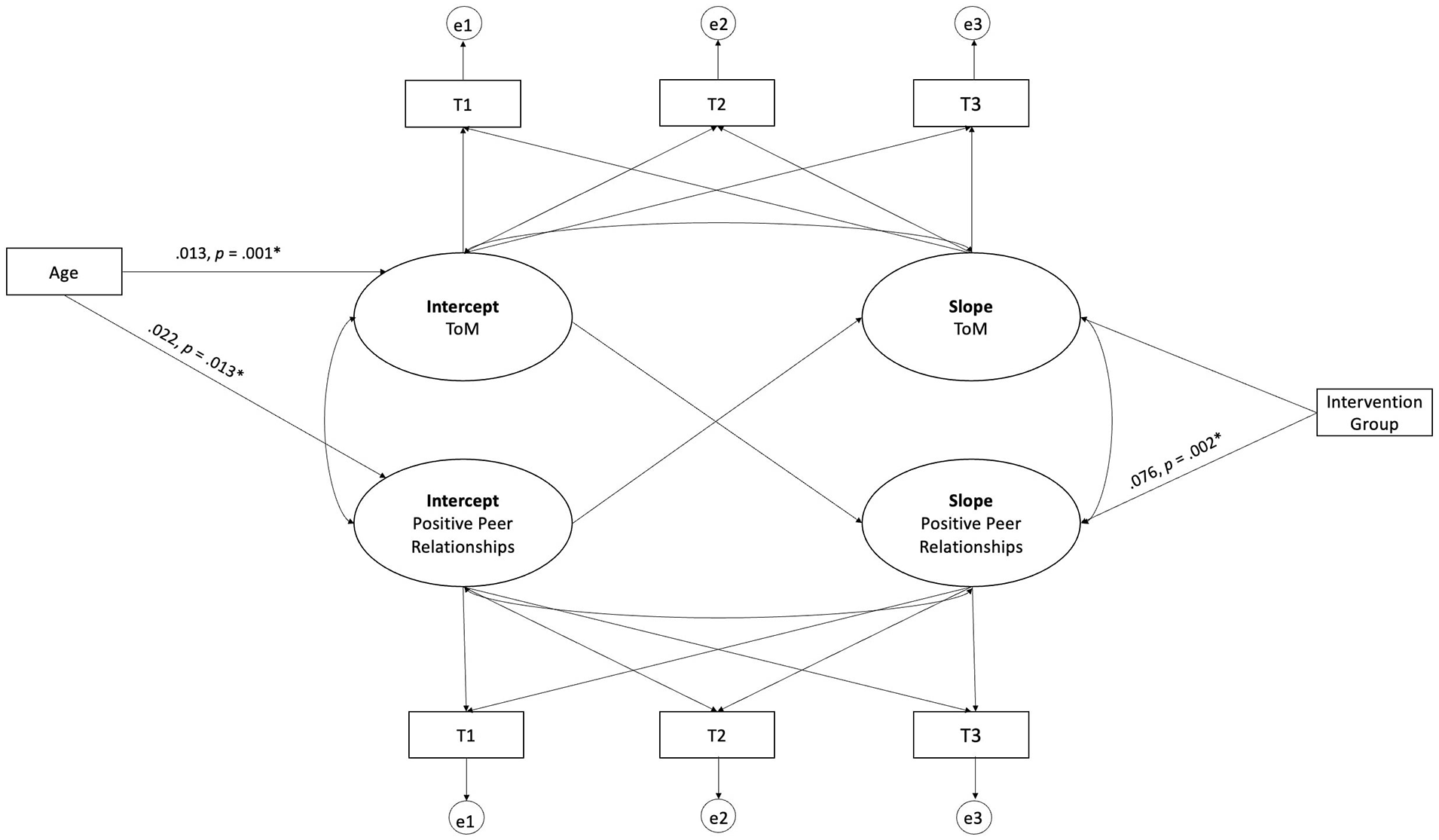
Changes in Children’s ToM and Positive Peer Relationships. N = 211. Only significant coefficients are displayed. Abbreviations: T1 = pretest, T2 = posttest, T3 = follow-up.
As a first step, we examined the longitudinal association between children’s ToM and their positive peer relationships (Model 1). Following this, we examined the longitudinal relationship between children’s emotion understanding and positive peer relationships (Model 2). As previously stated, two subscales were used to assess children’s emotion understanding (i.e., emotion recognition and understanding social situations). Each subscale, however, was scored differently. As a result, we calculated the means for each subscale, standardized the scores, and then calculated the overall mean to combine them within the same latent construct. As shown in Table 1, the two subscales were positively and significantly correlated at all timepoints.
We employed the Full Information Maximum Likelihood (FIML) method to handle missing data, which incorporates all available information from observed variables, reducing biases associated with missing data. This robust method enabled efficient and reliable parameter estimation using complete data. Model fit was assessed using the comparative fit index (CFI) and the misfit measure known as the root-mean-square error of approximation (RMSEA), with good model fit defined as CFI values greater than .95 and RMSEA values lower than .06, following Hu and Bentler’s (1999) suggestions. A data analysis plan was preregistered in Open Science Forum (https://osf.io/9ryzk/?view_only=e8920d7b23ae46a8acaf7f9659bc3384), and any subsequent analysis steps will be labeled as post hoc.
Results
Descriptive Statistics and Bivariate Correlations
Table 1 summarizes the descriptive statistics and the correlation coefficients between all variables. All correlations between ToM and emotion understanding, both concurrent and longitudinal, were significant and of moderate strength. The results also showed some weak positive correlations between positive peer relationships, ToM and emotion understanding, both concurrently and longitudinally. Significant correlations were also found between children’s age and all dependent variables. However, gender did not show any significant relationship with any variables. Despite this, in adherence to the preregistration, gender was included in the main analyses.
Descriptive Statistics and Bivariate Correlations of Study Variables with Confidence Intervals (N = 211).
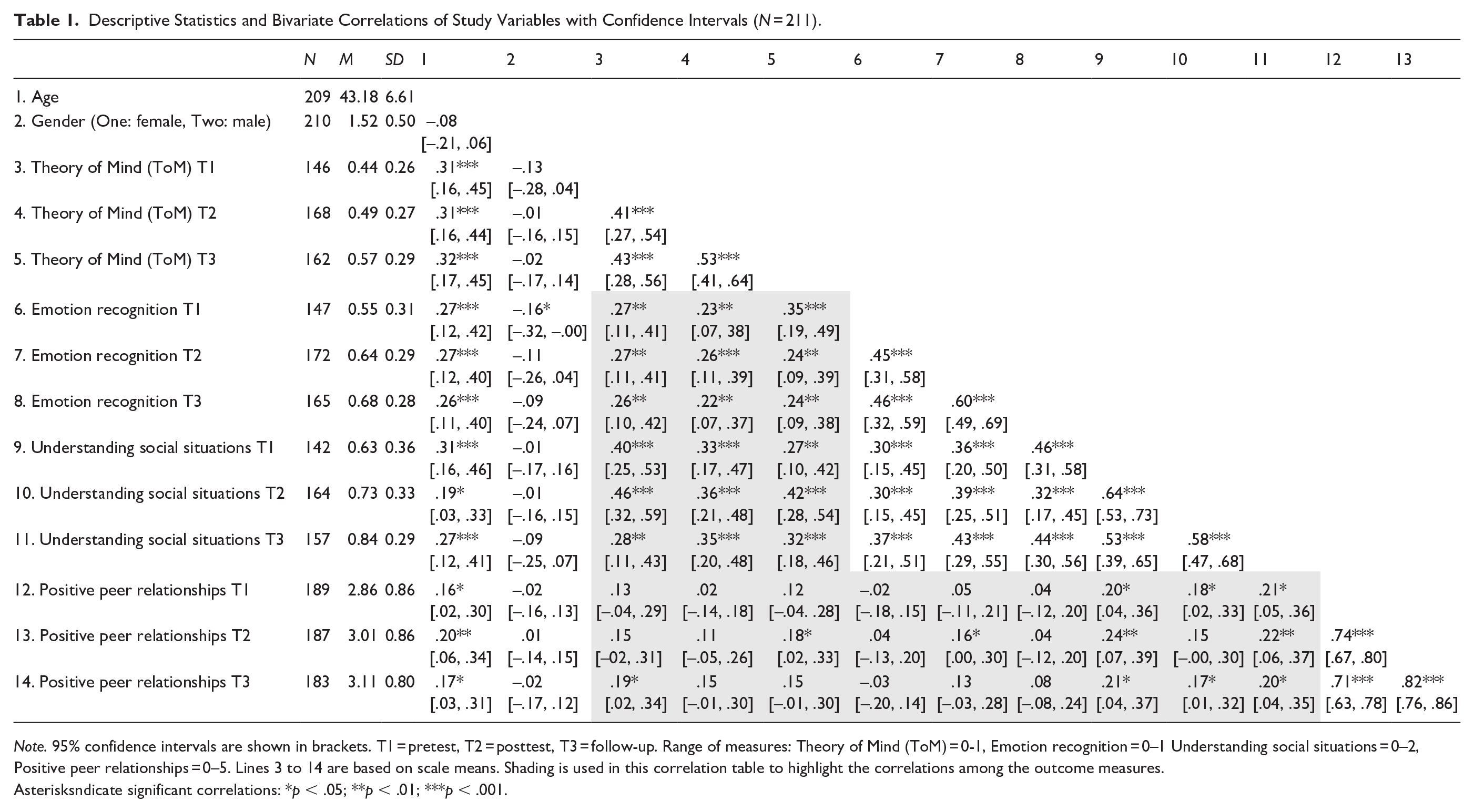
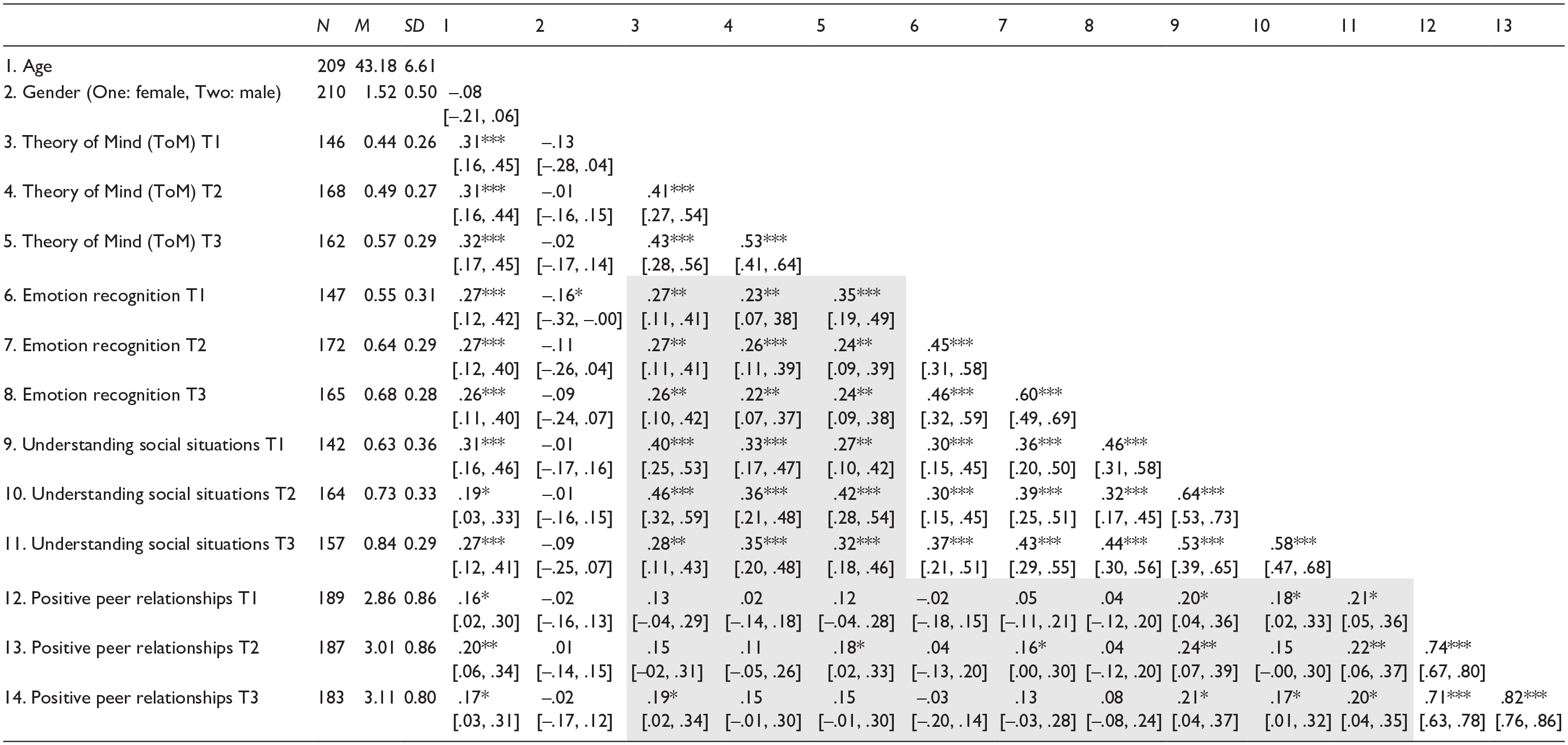
Note. 95% confidence intervals are shown in brackets. T1 = pretest, T2 = posttest, T3 = follow-up. Range of measures: Theory of Mind (ToM) = 0-1, Emotion recognition = 0–1 Understanding social situations = 0–2, Positive peer relationships = 0–5. Lines 3 to 14 are based on scale means. Shading is used in this correlation table to highlight the correlations among the outcome measures.
Asterisksndicate significant correlations: *p < .05; **p < .01; ***p < .001.
Main Analyses
Model 1: Children’s ToM and Positive Peer Relationships
First, we examined the longitudinal association between children’s ToM and positive peer relationships (Hypotheses 1, 3, and 5). The results of the multivariate latent growth curve model are shown in Figure 1. Overall, the model fits the data well (CFI = 1.00, RMSEA = .000).
There were no statistically significant relationships between any of the intercepts and slopes. The variance of children’s ToM was .018 (intercept) and .003 (slope), whereas the variance of their positive peer relationships was .548 (intercept) and .051 (slope). Children’s age was significantly associated with their initial level of ToM and their initial level of positive peer relationships. In addition, the intervention had a positive effect on the slope of children’s positive peer relationships, whereas gender was not significantly associated with any of the intercepts or slopes.
Model 2: Children’s Emotion Understanding and Positive Peer Relationships
Second, we examined the longitudinal association between children’s emotion understanding and positive peer relationships (Hypotheses 2, 4, and 6). The results of the multivariate latent growth model are shown in Figure 2. Overall, the model fits the data well (CFI = 1.00, RMSEA = .000).
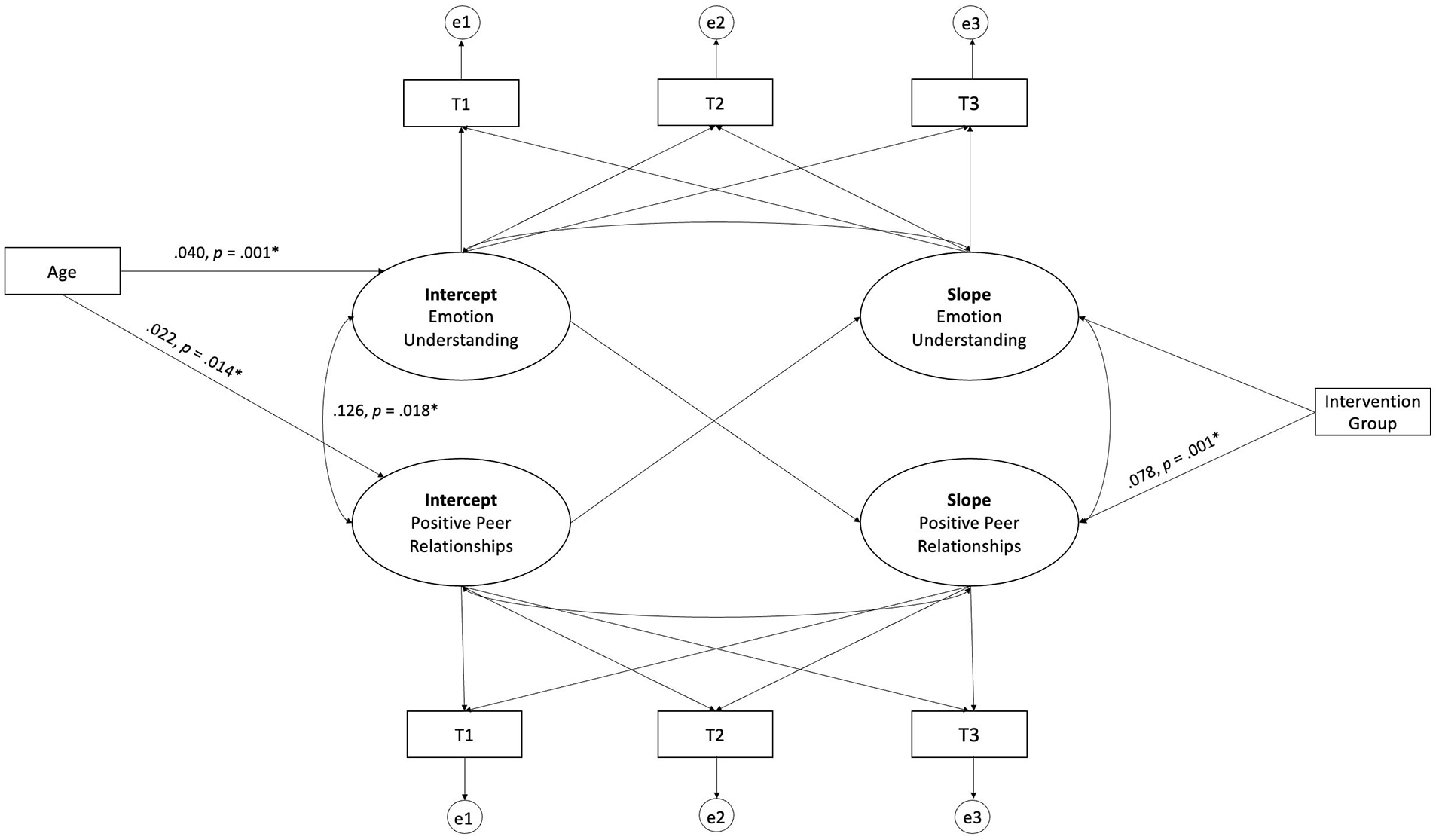
Changes in Children’s Emotion Understanding and Positive Peer Relationships. N = 211. Only significant coefficients are displayed. Abbreviations: T1 = pretest, T2 = posttest, T3 = follow-up.
Children’s initial level of emotion understanding was positively and significantly associated with their initial level of positive peer relationships. None of the other intercept-slope relationships were significantly related. The variance of children’s emotion understanding was .432 (intercept) and .003 (slope), whereas the variance of their positive peer relationships was .548 (intercept) and .049 (slope). Children’s age was significantly associated with their initial level of emotion understanding, and their initial level of positive peer relationships. In contrast, gender was not significantly associated with any of the intercepts or slopes.
In a post hoc analysis, we examined the relationship between each subscale of children’s emotion understanding and their positive peer relationships in two additional latent growth curve models. This analysis was motivated both by the different scaling of the two subscales and by the fact that they target different aspects of emotion understanding (Bassett et al., 2012). Overall, the models fit the data well (Subscale 1: CFI = .99, RMSEA = .013; Subscale 2: CFI = 1.00, RMSEA = .006). Children’s initial level of emotion understanding was positively and significantly associated with their initial level of positive peer relationships (β = .057, p = .020). However, this association was only evident in the model, which included Subscale 2 (i.e., children’s ability to comprehend social situations). Our results, however, did not reveal any significant intercept-slope relationships. Children’s age was significantly associated with their initial level of emotion understanding (Subscale 1: r = .012, p = .001; Subscale 2: r = .016, p = .001) and their initial level of positive peer relationships in both models (Subscale 1: r = .022, p = .013; Subscale 2: r = .022, p = .014). In contrast, children’s gender was only significantly associated with their initial level of emotion understanding in the model that included the first subscale (r = -.093, p = .034). Finally, the intervention had a significant effect on the slope of children’s positive peer relationships in both models.
Taken together, our findings show no support for Hypotheses 1, 3, 4, 5, and 6. Nevertheless, Hypothesis 2 was supported, revealing a positive link between children’s emotion understanding and their positive peer relationships at T1.
Discussion
The present research aimed to investigate the concurrent and longitudinal associations between children’s ToM, emotion understanding, and positive peer relationships. Specifically, we hypothesized that children’s initial levels of ToM (Hypothesis 1) and emotion understanding (Hypothesis 2) would be related to their initial levels of positive peer relationships. Furthermore, we hypothesized that a higher level of ToM (Hypothesis 3) and emotion understanding at T1 (Hypothesis 4) would be associated with a higher rate of change in children’s positive peer relationships. Finally, we hypothesized that these associations would be bidirectional, that is, that a higher initial level of positive peer relationships would be associated with a higher rate of change in ToM (Hypothesis 5) and emotion understanding (Hypothesis 6). Although the results did not confirm any of the expected longitudinal associations (Hypotheses 3, 4, 5 and 6), they did show that children’s initial level of emotion understanding, and their initial level of positive peer relationships were positively associated (Hypothesis 2). In other words, children who had a better grasp of emotions at the beginning of the study tended to have more positive interactions and relationships with their peers.
Children’s Initial Level of ToM, Emotion Understanding, and Positive Peer Relationships
The lack of a significant association between children’s initial level of ToM and positive peer relationships contradicts both theoretical assumptions (Banerjee et al., 2011; Barr, 2008; Carpendale & Lewis, 2006; Fabes et al., 2006; Hughes & Leekam, 2004; Zerwas et al., 2004) and prior empirical findings (Banerjee & Watling, 2005; Caputi et al., 2012; Cassidy et al., 2003; Diesendruck & Ben-Eliyahu, 2006; Lecce et al., 2017; Peterson & Siegal, 2002; Slaughter et al., 2002, 2015). Nevertheless, it has been reported that the association between children’s ToM and their positive peer relationships is not always consistent nor typically very strong (Slaughter et al., 2015), and some studies even report no association between the two (Badenes et al., 2000; Slaughter et al., 2002). Furthermore, some studies that discovered a link between ToM and positive peer relationships found that it was explained by other factors, such as children’s age and verbal abilities (Slaughter et al., 2002). The association also appears less robust when additional variables such as age, language skills, or gender are controlled for (Devine & Hughes, 2013; Kuhnert et al., 2017). For example, Slaughter and colleagues (2002) discovered a weak positive association between children’s ToM and peer acceptance, but only in a subsample of children older than 5 years of age. In fact, our main analysis consistently showed a positive association between children’s age and their initial level of ToM and positive peer relationships, which was consistent with the bivariate correlations among all three variables. When age was controlled, however, the correlation between ToM and positive peer relationships disappeared, suggesting that these associations are driven by age.
As expected, children’s initial level of emotion understanding was significantly associated with their initial level of positive peer relationships (Hypothesis 2). This finding is consistent with both theoretical assumptions (Denham, 1998; Fabes et al., 2006; Lemerise & Arsenio, 2000) and previous empirical findings (Cassidy et al., 2003; Denham et al., 2003; Izard et al., 2001; Mostow et al., 2002; Trentacosta & Fine, 2010). For instance, Denham and colleagues (2003) found a positive association between children’s ability to recognize emotional expressions and their positive peer interactions and likeability by peers. Similarly, Boyatzis and Satyaprasad (1994) demonstrated that 4- to 5-year-olds’ understanding of emotions and gestures is positively related to their popularity among peers. In our study, a post hoc analysis showed that the association between emotional understanding and positive peer relationships was driven by the second subscale of the emotion understanding test, which measures children’s ability to comprehend social situations. In other words, children who performed well on interpreting emotional reactions in social contexts (but not those who performed well on recognizing emotional facial expressions) were more likely to have better relationships with their peers. Social situations can be complex and involve multiple emotions, social cues, and expectations. Therefore, understanding and interpreting social situations emotionally may help children navigate these situations more effectively, communicate their own emotions and needs, and respond appropriately to the emotions of others. However, Sette and colleagues (2017) found conflicting results, as they only observed a link between children’s emotion recognition skills and socially appropriate behavior, and not their comprehension of social situations. This suggests that the relationship between emotional understanding and social behavior is complex and may differ depending on children’s developmental stage or social experiences (Carpendale & Lewis, 2006).
There could be several reasons why an association was found between children’s initial level of emotion understanding and their positive peer relationships, but not between children’s initial level of ToM and their positive peer relationships. First, it could be that emotion understanding plays a more significant role in peer relationships than ToM at this age. Emotion understanding may be more critical in peer relationships because children who can accurately interpret the emotions of others are better able to respond appropriately to their peers’ emotional needs and support them (Boyatzis & Satyaprasad, 1994; Denham et al., 2003). Second, longitudinal findings suggest that children’s acquisition of emotion understanding generally occurs before the development of ToM (Sarmento-Henrique et al., 2019). Given that the children in our study were relatively young, it is reasonable to assume that their communication with peers relied more on their ability to understand emotions than their ability to comprehend their peers’ mental states. Third, previous research indicates that children’s ToM becomes more strongly associated with positive peer relationships as they grow older, which may be related to their developing concept of friendship (Slaughter et al., 2002). Slaughter and colleagues argue that with age, children value their peers’ attitudes and personalities. Consequently, younger children prefer to be friends with those who understand their emotions. In contrast, older children value their peers’ ability to understand their mental states. Finally, limited language skills may prevent children from communicating their mental states during an interaction, leading to nonverbal interactions based on their understanding of others’ emotions (Harris et al., 2005).
Change Over Time in Children’s ToM, Emotion Understanding, and Positive Peer Relationships
Children with a higher ToM or emotion understanding were not more likely to develop positive peer relationships or become popular and well-liked by their peers. There are several possible explanations for these findings. Although both theoretical (Banerjee et al., 2011; Carpendale & Lewis, 2006; Hughes & Leekam, 2004; Zerwas et al., 2004) and empirical studies (Banerjee & Watling, 2005; Caputi et al., 2012; Cassidy et al., 2003; Diesendruck & Ben-Eliyahu, 2006; Peterson & Siegal, 2002; Slaughter et al., 2002, 2015) emphasize the importance of positive peer relationships, extensive research shows that children’s interactions with family members have a significant impact on their social cognition before the age of five (Barr, 2008; Carpendale & Lewis, 2006; Derksen et al., 2018; Devine & Hughes, 2018; Guajardo et al., 2009; Hughes & Leekam, 2004; Tompkins et al., 2018). As the children in our study were relatively young, perhaps their interactions with their families were more relevant. Some authors claim that child-adult interactions differ from peer interactions in that adults can facilitate problem-solving exchanges and collaborative social settings more effectively than children of the same age (Bauminger-Zviely et al., 2021). Although, as the authors argue, the relative difficulty of navigating the peer context provides valuable opportunities to develop social-cognitive skills (Bauminger-Zviely et al., 2021; Fabes et al., 2006; Zerwas et al., 2004), it is possible that this effect increases with age and was not strong enough to detect in our sample.
In addition, some authors argue that ToM tasks (first- and second-order belief tasks) are not representative of real-life situations where children must interpret others’ mental states to master social interactions (Banerjee & Watling, 2005). Therefore, false belief tasks generally do not require the social understanding necessary to establish positive peer relationships (Caputi et al., 2012). Perhaps this explains why children’s comprehension of social situations, but not their ToM, was associated with positive peer relationships. Finally, one plausible explanation for some of our findings pertains to the timing of the test sessions. Specifically, the quality of children’s relationships with their peers seemed relatively stable during this period, so the intervals may have been too short to detect any significant changes.
Although previous research has shown that the peer context is essential for the development of children’s ToM (Fink et al., 2014; Peterson & Siegal, 2002; Slaughter et al., 2002; Wright & Mahfoud, 2012) and emotion understanding (Dunsmore & Karn, 2004; Halberstadt et al., 2001; Kårstad et al., 2015; Maguire & Dunn, 1997), our findings did not uncover such effects (Hypotheses 5 and 6). Previous longitudinal studies have discovered a bidirectional relationship between children’s peer interactions and social understanding in children over five (Banerjee et al., 2011). In contrast, studies involving children as young as 3 years old did not yield the same results (Sette et al., 2017). Our findings support the latter. Although the bivariate correlation analysis revealed a few unsystematic longitudinal correlations in both directions between children’s ToM, emotion understanding, and positive peer relationships, the latent growth models showed no bidirectional relationship regarding change over time. It is important to note, however, that children in our study only met their peers once or twice a week, which is typical of Swiss educational playgroups. Although it has been argued that the quality of interactions is more important than the number of interactions (Bodrova et al., 2013), the relatively short amount of time children spent in the peer groups may have affected our findings.
Strengths and Limitations
The present research has several strengths. To start with, this is one of the few longitudinal studies using multivariate latent growth curve models to examine children’s social cognition and peer relationships. Latent growth curve models offer several advantages over traditional statistical methods (e.g., analysis of variance [ANOVA]). In contrast to traditional methods, latent growth curve models capture the average change over time and the variability of that change within a sample. Furthermore, unlike traditional statistical methods, latent growth curve modeling can account for model measurement errors (Duncan et al., 2013). Our study not only employed a robust statistical approach but also featured a larger sample size than previous studies (Caputi et al., 2012). In contrast to prior research that concentrated solely on children’s emotional comprehension (Sette et al., 2017) or used aggregate measures (Caputi et al., 2012), we assessed the distinct relations of children’s ToM and emotional understanding with their positive peer relationships. In addition, we increased the transparency of our work by preregistering the hypotheses and planned analyses.
There are, however, several limitations to consider. First, the present analyses were conducted on existing data from an intervention study, which may have biased the results. The analyses, however, controlled for intervention effects, in an attempt to keep bias to a minimum. Nevertheless, as the intervention was designed to improve positive peer relationships, statistically controlling for it might have reduced the variance in the data and thus limited the likelihood that any age-related changes could be detected. Second, despite the longitudinal nature of the data, ideally, the interval between each test period would have been longer, as children’s interactions with peers seem relatively stable during this period. Third, a limitation of this study is the unique nature of the playgroups examined, which significantly differ from other child care settings discussed in the literature review. Nevertheless, we believe that playgroups present an important arena for young children’s peer interactions and thus a valid context for investigating the development of social cognition and social behavior. Furthermore, while the assessment methods we used were appropriate for the studied age group, they might not have been sensitive enough to capture developmental change in the timeframe of the study. Another limitation of our study is related to the use of a scale with only a few items to measure children’s positive peer relationships. While the alpha coefficient demonstrated good internal consistency over time, it is possible that this limited scale might not have fully captured the complexity and multifaceted nature of peer interactions. In addition, the scale’s restricted sensitivity could have impacted our ability to detect subtle differences in children’s peer relationships. Finally, despite previous research suggesting that teachers are likely to accurately assess children’s positive peer relationships (Bierman & Montminy, 1993), it would be advantageous to use sociometric measures (peer ratings or peer nominations) because they are widely used, making it easier to compare our findings with previous ones.
Conclusion
To sum up, our results show a concurrent positive relation between children’s emotion understanding (but, unexpectedly, not ToM) and positive peer relationships, which is consistent with social-constructivist theories of social development, as well as with previous empirical findings. However, the question of how social cognition and positive peer relationships interact over time remains open for future research.
Footnotes
Funding
The author(s) disclosed receipt of the following financial support for the research, authorship, and/or publication of this article: Data assessment for this publication was funded by a grant from the Swiss National Science Foundation (SNF 100019_169786) to the last author.
