




Abstract
People living alone are often depicted as prone to social isolation and poor well-being. Since previous research largely focused on comparisons between the living arrangements of older adults, evidence on differences within middle-aged adults living alone remains sparse. The present study used a person-centered approach to allow for a comprehensive understanding of the heterogeneity of living alone in midlife. Middle-aged adults (N = 389; aged 35–60 years) reported on their personal networks, personality, and well-being and completed diaries on daily network interactions. Using latent class analysis, we constructed a network typology and examined differences in social motives, well-being, daily interaction quantity, and daily relationship quality. We found four structural network types: Individuals with diverse networks (highest in size, contact, proximity, and heterogeneity) felt less lonely than individuals with restricted (lowest in size, contact, proximity, and heterogeneity) or loose-knit networks (low in contact). Individuals with loose-knit networks reported poorer well-being than those in diverse or partner-focused networks (all partnered). We found little support for differences in social motives. All network types differed in daily interaction quantity but did not differ in daily relationship quality. The study highlights the heterogeneity of personal networks in middle-aged adults living alone. Possible implications for the social embeddedness and psychological adaptation of people living alone in midlife are discussed.
Keywords
Nowadays, more and more people live alone (Jamieson & Simpson, 2013). In Germany, the proportion of people living alone increased from 16% of the population to 20% between 1996 and 2021, with a projected increase to 24% by 2040 (Federal Statistical Office of Germany, 2023a, 2023b). The rapid growth in living alone extends beyond Germany and represents a significant demographic shift across Western societies (Bennett & Dixon, 2006). Existing literature primarily focuses on early or late life, linking the rise in living alone to age-specific life events or transitions. For example, delays in marriage and family formation contribute to increases in living alone among young adults, whereas partnership dissolutions and widowhood add to the growing prevalence in old age (Demey et al., 2013; Victor et al., 2000). Despite observing the fastest growth in living alone over recent decades among middle-aged adults (Bennett & Dixon, 2006; Demey et al., 2011), there has been limited empirical research on midlife.
Living Alone and Well-Being in Midlife
Midlife represents a heterogeneous developmental stage with diverse patterns of living arrangements (Demey et al., 2011). This is because middle-aged adults are involved in multiple social roles (e.g., work, family, friendships, or caregiving) and simultaneously connected to both younger and older generations within their social networks (Demey et al., 2013; Infurna et al., 2020). Moreover, middle-aged adults face numerous life transitions, encompassing changes in daily-life routines at work (e.g., changing companies or career advancement), in social relationships (e.g., divorce, [re]marriage, or parenthood), health (e.g., onset of chronic illness), and cognitive abilities (Demey et al., 2013; Infurna et al., 2020; Lachman et al., 2015). In addition, research has shown that developmental processes in midlife foreshadow functioning in health or behavioral domains in late life (Infurna, 2021; Launer et al., 1995). Finally, the living arrangements of middle-aged adults tend to be more permanent compared with the relatively temporary living arrangements of younger adults (Liu et al., 2020). Given these unique constellations of developmental challenges and opportunities, coupled with the current gap in research on living arrangements in midlife, the present study aims to contribute to a better understanding of living alone over the life course by focusing on middle-aged adults.
Living alone has often been associated with social isolation and being alone (Victor et al., 2000), leading previous studies to portray solo-living adults as a homogeneous group with poor well-being. Compared with those living with others, they tend to experience higher levels of loneliness (de Jong Gierveld et al., 2012; Greenfield & Russell, 2011) and unhappiness (Chou & Chi, 2000; Gaymu & Springer, 2012). However, our current understanding of living alone in midlife remains limited as most studies focused on older adults and comparisons between living arrangements.
Scholars acknowledge the considerable heterogeneity in social and daily-life conditions among those living alone (e.g., Bennett & Dixon, 2006). Specifically, the literature differentiates those who were compelled to live alone by circumstances from those who voluntarily chose to do so (Demey et al., 2013; Jamieson & Simpson, 2013). External factors can include divorce, widowhood, or having never partnered, suggesting an association between living alone and singlehood. However, living alone does not necessarily indicate singlehood. In Western societies, middle-aged individuals increasingly opt for “living apart together” (LAT), that is, being partnered without cohabitating (Hagemeyer et al., 2015). Moreover, living alone does not equate to being alone. In fact, research has demonstrated that the social networks of solo-living adults can be as diverse as those of cohabitating adults (e.g., Djundeva et al., 2019; Fiori et al., 2006). In sum, the literature emphasizes the significance of social networks in mitigating the impacts of social isolation associated with living alone (Bennett & Dixon, 2006). Therefore, the goal of this study was to investigate the diversity of personal networks among middle-aged adults who live alone, aiming to properly capture the heterogeneity within this population.
Personal Network Types in Midlife
Throughout life, individuals are surrounded by a personal network of close relationships that moves with them across various life situations (Antonucci et al., 2010). Personal networks vary in structural features, such as the network size, compositional aspects (e.g., the proportion of kin and non-kin ties), the frequency of contact with network members, and the geographic dispersion of social partners (i.e., proximity). Studying multiple structural features at once is challenging, as they are complexly interconnected and unlikely to be universal across individuals, making them particularly heterogeneous (Ali et al., 2022; Antonucci et al., 2010; Fiori et al., 2006). According to the social convoy model, each personal network is characterized by unique structural patterns (Kahn & Antonucci, 1980). Thus, the present study employs a typological perspective that allows for condensing multiple features that form individuals’ personal networks in a parsimonious way (Ali et al., 2022; Antonucci et al., 2010).
Previous studies identified four relatively robust structural network types among older adults: diverse (large size, frequent contacts, high proximity, and heterogeneous composition), family-focused (mainly kin ties), friend-oriented (primarily friendships), and restricted (small networks, infrequent contacts, low proximity, and homogeneous composition). These network types were found in general populations of older adults (Fiori et al., 2006, 2007, 2008; Li & Zhang, 2015; Litwin, 2001; Litwin & Shiovitz-Ezra, 2010; Litwin & Stoeckel, 2014) and among those living alone (Djundeva et al., 2019). However, network typology research in middle-aged adults remains scarce. Thus, our expectations for network types in middle-aged adults were based on findings from older adults. However, as we considered the diversity of social conditions (e.g., LAT) in midlife, there might be distinct network types unique to middle-aged adults. Overall, although we expected to identify diverse, family-focused, friend-oriented, and restricted networks, we did not rule out discovering different network types among middle-aged adults living alone.
Correlates of Network Types
Viewing individuals as integral parts of a dynamic person–environment system, they inherently engage in reciprocal interactions with their social environment (Neyer et al., 2014). Therefore, this study investigated whether the identified network types differed in individual characteristics (personality and well-being) and social-environmental aspects (including patterns of social interaction and the perceived quality of relationships in everyday life).
Social Motives
The need to form social relationships is deeply rooted in human nature, with individuals universally striving for communion to some degree (Baumeister & Leary, 1995; Hofer & Hagemeyer, 2018). At the same time, individuals pursue agentic needs for independence and self-sufficiency (Hagemeyer et al., 2015). The strength of social motivation for both communion and agency varies between individuals. Because individual living arrangements are considered as an expression of personal preferences in the regulation of social relationships (Hagemeyer et al., 2015; Neyer et al., 2014), living alone provides an interesting context for studying differences in communal and agentic motives. Specifically, solo-living individuals might easily regulate their agentic needs at home, but they need to actively reach out to their social partners to satisfy their communal desires. Therefore, the present study investigated network-type differences in communal (i.e., affiliation and intimacy) and agentic (i.e., autonomy and the desire for being alone) motive dispositions. Affiliation describes the desire for socializing frequently with others (Dufner et al., 2015; Hofer & Hagemeyer, 2018). Thus, individuals high in affiliation might be more likely to have diverse or friend-oriented networks. Intimacy refers to the preference for experiencing closeness in relationships (Hofer & Hagemeyer, 2018; McAdams et al., 1984). Those high in intimacy might preferably have smaller networks with close confidants (e.g., the family-focused type). Autonomy reflects the tendency for preserving independence and distance from others (Asendorpf et al., 1997). The desire for being alone characterizes the preference for solitude and privacy (Burger, 1995). Thus, individuals high in autonomy or in the desire for being alone might preferably entertain restricted networks.
Well-Being
According to the social convoy model, social relationships have an impact on well-being (Antonucci et al., 2010). Personal networks offer opportunities for interpersonal interactions, engagement, and support, all of which contribute to well-being (Ali et al., 2022). Previous studies revealed varying associations of network types and well-being, although consistently showing that individuals in diverse networks tend to feel happier and less lonely compared with those in restricted networks (Fiori et al., 2006, 2007; Li & Zhang, 2015; Litwin, 2001; Litwin & Shiovitz-Ezra, 2010). Consistent with previous research, we expected similar network-type differences in life satisfaction and loneliness.
As individuals differ in whether they voluntarily chose to live alone or were forced to do so by circumstance, this should impact on their experience of living alone (Jamieson & Simpson, 2013). The present study examined network-type differences in “lifestyle appraisal.” In particular, we were interested in how satisfied individuals were with living alone, their cognitive evaluation of living alone, and how much they preferred to continue living alone. We used these assessments as joint indicators of a common lifestyle appraisal scale. It might be that individuals with structurally constrained networks (e.g., the restricted type) score lower on lifestyle appraisal than individuals with other network types.
Daily Interaction Quantity
Research suggests a positive association of the network size and the quantity of daily interactions (Lee & Ko, 2018). Thus, individuals with diverse networks should report larger average numbers of social encounters across days than those in restricted networks. Beyond the network size, however, compositional features might affect mean levels of daily interaction quantity with particular network ties. For example, individuals in friend-oriented networks should report more daily non-kin interactions than those with family-based networks. Moreover, as most middle-aged individuals are still in the workforce (Infurna et al., 2020), their average numbers of interactions on business days might differ from that on weekends. In addition, individuals might differ in the variability of social interaction quantity across days, with some individuals (e.g., in the diverse type) showing larger deviations from their average daily interaction quantity than others (e.g., with restricted networks). In sum, the present study investigated whether mean levels and variability of daily social interaction quantity varied by network type, thereby further differentiating between (a) specific network ties (i.e., close kin, extended kin, friends, and cooperative non-kin) and (b) weekdays and weekends.
Daily Relationship Quality
Research suggests that individuals with diverse networks report higher average social satisfaction than those with restricted networks (Djundeva et al., 2019), but a diversified network might also increase the likelihood of negative social encounters in daily life. Thus, individuals with diverse networks could report more extreme levels of social satisfaction compared with those in restricted networks, not only across days but also between network members. Furthermore, it is unclear whether individuals with friend-oriented networks report lower satisfaction with kin relationships compared with those in family-based networks. Thus, in the present study, we explored network-type differences in mean levels and variability of daily satisfaction with relationships (a) in the overall network, (b) between particular network ties, and (c) between weekdays and weekends.
The Present Study
The present study contributes to the literature on living alone, closing gaps in previous research by considering the following aspects: First, we exclusively focused on a community-based sample of individuals living alone, enhancing the understanding of the heterogeneity within solo-living individuals. Second, we focused on midlife to offer insights into a life period with the potential of foreshadowing pathways into later ages. Finally, we used a person-centered approach to develop a network typology that highlights the heterogeneity of personal networks.
The overarching goal of this study was to describe and validate the heterogeneity of personal networks in middle-aged individuals living alone. To this end, we examined network-type differences in (a) social motives, (b) well-being, and (c) social interaction quantity and (d) relationship quality across 21 days.
In line with previous research in older adults, we expected to identify diverse, family-focused, friend-oriented, and restricted networks, though acknowledging the possibility of finding unique network types in middle-aged adults. We expected the highest well-being for individuals with diverse networks and the lowest well-being for those with restricted networks. According to the preregistration, we explored differences in social motives, daily social interaction quantity, and daily relationship quality by network type without casting specific hypotheses. Given the structural features of diverse, friend-oriented, family-based, and restricted networks found in the literature, however, certain differences between these network types might be anticipated.
First, individuals in diverse or friend-oriented networks are likely to engage in a greater number of relationships and social interactions, thus being more likely to report higher levels of affiliation than individuals with other network types. Those in family-based networks might prefer nurturing close dyadic relationships, thus reporting higher levels of intimacy relative to individuals with other network types. Individuals in restricted networks might prefer maintaining independence and distance from others, consequently reporting higher levels of autonomy and the desire for being alone.
Second, individuals with diverse networks should report the highest quantity of interactions on a daily basis, while those in restricted networks are likely to report the lowest. Others with friend-oriented or family-based networks are projected to fall in between these extremes. In addition, individuals in diverse networks should display greater deviations from their average levels of daily interaction quantity compared with those in restricted networks.
Finally, individuals in larger and more diversified networks (e.g., in diverse, family-based, or friend-oriented networks) should report higher levels of social satisfaction across days compared with those in restricted networks. Individuals with restricted networks, in turn, should report more consistent levels of social satisfaction than those with other network types across days.
Method
Overview
Data for the present study came from the Risks and Chances of Living Alone (RIKSCHA) project. RIKSCHA is a longitudinal study on personal networks and well-being in middle-aged adults living alone. The project comprised surveys at three measurement waves between 2020 and 2022 (i.e., T1 through T3). T1 included a 21-day diary phase. All waves began in July, with T1 ending in September 2020 upon completion of the diary. T2 and T3 spanned July to August 2021 and 2022, respectively. A detailed overview of the longitudinal design and all instruments is available at https://osf.io/yueg3/.
Ethics Approval
The study protocol was approved by the Institutional Review Board of Friedrich Schiller University Jena (FSV 18/43).
Open Practices Statement
The present study was preregistered at https://osf.io/raudb. Deviations of the final study from the preregistration are reported in Supplemental Table S1.
Procedure and Participants
Eligibility to participate in the study depended on (a) being aged between 35 and 60 years and (b) living alone. To increase the likelihood of reaching individuals who met the study criteria, we collaborated with Deutsche Post AG. Specifically, Deutsche Post allowed us to utilize their in-house address pool and to specify the inclusion criteria without granting direct access to this data. Subsequently, Deutsche Post selected 20,000 addresses in urban areas of Thuringia, Germany, that matched our criteria with a certain probability. To enhance the probability of reaching suitable participants, Deutsche Post used proprietary algorithms that drew from various data sources, such as population registry offices, the Federal Statistical Office, and online apartment advertisements. In a final step, Deutsche Post sent out 20,000 invitation letters for the online study. These letters included a personalized link to access the online study implemented with the formr survey framework (Arslan et al., 2020). Approximately 5,000 letters could not be delivered due to incorrect address details, individuals moving, or deceases. Ultimately, 396 individuals enrolled for the study and provided informed consent. However, seven of them were excluded as they did not meet the study criteria (falling outside the defined age range) or exhibited flagged response patterns. Thus, the present study analyzed data from 389 individuals. Participation was compensated with 50€ universal vouchers on completing the diary.
Of the 389 participants who finished the surveys at T1, 63% self-identified as female, and 24% reported being in a partnership. On average, participants were 47.22 years old (SD = 7.41). In terms of marital status, 58% of the participants were unmarried, 27% divorced, 7% married but separated, 4% married, 3% widowed, and 1% were in a registered partnership. Among the participants, 58% were parents and had an average of 1.72 children (SD = 1.50). In terms of education, 53% of the participants had completed vocational training, 27% held a university degree, 13% an advanced technical college degree, 3% a doctoral degree, and 2% did not have vocational education (with 2% preferring not to indicate their qualification). Regarding employment status, 87% of the participants were employed, while 6% were early retired, 4% unemployed, 2% in (secondary) training, and 1% were on parental leave.
A subsample of 377 individuals provided diary data. The 12 participants who did not submit diary entries were still included in the analyses of the survey data.
Measures
Network-Type Indicators
Personal networks were assessed using a refined ego-centered social network instrument (see Kersten et al., 2023). Participants (egos) listed a maximum of 25 persons whom they contacted at least monthly and who were emotionally important to them (alteri). Once decided on the number of alteri, egos evaluated each egoi-alterri-relationship along the following dimensions.
First, egos selected the relationship type with each alter from a list of 11 categories (i.e., partner, parent, grandparent, sibling, child, kin, friend, acquaintance, neighbor, coworker, and other). Second, egos rated the average frequency of contact for each relationship, separately for in-person and device-mediated interactions (i.e., “How often are you in contact with alterri?”) on a 5-point scale spanning 1 (daily), 2 (several times a week), 3 (several times a month), 4 (several times a year), and 5 (once a year or less). Third, egos estimated the distance between their own and each alter’s place of residence (i.e., “How far do you and alterri live apart?”) in kilometers (km). We transformed these measures into the following network-type indicators.
Network composition. Following previous research (Huxhold et al., 2022; Neyer et al., 2011), we reduced the number of relationship categories to five types that differentiated relationships based on kinship and closeness: Partner and friend were left unchanged. First-degree family ties (i.e., parent, sibling, and child) were combined to close kin. Other family ties (i.e., grandparent and kin) were subsumed under extended kin. All remaining non-family ties (i.e., acquaintance, neighbor, coworker, and other) were summarized as cooperative non-kin.
Network size. The total number of alteri listed by an ego reflected the size of their personal network.
Number of daily contacts. We reversed the contact frequency scales to capture higher values as more frequent contact. Since in-person and device-mediated interactions were assessed separately, we chose the higher score between the two. The number of daily contacts was calculated by summing the alteri with whom an ego reported having daily in-person or device-mediated contact.
Number of geographically close alteri. Following Djundeva et al. (2019), we calculated the number of geographically close alteri as the sum of alteri who were living within a radius of 5 km away from the ego.
Network-Type Correlates
The survey part included multiple self-reports of social motives and well-being. The diary comprised daily ratings of social interaction quantity and relationship quality. Complete item schedules are available at https://osf.io/bvh93/.
Social motives
Affiliation (e.g., “I try to be in company of friends as much as possible”) and intimacy (e.g., “Getting close to someone is the only thing that matters in life”) were each measured with 10 items of the Unified Motive Scales (Schönbrodt & Gerstenberg, 2012). Internal consistencies were high (αaf = .89; αin = .81). Autonomy (e.g., “I reach important decisions without others”) was assessed with eight items of the Relationship-Specific Attachment Scales (Asendorpf et al., 1997). We adapted all items so that they pertained to autonomy in relationship-unspecific contexts, instead of referring to autonomy in partner relationships as in Asendorpf et al. (1997). Internal consistency was acceptable (α = .77). Desire for being alone (e.g., “I enjoy being by myself”) was measured with 10 items of the Preference for Solitude Scale (Nestler et al., 2011). Internal consistency was high (α = .89). All items employed 6-point Likert-type scales, ranging from 1 (strongly disagree) to 6 (strongly agree).
Well-being
Life satisfaction (e.g., “I am satisfied with my life”) was assessed with five items of the Satisfaction with Life Scale (Diener et al., 1985). Items were answered using a 7-point Likert-type scale, ranging from 1 (strongly disagree) to 7 (strongly agree). Internal consistency was high (α = .88). Loneliness was measured with the eight-item version of the UCLA Loneliness Scale (Hays & DiMatteo, 1987). Items (e.g., “There is no one I can turn to”) were answered on a 4-point Likert-type scale, ranging from 1 (strongly disagree) to 4 (strongly agree). Internal consistency was high (α = .85). Lifestyle appraisal comprised three items (i.e., “I enjoy living alone,” “Living alone is a great lifestyle,” and “I do not wish to live alone any longer” [inverse-coded]), answered on a 4-point Likert-type scale, ranging from 1 (strongly disagree) to 4 (strongly agree). Internal consistency was high (α = .87).
Social interaction quantity
After completing the survey, egos were invited to submit daily end-of-day diary entries over 21 days. Egos indicated whether they had been in contact with their alteri (i.e., “Were you in contact with alterri today?”). The daily sum of an ego’s contacted alteri reflected their daily number of interactions. We investigated both mean levels and variability of social interaction quantity. Thus, we calculated within-person means and within-person standard deviations of egos’ interaction numbers across days. In addition, we calculated within-person means and within-person standard deviations separately for weekdays and weekends. Finally, we calculated within-person means of egos’ daily interaction numbers, differentiating between close kin, extended kin, friends, and cooperative non-kin.
Relationship quality. At the end of each diary entry, egos evaluated their satisfaction (i.e., “How satisfied are you currently with your relationship to alterri?”) with every egoi-alterri-relationship on a 7-point scale, ranging from 1 (dissatisfied) to 7 (satisfied). Daily scores were averaged across alteri for each ego to reflect their daily satisfaction with relationships. Similar to social interaction quantity, we calculated within-person means and standard deviations (a) across days, (b) separately for weekdays and weekends, and (c) within-person means for the five network ties we focused on.
Analyses
Analyses were conducted in R (R Core Team, 2022; version 4.2.1), using the package MplusAutomation (Hallquist & Wiley, 2018; version 1.1.0), and Mplus (Muthén & Muthén, 2017; version 8.8). Scripts and data are available at https://osf.io/bvh93/.
Latent Class Analysis
To develop a network typology, we employed latent class analysis (LCA). Initially, we had preregistered latent profile analyses (LPA), using continuous measures of all network-type indicators. However, the LPA models did not converge. Thus, we followed recent research (Ali et al., 2022; Djundeva et al., 2019) and conducted LCA using categorical network-type indicators.
In the LCA, we used the following indicators: network size, number of daily contacts, number of geographically close alteri, partner, close kin, extended kin, friend, and cooperative non-kin. Following previous research (Ali et al., 2022; Djundeva et al., 2019), we recoded network size and number of geographically close alteri into tertiles (1 = low, 2 = medium, 3 = high). As the number of daily contacts followed a binomial distribution when transformed into tertiles, we applied a median split (1 = low, 2 = high). Quantile ranges are provided in Supplemental Table S2. The five indicators of network composition assessed whether an ego’s personal network included partner, close kin, extended kin, friend, and cooperative non-kin. Following Djundeva et al. (2019), we used these variables dichotomously (0 = no, 1 = yes).
We estimated LCA models with two to six classes and identified the best-fitting model based on the balance between model fit and interpretability of the latent classes. We used the following information criteria to evaluate model fit: Akaike information criterion (AIC), Bayesian information criterion (BIC), sample-size adjusted BIC (SABIC), and consistent AIC (CAIC). Lower values of the model with k classes compared with the model with k − 1 classes indicate superior fit of the model with k classes (Nylund-Gibson & Choi, 2018). Furthermore, we inspected the bootstrap likelihood ratio test (BLRT) that compares a model with k classes to a k − 1 class model. A nonsignificant BLRT indicates that the more parsimonious model should be selected. Finally, we evaluated the entropy as a measure of the discriminability of the latent classes (Weller et al., 2020).
Network-Type Validation
We analyzed mean differences in the network-type correlates across latent classes to validate the network typology. The validation procedure was as follows: first, we z-standardized all correlates. Second, we estimated means across the latent classes, using the Bolck–Croon–Hagenaars (BCH) method (Bolck et al., 2004). Specifically, the BCH method allows for including continuous outcomes into an auxiliary model after estimating the LCA model. In the auxiliary model, each observation in each class is assigned a weight reflecting the measurement error of the latent class variable. The auxiliary model comprises a multi-group analysis using these weights to account for measurement errors. In the final step, the BCH method draws pairwise comparisons across the latent classes and tests for significant differences via Wald chi-square tests (Asparouhov & Muthén, 2021). Results with p-values ⩽ .01 were deemed statistically significant to avoid Type I error inflation. Corresponding effect sizes (Cohen’s d) are reported.
Results
Personal Network Types of Middle-Aged Adults Living Alone
Correlations among the latent class indicators were mostly weak to moderate (see Table 1). Model fit statistics of the LCA models are reported in Supplemental Table S3. We opted for the four-class solution as AIC and SABIC decreased considerably until that number. Moreover, BLRT (p = .002), entropy (.91), and classification probabilities (>.91) were satisfactory in the four-class model. Most importantly, however, the four-class model provided the best interpretable solution, effectively distinguishing personal networks based on quantitative aspects (i.e., size, contact, and proximity) and compositional features.
Correlations Among the Network-Type Indicators (N = 389).
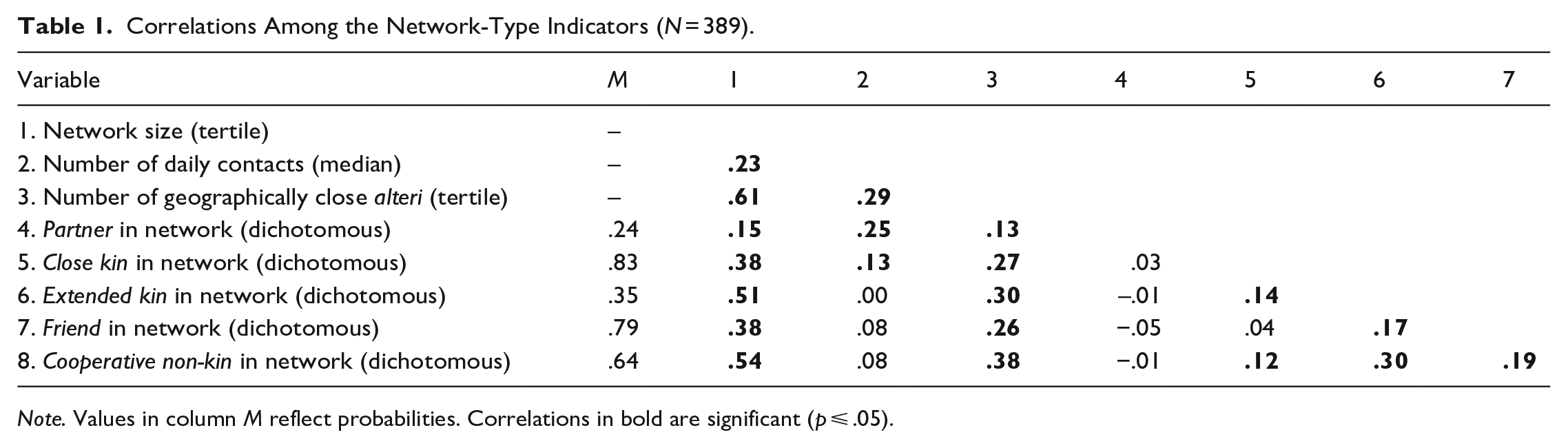
Note. Values in column M reflect probabilities. Correlations in bold are significant (p ⩽ .05).
Table 2 shows the probabilities and distributions of the network-type indicators across the latent classes. All indicators differed in their distribution across the four classes, except for close kin (.83) and friend (.79) which were consistently high throughout the study sample regardless of individuals’ class membership (see Table 1).
Probabilities of Network-Type Indicators Across Latent Classes (N = 389).
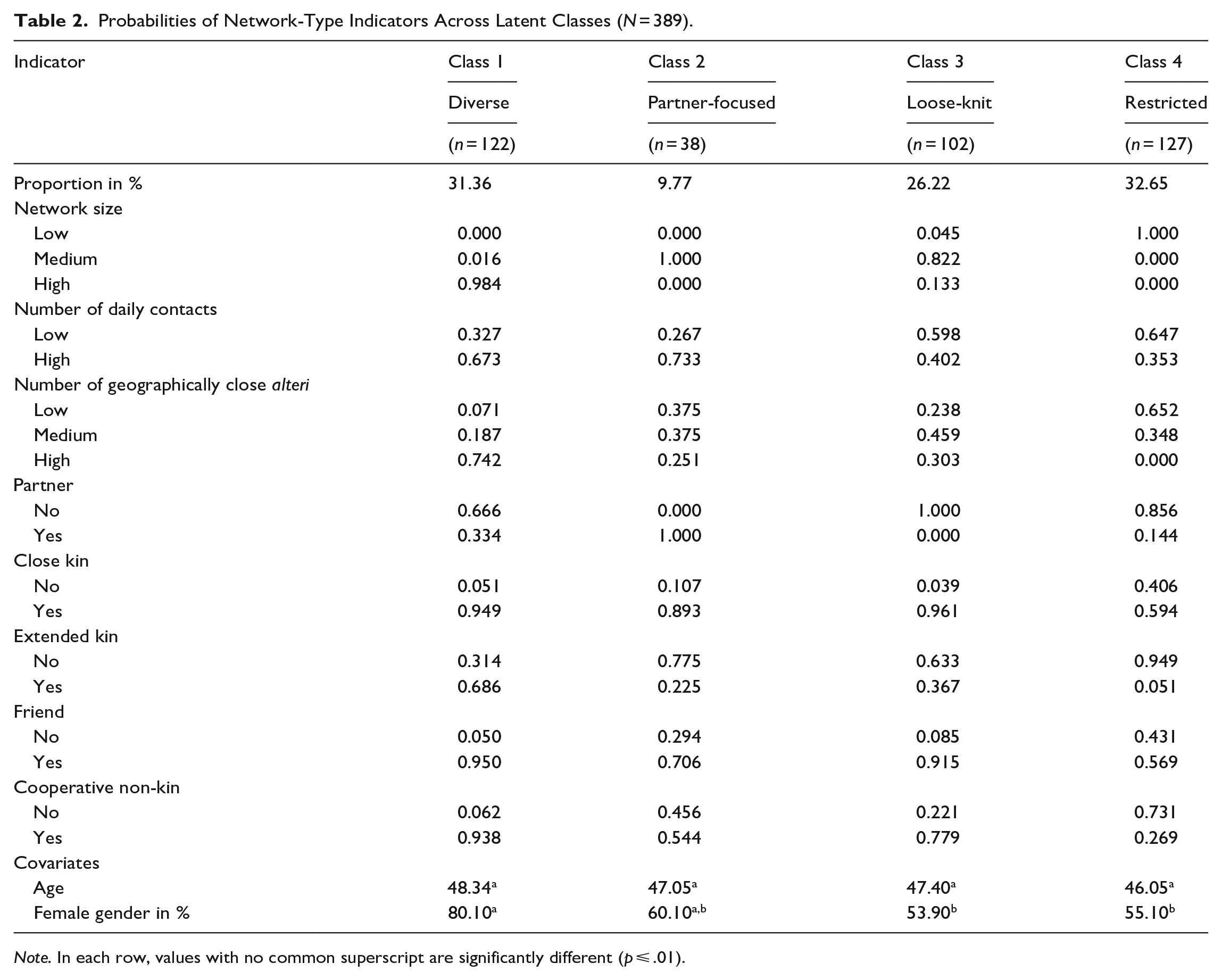
Note. In each row, values with no common superscript are significantly different (p ⩽ .01).
The first latent class (31.36%; n = 122) was labeled the diverse type. Compared with most other classes, diverse networks were larger, with more daily contacts and more alteri living nearby. In addition, diverse networks exhibited a highly heterogeneous composition, characterized by high probabilities of both kin and non-kin relationships.
The second latent class (9.77%; n = 38) was termed the partner-focused type. Partner-focused networks were all of medium size, with a large number of daily contacts and moderate to low numbers of alteri living close by. While most compositional features did not distinctly differentiate this class from others, the outstanding feature of partner-focused networks was that individuals most likely to belong to this class were all partnered.
The third latent class (26.22%; n = 102) was labeled the loose-knit type. Individuals most likely to belong to this class had predominantly medium-sized networks and moderate numbers of geographically close alteri. Despite all members of this class being single, no other compositional features distinctly separated this type from the other classes. Thus, the key characteristic of loose-knit networks was relatively few daily contacts, standing in contrast to the relatively large networks.
The fourth latent class (32.65%; n = 127) was named restricted, reflecting a pattern of small and scattered networks. Compared with the other classes, individuals most likely to belong to this class had smaller networks, mostly fewer daily contacts, and the lowest number of alteri nearby. In addition, restricted networks exhibited a homogeneous composition pattern with low probabilities of both kin and non-kin relationships.
Network-Type Correlates
In this section, we report the results of the Wald chi-square tests. Table 3 shows standardized means of social motives and well-being across latent classes (see Supplemental Table S4 for unstandardized results). Tables 4 (mean levels) and 5 (variability) display standardized means of daily interaction quantity and relationship quality across latent classes (see Supplemental Tables S5 and S6 for unstandardized results).
Standardized Means of Social Motives and Well-Being Across Latent Classes (N = 389).
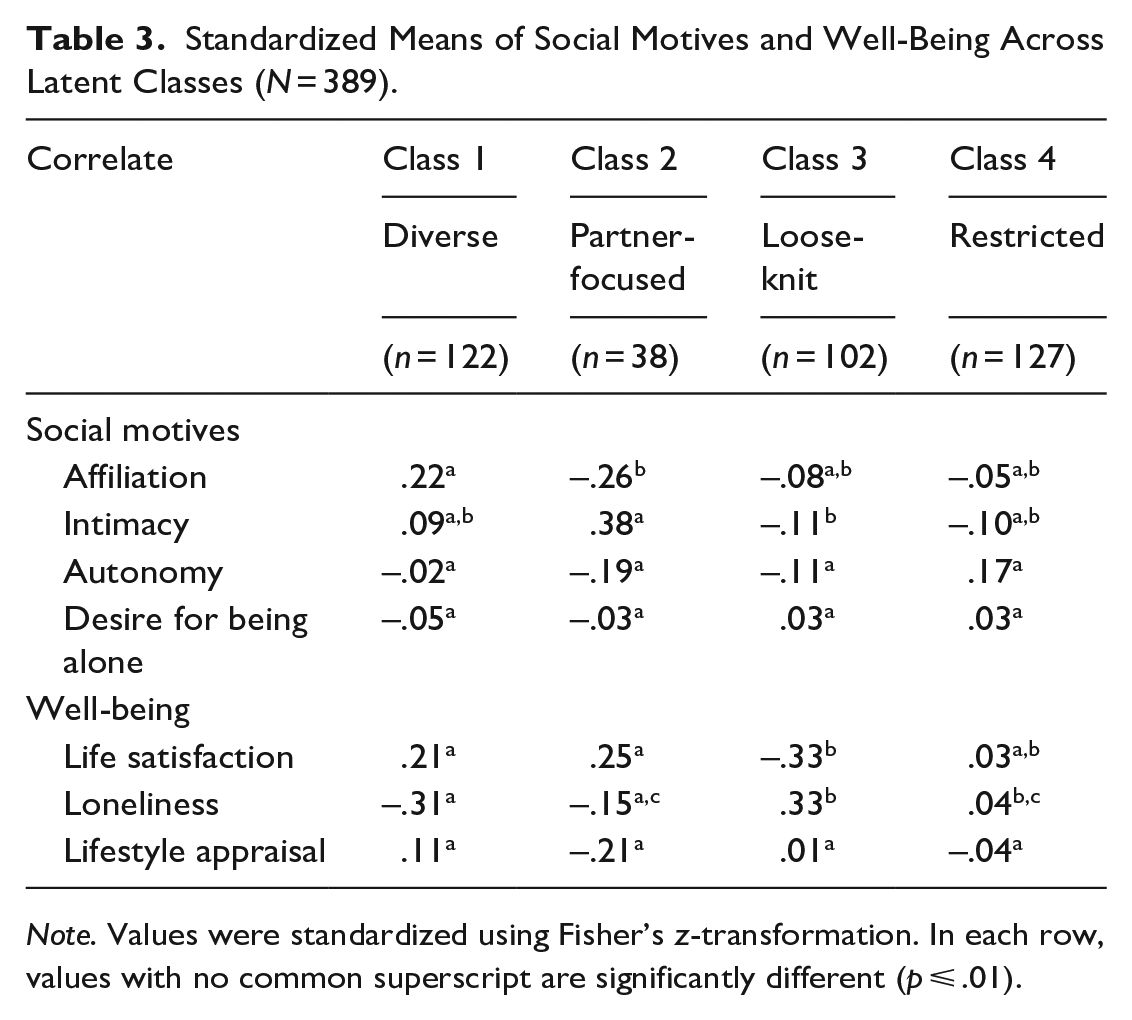
Note. Values were standardized using Fisher’s z-transformation. In each row, values with no common superscript are significantly different (p ⩽ .01).
Standardized Means of Average Social Interaction Quantity and Relationship Quality Over 21 Days Across Latent Classes (N = 389).
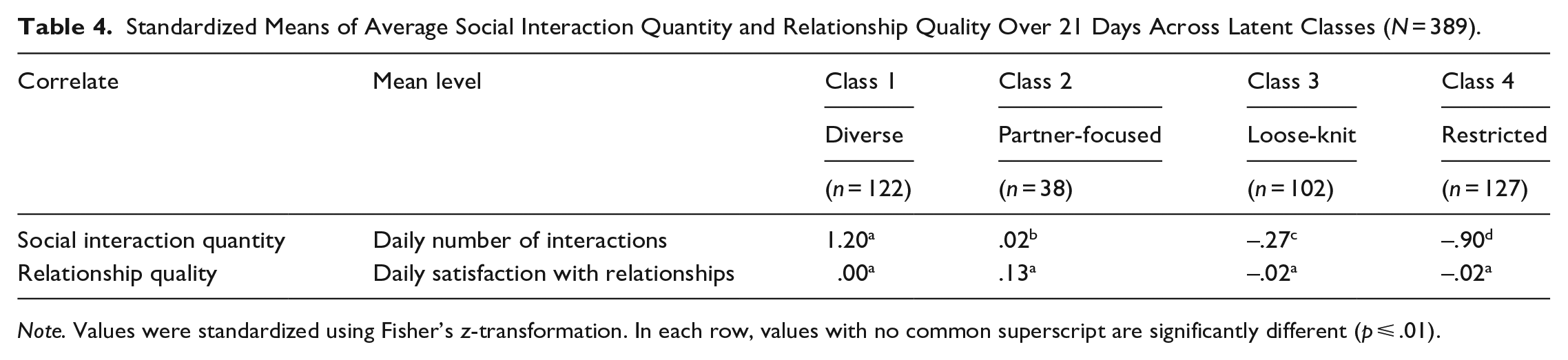
Note. Values were standardized using Fisher’s z-transformation. In each row, values with no common superscript are significantly different (p ⩽ .01).
Standardized Means of Variability in Social Interaction Quantity and Relationship Quality Over 21 Days Across Latent Classes (N = 389).
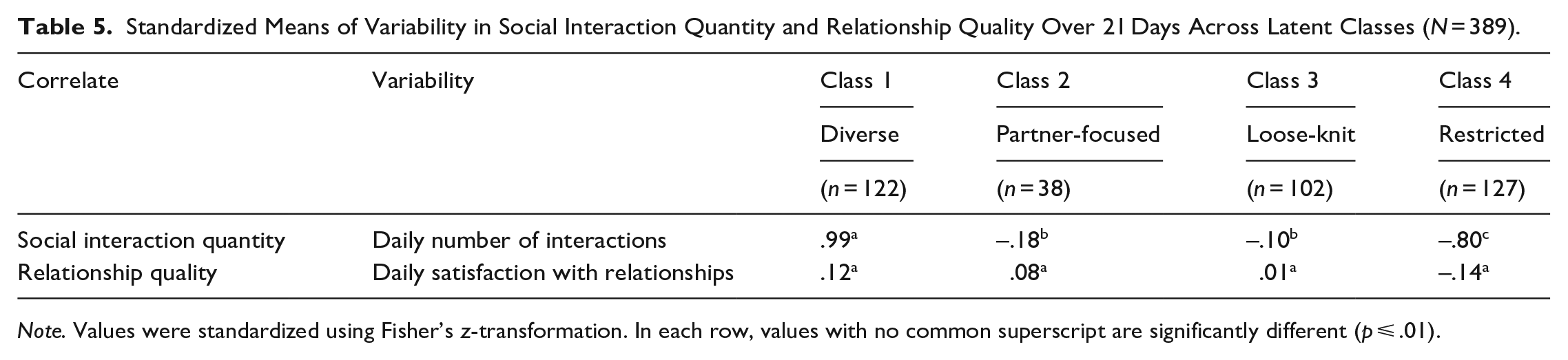
Note. Values were standardized using Fisher’s z-transformation. In each row, values with no common superscript are significantly different (p ⩽ .01).
Social Motives
Affiliation. Individuals with diverse networks 1 reported significantly higher levels of affiliation than individuals with partner-focused networks (d = .48; p = .008). No other differences in affiliation reached significance (ds < .30; ps > .032).
Intimacy. Individuals with partner-focused networks reported higher levels of intimacy than individuals with loose-knit networks, with marginal significance (d = .49; p = .010). We found no other significant differences in intimacy (ds < .50; ps > .010).
Autonomy. No significant differences in autonomy emerged between the latent classes (ds < .37; ps > .037).
Desire for being alone. We found no significant class differences in the desire for being alone (ds < .09; ps > .543).
Well-Being
Life satisfaction. Individuals with loose-knit networks reported significantly lower life satisfaction than individuals with diverse (d = −.54; p < .001) or partner-focused networks (d = −.58; p = .001). No other differences in life satisfaction reached significance (ds < .37; ps > .014).
Loneliness. Individuals with loose-knit networks reported feeling significantly lonelier than individuals with diverse (d = .64; p < .001) or partner-focused networks (d = .48; p = .004). Furthermore, individuals with diverse networks experienced significantly lower loneliness levels than individuals with restricted networks (d = −.35; p = .007). We found no other significant differences in loneliness (ds < .30; ps > .044).
Lifestyle appraisal. We found no significant class differences in lifestyle appraisal (ds < .32; ps > .100).
Daily Interaction Quantity
All latent classes significantly differed in average daily interaction quantity (see Table 4). Specifically, individuals with diverse networks reported more daily interactions than individuals with partner-focused (d = 1.17; p < .001), loose-knit (d = 1.47; p < .001), or restricted networks (d = 2.10; p < .001). Furthermore, individuals with partner-focused networks reported more daily interactions than individuals with loose-knit (d = .30; p = .004) or restricted networks (d = .93; p < .001). Finally, individuals with loose-knit networks reported more daily interactions than individuals with restricted networks (d = .63; p < .001).
Almost all latent classes significantly differed in the variability of daily interaction quantity (see Table 5). Individuals with diverse networks reported more variability than individuals with loose-knit (d = 1.09; p < .001), partner-focused (d = 1.16; p < .001), or restricted networks (d = 1.79; p < .001). Furthermore, individuals with restricted networks reported less variability than individuals with partner-focused (d = −.63; p < .001) or loose-knit networks (d = −.70; p < .001). No significant difference emerged between individuals with partner-focused networks and individuals with loose-knit networks (d = .07; p = .443).
Additional results that differentiated between (a) weekdays and weekends and (b) close kin, extended kin, friends, and cooperative non-kin are reported in the supplemental materials (see supplemental section 1 for details).
Daily Relationship Quality
No significant differences in both mean levels (ds < .16; ps > .379) and variability (ds < .27; ps > .050) of daily satisfaction with relationships emerged between the latent classes. Additional results are reported in the supplemental materials (see supplemental section 1).
Covariates
Age. No significant age differences emerged between the latent classes. Gender. Women were more likely to have diverse networks than restricted (odds ratio [OR] = 3.33; p < .001) or loose-knit networks (OR = 3.49; p < .001). Children. We found no significant class differences in the likelihood of having children. Number of children. No significant class differences emerged in the number of children. Marital status. No significant differences in marital status emerged between the latent classes. Employment status. Individuals with diverse networks were significantly more likely to be employed than those in restricted networks (OR = 5.19; p = .002). Professional education. Individuals in restricted networks were significantly more likely to have completed vocational training (OR = 0.42; p = .001) or to hold a technical college degree (OR = 0.42; p = .001) compared with those in diverse networks. Individuals with diverse networks, in turn, were significantly more likely to hold a university degree compared with those in restricted networks (OR = 2.95; p < .001).
Additional Results
As we found gender differences in the probabilities of belonging to the latent classes, we were additionally interested in whether gender acted as a moderator in the associations between network-type membership and the correlates examined in this study. To this end, we regressed all correlates on interaction terms between gender (dummy-coded with 1 = female) and the classification probabilities of the four classes. These analyses were not preregistered. Results are displayed in the supplemental materials (see supplemental Tables S11 through S21). In sum, the analyses revealed no consistent patterns of moderations by gender, leading to the conclusion that there were no gender differences in the associations between network-type membership and the network-type correlates.
Discussion
The present study highlighted the heterogeneity of personal networks in middle-aged adults living alone. We identified four structural network types: diverse, partner-focused, loose-knit, and restricted. Furthermore, we validated the typology by examining network-type differences in social motives, well-being, daily interaction quantity, and daily relationship quality.
Heterogeneity of Personal Networks
Consistent with previous research among older adults in general populations (Ali et al., 2022; Fiori et al., 2006, 2007, 2008; Li & Zhang, 2015; Litwin, 2001; Litwin & Shiovitz-Ezra, 2010; Litwin & Stoeckel, 2014) and those living alone (Djundeva et al., 2019), we identified diverse and restricted networks in middle-aged adults living alone. This indicates that these two network types are relatively robust across age groups and living arrangements. Contrary to recent studies, we found neither family-based nor friend-oriented networks but identified partner-focused and loose-knit networks.
The prevalence of partner-focused networks was notably lower compared with other network types in this study. Despite the majority of solo-living individuals being single (see Demey et al., 2013), the identification of partner-focused networks highlights the importance of distinguishing between living alone and being single. Furthermore, the partner-focused type aligns with previous research on midlife LAT couples. LAT relationships offer greater personal freedom, independence, and privacy, while providing opportunities for satisfying needs for closeness (Hagemeyer et al., 2015). Thus, within the context of living alone, LAT relationships may provide a unique context for effectively balancing communal and agentic motives. Considering the increasing prevalence of LAT couples in Western societies (Hagemeyer et al., 2015), it might be worthwhile to further investigate this network type in research on living alone.
Interestingly, we identified a loose-knit type characterized by an ambiguous structural pattern. Specifically, loose-knit networks exhibited relatively few daily contacts, standing in contrast to the relatively large networks observed. Social contact plays a vital role in receiving care and support from network members. Therefore, comprehending personal networks and their associations with well-being may include considering functional aspects beyond objective structural features (Fiori et al., 2008). In previous research, two types of restricted networks were identified by incorporating perceived social support in developing a network typology. The first type, termed structurally restricted, was primarily constrained in terms of size, contact frequency, and proximity—similar to the restricted type in the present study. The second type, labeled functionally restricted, displayed the lowest levels of perceived support from network members compared with other types (Fiori et al., 2008). It might be that the loose-knit type shares similarities with the functionally restricted type identified in prior research. Exploratory analyses supported this notion, indicating that individuals with loose-knit networks received relatively little social support from their network members (see Supplemental Table S9). Another intriguing facet about loose-knit networks is that, on average, individuals in this type had an 8.5% probability of belonging to the diverse type (see Supplemental Table S10). It might be conceivable that some individuals with loose-knit networks had formerly belonged to the diverse type but lost contact with a number of important ties. The reduction in contact could result either from external changes, such as divorce, relocation, or job loss, or from psychological problems, considering that individuals with loose-knit networks reported the poorest well-being. Although most demographic variables did not differentiate the loose-knit type from the other network types, it remains worthwhile to longitudinally track transitions between diverse and loose-knit networks. This could help uncover how certain life events prompt changes in network-type membership and, additionally, unveil whether the onset and progression of mental problems affect structural and functional attributes of individuals’ personal networks in the long term.
Contrary to previous late-life research, we did not find family-focused or friend-oriented networks in middle-aged adults. As individuals age, they become increasingly selective in choosing social partners, limiting social contacts to emotionally rewarding relationships with close others (Carstensen et al., 1999). Consequently, personal networks decrease in size and become more homogeneous (Wrzus et al., 2013). Interestingly, more than half the individuals with restricted networks in this study had close kin or friends (see Table 2), suggesting that the personal networks of middle-aged adults exhibit greater heterogeneity compared with those of older adults. It could be that middle-aged adults are less selective in maintaining relationships than older adults, leading to greater diversity of network composition. Moreover, the majority of middle-aged adults are still working, which provides greater opportunities for social contact compared with retirement in later life. Thus, the multiple social roles middle-aged adults navigate, including commitments in work, may contribute to their involvement in a wider range of social connections (Infurna, 2021). Together, age-related differences in selectivity and social involvement might impact on the diversity of network composition, which could contribute to why exclusive family-focused or friend-oriented networks were not found in this study.
Validity of the Personal Network Typology
Social Motives
We found little empirical support for network-type differences in social motives. However, individuals with diverse networks were relatively high in affiliation, which converges with research suggesting a positive association between affiliation and socializing behaviors (Dufner et al., 2015). Furthermore, individuals with partner-focused networks were relatively high in intimacy, aligning with studies showing that individuals high in intimacy more strongly focus on close dyadic relationships (McAdams et al., 1984). Nevertheless, given that most differences in social motives were insignificant, longitudinal research is warranted to disentangle whether individuals choose their personal networks based on their social preferences or adapt their personality to the network surrounding them.
Well-Being
Individuals with diverse networks reported lower loneliness levels compared with those with restricted or loose-knit networks, aligning with prior research demonstrating that a wider range of social ties is related to better well-being (Fiori et al., 2006, 2007; Li & Zhang, 2015; Litwin, 2001; Litwin & Shiovitz-Ezra, 2010). Furthermore, individuals with partner-focused networks reported higher life satisfaction and lower loneliness levels in comparison to those with loose-knit networks. Similar to the partner-focused type, previous research identified a spouse type among older adults, with individuals in spouse networks reporting relatively high well-being compared with individuals with other network types (Litwin & Stoeckel, 2014). In addition, individuals in restricted or loose-knit networks tended to report poorer well-being, with more significant differences observed for the loose-knit than the restricted type. The structural and functional constraints within these networks, particularly in terms of limited contact, likely contribute to increased feelings of social isolation. Previous research indicates that reduced social integration is strongly associated with diminished well-being (Fiori et al., 2006).
Overall, previous research and the present study consistently demonstrate that individuals with greater social capital, which includes the unity of social opportunities and contacts providing access to social, emotional, and instrumental support, tend to experience better well-being compared with those with less social capital (Fiori et al., 2006; Gray, 2009; Litwin & Shiovitz-Ezra, 2010; Litwin & Stoeckel, 2014). However, the associations between network-type membership and well-being might be more complex or influenced by intervening factors not captured in this study. For instance, Fiori et al. (2006) found that individuals in diverse networks reported greater well-being partly because they experienced high-quality support from their network members compared with individuals in structurally constrained networks. Therefore, further research is necessary to explore psychological mechanisms that could explain the associations between network-type membership and well-being.
Daily Interaction Quantity
Individuals in diverse networks reported both the highest mean levels and highest variability of daily interaction quantity, with individuals in restricted networks reporting the exact opposite pattern. This finding converges with prior research, suggesting a positive association between network size and daily social interaction quantity (Lee & Ko, 2018). However, individuals with loose-knit networks reported significantly fewer daily interactions than individuals with partner-focused networks, despite both network types being mostly of medium size. This highlights that similarly large networks may not necessarily provide comparable amounts of social contact in everyday life, underscoring the importance of using daily methods to reliably assess social interactions. Although the number of daily contacts was conceptually close to daily interaction quantity, we found only a moderate positive correlation between these measures (r = .40). This supports research showing that assessing self-reported behaviors retrospectively may lead to biased judgments about actual behaviors (e.g., Bernard et al., 1984). Therefore, we employed daily-reported social interaction quantity from more fine-grained data to validate the number of daily contacts. In sum, this study highlights the ecological validity of the diary method and emphasizes the importance of incorporating different measurement techniques to assess social interaction behaviors.
Daily Relationship Quality
Individuals’ daily satisfaction with relationships was relatively high and stable (M = 5.36 across network types; 7-point Likert-type scale), and did not significantly vary by network type (see Supplemental Table S5). This finding is surprising when considering that individuals with loose-knit networks reported feeling lonelier than individuals in diverse or partner-focused networks. Research suggests that satisfaction with relationships and loneliness are negatively related (Mellor et al., 2008). Although we found a weak negative correlation between these measures (r = −.30), there seemed to be considerable variability in relationship satisfaction within the network types. Furthermore, individuals were asked to rate their satisfaction with every alter at every single day throughout the diary. While, for example, individuals in restricted networks mostly reported on fewer, but perhaps relatively positive relations, those with diverse networks reported on a broader range of social ties. Some of these relationships may have been very positive, others quite negative. Thus, it might be worthwhile for upcoming research to delve deeper into specific relationships (e.g., at the dyadic level) to better understand (a) the discrepancy between individuals’ experiences of loneliness and their satisfaction with personal relationships and (b) the insignificant network-type differences in the present study.
Limitations
Despite the strengths of this study, some limitations have to be considered when interpreting the results. First, the cross-sectional design limits the ability to disentangle the temporal order of associations. It remains unclear whether individuals choose their personal networks based on their personality or if they adapt their social preferences to their network. Moreover, we cannot conclude that diverse or partner-focused networks improve well-being. It is possible that lonelier individuals have less frequent social contacts, increasing their chance to have loose-knit networks. Given the single point of data collection, we were unable to capture the long-term stability of the network typology. Intensive longitudinal studies with more and longer measurement intervals are required to (a) explore the dynamic interplay between personality and network types, (b) track longitudinal associations between network types and well-being, and (c) gain a better understanding of how individuals transition between network types over time.
Second, data for the present study were collected in Germany during the global spread of the coronavirus. Governments implemented strict social restrictions to contain the pandemic, including physical distancing and reduced social contact. Consequently, individuals experienced significant disruptions in their social lives, particularly those living alone who were forced to spend less time with their social partners (Pauly et al., 2022). These restrictions negatively affected well-being in the short term (Reitsema et al., 2023). For example, loneliness increased when restrictions were imposed but decreased before they were eased (Entringer & Gosling, 2022). During data collection in the summer of 2020, social restrictions in Germany were significantly relaxed due to low incidences. Although the pandemic may have influenced the findings, the diary data revealed a nearly balanced ratio of in-person and device-mediated interactions (see Kersten et al., 2023), supporting the generalizability of findings on the social lives of middle-aged adults living alone. Nevertheless, conducting a study on social networks in post-pandemic times would be valuable for future research.
Finally, the present study focused strongly on self-selected personal networks. Although research indicates that selection effects tend to be stronger than socialization effects in personal relationships (Mund & Neyer, 2014), it is crucial to consider contextual factors that could influence the network types of middle-aged adults. These factors could include significant life events such as relocation due to promotion, involvement in family caregiving, or financial constraints resulting from job loss. Therefore, future studies would benefit from incorporating the potential impacts of life events on the stability and changes within personal networks.
Conclusion
This study provides a valuable contribution to the literature on living alone by highlighting the diverse nature of personal networks among middle-aged individuals living alone. The findings suggest that living alone does not necessarily mean being alone. While network types providing greater social capital appeared to be more beneficial for well-being than those offering limited social opportunities, it is important to recognize the dynamic interplay between individual and environmental factors that contribute to the psychological adaptation of solo-living individuals. By focusing on midlife, this study fills a gap in lifespan research on living alone and contributes to a more comprehensive understanding of how living alone might succeed in contemporary societies.
Supplemental Material
sj-docx-1-jbd-10.1177_01650254231206329 – Supplemental material for Does living alone mean being alone? Personal networks of solo-living adults in midlife
Supplemental material, sj-docx-1-jbd-10.1177_01650254231206329 for Does living alone mean being alone? Personal networks of solo-living adults in midlife by Philipp Kersten, Marcus Mund and Franz J. Neyer in International Journal of Behavioral Development
Footnotes
Declaration of Conflicting Interests
The author(s) declared no potential conflicts of interest with respect to the research, authorship, and/or publication of this article.
Funding
The author(s) disclosed receipt of the following financial support for the research, authorship, and/or publication of this article: The present work was supported by the German Research Foundation, grant NE 633/11-1 awarded to F.J.N. and M.M.

Supplemental material
Supplemental material for this article is available online.
Notes
References
Supplementary Material
Please find the following supplemental material available below.
For Open Access articles published under a Creative Commons License, all supplemental material carries the same license as the article it is associated with.
For non-Open Access articles published, all supplemental material carries a non-exclusive license, and permission requests for re-use of supplemental material or any part of supplemental material shall be sent directly to the copyright owner as specified in the copyright notice associated with the article.
