




Abstract
This study investigates adolescents’ climate change distress and climate denialism profiles with two cohorts (born in 2008 and 2006) using longitudinal data from two waves collected in 2020 and 2021 (N = 3,002). In addition, the explanatory similarity of the subgroups regarding general well-being and pro-environmental behavior was studied. Four profiles were identified. The largest group was named the normative-carefree group because they had low climate change distress and climate denialism. Another group named denialists also had low distress but higher denial. Both these groups were associated with relatively good well-being. The third group had elevated climate change-related emotional distress and low climate denial and was therefore named the emotionally involved group. They engaged in pro-environmental behavior the most. The last and the smallest group was called the overburdened because they had elevated distress accompanied by denial; belongingness to the group was related to low well-being. Estimated transition patterns showed that the profiles were unstable within a 1-year span. The results endorse that adolescents’ climate change distress is ongoing and developing all the time, rather than being something permanent. The results also show that both climate change distress and climate denialism can co-exist among adolescents.
Keywords
Climate change is creating concerns about the future as one of the most urgent threats that humanity is facing (Intergovernmental Panel on Climate Change [IPCC], 2021). Even though the worry and distress caused by awareness and knowledge about climate change are widespread among young people all around the world (Hickman et al., 2021), they do not always act in a climate-friendly manner (Grønhøj & Thøgersen, 2012; Hyry, 2021). Ojala (2021) has argued that the commonly held twofold view of young people and climate change is too simple: they are seen either as being highly interested, agentic, and engaged concerning climate change or as being vulnerable victims of climate anxiety. Young people can be interested in climate change and active, but they can also be worried and feel that they have no influence at a societal level. They can also be completely uninterested in climate change, and some may even deny the seriousness of climate change.
Indeed, studies have shown that even adolescents at the age of 11 can deny the existence of climate change, or at least they de-emphasize its seriousness (Ojala, 2015). Research has also indicated that there are negative correlations between climate denial and climate change worry among adolescents (Ojala, 2013). However, in a study of adult climate denialists in the United States, alongside the normative group of denialists characterized by low levels of climate change worry, Haltinner et al. (2021) identified another subgroup of denialists who reported high levels of climate change worry. The authors argued that these results could indicate that denial is a dysfunctional way of coping with climate change for some people and that it does not always reduce distress. Since similar studies have not been performed with young people, it could be argued that it is vital to investigate whether the findings with adults extend to adolescents, as this would provide a better understanding of both climate change distress and denial in this age group. Adolescents are both important stakeholders to include in climate change mitigation and a group that could be particularly vulnerable to the negative mental health effects of climate change (Pereira & Freire, 2021; Sanson et al., 2019).
In addition, an earlier person-oriented study of Finnish adolescents identified different profiles based on climate change-related well-being and pro-environmental behavior (PEB) (Veijonaho & Salmela-Aro, 2022). The largest group in the study was characterized by both low climate change distress and low levels of PEB (Veijonaho & Salmela-Aro, 2022). The authors argued that this group was not homogeneous but instead consisted of subgroups with a range of reasons to belong to it. Some might deny the existence of climate change, while others might distance themselves from the phenomenon because they have too little knowledge, or perhaps the unpleasant emotions evoked by climate change were too hard to process (see Ojala, 2013).
These results from recent studies call for more in-depth person-oriented studies combining climate change distress and denial. More studies are needed to better understand the complicated relationship between these phenomena, as well as the functions of different responses to climate change among young people. Hence, through a longitudinal, person-oriented approach, this study aims to investigate whether climate change distress and denial co-exist among adolescents and how such subgroups differ regarding PEB and general well-being. In addition, the stability or transitions in the subgroups across a 1-year time span will be investigated. There have been few previous longitudinal studies on climate change-related well-being (e.g., McBride et al., 2021; Sciberras & Fernando, 2022), and none of them have examined latent profile transitions during adolescence. Thus, age cohort differences should be investigated.
This study focuses on adolescents aged 11–15, capturing development during the early years of adolescence. Adolescence is the time when children mature physically, psychologically, and socially, but there are large individual differences in the levels of maturing (Galambos et al., 2003). Changes during adolescence can be observed with stage-specific developmental tasks, such as acquiring socially responsible behavior, getting along with peers while taking distance from parents, shaping one’s own identity, and establishing a personal value and ethical system (Finkenauer et al., 2002; Masten et al., 2006).
Climate Change Distress
Climate change is often viewed as an environmental problem, but it also influences human well-being both directly (through environmental changes and extreme weather) and indirectly (through increased awareness) (Clayton et al., 2017; Koger et al., 2011). Climate change distress can be seen as one of the indirect effects of climate change (Reser et al., 2012), and young people can be particularly vulnerable to it (see Sanson et al., 2019). People use several coping strategies to regulate the distress, unpleasant feelings, and ambivalence caused by climate change (Ojala, 2012). Constructive coping strategies, such as problem-focused coping, have been found to be related to active engagement with climate change, while less constructive coping strategies, such as de-emphasizing the climate threat, are instead associated with disengagement (Ojala et al., 2021; Pihkala, 2020).
Multiple terms, such as “eco-anxiety,” “climate anxiety,” and “climate change worry,” are used to describe the distress caused by awareness of climate change, but the definitions of these terms vary (Ojala et al., 2021; Pihkala, 2020). In this study, we use the term climate change distress to refer to experiences of distress and negative emotions that manifest not only emotionally but also in cognitions and behaviors (see Ojala et al., 2021; Reser et al., 2012). In line with this, Clayton and Karazsia (2020) have identified two key features of climate anxiety: cognitive and emotional impairments in response to climate change (e.g., emotional overload, finding it difficult to sleep or concentrate) and behavioral impairment in daily life caused by concerns of climate change (e.g., finding it difficult to enjoy free time with friends and family). Similar to the cognitive-emotional component described by Clayton and Karazsia, Veijonaho and Salmela-Aro (2022) measured the climate change-related well-being of Finnish youth by capturing emotional exhaustion (e.g., a feeling of exhaustion that does not go away with sleep) and a sense of inadequacy caused by climate change. For the present study, we combined elements from both these studies to create a set of items to measure climate change distress among Finnish adolescents aged 11–15.
Climate Change Distress, Pro-Environmental Behavior, and General Well-Being
PEB can be defined as trying to act in the best way for the environment. People have multiple roles as pro-environmental actors: they can engage in individual-level actions (e.g., recycling), but they can also act as active members of communities (e.g., promoting ways to save energy in a neighborhood) and become involved in political actions (e.g., participating in a demonstration) (see Whitmarsh et al., 2021). The relationship between climate change distress and PEB is not straightforward. Empirical studies with adult populations have both shown that climate anxiety is negatively (e.g., Stanley et al., 2021) and positively associated with PEB (e.g., Heeren et al., 2022), and some do not find any connection between climate anxiety and behavior (Clayton & Karazsia, 2020). The complicated relationship between these two phenomena may be explained by the fact that PEB can be seen as one of many ways to cope with climate change distress. When a perceived threat exceeds available coping resources, it can lead to paralysis (Ojala et al., 2021). All in all, PEB is an important factor to study as habits learned during adolescence can promote sustainable behavior and engagement throughout adulthood (Riemer et al., 2014).
As stated above, climate change distress is a rational, rather than a pathological response, which can lead to constructive behavioral outcomes (Clayton & Karazsia, 2020; Pihkala, 2020). However, climate change distress and general well-being are sometimes also connected. A growing number of studies with adults have made it evident that climate change distress is associated with poorer mental health (Ogunbode et al., 2021; Stanley et al., 2021). In a Finnish study of young people, a group characterized by low climate change-related well-being and high rates of PEB had significantly more depressive symptoms and lower self-esteem than the other participants (Veijonaho & Salmela-Aro, 2022). Overall, the declining well-being of students at all levels of education has been a concern in Finland (Olivier et al., 2023; Read et al., 2022). More research is therefore needed on all aspects that affect the overall well-being of young people.
Climate Denialism
Previous research suggests that climate denialism exists on a spectrum— ranging from (1) full denial of the existence of climate change to (2) downplaying scientific facts, and, finally, (3) acknowledging the facts but denying the implications of climate change (Rahmstorf, 2004; Wullenkord, 2022). However, belonging on the spectrum of denialism does not necessarily indicate a low level of climate change distress. A study of adults in the United States showed that not even climate denialists are immune to worry and dread (Haltinner et al., 2021). Instead, many denialists are concerned about specific environmental problems (such as pollution, habitat destruction, and species extinction) and can sometimes support green policymaking (Haltinner et al., 2021).
Climate denial can be seen as an unconstructive strategy to cope with climate change and the negative emotions felt in relation to this threat (Ojala, 2012, 2013, 2015). Ojala (2013) found some adolescents who de-emphasized the seriousness of climate change and these adolescents’ tendency to de-emphasize or deny the threat was negatively related to environmental efficacy and PEB. There are no previous studies on the extent of climate change denial among Finnish adolescents under the age of 15. However, the Finnish Climate Barometer from 2019 shows that 23% of 15- to 29-year-olds totally or somewhat disagree that climate change is mainly caused by humans (Climate Barometer, 2019). Another survey on climate emotions shows that 25% of Finns under the age of 30 feel skeptical and doubtful about climate change, and 19% of them are in denial (Hyry, 2021).
The Present Study
The aim of this study is to shed light on adolescents’ climate change distress and climate denialism with a person-oriented approach in a longitudinal study setting using two separate age cohorts. Our aim was to identify subgroups of adolescents based on their similarities vis-à-vis climate change distress and denialism and to study the constancy or change of these subgroups across a 1-year period. We paired climate change distress measures with climate denialism measures. Here, we posited that those who have low climate change distress can be divided into two groups: those who deny the existence of climate change and those who believe in climate change but do not feel any distress (Hypothesis 1a). In addition, we expected to find at least one more profile that is characterized by high climate change distress and low climate denialism (Hypothesis 1b). Since no profile transition studies have previously been done on these issues, it is hard to hypothesize about the degree of stability in memberships of the profiles. Finally, to understand better the construct validity and practical relevance of the profiles, we assessed the relations between the identified profiles and PEB and general well-being. Our expectation was that profiles with high climate change distress and low climate denial would act more pro-environmentally and have lower well-being (Hypothesis 2).
Methods
Participants and Procedures
The data were collected as a part of a larger annual survey in elementary and middle schools in Helsinki, Finland. All students born in 2008 and 2006 participated in the study in the recruited schools. In this regard, the younger age cohort was 11–12 years old in 2020 and 12–13 years old in 2021, while the older cohort was 13–14 years old in 2020 and 14–15 years old in 2021. In the Finnish school system, the students move from elementary school to middle school in the fall of the year when they turn 13. Therefore, there were 55 schools involved in the study in 2020 (out of which 45 schools had elementary school students and 29 had middle school students). As the younger cohort moved from elementary school to middle school after 2020, only 31 middle schools were involved in 2021. Only students with parental consent participated in the study. In addition, participants gave their own consent at the beginning of the survey. Participants did not receive any compensation, but to engage the schools, they received individual feedback reports each year based on the data of their students. The data collection was approved by the ethical review board in humanities and social and behavioral sciences at the University of Helsinki (Statement 20/2018).
Participants completed an online survey during class hours and were monitored by their teachers. As the study involved Finnish-, Swedish-, and English-speaking classes, the survey was made available in all three languages. All questionnaires were translated by professional translators and revised by members of the research team. The data were collected as a part of an annual longitudinal survey that had started already in 2019, but some of the measures used in the present study were asked for the first time in 2020. Hence, the data included two waves collected in October to December 2020 (N = 2,164) and 2021 (N = 2,203). The retention rate from 2020 to 2021 was 57.3%. As parental consent was requested each year, there were 505 new participants in 2021. In addition, there were 275 original participants from 2019 who skipped the survey in 2020 and participated again in 2021. In total, the data were collected from 3002 unique participants (47% females and 45% males).
Measures
Profile Indicators
Climate change distress was measured with eight items adapted from Clayton and Karazsia’s (2020) climate change anxiety scale and measures of climate change-related emotional exhaustion and inadequacy used in a previous Finnish study (Veijonaho & Salmela-Aro, 2022). This was done to create a scale that was suitable for use with Finnish adolescents. To ensure that the scale was appropriate for the target group, the selected items were adapted after in-depth interviews about the scale with five adolescents aged 11–15. In the end, five items were designed to measure cognitive-emotional elements of climate change distress (e.g., “Thinking about climate change makes it difficult for me to concentrate.”), and three items were designed to measure behavioral impairment (e.g., “My concerns about climate change interfere with my ability to get school assignments done.”) (see all items in Figure 1). Participants rated the items with a 6-point scale (1 = Not true at all to 6 = Completely true).
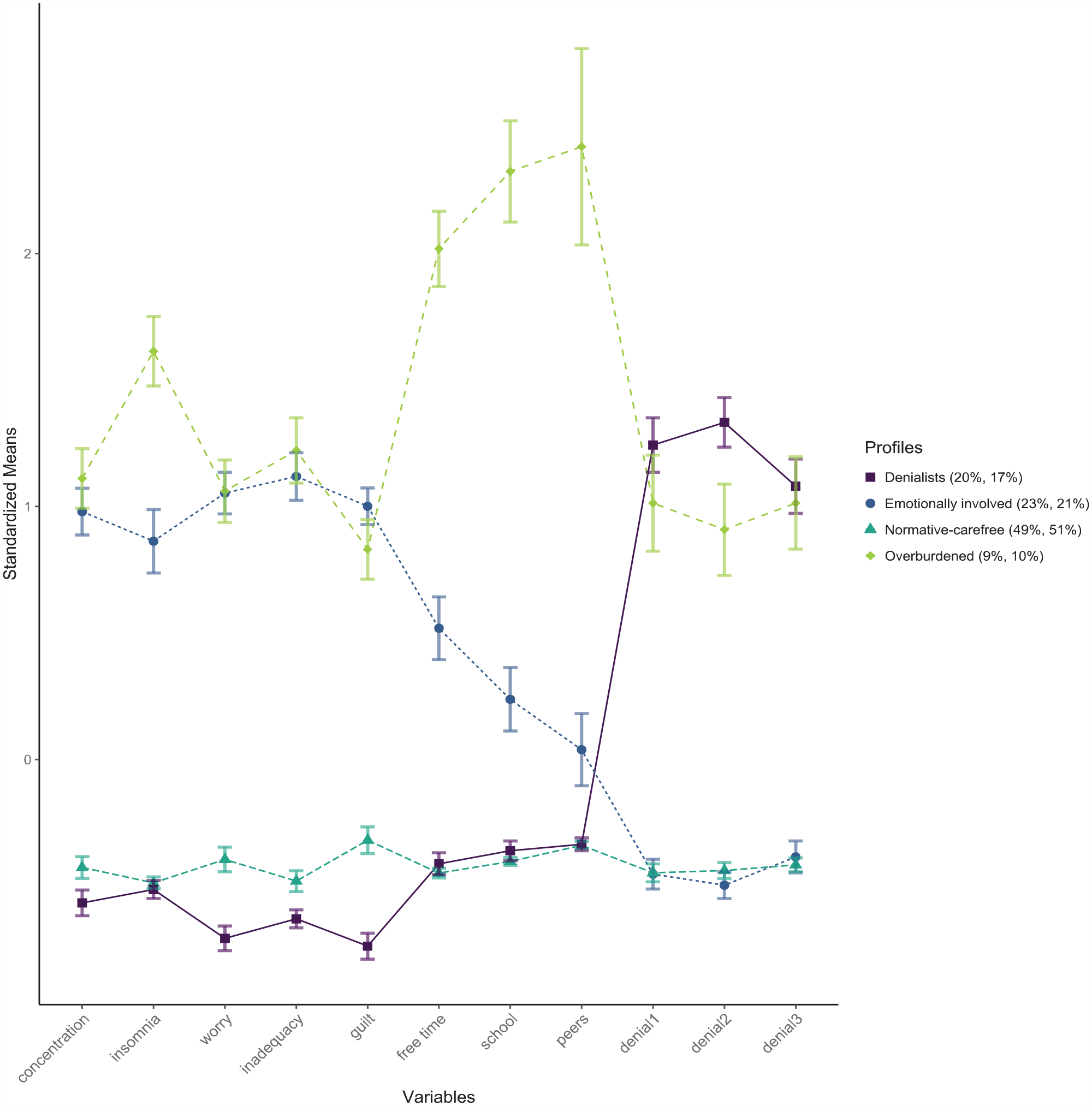
Profile Solution Plots With Standardized Means (M = 0, SD = 1). The bars indicate 95% confidence intervals. Total N of observations = 3,002. Concentration = Thinking about climate change makes it difficult for me to concentrate; Insomnia = Thinking about climate change makes it difficult for me to sleep; Worry = I brood over matters related to climate change a lot; Inadequacy = I have feelings of inadequacy because of climate change; Guilt = I feel guilty if I’m not acting against climate change; Free time = My concerns about climate change make it hard for me to have fun with my family or friends; School = My concerns about climate change interfere with my ability to get school assignments done; Peers = My friends say I think about climate change too much; Denial1 = I doubt that there is a global warming going on; Denial2 = I doubt that the climate change problem is as serious as some scientists claim; Denial3 = I doubt that climate change is caused by human emission.
Climate denialism was measured with three items (e.g., “I doubt that there is global warming going on.”) adapted from Ojala (2015). Participants were asked to report how much they agreed with the statements on a 5-point scale (1 = Totally disagree to 5 = Totally agree).
Distal Outcomes
General well-being was assessed by two scales measuring positive and negative indicators of well-being. Positive indicators were measured with a Satisfaction With Life Scale (Diener et al., 1985; Pavot et al., 1991). The participants evaluated their life situation with three items (e.g., “For the most part, my life is near my ideal.”) on a 7-point scale (1 = Completely disagree to 7 = Completely agree). The depressive symptoms scale (DEPS-10) (Salokangas et al., 1995) was used to measure negative indicators of well-being. The participants rated 10 items measuring their depression symptoms over the past month (e.g., “I felt my future was hopeless.”) on a 4-point scale (1 = Not at all to 4 = Very much).
PEB was measured with a 7-item scale adapted from De Leeuw et al. (2015). The participants reported on a 5-point scale (1 = Never to 5 = Always) how often they performed different pro-environmental actions (e.g., “I shower for less than 20 min”). See the Supplementary Material for more information on the adaptation process.
Preliminary Analyses
The measurement items of the profiles were used as separate indicators in order to explore qualitative nuances between the items rather than assuming that they form dimensions that vary systematically. The distal outcome measures were used as one-dimensional constructs in the later analyses. Regarding distal outcomes, their model fits and measurement invariance were tested (see the Supplementary Material for more information). The outcome measures passed partial metric invariance tests, and the factor scores were saved based on the most restricted well-fitting model to be used as variables in subsequent analyses in order to get better control for measurement errors (e.g., Kam et al., 2016; Morin & Marsh, 2015). Means and standard deviations of the measures can be found in the Supplementary Material alongside a correlation matrix (Table S2).
Analysis
Statistical analyses were performed in three steps. First, the climate change distress and denialism profiles were estimated separately at both time points by performing latent profile analysis (LPA). With LPA, we were able to identify a model of subpopulations characterized by different sets of climate change distress and climate denialism items that described the distribution of data the best and that was similar at both time points (Oberski, 2016). The second step was to determine the degree of stability over time in membership of the identified profiles by performing latent transition analyses (LTA) (Collins & Lanza, 2009). In LTA, latent profile variables are estimated at different time points, and the relationship between these variables is estimated through a logistic regression (Collins & Lanza, 2009). Finally, LTA models enabled us to add covariates and outcomes to determine the associations the profiles had with covariates (“Deterministic similarity”) and their outcomes (“explanatory similarity”) at both time points (Morin et al., 2016). Age cohort was used as a covariate to determine whether the transition patterns of the younger and older age cohorts differed. PEB and general well-being (life satisfaction and depression symptoms) were studied as outcome variables to see how the profiles of each time point differed based on them. All model fits were estimated based on several goodness-of-fit indices, such as the Bayesian information criterion (BIC), the consistent Akaike’s information criterion (CAIC), and the sample-adjusted BIC (SABIC). Lower goodness-of-fit indices values indicate better-fitting models.
Analyses were conducted using Mplus 8.6 together with RStudio, Rtools (version 4.2.1.), R packages Lavaan (Rosseel, 2012), MplusAutomatisation (Hallquist & Wiley, 2018), and TidyLPA (Rosenberg et al., 2018). A detailed description of the analysis can be found in the Supplementary Material. All the scripts, syntaxes, and outputs can be found at https://osf.io/24r7b/.
Results
Latent Profile Solution
Examination of goodness-of-fit indices for solutions with an increasing number of profiles revealed that statistically the model kept on improving with the addition of profiles at both time points, without ever reaching a minimum (see Tables S3 and S4 in the Supplementary Material). However, the graphical elbow plots showed that improvement in fit flattened between three and six profile solutions similarly at both time points (Figures S2 and S3). Finally, based on the qualitative shapes of the profiles (Tables S5 and S6; Figures S4 and S5), a solution with four groups was selected at both time points. The entropy value of the 4-profile solution was over 0.92 at both time points, which indicated strong classification accuracy.
After settling with four-profile solutions for both time points, we estimated a combined model with both time points in the same model (a two-time point LPA). The means of both time points were set equal after testing the measurement invariance. The final profiles with standardized means are plotted in Figure 1 (for unstandardized means, see Figure S6). The largest group was named normative-carefree (Time 1: 49% and Time 2: 51% of participants) because of the group size and their low scores in terms of climate change distress and climate denialism. The group of denialists (Time 1: 20% and Time 2: 17% of participants) also scored low in climate change distress, but they were in denial of climate change. The emotionally involved group had relatively high scores in climate change distress items measuring cognitive-emotional impairment, but they scored lower in behavioral impairment-related items. This group (Time 1: 23% and Time 2: 21% of participants) scored low in climate denialism. The smallest group (Time 1: 9% and Time 2: 10% of participants) was called overburdened because they had relatively high scores in all climate distress items, especially in the behavioral impairment items. Interestingly they also scored higher in climate denialism.
Estimated Transitions
An LTA model estimating the transitions was converted based on the final model with equal means by using simplified three-step estimation (Asparouhov & Muthén, 2021). Figure 2 illustrates participants’ profile transitions between two time points. The percentages shown in Figure 2 represent the size of the groups transferring but transitions of less than 5% of participants were excluded from the figure for clarity. The most stable group was the normative-carefree group (stability of 49%). The participants who moved from the normative-carefree group were most likely to transfer to the emotionally involved (22%) or the denialists (20%) groups. Few transferred to the overburdened group (10%). Most of those who belonged to the denialists group at the first time point transferred to the normative-carefree group at the second time point (54%). Only 33% of the denialists stayed in the same group, and a small number of them transferred to the overburdened (9%) or emotionally involved (3%) groups. Accordingly, only a few from the emotionally involved group moved to the denialists (1%) or overburdened (7%) groups. A substantial number stayed in the same group (41%), while most of them transferred to the normative-carefree group (51%). Finally, a moderate number of overburdened ones stayed in the same group over time (22%), while most of them moved to the normative-carefree group (61%). Few transferred to denialists (8%) or emotionally involved (9%) groups.
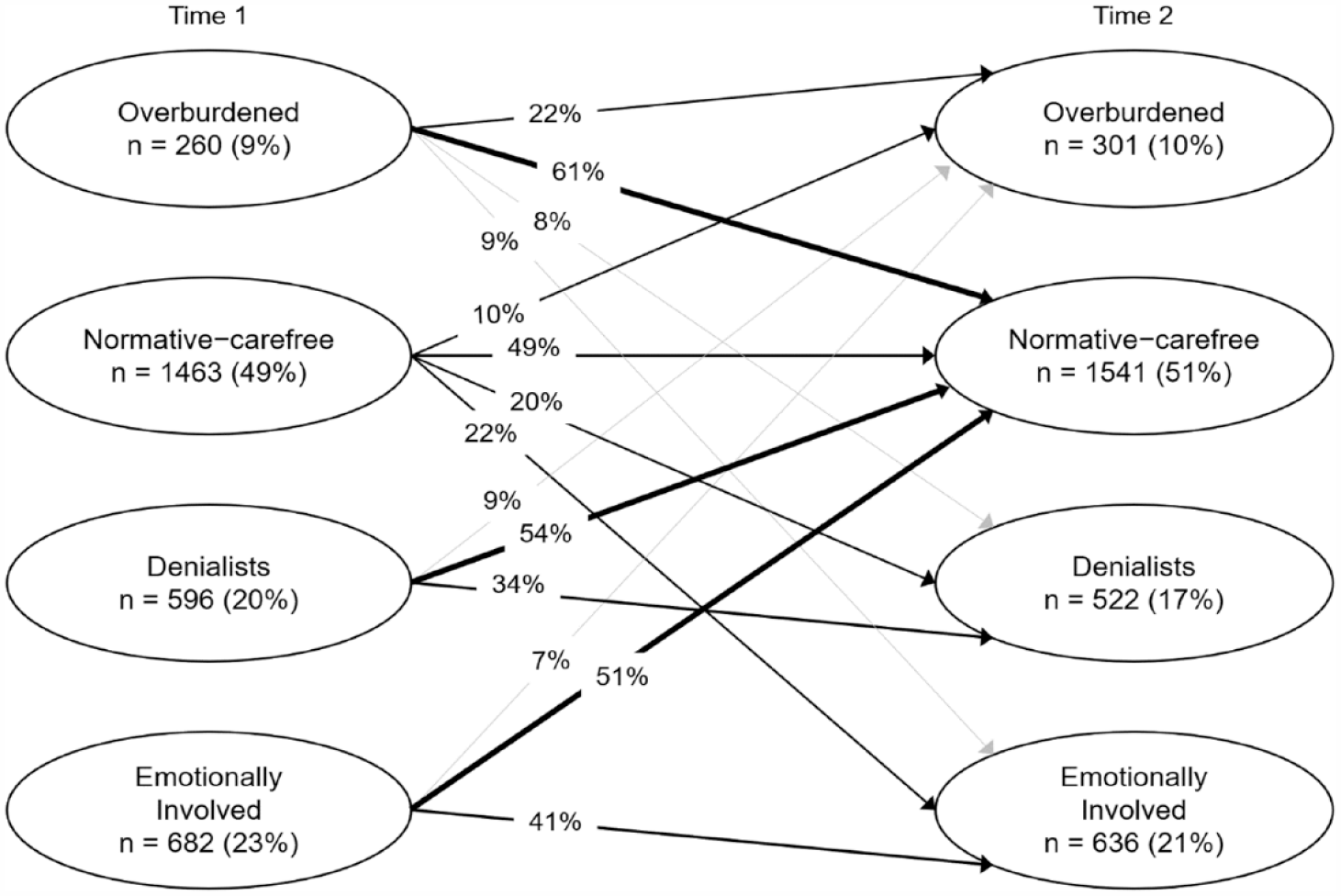
Percentages of Estimated Transitions From Time Point 1 to Time Point 2. Transitions With Less Than 5% of Participants Are Excluded From the Figure.
To examine whether the transitions between the groups differed based on age cohort, two models were compared: one model in which the age cohort was estimated freely across time and one in which the age cohorts were constrained as equals across time. Of these two models, the model allowing both age cohorts to estimate freely had lower values of information criteria indexes (Table 1). This indicated that the transition patterns of the age cohorts differed from each other. However, when the separate transition patterns of the cohorts were compared, most of the differences were minor (Table S10). The most notable difference between the groups was that the denialists group was more stable within the younger cohort (stability of 41%).
Model Fit Summary.
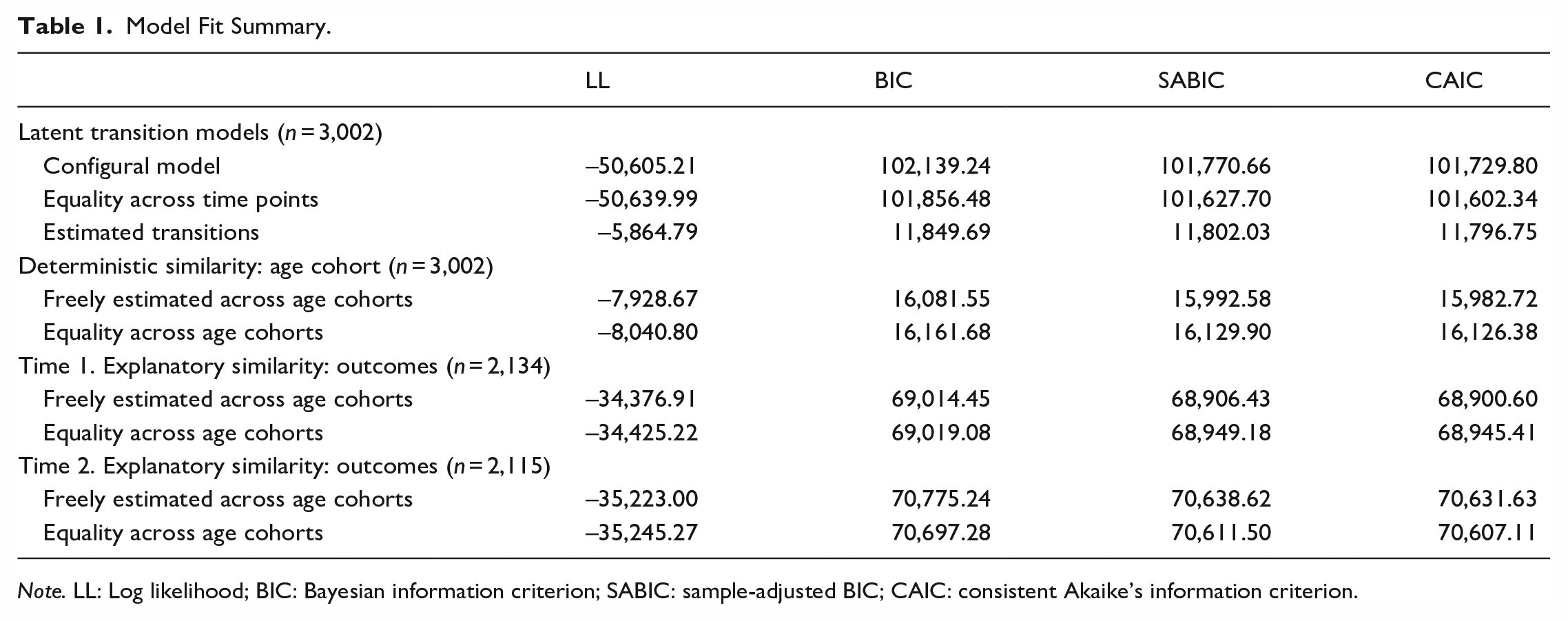
Note. LL: Log likelihood; BIC: Bayesian information criterion; SABIC: sample-adjusted BIC; CAIC: consistent Akaike’s information criterion.
Associations Between the Profiles and Outcome Variables
Finally, the explanatory similarity of the identified profiles in PEB and general well-being was studied by estimating two models separately for each time point. Outcomes were estimated freely across age cohorts in the first model, while the means of outcome were set equal across age cohorts in the second model. A comparison of goodness-of-fit indices showed that the model with outcomes freely estimated was a better fit at the first time point, indicating that the outcome variables should be reported separately for both age cohorts (Table 1). Conversely, the model of equality across time points performed better at the second time point (Table 1). Therefore, profile differences in outcome variables were presented separately across age cohorts at the first time point (Table 2) and together at the second time point (Table 3).
Profile Differences in Outcome Variables at Time Point 1 (Freely Estimated Across Age Cohorts).
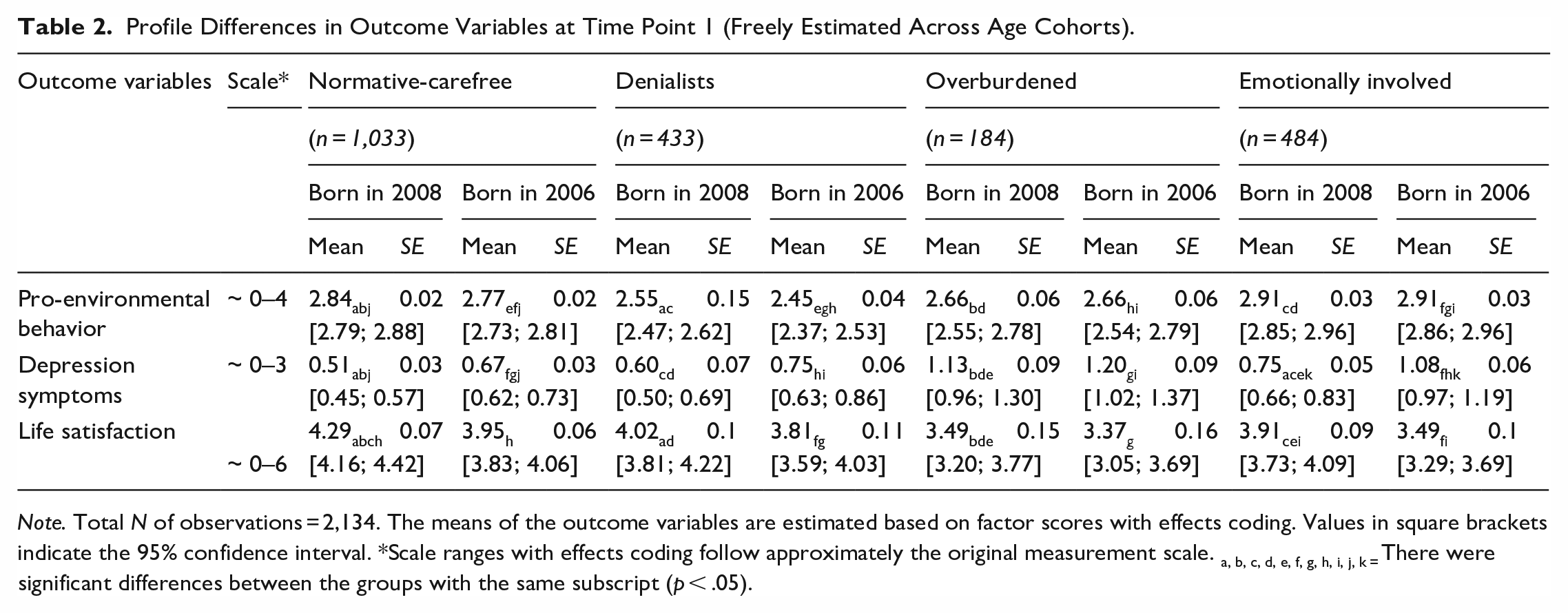
Note. Total N of observations = 2,134. The means of the outcome variables are estimated based on factor scores with effects coding. Values in square brackets indicate the 95% confidence interval. *Scale ranges with effects coding follow approximately the original measurement scale. a, b, c, d, e, f, g, h, i, j, k = There were significant differences between the groups with the same subscript (p < .05).
Profile Differences in Outcome Variables at Time Point 2.
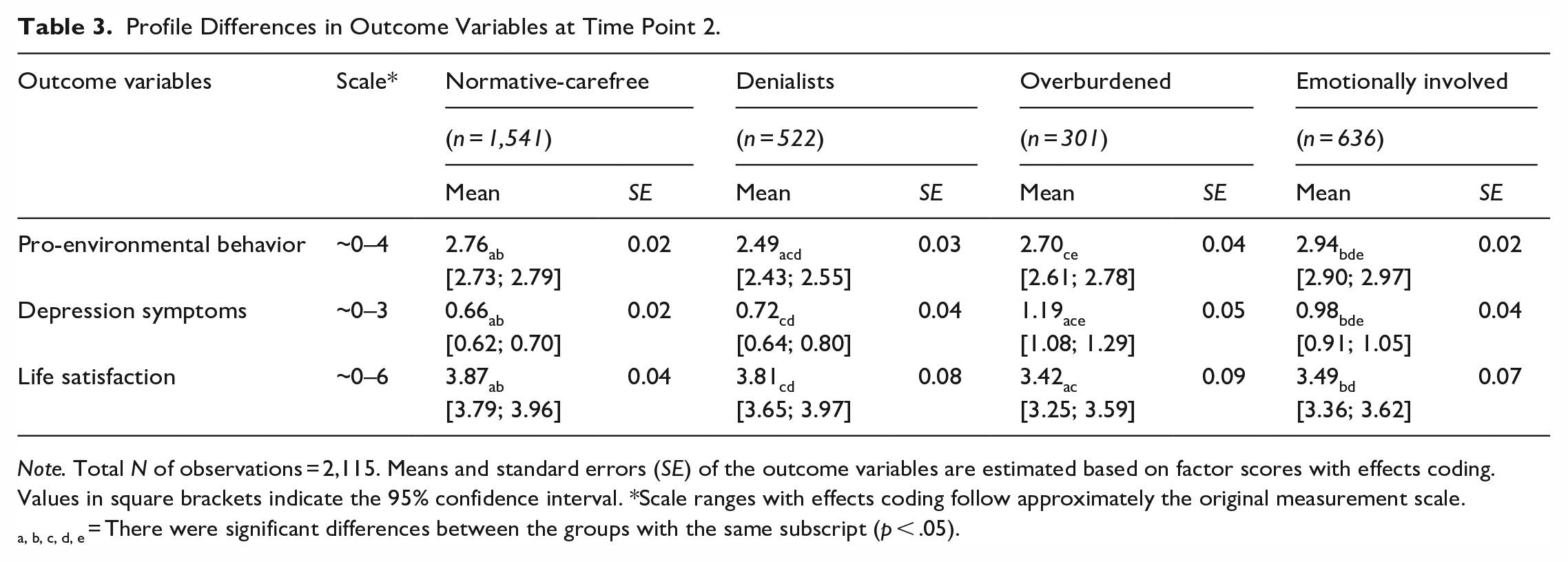
Note. Total N of observations = 2,115. Means and standard errors (SE) of the outcome variables are estimated based on factor scores with effects coding. Values in square brackets indicate the 95% confidence interval. *Scale ranges with effects coding follow approximately the original measurement scale. a, b, c, d, e = There were significant differences between the groups with the same subscript (p < .05).
The emotionally involved group reported PEB significantly more often than the other groups at both time points. However, there were no significant differences between the normative-carefree and emotionally involved groups in PEB among the younger age cohort at the first time point. Overall, denialists acted pro-environmentally the least. Even though the denialists and the overburdened groups had no significant differences within the younger age cohort at the first time point. The overburdened group experienced depression symptoms the most at both time points. However, there were no differences between the overburdened and emotionally involved groups within the older age cohort at the first time point. In contrast, the normative-carefree and denialists groups had the highest life satisfaction at both time points.
Discussion
Climate Change Distress and Climate Denialism Profiles of Adolescents
Previous studies have viewed young people as particularly vulnerable to the stress and anxiety associated with climate change (see Hickman et al., 2021). However, young people are not a homogeneous group, and they do not react to climate change in the same ways (Ojala, 2021). In addition, research with adults has shown that some people can experience climate change distress and still deny the existence of climate change (Haltinner et al., 2021). This study supports these later views by identifying four subgroups of adolescents with different experiences of climate change distress and climate denialism. As hypothesized (
Notably, half of the adolescents belonged to the normative-carefree group. While the increasing climate anxiety of young people has been widely covered in the media (see Pihkala, 2020), these results show that most of the adolescents in the study experienced low rates of distress caused by climate change. The normative-carefree group could be seen as having a normal response to climate change for adolescents, with their low climate change distress and moderate scores in PEB. One could argue that finding solutions to climate change requires communal action, and it should not be an individual youth’s responsibility to carry the burden of climate change (see Hickman et al., 2021; Whitmarsh et al., 2021). However, it could also be argued that experiences of climate change distress are an expected response for adolescents when confronting uncertainty of their future.
Indeed, previous studies have suggested that some aspects of climate change distress, like worry, could sometimes be seen as a normal, and even productive, response to a serious threat (see Ojala et al., 2021). This raises the question of whether certain elements of climate change distress are beneficial in the development of pro-environmental attitudes and mindsets while other elements are detrimental. This question could be addressed by examining the qualitative nuances between individual climate change distress items. The third identified profile, the emotionally involved group, scored relatively high on items representing cognitive-emotional distress while experiencing little of the behavioral components of climate change distress. This group seemed to represent constructive elements of distress, as belonging to the group was associated with high PEB at both time points, and general well-being was somewhat better, compared with the other group with elevated climate change distress. However, this group did have lower overall well-being than the normative-carefree group. Therefore, our hypotheses that a profile characterized by high climate change distress and low denial would be identified (
However, when climate change distress is dealt with by less constructive coping strategies, it may paralyze an individual and lead to unconstructive outcomes (Heeren et al., 2022; Ojala et al., 2021). The fourth group identified in this study was described as overburdened because they represented an example of overwhelming climate change distress. They differed from the emotionally involved group with elevated scores in both behavioral components of climate change distress and climate denialism. Earlier research has indicated that some adult denialists can still feel distress about climate change even though they deny its existence (Haltinner et al., 2021). Our study shows that this also can be the case among adolescents. The overburdened group was associated with low overall well-being accompanied by below-average PEB. By comparing the overburdened group to the emotionally involved group, one could argue that, when climate change distress affects functioning in daily tasks (such as schoolwork), it is more harmful to adolescents than cognitive-emotional distress, which may instead lead to some positive outcomes.
Profile Transitions During Adolescence
There is a lack of longitudinal studies on climate change-related well-being from the perspective of young people. One exception is a study by Sciberras and Frenando (2022) that found that Australian adolescents experienced various patterns of climate change-related worry throughout adolescence: roughly half of the adolescents they studied belonged to groups with persistently low or high worry, while the other half belonged to groups with decreasing or increasing worry. Similarly, the present study shows that the climate change distress and denialism profiles are unstable even across a 1-year period during adolescence. In addition, most of the participants in the high climate change distress groups transferred to the Normative-carefree group in the second measurement point, indicating that climate change distress during adolescence might be transient. The results supported a view of climate change distress in adolescence as something that is fluctuating and continuously developing. This could indicate the key role of coping strategies in mitigating climate change distress among adolescents (Ojala, 2012, 2013).
Furthermore, these unstable profiles can be observed from a developmental point of view. As adolescents grow toward adulthood, they need to accomplish many stage-specific developmental tasks (Masten et al., 2006). Early adolescence can be characterized by an unstable self and by experimenting with several identities and roles (Finkenauer et al., 2002), which might partly explain why the profiles were so unstable. There are huge individual differences in the pace of maturing during adolescence (Galambos et al., 2003), making it hard to investigate age differences in the transition patterns across a 1-year time span.
Limitations and Future Directions
This study has its limitations. First, the data were collected during the COVID-19 pandemic, and the special characteristics of that time may have affected participants’ responses. Furthermore, the retention rate between data waves was only 57%. This was due to the fact that participants completed the survey during class hours and had to be present at school. Participants could not complete the survey if they were unable to attend school. Also, because we were not able to recruit all possible middle schools in the area, we lost some participants from the younger cohort when they moved to middle schools after elementary school. In addition, there were 505 new participants in 2021 and 275 original participants from 2019 who skipped the survey in 2020 and participated again in 2021. To handle missing data, the robust maximum likelihood estimator (MLR) with FIML estimation was used throughout the analyses.
Second, the validity of the PEB scale should be considered carefully. All items of the scale only measured low-impact and individualistic PEB (e.g., recycling) due to the participants’ young age (the youngest were 11 years old when the data collection started), which may have led participants to report high PEB even without strong pro-environmental motivation. For future studies, it would be important to include measurements of high-impact and social-level actions to understand the association between different distress and denialism profiles and behavior patterns (see Whitmarsh et al., 2021).
Third, the climate change distress scale needs to be further studied. It was developed on the basis of two existing scales to create a scale suitable for use with Finnish adolescents. Although we assumed that the climate change distress scale consists of two different dimensions (cognitive-emotional and behavioral components), we were interested in exploring the qualitative nuances between the measurement items, and therefore the items were used as separate indicators when identifying the profiles. Even though the two different dimensions were only assumed, they were also verified by the data. The items that were assumed to measure the same dimension behaved uniformly while being inconsistent with the items of the other dimension. In addition, one has to be careful when comparing our results with previous studies. There is no consensus among researchers on what constitutes climate change-related distress, and the ways to measure it vary. For example, some measures include only a mix of different emotional responses to climate change, while others also include negative impacts on quality of life or daily functioning (see Ojala et al., 2021). One could argue that our scale is mainly measuring the effects of climate change distress rather than the distress itself.
Finally, given that 1 year is too brief a period to be able to understand fully climate change distress and denialism from a developmental perspective, future longitudinal studies covering both adolescence and early adulthood are still needed. In addition, it is important to pay more attention to youths in the areas most affected by these threats (see Sanson et al., 2019). Even though climate change is a global problem, it is more severe in the global south (IPCC, 2021), and its effects are more immediately apparent to youth in these areas than those in Finland. The same profiles might not be found in other cultural contexts.
Practical Implications
The study findings have several important implications for policy and practice. First, the person-oriented study approach shows that diverse groups of youth exist and have different constellations of climate change distress and climate denialism. From the perspective of educators, this means that students need a range of approaches and tools when climate change is discussed in the classroom: some youth might benefit from more information-led teaching (facts about climate change), while some need a safe space in which to share their climate change-related emotions or to practice PEB at individual and communal levels. Second, instead of focusing on treating youths’ climate change-related ill-being, it could be more efficient to pay attention to the development of constructive coping strategies (see Ojala, 2012). Adolescents might need help and encouragement from adults to transform distress into a constructive motivational force. Overburdened adolescents who deny climate change but are still experiencing climate change distress might especially need support to develop healthy and constructive ways to cope with climate change. All in all, adolescence is the time when an individual starts forming their identity and worldviews (e.g., Masten et al., 2006). Therefore, it is a crucial period for environmental education to promote the skills and attitudes needed for sustainable citizenship.
Supplemental Material
sj-docx-1-jbd-10.1177_01650254231205251 – Supplemental material for Profiles of climate change distress and climate denialism during adolescence: A two-cohort longitudinal study
Supplemental material, sj-docx-1-jbd-10.1177_01650254231205251 for Profiles of climate change distress and climate denialism during adolescence: A two-cohort longitudinal study by Salla Veijonaho, Maria Ojala, Lauri Hietajärvi and Katariina Salmela-Aro in International Journal of Behavioral Development
Footnotes
Funding
The author(s) disclosed receipt of the following financial support for the research, authorship, and/or publication of this article: This study was supported by Academy of Finland (projects TeensGoGreen, 336138 and ClimComp, 340794) and the Strategic Research Council of the Academy of Finland (project Growing Mind, 312529).

Supplemental Material
Supplemental material for this article is available online.
References
Supplementary Material
Please find the following supplemental material available below.
For Open Access articles published under a Creative Commons License, all supplemental material carries the same license as the article it is associated with.
For non-Open Access articles published, all supplemental material carries a non-exclusive license, and permission requests for re-use of supplemental material or any part of supplemental material shall be sent directly to the copyright owner as specified in the copyright notice associated with the article.
