




Abstract
The temporal precedence of the association between climate change anxiety and pro-environmental behavior has not yet been established. This study examines reciprocal relations between the two variables while controlling for personal values to rule out potential third-variable explanations. Based on theorizing on the functionality of anxiety and self-perception theory, it was hypothesized that climate change anxiety and pro-environmental behavior positively predict each other. Building on value-belief-norm theory and related empirical work, it was further expected that biospheric and altruistic values positively predict both climate change anxiety and pro-environmental behavior. Two-wave panel data across 6 months were collected from N = 1,355 individuals in Germany. Results showed that climate change anxiety and pro-environmental behavior positively, albeit weakly, predicted each other across a 6-month interval, while controlling for personal values. Biospheric, but not altruistic, values positively predicted pro-environmental behavior, and neither biospheric nor altruistic values significantly predicted climate change anxiety.
Anthropogenic climate change poses an existential threat to human well-being and prosperity (IPCC, 2023). As a result, people experience various negative emotions related to climate change, including anxiety, grief, anger, and guilt (for reviews, see Brosch, 2021; Ojala et al., 2021; Pihkala, 2022). Against the backdrop of accelerating climate change and associated catastrophes such as extreme weather events, the number of people experiencing negative climate-related emotions is increasing. This trend is particularly strong among younger people (e.g., Hickman et al., 2021), but is also evident across the entire population. For example, research conducted by the Yale Program on Climate Change Communication and George Mason University Center for Climate Change Communication (2022) showed that 51% of the American population reported being “somewhat” or “very” worried about climate change in 2010, which increased to 64% in 2022.
Climate change anxiety (also called “eco-anxiety” or “climate anxiety,” see Pihkala, 2020) is arguably the most studied emotional response associated with climate change (Pihkala, 2022). It can be defined as “. . .anxiety which is significantly related to anthropogenic climate change. . .” (Pihkala, 2020, p. 3). Climate change anxiety conceptually differs from climate change perceptions (i.e., beliefs about the reality, causes, and consequences of climate change; van Valkengoed et al., 2021), climate change risk perceptions (i.e., beliefs that climate change is a threat; van Valkengoed et al., 2021), and environmental concern (i.e., awareness of environmental issues and support for environmental protection; Dunlap & Jones, 2002). Climate change anxiety is closely related to climate change worry with some scholars conceptualizing worry as a facet of climate change anxiety (e.g., Van Valkengoed et al., 2023; Verplanken et al., 2020) or a process related to climate change anxiety (Clayton & Karazsia, 2020).
There are different views regarding the functionality of climate change anxiety. The impairment-based view considers climate change anxiety as “. . .a more clinically significant ‘anxious’ response to climate change. . .” that can impair mental wellbeing (Clayton & Karazsia, 2020, p. 20). For example, studies have found positive, albeit weak, associations with psychological distress and that climate change anxiety relates to higher levels of depression and lower general mental wellbeing (Hajek & König, 2023; Ogunbode et al., 2022; Verplanken et al., 2020; Wullenkord et al., 2021). Others have conceptualized climate change anxiety as a rational response to an existential crisis (Hogg et al., 2021) and as a form of “practical anxiety” (Pihkala, 2020) that can motivate pro-environmental behavior (i.e., “behavior that harms the environment as little as possible, or even benefits the environment,” Steg & Vlek, 2009, p. 309).
In line with this functional conceptualization, several studies have demonstrated positive associations between climate change anxiety and pro-environmental behavior (Heeren et al., 2022; Innocenti et al., 2023; Mathers-Jones & Todd, 2023; Ogunbode et al., 2022; Whitmarsh et al., 2022). However, research has almost exclusively relied on cross-sectional designs, with few exceptions (e.g., two-wave study by Pavani et al., 2023; daily diary study by Lutz et al., 2023). Therefore, the temporal precedence of the two variables in the relationship remains largely unclear: Does climate change anxiety lead to pro-environmental behavior or vice versa, or is the relationship reciprocal? To address this question, time-lagged studies with baseline controls are needed. By examining time-lagged effects and controlling for baseline levels of outcome variables, such studies can reveal whether climate change anxiety leads to changes in pro-environmental behavior, and vice versa (Aickin, 2009; Finkel, 2008).
It is further unknown whether the positive association between climate change anxiety and pro-environmental behavior is partly or entirely attributable to stable between-person differences, such as personal values. Personal values are considered as fundamental guiding principles in people’s lives, which remain relatively stable over time (Stern et al., 1995). They are strong predictors of environmental experiences (e.g., emotions, norms, attitudes) and behaviors (Steg, 2016, 2023). Specifically, research has identified biospheric and altruistic values as common predictors of both climate change anxiety (e.g., Bouman et al., 2020; Verplanken et al., 2020) and pro-environmental behavior (e.g., Bouman et al., 2020; Schultz & Zelezny, 1998; Schultz et al., 2005; Steg, Bolderdijk, et al., 2014).
The goal of this study is to examine the reciprocal relations between climate change anxiety and pro-environmental behavior over time and to disentangle these associations from the influence of personal values. Specifically, consistent with the common assumption in the literature, we expect that climate change anxiety has a functional aspect and, therefore, that it positively predicts pro-environmental behavior. At the same time, based on self-perception theory (Bem, 1972), we propose that engaging in pro-environmental behavior increases individuals’ awareness of their concern for the environment, consequently resulting in higher levels of climate change anxiety. Additionally, building on value-belief-norm theory (Stern, 2000; Stern et al., 1999) and related empirical research, we expect that biospheric and altruistic values positively predict both climate change anxiety and pro-environmental behavior. We test our hypotheses using a two-wave survey study across 6 months and a large and heterogeneous sample of individuals in Germany. Figure 1 depicts our conceptual model.
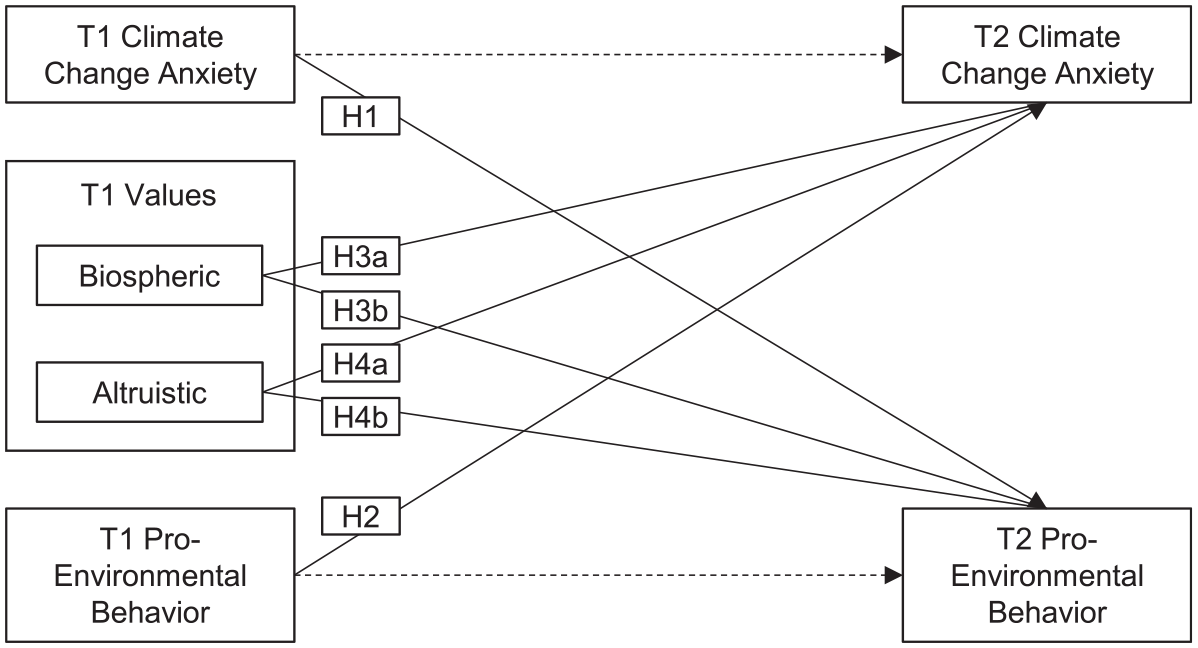
Conceptual model.
Our study contributes to theory and practice in two meaningful ways. First, we advance the literature on the associations between climate emotions and climate action. Scholars have repeatedly called for multi-wave studies to establish temporal precedence and detect potentially reciprocal relations between climate emotions and climate action (e.g., Brosch, 2021; Ojala et al., 2021; Whitmarsh et al., 2022). Our study further expands on another recent two-wave study on the topic (i.e., Pavani et al., 2023) by incorporating a longer time interval (i.e., 6 months vs. 1 month), using a larger sample (N = 1,355 vs. N = 167), and presenting and statistically testing theoretical arguments for both possible directions of effects among the focal variables (i.e., climate change anxiety predicting subsequent pro-environmental behavior, and vice versa), while also controlling for the effects of personal values. Although Pavani et al. (2023) reported significant effects for both directions, their hypotheses focused only on climate change anxiety predicting pro-environmental behavior and not vice versa. Second, from a practical point of view, our results are informative of the relative importance of various predictors of pro-environmental behavior (i.e., climate change anxiety, biospheric, and altruistic values) that can further be considered in the design of tailored interventions (Bingley et al., 2022) to increase pro-environmental behaviors. Furthermore, knowledge of how personal values and pro-environmental behavior are linked to climate change anxiety may be relevant to develop constructive coping mechanisms that can aid in reducing the experience of climate change anxiety.
Climate Change Anxiety Predicts Pro-Environmental Behavior
Theorizing and empirical research suggest that the association between climate change anxiety and pro-environmental behavior could be either positive or negative. On the one hand, experiencing climate change anxiety may result in “eco-paralysis,” leading to disengagement from topics around climate change and inhibiting pro-environmental behavior (Albrecht, 2011; Innocenti et al., 2023; Lutz et al., 2023; Van Valkengoed et al., 2023). On the other hand, in line with theorizing on the functionality of general worry and anxiety (Kurth, 2018; Sweeny & Dooley, 2017), experiencing climate change anxiety may signal individuals that something is wrong and needs to be corrected or changed. This, in turn, may lead people to rethink and adjust their behavior toward more pro-environmental action to mitigate climate change (Ojala et al., 2021; Pihkala, 2020).
Although there are some mixed findings regarding the association between climate change anxiety and pro-environmental behavior (e.g., Innocenti et al., 2023), we follow the functional conceptualization of climate change anxiety and expect it to be positively related to pro-environmental behavior. This functional perspective is supported by a considerable amount of empirical research. For example, in a cross-sectional study with participants from the United Kingdom, climate change anxiety was positively associated with various forms of pro-environmental behavior, including the tendency to encourage others to save energy, buy second-hand, borrow or rent items, and repurpose items (Whitmarsh et al., 2022). In a large international study, climate change anxiety was positively related to pro-environmental behavior in 24 countries (Ogunbode et al., 2022). Recent daily diary studies also suggest that daily eco-anxiety is associated with greater engagement in daily pro-environmental behavior (Lutz et al., 2023; Mathers-Jones & Todd, 2023). Consistent with theorizing on the functional aspects of anxiety, and supported by empirical evidence, we therefore propose that climate change anxiety is positively associated with pro-environmental behavior.
Hypothesis 1: Climate change anxiety positively predicts pro-environmental behavior.
Pro-Environmental Behavior Predicts Climate Change Anxiety
Although research and theorizing have predominantly focused on the relationship between climate change anxiety and subsequent pro-environmental behavior, scholars have repeatedly argued for a reciprocal relationship between the two constructs, suggesting that engaging in pro-environmental behavior is also associated with subsequent climate change anxiety (Brosch, 2021; Ojala et al., 2021; Van Valkengoed et al., 2023; Whitmarsh et al., 2022). There are conflicting perspectives on the direction of this relationship, with arguments for both, a positive and a negative association. On the one hand, engaging in pro-environmental action and thereby contributing to climate change mitigation can empower individuals and reduce hopelessness, thus potentially decreasing climate change anxiety (Bingley et al., 2022; Schwartz et al., 2023). However, building on self-perception theory, we expect that pro-environmental behavior is, overall, positively related to subsequent climate change anxiety.
The basic premise of self-perception theory is that “. . .individuals come to ‘know’ their own attitudes, emotions, and other internal states partially by interfering them from observations of their own overt behavior and/or the circumstances in which this behavior occurs. . .” (Bem, 1972, p. 2). By observing their pro-environmental behavior, people might “come to know” their anxiety related to environmental degradation, thereby increasing their climate change anxiety. Additionally, observing one’s pro-environmental behavior might signal to individuals that they apparently care for the environment and have a strong pro-environmental attitude. In fact, empirical research has repeatedly found that engagement in pro-environmental behavior is related to increased pro-environmental identity (van der Werff et al., 2014a, 2014b). People with a stronger pro-environmental attitude, in turn, are more likely to perceive climate change as a threat and experience climate change anxiety (e.g., Verplanken et al., 2020; Zacher & Rudolph, 2023).
According to self-perception theory, individuals not only observe their own behavior, but also the circumstances under which their behavior occurs (Bem, 1972). When individuals reflect on the circumstances of their pro-environmental actions, they may realize the limited impact of their individual efforts compared to the massive threat of climate change (Lacroix, 2018). This awareness of the discrepancy between individual action and the massive transformations needed to mitigate climate change might lead individuals to feel overwhelmed and, in turn, experience more climate change anxiety. This notion aligns with findings by Schwartz et al. (2023): Participants of a qualitative study reported that the realization how little a single person could do about climate change could lead to a “. . .perception of the insignificance. . .” (p. 16,718) of one’s actions, resulting in feelings of despair and, ultimately, increased climate change anxiety.
Finally, engaging in pro-environmental behavior and observing the circumstances of this behavior necessarily involves some mental preoccupation with climate change. For example, when researching the carbon footprint of various food products, it is inevitable to think about climate change in some way. This may raise awareness of climate change and, in turn, result in more climate change anxiety (Schwartz et al., 2023; Whitmarsh et al., 2022). Accordingly, Clayton (2020) argued that mental preoccupation with climate change (e.g., triggered by pro-environmental behavior) might aggravate rumination and anxiety about the climate crisis, especially for those who already have high levels of climate change anxiety.
There is initial empirical evidence supporting a positive association between pro-environmental behavior and subsequent climate change anxiety. For example, in a daily diary study, Lutz et al. (2023) found that pro-environmental choices when disposing of things were associated with more eco-anxiety the next day. In a two-wave study by Pavani et al. (2023), pro-environmental behavior was associated with more eco-anxiety one month later. Although cross-sectional studies preclude interpretations regarding the temporal ordering of variables, the positive correlations observed between climate change anxiety and pro-environmental behavior are frequently interpreted as evidence of climate change anxiety motivating pro-environmental behavior. However, these positive correlations could equally arise from engagement in pro-environmental behavior contributing to increased climate change anxiety. Overall, building on self-perception theory, we expect a positive relationship between pro-environmental behavior and subsequent climate change anxiety.
Hypothesis 2: Pro-environmental behavior positively predicts climate change anxiety.
Personal Values, Pro-Environmental Behavior, and Climate Change Anxiety
Personal values are “. . .desirable goals, varying in importance, that serve as guiding principles in people’s lives. . .” (Schwartz, 1992, p. 21). Building on Schwartz’s value theory (Schwartz, 1992), environmental psychology research has found that two values related to self-transcendence (i.e., focus on collective interests) and two values related to self-enhancement (i.e., focus on personal interest) are especially important for pro-environmental behavior and attitudes (Schultz et al., 2005; Steg, Bolderdijk, et al., 2014; Steg & de Groot, 2012; Steg, Perlaviciute, et al., 2014; Stern et al., 1999). Specifically, environmental psychology studies distinguished biospheric and altruistic values (both related to self-transcendence), and hedonic and egoistic values (both related to self-enhancement; Steg, 2023). Biospheric values involve being concerned about the natural environment (i.e., pro-environmental orientation), whereas altruistic values entail concerns about other people’s welfare (i.e., pro-social orientation; de Groot & Steg, 2008; Schultz, 2001). Hedonic values entail concerns with enhancing one’s satisfaction and positive emotions while reducing effort and negative feelings (Steg, Perlaviciute, et al., 2014), whereas egoistic values reflect concerns about protecting and increasing one’s material and social resources, including wealth and power (Schultz et al., 2005; Steg, Bolderdijk, et al., 2014). Personal values are relatively stable across time and different situations (Feather, 1995; van der Werff et al., 2013).
The value-belief-norm theory of environmentalism (VBN theory; Stern, 2000; Stern et al., 1999) suggests that personal values are important internal factors influencing individual pro-environmental behavior. Specifically, the theory posits that personal values determine how aware people are of the potentially negative environmental impact of human action and to what extent they recognize their own role for taking pro-environmental action. These beliefs, in turn, activate personal norms to take pro-environmental action, which, ultimately, result in pro-environmental behavior. Thus, personal values are conceptualized as central personality characteristics that build the foundation for pro-environmental action.
VBN theory suggests that people who strongly endorse biospheric and altruistic values are more likely to behave pro-environmentally (Steg, Bolderdijk, et al., 2014; Steg & de Groot, 2012). Individuals with high biospheric values are more concerned about an intact environment and take higher personal responsibility for environmental issues (Schultz & Zelezny, 1998; Steg, Bolderdijk, et al., 2014; Steg & de Groot, 2012). Individuals with high altruistic values are more concerned about the wellbeing of close (e.g., friends and family) and distant (e.g., people living in areas particularly affected by climate change, future generations) human beings and take higher responsibility for their welfare (Schultz & Zelezny, 1998; Schultz et al., 2005; Steg & de Groot, 2012; Steg, Perlaviciute, et al., 2014). As a result, individuals with high biospheric or altruistic values are more likely to engage in pro-environmental behavior to mitigate climate change, and, in turn, protect the environment and others from climate change’s negative consequences. Consistently, a large body of research has demonstrated that biospheric (e.g., Bouman et al., 2020; Ruepert et al., 2017; Schultz & Zelezny, 1998; van Riper et al., 2019) and altruistic values (Hartmann et al., 2017; Milfont et al., 2010; Steg, Perlaviciute, et al., 2014) are associated with more pro-environmental behavior.
Although emotional reactions toward environmental crises are not the focus of VBN theory (Stern, 2000; Stern et al., 1999), the theory builds on the assumption that personal values are the “. . .bases for environmental concern. . .” (Stern et al., 1999, p. 85). Accordingly, related research on climate change worry draws upon VBN theory to explain why values related to self-transcendence can be positively related to climate change worry (Bouman et al., 2020). When people strongly care about the wellbeing of nature and other human beings (i.e., high biospheric and altruistic values), they are likely to be more worried and anxious about climate change, because it threatens their biospheric and altruistic values (Steg, 2023). Accordingly, in a review on climate anxiety and worry, Ojala et al. (2021) further argued that anxiety and worry are “. . .reactions to threats to important values. . .” (p. 39). This is also supported by empirical findings. In a cross-sectional study across 22 European countries, biospheric values were positively related to feelings of worry about climate change (Bouman et al., 2020). In another cross-sectional study with participants from the United States and Europe, pro-environmental values were positively associated with global warming worry (Verplanken et al., 2020). Overall, building on VBN theory, we propose that biospheric and altruistic values positively predict both pro-environmental behavior and climate change anxiety. We do not hypothesize effects for hedonic and egoistic values since these have different foci (i.e., enhancing one’s feelings, and obtaining resources) and have so far received less research attention in the context of pro-environmental behavior and climate change anxiety (Steg, 2023). However, we introduce them as control variables to account for the full range of personal values.
Hypothesis 3: Biospheric values positively predict (a) climate change anxiety and (b) pro-environmental behavior.
Hypothesis 4: Altruistic values positively predict (a) climate change anxiety and (b) pro-environmental behavior.
Method
Participants and Procedure
This study is part of a larger longitudinal data collection effort that focuses on “Environmental Sustainability at Work,” thus resulting in a large sample of German employees from various jobs, organizations, and industries. The data collection effort consists of ten measurement waves in total (i.e., five monthly measurement waves between August and December 2022 and five follow-up waves with 3-month time intervals between June 2023 and June 2024). So far, two studies with completely different research questions and non-overlapping substantive variables have been published (Kühner et al., 2024; Zacher & Rudolph, 2023). For this study, we made use of data collected in December 2022 (for readability, this measurement wave is labeled Time 1 [T1] in the current study), and June 2023 (T2). Personal values were measured at T1 and pro-environmental behavior and climate change anxiety were both measured at T1 and 6 months later at T2. Additionally, we introduced demographic control variables (i.e., age, gender, education) that were assessed in a demographic survey in August 2022.
Our decision to explore the reciprocal relationship between climate change anxiety and pro-environmental behavior across a six-month time interval was guided by both methodological and conceptual considerations. Best practice recommendations for multi-wave studies in applied psychology (Dormann & Griffin, 2015) suggest that time-lags shorter than 1 year are most appropriate for detecting time-lagged effects and that models estimating reciprocal effects should apply slightly longer time-intervals than studies exploring unidirectional effects (i.e., several months instead of weeks). From a conceptual perspective, broader behavioral theory suggests that behavior modifications require time to unfold (e.g., Prochaska & DiClemente, 1982). Moreover, conceptual work on climate emotions suggests that negative climate emotions may also develop over a longer time period (Pihkala, 2022).
Participants were recruited by the ISO 26362-certified online panel company Norstatpanel, which ensures the quality of the data. Samples recruited via panel companies are generally more representative than convenience or university student samples due to their more diverse participant pool (e.g., Porter et al., 2019). Participation in the study was voluntary, and data were saved and processed anonymously. Informed consent about participation and publication was obtained from all individual participants included in the study. The data collection was approved by the Ethics Advisory Board of Leipzig University (No. 2023.08.01_eb_vv_7, Study Title: Environmental Sustainability at Work).
A sample of N = 1,355 employed adults in Germany participated in the two waves used in this study. The sample was 50.60% female and on average 48.70 years of age (SD = 11.60, range 18–85 years). Most participants (45.00%) held a college/university or technical college degree. The sample was not representative of the general population, as it did not include children, retirees, and unemployed people. The sample was also somewhat older and more highly educated than the general working population in Germany (i.e., average age of 44 years, 24% college/university degree). Additional information on the sample (e.g., income, industry) is available in Supplemental Table S1 in the Online Supplemental Materials (OSM; https://osf.io/bpd5a/).
The demographic survey (August 2022) was initiated by 3,566 people. Sample sizes for observed variables varied by time point (demographic survey: 3,564–3,491; T1: 2,067–2,406; T2: 1,933–1,998), suggesting some degree of attrition over time and some degree of missingness within each time point. Our analyses are based on a sample of 1,335 individuals who provided complete data on our substantive variables across the two time points. Supplemental Table S1 compares these complete responders to incomplete responders (N = 357). We also ran a logistic regression model showing that demographics predicted only 1.6% of the variance in attrition, suggesting that bias due to attrition was not a significant concern. Results of the logistic regression model are reported in Supplemental Table S2 in the OSM. We included two items to control for data quality in our survey (Meade & Craig, 2012). Participants were asked to select a specific answer option (i.e., “Please select the answer option ‘does not apply at all’/‘very often’ for this statement”). Only participants who had answered both items correctly were included in our focal analyses. This procedure led to the exclusion of 277 participants from our focal analyses. We ran supplemental analyses including careless participants (i.e., participants providing wrong answers to one or both quality check items; results are reported below).
Measures
Information on the reliability for all measures (i.e., McDonald’s Omega, ω), which was generally very good, is reported in Table 1. We conducted a confirmatory factor analysis of our focal constructs at T1 with ten first-order factors (i.e., conservation behavior, environmental citizenship, food consumption, transportation, climate change anxiety—functional impairment, climate change anxiety—emotional impairment, biospheric values, altruistic values, hedonic values, and egoistic values) and three higher-order factors (i.e., pro-environmental behavior, climate change anxiety, and personal values). Following recommendations by Schermelleh-Engel et al. (2003), we assessed the model fit as acceptable (χ2(1067) = 4,800.910, p < .001, CFI = 0.881, TLI = 0.874, RMSEA = 0.054, SRMR = 0.087).
Correlations and Descriptive Statistics.
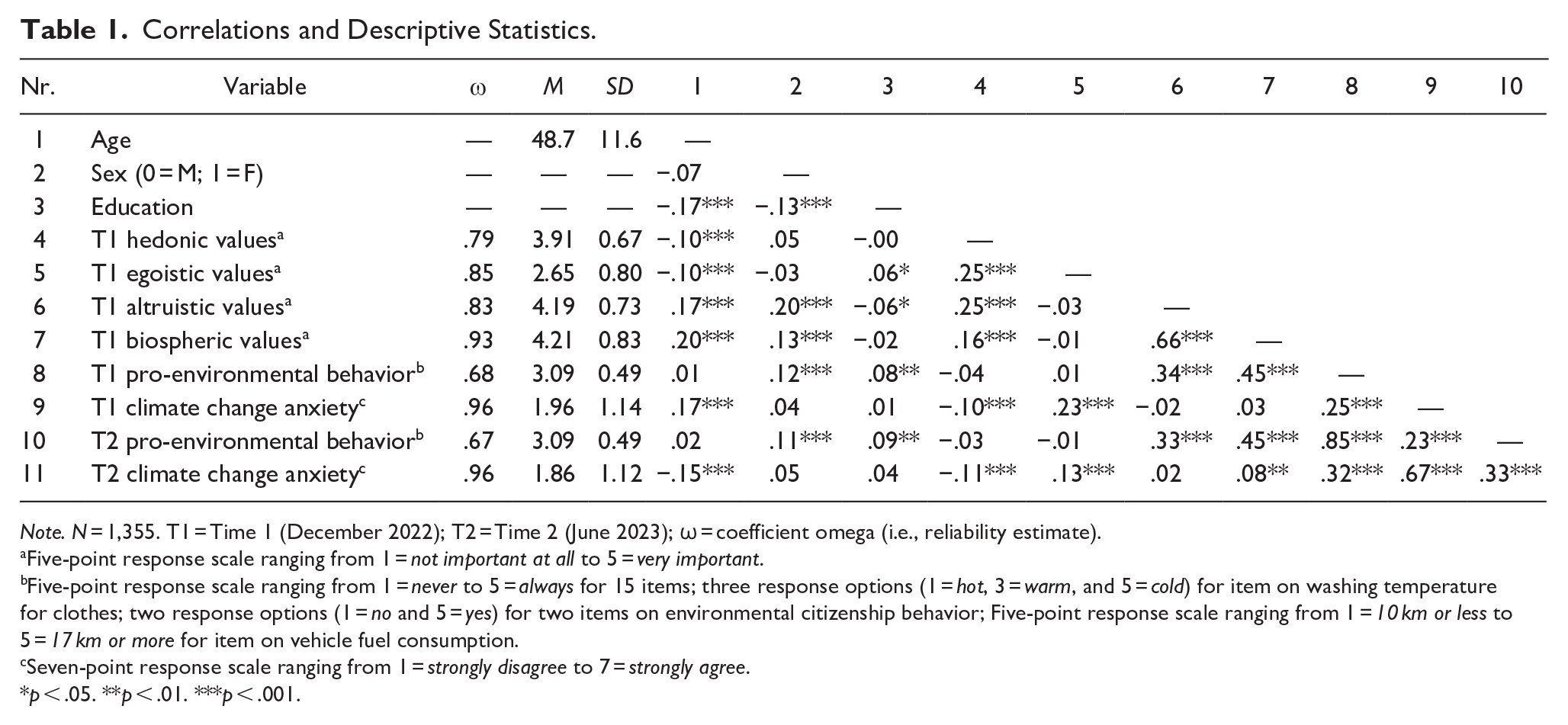
Note. N = 1,355. T1 = Time 1 (December 2022); T2 = Time 2 (June 2023); ⍵ = coefficient omega (i.e., reliability estimate).
Five-point response scale ranging from 1 = not important at all to 5 = very important.
Five-point response scale ranging from 1 = never to 5 = always for 15 items; three response options (1 = hot, 3 = warm, and 5 = cold) for item on washing temperature for clothes; two response options (1 = no and 5 = yes) for two items on environmental citizenship behavior; Five-point response scale ranging from 1 = 10 km or less to 5 = 17 km or more for item on vehicle fuel consumption.
Seven-point response scale ranging from 1 = strongly disagree to 7 = strongly agree.
p < .05. **p < .01. ***p < .001.
Personal Values
At T1, biospheric, altruistic, hedonic, and egoistic values were assessed with four, four, three, and five items, respectively (de Groot & Steg, 2008; Steg, Perlaviciute, et al., 2014; German translation by Sargisson et al., 2020). Participants were asked, “How important are the following values as guiding principles in your life?” Example items are “respecting the earth” (biospheric values), “helping others” (altruistic values), 1 “enjoying life” (hedonic values), and “authority” (egoistic values). Participants rated each item on a 5-point scale ranging from 1 = not important at all to 5 = very important.
Climate Change Anxiety
A widely-used 13-item measure of climate change anxiety was collected at T1 and T2 (Clayton & Karazsia, 2020; German translation by Wullenkord et al., 2021). Example items are “Thinking about climate change makes it difficult for me to concentrate” and “I find myself crying because of climate change.” Responses were provided on a 7-point scale ranging from 1 = strongly disagree to 7 = strongly agree. Clayton and Karazsia (2020) suggested that their scale consists of two dimensions, cognitive-emotional and functional impairment, which were strongly correlated in their studies (i.e., rxy = .78, rxy = .84). In a validation study with a German version of the climate change anxiety scale, Wullenkord et al. (2021) were unable to replicate the two-dimensional structure of climate change anxiety. Therefore, we used a single score of climate change anxiety in our focal analyses. As shown in our supplemental correlation table in the OSM (Supplemental Table S3), correlations between the two dimensions were high at T1 (rxy = .85) and T2 (rxy = .86). Below, we report the results of supplemental analyses for each climate change anxiety dimension.
Pro-environmental Behavior
At T1 and T2, pro-environmental behavior was assessed with a 19-item scale developed by Markle (2013; German translation by Meis-Harris et al., 2021). The scale covers conservation behaviors (e.g., “How often did you limit your time in the shower in order to conserve water?”), environmental citizenship (e.g., “How often did you talk to others about their environmental behavior?”), food consumption (e.g., “How often have you consumed beef?”), and transportation (e.g., “How often have you used public transportation?”). Participants were asked to think about their environmental behaviors in the last 4 weeks at T1 and in the last 6 months at T2. Ratings for 15 items were provided on a 5-point scale ranging from 1 = never to 5 = always, one item (“At what temperature did you wash most of your clothes?”) was rated on a 3-point scale including 1 = hot, 3 = warm, and 5 = cold, two items on environmental citizenship were rated using two response options including 1 = no and 5 = yes, and one item on the fuel consumption of the vehicle mostly used was rated on a 5-point scale ranging from 1 = 10 km or less to 5 = 17 km or more (adapted to the German context from “24 or less” to “40 or more” miles per gallon in the original scale). The overall score for pro-environmental behavior was created by averaging scores across the 19 items.
Demographic Characteristics
Given that research has demonstrated that demographic characteristics are associated with climate change anxiety (Wullenkord et al., 2021) and pro-environmental behavior (Li et al., 2019), we controlled for age (in years), sex (0 = male, 1 = female), and education (0 = lower secondary school, 1 = intermediate secondary school, 2 = upper secondary school, 3 = college/university or technical college) collected in the demographic survey.
Statistical Analyses
Following recommendations by Kline (2023), we used path analysis to test our hypotheses. T2 pro-environmental behavior and climate change anxiety were regressed onto age, sex and education, T1 personal values, and T1 pro-environmental behavior and T1 climate change anxiety. Controlling for time-lagged T1 levels of outcomes makes our model a lagged endogenous change model (Aickin, 2009; Finkel, 2008). Accordingly, the observed effects of predictors in these models can be interpreted in terms of their effect on changes in outcome variables from T1 to T2. We further conducted a dominance analysis to examine which predictors explained the largest share of variance in the two outcomes (Azen & Budescu, 2003). Owing to observed deviations from univariate and multivariate normality (for endogenous variables; see Supplemental Material S4 in the OSM for model assumption checks and tests for normality), we used a robust maximum likelihood estimation method in our models. We conducted all analyses in the open-source software R (R Core Team, 2023). Our model was tested using the lavaan package (Rosseel, 2012). Complete data and R code to reproduce all reported analyses can be found here: https://osf.io/bpd5a/.
Results
Descriptive statistics and correlations among the study variables are provided in Table 1. Consistent with previous research, climate change anxiety and pro-environmental behavior were positively and moderately associated at both T1 (r = .25, p < .001) and T2 (r = .33, p < .001). Moreover, biospheric values were positively related to climate change anxiety at T2 (r = .08, p = .005), but not at T1, and to pro-environmental behavior at both T1 (r = .45, p < .001) and T2 (r = .45, p < .001). Altruistic values were positively related to pro-environmental behavior at both T1 (r = .34, p < .001) and T2 (r = .33, p < .001), whereas they were not significantly related to climate change anxiety (see Table 1).
Our path model results are summarized in Table 2 and depicted graphically in Figure 2. Climate change anxiety positively, albeit very weakly, predicted pro-environmental behavior 6 months later, thus supporting Hypothesis 1 (βstd = .04, p = .023). Pro-environmental behavior positively, albeit relatively weakly, predicted climate change anxiety 6 months later, thus supporting Hypothesis 2 (βstd = .16, p < .001). We additionally tested whether the difference between the effects (i.e., from pro-environmental behavior on climate change anxiety, and vice versa) was statistically significant. To this end, we calculated the difference between the standardized regression coefficients of pro-environmental behavior and climate change anxiety, respectively, and introduced it into our model (Kline, 2023). The standardized regression coefficient of the difference was significantly different from zero (βstd = −0.12, p < .001), indicating that the effect of pro-environmental behavior on climate change anxiety was significantly stronger than the effect of climate change anxiety on pro-environmental behavior. Hypothesis 3a stating that biospheric values positively predict climate change anxiety was not supported (βstd = .00, p = .924). In contrast, biospheric values positively predicted pro-environmental behavior 6 months later (βstd = .07, p = .001), thus providing support for Hypothesis 3b. Altruistic values did not significantly predict climate change anxiety (βstd = −.01, p = .827) and pro-environmental behavior (βstd = .01, p = .509), thus providing no support for Hypotheses 4a and 4b.
Summary of Path Analysis Results.
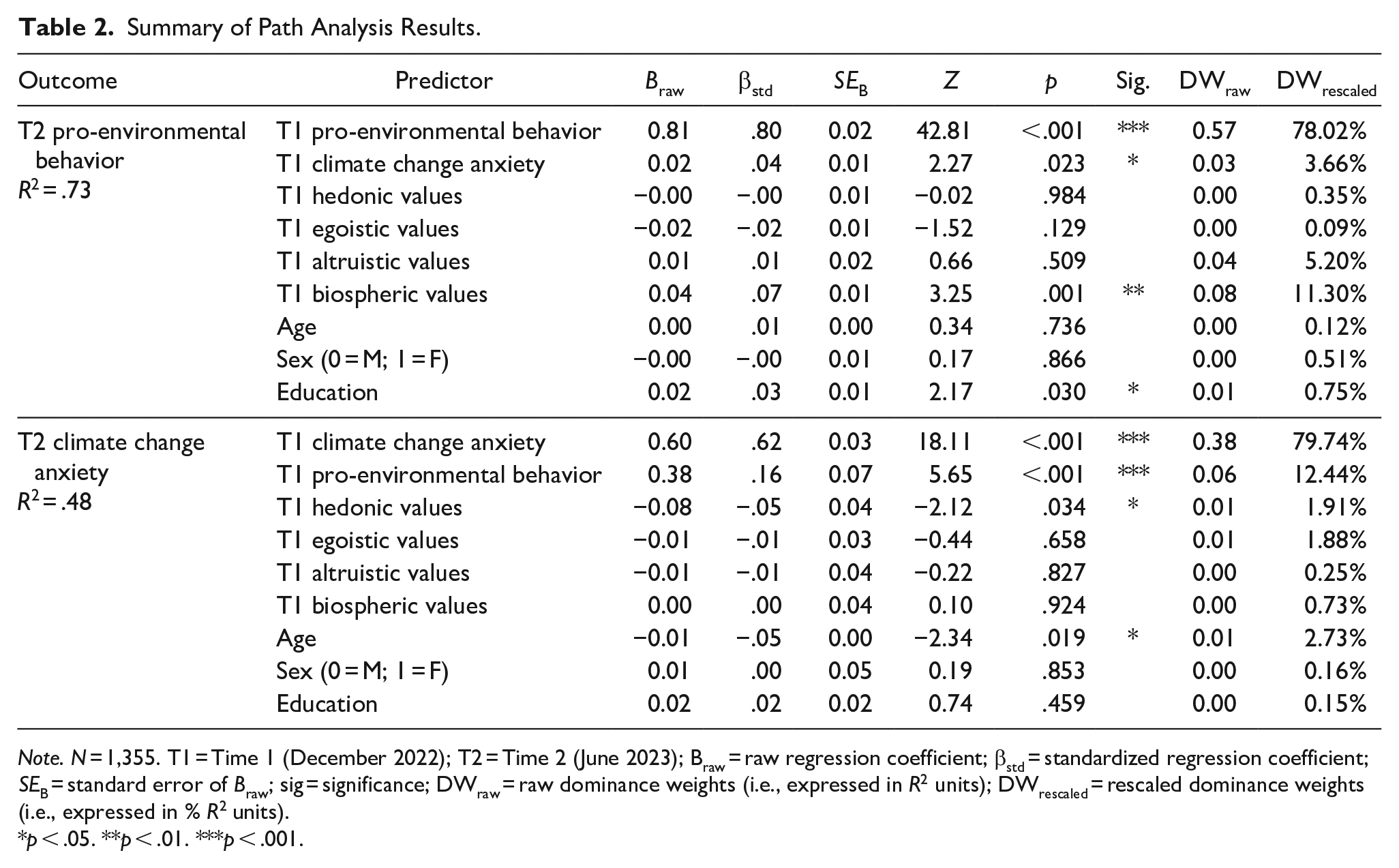
Note. N = 1,355. T1 = Time 1 (December 2022); T2 = Time 2 (June 2023); Braw = raw regression coefficient; βstd = standardized regression coefficient; SEB = standard error of Braw; sig = significance; DWraw = raw dominance weights (i.e., expressed in R2 units); DWrescaled = rescaled dominance weights (i.e., expressed in % R2 units).
p < .05. **p < .01. ***p < .001.
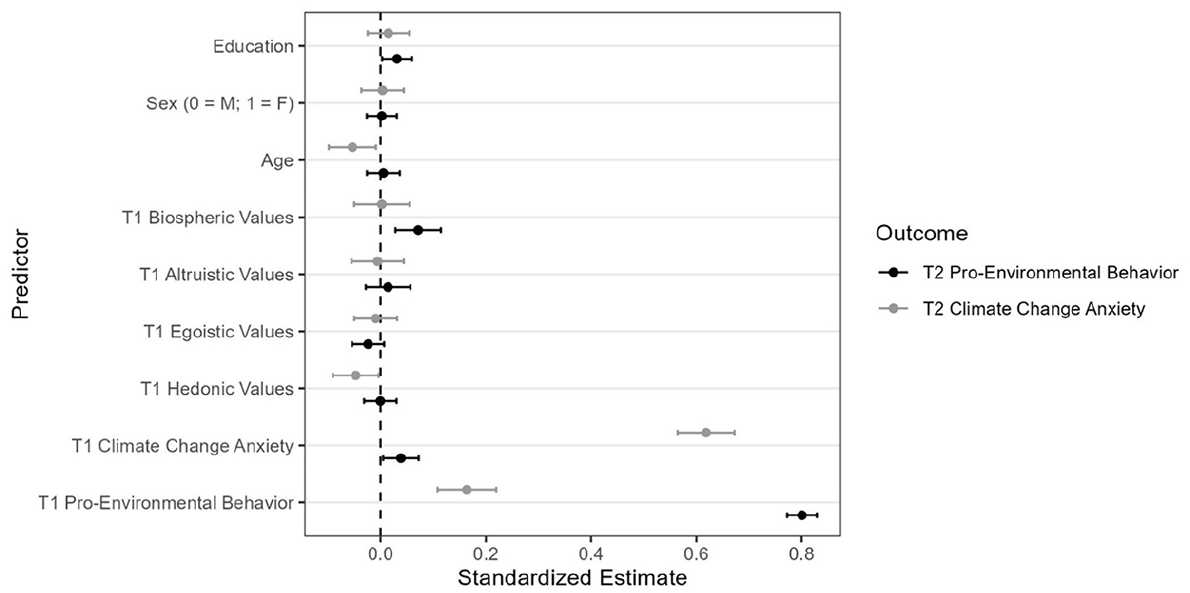
Graphical depiction of path analysis results.
In terms of model performance, 48% (R2 = .48) of the variance was explained in climate change anxiety, and 73% (R2 = .73) of the variance was explained in pro-environmental behavior by the predictors, including baseline assessments of the two focal outcome variables. Considering the results of a dominance analysis, the strongest contributors to R2 for climate change anxiety at T2 were climate change anxiety at T1 (DWraw = 0.38; DWrescaled = 79.74%) and pro-environmental behavior at T1 (DWraw = 0.06; DWrescaled = 12.44%). The strongest contributors to R2 for pro-environmental behavior at T2 were pro-environmental behavior at T1 (DWraw = 0.57; DWrescaled = 78.02%) and biospheric values at T1 (DWraw = 0.08; DWrescaled = 11.30%). Climate change anxiety at T1 accounted for 3.66% of R2 for pro-environmental behavior at T2 (DWraw = 0.02; DWrescaled = 3.66%).
Supplemental Analyses
We re-ran our model with the two subdimensions of climate change anxiety (see Supplemental Table S5 in the OSM). The cognitive-emotional impairment dimension (βstd = .03, p = .074) did not significantly predict pro-environmental behavior, but the functional impairment dimension (βstd = .05, p = .006) significantly predicted pro-environmental behavior in separate analyses and when both dimensions were included simultaneously as predictors. Pro-environmental behavior significantly predicted both the emotional (βstd = .17, p < .001) and the functional impairment (βstd = .16, p < .001) dimension of climate change anxiety. Additionally, we re-ran our model with the four subdimensions of pro-environmental behavior (i.e., conservation, environmental citizenship, food consumption, and transportation; see Supplemental Table S6 in the OSM). Climate change anxiety only significantly predicted environmental citizenship behavior (βstd = .08, p = .002), but not conservation behavior (βstd = .04, p = .081), food consumption (βstd = .02, p = .430), or transportation behavior (βstd = .01, p = .553). Environmental citizenship behavior (βstd = .14, p < .001), food consumption (βstd = −.04, p = .042), and transportation (βstd = .06, p = .008), but not conservation behavior (βstd = .02, p = .463) significantly predicted climate change anxiety. Notably, food consumption negatively predicted climate change anxiety.
We further ran a supplemental version of our path model where careless responders (i.e., participants who provided wrong answers to the two quality check items) were included. There were no substantial differences in the results between these and our focal analyses (see Supplemental Table S7 in the OSM). Additionally, we conducted supplementary moderation analyses by including interaction terms between climate change anxiety and pro-environmental behavior, respectively, and personal values as predictors. Results are presented in Supplemental Table S8 in the OSM. None of the interaction terms significantly predicted pro-environmental behavior or climate change anxiety.
Discussion
Using a two-wave panel design with a 6-month time lag and a large sample, this study aimed to disentangle reciprocal relations between climate change anxiety and pro-environmental behavior from the effects of biospheric and altruistic values while controlling for baseline levels of climate change anxiety and pro-environmental behavior as well as hedonic and egoistic values.
In line with Hypothesis 1, climate change anxiety positively, albeit weakly, predicted pro-environmental behavior 6 months later, while controlling for baseline levels of pro-environmental behavior at T1. This suggests that experiencing climate change anxiety may motivate people to increase their engagement in pro-environmental actions. This aligns with other studies reporting positive cross-sectional associations between climate change anxiety and pro-environmental behavior (e.g., Ogunbode et al., 2022; Whitmarsh et al., 2022; Wullenkord et al., 2021). Additionally, this finding corresponds with related research on climate emotions suggesting that affective responses toward climate change (e.g., grief, anger) are related to climate mitigation behavior (for reviews, see Brosch, 2021; Ojala et al., 2021; Pihkala, 2022). It is important to note, however, that the association between climate change anxiety and pro-environmental behavior was rather weak in our study and that biospheric values were a relatively stronger predictor of pro-environmental behavior. This emphasizes the important role of values for pro-environmental behavior (Bouman et al., 2020; Ruepert et al., 2017; Schultz & Zelezny, 1998; Schultz et al., 2005; van Riper et al., 2019). Additionally, supplemental analyses with separate dimensions revealed that climate change anxiety only significantly predicted one facet of pro-environmental behavior, namely environmental citizenship behavior. This may be because individuals consider environmental citizenship behaviors, such as joining environmental groups, to have a greater impact than conservation or dietary changes.
As expected in Hypothesis 2, pro-environmental behavior positively and weakly predicted climate change anxiety 6 months later, while controlling for baseline levels of climate change anxiety at T1. This finding stands in contrast with research suggesting that engaging in pro-environmental behavior can be an effective antidote to constructively cope with climate change anxiety. For example, in a qualitative study by Ojala (2012) with children, adolescents, and young adults, participants reported to engage in pro-environmental actions to cope with their climate-related worry. It is conceivable that the association may differ for various kinds of pro-environmental behavior. In fact, our supplemental analyses showed that environmental citizenship behavior and transportation behavior were positively related to climate change anxiety, whereas changes in food consumption were negatively related to climate change anxiety, and conservation behavior did not have a significant predictive effect. Engaging in environmental citizenship behavior (e.g., joining environmental groups) and making sustainable transportation choices (e.g., using public transportation) might necessitate individuals to educate themselves more about climate change compared to modifying conservation behaviors (e.g., switching off the lights when leaving a room). This increased awareness might lead to a deeper understanding of the severity of climate change and, in turn, increase climate change anxiety.
The finding that biospheric values are positively related to pro-environmental behavior is consistent with Hypothesis 3b based on the VBN theory (Stern, 2000; Stern et al., 1999) and existing research (e.g., Bouman et al., 2020; Ruepert et al., 2017; Schultz & Zelezny, 1998; van Riper et al., 2019). However, contrary to expectations proposed in Hypothesis 3a, biospheric values were not significantly related to climate change anxiety. This contrasts with research indicating that environmental values are positively related to climate change worry (Bouman et al., 2020; Verplanken et al., 2020). However, in a recent study by Whitmarsh et al. (2022), environmental values were negatively related to climate change anxiety. The authors argue that people with high environmental values are more likely to engage in pro-environmental behavior which attenuates climate change anxiety. However, the results of our study contradict this line of argumentation since engaging in pro-environmental behavior was positively related to climate change anxiety. Reasons for these mixed findings regarding the associations between biospheric values and climate change anxiety might be differences in measurement of the two constructs and the existence of third variables that buffer or boost these associations. These could be individual differences such as perceived personal responsibility (Bouman et al., 2020), cognitive mechanisms such as risk perception (van der Linden, 2015), or contextual factors such as external constraints for pro-environmental behavior (Steg & Vlek, 2009).
Inconsistent with propositions of Hypotheses 4a and 4b, altruistic values were neither significantly related to climate change anxiety, nor to pro-environmental behavior. This contrasts research on associations between altruistic values and pro-environmental behavior (e.g., Hartmann et al., 2017; Milfont et al., 2010; Steg, Perlaviciute, et al., 2014). However, our results align with findings that biospheric values predict pro-environmental behavior more strongly than altruistic values (Steg & de Groot, 2012). A possible explanation for the non-significant associations between altruistic values and pro-environmental behavior and climate change anxiety, respectively, might be the perceived temporal and spatial distance of climate change (Van Lange & Huckelba, 2021). Although the frequency of climate catastrophes increases around the world (IPCC, 2023), the impact of climate change on others’ welfare might still be perceived as limited to faraway places or futures. Since personal experiences of extreme weather events determine climate change risk perception (e.g., van der Linden, 2015), people living in regions so far less affected by climate change (e.g., Germany, where our sample came from) might underestimate the consequences of climate change for human wellbeing. Once the detrimental effects of climate change on human wellbeing become more present (e.g., via media coverage; Arlt et al., 2011; Happer & Philo, 2016), the predictive effect of altruistic values for pro-environmental behavior and climate change anxiety might increase.
We found that hedonic values, which we introduced as a control variable in our model, were negatively related to climate change anxiety (but not pro-environmental behavior). This implies that people with a focus on enhancing their satisfaction and positive emotions while reducing efforts and negative feelings are less likely to experience climate change anxiety. This corresponds with research by Steg, Perlaviciute, et al. (2014), who found that hedonic values were negatively related to environmental attitudes and preferences. Overall, our results suggest that biospheric, but not altruistic, egoistic, and hedonic values predict pro-environmental behavior, whereas hedonic, but not biospheric, altruistic, and egoistic values predict climate change anxiety.
In line with other research (e.g., Hickman et al., 2021; Whitmarsh et al., 2022), age was negatively related to climate change anxiety in our study. This implies that younger people are more frequently affected by climate change anxiety. Possible explanations might be feelings of powerlessness and mistrust in governments regarding climate-change mitigation among adolescents and young adults (Hickman et al., 2021). Additionally, the younger people are, the more severely they will be affected by accelerating climate change across their lifespan.
Theoretical Contributions
Our study advances understanding of the relationship between climate change anxiety and pro-environmental behavior in several important ways. First, prior studies on the topic are mostly based on data collected using cross-sectional designs, and, therefore, do not allow for strong conclusions regarding the temporal precedence of the two variables and potential reciprocal relations (Brosch, 2021; Whitmarsh et al., 2022). Using a two-wave panel design and controlling for baseline levels of climate change anxiety and pro-environmental behavior, our findings indicate a reciprocal relationship, suggesting mutual precedence between the two constructs. Second, the finding that experiences of climate change anxiety are associated with increased engagement in pro-environmental behavior 6 months later supports the conceptualization of climate change anxiety as a “practical anxiety” and an adaptive response that stimulates climate action rather than a pathological phenomenon (Hogg et al., 2021; Pihkala, 2020).
Third, our study draws attention to the effect of pro-environmental behavior on subsequent climate change anxiety, which, so far, received little attention in theory and empirical research. Contrary to the notion that pro-environmental behavior is an effective antidote for climate change anxiety (e.g., Schwartz et al., 2023), our results suggest that engaging in pro-environmental behavior is associated with increased climate change anxiety 6 months later. Notably, this effect was significantly stronger than the reverse effect (i.e., from climate change anxiety on pro-environmental behavior). Consequently, future theorizing should consider this dynamic in understanding the relationship between the two constructs. Fourth, by controlling for the effects of personal values, our study suggests that climate change anxiety and pro-environmental behavior are related to each other above and beyond the effect of stable between-person differences. Fifth, our results offer preliminary insights into potential variations in the reciprocal relationship between climate change anxiety and pro-environmental behavior across different pro-environmental behaviors. This highlights the necessity for more nuanced theoretical considerations in understanding the specific relationships between different pro-environmental behaviors and climate change anxiety.
Limitations and Future Research
Despite its contributions to the literature on climate change anxiety and pro-environmental behavior, this study has some limitations that could be addressed in future research. First, the conceptualization and operationalization of climate change anxiety must be critically reflected upon. We chose to use the climate change anxiety scale by Clayton and Karazsia (2020), because it is a widely-used and well-established measure of climate change anxiety that has been validated in various contexts and cultures, including Germany (Clayton & Karazsia, 2020; Wullenkord et al., 2021). However, the scale has also been criticized for only capturing climate change-related emotional-cognitive and functional impairment rather than emotional experiences of anxiety-related feelings including worry, fear, and concern (Wullenkord et al., 2021). The scale captures the consequences of climate change anxiety, namely impairment, rather than the affective experiences of climate change itself. As a result, people who are highly anxious about climate change, but not to the extent that this impairs their cognitive and behavioral functioning in daily life, would not score high on the scale (the scale means in the current study were 1.96 and 1.86 at T1 and T2, respectively, on a 7-point scale). Consistently, climate change anxiety scores as measured with the scale by Clayton and Karazsia (2020) have been rather low in German (Wullenkord et al., 2021), U.K. (Whitmarsh et al., 2022), and U.S. samples (Clayton & Karazsia, 2020), whereas studies applying other measures of climate change anxiety (Hickman et al., 2021; Hogg et al., 2021; Ogunbode et al., 2022) or assessing climate change concern (Poortinga et al., 2019; Whitmarsh et al., 2022) reported higher levels of anxiety and concern.
Thus, future research needs to differentiate clinical forms of climate change anxiety that involve impairment from more adaptive forms of climate change anxiety that motivate action. Furthermore, various labels describe climate change anxiety or highly related constructs (e.g., eco-anxiety, climate change distress). Future research needs to define the conceptual uniqueness and overlap of these constructs and develop appropriate measures to capture various facets of anxiety-related affective responses to climate change. Conceptual and operational clarity on climate change anxiety is essential for future theorizing and empirical research on the topic.
Second, future research needs to further establish the causal associations between climate change anxiety and pro-environmental behavior. Our study shows that climate change anxiety and pro-environmental behavior are associated positively and reciprocally across 6 months. However, our results allow for no conclusions in terms of causality. Unmeasured third variables, besides personal values which we controlled for, might account for the positive associations observed here. These could be personality-related, such as nature connectedness (Galway et al., 2021), experience-related, such as media exposure and personal experiences of extreme weather events (e.g., Ogunbode et al., 2022), or social-context related, such as social norms (e.g., van der Linden, 2015). Furthermore, additional personal values from Schwartz’ (1992) value theory, such as the security value, could be important common predictors of pro-environmental behavior and climate change anxiety. Quasi-experimental and intervention designs would be best suited to rule out the influence of third variables and systematically establish causal relations between climate change anxiety and pro-environmental behavior (Hill et al., 2021). Thereby, it might be worthwhile to differentiate between various kinds of pro-environmental behavior which might share different causal relations with climate change anxiety. For example, experimental studies could consider relations between climate change anxiety and support for climate-mitigation policies (Wullenkord et al., 2021), activism (Schwartz et al., 2023), employee green behavior (Zacher et al., 2023), and green investment decisions (Marder et al., 2023).
Third, most research on climate emotions and pro-environmental behavior focuses on anxiety and worry (Brosch, 2021; Pihkala, 2022). However, this does not by far capture the full range of potential climate emotions and especially neglects the role of positive climate emotions (Clayton & Ogunbode, 2023; Schneider et al., 2021). Future research might thus apply our panel research design to examine the lagged and reciprocal relations between a variety of climate emotions (e.g., anger, grief, hope, guilt) and pro-environmental behavior.
Fourth, our study has some methodological limitations. All data assessed in this study were self-reported by participants. While self-reports are suitable to assess inherently subjective constructs such as personal values and climate change anxiety, pro-environmental behavior could be assessed more objectively in future research (see Kormos & Gifford, 2014). Examples are measurement of household electricity consumption or behavioral observations derived from informants, such as spouses or roommates (Lange & Dewitte, 2019). Furthermore, our sample was not representative of the German population since it only included employed adults (no children, retirees, or unemployed people) and was further somewhat older and more highly educated than the general working population in Germany. Future research might use quota samples representative of the German population to ensure generalizability of findings (Wullenkord et al., 2021). Additionally, most studies on climate change anxiety, including ours, were conducted in Western and industrialized countries. To uncover cross-cultural similarities and differences in the associations between climate change anxiety, pro-environmental behavior, and personal values, it is necessary to expand research efforts toward samples from less developed countries of the Global South, especially since research suggests that prevalence rates of climate change anxiety are higher in these countries (Hickman et al., 2021; Reyes et al., 2023).
Finally, more longitudinal research on climate change anxiety and pro-environmental behavior with multiple measurement points is needed. Although our two-wave design allowed us to draw inferences regarding temporal precedence of the focal variables, we were not able to capture dynamic within-person changes in climate change anxiety and pro-environmental behavior and potential associations between such changes (Ployhart & Vandenberg, 2010). For example, analyzing data from more than three measurement waves via latent growth modeling (Chan, 1998; Liu et al., 2016) would allow for assessing the features of change over time in climate change anxiety and pro-environmental behavior and for comparing and linking their change trajectories. This would uncover how climate change anxiety and pro-environmental behavior evolve over time and whether changes in one construct are associated with comparable changes in the other.
Practical Implications
Our study, together with existing research on the topic, underlines the necessity to develop practical interventions that support people in constructively managing their climate change anxiety and channeling it into effective pro-environmental action (Baudon & Jachens, 2021). Importantly, interventions targeting individual pro-environmental behavior should be applied with care since our results suggest that pro-environmental action might be associated with increased climate change anxiety. It is further important to consider coping strategies tailored for young adults since they are more likely to experience climate change anxiety (Hickman et al., 2021; Ojala, 2012). When designing interventions to increase pro-environmental behavior (e.g., campaigns), our results suggest that it might be worthwhile to enhance the salience of the environmental benefits derived from such behaviors. This, in turn, will increase the likelihood that people with high biospheric values engage in the intended behavior.
Conclusion
In our study, we considered reciprocal associations between climate change anxiety and pro-environmental behavior while controlling for baseline assessments of these variables and the effects of personal values. Results of our two-wave panel study imply that climate change anxiety and pro-environmental behavior precede and positively predict each other over time, although these time-lagged effects were relatively small. Accordingly, climate change anxiety seems to be an adaptive rather than a pathological response to climate change that is related to subsequent pro-environmental action. However, engaging in pro-environmental action, in turn, might be associated with further increases in climate change anxiety over time. We hope that our study inspires further research on the specific dynamics of the association between climate change anxiety and pro-environmental behavior.
Supplemental Material
sj-docx-1-eab-10.1177_00139165241297050 – Supplemental material for Reciprocal Relations Between Climate Change Anxiety and Pro-Environmental Behavior
Supplemental material, sj-docx-1-eab-10.1177_00139165241297050 for Reciprocal Relations Between Climate Change Anxiety and Pro-Environmental Behavior by Clara Kühner, Cort W. Rudolph and Hannes Zacher in Environment and Behavior
Footnotes
Author Contributions
All authors contributed to the study conception and design. Material preparation and data collection were performed by Hannes Zacher, and analyses were performed by Cort W. Rudolph. The first draft of the manuscript was written by Clara Kühner and all authors commented on previous versions of the manuscript. All authors read and approved the final manuscript.
Data Availability

Declaration of Conflicting Interests
The author(s) declared no potential conflicts of interest with respect to the research, authorship, and/or publication of this article.
Funding
The author(s) received no financial support for the research, authorship, and/or publication of this article.
Supplemental Material
Supplemental material for this article is available online.
Notes
Author Biographies
References
Supplementary Material
Please find the following supplemental material available below.
For Open Access articles published under a Creative Commons License, all supplemental material carries the same license as the article it is associated with.
For non-Open Access articles published, all supplemental material carries a non-exclusive license, and permission requests for re-use of supplemental material or any part of supplemental material shall be sent directly to the copyright owner as specified in the copyright notice associated with the article.
