




Abstract
Trajectories of perceived stress from the transition to adulthood (age 25), during young adulthood (age 32), and into midlife (ages 43 and 50) were examined with four waves of longitudinal survey data (N = 688; 49% female, 37% with a university degree, 86% White). We explored how between- and within-person variation in perceived stress was associated with age 50 psychological well-being (life satisfaction and eudaimonic well-being), self-reported physical health, career satisfaction, and intimate partnership satisfaction. Growth curve analyses revealed stress followed a linear decreasing trajectory from the transition to adulthood into midlife with substantial variability underlying the average pattern. Between- and within-person variation in perceived stress was associated with midlife functioning. Those with lower initial levels of and more decline in perceived stress reported better psychological and physical health and higher relationship satisfaction at age 50 compared to those with initially higher perceived stress and less decline over time. Higher than one’s own average perceived stress at ages 25, 32, 43, and 50 years was associated with lower psychological and physical health and intimate partnership satisfaction at age 50. These results support key contentions of developmental theory and may prove useful when designing interventions aimed at promoting well-being in midlife.
Extensive research has identified stress as a central mechanism in the etiology of psychopathology (Monroe & Simons, 1991), health problems and disease risk (Selye, 1976), dissatisfying employment (Barling et al., 2005), and strained family relations (Conger & Elder, 1994; Karney & Bradbury, 1995). Indeed, this voluminous literature found heightened experiences of stress implicated in a wide range of maladaptive outcomes, including increased risk of a depressive disorder (Cristóbal-Narváez et al., 2020), slower wound healing (Vileikyte, 2007), lower career satisfaction (Burke, 1998), and less satisfying intimate partnerships (Neff & Karney, 2004). Given this array of negative psychological, physiological, and social consequences, a basic understanding of how perceptions of stress change across the life course may help identify normative periods of vulnerability and resilience to stress and how such trajectories predict future well-being. Nevertheless, there is surprisingly little longitudinal research focused on perceived stress (Aldwin, 2010) leaving unanswered many fundamental questions about trajectories of stress across adulthood.
The current study uses data from a sample of 688 Canadians surveyed in the transition to adulthood (age 25), young adulthood (age 32), and midlife (age 43 and 50) in the Edmonton Transitions Study (ETS) to explore trajectories of perceived stress. We also examine how between-person differences in stress trajectories and within-person fluctuations from one’s average trajectory predict age 50 psychological well-being (life satisfaction and eudaimonic well-being), self-reported physical health, career satisfaction, and intimate partnership satisfaction.
Background
Operationalizing Stress
Two predominant strategies have been used to operationalize stress. One approach focuses on the occurrence of stressors, the major or minor events that require one’s attention and resources for their management or resolution (Almeida et al., 2011). Major life event stressors that require dramatic adjustment, but also tend to be relatively rare (e.g., job loss; Dohrenwend, 2006), have been distinguished from the persistent hassles of daily life that may exert a more subtle and constant influence (e.g., arguing with one’s spouse; Almeida, 2005). In the stressor tradition, perceptions of stress may be assumed and not directly studied.
The other research approach focuses directly on individuals’ reaction to stressors, including the physiological stress response and the subjective psychological experience of feeling stressed. The physiological activation of the sympathetic adrenal medullary system and the hypothalamic pituitary adrenal axis (i.e., the fight or flight response) led some to operationalize stress reactions by measuring stress hormones (e.g., epinephrine, cortisol) in blood or salivary samples (e.g., Kiecolt-Glaser et al., 2003). Others have focused on psychological perceptions of stress, or an individual appraisal that contextual demands exceed one’s capacity to meet those demands (Lazarus & Folkman, 1984). Participants in the ETS were asked how stressful they would describe their lives, ranging from “not at all stressful” to “very stressful.” This item is similar to one in the Perceived Stress Scale (Cohen et al., 1983) assessing the frequency of feeling nervous or stressed in the past month but taps the broader subjective appraisal of life stress consistent with our long-term developmental focus.
Theoretical Perspective
Our examination of perceived stress trajectories is motivated by a core tenet of lifespan (e.g., Baltes, 1987) and life course (e.g., Elder, 1985) perspectives: Human development is a lifelong process reflecting both continuity with and divergence from earlier periods. One’s present circumstances are the product of accumulating earlier experiences and habitual patterns coupled with innovative changes arising from individual adaptation to life’s challenges and evolving environmental influences. A central research aim rooted in these perspectives is to map trajectories across the lifespan to understand the developmental antecedents and pathways that give rise to present circumstances. Pearlin (2010) proposed that the stress process (e.g., exposure to a stimulus perceived as stressful, the coping process to manage stress, and the resolution or proliferation of stress; Pearlin et al., 1981) must be understood within the context of the broader life course, as the components of this process become intertwined and its consequences manifested through the passage of time.
Trajectories of Perceived Stress From the Transition to Adulthood Into Midlife
Almeida and colleagues (2011) detailed opposing theoretical perspectives that predict both increases and decreases in perceived stress across adulthood. An adaptation perspective views the perception of stress decreasing with age because with time individuals accumulate the skills and resources to handle stress, allowing them to more efficiently manage future stressors (e.g., Whitbourne, 1985). Alternatively, experiences of stress may heighten awareness of stressful circumstances and set the stage for increases in future perceptions of stress (e.g., Sliwinski et al., 2009). Expectations that stress may increase or decrease across the lifespan align with the stress process model in that stress resolution or proliferation is dependent on the ability to successfully cope with earlier stressors (Pearlin et al., 1981).
The few longitudinal studies on perceived stress provide insight into how perceived stress develops early and late in the lifespan. Data from a metropolitan community sample of 331 adolescents aged 11 to 16 years surveyed annually for 5 years revealed perceived stress increased across adolescence (Felton et al., 2017). Another study surveyed 850 youth in an economically disadvantaged urban environment seven times between ages 15 and 22 years and found slight decreases in perceived stress most evident during the early 20s (Heinze et al., 2017). Moving to later life, Vasunilashorn et al. (2014) drew on three waves of data spanning 8 years in adults aged 60 and over in the Taiwan Longitudinal Study of Aging and found that although exposure to stressors (e.g., health problems) increased in later life, perceived stress declined. Data from 190 older adults aged 57 to 94 years surveyed seven times across 2-year intervals (Montreal Aging and Health Study) revealed, however, that perceived stress increased across the 12-year duration of the study (Herriot et al., 2020).
We were not able to locate any long-term longitudinal studies modeling perceived stress during young adulthood or midlife, a notable gap in the literature (Infurna et al., 2020). A recent study, however, gathered bursts of daily assessments three times over 20 years to examine changes in daily hassles (minor stressors) from individuals ranging in age from 22 to 77 years at baseline (Almeida et al., 2022). Daily stressors declined across time for all participants, and cross-cohort comparisons revealed stressor exposure decreased among older participants. In addition, the experience of negative affect on stressful days also decreased across time and age cohorts. This longitudinal study suggests that the occurrence of stressors and negative feelings in response to stressors decline with age. Some cross-sectional studies estimating the mean trajectory (i.e., between-person comparisons of perceived stress among respondents in different age groups; Cohen & Janicki-Deverts, 2012; Steptoe et al., 2015; Stone et al., 2010) generally found that participants in the transition to adulthood reported the highest levels of perceived stress, with progressively lower levels of perceived stress as age categories increased (young adults, adults in midlife, and older adults).
Although these findings suggest perceived stress may decrease across adulthood, analysis of between-person differences is inadequate for describing within-person changes (Baltes & Nesselroade, 1979), as recently demonstrated in the happiness literature (Galambos et al., 2020). Intraindividual change can only be understood through repeated assessments of the same individuals across time, as observed differences between younger versus older people can be as easily attributed to cohort or historical influences as to underlying developmental processes (Baltes, 1987; Elder, 1985). Our first aim is to use longitudinal data to identify the average trajectory of perceived stress across the transition to adulthood (age 25), young adulthood (age 32), and midlife (ages 43 and 50 years).
Between- and Within-Person Associations of Perceived Stress With Midlife Well-Being
The years spanning the transition to adulthood into midlife present many opportunities for stress to be experienced and to be linked to future well-being. The transition to adulthood, roughly the decade of the 20s, is a time when individuals acquire occupational skills and select a career path, while also developing interpersonal competencies necessary to establish and maintain long-term intimate unions (Roisman et al., 2004). Developmental cascade models show how young adulthood (the 30s) capitalizes on the gains made in the 20s as individuals take on adult professional and family roles through the establishment of a career, marriage or long-term relationship, and parenthood (Howard et al., 2010; Masten et al., 2010; Masten & Tellegen, 2012). Midlife (generally age 40–60) is a pivotal period noteworthy for managing and balancing demands in multiple roles (Infurna et al., 2020). Middle-aged adults may be at the pinnacle of their careers, take on caregiving of older generations while still raising children, prioritize their own health or risk development of health problems, and enjoy positions of leadership in their community. Each developmental period examined in the current study offers unique challenges with the potential for stress to be successfully managed or to proliferate and cause adversity long into the future (O’Rand, 1996).
But adult development is also remarkable for its diversity. The life course has become increasingly destandardized (Shanahan, 2000) with considerable variation in when individuals make normative occupational and family transitions (Krahn et al., 2018). A core tenet of developmental theory recommends examination of individual variability inherent in any mean trajectory (Aldwin, 2010; Baltes, 1987). An integration of developmental and stress perspectives begs for exploration of between- and within-person diversity underlying the average. There will inevitably be those who experience increasing or decreasing perceived stress relative to others and such between-person differences in stress may explain psychological, physical, career, and relationship well-being later in life (e.g., Almeida et al., 2011; Karney & Bradbury, 1995; Thoits, 2010).
A fuller understanding of how perceived stress influences individual well-being also requires considering within-person variability, how divergence from one’s average trajectory during a given developmental period may influence later well-being. Higher than average stress during any developmental period (e.g., heightened perceptions of stress in the 20s may interfere with acquiring requisite skills for a desired career; Eicher et al., 2014) may signal later challenges (e.g., failure to secure high-quality employment in the 30s) and could predict compromised well-being in the future (e.g., lower career satisfaction in the 40s). Diary studies have shown that on days when daily hassles are higher than typical, negative affect is higher and positive affect is lower than average (e.g., Blaxton et al., 2020; Stawski et al., 2008). A study with five diary assessments conducted every six months across two years found increased negative affect when perceived stress was higher than average (Sliwinski et al., 2009). Such findings point to the potential for within-person variability in stress on a larger timescale across adulthood to predict future well-being.
The Present Study
Drawing on four waves of longitudinal data gathered at ages 25, 32, 43, and 50 years, this study answers two research questions:
Research Question 1 (RQ1): What is the mean trajectory of perceived stress across the transition to adulthood, young adulthood, and into midlife? Research Question 2 (RQ2): How does between- and within-person variability in the perceived stress trajectory predict life satisfaction, eudaimonic well-being (sense that one’s life is meaningful; Ryff, 2014), self-reported physical health, career satisfaction, and intimate partnership satisfaction at age 50?
To increase confidence in our analyses, we control for variables known to be associated with perceived stress and these well-being outcomes, including participant sex (Taylor et al., 2000), educational attainment as an indicator of socioeconomic status (Marmot et al., 1997), and 18 depressive symptoms (Monroe & Simons, 1991), and age 18 self-rated physical health (Selye, 1976; Thoits, 2010).
We focus on diverse outcomes (psychological, physical, career, and intimate relationship well-being) to more fully understand how perceived stress across a wide swath of adulthood may be implicated in midlife functioning. Although links between stress and psychological (e.g., Monroe & Simons, 1991) and physical (e.g., Thoits, 2010) well-being are well-established, the literature also supports the examination of career and intimate relationship satisfaction. Reduced satisfaction with work was theorized as an organizational consequence of employee stress (Jex & Crossley, 2005) and prior longitudinal research found that work role overload (operationally equivalent [expectations exceed available time and resources] to the definition of stress; Lazarus & Folkman, 1984) predicted lower levels of job satisfaction 3 months later (Agho et al., 1993). Stress, along with individual characteristics and couple interaction, is also theorized as one of the key predictors of relationship quality in the vulnerability–stress adaptation model (Karney & Bradbury, 1995). Similarly, the linked lives concept from life course theory highlights the interdependent nature of human development (Settersten, 2015), whereby one partner’s stress may influence the overall satisfaction of the partnership. Indeed, perceived stress has consistently emerged as a longitudinal predictor of future relationship satisfaction (e.g., Neff & Karney, 2004).
Method
Procedures
The ETS surveyed adults eight times between age 18 and age 50. In 1985, 983 grade 12 students from six high schools in a western Canadian city completed questionnaires in class. Of these baseline participants, 47% identified as female, 80% were born in Canada, 15% reported their ethnic origin as non-White, and 29% had at least one university-educated parent. The baseline sample was representative of urban western Canadians in the 1967 birth cohort on race, immigration status, and parental education. Over 90% of the baseline sample (n = 894) consented to participate in future data collection. Follow-up surveys at ages 19, 20, 22, and 25 years targeted only those who participated in the previous wave, but all consenting baseline participants were targeted for data collection at ages 32, 43, and 50 years using computer-assisted telephone interviews, web-based surveys, and, upon request, mailed questionnaires. Participants provided informed consent prior to completing the survey at each wave of data collection. The most recent data were gathered in 2017 (age 50) from 404 original participants, a 41% response rate after 32 years. In 2017, participants received a US$50 gift card, the first time there was incentive to participate. More information about the study design appears in past publications (Galambos et al., 2006; Johnson et al., 2014). Ethics approval was obtained for all phases of this study from the University of Alberta Research Ethics Board (most recently in June 2017: Pro00074272; Transitions to midlife: 32-year follow-up of the class of 1985).
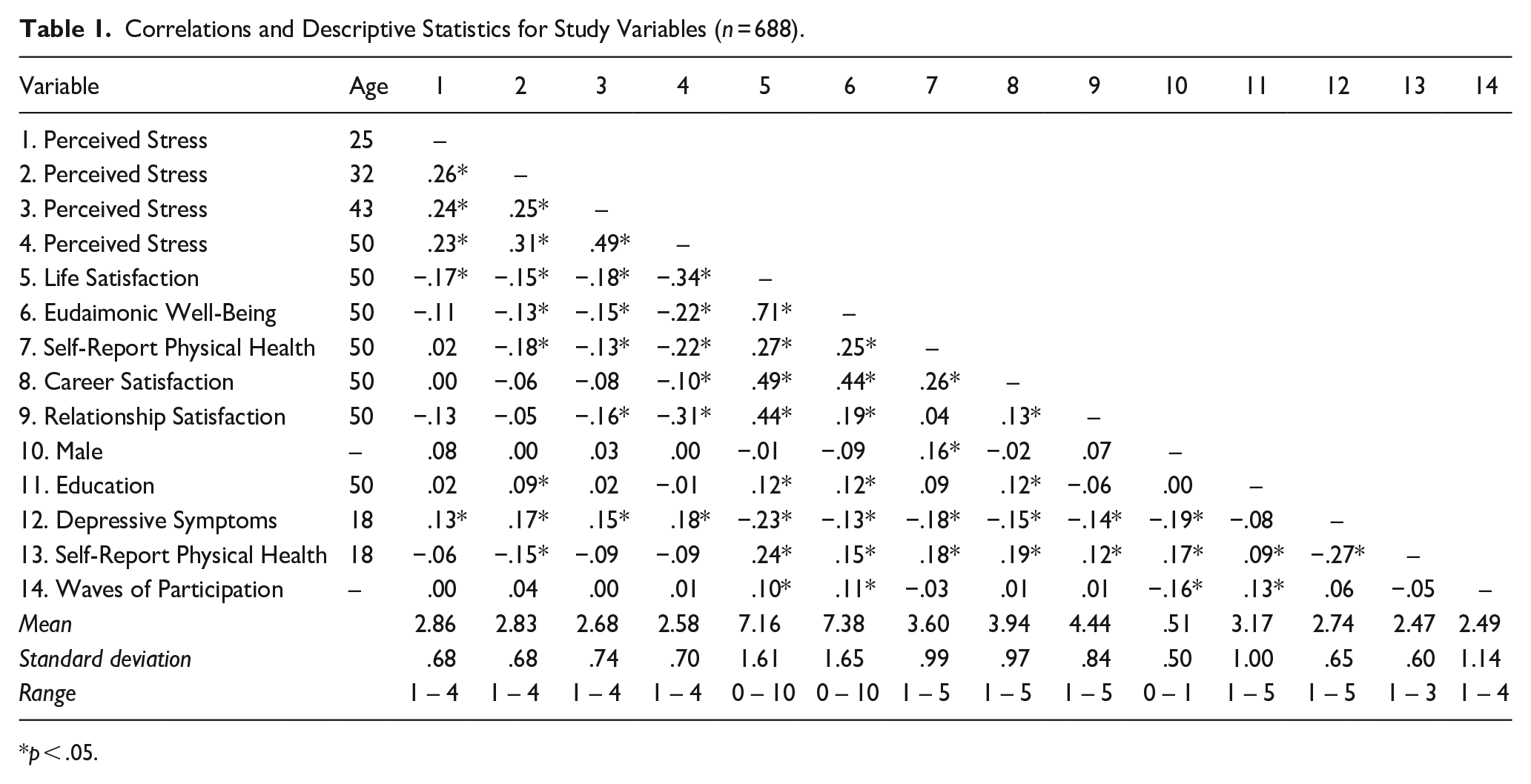
Perceived stress was first assessed in the ETS at age 25, so this study analyzed data at ages 25, 32, 43, and 50. We filtered our sample to select participants who answered the perceived stress item at least once (n = 688). Of these, 25.9% reported on perceived stress at all four waves, 24.0% provided three stress reports, 23.5% responded twice, and 26.6% reported on perceived stress once. We computed correlations between the number of waves of participation (range of 1–4) and all other study variables (see Table 1). All correlations between waves participated and perceived stress were non-significant, but more waves participated were associated with two of five midlife outcomes (i.e., higher life satisfaction and eudaimonic well-being), being female, and higher levels of education. We accounted for attrition by including the number of waves of participation as an additional control variable. Missing data were handled with full-information maximum likelihood estimation (Enders, 2011).
Correlations and Descriptive Statistics for Study Variables (n = 688).
p < .05.
We compared the 688 participants selected for analysis with the 295 excluded participants on baseline (age 18) reports of sex, parental education (indicating family socioeconomic status), immigration status, depressive symptoms, and self-reported physical health. Correcting for family-wise error, only one significant difference emerged; those selected into the sample were less likely to be immigrants (16.0%) compared to those excluded, 28.5%; χ2(1) = 20.321; p < .001.
The 688 participants in this study were 49.0% female and 85.9% White. At age 25, 41.5% of participants were married or cohabiting and 11.7% were raising children. By age 50, 77.0% were married or cohabiting and had been in their partnerships an average of 19.7 years (SD = 9.2 years). Most (82.2%) were parents and, among parents, 19.3% had one child, 49.4% had two children, and 31.3% had three or more children. Only 1.5% did not complete high school, while 27.8% finished high school, 33.8% earned a college or technical school diploma, 26.2% completed a university bachelor’s degree, and 10.8% held a graduate degree. At age 50, 91.1% of the samples were employed. Among the employed, 25.3% were in management, 27.5% were in a skilled position typically requiring a university degree, 36.2% held a job requiring an associate’s degree or technical training, and 10.9% were in a position that required a high school education.
Measures
Descriptive statistics and correlations for all study variables are presented in Table 1.
Perceived Stress
One item similar to that in Statistic Canada’s annual Canadian Community Health Survey (Shields, 2004) assessed perceived stress at ages 25, 32, 43, and 50 years, asking “Would you describe your life as. . .” with response options of 1 = not at all stressful, 2 = not very stressful, 3 = fairly stressful, and 4 = very stressful. To explore this item’s validity, in 2020, we collected cross-sectional data from 500 adults aged 40 to 60 years (M = 48.5 years; SD = 5.99) living in Canada and the United States (paralleling ETS respondent demographics in the most recent waves) recruited through Prolific’s online survey respondent panel. The single perceived stress item in the ETS correlated with the 10-item Perceived Stress Scale (Cohen et al., 1983) at r = .69, providing evidence of construct validity. Supporting the predictive validity of this item in the ETS, those with higher levels of perceived stress at age 32 reported worse intimate relationship functioning at age 43 (Johnson et al., 2014), in accordance with relevant theory (Karney & Bradbury, 1995).
Life Satisfaction and Eudaimonic Well-Being
Two items from the U.K. Annual Population Survey designed to assess the evaluative (life satisfaction) and eudaimonic components of well-being (Organisation for Economic Co-operation and Development, 2013) were administered at age 50 in the ETS. Life satisfaction was measured by asking: “Overall, how satisfied are you with your life as a whole these days?” Responses ranged from 0 = not at all satisfied to 10 = completely satisfied. Eudaimonic well-being was assessed with the item: “Overall, to what extent do you feel the things you do in your life are worthwhile?” Responses ranged from 0 = not at all worthwhile to 10 = completely worthwhile.
Self-Reported Physical Health
One item at age 50 assessed self-rated physical health: “In the past few months, how healthy have you felt physically?” Responses ranged from 1 = very unhealthy to 5 = very healthy. This single-item measure is similar to those widely used in health research (e.g., Wuorela et al., 2020) and was adapted from the 1983 Edmonton Area Survey (Population Research Laboratory, 2015).
Career Satisfaction
One item assessed career satisfaction at age 50: “How satisfied are you with your career to this point?” Responses ranged from 1 = very dissatisfied to 5 = very satisfied. This question is similar to an item in a widely used measure of career satisfaction: “I am satisfied with the success I have achieved in my career” (Greenhaus et al., 1990).
Intimate Relationship Satisfaction
One item adapted from the German Family Panel study (see Johnson et al., 2022) assessed intimate relationship satisfaction: “Overall, I am very satisfied with my relationship with my partner.” Responses ranged from 1 = strongly disagree to 5 = strongly agree.
Control Variables
Participant sex (1 = female, 2 = male), highest earned education credential (1 = less than high school, 2 = high school diploma, 3 = college or technical school diploma, 4 = university bachelor’s degree, and 5 = graduate degree), and age 18 reports of depressive symptoms and self-rated physical health were included as control variables. For highest educational credential, we used the most recent available report (i.e., age 50, then age 43, then age 32, and finally age 25). Depressive symptoms at age 18 were assessed with the mean of four items from the Center for Epidemiologic Studies Depression Scale (Radloff, 1977) that asked “how often in the past few months” participants “felt depressed,” “felt lonely,” “talked less than usual,” and “felt like people were unfriendly.” Responses ranged from 1 = never to 5 = almost always and internal consistency was α = .67. Self-reported physical health at age 18 was assessed with the same item used at age 50 (“In the past few months, how healthy have you felt physically?”) but had a different response scale: 1 = not very healthy, 2 = somewhat healthy, and 3 = very healthy.
Analysis Plan
Correlations among all study variables were computed. We answered our RQ1 with latent growth curve modeling computed in a structural equation modeling framework following recommendations by Little (2013). We answered our RQ2 using latent curve modeling with structured residuals (Curran et al., 2014). Analytic details are discussed in the supplemental material. Control variables were included in this analysis by regressing the outcomes and the perceived stress intercept and slope on sex, educational attainment, age 18 depressive symptoms and self-rated physical health, and number of waves of participation. The models were computed using Mplus 8.7 (Muthén & Muthén, 1998–2017) and model fit was evaluated with the model chi-square, the root mean square error of approximation (RMSEA), the comparative fit index (CFI), the Tucker–Lewis Index (TLI), and standardized root mean square residual (SRMR). A non-significant chi-square, values greater than .95 for CFI and TLI, and values smaller than .06 and .08 for RMSEA and SRMR are generally accepted criteria to suggest good model fit, while a CFI and TLI greater than .90 and RMSEA and SRMR smaller than .10 indicate acceptable fit (Little, 2013).
Results
Correlations
Perceived stress autocorrelations were significant at all ages; higher perceptions of stress at one age were associated with higher levels of stress at other ages (Table 1). Regarding the outcome variables, higher perceived stress at all ages was correlated with lower life satisfaction at age 50. Higher perceived stress at ages 32, 43, and 50 years was associated with lower eudaimonic well-being and poorer self-rated physical health at age 50. Higher perceived stress at age 50 was associated with less career satisfaction, and higher age 43 and 50 reports of perceived stress were linked with less relationship satisfaction.
RQ1: Growth Curve Results
We next computed a series of increasingly complex latent growth curve models (e.g., fixed intercept, random intercept, fixed linear slope) to identify the best-fitting perceived stress trajectory. Model fit indices are displayed in Table 2. The random linear slope model was the best-fitting trajectory. Initial perceptions of stress at age 25 were 2.89 (SE = .03) on a scale from 1 to 4 and decreased .01 units (SE = .002) each year, on average (depicted in Supplementary Figure S1). There was significant variance in both the intercept (SD = .38) and slope (SD = .02; ps < .001), showing much diversity beneath the average trajectory. The intercept and slope were not correlated (r = −.17, p = .387); stress at age 25 was not connected to the direction or rate of change in perceived stress over time. There was also significant within-person variability not explained by one’s average trajectory at each age when stress was measured (SDs from .42 to .58, ps < .001). A decomposition of variance revealed that 28% of the variability was between-persons and the remaining 72% was within-person (intraclass correlation coefficient = .28). The significant between- and within-person variability in perceived stress leaves open the possibility that it may, in fact, predict midlife outcomes.
Growth Curve Model Fit Indices of Perceived Stress From Age 25 to Age 50 (n = 688).
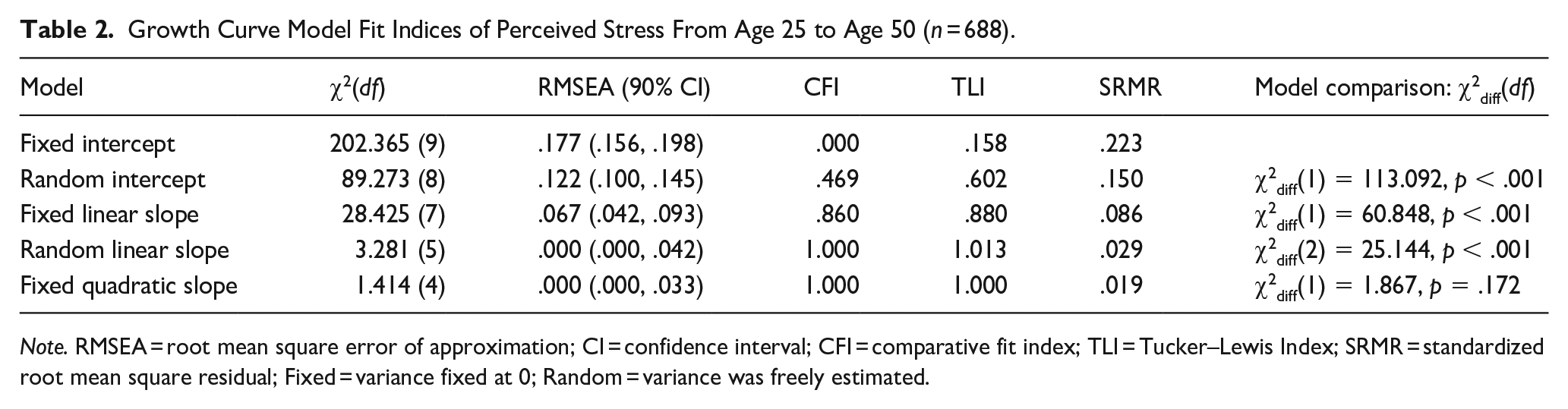
Note. RMSEA = root mean square error of approximation; CI = confidence interval; CFI = comparative fit index; TLI = Tucker–Lewis Index; SRMR = standardized root mean square residual; Fixed = variance fixed at 0; Random = variance was freely estimated.
RQ2: Between- and Within-Person Associations of Perceived Stress With Midlife Outcomes
Before turning to the key findings, we summarize results for the control variables predicting between- and within-person variation in perceived stress (full estimates available in Supplementary Table S1) and the age 50 outcome variables (full estimates available in Supplementary Table S2). Beginning with the between-person perceived stress associations, being male and reporting more depressive symptoms at age 18 were associated with higher initial levels of perceived stress and those with better self-rated physical health at age 18 experienced lower initial perceived stress compared to those with worse health. The control variables were not associated with the slope. For within-person perceived stress, being male was associated with higher than typical stress at age 25. Higher educational attainment was associated with higher than average perceived stress at age 32. Those who reported more symptoms of depression at age 18 experienced higher than typical perceived stress at all ages. Those with better self-reported physical health at age 18 experienced lower than average perceived stress at age 32.
Regarding control variable associations with the outcome variables, men reported higher levels of self-rated physical health and intimate relationship satisfaction at age 50 compared to women. Those with higher levels of education reported greater life satisfaction, eudaimonic well-being, and career satisfaction at age 50. Those who reported better self-rated health at age 18 experienced higher career satisfaction in midlife.
Table 3 contains the results for the between- and within-person perceived stress associations predicting life satisfaction, eudaimonic well-being, self-reported physical health, career satisfaction, and intimate relationship satisfaction at age 50. Considering between-person associations, those with higher perceived stress at age 25 reported lower life satisfaction and eudaimonic well-being at age 50 compared to those with lower initial perceptions of stress. Those with decreasing levels of perceived stress across 25 years reported higher life satisfaction, eudaimonic well-being, physical health, and satisfaction with their intimate partnerships at age 50 compared to those whose perceived stress did not decrease.
Within- and Between-Person Variation in Perceived Stress Predicting Life Satisfaction, Eudaimonic Well-Being, Self-Reported Physical Health, Career Satisfaction, and Relationship Satisfaction at Age 50 (n = 688).
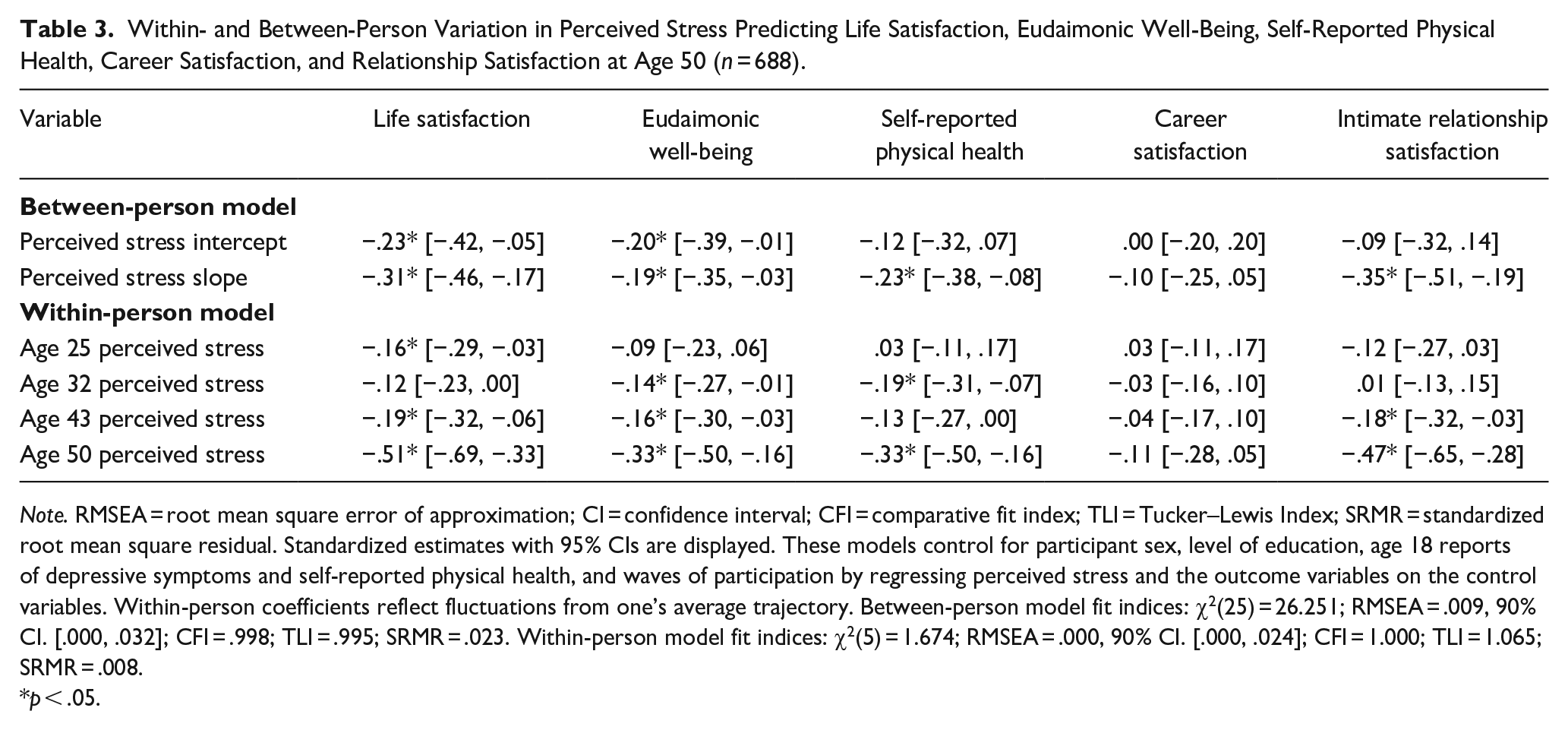
Note. RMSEA = root mean square error of approximation; CI = confidence interval; CFI = comparative fit index; TLI = Tucker–Lewis Index; SRMR = standardized root mean square residual. Standardized estimates with 95% CIs are displayed. These models control for participant sex, level of education, age 18 reports of depressive symptoms and self-reported physical health, and waves of participation by regressing perceived stress and the outcome variables on the control variables. Within-person coefficients reflect fluctuations from one’s average trajectory. Between-person model fit indices: χ2(25) = 26.251; RMSEA = .009, 90% CI. [.000, .032]; CFI = .998; TLI = .995; SRMR = .023. Within-person model fit indices: χ2(5) = 1.674; RMSEA = .000, 90% CI. [.000, .024]; CFI = 1.000; TLI = 1.065; SRMR = .008.
p < .05.
Within-person variation in perceived stress also predicted midlife outcomes. Higher than typical perceived stress in the transition to adulthood (age 25) predicted lower life satisfaction relative to others at age 50. Higher than typical perceived stress in young adulthood (age 32) predicted lower levels of eudaimonic well-being and self-reported physical health at age 50. Upward fluctuations in midlife stress (ages 43 and 50) predicted lower life satisfaction, eudaimonic well-being, self-reported physical health, and intimate relationship satisfaction at age 50.
Discussion
Guided by lifespan (Baltes, 1987) and life course (Elder, 1985) developmental perspectives, this study examined the average trajectory of perceived stress from the transition to adulthood into midlife as well as the between- and within-person associations of perceived stress across these adult years with midlife psychological well-being (life satisfaction and eudaimonic well-being), physical health, career satisfaction, and intimate partnership satisfaction. Longitudinal growth curve analyses of data gathered from a Canadian sample surveyed at ages 25, 32, 43, and 50 years contribute several important insights.
Trajectory of Perceived Stress
Perceived stress exhibited a significant linear decrease across the 25-year observation window. This finding is consistent with prior longitudinal research reporting intraindividual decreases in exposure to stressors and negative affect in response to stressors (Almeida et al., 2022) and cross-sectional studies documenting between-person differences in stress among participants of different age cohorts (Cohen & Janicki-Deverts, 2012; Steptoe et al., 2015; Stone et al., 2010). Perceived stress declined an average of .012 units per year on our item (responses from 1 to 4), resulting in a gradual, moderate overall reduction by age 50 (Hedges’ g = .40). This magnitude of change was a bit larger than that observed in between-person comparisons (see e.g., Cohen & Janicki-Deverts, 2012; Hedges’ gs from .07 to .33 [present authors’ calculations based on Table 1]). Measurement differences between the present and prior studies, however, make it difficult to determine whether the relatively larger magnitude of change observed in our investigation is due to larger within-person decreases in perceived stress compared to between-person age cohort comparisons or whether differences in measurement provide an explanation. For example, the ETS assessed the intensity of stress (e.g., very, fairly, not very, or not at all stressful) in one’s life, whereas past studies assessed the frequency of perceived stress (e.g., how often did you feel. . .) across daily (Almeida et al., 2020; Stawski et al., 2008; Steptoe et al., 2015; Stone et al., 2010) or monthly (Cohen & Janicki-Deverts, 2012) intervals. Although additional longitudinal research is needed to determine the magnitude of change in perceived stress, our results suggest a meaningful long-term decrease in perceived stress from the transition to adulthood into midlife.
The average decrease in perceived stress from age 25 to age 50 provides support for the adaptation perspective’s contention that perceptions of stress decrease with age as people acquire skills and resources to better manage life stressors (Almeida et al., 2011; Whitbourne, 1985). Numerous threads of evidence provide potential explanations for how this adaptation process unfolds. For example, older adults are more likely than younger adults to use active planning and analysis strategies to solve problems and are less likely to use avoidance or dependence on others (Blanchard-Fields, 2007). The increasing use of constructive problem-solving strategies with age may allow for more of life’s inevitable problems to be resolved effectively, leading to reductions in perceived stress. Alternatively, socioemotional selectivity theory argues that people prioritize meaningful connections and positive experiences as they age and perceive their available remaining time to be limited (Carstensen et al., 1999). Thus, as life becomes more deeply rooted in rewarding relationships that allow for the frequent experience of positive affect, perceptions of stress may naturally decline and individuals may gain access to others willing to provide assistance during times of stress.
In addition, we observed significant between- and within-person variability underlying the mean trajectory. At the between-person level, participants followed trajectories flowing in all directions; some experienced increasing perceptions of stress, others declined, and some maintained consistent stress perceptions. At the within-person level, there was significant variability in perceived stress at each measurement occasion not explained by the growth curve; participants reported substantial deviations from their average trajectory in the transition to adulthood, young adulthood, and midlife. Although our analysis identified an average decrease in perceived stress across a large swath of adulthood, the significant between- and within-person variance indicates there is not one single trajectory of perceived stress, in accordance with lifespan perspectives (Aldwin, 2010; Baltes, 1987). The transition to adulthood tends to be a period of higher vulnerability to stress, followed by young adulthood, but any developmental period may be stressful depending on individual circumstances.
An important aim for future research will be to understand the developmental precursors, macro-level contextual influences, and concomitant experiences that give rise to the between- and within-person variability in perceived stress across adulthood. Our control variable analysis provides some initial insight, most notably in regard to depressive symptoms assessed at age 18. Those with higher age 18 depressive symptoms reported higher perceptions of stress at age 25 and also experienced upward within-person fluctuations in perceived stress at ages 25, 32, 43, and 50 years compared to those with fewer baseline depressive symptoms. Such results highlight early mental health vulnerabilities as a risk factor for heightened stress up to three decades in the future. And it is possible that depressive symptoms may interact with macro-contextual factors (our sample experienced three recessions in their adult years) or concomitant experiences (such as job instability or intimate partnership dissolution) to further increase perceptions of stress from young adulthood into midlife.
Between- and Within-Person Perceived Stress Associations With Midlife Outcomes
The second aim of this study was to determine whether between- and within-person variability in perceived stress predicted psychological well-being, physical health, career satisfaction, and intimate partnership satisfaction at age 50. At the between-person level, those with higher levels of perceived stress at age 25 reported poorer psychological well-being at age 50 compared to those with lower perceived stress. The trajectory of perceived stress was more consequential for midlife functioning than the initial levels; however, those who decreased at a slower rate (or even increased) in perceived stress between ages 25 and 50 years reported poorer psychological well-being and physical health and were less satisfied with their intimate partnership compared to those whose perceived stress declined at a faster rate. These findings underscore the potency of stress as a powerful between-persons’ risk factor for poorer psychological and physical health and relational functioning later in life (Almeida et al., 2011; Karney & Bradbury, 1995; Thoits, 2010).
While one’s average trajectory was robustly linked with midlife functioning, deviations from one’s average trajectory during the transition to adulthood, young adulthood, and midlife also predicted well-being at age 50. Reporting higher than one’s own average perceived stress at ages 25, 43, and 50 years predicted lower life satisfaction at age 50 relative to others. Higher than average perceived stress at age 32, 43, and 50 years was associated with lower eudaimonic well-being. Higher than typical stress at ages 32 and 50 was associated with worse self-reported physical health, and upward fluctuations in perceived stress during midlife (ages 43 and 50 years) predicted lower relationship satisfaction relative to others at age 50. These within-person findings complement those from daily diary studies (Blaxton et al., 2020; Stawski et al., 2008): not only does well-being fluctuate on a daily basis in tandem with one’s experience of stress, but fluctuations in stress during key adult developmental periods foretell diverse aspects of well-being decades into the future.
Together, these between- and within-person findings provide compelling support for key contentions of lifespan (Baltes, 1987) and life course (Elder, 1985) perspectives. Past experiences and habitual patterns lead individuals to follow their own distinct perceived stress trajectory, but individual adaptation and changing contextual influences allow for intraindividual divergence from that path. And one’s average trajectory and fluctuations through adulthood each influence well-being in midlife, illustrating the connectedness and continuity of prior life experiences in shaping present circumstances. These findings may have useful implications for interventions aimed at promoting well-being in the middle adult years. The between-person results suggest that identifying individuals experiencing high levels of stress relative to others may allow more efficient deployment of interventions providing resources and skills to manage stress. The within-person findings suggest that efforts to reduce individuals’ perceived stress at a given point in their lives may lead to enhanced well-being later in life even if those individuals revert to typical patterns of stress in the future. More effective interventions for those experiencing high stress in the transition to adulthood, young adulthood, or midlife may promote well-being among those at risk of maladaptive midlife outcomes.
Our analysis revealed that perceived stress did not predict midlife career satisfaction at the between- or within-person levels. This is curious, given observed associations of perceived stress with other midlife outcomes. Along with individual effort and skills, career success is influenced by workplace factors, labor market conditions, and legislative policies, along with gender and race (Krahn et al., 2020). Compared to perceived psychological, physical, and relationship health, perceptions of career success (i.e., career satisfaction) may be less directly shaped by personal experiences of stress. Employment-related factors may contribute to perceptions of stress more so than they are influenced by them. Indeed, some of the earliest research on the stress process conceptualized workplace difficulties as a key source of stress (Pearlin et al., 1981). Future work that considers potential bidirectional associations between career satisfaction and perceived stress across adulthood would be valuable.
Study Limitations
All constructs were assessed with single items. Although the items are similar to those in other studies, possess face validity, and the perceived stress item demonstrated convergent and predictive validity, multi-item scales may measure constructs with more precision. Single-item measures are not without their merits (e.g., minimize participant fatigue, promote sample retention; Allen et al., 2022), and results aligned with relevant theory and research. Nevertheless, future studies with multi-item measures would be valuable. Second, attrition analyses revealed those who participated in more study waves across 25 years were more likely to be female and more educated, and to report better psychological well-being at age 50. Future long-term longitudinal studies that better retain sample members will allow broader generalization. Third, the remaining participants in the ETS at age 50 are not a representative sample of Canadians in midlife today. For example, 86% of participants reported their race to be White. Since this study began in 1985 decades of immigration from non-European countries shifted Canada’s racial composition in all age cohorts. Trajectories of stress may differ among a more racially diverse sample. Finally, our multi-decade approach provided a broad perspective on how perceptions of stress change from the transition to adulthood into midlife, but the long assessment intervals may not completely capture additional nuances in stress trajectories across adulthood. Findings from accelerated longitudinal studies that piece together trajectories from multiple age cohorts with more frequent assessments could complement the current results (e.g., Almeida et al., 2022).
Conclusion
This study aimed to identify the average trajectory of perceived stress from the transition to adulthood, young adulthood, and midlife and to understand how between- and within-person variation in perceived stress is associated with life satisfaction, eudaimonic well-being, self-reported physical health, career satisfaction, and intimate relationship satisfaction at age 50. Our analyses found evidence for a moderate decline in perceived stress across 25 years with much diversity underlying the average trajectory. Between-person differences across time and within-person deviations from one’s expected level of perceived stress were each predictive of midlife well-being. Those with high and increasing perceptions of stress relative to others are at risk of poor psychological and physical health and strained intimate relations in midlife, but within-person reductions in stress during the 20s, 30s, and 40s could carry forward and yield improved well-being at age 50.
Supplemental Material
sj-docx-1-jbd-10.1177_01650254221150887 – Supplemental material for Perceived stress trajectories from age 25 to 50 years
Supplemental material, sj-docx-1-jbd-10.1177_01650254221150887 for Perceived stress trajectories from age 25 to 50 ears by Matthew D. Johnson, Harvey J. Krahn and Nancy L. Galambos in International Journal of Behavioral Development
Footnotes
Declaration of Conflicting Interests
The author(s) declared no potential conflicts of interest with respect to the research, authorship, and/or publication of this article.
Funding
The author(s) disclosed receipt of the following financial support for the research, authorship, and/or publication of this article: This research was funded by grants from the Social Sciences and Humanities Research Council of Canada (SSHRC), Alberta Advanced Education, and the University of Alberta. Data were collected by the Population Research Laboratory, University of Alberta.

Supplemental material
Supplemental material for this article is available online.
References
Supplementary Material
Please find the following supplemental material available below.
For Open Access articles published under a Creative Commons License, all supplemental material carries the same license as the article it is associated with.
For non-Open Access articles published, all supplemental material carries a non-exclusive license, and permission requests for re-use of supplemental material or any part of supplemental material shall be sent directly to the copyright owner as specified in the copyright notice associated with the article.
