




Abstract
We examined Canadian host-society children’s prosociality (i.e., emotions and behaviors that reflect care for the welfare of others) toward refugee newcomer peers and the role of parental socialization (i.e., frequency of parent-child conversations about refugee newcomers) in children’s refugee-specific prosociality. The sample included 168 children (ages 6, 9, and 12 years; 51% girls; 58% European ethnicity) and their primary caregivers. We interviewed children to assess their ethical guilt-related emotions (based on emotions and reasoning) in response to a hypothetical vignette depicting prosocial omission involving a refugee newcomer peer or a non-refugee peer (between-subjects manipulation). A donation task was used to assess prosocial behavior wherein children were given the opportunity to donate chocolate coins to a refugee newcomer peer. Parents reported on how often they typically engage in conversations with their children about refugees and about inclusion. Children experienced similar intensities of ethical guilt-related emotions in the refugee compared with the nonrefugee condition, and donations to refugees increased across age groups. Furthermore, children whose parents engaged them in more frequent conversations about refugees expressed stronger ethical guilt-related emotions toward refugee peers (but not toward host-society peers), and donated more to a refugee peer. No significant associations between conversations about inclusion more broadly and refugee-specific prosociality were found. Encouraging parents to have conversations with their children that focus on the experiences of refugees may be important for fostering kindness between refugees and host-society children. Ultimately, these findings may contribute to initiatives that focus on promoting the inclusion of refugee newcomers in their postmigratory societies.
Due to various sociopolitical conflicts within and across nations in the last decade (e.g., the Syrian Civil War and the Russia–Ukraine War), there has been an escalation in the forced migration of children and families (i.e., refugees) (United Nations High Commissioner for Refugees [UNHCR], 2018). As such, researchers strive to identify strategies to help newcomers integrate into host societies (Cornelius & Rosenblum, 2005). Extant research focuses on the postmigratory welfare of refugee newcomers (Scoglio & Salhi, 2021). However, because the integration process is one of mutual accommodation between newcomers to a country and the members of the host society (Berry et al., 2006), it is critical to understand how host-society individuals contribute to helping or hindering the welfare of refugee newcomers. Engaging host-society children in this process may be particularly beneficial for the inclusion of refugee newcomer children and families and in protecting newcomer children from adverse psychosocial health outcomes in the future.
In this study, we examined host-society children’s prosociality (i.e., emotions and voluntary behaviors that reflect care for the welfare of others; Malti, 2021) toward refugee newcomer peers. Specifically, we investigated Canadian host-society children’s guilt-related emotions in ethical contexts (i.e., negatively valenced emotions following a transgression that reflect concerns for others’ welfare and rights; Jambon et al., 2022; Colasante et al., 2021; Malti, 2016) and donation behavior (i.e., the granting of personal resources that represents an individual’s willingness to consider the needs of others; Ongley et al., 2014) and explored how parent-child conversations about refugee newcomers (compared with conversations about inclusion in general) were associated with individual differences in host-society children’s emotions and behaviors. Encouraging host-society children to engage kindly with refugee newcomers is a promising strategy to counter refugee prejudice and discrimination (van Zalk & Kerr, 2014). We conducted our research in children ages 6, 9, and 12 years due to advancements in children’s ethical emotions and prosocial behavior, the importance of parents as socialization agents during that age window (Laible, 2004), and because it is a critical time in development to promote intergroup kindness and deter exclusion (Killen et al., 2011).
Refugee Newcomers in Canada and the Role of Group Membership
Global political conflicts have catalyzed rapid and forced migration. For example, the conflict in Syria, which remains the largest displacement crisis in the world, has displaced 6.5 million people across international borders within the last decade—including an estimated 2.5 million children (UNHCR, 2018). Since 2015, the Canadian federal government has resettled more than 40,000 Syrians in over 350 communities (Hynie, 2018). As such, Canadians (especially those who live in metropolitan areas) are likely to live among and interact with refugee newcomers in their communities.
Although Canadians’ attitudes toward migrants are relatively positive compared with other countries (Banting, 2010), refugees are conceptualized as social outgroup members (Esses et al., 2013). Social outgroups that lack status, prestige, power, and social capital within society (i.e., marginalized populations such as newcomer refugees) are more likely to experience discrimination and less likely to be the recipients of prosociality, which may lead to loneliness, depression, and anxiety over time (Killen et al., 2011; Ward et al., 2001). Encouraging host-society children’s prosociality toward refugee newcomers may combat prejudice and encourage newcomers’ successful adaptation to their postmigratory society.
Group Membership and Children’s Prosociality
Children feel better and behave more prosocially in contexts where ingroup members are favored (e.g., Renno et al., 2015; Weller & Lagattuta, 2013). According to Social Identity Theory (Tajfel & Turner, 1982), children strive to benefit their social ingroup (thus, disadvantaging their social outgroup) through their prosocial action, which is theorized to help them maintain a positive social identity (Renno et al., 2015; Schuhmacher & Kärtner, 2019). The recognition of outgroup need, however, may sometimes overpower ingroup bias, suggesting that intergroup prosociality may be influenced by context and group category (Sierksma et al., 2014). To garner insight into how refugee newcomers may be accepted into their postmigratory communities, we extend recent research (see Taylor & Glen, 2020) by investigating Canadian host-society children’s ethical guilt-related emotions and donation behavior based on refugee status—a salient outgroup in need.
Children’s Ethical Guilt-Related Emotions
Children’s ethical guilt matures across childhood into adolescence as they develop their perspective-taking skills, self-reflection, and understanding of moral and social norms (Lagattuta & Thompson, 2007; Malti, 2016). Guilt-related emotions arise when one violates their moral standards related to fairness and care, such as intentionally pushing another (harm) or not sharing with another (prosocial omission; Ongley & Malti, 2014). Although children typically feel less intense ethical guilt-related emotions following transgressions of prosocial omission compared with harm due to the discretionary nature of prosocial actions (Miller et al., 1990; Ongley & Malti, 2014; but see Dahl et al., 2020), ethical guilt-related emotions in prosocial omission contexts likely signal a strong commitment to prosocial action. Thus, we focused on ethical guilt-related emotions following prosocial omission due to our specific interest in prosocial engagement.
In intergroup contexts, children tend to experience more intense moral emotions toward ingroup peers, such as feeling happier after helping racial in- versus racial outgroup peers (Weller & Lagattuta, 2013) and experiencing more concern for the welfare of ingroup compared with outgroup peers (Buttelmann & Böhm, 2014). Nevertheless, children sometimes experience stronger moral emotions toward disadvantaged outgroups when need is salient (e.g., Dys et al., 2019). Indeed, in the case of refugee newcomers, children express high levels of empathic concern for refugee newcomers, likely due to the hardships they have faced (Taylor & Glen, 2020). However, no empirical work to our knowledge has tested ethical guilt-related emotions toward refugee newcomers.
Children’s Donation Behavior
Donation is a type of giving behavior that is granted to recipients who exhibit clear need, is often unreciprocated, and can be costly if the child donates valuable items (Malti et al., 2016). Donation behavior increases across childhood and adolescence because children become more fairness-oriented (Fehr et al., 2008; Gummerum et al., 2010). Children also become increasingly sensitive to the recipient of their prosociality, which influences how they distribute resources (van de Groep et al., 2019).
Little to no research has examined children’s donation toward refugee newcomers. Drawing from research on children’s sharing and helping based on other group categories, we see that young children share with ingroup others (e.g., friends, family, same-gender peers, native speakers) more than outgroup others (e.g., disliked peers, strangers, other-gender peers, and foreign speakers; for example, Kinzler et al., 2007; Renno et al., 2015). When outgroup need is apparent, however, children may share with and help outgroup members more than ingroup members (see Sierksma et al., 2018; Zinser et al., 1976). Indeed, children in early to late childhood share more with disadvantaged targets than with advantaged targets (Li et al., 2014; Malti et al., 2016; Shutts et al., 2016). Regarding refugee peers, Taylor and Glen (2020) showed that children donate roughly half their resources to refugee peers, and donate more to refugee newcomers than to other causes such as animal welfare and nature charity, which shows their recognition of need. In this study, we focused on exploring generosity in Canadian children’s donations to refugee newcomer peers and age-related differences in donation rates.
Socializing Prosociality Toward Refugee Newcomers Through Conversations
Parents play a prominent and consistent role in shaping children’s prosociality and one channel through which socialization occurs is conversation. Through conversations, parents assist their children in making sense of their social experiences and scaffold children’s moral growth and learning (Laible, 2004). Frequent parent–child conversations that are embedded with emotional and moral messages are eventually internalized and influence children’s emotions and behaviors when interacting with others (Dunn & Slomkowski, 1992). Indeed, what parents discuss with their children influences children’s and adolescents’ concern for others and their prosocial behavior (e.g., Peplak et al., 2021).
Parents within Western societies regularly draw children’s attention to, and relay messages about, social group distinctions and do so early on in a child’s life (Bigler & Liben, 2006; Killen et al., 2011). What parents explicitly teach their children about other groups influences children’s group identification, group preference, and intergroup attitudes (Aboud & Amato, 2001). Indeed, constructive conversations about various groups and intergroup issues allows children to better detect bias and reduce stereotyping, likely by increasing children’s perspective-taking and knowledge surrounding the challenges various groups face (Abaied & Perry, 2021; Bigler & Wright, 2014). Thus, it is likely that positive parent–child conversations about specific outgroups (such as refugee newcomers) may help children tune their attention to the needs of that outgroup, and increase their concern and desire to engage prosocially with them (Ottoni-Wilhelm et al., 2014). We assessed whether the frequency of conversations about refugee newcomers between parents and children was associated with host-society children’s prosociality toward refugee newcomers. We also explored the messages that parents relayed in their conversations to understand how they talk to their children about this topic.
The Present Study
This study had two overarching aims. Our first aim was to determine the extent to which children extend their prosociality (guilt-related emotions and donation behavior) toward refugee newcomer peers. We tested differences in children’s ethical guilt-related emotions following prosocial omission toward ingroup (host-society peer from the neighborhood) and outgroup (refugee newcomer) peers and examined children’s donation rates toward refugee newcomers. We expected that children would feel less ethical guilt-related emotions following a transgression against a host-society peer compared to a refugee peer due to ingroup biases. Nevertheless, we acknowledged that it was possible for children to feel stronger ethical guilt-related emotions following a transgression against a refugee newcomer compared with a host-society peer due to children’s understanding of outgroup need. Regarding donation, we anticipated that children would donate about half of their resources to a refugee newcomer (Cowell et al., 2017) and expected generosity to increase across age.
Our second aim was to examine how parent–child conversations about refugees would be associated with individual differences in children’s refugee-specific prosociality. We anticipated that, above and beyond general conversations about inclusion, more frequent parent–child conversations about refugees would be associated with higher levels of ethical guilt-related emotions following a prosocial omission toward a refugee peer (but not a host-society peer) and with more donations to a refugee newcomer peer. Finally, as an exploratory aim, we examined the types of messages parents were relaying within their conversations and tested whether parents who more frequently engaged in these conversations were more likely to relay certain messages.
Method
Participants
A sample of 168 children (51% girls) and their primary caregivers (96% biological parents; 82% mothers) participated. Children were of three age groups: 6- (n = 61, Mage = 6.61, SD = 0.42; 49% girls), 9- (n = 51, Mage = 9.54, SD = 0.52; 51% girls), and 12-year-olds (n = 56, Mage = 12.55, SD = 0.37; 53% girls). Families were recruited from multiple schools (six schools) from the Southern Ontario. G*Power (Faul et al., 2009) was used to perform an a priori power analysis for a multiple linear regression (fixed model single regression coefficient test with seven predictors, power = 0.80) to determine the minimum sample size needed to detect small effects (f2 = .04; Cohen, 1988; based on related research, see Malti & Krettenauer, 2013). The power analysis revealed that a minimum sample of N = 156 was sufficient (we oversampled to account for missing data). Fifteen percent of parents identified as immigrants and all children were Canadian born (25% did not respond or data was missing). Participants’ ethnic backgrounds included 58.4% Western or Eastern European; 0.6% Middle Eastern; 2.8% South or South-East Asian; 0.6% East Asian; 1.7% Central or South American; 0.6% other ethnic origin; 7.9% mixed ethnic origin (27.4% missing). Parents reported their highest level of education: 2% had less than a high school diploma, 8% had a high school diploma, 56% were college or university graduates and 9% completed a postgraduate degree (25% of reports were missing). This research was approved by the research ethics board at the University of Toronto, protocol # 35578.
Procedure
Parents provided written informed consent and children provided oral assent prior to study commencement. Children completed interviews in a private room at their school. The interview sessions were conducted by a trained research assistant and the first author and lasted approximately 30 min. Children’s understanding of refugee status was assessed at the beginning of the study (adapted from Cameron et al., 2006; see “Refugee Understanding” section on page 5). Children then performed the donation task followed by a battery of social-emotional responding tasks, including our ethical guilt assessment. Caregivers reported on their family demographics and socialization practices via a paper questionnaire. The questionnaire was sent to parents alongside consent materials, and parents who were interested in participating completed the questionnaire and the consent forms and submitted the documents (in a sealed envelope) to the lead author. Upon conclusion of the session, children received an age-appropriate book as a gift and parents were sent debriefing information.
Measures
Ethical Guilt-Related Emotions
Children participated in the vignette-based Social-Emotional Responding Task (Malti, 2019), which was designed to assess ethical guilt in children and adolescents. Children were presented with a hypothetical vignette in which they were told to imagine that they had decided not to share a second helping of ice cream with their peer. The vignette read,
Imagine that you’re at school and it is hot outside. Your mom brings you two ice cream cones, one for you, and one for your classmate [protagonist]. You really like ice cream. You eat your ice cream cone and choose not to tell [protagonist] that the other cone is for him/her, so you can eat it too.
The vignette was presented alongside two drawings and was in the first-person perspective to aid children in understanding their role as the transgressor. Participants were trained on the first-person perspective and all task scales prior to the interview. Following the presentation of the story, children were asked, “How would you feel if you did this?” They were provided with an emotion scale to assist their responding, which included six cartoon faces that depicted neutrality, happiness, sadness, anger, surprise, and fear. Children were also instructed that they could verbally provide an emotional response that was not a scale option if they wished. Following their first emotional response, interviewers prompted children by asking: “Is there any other emotion you would feel?” Children were then asked for emotion reasoning: “You said you would feel [emotion]. Why would you feel [emotion]?” The interviewer probed unelaborated or nonsensical responses. We coded up to two emotions and two lines of reasoning per emotion. Approximately 35% of children reported two emotions and 16% of children reported two lines of reasoning for their first reported emotion. Finally, we assessed the strength of children’s emotions using a 3-point scale (1 = not strong, 2 = somewhat strong, and 3 = very strong).
Coding
Children’s emotions were first binary coded, such that negatively valenced emotions (i.e., sad, worried, upset, sorry, guilty, disappointed, frustrated, angry, fearful) were assigned a score of 1, and other emotions (i.e., happiness, surprise, neutrality or other positively valenced emotions) were assigned a score of 0 (Dys et al., 2019). We coded children’s reasoning via the codebook thematic analysis (TA) approach using previously developed and validated schemes that assess children’s guilt-related reasoning (Colasante et al., 2021). Five categories pertained to ethical considerations: (1) principle of care, (2) fairness and rights, (3) moral identity, (4) relationships, and (5) counterfactual ethical reasoning. Nonethical categories pertained to social conventional or sanction-based concerns, self-oriented reasoning, and other or unelaborate reasoning. Inter-rater reliability on 20% of the data was established by two independent coders and consensus was determined for the final coding (κ = 0.95, range κ = 0.88–1.00 across categories). Children’s reasoning was binary coded such that ethical considerations were coded as 1 and non-ethical considerations were coded as 0. Responses entailing a mix of ethical and non-ethical emotions were assigned a score of 1.
Consistent with previous research (Colasante et al., 2021), children’s emotions and reasoning categories were considered when coding for ethical guilt-related emotions such that binary scores for negatively valenced emotions and binary scores for ethical reasoning were multiplied together. To add further gradation, scores were then multiplied by children’s reported intensity of their emotion, resulting in a 4-point ethical guilt-related emotion score ranging from 0 (no ethical guilt-related emotions) to 3 (strong ethical guilt-related emotions).
Condition Manipulation
Children were randomly assigned to the ingroup (n = 84) or outgroup condition (n = 84) for the moral emotion assessment. In the outgroup condition, children were told that the protagonist of the vignette was a refugee. The protagonist was given a common Syrian name (i.e., Zain for the boy and Lely for the girl; similar to previous research, see Taylor & Glen, 2020), whereas the ingroup peer was given a common English name (i.e., Kevin for the boy and Kelly for the girl). Characters in the outgroup condition were introduced alongside the definition of a refugee to ensure comprehension (i.e., “a refugee is someone who is from a different country, who just moved to Canada with his or her family because they were forced to leave their country”; Cameron et al., 2006; see Taylor & Glen, 2020). The ingroup peer was introduced as a peer from the child’s neighborhood. Across conditions, the protagonists were gender-, age-, and skin-tone-matched to the participant to isolate refugee status as the differentiating outgroup factor and to control for potential group membership effects of race/ethnicity, gender, and age.
Donation
Children engaged in a donation task adapted from the dictator game (Gummerum et al., 2010; Kahneman et al., 1986). At the start of the task, children were gifted six chocolate coins and were told that the coins were theirs to keep as a gift for participating in the study. Then, the interviewer showed children a picture of a refugee newcomer peer (gender-matched to the child) and told them that they were collecting chocolate coins for poor refugee children. Interviewers instructed children that they could donate as many coins as they wanted and explained that they were to place the coins they wanted to donate into the refugee peer’s box (a nondescript white box that was placed beside the photo of the refugee peer), and the coins they wanted to keep in their own box (a nondescript white box that was placed close to the child). The child was told that they would receive the coins they did not donate at the end of the study. The interviewer then left the room to ensure that their presence would not influence children’s behavior. The coins children shared with the refugee peer were divided by the total number of coins they were given to create a proportional score (0.00 = no coins donated to 1.00 = all coins donated). We used a proportional score as to easily convert findings to a percentage.
Parent–Child Conversations
Parents reported how often they have conversations with their child about inclusion (i.e., “Do you teach or talk about inclusion with your child?”) and about refugee newcomers (i.e., “Do you teach or talk about refugees with your child?”) using a 7-point rating scale (0 = never to 6 = frequently).
Topics of Conversation
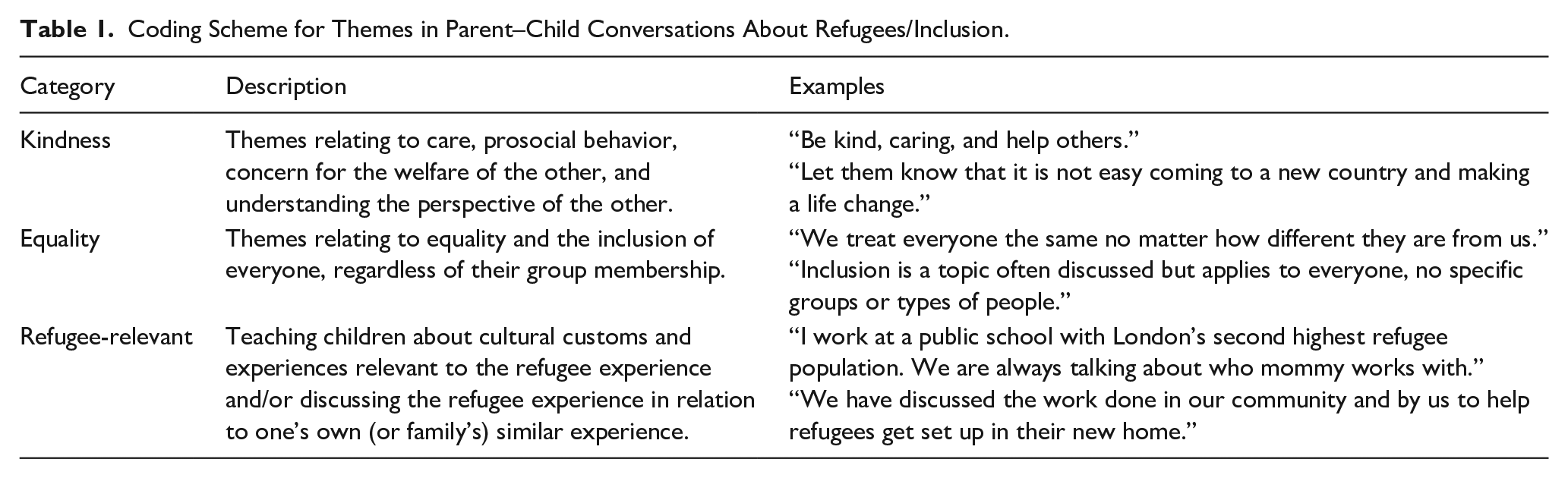
Parents reported on the method and/or content of their conversations: “If yes to the question above, how do you talk about refugees/inclusion with your child?” We coded parents’ qualitative responses using the coding reliability method (see Braun & Clarke, 2021). We developed a structured coding framework early in the coding process and refined our scheme using inductive data engagement. Categories included (1) kindness, (2) equality, and (3) refugee-related (reflects teaching children about cultural customs and experiences relevant to the refugee experience)—see Table 1 for description of coding categories and examples. Up to two themes were coded for each response. Approximately 24% of parents provided two themes in their responses. Two coders independently coded a random portion of responses (30%) and inter-rater reliability was established (Cohen’s κ = .86). Discrepancies were discussed for the final coding. Themes were then binary coded into separate variables for analyses.
Coding Scheme for Themes in Parent–Child Conversations About Refugees/Inclusion.
Messages Pertaining to Sameness
Drawing from research on ethnic socialization, we also coded conversations for messages of sameness (i.e., related to color-blind messaging; see Vittrup, 2018). Parents’ responses were binary coded, such that responses reflecting the idea that everyone should be treated the same regardless of background or individual differences were coded as 1 (e.g., “treat everyone the same no matter how different they are from us,” “there is no difference between ‘us’ and ‘them’”), and responses that did not reflect sameness were coded as 0. Two coders independently coded a portion of the data (30%) and inter-rater reliability was good (Cohen’s κ = .83).
Refugee Understanding (Manipulation Check)
Children’s understanding of refugee status was assessed at the beginning of the study (adapted from Cameron et al., 2006). If children verbally reported they did not know what a refugee was (98% of 6-year-olds, 86% of 9-year-olds, and 20% of 12-year-olds), the interviewer explained the definition using developmentally appropriate language (from UNHCR, n.d.):
A refugee is someone who is not from Canada. They are from a different country, but were forced to leave their country because of war, because a storm ruined their land, or because they were not treated nicely by other people in their country.
If children reported they knew what a refugee was, they were asked to explain their understanding. Research assistants assessed the accuracy of their definition and if it was incorrect, recited the correct definition. Children were reminded of the definition whenever the term “refugee” was mentioned in the study to ensure comprehension.
Control Variables
We controlled for refugee contact in our models based on previous research showing associations between outgroup contact and outgroup acceptance (Pettigrew & Tropp, 2006). As a proxy for refugee contact, parents reported whether they knew someone who is a refugee (1 = yes, 0 = no). We also anticipated an effect of preference on donation behavior (i.e., that lower preference would result in higher donation and vice versa) and thus controlled for preference in our model predicting donation. To measure preference, children were asked how much they like chocolate coins on a 3-point Likert-type scale (1 = not really to 3 = really) after they completed the donation task. Finally, we controlled for global prosocial behavior in our model predicting donation behavior to assess the unique contribution of parent conversations on donation to refugees above and beyond children’s general prosocial tendencies. Parents rated their children on five items from the Strengths and Difficulties Questionnaire (Goodman, 1997; for example, “My child shares readily with other children, for example, toys, treats, pencils”; α = .72) on a scale from 1 (not at all true) to 6 (always true). Data were aggregated across items to create a composite global prosocial behavior score.
Missing Data
From our main study variables, data were missing for ethical guilt-related emotions (n = 1; 0.6%), donation (n = 3; 1.8%), conversation about refugees (n = 43; 25.6%), conversations about inclusion, (n = 44; 26.2%), and themes of conversations (n = 88; 52.4%). Child-reported variables were missing due to incomplete interviews. Parent-reported data were missing because questionnaires were initially not administered as part of the study (n = 36) or because parents chose not to answer some questions. We ran Little’s MCAR test to assess patterns of missingness across study variables. The test was non-significant, χ2(12) = 14.47, p = .273. Thus, we estimated the data under the missing completely at random assumption using the full-information maximum-likelihood robust to nonnormality (MLR) estimator to account for all available data in our models.
Data Analytic Strategy
All analyses were conducted in Mplus (version 8.5; Muthén & Muthén, 1998–2017). We first conducted descriptive and bivariate analyses. Using multigroup models, we examined host-society children’s prosociality toward refugee peers by testing mean differences in children’s guilt-related emotions in ingroup (host-society peers) and outgroup (refugee newcomer) conditions, and examined children’s donation to a refugee newcomer by age group (6-, 9-, and 12-year-olds).
Next, we investigated associations between the frequency of conversations between parents and children about refugees (compared with conversations about inclusion more broadly) and children’s prosociality. We first employed multigroup modeling to test differences in associations between conversations and guilt-related emotions across conditions. This was accomplished by comparing the Satorra–Bentler Scaled χ2 values of models with the standardized regression parameters across the two conditions constrained to equality to models with the parameters freely estimated. Separate comparisons were conducted for each significant conversation variable path. We then employed a multiple regression model to investigate the association between conversations and children’s donation behavior toward refugee newcomers. We regressed donation on conversations about refugees and conversations about inclusion. We controlled for age group, gender, and contact in both models, as well as preference and global prosocial behavior when predicting donation (Eisenberg et al., 2015; Malti & Krettenauer, 2013; Pettigrew et al., 2011). In preliminary analyses, we included parent ethnicity as a covariate in our models predicting ethical guilt-related emotions and donation, however, parent ethnicity did not alter results. Thus, we removed it from our models to maintain parsimony (Cohen et al., 2003). Finally, we explored messages underlying parents’ conversations by employing thematic analysis and investigated associations between frequency of conversations and conversation messages in a regression model. The conversation variables were our dependent variables and the themes were dichotomous predictors.
Results
Descriptive Analyses
Distributions of the types of emotions children reported (in percentages), overall and by age group, are presented in Table 2. The means and standard deviations of our study variables and bivariate correlations are displayed in Table 3. We first tested age differences in means across study variables. Consistent with past findings (Malti et al., 2016), ethical guilt-related emotions differed by age group, χ2(2) = 12.43, p = .002, such 12 year-olds reported higher levels of guilt-related emotions than 6 year-olds, χ2(1) = 11.63, p < .001, Cohen’s d = 0.71, and 9-year-olds, χ2(1) = 4.96, p = .03, d = 0.46. Nine- and 6-year-olds did not differ in guilt-related emotions. Frequency of conversations about refugees differed by age group, χ2(2) = 7.93, p = .019, such that parents of 12-year-olds reported having more conversations about refugees than parents of 6-year-olds, χ2(1) = 8.05, p = .005, d = 0.67. Conversations about inclusion did not differ by age group.
Percentage of Emotions Reported Following Prosocial Omission—Overall and by Age Group.
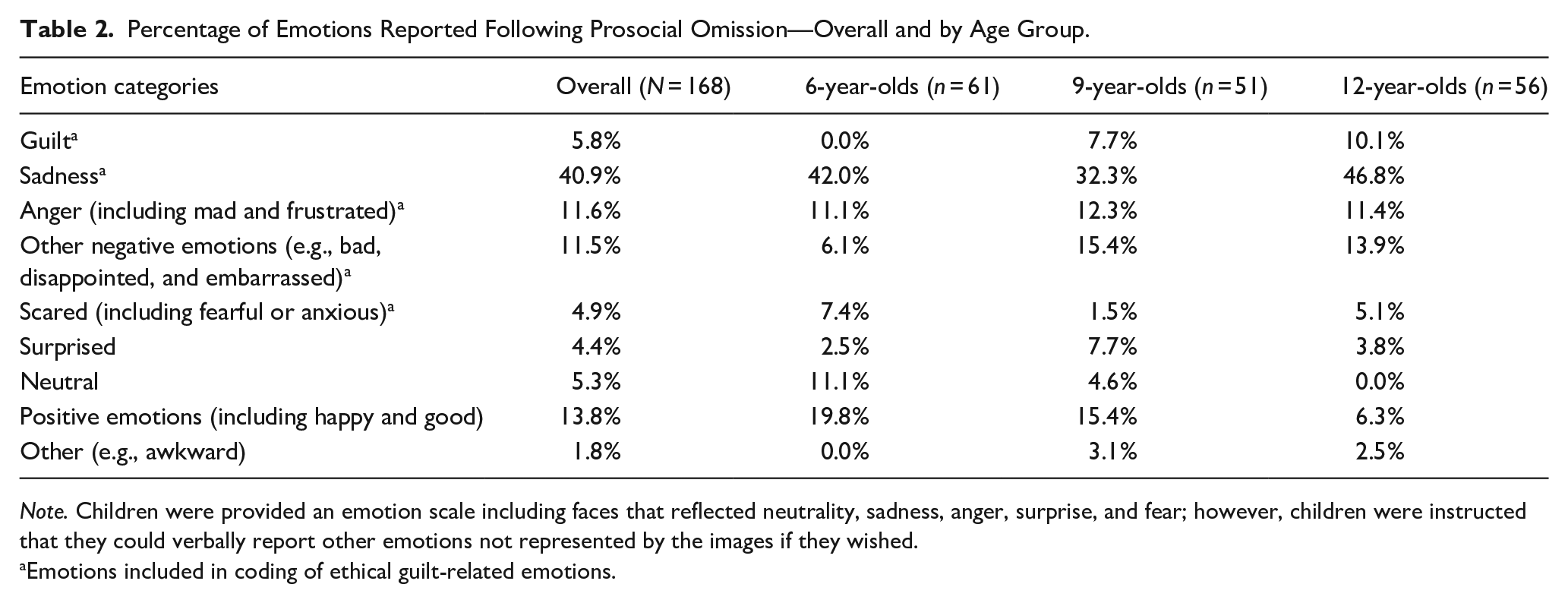
Note. Children were provided an emotion scale including faces that reflected neutrality, sadness, anger, surprise, and fear; however, children were instructed that they could verbally report other emotions not represented by the images if they wished.
Emotions included in coding of ethical guilt-related emotions.
Mean Values, Standard Deviations, and Bivariate Correlations Between Continuous Study Variables.
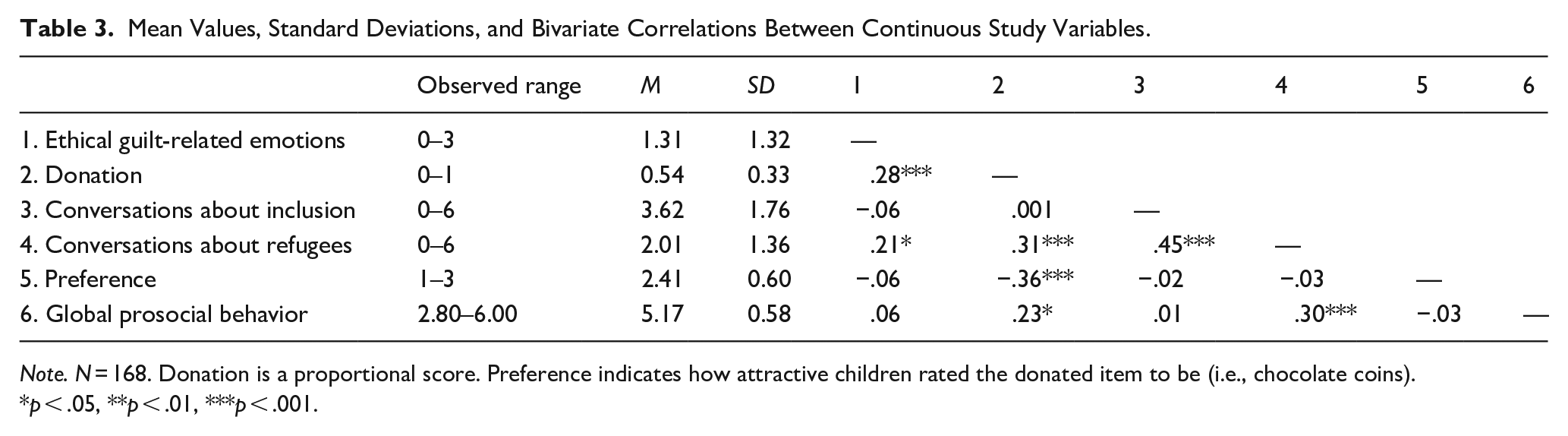
Note. N = 168. Donation is a proportional score. Preference indicates how attractive children rated the donated item to be (i.e., chocolate coins).
p < .05, **p < .01, ***p < .001.
Next, we tested mean differences in our main study variables by refugee contact and gender. Results revealed that parents who reported having contact with refugees also reported having more conversations about refugees with their children, χ2(1) = 32.56, p < .001, d = 0.93, as well as conversations about inclusion with their children, χ2(1) = 9.71, p = .002, d = 0.57. No significant difference in guilt-related emotions, donation, frequency of conversations, nor themes (kindness, equality, and refugee-relevant themes, as well as messages of sameness), were found between boys and girls. Ethical guilt-related emotions were lower in children of European ethnicity compared with children of non-European ethnicities, χ2(1) = 4.21, p = .04, d = 0.69 (this effect did not vary by condition). Bivariate correlations among our continuous variables revealed that ethical guilt-related emotions were positively associated with donation, and conversations about refugees. Donation was positively correlated with conversations about refugees, but negatively correlated with preference. Conversations about inclusion were positively and moderately correlated with conversations about refugees.
Host-Society Children’ Prosociality Toward Refugee Newcomers
Children reported moderate levels of ethical guilt-related emotions on average (M = 1.13, SD = 1.32). Contrary to our hypotheses, children did not significantly differ in their levels of ethical guilt-related emotions in the ingroup (M = 1.42, SD = 1.09) compared with the outgroup (M = 1.20, SD = 1.28) condition, χ2(1) = 1.11, p = .29 (see Figure 1(a)). Regarding donation, children donated 54% of their resources on average to a refugee peer. A multigroup model revealed mean differences in the number of resources donated by age, χ2 (2) = 70.86, p < .001. Specifically, as expected, 12-year-olds donated more to a refugee peer than 9-year-olds, χ2(1) = 39.51, p < .001, d = 1.20, and 6-year-olds, χ2(1) = 205.96, p < .001, d = 2.73, and 9-year-olds donated more than 6-year-olds χ2 (1) = 10.88, p = .001, d = .93 (see Figure 1(b)).
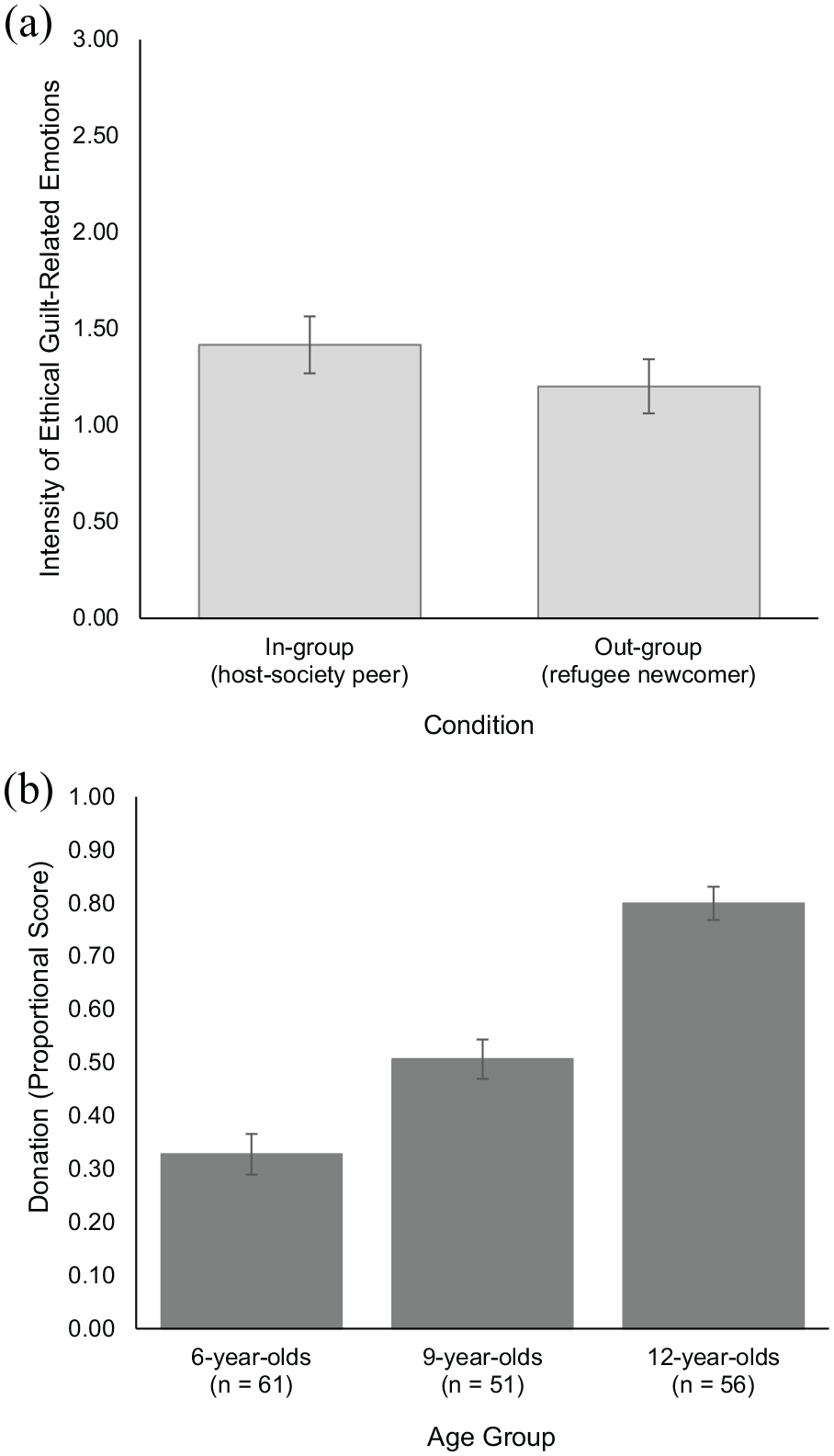
Children’s Prosociality Toward Refugee Newcomer Peers.
Associations Between Conversations and Ethical Guilt-Related Emotions
A multigroup analysis tested whether refugee-specific conversations and conversations about inclusion were differentially associated with children’s ethical guilt-related emotions across in- and outgroup conditions. Results for the overall model are displayed in Table 4. After controlling for age group, gender, and contact, we found that the effect of conversations about refugees on guilt-related emotions significantly varied by condition, χ2(1) = 4.92, p = .027. The frequency of refugee-specific conversations was positively associated with children’s guilt-related emotions in the outgroup condition, β = 0.57, SE = 0.14, p < .001, but not guilt-related emotions in the ingroup condition, β = 0.07, SE = 0.21, p = .75. The effect of conversations about inclusion in general was not associated with children’s ethical guilt-related emotions, nor did this effect vary by condition, χ2(1) = 0.08, p = .79.
Overall Model Testing the Association Between Conversations and Children’s Ethical Guilt-Related Emotions.
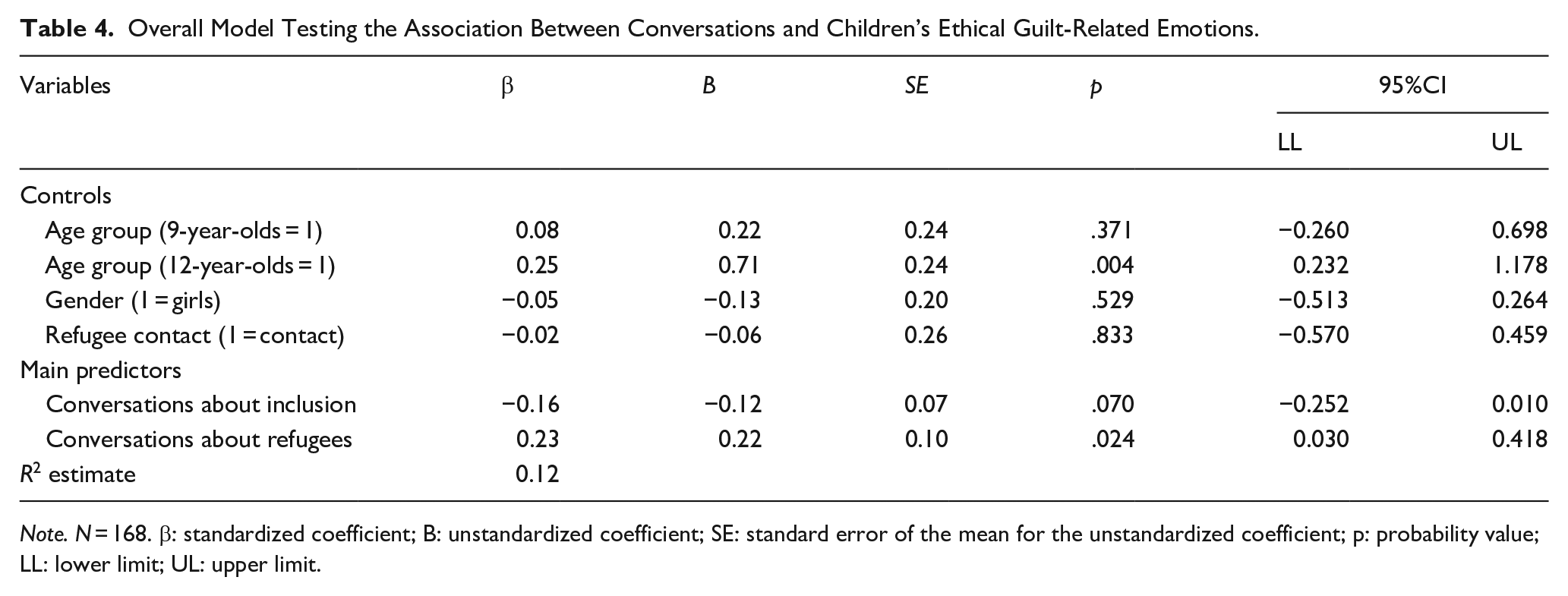
Note. N = 168. β: standardized coefficient; B: unstandardized coefficient; SE: standard error of the mean for the unstandardized coefficient; p: probability value; LL: lower limit; UL: upper limit.
Association Between Conversations and Donation
We examined links between refugee-specific conversations and conversations about inclusion with children’s donation to a refugee newcomer. As can be seen in Table 5, after controlling for age, gender, contact, preference (i.e., how much children reported liking chocolate coins), and children’s global prosocial behavior, as expected, we found a positive main effect of conversations about refugees on donation and did not find a significant effect of inclusion conversations on donation to a refugee peer.
Linear Regression Model Testing the Association Between Conversations and Donation.
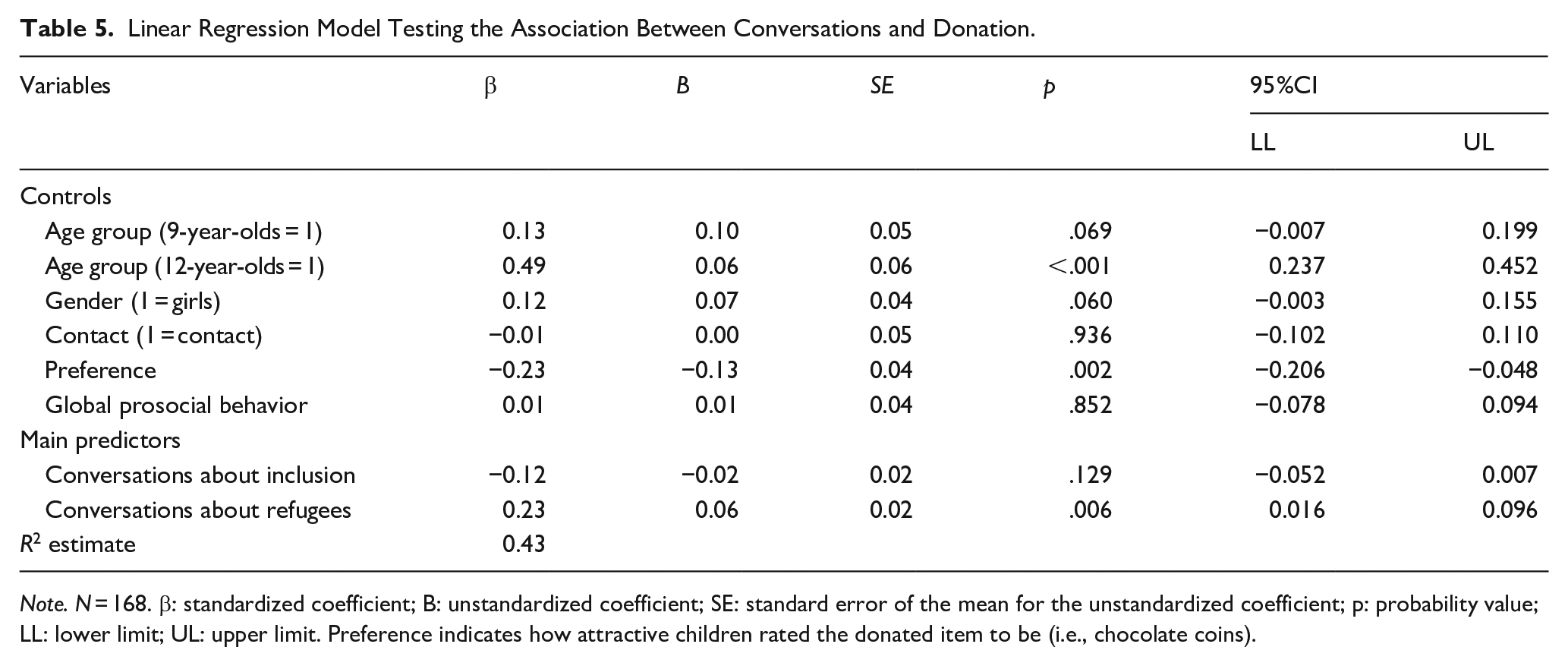
Note. N = 168. β: standardized coefficient; B: unstandardized coefficient; SE: standard error of the mean for the unstandardized coefficient; p: probability value; LL: lower limit; UL: upper limit. Preference indicates how attractive children rated the donated item to be (i.e., chocolate coins).
Messages Underlying Parent–Child Conversations
For those parents who reported talking to their children about inclusion (n = 114) and/or refugees (n = 111), the most commonly discussed themes focused on equality (56%), kindness (34%), and refugee-specific topics (11%; see Table 1 for examples). Topics related to equality were more likely to include messages pertaining to sameness (e.g., “treat everyone the same no matter how different they are from us”), χ2(1) = 18.85, p < .001. Parents who mentioned kindness themes were unlikely to include messages of sameness, χ2(1) = 3.83, p = .05, and those who reported refugee-specific themes were marginally less likely to include messages of sameness, χ2(1) = 3.39, p = .066, compared with those who did not include these themes. When examining associations between these messages and the frequency of conversations about inclusion and refugees, we found that parents who included refugee-specific themes in their conversations more frequently talked to their children about refugees, β = .26, b = 1.01, SE = 0.50, p = .041, while parents who included messages about equality reported having more frequent conversations about inclusion, β = .29, b = 1.13, SE = 0.57, p = .049.
Discussion
The successful inclusion of newcomers hinges upon the kindness of host-society members. In this study, we showed that children experienced similar levels of guilt-related emotions following a transgression against a refugee and a nonrefugee peer. We also demonstrated that more frequent parent-child conversations about refugee newcomers were positively associated with children’s refugee-specific prosociality (i.e., stronger guilt-related emotions and more donations). This association was unique to conversations about refugee newcomers. These findings have implications for programs that encourage the acceptance of refugees among host-society children and families.
We did not find differences in children’s ethical guilt-related emotions toward refugee compared to host-society peers. It is likely that children’s perceptions of need (and perhaps concern toward the refugee newcomer peer) overpowered their ingroup bias, resulting in similar levels of emotions across conditions (Sierksma et al., 2014). Furthermore, it is possible that additional effort was needed to distinguish refugees from other host-society peers. We verbally explained refugee status to children, but previous research has shown that providing children with verbal information about refugees is not as effective in promoting their moral emotions as providing in-depth stories about the refugee experiences (with pictures and visual aids; Taylor & Glen, 2020). Regarding donations to refugee newcomer peers, we found that children donated approximately half their resources on average, and donated substantially more with age. Specifically, 6-year-olds donated about 25% of their resources (self-benefiting allocations), 9-year-olds donated about 50% of their resources (fair allocations), and 12-year-olds donated about 75% of their resources (generous allocations) to the refugee newcomer peer. Children in early childhood tend to keep attractive resources for themselves, while children in middle-late childhood often distribute resources fairly (Fehr et al., 2008). Although little research has investigated adolescents’ willingness to donate to refugee newcomer peers (but see Taylor & Glen, 2020), it is possible that adolescents’ generosity was influenced by their advanced ability to consider and integrate the viewpoints and desires of others within their decision-making.
Importantly, we showed that the frequency of parent-child conversations about refugees mattered for how children treated refugee newcomer peers. Specifically, we found that more frequent refugee-specific conversations between parents and children were associated with stronger ethical guilt-related emotions following a transgression against a refugee peer (but not a nonrefugee peer) and more donations toward refugee newcomers. This was true above and beyond frequent conversations about inclusion, which were not significantly associated with children’s refugee-specific prosociality. Having conversations about refugees and/or the refugee experience likely facilitates children’s understanding of, and sensitivity to, the barriers refugees face. Indeed, explicit conversations help children garner a deeper understanding of various groups and make meaning of their own intergroup experiences (Loyd & Gaither, 2018). Conversations about refugees may prompt children to care more about the welfare of refugee newcomers and engage more prosocially in contexts where a refugee newcomer peer is disadvantaged (i.e., is not shared with) or needs help (i.e., via the distribution of valued resources). Nevertheless, because this study was correlational, more research is needed to test the directionality of this effect.
When investigating the messages underlying parent–child conversations, parents who reported having more frequent conversations with their children about refugees were more likely to incorporate refugee-specific topics such as personally relevant stories (e.g., “We talked about how their father came to Canada as a teenager 25 years ago. We explain the reasons why he came”), stories about interacting with refugee newcomers (e.g., “[. . .] through church sponsorship of refugee families”) or about the refugee-related work that occurs in their community (e.g., “We have discussed the work done in our community to help refugees get set up in their new home”). Through these types of conversations, parents highlight the personal relevance of refugee-specific prosociality, their specific experiences, and the ways in which they or others are helping them through their transition to a new society. Children may also be less likely to perceive refugee newcomers as outgroup peers if their parents incorporate narratives of family histories related to the refugee experience in their conversations. It is possible that parents who talk to their children more frequently about refugees are also those who have had more positive interactions with refugees in the community (Richeson & Nussbaum, 2004)—thus, positive contact may catalyze these conversations.
Within conversations about inclusion, parents who more frequently talked to their children about inclusion were more likely to relay messages about equality and sameness within their conversations (e.g., “We treat everyone the same no matter how different they are from us”). Drawing from research on racial-ethnic socialization, these types of messages are akin to color-blind messaging (i.e., the idea that race is not important) and may downplay the fact that certain groups face barriers that render them in need of help (Abaied & Perry, 2021). This specific conversational strategy may not provide children with enough direction to be able to know when and toward whom to extend their generosity. Because parents did not report often talking with their children about refugees, if the few conversations they have are void of messages emphasizing the idiosyncratic needs of refugees, children may learn that this group does not require additional support.
Implications
Teaching children how to extend their prosociality to those in need is not only beneficial for the recipient of kindness, but may also help children navigate diverse social interactions and foster cross-group friendships (Connolly & Hosken, 2006). There have been burgeoning efforts to decrease prejudice and negative intergroup attitudes in children and youth; however, decreasing prejudice against outgroups does not necessarily mean that children will engage in more outgroup prosociality. Our research shows that prompting ethical emotions and behaviors via parent–child conversations about specific outgroups in need (i.e., refugee newcomers) may encourage children to extend their kindness to those outgroups. Parents and teachers may wish to supplement their conversations about inclusion and equality with messages pertaining to the specific experiences, needs, and challenges that various groups face in order to highlight how to behave prosocially toward them. Adult-child conversations may be an important addition to interventions that promote empathy, awareness, and respect for diversity in children (Beelmann & Heinemann, 2014; Connolly & Hosken, 2006), and it may be important to include measures of ethical emotions and behaviors as markers of successful intergroup interventions (Killen et al., 2011).
Limitations and Future Directions
This study has some limitations and important future directions to mention. First, we used a cross-sectional design and were thus unable to speak to the directionality of parent–child conversations on children’s refugee-specific prosociality nor the developmental mechanisms that are involved in this association. Furthermore, our sample was underpowered to test age interactions in the links between conversations and guilt-related emotions across conditions. In addition, parent socialization may be most influential if children see their parents as models or if they perceive their parents as supportive (e.g., Miklikowska, 2017); thus, future research would benefit from investigating the relational conditions under which conversations about outgroups are most impactful. Furthermore, future research may benefit from understanding how other adults (e.g., teachers) and peers influence children’s refugee-specific prosociality.
Next, we only assessed children’s donation to a refugee newcomer peer—we did not measure donations to an ingroup target or other outgroup targets for comparison. Additional research is needed to better understand whether developmental changes in donations to refugee newcomers may compare with one’s own or other groups in need. Finally, we investigated explicit socialization practices via conversations, but children also learn how to feel about and treat others from observing patterns of behavior and unintended cues from trusted others (Vittrup & Holden, 2011). Thus, examining both explicit and implicit parental socialization strategies may provide a more comprehensive understanding of the various methods through which refugee-specific prosociality develops.
Conclusion
Discussing the experiences of other groups with children may prepare them to navigate diverse landscapes with kindness. We show that Canadian host-society children show prosociality toward refugee newcomer peers, and this prosociality may increase with age. Furthermore, we demonstrate that specific conversations that focus on explaining the experiences of refugees and include themes relevant to the refugee experience may be especially important for children’s prosociality toward refugee newcomers. Ultimately, encouraging refugee-specific prosociality may be critical for promoting the inclusion of refugee newcomers into society.
Footnotes
Acknowledgements
The authors thank the children, adolescents, parents, teachers, and principals who participated, and the members of the Laboratory for Social-Emotional Development and Intervention who helped with data collection and data processing.
Author Note
A fellowship from the Social Sciences and Humanities Research Council of Canada (SSHRC) awarded to the first author supported this research.
Declaration of Conflicting Interests
The author(s) declared no potential conflicts of interest with respect to the research, authorship, and/or publication of this article.
Funding
The author(s) disclosed receipt of the following financial support for the research, authorship, and/or publication of this article: This research was funded by Social Sciences and Humanities Research Council (SSHRC) Insight Grant awarded to Tina Malti.
