




Abstract
The present study examined age-related differences in bystander reactions within the context of peer exclusion of national ingroup (British) and immigrant outgroup (Australian or Turkish) peers. The immigrant peers were from nations that varied in terms of their perceived intergroup status in Britain. Participants were British children (n = 110, 8–11 years) and adolescents (n = 193, 13–16 years) who were presented with one of three scenarios in which a British national, Australian immigrant, or Turkish immigrant peer was excluded by a British peer group. Participants indicated their bystander responses. Perceived similarity and bystander self-efficacy were examined as possible correlates of bystander reactions. Findings revealed that children were more likely to directly challenge the social exclusion when the excluded peer was British or Australian compared with when they were Turkish. In contrast, adolescents did not differentiate in their response—they were equally likely to directly challenge the exclusion regardless of the excluded peer’s nationality. Importantly, when the excluded peer was Turkish, moderated mediation analysis showed that, with age, there was higher bystander self-efficacy for challenging the exclusions. In turn, higher bystander self-efficacy was related to higher direct challenging. These novel findings demonstrate the importance of intergroup relations, perceived similarity, and bystander self-efficacy in the emergence of age-related differences in bystander reactions to the exclusion of immigrant peers.
Social exclusion is pervasive in childhood and adolescence, resulting in detrimental psychological outcomes for those who experience it (e.g., mental health problems, poor academic achievement), especially when the exclusion is based upon prejudice resulting from one’s social group membership such as gender, ethnicity, or nationality (referred to as “intergroup social exclusion”) (Killen & Rutland, 2011). The intergroup social exclusion of immigrants is becoming more common with the rise of anti-immigrant attitudes among youth around the world (Gönültaş & Mulvey, 2019). Developmental research suggests that children and adolescents evaluate immigrants differently based upon their perceived “legality” (Verkuyten & Steenhuis, 2005), language skills (Beißert et al., 2020), and religion (Brown et al., 2017). Yet we know little about how children and adolescents distinguish between immigrants from different national groups when deciding how to react as a witness or “bystander” to social exclusion (Palmer et al., 2022). This is important because the prevalence of social exclusion decreases when bystanders intervene and challenge exclusion (Palmer & Abbott, 2018).
In the present study, we examined the development of bystander reactions among British children and adolescents to the social exclusion of a peer who was either a British national or an immigrant. The nationalities of the immigrant outgroups (Turkish or Australian) varied in terms of their perceived similarity with the British ingroup. These immigrant nationalities were chosen since the historical and current intergroup relations between these nations and Britain are different. The relations between Turkey and Britain are mixed with a degree of tension both historically and presently (Phillips, 2013). For example, in the 2016 UK referendum to remain in or leave the European Union (EU), Turkey’s potential membership of the EU was used by the Leave campaign to contest that Britain needed to leave the EU to reduce the prospect of increased Turkish immigration. Such potential immigration was presented as a threat to Britain’s way of life, given Turkey’s size and cultural (and Muslim) heritage (Ker-Lindsay, 2018). In contrast, relations between Australia and Britain are relatively more positive given their shared colonial history (Darian-Smith et al., 2007) and contemporary cultural connections (McKee, 2009).
These intergroup relations between Britain–Turkey and Britain–Australia are reflected in research which shows that, among the British, Turkish and Australian immigrants are perceived differently, with Australians being judged as more similar to British people than Turkish people (e.g., Blinder & Richards, 2020). In Britain, moreover, research indicates that people prefer immigrants from nations that are predominately English-speaking, Christian, and culturally similar (e.g., Australia) and are less positive toward immigrants from nations that are mainly non-English speaking, predominantly Muslim, and culturally different (e.g., Turkish; Blinder & Richards, 2020). As research suggests that children and adolescents are aware of others’ attitudes toward different immigrant groups (e.g., Jones & Rutland, 2018), we tested whether direct and indirect bystander reactions to intergroup exclusion would vary depending on the different immigrant identities of the excluded peer.
Direct and Indirect Bystander Challenging
In line with recent research, we examined the likelihood of children and adolescents engaging in direct and indirect bystander reactions that involve either challenging or supporting social exclusion (Mulvey et al., 2016). Typically, researchers average across different bystander responses to create one indicator of general prosocial bystander intentions or behavior (e.g., Palmer et al., 2015). However, explicit direct forms of challenging, such as “telling the group you don’t agree with the excluder,” will likely be harder for bystander peers to engage in compared with indirect types of bystander responses (e.g., “getting help from a teacher”). This is because they are directed at the excluder and more likely involve the presence of the peer group, and so come with perceptions of higher risk (Mulvey et al., 2016). Therefore, the current study examined both direct and indirect types of bystander responses.
Furthermore, peer group members can show their reactions to intergroup social exclusion in retaliatory ways (e.g., excluding the excluder from the group; Gönültaş & Mulvey, 2021a, 2021b). Gönültaş and Mulvey (2021b) presented participants with two initial bullying scenarios (Syrian peer is bullied by a Turkish bully and Turkish peer is bullied by a Turkish bully). Next, participants were told that the Syrian and Turkish victims retaliated against the bully. The findings demonstrated that Turkish adolescents perceived retaliation as less acceptable when Syrian refugee victims sought revenge from a Turkish ingroup bully compared with when Turkish victims sought revenge from a Turkish ingroup bully. Examining retaliatory bystander responses is essential in the context of intergroup social exclusion as it may reflect a bias by observers regarding the role of what makes a retaliatory response justified. Thus, bystanders’ direct retaliatory challenging responses to the exclusion of peers were also included in the current research. This study therefore uniquely examined how children and adolescents reacted (directly, indirectly, and retaliatory) as bystanders to the exclusion of immigrant peers from different national groups (Turkish or Australian), compared with those from their national ingroup (British).
Social Reasoning Developmental Model
This study was guided by the social reasoning developmental (SRD) model of social exclusion (Killen & Rutland, 2011; Rutland & Killen, 2015). The SRD model incorporates the social domain theory approach to moral development (Turiel, 1983) with developmental theories of social identity and intergroup dynamics (e.g., Abrams & Rutland, 2008). This theoretical approach outlines the various, potentially conflicting, considerations that children must weigh up when deciding how to respond to the intergroup exclusion of immigrants. These involve moral concerns about fairness and equality, personal concerns about risk and autonomy, whether to focus on helping others who are seen to be more like them (i.e., peers from the ingroup or a group perceived as similar), societal perceptions of discrimination against certain immigrant groups, and beliefs about whether they can effectively challenge exclusion by their group. These moral, personal, and societal concerns become more or less relevant at different points of development, between late childhood and mid-adolescence.
The SRD model contends children often favor their own group (e.g., national ingroup) or those from similar or shared groups (e.g., English-speaking) when making social and moral judgments. Previous studies based on the SRD model supports this possibility; research on bystander reactions by Palmer et al. (2022) showed preadolescents from a majority status group (i.e., Cypriot nationals) were more likely to challenge the social exclusion of a peer from their own group compared with an immigrant peer. Similarly, a recent study by Gönültaş and Mulvey (2021b) found that Turkish middle- and high-school students were more likely to report that they would be inclusive toward Turkish victims of interpersonal bullying compared with Syrian victims of intergroup bullying in their future interactions. The SRD model also, however, recognizes an important developmental shift between late childhood and mid-adolescence in reasoning about social exclusion (Rutland & Killen, 2015). This is why, in the present study, we compared bystander responses of 8- to 11-year-olds (“children”) and 13- to 15-year-olds (“adolescents”).
From late childhood into adolescence, individuals further develop the ability to take the perspective of others, particularly regarding intergroup relations within society (Rutland et al., 2010). For example, research has shown between these ages individuals increasingly use their knowledge of intergroup relations (i.e., “are certain groups seen as more or less different to us”) to make inclusive social and moral decisions (Elenbaas et al., 2020; McGuire et al., 2019). The SRD model expects that—from late childhood into adolescence—individuals are more likely to pay attention to intergroup related processes, like prejudice and discrimination, as underlying reasons behind intergroup social exclusion. For example, studies show that adolescents become more attuned to information about intergroup relations and social status differences compared with those in late childhood; adolescents report more bystander challenging responses and inclusivity (e.g., Yüksel et al., 2021), particularly when the excluded peers are from minority-status groups (e.g., immigrants). Furthermore, research shows a developmental increase in awareness of discrimination between middle to late childhood and adolescence (Brown et al., 2017; Thijs, 2017) and an increasing motivation to be supportive of disadvantaged groups and against condoning prejudice (McGuire et al., 2019; Rutland et al., 2010).
In the present study we anticipated that, while participants will generally favor challenging social exclusion when in the position of a bystander, there will be age differences. We expected that children will be more likely to challenge the exclusion of a peer perceived as similar (i.e., British or Australian) compared with an excluded peer who is perceived as dissimilar (i.e., Turkish peer). In contrast, adolescents are more likely to attend to the prevailing intergroup relations between Britain and the different immigrant identities, consequently appreciating that the exclusion of Turkish—unlike an Australian peer—may have resulted from prejudice or discrimination. Thus, we anticipate that adolescents will avoid showing bias in their bystander reactions by providing the same amount of challenging responses irrespective of whether the excluded peer is British or Australian or Turkish.
Psychological Processes Related to Age Differences in Bystander Reactions
One potential psychological process underlying age difference in bystander reactions is bystander self-efficacy. This is the belief that a chosen bystander reaction will be effective in defending the victim (Peets et al., 2015). In the context of interpersonal bullying, bystander self-efficacy has been shown to be related to an increase in prosocial bystander challenging (Salmivalli et al., 2011). It is also an important factor for majority-status adolescents (e.g., White British) likelihood of challenging intergroup discrimination (Wallrich et al., 2021). Bystander self-efficacy for challenging intergroup exclusion may increase between late childhood and adolescence, given that adolescents are more able to appreciate that their group may support this action when the person being excluded is from a stigmatized group. The emergence of such bystander self-efficacy could help explain age differences in challenging bystander responses.
Another potential psychological mechanism by which bystander challenging could increase with age within intergroup contexts is a growing perception that certain immigrant groups are perceived as more similar to the national ingroup. The category “immigrant” is confounded with other factors (e.g., culture, religion, language, etc.) and therefore not all immigrants are perceived the same. In the context of Britain, there is a belief that immigrants are typically non-English speaking, mostly Muslim, and from culturally dissimilar nations (e.g., Turkish) rather than English-speaking, mainly Christian, and from culturally similar nations (e.g., Australian) (Blinder & Richards, 2020). Research also indicates that perceptions of similarity between social groups typically increase from childhood into adolescence and adulthood in part due to greater intergroup exposure to peers from other different social groups (e.g., Heiphetz, 2019).
Developmental research has shown that immigrant groups that are perceived as least similar to the participant’s national group (e.g., in terms of cultural heritage) are evaluated more negatively (e.g., Beißert et al., 2020). However, there is evidence among children that perceptions of similarity depend on the cultural intergroup context (Smyth et al., 2017). This research has shown that perceptions of similarity are more present and relevant when there is intergroup contact and cultural connections between the social groups. This suggests that the level of perceived similarity between the British ingroup and immigrants will be higher when participants are thinking about and evaluating the exclusion of a British or Australian peer compared with a Turkish peer.
Therefore, in the present study, we anticipate that perceived similarity should in part explain age-differences in bystander challenging when the excluded peer is Turkish but not when they are British or Australian. When the immigrant excluded peer is Turkish, we anticipated that between late childhood and mid-adolescence, individuals would increasingly perceive more similarity between British people and immigrants (including Turkish) and this, in turn, will mean individuals are more likely to challenge intergroup exclusion. This emergence of increased perceived similarity could be driven by adolescents’ widening social horizons about different social groups in society and their increasing ability to take the perspective of those immigrants.
Another factor that might be related to bystander responses is empathy (i.e., “the ability to experience the same feelings as those of another person in response to a particular situation” (Nesdale et al., 2005, p. 624). Extensive research shows that empathy is positively related to challenging and defending responses (e.g., Abbott & Cameron, 2014; Barchia & Bussey, 2011). These studies have argued that empathy is linked to the recognition of hurt caused by social conflicts and understanding the feelings of victims which, in turn, motivates individuals to show prosocial bystander responses. We included empathy as a covariate based on developmental research which showed that children and adolescent bystanders with higher empathy were more likely to intervene (Barchia & Bussey, 2011).
Hypotheses
H1. Participants will be more likely to indicate challenging bystander responses (direct, retaliatory, and indirect) when the excluded peer is more similar to the ingroup (i.e., British or Australian) compared with when the excluded peer is dissimilar (i.e., Turkish)
H2. Children, compared with adolescents, will be more likely to show challenging bystander responses.
H3. There will be an interaction between age group and identity of the excluded peer: Children, but not adolescents, will indicate more bystander challenging when the excluded peer is British or Australian compared with when the excluded peer is Turkish (H3a). Children will show more bystander challenging responses than adolescents when the excluded peer is a British or Australian peer (H3b).
H4. The relationship between age and bystander challenging will be mediated by perceived similarity and bystander self-efficacy. These mediation processes will only be evident when the Turkish peer is excluded.
Method
Participants
Our initial sample (n = 386) included 133 British children (Mage in years = 9.67, SD = 1.08, 57 girls, aged 8–11) and 253 British adolescents (Mage in years = 14.23, SD = .94, 135 girls, aged 13–16) across the southeast of England. Participants self-reported their British identity. In the United Kingdom a civic notion of nationality is common, as being born in Britain or having parents born in Britain are not a requirement for holding a British passport or claiming nationality. We also asked our participants’ about their mothers’ and fathers’ birth place (please see supplementary documents for the exact numbers) but we did not use this as criteria because self-reported British identity was the important factor based on our research design. Participants who answered “no” and “I do not know” to the question, “Are you British?” were excluded from the analysis (n = 53). Furthermore, participants who failed to correctly state where their friends (n = 22) and the excluded peer (n = 17) in the scenario were born (i.e., a manipulation check) were also dropped from analyses. Our final sample consisted of 303 participants: 110 children (Mage in years = 9.69, SD = 1.07, 44 girls, aged 8–11) and 193 adolescents (Mage in years = 14.16, SD = .92, 104 girls, aged 13–16). The ethnic breakdown of our final sample was as follows: White-British (71%), White-European (10.6%), White-Irish (3%), White-Polish (.3%), Bangladeshi British, Indian, or Sri Lankan British (2%), Black-Caribbean British (.3%), mixed-ethnicity (3.4%), or “other” (9.6%).
We determined the appropriate sample size for testing for differences based on the exclusion condition (i.e., identity of the excluded peer) and age groups (children or adolescents) using G*Power. Based on the assumptions of an alpha of .05, power of .95, and effect size of .25 (medium), we required a sample of 279 participants (for F test analyses for analysis of covariance (ANCOVA), fixed effects, main effects, and within–between interactions; Faul et al., 2007).
Procedure
Ethical approval was provided by the Goldsmiths, University of London (Ethics Committee number 1438, approved 7 December 2018), when the Principal Investigator (Professor Adam Rutland) of the grant funding this research was employed there. Informed consent was given by the Head teacher, primary caregiver, and the participants themselves. Participants completed a Qualtrics survey within class-sized groups using a tablet/iPad. Participants completed the survey individually (with support from trained researchers if needed).
Participants were presented with a scenario and asked to imagine that they were part of a group of British friends (Mulvey et al., 2016). The scenario was accompanied by gender-matched silhouettes of a group of British friends. To ensure this was a meaningful group identity for participants, they were asked, “How much do you like being part of this group of British friends?” (1 = No way to 6 = Yes, definitely). A one-sample t-test showed participants liked being part of this group (M = 5.21, SD = .91), t (301) = 32.72, p < .001 (midpoint = 3.5). To ensure participants self-reported ingroup identity as “British” was meaningful, we also asked three questions about participants’ group identification (e.g., “I see myself as part of this group” (1 = No way to 6 = Yes, definitely). We created a composite score of group identification by averaging the items. Participants reported high group identification with their British group of friends (M = 5.09, SD = .86), t (302) = 32.14, p < .001 (midpoint = 3.5). We evaluated participants’ British identification via four questions (How much do you feel British?; How proud are you about being British?; ‘How important is it to you that you are British?’; How happy are you being British?) (1 = Not at all to 4 = Very). We created a composite score of group identification by averaging the items. Participants reported high British identification (M = 3.01, SD = .86), t (295) = 12.66, p < .001 (midpoint = 2.5).
Next, participants were asked to imagine their group of friends had chosen to go to an after-school cooking and baking club “that involves cooking and baking food that is popular in Britain.” Participants were asked, “How much do you like your group’s choice of activity?” Responding on a 1 (No way) to 6 (Yes, definitely) scale to see whether they like being involved in the club activity. A one-sample t-test (mid-point set at 3.5) indicated participants liked their club activity, t (302) = 23.03, p < .001, M = 4.93, SD = 1.08.
Social Exclusion Scenario
Participants read about a “newcomer” to the school who was Turkish, British, or Australian. Preliminary informal interviews with British children and adolescents (n = 13) confirmed our expectation that people from Turkey were perceived as culturally different and people from Australia as culturally similar, compared with people from Britain (see supplementary material for details).
Next, participants read: “Imagine one week there’s a new student who has come along to your group’s cooking club and wants to join in. [Deniz/Charlie/Jamie] was born in Turkey/Australia/Britain.” Gender-neutral common names specific to each group were used for all characters. Those scenarios involving an immigrant peer being excluded then read: “S/he recently moved from Turkey/Australia with his/her family to live in Britain.” Those involving a British peer being excluded read: “S/he recently moved here with his/her family from somewhere else in Britain.”
Participants then read that someone in their British group of friends did not want the newcomer to join (the “excluder”): Sam, who is in your group of friends, says to [newcomer], “We don’t want you to join our group because you are from somewhere else—you’re different. The social exclusion scenario was created based on earlier research that examined bias-based social transgressions toward immigrants (e.g., Gönültaş & Mulvey, 2021a) and research indicating that immigrant youth and students are often excluded because of they are perceived as different (Selimos & Daniel, 2017; Williams, 2016).
Participants’ Bystander Reactions
Participants were asked, “How likely it is that you would say or do the following things?” (1 = No way to 6 = Yes, definitely; see Table 1 for individual items). Factor analysis was conducted and both the Kaiser criterion (eigenvalue > 1) and the scree plot suggested a three-factor solution. The three factors explained 51.75% of the variance (standardized factor loadings ranging between .76 and .43, with Kaiser–Varimax rotation).
Factor Loadings for Bystander Responses.
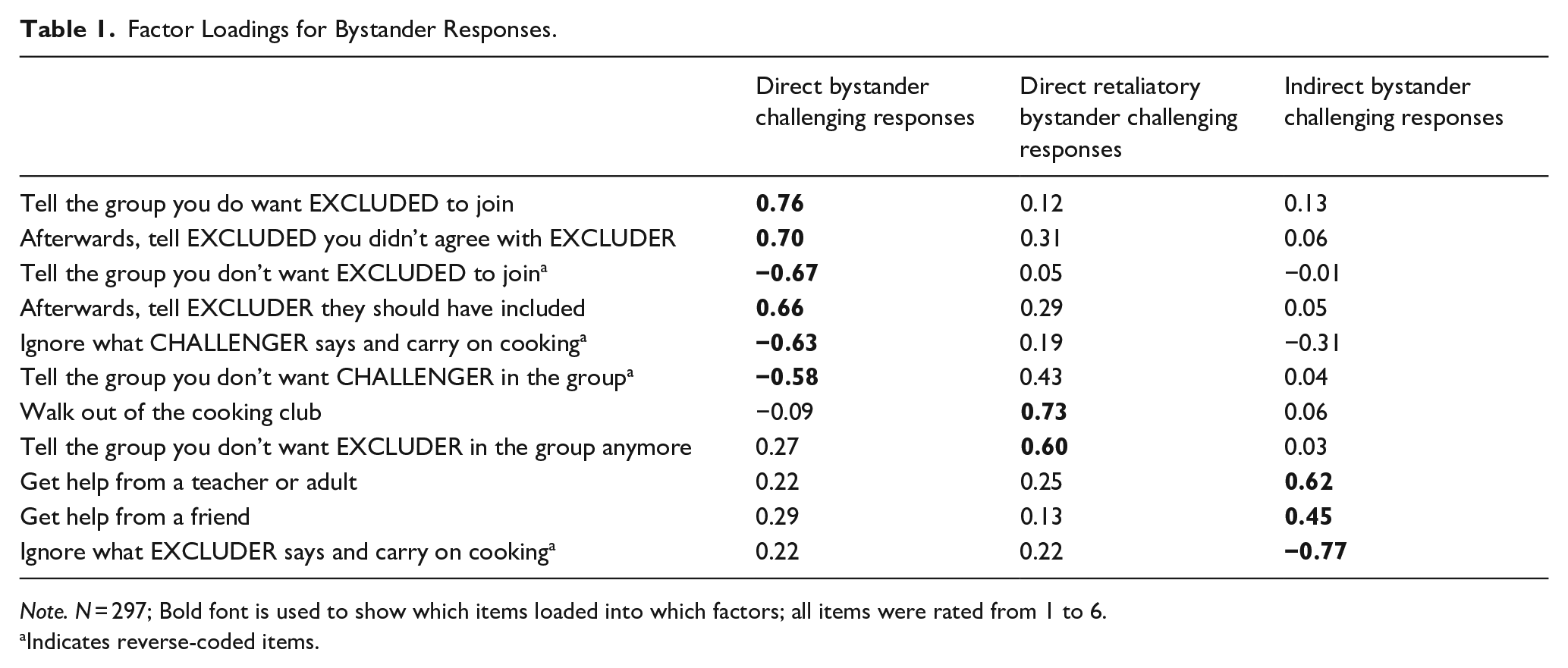
Note. N = 297; Bold font is used to show which items loaded into which factors; all items were rated from 1 to 6.
Indicates reverse-coded items.
Based on the factor analyses, we created composite scores for each subcategory of bystander responses (Table 1). The first subcategory included direct bystander challenging responses and focused on objecting to the exclusion or the excluder/challenger behavior (6 items). The second subcategory included direct retaliatory bystander challenging responses which involved some form of punishment or negative response aimed toward either the peer group or the excluding peer (2 items). The final subcategory included indirect bystander challenging responses which focused on seeking help from peers and teachers and ignoring the excluder (3 items).
Perceived Similarity
Participants were given a definition of the term “immigrants.” They were told that people who were born in another country and now live in Britain are called “immigrants.” Perceived similarity was measured using five items (adapted from Diesendruck & Menahem, 2015; Smyth et al., 2017) which examined whether participants viewed British people and immigrants as similar or different (e.g., “How much are British people and immigrants similar or different in what they like? See supplementary materials for full scale). Answers were on a 1 (completely the same) to 4 (completely different) scale, Cronbach’s α = .75. We reversed all items to create a composite score by averaging the items. Higher scores indicate higher perceived similarity.
Bystander Self-Efficacy
Participants’ bystander self-efficacy (i.e., feelings of confidence in ones’ ability to defend the victim of exclusion) was measured through five self-report items rated on a 5-point Likert-type type scale (1 = Very difficult for me to 5 = Very easy for me). Items were adapted from Peets et al. (2015) by adding the excluder and excluded peer names. Items were specific to the social exclusion scenario (e.g., Try to get [excluder] to include [excluded] in the group; see supplementary materials for full scale), Cronbach’s α = .74. A composite score was created by averaging the items. Higher scores indicate higher bystander self-efficacy.
Empathy
A nine-item scale measured empathy (Nesdale et al., 2005). Example items include, “Seeing people cry upsets me” (1 = not at all like me to 5 = just like me), Cronbach’s α = .64.
Data Analytic Plan
A series of 2(age group: children vs. adolescents) × 2 (Exclusion condition: Turkish vs. British or Australian) between-participant ANCOVAs were conducted on the three subcategories of bystander response. To test our hypotheses (H1, H2, H3), which expected bystander reactions to be similar for British and Australian excluded peers but different for the Turkish excluded peer, exclusion condition was dummy coded to create the following orthogonal weighted contrast: Turkish excluded peer (−2), British excluded peer (+1), Australian excluded peer (+1). This created two exclusion conditions—similar peer excluded (i.e., averaged across British/Australian peers) and different peer excluded (the Turkish excluded peer). Empathy, bystander self-efficacy, and perceived similarity were included as control variables considering the possible relations with these factors and the bystander responses. Bonferroni adjustments were applied when conducting pairwise comparisons.
Next, we examined the possible mediators of the relation between age and bystander reactions to intergroup exclusion: perceived similarity and bystander self-efficacy (see Table 2 for correlations). To test H4, a moderated parallel mediation analysis was conducted to understand pathways between age and bystander responses using bystander self-efficacy and perceived similarity as mediators and exclusion condition as the moderator.
Correlations Between Study Variables.
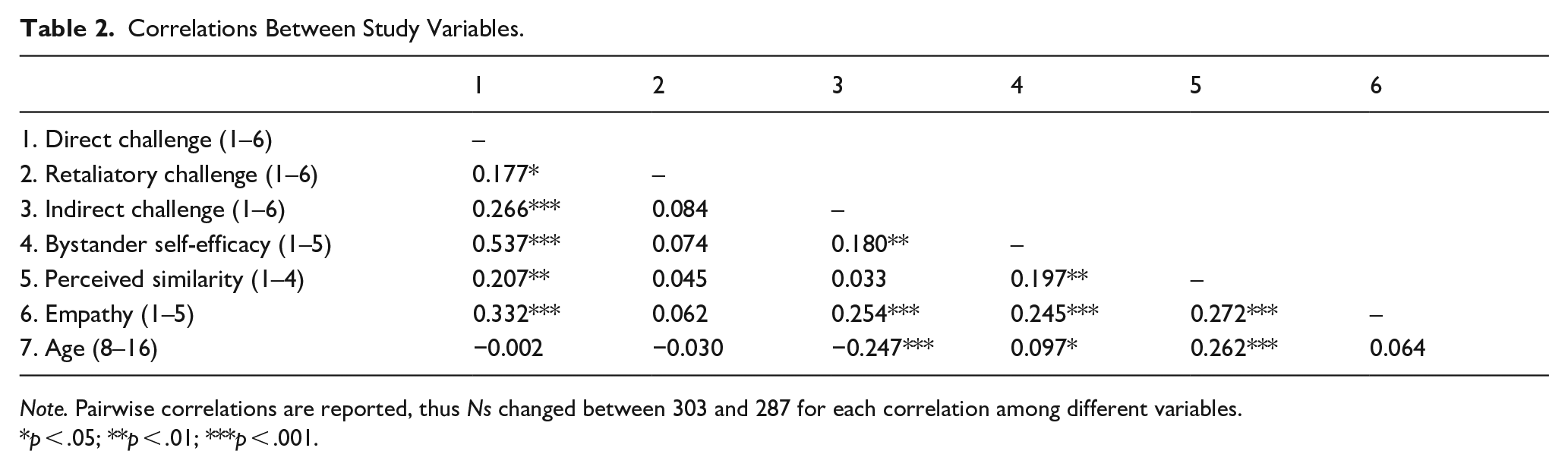
Note. Pairwise correlations are reported, thus Ns changed between 303 and 287 for each correlation among different variables.
p < .05; **p < .01; *** p < .001.
Results
Preliminary Analyses
To confirm there were no differences across British and Australian exclusion conditions we ran three separate 2(age group: children vs adolescents) × 2 (exclusion condition: British vs Australian) between-participant ANCOVAs on participants’ bystander responses (direct, retaliatory, and indirect). As expected, bystander responses did not differ across British and Australian conditions for any bystander responses, justifying collapsing the British and Australian conditions (see supplementary materials for full statistics).
Comparison of Three Bystander Responses
Across the whole sample, direct bystander challenging (M = 5.16, SD = 0.86) was the mostly likely bystander response, followed by indirect bystander challenging (M = 3.34, SD = 0.96). Direct retaliatory bystander challenging (M = 2.03, SD = 1.00) was least likely (all pairwise comparisons were significant, p < .01).
Direct Bystander Challenging
ANCOVA showed a main effect of exclusion condition showing that overall participants were more likely to report direct challenging in the British/Australian condition compared with Turkish condition, F (1, 276) = 7.29, p = .007, ηp2 = .026, controlling for empathy, bystander self-efficacy, and perceived similarity. A main effect of age group showed that children were more likely to report direct challenging compared with adolescents, F (1, 276) = 6.21, p = .013, ηp2 = .022.
As expected, there was a significant two-way interaction between age group and exclusion condition, F (1, 276) = 3.99, p = .047, ηp2 = .014. Pairwise comparisons showed that children were more likely to directly challenge when the British/Australian peer was excluded (M = 5.49, SD = 1.41) compared with a Turkish peer (M = 5.07, SD = 1.96), F (1, 276) = 8.47, p = .004, ηp2 = .030. However, adolescents did not differ in their likelihood of direct challenge responses between Turkish (M = 5.02, SD = 1.43) and British/Australian conditions, M = 5.09, SD = 1.05, F (1, 276) = 0.36, p = .552, ηp2 = .001. In addition, as predicted, children (M = 5.49, SD = 1.41) were more likely to directly challenge British/Australian exclusion compared with adolescents (M = 5.09, SD = 1.05, F [1, 276] = 14.55, p < .001, ηp2 = .050). There was no significant difference between children’s (M = 5.07, SD = 1.96) and adolescents’ (M = 5.02, SD = 1.43) responses when the excluded peer was Turkish, F (1, 276) = 0.12, p = .727, ηp2 = .000 (see Figure 1).
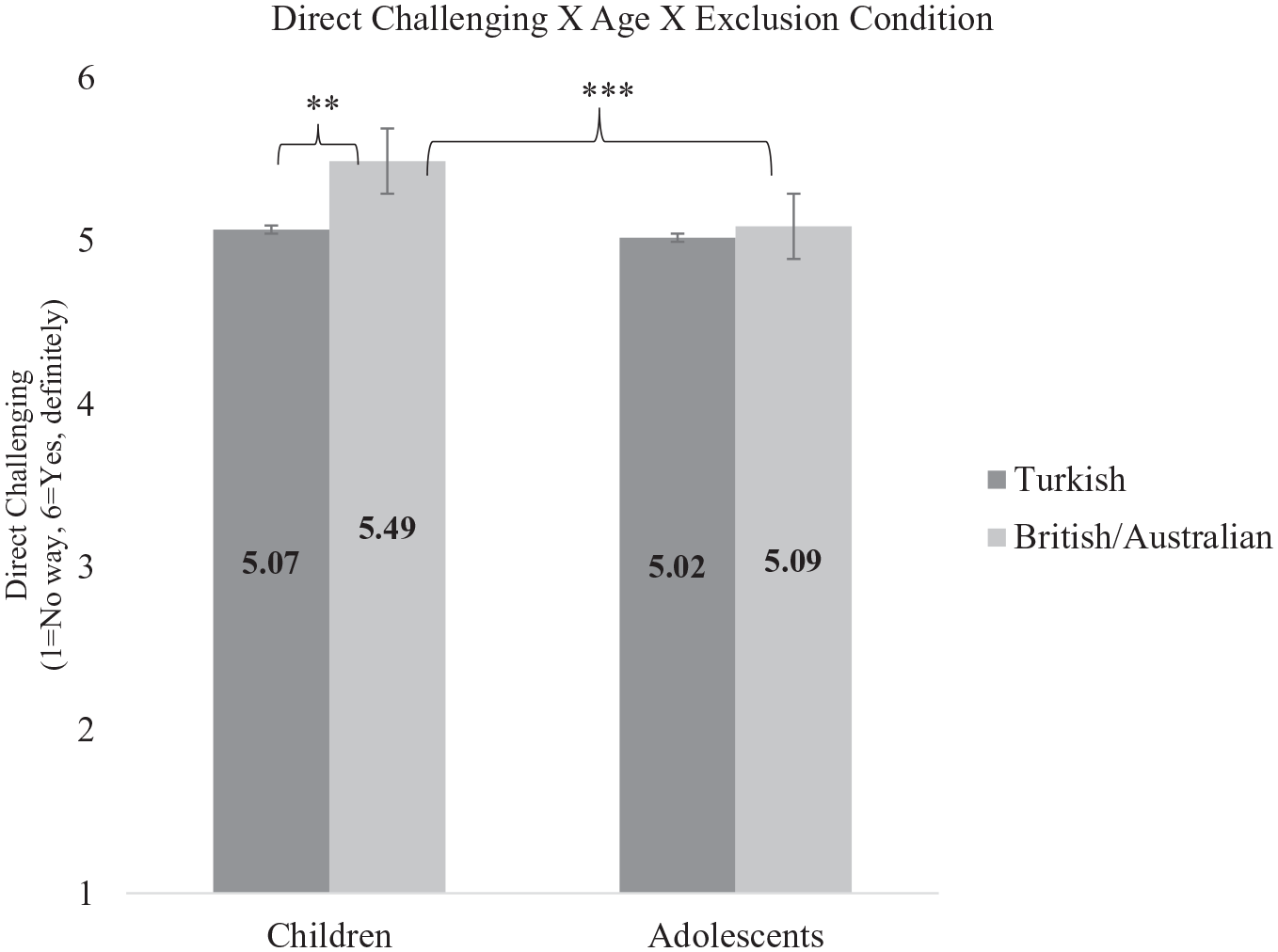
Direct Bystander Challenging by Age Groups and Exclusion Condition.
Direct Retaliatory Bystander Challenging
ANCOVA results showed no main effects for age group, F (1, 282) = 0.16, p = .689, ηp2 = .001, or exclusion condition, F (1, 282) = 0.17, p = .675, ηp2 = .001, controlling for empathy, bystander self-efficacy, and perceived similarity. There was no significant interaction between age group and exclusion condition, F (1, 282) = 2.02, p = .157, ηp2 = .007. Direct retaliatory bystander challenging was relatively low for children in both the Turkish exclusion condition (M = 1.94, SD = 2.65) and British/Australian exclusion condition (M = 2.17, SD = 1.96). Similarly, adolescents also did not differentiate in their direct retaliatory bystander challenging between Turkish exclusion (M = 2.06, SD = 2.03) and British/Australian exclusion (M = 1.94, SD = 1.48).
Indirect Bystander Challenging
A significant main effect of age group showed children were more likely to indirectly challenge compared with adolescents, F (1, 279) = 17.014, p < .001, ηp2 = .058, controlling for empathy, bystander self-efficacy, and perceived similarity. A significant interaction between age group and exclusion condition was observed, F (1, 279) = 3.95, p = .048, ηp2 = .014. Pairwise comparisons showed that children (M = 3.47, SD = 2.63) and adolescents (M = 3.19, SD = 1.99) did not differentiate in their indirect challenge responses when the excluded peer was Turkish, F (1, 279) = 1.91, p = .169, ηp2 = .007. Contrary to our expectations, neither children’s, F (1, 279) = 3.76, p = .054, ηp2 = .013, nor adolescents,’ F (1, 279) = .53, p = .468, ηp2 = .002, indirect challenging responses differed across conditions. However, as expected, when the excluded peer was British/Australian, children (M = 3.84, SD = 1.90) were more likely to report indirectly challenging compared with adolescents (M = 3.09, SD = 1.43), F (1, 279) = 27.31, p < .001, ηp2 = .089 (see Figure 2).
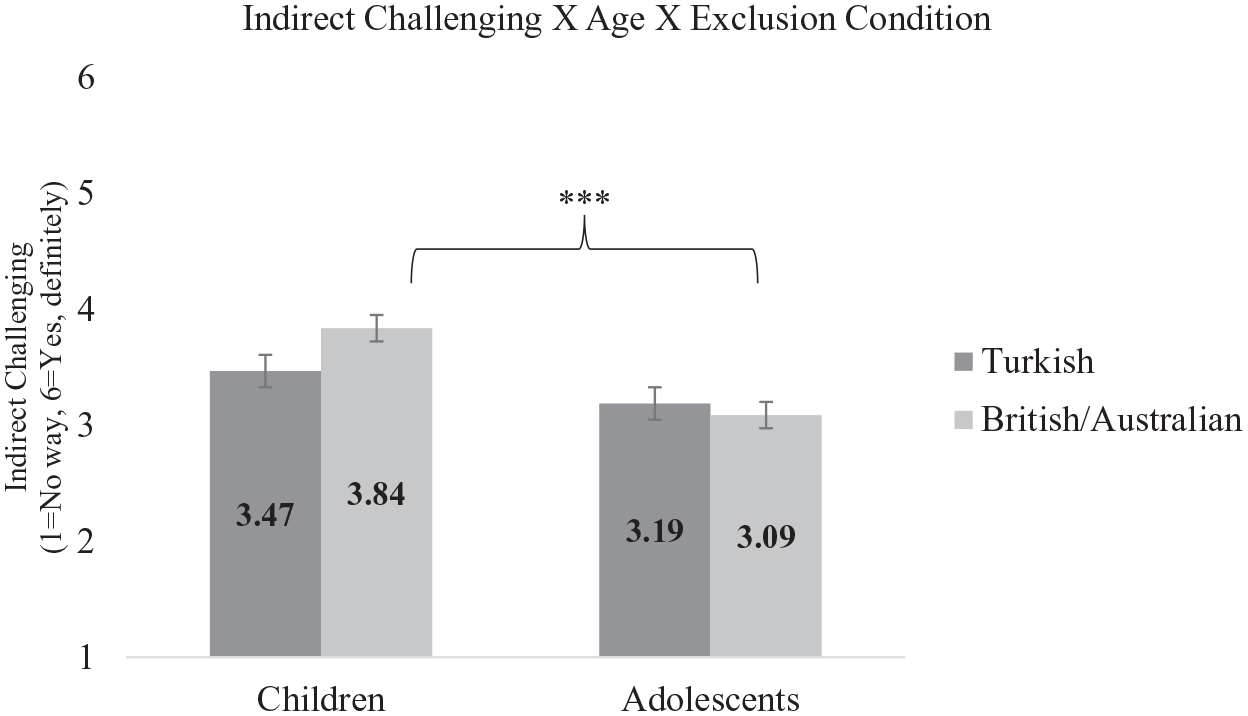
Indirect Bystander Challenging by Age Groups and Exclusion Condition.
Moderated Mediation Analyses With Conditional Process Modeling
Three moderated mediation models (Model 59) were tested using the PROCESS macro (Hayes, 2015) for each bystander response. Specifically, we tested whether the relationship between age and bystander responses was mediated through bystander self-efficacy and perceived similarity. We tested whether exclusion condition (using the orthogonal weight contrast: Turkish [−2], British [+1], Australian [+1]) moderated this relationship.
Direct Bystander Challenging
The overall model for direct bystander challenge was significant; approximately 34% of the variance (R2) was accounted for by predictors, F (7, 277) = 20.66, p < .001 (Figure 3). Age was significantly related to perceived similarity (β = .07, p < .001, 95% CI = .042 to .099) and bystander self-efficacy (β = .05, p = .038, 95% CI = .003 to .099). Perceived similarity (β = .22, p = .004, 95% CI = .074 to .369) and bystander self-efficacy (β = .45, p < .001, 95% CI = .358 to .535) were significant predictors of direct bystander challenging in the overall model.
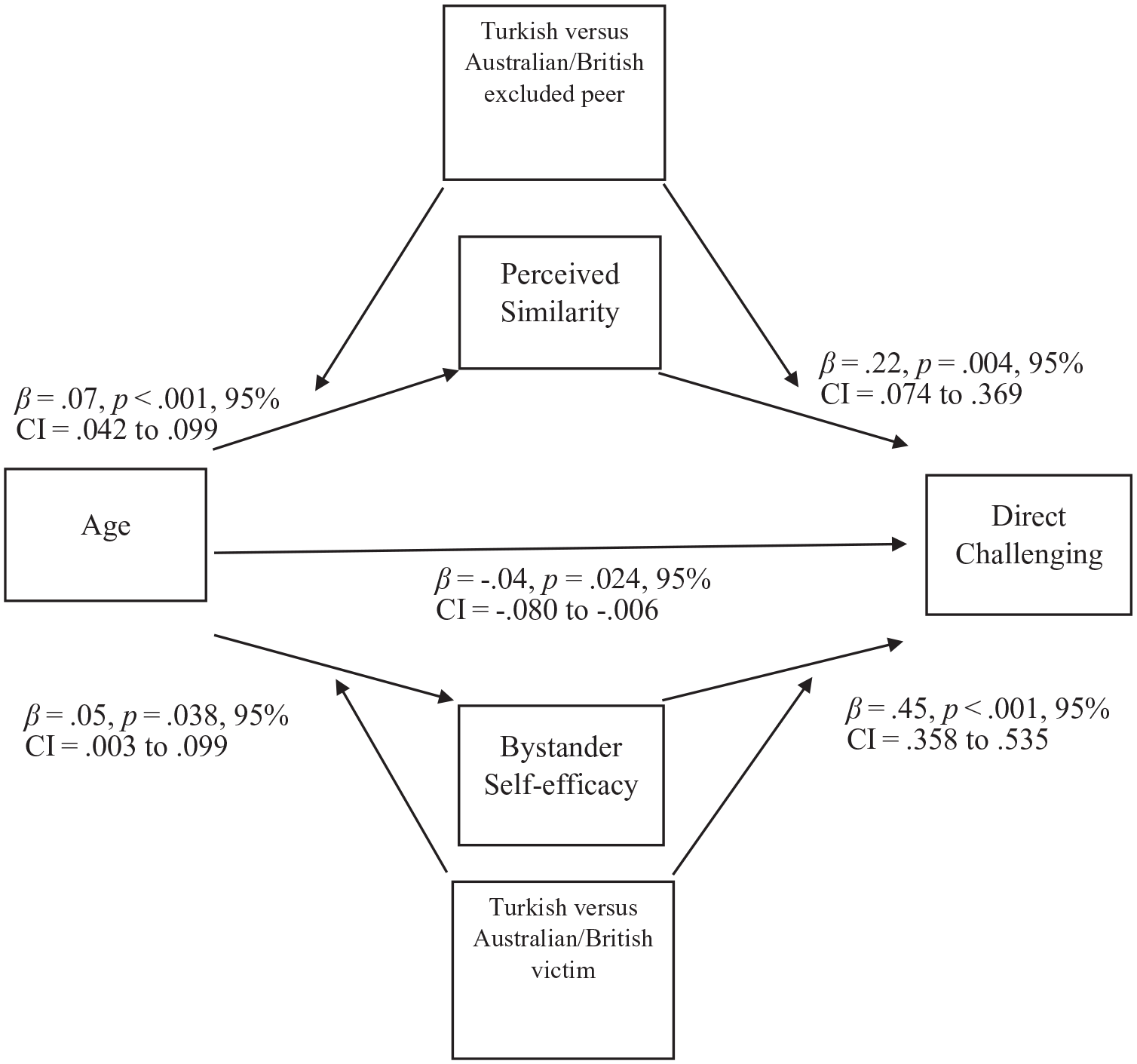
The Moderated Parallel Mediation Model With Age, Bystander Self-Efficacy, Perceived Similarity. The indirect pathways “age→ perceived similarity→explicit challenge” and “age→ bystander self-efficacy→explicit challenge” were only significant for Turkish victim condition (but not in British/Australian conditions); moderated mediation was only significant for the indirect effect of bystander self-efficacy on direct challenging; N = 286.
The direct effect of age on direct bystander challenging was significant when the excluded peer was British/Australian (β = −.07, p = .003, 95% CI = −.114 to −.025) but not when they were Turkish (β = .01, p = .768, 95% CI = −.056 to .076). This shows that only when the excluded peer was from the ingroup or a similar group was there a significant decline in direct bystander challenging with age. As expected, indirect effects of age on direct challenging through bystander self-efficacy (β = .06, 95% CI = .019 to .112) and perceived similarity (β = .02, 95% CI = .002 to .052) were only significant when the excluded peer was Turkish and not when they were British/Australian. This significant indirect effect shows that between late childhood and mid-adolescence participants reported higher bystander self-efficacy and perceived greater similarity between national ingroup and immigrants, and in turn were more likely to directly challenge the exclusion of a Turkish immigrant peer. However, the moderated mediation index was only significant for bystander self-efficacy (β = −.06, 95% CI = −.115 to −.007), not for perceived similarity (β = −.01, 95% CI = −.043 to .017). Thus, exclusion condition is only a significant moderator for the indirect effect of self-efficacy between age and direct challenging.
Direct Retaliatory Bystander Challenging
The overall model was not significant, F (7, 284) = .640, p = .722, accounting for 2% of the explained variance. None of the predictors (age, bystander self-efficacy, perceived similarity) were significant and neither were the indirect effects or moderation effects.
Indirect Bystander Challenging
The overall model was significant; approximately 13% of the variance (R2) was accounted for by the predictors, F (7, 280) = 5.91, p < .001. Age was positively related to perceived similarity (β = .06, p < .001, 95% CI = .036 to .092) but not bystander self-efficacy (β = .04, p = .126, 95% CI = −.011 to .086). Age was negatively related to indirect challenge responses (β = −.13, p < .001, 95% CI = −.178 to −.080). The direct effect of age on indirect bystander challenging was significant when the excluded peer was British/Australian (β = −.14, p < .001, 95% CI = −.199 to −.0811) or Turkish (β = −.11, p = .017, 95% CI = −.194 to −.019). This shows that between late childhood and mid-adolescence participants were less likely to indirectly challenge the exclusion both when the excluded peer was from their ingroup/similar group, or a dissimilar group. Furthermore, bystander self-efficacy was positively associated with indirect challenge responses (β = .20, p = .001, 95% CI = .081 to .315) while perceived similarity was not a significant predictor of indirect bystander challenging (β = .15, p = .135, 95% CI = −.048 to .351). Although the indirect effect of bystander effect was only significant (β = .02, 95% CI = .001 to .056) in the Turkish condition, the moderated mediation index was not significant (β = −.01, 95% CI = −.056 to .006). Neither indirect effect of perceived similarity nor moderated mediation index was significant.
Discussion
The findings of the present study showed direct challenging from bystanders depended on the nationality of the excluded peer, specifically, whether the excluded peer was perceived as similar (i.e., British or Australian) or different (i.e., Turkish) to the national ingroup (H1 partially supported). Results also documented, for the first time, age-related differences from late childhood to mid-adolescence in how individuals directly and indirectly respond as bystanders to the social exclusion of immigrant peers (H3 partially supported). In line with H3a, only children demonstrated more direct bystander challenging when a British or Australian peer was excluded, compared with a Turkish peer. In addition, as predicted by hypothesis H3b, children showed more direct and indirect bystander challenging responses than adolescents when the excluded peer was British or Australian. H4 was also partially supported since, when the excluded peer was from a nation (i.e., Turkish) typically perceived as different from Britain, there was an indirect effect of age on direct challenging shown via higher bystander self-efficacy.
Overall, both children and adolescents favored challenging social exclusion. As expected by the SRD model (Killen & Rutland, 2011), children were more likely to directly challenge when the excluded peer was from the ingroup or a group perceived as similar. Adolescents did not demonstrate this bias in their direct bystander challenging; they showed similar bystander responses irrespective of the excluded peer’s nationality. These age-differences in bystander reactions to intergroup exclusion suggest that adolescents attend more readily than children to intergroup relations and recognize possible similarities between British and Turkish groups. One explanation for this finding could be related to advanced social perspective taking ability or theory of mind (Gönültaş & Mulvey, 2021a). Although to our knowledge no study has tested the role of social perspective taking and theory of mind in bystander responses to social exclusion, theory of mind is positively related to active bystander responses to bias-based bullying of immigrants in the USA (Gönültaş & Mulvey, 2021a). Our finding, therefore, supports the SRD model which expects that greater understanding of intergroup relations (i.e., in terms of similarity and difference between groups) facilitates inclusive social and moral evaluations (see Elenbaas et al., 2020), and in the case of this study, more bystander challenging of exclusion.
Our moderated mediation analysis supports this explanation for the age-differences observed. The findings uniquely highlight some of the psychological processes underlying developmental differences between late childhood and mid-adolescence in bystander challenging within intergroup contexts. Only when a British or Australian peer was excluded, was there a direct relationship between age and direct or indirect bystander challenging, with challenging declining with age. In the case of direct bystander reactions, another relationship between age and challenging was apparent. When the excluded peer was Turkish, there was an indirect effect of age on direct challenging. This indirect effect showed that with age participants reported higher bystander self-efficacy about challenging the exclusion. In turn, increases in bystander self-efficacy were related to more direct bystander challenging. These findings indicate that developmental differences in direct bystander challenging are dependent on the intergroup context, especially the nationality of the excluded peer.
One possibility is that adolescents become more sensitive to the social information around intergroup relations and use this to inform their social and moral decision-making about how to respond as bystanders. Perceived similarity also mediated the relationship between age and direct challenging in the Turkish condition, however, the difference between conditional indirect effects (Turkish and British/Australian) was not significant.
Age-differences in bystander responding were not evident for the direct retaliatory bystander challenging sub-category, for example, by explicitly retaliating against either the excluder by trying to exclude them from the peer group or retaliating against the whole group by rejecting the group and leaving it in protest. Retaliation is not an uncommon response to social exclusion and bullying (McDonald & Lochman, 2012). Yet, a recent study revealed that non-immigrant origin compared with immigrant-origin adolescents judged retaliation by an outgroup victim against an ingroup bully as less acceptable (Gönültaş & Mulvey, 2021a). The participants in the present study were non-immigrants, who may not have experienced stigmatization due to their nationality. Thus, it is not surprising that they reported relatively low levels of direct retaliatory responding in this context. The higher degree of moral unacceptability and consequences for group dynamics surrounding this form of bystander responding may explain why no age differences were found. Bystander retaliation in this study was about rejecting the excluder from the peer group or leaving the peer group completely. These forms of retaliation involve changing the peer group composition as well as deserting the peer group and losing out on all the benefits membership can bring to the individual. Thus, the costs for the group and the individual within the group are potentially high, and both children and adolescents likely realize this, suggesting that direct retaliatory bystander responses may be rare in this context.
Future research on this topic could assess participants’ own experience with stigmatization and discrimination to determine whether this influences direct retaliatory responses. Indeed, individuals are members of more than one group; recent research has focused on how children and adolescents conceptualize identification with multiple groups (Burkholder et al., 2021). Thus, even though participants in the present study identified as British they could identify with other groups that have experienced social exclusion and discrimination, for example, based on gender, ethnicity, sexual identity or religion.
The ability of children and adolescents to perceive that exclusion involving a peer from a stigmatized group could be based on discrimination may help explain our findings. Possibly adolescents, with their more advanced knowledge of intergroup relations, especially the status of the excluded peer’s group, were more likely than children to perceive exclusion of a Turkish peer as discriminatory compared with British/Australian exclusion. Consequently, they directly and indirectly challenged exclusion irrespective of country of origin. Developmental research shows that when social exclusion involves an ethnic-majority status group peer excluding an ethnic-minority status peer, it is often viewed as discriminatory, even when ethnicity is not explicitly mentioned in the act of exclusion (Thijs, 2017; Verkuyten et al., 1997). Other research has also shown that intergroup social exclusion of a low-status person by a high-status perpetrator is a more prototypical excluded-excluder relationship and is, therefore, more likely to be perceived as discrimination among adults (O’Brien et al., 2008), adolescents (Yüksel et al., 2021), and preadolescents (Verkuyten et al., 1997). Previous developmental research has also shown a developmental increase in knowledge of discrimination between middle to late childhood and adolescence (Brown et al., 2017).
Future research should examine adolescents’ knowledge and understanding of discrimination since it may explain why, compared with children, they demonstrate more bystander challenging when the excluded peer is from a stigmatized group. Investigating the social and moral reasoning underpinning bystander reactions would shed light on whether reasoning focused on discrimination and prejudice is related to age-differences in bystander reactions to intergroup social exclusion between late childhood and mid-adolescence (Mulvey, 2016; Palmer et al., 2021). In adolescence, individuals may begin to reason that exclusion is often based on discrimination and is therefore unfair. Children reason about fairness in a narrower sense, for example, in terms of always sharing resources equally irrespective of existing inequality and discrimination (McGuire et al., 2019).
Group status may explain why, compared with children, adolescents showed more bystander challenging when the excluded peer is from a stigmatized rather than a non-stigmatized group. Previous developmental research has shown that children and adolescents belonging to social groups varying in status evaluate intergroup social exclusion differently (Cooley et al., 2019; Malti et al., 2012). Developmental research has also shown from late childhood into adolescence individuals increasingly apply their knowledge of group status when making inclusive social and moral decisions (Elenbaas & Killen, 2016; McGuire et al., 2019). For example, McGuire and colleagues (2019) found that adolescents (aged 13–16 years) compared with children (aged 7–11 years) paid greater attention to intergroup status when allocating resources. Future research should also examine how the perceived group status of excluding and excluded peers might be related to bystander intentions.
The present study did not examine whether bystander reactions to the exclusion of immigrants varied according to intergroup contact with immigrants, which is a limitation. Previous research has shown that adolescent bystanders with higher levels of intergroup contact challenge intergroup name-calling and social exclusion of immigrant peers more (Abbott & Cameron, 2014; Palmer et al., 2022). Future research examining the importance of nationality in bystander responses to the exclusion of immigrant peers should also examine intergroup contact with each relevant immigrant group.
In conclusion, the present study uniquely identified psychological processes underlying age-differences between late childhood and mid-adolescence in bystander challenging toward the intergroup exclusion of excluded peers with similar and different nationalities. These findings demonstrate the importance of increasing children’s knowledge about intergroup relations, especially the belief that they can effectively challenge their group, plus perception of similarities when the group excludes somebody who may be judged as “different.”
The findings suggest that interventions to promote bystander challenging around the exclusion of immigrants, while recognizing differences between immigrants from different countries, should also promote a sense that children can effectively challenge intergroup social exclusion and encourage similarity perceptions between immigrant and non-immigrant peers. Thus, we provide insight to both school practice and policy aimed at reducing the social exclusion of immigrants by improving the knowledge base available when designing educational strategies and interventions. Supporting a belief in the effectiveness of bystander challenging behavior is particularly important when peers from different immigrant groups may be excluded because of discrimination and prejudice. Such educational strategies and interventions should result in significant psychological, social and academic benefits for children and adolescents by reducing their experiences of discrimination-based social exclusion and promoting more harmonious social relationships between immigrants and non-immigrants within schools. Overall, reducing social exclusion and different types of bias-based victimization is essential for creating positive educational environments that promote healthy development for all children.
Supplemental Material
sj-docx-1-jbd-10.1177_01650254221128275 – Supplemental material for Challenging the exclusion of immigrant peers
Supplemental material, sj-docx-1-jbd-10.1177_01650254221128275 for Challenging the exclusion of immigrant peers by Sally B. Palmer, Seçil Gönültaş, Ayşe Şule Yüksel, Eirini K. Argyri, Luke McGuire, Melanie Killen and Adam Rutland in International Journal of Behavioral Development
Footnotes
Acknowledgements
The authors are grateful to the schools, parents, and children who generously gave up their time to take part in this study. They thank the advisory board for their guidance and feedback during the development of this study.
Author Note
This study was not preregistered. Please contact the first author for access to data and study materials.
Funding
The author(s) disclosed receipt of the following financial support for the research, authorship, and/or publication of this article: This research was funded through a grant from the Economic and Social Research Council (ES/R005540/1). M.K. was supported in part by a grant from the National Science Foundation (1728918), and the National Institute of Health (HDR01093698).

Supplemental Material
Supplemental material for this article is available online.
References
Supplementary Material
Please find the following supplemental material available below.
For Open Access articles published under a Creative Commons License, all supplemental material carries the same license as the article it is associated with.
For non-Open Access articles published, all supplemental material carries a non-exclusive license, and permission requests for re-use of supplemental material or any part of supplemental material shall be sent directly to the copyright owner as specified in the copyright notice associated with the article.
