




Abstract
Research investigating occupational aspirations in childhood is scarce. In addition, most research on occupational aspirations has focused on increasing the number of women in agentic jobs. In the present work, we investigate factors associated with communal occupational aspirations in two studies with young children (Study 1: 159 children [84 boys, 75 girls], Mage = 5.51 years, SD = 0.37; Study 2: 96 children [48 boys, 48 girls]; Mage = 9.44 years, SD = 1.91). We found gender differences in communal aspirations only among the older children. In both samples, as well as when combining the two samples, the stronger the communal occupational gender stereotypes children reported, the less boys (and the more girls) aspired toward communal occupations. In the combined sample, communal self-perceptions mediated the relationship between child gender and occupational aspirations. Finally, the perceived status of the occupations was positively associated with communal aspirations among older children.
Keywords
Gender inequality in the workplace begins in childhood, as researchers agree that the development of occupational aspirations (i.e., a set of preferences regarding future occupational roles and activities, see Lent et al., 1994) is a lifelong process from infancy through childhood, adolescence, and adulthood (e.g., Gottfredson, 1981; Hartung et al., 2005). Despite this, existing research on the predictors of occupational aspirations has often focused on adolescents and young adults rather than children (see Hartung et al., 2005). This is problematic as many psychological factors that lead individuals to rule out certain roles or fields as unsuitable (e.g., occupational gender stereotypes) develop in early childhood (Gottfredson, 1981). Because this exclusion of certain fields may influence occupational choices later in life and therefore contribute to occupational segregation and gender inequality in society, it is important to understand the predictors of occupational aspirations in early and middle childhood.
In addition, previous work on occupational aspirations has mostly focused on predictors of high-status agentic occupational aspirations (e.g., leadership roles) with the goal of increasing the number of women in male-dominated fields (Croft et al., 2015). This has been partly successful. For example, research from the United States shows an increase in women entering agentic fields between 1995 and 2013 (Bureau of Labor Statistics as cited in Croft et al., 2015). Interestingly, however, hardly any change has been observed in the number of men entering communal occupations (i.e., occupations associated with communal behaviors and traits such as being warm and caring, e.g., nurse, childcare center teacher; Bureau of Labor Statistics as cited in Croft et al., 2015). Increasing the number of men in communal roles, including communal occupations and domestic work, is important because research shows that being communally oriented has personal benefits, as men who engage in communal behavior have been found to be happier and have better relationships with their partners and children (e.g., Bauer & McAdams, 2010; Le et al., 2012). There are also societal benefits to men who engage in communal work, as having male nurses in a health care unit has been found to provide different perspectives and inclusive groups which can lead to better treatment for patients (Mao et al., 2020). In addition, men’s participation in the home is essential for women to be able to pursue agentic, high-status occupations (Croft et al., 2019). Thus, to address occupational segregation based on gender it is important to understand not only factors that predict agentic occupational aspirations, but also communal occupational aspirations. Therefore, based on key theories of gender role development, the present research investigates factors that are associated with young children’s communal occupational aspirations.
The Development of Occupational Aspirations in Childhood
In 1981, Gottfredson introduced a developmental theory of occupational aspirations, which states that children’s self-concept (i.e., their description and evaluation of themselves, contributing to their sense of identity, VandenBos, 2015) and occupational gender stereotypes (i.e., preconceived attitudes about a particular occupation and about people who are employed in that occupation, Lipton et al., 1991) are the main factors that influence their occupational aspirations throughout childhood. These factors are more or less impactful at different stages of development. When children reach adolescence or early adulthood and need to choose which occupation to pursue, they base their choice on the fit between their self-concept—including views about themselves, their gender, and so on—and their stereotypical view of the occupation (Gottfredson, 1981). This means that occupations that are viewed as appropriate for the person’s gender as well as a good fit for the person’s values and goals are considered. Importantly, Gottfredson also states that children exclude occupations throughout childhood that they view to be a poor match based on their self-concept and their gender stereotypes. These occupations will then rarely be revisited as an option in adolescence and early adulthood. In line with this reasoning, longitudinal research shows that vocational interest (i.e., individual preferences for certain types of work; Harmon et al., 1994) remain reasonably stable from age 12 years to age 40 years. 1 Whereas in adolescents (12−17 years), the stability was already moderately high, it increased even further in early adulthood (22−29 years). This indicates that individuals’ interest in occupations remain relatively unchanged from late childhood into adulthood, such that the decisions children make in early to middle childhood tend to influence their occupational choices later in life (Low et al., 2005).
In addition to Gottfredson’s (1981) work, other theoretical approaches could provide explanations for gender differences in occupational aspirations starting at a young age (e.g., Eagly & Karau, 2002; Martin et al., 2002). Gender schema theory, for instance, states that children are motivated to behave in accordance with their gender schemas (i.e., cognitive network of information about gender), as they seek cognitive consistency between their beliefs about gender and their own gender-related behavior (Martin et al., 2002). Accordingly, if a boy perceives that only women are nurses, he will not aspire to be a nurse. Furthermore, another prominent theory, role congruity theory, proposes that individuals who act in accordance with the norms associated with their social group will be evaluated positively, and those who do not will face negative evaluations (Eagly & Karau, 2002). This means that a girl who aspires toward a communal occupation (such as nursing) may receive positive feedback, whereas a boy who aspires toward a communal occupation may be evaluated negatively. Both gender schema theory and role congruity theory thus predict that individuals will be motivated to behave in accordance with gender norms, in line with Gottfredson’s (1981) theorizing. These theories have guided empirical research on the predictors of children’s occupational aspirations (e.g., Block et al., 2018; Helwig, 2001; Weisgram et al., 2010). However, little research has investigated whether these aspirations develop in line with the developmental stages proposed in the theory by Gottfredson (1981) or whether they develop earlier in childhood, as most research on occupational aspirations has been conducted on adolescents and young adults. Therefore, the focus of our research is on investigating how children’s gender stereotypes and (gendered) self-concept influence communal occupational aspirations in early to middle childhood. In addition, we will investigate whether perceptions of status are associated with children’s communal occupational aspirations as proposed by Gottfredson (1981).
The Impact of Gender and Gender Stereotypes on Children’s Occupational Aspirations
According to Gottfredson (1981), children begin to base their occupational preferences on the occupations they view as suitable for their gender at around 6−8 years old. Gottfredson (1981) also states that occupational aspirations can be gender-typed from an earlier age, but at this earlier point in children’s development this gender typing is caused by children modeling adult role models rather than acting in line with their own gender stereotypes. Gender stereotypes also play a crucial role in gender schema theory (Martin et al., 2002); however, this theory proposes that children’s understanding of their own and others’ gender is developed at an earlier age, as children begin to develop gender schemas as soon as they are able to observe differences between genders. According to this view, the content of children’s gender schemas (e.g., whether they are stereotypical or not) will determine whether children’s occupational aspirations are gender-typed or not.
Evidence for gender-typed preferences and behavior in early childhood has been found in many empirical studies. For example, children have been shown to prefer gender-congruent toys by age 2 years (Serbin et al., 2001), like novel gender-neutral attractive toys less when they are labeled as being toys for the other gender at ages 4−6 years (Martin et al., 1995), and prefer gender-typed toys at ages 4−7 years (Spinner et al., 2018). A longitudinal study also found that children’s gender-typed play behavior increased as their gender labeling skills developed (Fagot & Leinbach, 1989).
Concerning occupational aspirations, some research shows that by age 4 years, boys are more likely to aspire to agentic occupations, whereas girls are more likely to aspire to communal occupations (Levy et al., 2000; Trice & Rush, 1995; Weisgram et al., 2010), which indicates that, in line with Gottfredson (1981), gender differences in occupational aspirations can be observed in early childhood. In addition, a study conducted in Canada (Serbin et al., 1993) found that, among children between 5 and 12 years old, boys preferred masculine activities and occupations (e.g., sawing, police officer, fire fighter) more than girls, and that girls preferred feminine activities and occupations (e.g., sewing, feeding baby, teacher) more than boys. A recent study conducted in Switzerland (Pässler & Hell, 2020) also found gender differences in vocational interests among children in middle childhood (ages 10−11 years). Taken together, research indicates that children’s gender stereotypes may begin to impact their behavior and their occupational aspirations in early to middle childhood. However, because of the limited number of empirical studies investigating the effect of gender stereotypes on children’s communal occupational aspirations, more research on this is needed (for the same argument, see McMahon & Watson, 2008).
The Impact of the Self-Concept on Children’s Occupational Aspirations
Importantly, when considering the role of gender stereotypes on occupational aspirations, children’s self-concept in line with such stereotypes should be taken into account. According to Gottfredson (1981), children’s self-concept begins to influence their occupational aspirations from about 14 years of age. Children’s self-concept consists of internal factors, such as values, goals, and self-perceptions, as well as external factors such as socioeconomic status (SES). The internal factors of children’s self-concept are developed partially based on children’s exposure to gender norms, so that children’s interests and goals are in line with expectations for their gender. There has been mixed evidence for Gottfredson’s claim that the internal aspects of the self-concept only begin to influence children’s occupational aspirations in adolescence. In line with Gottfredson’s claim and role congruity theory (Eagly & Karau, 2002), research has found that, among adults, more communal values and goals predict higher communal occupational aspirations (Diekman et al., 2010; Weisgram et al., 2010). However, recent evidence suggests that values and goals already matter for young children’s aspirations: boys report less communal values and goals than girls, and girls report less agentic values and goals than boys (Block et al., 2018; Ojanen et al., 2005). It was further found that both agentic and communal values mediate the relationship between gender and family orientation, where those with higher agentic values report a lower family orientation and those with higher communal values report higher family orientation (Block et al., 2018). Taken together, gender differences in the internal aspect of children’s self-concept are visible in early to middle childhood and the self-concept seems to influence occupational aspirations earlier than previously thought. One important aspect of children’s self-concept is their self-perceptions, which include how much children view themselves as preferring communal behaviors (e.g., helping, being with others) or agentic behaviors (e.g., being assertive, competitive). We therefore aim to extend earlier research by investigating whether communal self-perceptions mediate the relationship between gender and occupational aspirations in young children.
The Impact of Perceived Occupational Status on Children’s Occupational Aspirations
In addition to the influence of gender stereotypes and gendered self-concepts, Gottfredson (1981) proposes that by the age of 9−13 years the child’s social class, the perceived status of the occupation, and the child’s perception of their ability to pursue the occupation emerge as important factors in shaping their occupational aspirations. However, research shows that the perceived status of occupations might also influence children’s occupational aspirations at an earlier age, as young children (ages 5−10 years) who endorsed agentic occupational values (i.e., valuing jobs involving making important decisions and earning more money) were shown to aspire more toward agentic male-dominated occupations and less toward communal female-dominated occupations (Weisgram et al., 2010). Similarly, 11-year-old children believed that novel jobs portrayed with male workers had a higher status than the same jobs portrayed with female workers, as the children thought the jobs portrayed with male workers were higher paid, more difficult, and more important (Liben et al., 2001). This illustrates that children in this age group have some understanding of status and power differences and that some children value high status when imagining their future occupations.
One important aspect of an occupation’s status is the salary that a person working in these occupations receives. Indeed, children between 3 and 7 years old believed that men generally earn more money than women, especially in agentic, high-status occupations (Levy et al., 2000). Although Weisgram et al. (2010) did not find an effect of salary on the occupational aspirations of children or adolescents, Hardie (2015) found that the lower perceived median income in communal occupations predicted adolescent boys’ lower communal occupational aspirations. Also examining this question of the role of salary, two experimental studies presented children between the ages of 6 and 11 years with novel occupations that were described as high in one of four values, where money was one of the values (Hayes et al., 2018). In the first experiment, boys showed greater interest than girls in occupations that were described as having a high salary, but the findings were not replicated in the second experiment. Taken together, earlier research on this topic is inconclusive, with some studies showing that young children consider power and status in their occupational aspirations (Liben et al., 2001; Weisgram et al., 2010), but others not corroborating an effect of perceived salary (Weisgram et al., 2010). Therefore, we extend existing research and explore the role perceived salary plays in the occupational aspirations of children.
The Present Research
The present research was conducted in Norway. Although Norway is one of the most gender egalitarian countries in the world (World Economic Forum, 2020), there is still a significant gender gap in the Norwegian workforce, where women make up only 20% of engineers and 34% of leaders (Utdanning, 2014). In addition, men make up only 16% of nurses and 10% of childcare center teachers in Norway (Statistisk Sentralbyrå [SSB], 2021a, 2021b). Thus, further research on the factors that influence communal occupational aspirations in children is needed.
In the present work, we investigate factors that shape children’s communal occupational aspirations in early to middle childhood by conducting two studies: one among preschool children in childcare centers, and one among elementary school children. We not only investigate the role of children’s gender and gender stereotypes, but we extend earlier research by also testing whether the perceived status of the occupation and the children’s communal self-perceptions relate to their occupational aspirations. We operationalize perceived status of an occupation as the salary the children believe a person working in this occupation receives.
We formulated the following hypotheses. First, girls will aspire more toward communal occupations than boys (H1). In addition, children’s endorsement of gender stereotypes related to communal occupations will interact with their gender (H2), that is, girls will aspire more toward communal roles the more strongly they endorse gender stereotypes whereas boys will aspire less toward communal roles the more they endorse gender stereotypes. Communal self-perceptions (H3) and perceived salary for communal occupations (H4) will be positively related to communal occupational aspirations. Finally, the relationship between children’s gender and their communal occupational aspirations will be mediated by their communal self-perceptions (H5). H1, H2, H3, and H5 were pre-registered on the Open Science Framework (OSF) (Study 1: https://osf.io/cq3zf/?view_only=5cc42135af034628a932665247f59f2a; Study 2: https://osf.io/g2j8a/?view_only=1cb13e9d03b743dead99d2ad9e5868fc) and tested in both studies. H4 was a non-preregistered exploratory hypothesis and only tested in Study 2 (see Supplemental Materials for additional preregistered analyses). To increase readability, we present the hypotheses of Study 1 and Study 2 in a slightly different order from the preregistrations. In the following, we will first present the data of the two studies analyzed separately and then report combined analyses to increase statistical power and test the robustness of the observed effects.
Study 1: Childcare Centers
The first study was conducted in childcare centers in Northern Norway in 2018 and investigated how gender, communal occupational gender stereotypes (CGST), and communal self-perceptions influence the communal occupational aspirations of children in early childhood. This study was conducted among preschool children in childcare centers because of the limited research on occupational aspirations in this age group. As the majority of children in Norway (93.4% in 2021) attend childcare centers, this represents the typical experience for Norwegian children.
Method
Transparency and Openness
The project was registered at the Norwegian Center for Research Data (https://www.nsd.no/en) which approved the planned data collection (ref. nr. 5209). In addition, we received approval from the internal board for research ethics at the first author’s institution (date of approval: 30.07.2017). All data and syntax of analyses are available at OSF (https://osf.io/5cr3u/?view_only=1f03932d91a0436dbdeb0c7144247d7d). All four hypotheses that we preregistered were formulated directionally. Therefore, when testing these hypotheses, we set the criterion for significance to a value of p = .10.
Pilot Studies
To ensure the reliability, validity, and understandability of the material, four pilot studies were conducted: two with adults and two with children. In the first two studies, we aimed to determine which occupational roles and behaviors Norwegians most strongly associate with agency and communality, respectively. We asked Norwegian adults (N = 28) to report descriptive gender stereotypes for a range of occupations/roles (e.g., “What percentage of preschool teachers in Norway are male?”). The participants reported their answers on a 100-point Likert-type scale that ranged from 0% to 100%. We also asked participants to report descriptive gender stereotypes for behaviors (e.g., “I associate comforting others with . . .”). Participants reported their answers on a 7-point Likert-type scale that ranged from Only women (scored as 1) to Only men (scored as 7). The behaviors and roles that were stereotyped as either female (i.e., mean score < 50% and < 4) or male (i.e., mean score > 50% and > 4) were then included in a second pilot study. In the second pilot, we aimed to double check the appropriateness of the chosen occupational roles and behaviors. For this, we presented Norwegian adults (N = 37) with definitions of communion and agency and then asked them to rate the extent to which they associated the stereotypically female and male roles and behaviors with communion and agency, respectively. Participants reported their answers on a 7-point Likert-type scale (1 = not at all to 7 = very much).
A third and fourth pilot study were conducted with preschool children. The aim of the third pilot study was to assess children’s ability to understand and engage with the study materials. From the items the children (N = 8, ages 4−6 years) understood, we selected for the main study the behaviors and roles from the earlier pilot studies that were most associated with women and communion or men and agency. In a fourth pilot study, the experimenters assessed the study length and observed children’s (N = 8, ages 4−6 years) ability to concentrate, as well as their ability to understand and use a 3-point smiley face Likert-type scale (see Supplementary Materials). This pilot study showed that 4- to 6-year-old children were able to maintain concentration for the duration of the study (i.e., approximately 15−20 min) and understood the use of the 3-point smiley face Likert-type scale.
Participants and Procedure
Participants were recruited by contacting the administrators of childcare centers in the local region, asking for permission to conduct our study in their childcare center. Approximately 40% of the contacted childcare centers agreed to participate in the study. When permission was granted, we distributed consent forms to the parents in the childcare centers. The consent forms signed by the parents were collected before the data collection. In total, we collected data from 177 children from 20 different childcare centers in northern Norway in 2018. Eleven participants were excluded from the analyses due to revoking consent during testing (n = 7), technical issues (n = 3), or not following instructions (n = 1). We also excluded all children younger than 4.5 years old (n = 7). Children who did not want to participate or revoked consent during testing were taken back to the rest of their group in the childcare center by one of the adults present during testing. Our final sample consisted of 159 participants (84 boys, 75 girls) between the ages of 54 and 75 months (M = 5.51 years, SD = 0.37, missing age for two boys), which corresponds to an age range of 4−6 years. Most of the parents of the children (58.6%) reported having an income of between NOK (Norwegian Kroner) 460,000−1,200,000 and most (78.4%) reported having a higher education. 2 The median income in Norway in 2021 was NOK 550,000 (SSB, 2021c), and 36% of the population above the age of 16 years had a higher education in 2021 (SSB, 2021d). This means that in terms of income and education, the present sample had relatively similar (if not slightly higher) SES than the average Norwegian family. No a-priori effect size could be determined, but a sensitivity analysis for a linear regression with four predictors (CGST, self-perceptions, interaction between CGST and gender) conducted for a sample of 159 indicated that a medium effect of f2 = .10 can be detected at a power of .95.
Participants were tested in groups of up to four by two experimenters, one taking the role of the interviewer (i.e., reading the instructions aloud to participants) and one the role of the secretary (i.e., taking notes and assisting participants if needed). For each testing, one female and one male experimenter were present, as well as a teacher from the childcare center. The interviewer asked the questions to the children, and the children answered using 3-point Likert-type scales on a tablet using the software OpenSesame. All questions were asked in Norwegian. The children received a sticker as a reward for participating. A detailed description of the procedure can be found in the Supplemental Materials.
Measures
All of the materials can be found in the Supplemental Material in both English and Norwegian. All of the measures were developed by the project group for this study. The items were developed in Norwegian and have been translated to English for this article (see Supplemental Material for the original and translated items). Children’s responses were recorded using two different kinds of scales. A 3-point smiley Likert-type scale was used to measure the extent to which children aspired toward a set of communal occupations and their preferences toward communal behaviors. 3
Communal Occupational Aspirations
Children’s communal occupational aspirations were measured by showing the children a picture relating to an occupation while telling them about the occupation, then asking the children how much they aspire toward the occupation. The questions were phrased: “Would you like to be a [communal occupation] when you grow up?” The children answered on a 3-point Likert-type scale (1 = not at all, 2 = some, 3 = very much). Children were asked to report aspirations toward three different communal occupations (i.e., nurse, childcare center teacher, stay-at-home parent; α = .62). Due to relatively low reliability (and an even lower one in Study 2), we decided to remove stay-at-home parent. The remaining items showed a significant correlation, r(158) = .28, p < .001. Analyses including this item can be found in the Supplemental Material.
Communal Self-Perceptions
To measure the extent to which children perceive themselves as communal the experimenter told children that “I will now read short stories about some children I know. It is your job to tell me whether this child sounds like you.” Four items assessed the extent to which participants identified with communal behaviors by asking the children: “I know a child who likes to [communal behavior]. Does this sound like you?” (i.e., help others who are upset, be close to others, hug others, comfort others who are upset). The children answered on a 3-point Likert-type scale (1 = not at all, 2 = some, 3 = very much). The scale was illustrated with three different emoticons, from a sad face for the first point to a very happy face for the third point (see Supplemental Material). The scale showed acceptable reliability (α = .71).
Communal Occupational Gender Stereotypes
The children were then asked to report gender stereotypes for the same three communal roles (i.e., nurse, childcare center teacher, stay-at-home parent). Children were instructed by the experimenter to “tell me who you think can do this job.” For example, “Who do you think can be a nurse?”: Children could answer either “only women”, “only men” or “both women and men”, where the options were presented as three corresponding illustrations of men and women. Following the procedure for computing a variable for gender stereotyping of communal roles by Spinner and colleagues (2018), the responses only boys or both boys and girls were coded as 0, since these answers do not represent traditional gender stereotypes for communal occupations. Responding only girls was coded as 1 as it represents traditional female gender stereotypes. A summed total score was calculated for each participant (range 0−3), with higher numbers indicating more gender stereotyping (the stay-at-home parent item removed). The two remaining items (nurse, childcare center teacher) are significantly correlated, r(158) = .19, p = .019.
Demographic Measures
Among others information about the children’s age (in years), gender (0 = boys and 1 = girls), and bilingualism were also obtained.
Results
Descriptive statistics of all measures and bivariate correlations are presented in Table 1.
Study 1: Descriptive Statistics and Correlations Between Measures for Girls and Boys.
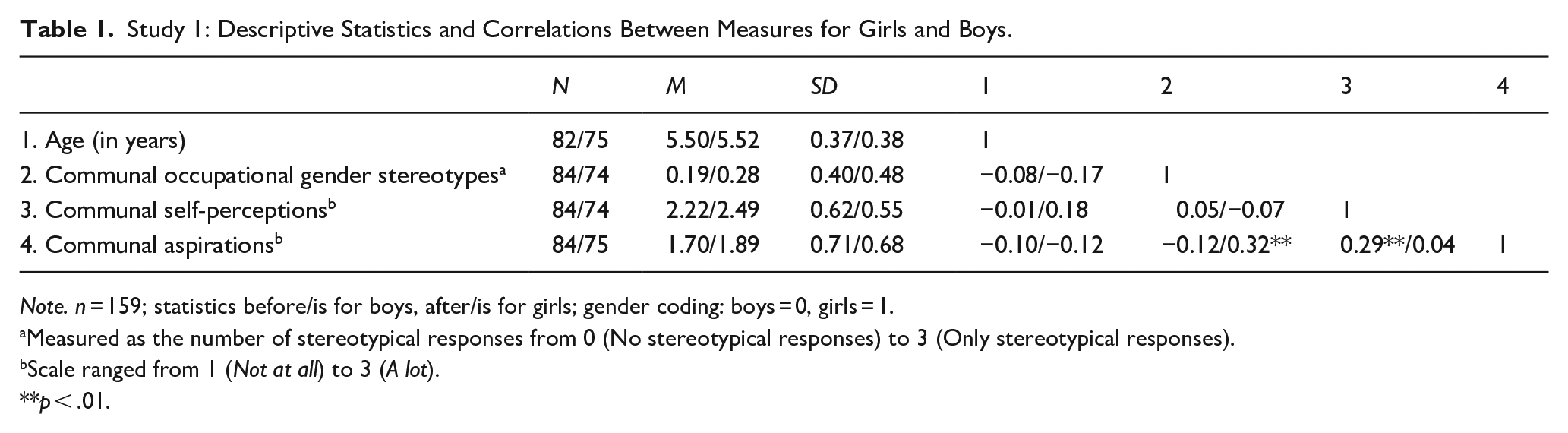
Note. n = 159; statistics before/is for boys, after/is for girls; gender coding: boys = 0, girls = 1.
Measured as the number of stereotypical responses from 0 (No stereotypical responses) to 3 (Only stereotypical responses).
Scale ranged from 1 (Not at all) to 3 (A lot).
p < .01.
Factors Associated with Children’s Communal Occupational Aspirations
To test which factors influence communal occupational aspirations (H1−H3), we conducted a multiple regression analysis with age (covariate), CGST, the interaction between communal occupational gender stereotypes and gender, and communal self-perceptions as independent variables. 4 All interactions of age and gender with the independent variables were also tested but were found to be non-significant and were, therefore, not included in the model presented below, with the exception of the preregistered interaction between communal occupational gender stereotypes and gender. All analyses including all covariates and interactions can be found in the Supplemental Material. 5
The results of the regression analysis can be found in Table 2. The effect of gender on communal aspirations was not significant, which indicates that girls did not aspire more toward communal roles than boys did (contrary to H1). In line with H2, the interaction between communal occupational gender stereotypes and gender on communal occupational aspirations was significant, B = 0.79, t(150) = 3.10, p = .002, 90% confidence interval (CI) = [0.37, 1.21]. Boys showed a decrease in communal occupational aspirations with increased communal occupational gender stereotypes, B = −0.35, t(78) = −1.76, p = .082, 90% CI = [−0.68, −0.02], whereas girls showed a significant increase in communal occupational aspirations with increased communal occupational gender stereotypes, B = 0.44, t(70) = 2.73, p = .008, 90% CI = [0.17, 0.72]. We also found the predicted significant relationship between communal self-perceptions and communal occupational aspirations, B = 0.24, t(150) = 2.56, p = .011, 90% CI = [0.08, 0.39], indicating that the more children see themselves as communal, the more they aspire toward communal occupations, in line with H3.
Regression Analysis With Communal Occupational Aspirations as the Outcome (Study 1; n = 156).
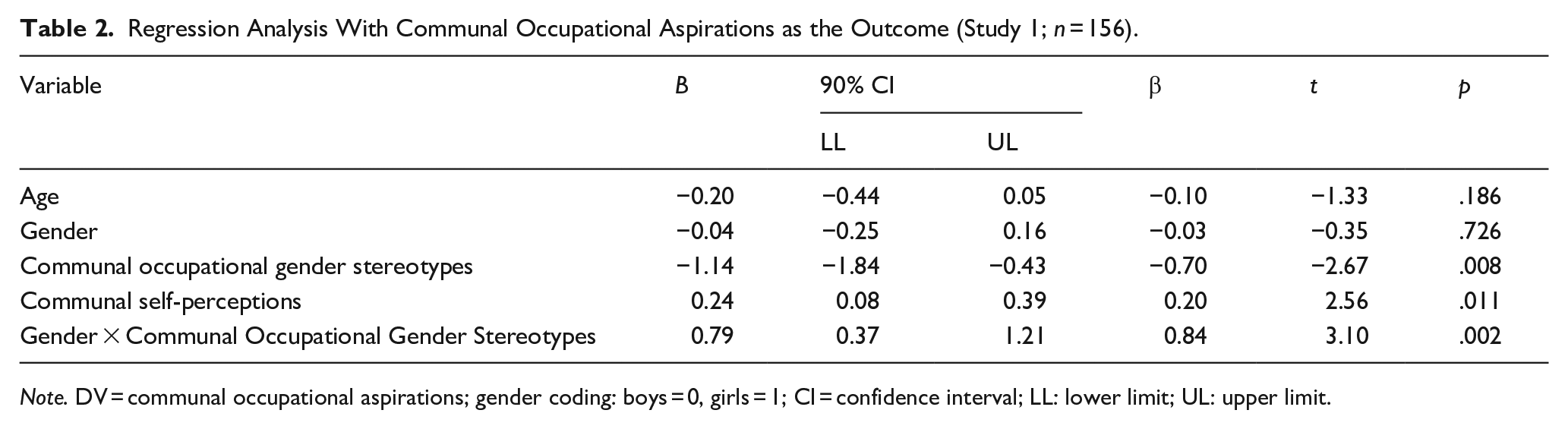
Note. DV = communal occupational aspirations; gender coding: boys = 0, girls = 1; CI = confidence interval; LL: lower limit; UL: upper limit.
Do Communal Self-Perceptions Mediate the Relationship Between Gender and Communal Occupational Aspirations in Children?
To assess the extent to which gender influences aspirations via communal self-perceptions in children (H5), we conducted a mediation analysis using Hayes’ Process macro (2017; Version 3.4.1, Model 4, 10,000 bootstrap samples). Gender was entered as the predictor (X), communal aspirations as the outcome (Y), and communal self-perceptions as the mediator (M). Age was included in the analysis as a covariate. Gender predicted communal self-perceptions, B = 0.27, p = .005, 90% CI = [0.11, 0.44], which, in turn, predicted communal aspirations, B = 0.22, p = .020, 90% CI = [0.07, 0.38]. A bias-corrected bootstrap CI for the indirect effect was above zero, B = 0.06, 90% CI = [0.01, 0.12]. Gender did not predict communal aspirations independent of the mediator (B = 0.15, p = .198, 90% CI = [−0.04, 0.33]). This indicates that girls reported higher levels of communal self-perceptions than boys, which, in turn, was associated with higher communal aspirations. This finding is in line with H5 and suggests that children’s communal aspirations are internally regulated via their communal self-perceptions. Thus, girls may ultimately be more likely to aspire toward communal roles because they are more likely than boys to identify as communal.
Study 2: Elementary Schools
The aim of the second study was to test if we would replicate the findings of Study 1 in a sample with older children (in elementary schools). As researchers agree that occupational aspirations develop throughout childhood (Gottfredson, 1981; Hartung et al., 2005), we investigated if the predictors of occupational aspirations would influence older children differently than younger children. In addition, we extended Study 1 by exploring another predictor of occupational aspirations in middle childhood from Gottfredson’s theory, namely occupational status. We operationalize the perceived status of an occupation as the salary the children believe a person working in this occupation receives.
The second study was conducted in elementary school, in Norway ranging from Class 1 to Class 7, that all children are required to attend. Thus, by conducting the study among elementary school children, we hoped to get a sample that would reasonably represent Norwegian children in this age group.
Method
Transparency and Openness
The project was registered at the Norwegian Center for Research Data, which approved of the planned data collection (ref. nr. 164246). In addition, we received approval from the internal board for research ethics at the first author’s institution (ref. nr. 2017/1912). All data and syntax of analyses are available at https://osf.io/5cr3u/?view_only=1f03932d91a0436dbdeb0c7144247d7d. As outlined earlier, all four preregistered hypotheses were directional. Therefore, when testing these hypotheses, we set the criterion for significance to a value of p = .10.
Participants and Procedure
This study was part of a larger research project mainly focused on investigating parents’ and children’s well-being during the COVID-19 pandemic (Kvalø et al., 2021; Martiny et al., 2021; Thorsteinsen et al., 2021, 2022). The study was conducted in June 2020. The study consisted of two questionnaires: one online questionnaire for parents and one online questionnaire for their children. Only the data from the children’s questionnaire are used in these analyses. Elementary school children were recruited by contacting the principals at elementary schools all over Norway and asking them to forward information about the study and the link to the online survey to the parents of the children at their school. We also recruited using an advertisement on Facebook, asking parents of elementary children to participate in the study. After the parents completed their survey, they were asked to give their consent for their children to participate in the children’s questionnaire. If they provided consent, they received the link to the children’s questionnaire. The children were also asked to give their consent to participate at the beginning of the survey. We collected data from 273 parents and 98 (35.9%) of their children between June 8 and June 29. No reward was offered to the children who participated in the questionnaire, but the parents had the opportunity to participate in a lottery where they could win one out of five gift cards worth NOK 500.
Two children were excluded from analysis as they stated that they did not understand the questions in the questionnaire. Our final sample consisted of 96 elementary school children (48 boys, 48 girls) between the ages of 6 and 13 years (M = 9.44, SD = 1.91, age missing for six children). Most of the parents of the children (54.3%) reported having an income of between NOK 460,000 and 1,200,000, which includes the median income in Norway in 2021 of NOK 550,000 (SSB, 2021c). This means that in terms of income, the present sample had relatively similar (if not slightly higher) SES than the average Norwegian family. We did not ask children or their parents to report which school the child attends, but we did ask parents to report their municipality. There are 358 municipalities in Norway, and our 96 participants are distributed across 40 municipalities. A sensitivity analysis for a linear regression with five predictors (gender, CGST, self-perceptions, status, CGST × gender) given N = 96 indicated that a moderate effect size of f2 = .19 at a power of .95 could be detected.
Measures
The study was conducted using a child-friendly online questionnaire in Norwegian (Bokmål). The questionnaire was pilot tested on a small sample of elementary school children prior to the data collection to assess children’s understanding of the questions and the study length. Parents were instructed to help their children with the questionnaire without influencing their responses. To enable young children and children who had difficulties reading to participate, all instructions, items, and scale ranges were audiotaped. Children could therefore choose whether they wanted to read the instructions and items or whether to listen to them. In addition, most of the scale ranges were illustrated with images (e.g., smileys, thumbs up). The measures were adapted from Study 1, with the exception of perceived salary, which was developed by the project group for this study. The items were developed in Norwegian and have been translated to English for this article (see Supplemental Material for the original and translated items). The items and illustrations can be found in the Supplemental Material in English and Norwegian in the order in which they were assessed. The audio files (in Norwegian) are available on OSF: https://osf.io/4frk2/?view_only=b59c6a912a7b488b8b822228c494d52f.
Communal Occupational Aspirations
Children’s communal occupational aspirations were measured by asking the children how much they aspire toward three communal occupations (based on Study 1; nurse, childcare center teacher, stay-at-home parent). The questions were phrased: “How much do you want to be a [communal occupation]?” Then the children answered on a 5-point Likert-type scale (1 = not at all, 2 = a little, 3 = some, 4 = quite much, 5 = very much). The scale was illustrated with five different emotions, from a sad face for the first point to a very happy face for the fifth point (see Supplemental Material). Because the scale did not have satisfactory reliability (α = .53), the item with the lowest correlations was excluded (stay-at-home parent). The other two occupations correlated strongly, r(95) = .50, p < .001, and therefore were combined to form a scale. 6
Communal Occupational Gender Stereotypes
Children’s gender stereotypes about communal occupations were measured by asking the children who they believed could work in the three communal occupations: “Who do you think can be a [communal occupation]?” (i.e., nurse, childcare center teacher, stay-at-home parent). The children answered on a 5-point Likert-type scale (1 = only men, 2 = mostly men, 3 = both men and women, 4 = mostly women, 5 = only women). The scale was illustrated with a group of people with corresponding proportions of men or women. The occupations included were the same as in the communal occupational aspirations scale (nurse, childcare center teacher, stay-at-home parent). As the scale again did not have satisfactory reliability (α = .52), the item with the lowest correlation with the other variables (stay-at-home-parent) was removed. The two remaining items correlated strongly, r(95) = .54, p < .001.
Perceived Salary
Children’s beliefs about the salary associated with the three communal occupations were also assessed. The children were asked how much money they believe people working in the three communal occupations make: “How much money do you think a [communal occupation] makes?” (i.e., nurse, childcare center teacher, stay-at-home parent). They answered on a 5-point Likert-type scale (1 = very little, 2 = little, 3 = some, 4 = much, 5 = very much). The scale was illustrated with money piles of increasing size. As reliability was again low (α = .53), stay-at-home parent was removed from the scale; the other two items were strongly correlated, r(95) = .52, p < .001
Communal Self-Perceptions
Communal self-perceptions were measured by asking the children how much they liked to engage in three communal behaviors: “Do you like to [communal behavior]?” (i.e., be with other children, comfort other children who are sad, help other children when they are in pain). The children answered on a 5-point Likert-type scale (1 = not at all, 2 = a little, 3 = some, 4 = much, 5 = very much). The scale was illustrated with five different emotions, from a sad face for the first point and a very happy face for the fifth point (see Supplemental Material). The scale showed a good reliability (α = .83).
Demographic Measures
Children were also asked to report their age (in years), gender (0 = boys, 1 = girls), bilingualism, and if they were born in Norway or not.
Results
The descriptive statistics of all the relevant measures and the correlations between them can be found in Table 3.
Study 2: Descriptive Statistics and Correlations Between Measures for Girls and Boys.
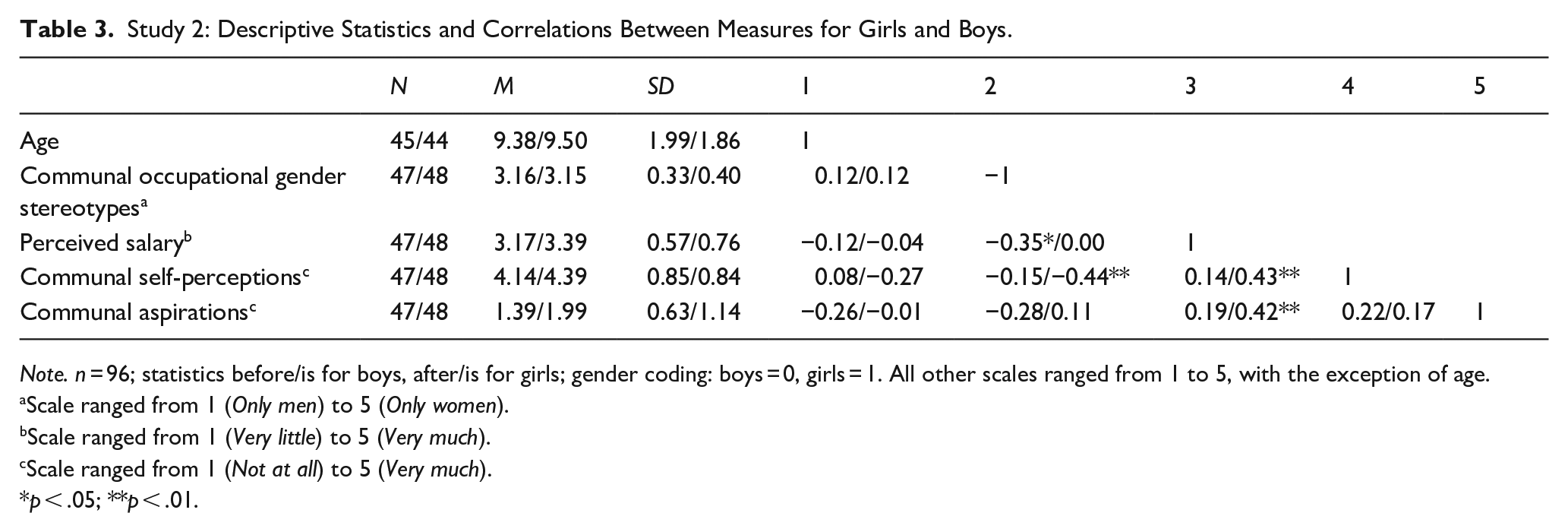
Note. n = 96; statistics before/is for boys, after/is for girls; gender coding: boys = 0, girls = 1. All other scales ranged from 1 to 5, with the exception of age.
Scale ranged from 1 (Only men) to 5 (Only women).
Scale ranged from 1 (Very little) to 5 (Very much).
Scale ranged from 1 (Not at all) to 5 (Very much).
p < .05; **p < .01.
Factors Associated With Children’s Communal Occupational Aspirations
To investigate H1−3, we used the same procedure as in Study 1. The interactions of age and gender with the independent variables—except for communal occupational gender stereotypes—were tested and were found to be non-significant and were therefore not included in the final model. All analyses including all covariates can be found in the Supplemental Materials.
The results of the regression analysis can be found in Table 4. The analysis showed the predicted main effect of gender on communal occupational aspirations, B = 0.44, t(83) = 2.27, p = .026, 90% CI = [0.12, 0.76]. As predicted, girls (M = 1.99, SD = 1.14) reported higher communal occupational aspirations than boys (M = 1.39, SD = 0.63; H1). In line with H2, the interaction between communal occupational gender stereotypes and gender on communal occupational aspirations was also significant, B = −0.91, t(83) = −1.69, p = .095, 90% CI = [−1.81, −0.01]. Boys showed a descriptive decrease in communal occupational aspirations with increased communal occupational gender stereotypes, B = −0.45, t(41) = −1.63, p = .111, 90% CI = [−0.91, 0.01], whereas girls did not show an increase in communal occupational aspirations with increased communal occupational gender stereotypes, B = 0.56, t(40) = 1.12, p = .268, 90% CI = [−0.28, 1.41]. Finally, the main effect of communal self-perceptions on communal occupational aspirations was significant B = 0.23, t(91) = 1.91, p = .059, 90% CI = [0.03, 0.43], and pointed in the predicted direction, with higher communal self-perceptions predicting greater aspirations toward communal occupations (H3).
Regression Analyses With Communal Occupational Aspirations as the Outcome (Study 2; n = 89).
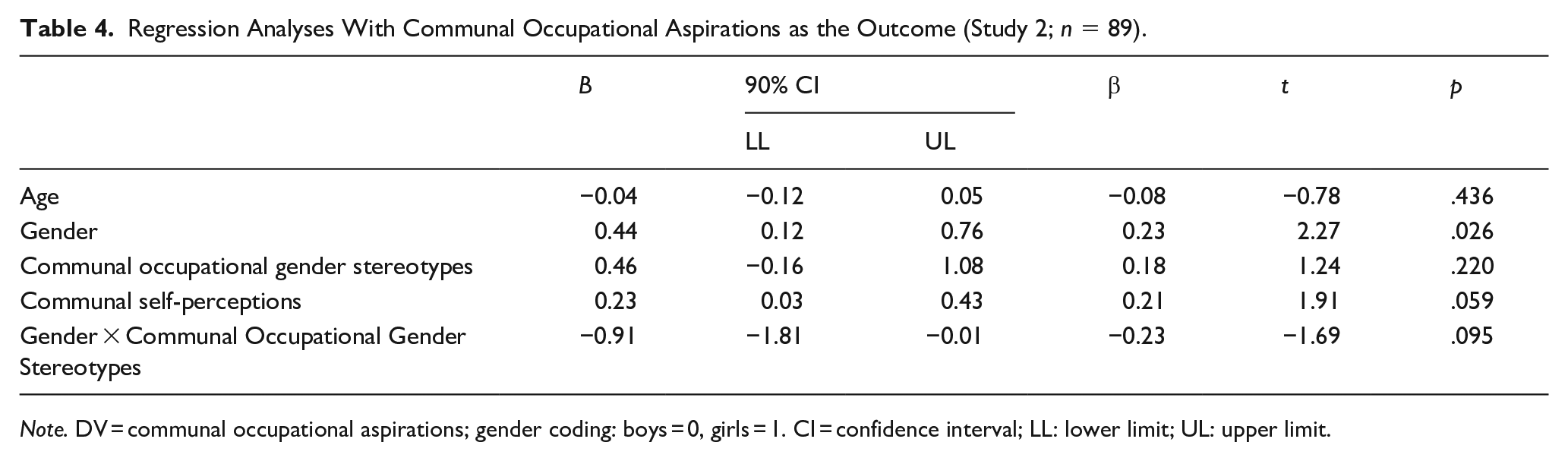
Note. DV = communal occupational aspirations; gender coding: boys = 0, girls = 1. CI = confidence interval; LL: lower limit; UL: upper limit.
Exploratory Analysis
To test the additional hypothesis (H4) about the effect of perceived salary on communal occupational aspirations, we ran the multiple regression analyses again separately and included perceived salary as a predictor. The effect of perceived salary was significant, B = 0.35, t(82) = 2.23, p = .028, 90% CI = [0.09, 0.60]. Specifically, children who believed a person makes a lot of money in communal occupations aspired more toward communal occupations.
Do Communal Self-Perceptions Mediate the Relationship Between Gender and Communal Occupational Aspirations in Children?
Finally, to test the mediation model (H5), we used Hayes’ Process macro (Model 4; 10,000 bootstrap samples). Gender was included as the predictor (X), communal occupational aspirations as the outcome (Y), and communal self-perceptions as the mediator (M). Age was included in the model as a covariate. Gender predicted communal occupational aspirations independently of communal self-perceptions (B = 0.44, p = .025, 90% CI = [0.12, 0.77]). However, gender did not significantly predict children’s level of communal self-perceptions (B = 0.26, p = .162, 90% CI = [−0.05, 0.56]). Children’s communal self-perceptions significantly predicted their communal occupational aspirations and the results pointed in the predicted direction (B = .19, p = .091, 90% CI = [0.01, 0.38]). However, a bias-corrected bootstrap CI for the indirect effect included zero (B = 0.05, 90% CI = [−0.01, 0.12]). This means that girls had descriptively, but not significantly more communal self-perceptions than boys, and children with more communal self-perceptions also aspired more toward communal occupations.
Analyses With the Combined Data
To investigate the predictors of communal occupational aspirations in childhood with more statistical power, we combined the data from Study 1 and Study 2. This resulted in a sample of 246 children between the ages of 4 and 13 years. A sensitivity analysis for a linear regression with four predictors (gender, CGST, self-perceptions, CGST × gender) given N = 246 indicated that a small effect size of f2 = .07 at a power of .95 could be detected. The variables were z-standardized as the variables were measured with a 3-point Likert-type scale in Study 1 and a 5-point Likert-type scale in Study 2. Age was included as a covariate in the analyses.
To investigate H1−3, we conducted a multiple regression analysis where we included CGST, and communal self-perceptions as main effects. We also included the interaction between gender and communal occupational gender stereotypes and between age and gender since we only found a main effect of gender in Study 2. Communal occupational aspirations was the dependent variable. The results of the regression analysis can be found in Table 5. Contrasting H1, the analyses did not reveal a significant main effect of gender on communal occupational aspirations (B = 0.12, t(238) = 0.93, p = .351, 90% CI = [−0.09, 0.32]). The interaction between age and gender was also not significant (B = 0.05, t(238) = 0.35, p = .729, 90% CI = [−0.18, 0.28]). However, in line with H2, the interaction between communal occupational gender stereotypes and gender on communal occupational aspirations was significant (B = 0.45, t(238) = 3.62, p < .001, 90% CI = [0.24, 0.65]). Boys’ communal occupational aspirations significantly decreased with increased communal occupational gender stereotypes (B = −0.19, t(123) = −2.32, p = .022, 90% CI = [−0.32, −0.05]), whereas girls’ communal occupational aspirations significantly increased with increased communal occupational gender stereotypes (B = 0.25, t(114) = 2.62, p = .010, 90% CI = [0.09, 0.41]). Finally, in line with H3, the effect of communal self-perceptions on communal occupational aspirations was significant (B = 0.20, t(238) = 3.24, p = .001, 90% CI = [0.10, 0.30]), meaning that higher communal self-perceptions were related to greater aspirations toward communal occupations.
Regression Analyses With Communal Occupational Aspirations as the Outcome for the Combined Data of Study 1 and Study 2 (n = 245).
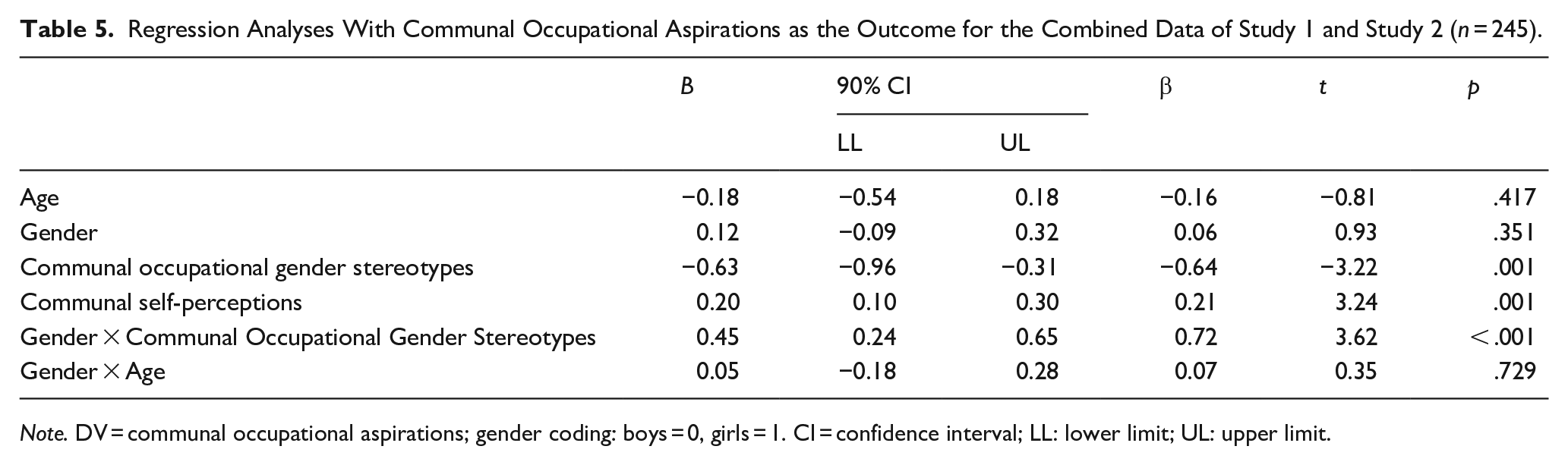
Note. DV = communal occupational aspirations; gender coding: boys = 0, girls = 1. CI = confidence interval; LL: lower limit; UL: upper limit.
Mediation Analysis
Next, we conducted a mediation analysis using Hayes’ Process macro (Model 4; 10,000 bootstrap samples). The mediating effect of communal self-perceptions on the relationship between children’s gender and their communal occupational aspirations can be found in Figure 1. Gender was significantly associated with communal self-perceptions (B = 0.40, p = .002, 90% CI = [0.19, 0.61]), with girls reporting higher communal self-perceptions than boys. Communal self-perceptions, in turn, were positively associated with communal occupational aspirations (B = 0.17, p = .006, 90% CI = [0.07, 0.27]). A bias-corrected bootstrap CI for the indirect effect did not include zero (B = 0.07, 90% CI = [0.02, 0.13]), supporting H5. Gender did not significantly predict communal aspirations independent of the mediator (B = 0.12, p = .328, 90% CI = [−0.08, 0.33]).
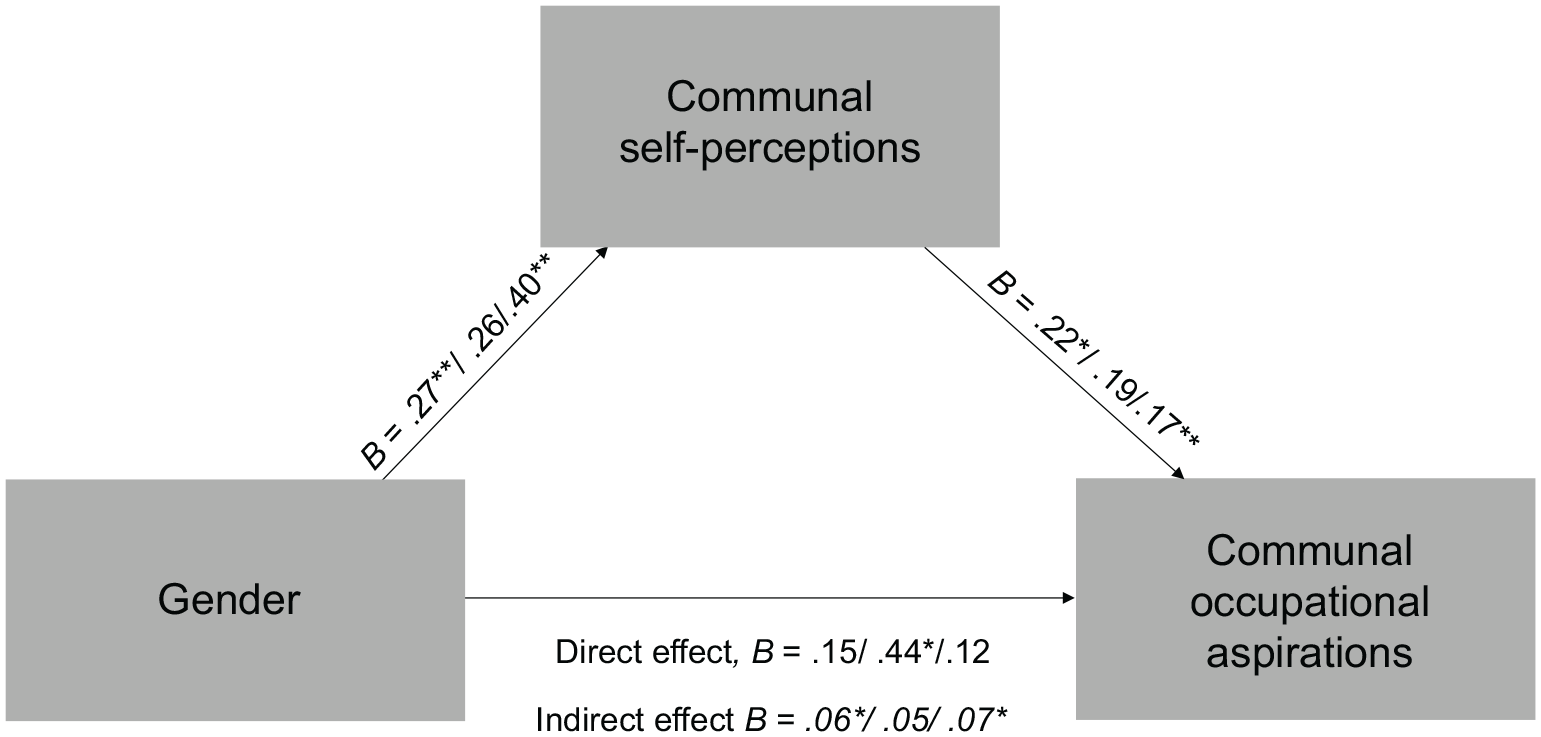
Mediating effect of communal self-perceptions on the relationship between gender and communal occupational aspirations in Study 1 (n = 156), Study 2 (n = 89), and with Combined data (n = 245). Note. *p < .05; **p < .01; Statistics are presented as such: Study 1 / Study 2 / Combined data.
Additional Study Testing the Prototypicality of the Communal Occupations
To test the validity of the two communal occupations that we chose to use in the two studies presented above (nurse and preschool teacher), we asked 139 (62 girls, 72 boys; Mage = 9.34, SD = 1.18) Norwegian children to report which occupations they viewed as communal in an open-ended question in an additional study. The question was phrased as such: “In some jobs it is important to be kind, to take care of other people, to be friendly, and to be caring. Can you think of any jobs where this is important?” Results showed that 45.6% of the occupations that the children spontaneously named were occupations within health care including nurse and doctor and 24.1% were occupations involving childcare, such as preschool teacher and schoolteacher. There was no other category of occupations that was named more often. This indicates that children in Norway view these two occupations as prototypical communal occupations. The full overview of occupations that children reported can be found in the Supplemental Materials.
General Discussion
The present research investigated the development of communal occupational aspirations in childhood. The aim was to identify factors that influence occupational aspirations in early and middle childhood. We investigated the effects of children’s CGST, communal self-perceptions, and perceived salary on their communal occupational aspirations. Concerning the main effect of gender (H1), whereas no difference between boys’ and girls’ communal occupational aspirations was observed in the younger sample (Study 1), girls did aspire more to communal occupations than boys in the older sample (Study 2). When combining the two samples, we did not find a main effect of gender on children’s communal occupational aspirations when including gender as a main effect in the regression while controlling for other variables. There thus seems to be a non-robust main effect of gender that disappears when controlling for other psychological variables that are related to children’s concept of gender such as gender stereotypes. This finding is not in line previous empirical findings (Levy et al., 2000; Trice & Rush, 1995; Weisgram et al., 2010) or with Gottfredson’s (1981) theorizing, according to which gender differences in occupational aspirations emerge in early childhood. However, Gottfredson (1981) attributes this gender difference to children’s desire to model adults in their life, meaning that societal gender norms are not internalized until middle childhood. Simply modeling adults might not be as strong a motivation as adhering to one’s own internalized norms, which could explain why we observe a stronger gender difference in communal occupational aspirations in middle childhood than in early childhood.
In addition, the different results between our participants in early childhood and middle childhood could be due to developmental factors, such as children’s ability to understand gender constancy (Kohlberg, 1966). According to Kohlberg’s stages of gender development, gender constancy (i.e., the understanding that sex is permanent across situations and over time) is developed by about age 6 or 7 years, which would mean that our sample of children in early childhood (i.e., ages 4–6 years) will have a less developed concept of gender constancy than our sample of children in middle childhood (i.e., ages 6–13 years). However, later empirical work has found signs of gender constancy from age 4 years, which would contradict this explanation (Bussey & Bandura, 1992). Another explanation for the different results between our participants in early childhood and middle childhood might be due to differences of how gender is used to organize groups in childcare centers and elementary schools. Although there is little research on this topic in Norway, we speculate that one important aspect might be differences in the extent to which children in each age group are routinely labeled and organized in group based on their gender. As children in childcare centers are mixed in age, a common way to label and organize children into groups is by age. In elementary schools, however, children are in the same class as their age group, which can lead teachers to categorize and organize children based on gender instead of their age. Extensive research has found that using gender as a label and as a way to group children can increase children’s gender stereotypes, which could explain why we observe a stronger gender difference in occupational aspirations among the older children (Bigler, 1995; Hilliard & Liben, 2010; Patterson & Bigler, 2006).
Interestingly, both studies provide evidence for the role of communal occupational gender stereotypes in communal occupational aspirations. We found a significant interaction between gender and communal occupational gender stereotypes in both Study 1 and Study 2, which replicated in the combined data set. This means that in line with role congruity theory (Eagly & Karau, 2002) and gender schema theory (Martin et al., 2002) children seem to want to behave in line with existing gender stereotypes. This is also in line with Gottfredson’s developmental theory of occupational aspirations, which states that occupational gender stereotypes influence children’s occupational aspirations from age 6 years. Results of analyses of all three samples (Study 1, Study 2, and combined data) showed that communal occupational gender stereotypes influenced the communal occupational aspirations of both boys and girls. The more traditional communal occupational gender stereotypes girls reported, the more they aspired toward communal occupations, whereas the more traditional communal occupational gender stereotypes boys reported, the less they aspired toward communal occupations. With the present data, it is not possible to differentiate between different underlying motivations of this effect. More research is needed to disentangle whether this effect is driven by children’s desire to achieve cognitive consistency as predicted by gender schema theory, the desire to avoid negative consequences from others as predicted by role congruity theory, or by a combination of these two motives. This finding is nevertheless important since past research has mostly focused on the relationship between gender stereotypes and occupational aspirations in adolescents and young adults (Cundiff et al., 2013; Garriott et al., 2017), with a lack of empirical evidence in younger children (Hartung et al., 2005).
In addition, results of both studies and the combined samples showed that children’s gendered self-concepts in terms of their communal self-perceptions were related to communal occupational aspirations (H3) and results from Study 1 and the combined sample showed that these self-perceptions mediated the relationship between child gender and occupational aspirations (H5). We believe the present results, together with the evidence from Block et al. (2018), suggest that Gottfredson’s (1981) prediction that self-concepts do not play a role in young children’s occupational aspirations may need to be reconsidered. The fact that young girls and boys already differ in their communal self-perceptions might explain why boys become less likely to aspire toward communal roles than girls the older they get, as children who view themselves in line with gender stereotypes might over time develop more rigid internalized beliefs about gender roles and, thus, aspire more toward gender congruent occupations. This would mean that a boy who does not view himself as communal might develop stronger beliefs that boys should not be communal and will, therefore, aspire less toward communal occupations. However, as the effect of self-perceptions on occupational aspirations in young children has been underexamined, further research should explore this possible alternative development of occupational aspirations in childhood.
Finally, in Study 2, we found that the perceived salary of the communal occupation was related to children’s aspirations toward communal occupations, even when controlling for other important factors, supporting our exploratory H4. This means that the more money children believe a person makes in a specific communal occupation, the more they aspire toward this occupation. This result supports previous findings showing that the occupational aspirations of young children in middle childhood are influenced by power and status (Liben et al., 2001; Weisgram et al., 2010). The finding is also consistent with Gottfredson’s developmental theory of occupational aspirations, which states that the occupational aspirations of children between the ages of 9 and 13 years are influenced by the status of the occupations. This is also in line with previous empirical findings that occupational status influences young children’s occupational aspirations (Hayes et al., 2018; Liben et al., 2001; Weisgram et al., 2010). When planning interventions to increase engagement in communal occupations, researchers and decision makers might, therefore, consider the status of occupations, and particularly the perceived salary of communal occupations. Previous interventions have focused on using role models to influence children’s occupational aspirations (see Olsson & Martiny, 2018); however, if the present pattern is robust, this may not be enough. Even at a young age, children need to perceive communal occupations as being desirable, which means that increasing the status of communal occupations should be included in interventions to increase communal occupational aspirations. Our findings suggest that factors previously thought to only influence children at an older age, like occupational status, do relate to children’s aspirations already at elementary school age. Therefore, more work should be done to investigate predictors of occupational aspirations at different stages in childhood, especially as this has been underexamined in previous research.
An important predictor of children’s occupational aspirations that we decided to not include in the present work is SES. Gottfredson’s (1981) developmental theory of occupational aspirations states that SES influences the perceived accessibility of occupations, and thereby shapes occupational aspirations. This is supported by empirical work, which has found that SES is an important factor that influences the occupational aspirations of children, where children with higher SES aspire more toward more prestigious occupations (Cochran et al., 2011; Hannah & Kahn, 1989). The only measure of SES we included in both studies was parents’ income. When looking at the distribution of parental income, most parents (58.6% in Study 1 and 54.3% in Study 2) report earning a salary of between NOK 460,000 and 1,200,000. The median salary in Norway in 2021 was NOK 550,000 (SSB, 2021c), meaning that our sample earned approximately the median Norwegian salary. We also have a measure of parental education in Study 1, for which 78.4% of parents report having a higher education. 36% of the population in Norway above the age of 16 years had a higher education in 2021 (SSB, 2021d). Our samples therefore mostly consist of children with moderate to high SES. In our opinion, it does not seem likely that SES strongly influenced the present results, particularly since Norway is a country with relatively low economic inequality (OECD, 2022) and the majority of children attend the same (public) school until grade 10 (age 13 years). However, further research should explore the role of SES in children’s occupational aspirations in detail.
The focus of the present work is on social psychological influences, including gender norms and status. Researchers from an evolutionary perspective, however, argue that the gender difference in communal occupations is due to women’s stronger motivation to form interpersonal affiliations and men’s stronger motivation to attain prestige, as well as the ancestral sex roles that lead men to be oriented toward things while women are oriented toward people (see Tay et al., 2019). In addition, researchers from a biological perspective argue that there is evidence for a biological influence on children’s engagement in gendered activities and interests. For example, prenatal androgens have an effect on interests and engagement in gendered activities, with girls who are exposed to high levels of androgens in early life have been found to be more interested in male-typed activities (Berenbaum, 2018; Berenbaum & Hines, 1992; Berenbaum & Snyder, 1995). In line with social role theory (Eagly, 1987), biological differences between women and men might contribute to observed differences in women’s and men’s’ (communal) behavior and self-perceptions. At the same time, in line with social role theory (Eagly, 1987), we argue that these potential biological differences may be exaggerated by (rigid) gender norms in society. With the present work, we are not able to distinguish between these potential sources for the observed gender differences in children’s communal occupational aspirations.
Limitations
The present work makes important contributions regarding the development of communal occupational aspirations in young children. However, a first limitation that needs to be addressed is the cross-sectional design of both studies, which makes it impossible to draw causal conclusions. Whereas a causal interpretation of the present findings regarding gender and communal self-perceptions is in line with role congruity theory (Diekman et al., 2017), the direction of the effects of perceived status remains unclear. As we argued based on the theoretical approach by Gottfredson (1981), it may be that perceived status affects young children’s occupational aspirations. However, it is of course possible that children ascribed more salary to occupations that they perceive as more interesting and desirable. More (experimental) research is, therefore, needed to investigate this causal link, for example, by manipulating the ascribed status of (unknown) occupations.
As a second limitation, the original scales for communal occupational aspirations and the perceived salary of communal occupations referred to three occupations: stay-at-home parent, nurse, and preschool teacher. We used these three items in Study 2 because they had shown satisfactory reliability in Study 1. However, in the sample of older children, stay-at-home parent did not correlate highly with the other two communal occupations, perhaps because older children understand that staying at home is not an occupation. Another problematic issue with the stay-at-home-parent item is that in Norway about 75% of the fathers take parental leave during the first year of their child’s life (Engvik & Pettersen, 2021). Even though women in Norway take longer parental leave this means that Norwegian children often observe men and women in this role. This might explain why the used scale did not show high reliability in both studies and we had to exclude this item from both studies to ensure consistency between the analyses. In an additional study, we showed that Norwegian children perceive nurses and preschool teachers as typical communal occupations. At the same time, further research should make sure to use scales that consist of more items and show a higher reliability. Finally, there is a need for longitudinal studies that investigate how predictors of occupational aspirations in children develop throughout childhood.
Conclusion
The present study addresses an underexamined but important question, namely factors that contribute to children’s communal occupational aspirations that may ultimately explain men’s underrepresentation in communal roles. The tendency for boys to identify less with communal behaviors than girls at an early age and in an egalitarian context is noteworthy. The relationship between gender, communal self-perceptions, and communal occupational aspirations suggests that girls and boys enter different career trajectories from early childhood on. Therefore, interventions seeking to increase communal self-perceptions in young boys are needed. When planning these interventions researchers and practitioners should consider also focusing on raising the perceived and real status of communal occupations.
Supplemental Material
sj-docx-1-jbd-10.1177_01650254221121842 – Supplemental material for What do I want to be? Predictors of communal occupational aspirations in early to middle childhood
Supplemental material, sj-docx-1-jbd-10.1177_01650254221121842 for What do I want to be? Predictors of communal occupational aspirations in early to middle childhood by Marte Olsen, Maria I. T. Olsson, Elizabeth J. Parks-Stamm, Marie Kvalø, Kjærsti Thorsteinsen, Melanie C. Steffens and Sarah E. Martiny in International Journal of Behavioral Development
Footnotes

Funding
The author(s) received no financial support for the research, authorship, and/or publication of this article.
Supplemental Material
Supplemental material for this article is available online.
Notes
References
Supplementary Material
Please find the following supplemental material available below.
For Open Access articles published under a Creative Commons License, all supplemental material carries the same license as the article it is associated with.
For non-Open Access articles published, all supplemental material carries a non-exclusive license, and permission requests for re-use of supplemental material or any part of supplemental material shall be sent directly to the copyright owner as specified in the copyright notice associated with the article.
