




Abstract
Interventions in which people are exposed to counter-stereotypical role models are often used for breaking gender stereotypes. Most gender role-model interventions focus on adolescents and emerging adults. Yet, middle childhood might be a highly effective period for changing gender stereotypes because children are still learning about gender and gender roles. Therefore, this study examined the effects of a newly developed educational program with counter-stereotypical female heroines, on children’s gender schemas and self-esteem. Differences between boys and girls in the effects of the intervention were also investigated. A sample of 125 Dutch children (53% girls, 7–11 years old) completed a quantitative survey (assessing gender schemas, self-esteem) in class before and after completing the Heroines program with their teachers. Results showed that the program reduced children’s gender stereotypes about activities, but did not lead to change in five other gender schemas or self-esteem. Thus, the Heroines program had modest effects on some gender schemas, whereas most gender schemas did not change. This limited change might be due to the relatively short duration of the program, its broad nature, and the possible resistance of gender schemas to change as they have been formed over years in environments that are filled with gender-stereotypical information.
Introduction
Middle childhood, usually defined as the period between age 6 and 12 years old, is an important period for the development of multiple interrelated gender schemas, that is children’s thoughts about themselves and others in terms of gender (Tenenbaum & Leaper, 2002). There is ample evidence that from about age 6 to 8, children start reporting gender-typed career and family aspirations and expectations (Block et al., 2018; Croft et al., 2014; Polavieja & Platt, 2014). For instance, boys desire to become an athlete, mechanic, or soldier, whereas girls desire being an actor, hairdresser, or teacher (Polavieja & Platt, 2014). Moreover, girls expected themselves to be more family than career oriented in the future, whereas boys expected themselves to be more career oriented than family oriented (Block et al., 2018; Croft et al., 2014). In this period, children also begin to internalize gender-role dimensions of agency (e.g., assertiveness, dominance, competitiveness) and communion (e.g., warmth, nurturance, concern for others) in their self-concepts, with boys endorsing less communal and more agentic values than girls do (Block et al., 2018). Additionally, children’s gender stereotypes, a socially shared set of expectations about the roles, behaviors, interests, and traits of men and women, peak between age 5 to 7, and become more flexible thereafter (Trautner et al., 2005). In the same period children develop a more complex and multidimensional gender identity, that is their sense of self as boy or girl (Halim & Ruble, 2010). Furthermore, school-aged children have strong positive attitudes and preferences for their own gender (and negative attitudes about the other gender), which tend to decrease somewhat during middle childhood for boys in particular (Halim et al., 2017; Xiao et al., 2021).
Importantly, these gender schemas each have been found to be key explanatory factors for occupational gender inequality, specifically women’s underrepresentation in some science, technology, engineering, and mathematics careers (Diekman et al., 2017), and men’s underrepresentation in careers in health and elementary education, and in the domestic sphere (HEED; Croft et al., 2015; Block et al., 2018). Childhood career aspirations and expectations are also linked over time with the actual (gender-typed) careers of adults (Lawson et al., 2018). In addition, children’s attitudes about same- and other-gender individuals appear to be important for positive interactions or a sense of inclusion with individuals of the other gender (Halim et al., 2021; Xiao et al., 2021). Furthermore, research has revealed a consistent link between children’s gender identity and social-emotional functioning and well-being, with favorable effects found particularly for more androgynous children who can identify with both genders (Martin et al., 2017). In order to foster greater occupational gender equality, positive intergroup contact between the genders, and well-being regardless of one’s gender, more insight is needed in how to effectively change children’s gender schemas. Middle childhood is suggested to be a highly effective period for changing gender schemas because at this age children are still learning about gender and gender roles (Bigler & Liben, 2006). In the current study, the effects of a new educational program with female role models were tested on children’s gender schemas.
The Importance of Gender Role Models
Children do not develop gender schemas in a vacuum. Gender-schema theorists argue that children actively construct schemas about gender on the basis of gender information that can be found in the world around them (Martin & Halverson, 1987), for instance via the gender role models they are exposed to. For example, parents are gender role models for children via their own work, task division, and work hours, which has been associated with children’s gender-typical views about their future career and family involvement (Endendijk & Portengen, 2022). Gender schemas also influence the way children perceive, attend to, and process newly incoming gender information. For instance, a child will selectively attend to gender information that confirms their preconceptions (Martin et al., 2002; Martin & Halverson, 1987). This transactional process may help explain why it appears so difficult to change gender schemas once in place during childhood. Gender schema theories also predict that gender schemas provide social standards that guide children’s behavior and choices. As such, a certain degree of congruence between children’s gender schemas and gender-related behaviors is expected. For instance, children’s gender stereotypes about STEM are linked to gender-typical educational and career choices and interests (Master et al., 2017).
Previous Research on the Effects of Gender-Role Model Interventions
Building on the premises of gender schema theories, interventions to reduce gender stereotypes and promote gender equality often make use of exposure to counter-stereotypical role models who break or diversify traditional gender roles. Surprisingly, most role-model interventions focus on adolescents and emerging adults, whereas only a few specifically target gender schemas and gender-related behavior in middle childhood (Olsson & Martiny, 2018). A review of the available literature in middle childhood concluded that exposure to counter-stereotypical role models via books or magazines appears to change children’s gender stereotypes in the short-term (Olsson & Martiny, 2018). However, less was known about the effects on children’s aspirations and other gender schemas and the longevity of role-model effects.
More specifically, regarding changes in gender stereotypes, six-year-old children from the US reported less gender stereotypes about occupations after a 2-month program in which teachers read books with counter-stereotypical models and children completed accompanying activities (e.g., role-play, group discussions) (Trepanier-Street & Romatowski, 1999). Similarly, Israelian first-graders exposed to basal readers with diverse presentations of males and females had less gender stereotypes about activities than first-graders who were exposed to more gender-stereotypical basal readers (Karniol & Gal-Disegni, 2009).
There is also some research examining the effects of counter-stereotypical role models on a broad range of gender schemas, not solely gender stereotypes, as well as on gender-related behavior. For instance, viewing a magazine page with peers playing with counter-stereotypical toys reduced UK children’s (4–8 years) gender stereotypes about toys, gender-typed playmate choices, and gender-based exclusion among boys, but did not change children’s gender-typed toy preferences (Spinner et al., 2018). Moreover, a 4-month stereotype-reducing educational program for 6- to 10-year-old UK children that also included exposure to counter-stereotypical role models effectively increased felt similarity to peers of the other gender, perceived unfairness of gender norms in boys, and diversity of occupational aspirations (Spinner et al., 2021).
A few studies specifically examined the effects of interventions with female role models. One study found that exposure to female scientists (through a lesson plan with trading cards, comic books, guest scientists) lead to less stereotypical drawings of scientists by 6-grade girls and boys from the US (Meaders et al., 2023). Similarly, being exposed to a book or short stories with female STEM role models increased girls’ interest in STEM careers (Bonus et al., 2022) and reduced girls’ gender stereotypes about intellectual ability, but not their beliefs of females as nice (Buckley et al., 2022).
A three-year longitudinal program in which Zimbabwean students (grade 4-7) used readers with females in counter-stereotypical careers combined with direct encouragement (e.g., “anybody can do any job they like”) demonstrated that girls became more interested in counter-stereotypical occupations (Nhundu, 2007). Although, at the same time, these girls still thought it was important to prioritize family over career. For boys, no changes in occupational aspirations were found, which could suggest that female role models might have a stronger effect on girls’ gender schemas than on boys’ gender schemas. Indeed, for 8- to 12-year-old boys, reading a book with a counter-stereotypical male character was more effective in reducing gender stereotypes than a book with a counter-stereotypical female character (Kneeskern & Reeder, 2020). Boys might be less able to identify with female role models than girls, and better able to identify with male role models instead. In sum, although the evidence for the gender-specific effects of counter-stereotypical female role models is not entirely consistent, there are at least some indications that such female role models might have a stronger effect on certain gender schemas of girls compared to boys.
Gaps in Previous Research
The above body of research on role-model interventions highlights several important gaps. First, most research focused on the effects of role-model interventions on children’s gender stereotypes and to a lesser extent on other gender schemas. As such, it remains unclear whether counter-stereotypical role models are able to change children’s views of themselves and others in terms of gender (Martin et al., 2002). The current study therefore assessed the effects of a role model intervention on a wide range of gender schemas, both about oneself (e.g., gender identity, gendered self-concept, occupational aspirations) and about others (e.g., gender stereotypes, attitudes about boys and girls). This is important as the predictive ability of gender cognitions about others for one’s own behavior is somewhat limited (Meissner et al., 2019). The internalization of changed gender stereotypes about others into children’s gendered views about themselves (after role model interventions) might be a more relevant indicator of children’s subsequent behavior (Olsson & Martiny, 2018).
Second, most previous research with gender-role models has made use of role models that are of the same gender as the target children, mostly female role models to change gender stereotypes, interests, and behavior of girls. This is often based on the idea that individuals who perceive a role model to be similar to themselves are more likely to be influenced by the model (Olsson & Martiny, 2018). However, children can identify with the role models on multiple grounds, as similarity can be demographical (e.g., gender, age, ethnicity) or psychological (e.g., traits, values, struggles) (Gladstone & Cimpian, 2021). Therefore, it is interesting to examine whether female counter-stereotypical role models can change boys’ gender schemas to a similar extent as girls’ gender schemas. This can provide insight into the generalizability of the effects of role models from groups with less power (e.g., women) on members of groups with more power (e.g., men, boys). In addition, this can provide some indications as to whether boys are able to identify with the female role models on other grounds than gender.
Third, research has not yet examined effects of gender-role model interventions on self-esteem. Yet, self-esteem is an essential part of an interrelated set of social cognitions about gender (i.e., identity, attitudes, stereotypes, self-concept, self-esteem) that are organized in a balanced affective-cognitive system (Greenwald et al., 2002). This might indicate that when one gender cognition in the system changes because of an intervention, one or multiple of the other cognitions change as well in order to restore balance. Disbalance between cognitions is thought to elicit discomfort and stress, providing pressure toward further change and to renew balance (Greenwald et al., 2002). The current study therefore also examined effects of a role model intervention on self-esteem to provide insight in other positive side-effects.
A Newly Developed Role Model Intervention: The Heroines Program
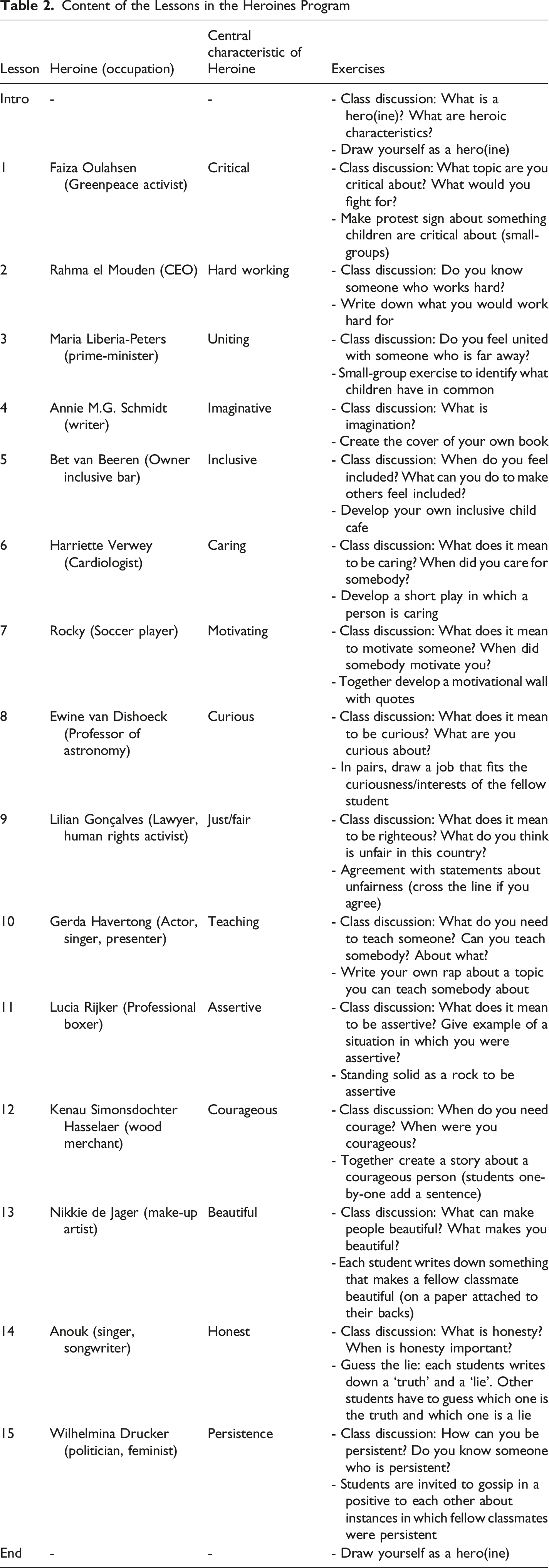
Recently, a new educational program called Heroines! was developed for children between the ages of 6 and 10 that centers around the book Het begint met een droom (It starts with a dream). The Heroines program consists of fifteen one-hour lessons and an introductory and closing lesson. Each lesson features a counter-stereotypical heroine from the Dutch Kingdom (e.g., Rocky, Anouk, Ewine van Dishoeck, Lilian Gonçalves). Children learned about each heroine’s occupation or career, the activities they engage(d) in that make them a heroine, and about a specific character trait of the heroine. The lessons focus on agentic (e.g., strong, assertive), communal (e.g., nurturing, compassionate) as well as more gender-neutral character traits (e.g., sincere, truthful). Each lesson has a similar structure, starting with reading the story of a specific heroine from the book, sometimes followed by a short video of the heroine. Subsequently, children engage in a teacher-led class discussion about the accompanying character trait (e.g., “What does ‘hard-working’ mean?”, “Do you know somebody who is hard-working?”, “What would you work hard for?”). Next, children participate in an activating exercise in which they can use or become familiar with a specific character trait (e.g., make protest signs to practice with ‘being critical’). The program is flexible in that schools can make their own decisions on how they integrate the project into their curriculum. The maximum recommended length of the program is three months.
Several rationales were underlying the intervention development. The first and most important rationale based on gender schema theory (Martin & Halverson, 1987) was that exposure to counter-stereotypical female role models would lead to more diverse or flexible gender schemas and less gender-typical behavior. The female role models in the Heroines intervention were selected for being antithetical to gender stereotypes by their occupation or career, the activities they employed that made them a heroine, and/or their character traits.
Second, in general children’s books and learning material contains many stereotypical role models with little diversity in terms of ethnicity. A literature review concluded that in textbooks (1) males are overrepresented, and (2) males and females primarily engage in stereotypical occupational and domestic roles, and exhibit stereotypical communal and agentic traits (Blumberg, 2007). Similarly, a content analysis of popular books for children (4–8 years) revealed that male characters were more often portrayed as adventurous and active and female characters more as domestic and passive (Pownall & Heflick, 2023). In addition, the vast majority of characters in popular Dutch children’s book where White, even though Dutch society is much more ethnically diverse (de Bruijn et al., 2021). This highlighted the importance of developing a book with counter-stereotypical female models from diverse ethnic and socioeconomic backgrounds. The goal was to balance out the stereotypical, male, and ethnically non-diverse models children are frequently exposed to. In addition, the ethnic and socioeconomic diversity of the heroines was considered to facilitate identification with the heroines for children from diverse backgrounds (Gladstone & Cimpian, 2021; Olsson & Martiny, 2018).
Third, the intervention was designed specifically for a school setting. Because schools reach many children at once, they provide a more efficient driving force for changing children’s gender schemas, compared to the family context. Moreover, in the school context children can also be reached that are less likely to be exposed to counter-stereotypical role models by their parents, for instance children from lower-educated families (Polavieja & Platt, 2014). The choice of an intervention centered around a book was also fitting in the school context because children spend as much as 80 to 95% of classroom time using physical or online books. An additional advantage was that after the intervention ended the book remained available to the children in the class, thereby extending the possible exposure to counter-stereotypical role models.
Current Study
The aim of this study was to examine the effects of the Heroines program on children’s gender schemas (i.e., gender stereotypes, self-concept, gender identity, gendered expectations about their future career and family involvement, gender attitudes) and their self-esteem. The following preregistered hypothesis was formulated (see Methods for link to preregistration): The Heroines intervention would lead to more egalitarian and balanced gender schemas in children, as well as increased self-esteem (pre-post intervention comparison) (Greenwald et al., 2002; Olsson & Martiny, 2018). More specifically, regarding the gender schemas, children were expected to report (1) less gender-typical expectations about their future occupation and involvement with career and family, (2) less strong gender-role stereotypes and gender stereotypes about activities, (3) less gender-typical trait endorsement, (4) more similarity to other-gender peers, less similarity to same-gender peers, (5) perceiving boys and girls as more similar, and (6) less ingroup favoritism, less outgroup derogation. A secondary aim of the study was to investigate differences between boys and girls in the effects of the intervention. It was hypothesized (preregistered) that the intervention would have a stronger effect on girls’ gender schemas and self-esteem than on boys’ gender schemas and self-esteem, because the book featured female role models (Kneeskern & Reeder, 2020; Nhundu, 2007).
Methods
Design
This study had a pretest-posttest quasi-experimental design. Data were collected via online surveys (including quantitative questions and one open question) administered to children in class before and after the Heroines program. Through these methods, changes in children’s self-reported gender beliefs and self-esteem could be assessed. This study was preregistered (https://osf.io/wyb2u). Originally, a comparison of children’s pretest and posttest drawings of themselves as hero(ine) was also part of the preregistration. Yet, the subset of pretest-posttest drawings that teachers handed in was too small (n = 17) to make any relevant statistical comparisons. Therefore, this part of the preregistration was left out of the study. It should be noted that the researchers conducting this study were not involved in the development of the Heroines intervention, thereby ensuring a certain degree of objectivity.
Participants
Characteristics of Schools Participating in the Pretest-Posttest Child-Surveys
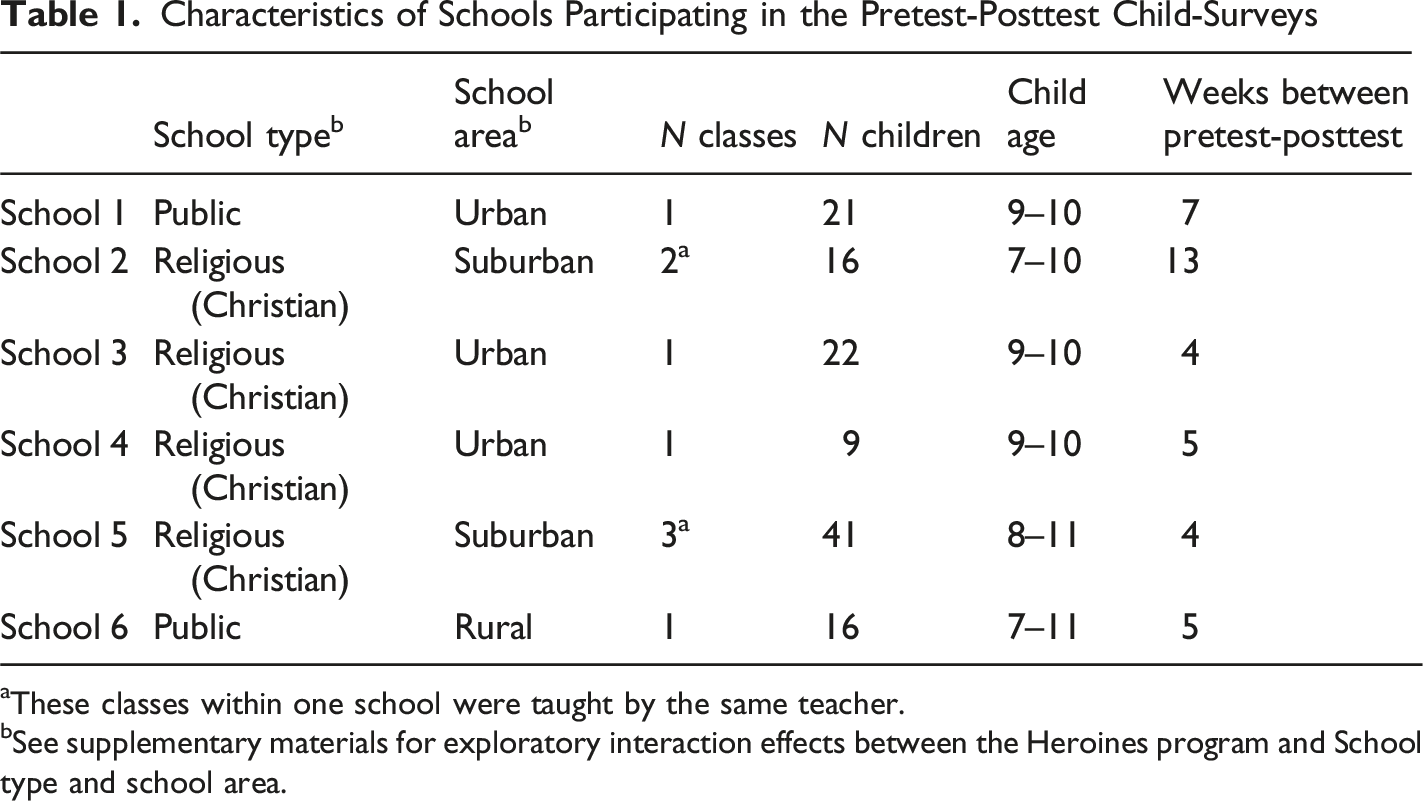
aThese classes within one school were taught by the same teacher.
bSee supplementary materials for exploratory interaction effects between the Heroines program and School type and school area.
Procedure
Participating children and their parents provided written informed consent before the start of the study. Children completed an online survey via Qualtrics in class before and after the Heroines program (pretest: 1–7 days before start program, posttest: 1–7 after program end). On average there were 6.3 weeks between the pretest and posttest (min = 4; max = 13). The pretest and posttest surveys included the same questionnaires (see Measures). The surveys were completed under supervision of a trained research assistant and the teacher of the class (duration: 1 hour). The research assistant instructed children on each questionnaire. The teacher was instructed to not comment on the content of the questions and only assist with keeping the order in class and ensure that children completed the survey quietly by themselves. Children received no compensation for their participation. This study was approved by the Ethical Review Board of the Faculty of Social and Behavioral Sciences at Utrecht University (number: 22-0331).
The Heroines Program
Content of the Lessons in the Heroines Program
Measures
The effects of the Heroines program were examined on multiple gender schemas because the intervention and the role models in the book addressed gender-schematic content in different domains, i.e., occupation/career, activities, and character traits. The first five measures estimate the effect of exposure to this specific content on children’s beliefs about occupations, roles, career, activities, and character traits. A second reason for the focus on multiple gender schemas was that gender cognitions (i.e., identity, attitudes, stereotypes, self-concept, self-esteem) are interrelated and organized in a balanced affective-cognitive system (Greenwald et al., 2002). This might indicate that when one gender cognition in the system changes because of an intervention, one or multiple of the other cognitions change as well in order to restore balance. The last four measures estimate this more indirect effect of the Heroines program on gender schemas that are not specifically addressed in the program.
Occupational Aspirations
First, to assess children’s desired future occupation, children were asked the following question: “What do you want to be when you grow up?” Children’s free responses to this question were coded by using the Dutch Central Bureau of Statistics data from 2023 that provides information on the proportion of men and women in an extensive list of occupations (Endendijk & Portengen, 2022). The proportion of men in a certain occupation that corresponded with the occupation mentioned by the child was used for our analyses. Proportions above .50 indicated more men than women in a certain occupation, proportions below .50 indicated more women than men in an occupational domain. When children indicated multiple occupations, the proportions were averaged. In case children answered the question with “I don’t know” (or something similar) a proportion of 0.5 (i.e., neutral score) was used for this child 1 . Forty (16%) of the total number of reported occupations by children were double coded independently by a second coder. The intraclass correlation coefficient (ICC = 0.93) demonstrated excellent coder reliability. This scale was used to assess the effect of exposure to women in counter-stereotypical occupations in the Heroines program on children’s own occupational aspirations.
Family Versus Career Orientation
To assess children’s expectations about relative future involvement with family versus career, children were presented with two own-gender individuals and a description of their career and family life (Croft et al., 2014; non-binary children were presented with both genders). For each pair of individuals (i.e., two pairs were used), a person who worked full time was contrasted with a person who stayed at home caring for the children. Children were asked to indicate for each pair of individuals who they think they will be more like when they are grown up. They rated their similarity on a slider ranging from 0–100 (0 = most similar to career-oriented target, 50 = equally similar to both targets, 100 = most similar to the family-oriented target). Children were explained the end points of the slider (i.e., highly similar to left or right individual), the midpoint (i.e., equally similar to both individuals), and that they could use the entire range of the slider to indicate the degree of similarity to either one of the individuals. See Figure 1 in Supplementary Materials for an example item. Scores were averaged over the two items, so that higher average scores indicated more expected involvement with family than with career in the future. As all role models in the Heroines program were career women, this scale was used to assess whether exposure to career women would lead to increased career orientation in girls and reduced career orientation in boys.
Gender-Role Stereotypes
Children completed five items asking which person in a heterosexual couple would do more of a given household task (dishes, cleaning, child care, cooking, and laundry) (Croft et al., 2014). For each item, children indicated their response by sliding a scale toward either the person on the left (0) or on the right (100), with 50 representing 50/50 sharing of the task between the couple. The gender of the person depicted on each side of the scale was randomly counterbalanced. Children’s scores were averaged and recoded so that higher scores indicated more traditional gender-role stereotypes (i.e., women do more domestic work than men). Internal consistency of this scale was deemed unsatisfactory (α′s = 0.03; 0.26). In the Supplementary Materials (Table S1 and S2) outcomes of a factor analysis on this scale can be found, as well as (non-significant) results of an analysis testing the intervention’s effect on item level.
Gender Stereotypes About Activities
To measure children’s gender stereotypes about activities a short version (Fast & Olson, 2018) of the activity subscale of the COAT-AM (Children’s Occupations, Activities, and Traits-Attitude Measure) was utilized. Children were presented a list of 10 activities that people can do (e.g., do gymnastics, play video games), and to say who they think should do each activity: boys, girls, or both boys and girls. The activities were relevant for school-aged children and as such were different from the activities of the role models in the Heroines program. Scores were recoded and averaged (Cronbach’s α pretest = 0.74; α posttest = 0.77) in such a way that positive scores reflected stronger prescriptive gender stereotypes about activities (e.g., boys should play video games, girls should do gymnastics), scores around zero reflected egalitarian gender stereotypes (e.g., both boys and girls should do gymnastics), and negative scores reflected counter-stereotypical beliefs (e.g., girls should play videogames, boys should do gymnastics). This scale was used to assess the effect of exposure to women engaging in counter-stereotypical activities in the Heroines program on children’s gender stereotypes about activities.
Communal and Agentic Traits
To measure how important communal and agentic character traits are to children’s views of themselves (i.e., self-concept) a scale of communal and agentic value endorsement was used (Block et al., 2018). Children were asked to rate the importance of four communal values (“How important do YOU think it is to be kind to others?”) and four agentic values (“How important do YOU think it is to win?”) on a 5-point slider scale ranging from 1 (not very important) to 5 (super important). Scores were averaged in separate scales for endorsement of communal values (Cronbach’s α pretest = 0.66; α posttest = 0.73) and endorsement of agentic values. Internal consistency of the agentic scale was unsatisfactory (α′s = 0.51; 0.53). In the Supplementary Materials (Table S3 and S4) outcomes of a factor analysis on the agentic subscale can be found, as well as (non-significant) results of an analysis testing the intervention’s effect on item/subscale level.
The role models in the Heroines program were linked with a combination of (stereotypical) communal traits, (counter-stereotypical) agentic traits, and neutral traits, and children engaged in discussions and exercises about all these traits. Therefore, this scale was used to assess whether the gender-diverse content about character traits in the Heroines program lead to reduced communal and/or increased agentic trait endorsement in girls and increased communal and/or decreased agentic trait endorsement in boys.
Gender Identity: Felt Similarity to Boys and Girls
Next, children’s gender identity was assessed by a dual gender identity measure (Martin et al., 2017) measuring children’s felt similarity to both boys and girls. Children answered 10 questions regarding how similar they felt to both boys (e.g., “How similar do you feel to boys?”, “How much do you like to do the same things as boys?”) and girls (e.g., “How similar do you feel to girls?”, “How much do you like to do the same things as girls?”). A graphical response scale was used with two circles, one representing oneself and one representing either boys or girls (Martin et al., 2017). The closer the two circles were together, the greater the perceived similarity. Responses ranged from 1 (two circles farthest apart) to 5 (two overlapping circles). Children’s responses on the five male and five female items were averaged separately, with higher scores representing more similarity to respectively boys and girls (similarity to boys: Cronbach’s α pretest = 0.91; α posttest = 0.92, similarity to girls: α pretest = 0.93; α posttest = 0.94). This scale was used to assess whether exposure to counter-stereotypical female role models would lead to increased felt similarity to girls in boys in particular (i.e., experiencing that they have things in common with these role models).
Similarity of Boys and Girls
Children also reported how similar they thought boys and girls were using a similar graphical response scale as the gender identity measure with the distance between two circles indicating the level of similarity (adapted from Martin et al., 2017). The instruction they received was the following: “Click on the circles that show how similar you think boys and girl are.” Responses ranged from 1 (circles representing boys and girls farthest apart) to 5 (overlapping circles representing boys and girls). Higher scores represent stronger perceived similarity of boys and girls. This scale was used to assess whether exposure to female role models that are counter-stereotypical in their occupation/career, activities, and/or character traits would enhance the belief in children that boys and girls are similar.
Intergroup Attitudes
Finally, as a measure of intergroup attitudes children were asked how they felt about boys and girls by using a feeling thermometer (1 = very negative emotions, 3 = neutral, 5 = very positive emotions). Feeling thermometers are often used to assess intergroup attitudes and demonstrate satisfactory psychometric properties across different age groups (Lolliot et al., 2004). This scale was used to assess whether exposure to female heroines would enhance children’s positive feelings about girls in particular.
Self-Esteem
Child self-esteem, defined as a general positive perception of the self, was measured with the Self-Perception Profile for Children (Grades 3–8) global self-worth scale (Harter, 2012). This subscale is similar to Rosenberg's (1965) measurement of self-esteem but the wording is more appropriate for children (Harter, 2012). In this 6-item subscale, children are asked to choose which of 2 kinds of children they are most like (e.g. “some kids like the kind of person they are BUT other kids wish they were different”, “Some kids are often unhappy with themselves BUT Other kids are pretty pleased with themselves.”). After making a choice, children were asked whether this was “sort of true” or “really true.” Responses were recoded and averaged to a scale from 1 to 4 with higher scores indicating higher self-esteem (Cronbach’s α pretest = 0.80; α posttest = 0.82).
Analyses
Three-level multilevel models were not fitted to the data as preregistered because ICCs for school level were zero for all outcomes. In addition, the number of clusters was too small for unbiased fixed effects in three-level models (Kerkhoff & Nussbeck, 2023). Therefore, multilevel modeling was not warranted and regular analyses of variance with repeated-measures (RM-ANOVA) were used with child outcomes on pretest and posttest as repeated measures. Separate RM-ANOVAs were conducted for each outcome, except for outcomes that were assessed in the same questionnaire (i.e., similarity to boys and similarity to girls; attitudes about boys and attitudes about girls), which were included in the same RM-ANOVA as separate within-subject factors. As the sample included two children who did not identify as either boy or girl, main effects of the Heroines program and interaction effects with child gender were tested in two separate steps. In the first step, the main effect of time was examined in RM-ANOVAs on the whole sample including the two non-binary children. In the second step, interactions between child gender (boy vs girl) and time were included in the RM-ANOVAs. In both steps child age was included as covariate. Interactions with the covariate child age and main effects of child gender were also included in the models, but these effects were not hypothesized and preregistered and can therefore be found in the Supplemental Materials.
Power analysis with G*Power (Faul et al., 2009) showed that a sample of 90 would have enough power (.80) to detect small-to-medium sized main effects of the intervention or interactions between child gender and the intervention effect (f = .15) in a RM-ANOVA with 2 measurements, 2 groups, and a correlation of .5 between repeated measures. However, the power for this interaction refers to a complete cross-over interaction (e.g., intervention effect positive for one group and negative for the other group) (Brysbaert, 2019). In the current study, a cross-over interaction was not hypothesized, but it was expected that the intervention would have a stronger effect on girls than on boys. Such a simple slopes design would require at least 90 participants per group to detect a small-to-medium sized main effect of the intervention (f = .15) in a RM-ANOVA in one group and not in the other (Brysbaert, 2019). So, for detecting interactions between child gender and the intervention effect this study was somewhat underpowered.
Results
Effects of Heroines Program on Children’s Self-Reported Gender Schemas and Self-Esteem
Descriptive Statistics for Children’s Gender Schemas and Self-Esteem before and after the Heroines Program
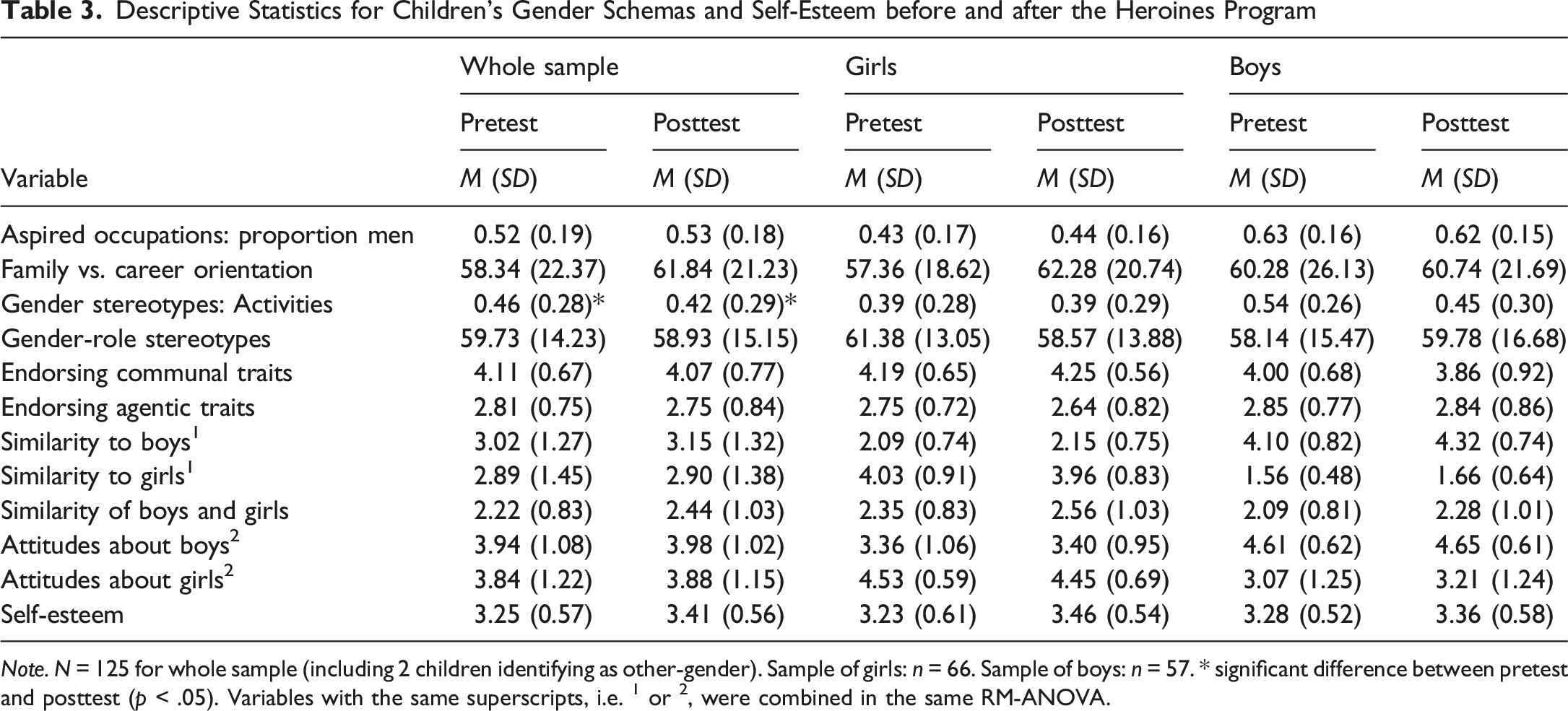
Note. N = 125 for whole sample (including 2 children identifying as other-gender). Sample of girls: n = 66. Sample of boys: n = 57. * significant difference between pretest and posttest (p < .05). Variables with the same superscripts, i.e. 1 or 2, were combined in the same RM-ANOVA.
Main Effects of Heroines Program
First, analyses on the whole sample revealed a significant decrease in gender stereotypes about activities from pretest to posttest (Pillais F (1, 123) = 5.43, p = .021, η p = .04). There were no significant changes from pre-to posttest on the other outcome variables (aspired occupations: Pillais F (1, 123) = 0.05, p = .818, η p < .01; felt similarity to boys and girls: Pillais F (1, 123) = 0.03, p = .855, η p < .01; self-esteem: Pillais F (1, 123) = 2.40, p = .124, η p = .02; family-career orientation: Pillais F (1, 123) = 1.07, p = .304, η p = .01; gender-role stereotypes, Pillais F (1, 123) = 0.10, p = .747, η p < .01; communal values: Pillais F (1, 123) = 1.07, p = .303, η p = .01; agentic values: Pillais F (1, 123) = 0.56, p = .455, η p < .01; similarity of boys and girls: Pillais F (1, 123) = 3.42, p = .067, η p = .03; attitudes about boys and girls: Pillais F (1, 123) = 0.43, p = .513, η p < .01).
Effects of Heroines Program for Boys and Girls
Second, analyses with child gender as moderator revealed there were no significant differences between boys and girls in pre-to posttest change on any of the outcome variables (aspired occupations: Pillais F (1, 120) = 1.35, p = .247, η p = .01; gender stereotypes about activities: Pillais F (1, 120) = 2.39, p = .124, η p = .02; family-career orientation: Pillais F (1, 120) = 1.94, p = .167, η p = .02; gender-role stereotypes, Pillais F (1, 120) = 1.56, p = .214, η p = .01; communal values: Pillais F (1, 120) = 3.57, p = .061, η p = .03; agentic values: Pillais F (1, 120) = 0.14, p = .714, η p < .01; similarity to boys and girls: Pillais F (1, 121) = 3.38, p = .068, η p = .03; perceived similarity of boys and girls: Pillais F (1, 120) = 0.06, p = .801, η p < .01; attitudes about boys and girls: Pillais F (1, 120) = 1.07, p = .303, η p = .01, self-esteem: Pillais F (1, 120) = 3.17, p = .077, η p = .03).
Discussion
This pretest-posttest study examined the effects of an intervention featuring counter-stereotypical female role-models (i.e., Heroines program) on children’s gender schemas and self-esteem. The quantitative survey revealed that the program reduced both boys’ and girls’ gender stereotypes about activities, thereby providing support for one of the pre-registered hypotheses. Other child-reported gender schemas (i.e., occupational aspirations, family vs. career orientation, endorsement of communal traits, perceived similarity to/of boys and girls, intergroup attitudes, self-esteem) did not change from pretest to post-intervention for boys as well as girls. This was not in line with the seven remaining pre-registered hypotheses. Publishing limited, non-significant, or unexpected effects of stereotype-reducing interventions is important as this body of literature is hampered by publication bias, with many low-power studies with nonsignificant results remaining unpublished (Paluck et al., 2021).
Limited Main Effects of the Heroines Program on Children’s Gender Schemas
Only one change towards more egalitarian or diverse gender schemas was identified in children after the Heroines program. However, this effect was small-to-medium sized and not consistently found across all gender schemas. The limited effects might be due to the broad nature of the Heroines program. More precise interventions, targeting specific psychological processes that contribute to a social or health problem might be particularly effective in reaching their goal (Kok et al., 2016; Walton, 2014). For instance, interventions specifically aimed at re-framing stereotypes that disadvantaged (i.e., lower-status) groups lack strength and agency can have powerful effects on the confidence and motivation of members from these groups to successfully pursue life goals (Bauer & Walton, 2024). In the context of promoting more egalitarian or diverse gender schemas in children via role models, repeated positive contact with counter-stereotypical peers of the other gender, for instance in an AI context (Hermann et al., 2025), might be particularly effective in increasing knowledge of and perceived similarity to individuals of the other gender, which in turn can have positive effects on other gender schemas as well (Boin et al., 2021).
The limited effects of the Heroines program could also be attributed to the diversity of the gender schemas that were assessed in this study. Some of the assessed gender schemas might be more closely aligned to the content of the Heroines intervention (e.g., occupational aspirations, gender stereotypes about activities, career-family orientation, communal values) than others (e.g., intergroup attitudes, similarity of boys and girls, gender identity).
Alternatively, the limited effects can be explained in light of gender schema theories, which state that gender schemas are formed over years in environments that are generally filled with gender-stereotypical information (Martin et al., 2002; Martin & Halverson, 1987). This overwhelming and accumulating exposure to gender-stereotypical information over the years might be difficult to counteract by short-term exposure to counter-stereotypical role models. Especially because gender schemas also shape the perception of this new information.
Converging with previous research, a small-to-moderate role-model effect was found for children’s gender stereotypes about activities (Buckley et al., 2022; Olsson & Martiny, 2018). It is not surprising that role-model interventions might have the most direct effects on children’s gender stereotypes because counter-stereotypical role models per definition break or diversify gender stereotypes by their behavior, roles, or characteristics. Also, the Heroines program specifically addressed the often counter-stereotypical activities the heroines engaged in, thereby stimulating more diverse beliefs in children about the appropriateness of certain activities for boys and girls. Even though this effect is limited, changes in one cognition might over time trickle down to other gender cognitions and behaviors as well because gender stereotypes are part of an interrelated and balanced system of gender cognitions (Greenwald et al., 2002).
No changes were found in children’s self-reported occupational aspirations as well as their expectations about future family versus career involvement. It has been suggested that in middle childhood children are particularly rigid in their orientation to gender-typical careers, being concerned primarily with which jobs are appropriate for one’s gender (Gottfredson, 2002). As such children’s career aspirations at this age might be quite resistant to change by short-term exposure to counter-stereotypical role models. During the program’s lessons children might have been temporarily inspired to think about alternative future occupations, which might not have generalized to the post-intervention assessment of children’s aspirations for career and family life.
Also, a change in endorsement of communal values was not found in the children’s self-concept. The program did include activating exercises in which children could practice specific communal (e.g., helping) and agentic behaviors (e.g., being assertive). Yet, the communal and agentic characteristics might have been linked too little to the role models in the book for them to have a specific effect on children’s communal characteristics. In addition, self-concept can be operationalized and measured in different ways, with the survey focusing on an evaluative aspect of children’s self-concept, by asking how important certain communal and agentic characteristics are to them. Maybe role models might have more influence on non-evaluative aspects of children’s self-concept, for instance associations between the self and communal or agentic characteristics (Greenwald et al., 2002). Moreover, the internal consistency of the agentic self-concept scale was not acceptable and barely acceptable for the communal scale, which might be another explanation for the lack of change in self-concept found with this measure.
Further, no effects of the Heroines program were found for children’s perceived similarity to, and of, other boys and girls, which might be because these beliefs were not specifically addressed in the program. Alternatively, the sole focus on female role models in the intervention might have created a context with little opportunities for children to directly observe and internalize similarities between the genders.
Moreover, there were no changes in intergroup attitudes after the Heroines program. Even though the program included successful female role models, this did not increase children’s positive feelings about girls. Although according to anecdotal evidence from teachers that children were generally positive about the adult female role models in the Heroines program this might not have generalized to children’s attitudes about female children. Alternatively, intergroup attitudes were measured by two single items, whereas in previous research more extensive measures were used including feelings and thoughts, allocation of resources, and difference in seating distance regarding same-gender and other-gender individuals (Halim et al., 2017). Maybe more comprehensive measurement of intergroup attitudes would have captured changes following the intervention.
Finally, no effect of the Heroines program was found on self-esteem. Even though the Heroines program focuses on strong, successful, and accomplished female role models, neither girls nor boys internalized the success experiences of the role models in their own self-esteem (Bussey & Bandura, 1999). It is possible that the success of the role models in the Heroines program was seen by children as too difficult to attain or too abstract to have a positive effect on their self-esteem (Betz & Sekaquaptewa, 2012). The lack of effect on children’s self-esteem also provides no support for the idea that the Heroines program might have a positive side-effect on self-esteem via changes in other gender schemas (Greenwald et al., 2002). Although children might have developed more egalitarian stereotypes about the appropriateness of certain activities for boys and girls after the role-model intervention, children did not necessarily feel better about themselves (self-esteem) because of these more egalitarian beliefs about gender. Possibly more time is needed for children to realize that having more egalitarian beliefs about boys and girls activities, reduces the pressure to behave in gender conform ways, which could subsequently contribute to higher self-esteem regardless of whether their activity preferences are gender-typical or not (Skinner et al., 2018).
No Gender-Specific Effects of the Heroines Program for Boys and Girls
A secondary aim of the study was to investigate differences between boys and girls in the effects of the Heroines program. Overall, no significant interactions were found between child gender and the effect of the Heroines program on children’s gender schemas and self-esteem. This might be due to the study being somewhat underpowered to detect interactions between child gender and the effects of the intervention.
That the effect of the Heroines program on gender stereotypes about activities was the same for boys and girls was not in line with the preregistered hypothesis. The counter-stereotypical nature of the role models might have been more important than the female gender of the role models for changing children’s gender stereotypes. Indeed, feeling similar to, or identification with, role models can be achieved on many demographical (e.g., age, ethnicity) or psychological (e.g., traits, values, struggles) grounds other than gender (Gladstone & Cimpian, 2021), which might explain the influence of female role models on boys’ gender stereotypes. The ability to identify with role models is an important underlying working mechanism of role-model interventions, as interventions that fail to facilitate identification with the role model may not result in role-model effects on children’s beliefs and behaviors (Olsson & Martiny, 2018). Because of the diversity of role models in the Heroines program both boys and girls could find similarities with the role models on many grounds, such as ethnicity, gender identity, socioeconomic status, values, traits, and interests. An important next step is to directly explore whether children’s ability to identify with role models indeed can be considered a mechanism or mediator that underlies the effects of the role models on children’s gender schemas and gendered behavior.
The effect of the Heroines program on boys’ gender stereotypes about activities also indicates that effects of female role-models on gender schemas might generalize to other-gender children. This fits with previous research in which female college students mentioned the specific importance of a female role model from their childhood for their motivation to pursue university education, whereas for male college students the gender of the role model did not matter (Lockwood, 2006). Role models from underrepresented groups (e.g., women, Black people) also were found to have the broadest positive effects on students’ STEM motivation and stereotypes, regardless of students’ own gender or ethnicity (Gladstone & Cimpian, 2021). When designing interventions solely with role models from underrepresented groups, or groups with less power, it is however important to consider possible initial resistance of the individuals from the majority or higher-powered group. Such initial resistance of boys to the Heroines program was also mentioned anecdotally by some of the teachers of the classes that participated in this study. Interventions to promote gender equality often elicit resistance in boys and men which may result from the male privileges associated with gender inequality, fears about identity change, or a need to defend male supremacy (Connell, 2003). Some ‘framing’ on the importance of the focus on underrepresented groups, or ‘re-framing’ of the intervention can be effective to lower resistance and enhance support (Flood et al., 2021).
Limitations
An important limitation of this research was the absence of a control group. Therefore, we cannot be certain that the effect of the Heroines program on children’s gender stereotypes about activities is completely due to the intervention or due to other changes. However, more non-significant than significant effects were found for the Heroines program. Therefore, the absence of a control group might be less problematic here than in studies with many significant effects, which could be due to other factors apart from the intervention. Additionally, we would expect minimal ‘natural’ change in children’s gender schemas during the brief period between the pretest and posttest measurement (e.g., maximum of 3 months). This is due to the moderate-to-strong short-term stability typically found for gender schemas and gender-typing (Delay et al., 2018; Martin & Ruble, 2010). So, if a control group had been included in this study, the effects of the Heroines program on children’s gender schemas would likely have been contrasted with minimal or no mean-level change in the control group.
Second, multiple analyses were conducted in this study, which increases the chance of Type 1 error (i.e., effects emerging by chance). The significant effect of the Heroines program on children’s gender stereotypes would not survive adjustment for multiple comparisons (i.e., p-value adjusted to .006). Thus, this effect needs to be interpreted with caution.
Third, the Heroines program did not solely consist of exposing children to counter-stereotypical role models, but also of class discussions and exercises about communal and agentic character traits. As a consequence, it is unclear whether the limited change in children’s gender stereotypes is a pure role-model effect or whether other elements of the intervention contributed to this change as well. In addition, the participating schools might not be representative for all schools in the Netherlands, as they might already value and foster gender equality more than non-participating schools. Yet, the participating schools were at least diverse in background characteristics and the scores of children gender schemas were not indicative of any bottom- or ceiling effects. Thus, it seems unlikely that the limited effects of the Heroines program found in this study are completely due to selection effects. Furthermore, in the child-reported survey the focus was mostly on gender schemas and not on gender-related behaviors. For this reason it was not possible to draw conclusions about the underlying mechanisms of a role-model effect, i.e., direct observation and imitation (Bussey & Bandura, 1999) or changes in gender schemas guiding children’s behavior (Martin & Halverson, 1987).
Conclusion
In sum, this study found limited effects of a newly developed role model intervention, the Heroines program, on children’s gender schemas and self-esteem. The limited effects might be due to the relatively short duration of the program, its broad nature, and the accumulating impact of other gender-stereotypical input from the environment on children’s gender schemas. Longitudinal role-model intervention studies are now needed to examine whether these small changes, if supported in children’s social environment, might contribute to changes in other gender schemas and behavior, and ultimately greater gender equality in the long term.
This research also revealed some important areas for improvement of the Heroines program, or role-model interventions more broadly, that might increase their effectiveness. This includes the framing of the importance of the focus on female role-models in order to reduce resistance among boys. In addition, the activating exercises of the Heroines program could be more explicitly linked to the communal and agentic characteristics of the heroines to foster children’s active exploration of their self-concept. Finally, more research is necessary on the mediators and moderators (e.g., child age, child ethnicity, religiosity, degree of urbanization) of role-model effects on children’s gender schemas and behavior, to further elucidate which role models are effective for which children and why.
Supplemental Material
Supplemental Material - Heroines: Limited Effects of an Educational Program With Counter-Stereotypical Female Role Models on Gender Schemas in Middle Childhood
Supplemental Material for Heroines: Limited Effects of an Educational Program With Counter-Stereotypical Female Role Models on Gender Schemas in Middle Childhood by Joyce J. Endendijk in Psychological Reports
Footnotes
Acknowledgements
The author would like to thank Femke Visser for her invaluable assistance with data collection, and the schools, teachers, and children for participating in this research.

Ethical Considerations
The study was approved by the Ethics Committee of the Faculty of Social and Behavioural Sciences of Utrecht University (FETC22-0331).
Consent to Participate
Informed consent was obtained from all subjects participating in the study.
Author Contributions
The author of this paper was solely responsible for Conceptualization, Methodology, Supervision of data collection, Formal Analysis, and Writing.
Funding
No funding was received for conducting this study.
Declaration of Conflicting Interests
The author has no competing interests to declare that are relevant to the content of this article.
Data Availability Statement
The data that support the findings of this study are available on request from the corresponding author.
Supplemental Material
Supplemental material for this article is available online.
Note
Author Biography
References
Supplementary Material
Please find the following supplemental material available below.
For Open Access articles published under a Creative Commons License, all supplemental material carries the same license as the article it is associated with.
For non-Open Access articles published, all supplemental material carries a non-exclusive license, and permission requests for re-use of supplemental material or any part of supplemental material shall be sent directly to the copyright owner as specified in the copyright notice associated with the article.
