




Abstract
Training studies have shown the positive effects of play tutoring on children’s social skills. This study investigates whether the theoretically suggested mechanism of change—social pretend play quality—explains the effect of play tutoring on social pretend play competence and social skills. Twenty-seven Swiss playgroups (N = 214 three- to four-year-olds) participated in a randomized intervention study with three conditions: the intervention group (play tutoring), the material group (half-dose), and the control group (treatment as usual). Weekly treatment sessions took place for six consecutive weeks. Pre-tests, post-tests, and a follow-up were made. Playgroup educators reported on children’s pretend play competence and social skills using a questionnaire. Children’s pretend play quality during treatment sessions was assessed by standardized behavioral observations. Using latent change models with indirect effects, we investigated whether the intervention effects of play tutoring on children’s pretend play competence and social skills are mediated by their social pretend play quality shown during the intervention sessions. The results indicate mediating effects of social pretend play quality on children’s change in social pretend play competence and self-oriented social skills (sociability and setting limits). The study supports social pretend play as a beneficial ground to promote social development but also indicates a more complex interplay of different change mechanisms.
Keywords
Children’s early social skill acquisition is significant for their positive development and has a meaningful impact on lifelong social experiences (Denham & Weissberg, 2004). These skills emerge during the preschool years and grow throughout childhood (Perren & Malti, 2015; Pons et al., 2004; Wellman et al., 2001). Social pretend play, which arises at the same time, might be an ideal ground for promoting children’s social development. Some training studies have already shown a positive link between pretend play tutoring and social development (Fung & Cheng, 2017; Hermann, 2017; Schellenberg, 2004), although others have found no effect on children’s social skills (Goldstein & Lerner, 2018). However, how pretend play tutoring might be linked to fostering children’s social development has not been clarified empirically (Bergen, 2013; Lillard et al., 2013). To shed light on this relationship, we must examine the causal factor(s). One line of argumentation attributes the effect of play tutoring to increased specialized adult interaction in social pretend play (Lillard et al., 2013). Another might be that the quality rather than the quantity of social pretend play is a crucial factor in the positive impact on children’s development (Bodrova et al., 2013; Elias & Berk, 2002; Slot et al., 2017).
This study focuses on the investigation of one path: social pretend play quality (SPPQ) as a potential mechanism of change in children’s social skills. Therefore, an experimental intervention study was used where SPPQ was manipulated.
SPPQ and Its Role as Crucial Factor
Pretend play starts to arise at around the age of 15 months (Smith, 2010) and then develops on both the symbolic and social level. Different elements of social pretend play can be identified throughout normative developmental progress (Hauser, 2013; Smilansky, 1968; Smith, 2010; Thompson & Goldstein, 2019): (1) Decentration describes how children’s orientation develops from themselves to others; (2) decontextualization is the use of an object as a substitute for another, which develops into imaginary transformation; (3) role taking stands for the elaborateness of engagement in roles; (4) planning of pretend play sequences (including metacommunication); and (5) sequencing, which means that pretend play initially consists of single sequences and develops into play that follows a logical script. Nevertheless, there are great interindividual differences in children’s frequency of engagement in pretend play and in their play quality. The level of each element contributes to an individual child’s play quality.
The quality rather than the quantity of social pretend play is considered the crucial factor for children’s development (Bodrova et al., 2013; Elias & Berk, 2002; Slot et al., 2017). Vygotsky (1978) ascribes to pretend play the potential to create the “zone of proximal development within the child” (p. 102), in which the child is able to go beyond itself and can accomplish tasks it would not be able to master in real-life situations. Elkonin (2005) describes mature play as a requirement for pretend play to function as a source of development. Thus, maybe a certain level must be attained before social pretend play becomes beneficial (Germeroth et al., 2019). In this reasoning, the quality of pretend play might be crucial for a positive causal linkage (Bodrova et al., 2013; Elkonin, 2005). In elaborated social pretend play, children must maintain their roles, negotiate play actions, and work out roles with each other, which requires self-regulation, cooperation, or assertiveness and might challenge these skills. It also provides an opportunity for children to experience positive peer interactions like sharing, waiting, or asserting themselves (Ashiabi, 2007). Social pretend play, especially in its high-quality form, is highly structured in itself and requires the child to follow a variety of rules (Berk et al., 2006). To be able to play a certain role and take part in social pretend play, the child must follow the social rules that the chosen role implicates or that were negotiated with the play partners. Nevertheless, the child and their play partner(s) actively choose their roles and create the structure of their play and thus the play is still child-directed.
Social Skills, Peer Relationship Quality, and Pretend Play Tutoring
Social skills can be understood as behaviors that affect interpersonal relations. While self-oriented skills (e.g., sociability, assertiveness) aim to satisfy one’s own goals and needs in social interactions, other-oriented skills (e.g., prosocial behavior, cooperation) take the needs and goals of others into consideration (Perren & Malti, 2015; Perren & Alsaker, 2009). Associations with other constructs can differ between self- and other-oriented social skills (e.g., Perren et al., 2008). Moreover, peer relationship quality refers to whether social interactions with peers result in successful relationships. Positive peer relationships are characterized by reciprocity (Dunn, 1983) and include mutual engagement of attention, communication, and sensitive coordination of actions (Hay et al., 2004). Forming such reciprocal and successful relationships might require both self- and other-oriented social skills and then again provide a rich training ground for the development of these skills (Hartup, 1992; Perren & Malti, 2015).
Several studies suggest positive correlations between social pretend play and different self- and other-oriented social skills such as cooperation, assertiveness, affective perspective-taking, and social activity (Connolly & Doyle, 1984; Li et al., 2016; Uren & Stagnitti, 2009). However, empirical support for a causal link between pretend play tutoring and social skills is inconsistent. Fung and Cheng (2017) showed a greater decrease in disruptiveness for 5-year-old girls who participated in pretend play training than for girls in non-pretend play activities. Boys benefited similarly from both activities. Schellenberg (2004), examining the effect of music lessons on 6-year-old children’s IQ, unexpectedly found effects of the control condition (drama lessons) on children’s adaptive social behavior (i.e., adaptability, social skills, and leadership). On the other hand, the study by Goldstein and Lerner (2018), using a dramatic pretend play intervention in a sample of 4-year-old children with a low socioeconomic status (SES) background, did not find effects on children’s social skills (i.e., comforting, altruism, or helping behavior). Hermann (2017) conducted a study with 4- to 6-year-olds and showed a positive effect of a pretend play intervention on children’s social behavior. However, it proved impossible to replicate this finding in another methodologically sound study (Hermann, 2017). Thus, some studies support the assumption of a positive link between pretend play tutoring and the development of both self- and other-oriented social skills, but the mixed results call for more in-depth investigations. Previous results of our intervention study (for simplified summary of results, see Table 1) showed that play tutoring and providing role-play material had positive effects on intraindividual changes in children’s social pretend play competence (Jaggy et al., 2022). Moreover, compared to children in the control condition, play tutoring had positive effects on changes in behavioral regulation, self- and other-oriented (such as social skills cooperative behavior, sociability, setting limits) and positive peer relationships. These positive effects of play tutoring might be attributed to SPPQ. Only a few studies have investigated the precise link between SPPQ and children’s social development. The results concern regulation skills: these studies support a positive association with pretend play quality or complex social pretend play (Elias & Berk, 2002; Matthews, 2008; Nader-Grosbois & Vieillevoye, 2012). Slot et al. (2017) showed a positive significant effect of the quality of pretend play on cognitive self-regulation as well as emotional self-regulation.
Simplified Intervention Results.
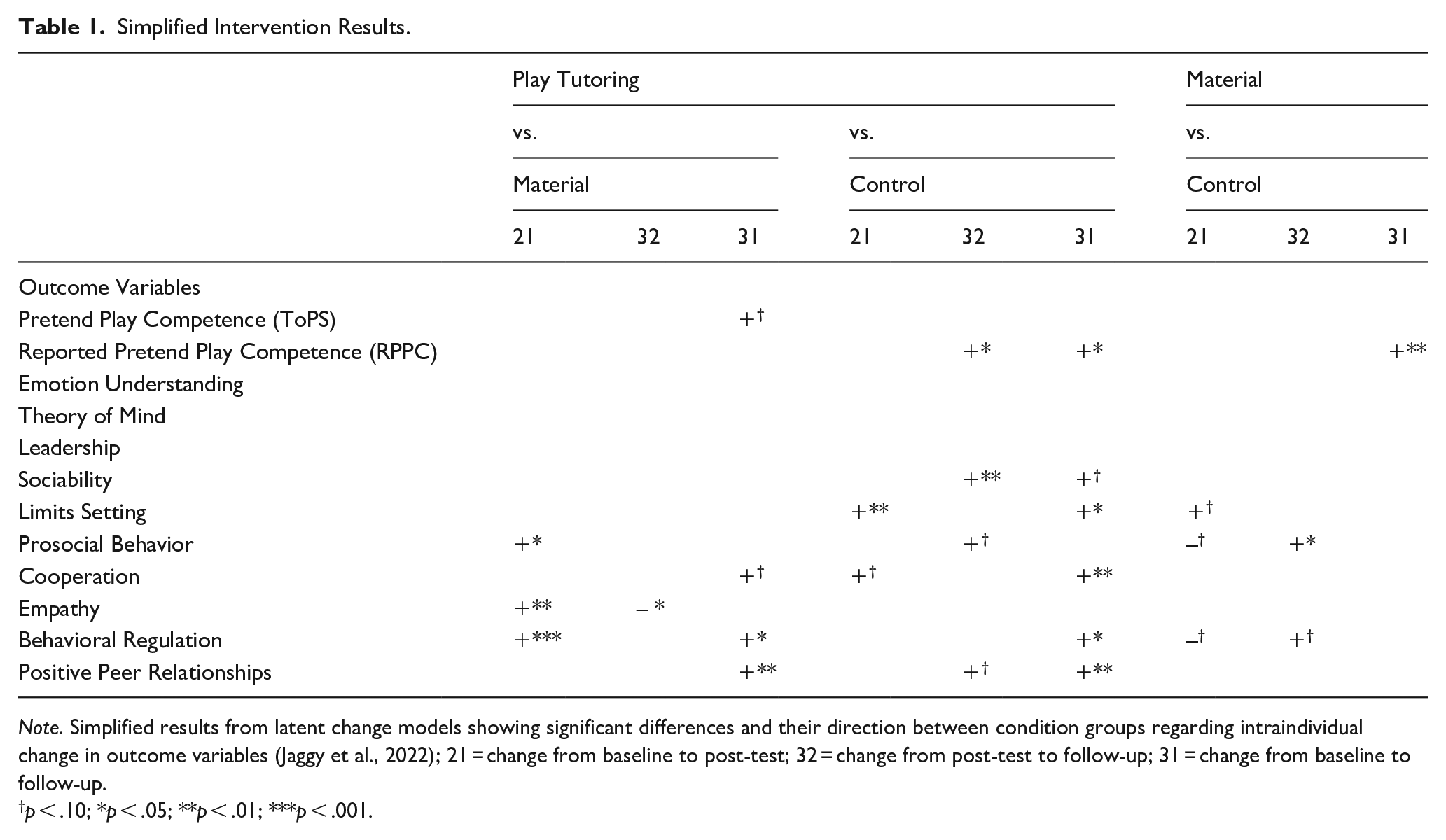
Note. Simplified results from latent change models showing significant differences and their direction between condition groups regarding intraindividual change in outcome variables (Jaggy et al., 2022); 21 = change from baseline to post-test; 32 = change from post-test to follow-up; 31 = change from baseline to follow-up.
p < .10; *p < .05; **p < .01; ***p < .001.
Promoting SPPQ by Play Tutoring
One popular educational strategy to promote SPPQ is play tutoring. Most of the studies on pretend play that used play tutoring as a training method (Berk et al., 2006; Christie, 1983; Craig-Unkefer & Kaiser, 2003; Gmitrova, 2013) are based on the work of Smilansky (1968) and Smilansky and Shefatya (1990). Johnson et al. (1987) describe specific supportive strategies: active engagement in roles, encouraging play actions through material or verbal encouragement, modeling play actions, and recognizing and including children’s ideas in the play. In addition, the findings of Perren et al. (2019) indicate that active play support had a positive within-person effect on children’s SPPQ, whereas play management was not associated with any change in children’s SPPQ. They provide additional empirical support for the potential of active play support to promote the quality of children’s social pretend play. Moreover, previous results of our intervention study showed the conditions manipulated children’s SPPQ. The SPPQ of children given role-play material (material group) was lower than that in the play tutoring group but higher than that in the control group, which can also be traced back to the educator’s support. In comparison with the play tutoring group, however, adult support in the material group was lower and less standardized (Kalkusch et al., 2021).
SPPQ as Hypothesized Mechanism of Change
During play in interaction with the play tutor, the child is motivated and supported to engage in high-quality play. We suggest a child needs to play individually at a higher quality level to internalize the play behavior and bring about a long-term change in play competence. Therefore, we differentiate in this study between social pretend play competence and quality. Children’s social pretend play competence can be defined as the developmental level of their play, that is, their competence to play in interaction with one or more play partners and show developmentally advanced features of pretend play (Jaggy, Perren & Sticca, 2020). On the other hand, we consider SPPQ as the quality (in terms of the mentioned features) the child shows during play. It is rather situate and dependent on characteristics of the play situation (e.g., interaction partners, Jaggy, Mainhard, et al., 2020; Kalkusch et al., 2021).
Such high-quality social pretend play contains several features that challenge children’s self- and other-oriented social skills, allows children to experiment with their behavior (Bretherton, 1989; Doyle & Connolly, 1989; Howes & Matheson, 1992), and gives them an opportunity to engage in positive social interactions (Ashiabi, 2007). We suggest that what is essential for manifested change in a child’s behavior is what reaches the individual child: SPPQ during play. Therefore, we hypothesize that the quality of children’s social pretend play is the causal factor for the positive change in children’s social skills.
Current Study
To investigate whether SPPQ is one path to children’s social development, we should first be able to manipulate it during play, and this should manifest directly through changes in children’s social pretend play competence. The intervention effect on children’s social pretend play competence would therefore be theorized as the proximal intervention effect. Effects on changes in children’s self- and other-oriented social skills, as well as positive peer relationships, are theorized as distal intervention effects, as they are conceptionally—but not directly—manipulated by the play tutoring.
In this study, we are interested in the function of our intervention: following the Vygotskian’s theoretical considerations, it might be that the SPPQ children reach during tutored pretend play causes change, especially in the behavioral level of their social skills (conceptual model in Figure 1). We therefore focus on the role of SPPQ during play tutoring for both proximal and distal intervention effects: (1) We hypothesize that the quality of social pretend play mediates the proximal intervention effect; (2) we also hypothesize that SPPQ mediates the distal intervention effects.
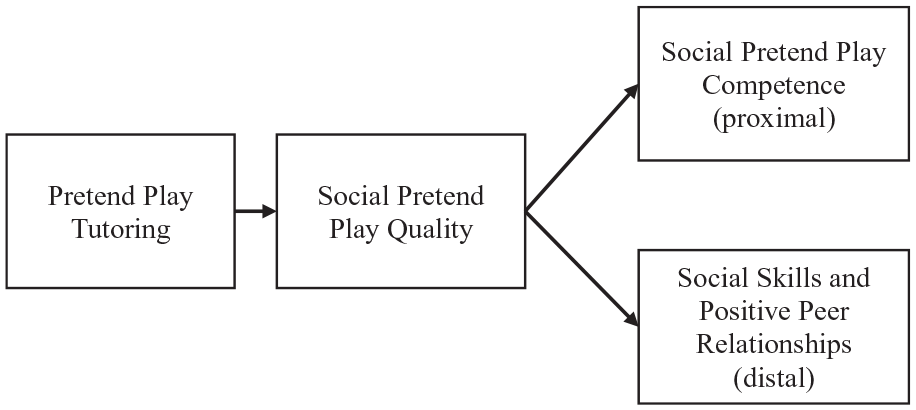
Conceptional Model.
Methods
Participants
In the recruitment procedure, 171 playgroups from the German-speaking part of Switzerland with a predominantly middle-class population were selected randomly and asked to participate; of these, 29 playgroups confirmed their participation. After the pre-test, two playgroups (total n = 6 children) had to be excluded due to very low participation rates. Out of 27 playgroups, parents of 215 children gave written permission for their child’s participation. We had for 210 children of the participating children the parental permission for collecting educator questionnaires; for 10 children, we were not allowed to evaluate video data; and for 4 children, we were only allowed to assess video data. One child had to be excluded at all from the analyzed sample as we only had permission to assess testing data, which was not used in this study. This resulted in a sample of 214 children (48% girls, Mage = 43.29 months, SDage = 6.5) for this study. For 80% of the children, German was at least one of the family languages. Demographic differences between the condition groups only concerned age: children in the play tutoring group were significantly younger than children in the material group, ΔM = −3.10, T(206) = −2.913, p < .01. In pedagogical work with young children, trained playgroup educators (N = 27) were between 28 and 59 years old (M = 44.7 years; SD = 9.3). The study has been approved by the Institutional Review Board (IRB, Ethics Committee) of the University of Konstanz (IRB statement 36/2016).
Study Design and Measurements
This randomized controlled intervention study used a pre–post-test design with a follow-up (two waves from 2017 to 2019). Data collection started in November and was followed by a pre-test and follow-up (approx. 15 weeks apart from each other). Each playgroup was randomly allocated to one of three condition groups: play tutoring (n = 10 groups, n = 77 children), material (n = 8 groups, n = 72 children) and control (n = 9 groups, n = 66 children). Between pre- and post-test, the intervention phase, consisting of six consecutive play sessions (each lasting 30 min, once a week), took place. The play sessions were video recorded in each condition group. Assessments of children’s behavior were based on the video material and were conducted by trained undergraduate students. For each measurement point, data regarding children’s competences and demographic characteristics were collected by means of educator questionnaires.
Experimental Conditions
The play tutoring group received a standardized set of role-play materials, as well as social pretend play tutoring (external adult interaction). The same set of materials was given to the material group, which received standard interaction with their playgroup educator (no external adult interaction). Standard adult interaction includes acting according to the educator’s normal schedule and behavior during free play time. The control group received no additional role-play material but had standard adult interaction with their playgroup educator. The social pretend play tutoring used is based on the work of Craig-Unkefer and Kaiser (2003) and Perren et al. (2019). The play tutoring followed a child-centered approach of active play support (specific play supportive strategies) with a particular thematic focus (“Let’s play firefighters”) and a standardized but flexible outline. The standardized set of role-play materials for the play tutoring and material group consisted of thematically appropriate role-play materials (e.g., helmet, vest, garden hoses, yellow, red, and orange silk scarves, and wooden blocks). Each play session followed the same structure: planning, play, and reflection phases. First, the play tutor and the children planned how, where, and what the group would be playing (within the thematic focus). Second, in the play phase, the play tutor took over an active role (e.g., firefighter). Within this role, the play tutor supported and enhanced children’s play by, for instance, modeling play actions and prompting interactions between the children. The sessions ended with a short interactive reflection (e.g., “What did the firefighters do today?”). The play tutoring was conducted by two trained play tutors, and its implementation regarding standardization and quality was monitored and examined in the first study wave.
Outcome Measures
Reported Social Pretend Play Competence (Proximal)
Playgroup educators completed a short questionnaire on children’s social pretend play competence (Perren & Sticca, 2019). The reported social pretend play competence (RPPC) scale encompasses three items: the overall quantity, the social quantity, and the level of children’s pretend play (e.g., “how often does the child show pretend play with others,” ωt1/t2/t3 = .90/.86/.87). The questionnaire provided a detailed theoretical definition of low and high social pretend play competence. All three items were rated on a 5-point Likert-type scale (i.e., 0 = never, 1 = seldom, 2 = sometimes, 3 = often, and 4 = always).
Educator Reports on Children’s Social Skills, Empathy, and Peer Relationship Quality (Distal)
Children’s playgroup educators completed a questionnaire on children’s empathy, social skills, and peer relationship quality. We used an adapted version of the empathy subscale from the HSA (Holistic Student Assessment; Malti & Noam, 2016; ωt1/t2/t3 = .89/.89/.93) and the subscale behavioral regulation from the BIKO (Seeger et al., 2014; ωt1/t2/t3 = .80/.81/.76). For this study, we used the subscales sociability (ωt1/t2/t3 = .87/.82/.83), setting limits (ωt1/t2/t3 = .65/.74/.71), prosocial behavior (ωt1/t2/t3 = .85/.82/.85), cooperation (ωt1/t2/t3 = .75/.74/.76) and peer relationship quality (ωt1/t2/t3 = .83/.87/.88) from the SOCOMP (Self- and Other-oriented social COMPetences; Perren, 2007). Items were rated on a 5-point Likert-type scale (0 = not at all true to 4 = definitely true). Two measurement points (t2/t3) lack questionnaires from one playgroup educator (n = 12 children) for personal reasons. The reliability of the models, evaluated using confirmatory factor analysis, was good.
Observational Measurement of SPPQ During Intervention Phase
Individuals’ SPPQ was rated for four 5-min cycles. These cycles were chosen randomly from six possible cycles per play session. Up to 24 cycles per child (i.e., six sessions of four cycles each) were therefore rated. Some cycles could not be assessed as children were not visible long enough to generate a reliable rating code. The number of play sessions varied between children for reasons of differing attendance and fewer video recordings in the second study wave (two sessions per group). To ensure objective ratings, an extensive training procedure based on a standardized manual was conducted to train six graduate students (double and consistency ratings). The reliability of the rating scale was also assessed using double coding of 18% of the videos, selected at random.
We developed a standardized manual to assess children’s SPPQ. This is based on characteristic features and steps of pretend play’s normative development (Thompson & Goldstein, 2019). The manual uses the following categories and response options: Decentration (0 = no decentration, 1 = self-related, 2 = object-related, 3 = other-related play); Decontextualization (0 = no decontextualization, 1 = imitation, 2 = object substitution, 3 = fantasy transformation); Role-taking (0 = no role-taking, 1 = role-taking without role-conforming behavior, 2 = role-taking with some role-conforming behavior, 3 = sustained role-taking and role-conformity); and Sequencing (0 = no sequencing, 1 = limited script elements, 2 = several actions without a script, 3 = flexible application of a script). The highest level observed was rated for each category. Children’s scores for each category were calculated as a mean score of all available cycles. The ratings were conducted by nine graduate students, who were trained based on a standardized manual. The inter-rater reliability for the scale was classified as good (intraclass correlation coefficient [ICC] = .82).
Data Analytic Steps
The first step produced a descriptive analysis for the model variables and examined differences between the condition groups regarding the mediators. In a second step, we chose a structural equation model (SEM) approach to test the mediation hypotheses of proximal and distal intervention effects. The intervention effects for each of the eight outcome variables were modeled in a separate latent change model (LCM; based on Jaggy et al. (2022)). The used LCM models the intraindividual change from baseline to post-test (first baseline change) and to follow-up (second baseline change; Geiser, 2011). A regression path from baseline to both latent change scores was included to control for baseline differences. Measurement invariance was tested for all outcome variables over the three measurement points used. The LCM of each outcome measure was extended to latent mediation model by including in each model an indirect effect of SPPQ (Figure 2). This enabled us to test the mediating effect of SPPQ on the proximal and distal intervention effects. Dummy coded variables represent the condition groups. Bootstrapping was used for standard error estimation. This approach is appropriate for estimating 95% confidence intervals (CIs) and p values of indirect effects and was used to determine the significance level of the indirect effects.
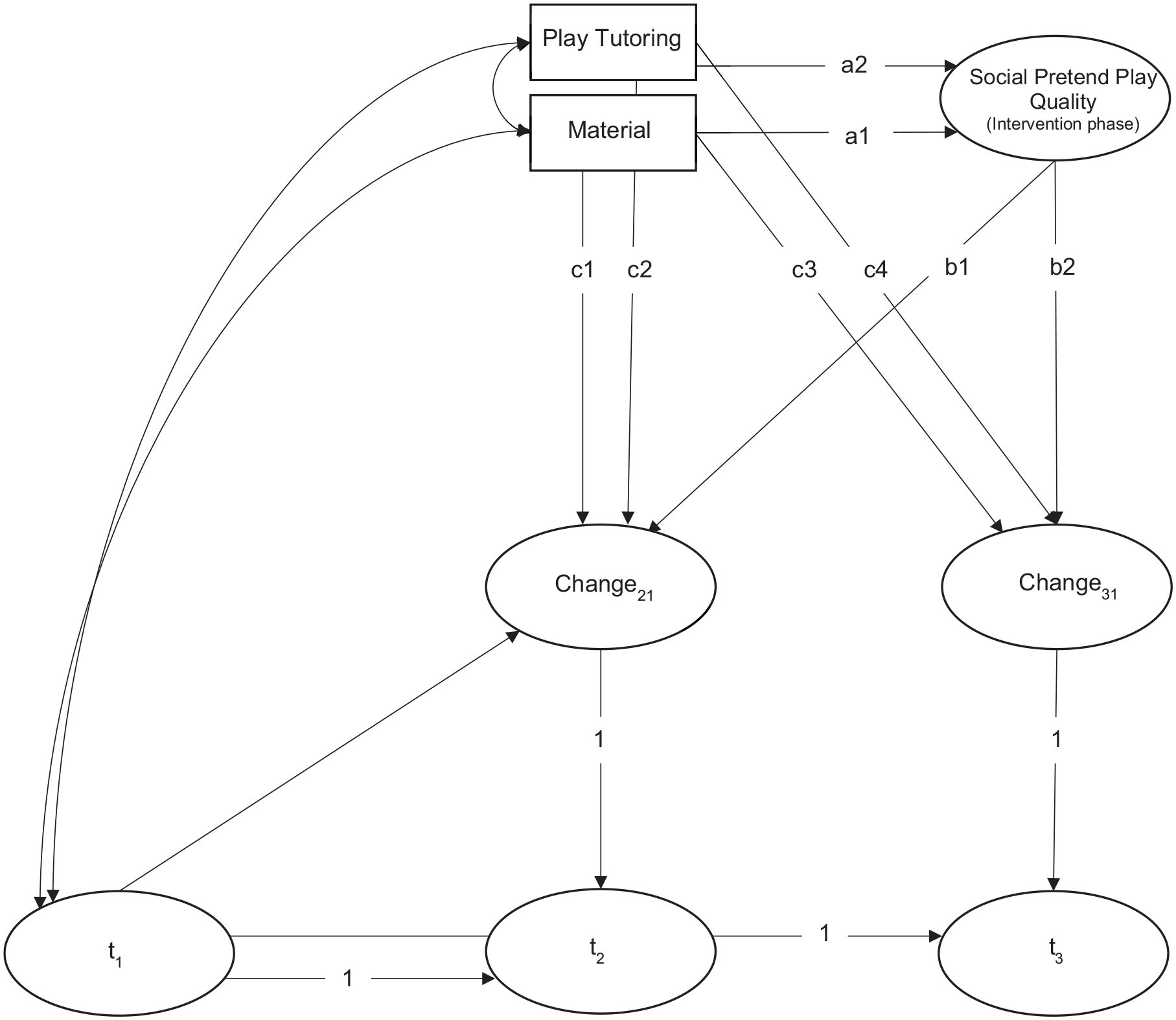
Latent Change Model of Outcome Variables with Indirect Effect of Intervention Effects over Social Pretend Play Quality (SPPQ).
Full-information maximum likelihood (FIML; Enders & Bandalos, 2001) was used to deal with missing data. Even if missing not at random (MNAR) were the case, this procedure produces less biased estimates than using traditional methods (Enders, 2010). The statistical software R (R Core Team, 2019) was used for all analyses. SEM was conducted using the R package lavaan (Rosseel, 2012).
Model Specifications, Model Fit Indices, and Measurement Invariance
The effect coding method was used to identify all latent variables (Little, 2013). We modeled the correlated uniqueness between t1, t2, and t3 scores of the outcome variables. To evaluate the fit of the models to the data, we used the root mean square error of approximation (RMSEA) and the comparative fit index (CFI). Based on these fit indices, the analyses yielded for all outcome variables at least partial strong measurement invariance with model fit indices higher than .94 for CFI and lower than .07 for RMSEA (model specifications are reported in more detail in Jaggy et al. (2022)).
We used four indicators for latent variable SPPQ. The error covariance between two indicators (decontextualization and decentration) was allowed, which resulted in a model with df = 1. For this model, the fit indices’ CFI = 1 and RMSEA = 0 have limited informative value, but the model withstands adding predictors, and thus more reliable fit indices (CFI = 0.99; RMSEA = .061) were achieved. Most LCM with indirect effects were classified as well-fitting models; a detailed overview of the model fit indices can be found in the supplementary material (Supplemental Table 4).
Results
Descriptive Results
Table 2 shows the latent mean and standard deviation for all variables. The differences in SPPQ between condition groups were calculated: the play tutoring group scored significantly higher than both the material group, ΔMSPPQ = 0.38, T(188) = 3.53, p < .001, and the control group, ΔMSPPQ = 0.86, T(188) = 7.85, p < .001. The material group scored significantly higher than the control group, ΔMSPPQ = 0.48, T(188) = 4.43, p < .001.
Latent Means and Standard Deviation of Outcome and Mediator Variables.
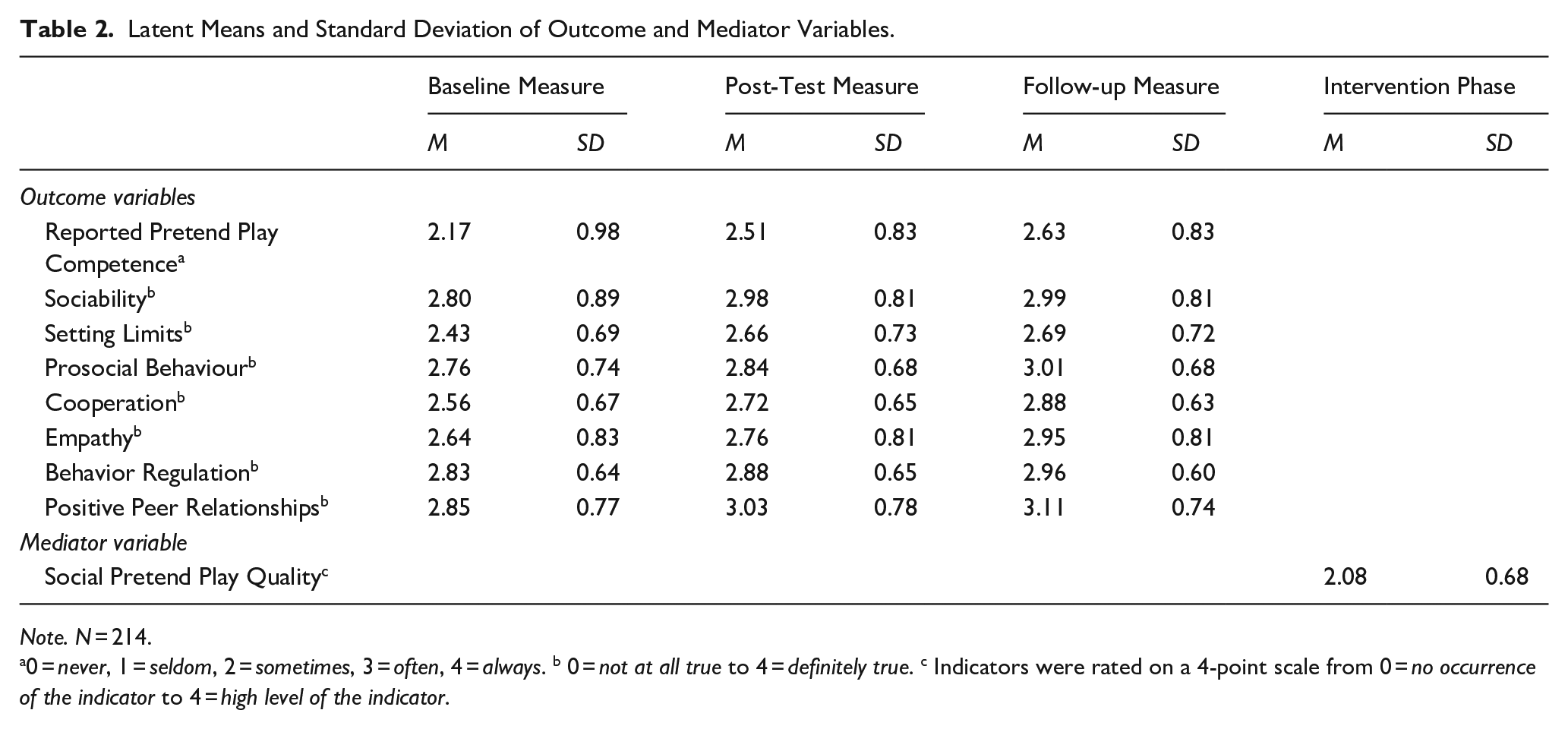
Note. N = 214.
0 = never, 1 = seldom, 2 = sometimes, 3 = often, 4 = always. b 0 = not at all true to 4 = definitely true. c Indicators were rated on a 4-point scale from 0 = no occurrence of the indicator to 4 = high level of the indicator.
Mediating Effects and Indirect Effects of SPPQ
Direct, indirect, and total effects for the latent mediation models are shown in Table 3. Total effects reflect proximal and distal intervention effects. These are mediated when the respective indirect effect is significant. Several significant positive indirect effects were found, but without a total effect of play tutoring or material group on changes in the outcome variables.
Standardized Indirect, Direct, and Total Effects of Latent Change Models with Social Pretend Play Quality (SPPQ) as Mediator.
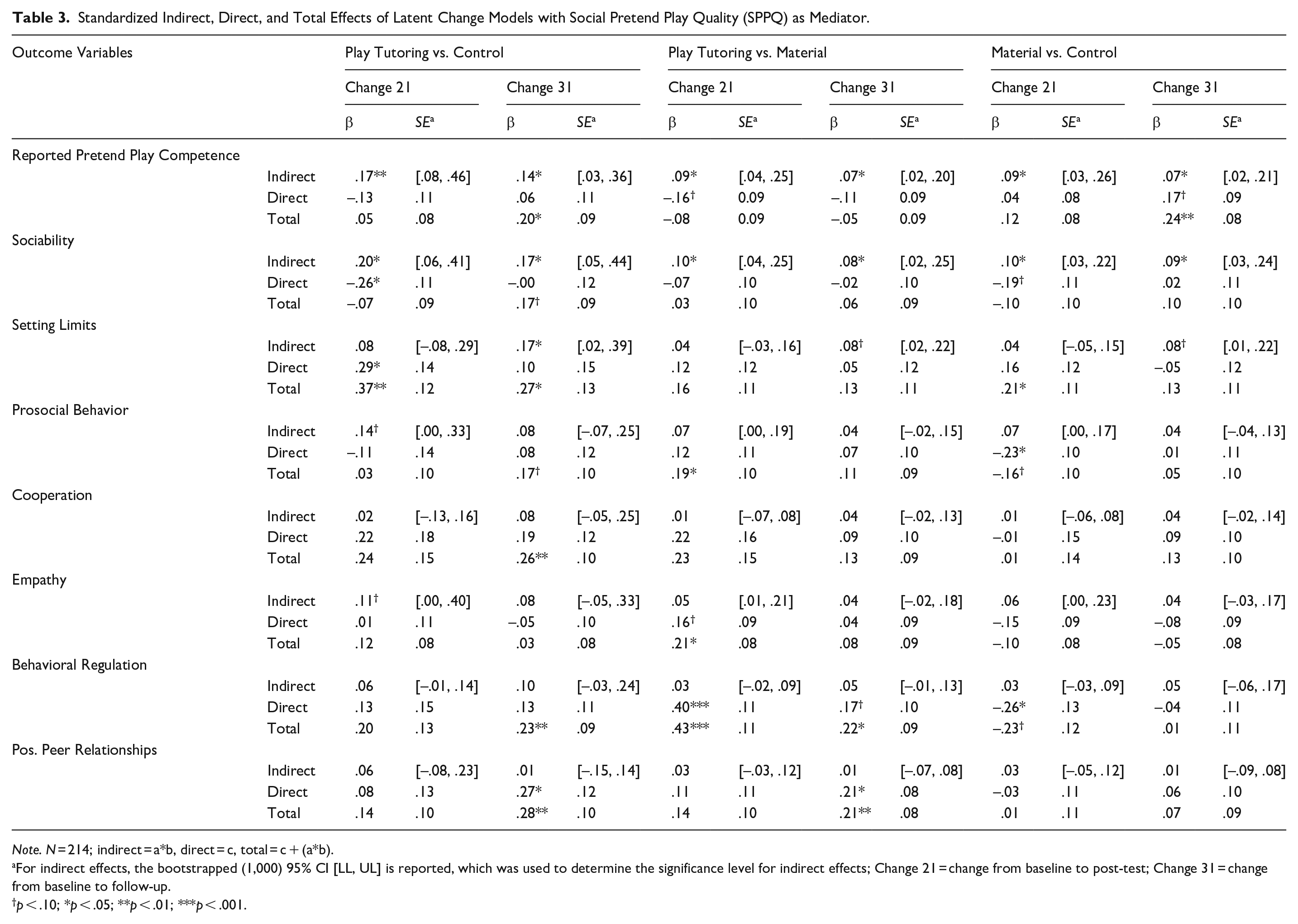
Note. N = 214; indirect = a*b, direct = c, total = c + (a*b).
For indirect effects, the bootstrapped (1,000) 95% CI [LL, UL] is reported, which was used to determine the significance level for indirect effects; Change 21 = change from baseline to post-test; Change 31 = change from baseline to follow-up.
p < .10; *p < .05; **p < .01; ***p < .001.
When comparing the play tutoring group versus control group, the results showed a significant indirect effect over SPPQ on the first baseline change in social pretend play competences and a mediated proximal intervention effect on the second baseline change. The distal intervention effect on the second baseline change in sociability (marginal) and setting limits was mediated. In addition, an indirect effect across SPPQ was significant regarding the first baseline change in sociability. SPPQ did not mediate the distal intervention effects on the second baseline change in cooperation, behavioral regulation, and positive peer relationships. A marginal significant indirect effect of SPPQ occurred on the first baseline change of prosocial behavior and empathy. There was no significant indirect effect of SPPQ on the first baseline change in cooperation, behavioral regulation, or positive peer relationships.
When comparing the play tutoring group versus material group, the results showed a significant indirect effect over SPPQ on the first and second baseline change in social pretend play competence and sociability. The distal intervention effects on the first baseline change in prosocial behavior, empathy, and behavioral regulation was not mediated by SPPQ, and neither was the effect mediated on the second baseline change in behavioral regulation and positive peer relationships. Apart from a marginally significant indirect effect over SPPQ on setting limits to the second baseline change, no additional indirect effects over SPPQ were found.
When comparing material group versus control group, the results showed a significant indirect effect over SPPQ on the first baseline change in social pretend play competence. The proximal intervention effect on the second baseline change in social pretend play competence was mediated by SPPQ. Significant indirect effect over SPPQ were found on the first and second baseline change in sociability as well as a marginal significant indirect effect on the second baseline change in setting limits. The distal intervention effects on first baseline change in setting limits, prosocial behavior (marginal negative), and behavioral regulation (marginal negative) was not mediated by SPPQ. No additional indirect effects of SPPQ were found.
Discussion
Using an experimental approach, we investigated whether SPPQ functions as a mechanism of change for the effect of play tutoring on social pretend play competence and social skills. The results of this study suggest a child’s SPPQ is relevant in promoting social pretend play competence. Results are mixed regarding the distal intervention effects: the play tutoring effects on change in sociability and setting limits are mediated by SPPQ, while we found no mediating effects of the play tutoring effects on changes in other social skills (e.g., cooperation) or positive peer relationships. This suggests that high-quality pretend play fosters self-oriented skills that aim to satisfy one’s own needs rather than other-oriented social skills. Different change mechanisms might be in play for other-oriented social skills and positive peer relationships.
SPPQ as a Mechanism of Change in Social Pretend Play Competence
The first mediation hypothesis is supported by the results. Pretend play tutoring and provision of role-play material had a positive effect on the change at follow-up of social pretend play competence compared to the control condition, and these proximal intervention effects were mediated by children’s SPPQ. The results support our hypothesis that the quality of social pretend play in which the child engages is significant for the change in competence. The adult’s play support functions as an initiator for change, but whether the support actually leads to higher quality in a child’s play is also important.
We also found unexpected indirect effects that might provide more insight or give us hints regarding the mechanism of change. No group effects manifested on the change at post-test, although our results displayed significant indirect intervention effects over SPPQ (when comparing all conditions). Following Dansky (1999), pretend play group intervention might result in a long-term change of pretend play behavior. Our finding supports the results and interpretation of Jaggy et al. (2022) regarding transfer effects: children in the intervention groups (play tutoring and material) might keep playing at a higher level of social pretend play, and this might later lead to a manifestation of the proximal intervention effects of play tutoring and material compared to the control condition. Another possible interpretation is that the play tutor and the material functioned as role models and inspiration.
SPPQ as a Mechanism of Change in Social Skills
The second mediation hypothesis is only partly supported by the results. SPPQ is cautiously indicated as a relevant mechanism of change for sociability and setting limits. However, the results do not support SPPQ as a causal mechanism of change for other-oriented social skills or positive peer relationships, while positive distal intervention effects of play tutoring remain for cooperation, behavioral regulation, prosocial behavior, empathy, and positive peer relationships. This suggests that some of these play tutoring effects on social skills and positive peer relationships were not caused by the SPPQ and is in line with the inconsistent results from other training studies (e.g., Goldstein & Lerner, 2018; Hermann, 2017; Schellenberg, 2004).
For sociability, the results indicate that playing at a higher quality level of social pretend play is the causal mechanism for the play tutoring effects. In addition, indirect effects of the intervention on SPPQ were found for the material group at changes at both timepoints and for the play tutoring group at the change at post-test. Perren et al. (2019) showed that more sociable children benefited more than less sociable ones from play tutoring in terms of their SPPQ. It might therefore be that only these children gained in their sociability in the short term, and it manifested only in the long term in a group effect—after the children might have kept playing. Otherwise, the educators were not instructed to provide play support in the material group (Kalkusch et al., 2021), thus their play support might not have had the same group focus as that of the external play tutors. This might have caused the more sociable children in the material group to engage in the pretend play activity, and finally produced only an indirect effect.
As expected, the long-term effect of play tutoring on the change of setting limits is mediated by SPPQ. Setting limits is part of assertiveness, for which correlational studies have found positive correlations with social pretend play (Connolly & Doyle, 1984; Li et al., 2016; Uren & Stagnitti, 2009). Surprisingly, the strong effect of play tutoring and the effect of the material group on the change at post-test are not mediated. One possibility is that two different mechanisms caused this result pattern: the short-term effect might be caused by the group setting and the long-term results accompany an increase in social pretend play competence. But this is only one possible explanation, which we are not able to test with the available information, and to a certain degree, this limits the interpretation of the results regarding setting limits.
The results regarding the other social skills and positive peer relationships suggest that different mechanisms cause the distal intervention effects. One reason might lie in discontinuous change patterns of behavior regulation, prosocial behavior and empathy (Jaggy et al., 2022). In line with the inconsistent findings of training studies, this study’s results cannot provide clear support for a link between social pretend play and these social skills (e.g., Goldstein & Lerner, 2018; Hermann, 2017). SPPQ is not supported as the relevant mechanism of change for cooperation or positive peer relationships either, despite a significant effect of play tutoring on the change. This raises the question of whether we changed something else. Perhaps play support by adults affected the children’s cooperative behavior directly. Social proximity is a condition that produces social stimuli in which social play lasts longer and is more likely to result in cooperative play between peers (Brownell et al., 2006). A social pretend play situation creates social proximity and potentially numerous opportunities for cooperative behavior. With support or mediation by an educator, these situations are more likely to result in behavior that is actually cooperative. Another mechanism might be at play in the quality of peer relationship. Children’s positive peer relationships might benefit from the closeness, positive climate, and joyfulness of pretend play as a social activity, even though they are not yet able to display high-quality pretend actions.
The Role of Adult’s Play Support and Potential Alternative Mechanisms of Change
The two intervention conditions mostly differed in terms of social interaction with adults. The key might therefore lie in the play support provided. The play tutor enables the children to reach a higher level of play and train their social pretend play competence, opening a door for the development of some social skills (e.g., self-oriented skills). But social pretend play implies not only a pretend component but also a social component. By manipulating SPPQ, we may also have opened another developmental door: social interaction (Vygotsky, 1978). The competent other plays an important role in developing competences (e.g., Johnson et al., 1987; Vygotsky, 1978), and this other could be an adult or a child’s peers. This study does not allow us to determine whether the important factor was a specific kind of support by adults (i.e., play support) or a more general adult support like scaffolding (Lillard et al., 2013), or some other element of the social interaction element in pretend play.
In addition, unobserved psychological mechanisms might have played a role. Weisberg et al. (2013) suggest that it might be a hodgepodge of different psychological mechanisms, such as joy or attention, which are a part of play and might contribute to a positive effect. The play tutors might have created a social play situation that included large parts of the group and that had a less selective character than in the material group. This might be another function of social pretend play: the joy and freedom children might experience could also be a reason why it is such a popular and intrinsically motivated activity (Smith & Vollstedt, 1985), in which every child can find a place and a role. This makes social pretend play an ideal ground for creating positive social interactions with peers and experiencing different social behaviors. The lack of mediating effects of SPPQ on several social skills might therefore not mean that the pretend element of social pretend play is irrelevant for children’s development, but it might have another function, at least for some social skills. The adult’s role also needs to be further clarified; he or she might be significant as a door opener to developmental processes within the child.
Strength and Limitations
A significant strength of this study is that our intervention design allowed the presumed mediator to be manipulated. This allowed us to test this mechanism and draw cautious conclusions about its causality. In addition, we measured the SPPQ of each child multiple times during play sessions. This provides us with a reliable measurement and, foremost, gives us a remarkable chance to gain insight into the functional process of a play tutoring intervention. Another strength is the methodological approach to modeling intervention effects with latent change models, which has the benefit of being free from measurement error and accounting for missing values in a cutting-edge way (Enders, 2010).
On the other hand, not being able to rule out the adult’s interactions as a mechanism is a limitation of this study. Thus, we cannot preclude that play tutoring’s effects are caused by increased adult interaction or examine a shared role in the mechanism of change. The study’s results are further limited, as social pretend play competence and social skills were assessed using educator questionnaires. Thus, we could only evaluate the effects on children’s skills with a single measurement instrument. Furthermore, the educators were not blind to the condition groups. However, the lack of significant effects at post-test contradicts this objection. Another limitation is that we cannot precluded that the outcome variables were influenced by additional unknown variables. In such a case, the associations between the outcome variables and the mediator might be biased. This would limit the validity of the separation of total effects into direct and indirect effects (Bullock et al., 2010).
Implications and Future Research
SPPQ might be the causal mechanism for social pretend play competence and self-oriented social skills. The mixed results of this study also highlight the importance of investigating what elements of the intervention the child received, instead of extrapolating from group differences to within-child effects, and that what the adult’s support promotes within the child is important. The child is an active agent in its own developmental process. The results call for further investigations of other mechanisms that might contribute to change in social development. To gain insight into the relevance of adult interaction as a mechanism of change, it would be necessary to install an additional condition that specifically supported children’s social skills, which might be challenging. Finding a social activity in which children do not include pretend elements would be difficult, considering the popularity of pretend play at this age. One possibility for gaining a more differentiated insight into the mechanisms might be to assess the children’s and adults’ specific social behavior during play as well. Considering that in our study the group differences manifested only at the change at follow-up, it might be that more timepoints are needed.
Nevertheless, the play tutoring had a positive effect on most social skills. Even though SPPQ might not be the relevant mechanism for certain social skills, it might be an ideal group activity for developing social skills in general. Its joyful character makes it intrinsically motivating, and each child can find a place and a role. But the results also indicate that an adult has an important role in this process. Thus, play support might be an anchor to engage the whole group, or at least large parts of it, in a joint social activity and therefore increase efficiency.
Conclusion
To conclude, the study showed that SPPQ is a relevant mechanism of change for social pretend play competence and self-oriented social skills. This cautiously links pretend play tutoring with children’s social development but also indicates a more complex interplay of different mechanisms. It is important to examine what reaches the child in an intervention; this highlights the child as an active agent in its own developmental process. The results support social pretend play as an ideal ground for promoting positive peer interactions and social learning.
Supplemental Material
sj-docx-1-jbd-10.1177_01650254221108163 – Supplemental material for Fostering children’s social pretend play competence and social skills through play tutoring: What is the mechanism of change?
Supplemental material, sj-docx-1-jbd-10.1177_01650254221108163 for Fostering children’s social pretend play competence and social skills through play tutoring: What is the mechanism of change? by Isabelle Kalkusch, Ann-Kathrin Jaggy, Carine Burkhardt Bossi, Barbara Weiss, Fabio Sticca and Sonja Perren in International Journal of Behavioral Development
Footnotes
Acknowledgements
We would like to thank all participants that took part in the study and enabled this research to be possible and to appreciate the work of numerous students who collected data and rated videos.
Data Availability
Data are available upon request.
Declaration of Conflicting Interests
The author(s) declared no potential conflicts of interest with respect to the research, authorship, and/or publication of this article.
Funding
The author(s) disclosed receipt of the following financial support for the research, authorship, and/or publication of this article: This work was supported by the Swiss National Fond (SNF) under Grant [SNF 100019_169786].
Ethical Approval
Study has been conducted in accordance with APA ethical guidelines.

Supplemental Material
Supplemental material for this article is available online.
References
Supplementary Material
Please find the following supplemental material available below.
For Open Access articles published under a Creative Commons License, all supplemental material carries the same license as the article it is associated with.
For non-Open Access articles published, all supplemental material carries a non-exclusive license, and permission requests for re-use of supplemental material or any part of supplemental material shall be sent directly to the copyright owner as specified in the copyright notice associated with the article.
