




Abstract
The directionality and longitudinal course between perfectionism and academic achievement throughout adolescence remains unclear as most studies rely on cross-sectional or short-term data and many examine these associations in university students who do not represent the full spectrum of learners. Moreover, most studies are hampered by their reliance on student-reported grades. We rectified these issues by examining the longitudinal relation between self-reported perfectionism and teacher-rated academic achievement (grade point average) in a sample of 604 Canadian adolescents followed prospectively from Grade 7 to Grade 12. Using path analysis, results demonstrated a positive relation between academic achievement and perfectionism. In particular, academic achievement positively predicted self-oriented perfectionism (SOP) at every time point. Academic achievement also positively predicted socially prescribed perfectionism across every time point. At no time point did either form of perfectionism predict academic achievement, highlighting that perfectionism is more likely an outcome of academic achievement, rather than an antecedent. Results also demonstrated that the cross-lagged effect from academic achievement to SOP was stronger at the transition from middle school to high school compared to pathways in all subsequent years. Overall, such findings imply that adolescents who experience academic success are more likely to experience increases in levels of perfectionism, which may increase their vulnerability to stress.
Over the past few decades, the definition of perfectionism as a personality trait has undergone much development. Initially, perfectionism was thought to be a one-dimensional construct and measures focused on the dysfunctional aspects of this trait (Stoeber, 2018). However, since the 1990s, perfectionism has been considered a multidimensional construct, consisting of positive and negative features (Stoeber, 2018). Still, there exists controversy in the research literature regarding whether perfectionism is adaptive and whether perfectionism is helpful or hurtful in the long term. Moreover, while perfectionism can affect individuals in all stages of life, and in many domains, little research has examined this trait in adolescence and its relation with academic achievement. Adolescence represents an important time in life, for both the appearance and development of perfectionism, and the importance of succeeding academically, making this an ideal time in which to examine perfectionism.
Perfectionism
Around 25–30% of adolescents are negatively impacted by perfectionism in terms of their greater risk for the development of depression, anxiety, and suicidal ideation (Flett et al., 2016). Perfectionism is a multifaceted construct, consisting of personal and social features, which can contribute to poor psychological adjustment (Affrunti & Woodruff-Borden, 2016; Asseraf & Vaillancourt, 2015; Hewitt et al., 2002; Vaillancourt & Haltigan, 2018). Perfectionism is commonly viewed as a “pervasive neurotic style” that often involves feelings of failure, guilt, shame, and low self-esteem (Hewitt & Flett, 1991). Although some researchers believe that no aspect of perfectionism is adaptive (Hewitt & Flett, 1991), others have made a distinction between positive and negative perfectionism (Hamachek, 1978; Slade & Owens, 1998; Stoeber & Rambow, 2007). Positive perfectionism, also referred to as adaptive perfectionism, has been explained as behavior in which individuals strive for achievement (Slade & Owens, 1998), while exhibiting the ability to manage this behavior based on the situation (Hamachek, 1978). Negative or maladaptive perfectionism, in contrast, has been explained as perfectionistic behavior that is engaged in order to avoid failures (Slade & Owens, 1998) and involves setting an unachievable level of performance in all situations (Hamachek, 1978). It also includes perfectionistic concerns, a negative cognitive component of perfectionism that entails being excessively self-evaluative and self-critical (Stoeber & Rambow, 2007).
In their pioneering research, Hewitt and Flett (1991) broke down perfectionism into three main dimensions: self-oriented perfectionism (SOP), socially prescribed perfectionism (SPP), and other-oriented perfectionism (OOP). These different dimensions of perfectionism can also co-exist at different levels within an individual (Kljajic et al., 2017). SOP refers to behavior which is self-directed, such as setting exceedingly high standards for oneself and strictly assessing one’s own performance (Hewitt & Flett, 1991). SOP also consists of a motivational component, which involves working toward perfection, while being determined to avoid failures (Hewitt & Flett, 1991). SPP involves striving for perfection due to the belief that significant others (e.g., peers, parents, coaches) have unrealistic expectations of the self (Hewitt & Flett, 1991). This implies a propensity toward social evaluation and striving for perfection for the purpose of gaining or maintaining social acceptance (Kljajic et al., 2017) and avoiding disapproval from others (Hewitt & Flett, 1991). Researchers have found that “positive striving” (positive perfectionism) is related to SOP and “maladaptive evaluation concerns” (negative perfectionism) is related to SPP (Frost et al., 1993). Finally, OOP consists of attitudes and expectations about the competencies of others, whereby the performance of others is strictly assessed (Hewitt & Flett, 1991). This often leads to impaired interpersonal functioning due to being critical, distrustful, and hostile toward others (Hewitt & Flett, 1991). As there is an absence of information on the development and appearance of this subtype of perfectionism in youth (Flett et al., 2016), OOP was not examined in the present study.
Perfectionism has been shown to be a stable personality trait emerging in childhood, with a tendency to display a delayed onset, with SOP accelerating around Grade 7 and SPP accelerating around Grade 10 (Herman et al., 2013). Asseraf and Vaillancourt (2015) found 1 year stability estimates for both SOP and SPP across Grades 7 and 8 (β = 0.66, β = 0.53, respectively), and Vaillancourt and Haltigan (2018) found evidence for the stability of SPP over time, whereby perfectionism remained stable or increased throughout adolescence. The long-term stability of perfectionism can put youth at risk for psychological maladjustment (Vaillancourt & Haltigan, 2018) and impaired academic achievement. This emphasizes the need for early intervention, especially when perfectionism seems to be on the rise. In a study of over 40,000 college students, Curran and Hill (2017) found that university students today are more demanding of themselves and perceive others to be more demanding of them, compared to previous generations of students.
Academic Achievement
Academic achievement represents an individual’s performance as decided by the educational institution (e.g., the ability to acquire knowledge in particular subjects) and is commonly measured by grade point average (GPA), which represents a student’s average of all final grades (Steinmayr et al., 2014). GPA is calculated by finding the average of a student’s grades across all courses from the academic year and demonstrates how well a student has scored across these courses, with a higher GPA indicating higher overall achievement (The Glossary of Education Reform, 2013). Courses are typically weighted proportionally to the number of credits they are worth. A student’s GPA is often used by universities and employers to evaluate a student’s overall capabilities (Steinmayr et al., 2014). Succeeding in academics is important for adolescents because it determines their ability to continue with higher education, which also influences their occupational prospects (Steinmayr et al., 2014). In a study evaluating the validity of high school grades in predicting university student success, it was found that high school GPA was the most robust predictor of cumulative fourth-year GPA among university students (above standardized test scores; Geiser & Santelices, 2007).
Perfectionism and Academic Achievement
The longitudinal relation between perfectionism and academic achievement remains unclear. Although some researchers have found perfectionism to be an outcome of academic success (Bieling et al., 2003; Damian et al., 2017), most research has focused on the influence of perfectionism on subsequent academic achievement (Kljajic et al., 2017; Shahar et al., 2006; Verner-Filion & Gaudreau, 2010). Researchers have demonstrated that while SOP and SPP tend to be highly correlated with one another, when examined as a vulnerability to academic achievement, the effect of the relation between perfectionism and academic achievement is different for each subtype of perfectionism. SPP is consistently negatively associated with academic achievement, while SOP tends to display a positive association with academic achievement. In their study of undergraduate students, Kljajic et al. (2017) investigated the coexistence of different levels of SOP and SPP. Their results indicated that students with pure SPP (high SPP and low SOP) suffered the worst outcomes, including higher academic burnout, lower school engagement, and lower semester GPA. In contrast, pure SOP (high SOP and low SPP) was correlated with lower burnout, higher engagement, and higher achievement. Mixed perfectionists (those high on both SOP and SPP) experienced outcomes better than pure socially prescribed perfectionists but worse than pure self-oriented perfectionists. Students with high SPP put a lot of pressure on themselves that can lead to negative feelings toward school and decrease engagement in academically related tasks (Kljajic et al., 2017). It has also been found that students who are more self-critical are less likely to partake in academic activities for their inherent enjoyment (Shahar et al., 2006). These individuals then experience a decline in their well-being including emotional exhaustion, loss of interest for schoolwork, and a general feeling of incompetence as a student (Kljajic et al., 2017).
In another short-term longitudinal study of university students, Verner-Filion and Gaudreau (2010) found that SPP was negatively correlated with GPA. They found that socially prescribed perfectionists were equally motivated by the need for achievement success and the avoidance of failures. This equal need to succeed, while avoiding failure, led to lower overall academic performance and decreased academic satisfaction. SOP, conversely, was positively correlated with academic success. The authors noted that individuals high on SOP were characterized as implementing goals to outperform others, rather than to avoid displaying incompetence. Specifically, students exhibiting pure SOP were more motivated by a need to succeed than by a need to avoid failure, marking a significant distinction in the way that SOP and SPP relate to academics. This distinction was supported in a study examining the relation between perfectionism and motivation in seventh graders, which found that SOP was positively associated with academic achievement (Bong et al., 2014). Although in this study SPP was not significantly associated with academic achievement, it was positively associated with outcomes such as test anxiety and school-related procrastination, factors which can affect achievement in the long term. Finally, in a study examining high school students, maintaining high personal standards was found to be positively correlated with GPA, likely because high personal standards are often related with displaying adaptive work habits and striving for achievement (Accordino et al., 2000). However, lower achievement was likely to follow when students experienced a discrepancy between what they actually achieved and what they expected to achieve.
Academic Achievement Predicting Perfectionism
In contrast, both perfectionistic strivings and perfectionistic concerns have been found to be an outcome of academic achievement (Damian et al., 2017). In this line of research, adolescents with high academic achievement and who develop an increased sense of academic efficacy as a result are more likely to demonstrate increases in perfectionistic strivings, as they develop the belief that perfection may be attainable (Damian et al., 2017). Furthermore, high achieving adolescents may think that others have increased expectations of them and perceive these expectations as further pressure to maintain success, which, in turn, increases their perfectionistic concerns (Damian et al., 2017). Alternatively, perfectionism and academic achievement may be linked in a downward spiral. For example, perfectionism may affect an individual’s subsequent academic performance, which may then lead to further increases in perfectionism, and so on. In a study examining the behavioral correlates of perfectionism, students completed a battery of perfectionism scales prior to writing a midterm exam and again after receiving their grades. Results demonstrated that adaptive perfectionism (which included a combined score on SOP, OOP, personal standards, and organization) was related with better performance on the exam, whereas maladaptive perfectionism (which included a combined scored on SPP, concerns over mistakes, parental criticism/expectations, and doubts about actions) was not (Bieling et al., 2003). However, students higher on either form of perfectionism prior to writing the midterm exam later set a higher standard for the next exam after receiving their midterm grades.
It is important to note that research shows that SOP has been regarded as encompassing both perfectionistic strivings (Damian et al., 2017; Enns et al., 2001) and perfectionistic concerns (O’Connor et al., 2009), whereas SPP has been regarded as reflecting evaluative concerns (Damian et al., 2017; Enns et al., 2001). This is fitting considering SOP entails striving for achievement and setting strict standards for oneself, while continuously evaluating and monitoring one’s performance and SPP entails excessive concern for the expectations and social evaluations of others (Enns et al., 2001). Therefore, although researchers have generally found a positive correlation between academic achievement and SOP and a negative correlation between academic achievement and SPP, the long-term effects of constantly striving for perfection have yet to be determined (Madigan, 2019). In other words, when adolescents high on SOP fail to meet their highly set standards, there may be a greater cost to long-term achievement.
Study Rational
Existing longitudinal studies on the link between perfectionism and academic achievement are few and are relatively short term in nature, often less than a year. In a recent meta-analysis of perfectionism and academic achievement, Madigan (2019) included 37 studies, only one of which used a longitudinal design. Longitudinal data allow researchers to explore many facets of a model that are not possible in cross-sectional data, including whether an effect is stable across time, as well as evidence for temporal precedence (MacKinnon et al., 2007). In the present study, we examined perfectionism and academic achievement across 6 years of adolescent development, which afforded us the opportunity to examine the temporal priority between these variables.
Additionally, most studies use self-reported measures of academic achievement, as student-reported grades are easier to obtain. Indeed, very few studies have used teacher-derived GPA obtained from official school records (Accordino et al., 2000; Kljajic et al., 2017; Shahar et al., 2006), even though self-reported grades have been shown to be unreliable (Kuncel et al., 2005). In the present study, we assessed academic achievement using official school records of teacher-rated GPA.
Most of the literature developed around perfectionism and academic achievement has focused on university students, who likely function differently from adolescents in middle school and high school. Adolescence is an important developmental period for perfectionism, due to increased levels of self-consciousness, social comparisons, and social evaluations that occur at this time (Flett et al., 2002). Researchers have shown that social fears become predominant during adolescence, with an increased sensitivity to social evaluations (van den Bos et al., 2016). Social-evaluative threat happens when a significant part of one’s self-identity may be judged negatively by others and leads to increased stress among adolescents (van den Bos et al., 2016). The relation between GPA and SPP in adolescence may therefore be affected by this, especially for those who deem high academic performance to be an important part of their identity. High school students also represent the full spectrum of academic achievers, while university students consist disproportionally of high achievers, due to the selection effect by which individuals with higher grades more frequently move on to higher education.
Finally, researchers have found that the transition to secondary school leaves adolescents especially vulnerable to decreased levels of academic achievement, as the high school environment significantly differs from that of elementary education (Evans et al., 2018). In high school, classrooms are typically larger, students must create new student–teacher and peer relationships and adjust to new academic standards, which tend to be higher and require more intrinsic motivation (Evans et al., 2018). In addition, students’ grades become more important at the end of high school, as these grades are critical for admission into university. Leonard et al. (2015) found that the pressure to succeed academically was one of the most substantial sources of stress for students, as better high school grades are necessary for admission into top tier universities. For these reasons, it is important that researchers examining perfectionism and academic performance assess these relations across adolescence. In the present study, we examined perfectionism and academic achievement from Grade 7 to Grade 12, with a time-specific transition from middle school to high school occurring from Grade 8 to Grade 9.
Present Study
Considering the potentially harmful relation between perfectionism (i.e., SPP) and academic achievement in youth, it is important to advance research that will help outline what these relations look like over time, by determining the patterns that occur throughout child development (Affrunti & Woodruff-Borden, 2016). Accordingly, we investigated the longitudinal associations between self-reported perfectionism and teacher-rated GPA and examined the direction and effect of these associations.
Per previous research, we expected SOP and SPP to be positively correlated within each time point. We predicted that SOP and academic achievement would share a positive association within- and across time, whereas SPP and academic achievement would share a negative association within- and across-time. Researchers have found differences in the relation between SPP and academic achievement depending on whether SPP is examined as a precursor or an outcome of academic achievement. When SPP is studied as a vulnerability to academic achievement, researchers consistently find a negative relation between the two variables. However, when academic achievement is examined as a predictor of perfectionism, both types of perfectionism, including SPP, subsequently increased, demonstrating a positive relation. Therefore, in terms of the directionality of these associations (perfectionism to GPA or GPA to perfectionism), no predictions were made given the mixed research findings.
Although some students may be vulnerable to decreased achievement as they begin high school, we examined whether a stronger cross-lagged relation between perfectionism and academic achievement would be found at this transition (middle school to high school) compared to future cross-lagged relations, given the mounting pressure to succeed that adolescents may experience as they begin their high school journey. We also examined if the associations (within-time and cross-lagged) between perfectionism and academic achievement were stronger across different developmental periods. For example, it could be that at the end of high school, the expected associations between SOP and academic achievement are stronger than at the beginning of high school given the importance of grades for university admission. Our developmental and school transition examinations were exploratory in nature, and thus, no prior predictions were made.
In our model, we controlled for known predictors of academic achievement including socioeconomic status (SES; family income and parental education), biological sex, and the presence of an Individual Education Plan (IEP). SES has been shown to be a strong predictor of adolescent academic achievement, with lower SES in childhood generally associated with lower academic achievement (Davis-Kean, 2005; Rosen et al., 2018). Evidence further suggested that the academic achievement gap between children of low and high SES remained stable from the ages of 7 to 11 years, but widened between the ages of 11 and 15 years, demonstrating a cumulative effect over time (Caro et al., 2009). Although sex differences in perfectionism are not typically found (Madigan, 2019), girls tend to outperform boys academically across school subjects (Voyer & Voyer, 2014). Accordingly, we controlled for biological sex in our analyses. An IEP, also known as an Individual Education Plan, is a written document that outlines services (educational accommodations and/or modifications) that may be required by a particular student, based on their needs related to learning abilities (Ontario Ministry of Education, 2017). This encompasses students who have “behavioural, communicational, intellectual, physical or multiple exceptionalities” and therefore meet criteria for being deemed as an “exceptional pupil,” which also includes gifted students. This may lead to accommodations and/or modifications that are either above or below a student’s current grade level (Ontario Ministry of Education, 2017). Therefore, the presence of an IEP was also used as a control variable, as the multitude of reasons for having such a plan is likely to be a predictor of academic achievement. For example, Gao and Eldessouki (2012) found that most students classified as having a learning disability displayed lower academic achievement.
Method
Participants and Procedure
Data for this study were drawn from the McMaster Teen Study; an ongoing prospective study that began in the Spring of 2008. This longitudinal study examines the relations between bullying, mental health constructs, and academic achievement among youth. Ethical approval for research involving human participants was obtained from McMaster University (protocol 2006-166) and the University of Ottawa (protocols 08-11-03 and 08-11-03B). At Time 1, participants were recruited from a random sample of 51 schools that included fifth-grade students (using a random number generator; N = 87 eligible schools) within a large Southern Ontario public school board. All Grade 5 students in the selected schools were invited to participate; 875 participants consented to take part in the longitudinal arm of the study (Time 1 students per school min = 4, max = 51, median = 16). 1 Parental consent and youth assent were sought annually. Of participants who initially consented, 703 provided longitudinal data in at least one time point between Time 2 and Time 8. At Time 1, and in the Spring of each subsequent year, parents provided consent for their child to participate in the study and for access to their provincial student records, specifically their Ontario Student Records (OSR). Students also provided yearly assent to participate in the study. Most of these participants were White (71.4%), and about half were girls (52.8%). At Time 1, participants completed a paper/pencil version of the survey in their classrooms. Subsequently, participants completed the survey from home, either on paper or online. Parent interviews were also completed by telephone, in each year of the study, by a trained research assistant (for more information, see Vaillancourt et al., 2013). The present study consists of a sample of 604 participants (due to attrition that occurs over time; 54.0% girls and 46.0% boys), assessed from Time 3 (T3; Grade 7) to Time 8 (T8; Grade 12) who had reports of perfectionism and grades reported in at least one time point in this time frame.
Measures
Perfectionism
Perfectionism was measured using the Child and Adolescent Perfectionism Scale (CAPS) and was completed by participants at each time point. CAPS is a 22 item self-report measure that examines both SOP (12 items) and SPP (10 items) and contains items such as “I try to be perfect in everything I do” and “There are people in my life who expect me to be perfect” (Flett et al., 2000). All items are rated on a 5-point Likert-type scale, with higher scores indicating higher levels of perfectionism (0 = false-not at all true of me, 5 = very true of me). Items were averaged to create composite scores. The dimensional nature of the CAPS has been confirmed using factor analysis (Flett et al., 2016). The internal consistency of both the SOP subscale (α = 0.83–0.91) and SPP subscale (α = 0.88–0.91) of the CAPS are high for the present study (Grade 7–12).
Academic achievement
Academic achievement was measured using students’ yearly overall GPA, by way of their OSR. An OSR contains an evaluation of the student’s achievement of the curriculum expectations in each school subject for that reporting period. Grades were scored as percentage grades. In elementary school, term averages were computed from grades in English, French, science/technology, history, geography, art, and health/physical education (Grade 7, three terms; Grade 8, two terms). Averages for subjects with multiple components (e.g., English reading, writing, and oral) were computed prior to taking term averages. Term averages were used to calculate annual GPA scores. In secondary school, course selection was not standardized, and students could enroll in a variety of courses, often resulting in an unbalanced course load over semesters. For these reasons, an overall annual GPA was calculated in Grades 9–12 by taking an average of the marks within each year. Lower GPA scores indicated lower academic achievement.
Covariates
SES was controlled for by way of household income and parental education. Parental household income was measured on an 8-point scale, ranging from 1 = less than CAN$20,000 to 8 = more than CAN$80,000. Parental education was measured using a 5-point scale, to determine the level of education attained. Response options on this scale included 1 = did not complete high school, 2 = completed high school, 3 = college diploma or trades certificate, 4 = university undergraduate degree, and 5 = university graduate degree. As these variables are shown to be highly consistent over time, covariate data used in the present study were measured at Time 1 (or Time 2, if Time 1 data were missing). Household income and parental education were collected from the main caregiver who participated in the study and treated as continuous in the analysis. Participants’ biological sex was also controlled for in the primary analyses. Status of a participant’s IEP was assessed by asking of parents annually in Grades 9 through 12. A participant was classified as having an IEP if a parent indicated presence of a plan at any time point.
Data Analysis
Using Statistical Package for the Social Sciences (SPSS v. 26), a series of Chi-square and independent sample t tests were used to determine whether significant differences existed between individuals in the analytic sample and those in the nonanalytic sample, followed by a missing completely at random (MCAR) analysis. Using Mplus version 8.1, we used a cross-lagged panel model to describe the relation between perfectionism and academic achievement and to explore the directionality of these relations. Through the inclusion of within-time covariance terms and autoregressive stability paths, the cross-lagged effects between variables can be isolated. That is, cross-lagged effects represent how changes in one variable are associated with changes in another (e.g., changes in GPA from Grade 7 to 8 are related to changes in SOP from Grade 8 to 9, controlling for their concurrent associations at each time point). Models were examined using path analysis with maximum likelihood estimation with missing data full information maximum likelihood estimation (FIML). To test model fit, a series of nested models were performed with statistical fit being assessed at each step, with all future models including the parameters estimated in the previous model (Vaillancourt et al., 2013). All models included the control variables of household income (mean centered), parental education (mean centered), biological sex (0 = boy, 1 = girl), and IEP status (0 = no IEP, 1 = IEP). Model 1 included within-time covariance terms between study variables (e.g., Grade 9 SOP with Grade 9 SPP). In Model 2, 1-year and 2-year stability paths were added between repeated measures (e.g., Grade 10 SOP to Grade 11 SOP; Grade 10 SOP to Grade 12 SOP). In Model 3, cross-lagged paths were added between SPP and SOP at adjoining time points (e.g., Grade 9 SOP to Grade 10 SPP) to control for the interdependence between the two forms of perfectionism. In Model 4, the cross-lagged paths between GPA and perfectionism were examined, that is, GPA predicting SOP, GPA predicting SPP, SOP predicting GPA, and SPP predicting GPA. We then examined invariance of sets of repeated cross-lagged paths by constraining the parameter estimates to be equal. Where there was no statistically significant decline in model fit, as assessed by the Chi-square difference test, the constraints were imposed for parsimony (Model 5). 2
Fit indices including the Chi-square test statistic, the root mean square error of approximation (RMSEA), standardized root mean square residual (SRMR), the comparative fit index (CFI), and Tucker–Lewis index (TLI) were used to assess model fit. Values of CFI and TLI of .95 and above, as well as RMSEA and SRMR values of .08 and below, were evidence of a well-fitting model (Browne & Cudeck, 1992; Hu & Bentler, 1999). Nested models were compared with the Chi-square difference test. In the case of a nonsignificant difference, the more parsimonious model was chosen. In addition, lower Akaike information criterion (AIC) values indicated a better fitting model. Once the final model was identified, follow-up analyses were conducted to investigate differences in the magnitude of significant within-time associations over the study period as well as cross-lagged pathways relative to the high school transition lag (i.e., Grade 8 to Grade 9) using Wald Chi-square tests. Since all estimates following Grade 7 are residual values (i.e., controlling for prior levels), we only examined differences between parameters from Grade 8 on. Further, the statistical significance of indirect pathways was tested using the MODEL INDIRECT command and examined using bootstrapped confidence intervals (5,000 draws) and Bayesian estimation (20,000 iterations) to ensure replication of results.
Results
Missing Data Analysis
A series of Chi-square and independent sample t tests were conducted to determine whether significant differences existed between individuals in the analytic sample and individuals in the nonanalytic sample on demographic variables. Analytic and nonanalytic samples did not vary by sex, χ2(1) = 1.08, p = .299. In comparison to the nonanalytic sample, individuals in the analytic sample were more likely to be White, χ2(1) = 16.459, p < .001, more likely to have a higher household income, t(336.70) = −5.99, p < .001, and more likely to have parents with a higher level of education, t(805) = −7.59, p < .001. Further, to examine missingness in the analytic sample, a Little’s MCAR test was completed with study variables. Results indicated that the data were not MCAR, χ2(1481) = 1,717.70, p < .001. An examination of t tests comparing those with missing data and those without on other study variables indicated that participants who were missing survey data, that is those missing SPP and SOP scores, had lower grades at each time point.
Descriptive Statistics
The descriptive statistics and correlations for all study variables are presented in the Supplemental files (Table S1 and S2). All study variables demonstrated skewness and kurtosis values that were acceptable for path analysis (i.e., less than 3 and 10, respectively; Kline, 2015). All correlations between SOP and SPP were positive and statistically significant. SOP was significantly positively correlated with GPA at all time points except for Grade 7 SOP and Grades 11 and 12 GPA. Several positive correlations were found between SPP and GPA, SPP in Grade 9 with GPA in Grade 7, Grade 10 SPP with Grade 7 GPA, Grade 11 and Grade 12 SPP with Grades 7–10 GPA.
Path Models
Model fit statistics for each step are found in Table S3 in the Supplemental files. Model 1 consisted of the control variables and associated paths as well as within-time covariances between SOP, SPP, and GPA. This model had poor fit to the data. In Model 2, due to the high stability in each of the constructs over time, the 1-year and 2-year across-time stability paths were added, which resulted in a significantly better fit to the data, Δχ2(27) = 4,898.300, p < .001. In Model 3, cross-lagged paths between SOP and SPP were included to control for the possible inter-relations between forms of perfectionism overtime. This addition improved the fit of the model to the data, Δχ 2 (10) = 23.055, p = .011, and paths were retained. In Model 4, the longitudinal associations between perfectionism and GPA were added. This resulted in significantly better fit than Model 3, Δχ2(20) = 99.428, p < .001. The resulting model, including within-time covariances, across-time stability, and cross-lagged paths, fit the data well, χ2(78) = 134.570, p < .001, RMSEA = .035 [.025, .044], SRMR = .026, CFI = .992, TLI = .977, AIC = 35,651.380. We further examined the longitudinal invariance of cross-lagged paths and concluded that GPA to SOP paths varied in magnitude over time, Δχ2(4) = 24.570, p < .001, whereas paths from SOP to SPP, Δχ2(4) = 8.062, p = .089; SPP to SOP, Δχ2(4) = 4.734, p = .316; SPP to GPA, Δχ2(4) = 1.671, p = .780; GPA to SPP, Δχ2(4) = 7.093, p = .131; and SOP to GPA, Δχ2(4) = 6.338, p = .175, were time invariant and subsequently constrained. The resulting model, Model 5, was considered the final model and fit the data well, χ2(98) = 158.352, p < .001, RMSEA = .032 [.022, .041], SRMR = .029, CFI = .991, TLI = .980, AIC = 35,635.162 (see Figure 1).
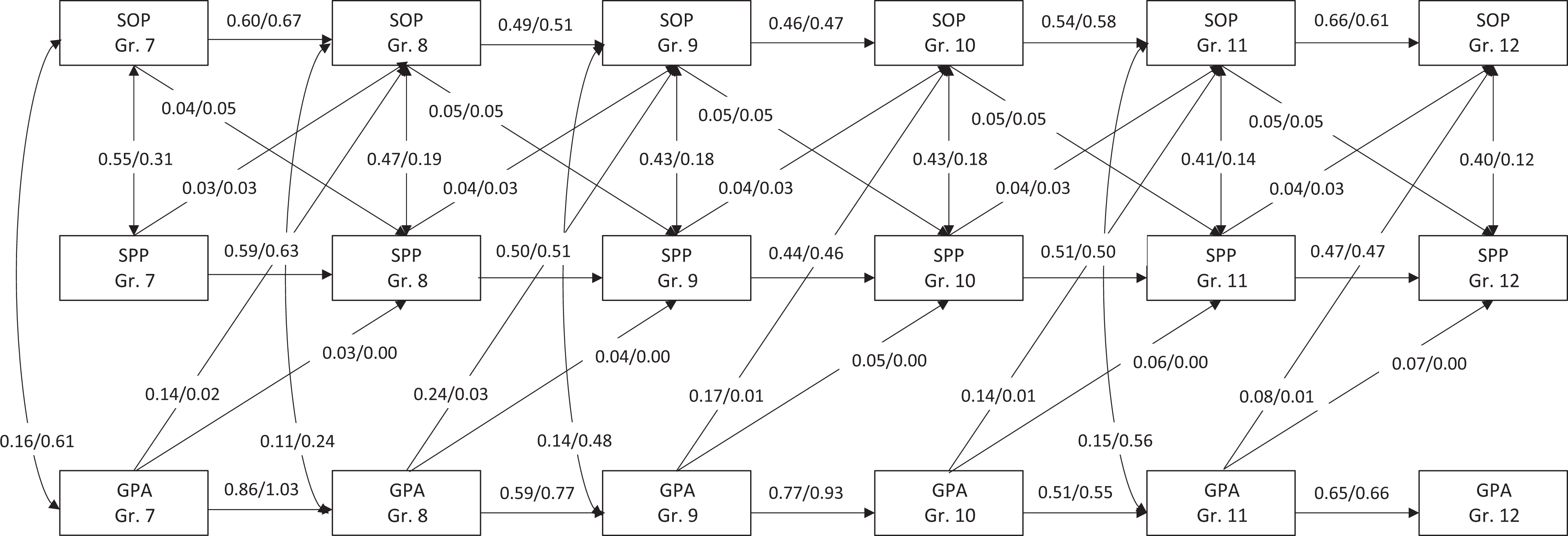
Model of Self-Oriented Perfectionism and Socially Prescribed Perfectionism From Grade 7 to 12.
Within each time point, SOP was concurrently positively related with SPP. SOP was also concurrently related with GPA in Grades 7, 8, 9, and 11; however, the concurrent associations in Grades 10 and 12 did not reach statistical significance, r = .068, p = .183, and r = .081, p = .163, respectively. SPP was not related with GPA within any time point. All variables showed stability across time; 1- and 2-year stability paths were all statistically significant. SOP and SPP showed time-invariant reciprocal associations over time. Although time-invariant, cross-lagged paths from GPA to SOP were found between all successive time points. GPA was also associated with subsequent SPP (time-invariant). GPA was not found to follow perfectionism across any time point. 3
High school transition
Differences in magnitude of the 1-year cross-lagged pathways from GPA to SOP were examined using Wald Chi-square tests. The transition lag (i.e., Grade 8–9) was higher than all subsequent lags within high school (b diff = .011, .016, .021; ps < .05). Pathways from GPA to SPP were found to be invariant across time and therefore transition effects were not examined. Because there were no statistically significant covariance terms between GPA and SPP, only differences in the magnitude of the covariances between GPA and SOP were examined. None of the parameter estimates from Grade 8 through Grade 12 were statistically significantly different from one another, ps > .05.
Indirect effects
Given the significant cross-lagged pathways, three-lag indirect effects were identified from GPA to SPP through SOP, as well as from GPA to SOP through SPP, initiating from Grade 7, 8, 9, and 10 GPA. The eight indirect effects were tested using bootstrapped confidence intervals (N = 5,000, with 95% confidence), as well as Bayesian estimation (20,000 iterations, 95% credibility intervals). Pathways from GPA to SPP to SOP were statistically significant; however, all unstandardized confidence intervals and credibility intervals included zero as a lower bound. We found evidence of consistent positive statistically significant independent indirect effects from GPA to SOP to SPP. See Supplemental Table S5 for estimates.
Discussion
The purpose of the present study was to examine the longitudinal associations and directionality between two types of perfectionism and academic achievement in adolescents. This research helps to understand factors that may lead to the impairment of successful life outcomes for adolescents, especially since youth tend to report higher levels of stress when striving to meet high academic standards (Leonard et al., 2015). This knowledge can help guide the development of prevention and intervention strategies.
The results demonstrated that, as expected, SOP and SPP were positively related within each time point—within any given year, adolescents who displayed high levels of one subtype of perfectionism were also likely to exhibit high levels of the other. Although in our path model SPP and GPA were not concurrently related within any time point, SOP and GPA were positively concurrently related at most time points, with the exceptions of Grades 10 and 12. However, at the bivariate level, the correlations were statistically significant for all time points including Grade 10 and Grade 12 GPA (see Supplemental Table S2). The positive correlation between GPA and SOP is consistent with the literature, which has found that striving for perfection is positively correlated with academic achievement (Stoeber & Rambow, 2007). The positive correlation between SOP and SPP within each time point is also consistent with other studies. Researchers often find a positive and moderate correlation between subtypes of perfectionism yet omit a longitudinal investigation between subtypes.
We found that SOP and SPP showed a time-invariant reciprocal relation across all time points. Specifically, SOP positively predicted SPP, and SPP positively predicted SOP at all successive time points; meaning, increases in one subtype of perfectionism led to subsequent increases in the other subtype of perfectionism. Given that SOP and SPP are typically moderately and positively correlated within time (Herman et al., 2013; Vaillancourt & Haltigan, 2018), these results are consistent with the literature. However, these results reinforce the importance of early intervention for young perfectionists, to reduce the potentially harmful long-term effects of these associations. To our knowledge, researchers have not examined longitudinally the development of one subtype of perfectionism as a result of the other. In contrast, researchers have explored the separate pathways of development of SOP and SPP or their relation to the development of a third variable. The different dimensions of perfectionism may be differentially associated with the other variables (Bong et al., 2014; Kljajic et al., 2017; Verner-Filion & Gaudreau, 2010), as was the case with GPA in the current study.
The results also showed that SOP was a consistent outcome of GPA and not the reverse. Notably, GPA positively predicted SOP at all successive time points. Therefore, increases in academic achievement were related to increases in SOP both within and across time. This marks a unique relation between SOP and GPA, as these pathways demonstrate a reliably significant relation, even while controlling for SPP and all other previous associations. The consistency of these results supports the literature that has found perfectionism to be an outcome of achievement (Damian et al., 2017). This promotes the notion that the development of SOP is likely to occur when individuals experience academic success (Flett et al., 2002). Experiences of success may lead to an increase in one’s feelings about one’s personal abilities, which may then push individuals to increase their personal goals, as they develop the notion that attaining perfection may be possible (Flett et al., 2002). This was supported in a study examining the longitudinal relations between perfectionism, academic achievement, and academic efficacy in adolescents, which found that when academic efficacy (one’s beliefs about one’s abilities) was taken into consideration, a positive unidirectional effect from academic efficacy to striving for perfection became significant, in addition to pathways from achievement to striving for perfection (Damian et al., 2017). When adolescents easily and frequently obtain high grades, they learn that perfection could and should be attained and maintained.
According to the social cognitive theory of personality, personal goal setting is determined by the self-evaluation of abilities (Bandura, 1989; Damian et al., 2017). Demanding goals lead to motivation by involving self-evaluation in the task, such that the stronger the belief in one’s abilities, the more determined one’s efforts will be. Individuals with strong beliefs in their self-efficacy are more likely to set demanding goals, commit to them strongly, and increase their efforts in the face of failure. It is fitting that as adolescents realize they can obtain their higher goals, as demonstrated by increased academic success, they may become more likely to strive for more success, leading to further increases in their standards (Damian et al., 2017). However, while striving for perfection has been found to be correlated with conscientiousness and motivation, perfectionistic concerns and negative reactions to imperfection, other aspects of SOP, which entail being excessively self-evaluative and self-critical, especially regarding perceived failure, have been found to be correlated with lower well-being (Stoeber & Rambow, 2007). Therefore, it is important to consider the multidimensional nature of perfectionism and how the relation between GPA and SOP might affect an adolescent long term. The potential harmful effects of high levels of SOP, which may include an increased vulnerability to the development of psychopathology (Hewitt & Flett, 1993), can have serious consequences on future life outcomes. Individuals high on SOP are characterized by the personally demanding nature of their standards and are constantly striving to do better. Even when a standard for performance is met, it is often viewed as inadequately challenging and is subsequently raised, putting individuals in a vicious cycle of setting higher and more unrealistic standards for themselves (Shafran et al., 2002).
Our results demonstrated that, SPP and GPA were not correlated within-time. In addition, SPP was a significant outcome of GPA, and not the reverse. GPA positively predicted SPP at all successive time points, contrary to our initial prediction. These findings are interesting, as researchers have generally found a negative association between academic achievement and SPP, whereby high SPP is related with lower academic achievement (Kljajic et al., 2017; Verner-Filion & Gaudreau, 2010), although these studies tend to specifically examine perfectionism as a precursor to achievement and not the reverse. Our results therefore continue to replicate the effects found by Damian et al. (2017), which found that GPA positively predicted perfectionistic concerns (a measure which included SPP). Increased academic achievement may lead adolescents to feel increased pressure to maintain this perception of perfection for others. Individuals high on SPP believe they must pursue and maintain perfectionistic standards to keep their connection with their social world and to please significant others within it (Kljajic et al., 2017). Moreover, adolescents with parents who are demanding and controlling, promote perfectionistic goals, place children in situations that emphasize the attainment of highly set standards, and stress negative consequences for making mistakes, may support the further development of SPP in relation to academic achievement (Flett et al., 2002). Damian et al. (2013) found that adolescents who believed that their parents had strict expectations of them showed higher levels of SPP 7–9 months later. Children (and adolescents) are also still developing their identity and may thus be reliant on significant others, including parents and teachers, for guidance on their behavior. As mentioned, social fears become more prominent during adolescence, which may also help explain the relation between academic achievement and SPP, especially for adolescents who consider high academic performance to be an important part of their identity (van den Bos et al., 2016).
Regarding the transition from middle school to high school (i.e., from Grade 8 to Grade 9), we found that there were no statistically significant differences in the strength of the within-time associations between GPA and SOP from Grade 8 to Grade 12. However, the results demonstrated significant differences in the magnitude of the cross-lagged relations between GPA and SOP. Specifically, the pathway from Grade 8 GPA to Grade 9 SOP displayed the strongest relation in comparison to the pathways from GPA to SOP in all subsequent high school years. This may be explained by the notion that adolescents finishing middle school with high levels of achievement may be more motivated to maintain or even increase their standards as they begin a new academic phase. Likely in a new school, with new teachers, and increasing academic standards, it is fitting that adolescents who have experienced success in middle school would want to continue this trajectory throughout high school. However, this relation may be then likely to stabilize, as adolescents become settled into the high school environment.
Consistent positive significant indirect effects were found from GPA to SPP through SOP starting in Grades 7 through 10. The results demonstrate that high grades initiate the pathway to increased perfectionism, both SOP and SPP. Increased academic achievement may cause adolescents to adopt stricter perfectionistic standards, as experiences of success may lead to the belief that perfection is possible. These higher standards then seem to extend to include others, for example, parents. Throughout adolescence, parents are still typically involved and invested in their children’s academic success. With increased achievement, as demonstrated by higher GPA, adolescents’ perception of parental expectations may increase as a result, in addition to their increasing personal standards, which may be a misperception among adolescents. Researchers have found that perceived parental expectations may generalize to the perceived expectations of other significant individuals, and meeting these standards becomes necessary to feel accepted (Damian et al., 2013).
Some limitations of the present study warrant discussion. Individuals in the analytic sample were significantly different from those in the non-analytic sample regarding ethnicity, household income, and level of parental education. Participants in the analytic sample who had both GPA and survey data also had higher grades than those without surveys at each time point. Accordingly, individuals in the analytic sample are not representative of the initial cohort. For example, more at-risk adolescents were likely lost, a consistent issue with other longitudinal studies (Asendorpf et al., 2014). The cross-lagged path analysis used has been criticized. For example, according to Hamaker et al. (2015), this modeling approach fails to adequately disaggregate within- and between-person relations resulting in the estimates of lagged parameters being confounded by the relation that exists at the between-person level. To avoid this blending of effects into a single estimate (Hoffman, 2015; Vaillancourt & Brittain, 2019), longitudinal associations using an autoregressive latent trajectory model with structured residuals (Berry & Willoughby, 2017; Curran et al., 2014) should be considered. What we have modeled in the present study are between-person associations (e.g., a person’s level of perfectionism relative to other participants’ levels) and not true age-related processes (e.g., a person’s level of perfectionism relative to their own level).
The findings from the present study support the notion that a significant relation exists between perfectionism and academic achievement. In particular, the present study supports previous literature that has found perfectionism to be more an outcome of achievement than an antecedent. In other words, once adolescents experience incidences of academic success, they may form beliefs surrounding the attainability of perfection, feel increased pressure from others, and further increase their perfectionistic behavior and the standards which they set for themselves. It is possible that alternative explanations exist that can be accounted for by variables that were not measured in the current study. This emphasizes the need for continued research on this topic. Importantly, adolescents who find themselves in the constant cycle of higher academic achievement leading to higher perfectionism are likely to experience elevated levels of stress. Considering that perfectionism entails setting extremely high standards and strictly monitoring one’s performance (Hewitt & Flett, 1991), perfectionistic individuals tend to induce stressful experiences more often (Hewitt et al., 1998). Individuals high on perfectionism, therefore tend to experience more chronic stress, which has the potential to lead to further psychopathology (Hewitt et al., 1998). SPP is also correlated with adverse long-term outcomes, such as depression, and self-harm and suicide (Hewitt et al., 2002; O’Connor et al., 2010). High achieving adolescents may therefore be at a particularly high risk for these experiences.
An understanding of the interplay between perfectionism and academic achievement in the particular context of adolescent development is crucial to provide adolescents with tools for overcoming any maladaptation and to mitigate lasting negative effects as they move into adulthood. This is essential since well-timed and targeted interventions have the potential to interrupt negative developmental cascades and promote positive ones, by both decreasing the kind of adolescent issues that would lead to future and more severe issues in adulthood, and by targeting improvements in competence that can then lead to an increase in better functioning in the future (Masten & Cicchetti, 2010).
Supplemental Material
Supplemental Material, sj-docx-1-jbd-10.1177_01650254211037400 - The longitudinal associations between perfectionism and academic achievement across adolescence
Supplemental Material, sj-docx-1-jbd-10.1177_01650254211037400 for The longitudinal associations between perfectionism and academic achievement across adolescence by Shari Endleman, Heather Brittain and Tracy Vaillancourt in International Journal of Behavioral Development
Footnotes
Funding
The author(s) disclosed receipt of the following financial support for the research, authorship, and/or publication of this article: This study was funded by Social Sciences and Humanities Research Council of Canada [SSHRC; grant numbers 833-2004-1019, 435-2016-1251], Ontario Mental Health Foundation [grant number PA-13-303], and Canadian Institutes of Health Research [grant numbers 201009MOP-232632-CHI-CECA-136591, 201603PJT-365626-PJT-CECA-136591]. Heather Brittain is supported by a SSHRC Vanier scholarship.

Supplemental Material
Supplemental material for this article is available online.
Notes
References
Supplementary Material
Please find the following supplemental material available below.
For Open Access articles published under a Creative Commons License, all supplemental material carries the same license as the article it is associated with.
For non-Open Access articles published, all supplemental material carries a non-exclusive license, and permission requests for re-use of supplemental material or any part of supplemental material shall be sent directly to the copyright owner as specified in the copyright notice associated with the article.
