




Abstract
This study explores classroom differences in social status norms by identifying profiles based on aggressive and prosocial popularity norms, likability norms, and rejection norms, analyzing the differences among profiles in classroom-level bullying, victimization, bullying reinforcement, defending, and students’ social goals. Latent profile analysis of 328 classrooms comprising 6,395 students (Mage = 13.43, SD
Keywords
Introduction
Adolescence is a developmental stage marked by an increased focus on social status (Lafontana & Cillessen, 2010). During this period, adolescents seek two forms of peer approval: peer acceptance (i.e., fitting in and being liked) and popularity (i.e., standing out, gaining admiration, or exerting influence) (Dawes & Xie, 2014). While aggression and bullying are often seen as effective means of attaining popularity, prosocial behaviors, such as defending victims of bullying, can also boost one’s social status (Hines et al., 2025). The classroom context plays a key role in shaping students’ social behavior through norms—shared beliefs about what is acceptable—enforced via social rewards and sanctions (Laursen & Veenstra, 2021). These norms may apply broadly or be dictated by influential students, forming a popularity norm (Veenstra & Lodder, 2022). Two common types are prosocial and aggressive (bullying) popularity norms, which can vary significantly between classrooms, influencing students’ social behavior, well-being, and social status. Alongside popularity norms, the classroom’s social dynamics can also be influenced by how classmates like or dislike bullies and prosocial students (i.e., bullying likability or bullying rejection norms; prosocial likability or prosocial rejection norms) (see, for example, Garandeau et al., 2022). These group-level dynamics may be particularly influential in school systems with highly stable peer groups. In Slovenia, for example, students typically remain in the same classroom cohort for the entire nine years of elementary education, making the classroom a key context for both academic and social development.
While prior research has examined classroom-level status norms, other constructs central to bullying dynamics—such as bystander behavior and students’ social goals—have rarely been studied at the classroom level. The present study therefore examined how classrooms differ in their social status norms by identifying latent profiles based on prosocial and aggressive (1) popularity norms, (2) likability norms, and (3) rejection norms. We also investigated how these profiles relate to classroom-level bullying, victimization, bystander behavior (defending and reinforcing), and popularity and likability goals. By examining these six types of classroom social status norms in combination and comparing them on multiple indicators, our study offers a broader perspective on how peer dynamics may shape bullying-related processes at the group level.
Classroom Environments as Contexts for Social and Emotional Learning
The classroom is a key and relatively stable social context in which children and adolescents interact, form relationships, and cope with power dynamics that may involve conflict or bullying. As a primary setting for peer interaction, it plays a central role in students’ social and emotional learning by providing opportunities to develop social behaviors, manage interpersonal challenges, and engage in cooperation and competition (Eccles & Roeser, 2011).
Bullying—defined as the repeated and systematic abuse of power by a dominant individual or group over a less powerful peer (Olweus, 1999)—predominantly occurs within the classroom context (Siu, 2025). Contemporary definitions (e.g., Volk et al., 2017) conceptualize bullying as a group-based phenomenon, manifesting as strategic behavior aimed at securing social resources. Over the past two decades, numerous studies (for a review, see Pouwels & Garandeau, 2021) have examined which demographic and psychosocial characteristics of classrooms may act as protective or risk factors for bullying. Although classroom-level factors tend to explain less variance than individual-level factors, research (e.g., Saarento et al., 2013) has shown that differences between classrooms account for up to 10% of the variance in bullying—an amount that is practically meaningful because these characteristics are modifiable through educational interventions. Studies have identified several classroom-level risk factors, including higher levels of status hierarchy (Garandeau et al., 2014), greater moral disengagement (Thornberg et al., 2021), and poor teacher classroom management (Kloo et al., 2023). Another modifiable classroom-level characteristic is the classroom norm, which can be shaped via sensitive classroom management and consistent teacher responses. Once established, classroom norms tend to remain stable and guide peer interactions (see Salmivalli, 2010). Norms reflect the extent to which specific behaviors are accepted, rewarded, or rejected in a given peer group. They can be descriptive (i.e., how common bullying is), injunctive (i.e., how much peers disapprove of bullying), or social status norms (i.e., which behaviors are linked to social status; Pouwels & Garandeau, 2021). In this study, we focused on classroom social status norms as one important descriptive factor of group dynamics.
During adolescence, bullying behaviors become more subtle, often making detection difficult during casual observation of peer interactions (Juvonen & Schacter, 2017). Adolescents who engage in bullying are often socially skilled individuals with a strong desire for popularity in the classroom (Dawes, 2017). For these students, bullying is often instrumental in achieving a high status within the classroom. It is important to distinguish between likability (being well-liked and accepted within the group) and popularity (being noticed and wielding power and influence). Likability refers to an individual’s overall acceptance; students who are highly liked receive many positive and few, if any, negative nominations from their peers. Rejected students receive many negative and few, if any, positive nominations. On the other hand, peer-perceived popularity refers to the extent to which peers view an individual as popular. Unlike likability, perceived popularity is associated with higher levels of bullying (van den Berg et al., 2020).
According to the goal theory (Austin & Vancouver, 1996), students may pursue status goals related to popularity or likability, which shape their behaviors and peer status (Li & Wright, 2014). Popularity goals reflect a desire to gain social dominance and are often linked to aggressive behaviors, such as bullying, which may increase popularity but reduce likability (Dawes, 2017). On the other hand, likability goals involve aspirations to be seen as kind and are associated with prosocial behaviors, which enhance likability but do not necessarily increase popularity (Dawes, 2017; Lansu, 2023). While individual-level links between social goals and status are well-documented, no study to date has examined the association between classroom social status norms and social goals at the classroom level.
As children transition into adolescence, the initially overlapping constructs of likability and perceived popularity become increasingly distinct (e.g., Pouwels & Garandeau, 2021). For some adolescents, being popular becomes a primary social goal (Lafontana & Cillessen, 2010), sometimes at the expense of prosocial behavior, such as defending victims, which is more common at younger ages (Pouwels, van Noorden, et al., 2018). Yet popularity is a limited resource, and attaining membership in a select group of popular peers requires strategic behavior (Pouwels, Lansu, et al., 2018). This often involves the deliberate use of bullying, which secures a dominant position within the group and enhances perceived popularity. Consequently, in adolescence, bullying becomes a potentially successful strategy for achieving high status. Longitudinal studies (e.g., Pouwels, van Noorden, et al., 2018) have shown that the key to attaining popularity is a combination of a certain degree of prosocial behavior and bullying, which is, according to Resource Control Theory (Hawley, 2014), labeled as bistrategic behavior. Once a student reaches a high position within the group, their popularity status becomes self-reinforcing, influencing the norms of the entire peer group.
Classroom Social Status Norms
Bullying is frequently used to gain popularity during adolescence, yet this is not the case in every classroom. Classrooms differ in the extent to which bullying behavior is associated with popularity (Laninga-Wijnen et al., 2018); in some classrooms, aggressive behavior does not secure a high position in the peer hierarchy. These differences reflect variations in social status norms that refer to the various aspects of social standing: in every classroom, status hierarchies emerge as some group members are attributed higher status or are distinctly accepted or rejected by their peers. According to the reputational salience hypothesis (Hartup, 1996), behaviors that are positively linked to social status in a particular context become prominent in shaping individuals’ reputations. Classroom popularity norms refer to the factors that enable high popularity and social standing (Laninga-Wijnen & Veenstra, 2021). Groups differ in the behaviors that yield social power and influence within the classroom. Researchers have most often examined two popularity-related classroom norms: prosocial popularity norms, reflecting the classroom-level association between prosocial behavior and popularity, and aggressive popularity norms, reflecting the association between aggressive behavior and perceived popularity (Laninga-Wijnen & Veenstra, 2021). Strong prosocial popularity norms indicate that prosocial students are seen as popular, whereas strong aggressive popularity norms indicate that aggressive students are perceived as popular. In classrooms where the latter prevail, there tends to be more peer rejection, higher levels of victimization, poorer academic performance, and a less positive school experience (Dijkstra & Gest, 2015). Regarding the formation of these norms, Laninga-Wijnen, Harakeh, and colleagues (2020) found that a higher proportion of socially dominant students who engage in bullying, as well as those who strategically use both bullying and prosocial behavior (bi-strategic students), significantly predicts aggressive popularity norms, whereas a higher proportion of non-dominant bullying students and socially dominant prosocial students helps to reduce them.
Both types of norms are mutually independent, meaning that high or low norms for attaining popularity through prosocial behavior can coexist alongside high or low norms for attaining popularity through aggression. Laninga-Wijnen, Steglich, and colleagues (2020) found that in highly prosocial classrooms (i.e., where prosocial popularity norms are high and aggressive popularity norms are low), friendships are maintained based on prosocial behavior. In mixed classrooms where both types of norms are equally present, and in classrooms with higher aggressive popularity norms, bullying plays a more significant role in sustaining friendships. Thus, the prosocial behavior of popular individuals serves as a protective factor that prevents the formation of bullying-based friendships and reinforces prosocial behavior in relationships, but only in classrooms where popular students do not participate in bullying.
In addition to popularity norms, a classroom’s social dynamics are also characterized by other classroom social status norms, for example, likability norms that indicate the behaviors that are related to being liked, and rejection norms as indicators of which social behaviors are related to being rejected. Researchers have examined these norms less frequently than popularity norms, although some studies (e.g., Garandeau et al., 2022) indicate they are also important for understanding the social context of the classroom. In classrooms where bullies are widely disliked—thus being high in aggressive rejection norms—bystanders find it easier to defend victims (Garandeau et al., 2022), as resisting an unliked bully does not threaten social status. Defenders also fear retaliation less, expecting it will be easier to handle. Similarly, in classrooms with lower prosocial rejection norms, where prosocial students are less disliked, students are more likely to engage in defending and other prosocial behaviors and less likely to reinforce bullying.
While prior research has uncovered important associations between specific social status norms—such as popularity, likability, and rejection norms—and bullying-related behaviors, these constructs do not operate in isolation. In fact, classrooms may cluster into distinct profiles characterized by different combinations of these norms, each associated with varying patterns of peer interactions and bullying dynamics. To capture this complexity, it is necessary to go beyond variable-centered approaches and examine how psychosocial classroom characteristics co-occur and interact.
Approaches to Categorizing Classroom Environments: A Latent Profile Analysis Perspective
Person-centered methods can uncover common patterns in how social status relates to specific social behaviors. In previous studies where classrooms were categorized based on their psychosocial characteristics, researchers mostly applied cluster analysis (Dijkstra & Gest, 2015; Laninga-Wijnen, Steglich, et al., 2020). Studies that employed a latent profile analysis (LPA) to identify various classroom environments with regard to social status norms are rare; in their longitudinal study on a sample of early adolescents in new peer contexts, Laninga-Wijnen et al. (2018) identified three profiles based on aggressive-popularity and prosocial popularity norms: a prosocial peer norms profile, an aggressive peer norm profile, and a mixed profile. Using latent transition analysis, the study additionally demonstrated that status norms exhibited some dynamic change across the school year, with classrooms tending to shift toward more aggressive norm profiles over time.
In the present study, LPA was employed to classify classrooms according to their classroom social status norms. This method offers several advantages over conventional clustering techniques since the selection of clustering criteria is less arbitrary due to its underlying statistical model, and as a model-based approach, it provides a range of rigorous statistical tests to assess model fit (Xu et al., 2013). LPA has frequently been used in recent years in school research to categorize individuals (e.g., Kochel et al., 2015; Pivec et al., 2023); however, only a few studies (e.g., Bardach et al., 2022; Choi & Shen, 2025; Lindermayer et al., 2024) have applied this method to classify classrooms as the primary units of analysis.
The Present Study
The current study aimed to investigate classroom differences in social status norms by identifying latent profiles based on aggressive and prosocial popularity norms, likability norms, and rejection norms. Based on previous findings (Laninga-Wijnen et al., 2018; Laninga-Wijnen, Steglich, et al., 2020), we hypothesized the emergence of at least three profiles: a profile with high prosocial popularity norms, a profile with high aggressive popularity norms, and a profile with high levels of both prosocial and aggressive popularity norms. Since no prior studies have classified classrooms based on likability and rejection norms, our study was exploratory in this regard. Furthermore, we examined how these profiles relate to classroom-level bullying, victimization, bystander behaviors (defending and reinforcing bullying), and classroom-level popularity and likability goals. By adopting a person-centered approach, this study expands existing research by considering multiple social status norms simultaneously. To our knowledge, this is the first study to apply LPA to categorize classrooms based on various social status norms, contributing to the growing body of research on the social ecology of peer relationships in school settings.
Method
Participants
This study is part of a larger project examining the role of social context in bullying behavior in elementary schools. Altogether, students from 328 classrooms attending eighth and ninth grade (Mage = 13.43, SD
Measures
Classroom Norms
Classroom prosocial and aggressive popularity, likability, and rejection norms were measured, resulting in six distinctive measures (prosocial/aggressive popularity, likability, and rejection norms). These measures were calculated as a classroom correlation between peer-nominated status and behavior. Students were asked to nominate three classmates who are kind and willing to help others (prosocial), who take it out on others (aggressive), who are the most popular in the classroom (popularity), whom they like to hang out with the most (likability), and who they like to hang out with the least(rejection). Each score was computed as the proportion of nominated students relative to possible nominators within each class. Prosocial social status norms were operationalized as classroom-level correlations between prosocial behavior and popularity, likability, and rejection nominations, respectively. Likewise, aggressive social status norms were calculated as correlations between aggression and popularity, likability, and rejection nominations.
Bullying and Victimization
We measured bullying and victimization using the Adolescent Peer Relations Instrument: Bully-Target (APRI-BT) (Parada, 2000). The questionnaire comprises 36 self-reported items, half (18) measuring bullying and the other half victimization. Both bullying and victimization scales contain three subscales (six items per subscale) that measure physical, verbal, and relational bullying and victimization. Participants answered the items on a 6-point scale, from 1 = never to 6 = every day. Bullying (α = .91) and victimization (α = .92) showed high reliability. Self-reported bullying was positively correlated with peer-nominated aggression (r = .38, p < .001) and negatively correlated with peer-nominated prosocial behavior (r = –.16, p < .001).
Classroom Mean Level Values for Bullying and Victimization Were Used in the Analysis
Defending and Reinforcing Bullying
Bystander roles in bullying were measured with the Adolescent Peer Relation Instrument: Participant Roles (Parada, 2006), which assesses active and passive bullying reinforcement, ignoring, and victim defending. We focused on two contrasting roles, i.e., active bullying reinforcement and defending the victim. Each role was measured with six items, using the six-point agreement scale from 1—strongly disagree to 6—strongly agree. Internal consistency, as measured by the alpha coefficient, was satisfactory (α = .72 for active reinforcement and α = .89 for defending). We used classroom mean values to determine the classroom level of active bullying reinforcement and defending.
Popularity and Likability Goals
We measured popularity and likability goals with the Social Status Goals questionnaire (Li & Wright, 2014). The popularity goals scale measures students’ desire to be popular in the classroom and consists of six items. The likability goals were evaluated with five items and assessed students’ goals to be well-liked in the classroom. The participants answered each item using the five-point frequency answering scale from 1-never to 5-all the time. Reliability was α = .84 for popularity and α = .74 for likability. Classroom-level mean scores of both variables were utilized in the analysis.
Procedure
The schools were contacted via email with the study description and the invitation to participate in the study. Initially, 134 schools expressed their willingness to participate; the final sample consisted of 118 schools, roughly 25% of all public elementary schools in the country. 1 Upon their agreement, school counselors took part in an online workshop conducted by the research team, during which they received an overview of the study and detailed instructions regarding the data collection procedures. Afterwards, school counselors distributed parental consent forms. Only classrooms with over 90 % parental consent were included in the study. Data was collected during school time at the beginning, middle, and end of the school year. The data analyzed in this study were collected during the first measurement point (in October and November 2022). The questionnaires were administered in a paper-and-pencil format. To ensure anonymity, each student was assigned a unique identification code. The study was approved by the ethics committee at the Faculty of Arts, University of Maribor (038-30-120/2022/5/FFUM).
Data Analysis
First, we screened the data for possible outliers and missing values. Questionnaire scores were calculated when at least 80 % of items on a selected scale were completed; therefore, sample sizes varied across measures (n = 6257–6379). Although bullying, victimization, bystander roles, and social status goals were measured at the student level, analyses were conducted using aggregated classroom-level data. Group-mean classroom scores were used in all analyses.
The intra-class correlation coefficients were calculated for the school level. In the original three-level structure (student, classroom, and school), the ICCs ranged from .008 to .080 for self-reported measures, indicating that most variance resided at the student- and classroom levels. However, the present study focuses exclusively on classroom-level variables. When the student level was omitted, and a two-level structure (classroom and school) was considered, ICCs ranged from .01 to .24 (see Table 1). It is important to note that the relatively low number of classrooms per school, with some schools represented by only one classroom, may affect ICC estimates and their interpretation. Descriptive statistics and correlations were computed using IBM SPSS (ver. 29).
Descriptive Statistics and Correlations Between the Variables (N = 328 Classrooms).
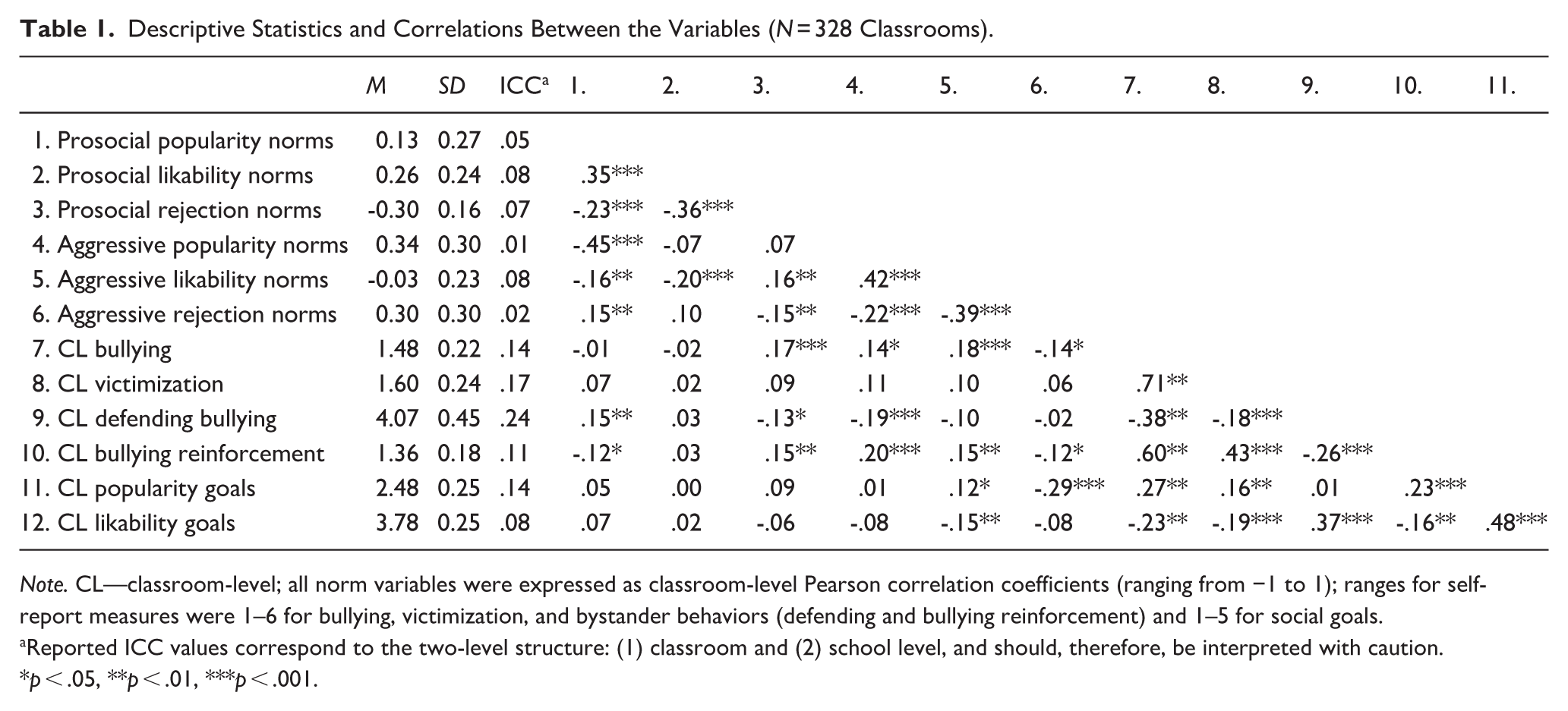
Note. CL—classroom-level; all norm variables were expressed as classroom-level Pearson correlation coefficients (ranging from −1 to 1); ranges for self-report measures were 1–6 for bullying, victimization, and bystander behaviors (defending and bullying reinforcement) and 1–5 for social goals.
Reported ICC values correspond to the two-level structure: (1) classroom and (2) school level, and should, therefore, be interpreted with caution.
p < .05, **p < .01, ***p < .001.
Second, LPA was performed in Mplus 8.10 to determine the optimal number of classroom profiles based on prosocial popularity norms, prosocial likability norms, prosocial rejection norms, aggressive popularity norms, aggressive likability norms, and aggressive rejection norms. The analysis commenced with a one-profile solution, progressively increasing the number of profiles while evaluating changes in model fit indices. Following Masyn (2013), multiple variance-covariance solutions were tested. Model 1 (class-invariant, diagonal) assumed equal variances across profiles without covariances (i.e., no correlations between constructs). Model 2 (class-varying, diagonal) allowed variances to differ across profiles but did not include covariances. Model 3 (class-invariant, unrestricted) assumed equal variances while allowing covariances between constructs. Finally, Model 4 (class-varying, unrestricted) permitted both variances and covariances to differ across profiles. The optimal solution was identified based on Bayesian Information Criterion (BIC) and the Sample-Size Adjusted BIC (SABIC), with lower values indicating a better fit (Nylund-Gibson & Choi, 2018). In addition, the Bootstrap Likelihood Ratio Test (BLRT) was employed to assess whether a model with a higher or lower number of profiles provided a superior fit. Selected profiles from each variance-covariance structure were further compared using BIC and SABIC values to determine the most suitable one. Classification accuracy was evaluated using entropy and average posterior probability values (AvePP), which were deemed acceptable if exceeding thresholds of .80 and .70, respectively (Masyn, 2013).
Once the final number of profiles was determined, comparisons were conducted using Welch’s ANOVA in SPSS to examine differences in prosocial popularity norms, prosocial likability norms, prosocial rejection norms, aggressive popularity norms, aggressive likability norms, and aggressive rejection norms. Following the identification of initial profile differences, additional comparisons were performed on classroom-level bullying, victimization, defending bullying, bullying reinforcement, popularity goals, and likability using the Bolck–Croon–Hagenaars (BCH) approach in Mplus (Asparouhov & Muthén, 2014).
Third, a multilevel LPA was conducted to identify school-level profiles based on the composition of classroom-level profiles, specifically the relative frequency of each classroom-level profile within a given school. The profile constraints from the final single-level analysis were applied in the multilevel LPA to ensure consistency. School-level profiles were then regressed on classroom-level profiles (which were controlled for classroom size), and multilevel solutions ranging from one to three profiles were systematically tested.
Results
Descriptive Statistics
Descriptive statistics and correlations among variables are reported in Table 1. Overall, prosocial norms were correlated with more supportive classroom processes, whereas aggressive norms were correlated with higher levels of bullying, victimization, and bullying reinforcement.
Classroom-Level Profiles
Initially, LPA models with different variance-covariance structures were run to identify the most appropriate specification (see Table 2). Following Nylund-Gibson and Choi (2018), profile enumeration stopped when solutions included profiles larger than 5–8% of the sample or when BIC or SABIC reached the lowest value. Given the relatively small sample size—although within the suggested range of N ≈ 300–1,000 (Nylund-Gibson and Choi, 2018)—and considering that classrooms, and not students, were used as units of analysis, we decided to follow SABIC. Unlike BIC, which may underestimate the number of profiles in smaller samples (McLachlan & Peel, 2000), SABIC adjusts for sample size (Nylund et al., 2007).
Model Fit Statistics for LPA (N = 328 Classrooms).
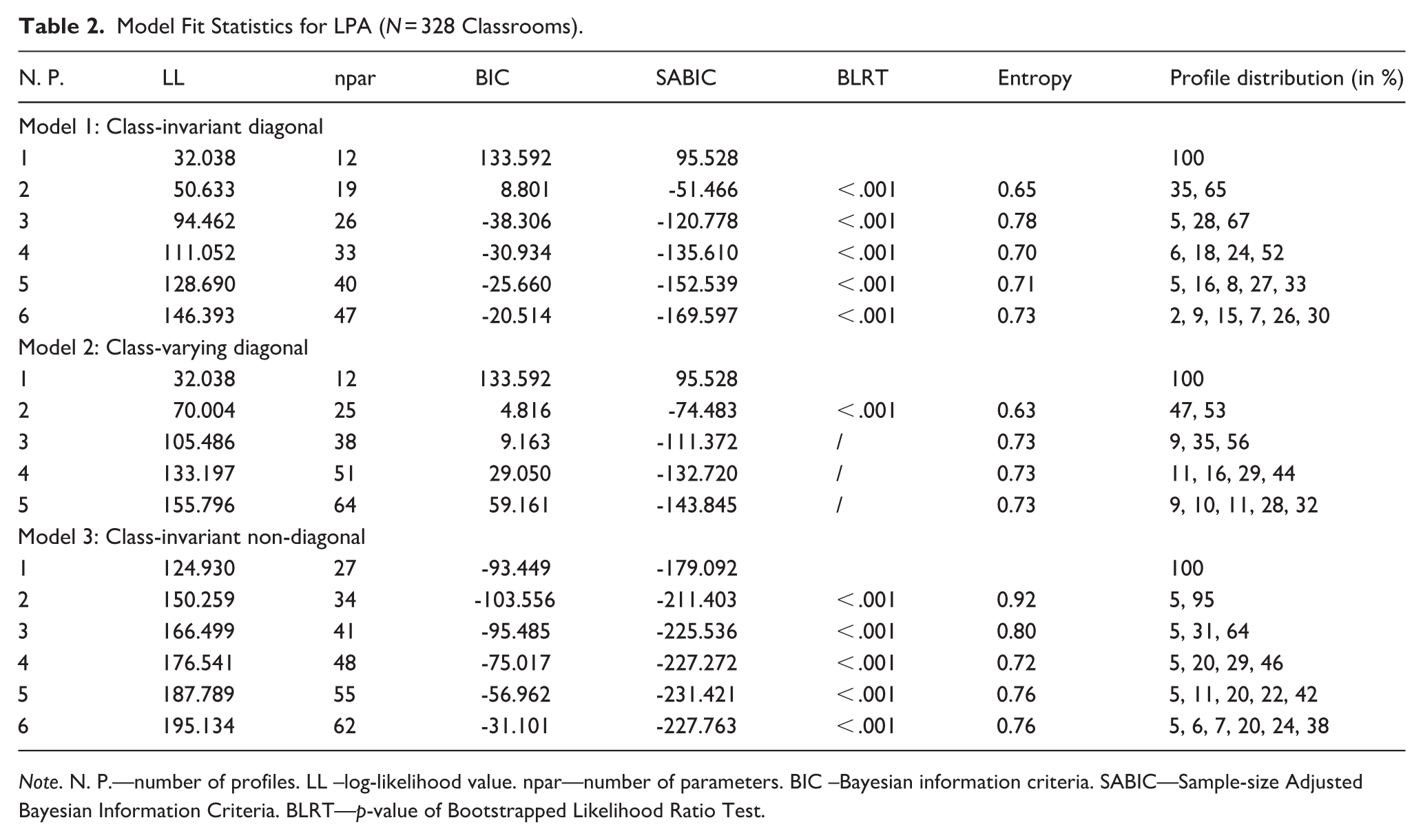
Note. N. P.—number of profiles. LL –log-likelihood value. npar—number of parameters. BIC –Bayesian information criteria. SABIC—Sample-size Adjusted Bayesian Information Criteria. BLRT—p-value of Bootstrapped Likelihood Ratio Test.
In Model 1, Class-invariant diagonal, one-to-six profiles solutions were compared. The six-profile solution was rejected due to a profile representing only 2% of the sample. Therefore, three-, four-, and five-profile solutions were compared as they had similar SABIC values. The three-profile solution included a profile with higher prosocial popularity norms and lower aggressive popularity norms, and two profiles with higher aggressive popularity norms and lower prosocial popularity norms; one also showed lower prosocial likability norms and higher aggressive likability norms. The four-profile solution identified an additional profile characterized by low values of prosocial and aggressive popularity norms. The five-profile solution revealed a profile with both higher prosocial and aggressive popularity norms. As the five-profile solution also identified a profile that is theoretically meaningful, it was selected as the most suitable model in the class-invariant diagonal variance-covariance structure.
In Model 2, Class-varying diagonal, the profile enumeration stopped at a five-profile solution, since in the six-profile solution, even with doubled starting values, the best log-likelihood value was not replicated. The BLRT was computed only for the two-profile solution, while for other solutions, even with increased random starts, p-values were not trustworthy due to local maxima. Following SABIC values, three-to-five profile solutions were compared. The three-profile solution revealed a profile with higher prosocial popularity norms and lower aggressive popularity norms, and two profiles with higher aggressive popularity norms and lower prosocial popularity norms that differed in likability and rejection norms. Specifically, one profile showed greater rejection of prosociality and acceptance of aggression. In the four-profile solution, a profile with lower popularity norms emerged, while in the five-profile solution, a profile with average prosocial and aggressive popularity norms was added. As in model 1, the five-profile solution was selected as the most suitable since it was also theoretically meaningful.
In Model 3, Class-invariant non-diagonal, one- to six-profile solutions were compared with the lowest SABIC value observed in the five-profile solution. All three-to-five profile solutions were compared since they had very similar SABIC values. All profiles resembled those in Model 1, differing mainly in profile proportions and minor variations in variable means. The five-profile solution had the lowest SABIC value and was therefore selected as the most suitable model.
In Model 4, Class-varying non-diagonal, all solutions were not trustworthy due to several warnings (e.g., a non-positive definite first-order derivative product matrix, an ill-conditioned Fisher information matrix); thus, the profile solutions from this covariance-variance structure were not considered.
Comparison across covariance-variance structures revealed similar profile patterns in all three models. However, the five-profile solution in the Model 3 (class-invariant non-diagonal) had the lowest SABIC value, indicating that covariance among different norms should be considered. The entropy of the selected model (.76) was slightly below the suggested cut-off value (.80), indicating some profile classification uncertainty. Regarding AvePP, values exceeded the recommended threshold of .70, indicating that profiles are well-separated.
The most optimal profile solution is presented in Figure 1. The first profile, named the Prosocial profile (11.0%, 36 classrooms), was characterized by higher prosocial popularity norms, higher prosocial likability norms, lower prosocial rejection norms, lower aggressive popularity norms, lower aggressive likability norms, and higher aggressive rejection norms. The second profile, Low Norms (20.4%; 67 classrooms), had lower prosocial popularity norms, lower prosocial likability norms, lower prosocial rejection norms, lower aggressive popularity norms, lower aggressive likability norms, and higher aggressive rejection norms. The third profile, Mixed Popularity profile (21.6%; 71 classrooms), had average prosocial popularity norms, higher prosocial likability norms, lower prosocial rejection norms, higher aggressive popularity norms, average aggressive likability norms, and higher aggressive rejection norms. The fourth profile, the Aggression-Favoring profile (5.2%; 17 classrooms), retained for its theoretical significance, showed lower prosocial popularity norms, lower prosocial likability norms, higher prosocial rejection norms, higher aggressive popularity norms, higher aggressive likability norms, and lower aggressive rejection norms. The fifth profile, named the Aggression-Tolerant profile (41.8%; 137 classrooms), displayed lower prosocial popularity norms, average prosocial likability norms, lower prosocial rejection norms, higher aggressive popularity norms, average aggressive likability norms, and average aggressive rejection norms.
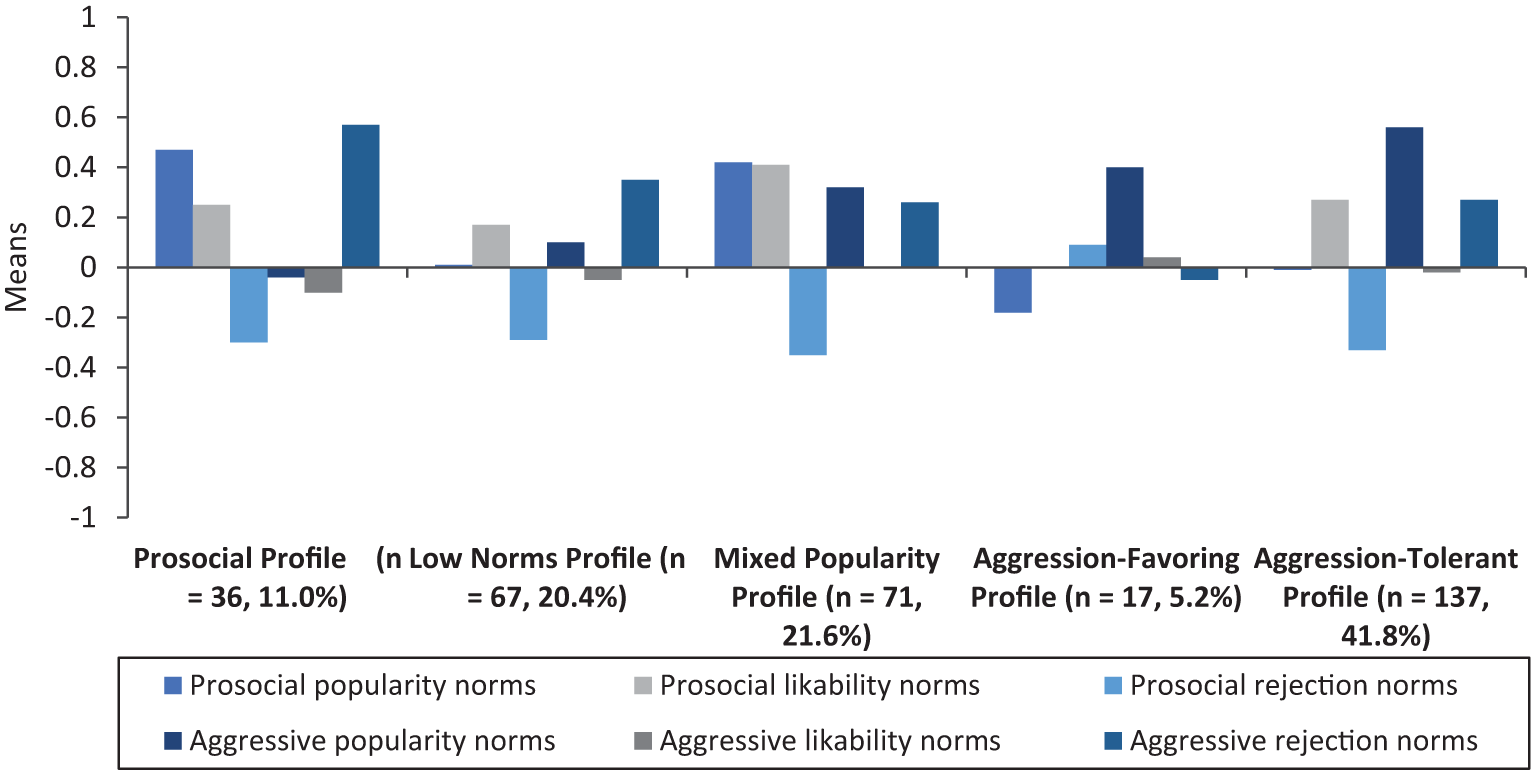
Latent Profiles Based on Prosocial Popularity Norms, Prosocial Likability Norms, Prosocial Rejection Norms, Aggressive Popularity Norms, Aggressive Likability Norms, and Aggressive Rejection Norms.
Using Welch’s ANOVA, profiles were compared in prosocial popularity norms, prosocial likability norms, prosocial rejection norms, aggressive popularity norms, aggressive likability norms, and aggressive rejection norms (see Table S1).
The analysis revealed significant differences among profiles for all variables, except for aggression likability norms. However, some similarities between profiles were also observed. Regarding prosocial popularity norms, the Prosocial and Mixed Popularity profiles (p = .623) had higher prosocial popularity norms, followed by the Low Norms and Aggression Tolerant profiles (p = .804), with the Aggression Favoring profile displaying the lowest prosocial popularity norms. As for prosocial likability norms, the Mixed Popularity profile had the highest prosocial likability norms, followed by the Prosocial and Aggression-Tolerant profiles (p = .305), and Low Norms and Aggression-Favoring profiles, exhibiting the lowest prosocial likability norms. For prosocial rejection norms, only the Aggression-Favoring profile significantly differed from all other profiles, thus having the highest prosocial rejection norms.
Regarding aggressive popularity norms, the Aggression-Tolerant profile had the highest aggressive popularity norms, followed by the Aggression-Favoring profile and Mixed Popularity profiles (p = .787). The Prosocial profile had the lowest aggressive popularity norms. There were no differences in aggressive likability norms, while the Prosocial profile had the highest aggressive rejection norms, followed by Low Norms, Mixed Popularity, and Aggression-Tolerant profiles (ps > .05). The Aggression-Favoring profile had the lowest aggressive rejection norms and significantly differed from all other profiles.
After the profile determination, profiles were compared in classroom-level bullying, victimization, bystander behaviors (defending and reinforcing bullying), and classroom-level popularity and likability goals using the BCH approach (see Table 3).
Means, Standard Errors, and 95% Confidence Intervals of Auxiliary Variables and Tests of Mean Differences Across Profiles (N = 328 Classrooms).
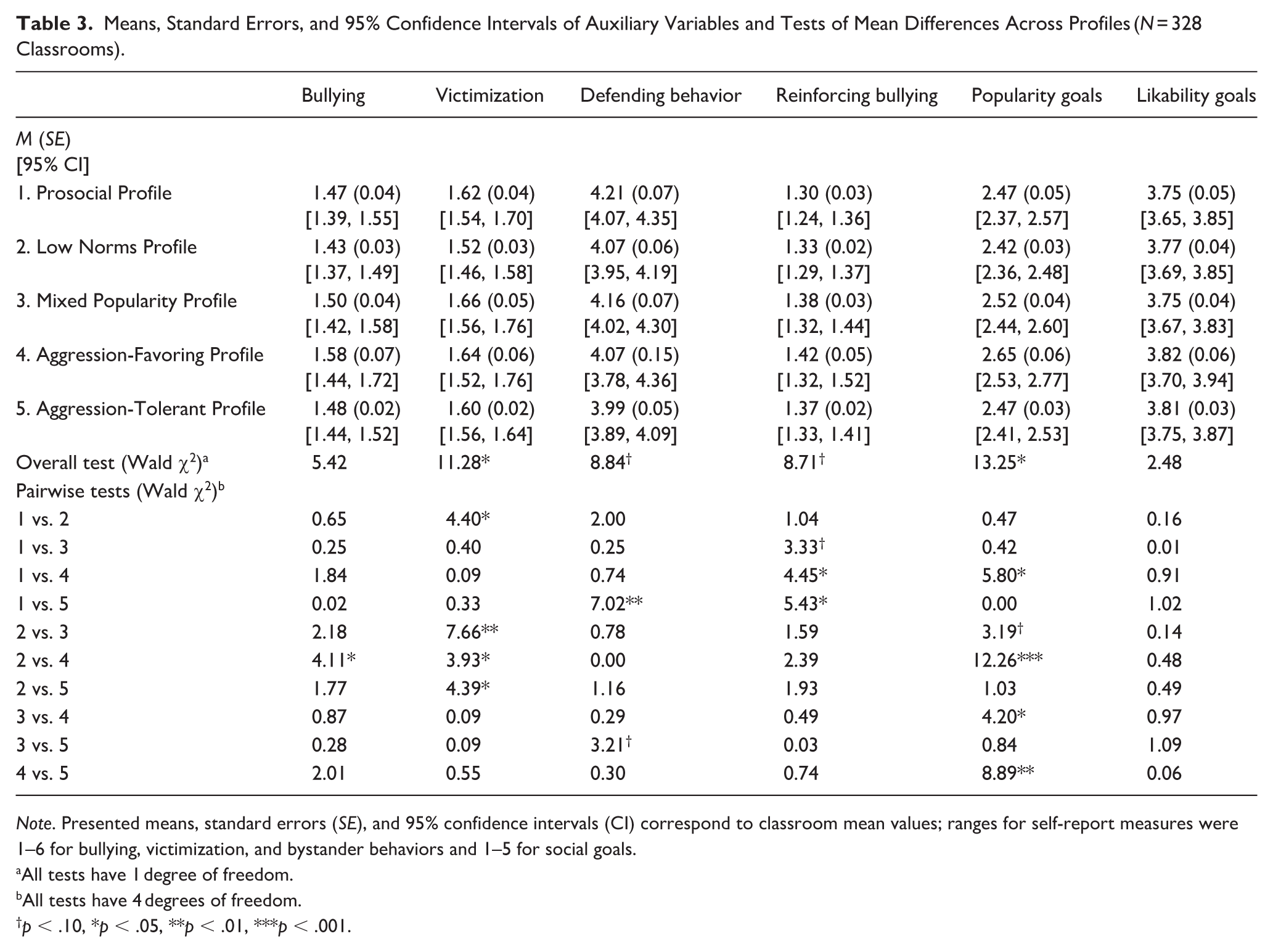
Note. Presented means, standard errors (SE), and 95% confidence intervals (CI) correspond to classroom mean values; ranges for self-report measures were 1–6 for bullying, victimization, and bystander behaviors and 1–5 for social goals.
All tests have 1 degree of freedom.
All tests have 4 degrees of freedom.
p < .10, *p < .05, **p < .01, ***p < .001.
Overall test for classroom-level bullying was not significant; however, one difference was identified between profiles, since the Low norms profile had lower bullying than the Aggression-Favoring profile. As for classroom-level victimization, only the Low norms profile significantly differed from all other profiles, exhibiting the lowest levels. Regarding classroom-level defending behavior, the overall test was marginally significant (p = .07), while pairwise tests showed that the Prosocial profile had higher defending compared to the Aggression-Tolerant and Mixed Popularity profiles (marginal significance was observed), whereas no significant differences were observed between other profiles. As for classroom-level bullying reinforcement, the overall test was marginally significant (p = .07), while pairwise tests exhibited that the Prosocial profile had lower bullying reinforcement than Aggression-Favoring, Aggression-Tolerant, and Mixed Popularity profiles (marginal significance). Regarding classroom-level popularity goals, the Aggression-Favoring profile exhibited higher levels than all other profiles, while the Mixed Popularity profile showed marginally higher popularity goals than the Low Norms profile. No profile differences emerged regarding the classroom-level likability goals.
School-Level Profiles
The fit indices for school-level LPA are presented in Table S2 as part of the supplementary material. Classroom-level profiles were controlled for classroom size. One-to-three profile solutions were tested; however, the values of the BIC and SABIC were the lowest in the one-profile solution, suggesting only one profile at the school level.
Discussion
The present study aimed to identify latent profiles of classrooms based on prosocial and aggressive popularity norms, likability norms, and rejection norms, thereby extending previous research that classified classrooms according to popularity norms (e.g., Laninga-Wijnen, Steglich, et al., 2020). In the current study, profiles were derived from classroom-level norms reflecting how aggressive and prosocial behaviors were associated with three distinct measures of social status: peer-perceived popularity, likability, and rejection. Furthermore, the identified classroom profiles differed in students’ self-reported behavior (bullying, victimization, bullying reinforcement, and defending) and social-cognitive factors (popularity and likability goals) which, at the individual level, have been found to be related to bullying (e.g., Li & Wright, 2014).
Five classroom social status norm profiles were identified: the Prosocial profile, the Low Norms profile, the Mixed Popularity profile, the Aggression-Favoring profile, and the Aggression-Tolerant profile. Using a sample of early adolescents in newly formed peer groups, Laninga-Wijnen et al. (2018) identified three similar profiles: a prosocial peer norms profile, an aggressive peer norms profile, and a mixed profile, corresponding to the Prosocial profile, Mixed popularity profile, and Aggression-Tolerant profile, respectively. Similar profiles were also identified using cluster analysis (Laninga-Wijnen, Steglich, et al., 2020). By incorporating likability and rejection norms alongside popularity norms, the present study identified two additional classroom profiles—Low Norms and Aggression-Favoring—resulting in a more differentiated, five-profile solution. Notably, the Low Norms profile, absent in previous research, reflects classrooms with weak status-related incentives that may be less conducive to status-driven behaviors such as bullying. Furthermore, while Laninga-Wijnen et al. (2018) identified a single aggressive peer norm profile, our findings revealed a further differentiation into two distinct profiles: the Aggression-Favoring profile, in which aggression is clearly rewarded and prosocial behavior penalized, and the Aggression-Tolerant profile, where aggression is somewhat rewarded and not actively rejected. The Aggression-Tolerant profile was also the most prevalent, whereas the Aggression-Favoring profile represented the smallest proportion of classrooms. Importantly, the overall pattern of profiles remained stable across the different variance–covariance structures tested, indicating that the five-profile solution was statistically robust. This highlights important qualitative differences in how aggression is integrated into peer ecology, which may be overlooked when only popularity norms are considered.
A closer comparison of the two aggression-related profiles reveals meaningful differences in how aggression and prosociality are socially evaluated. In Aggression-Favoring classrooms, aggressive behavior is linked not only to popularity but also to likability, while prosocial behavior is socially devalued, being less associated with popularity or likability and more frequently rejected. These classrooms strongly favor aggression as a means to achieve social standing and discourage prosocial conduct. In contrast, Aggression-Tolerant classrooms –the most prevalent pattern in our sample– reflect a more moderate and permissive normative climate: aggression may boost popularity, but it is not strongly sanctioned, promoted, or admired, and prosocial behavior retains some value, particularly for likability, but is not a central pathway to social recognition. This distinction suggests that aggression-tolerant contexts allow for mixed behavioral strategies, whereas aggression-favoring contexts more clearly and consistently support aggressive forms of status-seeking.
In addition, the Prosocial profile identified in the present study mirrors the prosocial peer norm profile described by Laninga-Wijnen et al. (2018), yet it further enriches this previously recognized pattern by capturing not only the association between prosocial behavior and popularity but also its strong link to likability and low rejection, combined with a clear rejection of aggression. Although representing a relatively small proportion of classrooms, this profile reflects a distinctive normative climate that actively promotes prosociality as both socially valued and status-enhancing. The Mixed Popularity profile—where both prosocial and aggressive behaviors are associated with popularity—aligns with the mixed profile reported in prior research. However, including likability and rejection norms in the present study revealed that, despite prosocial behavior being appreciated for likability, aggression can still serve as a viable route to status in such classrooms. This combination may convey inconsistent normative cues to students about which behaviors are socially rewarded and accepted, potentially complicating their social goal orientations. Compared to the Aggression-Tolerant profile, the Mixed Popularity profile places greater social value on prosocial behavior—particularly regarding likability—while aggression remains a parallel, though not exclusive, route to status. This suggests a more balanced, yet still conflicting, normative structure than in aggression-tolerant classrooms, where prosociality is less emphasized. Finally, the Low Norms profile, newly identified in this study, represents classrooms where both prosocial and aggressive behaviors are weakly tied to social status, and aggression remains relatively disapproved. Such classrooms may be less driven by status-related motives and therefore show fewer status-based social dynamics.
Beyond profile comparisons, examining how the core classroom-level variables relate to one another can offer further insight into the characteristics of classroom social ecologies. A closer look at the correlations between classroom-level variables revealed some notable patterns. Most prominently, prosocial likability norms showed weak or no significant associations with other norm indicators, suggesting that they may function somewhat independently from other classroom status dynamics.
School-level analysis revealed only one dominant profile, indicating limited variability in norm configurations across schools. Consistent with low school-level ICCs, this suggests that social status norms are more strongly associated with classroom-level processes than with broader school-wide factors, further supporting the idea that classroom-specific peer ecologies are a critical context for understanding status-related social processes.
The classroom profiles also differed meaningfully in bullying-related behaviors and social goals, aligning with and extending previous research. Previous studies have already examined classroom-level aggregated measures of bullying, victimization, and defending, (e.g., Garandeau et al., 2014; Saarento et al., 2013), however, to our knowledge, this is the first study to examine classroom-level social goals by aggregating students’ popularity and likability goals to the group level. The identified classroom profiles showed some meaningful, though modest, differences in bullying-related behaviors and social goals. The Low Norms profile consistently stood out as the least bullying-prone context, showing lower levels of both bullying and victimization than other profiles. While the direction of association cannot be determined due to the cross-sectional design, this finding supports the idea that classrooms with weak links between behavior and social status—where neither aggression nor prosociality determines peer standing—may offer less opportunity for status-driven aggression and victimization (Dijkstra & Gest, 2015). Profiles differed only marginally in defending and reinforcement of bullying. Although not statistically robust, descriptive patterns suggest that classrooms characterized by prosocial and anti-aggression norms (the Prosocial profile) tended to show more defending and less reinforcement than aggression-tolerant or mixed profile classrooms. This aligns with the notion that strong antibullying norms can facilitate defending by lowering the social risk of opposing aggressors (Garandeau et al., 2022). As for social goals, the Aggression-Favoring profile exhibited the highest popularity goals, whereas the Mixed Popularity profile showed somewhat elevated levels compared with the Low Norms profile. No differences were found for likability goals, suggesting that the motivation to be liked may be less dependent on the classroom’s normative climate than the drive for social visibility and influence. Together, these findings indicate that differences in classroom-level social status norms correspond to variations in students’ social motivations and collective behaviors, even if effects are modest. In particular, aggression-oriented classrooms appear to foster status-seeking goals, whereas status-neutral classrooms provide a more socially balanced environment that discourages bullying-related dynamics.
Limitations and Future Directions
Several limitations should be considered when interpreting the findings of this study. Most notably, the cross-sectional design limits the ability to draw conclusions about the directionality and underlying mechanisms of the observed associations. It remains unclear whether classroom norm configurations influence behavior or whether behaviors and goals contribute to norm development. Longitudinal evidence from newly formed peer groups suggests a dynamic, reciprocal relationship, with initial levels of aggression and prosociality associated with subsequent changes in classroom-level status norms (Laninga-Wijnen et al., 2018). Another important methodological consideration concerns the specification of variance–covariance structures in latent profile analysis. Following current best practices (Masyn, 2013), we systematically compared several variances–covariance structures rather than relying on the default class-invariant, diagonal model. This more rigorous approach provided a more conservative and statistically robust representation of the data but likely resulted in smaller between-profile differences in bullying-related behaviors and social goals compared to those obtained under the default specification, which tends to accentuate group distinctions (results from the default model (class-invariant, diagonal), which yielded somewhat larger between-profile contrasts, are available upon request). Future research should consistently adopt a more rigorous analytic approach when identifying latent classroom profiles, to ensure comparability across studies and avoid overinterpretation of exaggerated profile differences.
Furthermore, while peer nominations are a well-established and ecologically valid method for capturing social dynamics and classroom norms (e.g., Pouwels & Garandeau, 2021), these measures may still be influenced by cultural or contextual factors, which could limit the generalizability of the findings beyond the current sample. In addition, a limited nominations procedure was used, which may have constrained the variability and precision of classroom-level indicators. Although classroom norms in this study were operationalized as classroom-level correlations between peer nomination variables –an approach that conceptually applies regardless of class size– we acknowledge that norm estimates based on very small peer groups may be less stable and should therefore be interpreted with caution. While small between-classroom variance is common in adolescent peer research, especially in highly integrated school systems such as the Slovenian one, where nearly all students attend the same type of comprehensive basic school and are not tracked into different classrooms or programs based on academic performance, this should still be taken into account when interpreting the practical significance of classroom-level effects.
Future research should examine how additional classroom-level factors, such as teacher practices and classroom climate, relate to the emergence and stability of normative profiles. Evidence from younger samples suggests that both peer norms and teacher responses independently relate to changes in bullying (Devleeschouwer et al., 2025); it therefore remains important to test whether similar processes operate among early adolescents and within a social status norms framework. Such work could clarify how teacher and peer influences jointly relate to behaviors that are socially rewarded or sanctioned. Moreover, interventions targeting classroom norms may benefit from a multi-faceted focus on popularity, likability, and rejection norms to promote prosocial behavior as a socially valued pathway to status. This focus is particularly relevant in systems where students stay in the same class for multiple years, creating stable and influential classroom peer dynamics.
Conclusion
This study advances the understanding of classroom peer ecology by identifying five distinct classroom profiles based on prosocial and aggressive popularity, likability, and rejection norms. While the overall pattern of profiles was consistent across different variance–covariance structures, the differences between profiles were generally modest, reflecting a more conservative and methodologically rigorous analytic approach. The findings demonstrate that different configurations of social status norms correspond to some variation in bullying-related behaviors and social goals, particularly highlighting the role of Low Norms classrooms as less prone to bullying and victimization. Importantly, the study highlights the added value of incorporating multiple types of social status norms, revealing subtler but theoretically meaningful distinctions between classrooms that would remain undetected if only popularity norms were considered.
By offering a more comprehensive framework for analyzing normative classroom environments, this research lays the groundwork for future studies and interventions aiming to promote healthier peer dynamics. These findings suggest that effective bullying prevention and social-emotional learning programs should go beyond discouraging aggression and actively promote prosocial behaviors as a valued pathway to social recognition. Interventions may benefit from directly addressing classroom norms—making them visible, discussable, and modifiable—so that students come to associate positive social status not with dominance or aggression but with kindness, cooperation, and inclusion. Furthermore, identifying classrooms with a Low Norms profile is particularly relevant, as these environments are less driven by status-based dynamics and may offer a unique opportunity for early preventive efforts before more stable, potentially harmful status hierarchies become entrenched.
Supplemental Material
sj-docx-1-jbd-10.1177_01650254261425591 – Supplemental material for Classroom social status norms and bullying dynamics: A latent profile analysis of popularity, likability, and rejection norms
Supplemental material, sj-docx-1-jbd-10.1177_01650254261425591 for Classroom social status norms and bullying dynamics: A latent profile analysis of popularity, likability, and rejection norms by Katja Košir, Marina Horvat, Ana Lampret and Tina Pivec in International Journal of Behavioral Development
Footnotes

Ethical Considerations
This study was approved by the Ethics Committee of the Faculty of Arts, University of Maribor (Ethics Code: 038-30-120/2022/5/FFUM) on June 6, 2022. Informed written consent to participate in the study was obtained from the parents or legal guardians of all participating students prior to enrolment in the study.
Consent to Participate
Informed written consent to participate in the study was obtained from the parents or legal guardians of all participating students.
Consent for Publication
Not applicable.
Funding
The authors disclosed receipt of the following financial support for the research, authorship, and/or publication of this article: This research was supported by the Slovenian Research and Innovation Agency (J5-3114, P2-0425 (A)).
Declaration of Conflicting Interests
The authors declared no potential conflicts of interest with respect to the research, authorship, and/or publication of this article.
Data Availability Statement
The data supporting the findings of the present study are available from the corresponding author, Katja Košir, upon reasonable request. This study is not preregistered.
Supplemental Material
Supplemental material for this article is available online.
Notes
References
Supplementary Material
Please find the following supplemental material available below.
For Open Access articles published under a Creative Commons License, all supplemental material carries the same license as the article it is associated with.
For non-Open Access articles published, all supplemental material carries a non-exclusive license, and permission requests for re-use of supplemental material or any part of supplemental material shall be sent directly to the copyright owner as specified in the copyright notice associated with the article.
