




Abstract
The present study used quantitative and qualitative methods to explore how lonely young people are seen from others’ perspectives, in terms of their personality, behavior, and life circumstances. Data were drawn from the Environmental Risk Longitudinal Twin Study, a cohort of 2,232 individuals born in the U.K. in the mid-1990s. When participants were aged 18, they provided self-reports of loneliness, and informant ratings of loneliness were provided by interviewers, as well as participants’ parents and siblings. Interviewers further provided Big Five personality ratings and detailed written notes in which they documented their perceptions of the participants and their reflections on the content of the interview. In the quantitative section of the article, regression analyses were used to examine the perceptibility of loneliness and how participants’ loneliness related to their perceived personality traits. The informant ratings of participants’ loneliness showed good agreement with self-reports. Furthermore, loneliness was associated with lower perceived conscientiousness, agreeableness, and extroversion and higher perceived neuroticism. Within-twin pair analyses indicated that these associations were partly explained by common underlying genetic influences. In the qualitative section of the study, the loneliest 5% of study participants (N = 108) were selected, and thematic analysis was applied to the study interviewers’ notes about those participants. Three themes were identified and named: “uncomfortable in own skin,” “clustering of risk,” and “difficulties accessing social resources.” These results add depth to the current conceptualization of loneliness and emphasize the complexity and intersectional nature of the circumstances severely lonely young adults live in.
Introduction
Loneliness is a form of psychological distress felt in response to perceived deficits in one’s social relationships (Ernst & Cacioppo, 1999). Temporary, sporadic episodes of loneliness are likely to affect many individuals at some time in their lives and, if the circumstances responsible are resolved in due course, are unlikely to impose significant impairment or long-term consequences. However, for some individuals, loneliness becomes a burden that is persistent across time and pervasive across situations. Over time, loneliness predicts deterioration in mental and physical health and elevated risk for early mortality (Cacioppo & Cacioppo, 2014; Courtin & Knapp, 2017; Holt-Lunstad et al., 2015). Preventing individuals from becoming trapped in loneliness is therefore of key importance, and a goal of research should be to develop a detailed, context-rich profile of this phenomena, to understand the circumstances under which that could occur.
Recent research has drawn attention to the disproportionately high rates of self-reported loneliness in adolescence and young adulthood (Luhmann & Hawkley, 2016; Office for National Statistics, 2018). These developmental stages are periods of significant transition, in which individuals face the task of establishing their independence for the first time and adapting to changes in their social networks (Lenz, 2001). Milestones such as leaving school, moving out of the parental home, entering the labor market or tertiary education, and establishing long-term romantic relationships each represent new challenges which, if not navigated successfully, could threaten to impoverish individuals of social connection and leave them feeling marginalized and cutoff from those around them.
The predominant conceptual approach to loneliness defines it in terms of a mismatch between the kinds of social relationships a person desires and those that they have in reality (Peplau & Perlman, 1982). Thus, loneliness is not synonymous with solitude or isolation (Victor et al., 2000). Instead, it is a state of mind, and even individuals with similar degrees of actual social connection may differ in the extent to which they feel lonely. Moreover, individual differences in loneliness show similar stability to differences in personality traits, which has led to loneliness being described as trait-like in nature (Mund et al., 2019). Loneliness and personality are therefore likely to be closely interrelated, and indeed, associations have been found between loneliness and each of the Big Five personality traits, particularly neuroticism (Buecker et al., 2020; Mund & Neyer, 2018; Vanhalst et al., 2012).
Furthermore, there is evidence that associations between loneliness and personality traits are mediated by genetic influences, indicating the importance of using study designs that allow these influences to be controlled for (Abdellaoui et al., 2018). Twin studies offer one such solution, in the form of the discordant twin method (Pingault et al., 2018). By comparing twins within a pair, unmeasured familial sources of confounding are held constant by design, as these effects are assumed to be the same for each twin. In the case of monozygotic (MZ) twins, these include all genetic effects. Therefore, any differences in a given trait between two MZ twins cannot be explained by genetic differences. If these differences are correlated with differences in a second trait, this indicates an association independent of genetic confounding. If, on the other hand, no such correlation is observed, despite the two traits being correlated in samples of singletons, this suggests that the association between them is explained by a common underlying genetic etiology. This method provides a powerful means of investigating the role of genetics in associations between loneliness and personality traits.
Loneliness could also have implications for how an individual’s personality and behavior is perceived by others. Past research has shown that self-reports of loneliness are corroborated with reasonable accuracy by ratings made by informants such as parents, friends, and romantic partners (Luhmann et al., 2016), indicating that loneliness is perceptible. A similar degree of agreement is observed between “self” and “other” ratings of personality (Vazire & Carlson, 2010). Previous research has found that lonely individuals are viewed more negatively by others (Jones et al., 1981; Tsai & Reis, 2009). This may be partly due to stigma (Lau & Gruen, 1992), but behavioral cues in social interactions may also play a role (Nestler & Back, 2013). According to a hypothesis rooted in evolutionary theory (Cacioppo et al., 2006), loneliness is an adaptive response to the experience of social disconnection, which braces individuals to cope with a potentially unsafe environment without the protection of others. As a result, loneliness is accompanied by an elevated vigilance for social threats, reduced trust toward others, and more negative expectations of social encounters (Spithoven et al., 2017). While this may help to maintain distance from those with potentially hostile intent, engaging in these defensive patterns of behavior could negatively bias how lonely individuals are perceived by others.
However, the impressions formed from these interactions may leave others with an incomplete or misleading perception of lonely individuals. That loneliness is closely interrelated with personality characteristics does not preclude the possibility that there are wider contextual factors that also shape the ways in which lonely individuals interact with the world. For instance, research has shown that loneliness intersects with difficulties across many domains of young people’s lives, including mental health problems, negative physical health-related behaviors, academic and job-seeking struggles, difficulty coping with stress, and childhood peer problems (Matthews et al., 2019). This coalescence of other adversities around loneliness means that each individual case is likely to be complex and multifaceted, and appraisals of personality traits based on superficial observations of behavior may lead to lonely individuals being misunderstood.
The use of qualitative methods, alongside the more statistical approaches commonly used in research on loneliness, is one way in which the complexities of this phenotype can be explored in novel ways. A number of qualitative studies have previously been conducted on loneliness in young people. These have typically focused on specific aspects of people’s lived experiences of loneliness, such as the perceived causes of loneliness and strategies for coping with it (Korkiamäki, 2014; Office for National Statistics, 2018; Vasileiou et al., 2019). Another way in which qualitative analysis can be used to explore the nature of loneliness is to examine the accounts of individuals who have just spent time interacting with a lonely individual and investigate whether the narratives that emerge from those accounts converge on certain themes. Such an approach could yield not only more nuanced descriptions of lonely individuals’ outward personality characteristics but also more general observations that add context and meaning to these appraisals.
In the present study, we utilize quantitative and qualitative approaches to investigate how lonely young people are perceived by others, using data collected via home visits in a cohort study of young people. Here, the majority of the data are not provided directly by participants themselves, but instead are drawn from other people’s perceptions based on their interactions with the participants. In the quantitative part of the study, a multi-informant approach is used to measure the perceptibility of loneliness to others (interviewers, siblings, and parents). Moreover, interviewer’s ratings of participants’ Big Five personality traits are used to examine the association between loneliness and perceived personality, and twin data are used to test for genetic confounding of these associations. In the qualitative part of the study, interviewers’ written notes about the participants are explored and analyzed for recurring themes. In this approach, the interviewers are used as intermediaries on whom the participants’ characteristics and circumstances are impressed and subsequently recorded and interpreted. This allows loneliness—typically conceptualized as a private and intimate phenomenon—to be examined “from the outside,” yielding novel insights that solely quantitative or self-reported data may not capture.
Method
Participants
Participants were members of the Environmental Risk (E-Risk) Longitudinal Twin Study, which tracks the development of a birth cohort of 2,232 British children. The sample was drawn from a larger birth register of twins born in England and Wales in 1994–1995 (Trouton et al., 2002). Full details about the sample are reported elsewhere (Moffitt & E-Risk Study Team, 2002). Briefly, the E-Risk sample was constructed in 1999–2000, when 1,116 families (93% of those eligible) with same-sex 5-year-old twins participated in home-visit assessments. This sample comprised 56% MZ and 44% dizygotic twin pairs; sex was evenly distributed within zygosity (49% male); 90% of participants were of White ethnicity.
Families were recruited to represent the U.K. population with newborns in the 1990s, to ensure adequate numbers of children in disadvantaged homes, and to avoid an excess of twins born to well-educated women using assisted reproduction. The study sample represents the full range of socioeconomic conditions in Great Britain, as reflected in the families’ distribution on a neighborhood-level socioeconomic index (A Classification of Residential Neighbourhoods [ACORN], developed by CACI Inc. for commercial use) (Odgers, Caspi, Bates et al., 2012; Odgers, Caspi, Russell et al., 2012). Specifically, E-Risk families’ ACORN distribution matches that of households nationwide: 25.6% of E-Risk families live in “wealthy achiever” neighborhoods compared to 25.3% nationwide, 5.3% versus 11.6% live in “urban prosperity” neighborhoods, 29.6% versus 26.9% live in “comfortably off” neighborhoods, 13.4% versus 13.9% live in “moderate means” neighborhoods, and 26.1% versus 20.7% live in “hard-pressed” neighborhoods. E-Risk underrepresents “urban prosperity” neighborhoods because such houses are likely to be childless.
Follow-up home visits were conducted when the children were aged 7 (98% participation), 10 (96%), 12 (96%), and 18 years (93%). There were 2,066 children who participated in the E-Risk assessments at age 18. The average age of the twins at the time of the assessment was 18.4 years (SD = 0.36); all interviews were conducted after their 18th birthday. There were no differences between those who did and did not take part at age 18 in terms of socioeconomic status (SES) assessed when the cohort was initially defined, χ2(2, N = 2,232) = 0.86, p = .65; age-5 IQ scores, t(2,208) = 0.98, p = .33; or age-5 emotional or behavioral problems, t(2,230) = 0.40, p = .69 and t(2,230) = 0.41, p = .68, respectively. Home visits at ages 5, 7, 10, and 12 years included assessments with participants as well as their mother (or primary caretaker). The home visit at age 18 included interviews only with the participants. The Joint South London and Maudsley and the Institute of Psychiatry Research Ethics Committee approved each phase of the study. Parents gave informed consent and twins gave assent between 5 and 12 years and then informed consent at age 18.
Interviewers
Study interviewers were psychology graduates or nurses. At the age-18 assessment, a total of 14 interviewers were recruited across 2 years of data collection. Prior to data collection, interviewers undertook intensive training for over 4 weeks, in which they were instructed on interview technique, administering measures, making observations, and ethical issues. Interviewers were only sent into the field after they had received accreditation from the project leads.
Measures
Self-reported loneliness
Self-reported loneliness was assessed when participants were 18 years of age using 4 items from the University of California, Los Angeles (UCLA) Loneliness Scale, Version 3 (Russell, 1996): “How often do you feel that you lack companionship?,” “How often do you feel left out?,” “How often do you feel isolated from others?,” and “How often do you feel alone?” A very similar short form of the UCLA scale has previously been developed for use in large-scale surveys and correlates strongly with the full 20-item version (Hughes et al., 2004). The scale was administered as part of a computer-based self-complete questionnaire. Interviewers were blind to participants’ responses. The items were rated hardly ever (0), some of the time (1), or often (2). Items were summed to produce a total loneliness score (Table 1).
Descriptive Statistics of Variables.
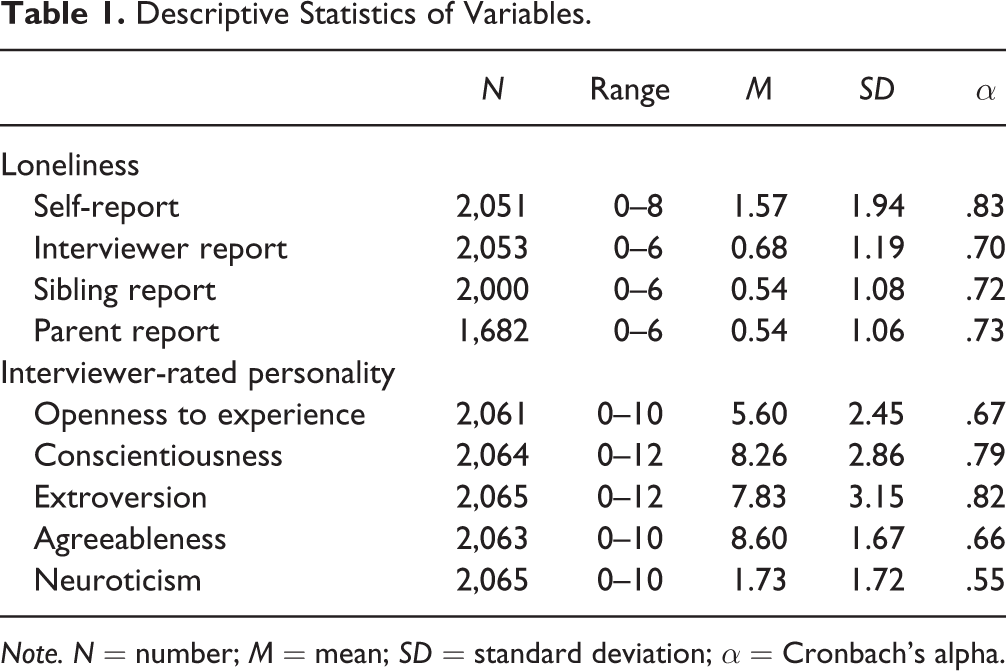
Note. N = number; M = mean; SD = standard deviation; α = Cronbach’s alpha.
Informant-rated loneliness
The “interviewer impressions” section of the assessment materials was completed by study interviewers after the age-18 home visit had ended. The purpose of this section was to capture their own perceptions of the participants’ personality, behavior, and overall functioning. Interviewers were trained to administer the interview and record participants’ responses in an accepting and nonjudgmental manner but afterward to record their impressions as a proxy for how the participants might be perceived by a prospective employer, health care professional, or educator. Interviewers were instructed to complete this section immediately after the visit, while it was still fresh in their memories. Three items in this section were selected to derive interviewer ratings of loneliness: “seems lonely,” “feels that no one cares for them,” and “has trouble making friends.” Items were coded no (0), a little/somewhat (1), and yes (2).
The same 3 items were also included in an “informant questionnaire,” completed by two individuals nominated by the participant who knew them well. Questionnaires were completed by 98.0% of the first nominated informants, of whom 99.8% were the participant’s co-twin or other sibling. Questionnaires were completed by 83.5% of the second nominated informants, of whom 98.1% were the participant’s parent.
For each informant (interviewer, sibling, and parent), responses to the three loneliness items were summed to create Informant-Rated Loneliness Scales (Table 1). Rather than combining the informant ratings, the scales were analyzed separately to compare the degree of correspondence between self-reported loneliness and ratings made by individuals with different degrees of familiarity with the participants.
Perceived personality
Included in the interviewer impressions was an adapted form of the Big Five personality inventory (John & Strivastava, 1999). This began, “Based on your interaction with the twin do you think he/she is…” followed by a list of 27 traits (e.g., “gregarious,” “touchy,” “curious”). Items were coded no (0), a little/somewhat (1), or yes (2). The items were summed to create personality scales of openness to experience, conscientiousness, extroversion, agreeableness, and neuroticism (Table 1).
Qualitative data
Lined sections for text notes were interspersed with the questions in the interviewer impressions section. During training, interviewers were advised to write as many notes as possible and to allocate ample time for this to record valid and reliable data. Notes were subsequently transcribed to electronic format using a bespoke data entry application.
Data Analysis
Quantitative analyses
Statistical analyses were carried out in Stata 15 (StataCorp, 2017). First, to examine the perceptibility of loneliness, correlations were calculated between self-reported loneliness and the three informant-rated loneliness scales. Second, to examine associations between loneliness and perceived personality traits, each of the interviewer ratings of the Big Five traits was regressed on the Self-Reported Loneliness Scale. Regression analyses were adjusted for sex and SES. Due to the nonindependence of observations in twin data, the Huber–White estimator was used to obtain robust standard errors (Williams, 2000).
Third, to test for genetic confounding, we calculated within-twin pair difference scores for each family in the sample, by subtracting Twin 2’s score from Twin 1’s score on each of the key variables (i.e., loneliness and each of the perceived personality traits). A significant association between twin differences in loneliness and twin differences in (for example) neuroticism would indicate that the association between these two traits cannot be explained by the shared environment (i.e., environmental influences that make twins similar to each other). This is because twins who grow up in the same home environment are assumed to be matched for these influences. By further restricting the analyses to MZ twin pairs, who are also matched for their genomes, genetic influences are held constant as well. Therefore, if the twin difference scores remain significantly associated with each other among MZ twins, the association between the two traits cannot be entirely explained by genetic differences.
Qualitative analyses
The qualitative analyses were carried out using the text notes from the age-18 assessment. First, the loneliest 5% of participants were identified (N = 108). This cutoff was chosen as it provides an overall percentage that is similar to the proportion of individuals who answered “often” to each of the items in the loneliness scale; hence, it was expected to capture the more severe or frequent cases of loneliness. Indeed, this subset comprised individuals scoring above 5 on the total scale, and to obtain such a score, a participant would have to answer “often” to at least 2 of the 4 questionnaire items. The mean loneliness score in this group was 6.81, versus 1.28 in the remaining 95% of the sample. Demographically, however, this subset was comparable to the rest of the sample: both groups were 47% male, low SES was similarly represented in both groups (35% in the subset vs. 33% in the rest of the sample), and the mean IQ was 100 in both groups.
The interviewer notes relating to these 108 participants were then extracted. The length of the notes varied depending on the amount of salient information that arose during the interview; cases with complicated life histories tended to have longer notes. Word counts ranged from 84 to 2,008 (M = 697, SD = 384). For 68% of participants, the notes were at least 500 words in length; for 92%, the notes were at least 200 words in length. Thematic analysis was carried out on the notes, based on the procedure described by Braun and Clarke (2006). First, the notes were read multiple times to build familiarity. Second, a set of codes were created to flag recurring patterns in the data. Third, the codes were examined and consolidated into a set of broader themes. Fourth, the themes were reviewed in relation to the original data and refined to reach a final thematic structure. Fifth, the meaning of the themes was explored and suitable names for them were selected. Sixth, descriptions of the themes were written up with quoted excerpts drawn from the original data to support them. To strengthen the reliability of the analysis, the initial coding and identification of themes was repeated by two other raters who were blind to the initial analysis, and the selection of the final themes was agreed by consensus. Further details are provided in the Supplementary Materials.
Results
Perceptibility of Loneliness
The correlation between self-reported and interviewer-rated loneliness in this cohort was r = .46, indicating that participants’ loneliness was visible to a stranger. Moreover, both sibling and parent ratings of participant’s loneliness had correlations of r = .34 with self-reported loneliness. The pairwise agreement between the three informants was of a similar magnitude (rs = .31–.43; Table 2). This is comparable to the level of agreement found between different informants for emotional and behavioral problems (Achenbach et al., 1987).
Correlations Between Self- and Informant-Rated Loneliness.
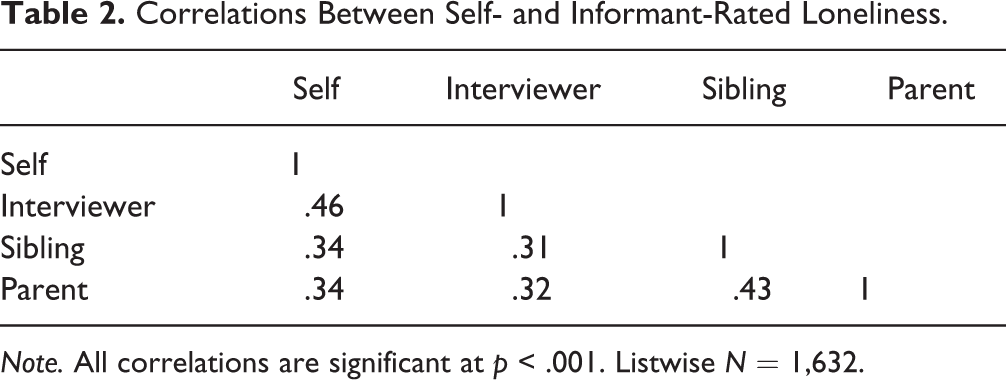
Note. All correlations are significant at p < .001. Listwise N = 1,632.
Associations Between Loneliness and Perceived Personality
Loneliness was significantly associated with lower perceived conscientiousness, extroversion, and agreeableness and higher neuroticism, as rated by interviewers. However, it was not significantly associated with openness to experience (Table 3; Figure 1). In the whole sample, within-twin pair differences in loneliness were significantly associated with differences in conscientiousness, extroversion, and neuroticism, but not with differences in agreeableness (Table 4). When the analyses were restricted to MZ twins only, the associations for conscientiousness became nonsignificant, while significant associations remained for extroversion and neuroticism. The attenuation of the coefficients, particularly for neuroticism, indicates that a substantial part (though not all) of the associations between loneliness and these traits is explained by shared genetic effects.
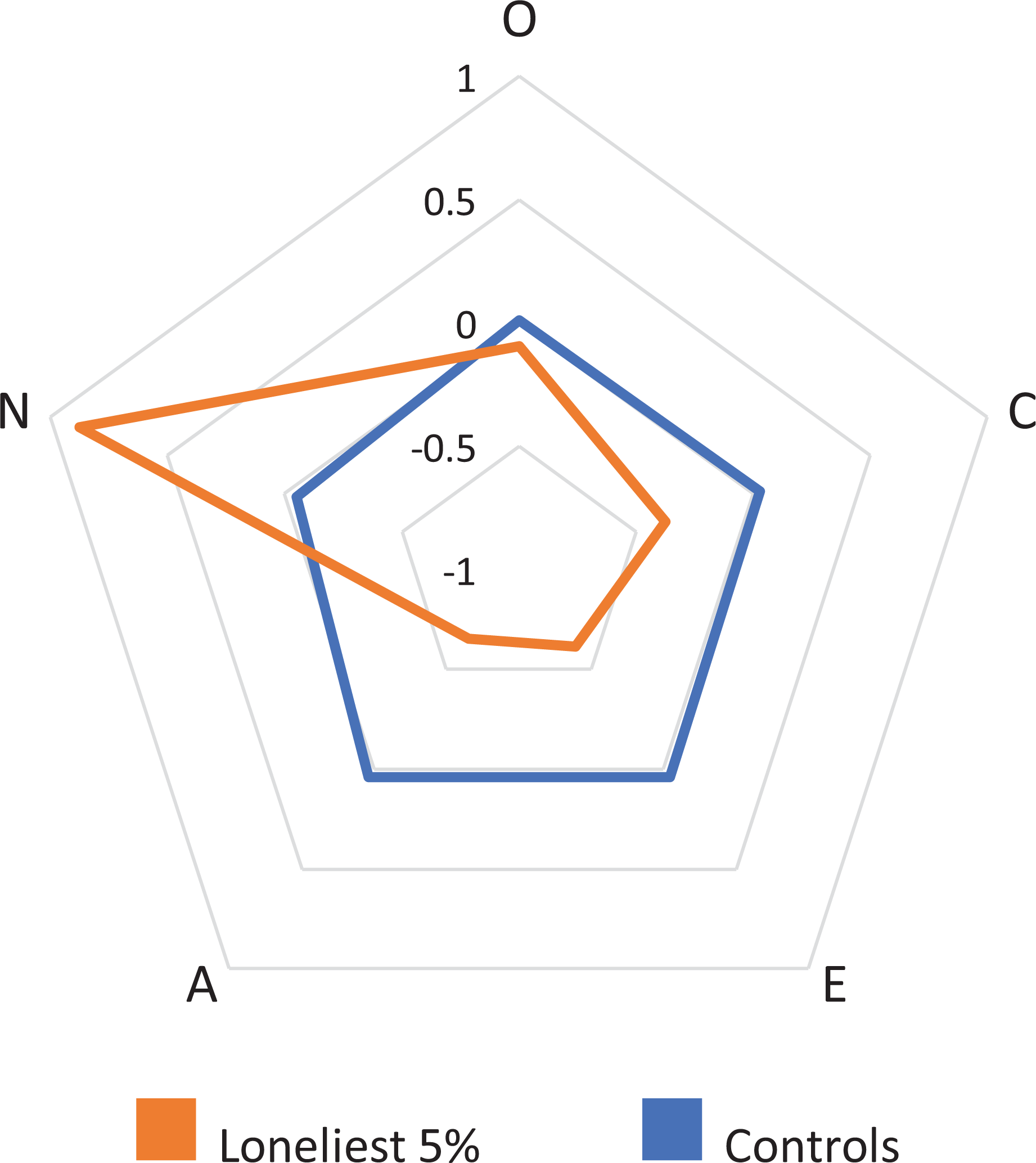
Radar chart of perceived Big Five personality scores in the loneliest 5% of participants (N = 108) versus “controls” (the remaining 95% of participants; N = 1,936). The corners of the polygonal shapes indicate the mean scores in the two groups for each of the fives scales. The scales have been z-scored, such that the midpoint of the axes (0) reflects the overall sample means for each trait, and the axis ranges from 1 standard deviation below the mean to 1 standard deviation above. Scores nearer the center of the figure are lower than the mean; scores further to the edges are higher. O = openness to experience; C = conscientiousness; E = extroversion; A = agreeableness; N = neuroticism.
Bivariate Associations Between Perceived Personality Traits and Self-Reported Loneliness at Age 18.
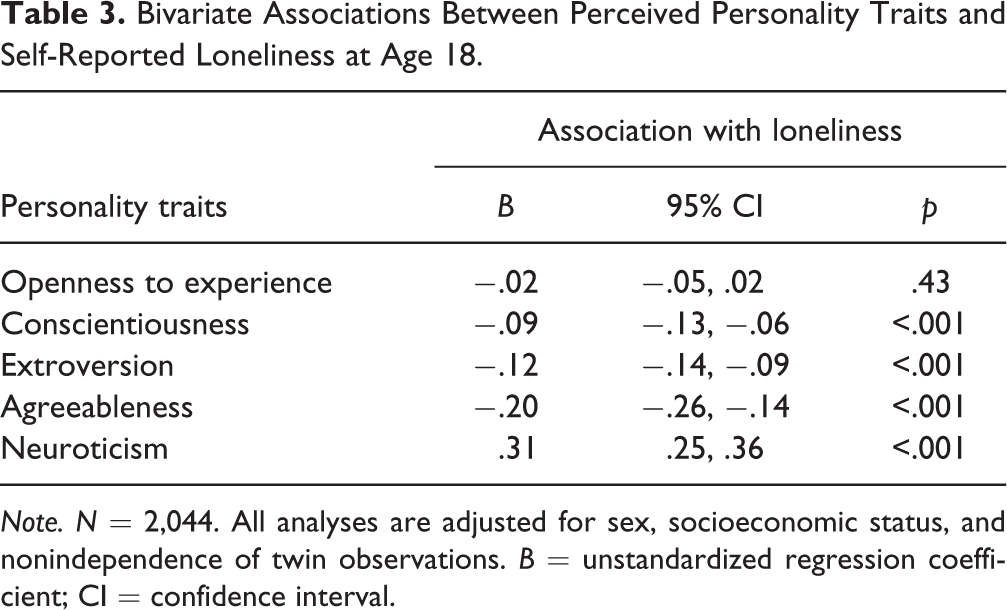
Note. N = 2,044. All analyses are adjusted for sex, socioeconomic status, and nonindependence of twin observations. B = unstandardized regression coefficient; CI = confidence interval.
Associations Between Twin Differences in Perceived Personality Traits and Twin Differences in Loneliness.
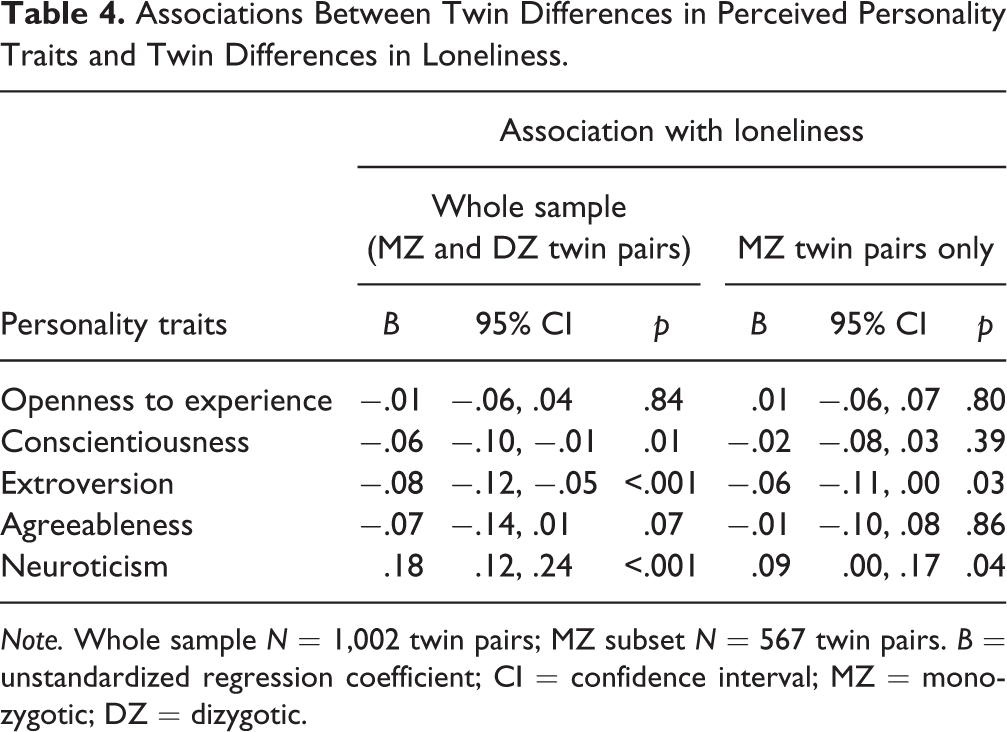
Note. Whole sample N = 1,002 twin pairs; MZ subset N = 567 twin pairs. B = unstandardized regression coefficient; CI = confidence interval; MZ = monozygotic; DZ = dizygotic.
Qualitative Analyses
Thematic analysis of the interviewers’ text notes of the 108 loneliest individuals yielded three predominant themes. These were named uncomfortable in own skin, clustering of risk, and difficulties accessing social resources.
Uncomfortable in own skin
Interviewers’ appraisals of the loneliest participants were favorable more often than not. The most common adjectives used to describe participants were “nice,” “friendly,” and “bright.” Negative descriptions, such as “rude,” “unfriendly,” and “jealous,” were rare. However, the quantitative personality ratings made by the interviewers were reflected in their written accounts, in which participants were frequently described as having a nervous or sensitive demeanor. Nervy disposition—was pacing the floor a couple of times during the interview. […] Quite sensitive and even minor slights really affect him it seems. (Participant 36; male) I could imagine that she gets upset very easily. At times in the interview I was expecting her to burst into tears. (Participant 82; female) [Participant] was polite throughout but continually put herself down and displayed very low self-esteem. (Participant 68; female) I think he thinks about things too much [and] is too hard on himself. Even when he answered one of my questions wrong […] he would be really apologetic or say something negative about himself. (Participant 27; male) Seemed to try and make herself look smaller by dipping her head and pulling her arms close. […] She did not seem very confident and seemed quite introverted. (Participant 3; female) Found him awkward during the interview—like he didn’t know how to interact with strangers, and it was left to Dad to do a lot of the chit chat. I think he didn’t really like having so much attention focused on him as well. (Participant 20; male) Seems very nervous and uncomfortable in her own skin. Found it hard to make eye contact and seemed uncomfortable under my gaze; picking at nails, hair and shuffling about during the interview. (Participant 2; female) I found it quite hard to get conversation flowing with [participant], she gave very short answers to questions and didn’t really attempt to make conversation. […] There were some long awkward silences when I couldn’t think of anything else to say! (Participant 12; female) It seems she has not ventured far and did not feel confident to ride the London transport or navigate areas alone. (Participant 21; female) [Participant] was really talkative but not in terms of showing interest or general chat, he would just ask question after question and it almost felt like an interrogation at first. (Participant 49; male) Would go off on rants and tangents and as such the interview took over five hours to complete. (Participant 72; male)
Clustering of risk
The majority of participants were described as having experienced significant adversities such as mental health problems and victimization, and in the majority of these cases, multiple different forms of adversity were present. Many of the interviewers’ accounts described complex and eventful life histories. For instance, one of the most severe cases involved a catalogue of physical and sexual abuse during childhood, parental substance problems, family conflict, homelessness, self-harm, and suicide attempts. I really liked the twin and felt sorry for her and what she had been through, I still felt that she had many issues to deal with and perhaps needed more in-depth help as [she] had only had 6 sessions, which although she said had helped and helped her to be able to talk about it, she still seemed to have many issues. (Participant 25; female) [Participant] presented with symptoms of depression, GAD and PTSD. His difficulties appeared inherently connected to the experiences of domestic violence he has been through in his childhood. He is unhappy with his life at the moment and being unemployed. (Participant 42; male) I noted that [participant] seemed to have trouble maintaining eye contact. She was very intelligent but I felt that she had low self-esteem. Maybe the bullying had more of an impact on her than she thought. (Participant 6; female) The bullying [participant] experienced was intense and occurred more or less every day throughout the whole of her education. As a result of the bullying [participant] left school without receiving any qualifications which she is very conscious of and makes her unconfident during interviews. (Participant 30; female) Twin has a difficult relationship with her mother. Twin has said that her relationship has improved a lot since moving out to live with her father when 15 years old. However you can see that the relationship is still strained. (Participant 71; female) [Participant] said he hates living at home because he hates the atmosphere in the house and hates his older sister who lives there. (Participant 87; male) They are renting a 1 bed flat and barely have anything in it. No washing machine, no bed, just mattress, one tiny single sofa. [Participant] said they can’t afford to put the heating on as it costs too much on the gas card, house was freezing cold. (Participant 2; female) In general I think that she was a nice well rounded young woman, I think that her recent mental health problems seem to be under control and she has good support from friends and family to help her through it. She seemed positive for the future, and doesn’t want to dwell on what has happened and she is keen to make sure she stays well so has cut down on alcohol and is happy to still be seeing a counsellor. (Participant 29; female) He seemed very dissatisfied with his life, but didn’t seem have any desire to make any changes […] He said that if he could live his life over again, he would change everything about it, although couldn’t get out of him what exactly he would change or do differently. (Participant 60; male)
Difficulties accessing social resources
Unsurprisingly, having few or no friends featured in numerous cases. However, in many accounts, it appeared that what was lacking was not social connections per se, but rather the more functional aspects of those relationships. For example, some participants were fairly socially active, but when asked about sources of social support during the interview, it became clear that their friendships were largely superficial in nature, characterized by shared activities rather than companionship and confiding. I got the impression that she is a sociable girl, e.g. she goes out with her friends most weekends, however based on her answers during Social Support I don’t think she confides in her friends very much. (Participant 70; female) He views his friends as his real family. However, it seemed like they are all a group of friends he has only because they all take drugs together […] he was quite negative about them in the Social Support section. (Participant 52; male) Mentioned several times that she does not have any/many friends as she lost contact with them when she left college. (Participant 22; female) The twin was quite close to his psychology teacher at school and the twin sought him out to talk about things. However now the twin has left school he feels he has no one to talk to. (Participant 69; male) [Participant] perceives that he has no family support, and although in some regard he is right, he does seem to have more help than perhaps he realises. […] As the interview went on, he did seem to concede more and more that his family are there when he needs them to be. (Participant 52; male) I was surprised that he didn’t report more support from his family as they seemed very close and family oriented with lots of relatives living nearby. (Participant 5; male) [Participant] said that she didn’t have any friends at all and I do think that she has difficulty forming friendships […] yet she kept telling me stories of friends. (Participant 43; female) I think he has people there for support but he doesn’t feel that his family do enough for him. I think they are there if he wants them to be but he has pushed them away by moving out and now doesn’t really know what to do. (Participant 107; male) [Participant] feels she does have support from her friends and family but she chooses to deal with things alone. (Participant 18; female) Reported that sometimes relationship with family is not that great. Although thinks this is more to do with him keeping things to himself than lack of support. (Participant 66; male) She said she would never look for any help for her anxiety because she thinks that is just who she is and no-one would be able to change it. (Participant 88; female) She told me that she stopped taking her depression medication in September because she didn’t think that she needed it anymore but she was signed off work due to depression in October so she was obviously not feeling better at the time but she didn’t tell her doctor that she had stopped the medication. (Participant 13; female) [Participant] seems guarded and I don’t feel he completely opened up. He refused to answer the Self-Harm section as I am pretty sure he has self-harmed—but didn’t want to discuss it with me. (Participant 61; male) [Participant] has experienced several violence events. […] As a result of these events people who she thought were good friends turned against her which appears to have left her with trust issues (saying she feels as though she can’t trust anyone in the Unusual Thoughts section, and being quite suspicious of me initially). (Participant 96; female) Has friends but doesn’t trust them and doesn’t report feeling close to them. Only answered ‘somewhat true’ to Social Support questions about friends […] I think she is a bit lonely and isolated because of not trusting anyone and not having anyone to confide in. (Participant 12; female)
Discussion
This study employed a mixed-methods approach to document the outward presentation of loneliness, through the eyes of others. It replicates the finding that a person’s loneliness is perceptible to others who know them well (Luhmann et al., 2016). Furthermore, as reported previously (Matthews et al., 2017), the interviewer ratings indicate that participants’ loneliness is visible even to someone who has met them for the first time. The study further extends prior research by investigating the other ways in which lonely individuals are perceived by others. The interviewers observed patterns of personality characteristics, mannerisms, and life circumstances in the loneliest participants that illustrate the complexity of this phenotype and the wider context in which it is embedded.
A distinct profile of perceived personality traits in lonely individuals was observed. Neuroticism was particularly salient: of the five traits, it was the strongest correlate of loneliness. Meanwhile, openness to experience was the only trait not associated with loneliness. Both findings are consistent with other recent studies (Buecker et al., 2020; Mund & Neyer, 2016, 2018). The present study adds to the existing literature by applying genetically sensitive methods to these associations. Previous research using polygenic scores has shown a genetic correlation between loneliness and personality traits such as neuroticism (Abdellaoui et al., 2018). Using a twin-differences approach to control for all genetic effects, the present study provides further support for this, showing that the associations between loneliness and perceived personality traits are to a large extent explained by common genetic etiology. This attests to the notion of loneliness as a trait-like phenomenon that has much in common with personality traits (Mund & Neyer, 2018).
The qualitative analyses add further meaning to these findings, offering a rich insight into the lives of individuals suffering from loneliness, through the unique perspective of an outside observer who has been given a privileged view into their mental health, living circumstances, and childhood histories. Previous qualitative research has typically involved participants discussing their own lived experiences of loneliness (Korkiamäki, 2014; Office for National Statistics, 2018; Vasileiou et al., 2019). In the present study, our aim was to use the interviewers as mediators of information and to assimilate that information in a holistic, bigger-picture analysis in which loneliness is set within a wider context. The strength of this approach can be seen in the ability of the interviewers to “read between the lines” and make observations that might not have emerged from a first-person account. The narrative that arose from the interviewers’ accounts was one of highly vulnerable individuals who have experienced disrupted and at times chaotic lives. The data also reveal how individuals can become trapped in loneliness, through a combination of unfavorable circumstances and maladaptive perceptions that put potential sources of support out of reach.
The first theme, uncomfortable in own skin, shows lonely participants struggling to feel at ease in dyadic interactions with people they have met for the first time. Shyness, awkwardness, low confidence, and negative self-perceptions made it difficult for conversation to flow freely. Whether these traits were an acquired consequence of loneliness, or a contributing factor, was not clear. On the one hand, experiencing minimal social contact for a prolonged time could both beget feelings of loneliness and also deprive individuals of the opportunity to practice social skills, receive positive feedback, and build confidence in social situations. On the other hand, inhibited behavior in social encounters could prevent individuals from building rapport and experiencing a meaningful connection with others—indeed, in some cases, participants’ own discomfort appeared to spread to the interviewers, leaving both parties feeling mutually unable to engage with each other. One predominant model suggests that feelings of loneliness influence behavior in social situations, and the behavior of the social partner, in a cyclical manner (Hawkley & Cacioppo, 2010). According to this model, loneliness gives rise to negative expectations about social encounters and about the intentions of others, in turn leading to guarded behaviors and difficult social interactions that inadvertently reinforce these beliefs, creating further disconnect between lonely individuals and those around them. In this manner, loneliness could become a vicious cycle that perpetuates itself over a period of months or years.
The second theme, clustering of risk, highlights that loneliness does not occur in a vacuum but is often part of a constellation of intersecting adversities including mental illness, victimization, and family conflict. This aggregation of hardships within individual cases is supported by quantitative data in the same cohort, showing that loneliness in young adults is pervasively associated with psychopathology, poor stress coping, health risk behaviors, and job-seeking difficulties (Matthews et al., 2019). The qualitative analyses further highlight the complex interrelationship between different factors in the context of loneliness (e.g., between victimization and low trust, and between unemployment and depression). The role of bullying was particularly salient and merits further investigation: being a victim of bullying could be a risk factor for loneliness in its own right, but lonely individuals could also be perceived as easy targets (Pavri, 2015). However, other forms of victimization were also described in the data, and future research should consider how associations between victimization and loneliness vary across different types of exposure, context, and perpetrator.
While the second theme highlights lonely individuals’ need for support, the third, difficulties accessing social resources, reveals barriers to obtaining or utilizing that support. Objective lack of social connection was a problem in some cases, but in others, the issue appeared to concern the way participants felt about their relationships with those around them. Loneliness is defined as a mismatch between one’s desired and actual social relationships (Peplau & Perlman, 1982), and in view of this, it is unsurprising that the loneliest participants in this sample tended to perceive that they lacked social support. However, in some cases, the interviewer’s observation was that these perceptions were at odds with the empirical reality of their circumstances, underscoring the subjective nature of loneliness and its association with negatively biased cognitions. Even where participants acknowledged that they had access to support, there was often a reluctance or lack of agency to avail themselves of that support: low trust, perceived hopelessness, and a preference for coping privately led to participants suffering in silence, compounding their isolation.
Strengths and Limitations
A strength of this study is that the personality ratings were made by study interviewers, thereby avoiding bias that could be introduced by relying entirely on self-reports. On the other hand, as interviewers were the sole informants for the personality rating, it was not possible to test agreement with self-reports or ratings made by other informants. Nonetheless, there is evidence that informant ratings of personality traits show good agreement with self-reports and measure the same underlying constructs (Olino & Klein, 2015). Another issue that bears consideration is that the agreement between self-reported loneliness and the three informant ratings was highest for the interviewer report. While the interviewers were blind to participants’ responses to the loneliness questionnaire, they had just conducted an in-depth interview with the participant about their mental health, experiences, and circumstances. This privileged knowledge may have placed the interviewers’ in a better position to make informed judgments about participants’ loneliness. Alternatively, behavioral cues that signaled participants’ loneliness may have been more unambiguous in the highly focused interview situation. Parents and siblings, meanwhile, may have drawn on more global information about the participants, including situations in which those cues were less visible.
The qualitative analyses were restricted to the 5% of participants at the extreme tail of the loneliness distribution. This is similar to the proportion of young people who report that they feel lonely often (Matthews et al., 2019; Office for National Statistics, 2018). However, the accounts presented here may reflect exceptionally troubled circumstances that are not generalizable to young people with more middling levels of loneliness. Furthermore, despite the recurring themes that were observed in the data, no two individuals’ circumstances were identical, and these themes reflect patterns within the lonely population rather than a single exemplary profile of the lonely individual.
Interviewers were not instructed to take notes according to a formal protocol, nor were they instructed to make notes specifically commenting on participants’ loneliness. Instead, their objective was to document, in a free-form manner and in as much detail as possible, what they considered to be the most salient details of the interview. This open-ended approach could be a strength, as it allowed the interviewers to focus on the most relevant aspects of each individual case and to draw connections that might have been missed by adhering to a more structured framework. Nonetheless, while all interviewers received the same training, some interrater differences in note-taking style are to be expected.
Implications
The insights from the interviewers’ accounts suggest potential avenues of intervention to reduce loneliness. Many different forms of intervention currently exist, but the evidence base is limited (Gardiner et al., 2018). Meta-analyses indicate that there is some support for therapeutic approaches geared toward addressing maladaptive social cognitions (Eccles & Qualter, 2020; Masi et al., 2011). The findings of the current study could be informative for such interventions: first, they highlight the need to help lonely youths access and make best use of social resources and foster a proactive and optimistic outlook. Second, because loneliness often co-occurs with other problems such as psychopathology and trauma, efforts to target feelings of loneliness should also take this wider context into account. However, the findings also suggest some barriers to the delivery of interventions: if lonely individuals are often reluctant to seek help, interventions may fail to reach some of the people most in need of them. Reducing stigma attached to loneliness and encouraging help-seeking behaviors is therefore an important objective also. Finally, the findings of this study show that lonely individuals live in a diverse range of situations, and there is unlikely to be a “one-size-fits all” approach (Mann et al., 2017). Instead, it is important to consider the role of individual differences in personality, and the unique circumstances in which each lonely individual is situated.
Supplemental Material
Supplemental Material, sj-pdf-1-jbd-10.1177_0165025420979357 - This is what loneliness looks like: A mixed-methods study of loneliness in adolescence and young adulthood
Supplemental Material, sj-pdf-1-jbd-10.1177_0165025420979357 for This is what loneliness looks like: A mixed-methods study of loneliness in adolescence and young adulthood by Timothy Matthews, Helen L. Fisher, Bridget T. Bryan, Andrea Danese, Terrie E. Moffitt, Pamela Qualter, Lily Verity and Louise Arseneault in International Journal of Behavioral Development
Footnotes
Acknowledgements
The authors are grateful to the Study members and their families for their participation. Our thanks to CACI, Inc., and to members of the E-Risk team for their dedication, hard work, and insights.
Funding
The author(s) declared receipt of the following financial support for the research, authorship, and/or publication of this article: The E-Risk Study is funded by the Medical Research Council (UKMRC grant G1002190). Additional support was provided by National Institute of Child Health and Human Development (grant HD077482) and by the Jacobs Foundation. Timothy Matthews is a British Academy Postdoctoral Fellow. Louise Arseneault is the Mental Health Leadership Fellow for the UK Economic and Social Research Council (ESRC). Helen L. Fisher received salary support from the ESRC Centre for Society and Mental Health at King’s College London [ES/S012567/1]. The views expressed are those of the authors and not necessarily those of the ESRC or King’s College London.

Supplemental Material
Supplemental material for this article is available online.
References
Supplementary Material
Please find the following supplemental material available below.
For Open Access articles published under a Creative Commons License, all supplemental material carries the same license as the article it is associated with.
For non-Open Access articles published, all supplemental material carries a non-exclusive license, and permission requests for re-use of supplemental material or any part of supplemental material shall be sent directly to the copyright owner as specified in the copyright notice associated with the article.
