




Abstract
In the current study, data collected from Wave 6 of the Millennium Cohort Study (n = 11,872), a nationally representative sample survey of youth aged 14 years in the UK, are used to examine the prevalence of loneliness among this age-group, investigate the feelings associated with the experience of loneliness among youth, explore the risk factors for loneliness among young people, and learn how they coped with loneliness. Given recent findings that youth are vulnerable to loneliness, the study assesses the prevalence of loneliness among adolescents across some important sociodemographic characteristics, such as nation of residence, gender, and ethnicity. We also identify the kinds of social experiences that accompany loneliness during adolescence, exploring friendship, relations with parents, social support, and bullying. Our key finding is that, in addition to the absence of desired social relationships, which has been typically identified as the ultimate source of loneliness, the presence of undesirable and even harmful social relationships is a major source of loneliness. This study uniquely brings together psychological and sociological perspectives to understand the experience of youth loneliness.
Loneliness is commonly defined as an unpleasant psychological reaction to the absence of desired social relations (Perlman & Peplau, 1981). It is an unpleasant experience for individuals and is accompanied by psychological distress (Young, 1982); if left unresolved, it is linked to health complaints (Cacioppo et al., 2010, 2015; Prieto-Flores et al., 2011). Despite empirical evidence that loneliness is an important issue for youth aged 16–24 years (BBC Loneliness Experiment, 2018; Office of National Statistics [ONS], 2019b; The Co-op Foundation, 2018; Sahin, 2012) and is commonplace among children (ONS, 2018, 2019a), loneliness continues to be widely perceived to be a problem primarily for older people (Arnold-Cathalifaud et al., 2008; Qualter et al., 2015; Von Soest et al., 2018). To a certain extent, recent media coverage of research findings has changed public perceptions, but prevalence data on youth younger than 16 years, so far, have not been available, and discussion of loneliness among young adolescents is largely absent from academic and public discourse. To fill that gap, we explore data on loneliness from the Millennium Cohort Study (MCS), providing prevalence rates for the first time for this age-group in the UK and exploring the feelings that accompany the experience of loneliness and investigating its correlates.
Three and half decades ago, Robert Weiss (1982) noted, “Loneliness almost certainly is more common in adolescence than later in life, and possibly more intense as well, although we as yet lack the survey data that would provide conclusive evidence for this observation” (pp. 76–77). At the same time, Tim Brennan (1982) made almost the same observation: “Although there are no large-scale, systematic epidemiological studies of loneliness across different ages, the available evidence suggests that there is more loneliness among adolescents than among any other age group” (p. 269). The recent reports from the ONS, BBC Loneliness Experiment, and The Co-op Foundation support those claims that late adolescence is a time of vulnerability to loneliness, with data from the BBC Loneliness Experiment also supporting the thesis that loneliness is more intense for adolescents aged 16–24 years compared to other age-groups (Barreto et al., in press). Indeed, results from academic studies suggest that loneliness is as prevalent among later adolescents as it is among older people (Luhmann & Hawkley, 2016; Vanhalst et al., 2014). Missing from the discussion, however, are younger adolescents, where the literature is devoid of large population-based studies focused specifically on loneliness in adolescents younger than 16 years. In the current study, using data from Wave 6 of the MCS (University of London, 2018), we (1) explore the prevalence of loneliness among youth aged 14 years in the UK; (2) investigate its distribution across gender, ethnicity, and nation of the UK and its association with some negative emotions; (3) discover how it is linked to the presence of negative social relationships at home and school; and (4) find out how youth cope with loneliness.
Prevalence of Loneliness Among Youth
Existing studies on loneliness with young adolescents use relatively small-scale samples (from less than 100 to 500), and there is a shortage of large-scale population data. An assessment of loneliness was included in the sixth survey of MCS (more details about MCS to be found in Data and Methods), enabling an exploration of the true prevalence of loneliness among youth under 16 years of age in the UK for the first time. While there are studies of prevalence of loneliness among youth, there is nothing recent and nothing from the UK.
The earliest large-scale study on loneliness among adolescents was that by Ostrov and Offer (1978). Their sample included 5,000 youths aged 12–18 years from Australia, Ireland, and the U.S. Of those, 22% of boys and 20% of girls aged 12–16 years agreed with the statement “I am so very lonely” (Ostrov & Offer, 1978, cited in Brennan, 1982). At about the same time, Brennan and Auslander (1979) studied 9,000 adolescents aged 10–18 years across 10 cities in the U.S. Their estimates were that 10–15% of adolescents were “seriously lonely,” as defined by a pattern of simultaneously high scores on self-reported loneliness, emotional and social isolation, and other indicators of loneliness; 54% of those interviewed agreed with the statement “I often feel lonely” (Brennan, 1982). In short, loneliness appeared to be highly prevalent among American adolescence in the U.S. in the late 1970s to the early 1980s. There are no current population-based studies of loneliness among those younger than 16 years since that time.
Emotions That Characterize Loneliness Among Youth
Using the MCS population cohort, we are also able to examine the emotions that characterize loneliness among UK youth. Among adults, there are clear emotional correlates, including hostility (Sermat, 1980), anger, emptiness, awkwardness, restlessness, and anxiety (Perlman et al., 1978; Russell et al., 1978); unhappiness; dissatisfaction with life generally; and pessimism (Perlman et al., 1978; Russell et al., 1978). But there is no work exploring whether the same emotions are evident among lonely youth. In the current study, we investigate whether loneliness is associated, as we would expect based on data from adults, with negative emotions and a pessimistic outlook.
Loneliness and Social Relations Among Youth
We also pay serious attention to both the lack of positive social relations and the presence of negative social relations in explaining loneliness. The deficit of friendship is a key source of loneliness for adolescence because belonging needs are heightened (Qualter et al., 2015). Less understood is the effect of undesirable social relations on loneliness, which is particularly important for youth, when the brain is particularly sensitive to both positive and negative social stimuli (Foulkes & Blakemore, 2016). First and empirically, while some American researchers have found elevated loneliness among victimized adolescents since the mid-1990s (Crick & Grotpeter, 1996; Nansel et al., 2001; Storch & Masia-Warner, 2004), this issue has not drawn an equal amount of attention from British researchers. More generally, the most popularly used definition of loneliness (Perlman & Peplau, 1981) restricts the source of loneliness to the deficit of desirable social relations, thereby effectively leaving the suffering from unpleasant social relations outside the explanation for loneliness.
Responding to that restriction, here we expand the existing research to explore the effects of the adolescents’ social relations, especially the unwelcome ones, on the probability of loneliness. We are particularly interested in adolescents’ relations with siblings, friends, peers, and parents and whether they have been victims of bullying. Earlier empirical work suggests that victimization contributes to experiences of loneliness (Alik & Güneri, 2013) and that loneliness is associated with negative interactions with parents (for a review, see Burgess et al., 1999), characterized by a lack of parental warmth and responsiveness. However, there is an absence of examination using large population cohorts. Knowledge of the connection between those social relations and loneliness is invaluable for tackling the root causes of loneliness among adolescents.
Coping With Loneliness
Among adults and adolescents, individuals cope with loneliness using a number of different strategies, including being nicer to others, improving physical appearance, active solitude, engaging in nonsocial activities in which one is skilled (e.g., hobbies), distracting oneself (e.g., spending money, watching TV), and thinking about why they are lonely (Cutrona, 1982; Moore & Schultz, 1983; Paloutzian & Ellison, 1982; Rokach & Neto, 2000; Rook & Peplau, 1982; Rubenstein & Shaver, 1982). Of those strategies, loneliness is alleviated best by seeking support from social networks (Bell, 1991). There are no studies to our knowledge that have explored how young adolescents manage their experiences of loneliness, but in talking about how schools could help them overcome loneliness, adolescents reported that teacher support was important (Galanaki, 2004). Data from the MCS allow the examination of whether those 14-year-olds who report loneliness are more likely to seek social support in difficult times, providing some data on how successful they are likely to be at alleviating loneliness when they experience it.
One extremely worrying reaction to loneliness that has drawn wide and serious attention from professionals working with young adolescents is self-harm. Self-harm has been found to be more common among people reporting loneliness at different ages (Aviva & Schonert-Reichl, 2005; Matthews et al., 2018; Troya et al., 2019; Wand et al., 2018), but there is no examination of that relationship among young adolescents in the UK. We fill that gap using MCS data.
Data and Method
The MCS
The data analyzed in this study came from the sixth survey of The MCS (University of London, Institute of Education, Centre for Longitudinal Studies, 2018), a multidisciplinary and nationally representative prospective study that has followed 18,818 adolescents born in the UK since 2000–2001. The sample size for this wave (11,872; Fitzsimons et al., 2017) is much larger than that of other studies on adolescent loneliness, and the questionnaire contains items on both loneliness and other variables that we would expect to be associated with loneliness. Different types of data (physical, cognitive, etc.) were collected at three levels (household, parents, and cohort member [CM]). In this article, we focus on data collected from the CM. It is important to note that, although MCS is a longitudinal study, it was not until this wave that questions about the respondent’s loneliness were included, and the data for the next wave on 17-year-olds are not released yet. Therefore, our analyses in this study are cross-sectional.
The sampling scheme followed a stratified and clustered sampling method. In England, the population was divided into three strata: the ethnic minority stratum (wards where the proportion of ethnic minorities in that ward in the 1991 Census was at least 30%), the disadvantaged stratum (wards other than those falling into the ethnic minority stratum, which fell into the poorest 25% of wards according to the Child Poverty Index for England and Wales), and the advantaged stratum (wards other than the two described above). In Wales, Scotland, and Northern Ireland, there were only two strata: the disadvantaged stratum was composed of adolescents living in wards (known as “Electoral Divisions” in Wales) that fell into the poorest 25% of wards according to the Child Poverty Index and the advantaged stratum was made up of children living in other wards in those countries. Of all families eligible for participating in the survey, 11,726 produced valid results, making the response rate 60.9% (Fitzsimon et al., 2017).
The fieldwork for collecting data was conducted by professionally trained interviewers visiting the selected households. Each interviewer brought a tablet with the questionnaires preinstalled. As the 14-year-olds were deemed as being able to complete the questionnaire on their own, they were asked to complete a 40-min computer-assisted self-interviewing questionnaire on the interviewer’s tablet.
Measures
Loneliness
Loneliness was measured alongside 12 other questions about the respondent’s feelings. The original instruction read: “The next few questions are about how you have been feeling or acting recently. For each question please select the answer which reflects how you have been feeling or acting in the past two weeks.” The loneliness statement was “I felt lonely,” and respondents chose from the following: 1 = not true, 2 = sometimes true, 3 = true. It has been argued that the use of the single-item measurement of loneliness like this is not as refined as other multiitem measures, such as the University of California, Los Angeles loneliness scale for adults (Russell et al., 1980) or the Illinois Loneliness Questionnaire (Asher et al., 1984). However, many studies examine loneliness with a single-item measure, and studies show they lead to the same results, even among youth (Eccles et al., 2019). On the other hand, it is worth pointing out that having three response options, in comparison with four in other studies (Yang & Victor, 2011), makes our measure less nuanced or capable of capturing more differentiated levels of loneliness.
Parent–adolescent relationships
MCS includes a series of questions about the adolescent respondent’s relationship with their mother and father. Given limited space, we focused on one question, “how often do you argue with your mother or father,” respectively. Respondents were asked to choose from the following: 5 = most days, 4 = more than once a week, 3 = less than once a week, 2 = hardly ever, 1 = never.
Peer close friendship
Youth were asked whether they had a best friend, with binary responses (yes or no).
Experiences of bullying
MCS included a set of questions designed for collecting information about the experience of being bullied. Using the term “pick on” as a more accessible term for bullying, MCS asked about the frequency of being bullied by siblings, other adolescents (presumably in person), or others online. The respondent used the following response categories: 6 = most days, 5 = about once a week, 4 = about once a month, 3 = every few months, 2 = less often, 1 = never.
Coping with loneliness
MCS does not contain any item on how the adolescent respondent would cope with loneliness specifically, but it does include an item asking “what do you do if you are worried about something.” There are seven responses to the question, including “keep it to myself,” “tell a teacher,” and “tell a friend.” Worrying may come with loneliness, either because the youth feels lonely due to being unable to share their worries with anybody else or because the youth worries about the lonely experience itself. If so, the actions they take when worrying are likely to be similar to those they would take when feeling lonely. MCS also included an item about self-harm (whether the adolescent harmed themself in the past year, with yes and no response options), which we explored as another coping strategy. Further, MCS included three statements about access to social support: “I have family and friends who help me feel safe, secure and happy,” “There is someone I trust whom I would turn to if I had problems,” and “There is no one I feel close to,” with three options: 3 = very true, 2 = partly true, 1 = not true at all.
Statistical Analyses
We produced the results, to be presented in the next section, by analyzing the data described above with a variety of statistical methods. Firstly, simple descriptive statistics in cross-tabulations (Tables 1, 3, and 4) were presented to show the prevalence of loneliness across several groups. We then explored the association between loneliness and each of the factors that were theoretically expected to be associated with loneliness with Kendall’s tau-b (Tables 2 and 5). We chose to use this particular statistical measure because it is especially designed for measuring the relationship between two ordinal variables; as shown above, both variable “loneliness” and other factors here are ordinal variables (binary variables could be treated as simplest ordinal variables). The percentage of cases with missing values is small for the variables included in our analyses; for example, 5% for loneliness; therefore, no multiple imputations were calculated and pair-wise deletion was used.
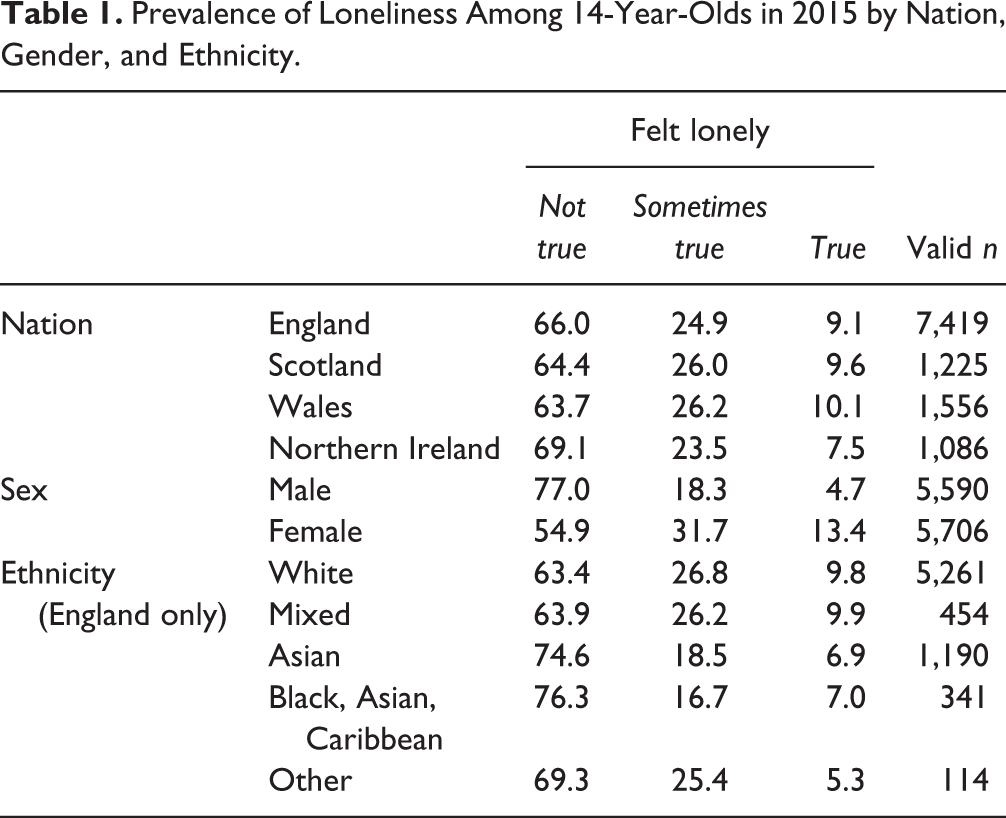
Prevalence of Loneliness Among 14-Year-Olds in 2015 by Nation, Gender, and Ethnicity.
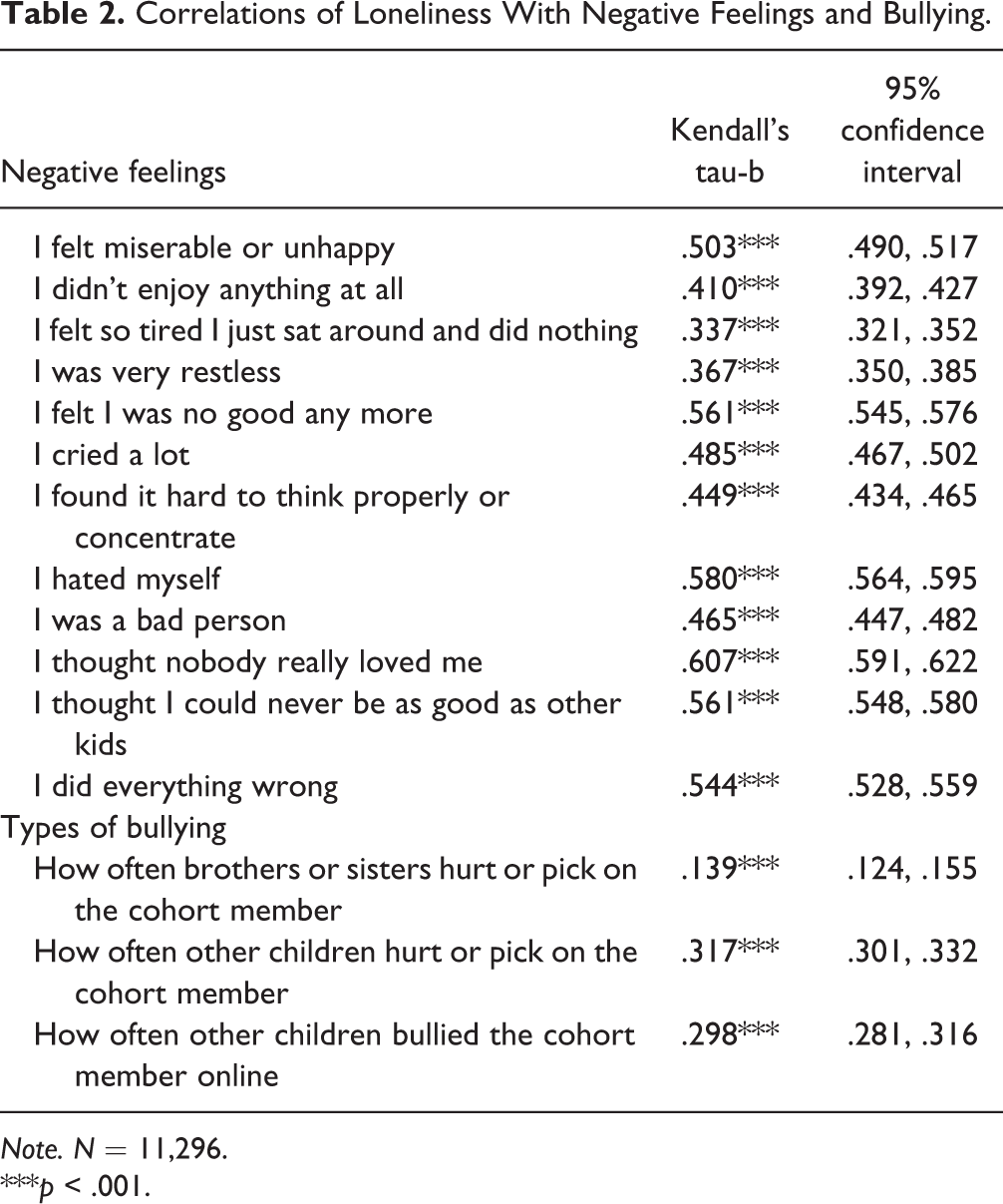
Correlations of Loneliness With Negative Feelings and Bullying.
Note. N = 11,296.
***p < .001.
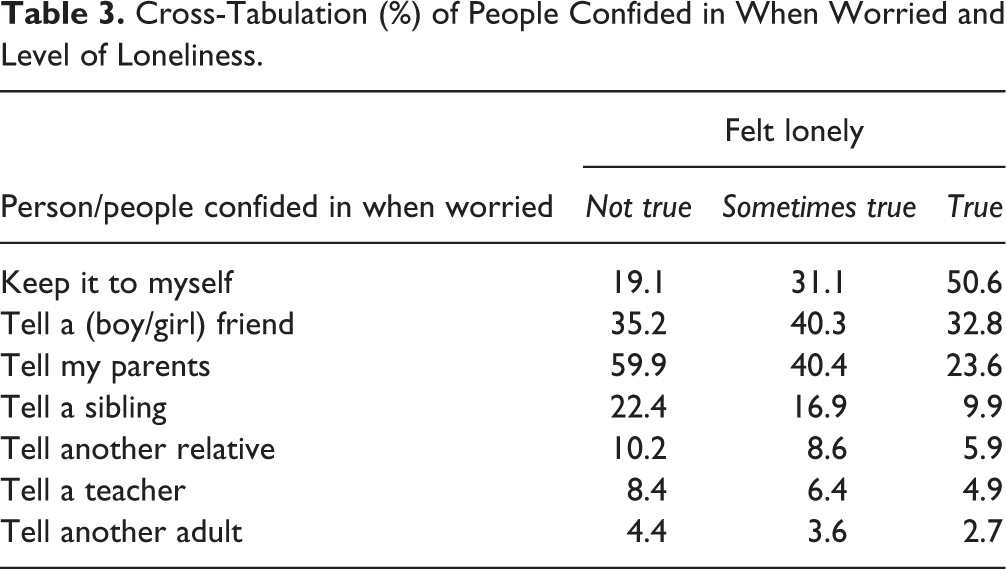
Cross-Tabulation (%) of People Confided in When Worried and Level of Loneliness.
Results
Prevalence of Loneliness Among 14-Year-Olds in the UK
Of the 11,286 (95.1% of the 11,872 total participants) 14-year-olds who provided valid loneliness responses, 65.8% chose “not true,” 25.0% “sometimes,” and 9.1% “true.” Combining the latter two responses, just over one third (34.1%) of the 14-year-olds in the sample had felt lonely during the past 2 weeks in 2015. The total number of 14-year-olds in mid-2015 was estimated at 707,888 (ONS, 2019c), making the total number of 14-year-olds at least sometimes lonely estimated as 241,390 in the UK in 2015. The corresponding number of “truly lonely” 14-year-olds would be 64,418.
As presented in Table 1, loneliness was the least prevalent among adolescents in the Northern Ireland and was the most prevalent among the Welsh youth. Among the 14-year-olds in the UK, girls were 3 times more likely to answer “true” than boys, and if we put “sometimes” and “true” together, the prevalence of loneliness among girls (45.1%) was almost twice than among boys (23.0%). We also explored how the prevalence of loneliness varied across ethnic groups among the youth in the UK. MCS contains 18 ethnic groups, which we reduced to 5: White, Mixed, Asian, Black/African/Caribbean (B/A/C), and Other. However, with the exception of England, the valid sample sizes for Black, Asian, and Minority Ethnicity, or non-White groups were too small to warrant statistical reliability, so here only the results for England are presented, showing that 14-year-olds who self-identified as Asian, B/A/C, and other were much less lonely than those who identified as White or Mixed.
Exploring Negative Feelings and Social Relationships as Potential Risk Factors for Loneliness
We found that loneliness was significantly correlated with all negative statements, but most frequently co-occurred with “I thought nobody really loved me,” “I hated myself,” and “I thought I could never be as good as other kids” (see Table 2).
For negative social relationships, we started by exploring adolescents’ relationships with parents. The higher the frequency of arguing, the more likely the 14-year-old reported loneliness (Kendall’s tau-b is −.180 [n = 11,132] for arguing with mother and −.132 [n = 10,440] for arguing with father, p < .001). We also explored whether having a close friend was a factor in an adolescent reporting loneliness. We found that adolescents without any close friends were 2.4 times more likely to choose “true” to “I am lonely” than those with a close friend. Next, we examined the associations of bullying and loneliness. The correlation of each response and loneliness was measured with Kendall’s tau-b.
The results align with our expectations: regardless of the type of bully, the more frequently the 14-year-old was “picked on,” the more likely they felt lonely; being bullied by peers seemed more hurtful than by siblings. In addition, online bullying appeared to have nearly the same effect as interpersonal bullying on loneliness. These association statistics show that those bullied online were more likely to be lonely than those who were either not bullied or bullied less frequently. Equally unsurprising is the statistically significant association (Kendall’s tau-b ranging from .12 to .29 with all p values below .001) between loneliness and being a victim of a series of ill treatment by others (insulted, threatened, hit with a weapon, stolen, sexually assaulted, etc.).
How 14-Year-Olds Coped With Loneliness
Table 3 presents the percentage of 14-year-olds who answered “yes” to different coping strategies that they employed when worried, organized by level of loneliness. Half of the adolescents who answered “true” to the question of loneliness would keep it to themselves when they were worried about something, one third of them would tell a friend, and just under a quarter would tell their parents. Fewer adolescents would tell their siblings, relatives, teachers, or other adults.
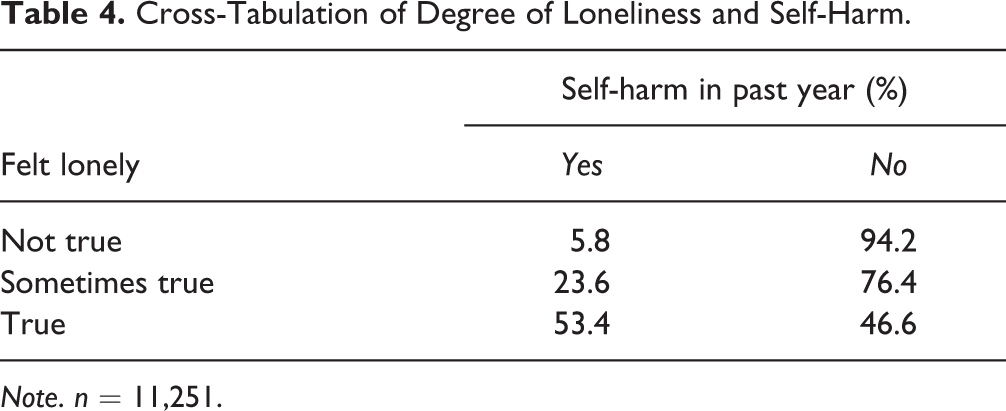
Table 4 presents an association between loneliness and self-harm: the risk of self-harm increases considerably when a 14-year-old reports loneliness—the chance of self-harm among the “sometimes lonely” is nearly 4 times that among the not lonely and in turn the chance among the “truly lonely” is more than double that for the “sometimes lonely.” More than half of those truly lonely reported self-harm (Kendall’s tau-b is −.368, p < .001).
Cross-Tabulation of Degree of Loneliness and Self-Harm.
Note. n = 11,251.
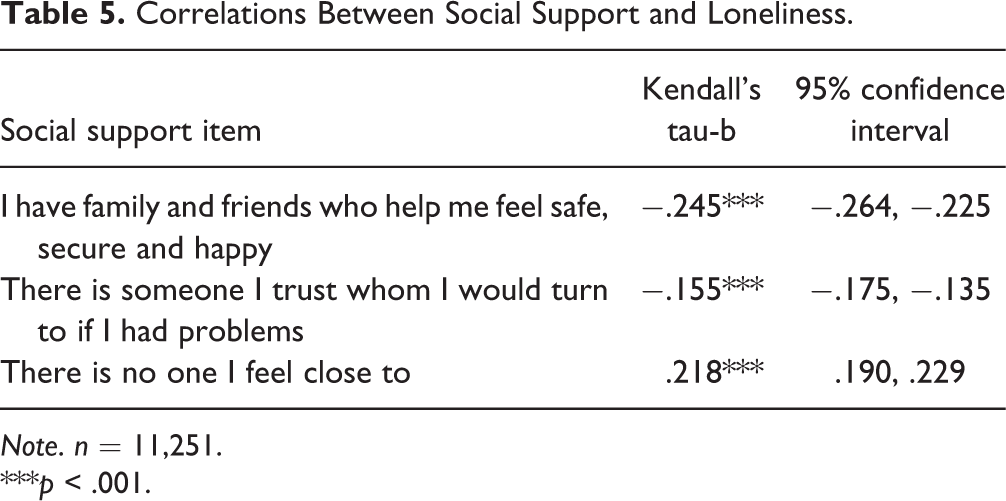
The provision of social support is an effective way of ameliorating loneliness, but our findings show that the higher the reports of loneliness, the less likely youth were to say they felt safe, secure, and happy with family and friends; had someone they could trust; or felt close to (Table 5).
Correlations Between Social Support and Loneliness.
Note. n = 11,251.
***p < .001.
Discussion
In this study, we explored the prevalence of loneliness among 14-year-olds, investigated the negative emotions that accompanied the experience, and examined how it linked to negative social experiences. We found that 9.1% of 14-year-olds in the UK felt “always lonely,” comparable to work with adults and older people (Victor & Yang, 2012). The findings are also comparable to empirical work where nonrepresentative samples were used and/or different loneliness scales were completed (Luhmann & Hawkley, 2016; Vanhalst et al., 2014). While we add to the literature by providing a true prevalence study of loneliness among 14-year-olds in the UK, it seems previous studies were close in their estimations.
We also found that loneliness was associated with being unhappy, restless, feeling unloved, and generally despondent. Again, such findings are consistent with empirical evidence from other age-groups (Perlman et al., 1978; Russell et al., 1978), providing further evidence that the experience of loneliness is not distinct at different ages (Qualter et al., 2015). Also, the findings fit with the current theories of loneliness which suggest that the uncomfortable feelings that accompany loneliness often lead to reconnection as we try to overcome them (Qualter et al., 2015).
In the current study, we paid careful attention to the presence of undesirable social relations among lonely mid-adolescents in the UK. Loneliness was associated with negative social experiences, including bullying from peers and siblings and arguments with parents. We found that, while adolescents reporting loneliness were more likely to lack a close friendship, they also experienced negative social relationships at school and home. As was the case in other studies with adolescents in this special issue (Matthews et al., 2018), we found there was a constellation of adversities, including victimization and family conflict, that contributed to loneliness. Reviewing the literature on loneliness among adolescents, Laursen and Hartl (2013) identified a few “developmental changes” that increase the risk for loneliness at this stage in development: companions, autonomy and individuation, identity exploration, cognitive maturation and developmental changes in social perspective taking, and physical maturation, none of which represents any form of increased hostility. In other words, adolescence is a developmental period in which they start to experience serious hostile relations as they move away from the protection of their families. The sense of being rejected, isolated, or humiliated comes as a clear and strong signal of broken social relationships, which in turn becomes a source of loneliness.
The data also provided us with information of how these 14-year-old youths in the UK might manage their loneliness experiences, with the majority of them keeping such worries to themselves. Those findings suggest that universal in-school interventions that address the stigma surrounding loneliness (Qualter et al., 2015) and provide coping mechanisms, perhaps as a tool kit of solutions (BBC Loneliness Experiment, 2018), should be considered; empowering young people to manage their negative social experiences and evaluate their social interactions accurately will go a long way to helping them overcome loneliness.
Limitations
While MCS was designed as a longitudinal survey, the inclusion of the measurement of loneliness only in its sixth round means we had to analyze the data as cross-sectional and, thus, cannot make temporal and causal arguments. However, even by analyzing the data from this particular wave of MCS, it is much more logical to see the lack of desirable social relations or the presence of undesirable social relations as a cause of loneliness rather than the opposite—the most widely used definition of loneliness (Perlman & Peplau, 1981) implies a strong theory on social relations as causes for loneliness. But this assumption warrants further investigation: while it is possible that being a victim of bullying is a risk factor for loneliness, empirical evidence also shows that lonely individuals are often perceived as easy targets for bullies (Pavri, 2015), and it is possible that there is a reciprocal relationship over time between those experiences (Chu et al., 2019).
Conclusions
Current results depict a worrisome picture of loneliness among youth in the UK. The prevalence of loneliness among this young group of people is on par with that among older people; it is particularly so in Wales, among girls, and among those who are White or of mixed ethnicities. The sense of loneliness accompanies negative emotions. The absence of friends is confirmed as an important source of loneliness, but we also found that undesirable and sometimes harmful social relationships contribute to youth loneliness. The preference to cope privately means that lonely youth may suffer in silence, which may compound their sense of isolation and ultimately lead to further mental suffering and radical reactions such as self-harm.
