




Abstract
Loneliness describes a perceived deficiency in quantitative or qualitative aspects of individuals’ social relationships. Whereas the health-related consequences of loneliness are well-documented, surprisingly little is known about its interpersonal features and its consequences for relationship outcomes. In the present study, we investigated the association between loneliness and relationship experiences in partner relationships with a sample of 937 individuals from 480 mixed-sex couples. By employing actor-partner interdependence models and dyadic cross-lagged moderated multilevel models, we found higher loneliness to be robustly related to (a) lower relationship satisfaction for both oneself and the partner, (b) more self-reported, but not partner-reported conflicts, (c) lower average levels of one’s own, but not the partner’s closeness, and (d) less own self-disclosure. In contrast, loneliness was not associated with (a) sexual contact frequency, (b) average levels of physical affection, or (c) the daily dynamics between closeness and self-disclosure/physical affection. Thus, the results of the present study indicated that loneliness is primarily associated with the perception of the partner relationship but not its rather objective features or daily dynamics.
Keywords
Partner relationships are among the closest and most intimate relationships individuals have in contemporary Western societies. As partner relationships help to satisfy individuals’ need to belong (Baumeister & Leary, 1995; Reis et al., 2000), they have been discussed as a protective factor against loneliness (Dykstra & Fokkema, 2007; Luhmann & Hawkley, 2016; Stack, 1998; Tornstam, 1992). Loneliness is defined as a subjectively experienced deficiency in an individual’s social relationships with regard to quantitative and/or qualitative aspects (Ernst & Cacioppo, 1999; Perlman & Peplau, 1981); an intimate partner relationships may at least partly satisfy social needs and buffer the effects of loneliness (Luhmann & Hawkley, 2016; Stack, 1998). Several studies, however, have challenged the notion that partner relationships, per se, protect against loneliness. Specifically, it has been shown in cross-sectional (Ayalon et al., 2013; de Jong Gierveld et al., 2009; Givertz et al., 2013; Hsieh & Hawkley, 2018; Knoke et al., 2010; Moorman, 2016; Stokes, 2017a) and longitudinal (Stokes, 2017b) studies that lower relationship satisfaction is associated with higher loneliness.
Whereas these studies consider loneliness a correlate or consequence of lower relationship quality, feelings of loneliness might also erode relationships. We are aware of only one study investigating loneliness as a predictor of relationship satisfaction (Mund & Johnson, in press), thereby paralleling the well-established research strand showing the predictive power of loneliness for various health-related outcomes (for reviews, see Hawkley & Cacioppo, 2010; Leigh-Hunt et al., 2017). The study by Mund and Johnson (in press) has shown that an individual’s level of loneliness was predictive of lower levels of one’s own (i.e., actor effect) and the partner’s (i.e., partner effect) satisfaction across 8 years. Similarly, higher loneliness predicted stronger declines in one’s own and the partner’s relationship satisfaction across the same time period.
These findings are in line with the tenets of prominent contemporary models of loneliness that argue that loneliness constitutes an approach-avoidance dilemma (Cacioppo et al., 2014; Cacioppo & Hawkley, 2009; Ernst & Cacioppo, 1999; Qualter et al., 2015; Spithoven et al., 2017): The experience of loneliness indicates malfunctioning or impaired social relationships and motivates individuals to restore them (the approach side of the conflict). At the same time, it has been argued that the subjectively sensed disconnection from others triggers perceptions of threat and danger, which individuals aim to avoid (Cacioppo et al., 2014). Thus, individuals high in loneliness are prone to various kinds of cognitive biases related to attention, memory, and, most importantly for the present work, the interpretation of ambiguous stimuli (Cacioppo & Hawkley, 2009; Spithoven et al., 2017). The increased sensitivity for all kinds of cues of social threat that comes along with these biases serves to protect the individual from further danger. Yet, it is also accompanied by a regulatory focus geared toward the prevention of negative outcomes (Spithoven et al., 2017). Consequently, individuals high in loneliness cannot pursue their goal for reaffiliation in a proactive fashion. Instead, these individuals are constantly watching out for possible signs of rejection and social exclusion, which hinders them from restoring and deepening their relationships (Cacioppo et al., 2014; Cacioppo & Hawkley, 2009; Spithoven et al., 2017). The results reported by Mund and Johnson (in press) might reflect these processes but were not empirically addressed in that study. In addition to such direct effects, the hypersensitivity for social threats that accompanies the experience of loneliness might modulate the perception of specific relationship-relevant events and behaviors in daily life. Specifically, although there might be no association between loneliness and the occurrence of actual events, individuals high in loneliness might still perceive their relationships as less affectionate and close on a daily level than individuals low in loneliness.
Based on this theoretical ground, we investigated the direct association between loneliness and relationship experiences (i.e., conflict frequency, sexual contact frequency) as well as the moderating role of loneliness for the daily dynamics between closeness and related aspects (i.e., closeness and self-disclosure; closeness and physical affection) of partner relationships by using data combining longitudinal and diary assessments (Bühler et al., 2020).
We note that we focus on dispositional loneliness in the current work. As opposed to state loneliness, which can fluctuate from day to day (Arpin et al., 2015; Doane & Adam, 2010), dispositional loneliness is relatively independent of current environmental influences, so that interindividual differences are preserved even over several years (Mund, Freuding, et al., 2020; Mund, Lüdtke, et al., 2020). Dispositional loneliness has been linked to lower extraversion and higher neuroticism as well as to related traits such as shyness and depression (Buecker et al., 2020; Hofstee et al., 1992) but shows a unique developmental pattern across the life span (Mund, Freuding, et al., 2020) and unique effects on relationship satisfaction beyond, for example, shyness and depression (Mund & Johnson, in press).
Loneliness in Daily Life
Loneliness has been found to be associated with a general tendency for self-protection (for reviews, see Cacioppo & Hawkley, 2009; Qualter et al., 2015; Spithoven et al., 2017), a regulatory focus geared toward the prevention of negative experiences (Mund & Neyer, 2019), and a hypersensitivity for social threats (Cacioppo & Hawkley, 2009; Spithoven et al., 2017). However, the daily lives of individuals high in loneliness do not seem to differ strongly from those of individuals low in loneliness, at least not with regard to rather objective, countable events. Specifically, it has been found that loneliness is not associated with time spent alone (Hawkley et al., 2003; Queen et al., 2014), social activity (Hawkley et al., 2003; Queen et al., 2014), or general positive affect throughout the day (Queen et al., 2014). However, loneliness has been associated with negative affect throughout the day (Queen et al., 2014) and in social interactions (Hawkley et al., 2003; van Roekel et al., 2016). Furthermore, greater loneliness was associated with a higher affective reactivity in both positive and negative interactions (van Roekel et al., 2016).
Given their focus on broad daily experiences, previous studies on loneliness in daily life did not differentiate between specific interaction partners with which the participants had contact. As a consequence, it was not possible, for example, to take into account the interaction partner’s perspective on the encounter. Zeroing in on the partner relationship provides at least two opportunities in this regard: First, it will be possible to consider both partners’ perspectives on the relationship and on daily partner-related experiences. And second, it will be possible to examine the association between loneliness and processes that have been previously found to affect relationship satisfaction and relationship functioning.
In the present study, we primarily focus on closeness and closeness-initiating behaviors. Closeness has been discussed as a key feature of well-functioning and satisfying relationships and can refer to emotional and physical aspects (Ben-Ari & Lavee, 2007). Emotional closeness can be considered a precondition and a consequence of sharing emotional states, thoughts, and feelings with the partner (i.e., self-disclosure, physical affection; Ben-Ari & Lavee, 2007; Greene et al., 2006). Physical closeness not only refers to aspects of mere spatial proximity but also to aspects such as physical affection (e.g., hugging, kissing; Ben-Ari & Lavee, 2007). In the present study, we focus on relationship-specific events that are associated with closeness and on the daily dynamics between closeness and closeness-promoting behaviors.
With regard to relationship-specific events, research based on behavior-oriented theories such as social learning models or exchange theories have identified conflicts (e.g., Gottman & Krokoff, 1989) and sexual activity (Byers & Wang, 2004) as central aspects of relationship quality. Whereas conflicts threaten closeness and the functioning of the relationship at least temporarily (Prager et al., 2015), sexual activity can (re)establish the closeness between the partners (Impett et al., 2014).
With regard to finer-grained mechanisms and daily dynamics, disclosing emotional states to the partner and showing affection have been discussed as important sources of emotional and physical closeness (Ben-Ari & Lavee, 2007). Based on cognitive bias models, it has been argued that loneliness increases individuals’ tendencies for self-protection (Cacioppo et al., 2014; Cacioppo & Hawkley, 2009; Spithoven et al., 2017). Indeed, loneliness has been found to be associated with greater self-centeredness (Cacioppo et al., 2017), less self-disclosure in social interactions (Wei et al., 2005), a tendency to physically withdraw from social interactions (Qualter et al., 2015), and a preference for a greater interpersonal distance (Layden et al., 2018). Taken together, it might be conceivable that individuals high in loneliness have difficulties in creating closeness to their partner through self-disclosure or showing physical affection such as hugging or kissing. If this would be the case, we would expect loneliness to moderate the association between closeness and self-disclosure and affection in a way that higher closeness is not expressed in more self-disclosure or affection and that the increase in closeness following self-disclosing or affective acts is dampened for individuals higher in loneliness compared to those lower in loneliness.
The Present Study
In the present study, we investigated the association between loneliness and relationship experiences by using data combining longitudinal and diary assessments. Specifically, we investigated whether loneliness would be cross-sectionally and prospectively associated with the occurrence of relationship events (i.e., frequency of conflicts, sexual contact frequency) and whether loneliness would moderate the association between (a) closeness and self-disclosure as well as (b) closeness and physical affection.
Based on previous studies on loneliness in daily life (Hawkley et al., 2003; Queen et al., 2014; van Roekel et al., 2016), we hypothesized that loneliness would not be associated with conflict frequency or sexual contact frequency across a 14-day diary period. However, we expected that loneliness would (a) affect the average levels of closeness and (b) self-disclosure (i.e., moderation of intercepts) as well as to moderate the daily dynamics between (c) closeness and self-disclosure and (d) closeness and physical affection (i.e., moderation of slopes). The detailed hypotheses and the analysis plan were preregistered at https://osf.io/92v5u.
Method
Participants and Procedure
The data analyzed in the present study were taken from the Processes in Romantic Relationships and Their Impact on Relationship and Personal Outcomes (CouPers) study, a multi-wave longitudinal online study of romantic couples conducted at the University of Basel, Switzerland, between 2016 and 2018 (Bühler et al., 2020). Participants were recruited (a) via Facebook advertisements targeted at residents of Switzerland, Germany, and Austria who reported being in a relationship, (b) from the local community, and (c) the student population. Eligibility to participate was dependent on being over 18 years old, having a partner over 18 years old also willing to participate, and a relationship duration of at least a month. The study consisted of four waves. Each wave included 14 days of online daily surveys with an additional battery of surveys on Day 1 and Day 14. The first three waves were separated by an interval of about 6 months, the last two waves by an interval of about 12 months. Participants were compensated with a shopping or cinema voucher to the value of 20 EUR/CHF per wave if they completed the extensive surveys on Days 1 and 14 and at least 7 of the 14 daily surveys. They also received personalized feedback on a selected measure if they requested it. Ethical approval for the study was granted by the ethics committee of the Department of Psychology at the University of Basel, Switzerland.
At the start of the study, 1,313 couples consented for surveys to be e-mailed to both partners. During the study, 10 new partners began participating. Three participants asked that their data be deleted, and a further 437 participants (belonging to 272 couples) withdrew (explicitly requested to discontinue participation). During Wave 1, 2,317 participants at least partially responded to surveys (including 1,111 couples in which both partners responded); during Wave 2, 1,760 (819 couples); during Wave 3, 1,481 (672 couples); and during Wave 4, 1,265 (549 couples). At Wave 1, conducted in 2016, unmarried participants constituted 59.3% of the sample; other participants were married (34.8%), in a registered partnership (1.6%), divorced (3.4%), separated (0.3%), or widowed (0.6%). In the present article, we analyze data collected in 2017 (Wave 3) and 2018 (Wave 4). A total of 937 participants (50.05% women) provided data on the relevant measures. These participants belonged to 480 mixed-sex couples. The mean age of female participants was 31.27 (
Measures
Loneliness
Loneliness was assessed in 2017 and 2018 using the German version of the 8-item University of California Los Angeles Loneliness Scale (Hays & DiMatteo, 1987). The items (e.g., “I feel isolated from others”; “There is no one I can turn to”) were answered using a 7-point rating scale ranging from 0 (does not apply) to 6 (fully applies).
We computed coefficient ω as indicator of internal consistency using the R package MBESS (Kelley, 2007). Coefficient ω assumes τ-congeneric scales (i.e., items might differ in how strongly they are associated with the underlying construct), whereas coefficient α assumes τ-equivalent scales (i.e., all items are equally good indicators of the underlying construct as expressed in equal factor loadings; McNeish, 2018). The assumption of τ-equivalence is very rigid and not often met in practical applications; coefficient ω, thus, provides a more accurate estimate of scale reliability. However, if the scale is indeed τ-equivalent, coefficients α and ω converge on the exact same value, as coefficient α can be thought of as a special case of coefficient ω (Dunn et al., 2014; McNeish, 2018). In the present study, the scale was highly consistent for women (
Closeness
In the diary phase conducted in 2018, closeness was measured using 4 items taken from Schoebi et al. (2012). The items (e.g., “How close have you felt to your partner today?”) were rated on a 7-point scale ranging from 1 (hardly) to 7 (very much). Internal consistency at each day ranged between ω = .92 and ω = .94 (average ω = .93, median ω = .94) for women and from ω = .92 through ω = .95 (average ω = .94, median ω = .94) for men, respectively.
Self-disclosure
In the diary phase conducted in 2018, self-disclosure was measured using 3 items taken from Laurenceau et al. (2005). The items (e.g., “Today, I shared my thoughts with my partner”) were rated on a 5-point scale ranging from 1 (very little) to 5 (a great deal). Internal consistency at each day ranged between ω = .86 and ω = .90 (average ω = .88, median ω = .88) for women and from ω = .85 through ω = .90 (average ω = .88, median ω = .88) for men, respectively.
Physical affection
In the diary phase in 2018, physical affection was measured using a single item asking participants how often they have exchanged physical tenderness (e.g., kissing, hugging) with their partner. This item was rated on a 5-point scale ranging from 1 (not at all) to 5 (very often).
Conflict frequency
At each day in the diary phase, participants were asked to indicate whether they experienced a disagreement with their partner (yes/no). For the present analysis, we calculated the sum of conflicts across the 14 days of the diary phase.
Sexual frequency
At each day in the diary phase, participants were asked to indicate whether they had sexual contact with their partner (yes/no). For the present analysis, we calculated the sum of sexual contacts across the 14 days of the diary phase.
Control variables
As control variables, we included the Experiences in Close Relationships-Relationship Structure as a measure of attachment (9 items; Fraley et al., 2011) and the German version of the Relationship Assessment Scale (7 items; Sander & Böcker, 1993) as a measure of global relationship satisfaction, relationship duration (grand-mean centered), and age (grand-mean centered).
Analysis Strategy
We applied two modeling strategies to address our research questions; both strategies have been preregistered (https://osf.io/92v5u). First, to examine whether loneliness (in 2017 and 2018) would be associated with conflict frequency and sexual contact frequency across the diary period (in 2018), we employed actor-partner interdependence models (APIMs; Kenny et al., 2006). These models allowed us to examine to what extent one’s own loneliness would be associated with one’s own (i.e., actor effects) and the partner’s (i.e., partner effects) reports of conflicts and sexual contact, thereby taking into account the dependency between the couple members (Kenny et al., 2006). In addition to these preregistered analyses, we applied an APIM in an unregistered analysis to investigate whether loneliness measured in 2017 and 2018 would be associated with relationship satisfaction in 2018.
Second, we applied multilevel modeling (MLM) to examine the moderating role of loneliness for the daily interplay between closeness and self-disclosure as well as between closeness and physical affection. Specifically, we implemented a dyadic cross-lagged multilevel model (Laurenceau & Bolger, 2012) with cross-level interactions (loneliness in 2018 as moderator at Level 2). At Level 1, we implemented cross-lagged associations between self-disclosure and closeness (Model 1) and physical affection and closeness (Model 2). The lagged effects were modeled as lag-1 associations, meaning that the independent variable at one day predicted the dependent variable on the next day. As preregistered (https://osf.io/92v5u), we fitted models including random intercepts and random slopes. We slightly deviated from the preregistered analysis plan in that we excluded relationship satisfaction from the list of covariates to avoid overcontrolling. The results of the preregistered analyses including relationship satisfaction are displayed in Supplemental Tables S3, S5, and S7. In these preregistered analyses, relationship satisfaction emerged as the only significant predictor; the effects of loneliness or any covariate included in the model were not significant.
The model fit of the APIM and MLM is displayed in Supplemental Tables S1 and S2, respectively. All input and output files are available at https://osf.io/xc2hv/.
Results
Descriptive Statistics
Descriptive statistics for the two assessment waves are displayed in Table 1. At both measurement occasions, women reported higher satisfaction (
Descriptive Statistics for the Study Variables in 2017 and 2018.
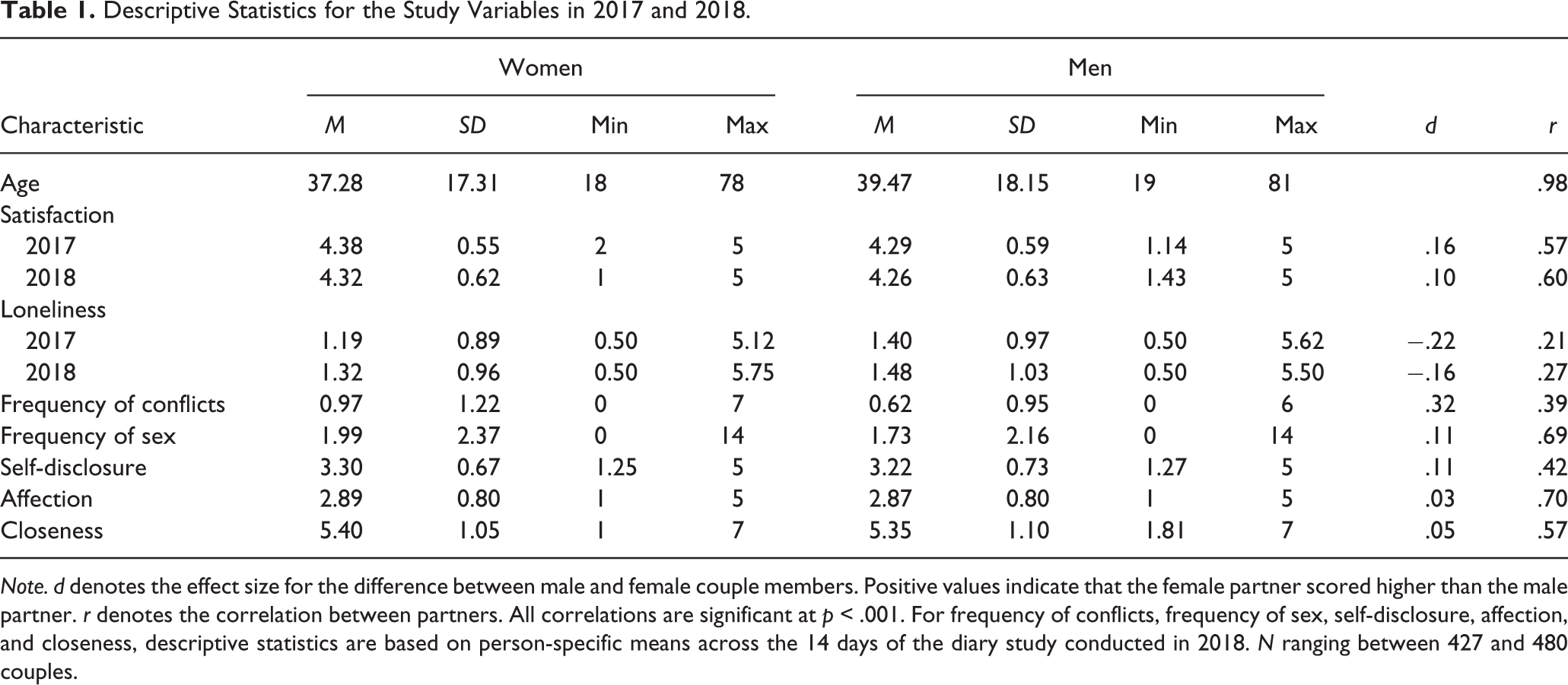
Note. d denotes the effect size for the difference between male and female couple members. Positive values indicate that the female partner scored higher than the male partner. r denotes the correlation between partners. All correlations are significant at p < .001. For frequency of conflicts, frequency of sex, self-disclosure, affection, and closeness, descriptive statistics are based on person-specific means across the 14 days of the diary study conducted in 2018. N ranging between 427 and 480 couples.
Loneliness and Relationship Satisfaction (APIM)
To replicate the findings from Mund and Johnson (in press), we first investigated whether loneliness measured in 2018 would be cross-sectionally associated with relationship satisfaction in 2018. The results of this unregistered analysis are displayed in the upper part of Table 2. In both the models without covariates and when controlling for attachment, relationship duration, and age, loneliness had statistically significant negative actor and partner effects on concurrent relationship satisfaction. This finding indicates that higher loneliness was associated with lower relationship satisfaction for oneself and the partner. The pattern was identical when we used loneliness measured in 2017 as a predictor of relationship satisfaction 1 year later (see Supplemental Table S4).
Concurrent Effects of Loneliness on Relationship Satisfaction, Conflict Frequency, and Sexual Contact Frequency (APIM).
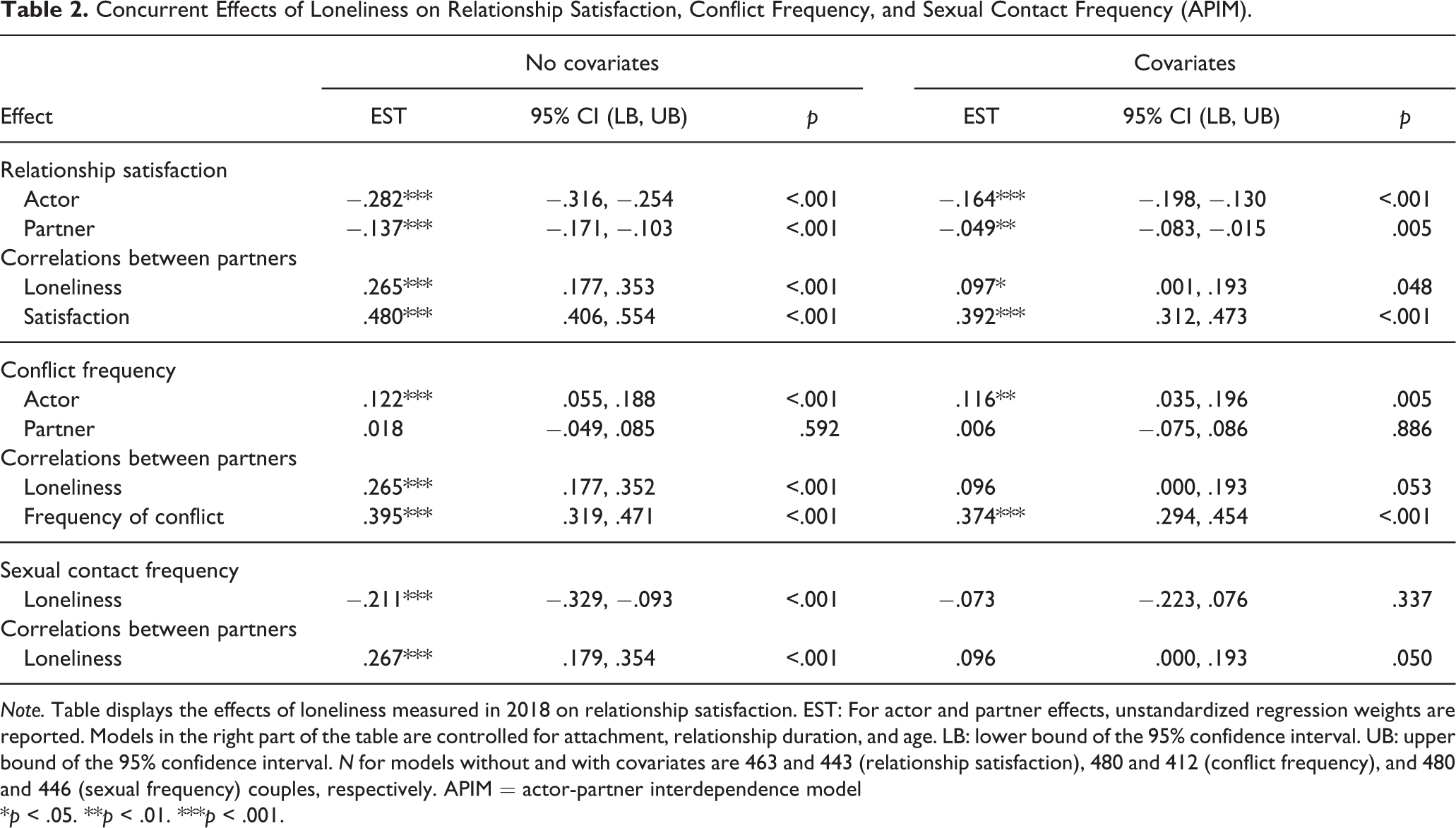
Note. Table displays the effects of loneliness measured in 2018 on relationship satisfaction. EST: For actor and partner effects, unstandardized regression weights are reported. Models in the right part of the table are controlled for attachment, relationship duration, and age. LB: lower bound of the 95% confidence interval. UB: upper bound of the 95% confidence interval. N for models without and with covariates are 463 and 443 (relationship satisfaction), 480 and 412 (conflict frequency), and 480 and 446 (sexual frequency) couples, respectively. APIM = actor-partner interdependence model
*p < .05. **p < .01. ***p < .001.
In a supplementary analysis, we examined whether relationship satisfaction would predict loneliness as well. Irrespective of whether we used satisfaction measured in 2017 or 2018, there were only actor effects (2017: B = −.470,
Loneliness and Relationship Events in Daily Life
For all APIM, the models with effects for women and men constrained to be equal did not fit worse than the unconstrained models (see Supplemental Table S1). Accordingly, we report the results of the more parsimonious models in the following paragraphs.
Loneliness and conflict frequency (APIM)
The results of the APIM predicting conflict frequency across the 14 days of the diary phase from loneliness are displayed in the middle section of Table 2. As can be seen in the left-hand side of Table 2, in the model without any covariates, loneliness had significant positive actor effects on reported conflict frequency, indicating that one’s own higher loneliness was associated with more self-reported conflicts. This actor effect remained stable when attachment, relationship duration, and age were entered as control variables (see right-hand part of Table 2). The results were virtually identical when using loneliness measured in 2017 as the predictor (see Supplemental Table S4).
Loneliness and sexual contact frequency (APIM)
As displayed in Table 1, the reports of sexual contact frequency were highly correlated between partners and suggest indistinguishability (
Loneliness and Relationship Dynamics in Daily Life
For all multilevel analyses, the models with effects for women and men constrained to be equal did not fit worse than the unconstrained models (see Supplemental Table S2). Accordingly, we report the results of the more parsimonious models in the following paragraphs.
Self-disclosure and closeness (MLM)
The results of the multilevel models on the interplay between self-disclosure and closeness are displayed in Table 3. Significant positive covariances emerged between self-disclosure and closeness for actors and partners. This finding indicates that days with higher-than-usual self-disclosure were accompanied by one’s own and partner’s higher-than-usual closeness (see Section I in Table 3). However, on average, higher-than-usual self-disclosure on specific days did not predict how close people felt to each other the next day. Likewise, people who felt closer to their partners than usual on specific days did not engage in more-than-usual self-disclosing on the next day (see Section II in Table 3).
Interplay Between Daily Self-Disclosure and Closeness and the Moderating Role of Loneliness (MLM).
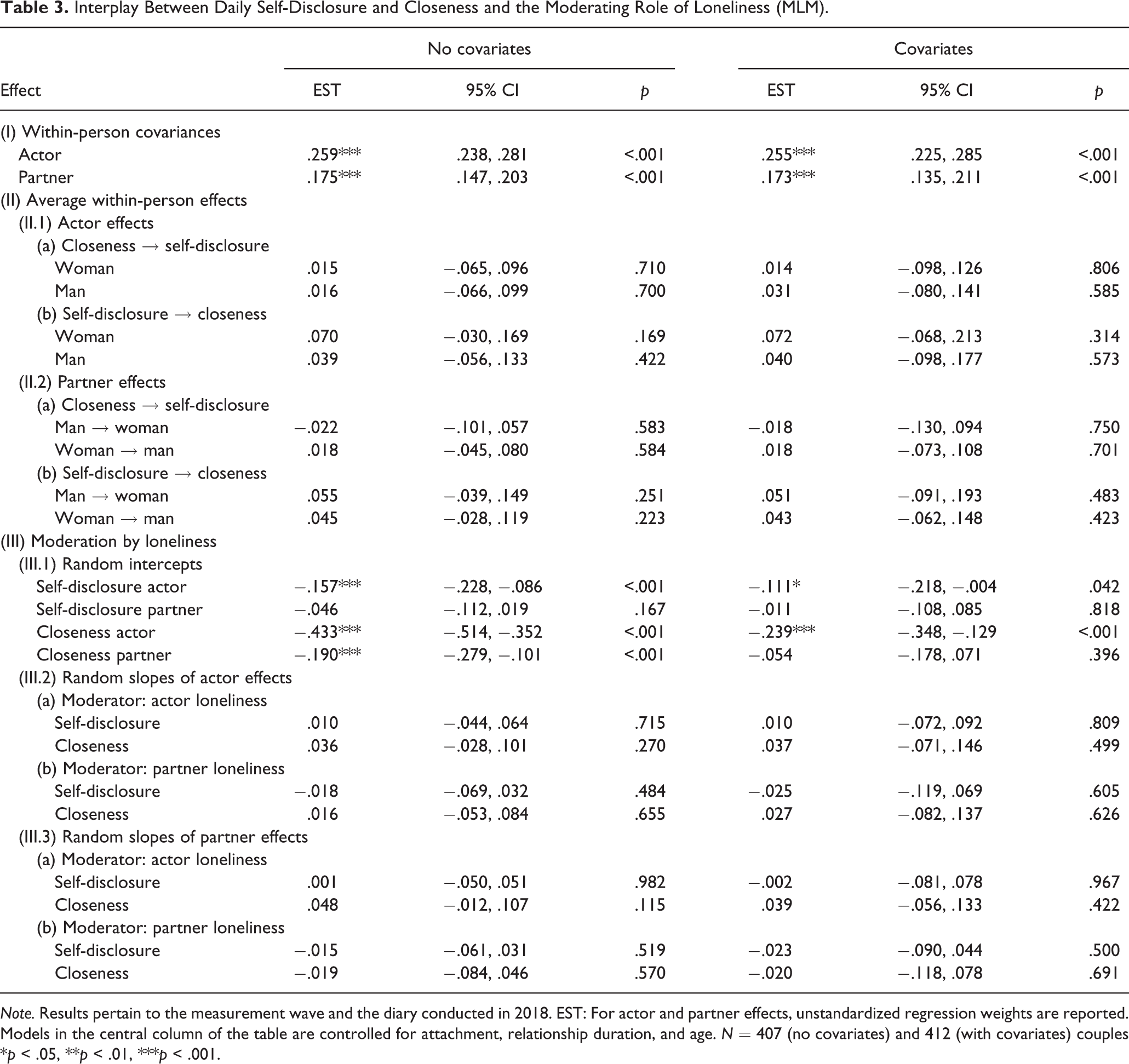
Note. Results pertain to the measurement wave and the diary conducted in 2018. EST: For actor and partner effects, unstandardized regression weights are reported. Models in the central column of the table are controlled for attachment, relationship duration, and age. N = 407 (no covariates) and 412 (with covariates) couples *p < .05, **p < .01, ***p < .001.
Regarding the average closeness and self-disclosure (i.e., random intercepts), higher loneliness predicted lower levels of one’s own self-disclosure and one’s own and the partner’s closeness (see Section III.1 in Table 3). Controlling for attachment, relationship duration, and age, only the negative associations between loneliness and actor’s self-disclosure and actor’s closeness remained statistically significant. Finally, loneliness did not moderate the daily dynamics between self-disclosure and closeness (see Subsections III.2 and III.3 in Table 3). The pattern of results was identical for all effects when using loneliness measured in 2017 (i.e., 1 year prior to the diary phase) as moderator (see Supplemental Table S6).
Physical affection and closeness (MLM)
The results of the multilevel models on the interplay between physical affection and closeness are displayed in Table 4. Significant positive covariances emerged between physical affection and closeness for actors and partners. This finding indicates that days with higher-than-usual physical affection were accompanied by one’s own and the partner’s higher-than-usual closeness (see Section I in Table 4). However, on average, higher-than-usual physical affection on specific days did not predict how close people felt to each other the next day. Likewise, people who felt closer to their partners than usual on specific days did not show more-than-usual physical affection on the next day (see Section II in Table 4).
Interplay Between Daily Physical Affection and Closeness and the Moderating Role of Loneliness (MLM).
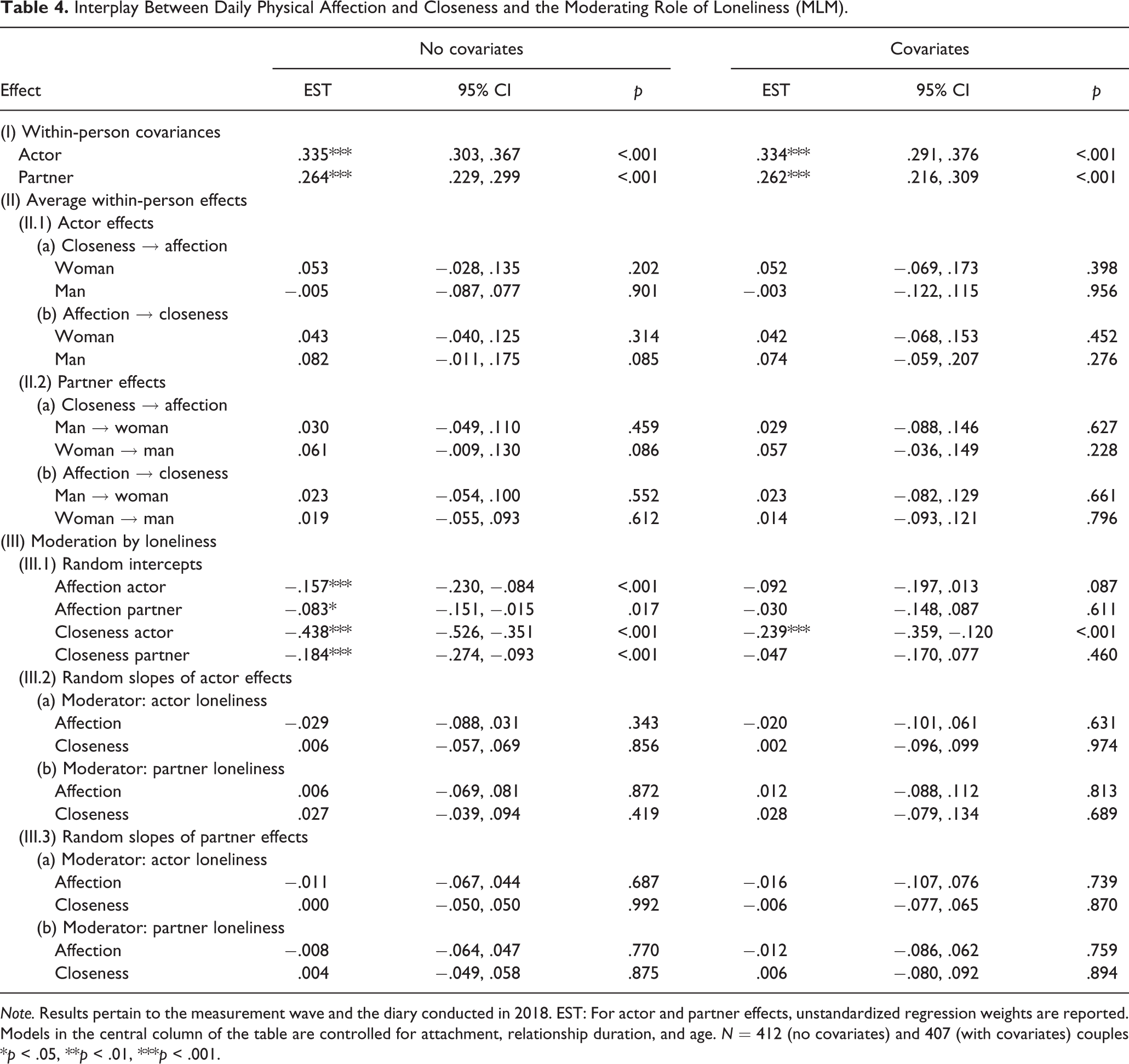
Note. Results pertain to the measurement wave and the diary conducted in 2018. EST: For actor and partner effects, unstandardized regression weights are reported. Models in the central column of the table are controlled for attachment, relationship duration, and age. N = 412 (no covariates) and 407 (with covariates) couples *p < .05, **p < .01, ***p < .001.
Regarding random intercepts, loneliness was associated with lower levels of one’s own and the partner’s physical affection and closeness (see Section III.1 in Table 4). After including attachment, relationship duration, and age as covariates, only the negative actor effect of loneliness on closeness remained statistically significant (see Sections III.1 in Table 4). Finally, loneliness did not significantly moderate the daily dynamics between physical affection and closeness (see Sections III.2 and III.3 in Table 4). The pattern of results was identical for all effects when using loneliness measured in 2017 (i.e., one year prior to the diary phase) as moderator (see Supplemental Table S8).
Discussion
Loneliness describes the perception of individuals’ social relationships as deficient regarding quantity and/or quality (Ernst & Cacioppo, 1999; Perlman & Peplau, 1981). Levels of loneliness have been found to be lower in married and partnered people than in singletons or widowed people (Dykstra & Fokkema, 2007; Luhmann & Hawkley, 2016; Stack, 1998; Tornstam, 1992). Yet, even among people in romantic partnerships, loneliness differs and is cross-sectionally associated with lower relationship satisfaction (Ayalon et al., 2013; de Jong Gierveld et al., 2009; Givertz et al., 2013; Hsieh & Hawkley, 2018; Knoke et al., 2010; Moorman, 2016; Stokes, 2017a) and longitudinally predicted by lower relationship satisfaction (Stokes, 2017b). Moreover, it has been found that loneliness itself has negative intra- and interpersonal effects on later levels and the development of relationship satisfaction over time (Mund & Johnson, in press). In the present study, we investigated whether loneliness would be associated with the occurrence of specific relationship-related events (i.e., conflict frequency, sexual contact frequency) and whether loneliness would moderate relationship dynamics in everyday life. Overall, the results of the present study draw a nuanced picture of the role of loneliness in partner relationships.
Loneliness and Relationship Satisfaction
In line with previous results (Mund & Johnson, in press), the current study also yielded negative actor as well as partner effects of loneliness on relationship satisfaction. Whereas a previous study (Mund & Johnson, in press) was confined to single-item measures of both loneliness and relationship satisfaction, we used widely accepted multi-item measures of both constructs in the present study. Given the criticism raised against single items in general (Diamantopoulos et al., 2012) and regarding loneliness in particular (Marangoni & Ickes, 1989; Russell, 1982), the convergence between the present study and the study by Mund and Johnson (in press) is important, as it indicates that results based on single-item measures do not necessarily lead to substantially different results.
Further, replicating previous findings (Stokes, 2017b), we found relationship satisfaction to have negative actor but no partner effects on loneliness. This finding indicates that one’s own, but not the partner’s loneliness is affected by prior levels of one’s relationship satisfaction.
Loneliness and Relationship Events
Loneliness and conflict frequency
The results of the present study suggest one’s own higher loneliness was associated with more self-reported conflicts across the 14 days of the diary study. It should be noted, though, that the average conflict frequency was low in the present study (less than one conflict across the 14 days), warranting some caution in interpreting the results.
Although not supporting our hypothesis, this finding is in line with theoretical conceptions of loneliness being associated with a hypersensitivity for signs of social threat (Cacioppo & Hawkley, 2009; Spithoven et al., 2017). Thus, it might be possible that individuals with high scores on loneliness more readily perceive a conflict in ambiguous situations or in situations where the interaction partner acts less affectionate than expected or desired. This interpretation is also supported by the moderate correlation of reported conflict frequency between partners: The conflicts perceived by individuals high in loneliness appear to be rather minor disagreements instead of heavy conflicts and might, thus, not be worth mentioning for the less lonely partners. The partners with high scores on loneliness, in contrast, might consider such disagreements important relationship events and feel threatened by them (Cacioppo & Hawkley, 2009; Spithoven et al., 2017). An alternative interpretation could be that individuals scoring high on loneliness spot evolving problems earlier in the process due to their higher threat sensitivity, whereas less lonely people might recognize these issues only when they have already accumulated.
The perception of the relationship as more conflict laden by lonelier individuals might also have consequences for the partner relationship. Specifically, individuals with higher loneliness might withdraw from the interaction and react in a more hostile way to protect themselves from being rejected and hurt (Cacioppo et al., 2014; for similar mechanisms, see McNulty, 2008; Murray et al., 2006). This process might also provide an explanation for the negative link between loneliness and both partners’ relationship satisfaction that was observed in the present and a previous study (Mund & Johnson, in press).
Loneliness and sexual contact frequency
Loneliness was negatively associated with sexual contact frequency, but this effect did not hold when controlling for attachment, relationship duration, and age; thus, there seems to be no unique effect of loneliness on sexual contact frequency, which is in line with our prespecified expectations. Furthermore, given the high correlation in self-reported sexual contact frequency between partners, we modeled this variable as a dyadic variable shared by both partners. In essence, such dyadic variables can be thought of as reflecting the shared perception of both partners and to provide a consensual view on the relationship (Galovan et al., 2017). As such, the results of the present study are in line with other research showing that loneliness is not associated with the occurrence of rather objective experiences (Hawkley et al., 2003; Queen et al., 2014; van Roekel et al., 2016). Together, these findings underscore the importance of intrapersonal cognitive, motivational, and affective processes associated with loneliness in shaping individual (mostly negative) perceptions of one’s social world (Cacioppo & Hawkley, 2009; Spithoven et al., 2017; see also Mund et al., 2016; Weidmann et al., 2016).
Loneliness and Dynamics in Daily Life
Overall, the results of the dyadic cross-lagged moderated multilevel models did not support our hypotheses. Whereas we found higher dispositional loneliness to be associated with lower average levels of closeness and self-disclosure in actors (but not partners), we did not find evidence for loneliness moderating the daily dynamics between closeness and self-disclosure. Furthermore, we only found within-day associations between closeness and self-disclosure indicating that higher-than-usual closeness at one day was associated with higher-than-usual self-disclosure on that day. However, there was, on average, no association between closeness (self-disclosure) at one day and self-disclosure (closeness) the day after. This finding might suggest that relationship experiences related to self-disclosure and closeness are rather short-lived in the present sample and do not carry over from one day to the next.
With regard to the interplay between physical affection and closeness, the pattern of results was very similar in that we found (a) within-day associations between closeness and physical affection but (b) no lagged effects, on average, of physical affection (closeness) on closeness (physical affection), and (c) no moderating effects of loneliness, except for average levels of actor’s closeness.
Limitations
Although the present study provided a nuanced view on the effects of loneliness in partner relationships, it is not without limitations. First, loneliness has not been assessed on a daily level. As a consequence, we used dispositional loneliness as a moderator of daily relationship experiences. However, it might be possible that relationship dynamics are altered at days when individuals feel particularly (less) lonely. Likewise, by assessing loneliness on a day-to-day level, it would have been possible to also investigate how momentary loneliness itself is affected by the daily interaction dynamics.
Second, particularly with regard to self-disclosure, we could not differentiate between specific facets (i.e., breadth and depth) or contents (personal vs. relational) of self-disclosure (for a review, see Greene et al., 2006). Although it might be possible that loneliness, for instance, affects the depth but not the breadth of self-disclosure (Cacioppo et al., 2017; Wei et al., 2005), it was not possible in the present study to examine such differential effects of loneliness.
Third, it might be that relationship dynamics as investigated in the present study change over the course of a relationship (e.g., changes in sexual contact frequency or changes in aspects of self-disclosure; Greene et al., 2006; Impett et al., 2014). Although we controlled for relationship duration in the present study, we could not investigate the stability and change of relationship dynamics and processes, as we were confined to one diary phase only. Thus, such issues remain subject to future research.
Fourth, the results of the present study are in line with previous findings on the effects of loneliness on relationship satisfaction (Mund & Johnson, in press). Furthermore, we could shed some light on possible mechanisms underlying the intrapersonal effects of loneliness on satisfaction (i.e., more self-reported conflicts, less closeness, less self-disclosure). However, none of these processes had interpersonal effects and, hence, did not affect the partner. As a consequence, it must remain subject to future research to investigate whether, and if so, through which pathways one’s own loneliness might influence the partner’s satisfaction.
Conclusion
In the present study, we investigated the role of loneliness for relationship experiences in partner relationships. It was found that loneliness is robustly associated with lower relationship satisfaction for both oneself and the partner and with a higher self-reported frequency of conflicts. Looking more closely at the moderating role of loneliness for daily dynamics within the relationship, we found no effects of loneliness on the interplay between closeness on the one hand and self-disclosure and physical affection on the other hand. However, loneliness was associated with lower average levels of closeness and self-disclosure.
Overall, the results of the present study suggest that loneliness affects the perception of a partner relationship rather than its more objective features (e.g., sexual contact frequency) or daily relationship dynamics. Thus, the results of the present study imply that loneliness is influential for partner relationships but needs to be considered more closely to advance the understanding of its intrapersonal and, in particular, its interpersonal features. In this way, it might be possible to deepen the knowledge on relational factors that serve to maintain loneliness over time.
Supplemental Material
Supplemental Material, lonelinessRelationshipExperiences_supplement - Loneliness is associated with the subjective evaluation of but not daily dynamics in partner relationships
Supplemental Material, lonelinessRelationshipExperiences_supplement for Loneliness is associated with the subjective evaluation of but not daily dynamics in partner relationships by Marcus Mund, Rebekka Weidmann, Cornelia Wrzus, Matthew D. Johnson, Janina Larissa Bühler, Robert Philip Burriss, Jenna Wünsche and Alexander Grob in International Journal of Behavioral Development
Footnotes
Authors’ note
We preregistered this study via the Open Science Framework at https://osf.io/92v5u. In addition, we provide syntax files for R and Mplus for all data analyses reported in this article at  .
.
Acknowledgment
The authors are grateful for the research assistance of Sabrina Brunner, Fabienne Fend, and Rahel Hütten.
Declaration of Conflicting Interests
The author(s) declared no potential conflicts of interest with respect to the research, authorship, and/or publication of this article.
Funding
The author(s) disclosed receipt of the following financial support for the research, authorship, and/or publication of this article: Preparation of this article was partly supported by German Research Foundation grant MU 4338/1-1 awarded to Marcus Mund. This study was funded by the Swiss National Science Foundation (SNSF 100019_162697).
Supplemental Material
Supplemental material for this article is available online.
References
Supplementary Material
Please find the following supplemental material available below.
For Open Access articles published under a Creative Commons License, all supplemental material carries the same license as the article it is associated with.
For non-Open Access articles published, all supplemental material carries a non-exclusive license, and permission requests for re-use of supplemental material or any part of supplemental material shall be sent directly to the copyright owner as specified in the copyright notice associated with the article.
