




Abstract
This study examined the sex-specific developmental trajectories of sharing behavior in the Dictator Game with an anonymous other, best friend, and disliked peer and associations with peer likeability and peer dislikeability in 1,108 children (50.5% boys) followed annually across grades 2–6 (ages 8–12) of elementary school. Results showed that sharing with an anonymous other and disliked peer remained stable over time. Sharing with a best friend decreased slightly between grades 2 and 5 and then remained stable. Girls consistently shared more with all recipients than boys. Moreover, children who were liked by classmates shared more with a best friend, while disliked children shared less with all recipients. Findings emphasize the importance of considering characteristics of both recipient and actor when studying the development of sharing behavior.
The elementary school period is an important period for children’s social development. During this period, children are expected to act less selfish and more prosocial (Berndt, 2002). Prosocial behavior is any voluntary behavior aimed to benefit others (Eisenberg et al., 2006). One type of prosocial behavior is sharing behavior. During sharing decisions, children have to choose how to divide a limited resource (e.g., toys, craft supply, candy) between themselves and a recipient (Dunfield, 2014). Sharing resources with peers may be essential for the formation and maintenance of positive and supportive peer interactions and social exchanges between peers (Berndt, 2002; Laursen & Hartup, 2002). Despite its importance in peer relationships, our knowledge on the development of sharing behavior and individual differences in sharing behavior in the elementary school period is still limited. Most studies on sharing behavior used a cross-sectional design limiting our ability to conclude on developmental processes (Kraemer et al., 2000). Furthermore, prior studies focused on either the characteristics of the recipients (e.g., Paulus & Moore, 2014) or on characteristics of the person who shares (i.e., the actor; e.g., Malti et al., 2012) and showed that both are associated with the development of sharing. This may imply that in order to understand the development of sharing behavior, both recipient and actor characteristics should be studied in concert. Here, we examined the development of sharing behavior with different recipients (i.e., friends, disliked peers, and anonymous others) across grades 2–6 of elementary school and assessed how individual differences in the peer likeability and dislikeability of the actor are linked to this development.
Development of Sharing Behavior
Prosocial behavior is a multidimensional construct including different behaviors, such as sharing, helping, and comforting (Dunfield, 2014). These different types of behavior serve to benefit the recipient in different ways (Dunfield, 2014). That is, whereas sharing may resolve unmet material needs, helping and comforting entails resolving unmet instrumental needs and unmet emotional needs, respectively. Thus, these different prosocial behaviors require the recognition of the needs and desires of others (Fehr et al., 2013; Gummerum et al., 2008; Güroğlu et al., 2009; Imuta et al., 2016; Warneken & Tomasello, 2007). Yet, compared to helping and comforting, sharing may also require a child to inhibit impulses to keep resources for themselves (Aguilar-Pardo et al., 2013; Paulus et al., 2014). Sharing may therefore be more challenging for a child than helping and comforting (Dunfield & Kuhlmeier, 2013).
Both perspective-taking abilities and behavioral control, as potential underlying factors of the development of sharing behavior, undergo rapid development during early childhood but still undergo refinement across childhood and adolescence (Best & Miller, 2010; Frith & Frith, 2003). However, our knowledge on the development of sharing behavior during the elementary school period is still limited. Prior cross-sectional studies on age-related changes in sharing behavior found that 8- or 9-year-old children shared more than 3- and 4-year-old children (Benenson et al., 2007; Fehr et al., 2008; Ongley & Malti, 2014), thus suggesting increased sharing behavior with age. Nevertheless, other cross-sectional studies showed that 8-year-old children shared similar to or more than youth aged 12 (Fehr et al., 2013; Gummerum et al., 2008; Güroğlu et al., 2009, 2014; Leman et al., 2009; Ongley & Malti, 2014). Limited longitudinal work suggests a nonlinear pattern. That is, one study showed an increase in sharing behavior from ages 6 to 9 (Malti et al., 2012). Another longitudinal study found this similar increase in sharing behavior from ages 6 to 9 but a decrease in sharing behavior from ages 9 to 12 (Malti, Ongley, et al., 2016). The observed increase may be due to improvements in perspective-taking and behavioral control necessary to share resources (Best & Miller, 2010; Frith & Frith, 2003), while the decrease was suggested to relate to increased awareness of ownership which may decrease a child’s willingness to share (Nancekivell et al., 2013). Importantly though, in the study of Malti, Ongley, et al. (2016), sharing was assessed by sharing stickers at ages 6 and 9 and sharing money at age 12, making it unclear whether the found decrease was a true developmental change in sharing behavior or due to method variance. Given the importance of sharing behavior in children’s social development in this period, it is important to gain insight into the development of sharing behavior in elementary school children.
Development of Sharing Behavior With Different Recipients
Children’s sharing behavior may not only depend on the child’s perspective-taking abilities and behavioral control but also on whom the recipient of that sharing behavior is. These differences may relate to relationship attributes and social motivations. That is, children may be more likely to share with friends as these interactions are more reciprocal, pleasurable, and rewarding compared to other relationships such as with anonymous others or with peers who are disliked (Braams et al., 2014; Güroğlu et al., 2008, 2014; Hartup, 1996; Paulus, 2016). As such, higher sharing behavior may be guided by expectations of receiving resources back from these peers in the future (Kenward et al., 2015; Laursen & Hartup, 2002). Alternatively, higher sharing behavior may also relate to gaining higher social influence or acceptance within a peer group (Hawley, 1999). In contrast, relationships with disliked recipients are characterized by higher conflict and more aggression (Abecassis et al., 2002; Card, 2007) and may therefore be less reciprocal in nature.
Despite these notions, the empirical evidence is still mixed with regard to what age children become selective with whom they share with and how such differences develop across the elementary school period. For instance, some prior cross-sectional studies showed that children from age 4 and onward share more with a friend, compared to a stranger or disliked classmate (Malti, Gummerum, et al., 2016; McGuigan et al., 2016; Paulus, 2014; Paulus et al., 2015; Paulus & Moore, 2014; Vaish et al., 2018). However, other studies showed that preschool children shared similar amounts of resources with friends and anonymous peers, and differences in sharing behavior with friends compared to anonymous peers emerged only at age 6 (Lu & Chang, 2016; Yu et al., 2016). In addition, 6-year-old children also shared more with an anonymous other than with a disliked peer (Moore, 2009; Paulus & Moore, 2014). Other cross-sectional studies do not support this differentiation during elementary school as they found that children aged 9–12 did not differentiate in the amount of resources shared with a friend, disliked, and anonymous recipient (Güroğlu et al., 2014), but adolescents from 12 years and older did (Güroğlu et al., 2014; van de Groep et al., 2019). Thus, results from previous cross-sectional studies were quite mixed on whether elementary school children share more with friends, compared to anonymous and disliked recipients, and how sharing behavior with friends, anonymous, and disliked peers develops during elementary school.
Characteristics of the Actor and Sharing Behavior
Although not exclusively, two characteristics of the actor may be of importance when studying the development of sharing behavior, namely the child’s sex and a child’s social preference among peers. Cross-sectional studies showed that girls are more generous than boys (Fabes & Eisenberg, 1998; Fehr et al., 2013; Gummerum et al., 2008; van de Groep et al., 2019). Several explanations for this sex difference have been proposed. Girls are suggested to demonstrate a higher social understanding of feelings and concerns for others compared to boys and thus may share more than boys (Fabes & Eisenberg, 1998; Porath, 2003). In addition, prosocial behaviors shown by girls are suggested to be more reinforced by parents and other adults such as teachers than prosocial behaviors are for boys (Hastings et al., 2007). Moreover, girls are suggested to demonstrate more connection-oriented behavior that fosters interpersonal relationship, while boys are suggested to endorse more status-oriented goals and behaviors that promote self-interests (Rose & Rudolph, 2006).
Sharing behavior may also differ as a function of a child’s likeability or dislikeability among peers, which can be assessed by asking peers to indicate children they like or dislike in the classroom (Cillessen & Bukowski, 2018). Prior studies showed links between children’s peer likeability and dislikeability among peers and their prosocial behavior (e.g., Crick, 1996; Gifford-Smith & Brownell, 2003; Torrente et al., 2014; Wentzel, 2014). For instance, children who are liked by their peers are often described as engaging in more positive social behaviors including more cooperative and helping behavior (Gifford-Smith & Brownell, 2003; Zimmer-Gembeck et al., 2005). Given the suggested multidimensional nature of prosocial behaviors (e.g., sharing, helping, and comforting; Dunfield, 2014), it is unclear whether previous findings on peer likeability and dislikeability and prosocial behavior can be translated to sharing behavior. One longitudinal study found that children who perceived themselves as being liked by others at age 6 shared more with an anonymous peer 1 year later (Malti et al., 2012). However, little is known about whether being liked in elementary school is also associated with sharing behavior with familiar peers such as friends and disliked peers.
In contrast to liked children, children who are disliked among peers have been suggested to demonstrate more negative social behaviors, such as aggressive behaviors (Prinstein et al., 2018). Moreover, disliked children have been found to perceive their peers as more hostile, untrustworthy, and unsupportive (Peets et al., 2008). The general tendency of disliked children to show more negative social behaviors and a hostile attitude toward peers may result in sharing less resources with peers.
Last, associations between peer likeability or dislikeability and sharing behavior may be moderated by sex. Findings from a few prior studies showed that the association between social preference and peer-nominated measures of prosocial behavior was stronger for girls than for boys (Kornbluh & Neal, 2014; Zimmer-Gembeck et al., 2005). Given the lack of prior empirical studies on sharing behavior, we explored potential sex moderation in the association between peer likeability or dislikeability and sharing behavior with anonymous others, friends, and disliked peers.
The Present Study
In this longitudinal study, 1,108 children attending elementary school were assessed annually on their sharing behavior with an undefined (anonymous) other, a best friend, and a disliked peer across grades 2–6 (ages 8–12). Sharing behavior was assessed by examining how children divide coins between themselves and the recipients. As such, we included children from age 8 and older, as from this age, children are suggested to be well capable of understanding the value and meaning of money, which may not yet be the case in younger children (Webley, 2005). Our first aim was to explore the development of sharing behavior with different recipients across these ages. We expected that children shared more with friends compared to anonymous others and shared the least with disliked peers (Güroğlu et al., 2014; Paulus & Moore, 2014) and that boys shared less than girls regardless of the recipients (Gummerum et al., 2008; van de Groep et al., 2019). We further hypothesized that sharing behavior with these recipients would increase from grades 2 to 6 due to the improvements in perspective-taking abilities and behavioral control during this period (Best & Miller, 2010; Frith & Frith, 2003).
Our second aim was to assess associations of children’s sex and children’s likeability and dislikeability among peers and their sharing behavior across grades 2–6 of elementary school. We hypothesized that children who were more liked among peers shared more with all recipients. In contrast, we expected that children who were more disliked among peers shared less with all recipients. Given the scarcity of studies on sex differences in the association between peer likeability, dislikeability, and sharing behavior, we did not formulate specific hypotheses on sex differences regarding these associations.
Method
Participants
Children from 70 classrooms in 13 elementary schools located in the eastern and central parts of the Netherlands participated in the study. The present study is part of an overarching longitudinal study focused on children’s behavioral, social–emotional, cognitive, and biopsychological development during elementary school (Behnsen et al., 2018; de Wilde et al., 2016; Tieskens et al., 2018). All study procedures were approved by the medical ethical committee of the Vrije Universiteit Amsterdam, The Netherlands (protocol number: NL37788.029.11). Parents were informed about the study and asked to provide informed consent for their child to participate in the assessments.
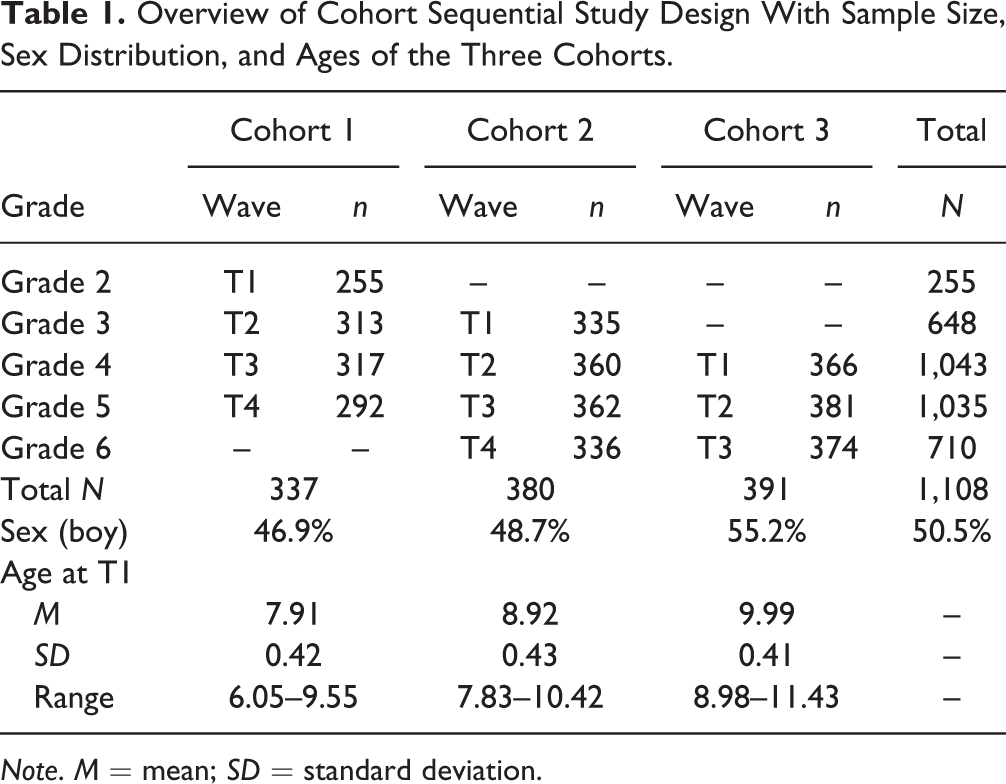
Data were collected on four annual assessments in the spring of 2015 (T1), 2016 (T2), 2017 (T3), and 2018 (T4). Three cohorts of children participated in this study (Table 1). The youngest cohort (cohort 1) was assessed across grade 2 through grade 5. The middle cohort (cohort 2) was assessed across grades 3 through 6. The oldest cohort (cohort 3) was assessed across grades 4 through 6. Mean intervals between the assessments were 12.26 months (SD = 1.56 months) from T1 to T2, 11.89 months (SD = 1.21) from T2 to T3, and 11.57 months (SD = 1.36) from T3 to T4.
Overview of Cohort Sequential Study Design With Sample Size, Sex Distribution, and Ages of the Three Cohorts.
Note. M = mean; SD = standard deviation.
Of the 1,228 children in the 3 cohorts, 120 children (38, 30, and 52 in cohorts 1, 2, and 3, respectively) had valid data at only one assessment across the studied period. This was due to technical problems, absence on the test day, change of school or classroom, or withdrawal of consent. Given our focus on examining the development of sharing behavior, we excluded the data of these children, leaving a total of 1,108 children included in the study (i.e., those with valid data on at least two assessments). Included children did not differ from excluded children at T1 with respect to sex distribution, χ2(1) = 0.34, p = .39, ϕ = .03, sharing with an anonymous peer, F(1, 1,039) = 0.43, p = .51, η2 = .01, sharing with a friend, F(1, 1,039) = 0.14, p = .71, η2 = .01, sharing with a disliked peer, F(1, 1,039) = 1.96, p = .16, η2 = .01, or peer likeability, F(1, 1,115) = 1.94, p = .16, η2 = .01. However, excluded children had somewhat higher levels of peer dislikeability than children included in the study, F(1, 1,115) = 6.19, p = .01, η2 = .01.
Descriptive statistics of the 1,108 children in our study sample and separately for each cohort are depicted in Table 1. Most children were from Dutch ethnical background (76.1%), which was similar to the broader Dutch population (78.8%, Statistics Netherlands, 2017). The remaining children were from a Turkish (2.7%), Moroccan (2.0%), Surinamese (1.1%), or other (14.1%) ethnical background, and of 4.0% of children, there was no information on their ethnical background.
Procedure
On each annual school visit, children participated in two 45-min assessment sessions: one in the morning and one in the afternoon. All questionnaires and tests were completed using a tablet computer (Apple iPad 2, Cupertino, CA, USA). In the morning session, children filled out the questionnaires, including peer nominations, in the classroom. Trained research assistants (master level or completed psychology education) were present in the classroom to provide verbal instructions and to assist children when needed. In the afternoon, children completed the Dictator Game to assess their sharing behavior as part of a larger test battery in another room outside the classroom. Children were supervised one-on-one by a trained research assistant. The duration of the Dictator Game was approximately 5 min and was administered halfway during the afternoon test battery.
Children received a small gift for participation at the end of each yearly school visit. All instructions, questionnaires, and tasks in the test battery were identical for all three cohorts and at each annual assessment.
Measures
Sharing behavior
The Dictator Game was used to assess sharing behavior (Kahneman et al., 1986). In the Dictator Game, children are asked to share resources between themselves and a recipient and has previously been used in studies examining sharing behavior in children from ages 4 and older (Benenson et al., 2007; Fehr et al., 2008). On the interface of a tablet computer, children were presented with the illustration of 10 coins. It was emphasized that children were free to choose how to divide the coins. Children could slide the coins they wanted to keep for themselves to the left side of the screen, under the header “me” and the coins for the other recipient to the right side of the screen. Children performed three rounds. In the first round, children had to share with an undefined recipient (header was “someone else”; henceforth referred to as anonymous other). No further specifications about the age and gender were provided. In the second round, children were prompted to think of someone they considered their best friend and were asked to share the coins with this friend (header was “best friend”). Last, children were prompted to think of someone they considered a peer they disliked and to share the coins with this peer (header was “someone you dislike”). The recipients were presented in the same order throughout the assessments. A manipulation check following the Dictator Game was conducted at T4. Children were asked to name the recipient of which the child was thinking during their allocation. This named classmate was then compared with the child’s nominations of friends and disliked peers on the peer nomination questionnaire. Results showed that 97% of the classmates who were named best friend in the Dictator Game were also nominated by the child as a friend. Similarly, 90% of the classmates who were named as disliked recipient were also nominated by this child as being a classmate he/she disliked. Importantly, the fact that some children did not nominate a classroom peer does not mean they were not thinking about a peer outside their classroom (e.g., other classrooms, sports club, neighborhood). We, therefore, decided not to control for or omit these children from our analysis.
The sharing behavior score of the child was based on the number of coins allocated to the recipient (ranging from 0 to 10), with higher scores indicating higher sharing behavior. No monetary reward based on the allocations during the Dictator Game was offered to the children nor the recipients at the end of the game (e.g., Burnett Heyes et al., 2015; Güroğlu et al., 2014; Overgaauw et al., 2014). The use of hypothetical allocations was driven by ethical (e.g., differences in rewards within classroom) and measurement considerations (i.e., changing of valuation of reward across years) as well as by evidence showing that hypothetical rewards also motivate behavior (Miyapuram et al., 2012).
Peer likeability and dislikeability
Children’s peer likeability and dislikeability were assessed using peer nominations (Cillessen & Bukowski, 2018). Children were asked to nominate an unlimited number of peers in their classroom grade they liked (Who do you like in your class?) and disliked (Who do you dislike in your class?). Children were presented with a list of all children in their class and were asked to nominate their classmates on each of these items. To correct for differences in classroom size, a normalized score for both likeability and dislikeability was calculated by dividing the number of nominations received on an item by the number of classmates who completed the peer nominations questionnaire minus one (i.e., children could not nominate themselves). The normalized likeability and dislikeability scores could, therefore, range between 0 and 1, with higher scores either indicating that a child is being more liked by classroom peers (likeability) or more disliked by classroom peers (dislikeability).
Children’s sex
Sex was dummy coded as 0 = boys and 1 = girls.
Socioeconomic status (SES)
SES was based on parent reports on their current or most recent job. Job descriptions were classified according to the Statistics Netherlands classification of occupation scheme (Statistics Netherlands, 2010), which is based on international classification schemes (International Labour Organization, 2012). The highest SES level of one of the two parents was used as SES of the child. Unemployment or having a lower elementary level job was defined as low SES (coded as 0), with the remaining SES levels coded as non-low SES (coded as 1).
Analytical Strategy
We used latent growth curve models (LGM) in Mplus version 8 for our analysis (Muthén & Muthén, 1998–2017). Model fit was determined using the comparative fit index (acceptable values >0.90; Bentler, 1990), the root mean square error of approximation (acceptable values <.08; Browne & Cudeck, 1992), and the standardized root mean square residual (acceptable values <.08; Bollen & Curran, 2006). Variance in sharing behavior on the school level was low (intraclass correlations ranged between .005 and .015) and is in accordance with other studies (e.g., Stormshak et al., 1999; Torrente et al., 2014; Wissink et al., 2013). Moreover, our research questions were related to individual-level differences. Therefore, we did not fit a multilevel model but adjusted standard errors of all estimates at the school level using a sandwich estimator (Williams, 2000). Sandwich estimators have been shown to be valid for individual-level questions (Huang, 2016). Satorra–Bentler χ2 difference test was used to compare the model fit of nested models (Satorra, 2000).
To test our first set of research questions on the development of sharing behavior with different recipients from grades 2 to 6, we fitted separate growth models for each recipient (i.e., anonymous other/best friend/disliked peer). In LGM, latent growth factors are estimated to capture the developmental trajectory of sharing behavior. The intercept refers to the level of sharing behavior at the centered point of the intercept. The slope (linear or quadratic) parameter refers to the change of sharing behavior over time. In this study, the intercept was centered at grade 4, which is in the middle of the covered study period. We modeled linear as well as quadratic slopes to test which model captured the developmental patterns of sharing behavior best. The maximum likelihood estimation with robust standard errors was used to account for the non-normal distribution of the data. Potential confounding effects of SES on the level of sharing as well as across-time changes were examined in the developmental models by estimating SES as a time-invariant predictor of the intercepts and slopes of sharing behavior.
Using multiple group models, we also assessed whether there were sex differences in the development of sharing. In addition, multiple group models were used to assess differences in the development of sharing between recipients. In these multiple group models, the growth factors were first constrained to be equal across groups (i.e., sex/recipients) and then estimated freely to see whether free estimations significantly improved the model fit. To ensure positive χ2 test statistics, Wald tests were used to compare the development of sharing behavior between different recipients (Satorra & Bentler, 2010).
Our research questions on the developmental associations between sharing behavior and peer likeability/dislikeability and potential sex differences in these associations were tested using dual process LGMs. That is, LGMs of peer likeability and dislikeability were added to the models of the development of sharing behavior in two separate models. We estimated the associations of the intercept of peer likeability/dislikeability with the intercept of sharing behavior and the association of the slope of peer likeability/ dislikeability with the slope of sharing behavior (see conceptual model in Figure 1). To test for sex differences in the association between sharing behavior and peer likeability/dislikeability, the association estimates of the intercept and slope of peer likeability/dislikeability with sharing behavior were constrained to be equal across sex and subsequently compared to a model in which these estimations were allowed to vary across sex.
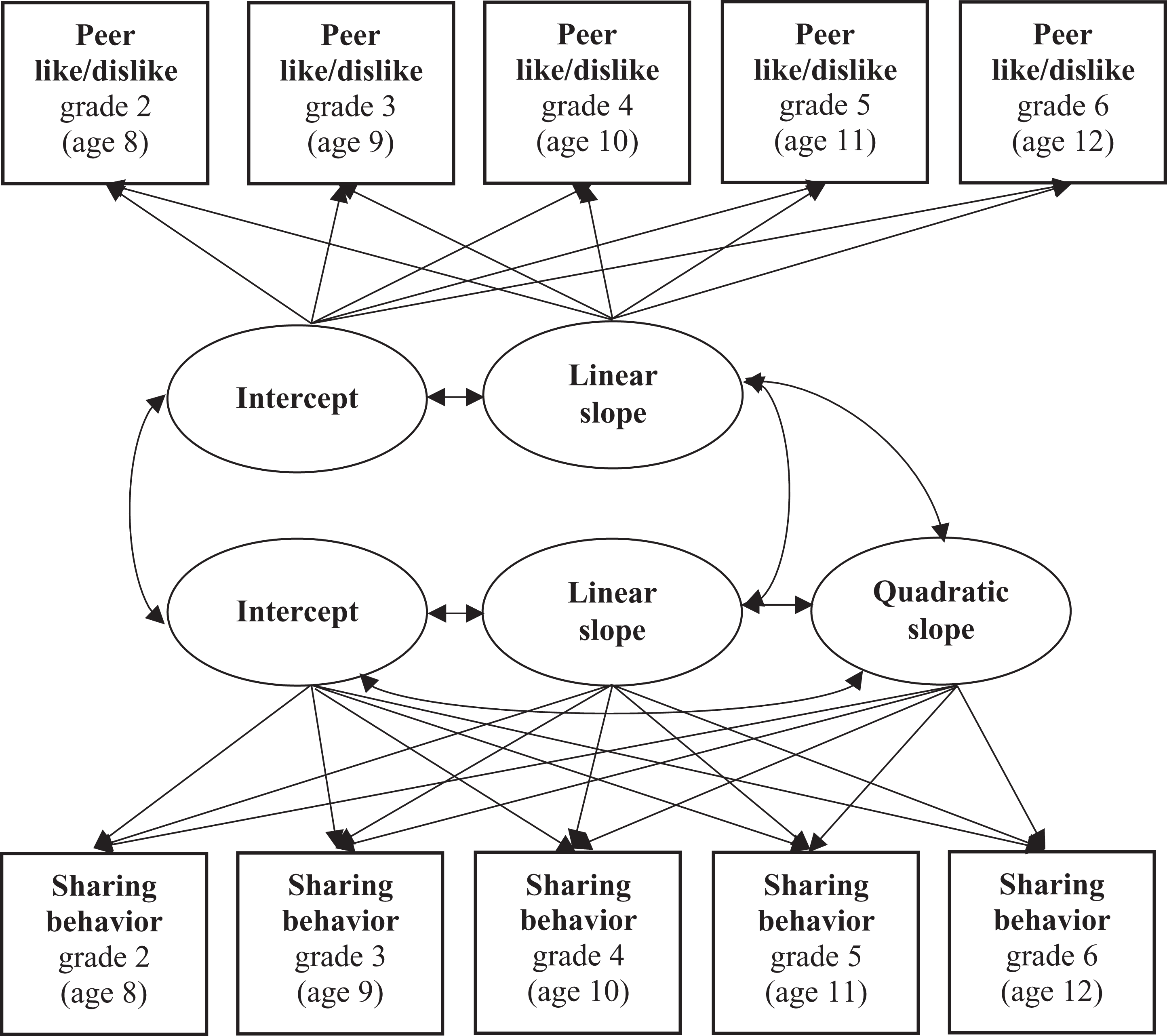
Graphical Representation of the Dual Latent Growth Model Testing the Association Between Peer Likeability and Dislikeability and Sharing Behavior Across Grades 2–6.
Results
Development of Sharing With Different Recipients and Sex Differences
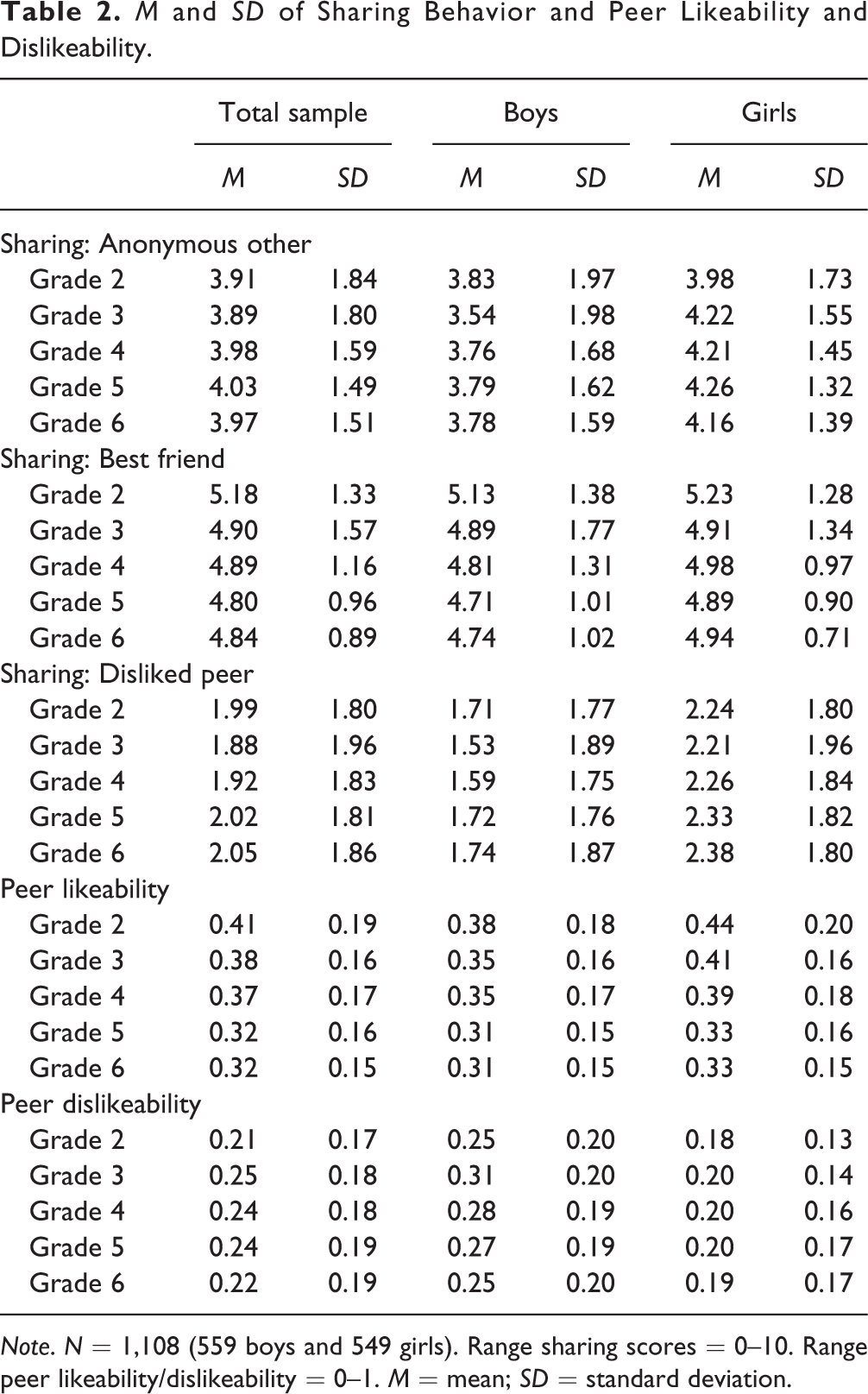
Descriptive statistics of the study variables are presented in Table 2. It shows that children share roughly 50% of their coins with friends, around 40% with anonymous recipients, and only 15–25% with disliked peers.
M and SD of Sharing Behavior and Peer Likeability and Dislikeability.
Note. N = 1,108 (559 boys and 549 girls). Range sharing scores = 0–10. Range peer likeability/dislikeability = 0–1. M = mean; SD = standard deviation.
To examine our research hypotheses on the potential sex-specific development of sharing with different recipients, we fitted three LGMs (Table 3). For the anonymous recipient, we found that an LGM with a linear slope best described the development of sharing behavior with an anonymous other (Table 3, Figure 2(a)). Moreover, both the intercept and slope showed significant variance (i.e., individual differences) in boys and girls (Table 3). The intercept, but not the slope of sharing behavior with an anonymous other, differed between boys and girls (intercept, Δχ2 = 45.52, Δdf = 1, p < .001; slope, Δχ2 = 0.24, Δdf = 1, p = .63). Moreover, the means of the linear growth terms were not significant (Table 3), suggesting that sharing behavior with anonymous others remained stable across ages 8–12 for boys and girls but that girls shared more than boys across the studied period.
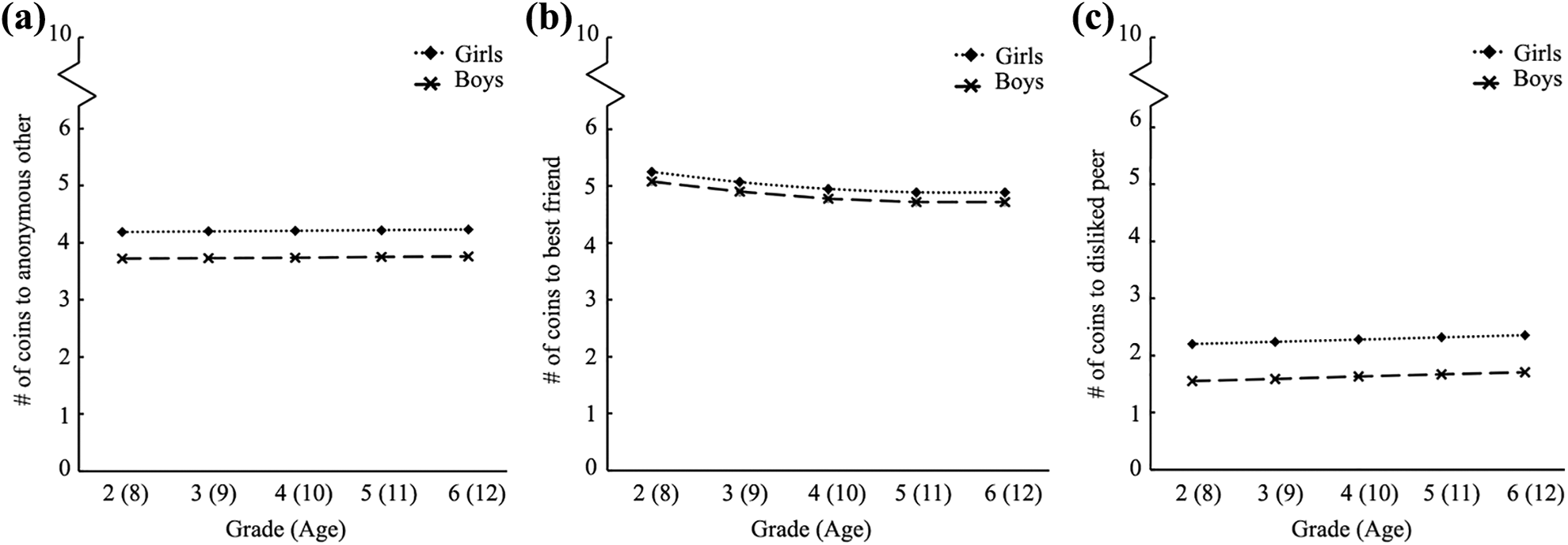
Estimated Developmental Trajectories of Sharing With (a) an Anonymous Other, (b) a Best Friend, and (c) a Disliked Peer for Boys (n = 559) and girls (n = 549).
Model Fit and Growth Parameter Estimates of LGM of Sharing Behavior for Boys and Girls.
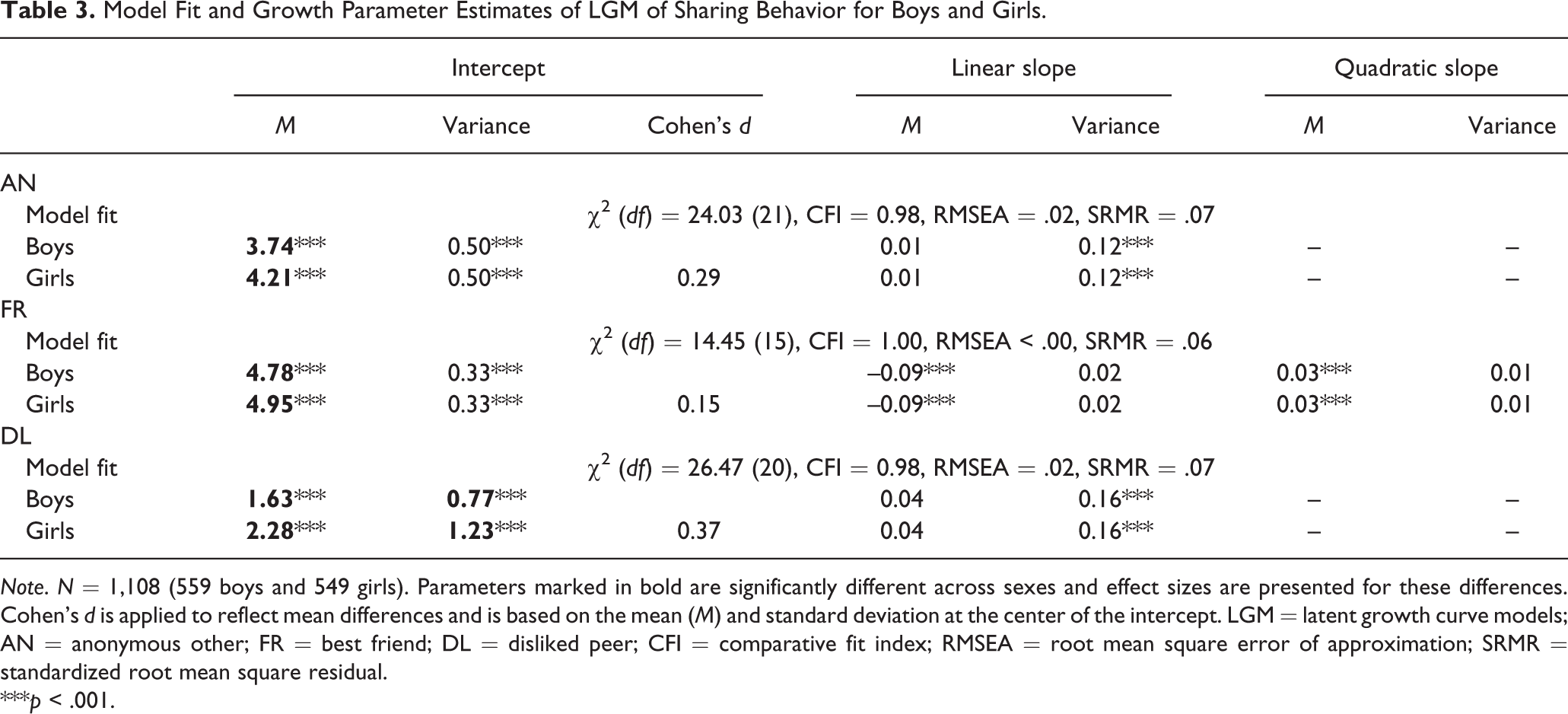
Note. N = 1,108 (559 boys and 549 girls). Parameters marked in bold are significantly different across sexes and effect sizes are presented for these differences. Cohen’s d is applied to reflect mean differences and is based on the mean (M) and standard deviation at the center of the intercept. LGM = latent growth curve models; AN = anonymous other; FR = best friend; DL = disliked peer; CFI = comparative fit index; RMSEA = root mean square error of approximation; SRMR = standardized root mean square residual.
***p < .001.
The LGM for sharing behavior with a best friend showed that adding the quadratic slope factor significantly improved model fit (Δχ2 = 10.20, Δdf = 4, p = .04). The intercept, but not the slopes, showed significant variance in boys and girls (Table 3). Again, girls had higher mean intercept scores than boys (Δχ2 = 13.25, Δdf = 1, p < .001). Results plotted in Figure 2(b) thus showed that the development of sharing behavior with a best friend declined from ages 8 to 10, to became stable thereafter to age 12, with girls sharing more with their best friend than boys.
Fitting a model with a linear slope term in LGM was sufficient to model the trajectory of sharing behavior with a disliked peer. Both the intercept and slope showed significant individual differences in boys and girls (Table 3). Again, girls had higher mean intercept estimates than boys (Δχ2 = 48.09, Δdf = 1, p < .001). The linear growth terms were not significant (Table 3), thereby suggesting that sharing behavior with a disliked peer was stable from ages 8 to 12, with again girls sharing more than boys (see Figure 2(c)).
Results of comparing the growth parameters of sharing behavior between recipients are presented in Table 4. Given that the slopes of sharing behavior with friends (i.e., quadratic) showed a different pattern from sharing with anonymous and disliked recipients (i.e., linear), only intercept differences could be assessed. Results showed that the levels of sharing differed between recipients. These significant differences were found for both boys and girls. Children shared more with a best friend than with an anonymous other and a disliked peer. Moreover, children also shared more with an anonymous other than with a disliked peer (i.e., best friend > anonymous other > disliked peer). Across recipients, we found no significant associations of children’s SES with the development of sharing behavior (Online Supplemental Table S1). Therefore, we did not include SES in our subsequent analyses.
Wald Test Results of Model Comparisons on the Intercept Means of Sharing With Different Recipients.
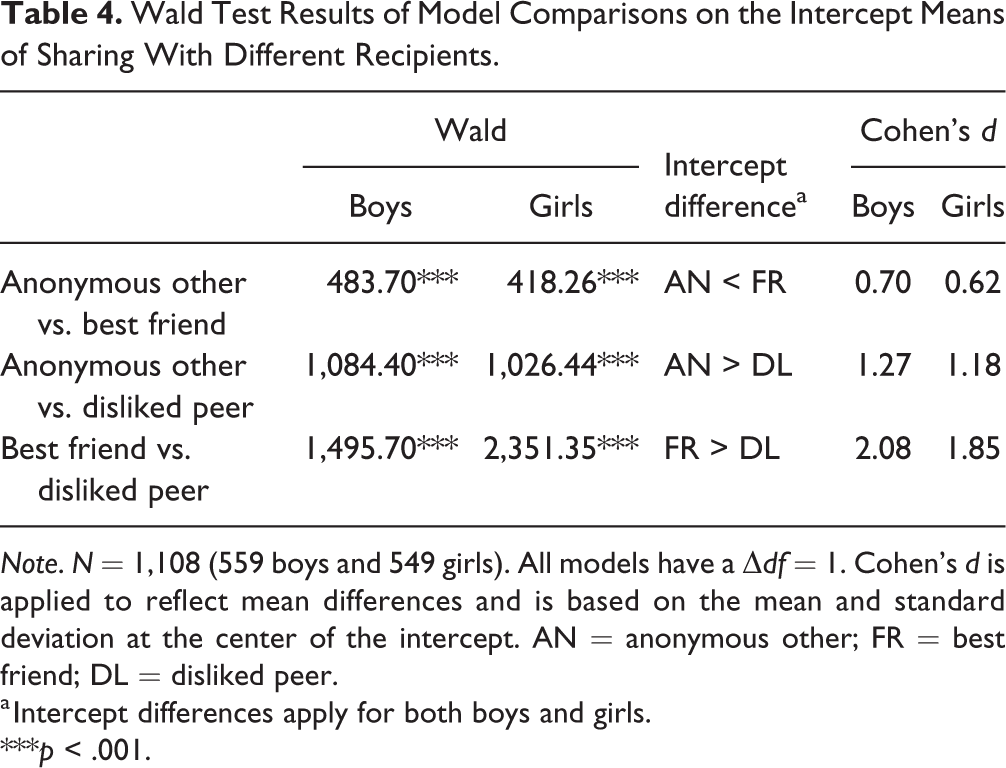
Note. N = 1,108 (559 boys and 549 girls). All models have a Δdf = 1. Cohen’s d is applied to reflect mean differences and is based on the mean and standard deviation at the center of the intercept. AN = anonymous other; FR = best friend; DL = disliked peer.
a Intercept differences apply for both boys and girls.
***p < .001.
Associations Between Peer Likeability and Dislikeability and Sharing Behavior
Model fit indices for the dual process LGMs of peer likeability and dislikeability and sharing behavior are reported in Table 5, and parameter estimates are reported in Table 6. Results showed that peer dislikeability was negatively associated with the intercept for all recipients. However, the association between the intercept of sharing with an anonymous other and the intercept of peer dislikeability was only significant for boys but not for girls (Δχ2 = 10.74, Δdf = 1, p < .001; Bboys = −.03, 95% confidence interval [CI] = [−.04, −.01], β = −.24, p < .001; Bgirls = −.002, 95% CI = [−.008, .005], β = −.15, p = .60). Furthermore, an additional significant negative association between the slope of sharing behavior with a disliked recipient and the slope of peer dislikeability was found. Results thus indicate that children who were more disliked shared less regardless of the recipient (with this association being specific for boys when sharing with an anonymous recipient) and that children who became more disliked by peers across grades 2–6 shared increasingly less with a disliked recipient.
Model Fit Indices for the Dual Process Latent Growth Models of Peer Likeability and Dislikeability and Sharing Behavior.
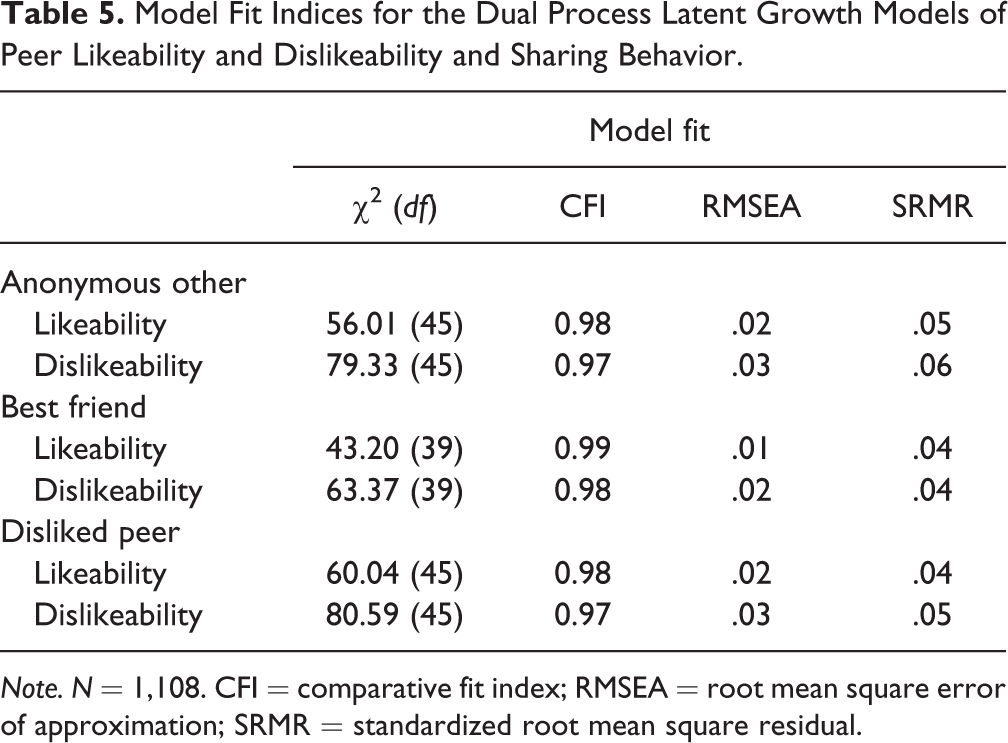
Note. N = 1,108. CFI = comparative fit index; RMSEA = root mean square error of approximation; SRMR = standardized root mean square residual.
Associations for Dual Process Latent Growth Models of Peer Likeability, Dislikeability, and Sharing Behavior.
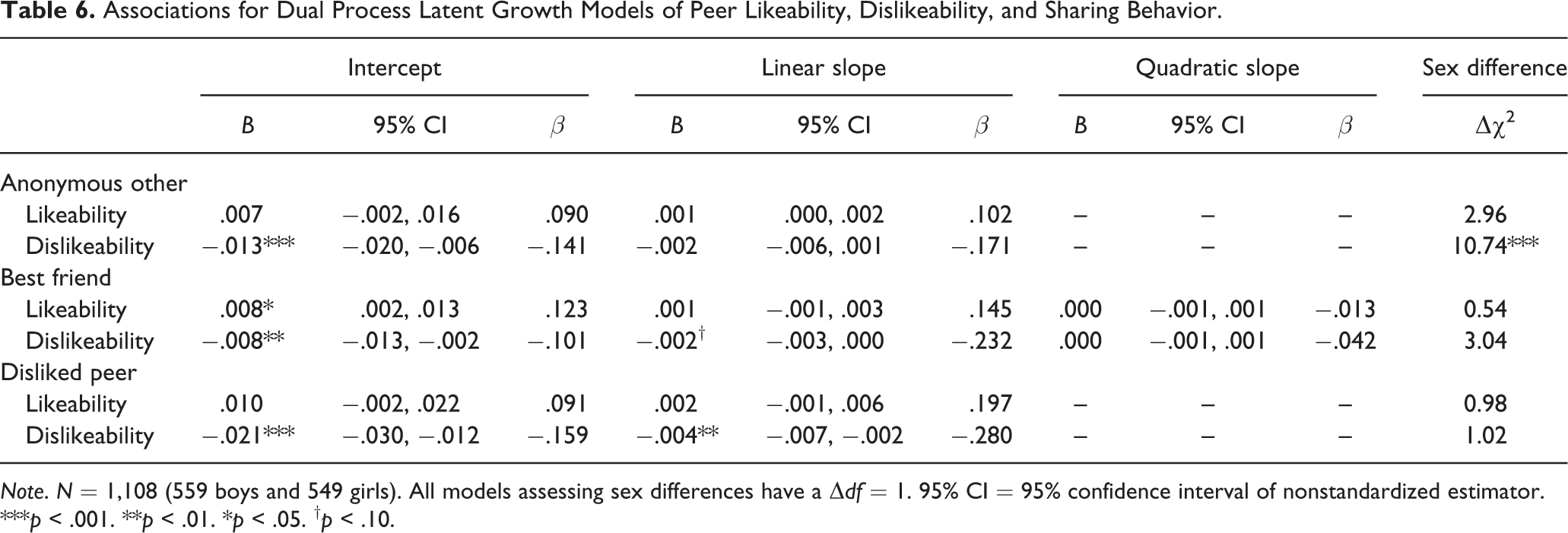
Note. N = 1,108 (559 boys and 549 girls). All models assessing sex differences have a Δdf = 1. 95% CI = 95% confidence interval of nonstandardized estimator.
***p < .001. **p < .01. *p < .05. †p < .10.
With respect to peer likeability, only one significant association was found. Specifically, the intercept of peer likeability was positively associated with the intercept of sharing behavior with a best friend. These results indicate that children who are more liked by their peers share more with their best friend but do not share more with anonymous and disliked recipients. No significant slope associations were found nor did we find sex differences in the associations between peer likeability and sharing behavior.
Discussion
Sharing behavior is an important part of children’s social development and plays a key role in children’s daily social interactions with their peers during elementary school. Results of this study show that children shared 40% of their coins with an anonymous recipient and 20% of their coins with a disliked peer, which was stable across ages 8–12. Children shared most of their coins with friends (50%), but sharing with a best friend decreased slightly from ages 8 to 10 and then became stable. Girls shared more than boys regardless of the recipient. Moreover, children who were liked among peers shared more with a best friend, but not with a disliked and anonymous peer. Children who were disliked by their peers shared less regardless of the recipient, with this association being specific for boys regarding an anonymous recipient. Last, children who became increasingly disliked by peers also shared increasingly less with children they dislike.
Our results on the stability of sharing behavior with disliked and anonymous recipients and quite stable levels of sharing with friends across ages 8–12 does not concur with prior longitudinal work that found that sharing behavior with an anonymous recipient first increased from ages 6 to 9 and decreased from ages 9 to 12 (Malti et al., 2012; Malti, Ongley, et al., 2016). However, Malti, Ongley, et al. (2016) introduced measurement variance by changing the resource from stickers to money from ages 9 to 12. Hence, it was unclear whether the decrease in sharing with an anonymous recipient reflected a true developmental change in sharing behavior from ages 9 to 12, or a difference in valuing the resources (i.e., stickers vs. money) that children were asked to share. Moreover, the current study assessed sharing behavior from age 8, while prior studies examined sharing behavior at age 6. Possibly, sharing behavior toward anonymous and disliked peers may increase during early childhood because of increases in perspective-taking abilities and behavioral control. By the age of 8, the level of skills required for sharing with these recipients may have reached the necessary level and further improvements in these skills do not change children’s level of sharing behavior. From this age, the development of sharing behavior may remain stable and only level differences may exist between children. Importantly, across ages 12–17, increases in prosocial behavior have been found (Padilla-Walker, Carlo et al., 2018), suggesting a nonlinear development across childhood and adolescence. These increases during adolescence may relate to the increased sensitivity to social acceptance often found among adolescents, which could be reflected in changes in sharing behavior toward different peers (Schriber & Guyer, 2016). Nevertheless, the current longitudinal study showed that sharing behavior toward anonymous others and disliked peers is stable across grades 2–6 of elementary school.
Sharing behavior with a best friend decreased over ages 8–12, although decreases were small. Previous studies suggested that besides fairness concerns, the understanding of social norms within friendships is important in the development of sharing behavior with friends (Berndt, 1981; Fehr et al., 2013; Güroğlu et al., 2009; Yu et al., 2016). Social norms within friendships may be subjected to developmental changes. That is, the social norm in younger children’s friendships may be to share equally in order to maintain the friendship, but when children grow older, friendships norms may be driven by other resources such as emotional support and intimacy (Laursen & Hartup, 2002). Other prosocial behaviors, such as comforting, may also become more important in adolescent friendships. Indeed, a previous longitudinal study assessed prosocial development toward friends using a questionnaire and found a small but steady increase from ages 12 to 17 (Padilla-Walker, Carlo, et al., 2018). However, even with the small decrease in sharing found in this study, levels of sharing with a friend remained at approximately 50%, thus still being equal.
Similar to other studies, we found level differences in sharing with different recipients (Güroğlu et al., 2014; Lu & Chang, 2016; Moore, 2009; Paulus & Moore, 2014; van de Groep et al., 2019; Yu et al., 2016). Our findings together with previous studies underscore that children use social contextual information during their sharing decisions (Güroğlu et al., 2009; van de Groep et al., 2019; Will et al., 2013). However, earlier studies were mixed regarding at what age differentiation in sharing behavior for different recipients emerged. Findings from this study suggest that already at age 8, children might consider their appreciation of the recipient in their decision to share, and these considerations may be quite stable across the later elementary school years.
In line with previous studies, we found that girls shared more with an anonymous other than boys across the studied period (Fehr et al., 2013; Gummerum et al., 2008; van de Groep et al., 2019). We extend these findings by showing that girls also shared more with a best friend and disliked peer compared to boys during the elementary school. Girls are suggested to demonstrate more connection-oriented behavior such as prosocial behavior, which may explain the stable levels of higher sharing behavior in girls compared to boys (Rose & Rudolph, 2006). Moreover, prosocial behavior shown by girls may be more reinforced by parents or teachers compared to prosocial behavior shown by boys, which may result in higher sharing behavior in girls than in boys (Hastings et al., 2007). Our results advance prior knowledge on sharing behavior of children by showing that sharing behavior is quite stable across the elementary school ages, including stable sex differences and stable differences in levels of sharing with different recipients.
Our second set of research questions addressed the developmental correlates between peer likeability and dislikeability and sharing behavior. Two findings stand out. First, peer dislikeability was associated with sharing behavior with all recipients, while peer likeability was only associated with sharing behavior with a best friend. This suggests that negative peer experiences may be more closely associated with sharing behavior than positive peer experiences (Baumeister et al., 2001). Second, associations were mostly similar across sexes. Our finding that sharing behavior differs as a function of peer (dis)likeability was in line with the previous study that found that social acceptance was related to increased sharing behavior with an anonymous recipient (Malti et al., 2012). However, we extend these findings by showing that such effects may exist for different recipients and may be more profound for peer dislikeability than for peer acceptance.
It has been theorized (Williams, 2009) and empirically supported that increasing prosocial behavior may help poorly appreciated children to improve their social position within a peer group (He et al., 2018). Our results regarding peer dislikeability suggest that disliked children do not engage in such behavior. Rather, disliked children shared less with all recipients, and most profoundly children who became more disliked over time also shared less with disliked peers over time. This developmental association may reflect a vindictive cycle. That is, children who become more disliked over time may share less to dissociate themselves from disliked recipients and start to treat these peers as members from a different social group (Fehr et al., 2008; Telzer et al., 2015; Yu et al., 2016). Moreover, decreasing sharing behavior toward disliked recipients may be indicative of a coercive strategy of the (disliked) child to improve their social status, which conforms the resource control theory (Hawley et al., 2002). Importantly, peer dislikeability was also associated with less sharing with friends or (anonymous) others. However, sharing more with others could result in friendships and sharing more with friends may result in developing more stable, positive, and stronger friendships (Berndt, 2002; Laursen & Hartup, 2002). These friendships may be important for disliked children to alleviate the stress that these children may experience as friends have been found to buffer against the consequences of negative peer treatment possibly by providing protection and security (Hodges et al., 1999). Results of this study thus suggest that disliked children may not use opportunities to improve their social position, by reaching out to develop or strengthen social bonds and friendships. Rather, they seem to engage in vindictive behavior with peers they already dislike. This may be in line with previous findings that disliked children perceive their peers as hostile and untrustworthy (Peets et al., 2008) and that they no longer expect that their sharing decisions have future benefits (e.g., improved social acceptance) or are reciprocated by peers. This, together with the actual lower sharing choices, may contribute to their poor social position, which may lead to the development of internalizing and externalizing psychopathology (Padilla-Walker, Memmott-Elison et al., 2018; Parker et al., 2006).
This study has several limitations. First, although our sample was representative of the Dutch population, participants were primarily Caucasian children attending mainstream elementary schools. The lack of variety in non-Caucasian children did not allow to test effects of ethnicity. More research is necessary to determine the generalizability of our findings to different cultural or ethnical contexts. For example, a prior study showed that unlike Western children, Ugandan children are not influenced by recipient type on the Dictator Game (Scharpf et al., 2017). Moreover, a longitudinal study in adolescents showed that the slope of sharing behavior with anonymous others and friends across ages 12–20 was associated with ethnicity (European Americans vs. non-European Americans) (Padilla-Walker, Carlo, et al., 2018). Second, we did not provide information on the age and gender of the anonymous peer as was done in several prior studies (e.g., Gummerum et al., 2008; Güroğlu et al., 2014; Malti et al., 2012). Prior studies showed that children act differently when interacting with children from the same sex (Fabes et al., 2003) and share more with children from the same sex compared to the other sex (Eisenberg-Berg & Hand, 1979). Nevertheless, level differences between the recipients (most to friends, less to anonymous peers, and the least to disliked peers) concur with several prior studies (Güroğlu et al., 2014; Padilla-Walker, Carlo, et al., 2018; van de Groep et al., 2019), suggesting that this absence of information did not significantly affect sharing behavior. Third, children did not receive a (monetary) reward based on their individual allocations of coins. This was due to ethical (e.g., children receiving higher rewards than other classmates) and practical considerations due to the longitudinal classroom-based nature of this study (i.e., changing of valuation of reward across years). However, levels of sharing in the present study were similar to sharing levels of the cross-sectional study by Gummerum et al. (2008) who did have a monetary reward. Moreover, sharing that is not directly linked to obtaining the resource may be related to behavior demonstrated by children in daily interactions with classroom peers. That is, in school, children need to share goods such as toys or crayons that are owned by the school and therefore cannot be kept after use. Last, the associations between peer likeability, dislikeability, and sharing behavior are correlational and no direction of effects was studied, nor implied.
Findings of this study imply that in order to understand sharing behavior, and the role sharing behavior may have in the social–behavioral development of children, measures should be specific about the recipient of the sharing behavior. This is further amplified by the fact that peer likeability was only associated with one recipient while already at age 8 (grade 2 of elementary school) children who are disliked by their peers shared less across recipients. Our findings may encourage teachers, school mental health workers, and clinicians to gain insight into the factors underlying these disliked children’s lower sharing decisions. In addition, they should encourage these children to make different sharing decisions as this may be a tool to improve their social position in the classroom. Given the importance of positive peer relationships during elementary school, improving the social position of disliked children may potentially protect these children from negative developmental outcomes.
Supplemental Material
JBD911094_supplemental_material - Classroom peer preferences and the development of sharing behavior with friends and others
JBD911094_supplemental_material for Classroom peer preferences and the development of sharing behavior with friends and others by J. Susanne Asscheman, Jin He, Susanne Koot, J. Marieke Buil, Lydia Krabbendam and Pol A. C. van Lier in International Journal of Behavioral Development
Footnotes
Author Contributions
J. Susanne Asscheman and Jin He both contributed equally to this work.
Funding
The author(s) disclosed receipt of the following financial support for the research, authorship, and/or publication of this article: This study was supported by the European Research Council (ERC) under the European Union’s Horizon 2020 research and innovation program [grant numbers 646594, 648082]; the Netherlands Organization for Scientific Research, program medium sized investments [grant number 480-13-006]; and the ZonMW subsidy: Netherlands Organization for Health Research and Development, program Youth [grant number 157004001].

Supplemental Material
Supplemental material for this article is available online.
References
Supplementary Material
Please find the following supplemental material available below.
For Open Access articles published under a Creative Commons License, all supplemental material carries the same license as the article it is associated with.
For non-Open Access articles published, all supplemental material carries a non-exclusive license, and permission requests for re-use of supplemental material or any part of supplemental material shall be sent directly to the copyright owner as specified in the copyright notice associated with the article.
